



Abstract
This article presents different vignettes on the life of matter and machines among the Yagua people in northwestern Amazonia. Based on an extended period of ethnographic fieldwork, it highlights the potential ubiquity, plurality and complexity of life-forces in matter and machines among the Yagua people. It shows how Yaguan materialisms differ from existing materialisms in anthropology, archaeology and the wider social sciences. The article advocates for an ontologically open attitude towards the life of matter, which is rooted in the belief that we can never be certain about the underlying fabric of our world.
Introduction
Rocio Pano Cahuamari, a young Yaguan woman from the Orosa River in Peru, once told me how her brother had tragically died because of his father using a boat motor. Only a month and 15 days old, her brother ‘began to cry, to cry, and he got really black, and his blood left everywhere, through his nose, through his eyes, through his ears, through all his nails,’ Rocio shared with me. ‘He died, my little brother.’ The father had only touched the boat motor, but the tension of the motor had still gone into the baby's little body, led to severe bleedings and resulted in an untimely death.
I was intrigued by this story, as tragic as it was. How can a boat motor kill a baby without even being close to it? How can its tension transfer to a human body and lead to nosebleed? And how can my research participants know that the boat motor had killed the baby? The longer I lived among the Yagua, however, and the longer I studied the dangers of machines and other beings, the more I understood that the given explanations for the baby boy's death made complete sense within Yaguan ontologies. Among the Yagua, it is widely known that machines can harm newborn babies, even after a mere touch from their parents.
Later in my fieldwork, I learnt that fuel-based grasscutters can make newborn babies cry and that televisions can give babies nightmares and insomnia when their parents use them. I further learnt that there was a decent amount of evidence to corroborate these claims. When a fuel-based grasscutter had harmed the baby and the baby and the grasscutter's metal pole were washed in the same water, the baby would be healed. And when a television had harmed the baby, shamans would see two small television antennae growing out of the baby's head and be able to cure the harm with tobacco smoke.
As I continued my research, I noticed that the different materialist theories of my Yaguan research participants were in strong contrast not only to my own beliefs but also to the gamut of materialist theories that are currently en vogue in anthropology, philosophy and the wider social sciences. Among the Yagua people in northwestern Amazonia, some machines are alive, and some are not. Furthermore, they carry a plural -s. As a consequence, even non-reductive monist theories of ‘vibrant matter’ (Bennett, 2010) or ‘intra-activity’ (Barad, 2007) sit ill at ease with Yaguan materialisms, and so do dualist theories predicated on a clear-cut distinction between the living and the non-living. What my extended ethnographic fieldwork highlighted was that matter and life are potentially ubiquitous, plural and complex phenomena.
For anthropologists of the Amazon region, some of my findings will be unsurprising. It is already well-established that boundaries between artefacts, animals, plants, human beings, deities and stars are not fixed in Amazonia (Santos-Granero, 2009a). In Amazonian myths, we thus encounter many an artefact that transforms into an animal (and vice versa), and in everyday life, we find many an artefact that is ensouled by its creator or user or that may transfer its characteristics onto human bodies (e.g. Erikson, 2009; Santos-Granero, 2009a, 2009b; Walker, 2009, 2012a). And yet the extension of animacy to modern technical artefacts is only rarely documented in the region (notable exceptions are Penfield, 2023; Walker, 2012a), and my article thus provides valuable ethnographic data on the conjunction of animism and modernism, which can be used to inform ongoing debates on the anthropology of life (see also Pitrou, 2014, 2015; Rival, 2012a, 2012b).
After a brief sketch of the fieldwork context, the main part of this article will present my empirical findings on the life-forces of machines among the Yagua people. It consists of five sections: The first two sections illuminate the life of machines from mythological and linguistic perspectives, respectively. The third section fleshes out the ethnographic vignettes from my opening, describing in further detail the dangers of machines during the couvade period. The fourth section discusses the relationship of j
Research context
There are currently between 4000 and 11,000 Yagua people in Peru and Colombia (own calculations based on DANE, 2022, and INEI, 2018). Most of them live in communities along tributaries of the Amazon River, such as the rivers Napo, Orosa, Atacuari, Yavari and Putumayo, as shown in the map (Figure 1). My article draws on more than a year of ethnographic fieldwork in two Yaguan communities (one on the Orosa River and the other one on the Atacuari River), in which I carried out interviews and focus group discussions; collected stories, photographs and songs; and followed the everyday life of my research participants.
Thanks to Jean-Pierre Chaumeil (1981, 1983, 1985, 1994, 2024), there exist comprehensive anthropological treatments of Yaguan cosmology, shamanry, history and everyday life, which prove invaluable for the present discussion. In his work, Chaumeil already highlights the central importance of j
Animated matter among the Yagua people
Mythologies of things
The Yaguan mythic past is populated by persons of all kinds, and the boundaries between the living and the non-living are frequently blurred. In my point of view, this provides an indication of life's possibilities. A story told to me by Miguel Panaijo Saboya, an exceptionally gifted storyteller from El Sol (Atacuari River), may serve as illustration.
The story tells of a young man in search of his two older brothers. One late afternoon, Sisuro, as the man was called, reaches a farm. Unable to continue his journey the same day, he decides to stay and promises the landlady to protect the banana plantation for her. Around midnight, a white horse descends from the sky to steal the bananas, but the man captures it. The horse kicks and wails and pleads, but Sisuro agrees to set it free only when it offers a wish-fulfilling metal rod to him and explains how it works: ‘Say: “Metal, metal, I need good food” and that moment there's going to appear good food’ (Miguel Panaijo Saboya, 2023, personal communication). The white horse enters the story as a deus ex machina and provides Sisuro with a machina ex deo that later helps him survive his brothers’ attempts to murder him. The brothers cut him in half, but the metal mends him; they tie him to a tree, but the metal sets him free; finally, they throw him down an abyss, three hundred metres deep, and Sisuro loses the metal from his pocket. He calls: ‘Metal, metal, help me up!, and indeed, the metal comes up with a solution: The metal was thinking at the top: ‘How are we going to make it?’ [Towards Sisuro:] ‘Look what you’re going to do. I’m going to try sticking out my tongue. Maybe it can reach there. If my tongue protrudes three hundred metres, that's how I’m going to get you up.’ (Miguel Panaijo Saboya 2023, personal communication)
Grammatical animacy
According to the linguist Doris Payne (1985), the Yaguan language distinguishes between animate and inanimate entities. Clitics for subject reference differentiate for instance between ra for an inanimate subject and sa for the third-person animate subject in the singular. To give an example, sa-yanuma carroj
It should be noted at this point that grammatical animacy is an etic concept. In theory, grammatical animacy does not need to indicate ‘life’ but could also refer to an entity's agency, sentience or volition. In the Yaguan case, however, a research informant once explained that the grammatical classifier changes with death, indicating that Payne's interpretation holds. Classifying the given grammatical feature as marker of animacy, Payne (1985: 182) highlights that animate entities in the Yaguan language do not fully map onto animate entities as conventionally understood in naturalist ontologies (sensu Descola, 2013). While grammatically animate beings include humans and animals and exclude things such as hammocks and houses, there are several anomalous cases. Payne notes, in particular, ‘such things as stars, the moon (and months), motors, mirrors, photographs, brooms, fans, manioc beer strainers, rocks, pineapples, and watering holes,’ all of which she found to be grammatically animate.
Payne (1985) advances two hypotheses to explain these anomalies. The first one is that grammatical animacy might derive from the entities’ association with animate beings. Mirrors and photographs are, for instance, generally used to reflect people rather than objects, and the moon and at least one star are mythologically linked to human beings. As a second hypothesis, their animacy could be explained by their connection to movement. The sun and the moon as well as motors seem to move of their own accord, and the use of brooms, fans and manioc beer strainers is linked to rhythmic movements. In the case of rocks, pineapples and watering holes, Payne (1985) merely remarks that ‘their animate status appears to be idiosyncratic,’ possibly derived from past beliefs (p. 183).
While I was unable to corroborate Payne's linguistic data, 1 I wish to suggest as a third hypothesis that the observed animacy goes beyond a mere association with living beings or movements. When reading through the list, it immediately struck me, for instance, that several of the items (namely, motors, rocks and pineapples) are able to cutipate and thus demonstrate strong life-forces. It is then likely that Payne's research informants considered fans and pineapples to be as alive as animals, plants and human beings, and the same holds true for motors.
The danger of living machines
The life of entities brings danger. After birth, Yaguan parents typically follow a series of dietary and behavioural restrictions in order to protect their newborn babies against what is regionally referred to as cutipa (see Regan, 2010: 98–99, 452, for a discussion of the term's etymology), a term which I render as ‘cutipation’ in English. Cutipa denotes the harmful contact with another being or the harmful transfer of its physical characteristics, which may happen upon the insult, kill or touch of that being. The Yagua possess detailed empirical knowledge on the phenomenon, with archival and linguistic evidence indicating that they have known about cutipation for at least a century (cf. Sierra de la Calle, 1993: 18).
The cutipator is typically a nonhuman being such as a boa, a jaguar, a ficus tree or, as we have already seen in the introduction, a boat's motor. Symptoms of cutipation include insomnia, headache, gauntness or abnormal body tension, depending on the cutipating being (see also Chaumeil, 1987: 104–105, for an exemplary list of cutipators and symptoms). Once a symptom appears, parents need to correctly identify the cutipator and then cure the baby by burning or bathing parts of the cutipator (e.g. its fur) in the vicinity of the baby, or else a shaman needs to be involved.
The anthropological literature rarely focuses on cutipation as such, analysing instead its human flipside, that is, the couvade restrictions that prevent cutipation harm. In anthropology, the term ‘couvade’ encompasses a wide range of customs that involve the father's participation in the ‘hatching’ of an infant. The couvade is variously interpreted as an institution to legitimise fatherhood (e.g. Rival, 1998a), as a form of spiritual birth (e.g. Rivière, 1974; Vilaça, 2002) or as a way to build and foster social relations (e.g., Rival, 1998a; Walker, 2012b). In only a few cases (e.g. Tylor, 1865) is the couvade taken as a measure to protect the child, even though such an interpretation leads to the interesting ontological question of how and why nonhuman beings cutipate.
Among the Yagua, knowledge on cutipation is extensive. It generally encompasses heterogeneous information on cutipators, symptoms, cures, and the age and constitution of the victim. We have already encountered the tragic case of Rocio's brother, who had been cutipated by a boat's motor and died when he was just a month and 15 days old. His symptoms make sense within the Yaguan animist–analogist framework. A boat's motor is known for its energetic tension, which needs to be controlled by the helmsman, and this tension can be transferred to newborn babies and then lead, for instance, to severe bleedings.
As we now know, symptoms can be cured with water from the engine (see Figure 2): You empty the water. This, you collect in a small bowl. And with this water you wash it [the baby]. You wash it. With this, the baby gets better. The chainsaw is exactly the same. (Isabel Margarita Cahuamari Santana 2022) O I O O
In the case of cutipation, beings like boas, motors, chainsaws and deer are equivalent in their cutipative dangers, distinguished from harmless entities like bananas or smartphones. Cutipation thus presents a categorisation of beings that transcends naturalist distinctions between the living and the non-living. The reader may at this point wonder how and why animals, plants and artefacts would cutipate newborn babies. There are several possible explanations, which is also why I speak of Yaguan materialisms in the plural rather than in the singular. Some research participants point to a transmission via the mother's breast milk and the father's blood; others hazard that it is the smell (‘humour’) that cutipates. Most people, however, especially those with better access to shamanic knowledge, explain cutipation with spirit beings, who attach themselves to the baby. The son of a powerful shaman observed that the television gives a newborn baby nightmares when parents watch it and that antennae are then protruding from the baby's head. Another research participant told me how battery spirits cutipate babies: ‘They smother it. […] The baby cries. Because it doesn’t endure the weight of the battery. It smothers it, and then the baby cries again’ (Anonymous research participant, 2023, personal communication).
Cutipation is not an intentional act, starkly contrasting with shamanry in this regard, since shamanry involves a high degree of volition. King vultures, for instance, who are known for their shamanic abilities, damage blowguns whenever a person is imprudent enough to take aim at them, but a kitten may cutipate a baby even if the family treats and feeds it well. Cutipators are, in this, comparable to gusts of cold air, which the Yagua connect to the spirits of dead people and which unintentionally make the living sick. In short, shamanry involves a higher degree of volition and can harm adults; cutipation affects only weak persons and is unintentional.
The preceding discussion of artefacts and their relation to the shamanic world of the Yagua indicates that grasscutters, chainsaws and batteries are more-than-things. Among the Yagua, modern artefacts teem with life and agency. The vast number of potential cutipators, however, means that it is not always possible to distinguish cutipators from their surroundings. Used pots are known to cutipate, for instance, but some informants clarified that it is the spirits of dead animals who cutipate, and not the pot itself. Opinions also diverged with respect to machines. Some research participants stated that it was the gasoline and oil that cutipated, not the machine itself, but others were adamant in pointing their finger at the machine itself. The above remarks on bodies being ‘smothered’ by the weight of batteries and on television antennae growing out of babies’ heads support the latter hypothesis.
The life and personhood of machines
José Mukatyu, a research participant from the Atacuari River, once told me about the shamanic practices of his grandfather, who had lived on the Putumayo River. Being a shaman, he told me, his grandfather could ‘suck’ the eel-shaped spirit from electricity cables and then create a small energetic ball to throw onto the ground and harm anyone who steps on it. He could similarly form energetic balls from televisions, which he could then blow into a bowl of manioc beer to induce strong abdominal pain in his victims. However, by sucking out the life-forces of the television apparatus, he would destroy the machine. ‘Once they [shamans] take the television's spirit, that television is no longer going to work. It's damaged,’ José explained. If they only take j
To my great surprise, shamanic power even extends to airplanes or at least did so in the past. ‘That's nothing,’ José's grandfather used to say. Blowing tobacco, he had seen that planes were carried by vulture spirits on the wings and swallow spirits on the tails. Occasionally, he would make the plane crash by removing its vulture spirit. ‘The vulture is what makes the plane go. […] And once the shaman takes it away, the plane falls,’ José Mukatyu (2023, personal communication) explained.
In the Yaguan language, j
J
I would like to briefly return to Santos-Granero's ‘Amerindian political economies of life’ at this point because his theory centres around a commonly shared and transferable vital substance. In line with Chaumeil (1985), he identifies this substance to be j
‘The chainsaw lives’
When I asked a Yaguan research participant about whether the chainsaw is alive, he told me matter-of-factly: ‘It lives. That's why it cutipates’ (Richa Mutyasurya, 2023). However, when he afterwards translated ‘to live’ into the Yaguan language, I could not help but notice that he used different verbs for the life of deer and chainsaws: Deer, j
As I undertook further studies on the emic understanding of vivir (‘to live’), I, on one occasion, also asked a research participant whether my notebook and pen were alive, and to my surprise, they were. It seems that most entities can be assumed to have life-forces among the Yagua. Chainsaws are alive, as Richa Mutyasurya told me and so were notebooks and pens. As I found out, the j
Juvencio's remark on the life of pens brings to the fore that the living and non-living cannot always be separated (see, for example, also Rival, 1998b: 22–23).
Like Schrödinger's cat, the pen is not alive when the ink ends. And at the same time, it is alive, since it can be refilled. What this shows, I believe, is that life among the Yagua is not a binary category. It cannot be pinpointed by animate clitics or cutipation. It exists in different guises, and it is potentially everywhere (see Figure 3).
Between ‘old’ and ‘new’ materialisms
It is already noted by Alfred Gell (1992) that artefacts can enthral and enchant us and that they can appear as if they had an agency of their own. ‘The enchantment of technology is the power that technical processes have of casting a spell over us so that we see the real world in an enchanted form,’ Gell (1992: 44) writes. For him, this enchantment is due to the opaque process of their production, which makes them appear as if they were magical. In that reading, the perceived agency and animacy of machines among the Yagua people are merely a figment of human imagination and creativity. Unfortunately, Gell's theory negates artefacts the potential to be truly alive and thus closes ontological spaces that allow Yaguan knowledge about artefactual animacy to thrive and survive.
The same predicament befalls the dualist materialism of Alf Hornborg (2017, 2021), who defends existing dividing lines between living and non-living matter. Hornborg grants that research participants may attribute agency to non-living entities but maintains that researchers should not follow suit (cf. Hornborg, 2021: 754). According to him, ontological distinctions are analytically necessary to explore modern-day fetishism and to make meaningful critiques of exploitative relations in a global capitalist system. ‘[W]e need to grasp that the operation of machines is a matter of societal relations masquerading as relations between things,’ he writes (Hornborg, 2017: 9), and he shows in his oeuvre how ‘global magic’ hides the exploitation of human beings and nature inherent in the production of machines (e.g. Hornborg, 2023). While I find his overall analysis persuasive, I fail to see why it matters to him whether machines are alive or not. The writings of Karl Marx (2010 [1842]), for example, show that young trees and rabbits can be fetishised in capitalist societies, namely, when they are considered more valuable than human beings, and Marx exposes this fetishism without negating the animacy of trees and rabbits.
Eduardo Kohn's (2017) dualist framework, as inspirational as it is, including for Hornborg (e.g. p. 757), is also unable to encompass Yaguan materialisms. Kohn (2013) suggests to distinguish ‘things’ and ‘selves’ by their respective (in)ability to think (e.g. p. 92). According to him, all living beings permanently produce and process iconic and indexical signs, forming an ‘enchanted’ ecology of selves (e.g. Kohn, 2013: 9). Importantly, however, and unfortunately, ‘things’ are ab initio excluded from the ecology of selves, since only ‘[s]elves, not things, qualify as agents’ (Kohn, 2013: 92). This categorical exclusion of things causes me to put a question mark behind his redefinition of life as a semiotic process. If modern sign-processing machines such as computers are by definition unable to think because they are not alive, and if by the same token they are not alive because they are unable to think, Kohn's whole ontological journey seems to be circular. ‘[T]here is something unique to life: life thinks, stones don’t,’ Kohn (2013: 100) writes, but such supposition, in my perspective, results in the closure of heterodox ontological spaces. Among the Ávila Runa, for instance, to draw on Kohn's own ethnographic descriptions, the soul of deer is located in the indigestible ‘bezoar stones’ of their stomachs, which are their ‘organs of consciousness’ (cf. Kohn, 2013: 106–107). And yet there is no space for thinking, living stones in Kohn's ontology.
Various research approaches seek to overcome the limitations of ‘old’ dualisms, and these often go by the name of ‘new materialisms’ (see Coole and Frost, 2010; Gamble et al., 2019; Witmore, 2014, for overviews). Now, before I compare some of these post-dualist approaches with Yaguan materialisms, let me highlight the critique of this terminology by Indigenous scholars (Hokowhitu, 2021; Rosiek et al., 2020). Brendan Hokowhitu (2021) for example argues that ‘new materialism' is not ‘new' at all, and that ‘the nomenclature of “new” is simply offensive in the broader realm of multiple realities because its claims to temporal ownership of ideas that already existed in multiple Indigenous philosophies, reminding me of the doctrine of discovery where already discovered lands only became meaningful through a white captive narrative’ (2021: 159).
The critique is to be understood as an encouragement to engage with materialisms other than those influenced by European continental philosophy.
In the following, I wish to exemplarily discuss major fault lines between the observed materialisms among the Yagua people and the post-dualist materialism put forward by Jane Bennett (2010). According to Bennett, the world is through and through animated by ‘thing-power.’ Even road debris – a rubber glove, a mat of pollen, a wooden stick, a dead rat and a bottle cap, she describes – once ‘issued a call’ to her (Bennett, 2010: 4) and thereby allowed her to catch ‘a glimpse of an energetic vitality inside each of these things’ (Bennett, 2010: 5). Bennett's most illuminating example for the thing-power of matter is a large-scale electricity blackout which, as she argues, cannot be blamed on ‘deregulation and corporate greed’ alone but was instead caused by an assemblage of motley actants, including electricity, power plants, transmission wires, consumers, corporations and regulatory commissions. As such, the blackout should, according to Bennett (2010), be interpreted as giving a voice to electricity: ‘Thus spoke the grid,’ she writes (p. 36).
In contrast to the dualist frameworks discussed earlier, Bennett's framework then allows us to interpret chainsaws, boat motors and grasscutters as ‘vibrant matter.’ However, Bennett's monism, according to which everything is pervaded by vibrancy, stands in stark contrast to the plural and complex conceptualisation of life-forces in Yaguan materialisms. The reader may, for instance, remember how shamans can suck the life-forces of machines and then leave them lifeless, and they may also remember the nuances between j
As these elaborations intimate, neither monist nor dualist materialisms are able to capture the plurality and complexity of life-forces among the Yagua people. We could further extend these comparisons, for instance, by observing that the agential realism of Karen Barad (2007) posits a universal intra-active matter that is different from the plurality and complexity of matter among the Yagua, or by noting that the object-oriented ontology proposed by Graham Harman (2018) makes a distinction between ‘real’ and ‘sensual’ objects that is simply alien to Yaguan ontologies. I, however, believe that the preceding discussions suffice to highlight the existence of different materialisms and the need to remain attentive to this diversity, including to Indigenous materialisms. I wish to stress, in this context, that Yaguan materialisms and their notion of potentially ubiquitous, plural and complex life-forces are not an anomaly in the Amazon region, where life has repeatedly been shown to defy simple categorisations (Rival, 1998b, 2012a, 2012b). Laura Rival (2012a) indicates, for example, that manioc plants among the Waorani and the Makushi may lead a ‘double life’: ‘[T]wo distinct life forces may be at work, one characterising the intentionality of the master spirit or soul of the plant, the other relating to its biological condition’ (p. 79), she writes. My results also confirm that ‘life’ is not a natural given, but rather, as Perig Pitrou (2014, 2015) argues, a polysemic concept. Indeed, there is a question remaining as to whether the presented vignettes on ‘life’ are related to each other from an emic perspective, or whether my own preconceptions of ‘life’ have induced me to merge together separate phenomena under a single umbrella term. I cannot rule out equivocations (Viveiros de Castro, 2004), but I have sought to control for them by sharing a variety of vignettes with the reader.
Importantly, by comparing Yaguan materialisms to existing materialist frameworks, I am not seeking to argue that one materialism is less ‘true’ than the other. Rather, I am trying to advocate for a pragmatist stance, according to which, true is ‘any idea upon which we can ride, so to speak; any idea that will carry us prosperously from any one part of our experience to any other part, linking things satisfactorily, working securely, simplifying, saving labor’ (James, 1975: 34). Yaguan materialisms demonstrate that life-forces of matter are potentially ubiquitous, plural and complex, and their difference to existing materialisms in the wider social sciences highlights that we should cultivate an ontologically open attitude towards the life of matter. Since we can never be certain about the underlying fabric of our world, I suggest to promote an ‘ontological agnosticism,’ which goes well with the ‘ontological turn,’ as defined by Holbraad and Pedersen (2017). By accepting the potential value of local knowledge systems, and by refusing to see these systems through the lenses of existing theories, ‘ontological agnosticism’ reduces the risk of perpetuating colonial epistemic violence. In my particular research context, for example, it would be disrespectful to present the Yaguan knowledge system as an erroneous belief system. And yet, I hold that the ontological theories of Hornborg, Kohn, Bennett, and the Yagua can all be contextually true, as long as they provide a working compass for navigating our world.
In material culture studies, we have already seen marvellous applications of post-dualist materialisms. Nadia Bartolini (2015) comes to mind, who applies Bennett's framework to illuminate the vibrancy of a fascist bunker in Rome, in this context, by the way, also noting the need to break up the monist underpinning of Bennett's vibrancy. There are also Chris Fowler and Harris (2015), who use a framework inspired by Barad to show how a neolithic tomb is both a bundle of relations and a thing in itself. And there are of course also various scholars influenced by Harman's object-oriented ontology, such as Chris Witmore (2014), who take a thing-centred approach to reduce archaeology's anthropocentrism. I wonder whether future studies can also take Yaguan materialisms on board and discuss artefacts as potentially having plural and complex life-forces.
Concluding remarks
The distinction between living and non-living things constitutes an age-old conundrum. The astrophysicist Carl Sagan (2010 [1970]) illustrates this well when he provocatively writes that [a]n automobile […] can be said to eat, metabolize, excrete, breathe, move, and be responsive to external stimuli, [and that] a visitor from another planet, judging from the enormous numbers of automobiles on the Earth and the way in which cities and landscapes have been designed for the special benefit of motorcars, might well believe that automobiles are not only alive, but are the dominant life form on the planet. (p. 303)
Sagan still goes on to explain that cars are not alive because they lack cellular organisation, but as far as I can see, there is no prima facie reason for excluding cars from the realm of the living, other than they do not conform to ‘life’ as defined by biologists. Indeed, my research indicates that cars may well be alive. Among the Yagua people in Peru, I have encountered a categorical quilt of animacy and agency, a complex ontology that challenges the classic life and death binary of naturalism and at the same time resists a range of materialisms used in the wider social sciences. My mythological, linguistic and ethnographic data suggest that the Yagua not only attribute a simple life to machines, but a life that is marked by a plurality and complexity of life-forces. I hope that the article inspires further research on and with Indigenous materialisms.
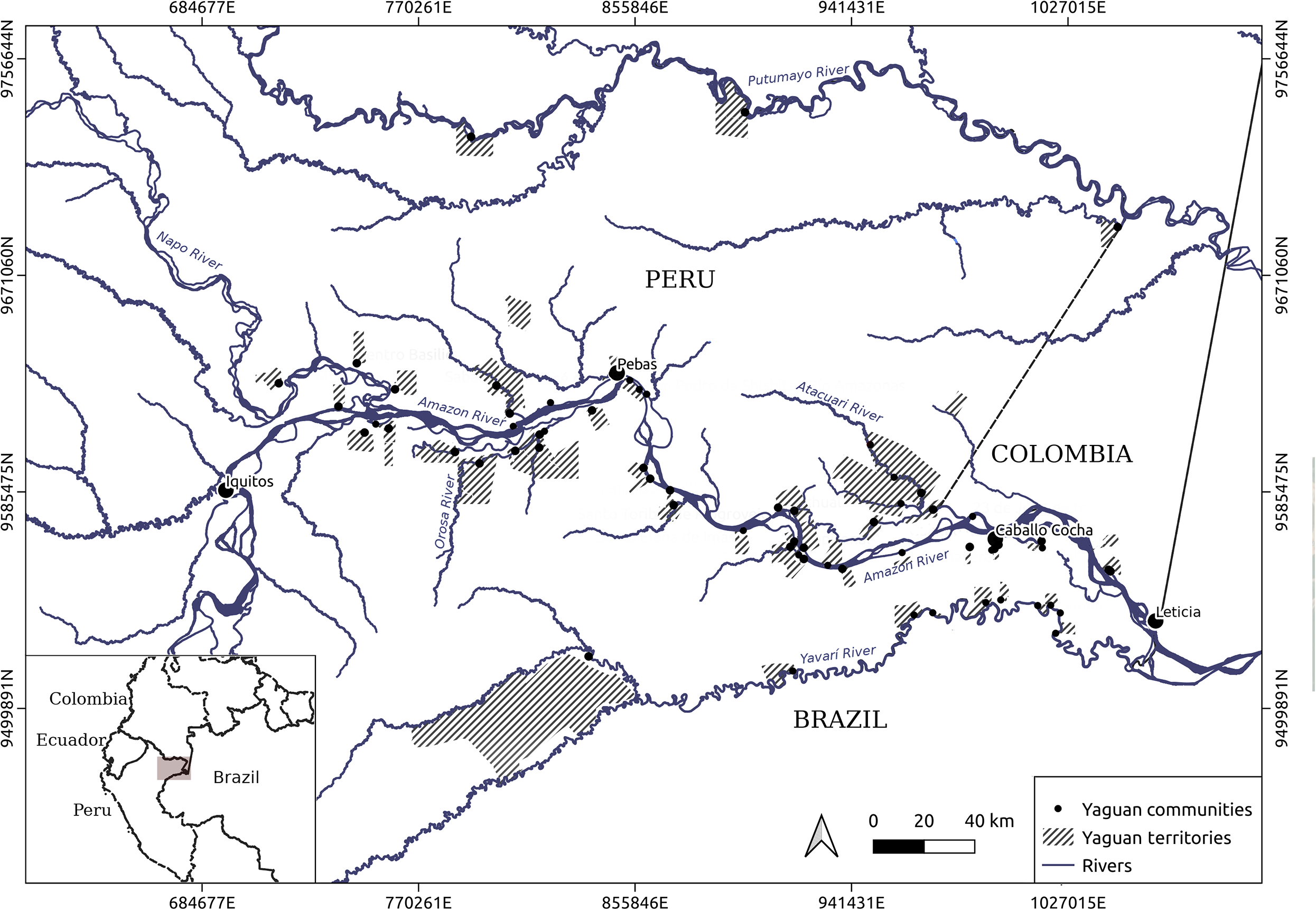
Location of Yaguan communities and territories in Peru. Map by author based on data by the Instituto del Bien Común (IBC), the Autoridad Nacional del Agua (ANA), and OpenStreetMap (OSM)
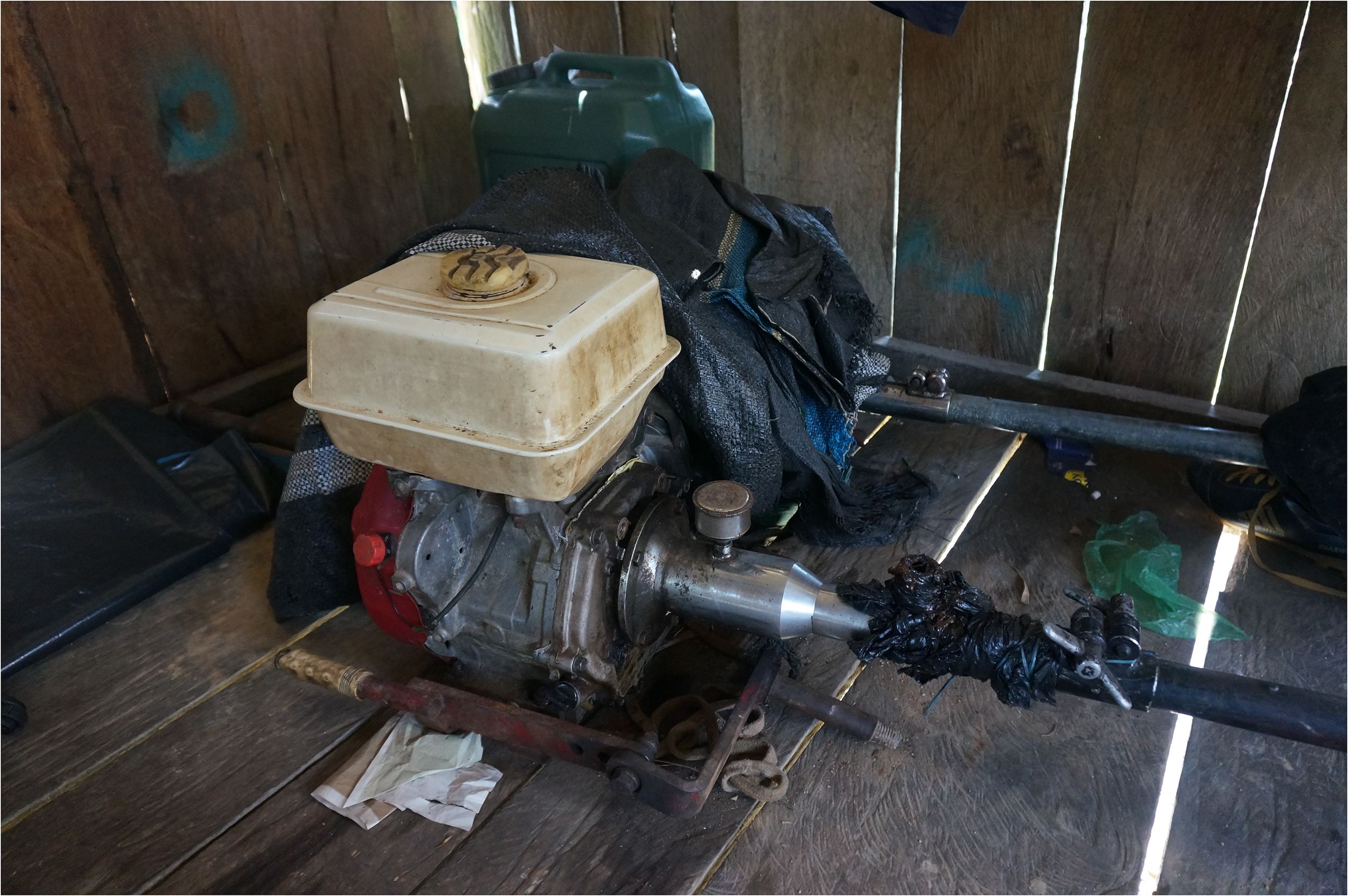
A typical peke-peke boat's motor, whose tail extends another metre to the right. The sole of a rubber boot serves to replace the original lid of the tank. Photograph by author.
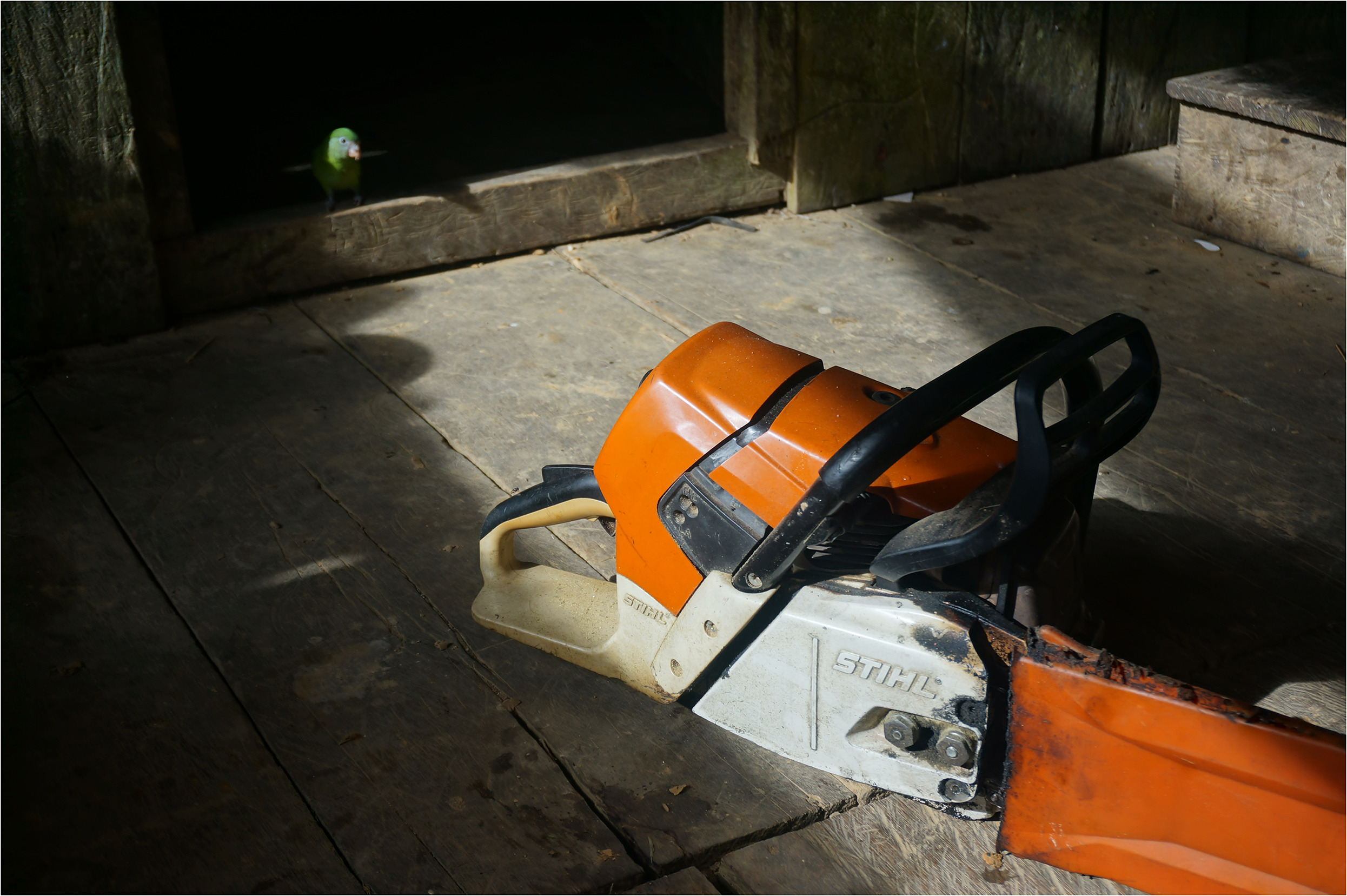
A chainsaw under observation by a parakeet in my field site on the Atacuari River (Peru). Photograph by author.
Footnotes
Acknowledgements
The author expresses his heartfelt gratitude to Andrés González Dinamarca, Laura Rival, Jessica Rahardjo and the two anonymous reviewers for reading previous drafts of this article and providing helpful feedback. He also thanks Jean-Pierre Chaumeil as well as participants of the panel ‘Procesos miméticos/transformadores del capitalismo global en los territorios amazónicos del siglo XXI’ of the Biennial Conference of the Society for the Anthropology of Lowland South America (SALSA) for their wonderful comments, ideas and discussions.

Funding
The author received no financial support for the research, authorship and/or publication of this article.
Declaration of conflicting interests
The author declared no potential conflicts of interest with respect to the research, authorship and/or publication of this article.