




Abstract
For the current-day K’iche’ Maya of the Highland community of Momostenango, Guatemala, animals are conceived as having not human, but artificial souls: they are, in fact, objects that exist in the mountain dwellings of their gods. Conversely, artefacts like sacred altars are seen as being wild animals of the gods and ancestors, which can bring illness and death to people when not fed by ritual offerings. Based on this and other data that the author gathered during his recent ethnographic fieldwork among the K’iche’, in this article he explores the ontological paradoxes of living beings and artefacts among current-day Maya and other Mesoamerican peoples of the past to propose a version of perspectivism that incorporates the ideas of technology, asymmetry and material culture to the more horizontal and personhood-based model proposed for Amazon cultures by Viveiros de Castro in his article, ‘Cosmological deixis and Amerindian perspectivism’ (1998).
Introduction
Since its introduction, the notion of ‘perspectivism’ proposed by Eduardo Viveiros de Castro (1998) has exerted a powerful and ever-growing influence in the study of indigenous cosmologies in the Americas. This conception is widely recognized as being based on the notion of a ‘shared humanity’ by the different beings that populate those universes, such as animals, plants and even objects. However, despite promising recent ethnographies and proposals (Lamrani, 2008; Lorente, 2011; Pitarch, 2013a; Millán, 2019; Neurath, 2015), Viveiros de Castro’s ideas and the ontological models akin to them have had a hard time finding acceptance among Mesoamericanist scholars, who prefer to stick to old-school symbolic approaches, 1 arguing that the phenomena that are regarded as effectively ontological by Viveiros or Descola are merely oneiric, ritual, metaphorical or mythical (Martínez González, 2016). While Descola’s (2005: 207–221) classification of the central Mexican Aztec and other Mesoamerican peoples in the group of ‘analogical’ or mostly symbol-oriented ontologies may be one of the main reasons for this situation, 2 I believe that some of the lack of acceptance of the perspectivist model in the Mesoamerican context derives from a certain failure of accounting for material culture in a way that is meaningful and specific instead of being based on general analogies. After all, the archaeological culture of the Maya and the Aztec is widely recognized to be of a massive, spectacular nature (Trigger, 1990: 120), while their societies have been defined as classic examples of stratification (Kowalewski et al., 1992); these two traits are insufficiently explained when using frameworks developed for relatively horizontal, egalitarian societies like those in the Amazon, and are naturally fitting, it seems, with a more analogical and even symbolic model.
In order to address this problem, in this article I advance a notion of perspectivism that incorporates an element of artificiality, materiality and asymmetry to the more horizontal, personhood-centred framework proposed by Viveiros de Castro. It is based on recent fieldwork (2017–2018) I undertook in the K’iche’ town of Momostenango, a Highland Maya community where a strong mix of indigenous and Catholic practices (known as costumbre) persists, as well as a continuous usage of the native calendar, an aspect of the town’s life studied in depth by past ethnographers (Tedlock, 1992). According to my ethnographic findings, for contemporary K’iche’ Maya, animals can indeed perceive themselves as people; however, in the eyes of their telluric gods, they are nothing but artefacts that populate their supernatural dwellings. Conversely, sacred K’iche’ altars are said to be material versions of the animal co-essences of the earth gods, which can become hungry when neglected, bringing disgrace and illnesses to the people. I compare these contemporary ideas with the artistic expressions of both the Aztec and the Classic Maya, who, in their sacrificial vessels and altars, emphasized animal imagery, feeding and violence (McEwan and López Lujan, 2009). Finally, based on these examples, I argue that the Mesoamerican notion of ‘making’, whose importance has been recently highlighted by Perig Pitrou (2015), could perhaps admit a more ontological reading in order to give a twist to the perspectivist paradigm, which speaks about nature as the ‘culture’ of the cosmological others: thus, in Mesoamerican ontologies, not only can the inanimate be regarded as being imbued with personhood, but the animate and personal is also deeply artificial and objectual.
The artificial ontology of the living: What is a nawal for the K’iche’ Maya?
The K’iche’, a Maya-speaking group, established itself in the Highlands of Western Guatemala during the Post-Classic Period of Mesoamerican civilization, circa 1200 AD (Carmack and Weeks, 1981: 323). While being linguistically and culturally different from the Classic Maya, 3 the ‘conservative’ character of K’iche’ culture (Villa Rojas, 1986[1968]: 148), shown in traits such as the continuous usage of the native divinatory calendar (Tedlock, 1992), as well as in the wealth of their early colonial literary legacy (see Craveri, 2013), placed it at the forefront of studies regarding Maya cosmology. Nonetheless, previous misinterpretations of Classic iconography and artefacts, which in former decades heavily relied upon K’iche’ colonial documents like the cosmological epic Popol Vuh, 4 have been corrected by recent advancements in epigraphy and iconography, underlining the discontinuities and ruptures between Classic and Postclassic mythologies (Velásquez García, 2015: 299), while still recognizing their shared traits. Thus, in this article, historic comparisons with other Maya groups are not conceptualized in a genealogical way, nor do they rely on direct continuities.
On the other hand, stronger and more direct affinities exist between central Mexican cultures of the Postclassic and the K’iche’, an influence which can be very clearly appreciated in Pre-Hispanic iconography and architecture (Carmack and Larmer, 1971) as well as in numerous lexical borrowings which continue to be used nowadays (Campbell, 1970; Carmack, 1968). Such is the case of the word that designates the concept that lies at the heart of this article’s argument, nawal. The word is actually not Maya in origin: it derives from Nahuatl, the language spoken by the Aztec and other central Mexican groups. 5 It comes from the word nāwalli, which in colonial dictionaries has the meaning of ‘sorcerer’ or ‘magician’; 6 but also alluded to the animal alter ego of a ‘transforming’ sorcerer or even a god. Probably due to the linguistic influence of central Mexican groups in Highland Maya culture, the word came into use among the K’iche’, for whom it signified, at first, the powerful animal spirits of rulers and sorcerers. 7
Nawal and similar terms could be considered to belong to a complex of concepts of Mesoamerican personhood that Monaghan (1998) proposed to call ‘co-essences’, in order to avoid the confusion brought about by the generalizing usage of specific local terms. My own ethnographic fieldwork revealed that, for the Momosteco Maya, nawal is a polysemic term. It has at least three meanings. 8 The first alludes to the sign of a person in the traditional calendar, that is, their birth sign and its influence over them. In this sense, nawal is sometimes synonymous with the term wach uq’ij ‘the visage of his day’ (Tedlock, 1992: 2). Its second meaning alludes to a ‘heat force’ inherent in a person or animal that is linked to their/its strength. In its most elementary sense, nawal is the force that an animal uses to hunt or kill another one. An animal is considered to have a greater and ‘hotter’ nawal when it is deadlier and more powerful, regardless of its size. In this sense, nawal is similar to the classic Aztec term tōnalli (López Austin, 1988[1980]: 204–229).
The third meaning of nawal, which this article follows, is that of a ‘companion animal’ or co-essence of a person, an animal which shares the destiny of someone (Bunzel, 1952: 317–320). In the case of humans, this soul takes the form of an animal which is considered to live in a special enclosure within a supernatural mountain space. This belief, which went unnoticed by previous ethnographers like Cook (1981) and Tedlock (1992), is still extant both among calendrical specialists and non-specialists alike, and is very similar to those described by scholars like Holland (1964) and Vogt (1969) for the Tzotzil Maya and Hermitte (1970), Pitarch (1996) and others for the Tzeltal Maya of Chiapas. In Momostenango, a brave or daring person would be considered to have an animal associated with those traits, such as the eagle, as a nawal. For example, a friend of an informant, a merchant, complained once that he did not have a daring nawal, like an eagle, or a cunning one, like a coyote, so he could be bolder in trade. Similarly, ritual specialists sometimes attribute the agency of their shamanic powers to their nawal. A young calendric diviner I knew told me that his nawal was an eagle for, when he peered into the future, as he sometimes did, the ancestral gods would ‘heat’ the eyes of his eagle nawal in their mountain abodes, showing him places and times ‘far away’.
Besides these ideas, which correlate to well-known examples in both ethnography and history (see Martínez González, 2011), I obtained a peculiar explanation regarding companion souls focused not on human beings, but rather on animals. For the K’iche, both humans and animals have co-essential counterparts in a supernatural space; however, for the K’iche’, animals are not only perceived as being ‘human’, unlike in other shamanistic traditions, such as in Siberia, where animals perceive themselves as persons with a culture of their own which would translate as nature to us (Willerslev, 2007). One of my informants, a rural teacher in his 60s, told me that some of his students were recently anxious, for coyotes had appeared near their village. He used the situation to explain to me the concept of nawal, recalling what his father told him about how the coyote hunts.
According to his explanation, while hunting, a coyote does not just simply lunge onto its prey (let’s say, a chicken) and eat it straight away. Instead, the coyote actually ‘takes a drum out of his heart’, and then it plays it to its prey. Seduced by its song, the prey is then lured to the mouth of the coyote, voluntarily ‘jumping’ into its own doom. This drum is the nawal or co-essence of the coyote; in fact, it could be said to be the true form of its soul (Figure 1). Furthermore, it is said that a coyote, when lying still, can be seen as becoming ‘like a log’, or even more, a wooden slit-drum. In consequence, a man who eats the flesh of the coyote can become a seducer of women, or can get people to lend him money easily, for he somewhat briefly acquires the nawal of the coyote himself. Magical taboos are also traditionally applied to the name of the coyote. Thus, the name of the animal (utiw, in K’iche’) should not be pronounced, for it is said that saying the name of the coyote ‘multiplies’ coyotes and makes them powerful; instead, it should be called utza’m si’ (‘wooden snout’, an allusion to its nawal essence) to render it powerless.
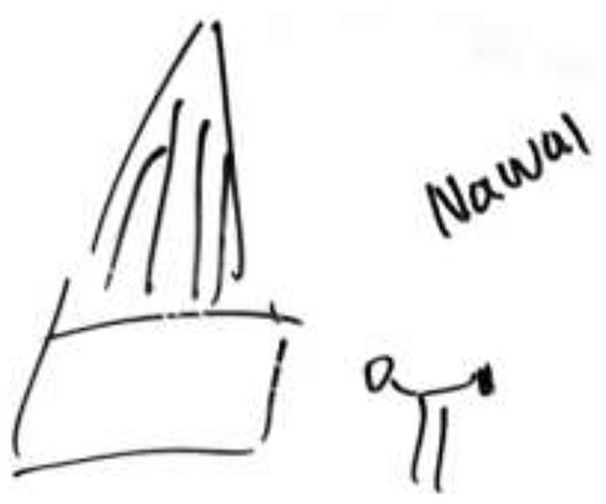
A coyote hunting chickens outside a pen with its nawal, as drawn by an informant. Notice the tiny drum in the paws of the coyote. © Photograph: Alonso Zamora Corona.
Taken at face value, these conceptions may seem surprising and difficult to explain. However, when contextualized within other K’iche’ beliefs, they become clearer. In Highland K’iche’ culture, telluric deities called dioses mundo (literally ‘world gods’, an expression which can be glossed more precisely as ‘earth gods’) are the masters of animals; sometimes they are presented as a singular entity called El Mundo or El Santo Mundo. According to information gathered by Benson Saler at El Palmar, this deity lives in the interior of the mountains and is a rich Ladino or white person who is the owner of wild animals, as well as many plantations in the underworld where the dead toil for him (Saler, 1960: 111). There is no better description of a mundo deity than that given by Leonhard Schultze-Jena in his 1933 monograph on the K’iche’ of Chichicastenango and Momostenango. In this text, a man recounts his encounter with Pokojil, the mountain lord of an altar near Chichicastenango:
Suddenly I felt that I entered a hidden place, not under the light of the sun, but concealed. Immediately I saw animals that were there, and saw at once the lord of the mountain, a strange being. The animals there saw me as I came near their faces, and rose. There were snakes, coyotes, horses, jaguars, all fettered with chains. The same animals that are here under the light of day, were there. Suddenly the Lord of the Mountains came and told me: ‘What is it, what do you seek? What do you ask for? What afflicts you? What makes you sigh at your home? What do you seek at the summit of the mountains? (Schultze-Jena, 1933: 201)
Schultze-Jena, who presents the K’iche’ text along with his German translation, uses the term Bergherr (‘mountain lord’) to refer to this god, but the native word is actually mo’x, ‘the demented one’, the ‘white man’ or gringo, as Momostecans would say nowadays. 9 Effectively, the lords of mountain altars are often seen among the K’iche’ as gringos or ladinos, in contrast to the ancestral deities or divinized ancestors, who are also conceived as telluric lords, seated upon stones at the summit of the mountains, but who, instead of being gringos, are seen as old indigenous people. 10
Going back to the coyote example, how do we begin to explain the artificial nature of its co-essence? The idea that animals are literally artificial objects owned by the earth gods is found in K’iche’ ritual speech. Schultze-Jena (1993: 66) mentions that, during the ‘snake dance’ in Chichicastenango, a performance where live snakes are used in ritual dancing, this reptile is called ‘the arm-band of the earth god’ in order to tame it. Momostecos today say that the dancers ‘subdue’ the nawal of the snake, thus using it as the earth gods would. Likewise, other informants told me that the reason why the coyote has a drum co-essence is because it is actually ‘the drum of the earth god’. So, just as humans have animal souls who are protected by their ancestral gods, animals have artificial co-essences that are the property of the gods. The idea is not unknown among other Maya groups. Evon Vogt (1993[1976]: 71) mentions that, among the Zinacantan Tzotzil, the plant species that grow in the wild are actually domestic plants in the houses of the gods, which are the mountains themselves. For example, Pedro Pitarch (2013a) remarks that, for the Tzeltal of Chiapas, the jaguar hunts with the ‘glyphs’ that cover its skin; illness sorcery is thus called among them ‘jaguar words’ (p. 85). Similarly, Köhler (1995[1977]: 31) reports that, among the Tzotzil (close neighbours of the Tzeltal), the mountain divinities are masters of animal souls; their chairs are armadillos, their ‘dogs’ are racoons, and so on. Thus, for the K’iche’, a hierarchy of perspectives exists where, while animals can be said to have a personhood, they are nothing but artificial objects in the eyes of the gods. As such, what people regard as ‘wild nature’ is in fact the domestic culture of the gods.
Therefore, in my example, the agency of the coyote, a natural species, is actually the agency of a supernatural object in its inside, in what could be regarded as an ontological twist to Gell’s (1992: 150) notion of agency regarding artistic objects, in which ‘the objects which resemble human beings with which the anthropologist deals, primarily, are not portraits, effigies, idols and so forth, but simply human beings themselves’. For the K’iche’, the coyote is indeed a person that can take out a drum and play it to its victim, but for the gods it is nothing but the drum itself. The relationship of the coyote and the drum among the present-day K’iche’ echoes imagery found in Ancient Mexico, too. Some slit drums of the Aztec (teponāstli), like a famous example at Malinalco, have the figure of a coyote (Figure 2). Also, a coyote god, Wēwekoyōtl (‘old coyote’) was said to be a patron of poets and musicians in Aztec almanacs (Boone, 2007: 41).
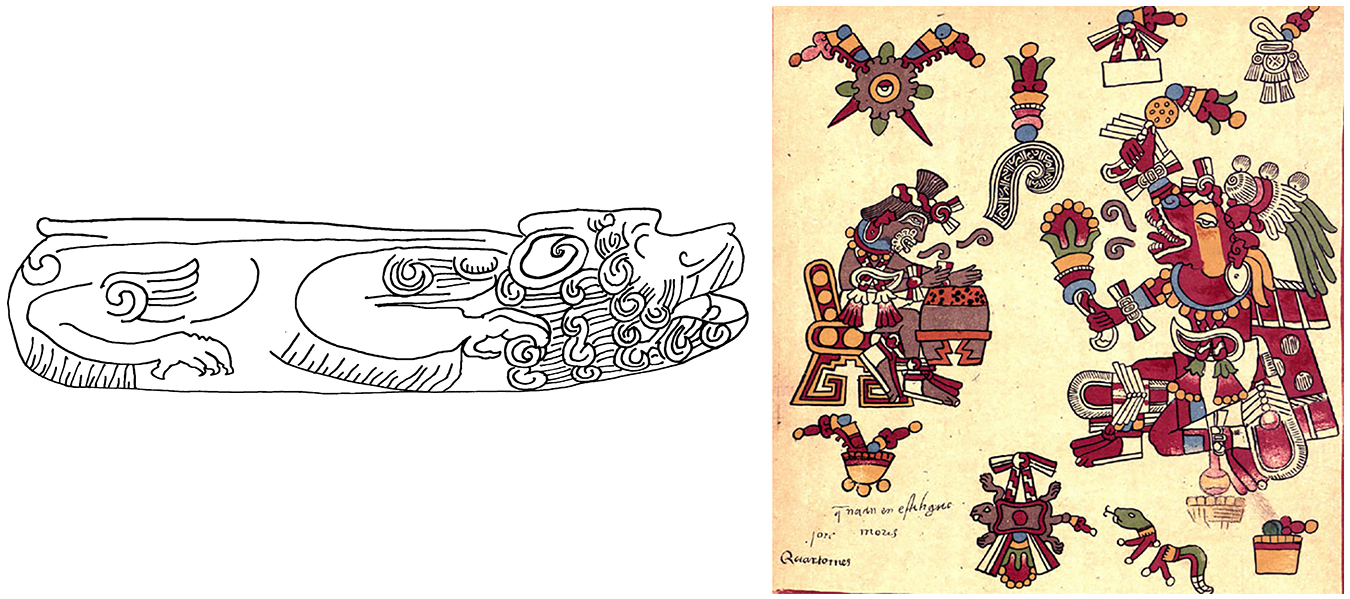
Left: Aztec slit-drum (teponāstli) from Malinalco (redrawn by the author); right: the Aztec god Wēwekoyōtl, patron of musicians (Codex Borbonicus, p. 4).
Thus, it could be speculated that, in some cases, artistic objects among Pre-Hispanic Mesoamerican cultures pertained to a wider ontological context, where an interplay of the artificial and the natural was implied. So, just as people in Momostenango can eat coyote meat and become seductive and cunning, engaging in a sort of ‘coyote-becoming’ in the Deleuzian sense (1987[1980]: 232), a wooden drum could be fashioned in the form of a coyote to imbue it with the agency of what a coyote actually is: a drum in the dwelling of the gods, engaging it in a coyote-becoming of its own. Pedro Pitarch (2000) has suggested that the bodies of the saints in Maya communities like the Tzeltal are actually externalized versions of the co-essences of the interior of people’s hearts; artistic objects for the Maya and the Aztec were probably similar, but they perhaps functioned in an interplay between the world of divine technology (nature) and the human world of technique (art and culture). Thus, a man-made drum would work as a contemporary Maya saint does but, instead of externalizing a human-like hidden spirit, it would have been the externalization of an animal spirit, which in the end is just an artificial essence in the world of the gods.
I suspect that similar interplays and reversals of ontological levels were not unknown to the Pre-Columbian cultures of Ancient Mexico. For example, it is well known that the Aztec goddess of water, Chālchiwtlikwe, ‘she of the jade-skirt’ was so named because her jade-skirt was a ‘symbol’ of the water of lakes and rivers; she was both playful and dangerous, for she lured and plunged men into the depths (Sahagún, 1950[1590], vol. 1: 6). However, in the speech of sorcerers and priests, water itself was called Chālchiwkwēye, ‘the owner of the jade skirt’, a variant of the goddess’s name, emphasizing the identity between her and the element (Alarcón, 1987[1629]: 222). I believe that we should take the idea even further: for the goddess, what is water in the world of humans would actually be a skirt of precious jade stones that she plays with (Figure 3).
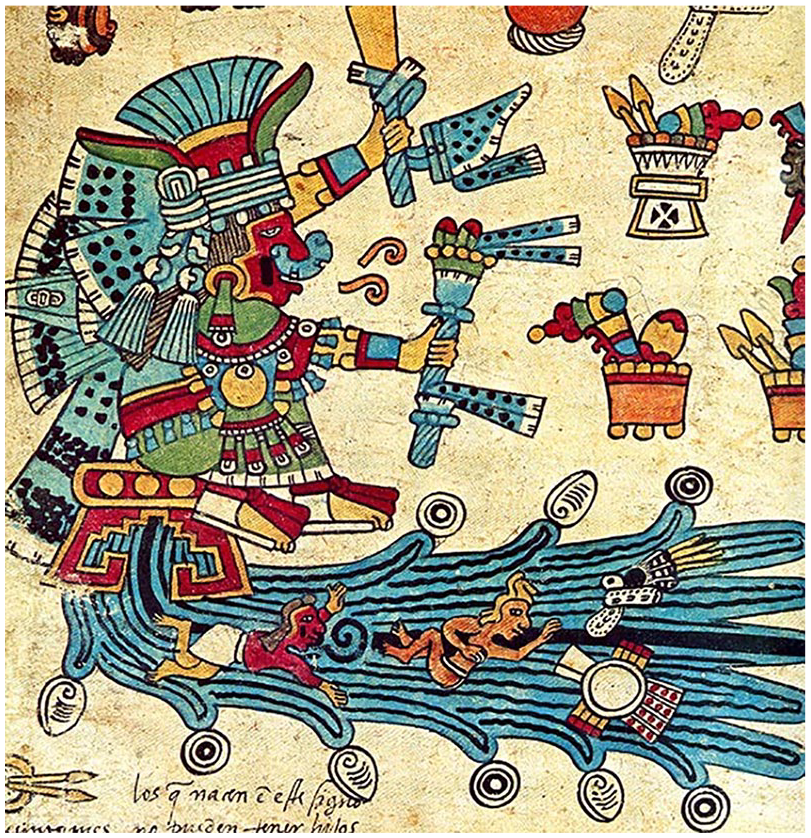
Chālchiwtlikwe, ‘she of the jade-skirt’, the Aztec goddess of water. Codex Borbonicus, p. 05.
Aztec gods were said to have animal co-essences (nāwalli) which often appear in iconography merely as animal disguises, objects. For example, the co-essence of the oldest pair of gods, Tōnakātēkwtli, and his wife, Tōnakāsiwātl, was a caiman, the first day sign of the Aztec calendar; this was ‘symbolized’ by a caiman costume (Boone, 2007: 41). Similarly, the Maya god Itzamna, equivalent to Tōnakātēkwtli, had a caiman form, and in some images is seen as coming out from a caiman costume, as in the Dresden Codex. Other examples show this artificiality more explicitly: E’ēkatl, god of the winds, had a wind-bellow affixed to his mouth. Therefore, the animality and the mastery over the elements inherent in these figures were not only natural but deeply artificial (Figure 4).
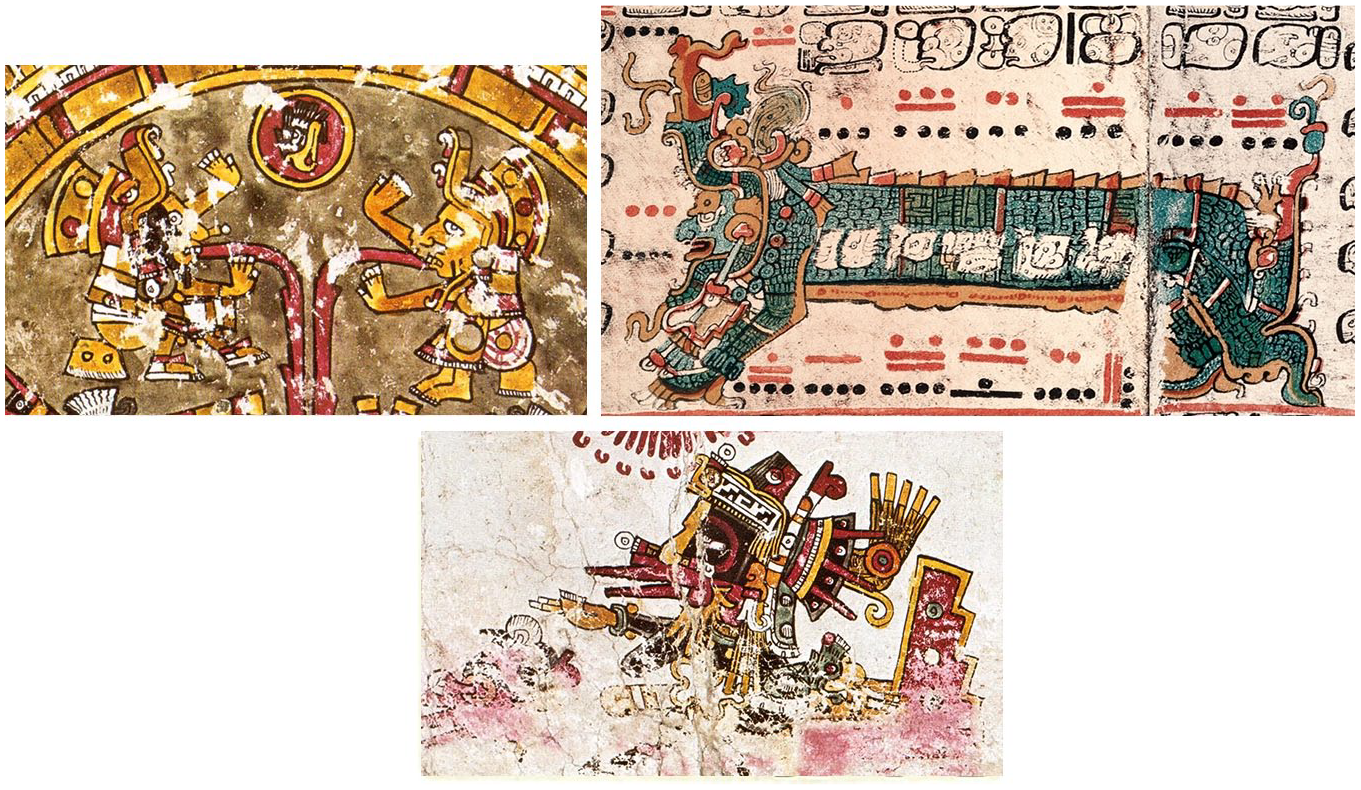
Above: Tōnakātēkwtli and Tōnakāsiwātl with caiman costumes, Codex Borgia, p. 41; Itzamna, Dresden Codex, pp. 4–5; below: E’ēkatl as ruler of the day ‘wind’, with a e’ēkatzakawīloni or wind-bellow attached to his mouth. Codex Borgia, p. 9.
In this section I have argued that there was some interplay between the natural and the cultural conceived in Mesoamerican indigenous ontologies, a subject on which I will elaborate more in my conclusions. However, the interplay of the animal and the artificial does not end here. As we will see, among the Momostecos, certain sacred altars are considered to have animal co-essences owned by the earth gods, which can predate people when not satisfied with offerings: thus, sacred artefacts are not only seen as places of worship, but as material concretions of the animal counterparts of the gods.
Material culture as animate: ‘The altars bark and bite’
Most of K’iche’ religious ceremonies are carried out in both private and public ancestral altars called awas, a word meaning ‘taboo’. Informally, they are also called porob’al (burning places) or quemaderos, in Spanish. K’iche’ patrilineages have different such altars in their lands, at least three of them: one called winel, for agriculture; one called warab’al ja (‘house of dreaming’), where the spirits of the patrilineage are enshrined; and one altar for material abundance, called meb’il, which sometimes takes the form of a stone in the shape of an animal (Tedlock, 1992: 77). Agricultural ceremonies, like the blessing of seeds, are carried in the winel, while the warab’al ja is reserved for ceremonies regarding the patrilineage, such as the presentation of new children or wives to the ancestors, for the altar is the ‘sleeping place’ of the souls of the ancestors. These ceremonies involve the cleaning of ritual spaces which are covered with pine needles, and the burning of multiple offerings – aromatic resins, candles, wood and foodstuff – while prayers directed to the ancestors are recited. A large number of public altars are placed throughout Momostenango and its surrounding natural landscape, and are similarly used to make offerings dedicated to the earth gods (Figures 5 and 6).
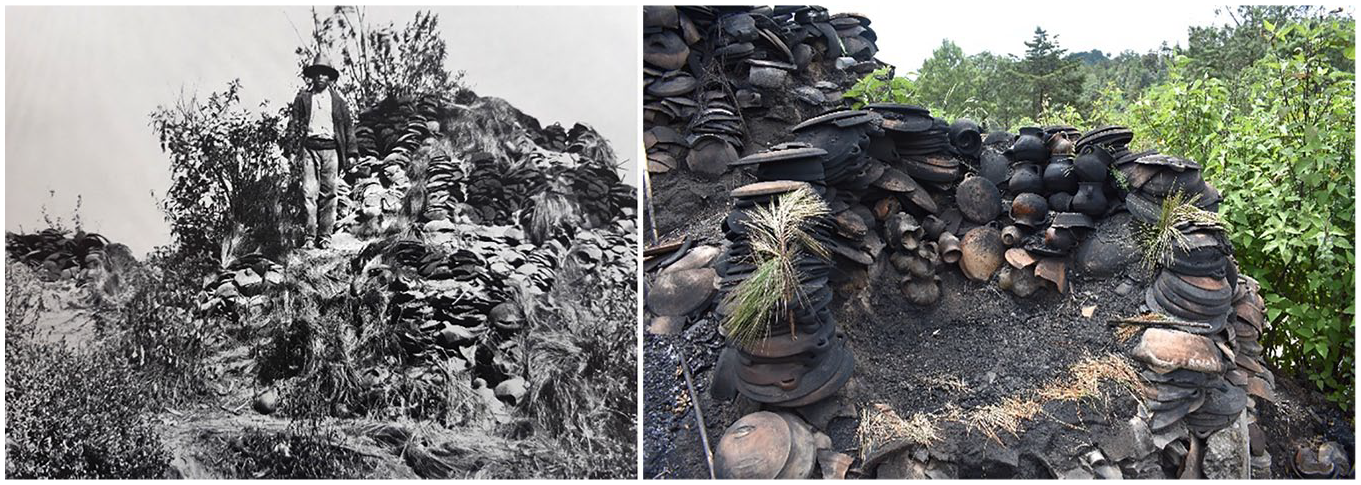
Public altar (awas) in Momostenango, by Schultze-Jena (1935), and a present-day altar. © Photograph: Alonso Zamora Carona.
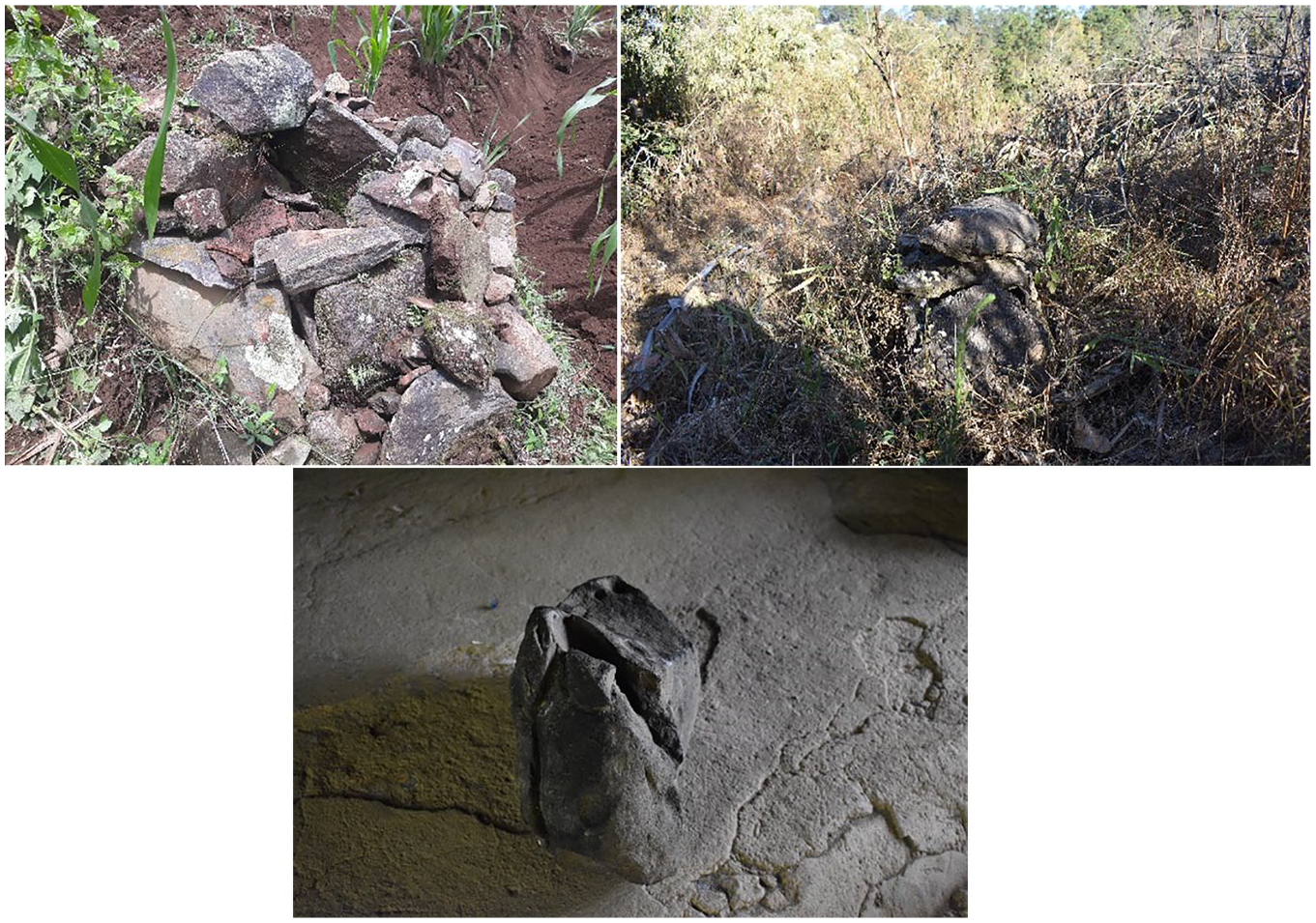
To the left: winel type of altar. To the right: abandoned warab’al ja altar. Bottom: meb’il family stone shaped like a rabbit. © Photographs: Alonso Zamora Carona.
An old man, who in recent years left the K’iche’ costumbrista religion, gave me a very interesting account regarding the myths about the origin of these altars. The man recalled what his father told him when he was a child: long ago, the world was lost. Fire rained from the sky in the form of a flammable resin that burned people’s homes. Animals devoured and killed people. Snakes made their nests in people’s homes, jaguars lived in the fields, and monkeys perched atop the roofs, mocking men. Many people escaped, hiding underground or in the mountains. Eventually, they became animals, too. In order to quell the fury of the elements and the hunger of the earth gods and their supernatural animal spirits, the people who remained created the sacred altars. To stop the rain of fire, they burned resin, the same substance that rained from the sky, to honour the gods. In order to quell the hunger of the animals, they made altars out of broken pots and stones, to offer food in them to the dangerous and hungry animal counterparts of the earth gods, called awajmundo (‘earth-god animals’). In that manner, the rites were invented: the hunger of the gods was sated, and they left people alone. However, the animal co-essences of the gods remain hidden within the ancestral altars. 11
As a consequence, K’iche’ patrilineages are born out of an alliance between the earth gods and the ancestors of mankind. In exchange for worship, the earth gods gave the founders of the patrilineages power over supernatural nawales to carry their will and become god-like themselves after death: ‘It is said that the dead are earth gods themselves’, stressed an informant. Ancestors live in the underworld and communicate through the altars; after dying, the head of the patrilineage joins them and becomes himself a ‘lord of the face of the earth’ (ajaw ri uwachulew), by the enactment of a series of special ceremonies on the last day of the K’iche’ divinatory calendar, Ajpu (‘blowgunner’), carried on by his successor. 12 These divinized ancestors are visualized as very old men and women sitting on stones atop supernatural mountains: thus, in ritual speech, it is said of them ‘white are your hairs, your heads’, a poetic expression which means the white clouds surrounding mountain tops (Schultze-Jena, 1933: 20).
The ancestors must be fed with offerings, much like the gods that once destroyed the world. The reason is that the members of the patrilineage are said to be like small animals 13 living within an enclosure in the underworld, surrounded by beasts of prey. The patrilineage head ‘writes’ or ‘records’ through his prayers (not physically) the names of his relatives inside the space of the altars. This is said to make the human and animal co-essences of a person appear inside the enclosure that the altar represents. When the members of the patrilineage make offerings, the ‘enclosure’ remains closed. However, as soon as one member of the patriclan neglects his duties, the door ‘becomes open’, and people’s animal co-essences are bitten, scratched and ultimately devoured by the beasts outside. This conception echoes those found among the Tzotzil (Holland, 1964) and the Tzeltal (Hermitte, 1970; Pitarch, 1996). My informant explicitly recalled the image of the coyote outside the chicken pen to make me visualize the attacks of the hungry earth gods against the animal souls of the people. However, in some other versions, it is the ancestors themselves who become hungry and attack people, for ancestors ‘eat’ incense and offerings. Consequently, if ancestors become hungry, their altars turn into beasts of prey again, as when the world ended; they become alive, and ‘bark and bite’ men. Thus, an informant told me that, during some nights, abandoned altars ‘rise’ like animals and go out, bringing illness and death due to their hunger. ‘If I don’t place their food before them’, he remarked, ‘it (the altar) will go and bite, sting, do harm, if you don’t do ceremonies for it, the altar will eat you.’
Feeding the altars during the appropriate sacred days is the duty of the Maya calendric priests (ajq’ijab’), for if they are not fed properly, people become their prey. In this way, neglected ancestors are said to be like coyotes, a pack of hungry dogs, or a jaguar. Sometimes, when the ancestors are angry, people can see those animals surrounding their lands, perching atop the roofs, amid an intolerable heat, just as in cosmological myths. Sacrifice is thus conceived as ‘closing the door’, keeping safe, or being protected. As an informant was told by a calendric priest:
The ancestors have left your name in this altar and you don’t sustain them, you don’t feed them, they became hungry and they are fighting among themselves, that is why you have accidents, failures, illnesses: the snakes arrive, the jaguars, the wild animals arrive . . . You know why? Because the ancestors are there, and if you don’t sustain them, they bark, they bite, the ancestors bark and bite. If you don’t feed these altars, their altars bark and bite. That is why you will have illness, failure, even death, until you feed them. Their food is the offerings, the copal, the candles . . .
Evangelical and Mormon missionaries in Momostenango sometimes urge people to destroy the sacred altars in their lands; however, some of them resist this, even after conversion. An informant of mine who underwent conversion knew a neighbouring couple that did exactly this. One day, they took the pottery sherds and stones of the altar and destroyed them, smashing them into pieces. The vengeance of the ancestors was swift. The couple used to travel to the coast to do business. One day, both of them fell into the river, and they died. The people of the community agreed: their deaths were the work of the ancestors. The informant who told me this, currently an Evangelical Christian, prefers to keep the altars abandoned but untouched.
In this manner, sacred altars are fully animated entities for the K’iche’, and possess the agency of the animal spirits of the earth gods, as well as the co-essences of divinized ancestors. Similarly, in ancient Maya and Aztec art, sacrificial altars would usually have animal forms. In the Maya site of Copán, in Honduras, altars placed before steles bearing the images of rulers, like the famous Waxaklaju’n Ub’aah K’awiil (8th century), often have zoomorphic figures of ‘monsters’ and jaguars. For example, CPN 12, the altar to Stela F in Copan’s plaza, is a visual composite creature between the so called witz or mountain, and two jaguars that converge (cfr. Baudez, 1994: 53–55). 14 In some classic Maya vases, as in K8719 and K928, human sacrifices performed on altars placed before sacred stelae, supervised by lords, were represented. In these images, animal dancers are seen before the grisly scenes, or the stelae would have jaguar mannequins attached to them. These animal dancers and mannequins are interpreted nowadays as way spirits, the aggressive supernatural co-essences of rulers (see Matteo and Rodríguez Manjavacas, 2009; see Figure 7).
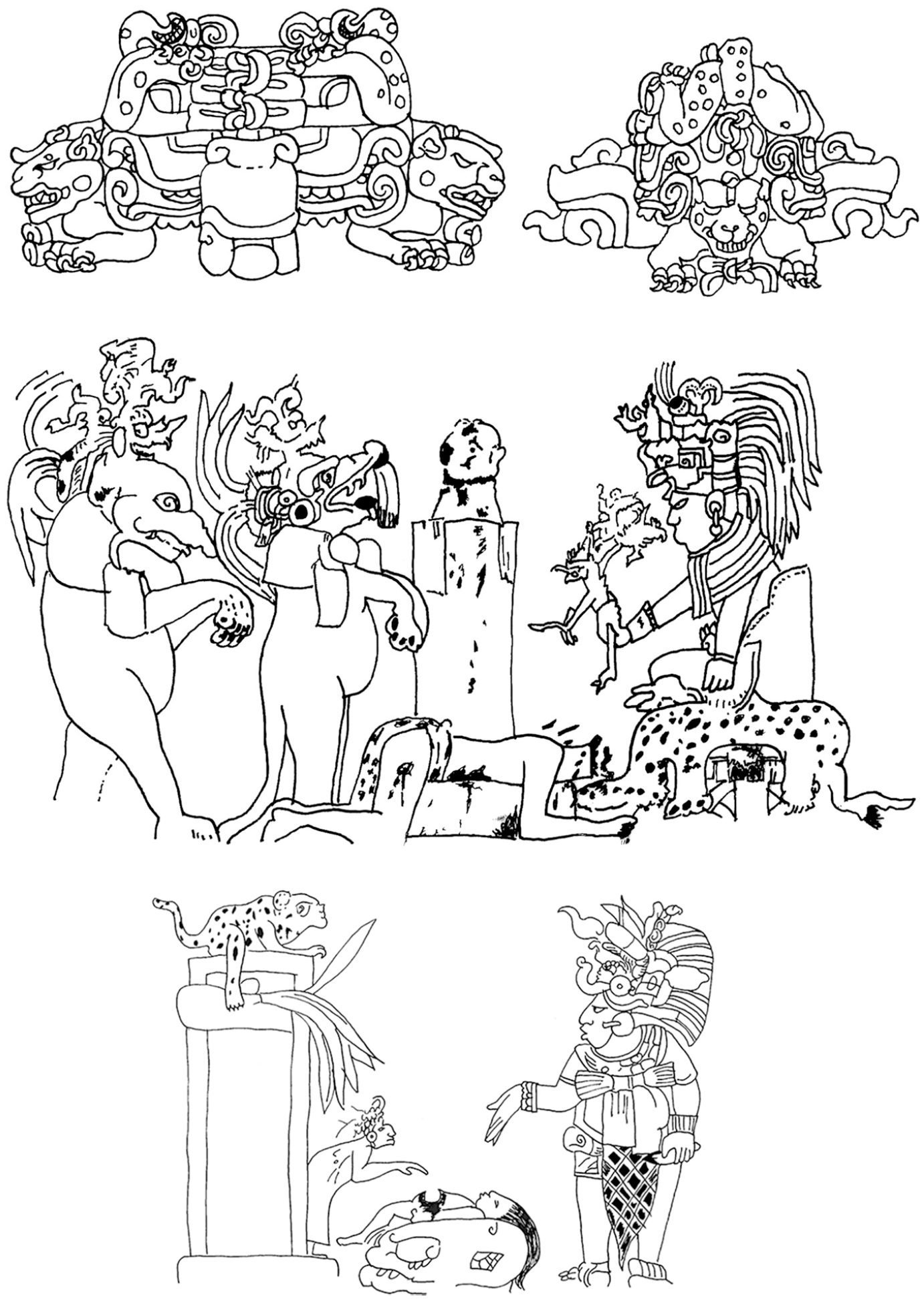
Above: CPN 12 (Altar of Stela F) redrawn by the author after Linda Schele’s version; middle: Classic Maya vase depicting a scene of decapitation before a stela, supervised by a lord accompanied by way dancers (K8719, sans epigraphy, drawing by the author); below: Classic Maya vase depicting a human sacrifice before a stela adorned with a jaguar mannequin (K928, sans epigraphy, drawing by Alonso Zamora Corona).
For the Aztec, the sun needed to be fed through sacred vessels called kwāwxīkalli or ōsēlōxīkalli, that is, ‘the gourd-bowl of the eagles’ and ‘the gourd-bowl of the jaguars’, respectively. 15 Occasionally they were small stone-vessels that contained a solar cosmogram within them. However, two massive, full-figure versions of these recipients are exhibited in the National Museum of Anthropology in Mexico. The ōsēlōxīkalli is a massive stone jaguar with a carved hollowing that was filled with human hearts; the kwāwxīkalli was a stone eagle with an analogous use. These images have been taken by art historians to belong to symbolic complexes related to the solar worship (McEwan and López Lujan, 2009: 42); however, I believe they could be seen in a fully animated way, just as present-day K’iche’ see their own altars. The K’iche’ believe that their ancestors are masters of underworld animals. They are fed through the altars, which are animals, ‘frozen’ in piles of stones and ceramic. Being thus fed, the animal souls of the ancestors and their descendants are kept happy inside their mountain dwellings of the underworld, eventually earning the right to join their ancestors as gods after death. Nowadays, K’iche’ Maya ancestors are fed by making offerings of incense, but even in colonial times these offerings were often mixed with blood, a practice strongly condemned by Spanish priests (Chinchilla Aguilar, 1957: 6). Similarly, the Aztecs believed that, after their demise, warriors would become eagles and jaguars of the Sun god, Tōnatiw, (Sahagún, 1950[1590] vol. 3: 47). The Aztec codices show they were represented as eagles and jaguars with sacrificial banners attached (Figure 8). However, I believe that these ideas were not simply ‘eschatological’ or ‘symbolic’ in nature. For example, occasionally the Aztec would speak of the patronage of the supernatural over their protégés in terms of animal property, just as Tzotzil or K’iche’ do today. When the children of Aztec nobility were born, the sun-god, Tōnatiw, would be addressed by saying that the new-born were as precious birds of their property: ‘He called and invoked the sun thus, saying: our mother, our father Tōnatiw, lord of the earth, here is your underling, your sākwān bird, your kechōlli bird’; 16 the Sun god himself, Tōnatiw, was addressed as ‘Eagle and Jaguar’ (García Quintana, 1969: 205). Teskatlipōka, the supreme god of the Aztec pantheon, presents an interesting parallel too. As well as being the protector of kings, he was the protector of the slaves, who could not be mistreated by their masters, for ‘it was said that they were like the blue cotingas, the turpials, the precious birds of Teskatlipōka’ (Sahagún, 1950[1590], vol. 4: 34)
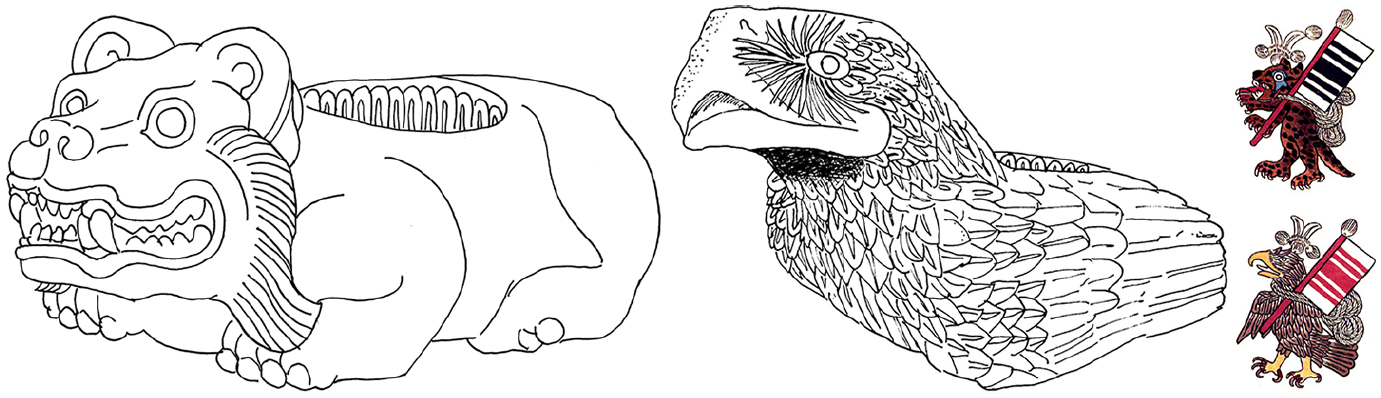
Left: Aztec ōsēlōxīkalli; middle: kwāwxīkalli Mexico, Museo Nacional de Antropología (drawings by Alonso Zamora Corona); right: Aztec braves represented as jaguars and eagles ready for sacrifice. Codex Borbonicus, p. 11.
I would suggest that when the Aztecs warriors were feeding these massive altars, they were also nourishing and strengthening the animal cohort of the Sun god, who extended his protection over his warriors as they became his ‘precious’ jaguars and eagles. This could explain the ever-elusive imagery used in Aztec poetry, where warriors were described as flowers blooming in the ‘eagle mountain’, the ‘house of war’, and the death of braves was compared to precious feathers being ripped and jade necklaces being scattered. 17 Thus, princes and warriors were said to be protégés of deities like Teskatlipōka, as well as Wītsilōpōchtli (Bierhorst, 1985: 71). Arguably, we should interpret these literary allusions in a different way from what has been done previously. These deities of war should probably be seen as masters of the destiny of rulers and warriors, who were like precious eagles and jaguars in their supernatural abodes; in turn, their destruction was seen as the spoilage of precious treasures of the gods. 18
Taking the former into account, rituals of human sacrifice could not only be conceptualized as mere rituals of metaphysical sustenance of abstract gods, or exchanges of gifts (López Austin, 2010: 30), but ones of deep material care for the artificial and animal nature of the cosmos and the human body. Thus, spectacular artefacts such as altars could be considered as fully animated, hungry and powerful, perhaps demanding sacrifices to their priests just as they do now to the K’iche’ calendric priests. For example, once a calendric priest told me that one of his clients saw a snake coiling unnaturally inside the home of his family. For him, the meaning of this was clear: ‘The altar sent an omen, it gave a warning, it became a snake and spoke thus, he was telling them: you are failing me, defend yourselves, feed me.’
Discussion: Ontological perspectives
Over the course of this article, I have tried to highlight and analyse the place of the material in Mesoamerican cosmologies, taking it to an ontological level instead of a merely symbolic one. The first example, the coyote-drum, challenges the ‘naturality’ of being; nature itself is deeply artificial, since beings can be regarded as artefacts made or even owned by the gods. The artificial character of natural beings not only extends to things that we believe to have diminished agency like rocks or mountains, but even to wild animals and humans, which sometimes are seen as domestic animals and objects in the houses of the gods. It is a perspectivist world, for all beings have a distinctive perspective on what they are, but these perspectives are ordered in some kind of tier, for the gods always stand in a higher hierarchy than men and animals, for example. It seems then to be a case of a multi-tiered perspectivism instead of a horizontal one.
The second example, the animated altars, can lead us to challenge the inertness of artefacts: artefacts are sometimes considered as living beings, and moreover, they can be used to renew and sustain the life and order of the cosmos, mirroring the working of the gods in the act of making, which would account for the importance of artefacts in Mesoamerican cultures. However, some issues remain to be discussed in order to fully propose an ontological model centred on the notion of artefacts. The first is to ascertain whether ‘artificiality’ is really a valid indigenous category; the second, to explain a bit more about this proposed ontology and its relationship with recent developments in the so-called ‘ontological turn’ (Holbraad and Pedersen, 2017) as well as material culture studies.
Far from being alien, the notion of artificiality is a veritable obsession in the cosmology of Mesoamerican cultures. A formulation of the idea closer to indigenous categories would be the notion of ‘making’. Perhaps the best current example can be found in the work of Perig Pitrou, who has shown how, among the Mixe of Oaxaca, life is conceived as being a process of ‘making’ carried out by a divinity known as the ‘one who makes live’, a god that is said to create nature and life ‘just as a potter or a weaver’ would (Pitrou, 2015: 94). Similar examples are ubiquitous in several cosmologies from ancient Mexico. In the case of the Classic Maya, the creation of mankind is portrayed in the vase K8457, where monkey gods are represented while fashioning men as if sculpting wooden figures. The verb used in the corresponding inscription is pat, ‘whose range of meanings includes the actions of constructing, shaping by hand, painting, and planting’ (Chinchilla Mazariegos, 2017: 69) and was eminently used to denote the fashioning of precious artefacts, houses and buildings (Velásquez, 2011: 15). Likewise, the Mixtec portrayed the creative activities of gods in establishing the cosmos (mountains, rivers and other natural features) as the building of pyramids and temples in mythical times, as the plates of the Codex Vindobonensis exemplify (see Furst, 1978). Among the Aztec, prayers made by calendric priests after the birth of noble children would mention that people were ‘drilled like precious stones’ by the hands of the gods themselves before being sent to earth: ‘you were casted, you were drilled’ (García Quintana, 1969: 201). Furthermore, when water was poured over the children during the ritual bath, the priests would say that they were being again ‘casted and drilled’ by Chālchiwtlikwe, the goddess of water (García Quintana, 1969: 203). It is no wonder that one of the supreme gods of the Aztec pantheon, Teskatlipōka, was called ‘he who invents himself’ (moyōkoyatsin) or ‘he for whom we live’ (īpalnemowani), translated by the 16th-century friar Bernardino de Sahagun as dador de vida, ‘giver of life’ (1986[1524]: 169), a Spanish phrase that is still used by the Mixe in reference to their own maker god (Pitrou, 2015: 86). These ideas resonate with modern K’iche’ myths in which the root b’an, can denote ‘to do’, ‘to make’, ‘to make by hand’, to ‘imitate’ or ‘fashion’; a maker or artisan, for example, is called b’anol (Christenson, 2003: 16–17). I have gathered a myth where the Mam, the regent god of the calendar, ordered the earth as if working a maize field or milpa, after which he fashioned (xb’antaj) the co-essence or nawal of water, a supernatural caiman, on the first day of the calendar, Imox, starting the count of days; he then carried the sacred mountains of K’iche’ cosmology on a tumpline on his back and placed them on the four directions. 19 In summary, all of these examples show us that Mesoamerican gods were ‘makers’ above all, and thus their relationship with nature is eminently cultural.
Having clarified this point, it is necessary to relate this vertical, artefact-based ontology to recent developments in the so-called ‘ontological’ turn and in the field of material culture studies. The notion of an asymmetrical, ‘vertical’ perspectivism has already been proposed for societies of Inner Asia, either in versions that emphasize an unsurmountable transcendence (Pedersen, 2007) or in versions that rely on a more ‘relational’ transcendence (Holbraad and Willerslev, 2007). Ultimately, both are based on notions of absolute perspectives and spirit-realms which are deeply embedded in these particular cosmologies. In consequence, the idea of a hierarchical perspectivism is nothing new. However, as Holbraad and Willerslev (cfr. 2007: 329–331) seem to imply, Inner Asian perspectivism is somewhat ‘disembodied’ in contrast to Viveiros de Castro’s Amazonian perspectivism, which ultimately ties perspectives to bodies. Viveiros de Castro’s approach has been somewhat replicated by Pedro Pitarch (2013b) in his ethnographic account of shamanic curing among the Tzeltal Maya in which he speaks of the indigenous as the ‘bodily’ in opposition to the non-indigenous as the ‘cultural’ par excellence. 20
What is to be done with hyper-cultural groups like the K’iche’ who, in a similar way to the Classic Maya or the Aztec, take pride in writing, memory and calendrics? How to talk about hierarchical American indigenous civilizations in ontological terms, without falling into the position of Inner Asian ontologies and their emphasis on consciousness? This is where a new ontological proposal could be relevant. While proposals like that of Lamrani (2008: 42–46) have performed a clever inversion of Viveiros de Castro, speaking of a ‘shared animality’ in regard to Mesoamerican co-essences and companion entities, the main problems remain: how to transcend the paradigm of the American indigenous as the ‘body’ vis-à the European as the ‘cultural’, and how to transcend the ‘anarcho-primitivist’ slant of Viveiros de Castro (2003: 42). This is where a deeper involvement of the ontological turn with the notion of ‘material culture’ could be relevant. In fact, as Victor Buchli (2002: 2) explains, ‘the first reference to such a concept according to the Oxford English Dictionary was made in 1843 by Prescott in reference to the material civilization of Mexico.’ In recent times, material culture as the study of the relations between artefacts and society has naturally led to a broader discussion of ‘the ways in which different cultures have thought about the relationship between people and things and, in a wider frame, humans and non-humans, and the relationship between artefacts and living beings’ (Coupaye, 2016: 1). Thus, the Mexican example is an excellent opportunity to link the debate on ontologies with the debate on emic conceptions of materiality and culture or ‘making’.
I posit that, in order to transcend the limitations of a horizontal perspectivism tied to bodies (as in Viveiros de Castro or Pitarch) and the limitations of a transcendent perspectivism tied to an all-knowing consciousness (as in Inner Asia), an asymmetrical, vertical and materialist version of perspectivism can be proposed for Mesoamerican societies, one that would account for their obsession with massive material creations and hierarchies. In the first place, this perspectivism would be vertical and hierarchical for, as was the case in many modern indigenous communities of Mexico and Central America, the social inequalities between men were explained by perspectivist differences of their animal spirits 21 – a difference that is repeated in regard to how gods see men as mere animal spirits under their mastery. Second, this perspectivism would be tied around ‘artefacts’ instead of ‘bodies’ as its anchor. Thus, what could probably differentiate these ‘hyper-culturized’ groups would not only be the aforementioned idea of a hierarchy of souls, but also the realization that nature and bodies are somewhat fabricated realities, that they are ‘material culture’, divine artefacts or makings which, while wholly material and bodily, could in turn be influenced by human material culture.
Conclusions: An ontology of making
To summarize, I propose a ‘perspectivist’ model for Mesoamerican cultures in a similar vein to the one Viveiros de Castro proposed for the Amazon, being both indigenous cultures of the Americas, but with significantly distinct features:
(1) It is hierarchical, since beings have indeed different perspectives regarding their own agency and personhood depending on their place in a vertical cosmology, higher beings such as gods being conceived as the ‘owners’ of nature and people, subordinates with which they have a ‘cultural’ relationship of control that can range from protection and nourishment to destruction and consumption. This hierarchy is somewhat reflected in human society, for shamans, kings and rulers had powerful co-essences closer to those of gods, and enjoyed a certain degree of power over men and nature akin to that of the gods, but limited. 22
(2) It considers artefacts over ‘bodies’ as the main focus of ontological relationships. Nature is not only the ‘culture’ of gods or cosmological beings, but it is also a ‘material culture’, a complex assemblage of relationships between beings and objects. Thus, human bodies, natural phenomena and animals, while being subjects themselves, can have artificial aspects to them. These aspects are reflected in rituals and magic, which seek to constantly manipulate beings and bodies by creating a ‘counter-culture’ to that of the gods.
In this respect, I would place the Maya close to the idea expressed by Roy Wagner in his famous Invention of Culture (1981), where he famously argued that, while in Western society culture is conceived of as conventional and nature as belonging to the ‘innate’ or the ‘given’, many non-Western societies perceive culture as ‘given’ and nature as ‘invention’ (p. 43). Thus, some ideas that seem to belong to the realm of the innate or the natural would, in fact, belong to the realm of invention, thus rendering the ‘manipulation’ of nature as something akin to an artistic operation. 23 Or, as Viveiros de Castro (2008 ) puts it, ‘the rattle of the shaman is a particle accelerator’, something closer to what we experience as science than to what we conceive as art. 24 Perhaps, we can conclude, what drove these cultures in their spectacular undertakings was the desire to emulate the inventive and material power of the gods, the ‘owners’ of nature and the ‘makers’ of life, and to sustain and renew that power and creation, achieving the miracle of manipulating nature just as the gods did, through art and technique. Thus, in these cosmologies, it could be said that nature itself is nothing more than the material culture of the gods, something that men can influence and sustain through a cunning material culture of their own.
Footnotes
Acknowledgements
I would like to thank my supervisor, Martin Holbraad, for his guidance during my fieldwork. I would also like to thank my colleagues Johannes Neurath, Sanja Savkic, Miriam Lamrani, Fernando Guerrero, David Colmenares and Hilary Leathem, as well as Laura Angélica de la Torre, for their remarks and suggestions during the writing of this article. I would also like to thank my informants and the traditional authorities of Momostenango for their hospitality during my fieldwork. This article is dedicated to the memory of my brother, Julio Zamora Corona, and to my sister, Sol Zamora Corona.
Declaration of conflicting interests
The author(s) declared no potential conflicts of interest with respect to the research, authorship, and/or publication of this article.
Funding
The author(s) disclosed receipt of the following financial support for the research, authorship, and/or publication of this article: The findings presented in this article are the result of 16 months of fieldwork, completed in October 2018, as part of my PhD project on K’iche Cosmology, funded by CONACYT and University College London.
