



Abstract
Containment practices have been largely overlooked as a set of techniques. When they have received attention, it has largely been a matter of seeing containers as spaces. I argue here that a focus on the temporal dimension of containment can generate a more dynamic understanding of containers as artefacts. One key aspect of this reorientation is a recognition that containment invariably is followed by release, whether anticipated or accidental. In other words, there is a duration to containment. In exploring this question of duration, I turn to an ancient case study, looking at the varying durations incorporated into the design and use of Bronze Age ceramic vessels from the island of Crete in the Aegean. The method entails an integrated approach that inserts the body and its gestures between containers and their contents. With a fuller emphasis on duration as a factor in container design and use, archaeology can reanimate the interdependent containment practices of ancient societies.
Theorising containment
Considering their ubiquity in everyday life, the marginalisation of containers in various scholarly fields might come as a surprise. But even as far back as the 1930s, Lewis Mumford commented on the tendency to privilege ‘noisier’ technics at the expense of seemingly more passive, and maternal ones, chief among them container technics (Mumford, 1934; Mumford, 1961, 12–17). In the 1970s, a feminist perspective on containers as ‘carrier bag’ technologies sought to address this bias (Fisher, 1979; Tanner and Zihlman, 1976). However, such was the prevalence of the male account of technology that it seems not to have been immediately taken up, despite Ursula Le Guin's famous 1986 essay. So much so that we find a further feminist critique in 2000, by Zoe Sofia, following a different tack, turning instead both to philosophy and psychoanalysis in seeking to unsettle the comfortable assumption that containers are mere dumb spaces: to Heidegger for the recognition of containing as a dynamic process, and to Donald Winnicott for the idea of the infant's environment as a container, an extension of the womb.
Another field in which container technics have recently come to the fore is media studies. Now, this may seem counterintuitive, if one thinks of media studies as concerned with information and communication. However, the domain is, in a broader sense, about infrastructure. As John Durham Peters puts it (2015, 14): ‘Once communication is understood not only as sending messages – certainly an essential function – but also as providing conditions for existence, media cease to be only studios and stations, messages and channels, and become infrastructures and forms of life’. In the hands of early protagonists, such as Marshall McLuhan, who wrote of media as ‘the extensions of man’, a feminist reading of containers may have seemed unlikely. However, in acknowledging the strong masculinist bias in histories of technology, Peters argues that ‘a philosophy of technology must also be a philosophy of gender’ (Peters, 2015, 101). 1 This sentiment is powerfully instantiated in the work of feminist scholars of technology, stressing that technology has been predominantly characterised as inherently male (Bray, 2007; Wajcman, 2010). While advocating for a much greater emphasis on everyday technologies, container technics have nonetheless not featured prominently in technofeminism (though see Sofia, 2000; and more recently Angerer et al., 2024). Still, a growing interest can recently be seen across related disciplines, including socio-technical studies (Bauer et al., 2020), anthropology (Douny, 2014; Gonçalves Martín, 2020; Warnier, 2007), art history (Brittenham, 2019; Wolf, 2019), history (Shryock and Lord Smail, 2018), and archaeology (Gamble, 2007; Jordan and Gibbs, 2019; Nieuwenhuyse et al., 2023). There exist different accounts for why containment has been overlooked in scholarship; Shryock and Lord Smail (2018), for example, blame the foregrounding of contents (i.e., commodities) over containers, while Gamble draws from Mumford in arguing that tools and instruments have taken up most of the bandwidth in explorations of prehistoric technologies, while also recognising the insight (from Nancy Tanner, and others) that the ‘bucket, bag and sling’ were among the earliest container technologies (Gamble, 2007, 204).
This recent growing scholarly interest in containment processes provides us with a starting point. However, I argue here that most existing approaches are limited in viewing containers predominantly as spaces. It is a bias that is, in some ways, entirely understandable. After all, fundamental bodily metaphors shape the way we think, as expressed in the widely influential ‘conceptual metaphor theory’ (Johnson, 1987; Lakoff and Johnson, 1980; Lakoff, 1987). As Lakoff notes, ‘we conceptualize an enormous number of activities in CONTAINER terms’ (1987, 272; original emphasis). We have a body-based understanding of inside and outside, which we extend to many abstract concepts: Lakoff gives the example of personal relationships that are understood in container terms, such as being ‘trapped’ in a marriage or being able to ‘get out of’ a relationship (Lakoff, 1987, 272). Thus, there is a bodily and material basis to our conceptualisation of space as regulated by this inside–outside image schema; containment is a process for controlling space (Johnson, 1987, 22–23).
What I argue for here is the need to think beyond this spatial model of containment to consider its inevitable temporal dimension too. There is a duration to containment – it is rarely forever. Which is to say, that containment always entails release, whether by design or accident (Knappett, 2020; 2023). Indeed, this temporal perspective is borne from a fuller emphasis on both (a) the design of objects with certain durations in mind and (b) the almost inevitable failure of objects to perfectly fulfil their intended design. When we foreground duration, which encourages the realisation that whatever is inside will at some point cease to be so, we soften the duality between inside and outside, thereby thinking about containment as not just spatial but inherently spatiotemporal.
Archaeology offers a rich set of instances for examining containment as duration, because of its range of timeframes, extending even over the longue durée. Moreover, much of the materiality recovered from many ancient societies consists of containers. This is true for many Mediterranean societies from the Neolithic on, and perhaps none less so than that of Bronze Age Crete, with an incredibly rich and diverse corpus of ancient ceramic vessels. However, this is not to say that scholarship has often explicitly looked at them as containers; the focus has more often been on their typology and style for the purposes of chronological and regional definition. Nevertheless, the material offers diverse possibilities when considered in a more functional light for what these vessels afforded by way of containment. Functional approaches have, of course, been adopted before, but here a slightly different understanding is intended, whereby containers and their contents are viewed as mutually dependent. 2 In order to do so, we should not dive immediately into the specifics of how a particular pot functioned, but imagine the interaction between container and contained in terms of elemental media (Peters, 2015), which is to say air, liquid, solid and plasma (fire). Many containers of the ancient world are designed to mediate contact between these media, whether it be between liquid and air (e.g., limiting access of oxygen to wine), or between fire and liquid (e.g., a stew simmering on the hearth). What this broader perspective on container/contained soon produces is a perspective on the differential durations of containment anticipated in vessel design. A further, related component of this approach is the archaeological commitment to studying assemblages, which then allows for the comparison of multiple vessel types used concurrently. That various containers were used concurrently while caught up in different temporalities is an aspect to be explored further below. In sum, this is a perspective that obliges us to understand a container as providing ‘a space for time.’
An ancient case study
The particular area of the east Mediterranean on which I will focus is the island of Crete (Figure 1). Cretan Bronze Age containers come in various inorganic materials – ceramic, stone, metal, and faience – while organic containers in wood, basketry, animal skins and textiles were also likely used, though these generally do not survive. Here, the focus falls on what is by far the most common archaeological find, ceramics. To begin, we need to consider the ways in which ceramic containers separate liquids, solids, air, and fire. Some vessels were designed to contain liquids of varying viscosities – water, wine, or olive oil (on wine and oil in ancient Greece, see Pratt, 2021). This containment may have been so fleeting that separation from air was of little concern, but more enduring containment may have been quite concerned to exclude oxygen. Other vessels contained solid objects: the pyxis, for example, was a container in which jewelry or cosmetics may have been stored. In some cases, the solid contents behaved more like liquids (we might say semi-solids) – as in the grain that was stored in large jars. Some vessels were used for the presentation and consumption of food of varying consistency. Then there were those vessels destined to contain one medium – liquid – while withstanding another – fire (a plasma). Some cooking pots acted as interfaces between these media, conducting heat to liquid; others were used for roasting solid contents (Langohr and Tsafou, in press). Furthermore, fire was also used in lamps for lighting, and in fireboxes for producing medicines, unguents and aromatics – in these cases, fire was contained and controlled within vessels, rather than directed at exterior surfaces. In each instance, the specifics of design provide a certain kind of space for time, over varying durations. Crucial to such designs are not just vessel shape and size, and surface treatments and fabrics, but also features such as spouts and handles; often literally seen as mere appendages, in this perspective, they become crucial design elements (cf. Gaifman and Platt, 2018; Simmel, 1965). We can examine the design of each vessel category, and how that design fits within a wider artefact ecology (cf. Knappett, 2022).
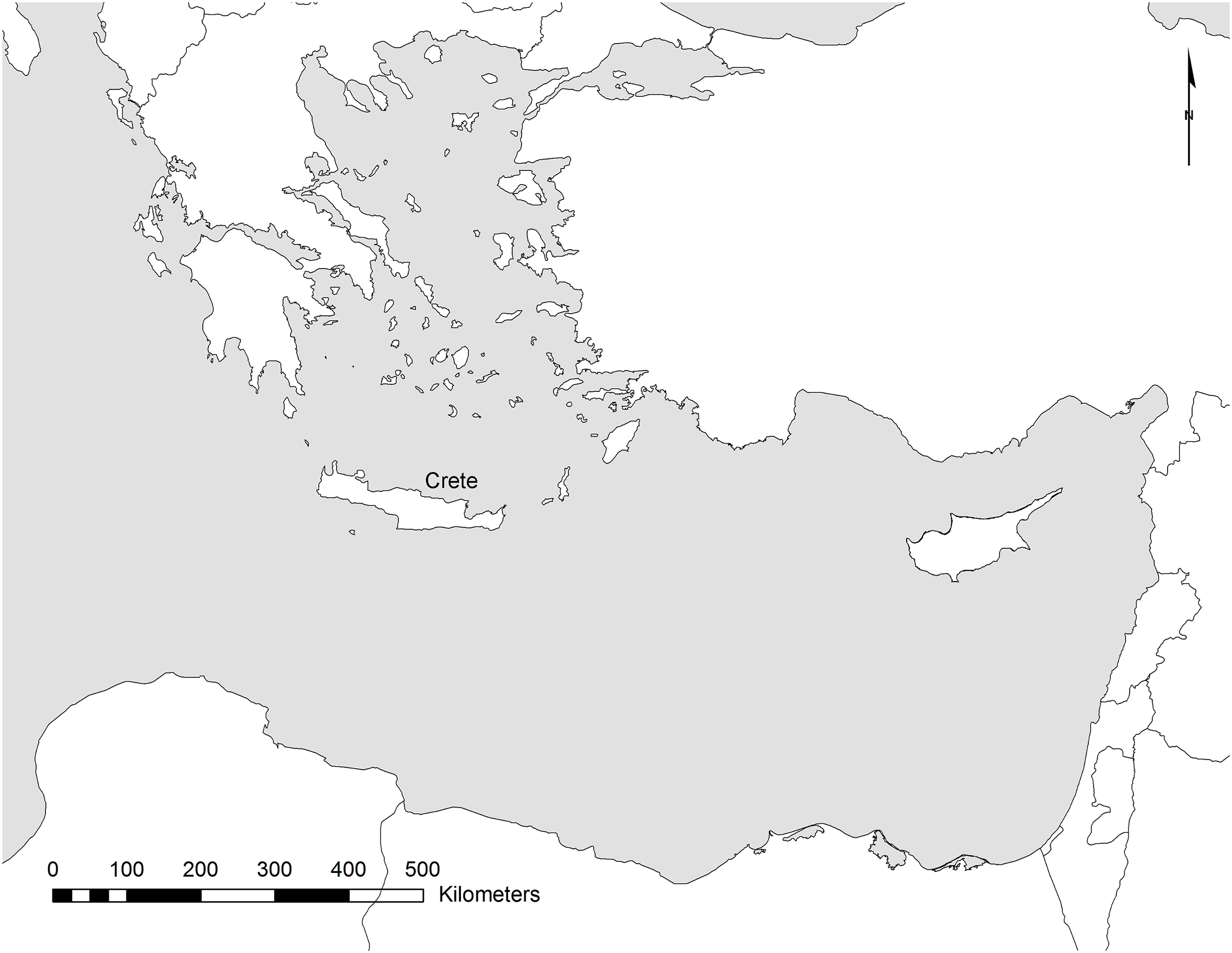
Map of the east Mediterranean showing Crete.
Cups – momentary drinking
As cups are designed for only momentary liquid containment (a few seconds, a few minutes, a few hours at most), separation of liquid from air is of minimal concern – hence an open form is fitting. What an open form also allows is viewing – such that the viewer may see the liquid they are imbibing. The act of drinking typically requires that the vessel is brought up to the mouth by the user, picking up the vessel and tipping it. The lifting of the vessel also means the hand is in contact with the vessel. In some cases, this action sees contact between the hand and the vessel body – if this is the case, the body must be sufficiently narrow for a grasping action. With a wider body that may not lend itself to such grasping, the vessel can be furnished with a handle; this handle is often oriented vertically to facilitate the tipping motion up to the lips. Handleless cups are often called goblets; for the reasons just outlined pertaining to grasping, they have a narrower lower body (and may be correspondingly tall, to ensure sufficient capacity). These forms are among the earliest drinking vessels in Early Minoan (EM) Crete (c. 3000-2100 BC) (Figure 2(a)), though they continue into the Middle Minoan (MM) period (c. 2100-1600 BC) (Figure 2(b)
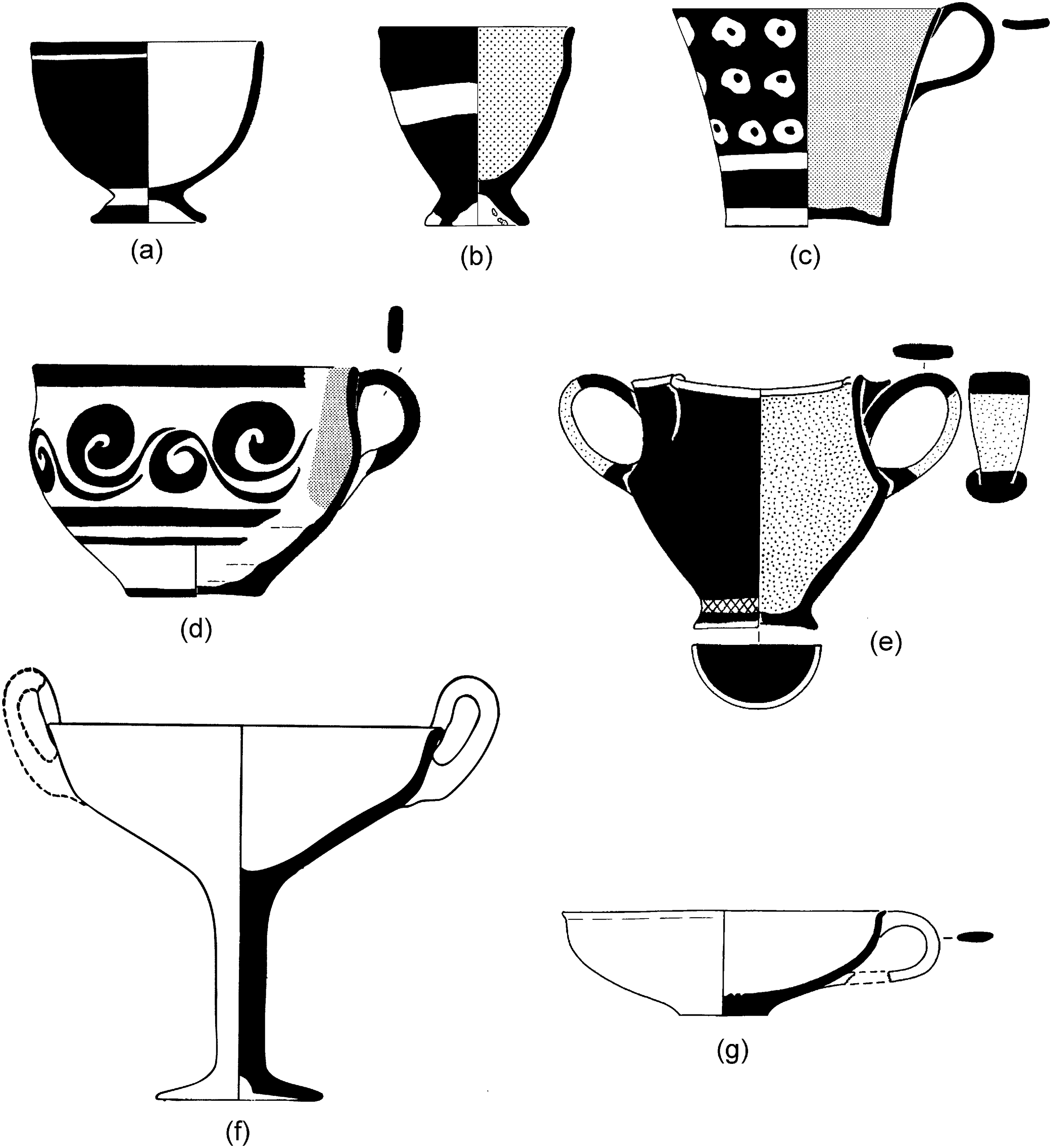
(a) Footed goblet, Knossos, EM IIB – Hood and Cadogan, 2011, Fig. 7.6, 310. (b) Footed goblet, Knossos, MM IB – Macdonald and Knappett, 2007, Fig. 3.1. (c) Straight-sided cup, Knossos, MM IIA – Macdonald and Knappett, 2007, Fig. 3.22. (d) Hemispherical cup, Palaikastro, LM IA – Knappett and Cunningham, 2003, Fig. 44, 422. (e) Kantharos, Myrtos Pyrgos, MM IIB – P3456. (f) Kylix, Knossos, LM IIIB – Hatzaki, 2007b, Fig. 6.30, 3. (g) Shallow cup, Knossos, LM IIIA1– Popham, 1984, Pl. 176, 4 Scale – 1:4.
The liquid consumed from these vessels is usually assumed to be wine (Wright, 1995). 3 Given the cultural importance attached to wine (Pratt, 2021) and its likely role in feasting ceremonies (Borgna, 2004; Haggis, 2007; Whitelaw, 2014), the containers used for its consumption incorporated further design criteria. That is to say, the conspicuous act of lifting the wine vessel up to the lips could be used to stage a display of status through the elaborate decoration of the exterior surfaces, and even the underside of the vessel. Cups, goblets, kantharoi and kylikes are typically the most elaborately decorated ceramics of Minoan Crete (Figure 3(a)–(d)). Meanwhile, their interiors may often be slipped or polished for the purposes of liquid containment and the overall effect of a well-finished vessel.
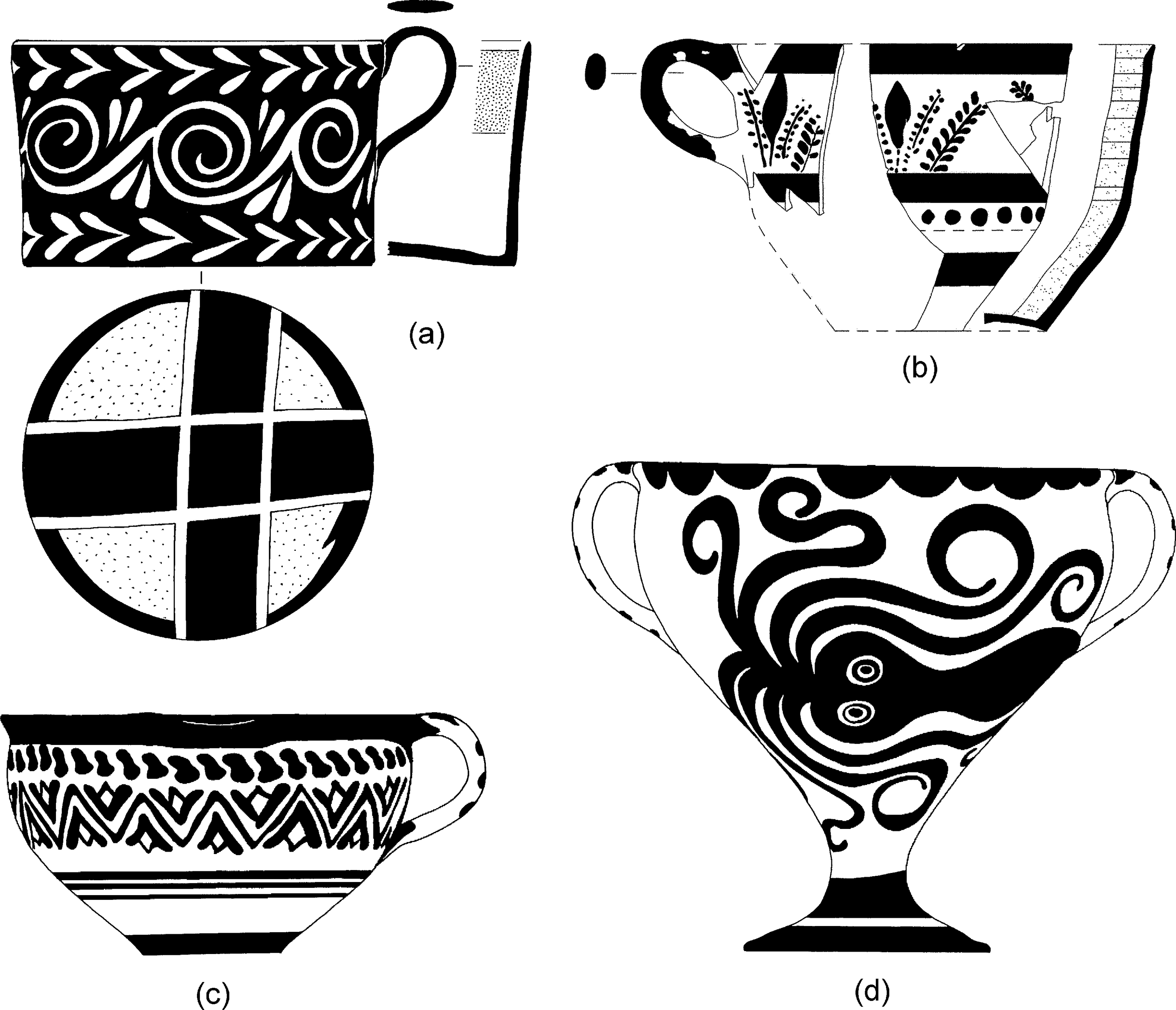
(a) Decorated cup, Myrtos Pyrgos, MM IIB – P3235. (b) Decorated cup, Palaikastro, LM IA – Knappett et al. in press. (c) Decorated cup, Knossos, LM II – Popham, 1984, pl. 147, 1. (d) Decorated goblet, Knossos, LM II – Popham, 1984, pl. 149, 2 Scale – 1:4.
Bowls – momentary serving
Bowls are much like cups in that they are designed for momentary containment, and so separation from the medium of air is not a major concern. Immediate and ready access to their contents is paramount; hence, they are to be open forms. Shallow open vessels might be thought of as holding rather than enclosing, and thus as differing from cups in various respects; though we may still understand this function as a form of containing (e.g., Richardson and Sofoulis, 2024). However, bowls as open forms do not have to be shallow – there are also deeper versions. This distinction between shallow and deep bowls begins already in the Early Bronze Age. In his study of bowls and other shapes for drinking and food preparation at the EM site of Myrtos Fournou Korifi, Whitelaw discusses the parameters of width and depth; shallow bowls may have been better suited as serving vessels (Figure 4(a)), while deep bowls (Figure 4(b)) could have been more easily filled and moved without spilling (Whitelaw, 2014, 252). Here, we need to distinguish between two kinds of serving. First, there is the kind where a bowl stands on a table and is used to serve from. Such vessels, remaining on the table for food presentation, should be quite broad and shallow, enabling ready access to contents, and even the distribution of different contents across their interior (e.g., bread, meat, and vegetables). The shallower the better, particularly as spilling while lifting is not a concern (since they are not brought to the lips, remaining on the surface on which they stand). Such a function may be readily imagined for shallow bowls with flaring or conical profiles, as that in Figure 4(c), though examples with rounded bodies, as in Figure 4(d), could conceivably have been suited to more liquid contents. In each case, handles are lacking, presumably because these relatively small, fine forms were not meant to be handled and lifted.
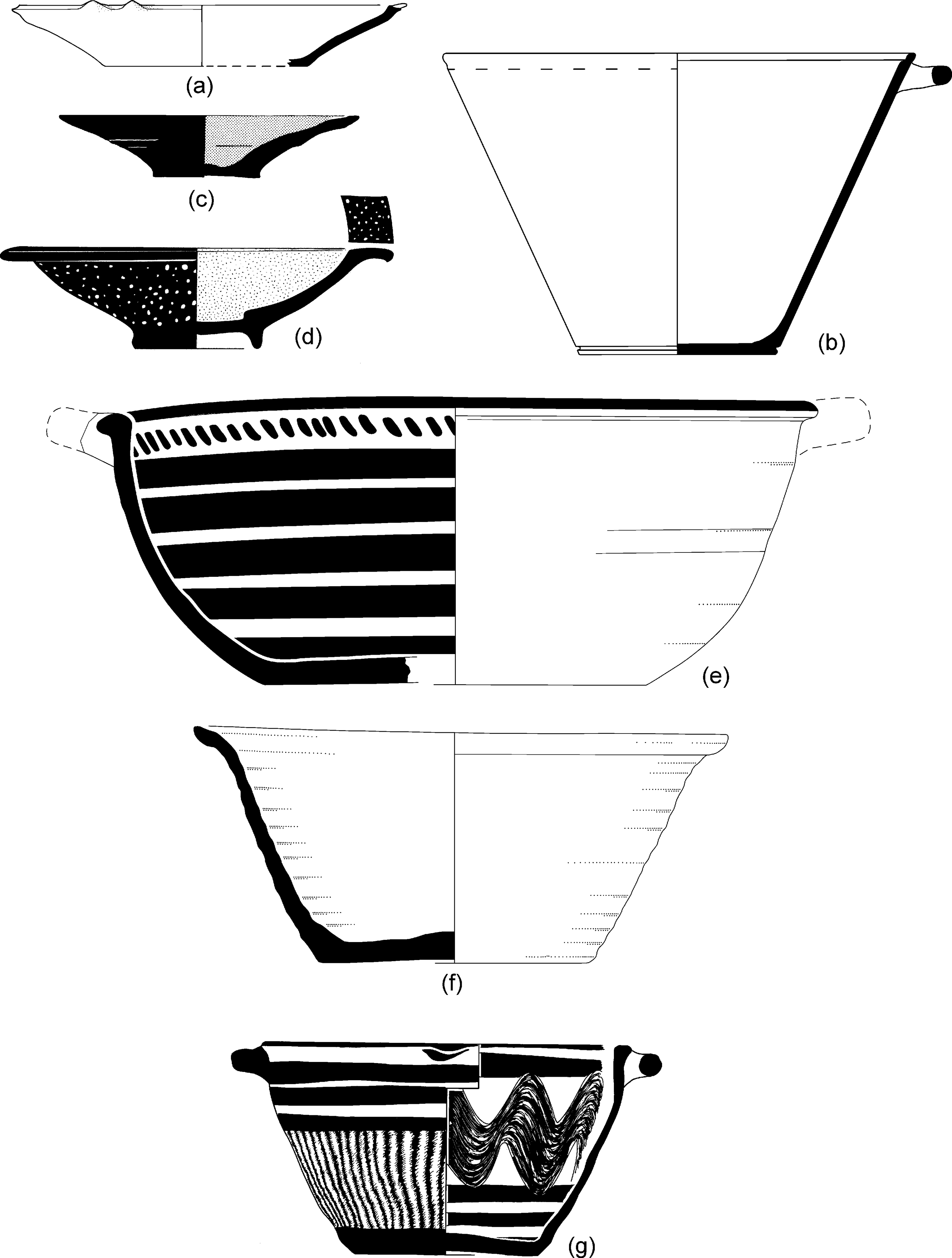
(a) Shallow bowl, Palaikastro, EM IIB – Knappett, forthcoming, Palaikastro Building 7 (PK/11929). (b) Deep bowl, Palaikastro, EM IIB – Knappett forthcoming, Palaikastro Building 7 (PK/7886). (c) Saucer, Knossos, MM IIA – Macdonald and Knappett, 2007, Fig. 3.18. (d) Rounded bowl with everted rim, Knossos, MM IIIA – Warren and Rethemiotakis, 2013, Fig. 3.4. (e) Bowl (with handles), Malia, MM IIIA – Langohr et al., 2022, pl. 15. (f) Kalathos (handleless), Malia, MM IIIA – Langohr et al., 2022, pl. 11. (g) In-and-out bowl, Palaikastro, MM IIIB – Knappett and Cunningham, 2012, fig. 5, 21, 383 Scale – 1:4.
The second kind is the bowl that could be used for serving in the sense of being brought from kitchen to table. For this function, deep bowls are more suitable: they may be less shallow not only because their contents are more liquid, but also if they are intended for a form of serving that requires regular transport from kitchen to table (see Whitelaw, 2014 above; Rutter, 2004). Various forms of deep bowls are quite common in Minoan pottery, following on from the EM examples mentioned above (see Figure 4(b)). Such bowls typically have horizontal handles or lugs to facilitate carrying, as can be seen in Neopalatial examples from Malia (Figure 4(e)), considered as suitable for food serving (Langohr et al., 2022, 90). These have an internal slip, further supporting this functional interpretation. While these have a conical profile, a convex profile on some might be viewed as offering further help in liquid content retention. When larger, coarser bowls of this kind lack handles, which they sometimes do (Figure 4(f)), it may be because they stayed on a use surface, and had a rather different function, used in preparing rather than serving food (Langohr et al., 2022, 90).
A few differences between cups and bowls can be highlighted. The bowl may generally be more associated with communal consumption than the more individualising cup. With a large shallow bowl in particular, a number of diners could reach and access it. The larger variants of deeper bowls could also serve multiple consumers. However, some bowls are more the size of an individual portion and can start to resemble cups in many ways. They will rarely have single vertical handles, but they can have horizontal handles that can serve to raise the vessel up, or they may be manipulated much like a goblet (see above). When such bowls start to resemble cups, in their function as tablewares, they may also have similarly elaborate decoration. Interestingly, because of their more open form and different role in serving, they may have decoration not only at the exterior, but also the interior. This similar treatment of inside and outside is seen across different periods, from the polished or burnished shallow bowls of the Prepalatial period, to the aptly named ‘in-and-out’ bowls of the Neopalatial period (Figure 4g), with similar dark-on-light decoration both inside and out (Hatzaki, 2015).
Jugs – momentary disbursement
Jugs relate to cups in that they, too, are intended for liquids. Indeed, the liquid contents of a jug may be directly disbursed into a cup. In this regard, they share another similarity: they are generally grasped and lifted up from where they stand. However, jugs are not brought to the lips; all that touches their rim is the liquid as it is decanted. What the rim design must accommodate is smooth pouring. For this, the spout rarely exists by itself – there is also usually a handle. The handle is often placed vertically and directly opposite the spout (Figure 5(a)), though this is not always the case: some pouring vessels have a single handle placed laterally to the spout, or two horizontal handles either side of the spout (Figure 5(b)). In these two cases, the spouts also differ: a beaked spout vs. a bridge spout. In some cases, the single vertical handle is combined with a bridge spout (Figure 5(c)). As with cups, the presence of one or two handles invites one or two-handed gestures. Another feature concerns the openness of the mouth and neck. Many Bronze Age Cretan jugs have quite narrow necks and closed mouths; while this facilitates moving with the vessel without spilling, and then directed pouring, it also means that the contents are generally not visible until they are poured. This was presumably not a problem for contents that could then be inspected in the open cup into which they were poured. However, some jugs have quite open mouths (Figure 5(d)), such that the vessel contents would have been visible. We might speculate on what kinds of content might have suited viewing or not before pouring. Another factor here is how exposed the contents are to the air. With an open mouth, it would be difficult to protect the contents with any kind of stopper, thus perhaps suggesting immediate consumption. Another way in which an open-spouted jug could have been used is to dip it into a basin to fill it up instantly; this action would not have been possible with a narrow-necked jug. While there is little to suggest the more closed Minoan jugs were stoppered, they would at least afford some kind of sealing, and hence encourage a slightly longer duration for their contents. A further observation concerns their size. Jugs are often larger than cups, as if their contents were to be disbursed into several cups rather than just one. However, Bronze Age Crete does also have plenty of small jugs, or juglets, which can have a similar capacity to cups.
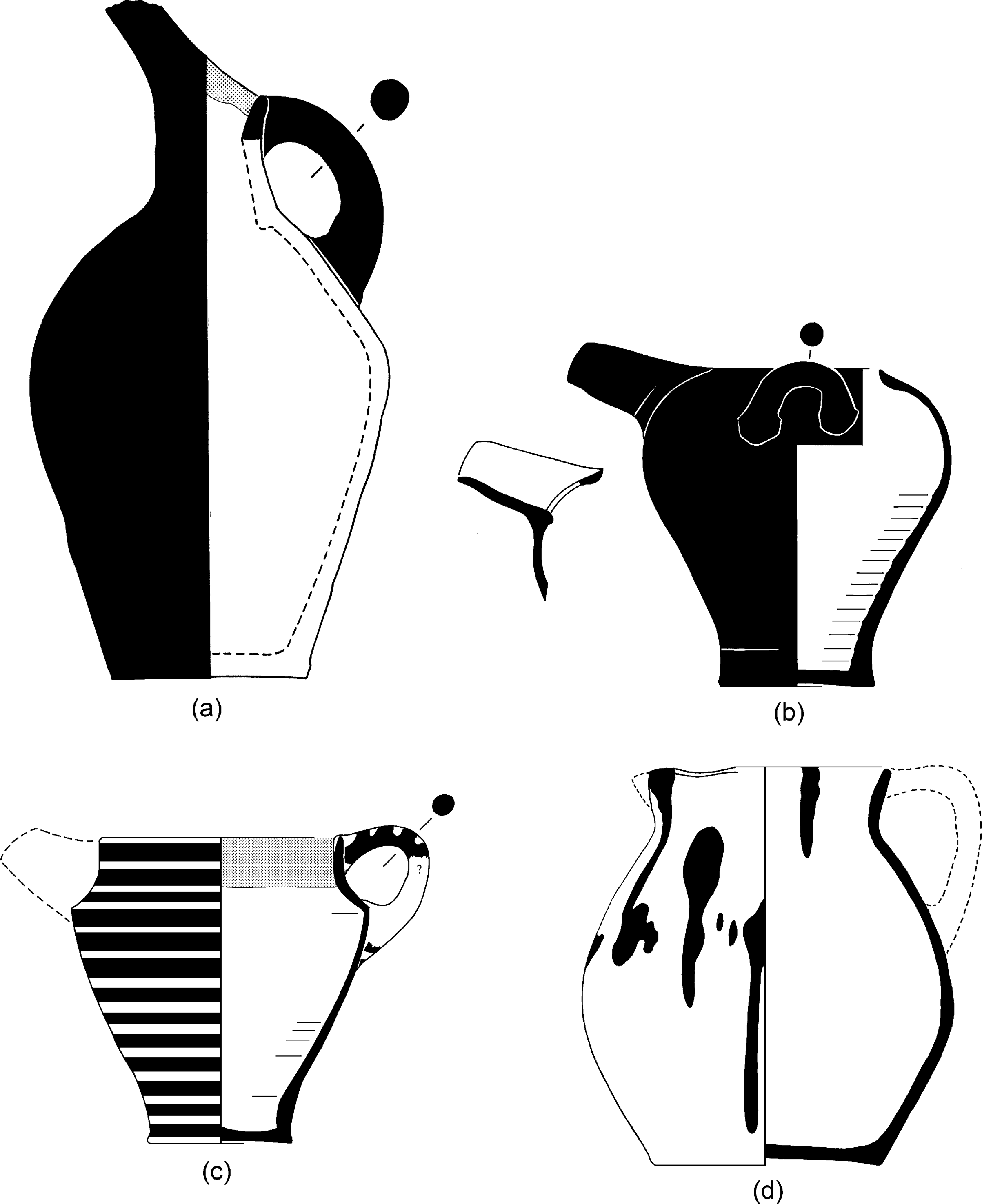
(a) Beaked jug, Knossos, MM IIA – Macdonald and Knappett, 2007, Fig. 3.27. (b) Bridge-spouted jar, Palaikastro, MM IIIA – Knappett and Cunningham, 2012, Fig. 5.3, 168. (c) Bridge-spouted jug, Palaikastro, MM IIB – Knappett and Cunningham, 2012, Fig. 4.13, 110 (d) Open jug, Palaikastro, LM I – Knappett and Collar, 2008, Fig. 29, 163 Scale – 1:4.
For those jugs with narrow necks, there is a strong differentiation between exterior and interior surfaces, with the latter typically untreated. Many such jugs align closely in their appearance with cups, as if forming tableware sets; one might imagine that momentary containment held true for both cups and jugs. However, some jugs are decorated more like storage wares, with trickle decoration (see Figure 5(d)); this could suggest a more extended duration for their contents. A limited surface treatment might also promote the evaporation that occurs through the pores of earthenware vessels, keeping their contents (especially water) cool.
Amphoras – intermediate liquid containment
If jugs are for disbursement into cups, then what filled the jugs? Here we can turn to amphoras, which are the next size up with greater capacity for liquids. However, amphoras in their design lend themselves to a different kind of handling and containment over a longer duration. Their mouths are closed, and their primary design feature is that they can be stoppered (cf. Bevan, 2014; van Damme, 2019). The stoppering function is facilitated by a flaring mouth, which is also often oval in shape to allow for disbursement of liquid contents (Figure 6(a)). One offshoot of the amphora is the transport stirrup jar, exhibiting a greater concern for control with the mouth sealed off (‘pseutostomos’ in Greek), and a smaller opening placed to the side (Figure 6(b); also Pratt, 2016). Their twin handles are attached vertically from rim to shoulder to enable carrying and pouring, although when full, the larger examples would likely be too heavy to lift from the handles alone. Here, the shape of the body is also important, since its ovoid-conical shape (though some are more globular) would facilitate porterage. However, none yet has the very narrow, pointed bases seen in later periods, designed for efficient stacking in ships’ hulls (Bevan, 2014).
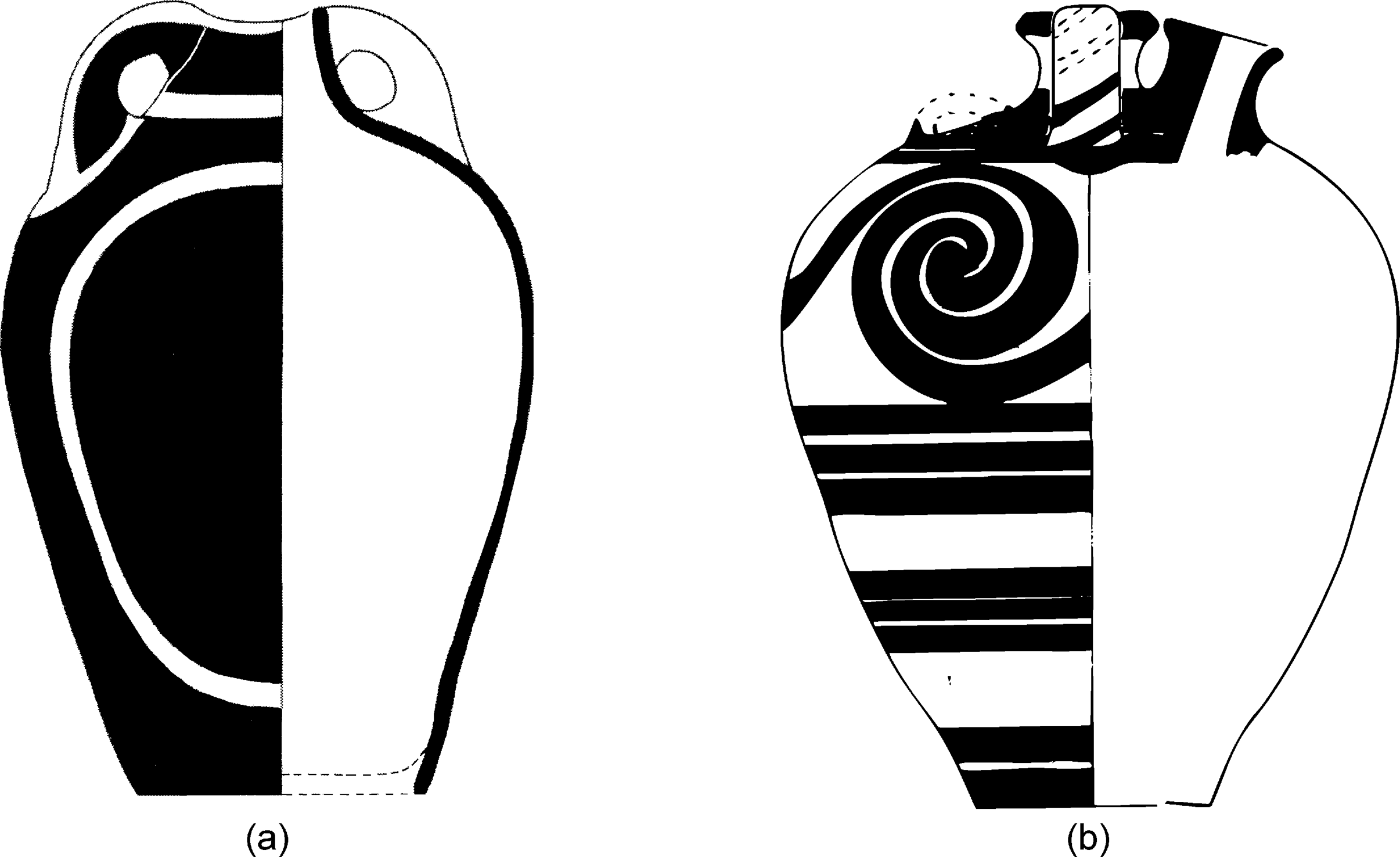
(a) Oval-mouthed amphora, Knossos, MM IIIB – Hatzaki, 2007a, fig. 5.8, 1. (b) Transport stirrup jar, Knossos, LM IA – Hatzaki, 2007a, fig. 5.18, 2 Scale – 1:4.
Amphoras rarely reach a size beyond what could be carried by a single ‘porter’. Bevan (2014) has stressed the importance trans-historically of amphora size and shape in relation to loading on and off ships, over the course of millennia. A study of maritime transport containers suggests their earliest occurrence goes back to the Early Bronze Age (Demesticha and Knapp, 2016). We may imagine that transport was indeed their primary function, and there is plenty of evidence from later periods of shipwrecks laden with amphoras; for the Bronze Age, we have precious few examples (Hadjidaki-Marder, 2021; Ozdas, 2022). Amphoras are also found in storerooms, where they may have been placed for a limited amount of time before their contents were consumed. With some journeys across the Bronze Age east Mediterranean probably taking weeks and not days, we should envisage an ‘intermediate’ duration for storage in amphoras – not hours and days, but weeks and a few months (rather than many months and even years – for which see jars below). 4
In terms of their decoration, Protopalatial amphoras tend to have their own distinctive appearances, such as the ‘discs and loops’ of east Crete, or the triple axe motifs of the Mesara (Poursat and Knappett, 2006), perhaps serving as forms of ‘commodity branding’ (Wengrow, 2012). While this trend continues in later periods, with transport stirrup jars, we do also see some amphoras with trickle decoration, aligning them more closely with storage pithoi, and perhaps then more extended durations. The stirrup jar, with its false mouth and narrow spout, is undoubtedly the most closed-off vessel discussed here, with a strong differentiation of interior and exterior. 5
Jars and pithoi – enduring liquid/semi-solid containment
Jars and pithoi have various features that signal their designed use for storage. Starting with jars, we might most usefully contrast them with amphoras. They have broad bases, suggesting stability was paramount. They also have relatively open mouths (usually a slightly incurving rim), enabling easy access and content visibility, but limiting transport. Most, like the example in Figure 7(a), have two horizontal handles, probably not able to support the jar's weight when full, but suitable for some manipulation, such as tipping. This may have been how the contents were accessed, and potentially quite regularly. If a jar contained 50 litres of olive oil, for example, and only a litre at a time was taken for consumption, it might have been accessed 50 times over the course of, say, 6–12 months. The trickle decoration, as shown in Figure 7(a), may be alluding to the process of removing olive oil from such a jar. Lacking any kind of spout, would some kind of dipper or ladle have been required, or would jugs have been dipped into the liquid? There are plain open-mouthed jugs that might have been well adapted to such a ‘dipping’ function (see Figure 5(d)). We should also consider whether jars with such wide openings may have needed a cover of some kind, made of ceramic, textile, stone or wood perhaps, one that could be easily removed and replaced; many jars do have a small collar at the rim to facilitate placement of a lid, and ceramic lids of an appropriate size do exist.
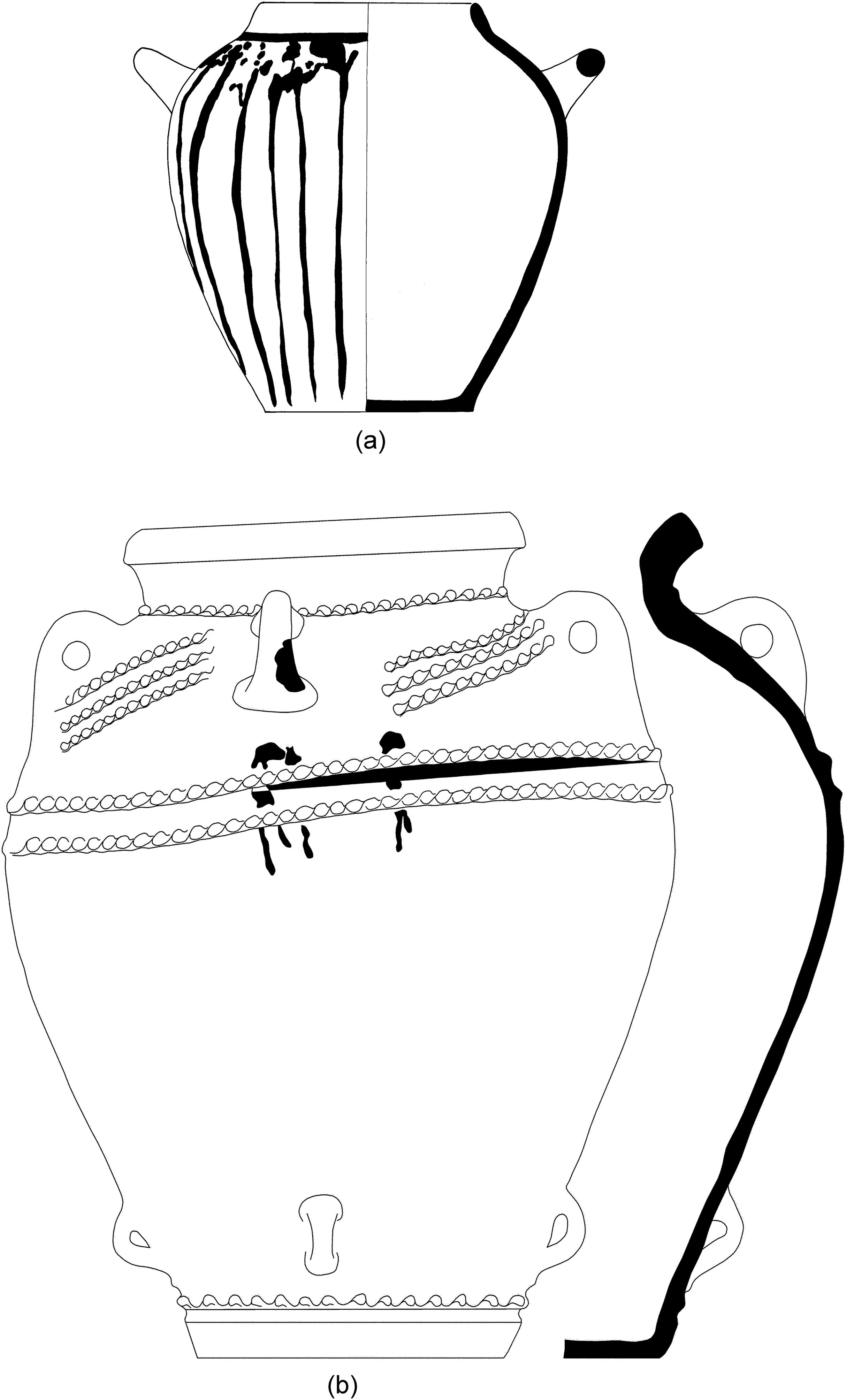
(a) Hole-mouthed jar with trickle decoration, Myrtos Pyrgos, MM IIB – N2402. (b) Pithos, with rope decoration, Palaikastro, LM IB – Knappett et al. in press Scale – 1:6.
When jars are made larger, their shape stays quite similar, though in Greek contexts they are usually called ‘pithoi’ (singular = pithos). They have different handle arrangements, now acquiring vertical handles, often a set of three or four at the upper body and a further set at the lower body (Figure 7(b)). The handles may have been for threading ropes that could then facilitate the movement of these cumbersome vessels; the rope cord decoration on many (see Figure 7(b)) may allude to this behaviour. Many are more than a metre high and with significant capacity: at Malia, examples from 60 to 126 cm in height ranged in capacity from 60 to 340 litres (Poursat and Knappett, 2005, 45; see also Bevan, 2018). They can be scaled up quite readily because mobility is of little concern: once moved from the potter's workshop to be placed in a storeroom, they likely stayed there throughout their use life. Nevertheless, we do also find examples that have been imported – sites in the Cyclades and coastal Anatolia, for example, Akrotiri and Miletus, have imported pithoi from Crete. So, we should not be too hard and fast in imagining jars were only ever static installations in storerooms; after all, they are also found in burials.
There are a few known ceramic lids of sufficient size to cover the rims of the larger pithoi. In such cases, it may be that slabs which could be easily slid aside might have been well adapted, and these could have been in an organic material such as wood. It is also possible that fabric coverings were used, of which no evidence remains.
The containing function of jars and pithoi is beyond the intermediate timeframe of amphoras. We might call it medium-term, envisaging a year-to-year duration, rather than long-term, which could imply multi-year. Although it is hard to know, wine, oil and grain contents would likely have been stored for up to 2 years (Cheung, 2024; Christakis, 1999; Halstead, 2014, 162; van Oyen, 2020, 7). When it comes to the exterior surface treatment, the prevalence of trickle decoration (Figure 7(a)
Pyxides – enduring solid containment
Pyxides (singular: pyxis) are a very particular kind of container, occurring throughout the Minoan ceramic tradition, but more sporadically than many of the other types discussed here. Perhaps this relative lack is due to their prevalence in burials, which are not equally well represented through time. Pyxides are usually mid-sized, with a similar capacity to jugs. In a sense, they are small jars, very commonly cylindrical in form (Figure 8(a)–(d)), though some globular pyxides exist too (particularly in the EM period). The cylindrical forms have an open mouth that maximises content visibility, and often a differentiated rim that is for lid placement (Knappett, 2023). Some do have their lids found with them. Handles are not usually a prominent feature, suggesting that portability may not have been to the fore. In any case, their form and size would have made them perfectly portable with two-handed carrying. They do not have spouts, indicating they were not designed for pouring liquid contents. They are often decorated like fine wares, suggesting a similar kind of function, placed on tables or similar surfaces for display. Their design would seem to make them well suited to storage of items that could be concealed from view by a lid, but also readily accessed when needed. Later examples are often associated with cosmetics and jewelry (Lissarague, 1995); a Bronze Age ivory pyxis from Mochlos did contain jewelry. It has been suggested that Bronze Age pyxides, like their Classical counterparts, were indeed primarily associated with women (D’Agata, 2020). What is interesting about their use to contain jewelry is that the objects in question are non-comestibles without an ‘expiry date’. So, we might say that pyxides could have been for multi-year storage, which in the framework outlined here we might view as long-term. In this regard, we can also consider relevant their frequent placement in burials.
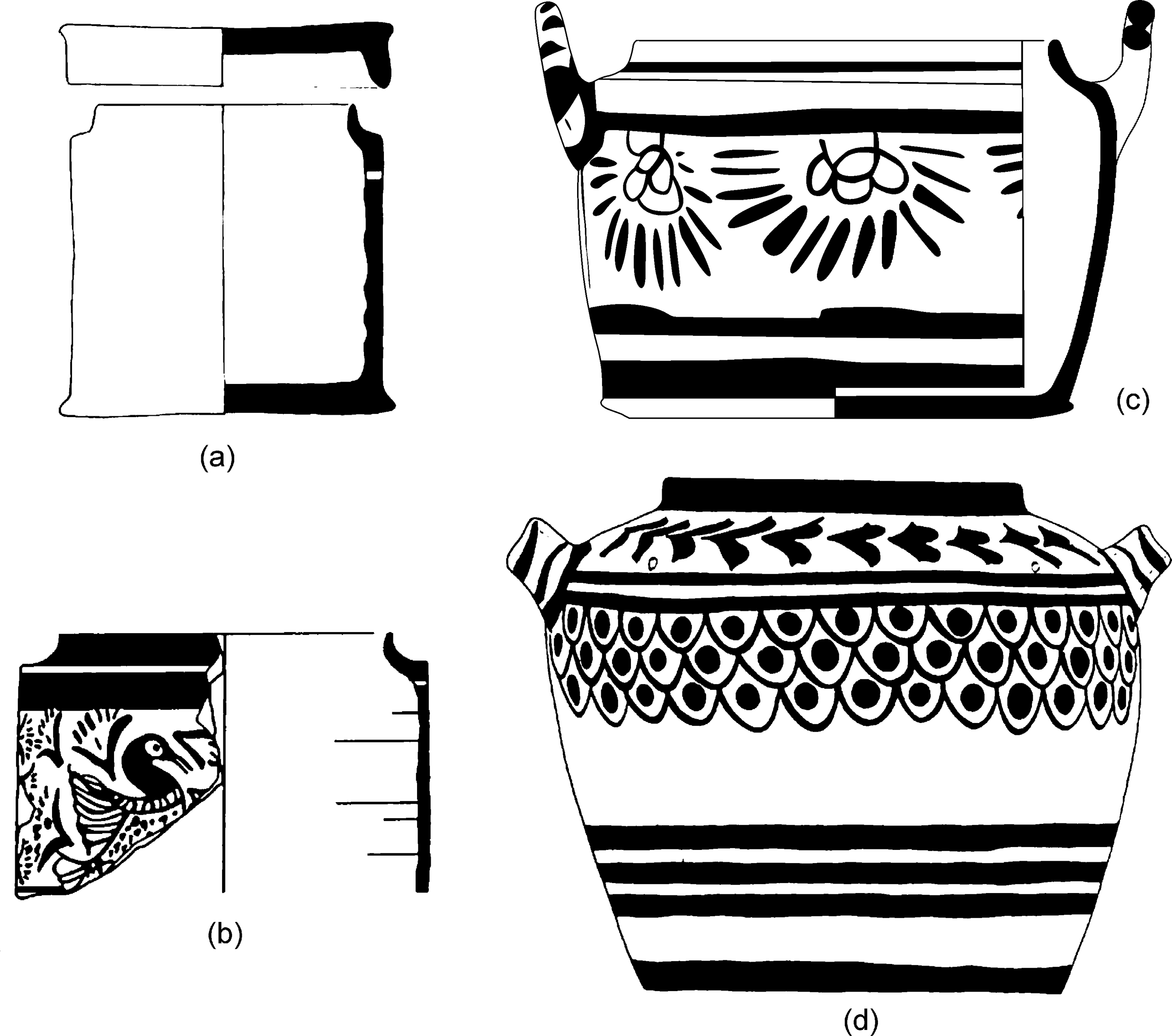
(a) Pyxis and lid, Knossos, LM II – Popham, 1984, pl. 155, 2. (b) Pyxis, Palaikastro, LM IIIA1-2 – MacGillivray et al., 2007, Fig. 4.31, 648. (c) Pyxis, Palaikastro, LM IIIA-B – PK22.0027. (d) Pyxis, Knossos, LM II – Popham, 1984, pl. 155, 8 Scale 1:4.
Moreover, when it comes to their decorative schemes, it is interesting that, despite being such open shapes, their interior and exterior surface treatments are usually quite distinct. We do not, for example, find any ‘in-and-out’ pyxides, even though this would technically have been achievable for an open vase. Their exterior decor, especially in the Postpalatial (LM IIIA2-B) period, is typically quite elaborate, with genre or narrative scenes (D’Agata, 2020, 308); bird motifs feature prominently too (e.g., Figure 8(b). For a container with prolonged closure, with its contents seemingly associated with female identity, both in life and death, this sharp distinction between exterior and interior stands apart from most tablewares, with their momentary disbursement. One might draw a connection with another form most commonly encountered in the funerary sphere: the larnax (Georgel-Debedde, 2025).
Cooking pots – heat conduction for liquid transformation
Bronze Age Cretan cooking pots are readily recognisable thanks to their tripod legs, attached where the base meets the lower body, and designed to allow the vessel to be placed above or adjacent to the coals in a hearth. They are made in coarse fabrics designed to withstand repeated thermal shock (see Müller, 2017). Experimental archaeology has shown how such vessels likely worked (Morrison et al., 2015). In terms of shape, we can distinguish broadly between two forms: one that is a shallow, open bowl (Figure 9(a)) and one that is a tall, ovoid jar (Figure 9(b)). By examining design characteristics in combination with use-wear analysis, Tsafou has been able to argue that the jar was likely used for lengthy simmering of liquid contents, while the bowl was adapted to the preparation of food with more solid consistency, thanks to faster evaporation (Langohr and Tsafou, in press). 6 The tall jar has two horizontal handles, suggesting a degree of manipulability, perhaps for tipping (not unlike the storage jars discussed above); while the bowl typically has the same, it often has an additional vertical handle (or lug) and a rim spout. Greater manipulability seems to be a feature of this type. The temporal duration of use surely varies accordingly: a matter of hours for the tall jar, and perhaps rather less for the bowl.
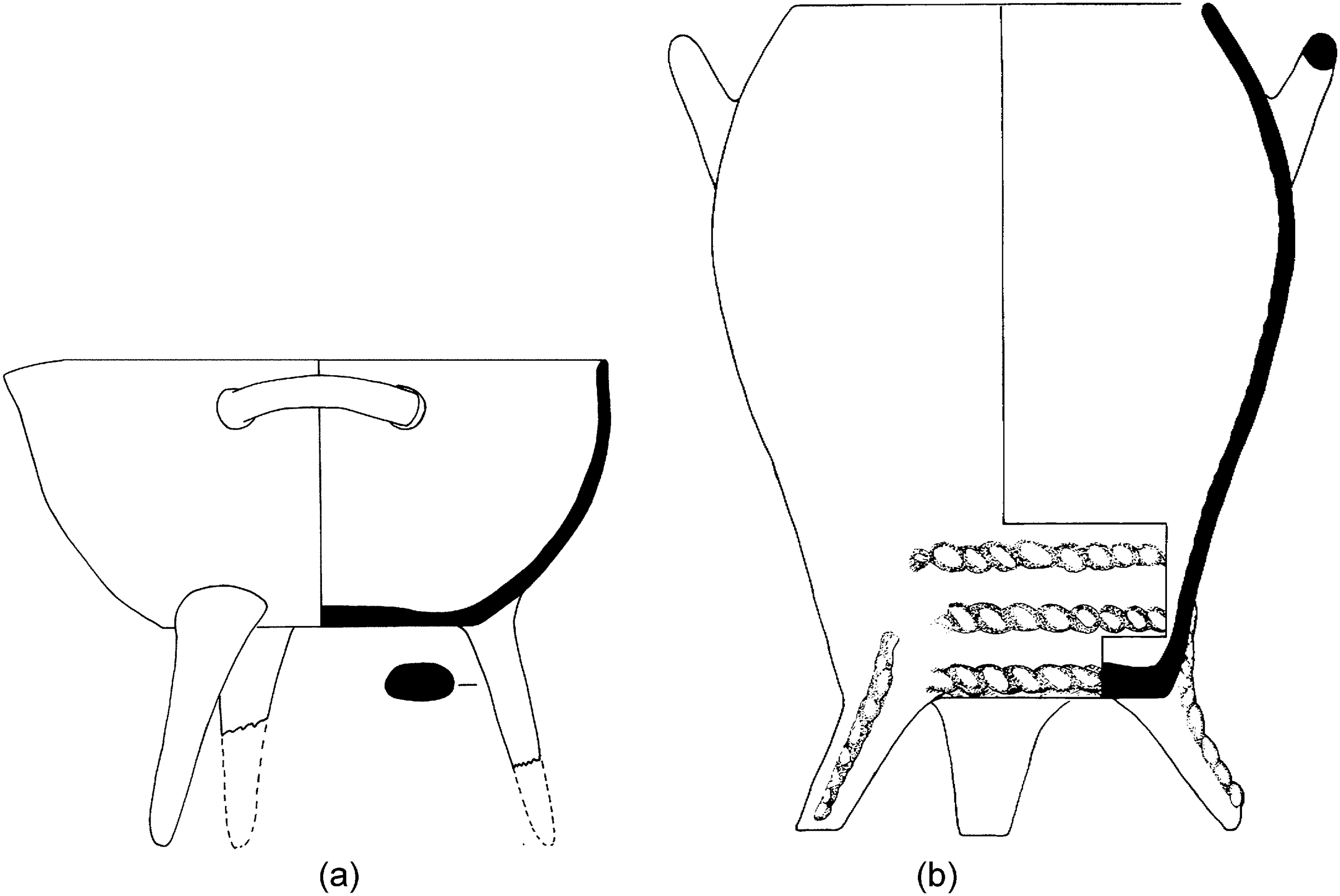
(a) Shallow tripod bowl, Knossos, MM IIA – Macdonald and Knappett, 2007, Fig. 3.32, 532 (scale 1:4). (b) Tall tripod jar, Palaikastro, MM IIIB – Knappett and Cunningham, 2003, Fig. 20, 177 (scale 1:8).
Minoan cooking pots are rarely if ever decorated, generally having plain surfaces inside and out. But here we might expect a different kind of relationship between container and contents, one in which the active transformation of the latter through fire directly generated use marks (Rompou and Tsafou, 2023; Tsafou, 2023), and hence a much more dynamic signalling of the interior on the exterior.
Lamps, fireboxes and incense burners
These containers share a function with cooking pots in that they are intended to withstand the medium of fire. Cooking pots mediate the heat from a fire at their exterior to transform the contents at their interior. Fireboxes may have performed similarly, though only containing a very small quantity of material, and with limited heat: one idea is that these small capsules with a spreading rim could have been used to make medicinal compounds, unguents, or aromatics (Figure 10(a); Poursat, 2013, 130–131). Incense burners (cf. Georgiou, 1986) may also have been used in the manufacture of aromatics (the term ‘incense’ is purely conjectural). They contained fire, in an enclosed manner, seemingly designed for the gentle application of heat to their contents (Figure 10(b)). They have rough, plain surfaces, not unlike cooking pots; perhaps the intention was similar in that the contents would come to be marked at the exterior as at the interior. Lamps contained fire within their interior, open forms with the aim of supplying light rather than heat. There are two main types, connected to the degree of intended portability. Handlamps are small and portable, essentially bowls with an incurving rim (Figure 10(c)). They have a vertical handle or ‘stick’ handle opposite a spout or groove for a wick. They contain a modest amount of oil that could be burnt for light over a relatively short duration, experiments suggesting in the region of 10 hours (Rueff, 2020, 305–306). Pedestalled lamps are larger, designed to remain in place – they too are bowls, rather more open than those of the hand lamps, and are elevated from the floor by a tall pedestal (Figure 10(d)) (c. 30 cm high – see Poursat, 2013, 123; Mercando, 1978). They often have two grooves for wicks, and contain more oil than the hand lamps, allowing a longer duration for lighting, even up to c. 150 hours for those with 0.75 l capacity (Rueff, 2020, 305–306). They can have lugs or handles at the underside, suggesting they were sometimes moved. Lamps are often treated with a thorough burnish all over, diminishing the differentiation between interior and exterior.
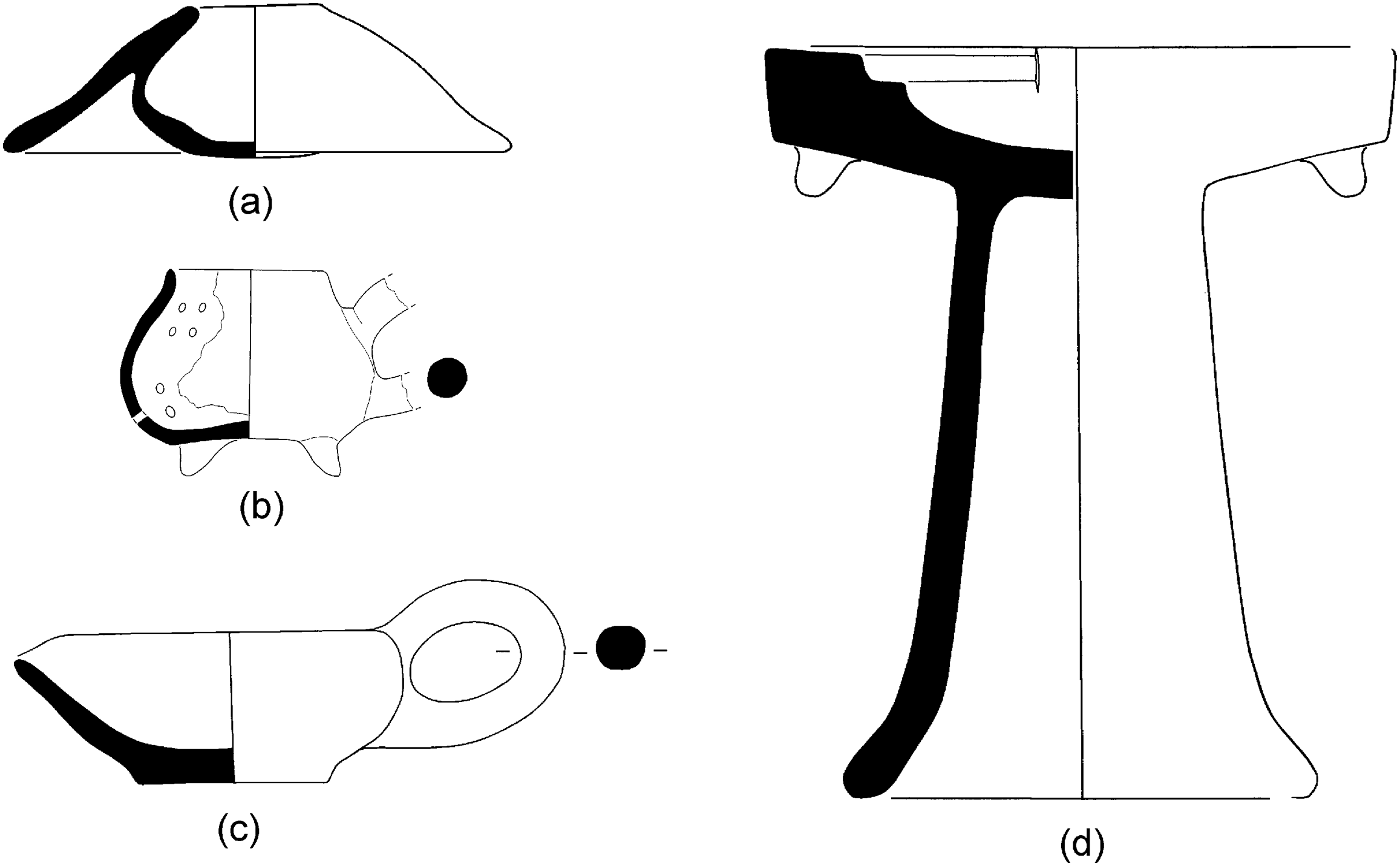
(a) Firebox, Malia, MM IIB – Poursat, 2013 (Mu V), Pl. 7.1, g. (b) Incense burner, Malia, MM IIB – Poursat, 2013 (Mu V), Pl. 7.2, a. E 1. (c) Handlamp, Malia, MM IIB – Poursat, 2013 (Mu V), Pl. 6.1, c. A 25. (d) Pedestalled lamp, Malia, MM IIB – Poursat, 2013 (Mu V), Pl. 6.3, k. A 168. scale – 1:4.
Discussion
What we can draw from the above is that ceramic vessels have distinctive design features oriented to containing over varying durations. Some contain and then release momentarily; others may not release their contents for several months or even years. These dynamics are closely tied not only to the media implicated in each case (liquid/solid/fire/air), but also to human bodies and their gestures. Vessels afforded pouring or portering, stirring or storing; we might understand such actions as ‘cultural techniques,’ as in the German media studies tradition (e.g., Siegert, 2015); or as bodily techniques, in line with the French tradition in the anthropology of techniques (e.g., Sigaut, 1991; Lemonnier, 1993, 2012; Coupaye, 2020), or even using affordances, from ecological psychology (e.g., Rietveld and Kiverstein, 2014). We can also understand design features such as spouts, handles, rims and lids as mediating between elements on the one hand, and gestures on the other, hence forming a kind of ‘connective materiality’. The handle allows the vessel to be brought to the mouth, with the rim touching the lips; the small stirrup jar is held in one hand, with the scented oil poured into the other, to be applied to the body. Surfaces too have a range of textures and ornaments that also act as interface, particularly when tactile, like burnishing or scoring, and incision or impression, not to mention barbotine, but also in painted effects such as polychromy. Exterior surfaces are especially implicated, but so may be interior surfaces, when it comes to open forms – such as bowls – with highly visible interiors. Design features and decorated surfaces come into play to differing degrees, as the conjunction of container and contents varies widely from open drinking and eating vessels, to more closed transport and storage wares.
We should also examine where these actions and gestures were taking place. Ceramic containers were used in a wide range of contexts in Bronze Age Crete from civic structures such as palaces, to cult places (peak sanctuaries), to burials. However, the majority were used in dwellings, which often contained both multifunctional spaces where many of these containers were used alongside each other, to specialised spaces such as storerooms. Medium-sized jars of varying shape and the more standardised large-sized pithoi were the most common form of container in storerooms; they were generally quite immobile, remaining in such rooms throughout their use lives, with the occupants intermittently scooping or ladling out some of their contents (Christakis, 2005). Cups and jugs, however, were stored in cupboards or chests, and brought out for drinking, sometimes in ceremonies. As for eating, some bowls behaved a little like cups, in that they were principally associated with the table; their role was the presentation of food, or its ‘serving’ at table. Other bowls, however, had a different role in serving, in that they likely travelled between kitchen and table. Pyxides were likely also confined to certain rooms, perhaps with more restricted access, alongside other personal belongings; but then they may have travelled beyond the house when accompanying the person into the funerary domain. 7 Amphoras went even farther afield, not only out of the house but out of the community, used to transport commodities across a region and perhaps beyond. Whitelaw has estimated that a typical household assemblage in Protopalatial Crete consisted of 200 vessels, with even more in the Neopalatial period (Whitelaw, 2024). Some of these vessels offered, metaphorically speaking, a kind of nested containment within rooms within the house, while others moved in and out of the space over varying durations.
As briefly mentioned above, some containers were used not only in houses, but also in burials, particularly inhumations – which in Bronze Age Crete are sometimes placed on the floors of house-like structures (Legarra Herrero, 2014), but also commonly contained within ceramic vessels. Some of these are specialised forms known as larnakes, which can take various forms, like tubs or chests, the latter with dedicated lids. Other vessels used in burial are pithoi, much like those used for storage in houses; indeed, 60% of those used in burial in the late Prepalatial and early Protopalatial periods reprise forms used in domestic contexts (Vavouranakis, 2014). In these cases, there are strong connections drawn between the ceramics sustaining life in the house, and the continuing sustenance and protection offered by such containers in death. It has been argued that the increased use of ceramic containers in burials in the late Prepalatial period signals a heightened concern with the regeneration of life (Vavouranakis, 2014, 216). The deceased is also more fully contained, placed in a vessel before then also being placed in a burial structure; some pithoi were also inverted, further closing off the body. The duration of such bodily containment may seem to far exceed that of most domestic containment; however, burials were revisited, and some larnakes especially were reused multiple times.
The position developed in this paper enables us to conceive of container and contained as in more than just a set spatial relationship, but in a changing temporal one. Because of release, whether intended or accidental, containment has a duration. We are then obliged to recognise the variable relations with past, present and future embodied in different container technics: some momentary, some much more extended. Certain vases, such as cups, may only ever contain their contents momentarily; in addition, any individual cup may only survive a few months before breakage anyway (Whitelaw, 2024, 136). Whereas a pithos, on the other hand, could contain for years, and likewise endure as a container for decades. Thus, in any given household assemblage of the Cretan Bronze Age, containers and their contents have parallel lives, of differing pasts and futures. It also seems likely that those who used these containers came to understand time at least in part through the ways they related to them (cf. Fortis and Küchler, 2021).
Conclusions
On a more speculative note, are there some modest implications for how we might imagine containment more generally, even in the present? Archaeologists have increasingly sought to develop ‘futurity’ perspectives, particularly as a form of response to the environmental crisis of the Anthropocene (e.g., Crossland, 2014; Edgeworth, 2021; Pétursdóttir and Sorensen, 2023). What we could cautiously suggest is that a singular spatial outlook on containment is quite common, and inflects how we envisage contemporary practices too. Given what was noted above from conceptual metaphor theory concerning the embedded nature of inside–outside image schemas, it is also understandable. We could provide as an example of this spatial metaphor the ‘Spheres’ philosophy of Sloterdijk, quite inspiring in many ways (Hui and Lemmens, 2017; Sloterdijk, 2011, 2014, 2016). But to think that containment is a fact of spatial control is misleading, and even damaging. Once we start to inject the temporal, to consider duration, it is hard to sustain this myth of control. Or, as Richardson and Sofoulis put it, ‘this pollution of our lifeworld makes it hard to theorise any form of container without thinking about failures of containment, or contemplating the uncontainable’ (2024, 9). Indeed, the ‘containment’ of landfill is imperfect – leachates have a habit of always leaking out (Hird, 2013). Nuclear containment is another case in point. The oceans display some of humanity's poor grasp of the inevitability of uncontainment. If we really do imagine that the container controls its contents, then we are succumbing willingly to a kind of amnesia. Recognising duration makes it impossible to forget. This paper is a small attempt at its demystification.
This integrated, holistic approach to containers and their contents helps us to see how an ancient society, in this case Bronze Age Crete, used materials, techniques, and gestures to construct spaces for time. By studying ceramic vessels explicitly in terms of containment and release, while framing those processes in terms of duration, we can begin to understand containment more fully as a dynamic phenomenon.
Footnotes
Acknowledgements
My sincere thanks go to Ludovic Coupaye and Charlotte Langohr for their invaluable feedback on earlier drafts. I am also grateful to the four anonymous reviewers for their insightful comments. Figures 2–9 are all courtesy of the British School at Athens; Figure 4(e–f) and Figure 10(a–d) are courtesy of the Ecole Française d’Athènes.

Funding
The author disclosed receipt of the following financial support for the research, authorship, and/or publication of this article: The author wrote this article with an Insight Grant ('Containing Cultures: A New History of Minoan Pottery’) from the Social Sciences and Humanities Research Council of Canada, and a Fellowship from the John Simon Guggenheim Memorial Foundation.
Declaration of conflicting interests
The author declared no potential conflicts of interest with respect to the research, authorship, and/or publication of this article.