




Abstract
This article examines the dynamism of art and material culture within the Gija community of Warmun, in the East Kimberley region of Western Australia, and how it is used to sustain continuing traditions and negotiate change. Ethnographic accounts of events surrounding the creation, use and circulation of artworks and material culture reveal how they operate within networks of kinship and custodial responsibility. An analysis of the Warmun Community Collection introduces the categories of enculturation, acculturation, and hybridity to illustrate how Gija people have responded to internal and external socio-cultural systems amongst socio-historical change. Drawing on the concept of relative autonomy, the article argues that in Warmun, cultural succession through artwork and material culture is a relational process that maintains degrees of independence, whilst being shaped by internal and external forces.
Introduction
In October 2011, I sat in a room with four senior Gija people and several art historians, conservators and an art centre manager, surrounded by flood-damaged, muddied objects and artworks. Everyone had converged at a university conservation centre in Victoria (Australia) to discuss restoration and conservation strategies for the artworks and objects damaged by a flood that struck the Gija Aboriginal community of Warmun in north-east Western Australia, seven months earlier. Immediately after the flood, the Warmun community was evacuated: several hundred residents and artworks and objects of historical, artistic, cultural, financial, and sentimental value, many from the Warmun Community Collection. The impaired artworks and objects were taken to the nearby town Kununurra (197 km north of Warmun) for damage assessment, and those in need of treatment were subsequently transported to the Victorian conservation centre. Although the meeting was designed to determine conservation treatment for the damaged objects and artworks, provenance and stories
1
were also discussed with the Gija custodians and seniors and inscribed on a new register. ‘What's the story for this one?’ the conservator Paul
2
asked Nyawoorroo, a senior Gija woman, who squinted and pursed her lips before responding: ‘That one Garn’giny [moon]’. Set against a black background, the painting depicted an upward-hanging crescent moon with a four-pointed star above it. ‘Did you do this one?’ Paul asked further. Nyawoorroo squinted again and replied: ‘yep. Garn’giny’. Paul wrote Nyawoorroo's English name as the artist for the painting on a bound document. I looked down at the older register in my hands with a photograph of the same painting, made eleven years earlier. Penned by a different hand, it read another name as the creator.
For Gija people, totems serve as markers of a relational network that bind humans to non-humans, through principles of reciprocity and interdependence. At birth, Gija people receive a Gooniny, a ‘djeriŋ’ (conception totem) (Kaberry, 1937/1938: 279, also spelt Jarrinybe in Kofod et al., 2022:167) and subsection (skin) classification, each distinct. 3 Gooniny can be inherited bilaterally and through fictive kinship. In contrast, Jarrinybe is an incarnated totem acquired through material mediation. Humans inherit their Jarrinybe when a man kills an animal near a waterhole, and his pregnant partner eats the meat and falls ill. It is understood then that the spirit of the animal has entered the woman's womb (Kaberry, 1937/1938: 279), marking the establishment of the child's Jarrinybe and creating a permanent bond between the child and animal (Elkin, 1932; Worms et al., 1986). By comparison, subsection totems are predetermined and inherited matrilineally through one of two moieties. However, those whose parents were not ‘straight skins’ (partners not made within their generational moiety) often claim two skins determined by each parent (Kofod et al., 2022: 14).
While Jarrinybe, Gooniny and subsection classifications are relatively stable in Gija society, external influences, evident through the conservator's notation, can unintentionally and unpredictably influence cultural succession. This article examines Gija cultural succession through historical and contemporary artworks 4 and material culture. I argue that cultural succession involves negotiation within and between different social and cultural systems, through human action and the objects they make. Moreover, interaction between the Gija cultural system and external systems drives innovation and the creation of new and hybrid forms. Despite external influences such as Catholicism, pastoralism, art workers, the art market and social change, elements of the Gija cultural system endure and retain independence, relatively autonomously (drawing from Althusser, 1969; Godelier, 1977 and further discussed by Morphy and Morphy, 2017).
The Warmun Community Collection
The Garn’giny painting is part of the Warmun Community Collection (henceforth, ‘the Collection’), a mélange of artworks, material culture and various cultural media predominantly made by Gija seniors in the late 1970s and early 1980s in Warmun and gifted to Sisters and the-then newly established Catholic school, Ngalangangpum. The items were first used by Gija seniors for a ‘two-way’ educational programme, where Gija language and cultural practices were taught alongside the Western and Catholic curricula. This was a time of significant social and political change in Australia, as government policies and legislation were developed to support Aboriginal self-determination. 5 Over its life, the Collection has expanded and been moved to various locations in Warmun, where it has undergone formal registration, improved storage and value transformations (for a detailed history see Massola, 2023). It has been shaped through the involvement of multiple groups and individuals, reflecting complex social, educational, political and cultural entanglements.
Currently, portions of the Collection are in storage and while others are on public display within the Warmun Art Centre grounds, where they are accessible to local Aboriginal community members. It is managed primarily through its two custodians and in collaboration with the Warmun Art Centre. It is used as a resource for the Ngalangangpum School, interstate academic programmes, and art-related initiatives. The Collection is documented in a range of written records and has at least four different registration systems, with some objects assigned multiple registration numbers. The first Registration Book and Collection Audit (Coote, 2000) included object files for 271 items. It provided information on provenance, stories, and titles gathered through interviews with creators and their families by conservator Karen Coote and Warmun Art Centre employees. Some files have detailed notes, others are incomplete, blank and marked with question marks. Notably, 129 objects in the Registration Book lack attribution, titles, or stories. A National Significance Assessment (Davidson, 2006) was conducted six years later to highlight the historical value of the Collection and attempt to secure future funding.
Following the 2011 flood, new catalogues and reports were created, including a ‘Collection Catalogue’ (Ormond-Parker et al., 2013a), a ‘Collection Conservation Report’ (Ormond-Parker et al., 2013b) and a catalogue of items temporarily held Kununurra immediately after the flood (Centre for Cultural Materials Conservation, 2011). These post-flood documents focus on items with conservation needs and include artworks from artist estates, for commercial sale, and informally added by Art Centre managers during the 1990s and 2000s. A ‘Preservation Needs Assessment’ (Lewincamp and Scott, 2016) was created after the Collection's return to Warmun. As of 2022, a Master Register (Rivers et al., 2022) is maintained in both digital and physical formats, and the Collection has increased to 450 items. Warmun Art Centre plans indicate ongoing development. 6 In summary, the Collection has been made, remade and continues to be made by a range of people.
Methodology and theoretical framework
During my doctoral fieldwork in Warmun, I observed a range of engagements with and responses to material culture, commercial artworks and the Warmun Community Collection. In my research on the social life of the Collection (Massola, 2023), I found that ownership and responsibility for certain artworks and objects were clear, while for others, uncertainty and disengagement prevailed. Community members expressed care for the Collection's preservation and the importance of it being in Warmun, alongside indications of hesitation and proprietary interest. I attribute this variability to two significant factors that are interrelated: firstly, the items were initially given as gifts to the Sisters and the School, created solely as pedagogical aids for transmitting Gija, Catholic and Western beliefs and practices and secondly, and pertinent to artworks more broadly, Gija customary Law (the system of social and cultural norms in Warmun) prescribes that one should not speak for another's artwork, Country, totem, or story unless succession is established and recognised, with avoidance expected if individuals are deceased. For some Collection items, there is no documented provenance, or the creators are deceased, and/or succession has not been established. Therefore, clarity around who has ownership of particular items and who can speak for them is complicated.
As such, this article does not seek to fix the meaning or resolve the provenance of artworks and objects but magnify the complexity of these issues. I am concerned with the dynamism of art and material culture within the Gija community. Unlike Brady et al. (2016) study of local Aboriginal perspectives and interpretations of Yanyuwa rock paintings in Carpentaria, my focus is not on current Gija perspectives of the Collection or artworks, though this might offer a specific decolonised viewpoint. Instead, I examine the ways that people in Warmun use artworks and material culture to act. Although material forms hold properties and values that support Gija ways of being, it is Gija people who actively shape their meaning and use, and who allow non-Gija audiences to encounter and engage with Gija worldviews. I argue these engagements assert the relative autonomy of Gija cultural continuity.
This article contributes to recent discourses in the anthropology of art (e.g. Ingold, 2019; Kisin and Myers, 2019; Schneider and Wright, 2021) that move beyond earlier frameworks that focused on either semiotic or relational analysis by combining ethnographic, archival and visual analysis. Drawing on two sets of data from different spatiotemporal contexts, though all conceptually associated with or geographically located at the Warmun Art Centre, I present ethnographic observations of intercultural and intracultural interactions involving artworks and material culture and give an analysis of the Warmun Community Collection.
To begin, I use ethnographic description to examine the relational nature of cultural succession in Warmun at the everyday level. I focus on two occasions where people shape and respond to protocols and processes of succession involving Gija customary law and the priorities of the Art Centre, through an artwork and a handmade object. I argue that cultural succession is a relational and contingent process, and whilst objects lack intrinsic agency in themselves (Morphy, 2009), they are ‘secondary agents’ (Gell, 1998: 36) used by people to act.
In the second part of my analysis, I show how the Collection indicates varying degrees of interaction with, and influence from, both within and beyond Gija society. I identify three thematic categories that represent varying levels of influence from internal and external systems: enculturation, acculturation, and hybridisation. This tripartite categorisation aligns with, but extends from, Gosden and Knowles (2020: 5) three-part ‘model of historical change’ from in their work in Melanesia. I construct these categories based on the accompanying documentation in the registers, their visual typologies and their functional qualities, bearing in mind that the records are at times incomplete, ambiguous and conflicting. Moreover, I do not foreclose the possibility of multiple interpretations and acknowledge the limits of my interpretation, 7 which is shaped by my academic training, periods of fieldwork and my positionality as an Australian woman with Italian, Irish and Danish heritage. While my classifications appear to contradict a dynamic and reflexive reading, they reveal how people use art and material culture to adapt, negotiate and select internal and external systems and elements.
The first category, enculturation, reflects the minimal impact of externality and the maintenance of Gija tradition, evident in the continuing use of totems, the non-iconic designs, the object file information and functionality. It includes weapons, ornaments, carvings, and paintings. The second category, acculturation, contains representations of Catholic beliefs and processes of Catholic acculturation, through icons, symbols, thematic content and notes on the object files. The third category, hybridity, combines elements of the first two, resulting in innovative forms, through icons, symbols, totems, materials, the notes and thematic content. While the categories serve as analytical tools, they risk imposing fixed boundaries on dynamic cultural expressions. Arguably, all items bear the imprint of external influences and systems, given the history of intercultural relationships in the region and the materials used (e.g. commercially bought canvas and painting materials). My aim is not to essentialise or isolate, but to highlight patterns of continuity, adaptation, and co-presence.
In addition, three visual typologies are identifiable within the Collection: monosemic totems, polysemic symbols, and non-iconic, non-figurative elements (dots, lines and blocks of colour). Non-iconic and non-figurative elements reflect enduring visual traditions of the East Kimberley School of Art and the ‘Warmun School of Art’ (see Akerman, 1999, 2005; Stanton, 1989). Totems strongly resemble what they signify and relate to Gija cosmology. Symbols are flexible and allow a range of meanings shaped by the context in which they were made, as Nancy Munn (1966) noted in her research, the meaning of Warlpiri symbols can shift depending on the context and the interpreter's perspective.
Australian Aboriginal art centres, community collections and the decolonial context
Australian Aboriginal art centres provide a platform for Aboriginal people to market their artwork to galleries, institutions, and the broader public. Artworks are a means of transmitting elements of cultural knowledge and practices within and outside the community and are a source of income. They mediate internal and external socio-cultural systems. They have commercial, cultural and social imperatives and are subject to the internal priorities and logics of the local members, the external art market, and formal, informal and hybrid economies. Proceeds from sales are returned to the artists and reinvested in the centre's operational costs. Before the Warmun Art Centre was established in 1998 (Healy, 2002), East Kimberley Aboriginal people made and sold artwork through Waringarri Arts (in Kununurra) and several independent consultants, including Mary Macha, who were influential in the collection, promotion and sale of artworks. After two earlier ‘Arts Centre’ attempts in Warmun faced ownership and financial challenges, Gija people established the Warmun Art Centre. The Warmun Art Centre became an Aboriginal-owned, not-for-profit corporation, governed by the Office of Registrar of Indigenous Corporations, operating under the CATSI Act, which requires a Board of Directors of local Aboriginal people for governance. Since its inception, it has operated as an intercultural enterprise and is reliant on non-Aboriginal staff for operational management.
Indigenous-governed and co-managed organisations like the Warmun Art Centre aspire to facilitate the transmission of locally specific Indigenous knowledge, enabling both retrospective and prospective engagement with artworks and material culture. They not only sell artworks but also hold community archives, heritage records and collections. As a space that houses the Warmun Community Collection, the Warmun Art Centre shares similarities with other initiatives in Australia that hold archives, collections and records, such as Buku Larrnggay Mulka in Yirrkala (Edmundson, 2022) and the Strehlow Research Centre in the Northern Territory (Gibson, 2020). While each of these centres differs in content, history, and sociocultural context, they all strive to support socio-cultural succession, preservation, and the (re)production of local languages and practices. Central to their function is the preservation of material culture and objects and their accompanying documentation, both physical and digital.
Current discourse in museum and archival sectors focuses on supporting Indigenous communities to establish and maintain archives and ‘keeping places’ for the preservation of cultural heritage (Brown and Peers, 2003; Iskander, 2016; Lonetree, 2012; McMaster, 2019). This is a response to broader critiques that museums and institutions can perpetuate the structural and ideological exclusion of non-Western peoples (see Andrews, 2021 for an example). Such critiques are part of the global movement towards Indigenous sovereignty within settler-colonial states (see the foundational work of Smith, 2012; Tuck and Yang, 2012), integrating ‘Indigenous knowledge’ in systems, practices and structures. Central to this shift is facilitating reconnections between Indigenous peoples and their objects and collections, ensuring control over their cultural materials. Models of social, emotional, and cultural well-being are developed as ethical frameworks for re-engagement (Thorpe, 2024) as institutions endeavour to support Indigenous sovereignty and undergo repatriation processes (e.g. Christen, 2011; Ngoepe and Bhebhe, 2024).
As descendants, families, and kin renegotiate their relationships with old, archived, stolen, appropriated and ‘museumed’ objects, research on re-engagements is expanding (e.g. Andrews, 2021; Batty, 2005; Curran, 2019; Gibson et al., 2019; Sculthorpe, 2017). Institutions continue to be critiqued for perpetuating exclusionary practices, such as limiting access and engagement through the imposition of ‘new protectionism’ (see Thieberger et al., 2024). I posit that engagement extends beyond preservation; it involves dynamic and ongoing processes of learning and negotiating relationships between people and objects. It involves descendants, families, and kin actively participating in shaping the narratives surrounding their cultural heritage, choosing what to transmit, when, how and why. Indeed, while decolonisation discourse emphasises cultural restoration in various forms, it is also necessary to recognise cultural succession as a negotiated process of both continuity and change.
Negotiation is evident in spaces like the Warmun Art Centre because of its core priorities and values. Here, people engage in succession processes through social activities and art creation in ways they determine, amongst factors of constraint and influence. Succession is not straightforward or inevitable. Gaps in knowledge and practice arise, leaving responses to and decisions about cultural transmission contested and unresolved. Yet fissures and changes are not inherently a loss or negative. They can be catalysts and opportunities for cultural transformation and innovation. As individuals address and adapt to such clefts, they actively shape and reshape their cultural future.
Cultural succession at the Warmun Art Centre
The Warmun Art Centre enables opportunities for socio-cultural succession because Gija members determine its operations. However, it is not detached from external influences, which also shape succession. Gillian Cowlishaw (2012) has discussed the impact of contemporary Australian multicultural aspirations on totemic succession in her study of ‘Koori Hour’ in New South Wales, where a class of Koori children chose their totem for a day. She posited that the act of choosing one's totem undermines the stable and inherited nature of totems, where the ‘master signifier’ is arbitrarily chosen rather than ascribed, and bears ‘no necessary relationship to any specific reality’ (2012: 405). 8 While the experiences and impact of colonisation for Koori and Gija people differ significantly, her study is noteworthy because both the Warmun Art Centre and the Koori Hour class illustrate how people and external influences shape succession.
Seniors frequently visit the Warmun Art Centre to paint their Gooniny, often accompanied by preschool-aged children who observe their practice. Local Ngalangangpum school students participate in painting classes at the Art Centre, guided by Gija seniors, teachers, and Art Centre staff, both Gija and non-Gija. Discussions about ownership and custodianship frequently arise, particularly around who has the authority to reproduce or speak for specific totems or Country, as knowing what a painting signifies does not entitle one to share it with others, claim it, take responsibility for it or paint it. 9 Younger Gija individuals, uncertain or unaware of their daam or totem, often turn to the Art Centre's online database to recover absent knowledge, as the database includes the biographies, subsection classifications, Gija names, daam, and Gooniny for those who have created artwork for commercial sale at the centre. It acts as a trusted repository, enabling younger people to fill gaps in their understanding, though it is still subject to unpredictable and contestable factors. Many younger people also print paintings from the database to use as templates for their own creations.
Daily interactions at Warmun Art Centre reveal how cultural succession is enacted through artworks and material culture. For instance, on the 10th of July 2012, I recorded in my fieldnotes that: After a practice performance of the Goorirr Goorirr corroboree (a public Gija song and dance performance featuring painted boards carried on shoulders, see Akerman, 1999 and Berndt, 1975), Joowoorroo noticed that the Garlooroony [a male rainbow serpent] prop—a three-meter-long handmade snake, painted and stuffed—had been left outside in a communal area at the Art Centre (Figure 1). Given Garlooroony's significance within the corroboree, its abandonment caused Joowoorroo considerable concern. However, cultural protocols prevented him from directly addressing Jagarra, the man responsible for the prop's care, due to their avoidant relationship. And so, Joowoorroo quietly wrapped the prop in a sheet and stored it safely in a cupboard. The following day, during a meeting involving both Aboriginal and non-Aboriginal staff and Warmun community members, Joowoorroo raised the issue with the group, speaking indirectly to Jagarra, avoiding direct eye contact with him. He reminded those present of the importance of protecting Garlooroony and emphasised the need for younger men to learn and take responsibility for cultural matters. In response, a senior female relative of Jagarra intervened, urging Joowoorroo to guide Jagarra in particular. Another senior woman echoed this, stressing the importance of male leadership. She directed her comments forcefully toward Joowoorroo, noting that Jagarra had not previously taken responsibility for leading the performance and that intergenerational transmission required proactive guidance. Joowoorroo acknowledged her comments, although he remained frustrated by what he perceived as Jagarra's failure to act with a sense of responsibility and relational care. In the end, another senior male relative offered quiet instruction to Jagarra, reminding him of his obligations to care for the prop.
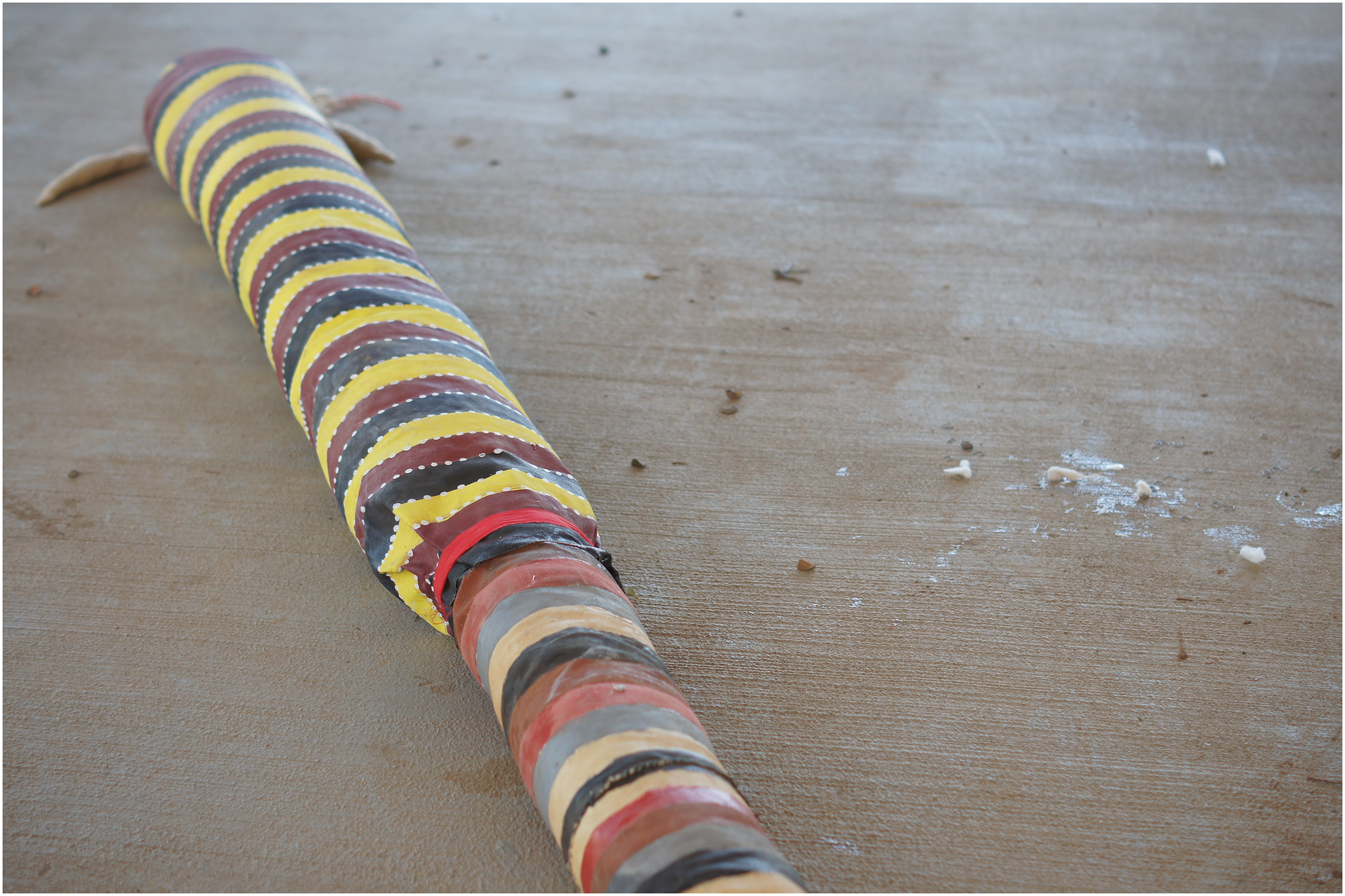
Garlooroony. Author's photo, July 2012.
Over several weeks in August 2012, another matter unfolded, which I noted periodically in my fieldnotes: Joowoorroo arrived at my donga [a portable and demountable building] one morning, noticeably agitated, grumbling to himself as he climbed the stairs. He explained to me that a painting depicting Doomoorriny [a spiritually dangerous place] had been placed in the public Art Centre gallery. He had spent the night worrying because he believed it would have negative ramifications for those who did not have permission to it. Later that morning, he approached a male non-Indigenous staff member at the Art Centre and threatened to resign from the Art Centre if the painting was not removed. While the staff member acknowledged the seriousness of his request, the painting was not moved. After a few days, Joowoorroo convened an informal meeting at the Art Centre with two Gija men and two staff members (one non-Indigenous) to address the issue, which I was not privy to. The result of it was that the painting was moved to the privacy of the Art Studio, away from the public gallery. The next day, Jaangari, the artist who had painted Doomoorriny, casually remarked to me that nobody liked his artwork. Over the succeeding days, Joowoorroo continued to worry about the painting. Shortly thereafter, he instructed a staff member to lay the painting face down to further prevent it from being seen. At the end of August, it was earmarked for an exhibition. Two years later, the painting had been returned to the public gallery.
The significance of the Doomoorriny artwork and the object Garlooroony extended beyond their physical existence. People used them to accord authority to Gija Law and their belief in Ngarranggarnin (‘Dreamtime, creation time,’ Kofod et al., 2022: 229), without breaking the taboos associated with the two items. Anthropologist Fred Myers (1991: 22) has similarly observed that Pintupi people recognise the authority of ‘The Dreaming’ over individual pronouncements, because ‘no one is prepared to tell others what to do’ (1991: 70). Joowoorroo's actions demonstrate key aspects of Gija cultural succession: respect for Law, a focus on consensus and a willingness to adapt to changing circumstances. The ‘gaps’ in these situations – Jaangari's inaction, Jagarra's silence, the Art Centre’s exhibition priorities – were ‘filled’ and transformed, relationally and contingently.
Schematising enculturation, acculturation and hybridity
Artworks made for commercial sale at the Warmun Art Centre today are informed by a long history of material culture traditions and a range of ephemeral and enduring practices which include body painting, performance, utilitarian objects, rock art and bodily adornment (Kjellgren, 1999). Historically, material culture in the East Kimberley region of Western Australia (home to the Gija, Worla, Miriwoong, Malngin, and Jaroo language groups) encompassed materials and objects sourced from the local environment and through local trade networks, such as stone, wood, sinews from animals, hair, teeth, fibre from gum and boab trees, resin, wax, bones, ochre, clay and shells. There is a strong history of intercultural interaction between Aboriginal groups and non-Aboriginal traders, travellers and explorers (Akerman, 1980) which led to the introduction of new materials like metal, glass, plastic, and tin and the incorporation of introduced animal species in rock art and for performative practices such as corrobborees. In the following analysis, I construct three categories of historical adaptation in the Collection to elucidate the varying degrees of acceptance and integration between internal and external systems. The objects demonstrate responses to the changing political and social conditions of the time and affirm the dynamic and mediating processes Gija people undertook through their artwork and material culture.
Continuing traditions
In the original registration (Coote, 2000), approximately three-quarters of the Collection contains elements of Gija Law, language and cultural practices. At least one hundred paintings and objects exclusively relate functionally, directly, thematically or symbolically to Gija cultural practices and beliefs. Paintings on plywood, compressed wood, board and canvas depict totemic and subsection animals such as Barramundi (Dayiwool, Lates calcarifer, Jambin subsection) and cultural practices such as the mortuary ritual of wrapping the deceased in tree branches (discussed in Kaberry, 1935). At least three paintings depict the performance of song and dance cycles and corroborees such as the Moonga Moonga. Topographical and metaphysical maps represent ancestral and geographic sites through their resemblance to features in the landscape, such as the distinct shape of a hill range or a permanent water source. These works display a strong iconic relationship between the signifier and the signified, though their specific cultural details are more readily understood by an initiated Gija audience.
Six animal forms and four human figures have been hand-carved. Animal carvings materialise the Gija subsection system as totems, such as a Barking Owl (Doomboony, Ninox connivens, Joongoorra subsection) and White-faced Heron/Crane (Ginyany, Egretta nogvaehollandiae, Jambin subsection) (Figure 2), Whistling Kite (Garnjalji, Haliastur sphenurus, Jambin subsection), Wedge-tailed Eagle (Warrarnany, Aquila audax, Jaangari subsection) and snakes (Purdie et al., 2018). These items are, as Myers has observed in his ethnography of Pintupi people, ‘objectifications of a set of social relations’ (1989: 25), and materialise the subsesction system shared between humans and non-humans in Gija cosmology. Indeed, some carved animals take a generalised form and do not resemble a specific species, such as one fish made from hollowed wood.
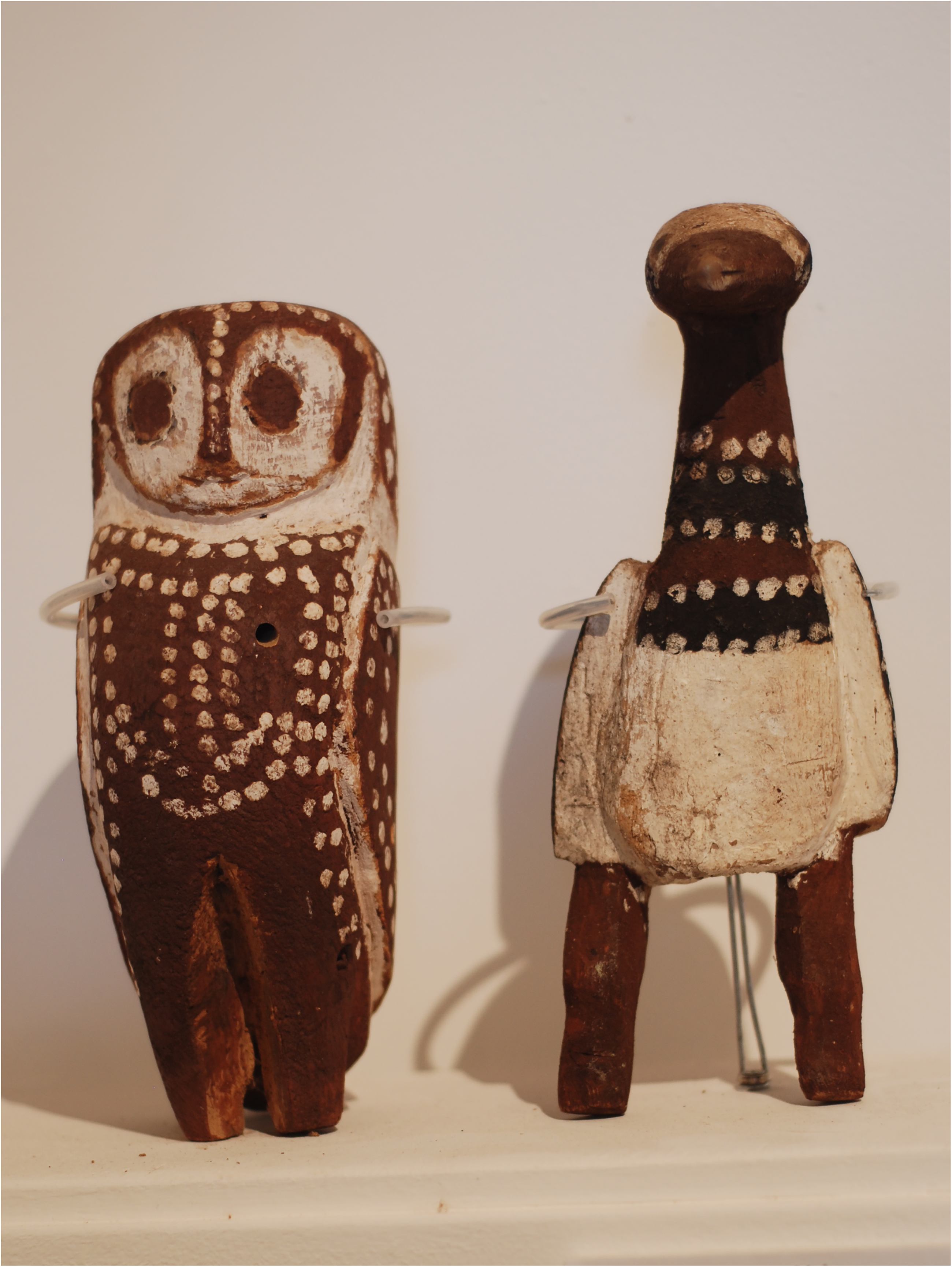
(L-R) Doomboony and Ginyany on display in the Warmun Art Centre gallery. Author's photo, February 2015.
Carved human figures model their human counterparts. They display cicatrices and body painting designs common across the Kimberley, such as white horizontal and dotted lines across the forehead, nose, chest, and limbs. In her East Kimberley fieldwork, Phyllis Kaberry (1939: 264 and frontispiece) documented women with similar pigment and ochre lines on their chests, shoulders, and backs, describing the ‘simplistic patterning’ as ‘bold, rhythmic’ (1939: 261). She also discussed two totems of crane and eagle moieties, painted on women by women (1939: 260–261). While Kaberry identified these designs as tied to women's rituals, she omitted details about the occasion, participants, or location, leaving some room for interpretation.
Approximately 18 boards, used in ‘Krill Krill’ (or Goorirr Goorirr) performances, depict ancestral figures and sites and geographic locations. Three cardboard Joowarriny (devil, ghost or spirit of a deceased person) masks, used in a chapter of the Goorirr Goorirr, exist. These designs and totems continue to be used by successive generations. For example, one painting attributed to Rover Thomas and another by Rusty Peters feature strikingly similar depictions of three figures: Garlooroony, the Worla woman; and a Joowarriny. Almost three decades later, Jane Yalunga, Rover Thomas's daughter, etched two very similar renditions of Garlooroony and the Worla woman on a work for commercial sale, 10 indicating the ongoing circulation of these signifiers.
The visual designs on utilitarian objects – shields, spears, ladles, axe heads, musical instruments, didgeridoos, and coolamons – vary greatly, from no decoration to blocks of colour, dots, circumferential lines, polysemous symbols, detailed pyrography and carved patterns. Some shields (mirdal) are plain, while others display dots and lines of white ochre. Four didgeridoos (gooloombboong) are each unique; one features circumferential lines, and another an incised leaf and branch motif. Fifteen fighting sticks (nawoolooloony) and several digging sticks (ganany) feature helical lines, dots, pyrography, and blocks of colour with individual variations. Similarly, spears (of various varieties: hooked, large, bamboo and short fighting) feature blocked colours, circumferential lines, and dots. Some are undecorated with functional wire tips, others lack sharpened tips, and some are heavily overlaid with dots in ochre and pigment, suggesting aesthetic and pedagogic purposes. The diversity of these items reflects the creators’ agency in visual design, though within a limited range: they still abide by the Gija visual system.
Acculturation
Catholic iconography and themes abound in the Collection. At least 70 paintings symbolise, represent and index Catholicism through their title, file notes, subject matter and icons and symbols, which include depictions of Jesus, crucifixes, and the Holy Spirit (represented as a dove). The Last Supper appears in at least four paintings. Biblical narratives such as Christ's birth and death, the descent of the Holy Spirit and scenes of human figures preaching are also represented (Figure 3). Many paintings are provenanced and their stories are recorded in the first Registration Book. These items were used in local Ngalangangpum School classrooms and celebrations, such as Pentecost and Christmas.
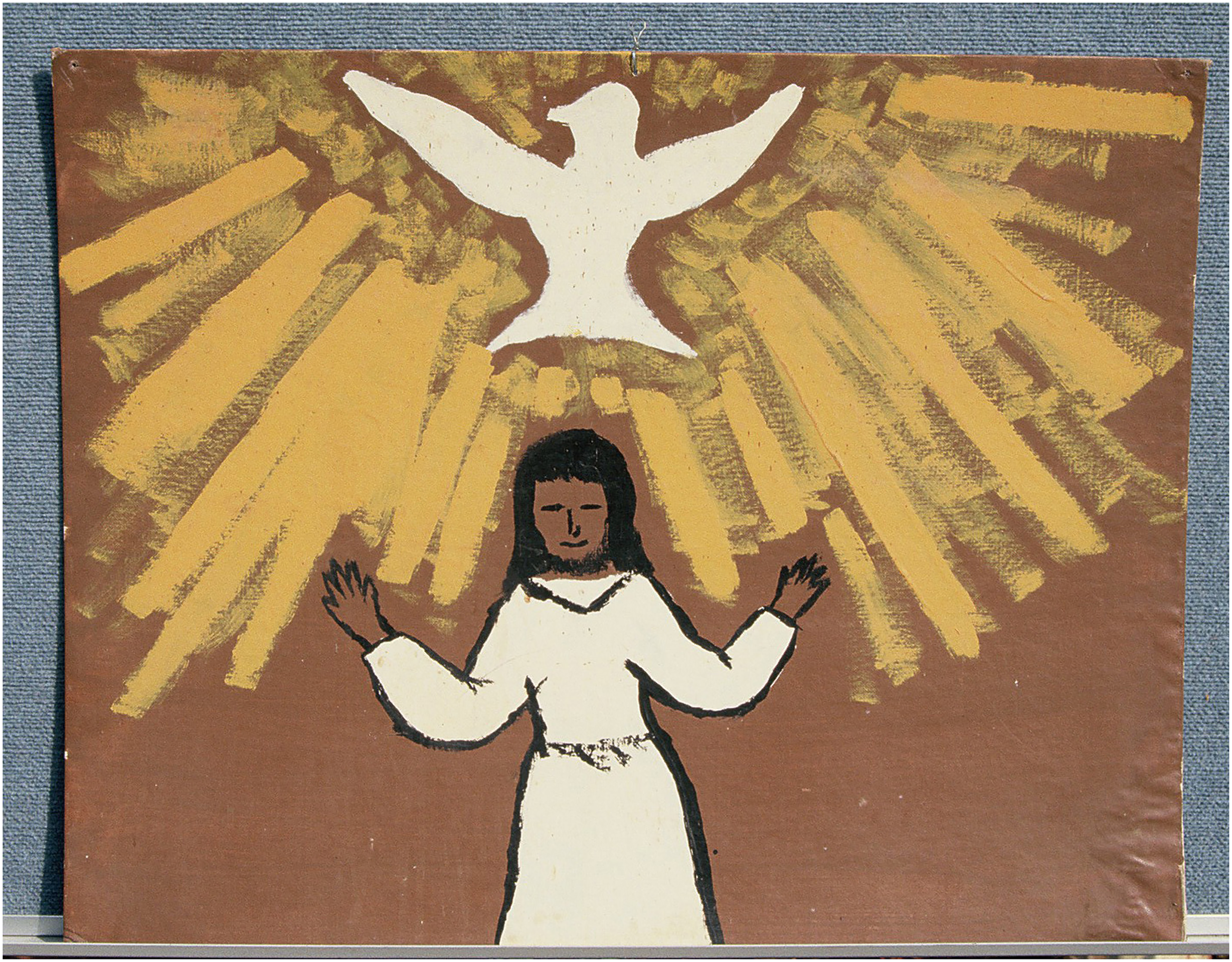
WCC115. Photo courtesy of Karen Coote, 2000.
Some paintings depict learning and acculturation processes, where human figures are painted in front of (seated) human groups and individuals. These paintings serve as visual records of a banking model of acculturation. At times, the object records are accompanied by references to the Gija language or Gija beliefs, indicating the copresence of distinct systems. Approximately ten paintings feature white dots around borders and shapes, illustrating the hybridity of Catholic content and East Kimberley aesthetics.
Hybridity
Almost half of the Collection paintings and objects have elements of hybridity. For example, a work attributed to Hector Jandany depicts a human figure, likely symbolising Jesus Christ, carrying a crucifix across the shoulder and a ‘Message stick carrying the Law,’ representing the coexistence of Catholic and Gija beliefs. The painting is in landscape format, with white dots outlining the cross and the message stick (Figure 4). Other works of Jandany's also demonstrate the amalgamation of cultural systems, with titles such as: ‘Jesus sent the spirit back for Warmun’ and ‘The Virgin Mary collecting tucker with coolamon at her feet.’ Indeed, some paintings by Jandany focus solely on Gija content.
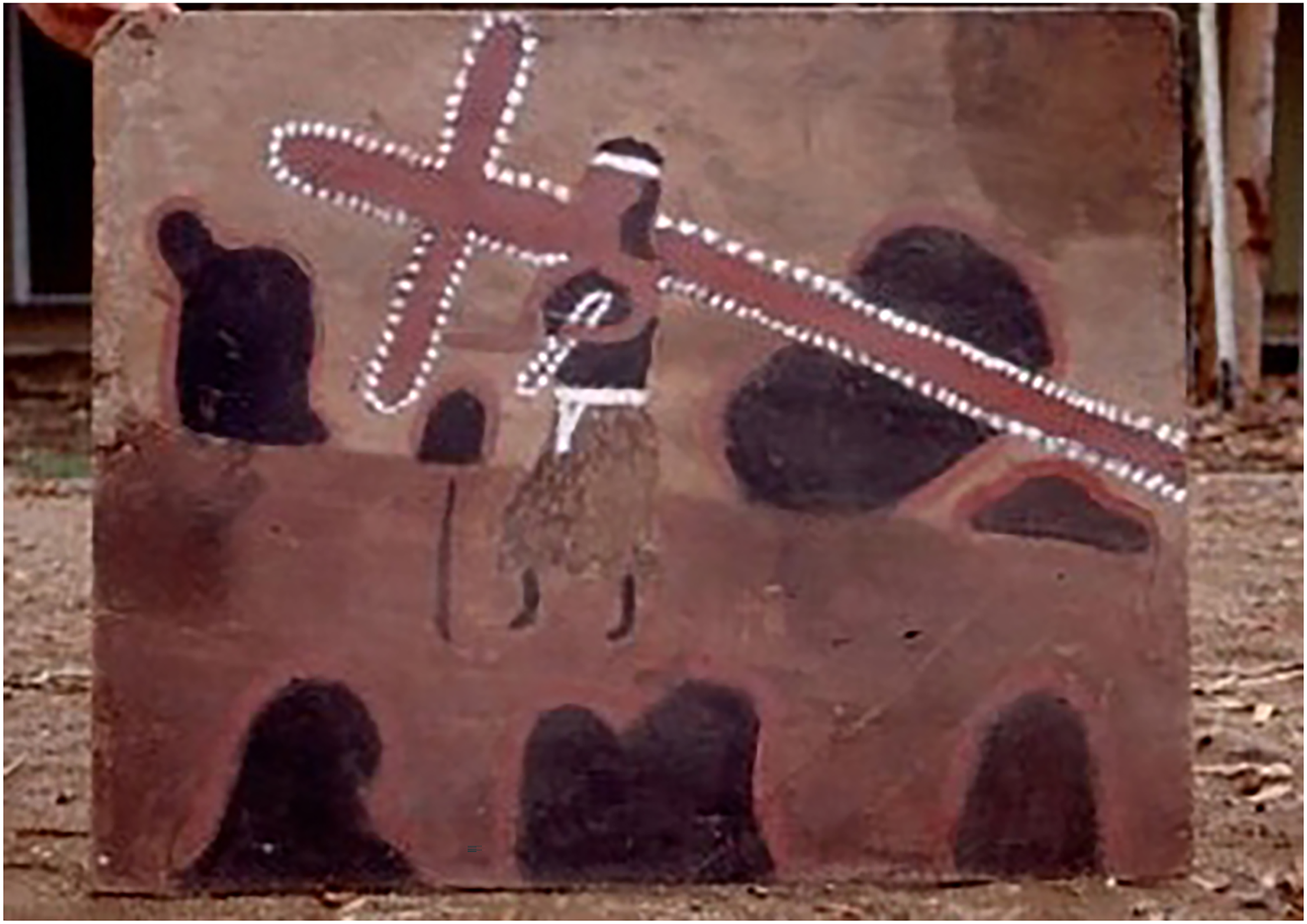
WCC047. Photo courtesy of Karen Coote, 2000.
Similarly, Queenie McKenzie combined the ‘Gija Fire Stick ceremony’ with ‘the Pentecost’ in one painting. Human figures hold sticks tipped with stars to represent the arrival of the new moon, the descent of the Holy Spirit and a hunting practice for Gija people. Likewise, a coolamon is painted with a woman resembling the Christian figure Mary Magdalene, cradling an infant encircled by a halo. It does not contain any white dots or lines. Inside, two painted turtles are bordered by hill-like shapes, likely representing darndal, the local native turtle (Elseya dentata, Nangala subsection). Another painting features a white bird, likely a dove and a symbol of the Holy Spirit from the Christian Trinity, casting white rays of light onto a black infant, in a coolamon. This painting appears to symbolise the coexistence of Gija and Catholic worldviews.
Among seven pokerwork boards, three feature profile representations of Aboriginal people with body painting and cicatrices, in a manner reminiscent of historic photography from the late 1800s and early 1900s. The remaining four depict pastoral landscapes with trees, stock fences, and one has a helicopter, likely reflecting time spent on pastoral properties – common experiences of East Kimberley Aboriginal people throughout the 20th century. Many items employ multivalent symbols, a form of hybridity due to their polysemy, such as trees, stars, tables, hills, animals, people, clouds, a crucifix, infants, and the moon. Boab nuts (Adansonia gregorii) are inscribed with depictions of crocodiles, crucifixes and trees. These symbols and objects can be interpreted in various ways and speak to external audiences and internal cultural systems. The ‘migration between encoding and decoding,’ as Forge describes (1973, 189), offers flexibility and enables creators and viewers to re-interpret and negotiate their meaning. These items demonstrate how people actively engage with and respond to externality and influencing systems while maintaining degrees of independence.
Conclusions
In this article, I have shown mechanisms and social conditions through which Gija cultural succession is regulated and sustained in creative and dynamic ways. I began with an example of Nyawoorroo, where she asserted ontological agency. Rather than rejecting provenance and conservation processes, she reoriented the situation to assert her Gija worldview. I have discussed two occasions of socio-cultural succession at the Warmun Art Centre. Finally, I have examined the Warmun Community Collection and highlighted the varying degrees of influence that different cultural systems have had on the production of artwork and material culture. Artworks and material culture face inward and outward, shaped by Gija collective and individual priorities as well as external systems and structures. Negotiation plays a key role in determining what persists and how, amidst the influences of externality and the structuring forces of Gija social organisation and customary Law.
My analysis has revealed that cultural succession is complicated by factors such as institutional priorities, Jaangari's inaction, Jagarra's silence and textual records. These disruptions create interpretative uncertainty where authority, action and authorship are not always clearly delineated or known. Gaps and fissures are ‘filled’ by art workers, Nyawoorroo, databases and authorial kin relations, like Joowoorroo and the aunties. Methods of transmission are adjusted; sometimes supported and challenged by kin, and all are relational, as Gija people invest in ‘people, not in things’ (Myers, 1989: 4). Cultural succession within Gija society is contingent on ongoing negotiation and dynamic interactions among individuals, cultural systems, external forces and structures, spatiotemporal shifts, and unpredictable events.
The visual language and thematic content of the Collection represent the mediation and integration of Catholicism, pastoralism, and Western art traditions of portraiture and landscape and commercial developments. It also represents core elements of the Gija cultural system, including Ngarranggarnin, ancestral icons such as Joowarriny, totems, functional carved objects and non-iconic elements derived from Gija body painting, cicatrices and ceremonies. Hybrid forms, such as decorated Boab nuts, pokerwork boards, and the co-presence of themes, symbols and icons in paintings and objects, indicate the new, innovation and continuity. They signify an openness to external worlds alongside the maintenance of continuing traditions. These distinct and overlapping systems reflect the complexity of specific historical circumstances.
Through artwork and material culture, Gija culture remains intact while individuals selectively incorporate, exclude, adapt and reinterpret external elements on their own terms. Jandany's painting of a human figure carrying both a message stick and a crucifix serves as an example of this relative autonomy in action. It is autonomy within a relative framework, impacted by the enculturating processes involved in the formation of Gija personhood, as well as the impact of external systems. This is an active process of negotiation in which enduring traditions coexist with transformation, contingent on various factors such as individual agency, collective dynamics, and the unpredictable influences of external events and actors. Gija culture is thus shaped by individuals who engage with and reinterpret external forces, navigating and responding to varying degrees of influence and constraint.
Gija people live within the structures of the Australian settler-colonial state, and their cultural production reflects its ongoing conditions. Adjustments are made that enrich and complicate the local landscape. Yet change and transformation do not equate to cultural erasure. Such a position ineludibly obscures the heterogeneous features of human sociality; noted decades ago by AR Radcliffe-Brown, when he remarked: ‘the continuity of social structures are not destroyed by changes in the units; the continuity of structure is maintained by the process of social life, which consists of the activities and interactions of the individual human beings and of the organised groups into which they are united’ (1965 [1952]: 180). Gija society demonstrates continuing traditions and active reconstitution. Webb Keane (1997: 68) claims that ‘objects acquire meaning and value that reflect both their historical origins and contemporary significance’ and I have sought to balance this duality. I demonstrate the stability of the Gija cultural system alongside the influence of other, distinct social systems and structures. These external forces exert pressure but do not fully determine or constrain the actions of Aboriginal people in Warmun, who select, incorporate, adapt and reject.
Footnotes
Acknowledgements
I thank the custodians of the Warmun Community Collection, Eileen Bray and Patrick Mung Mung, and to all those within the Warmun Community, including the Warmun Art Centre, who contributed to this research. I am appreciative to Howard Morphy and Sandy Toussaint for their insightful feedback on early drafts of this article. Finally, I thank the reviewers for their comments.
Declaration of conflicting interests
The author declares no potential conflicts of interest with respect to the research, authorship, and/or publication of this article.
Funding
The author received no financial support for the authorship and publication of this article. The research was supported by a PhD Scholarship from the Australian National University, College of the Arts and Social Sciences.
