




Abstract
“This little thing of ours”—beautifully ornamented tortoise shell containers filled with fragrant powdered herbs and plants—comprises an important part of Ju|’hoansi cultural practice in contemporary Omaheke, Namibia. Used for various purposes associated with potency and protection, the !’hurasi can be found back in time and throughout space, in the Kalahari ethnographies, ethnographic artifact collections, myths, narratives, and rock art, but it has seldom received any scholarly attention. In this article, we aim to document how aspects of a distinct San material culture are still made, used, and engaged with in the western Kalahari today, in ways that would, despite the popular belief in a general loss of traditions and ancestral knowledge in the area, be recognizable and meaningful for members of the ancestral communities a hundred years ago. Both ethnographic sources and present-day documentation strongly suggest, we argue, that the !’hurasi represents a continuation in practice, linking the Omaheke Ju|’hoansi with important San ontological concepts, and that they have played an important role in the preservation, resilience, and development of modern Ju|’hoan culture. In a first-of-its-kind study of San tortoise shell containers, the research data that form the empirical ground of our argument is gathered from ethnographic field work among Ju|’hoansi communities in Omaheke in 2022, as well as through archival studies in the ethnographic artifact collection of the Museum Africa in Johannesburg.
Keywords
Introduction
In the storerooms of the Museum Africa in Johannesburg, we find one of the largest ethnographic collections of San 1 material culture in the world. Between 1916 and 1928, the Medical Officer of South West Africa, Dr. Louis Fourie, doubled his official profession with that of an amateur ethnographer of the native population of the region. His efforts would eventually result in the collating of more than 3000 artifacts, about 300 photographs, extensive field notes, correspondence, maps, newspaper cutouts, and two publications on “The Bushmen of South West Africa” (Fourie, 1926, 1928; Wanless, 2007: appendices; 2010). 2
After decades of colonial destruction and genocide of the indigenous Khoisan populations and cultures in Southern Africa (Gordon, 2009; Hitchcock and Babchuk, 2011), the emerging field of “Bushman studies” (initially ethnographic, linguistic, and physical anthropological studies) operated around the turn of the nineteenth century within what later has been coined a “salvage ethnography” (Gruber, 1970). It was believed that the “pure Bushman race” was real, although a thing of the past, and it was deemed essential to record the last remnants of this “dying” culture, before it disappeared altogether (Davison, 2001; Weintroub, 2015). Fourie was working under the same conviction, and although his focus on collecting material culture was already somewhat outdated compared to other anthropological studies of his time (Wanless, 2007: 36), he was equally concerned to collect a representative selection of everything “bushman”: traditional tools, weapons, clothing, and ornaments.
In 1910, Dorothea Bleek (the daughter and niece of acclaimed Wilhelm Bleek and Lucy Lloyd [The Digital Bleek and Lloyd collection]) was disheartened to realize that the language and folklore of the Northern Cape |Xam were already lost to the impoverished San communities she visited in Prieska (Bleek, 1929: 311–312; Hall and de Prada-Samper, 2016: 10). The ultimate death of traditional narratives and knowledge has been taken more or less for granted in the Cape ever since (Hoff, 1997). Recent studies have shown, however, that local stories, narratives, and medicinal plant/floral expertise are still alive among extant descendant communities in the Northern and Western Cape, respectively, despite the documented historicide in some of these regions (e.g., Bam, 2021; de Prada-Samper, 2016; Hoff, 1997; Hoff, 1998). Similarly, the often-forced change in lifestyle among previous foragers of the Kalahari has reportedly resulted in a loss of traditions and ancestral knowledge and practices among San communities elsewhere (see Suzman, 2000).
Our work with the Fourie collection and among contemporary San communities in Omaheke, Namibia, has led us to different conclusions. In this article, we aim to demonstrate how aspects of a distinct San material culture are still made, used, and engaged with in the western Kalahari today, in ways that would be recognizable and meaningful for members of the communities Fourie worked among a hundred years ago. Secondary data from the Fourie collection and earlier ethnographic sources and primary data that we gathered from the western Kalahari today show that despite some change of materials (most notably, the introduction of glass and plastic beads (see note 7)), much of the cosmological meaning behind San artifacts has persisted.
In order to demonstrate one such continuation of practice and meaning, our point of departure in this article is the !’hurasi—ornamented tortoise shell containers (Figure 1), filled with fragrant powdered herbs and plants. “This little thing of ours,” as Bau from Otjinene expressed it, comprises an important part of the Omaheke Ju|’hoansi cultural practice today, just as they make up a prominent category of artifacts in the Fourie collection (Figure 2). Made from available animal, plant, or store-sourced materials and used for various purposes, such as protection during transition periods and against “bad winds,” or as a tool for orientation in space, the tortoise shell box is an example of a resilient practice that directly connects the “acculturated” contemporary Ju|’hoansi of the Omaheke region (Suzman, 2000) to their ancestors that inhabited the region about a century ago.
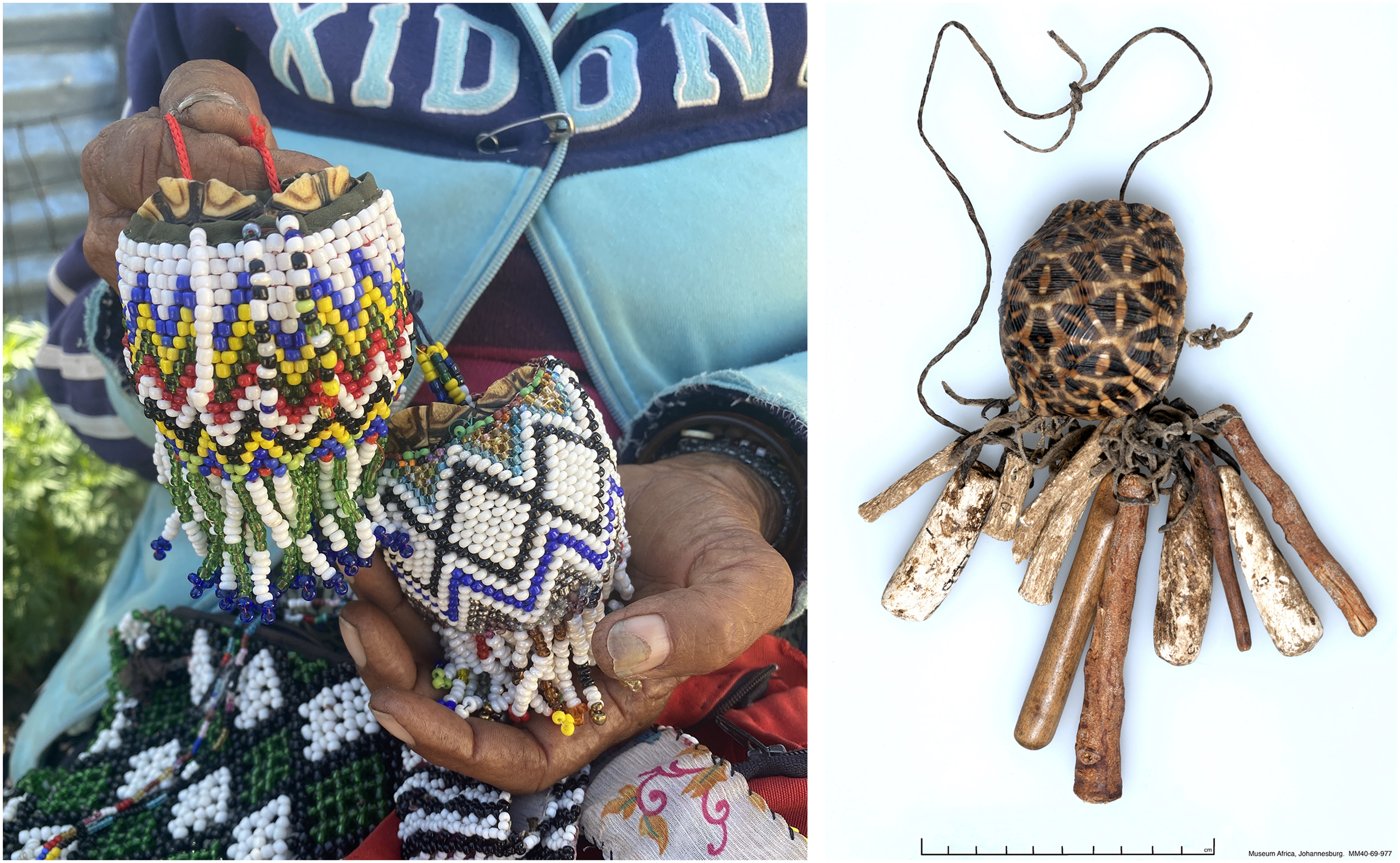
“This little thing of ours”: Tortoise shell containers from Omaheke today (2022) and approximately 100 years ago (to the right). The contemporary, beaded boxes are designed and beaded by Mita Itnau and feature the “snake” pattern (above) and the “eye” pattern (below) (photographs: Vibeke M. Viestad (left) and Museum Africa, Johannesburg MM40/69/977 (right)).
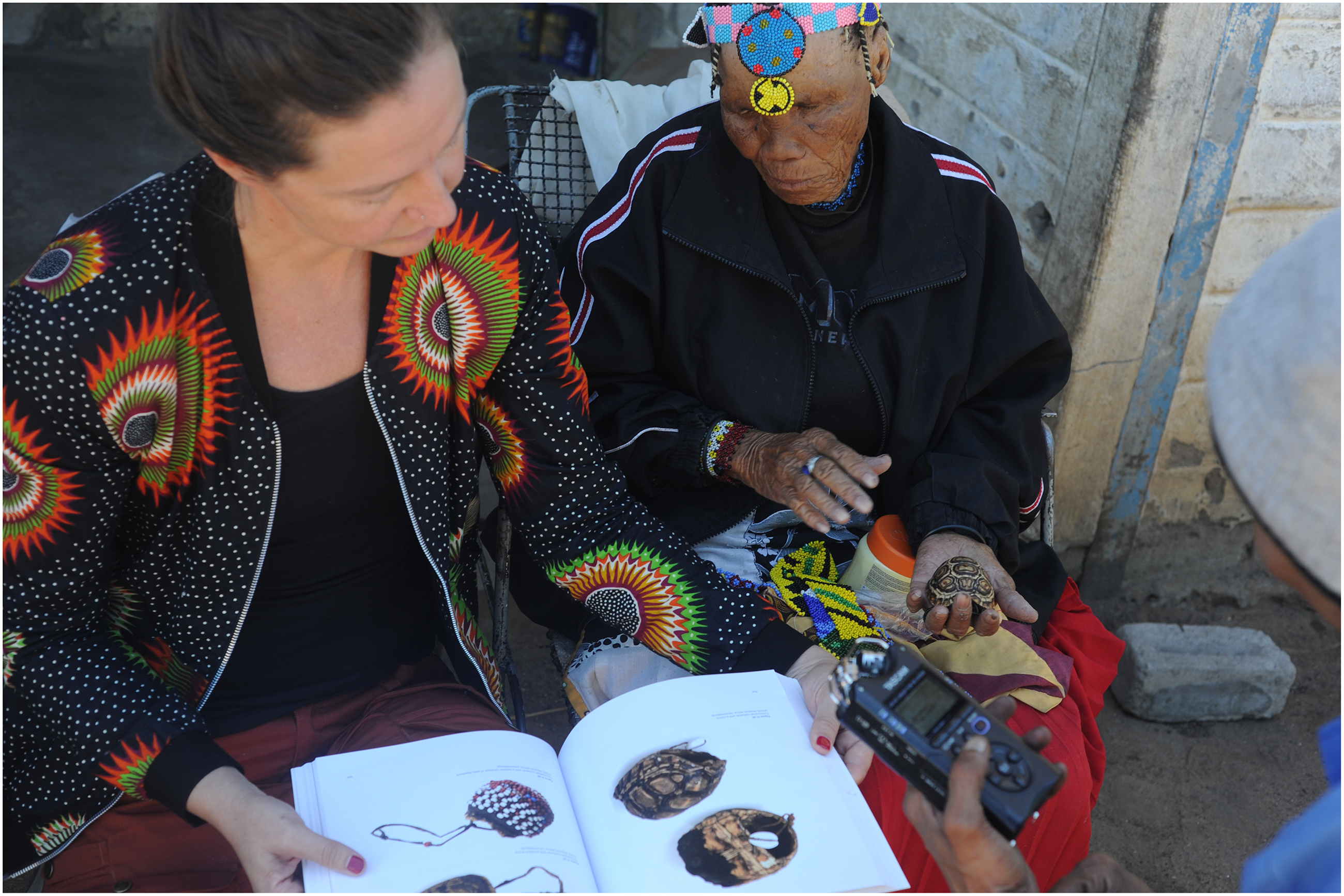
Vibeke M. Viestad and Christina Kowa (right) discussing the make and use of the !’hurasi today in relation to the tortoise shell containers collected in the area a century ago (photograph: Velina Ninkova).
Background and structure
The study is informed by primary and secondary data comprising material artifacts of the Omaheke Ju|’hoansi, spanning a period of about 100 years. Vibeke M. Viestad is trained as an archaeologist, specializing in dress and dress practices among historical San hunter-gatherers, working mostly with ethnographic artifact collections and archives. Velina Ninkova is a social and visual anthropologist, who has carried out ethnographic fieldwork with the Omaheke Ju|’hoansi since 2008. In 2021, Velina Ninkova received a grant by the British Museum's Endangered Material Knowledge Programme (EMKP) for the documentation of the material culture of the Omaheke Ju|’hoansi. The project is hosted by the !Kwa ttu San museum (in South Africa) and has received ethical approval by the Namibian San Council. In March–April 2022, the two authors met and conducted fieldwork with Ju|’hoansi communities in seven settlements in the Omaheke region: Skoonheid Resettlement Farm, Drimiopsis Resettlement Farm, Epukiro RC, Otjinene, Gobabis, Epukiro Pos 3, and Epukiro Pos 10. In addition to the two authors, the research team comprised five Ju|’hoansi members: Frederik Gariseb, Anna Kamta, Calie Kooper, Bertie Anton, and Frans Doeseb, who were trained in basic data collection skills and who engaged with the project depending on their personal interests, as interviewers, translators, photographers, or videographers, respectively. The research team spent many hours discussing the collected data, its meaning, and how it fits into other aspects of Ju|’hoan life.
During our first fieldwork trip for the project, we documented artifacts associated with dress and personal ornamentation, as well as tools and weapons, belonging to 72 Ju|’hoansi participants, among which we identified 26 tortoise shell containers. In order to obtain a deeper understanding of the making and some of the meaning of the tortoise shells, we spent considerable time with two elder Ju|’hoan women, Mita Itnau and Christina Kowa (Figure 2), both of whom reside in Skoonheid. We encountered Mita making tortoise shells in her home when we first visited the settlement with the project, and we returned several times to document and observe her skills and the materials she used (e.g., Figure 3), as well as to understanding her interpretation of the purpose of the tortoise shell container and its place in contemporary Ju|’hoan life. From Christina, we learned stories about the tortoise and its place in Ju|’hoan cosmology, as well as use cases for the containers.
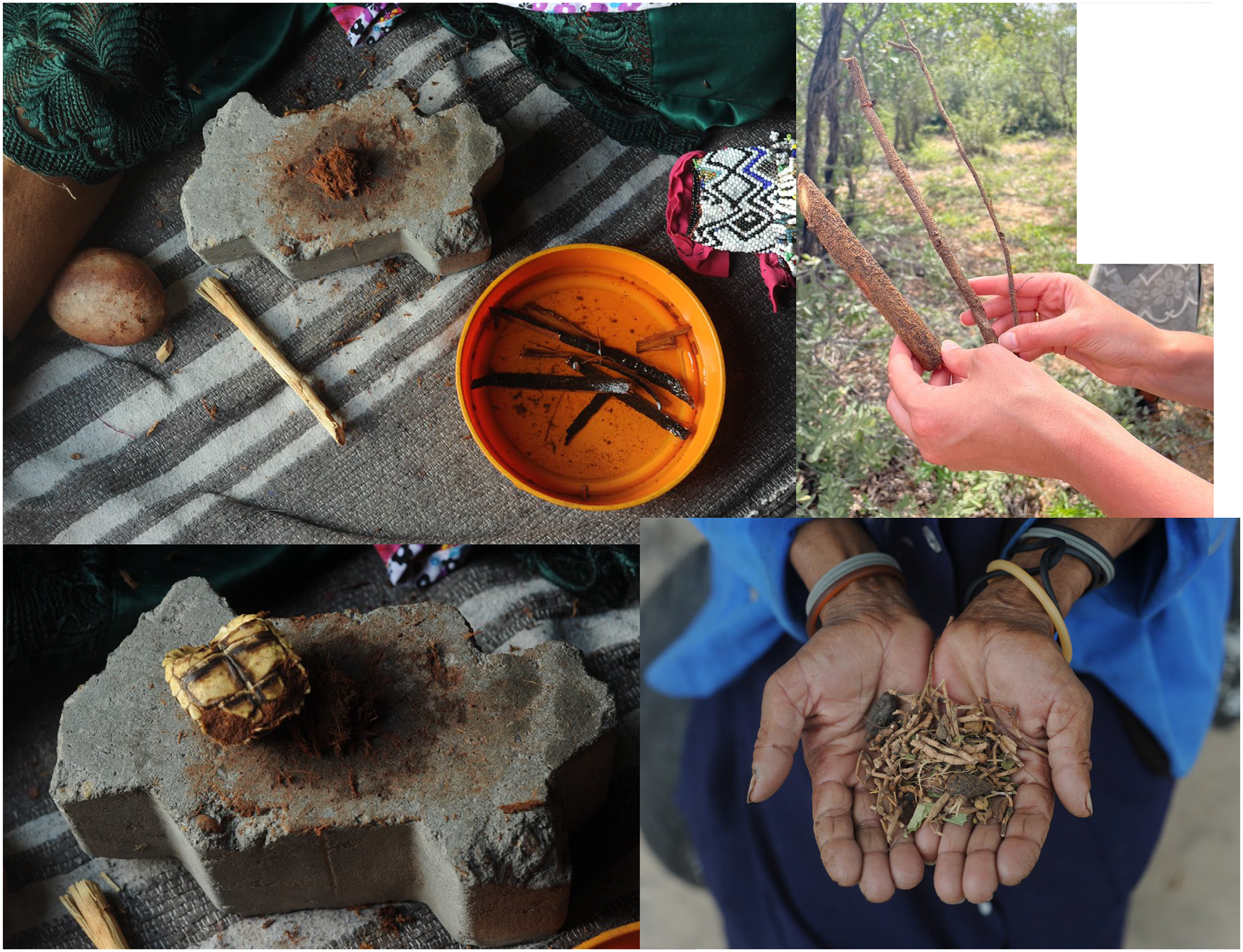
The n|inh roots as found in the veld (upper right corner) and grounded, mixed with water in the home of Mita Itnau (to the left). In the lower right corner are roots, sticks, and leaves of the fragrant tsah plant that will be powdered before put into the finished tortoise shell container (photographs: Velina Ninkova).
The following is an effort to explore the past and present of a distinct part of an extant material cultural tradition. We trace the making, appearance, use, and importance of the tortoise shell container among the Omaheke Ju|’hoansi from the beginning of the twentieth century to today. First, we introduce the Omaheke Ju|’hoansi community, before we present the century old tortoise shell containers that we find in the Fourie artifact collection. 3 Then, we give an overview of what has been written about San tortoise shell containers in the ethnographic literature, before we outline and describe the knowledge and information shared with us by Ju|’hoansi women, makers and users of the !’hurasi in the present. Finally, we discuss the longue durée of the San tortoise shell container and aim to understand it within a broader framework of San ontology and oral tradition. Both ethnographic sources and present-day documentation strongly suggest, we argue, that the tortoise shell containers of the Omaheke Ju|’hoansi represents a resilience in practice that binds material and symbolic culture and that spans across time and space.
Who are the Omaheke Ju|’hoansi?
Terminology and naming are lasting challenges in the broad field of San studies, due to numerous factors, including divergent ethnonyms coined by early travelers and explorers, anthropologists, and group members’ themselves, movement, and displacement of people over time, and perhaps most importantly incommensurable emic and etic ideas about group identity and belonging. The Ju|’hoansi are one of at least three San groups in Omaheke today (see Dieckmann et al., 2014) and form a linguistic and cultural continuum with the Ju|’hoansi of northeastern Namibia and northwestern Botswana. The term itself means “genuine or real people” (Lee et al., 1996), and the Ju|’hoansi often use it not only when they refer to themselves collectively, but also in individual reference to one another.
For this article, it is important to note that the Ju’|hoansi who live in the Omaheke region today (often referred to as southern Ju’|hoansi) self-identify as ‡Au || eisi and regard themselves to be same, but different, from the Ju’|hoansi of Otjozondjupa region further north. To complicate matters further, the name ‡Au || eisi comes from the word for north, ‡au, and as James Suzman (2000) writes, it serves as a relative term to distinguish the people living north of Gobabis (the administrative town of Omaheke) to those living south of it (‡Amkxausi, southern people). The term is politically recognized and the Omaheke Ju|’hoansi are assigned the political institution of traditional authority, with Chief Langmann as a head of the traditional authority of the Omaheke ‡Au || eisi.
When Fourie worked in South West Africa, he regularly encountered and collected artifacts among several San groups, of which the four main groups he knew as ‡Ao-||ein (singular for ‡Au || eisi), Naron, Hei-||om, and Nu-||ein. In one of Fourie's own maps (Figure 4), we can see from his handwritten notes where he met, and thus considered, most of each group to reside. According to Fourie, the ‡Au || eisi lived predominantly in the areas surrounding Epukiro, in the eastern part of the (then) protectorate, close to the Bechuanaland (Botswana) border. This is in the heartland of the modern Omaheke region and the exact same area where we carried out fieldwork in March and April 2022. We want to acknowledge that the Omaheke Ju|’hoansi should therefore be considered descendant communities of the ‡Au || eisi whom Fourie worked among a hundred years ago.
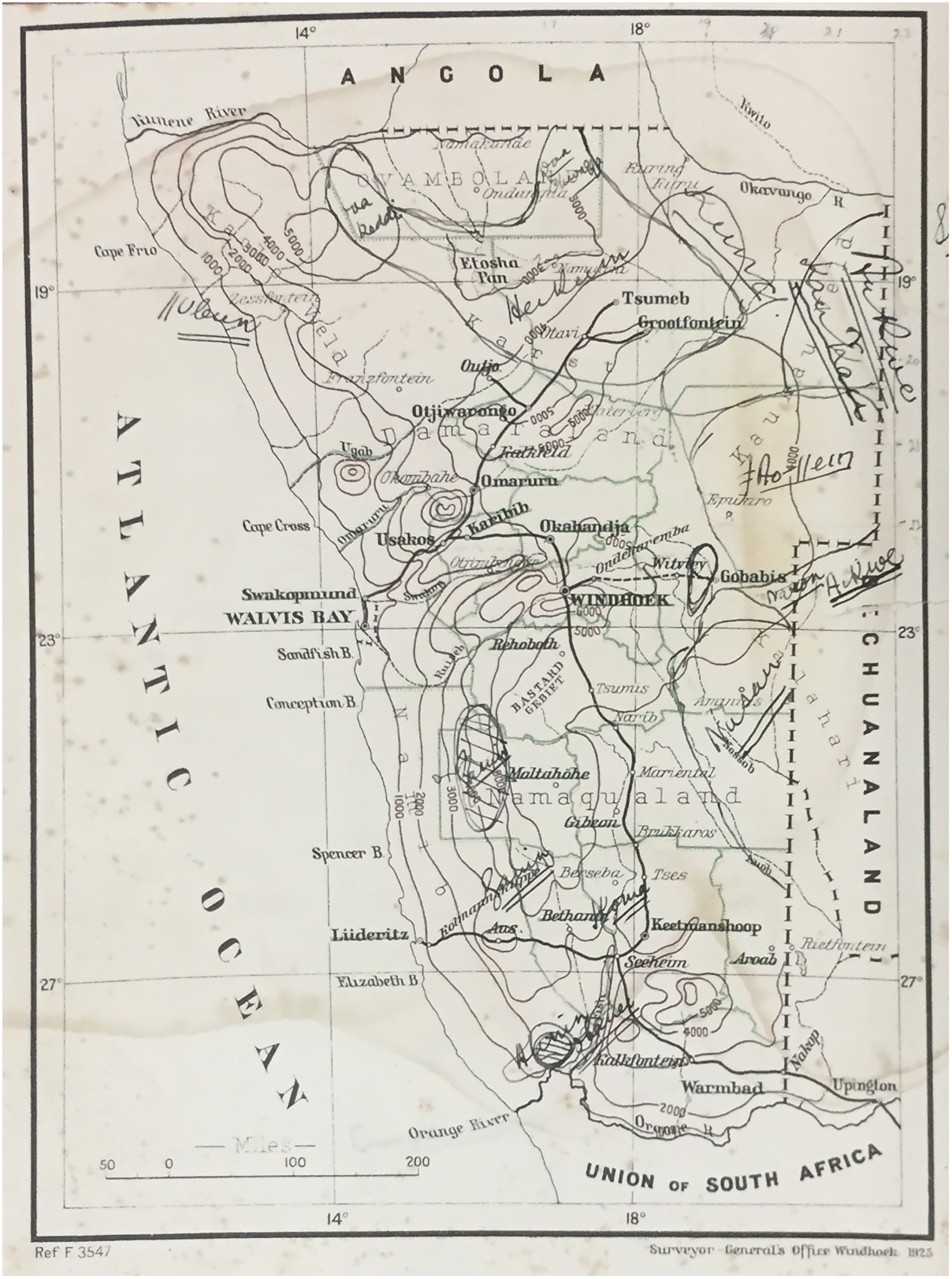
On this map of South West Africa from 1923, Fourie has added the names of the different San groups he met while in the field. Here we see, from the north moving south, the Heikum, ≠Ao-||ein, Naron/Aikwe, and Nusan placed in the landscape. Note that he would eventually change the orthography of the group names, from Heikum to Hei-||om, Aikwe to Naron, and Nusan to Nu-||ein (map: Museum Africa, Johannesburg).
Today's Omaheke Ju|’hoansi subside from a mixed economy based on small-scale farming, foraging, government welfare, and manual labor. Traditional subsistence practices, and specifically hunting, have been severely damaged by a decades-long history of land dispossession, fencing, entrapment into forced labor on white farms, and, in more recent times, ban on hunting and government development initiatives for subsistence farming. The Ju|’hoansi are one of the most marginalized groups in Omaheke by all socioeconomic factors (Ninkova, 2017; Suzman, 2000).
San tortoise shell containers in the Fourie collection
According to Ann Wanless’ archival analyses in 2007 (Wanless, 2007), Fourie collected in total 66 tortoise shell containers among the different groups of the native population he worked among in SWA (Wanless, 2007: appendix 8). In May 2022, Vibeke M. Viestad identified 58 of these in the Museum Africa, of which 40 are associated with either the ≠Ao-||ein, the Hei-||om, the Naron, or the Nu-||ein. Ten specimens are recorded simply as “tortoiseshell,” and they have no group affiliation and are mostly unmodified. The last eight are accessioned as either Herero or “Klip Kaffir” and thus most likely not of San origin.
From the contents of the paper archive in the collection, we know that Fourie took quite extensive notes from his various trips into the field. These are both on medical matters and ethnographic descriptions. Most important to our concern, there is one major notebook (Fourie nd MMS40/69 BOX E Item 22) that appears to be a compilation of notes from multiple field diaries, structured according to different themes and headings, such as “Transition rites,” ‘Death and Burial,” and “Beadmaking,” as well as “Tortoise shell containers.” The data derives mostly from ‡Au || eisi and Naro contexts/interlocutors and was probably systematized after Fourie published his 1926 article on the Hei||om (Fourie, 1926; Viestad, 2018: 84). In this notebook, we can read: Tortoise shell containers for powder … Known as XURUSI (A), Tjotamba (N). ≠Ao-||ein cut the opening straight & so do the Naron but not as straight as the ≠Ao-||ein. Exchange between these two tribes often takes place. Hei-||om use a different kind of tortoise. The material used for closing the hind leg openings is as follows: - ≠Ao-||ein & naron chew naun & mix it [ē?] charcoal. When naun is not available all tribes Use “byneerk” Nu-||ein, Hei-||om & k. kaffir use byneerk but when they have not got it may pulverize root of rosyntjebos & mix it with charcoal. (Fourie nd MMS40/69 BOX E Item 22:105)
From this relatively short paragraph, we can see that Fourie was interested in the different ways the various groups would make their tortoise shell containers. This is an interest that is evident in all his notes on the production of material culture. He was also meticulous about recording, to the best of his abilities, the names for objects and plants in the respective San languages ((A) denotes ≠Ao-||ein, (N) denotes Naron).
Directly beneath the above cited paragraph in the notebook, we find a list of tortoise shell containers with information on who used the different containers (e.g., young girls, young men, Naron, Nu-||ein), and how this is revealed from the modification of the shell (e.g., “as shown by ornamentation”). Fourie gave individual numbers to all his artifacts (Fourie nd MM40/69 BOX E Item 21), and these have largely been retained throughout the accessioning of the objects into various museum institutions (see note 2). By reading Fourie's lists and notes in parallel, while consulting the artifacts themselves in the collection today, the differences he describes (in modification and ornamentation of the shells) are in fact visible.
We thus know that the ‡Au || eisi Fourie interacted with between 1916 and 1928 would make their tortoise shell containers by cutting the opening straight, they would use a different tortoise than the Hei||om further north (predominantly the Psammobates oculifer as opposed to the Stigmochelys pardalis), 4 and they would preferably chew naũn and mix it with charcoal to seal the shell where the hind legs of the tortoise once were. Fourie tells us nothing about how the ‡Au || eisi would decorate their shells, but we know that the Nu||ein containers could be recognized on account of their ornamentation: “rimple” and beads (exemplified in Figure 5). Only 5 of the 13 ‡Au || eisi tortoise shells are decorated in any way, but 2 of these (MM40/69/977 (Figure 1) and MM40/69/2332 (Figure 5)) are quite distinct from all the other containers.
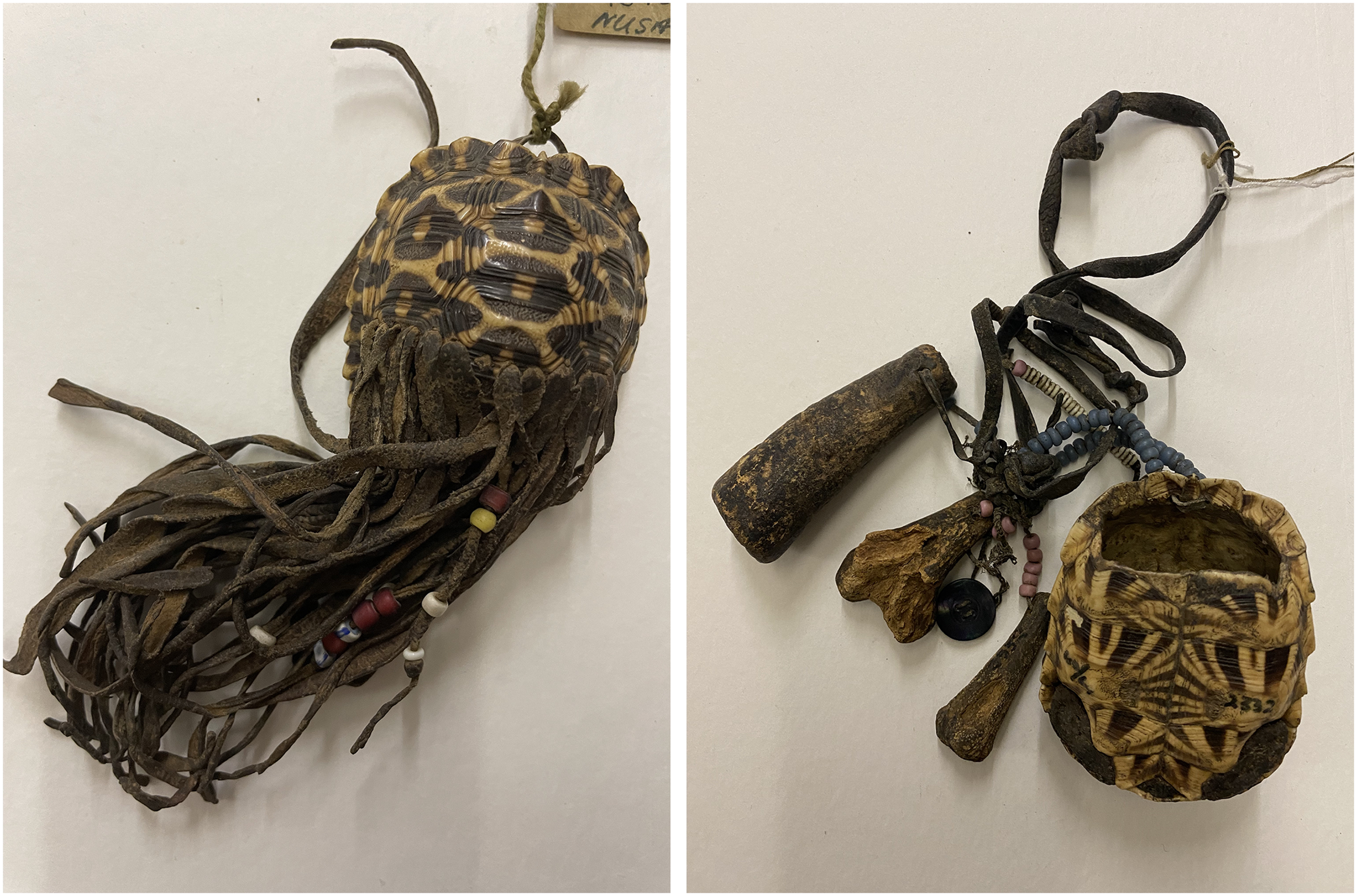
(Left) MM40/69/1518 is a Nu||ein tortoise shell container “belonging to young girls who have just reached maturity” (Fourie nd MM40/69 BOX E Item 22: 105). (Right) MM40/69/2332 “≠Ao//ein & Herero” (photographs: Vibeke M. Viestad, with permission from Museum Africa, Johannesburg).
MM40/69/977 is listed in Fourie's notebook: 977 is ≠Ao-||ein from Koroxas & belongs to young immature girls & contains 3 Khuxa (1, 2 & 3) 2 sã-sã (4 & 5) 1 Tjinagin (6) 1 ≠gĩ!gãihã(A), ≠gi-hiba(N) 4 ≠Kari (8, 9, 10 & 11) 1 Khoba ‘KŪXA is a single stem plant with [tuber?] which is soft and used for scraping into food of young women when menstruating’ (Fourie nd MM40/69 BOX E Item 22: 263). 'SÃ-SÃ … eaten by young girls for stomach complaint's … Sã-sã is also the root of a shrub and is scraped into food when a young B. first eats steinbuck they must eat it along with 1056, 1047, 1048 and 1359’ (Fourie nd MM40/69 BOX E Item 22: 262). ‘TSI-NAGŪ … from which buchu is made’ (Fourie nd MM40/69 BOX E Item 22: 261). ‘≠Gī-|GAIHA … made from the root of ≠gĩ-!gaia, a large tree, and worn by young men round neck. Scraped into water and food for stomach medicine. When taken with water it gives appetite. Has no particular taste. No special significance attached to thickness of root; … Scraped into food and taken internally by young women’ (Fourie nd MM40/69 BOX E Item 22: 259). ‘≠KARI … eaten by young women for stomach complaints’ (Fourie nd MM40/69 BOX E Item 22: 262). ‘KHOBAB … used by men as a love potion for women. When swallowed it excites the sexual appetite. It is chewed, spat on hands which are then rubbed together. The little that remains in mouth is then spat towards the woman who is desired. This will make her come to the man of her own accord’ (Fourie nd MM40/69 BOX E Item 22: 263).
Although these are all fascinating details, Fourie tells us next to nothing about the use of the tortoise shell boxes as such. We get to know that they are used “for powder” and “for buchu” and a couple of the Naro containers are said to be used by young men “for baljas.” We believe this to be a misspelling on Fourie's part of the Afrikaans word “paljas,” meaning “charm,” or “spell,” 5 and thus possibly associated with the healing/trance dance. To learn more about the function and meaning of the boxes, however, we need to turn to the published literature.
Tortoise shell containers in the Kalahari ethnographies
In the earlier ethnographic literature from the beginning of the last century, the tortoise shell boxes, and their contents, are sparsely commented on (e.g., Bleek, 1928: 12; Schapera, 1930: 67). When they are mentioned, they are mostly associated with hygiene, understood as a form of “washing”: Rubbing the face and body with fat and powdering with buchu is done by old and young. It is their method of washing. … Many women carry small tortoise-shells filled with powdered buchu, with a bit of soft bird's nest, or else of jackal's skin stuck in the top as a puff, and powder their face and body. (Bleek, 1928: 12) The one piece of equipment with which healers supplement their own n|um in healing … filled with a mixture of n|um plants and marrow or fat. (Marshall, 1999: 56) When the healer uses his tortoise shell in healing, he drops a glowing coal into the mixture. This produces a medicine smoke, !go n|um. The n|um is in the smell and is carried by the smoke. (Marshall, 1999: 57)
Due to several intersecting reasons, which have resulted in a lack of experienced healers and young people willing to learn the craft, the Omaheke Ju|’hoansi today do not practice the healing dance, or trance dance, that is well known from the Kalahari ethnographies from the 1960's onward. Their use of tortoise shell boxes is thus not related to trance or healing, but rather, as we will learn in the following section, other powerful notions of potency, place and protection—often also associated with the hot and cold dichotomy and good vs. bad winds.
Tortoise shell containers in Omaheke today
During the material culture documentation among the contemporary Omaheke Ju|’hoansi in March–April 2022, it quickly became apparent that the beaded tortoise shell box is the most common perceived “traditional” object in people's possession. Other, usually larger artifacts, such as men's weapons, or skin clothes, were exceedingly rare. Interlocutors attributed their scarcity to several factors, the most common of which was lack of access to land for hunting and for procurement of animal materials. Local tourist lodges also reportedly collected “old” objects for sale or display and people reported little motivation or lack of materials or knowledge for their replacement. Tortoise shell boxes, on the other hand, are small, personal objects, often hidden from sight. Before engaging with their documentation, and after spending over 18 months among the Ju|’hoansi, Velina Ninkova had only seen a few !’hurasi, usually placed around newborn babies or during first menarche ceremonies (Figure 6). During the documentation project, we found that most households indeed have a !’hura, and on several occasions, we were invited to observe women in the process of making new ones. Some women also reported that their tortoise shell boxes were kept by relatives who worked on commercial or communal farms, where people needed them more, a point to which we will return when we discuss their use.
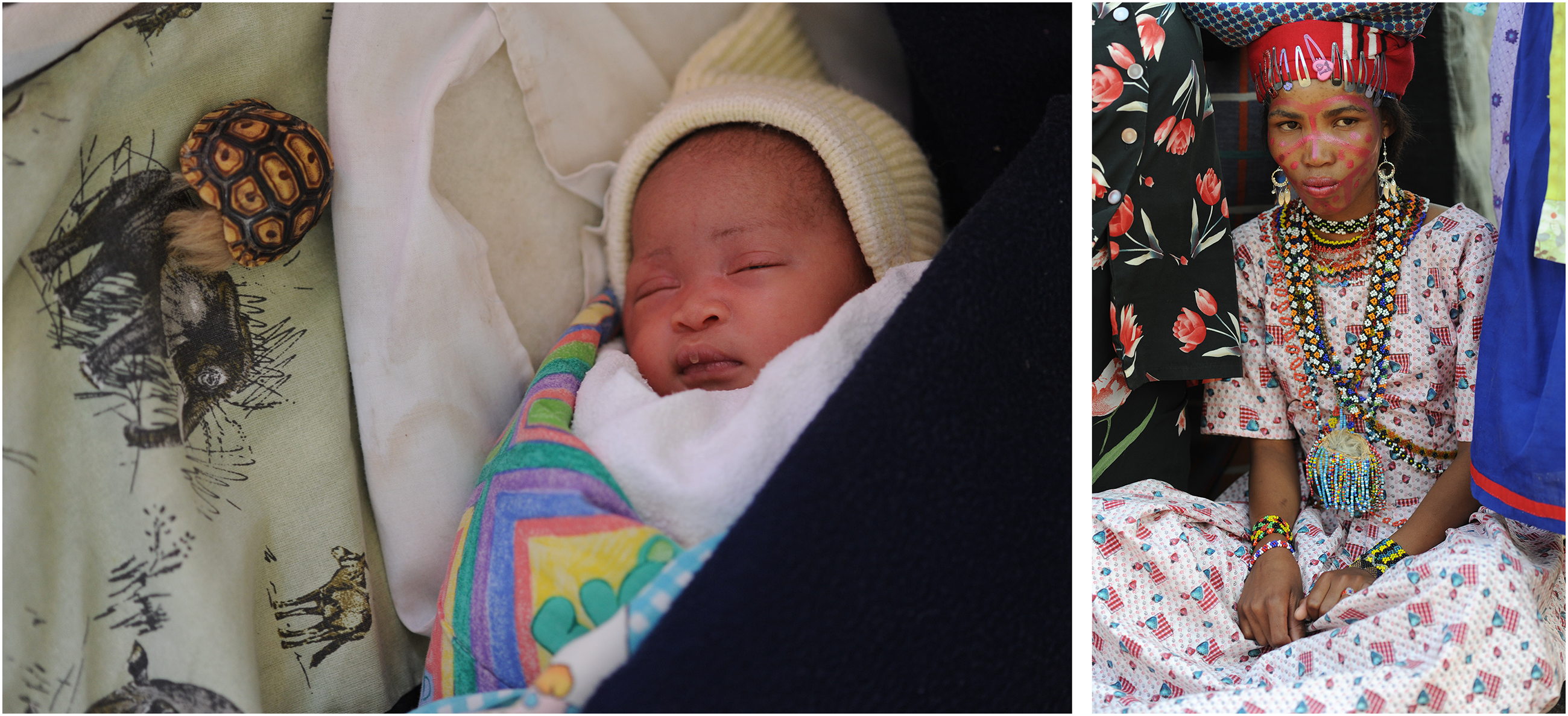
Tortoise shell containers carefully placed next to a newborn baby (left) and around the neck of a “New Girl” (right) dressed up in celebration of her first menarche (photographs: Velina Ninkova).
As the ethnographic literature describes, and the Fourie collection exemplifies, tortoise shell boxes can be owned and used by both women and men, old and young. In Omaheke, we only found women who made and owned them, although as Mita explained to us men could make and use them, too. One of the team members, Calie, a young man in his late twenties, expressed to us that he had not known that men could make them, but that now he was interested in learning how to do it. Our interlocutors described the tortoise shell container as a personal object—a woman who makes it, either keeps it for her own use, or gives it away to someone else. In the words of Mita “every Ju|’hoansi should have one.” She also shared that when a person dies, their tortoise shell box remains for use in the family. In practical terms, however, we observed that the !’hura usually “lives” somewhere hidden in the house and can be used by anyone in the household or shared with a relative or a friend who may need it.
As cited above, Bau from Otjinene referred endearingly to her tortoise shell container as “this little thing of ours,” and indeed, people place great aesthetic value on small, well-rounded tortoise shells that fit well into one's palm. When sharing her knowledge about tortoise shells, Christina from Skoonheid told us that it is important, when you find a tortoise in the veld, to pick it up in a certain manner (from head to tail and not side to side), so that it will “keep” its nice, rounded shape when made into a box. The two common tortoise species found in the Kalahari (||hoa and zam (Psammobates oculifer and Stigmochelys pardalis) can both be used for the purpose, and men, women, and children freely collect them when they find them in the bush. Once caught, the animal is killed, the flesh is cleaned with a knife, the head opening is cut larger, and the shell is ready for drilling, sealing, and decoration. Most commonly, women use the roots of the n|inh shrub, from which they make a thick paste by peeling, chewing, or grounding and mixing the roots with water (Figure 3). Other materials are also reportedly used for sealing the back and side openings of the shell, such as the branches of the n|inh plant, burned tree sap, and other plant species.
After the sealing dries, the exterior of the shell is lavishly decorated with glass or plastic beads, sometimes attached to a piece of fabric or skin. Each tortoise shell box is uniquely decorated, and no two boxes look alike. The beaded patterns can be “random,” or they can have a specific meaning, which may add to the potency of the !’hura. The two most common patterns we recorded were the “eye” pattern and the “snake” pattern (Figure 1), which we will discuss in more detail below.
Once sealed and decorated, the shell is filled with powdered tsah (Figure 3), which has a strong fragrance, and which some women mix with other herbs, or with baby talc powder, for a more powdery consistency or for additional aroma. A piece of fur is then added on top, which serves both for applying the powder and which also covers the powder and keeps it in the shell box. Most commonly, women use fur from the back of the bat-eared fox, for its softness, although we recorded fur from other animal species, such as springhare and sheep, as well as pieces of store-bought synthetic fabric. In some cases, the hairless under-side of the fur can be treated with red ocher to soften it.
Uses of the tortoise shell container
Two main uses of the tortoise shell box were documented among the contemporary Omaheke Ju|’hoansi—orientation in space and protection. The most commonly reported use of the !’hura is that it helps a person orient themselves in space. For example, when a Ju|’hoansi visits relatives who live in a far-away place with which the visitor is not familiar, they would be offered to sniff the tsah from the fur of the !’hura. The fragrance will help them get a sense of their position in the world, especially in terms of the four cardinal directions and orientation vis-à-vis their own home. The Ju|’hoansi of Omaheke travel extensively to visit relatives or for employment purposes, and these travels, while important can be also fraught with dangers from encounters with people from other ethnic groups, as well as with substances and forces over which the Ju|’hoansi do not have control (e.g., bad winds, witchcraft, etc.). Our team member, Frederik, expressed that in addition to feeling “fear” and “nervousness” when far away from his home, he also felt a sense of dizziness and disorientation. Sniffing the tsah from a tortoise shell container helped ease some of the disorientation he felt in unfamiliar places (see also Ninkova and Hays 2017).
Furthermore, some interlocutors told us that their tortoise shells were with relatives on farms. The farm is an undeniably non-Ju|’hoan space in which people from various backgrounds and different (often dramatically unequal) status live side by side. Women are particularly concerned about the health of newborn babies on farms, due to the obvious or hidden presence of harmful winds and of various substances used by others to mitigate them.
Similarly, for hunters who get lost—something, which according to some of the men who still hunted was not uncommon, especially among the young and inexperienced—a tsah sniff “helps your memory come back” and thus helps to find your way back home. This use was admittedly only reported by women, and no actual hunters from Omaheke confirmed that they carried tortoise shell boxes on their rare hunting trips. A photograph taken by the Marshalls in Gautscha, Namibia, in the early 1950s does however show a single tortoise shell container hanging from the hunting bow of one of four young men portrayed in the image (Figure 7). Biesele has also noted that “Medicine smoke from a tortoise shell [is used] … also to prepare a man for hunting. The zam (which means both the tortoise and the medicine box made from its shell) ‘sends you to the animal’” (Biesele, 1993: 93). We suggest that these examples might point to similar uses of “finding your way” while out hunting as that reported in Omaheke decades later.
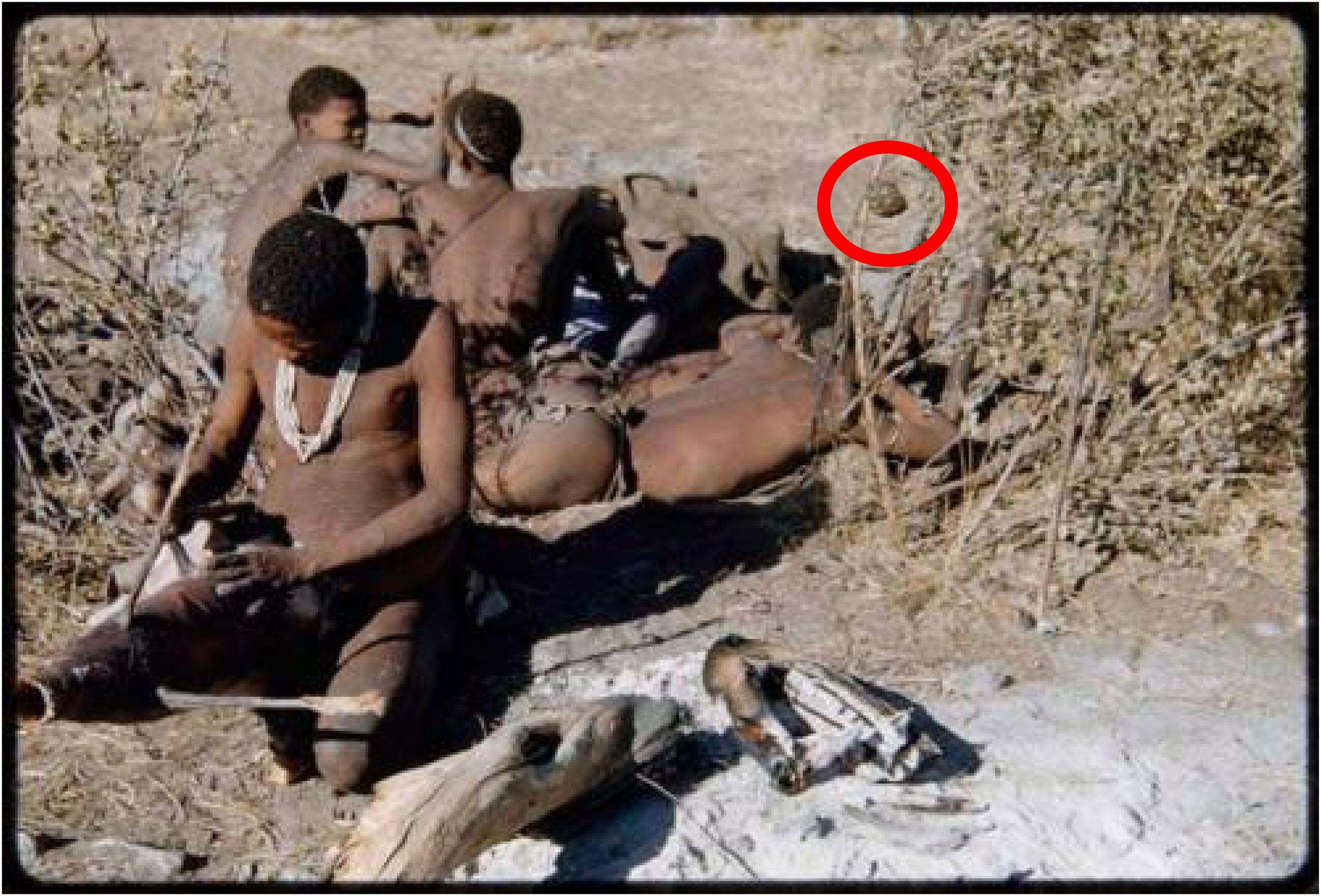
“Bag making: Man making a skin bag from the whole skin of a wart hog, with [three] young men sitting behind him and a tortoise shell hanging in a nearby tree with bow and quiver” (Gift of Laurence K. Marshall and Lorna J. Marshall. © President and Fellows of Harvard College, Peabody Museum of Archaeology and Ethnology, 2001.29.1294).
Secondly, the !’hura serves to protect people from malevolent beings and bad substances in several different ways. Following up on the reported use by hunters, Mita explained that when in the veld, if a hunter senses danger from predators, he may apply tsah powder for protection. The tsah masks the human smell, as well as the smell of substances which are dangerous for hunters in the veld, e.g., the smell of breast milk or sexual fluids.
Another form of protection comes from the geometrical patterns created with beads. 7 The pattern “eyes,” also found on beaded jewelry, crochet hats, or purses, protects individuals by warning them against malevolent forces. An important distinction that our interlocutors made was that the eyes are not metaphorical but literal. Describing the protective properties of the eyes on her purse, a Ju|’hoan woman from Otjinene reported that when she was in an unfamiliar place, the eyes would vibrate and warn her of existing danger (e.g., bad winds, sangoma (Bantu witchcraft), or “police”). Furthermore, beads in the pattern of “snakes” or “snake teeth” or “horns” protect the owners by keeping snakes away from the homes. !Oce from one of Skoonheid cattle posts described that the bead pattern on her tortoise shell box depicted the water snake (python) moving in the high grass during the rainy season (Figure 8). Keeping the tortoise shell in the house protected the house from the python and prevented it from entering the house. The python occupies a prominent role in the Omaheke Ju|’hoansi cosmology. It has personhood and agency on its own, can bring about sickness or death, and has to be dealt with care and respect.
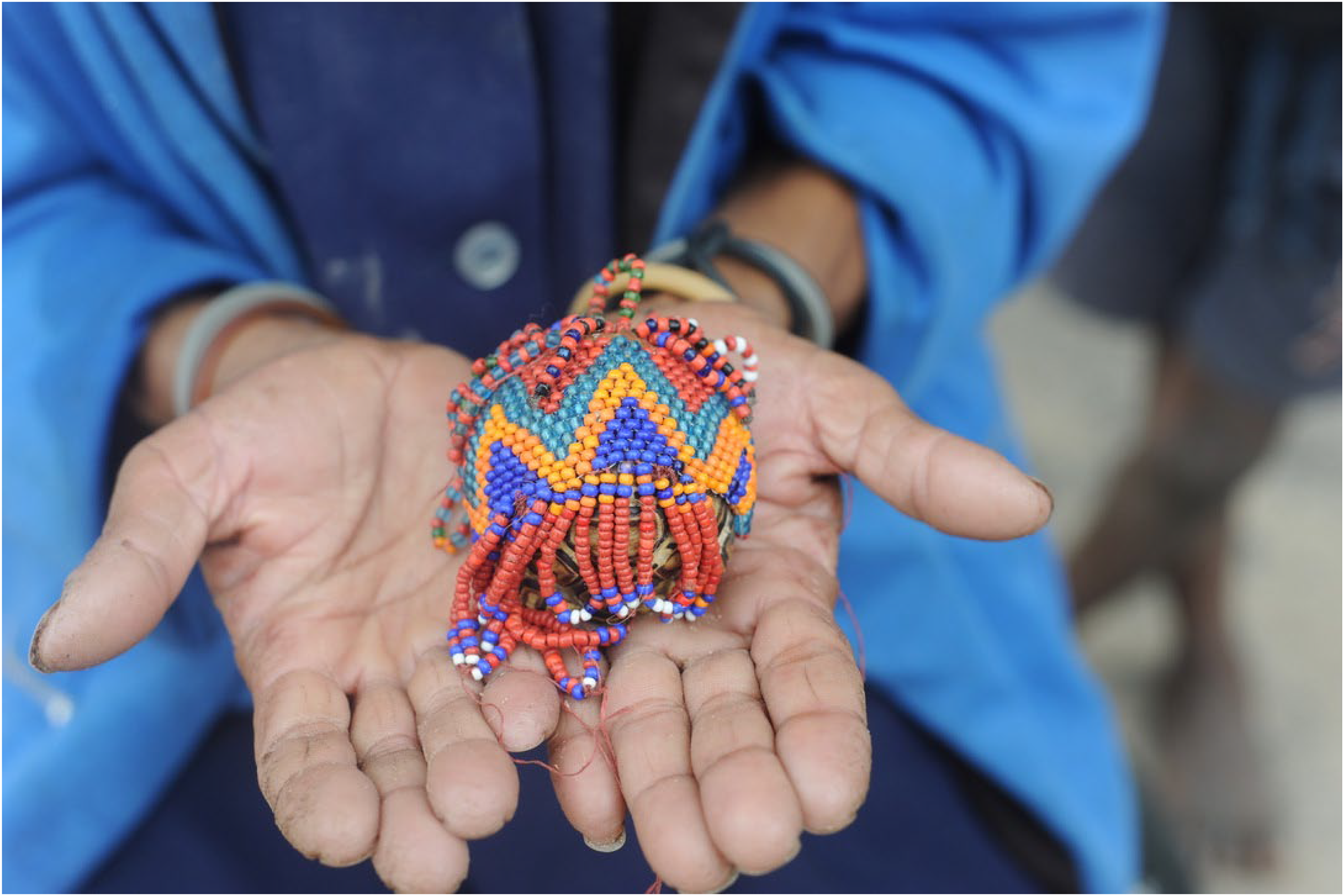
“The python running in the high grass in the rainy season,” designed and beaded by !Oce from Skoonheid (photograph: Velina Ninkova).
The other area in which the tortoise shell box, and more specifically the tsah fragrance inside it, protects people is related to the hot and cold complex. “The symbolism of heat and coolness and the operations that transform one into another,” as detailed by Biesele, “appear over and over in individual, social, and supernatural contexts" in Ju|’hoan life (Biesele, 1993: 80). Hot and cold are considered intrinsic to certain gendered persons and “things.” Women, the moon, and certain tools, objects, and activities are associated with coldness, whereas men, the sun, and other tools and activities are associated with heat. Ju|’hoansi oral tradition abounds with stories centered around hot-cold and male-female dichotomies. For example, the sun (male) marries the moon (female); a man discovers water (f) and his wife persuades him to share it with her; a woman discovers fire (m) and her husband steals it and shares it with the world; dry hot weather (m) combines with wet cold weather (f) to create the most desired cool weather, and so on (Biesele, 1993).
Hotness and coldness are not stable states, and the balance between hot and cold must be achieved and maintained by various observances, substances, and actions. A balance between hot and cold is needed for an individual and a community's well-being, commonly expressed in terms of health, abundance of food, luck (especially in hunting), and lack of conflicts with others.
In transition periods, for example, at birth and during a girl's first menarche, as well as through the presence of sexual fluids, menstrual blood and breast milk, women, girls, and babies can accumulate too much heat, which they then can pass to others. Too much heat can interfere with people's relation to food and sense of satiety, make them thin (jaqm), weaken the potency of weapons, and expose hunters in the bush to predators (as described above). To mitigate the excessive heat accumulated during this transition period, young girls apply tsah powder on themselves, in addition to consuming herbs and using other observances and substances (Figure 6).
Another powerful substance against which the Ju|’hoansi need protection is the so-called bad winds (mqa |kurisi). 8 For the Omaheke Ju|’hoansi, bad winds are most harmful to babies and young children and, when left unmanaged, may lead to severe disease and death. The concept refers not to the meteorological phenomenon (although movement of air may be associated with it), but rather to the presence of certain substances in the air and their associated smell. When babies come across these smells, they risk sickness. Application of tsah, as well as other substances usually worn in tiny black pouches around the neck, helps mitigate the impact of bad winds. Ita from Skoonheid also told us that tsah neutralizes the smell of breast milk on small babies and thus protects those who come in contact with the baby (Figure 6).
Finally, interlocutors reported that when someone in the family died, they applied tsah on babies and young children to protect them from the spirits of the dead ( || gangwasi), who are known to plague or even take away the living out of envy.
The longue durée of the tortoise shell container
From the above, it is clear that many San groups have had their version of the tortoise shell container—beautifully decorated or simply sealed and bored through, to make holes for a thong. They are present in every ethnographic collection Vibeke M. Viestad has visited 9 and made mention of in several publications, although only Lorna Marshall (1999) describes and explains them in more detail. Countless photographs and illustrations show them hanging around women's necks, and/or attached to their clothing (e.g., Figure 9; see also the Marshall Family Kalahari Archive 10 ).
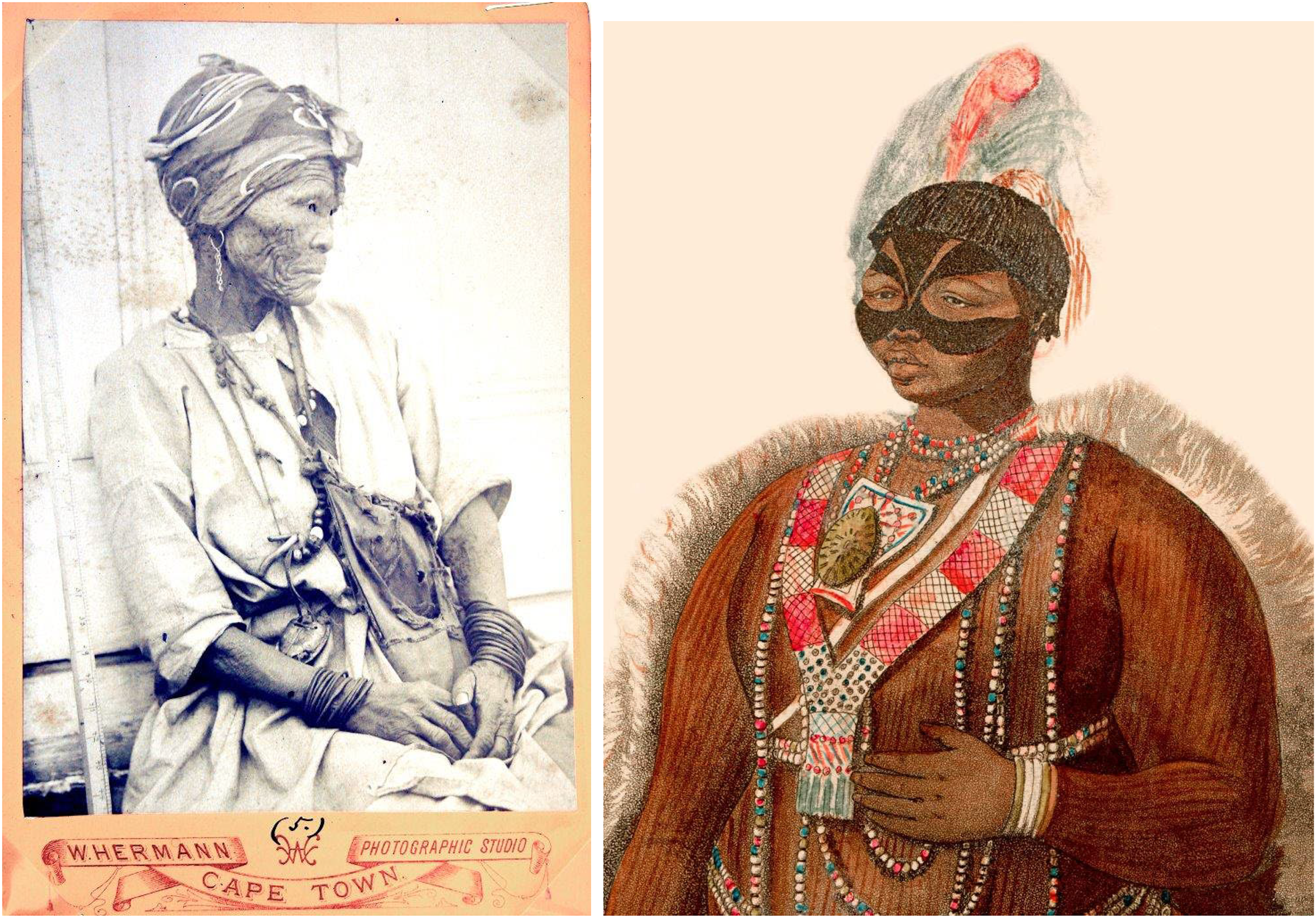
|Xanken-ang, Cape Town 1884 (left) (Iziko Museums of South Africa, Social History Collections). Sarah Baartman, Europe 1811 (right) (public domain: Encyclopædia Britannica).
From prints published in London in 1810 and 1811 (Crais and Scully, 2009: 75–77), we know that Sarah Baartman (Figure 9) kept and wore her tortoise shell container (as one of few “authentic” dress items and ornaments) while she was paraded around Europe, exhibited as a “phenomenon of nature” (Crais and Scully, 2009: 112) in the early nineteenth century. |Xanken-ang (Figure 9), an elderly |Xam woman photographed in Cape Town in 1884 at Lucy Lloyd's request (pers. comm. de Prada-Samper), no longer used skin clothing, but the beads, bag, and her tortoise shell container still made a conspicuous part of her dress. Although two random examples, both images indicate that the tortoise shell container would have been important enough for both women to keep in an otherwise changing world. Perhaps as one of the last material memories of a time and place that they no longer had access to.
Tortoise shell containers can also be attested in the archaeological record. Polished rims on tortoiseshell remains, and clear marks from scratching on the inside of the shell, have been interpreted as remains of tortoiseshell containers “such as the snuff boxes preferred by Kalahari Bushmen” (Sampson and Neville, 2018: 156). These remains have been found in the Upper Karoo of South Africa in archaeological contexts dating from between 544 ± 43 BP up until the mid-nineteenth century (Sampson, 1998: 987, 996–997). Faye Lander and Thembi Russel, who have compiled a southern African archaeological database of organic containers and materials, point to evidence of tortoise shell containers dating as early as between 290 cal BC and cal AD 310 (Lander and Russel, 2020: 10/31), thus adding considerably to the potential time span and longevity of the practice.
Tortoise shell containers can even be recognized in the rock art of South Africa. This was done already in the late nineteenth century by some of the |Xam individuals that stayed with Wilhelm Bleek and Lucy Lloyd at Mowbray outside of Cape Town, contributing to what today is known as the Bleek and Lloyd collection—an exceptional and important source of knowledge into the now extinct |Xam language, their myths, cultural knowledge, and expression (e.g., Bleek and Lloyd, 1911; The Digital Bleek and Lloyd). Asked to comment on reproductions of rock art from the Drakensberg, made by J. P. Orpen, “the Bushmen who are now staying with me” (most likely ‡Kasin and Dia!kwain at the time) explained to Wilhelm Bleek that one of the paintings, representing a large animal with ropes attached to its nose, was in fact the “water cow,” being led across the country by “men (sorcerers)” so that rain would fall (McGranaghan et al., 2013: 163): “In their hands are boxes made of tortoise (!khū) shell (containing charmed boochoo) from which strings, perhaps ornamented with beads, are dangling down” (McGranaghan et al. 2013: 163).
Dia!kwain later also made comments on reproductions of rock art from the Eastern and Northern Cape, made by George Stow (de Prada-Samper and Hollmann, 2017). One of the paintings from the Eastern Cape represents a big snake, and Dia!kwain said “that the groups round the snake are all meant to charm it and drive it away […] The man opposite the snake has [a] buchu dose in his hand, from which the strings hang down” (de Prada-Samper and Hollmann, 2017: 12). 11 Finally, Dia!kwain also recognized tortoise shell boxes in copies made of rock engravings from Driekopseiland in the Northern Cape (Figure 10) (de Prada-Samper and Hollmann, 2017: 24–25): “!ku: tortoise shells sewed round with springbok skin frayed. (bags) They put sã: (buchu) in these things” (de Prada-Samper and Hollmann, 2017: 24).
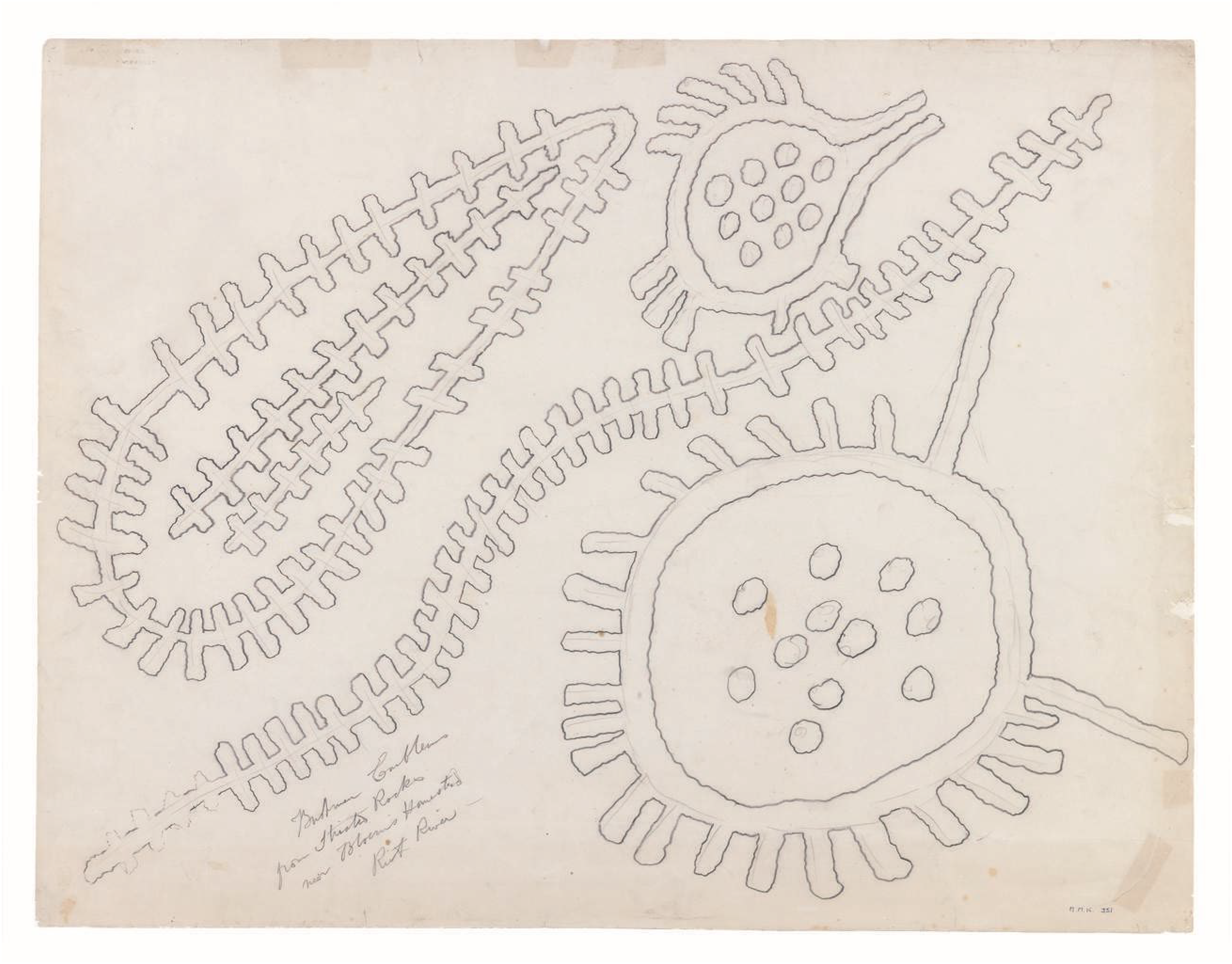
“Pencil drawing on card of engravings of symbols and shapes found near Riet River.” Dia!kwain recognized the rounded shapes as decorated tortoise shell boxes (McGregor Museum, Kimberley, South Africa).
Although one might argue that Dia!kwain recognized details in the rock art based on his own cultural background and experience and that this did not necessarily coincide with the past painter's/engraver's intentions, we find his associations to be compelling. In recent years, archaeologist and rock art specialist Jeremy Hollmann has identified further examples of what he convincingly argues are engravings of beaded tortoise shell boxes on the smooth rock outcrops of the Gestoptefontein-Driekuil complex, also in the Northern Cape (Hollman, 2011: 292–295, figs 8.32 and 8.33), associating these and other engravings (of beads, bags, and aprons) with the coming of age of Khoisan women and their reintroduction to the animated landscape (Hollmann, 2007; Hollmann, 2011; Hollmann, 2013). We believe there is only a matter of time, and awareness, before other examples of painted and engraved tortoise shell containers will be identified in the growing corpus of documented rock art of Southern Africa.
Apart from the examples noted above, there are however surprisingly few references to this type of artifact in the Bleek and Lloyd collection. In the Bushman Dictionary, examples of “tortoise shell (snuff box)” are explicitly associated with buchu (“I put buchu into the tortoiseshell (snuff-box)” (Bleek, 1956: 162); dress (“bore it (tortoiseshell), with a thong thread it, and wear it”) (Bleek 1956: 297); or both (“a woman slings (the tortoiseshell) on, wears it, with buchu fills it”) (Bleek, 1956: 343). We can also find different words for the tortoise shell powder box itself (Bleek, 1956: 391, 448, 622). Most of these examples seem, however, to derive from Dorothea Bleek's work in the Kalahari, and as far as we have been able to establish, there are no direct references to the tortoise shell container in the extensive collection of |Xam myths and narratives. But we do find reference to tortoises and what seems to be a clear distinction between “the tortoise” and “the Tortoise.” A certain set of stories are associated with the latter, where “the Tortoise” is a mischievous person of the Early Race, described by Dorothea Bleek “as a clever person, often likewise as a cruel one” (Bleek, 1929: 303).
The tortoise (the animal), on the other hand, is referred to as “a rain's thing,” associated with water, and strict taboos applied specifically to “the New Maiden,” or young women in menarche, in her relationships with the creature. In the story Things girls and youths must avoid (the rain's things) (Dia!kwain and Lloyd, 1875), we learn that girls are (and should be) afraid of the tortoise: the Bushman are those who teach them [the young girls] that they may not take up a tortoise; for, a water's/rain's thing it is. For, the rain would, if they had taken up a tortoise, with their hands, the rain would be angry with them. Therefore, they are afraid, on account of it, to take up a tortoise, with their hands, for a tortoise is a rain's thing. (Dia!kwain and Lloyd, 1875: 4384) For, her scent, with which she is a girl, it is upon her father; the rain would smell that her father has not got the scent of her buchu, the rain would lightning kill her father;… (Dia!kwain and Lloyd, 1875: 4396)
Discussion
The Ju|’hoansi, as described elsewhere, inhabit a world in which various human and other-than-human entities are interlinked in a web of predatory and/or benevolent relations (e.g., Biesele, 1993; Dieckmann, 2023; Marshall, 1999; Ninkova, 2022). Each individual is personally responsible to mitigate and take care of their relationships both with other fellow humans, and other-than-humans, such as animals, plants, natural phenomena, various spirits, and so on. Thus, “space,” “nature,” or “the world” is a living socio-system in which different intersubjective sentient beings interact and impact one another. “Winds”, and/or “scent”/“smell”/“odour” are acting phenomena within these relationships and can be transmitted between people and persons of different natures.
Low (2004, 2007) has previously discussed San ideas about “wind,” related notions of potency and the movement of potency, as a broader Khoisan phenomenon associated with healing practices and understandings of sickness and health. In 2012, Mark McGranaghan explored the ontological consequences of such, and similar, ideas (e.g., “odour”) within the |Xam world view specifically, explaining them from an animist (or “animic”) perspective (McGranaghan, 2012).
“Animists”, Graham Harvey states, “are people who recognise that the world is full of persons, only some of whom are human, and that life is always lived in relationship with others” (Harvey, 2005: xi). Harvey, who has been credited to have coined the term “New Animism” (Guenther, 2015: 279), is thus careful not to constrict “animism” within one set of clearly defined terms or world views but speak rather of “animisms” (in plural) as the many various ways (of many different groups of people) of understanding the world from a point of “relationality” (Harvey, 2013). The social aspect of relationships is essential: “[a]nimism could be defined as an ontology which postulates the social character of relations between humans and non-humans: the space between nature and society is itself social” (Viveiros de Castro, 1998: 473).
In 2015, anthropologist Mathias Guenther published a seminal paper he would further develop into a comprehensive effort of explaining San myth, ritual, and practice within an encompassing relational ontology (Guenther, 2015, 2020a, 2020b). “(S)animism,” as Guenther suggests, is characterized by “ontological flux,” of human and non-human person-beings (Guenther, 2015: 302) in which boundaries between them are porous (Guenther, 2020a: 5). This holds true both in the mythical shape shifting of the Early Race as well in the somatic tapping sensations hunters may experience during large animals hunting (2015), or the bodily metamorphosis of the trance dance or initiation ceremonies (Guenther, 2020a, 2020b).
Although Low does not comply theoretically with the “New Animist” approach (Low, 2014), both he and McGranaghan describe in their work (based on ethnographic field work and linguistic analysis respectively) how the wind, and smell, or “odour,” in San ontology are properties of the individual that move between identities, and therefore have impact on others; their individual boundaries in effect being permeated: Wind smells lock participants into a web of relationships. The essence of one organism connects with another. The consequences can be powerful. The hunter links to the prey; the wind potency of the healer cures the sick; the wind of the sick person transmits his or her illness. (Low, 2007: S75)
Although there is no mention of the container holding the buchu in the cited story, the detail of how the girl must “fumigate” her father resembles the healer's method of burning the content of his tortoise shell to make “medicine smoke.” We further remember that the n|um (and thus the potency of the smoke) is in the smell, just as it is the scent of the buchu that protects against the scent of the girl. Masking the scent of highly potent and potentially harmful substances, such as menstrual blood and breast milk, and thus balancing out excessive heat that can be harmful to other people, is also one of the tortoise shell (and its contents) many uses in Omaheke today—to protect the newborn baby, the new girl, as well as the community at large.
Further, the effects of “cooling a person” with a dust of the fragrant powder, the general sense of well-being it creates, or the regained sense of place and orientation it provides, can also be understood from such a viewpoint, where nice smells and good winds, as opposed to bad smells and bad winds, provide comfort and safety, within the preferred known as opposed the ambiguous unknown. Protecting against harmful winds is also essential in unfamiliar places, where one does not necessarily know whom or what might be present.
There are further aspects of the !hura that associate this small piece of material culture with other important San beliefs and presences in the world. One obvious example is the patterns of the beautiful beadwork of the modern containers—how they relate to other beadwork made in the community, as well as to practices concerning snakes. Further exploration of this must however wait for future work and more inquiries.
In line with what has been suggested elsewhere in a broader analysis of how elements of dress and ways of dressing the body initiated, engaged and maintained important social relations between humans, as well as human and other-than-human sentient beings among San of the recent past (Viestad, 2018, 2024), we argue that the !’hura plays an important part in the mitigation and control of potential danger due to ontological flux between persons, phenomenon, and their winds, heat, and associated scent. We see the tortoise shell box either as a central or a complementary element in a set of tools and practices that the Ju|’hoansi have at their disposal in liminal periods or situations, to achieve a desirable state, or avoid danger and disease. Despite its small size, the central role of the !’hura in making, maintaining, and protecting of the Ju|’hoansi body (and by extension—the Ju|’hoansi culture over time) may account for its durability and resilience through time and space.
Conclusion
The main objective of this article (and the project it results from) is to document resilience and continuation of practice in conditions of dramatic, unjust, yet seemingly inevitable change. Over the course of a hundred years, the Omaheke Ju|’hoansi have lost access to traditional territories and their available resources; have been forced as manual laborers on white farms, where they have been “taught” proper behavior and norms; and, after Namibian independence in 1990, have been again recast as underdeveloped citizens dependent on the state for their survival. During these turbulent times, many aspects of their symbolic and material culture have changed or disappeared. Other aspects have, however, remained and in some respects even flourished.
We suggest that the continued making and use of the !’hura should be understood as one of perhaps few ways that the Omaheke Ju’|hoansi today perceive to be able to act upon and make an impact on the forces of an ambiguous world—a world that increasingly seems to be outside of their control and influence. With a central role in the mitigation of various threats and mediation between different states-of-being and potent phenomena, we consider the tortoise shell box of the Omaheke Ju|’hoansi a complex material cultural tradition that signifies and provides personal agency in the continuation of practice, linking the Omaheke Ju|’hoansi with broader San ontological concepts related to winds, fragrance, potency, and protection. As such, the !’hura has played an important role in the preservation, resilience, and development of Ju|’hoan culture.
Footnotes
Acknowledgments
In the preparation and writing of this article, we have received help and guidance from a number of people and organizations. First of all, we would like to express our deep-felt gratitude to the Omaheke Ju|’hoansi, for welcoming us to do field work and research in their communities and for sharing their knowledge and cultural expertise with us throughout formal and informal conversations and interviews. We are especially grateful to our research team members, to all our interlocutors, and specifically to Mita and Christina for patiently spending time and sharing their knowledge with us. Ju|’hoan symbolic and material culture are tremendously complex and rich, and we have only scratched the surface. Any errors or misinterpretations are our own. The research was made possible with grants from the Endangered Material Knowledge Program and the Research Council of Norway (project number 315200) and is hosted by the !Kwha ttu Heritage Centre with the help from Chris Low and other staff. We would like to thank the Institut français d’Afrique du Sud, Johannesburg, and the KwaZulu Natal museum for inviting us to present earlier versions of this work, and we acknowledge the valuable feedback we received from participants of the “Weaving Histories from Below in the Global South” workshop (IFAS) and the experimental format of the “storeroom”-talk (KZNM). We are also grateful for all permissions received to publish imagery under copyright regulations. Thanks are due to Madimetsa David Kola, Cultural History Curator at the Museum Africa, for facilitating our archival research. Some preliminary results of this study have been disseminated to the public in the exhibition “The Origin of the World. Creation and transformation in San dress, narrative and rock art” at the Origins Centre, Johannesburg (7 September 2023–25 August 2024).
Declaration of conflicting interests
The authors declared no potential conflicts of interest with respect to the research, authorship, and/or publication of this article.
Funding
The authors disclosed receipt of the following financial support for the research, authorship, and/or publication of this article: This work was supported by the Arcadia Fund, Endangered Material Knowledge Programme, Norges Forskningsråd (grant number: 315200).
