




Abstract
In this article we consider the movement of fossils into art commercial spaces as a process of artification underpinned by the deep object associations that art spaces foster. We combine observational data gathering at art and fossil fairs, dealerships, and auctions with snapshot analysis of the online market for Tyrannosaurus rex fossils, contextualized by interviews with palaeontologists and fossil dealers, to understand the increasing appearance of fossils within art commercial spaces. We believe that the placement of fossils within the art market desirescape, so within a network of alluring, provocative, affective art objects, allows the fossils to transform into what consumers would consider art. The fossils then gain the social associations that artworks have for these consumers. We believe that art and fossil consumers are not simply drawn to individual objects of desire, but to the myriad associations those objects have with other objects and the deep meanings those associations overlay. Those associations and the network they form can, in turn, transform the objects within it. When a fossil is artified, it can be desired like art, and can command art prices.
Introduction
A dinosaur skeleton has a beauty to it, an artistry. (Peter Larson, quoted in: Fisher, 2022)
In late 2022, Maximus, 1 the fossilized skull of a Tyrannosaurus rex was presented at Sotheby's auction house in New York in a stand-alone sale. 2 In the lead up to the auction, Sotheby's released a series of photographs of Maximus which portrayed the specimen among prints, paintings, and other artworks 3 and invited members of the press to photograph the fossil in that setting. Maximus rests on a metal stand in the center of the room while artworks hang around. Maximus was in an art space (Figure 1).
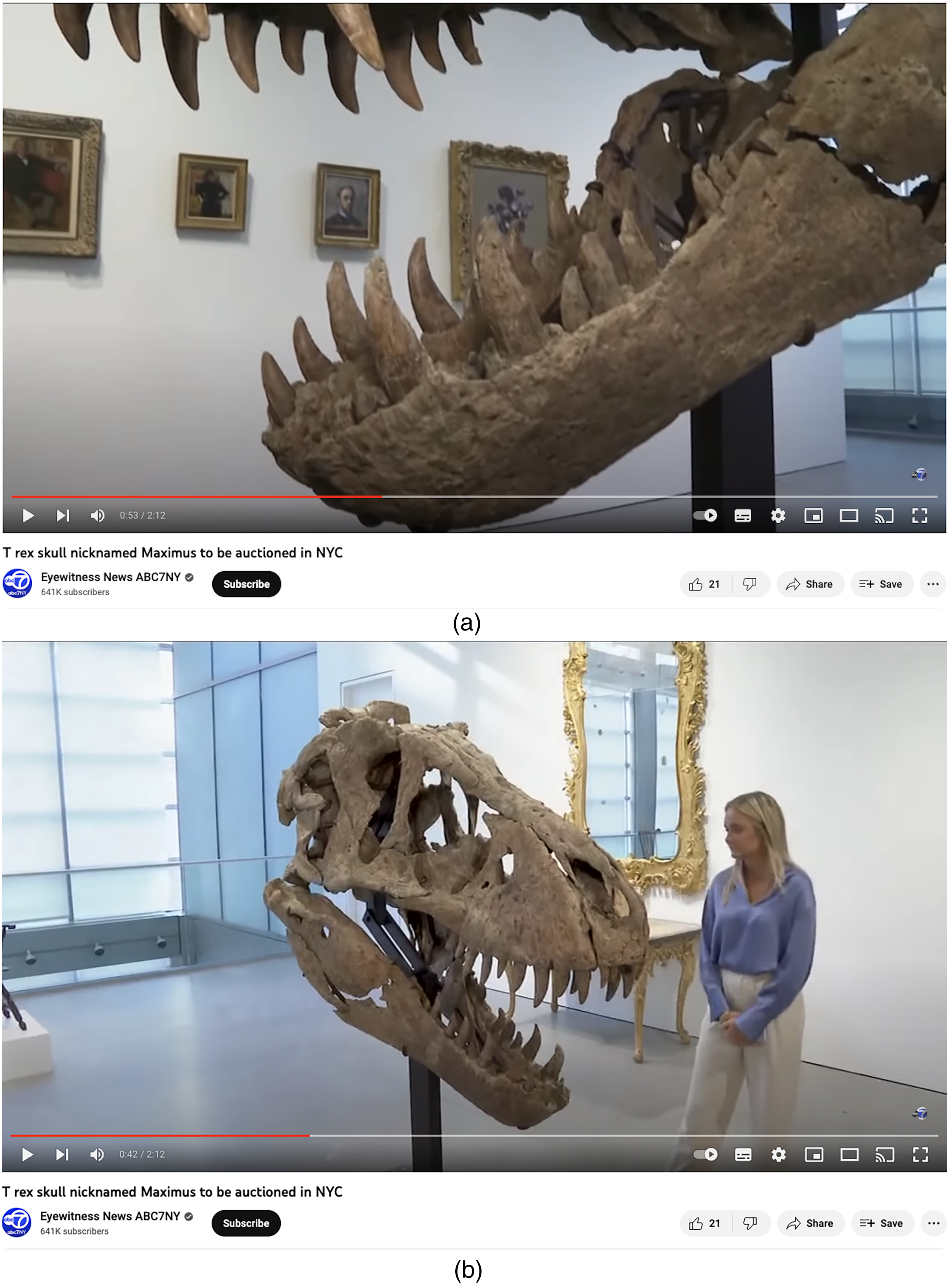
Figure 1a and 1b: Maximus within the Sotheby's art space; screen shots of eyewitness news ABC7NY (https://www.YouTube.com/watch?v=yjOcT_-oYcg), Screen shot taken by Yates, 4 April 2024.
At the same time that Maximus was on display at Sotheby's, Shen, a more complete T. rex specimen, was offered at Christie's Hong Kong. Unlike Maximus, Shen was offered during one of Christie's scheduled sales: ‘20th/21st Century Art Evening Sale’ scheduled for 30 November through 1 December in Hong Kong. Shen proved to be a controversial specimen that was removed from the sale for other reasons (e.g., see Jacobs and Small, 2022). Yet the approximately 66-million-year-old dinosaur had been presented as lot 23, between a Pat Steir work painted in 2019 and a Jonathan Gardner work painted in 2017. Every other lot offered alongside Shen was a contemporary painting. Shen was in an art space (Figure 2).
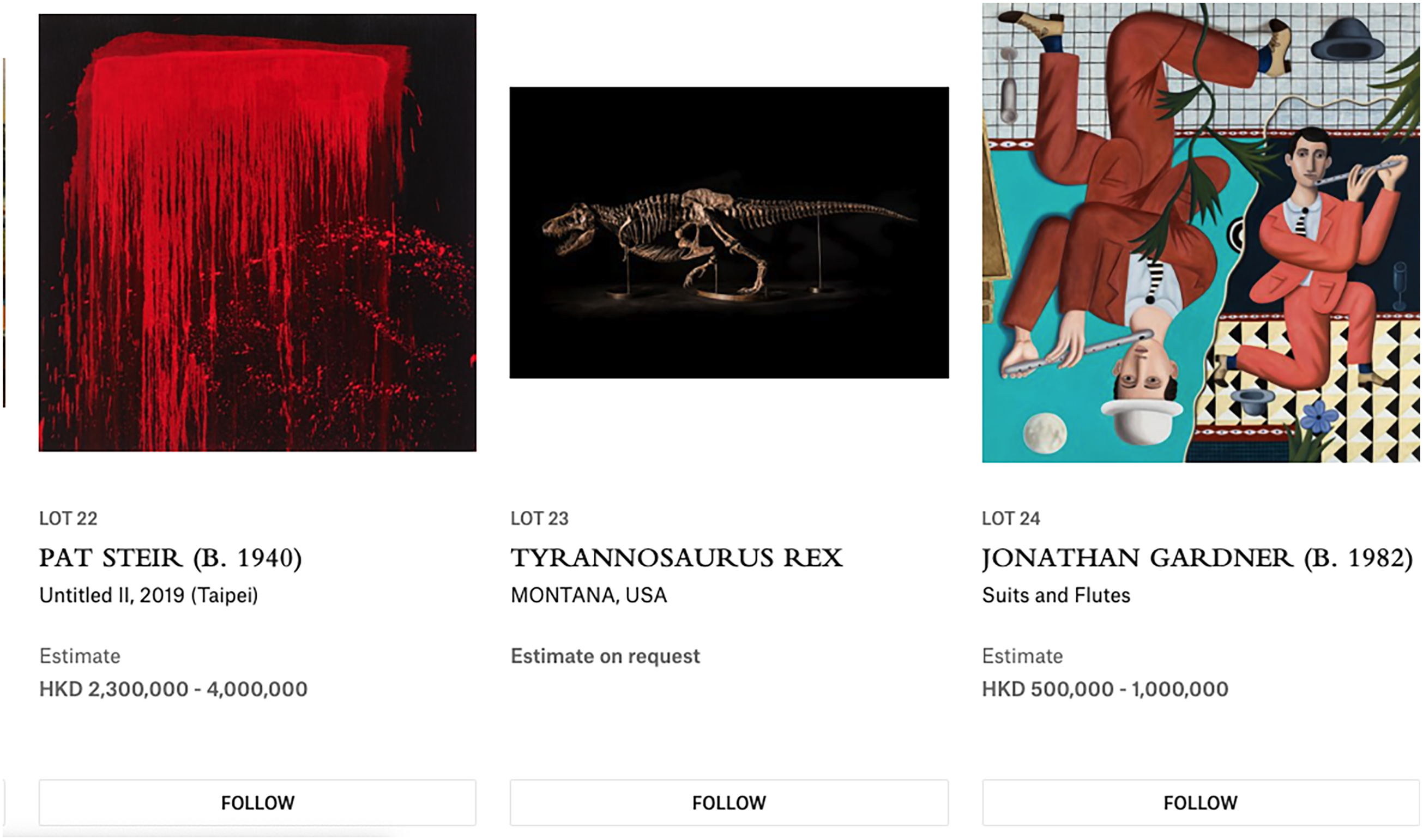
Lot 23, Shen, among contemporary paintings. Website of Christie's 20th/21st Century Art Evening Sale (https://www.christies.com/en/auction/20th-twenty-first-century-art-evening-sale-29078/browse-lots). Screen shot taken by Yates, 14 November 2022.
At the time of writing, we have been observing the appearance of fossils in commercial spaces normally reserved for art. The commodification of fossils is not new and the appearance of fossils at high-end auctions is not a recent occurrence (see e.g., Sue (Fiffer, 2000; Larson and Donnan, 2002)). And yet something has changed. Fossils appear more frequently at high-end auctions and at art fairs where they are presented alongside and among artworks. An increasing number of dealers who normally specialize in artworks have begun including fossils in their inventory (Haigney, 2021).
With some outlying exceptions, there is little distinction between the fossils offered for sale in what we would normally consider the art market and those offered for sale within what we would normally consider the traditional fossil market. As tangible objects, they are similar to the point of being indistinguishable and interchangeable. According to our observational research as well as interviews with market actors, the fossils for sale at high-end auction houses or via art dealers are only rarely finer, to use a woefully subjective art market term, than those that have been and continue to be offered through the traditional fossil market. Nearly all of the fossils seen on the art market are discovered, excavated, prepared, and supplied by the same people as those available in the traditional fossil market. Barring such ultra-unique objects as, say, a baby T. rex specimen, equivalent pieces to those available on the art market are present at fossil fairs and via fossil dealerships directly. Yet the fossils in the art market usually (but not always) command significantly higher prices than equivalent fossils in the fossil market, at times seemingly to the surprise of even the entity selling them.
We believe that spaces of art commerce are constructed via a web of meaningful associations between objects, many of which are art objects. These objects individually but, importantly, collectively act on human buyers, inspiring a willingness on the part of the human to spend large sums of money to satisfy desire. While traditional fossil commerce spaces also draw upon a web of meaningful object associations to provoke desire in potential consumers, the composition of those networks of meaning differs from those found in the art market. They lure different people and cause them to do different things.
While Maximus and Shen could be seen as intruders in art spaces, we argue that they were actually in the end stages of being transformed. Through a process of staged associations between other deeply symbolic objects, these fossils ended their existence as merely paleontological pieces, and it became possible to interpret them as art. We characterize the entrance of fossils into the art market as a process of transformation where the objects transcend their usual associations and patterns of categorization, becoming something they could never be within the fossil market. They have been artified. The artification of the fossils pulls them out of their more traditional market spaces into the world of high value, unique, and elite goods.
We use the term artification in a way that is broadly in line with how Naukkarinen (2012), Shapiro (2004, 2019), and Shapiro and Heinich (2012) use the term, although we acknowledge some important differences between their uses. In this article artification ‘refers to situations and processes in which something that is not regarded as art in the traditional sense of the word is changed into something art, […] to processes where art becomes mixed with something else that adopts some features of art’ (Naukkarinen, 2012). We consider artification ‘to be an all-encompassing process of change, both practical and symbolic’ (Shapiro and Heinich, 2012). Further we borrow from Shapiro (2019) by generally considering artification to be a series of microprocesses. Many of these processes (among them, displacement, renaming, reshuffling rankings, institutional, change, differentiation of function, normative and legal consolidation, and aesthetic formalization) we believe, are clearly present in the artification process for fossils we are observing. That said, our goal is not to assert the existence of artification as we believe that that has already been well-established by others. Rather here we present the phenomenon of the artification of fossils through the lens of provocative object relationships which create desirescapes (Yates and Mackenzie, 2021). The placement of these objects within such desirescapes dramatically increases the ability of the fossils to lure (some) people, provoking desire and increasing both the social and the monetary value of the pieces.
In this paper, we consider the fossil market and the art market via a series of in-person and digital observation methods. On a practical level, we note an important shift in some corners of the art and antiquities market to include fossils. This may be in response to consumer demand or a reshaping of the art market landscape away from more controversial objects towards fossils whose legality and salability are easier to confirm. But more importantly, we seek to further understand the transformation of these fossils through an object network lens. To do so, we expand upon the idea of desirescape by considering how competing deep associations between objects provoke human response and, in turn, change the objects themselves.
Dinosaurs in the desirescape
It used to be specialist collectors who bought fossils but dinosaurs have been picked up by collectors who would normally be more interested in art. (Professor Paul Barrett, quoted in Fisher, 2022)
In 2021 Yates and Mackenzie proposed the idea of a desirescape, ‘where a spatial array of myriad agentic objects cultivates desire among people to collect, own, [and] possess’ (Yates and Mackenzie, 2021: 119). The collective effort of these objects act on people, generating what can be experienced as irresistible lure, and at times seeming to disturb reason. We argued that desirescapes can be encouraged and maintained by human actors, often to their own social or financial benefit, but also that desirescapes may take on a life of their own, expanding far beyond their point of creation.
The concept of a desirescape becomes a useful tool while considering the seemingly irrational actions of otherwise rational humans when they encounter desirable objects. So, considering why someone might pay $75,600 for a Tyrannosaurus tooth at Sotheby's even though the auction house had only valued the fossil $5000 to $8,000, and even though equivalent specimens were available from the traditional fossil market in the $5000 range and below. This occurred on 29 July 2022. 4 We believe that it was the placement of this fossil within the art market desirescape, within the network of affective art objects, that allowed it to command a seemingly irrationally high price (Figure 3).
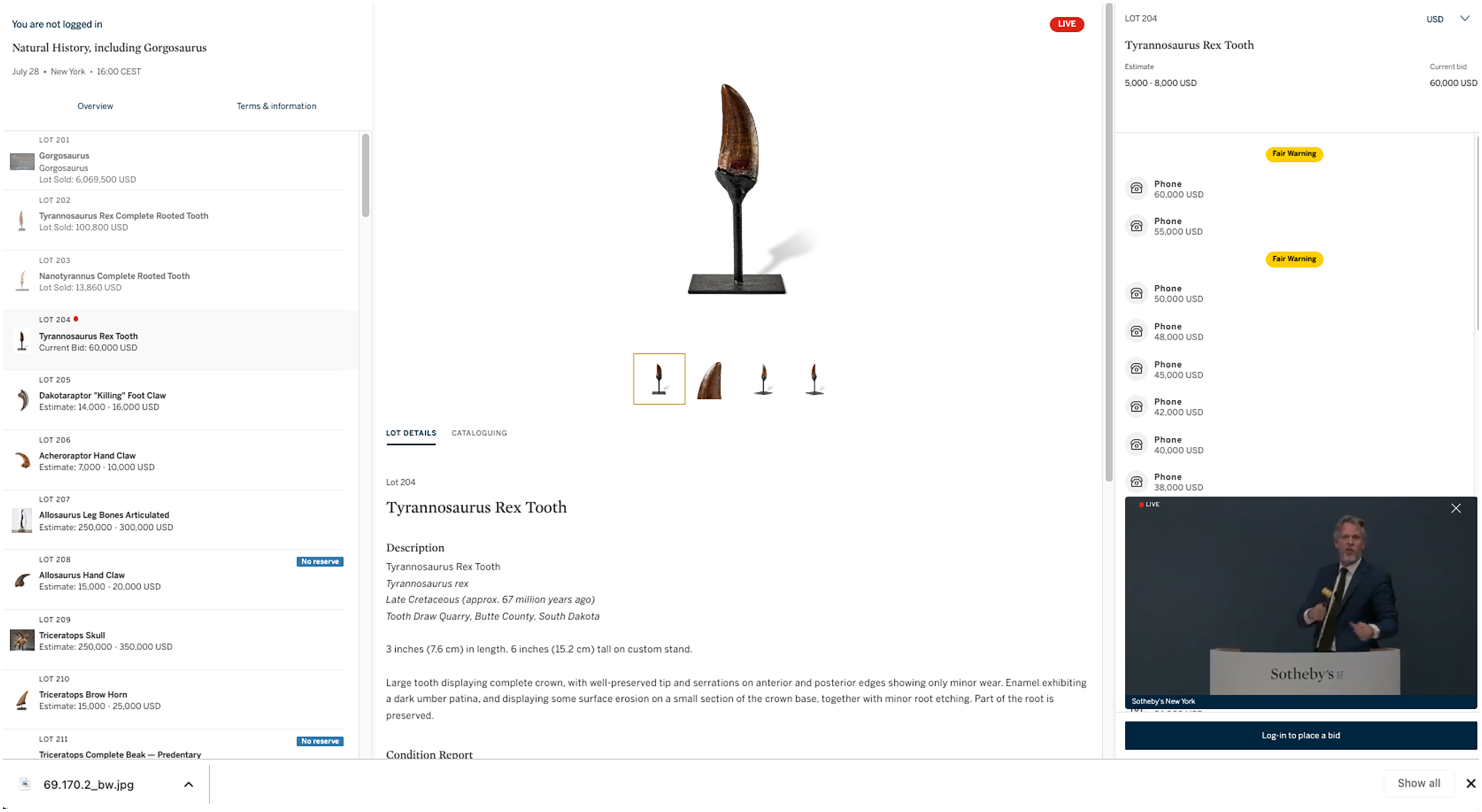
Lot 204 of Sotheby's Natural History, including Gorgosaurus sale in the online live sale platform. The original estimate as well as incoming bids are on the right. Screen shot taken by Yates, 29 July 2022.
Before we start to unpack the elements of both art market and fossil market desirescapes, we must briefly discuss human desire as it relates to fossils. While this is not meant to be a complete treatment of the subject, we think that it is easier to consider fossils as being agentic, having the ability to cause action, if we spend a moment reflecting on what fossils cause humans to do. Here we borrow in part from Yates and Peacock (2024).
Palaeontology, the study of fossilized remains of past life, coalesced as a scientific discipline in the early nineteenth century, notably around the discoveries of ichthyosaur and plesiosaur fossils found at Lyme Regis in England. The fossils that were discovered projected an image of the distant past filled with wonder and confusion and of life (often charismatically toothy life) that was fundamentally different from our own. The fossils’ ability to inspire wonder in humans seems to have provoked the foundations of ongoing societal desire, ultimately leading to the early development of commercial fossil trading. To cite the often-cited example, Mary Anning who is credited with many of the finest discoveries at Lyme Regis was a commercial fossil dealer (Emling, 2009; Pierce, 2014).
Moving to the United States, the rapid expansion of Europeans into the American West, alongside the resulting land theft and genocide of Indigenous American cultures, put people schooled in the results of budding scientific research in direct contact with the massive and monstrous vertebrate fossils of the Jurassic and the Cretaceous periods. This period in paleontological history has been termed the ‘Bone Wars’ or ‘The Great Dinosaur Rush’. While the juicy details of the Bone Wars and the period immediately after have received much-deserved attention from a number of authors (e.g., Brinkmank, 2010; Dingus, 2018; Jaffe, 2001; Lanham, 1991; Randall, 2022; Rieppel, 2019; Wallace, 1999), we simply state that this was a time where overwhelming and all-consuming desire to possess the newest, biggest, weirdest fossils overwhelmed several key paleontological actors who were within or funded major institutions. Entangled in the net of dinosaur lure, they acted rationally and irrationally, ethically and unethically, legally and illegally. They also sparked the foundations of the fossil market as we recognize it today: embedded in the cowboy culture of the American West with dealers who have direct connections to fossil extraction and ultimately adopting aspects of scientific palaeontology in philosophy and presentation.
In that sense contemporary fossil markets developed as a conduit through which palaeontology would be supplied with the raw material of scientific analysis. Yet, fossils and, in particular, dinosaur fossils, have notable power to attract people from beyond the sciences. This ability to lure was not lost on the 19th and twentieth century developers natural history museums, with dinosaurs identified as drawing the public in to the museum. Getting people across the museum threshold helped museums to achieve their educational mission, but also resulted in increased revenues both from wealthy patrons, some of whom, such as philanthropist/industrialist Andrew Carnegie, had made their fortunes from oil and were keen to interest the public in other wonders of Earth's geology. Philanthropists wanted to see attendance numbers increase in relation to their donations.
More recently, as museums have considered how to increase footfall and ticket sales, they have turned to dinosaur fossils supplied by the commercial market to do so. For example, when Naturalis, the public natural history museum of the Netherlands, sought to increase footfall to pay for an expansion, they chose to spend several million dollars within the commercial fossil market on a Tyrannosaurus rex skeleton that would come to be named Trix (Besselink, 2016; Remmerts de Vries, 2016). Other publicly funded museums have recently engaged in temporary displays of privately owned Tyrannosaurus rex fossils, a practice we will discuss in future publications.
Why do dinosaurs, particularly certain dinosaurs, have the power to draw humans? This question goes beyond the scope of this work, but we refer the reader to research that takes on that matter directly (e.g., Demeulemeester and Stein, 2022; Mitchell, 1998; Nieuwland, 2021; Sanz 2002), as well as our own recent work on T. rex agency and appeal (Yates and Peacock 2024). Here we are interested in how that lure occurs, how it is amplified or changed, and how those changes also change the fossil as well.
Observing art and fossil commercial spaces
We’ve been acquiring dinosaurs for at least a decade, and publicly displaying them for a few years. Most collectors of fossils and similar natural history objects tend to skew towards the very young and primarily collect contemporary art. (Salomon Aaron, quoted in Jhala 2022)
To explore fossil and art commercial spaces, and the objects and people networked within them, we employed several observational and other data-gathering methods drawn largely from our prior experience doing qualitative research on the market for antiquities (e.g., see Mackenzie et al., 2019). The discussion we present in subsequent sections is a synthesis of the information gathered by the methods outlined below. This research was undertaken under the aegis of the European Research Council-funded Trafficking Transformations Project with ethical approval granted by Maastricht University's Ethics Review Committee Inner City Faculties (ERCIC). Research at the 2018 Tucson Gem and Mineral Show was conducted as part of the Criminogenic Collectables pilot project with ethical approval granted by the University of Glasgow College of Social Sciences Research Ethics Committee.
The diversity in the research sites we outline below is counterbalanced by the shared network of social connections between these objects and the people and institutions that interact with them: these fossils are mobile and international, and their contexts and interpretations exist at a global scale. Sites of research were chosen based on a ‘strategically sited’ version of a ‘follow the thing’ approach to data collection (Marcus 1995). Our sites are places where fossils, often specifically T. rex fossils, exist physically, digitally, and intellectually, or at times where fossils are conspicuously absent. The fossils led our research, and we followed them.
Art and fossil commerce space observation
Art and fossil fairs represent one of the primary physical spaces of commerce for these commodities. In fair locations, dealers become exhibitors, setting up stand representing their business and contain objects for sale. Fair attendees stroll through the fair, visiting various stands, and if so inclined, purchasing artworks or fossils. They also secure relationships with dealers which may lead to future sales off site. Fairs are open to anyone who buys a ticket, but many fairs have invitation-only viewing days or exclusive events for select buyers or for other trade actors. We conducted observational research at the art fairs TEFAF Maastricht (2020, 2022, 2023), BRAFA (2024), Frieze Masters (2023), and Art Basel (2021), and at the fossil fairs associated with the Tucson Gem and Mineral Show (2018, 2024) and The Munich Show (2021). We conducted a ‘digital observation’ of the 2021 TEFAF Online digital art fair.
During these observations, the researcher spent between 5 and 25 hours within the fairs, using notetaking to record both immediate observations and aspects of atmosphere, vibe, and other embodied experiences. In other words, the researcher became a fair attendee, allowing the objects to act upon them as much as possible, while observing how others interacted with the objects and how the objects interacted with each other. During the 2018 Tucson Gem and Mineral Show, the researcher conducted approximately 20 impromptu unstructured interviews with fossil traders within the fair setting. At the other art and fossil fairs direct interaction with traders was minimized in favor of observation.
These fair experiences are supplemented with observational visits to other commercial art and fossil spaces, particularly fossil dealerships located in Arizona and Utah visited in 2018 and 2024. The authors also drew upon our decades of research into art and antiquities auctions, and fieldwork at numerous heritage sites. Understanding of fossil desirescapes were increased through visits to museums and protected natural heritage sites in Arizona, Utah, and Colorado in 2018 and 2024, Belgium and New Zealand in 2022, and The Netherlands, Germany, and Switzerland in 2023. Our understanding was expanded upon by observing the 2023 meeting of the Society of Vertebrate Palaeontology, particularly their theropod session. That said, the art and fossils fairs were our primary site of observation for this work, and our experiences in stand-alone dealerships, museums, and sites contextualize what we have seen in the fairs.
Snapshot
From 9 August 2020 to 14 August 2022, we conducted a snap-shot analysis of Tyrannosaurs rex fossils available for sale online via what we consider to be traditional fossil commercial spaces. The snapshot analysis technique was described by Brodie concerning antiquities (e.g., see Brodie et al., 2019: 55–58), and has since been used to capture a complete moment in online market spaces for a variety of types of cultural objects (e.g., Bērziņa, 2021; Yates, 2014). Taking an online market snapshot consists of recording all objects that meet pre-determined criteria offered for sale online during a limited period. The researcher adopts the role of a potential buyer of the object, and the snapshot records what is available to that buyer during a discreet moment, as well as how those objects are presented in photographs, videos, and descriptions. The technique allows for subsequent snapshots using the same criteria to be taken at later dates, revealing changes in the available market over time. However, in the short term, a single snapshot can provide significant insight into market availability and market experience.
We designed our snapshot specifically to provide insight into the traditional fossil market, so fossils outside of art spaces that we argue here had not yet been artified. To do this we took on the role of a buyer interested in purchasing Tyrannosaurus rex fossils online from a reputable traditional dealer, preferably based in the USA. We began with a list of ‘business and club members’ of the Association of Applied Paleontological Sciences (AAPS), the primary traditional fossil dealer association in the United States, 5 and located as many of their dealership websites as possible. We excluded all websites that appeared defunct or that were not trading in fossils. We then recorded the details of all Tyrannosaurs rex material available on these websites, including prices when available. Beyond tabulating this information, we took notes about the presentation of fossils on the sites, the content and tone of descriptions, the style of the sites themselves, and the presence of any additional objects that the fossils were associated or associating with.
Auction observation
‘The auction is a ritual that may turn commodities into sacred collectables’ (Belk 1995 p. 69), and we see auctions as front-line art spaces within which fossils are transformed in the eyes of consumers into art objects. This work draws upon several auction observation and analysis strands. Resting upon a foundation of long-term observation of art and antiquities auctions (Brodie et al., 2022; Mackenzie et al., 2019; Mackenzie and Yates, 2016a, 2016b; Yates 2015, 2022), we sought to expand our understanding of fossil appearance at auction. To do this we conducted a non-exhaustive review of fossil auctions conducted at Sotheby's, Bonhams, and Christie's auction houses, primarily from the period of 2019 to 2022. The goal of this review was to gain a sense of the tone, context, and contents of fossils within this art space, rather than to engage quantitative analysis. This was particularly useful in allowing us to see the important contextual differences between otherwise physically similar fossils at high-end auction and fossils within the snapshot.
In April 2023, one of the co-authors (Yates) attended the sale of the T. rex Trinity, among other fossils, at the Zurich-based auction house Koller. She previously had attended the public unveiling of Trinity in March 2023, as well as the press conference and reception associated with the sale. We also performed two live digital observations of elite fossil sales: Sotheby's Natural History, including Gorgosaurus sale held on 29 July 2022 and Sotheby's Maximus Rex sale held on 9 December 2022. Both sales were observed on the Sotheby's digital platform which allows interested parties to watch a live feed of the auctioneer and a running tally of the current bid price of a work but does not allow the viewer to see the auction hall audience.
Additional sources of information
In addition to the observational techniques outlined above, this project draws on the results of several more data-gathering efforts associated with the greater Trafficking Transformations project. These are mostly used as qualification and positioning for our observational methods described above. During this project we conducted semi- and unstructured interviews with academic palaeontologists who work in museum and university settings, as well as amateur/hobbyist palaeontology enthusiasts in which we discussed the commercial market for fossils among other topics. We have also conducted interviews and unstructured discussions with numerous fossil market actors, including dealers, preperators, and consumers. In addition, we have conducted an analysis of completed Tyrannosaurus rex related court cases in the United States (see Yates and Peacock 2024). The extensive court records detail commercial practice and determination of value related to fossils.
Fossils within the art market (and fossil market?) desirescape
Networks of display
Owning a dinosaur has become a trend. Their skeletons are effectively regarded as design objects. […] But few people know that a dinosaur is a work of art. Few people know the work of paleontologists, artisans, designers, and academics necessary to rebuild and restore it. (Dealer Luca Cableri, quoted in Brown, 2022)
Fossils within art spaces are often both presented and described in a manner that emphasizes a value in form that rests outside of scientific appreciation of the object. The descriptive vocabulary of art works is applied to fossils in a way that evokes association with the art pieces that the terms were developed for. In essence, this means applying the conventions of particular forms of art to fossils in order to allow them to be interpreted as art (see Becker 1982 for conventions as defining edges of art worlds). For example, lot 204 of Sotheby's Natural History, including Gorgosaur sale, the T. rex tooth that sold for $75,600 (Figure 3). It is described as ‘exhibiting a dark umber patina’. Umber is the deep brown pigment used by artists such as Vermeer and Rembrandt to create evocative darkness. A patina refers to the layer of oxidization that appears on the surface of metals over time, and is particularly associated with the aging of sculptures, antiques, or antiquities. The two words in conjunction immediately associate the tooth with the viewers memory of valuable paintings and sculptures, justifying the tooth's presence in the art space, and borrowing on the artworks’ value.
Taking the concept of art-style display a step further, consider lot 207 in the same Sotheby's sale, an articulated Allosaurus leg (Figure 4). 6 In three out of four photos, the leg is presented on a stand within a ‘white cube gallery’, a style of space that has defined the display of contemporary art from the mid 20th into the twenty-first century. Importantly, the white cube style is almost entirely absent within natural history museums and in museum display of fossils. The third of these photos introduces a smartly but youthfully dressed, spectacled male who appears to be around his late 30s looking at the leg in the cube space. Close observation reveals that his tailored polo shirt is decorated with a subtle dinosaur print. He is the anonymous denizen of the art white cube, silently appreciating the artwork at hand with a nod to an assumed residual love of dinosaurs from his childhood. Within the photograph the fossil interacts with the familiarity of the white wall, the cube corner, the polished concrete floor, and the art observer to become the art that would normally be placed within that position. The network of object associations, again, justifies the fossil's presence in the auction and implies that it deserves cultural and, thus, monetary valuation as an artwork.
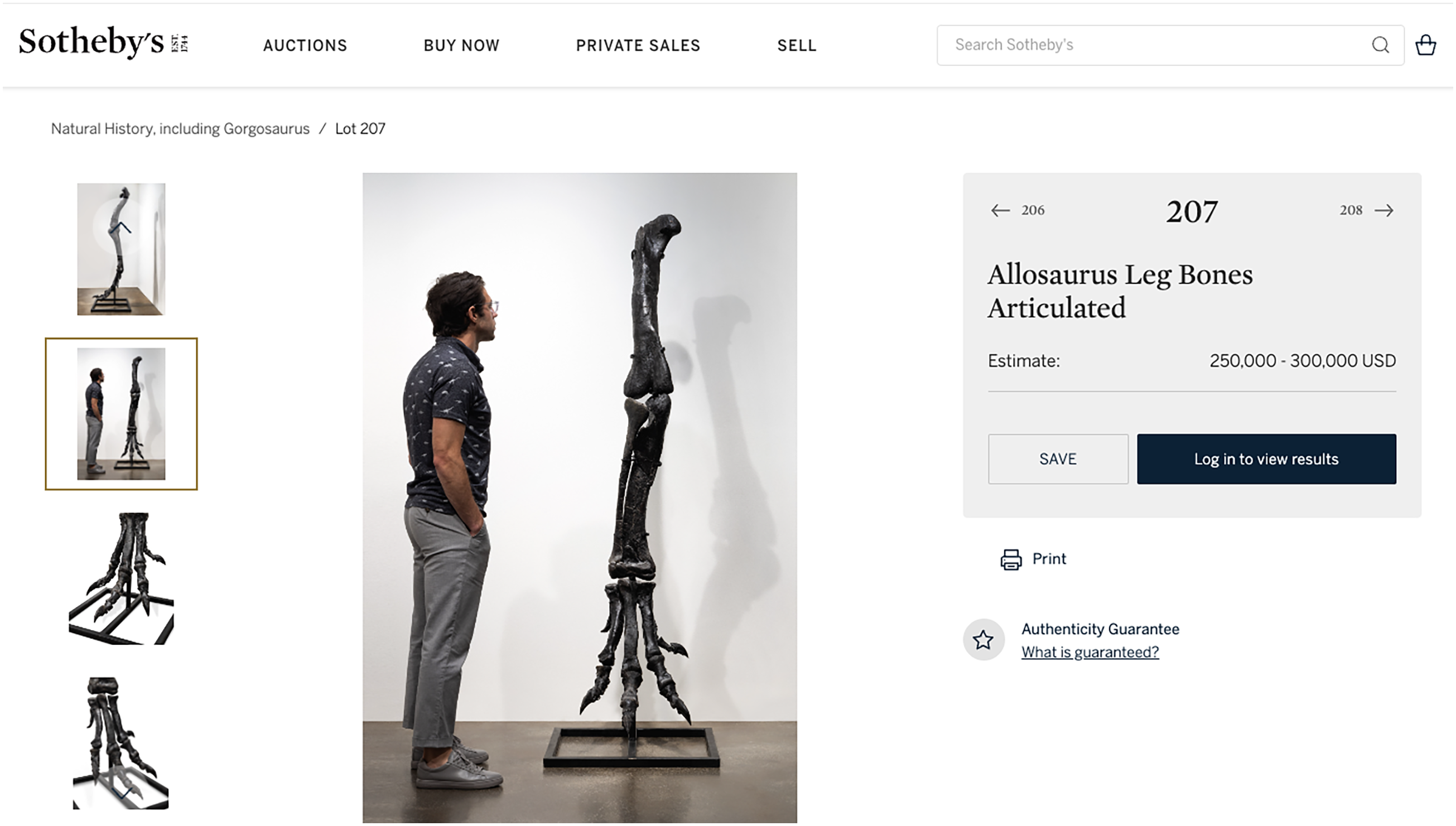
Lot 207 of Sotheby's Natural History, including Gorgosaurus sale. The Allosaurus fossil is confirmed as art by its association with a ‘white cube’ space and the ‘arty’ observer. Screen shot taken by Yates, 4 April 2024.
Finally, fossils within spaces of art commerce are at times presented with almost painfully forced associations that awkwardly insert fossils into art-style display. Looking at the same Sotheby's sale, lot 218 is a fossilized moonfish ‘plaque’ (already an art term) that, according to Sotheby's, ‘boasts both aesthetic appeal and scientific value’. 7 Three photos show the fossil in detail or with the background entirely deleted. However, the fourth shows the fossil in a computer-generated room, hung on a cream-colored wall, next to a nondescript window that looks out onto a bright green tree within an urban landscape. A smartly but neutrally dressed woman who appears to be in her 30 s is introduced as the observer of the fossil. Through associating the fossil with the physical features of a home or office space, including the tree and buildings outside, the fossil becomes the artwork that would normally be found in its position, affirming the fossil's status as art. More awkward, though, is the presence of the human observer. Anyone looking at multiple lots in the auction would notice that she appears, for example, in a photo for lot 217, a ‘Multi-fish Mural–A Triptych Display’ (mural and triptych being art terms that are meaningless within palaeontology) pasted into a different room (Figure 5).
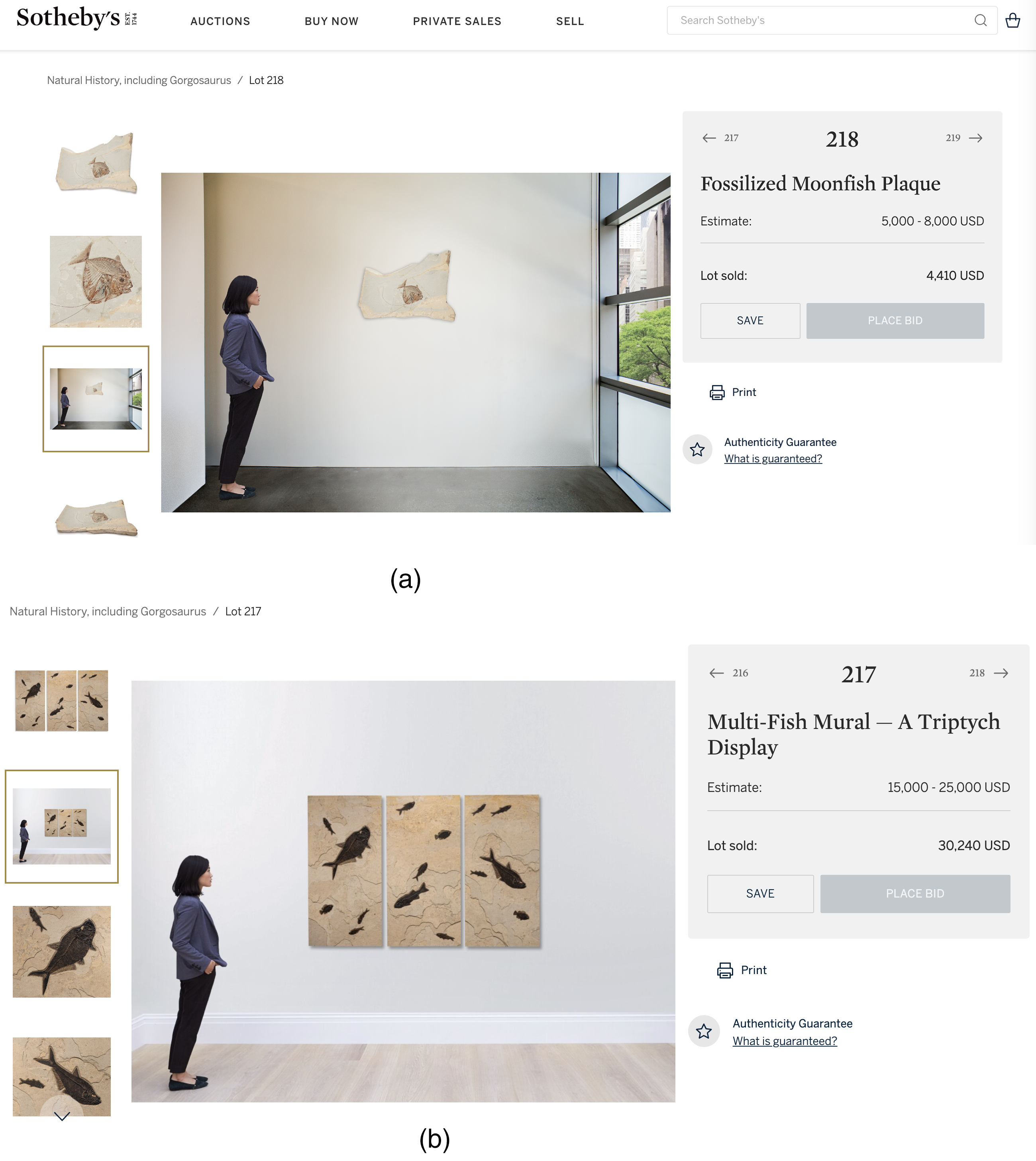
Figure 5a and 5b, lots 218 and 2019 of Sotheby's Natural History, including Gorgosaurus sale. The fossils are artified via their clearly computer-generated placement in art spaces, complete with a copy/paste human art observer. Screen shot taken by Yates, 4 April 2024.
Networks of uniqueness
When Christie’s sold the T-rex, it got people champing at the bit, wondering, when is the next Stan going to appear? […] It created a real dinosaur rush, like the gold rush of the late 1800s in California and the West. Now we’re seeing a dinosaur rush in that part of the U.S. (Tom Lindgren, Bonhams auction house, quoted in Haigney, 2021)
In traditional fossil market spaces, both online and at fairs and stand-alone dealerships, fossils are often presented in multiples. Several visually similar Tyrannosaur teeth tips, for example, will be displayed for sale, side by side, at the same time, with provenance information showing they come from the same few formations. While unique features of individual specimens are pointed out, and these unique features are directly associated with pricing, there is a clear sense of quantity that does not exist in art commerce spaces. In part this is because traditional fossil market consumers know that many of the fossils in question are not particularly rare. Moving back to the tooth example, Tyrannosaurs and other theropods constantly lost teeth throughout their lifetime and grew new ones, and teeth preserve relatively well in the paleontological record. Thus, Tyrannosaur teeth are not particularly rare, and a dealer may have half a dozen partial teeth and some larger specimens for sale at any given time.
In contrast, for an artwork or a fossil in an art space to provoke desire in humans and thus to command high prices, rarity bordering on uniqueness is required (to explore that wide area further, see Karpik, 2010; Kopytoff, 1986; Velthuis, 2007). For fossils in art spaces that are being positioned to generate the most desire and the highest price tags, their comparative relationship with other fossils is tied to their ability to lure buyers. Within art spaces, the sellers of fossils play upon this network to promote a delicate web of object associations that are meant to paradoxically reassure the buyer that the fossil has similar monetary value to comparable commercially-offered specimens, as well as reassure the buyer that the same fossil is unique, special, and singular.
Consider Maximus, the Tyrannosaurus rex skull sold at Sotheby's in December 2022.
8
The ‘Catalogue note’ that accompanied Maximus reads (all-caps in the original): ONE OF THE BEST AND MOST COMPLETE TYRANNOSAURUS REX SKULLS EVER FOUND JUST AS SOTHEBY'S MARKED THE FIRST-EVER SALE OF A DINOSAUR AT AUCTION WITH SUE THE T. REX IN 1997, THIS MARKS THE VERY FIRST TIME A STAND-ALONE TYRANNOSAURUS REX SKULL HAS EVER BEEN OFFERED AT PUBLIC AUCTION
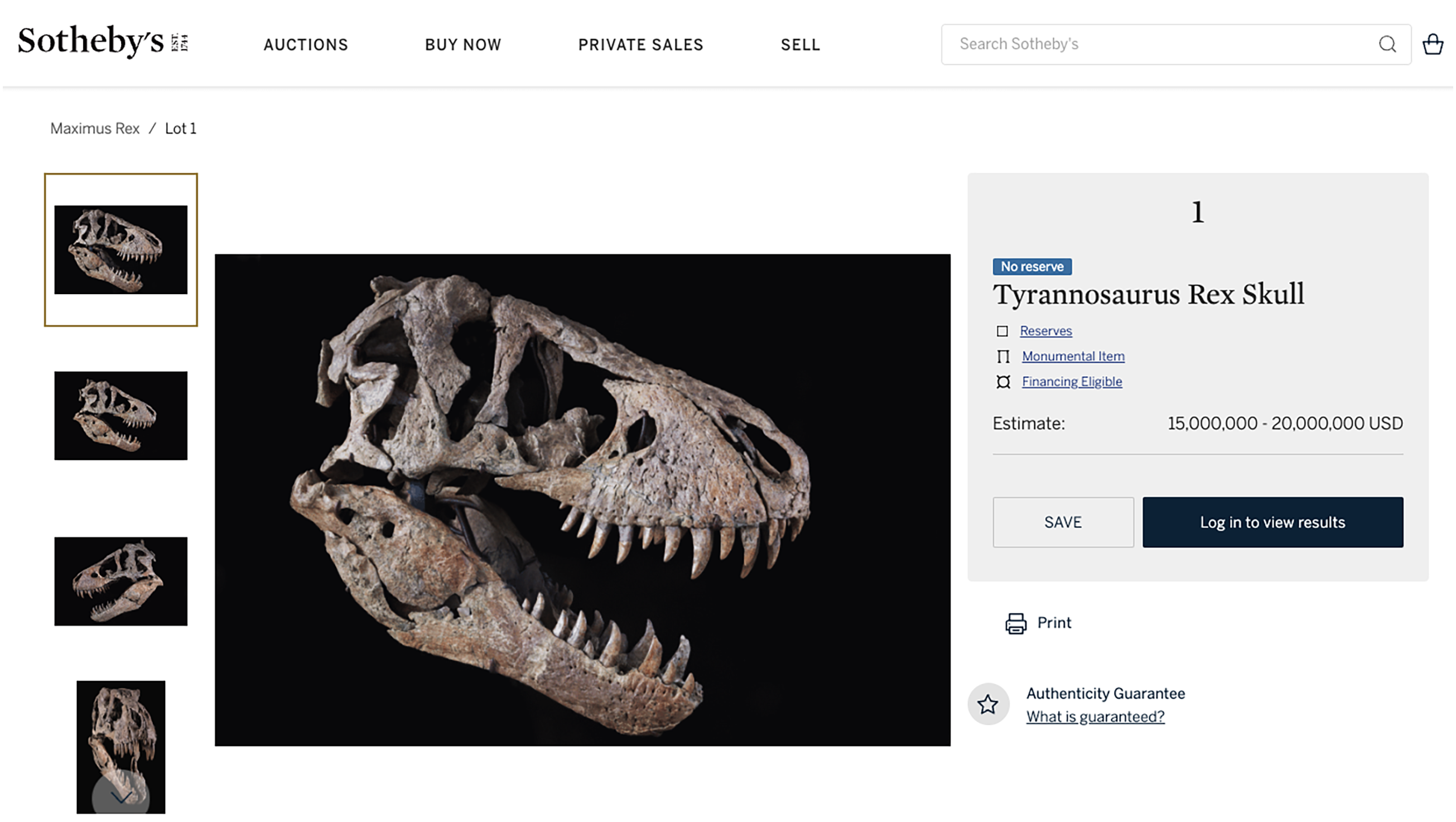
The listing for Maximus on the Sotheby's website. Screen shot taken by Yates, 4 April 2024.
Perhaps more tellingly, below the all-caps portion of the catalogue note, Sotheby's offers a sub-section entitled ‘Rarity & Importance’. Here the auction house names five well-known T. rex specimens, placing Maximus within their ranks. At the same time, the auction house applies an unexplained formula for specimen ‘completeness’ which places Maximus at 75% complete, behind SUE at 85% and Trix at 80%, but ahead of Scotty (70–75%), Thomas (70%), and Stan (65%). These figures are perplexing in several ways, none the least because Maximus is only a skull while the others are significantly more complete specimens. However, within this unfolding desirescape, the other named specimens lend Maximus their fame, credibility, and authenticity, and the manufactured completeness percentages affirm Maximus’ place in that network.
This balancing of uniqueness with comparison (and thus association) with other well-known works is a common feature of the art market. To select an example at random, 9 take lot 569 at Sotheby's Master Paintings and Sculpture Part II, a sale that is taking place as we write this paragraph on 27 January 2023. 10 This late 16th/early 17th painting by Carlo Sellitto is described as ‘[o]f the same generation as Caravaggio’; ‘[t]he composition has a clear and strong connection to Caravaggio's treatment of the same subject in the National Gallery of Art, London’; tying it to ‘Giovanni Battista Caracciolo, whose own Salome in the Museo de Bellas Artes’, as well as other works by Sellitto himself. Repeated comparison to the much more famous Caravaggio lends credibility to the Sellitto and allows the lure of the Caravaggio to flow into the Sellitto. In the same way, repeated references to Sue in the Maximus sale allow the more famous dinosaur to lend the skull some of its ability to provoke desire. In both cases, the ‘lesser’ object is not presented as better than the ‘greater’ object, rather they are positioned to collectively inspire confidence in the potential buyer. The subsequent referencing in both the painting and the fossil listing sale serves to affirm both the fossil and the artwork's authenticity and to assert its uniqueness and favorability among other favorable works. Artwork networks and the fossil networks in art settings and constructed like art networks then act on the observer with the auction house hoping that they are drawn in to buy.
Networks of art
‘This is a growth area, because I think people are increasingly interested in diversifying their collections and surrounding themselves with beautiful and historically important objects that are imbued with meaning’. Salomon Aaron, director of David Aaron, (quoted in Haigney, 2021).
Within art commerce spaces, fossils interact with artworks: both the artworks that are physically present as well as the artworks that have inhabited the space before or will/could inhabit the space in the future. From these direct and indirect associations with artworks, the fossil again is legitimized as being interpretable as art and as desirable to people who find art desirable. Once firmly within the art network, once artified, the fossil, too, contributes its ability to lure and provoke desire. It becomes an object that other and future objects in the art commerce space interact with and draw upon. A recent article in the Financial Times as stated that ‘A dinosaur skeleton may coexist with contemporary paintings and an Etruscan vase—making it a kind of bold statement piece of the kind many collectors are seeking’ (Haigney, 2021). We propose that the dinosaurs do more than coexist with contemporary paintings and vases. We believe that at auction and in other art commerce spaces, the fossils and art coalesce into a network or desirability largely due to their direct association.
Stan is a well-known T. rex specimen that was sold as the by-product of a personal and business dispute within one of the most prominent traditional commercial suppliers of high-value fossils. Ultimately the fossil sold for $31,800,000, an amount that exceeded all previous existing valuations for any other fossil, not to mention all previous of Stan (Yates and Peacock 2024). Yet within the context of the twentieth Century Evening Sale, Stan was not alone, rather the fossil was embedded within an alluring art network consisting of desire-provoking pieces. Indeed, Stan, lot 59, did not achieve the highest price in the sale. Lot 16 was a 1969 Twombly that sold for $38,685,000 (estimate $35,000,000–$50,000,000), 11 besting Stan's price by several million. Close behind Stan were lot 11, a 1967 Rothko which sold for $31,275,000 (estimate $30,000,000–$50,000,000), 12 and lot 8 a 1941 Picasso which sold for $29,557,500 (estimate: $20,000,000–$30,000,000). 13 These high-value, highly-desirable artworks enhance Stan's appeal, affirming Stan's status as an elite good of the highest quality and rarity. The lovers of artworks were invited and encouraged to experience Stan as being among equals, as being interpretable as art and, thus, worthy of art prices.
In this construction, one must wonder if Christie's were not fully confident in Stan's complete artification. Clearly Stan was placed within a desirescape of artworks that achieved comparatively high prices, and thus enacted comparable lure on potential buyers, but there is an important difference between how Stan and the paintings were marketed. While all three of the paintings mentioned above achieved a price within the published price estimate range, Stan was underestimated. The fossil achieved $31,800,000 million against an estimated price range of $6,000,000 to $8,000,000. It is true that auction house price ranges are a marketing technique rather than a true ascription of expected monetary value. Yet the $23,800,000 that Stan fetched above published expectation far exceeds what one would expect for any risky attempt at setting estimates low to provoke headline-worthy results. So, Stan was among the artworks, but the auction house appeared to believe the fossil was not yet an artwork and not yet capable of art-level lure.
As we noted in prior work ‘[m]aterial desirescapes are made by, and make, choices and behaviour’ (Yates and Mackenzie, 2021: 131). The agentic qualities of this hybrid dinosaur/art desirescape transcended the boundaries of its human construction. Stan, backed by the network of artworks that it was associated, was as allowed to be interpreted as art and exerted art-level lure on what was reported to be several bidders who engaged in a bidding war for the piece (Greshko, 2020). Stan in this art market desirescape prompted people to act as if it were art and the seemingly irrational, or at least unexpected, final price tag was the result.
Up to the point of the Stan sale, the going rate for comparatively complete Tyrannosaurus rex specimens purchased on the private market was in the $6,000,000 range: this is about what Naturalis paid for Trix and this was considered a fair market value for Stan in legal proceedings (see Yates and Peacock, 2024). The $8,300,000 sale of Sue at auction was seen as almost a one-time occurrence, a reflection of the notoriety and charisma of the skeleton, the scarcity of T. rex material on the market at the time and the presence of museum bidders backed by external funding among the bidders. Sue, offered in a stand-alone auction, was not presented as art, but rather a rare fossil intrusion into an art space. Stan was among art and became interpretable as art, expanding the fossils lure beyond scientific/museum audiences into the space of art buyers.
Moving beyond the auction house, we now see fossils in other elite art commerce spaces, having been transformed by those spaces and the objects in them into art. At the time of writing, a small number of art and/or antiquities dealers have moved directly into the fossil market space, presenting their fossils in forms and formats that have usually been reserved for art. Reputable art dealers moving fossils into art spaces is important to the artification process. Art dealers act almost as teachers to their clients; they ‘teach [clients] how to appreciate’ certain styles of art (Becker 1982, p. 111) with the effect creating ‘a trained audience for the work [the dealer] handles (Becker 1982. p. 155). In this case dealers are training their clients to see fossils as art.
When they appear on art dealer websites, fossils are presented among and as art. At the time of writing ArtAncient was not explicitly offering fossil material for sale on their website, but we observed them offering fossils at the October 2023 Frieze Masters art fair in London. Fossils they have presumably sold feature in their promotional photographs and videos. On their ‘About’ page, the visitor is presented with a silent video showing first the ArtAncient gallery then a series of images of art objects placed in a staged home setting. Amongst the tastefully bland sofa, table and chairs, and over-ordered bookshelf, we see ancient artworks hung on the wall, on stands, or resting on the table. Through this staging the potential buyer is meant to feel the totality of the objects and respond to them, with the artworks working together and in tandem with the symbolic ‘home’ objects to draw a buyer in. The buyer is meant to desire that network of objects, that interaction between art and home and to imagine themselves as existing within that web of relationships. Within this staged space, among the artworks and the furniture, is a Triceratops skull. 14 It, too, is portrayed as art (Figure 7).
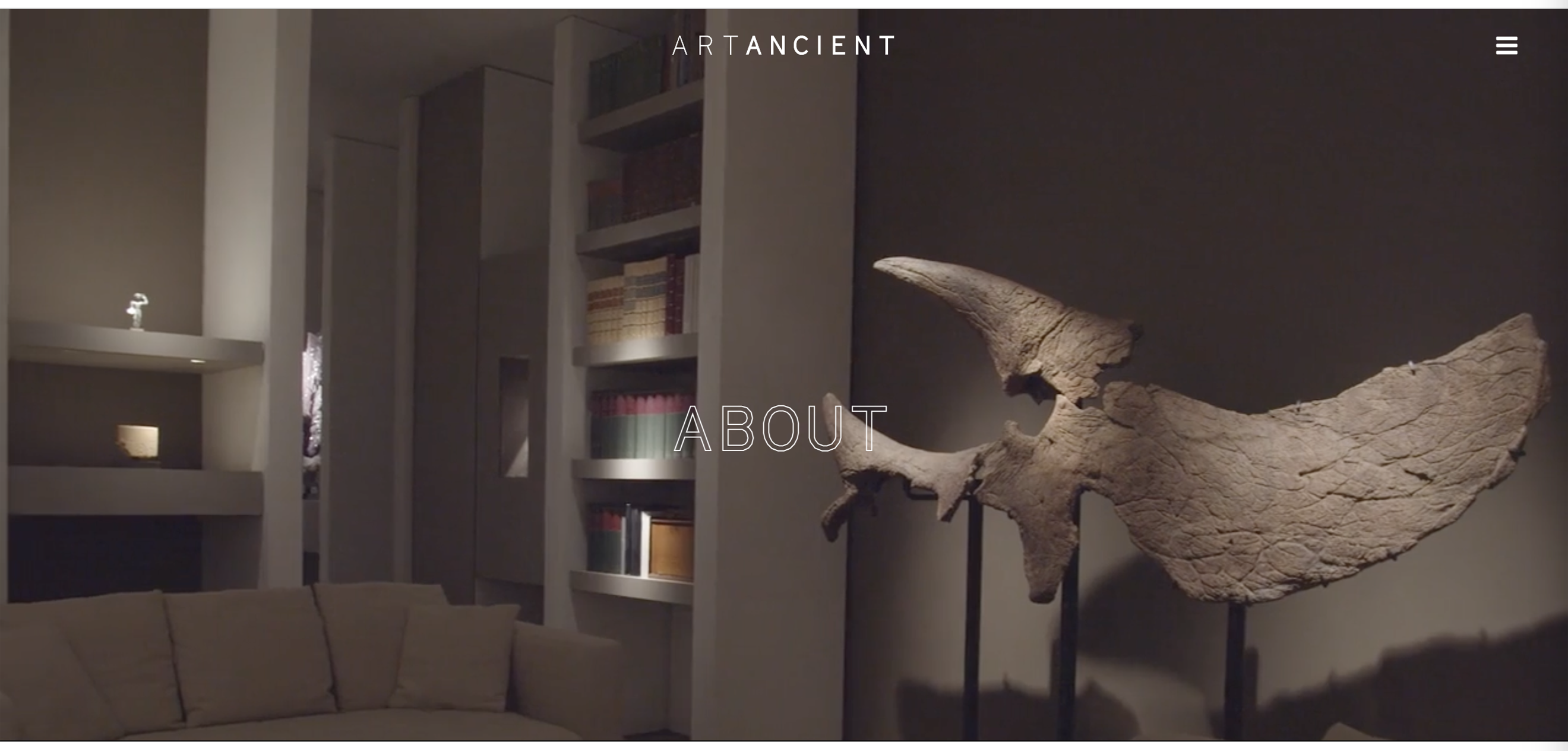
Still of video on https://artancient.com/about.html. A Triceratops fossil positioned as art within a home setting; notice the smaller antiquities also on display. Screen shot taken by Yates, 4 April 2024.
Because of the movement of art dealers into fossil sales, fossils as art have begun to make a more prominent appearance at some international art fairs. These include but are not limited to a much-discussed Triceratops at Masterpiece London in 2022 (Chow, 2022; Pryor, 2022), a wooly rhinoceros at BRAFA in 2022 (The Brussels Times, 2022), and a Camptosaurus at Frieze Masters in 2022 (Fullerton, 2022), as well the less pronounced presence of smaller fossils mixed in to a number of particularly antiques and antiquities stands at these fairs, many of which offer contemporary artworks. A notable recent example of clear ratified placement of fossils was observable at the 2023 Frieze Masters in London. A so-called baby T. rex specimen currently named Chomper but previously named Jodi, was offered for sale by antiquities dealership David Aaron (Shaw, 2023). Chomper was presented entirely in a separate ‘white cube’ space with white walls, a light grey floor, and minimal interpretation. Visitors could then access the rest of the David Aaron offerings, which were mostly antiquities, by walking behind the white wall and entering a more ‘traditional’ antiquities sales space: a dark room with dramatic lighting that evokes the feeling of a tomb. Although antiquities dealers are selling fossils, then, they are presenting them to consumers in ways that signal contemporary art. At the time of writing, fossils have not been present at explicitly contemporary art fairs (e.g., Art Basel). Yet we see art sales and art fairs progress or become replaced by digital platforms, the mixing in of fossils into contemporary art commerce may become more evident.
In most cases, it is the art dealers who have incorporated fossils into their normal dealership practices who exhibit them at art fairs. Costas Paraskevaides of ArtAncient was quoted in the Financial Times as saying, ‘As we have started to take these objects to art fairs, people have responded to them as to other forms of art’ (quoted in Crichton-Miller, 2018). In part this appears to be because the dealers are treating the fossils like art and are applying standards from the art world to these natural pieces. Quoted in the same article, Paraskevaides states that ‘[t]his is an immature market. We are trying to exercise high standards regarding condition and beauty. It is about making an aesthetic judgment and separating the best from the rest’ (quoted in Crichton-Miller, 2018). Dealer selection is a hallmark of the high-end and elite art market, and the practice of applying a dealers connoiseurial eye towards a pre-curation of artworks is one of the things that an art dealer is for (Becker, 1982: 115). The same aesthetic standards towards qualitative understandings of fineness and beauty as apply to artworks are employed for fossils, with quality and value resting in the appealing aspects of form.
Such pre-curation towards significance is evident in fossil commerce spaces, however significance rests on a different set of criteria. Much of the traditional fossil market has focused on collecting and curation that relates to the scientific significance of a specimen. Size, color, and form are often of interest to traditional fossil market participants, but these features are usually presented and discussed within at least some degree of a science-style context. Without exception, every commercial fossil dealer interviewed cited an interest in the prehistoric natural world as a motivating factor for themselves and their customers. Some characterized customer (and personal) collecting behavior as focusing on specific classes or subclasses of fossil (e.g., trilobites or ammonites), with buyers pouring over scientific literature related to those fossils and, at times, contributing to such research when possible. A desirable fossil in this context displays an unusually detailed level of preservation and rare or unique features within the fossilized organism. While there is certainly an aesthetic component to constructing a fossil fair display, a traditional fossil dealer would likely struggle to describe their selection process of what to show as making ‘aesthetic judgments’ or exercising a high standard of ‘beauty’. While they often describe specimens as being beautiful, what they mean by this appears to differ from an art market sense of marketable aesthetics.
The websites of many fossil market dealerships contrast quite pointedly from the websites of art dealers who offer fossils. The fossil dealership websites in our snapshot were often out of date, with a certain ‘Web 1.0’ quality, reflecting a market that still very much took place within physical spaces of commerce. Sleek videos, and staged photography is nearly non-existent. This market difference is mirrored in the differences between art and fossil fairs. At art fairs, dealers create entire experiences for visitors. Each booth is a different take on emersion into an art desirescape with different colored walls, lighting, additional decorations, furniture, etc. The art fair is a conglomerate of many small and separate galleries, each ensuring an art experience for visitors. While some fossils dealers have included featured like velvet ropes to seemingly portray a sense of elite exclusivity for the fossils they sell, the art market seems to view such items as crass. They seem like an outsider's emulation of elite space: velvet ropes are not a feature of art fairs. Fossil fairs are often unpolished in a way that is simply not allowable in the art market, with some dealers working out of cardboard boxes and crates and with bubble wrap falling on the floor. At the Tuscon show, some dealers even trade from their motel rooms, selling fossils that are spread out on the beds or tucked next to the nightstands. This does not mean that many or even most booths in fossil fairs are not neat, ordered, and well presented. Most are. But while art fairs offer a complete art experience, fossil fairs rarely transcend the feeling of a niche trade fair.
By placing fossils within art spaces, by surrounding them with art objects, and by embellishing the budding object relationship with the physical trappings of a particular idea of elite or luxury lifestyle, fossils become connected to the art they are presented with. These connections distinguish fossils in art spaces from fossils in fossil spaces. As these relationships develop fossils in art spaces consumers are allowed, invited, even encouraged to see these fossils as art.
Concluding thoughts
‘It's a masterpiece.’ Iacopo Briano, concerning Big John, a Triceratops fossil that sold at auction for $7.7 million (quoted in Willsher, 2021).
In prior research into the antiquities market (Mackenzie et al., 2019; Mackenzie and Yates, 2016a; Yates and Mackenzie, 2021), we often see a personification of objects of desire. When people speak of the objects that they collect, they speak not only of compulsion but draw and lure emanating from objects that ‘choose’ their collector to some degree. Collectors of art objects report talking to pieces in their collections, touching them, sleeping with them. Perhaps this personification helps to resolve the agentive qualities of these pieces and to cushion the emotional fall out that may come from spending a large amount of money on a thing with limited or no utilitarian value. If a charismatic and desirable artwork made a person buy, there was little that person could do but submit.
We believe at least some of this agentic ability to provoke desire rests in the affective associations that objects make with each other, and then the follow-on relationship that humans have with those object networks. People are not simply drawn to individual objects of desire, but to the myriad associations those objects have with other objects and the deep meanings those associations overlay. These meanings become a web of desire, a desirescape, that entangle humans within them (Yates and Mackenzie, 2021). Yet in this paper we take the next step. We assert that these desirescape not only can compel people to act, but they can also transform the objects that they are composed of. The art desirescape containing an alluring fossil can both provoke people to buy, and it can artify the fossil.
Why artefy a fossil? Why remove fossils from a thriving decades-old commercial space which has its own successful object-associations, its own alluring desirescape. Why inject fossils into the art world, or in the Becker (1982) sense, create new art worlds around fossils? We admit that we have not yet found a higher answer to this question than ‘money’. In many circumstances desirescapes are developed, maintained, and encouraged by the people who benefit most from their continued existence. By taking fossils out of their original market setting, and away from the original buyers and sellers, art market agents succeed in transforming fossils into something that can be interpreted as art. After being artified, fossils can produce more monetary return: they can inspire higher price tags as they become enmeshed in a network of high-value artworks. Those that profit from those higher price tags have every motivation to encourage the artification of fossils.
It is the art market actors and the traditional fossil dealers who can interface with and supply art market that benefit from the inclusion of fossils into art market desirescapes. The commerce spaces of these art market actors then serve as vectors for relationships to form between art and fossils and for fossils to be affirmed as art in the eyes of consumers. Within the auction house, the art dealership, and the art fair the affective associations between fossils and art amplify the desire provoked by both and increasing the objects’ ability to lure. People pay more for a fossil in an art space because the art space draws upon the implied validity of all artworks that have passed through it to confirm authenticity and value. The fossil then draws on the artworks and the physical manifestations of art spaces to be transformed into what can be interpreted as art. Art market actors confirm this transformation through staging, marketing literature, photographs, and artified price tags.
Without the associations with art objects and spaces, and without entering an art desirescape, a fossil cannot be artified. The fossil remains in the normal commercial fossil desirescape along with many other comparable fossils. Yet if the fossil is pushed out of the normal fossil space that it occupied by interested humans, and then pulled into the art world by the powerful art objects that now surround it, people respond to that change.
Footnotes
Acknowledgements
We wish to extend our most sincere thanks the experts within the hobbiest, commercial, museum, and academic palaeontological and art community members who spoke with us in relation to this research. Thank you to our peer reviewers who offered us constructive and useful comments, and so many good ideas.
Declaration of conflicting interests
The authors declared no potential conflicts of interest with respect to the research, authorship, and/or publication of this article.
Funding
The author(s) disclosed receipt of the following financial support for the research, authorship, and/or publication of this article: The funding for this research was provided by the European Research Council (ERC) under the European Union's Horizon 2020 research and innovation programme (grant agreement no. 804851).

Notes
Author biographies
Donna Yates is an associate professor of Criminology and Criminal Law at Maastricht University. Her work is focused on value, desire, and crime related to unique objects, including artworks, antiquities, and fossils.
Emily Peacock is a heritage professional who specialised in the relationships between the art market and archaeological and palaeontology material. She has a master degree in cultural heritage management from the University of York.