




Abstract
First surfacing on the antiquities market in the mid-twentieth century, the Sheikh Ibada fakes came to occupy a position of prominence within the study of Late Antique Egyptian art until they were eventually outed as fakes. Despite this, and with no clear arguments disputing claims these pieces are modern fakes, some sculptures belonging to this corpus are still presented by collections, and occasionally even published, as authentic examples of Late Antique Egyptian sculpture. In response to this impact, and in an effort to facilitate further identification of these sculptures, this paper provides a synopsis of the stylistic and formal characteristics that have been identified as typical of the Sheikh Ibada corpus. Using these characteristics as a guide, this paper then discusses four sculptures in the collection of the Rijksmuseum van Oudheden in Leiden, and argues that they should be viewed as examples of the Sheikh Ibada fakes.

Introduction
In the mid-twentieth century, a large group of fake sculptures began to surface on the antiquities market and subsequently were collected by many museums as authentic, important examples of Late Antique Egyptian sculpture. Clearly related stylistically, and with many said to have been found at Sheikh Ibada (ancient Antinoë), these sculptures were accepted by many academics and used to explain ‘the seemingly unbridgeable gulf between the degenerating Greek provincial art and the developing Coptic-Christian art’. 1 It is difficult to overstate the importance that scholars in the mid-twentieth century assigned to the Sheikh Ibada fakes, with James Cooney even claiming that the ‘Brooklyn Paralytic’, perhaps the most widely recognised of the corpus, was ‘the most important Christian sculpture to come out of Egypt in this century’. 2
For around 20 years the Sheikh Ibada fakes occupied a position of prominence within scholarship until they were eventually outed, and accepted, as fakes in the late 1970s. 3 Although the Sheikh Ibada sculptures as a general corpus are widely recognised as fakes, an interesting note in the sections of textbooks discussing the history of Late Antique Egyptian art history research, there has yet to be any attempt to properly track and catalogue the corpus, which has resulted in a lack of certainty about its size. Gary Vikan claimed to have found over 120 examples of the fakes, Alexander Kakovkin stated that he knew of around 30 examples, while Donald Spanel claimed that ‘hundreds … appeared on the art market’. 4 This lack of clarity is, of course, understandable because fakes are, by design, notoriously difficult to trace. Unfortunately, this does mean there are those unaware of the Sheikh Ibada fakes and the false information they provide(d) scholars. As a result, even in the twenty-first century – despite various attempts to draw attention to this corpus, including an exhibition by Brooklyn Museum – some continue to collect, sell, publish, and exhibit various pieces from this corpus as the authentic remnants of Late Antique Egypt. 5 This paper is a response to the continued impact of these fakes.
Although their influence on scholarship was perhaps exceptional, the Sheikh Ibada fakes are not an isolated case. Indeed, they are symptomatic of a wider issue, namely the willingness of scholars and museums to engage with poorly documented antiquities. Because the provenance of most antiquities that pass through the market is obscured, and this is accepted as normal by market participants, it has been relatively easy for fakes and forgeries to be inserted into the market’s supply streams. 6 Despite this, and because the market is often a source of exceptional antiquities, various scholars and museums have happily purchased and published market-derived antiquities. 7 Those in favour of the continued engagement of scholars and collections with the market have argued this practice is safe. Forgers, it is contended, rarely possess the technical skills or knowledge to produce convincing ‘antiquities’, while academic expertise is seen as sufficient protection against those fakes that do enter circulation. 8 This position, however, has been undermined in recent decades by a number of high-profile cases involving fakes like the Gospel of Jesus’s Wife, the post-2002 Dead Sea Scrolls, and the Jehoash Inscription. 9 Moreover, Christopher Rollston has argued that ‘the production of a good forgery in the contemporary period is not facile, but neither is it now as difficult as specialists and non-specialists within the guild would have affirmed in the past. Forgers have all the tools needed to produce a nearly impeccable forgery’ (emphasis in original). 10 Given this, it is unsurprising that convincing fakes are found in the corpora of almost all disciplines that study the ancient world. 11 It is, therefore, important that the criteria and methodologies by which fakes are identified are consistently updated and improved. 12
In the almost 50 years since the Sheikh Ibada sculptures were first publicly denounced as fakes, various scholars have sought to demonstrate the inauthenticity of a number of Sheikh Ibada pieces. 13 Across these treatments, it has been noted that there are stylistic qualities typical of the Sheikh Ibada sculptures that differ significantly from the accepted corpus of authentic Late Antique Egyptian sculpture. 14 Given the consistency of these features within the Sheikh Ibada corpus, it is contended here that one does not need to prove that a sculpture is a fake by demonstrating that its stylistic qualities isolate it from the accepted corpus of authentic Late Antique Egyptian sculpture. Rather, the same conclusion can be reached by proving that these qualities align it with the Sheikh Ibada corpus and on these grounds the sculpture is probably a fake. 15 As such, the first half of this paper provides a synopsis of the qualities that have been identified by scholars as typical of the Sheikh Ibada fakes. Using these as diagnostic criteria, this paper then examines four sculptures in the Rijksmuseum van Oudheden (henceforth RMO) collection in Leiden that have not been properly discussed as belonging to the Sheikh Ibada corpus, three of which are still identified by the museum as authentic. 16 It will be shown that, following the criteria outlined below, these sculptures should be considered Sheikh Ibada fakes.
Various cases have demonstrated that those who wish to argue that an antiquity is inauthentic are often required to meet a higher evidentiary threshold for their arguments to be given proper consideration, compared with those who wish to argue something is authentic. 17 Pat Getz-Gentle even argued scholars should be willing to accept undocumented antiquities, claiming ‘it is more damaging to condemn a genuine work than to accept a forgery … [because] The forgery will eventually be recognised for what it is’. 18 Such an approach is problematic and grounded in the belief that the antiquities market is a reliable source of material even if illicit material is present: 19 a belief repeatedly shown to be incorrect. 20 Moreover, it ignores the possibility that scholars can revisit pieces deemed fakes when new evidence surfaces or that scholars may build their work on fakes erroneously accepted as authentic, as happened with the Sheikh Ibada fakes, only to find later that their arguments are without evidence. The approach taken in this paper seeks to shift the burden of proof from those who wish to discuss these sculptures as fakes to those who wish to discuss them as authentic. Anyone who wishes to consider these sculptures as authentic must first prove that the criteria used to place these sculptures within the Sheikh Ibada corpus can be better understood as genuine products of Late Antique Egypt. Moreover, it is hoped further attention will be drawn to the wider Sheikh Ibada corpus and more hitherto unknown fakes may come to light, and thus be prevented from potentially further distorting the art historic landscape of Late Antique Egypt.
Background and Stylistic Characteristics
The Sheikh Ibada fakes were introduced to academia in 1960 when Hans Müller published his influential article on the so-called ‘Isismysten’: niche stelae that apparently represented the deceased devotees of Isis. 21 In this article, and seemingly unaware that variants of this general type of sculpture had been discovered by William Matthew Flinders Petrie, Müller argued the stelae were a hitherto unknown style of ‘Coptic’ sculpture, recently ‘discovered’, and native to Sheikh Ibada. 22 That these sculptures had surfaced on the antiquities market, with no reliable link to Sheikh Ibada beyond the market-provided provenience, was not seen as problematic. 23 The various unique stylistic qualities of these sculptures, which isolated them from the existing corpus of Late Antique Egyptian sculpture, were considered evidence of a regional style that had emerged in Antinoë around the fourth century CE. 24
As the earliest work examining any Sheikh Ibada pieces, Müller paved the way for others to also accept these sculptures as authentic. He both introduced Sheikh Ibada as an important site for sculpture and provided the grounds for a regional stylistic framework of sorts that could be applied to tie other pieces to the site. 25 Using this framework scholars began to incorporate the Sheikh Ibada fakes that surfaced on the market during this period within their studies of Late Antique Egyptian sculpture and art history. The most famous example of this is Klaus Wessel’s influential monograph, Koptische Kunst: Die Spätantike in Ägypten, 26 where roughly one-third of the illustrated sculptures are now considered part of the Sheikh Ibada corpus. Unsurprisingly, these sculptures played a substantial role in Wessel’s conclusions regarding the development of sculpture in Late Antique Egypt. 27
Although there were some who treated the Sheikh Ibada fakes with suspicion shortly after they surfaced, their concerns failed to find traction. 28 It was not until 1977 that the Sheikh Ibada fakes were openly discussed as fakes, when Gary Vikan delivered his important paper at the Third Annual Byzantine Studies Conference at Columbia University. 29 Noting similarities in form and style, Vikan divided the Sheikh Ibada sculptures into four subgroups. The division of the fakes into the subgroups proposed by Vikan, and adopted by Spanel, is retained here because it allows for clarity when describing the sculptures and the characteristics that mark them as fakes.
Of the four subgroups the first, and most numerous, are the grave or niche stelae. 30 These began to appear on the market in the mid-1950s, 31 and depict a youth, either sitting or standing, set in a niche and holding grapes and a bird (e.g. figs 1 and 5). 32 Less common are variations where the youth holds a cross, or is unframed. 33 As a sculptural type, the niche stelae have authentic parallels, although these were largely unknown when the Sheikh Ibada variants began to surface. 34 The great difficulty in dealing with the Sheikh Ibada niche examples, which has undoubtedly resulted in their continued presence in scholarship and museum displays, is that many were, originally, authentic but have been heavily reworked. 35 This is perhaps best exemplified by a stele housed in the Staatliche Museen zu Berlin, Skulpturensammlung und Museum für Byzantinische Kunst (fig 1). 36 Here, the figure’s left hand has clear evidence of reworking. It is noticeably smaller than the right, and the odd raised space above the bird suggests it was once larger than it currently is and has been recut. 37 Presumably the bird and the hand holding it were damaged and have been reworked to appear complete and thus more valuable. 38 More generally, these stelae are often brightly painted and predominantly without extensive damage or weathering. Although these stelae are, at their core, original, the extensive reworking has meant much, if not all, of the original detail has been lost; as such, these pieces should now be considered fake. 39 While some niche stelae are heavily recut, others are entirely modern. 40 These pieces tend to be those holding ‘hand crosses’, which Wessel took to be a stylistic development native to Sheikh Ibada, and often feature the so-called ‘goggle eyes’ discussed below. 41 The hand cross is somewhat common among the Sheikh Ibada niche stelae but unseen among the known authentic examples recovered from excavation. 42 Thus, those Sheikh Ibada stelae that do hold crosses are without ancient parallel, and so can be dismissed as fakes.
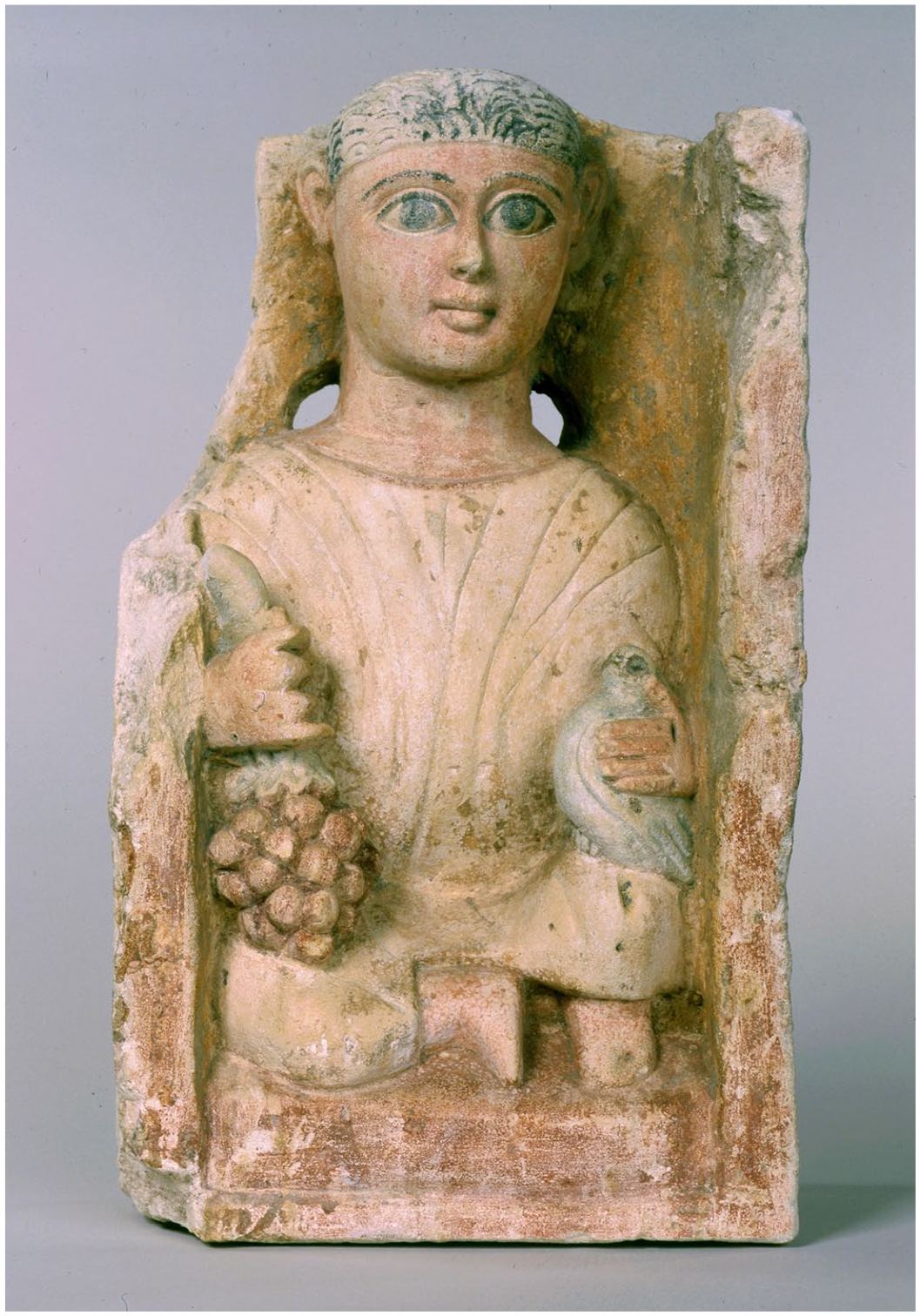
Recarved grave relief. Staatliche Museen zu Berlin, Skulpturensammlung und Museum für Byzantinische Kunst inv. 3/59 (photo: courtesy of the Staatliche Museen zu Berlin, Skulpturensammlung und Museum für Byzantinische Kunst. https://id.smb.museum/object/1414420/grabrelief-eines-knaben).
The only subgroup not represented in the RMO’s collection is the second, which is comprised of a series of busts. 43 The smallest of the four subgroups, these busts have received the least amount of attention, either as authentic or as fake works. According to Vikan there are some porphyry portraits from the Tetrarchic period that are somewhat similar to the Sheikh Ibada busts. 44 However, the similarities with the Sheikh Ibada pieces and the authentic portraits are limited, and the closest stylistic parallels are other fakes. 45 Moreover, damage and evidence of weathering among the Sheikh Ibada busts is minimal.
Perhaps the most well-known of the Sheikh Ibada fakes are those sculptures that comprise the third subgroup. This subgroup contains various types of decorative architectural sculpture, most displaying unparalleled compositional or iconographic features, such as the hand-held crosses, which are unusual among Late Antique Egyptian figural sculpture but common across this subgroup. 46 Broadly illustrative of the general issues of this subgroup, and one of the best-known examples, is the so-called Brooklyn Paralytic held by the Brooklyn Museum (also known as the ‘One Cured of Paralysis’) (fig. 2). 47 It is carved in the round, a feature which, on its own, provides cause to question its authenticity, given sculpture in the round is rare among Coptic art. 48 Furthermore, the renderings of its face, supposed bed, and body are without a suitable parallel by which the historic existence of these features might be demonstrated. 49 Simply, this sculpture is without a convincing antique parallel by which its authenticity might be proven. 50 These issues are far from unique among the sculptures that comprise this third subgroup, or the Sheikh Ibada corpus in general: many are without a convincing ancient parallel by which their type, iconography, or composition might be shown to have existed within antiquity. 51
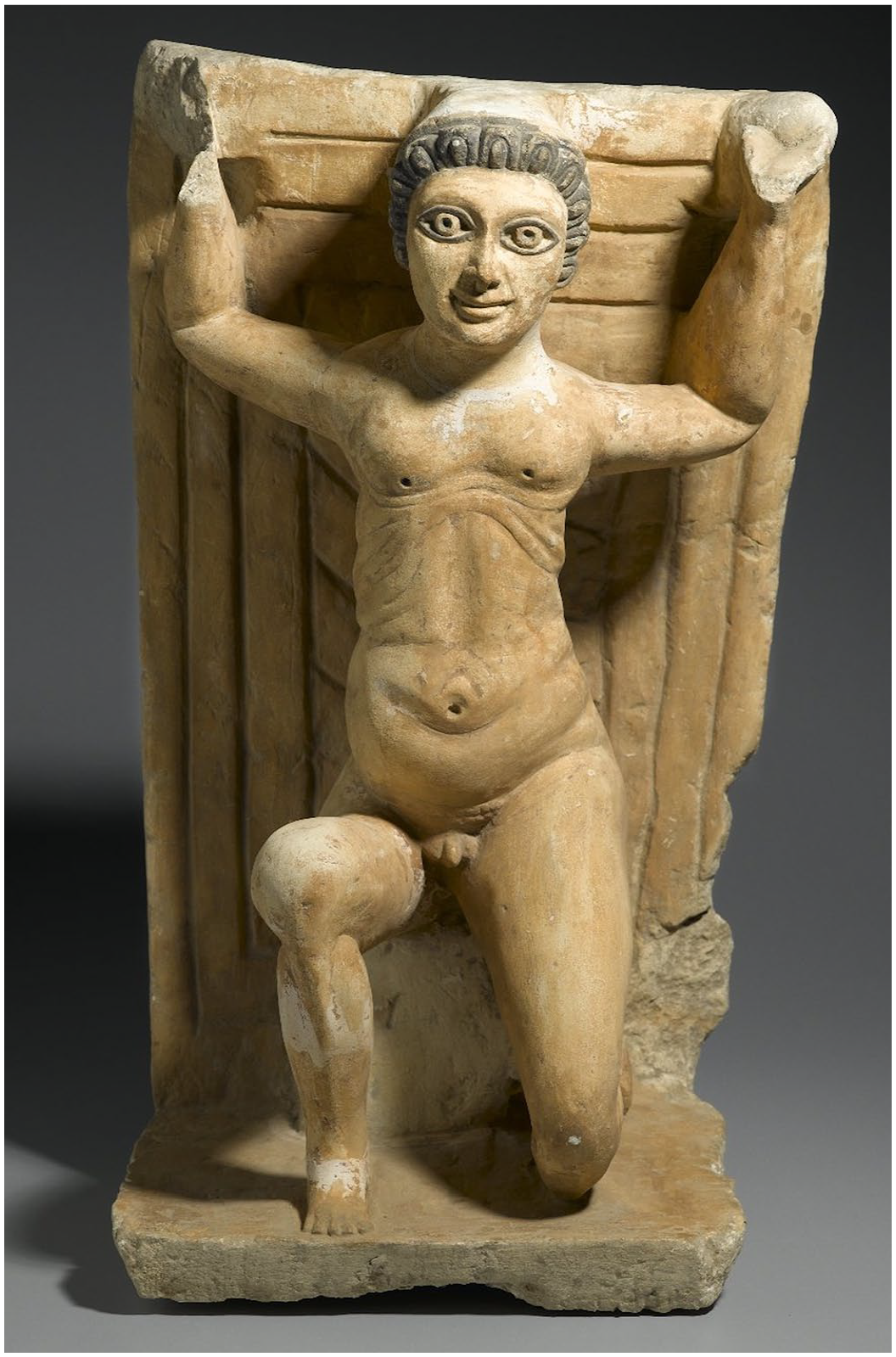
Brooklyn Paralytic. Brooklyn Museum inv. 62.44 (photo: courtesy of the Brooklyn Museum. https://www.brooklynmuseum.org/opencollection/objects/80243).
The final subgroup is comprised of rectangular plaques with unusual scenes and iconography (e.g. figs 3, 4, 10). These plaques are often Christian in nature and oddly executed with nonsensical decoration. 52 The clothing of many of the figures is often poorly rendered and inconsistent with historical fashions, while the bodies are strangely proportioned. 53 Finally, many of these plaques are carved from nummulitic limestone which, although prevalent in Middle Egypt near ancient Antinoë, was rarely used in Late Antique Egyptian sculpture. 54 Thus, these plaques can confidently be dismissed as fakes.
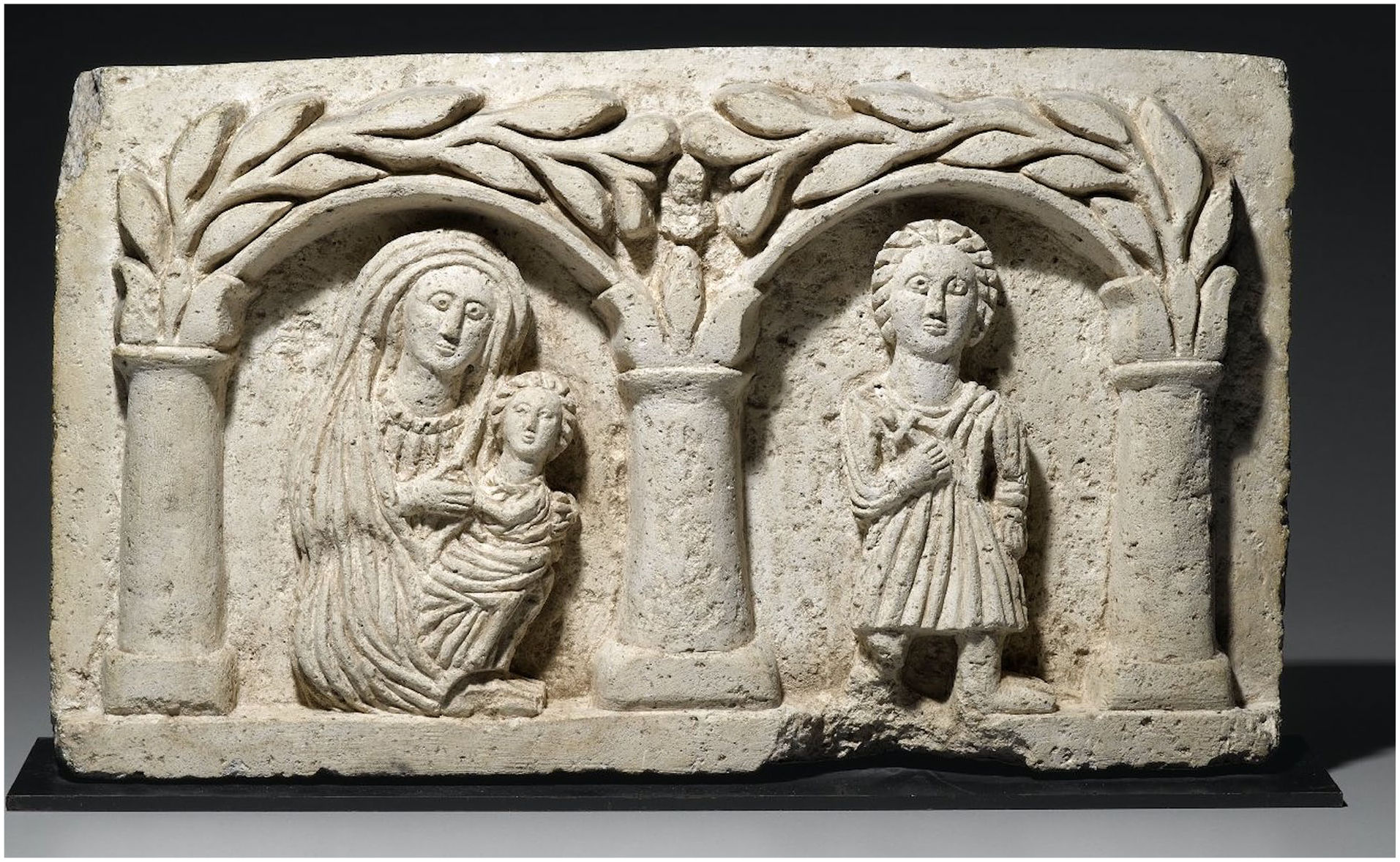
So-called Holy Family. Brooklyn Museum inv. 77.129 (photo: courtesy of the Brooklyn Museum. https://www.brooklynmuseum.org/opencollection/objects/103561).
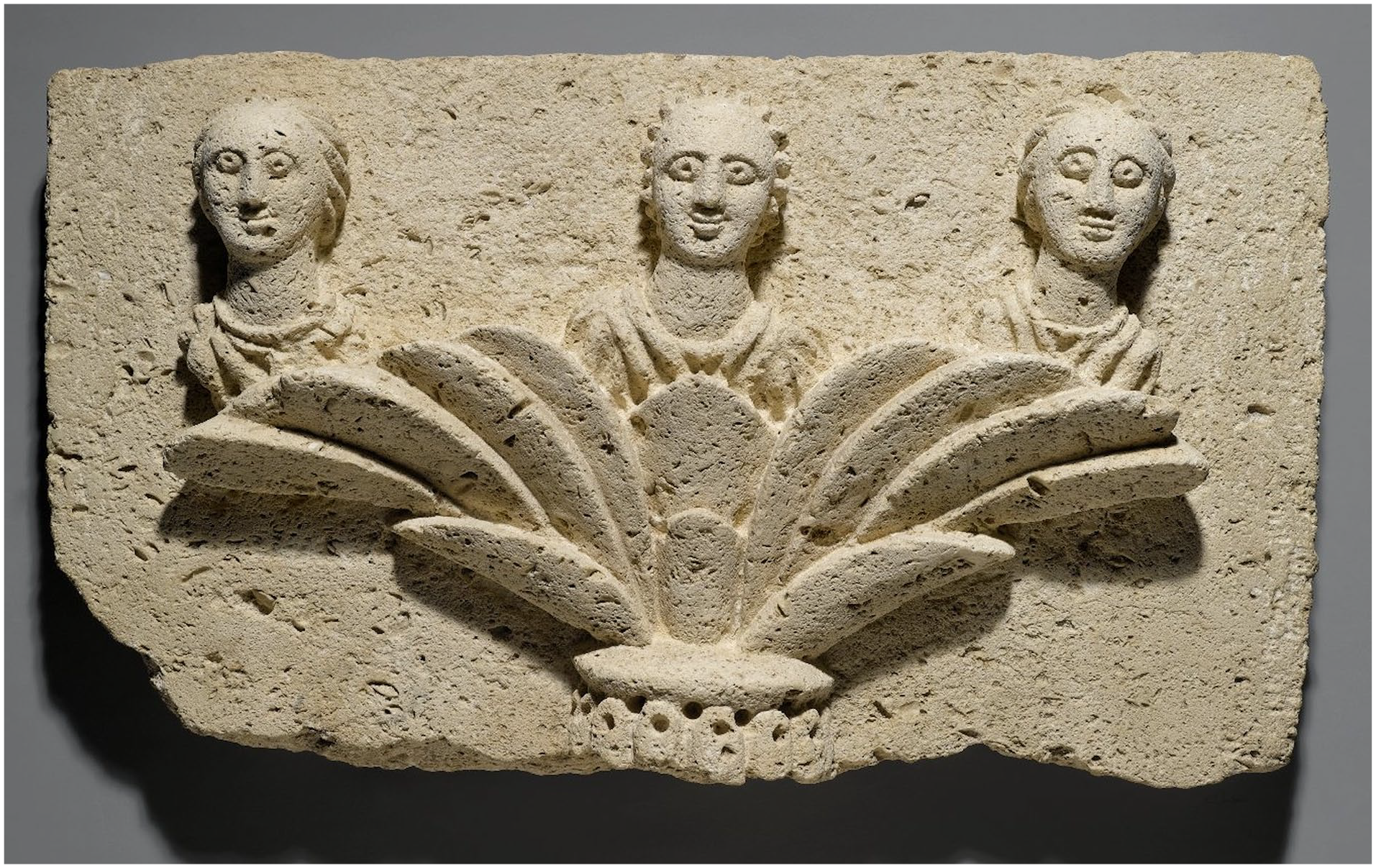
Plaque with three busts on a capital. Brooklyn Museum inv. 72.10 (photo: courtesy of the Brooklyn Museum. https://www.brooklynmuseum.org/opencollection/objects/98343).
As noted, the Sheikh Ibada pieces have been grouped as a corpus because of the shared ‘provenience’ many surfaced with. Just like many of the sculptures, however, this provenience is fabricated. The site of Antinoë has been subject to excavation, albeit intermittently, since 1895 when Albert Gayet began digging there. 55 Those excavations, however, uncovered only limited sculpture, and certainly nothing that paralleled the fakes. 56 Subsequent excavations, including those most recently undertaken by the Università degli Studi di Firenze’s Istituto Papirologico ‘Girolamo Vitelli’, have also failed to find sculpture that would demonstrate the antiquity of the stylistic features restricted to the Sheikh Ibada corpus. 57 There is, therefore, no archaeological evidence that can tie the Sheikh Ibada sculptures to their supposed provenience.
Along with the forged provenience, many of these works share clear stylistic characteristics. One such feature is the rendering of the faces. 58 Vikan distinguished two variations of facial type. First is that which is common among the grave stelae: faces are typically round, with precisely rendered hair, and dominated by large eyes, often painted. 59 Second are those faces most common among the second and third subgroups (although they also feature on some of the stelae). 60 Like the first type, these faces are dominated by the eyes. However, unlike those which are characteristic of the first facial type, the eyes of the second facial group are comprised of a doubly outlined eye socket, with a drilled pupil within the iris (henceforth ‘goggle eyes’). 61 Furthermore, the majority of these faces feature a ‘foolish smile’ and notched nostrils, capped by unusually rendered hairstyles largely unparalleled among authentic Late Antique Egyptian art. 62 To Vikan’s two facial types, two more might be added. The faces depicted in many of the plaques that comprise the fourth subgroup often have bulbous eyes that protrude from the face, with drilled pupils. 63 These faces vary from the other two types described above, and seem to be largely restricted to a number of the plaques in the fourth subgroup. The final facial type, which is again largely prominent among the sculptures of the fourth subgroup, is also defined by the eyes, which are especially prominent and also feature the doubly outlined socket. However, unlike those sculptures featuring the so-called ‘goggle eyes’, there is no attempt to individually render an iris and most of these pieces do not have the drilled pupil, either. 64 Many of the sculptures with either the bulbous or doubly outlined but blank eyes also feature a somewhat squat nose and large, almost duck-like, lips upon which the nose almost seems to sit. 65 It is worth noting these facial types described here are not immediately indicative of the Sheikh Ibada group, as Spanel has noted some parallels in authentic works. 66 However, they are rare and so the frequency with which they occur among the Sheikh Ibada group marks them as suspicious. 67
There are also more general indicators of dubious authenticity that span all subgroups. Damage to the sculptures is minimal and inconsistent with what one would expect of authentic works. Figures and especially faces, which are typically considered valuable by the market, are largely undamaged. Damage, if any, is typically restricted to the background and the protruding figures are confusingly left intact. When the faces are damaged the noses, which are vulnerable to breakage, are often intact. Breaks and chips instead appear on the cheeks and chins. 68 The issues with inconsistent damage patterns can be seen in an apparent niche head depicting Dionysos in the Louvre. 69 Here, despite extensive visible damage to its border, which makes it difficult to be certain of the original architectural function of the piece, the entirety of the figure is preserved. 70
This lack of damage to the sculptures that comprise the Sheikh Ibada group extends to the absence of a patina or evidence of weathering on many of the pieces. 71 The absence of weathering is especially suspicious given these sculptures were carved from limestone, which deteriorates fairly quickly and means authentic sculptures often lose a substantial amount of detail. 72 Yet, the level of detail visible among the Sheikh Ibada sculptures is unusually well defined. In sum, what damage is present among the Sheikh Ibada sculptures appears odd and is not consistent with what one would expect for sculptures supposedly some 1500–1700 years old. This all suggests the damage has occurred artificially in modernity.
Late Antique Egyptian sculpture was habitually painted, and highly dependent on this for the final overall effect. 73 This paint was typically applied over an interceding layer of gesso used to prepare the sculpture for paint, smoothing any issues with the stone and hiding unsightly tool marks. 74 However, although many of the Sheikh Ibada sculptures are painted, the paint is applied directly to the stone, not onto the expected grounding layer. 75 Further, this paint is also unusually well preserved and thick considering the supposed age of these sculptures. 76 At a minimum, the issues with the application of paint indicate that the sculptures have been retouched in modernity.
There are further issues with the construction of the Sheik Ibada sculptures that set them apart from the sculpture recovered from Oxyrhynchus and Heracleopolis Magna (modern Behnasa and Ahnas respectively). For example, the composition of the Sheikh Ibada sculptures is treated similarly irrespective of subject matter, with both pagan and Christian sculptures predominantly symmetrical in composition. 77 Yet, the majority of sculpture from Heracleopolis Magna and Oxyrhynchus that featured pagan subject matter was asymmetrical. 78 Further, the drapery for the Sheikh Ibada fakes is almost entirely detailed through carving, even among those which have retained their paint. 79 This did not typically occur among Late Antique Egyptian sculpture, where such detail was accomplished through a combination of moulding and paint, with the broad details rendered through carving and the more minute details painted. 80
Finally, the architectural function of many of the Sheikh Ibada sculptures is either unclear or misunderstood. As already mentioned, the relief plaques of the fourth group were typologically unattested before their emergence on the market, 81 and Vikan notes that he is unsure of the function the busts of the second subgroup supposedly performed. 82 Many other Sheikh Ibada sculptures appear to have been created without regard to their supposed architectural function. For example, there are several niche heads within the third group, which would, if authentic, have sat atop either wall or floor niches. 83 These sculptures parallel in basic shape other niche heads recovered from both Oxyrhynchus and Heracleopolis Magna. 84 Yet despite these parallels, the Sheikh Ibada variants remain concerning, even ignoring the troubling iconography, 85 due to their problematic construction. The figures depicted in these niche heads do not follow the concave background of the niches, nor do they protrude at either the top or bottom. This suggests they were designed to be viewed at eye-level, not from below, or above, as one would expect based on excavated parallels. 86
Ultimately, while the possibility that the Sheikh Ibada fakes might be authentic cannot be completely dismissed, the weight of the cumulative evidence against their authenticity suggests they should be considered fakes. Without archaeologically recovered provenience the stylistic oddities present throughout the Sheikh Ibada corpus remain without suitable parallels that would demonstrate the existence of these features within antiquity. Simply, the degree to which the Sheikh Ibada group differs from the known corpus is too great to consider these sculptures authentic. Perhaps the most convincing reason for accepting the Sheikh Ibada sculptures as fakes, however, is the lack of argument produced for accepting them as authentic. Although some continue to publish Sheikh Ibada sculptures as authentic, no one (in print at least) has yet sought to address the claims that these sculptures are fakes.
Four Sheikh Ibada Fakes in Leiden
F 1961/9.1: Grave Stele of a Boy
On display at the time of writing, F 1961/9.1 is arguably one of the most important pieces in the Sheikh Ibada story. 87 An excellent example of the so-called Isismysten that make up the first subgroup, this sculpture featured prominently in Müller’s 1960 publication and thus played a central role in defining the Sheikh Ibada ‘style’. 88 Like many of this subgroup, it depicts a seated youth set within a niche, holding a bird in one hand and a bunch of grapes in the other. According to the RMO’s records this sculpture was purchased in September 1961 from Galerie Heidi Vollmoeller, who supposedly purchased it in Egypt. 89 When it was acquired by the RMO this stele was apparently without a stated provenience. 90 Yet, based on its similarity to other Sheikh Ibada pieces, it was attributed to Sheikh Ibada, and this ‘provenience’ is still reported on the accompanying museum label. 91 That being said, and following Klaus Parlasca, since the late twentieth century some have dropped the Sheikh Ibada provenience for this and other Isismysten stelae and suggested they came from Oxyrhynchus instead. 92 Although the recut Sheikh Ibada niche stelae may well have originated at Oxyrhynchus, it is important that their link to the Sheikh Ibada corpus be preserved so their provenance and the history of their reception can be properly understood.
Although niche stelae as a general type do have authentic parallels, the stylistic and technical features visible in this stele indicate clearly that it has been recarved in modernity and is best viewed as part of the Sheikh Ibada corpus. Perhaps the most immediately suspicious aspect of this sculpture is its level of preservation. Viewers notice immediately the clarity and crispness of the carving and, especially where the face is concerned, the brightness of the remaining paint. The black paint used to define the eyes, including the bird’s, and eyebrows is especially sharp. More broadly, the paint has been applied directly to the stone, not over the expected interceding layer of gesso. 93 Although still largely preserved, the niche in which the figure sits is in comparatively worse condition, especially behind the sculpture’s head. The stone in these areas, although once clearly dressed, has deteriorated in the manner expected of limestone. 94 Yet the valuable figure, bar a few very minor chips, is in suspiciously good condition.
It also seems likely that the bird held in the figure’s left hand was once larger than it is now. Close inspection of the area surrounding the bird reveals a slightly raised section of stone behind the bird’s head. Moreover, the neck and head of the bird appear far smoother and less raised than the remainder of its body, and compared with authentic parallels are in excellent condition. 95 It thus appears that the head and neck of the bird, which were presumably damaged prior, have been recut in modernity to refine the features and make the figure appear more fulsome and thus appealing. 96 Like many niche stelae now considered examples of the Sheikh Ibada fakes, this piece illustrates well Vikan’s ‘first facial type’. 97 The face is dominated by large, staring eyes, which are highly reliant on the crisp paint for effect. 98 Additionally, the hair is precisely carved and has clear comparisons with other Sheikh Ibada pieces. It is thus clear that this piece belongs to the Sheikh Ibada corpus.
F 1962/8.2: Priests of Suchos and a ‘Perplexed Crocodile’
Perhaps the most famous of the RMO’s Sheikh Ibada sculptures, 99 this relief has previously been discussed briefly as a Sheikh Ibada fake. 100 In his 2005 monograph, Laszlo Török identifies this as an example of one of the ‘fantastic iconographic types [of Sheikh Ibada fakes] created ex novo’ by the forgers. 101 Török goes on to note, rather humorously, that one side depicts ‘a procession of four naked men (thought to represent priests of Suchos!) carrying a perplexed crocodile’. 102 Török’s misgivings are well founded and this sculpture should certainly be considered part of the corpus of Sheikh Ibada fakes. Stylistically, this sculpture is concerning. The rendering of the figures’ faces is immediately indicative of the third subgroup. Each face features Spanel’s ‘foolish smile’, along with the quintessential ‘goggle eyes’ and capped hairstyle: well paralleled with the Brooklyn Museum’s so-called Haghia Sophia fake (fig. 8). 103 This piece is currently displayed as an authentic example of Late Antique Egyptian sculpture. 104
Beyond the stylistic qualities of the figures being suspicious, much of the damage pattern also gives cause for concern. On the front, the limestone behind the four crocodile holders is extensively pockmarked, yet the figures, including the crocodile, are suspiciously almost without any evidence of weathering (fig. 6). Moreover, the right-most figure appears to be holding the end of another crocodile’s tail, which is broken towards the top of the relief. 105 Ultimately the, viewer is left confused by this decision: there is no room for a second crocodile anywhere, and it is difficult to understand why this figure would have carried a single tail. Judging by the placement of the hand of the fourth figure, the tail would have jutted out at least as far as the head of the third and fourth figures, yet it is only the tail that has broken away: the figures and indeed the existing crocodile are unbelievably well preserved. The left-hand side of this sculpture is even more confusing (fig. 7). The woman is largely complete; however, much of the infant that was grasping her robe has been lost, as have the front legs of the sphinx upon which she reclines. Likewise, what appears to have been another figure in the top-right corner has also been largely lost. According to Peter Jongst and Mat Immerzeel, there are traces of plaster and paint on the background, the robe of the woman, and the bodies of the men. 106 As far as the present author is aware, plaster, despite its prevalence on authentic Late Antique Egyptian sculpture as a grounding layer, is only found on those Sheikh Ibada pieces that were once authentic but have been reworked in modernity. If this piece were once authentic, this would explain why several of the figures on the left-hand side of this relief are so badly damaged.
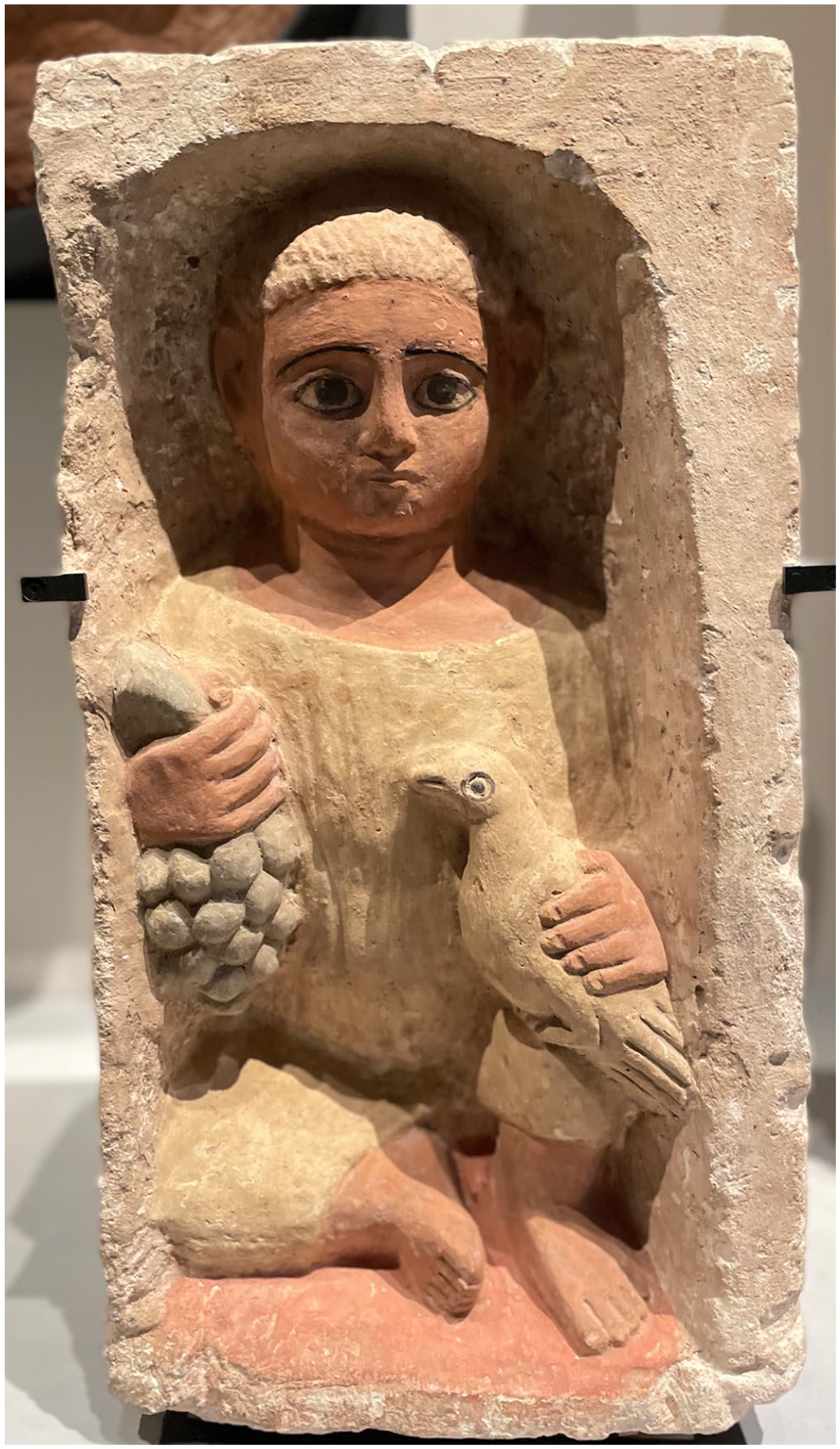
Recarved grave relief. RMO, Leiden inv. F 1961/9.1 (photo: author).
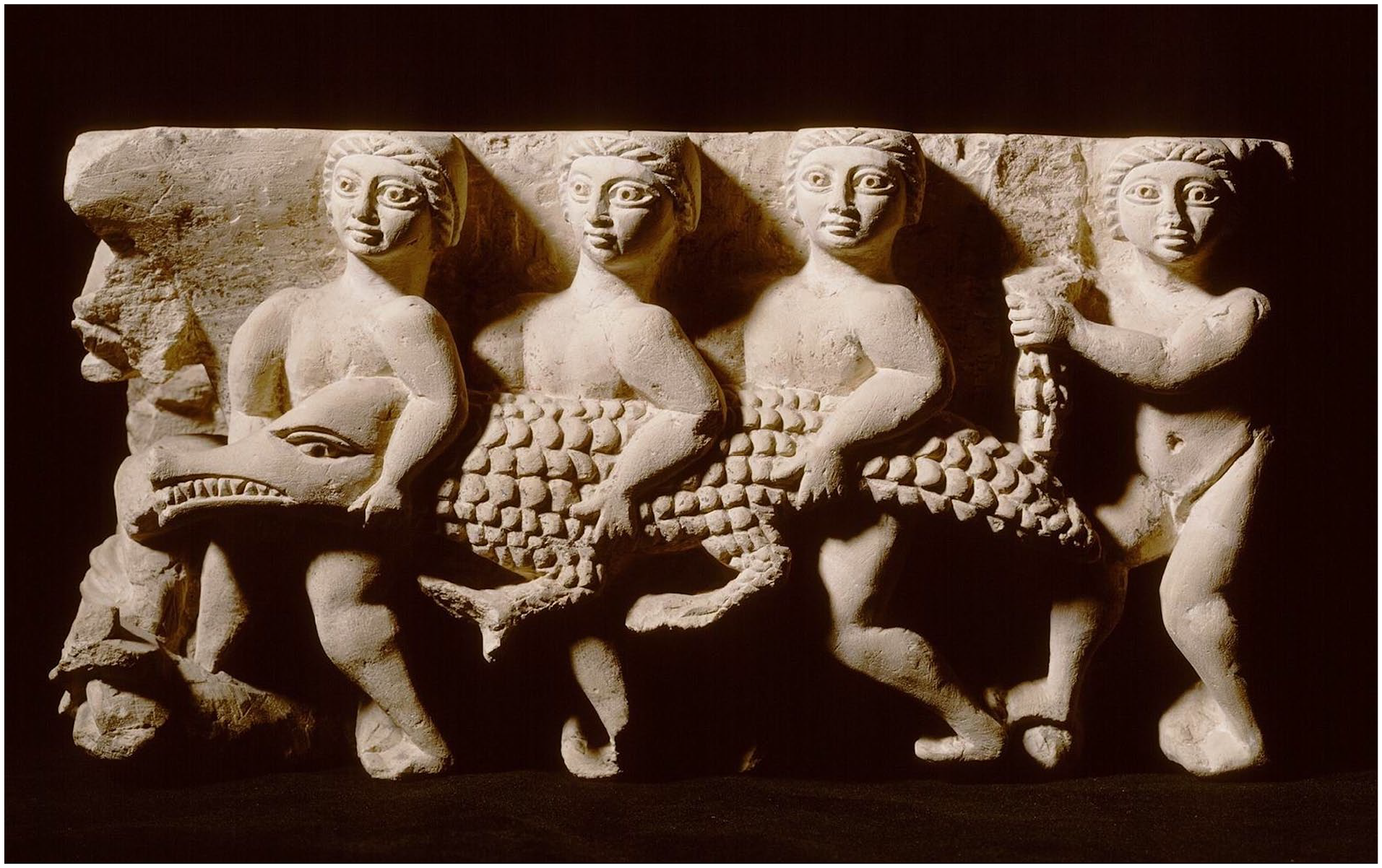
Priests of Suchos and their ‘perplexed crocodile’. RMO, Leiden inv. F 1962/8.2 (front) (photo: courtesy of the RMO, Leiden. https://hdl.handle.net/21.12126/22657).
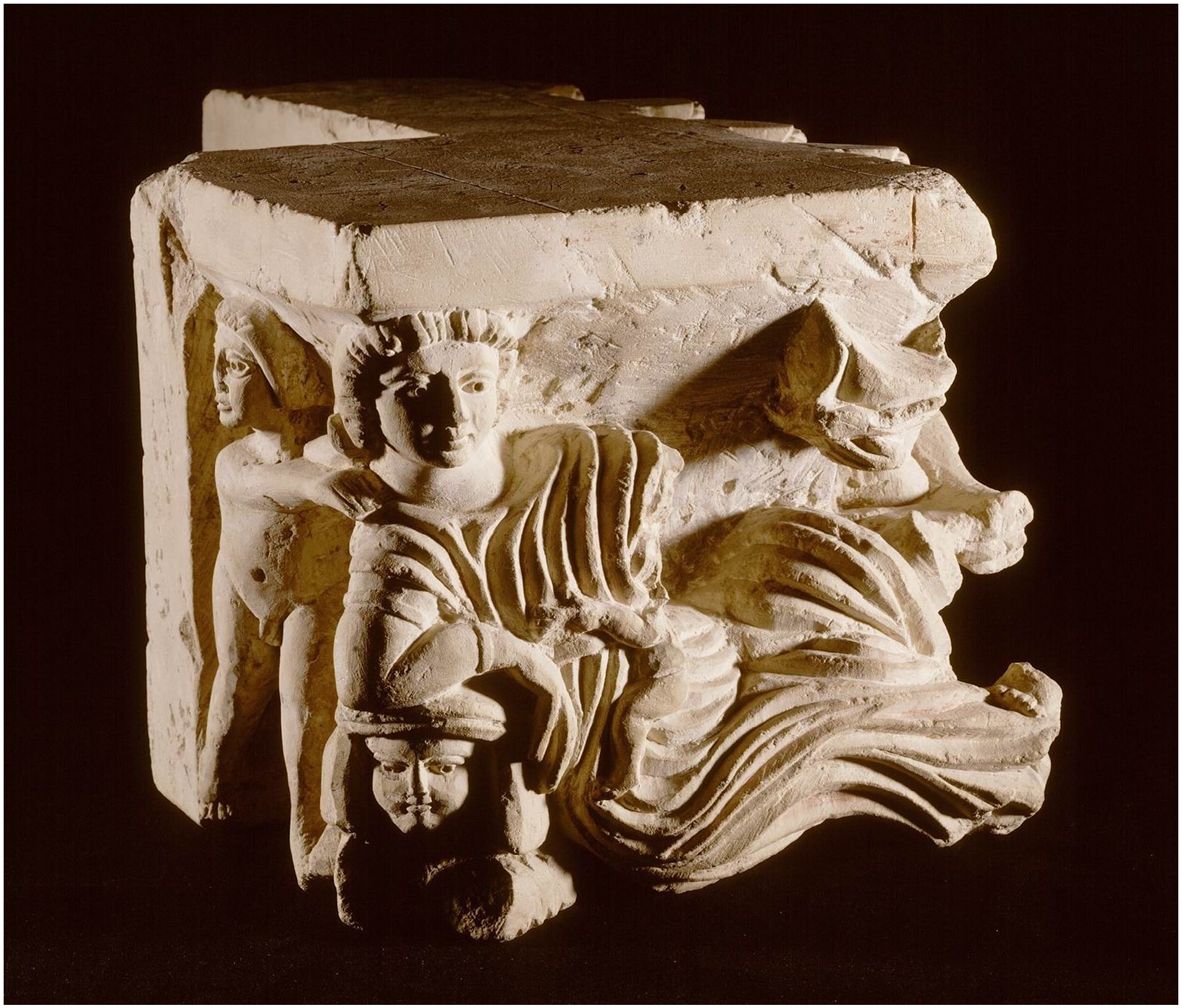
Woman reclining on sphinx, on a side of the same sculpture. RMO, Leiden inv. F 1962/8.2 (left-hand side and back) (photo: courtesy of the RMO, Leiden. https://hdl.handle.net/21.12126/22657).
3. F 1967/6.1: ‘Abraham and Isaac’
One of the most well-known Sheikh Ibada pieces is the so-called Brooklyn Paralytic (fig. 2), which supposedly reflects the biblical account of the healing of a paralysed man by Jesus. 107 A sizeable relief in the RMO also supposedly relays a biblical story – that of Abraham sacrificing Isaac. 108 Like many other Sheikh Ibada pieces, this panel passed through the hands of the antiquities dealer Jerome Eisenberg (1930–2022), who operated the Royal Athena Galleries in New York and London. 109 It arrived at the museum from Eisenberg in 1963 but was only accessioned in June of 1967. Curiously, the entry in the RMO’s accession book for this piece notes it is probably a fake, 110 and of the Sheikh Ibada pieces in the RMO this relief is the only one currently identified as a fake in the museum’s public-facing catalogue. 111 Despite this, however, this relief has not yet featured in print and thus has not been formally linked to the wider Sheikh Ibada corpus, which is why it is discussed here. Finally, based on the museum’s records, there is no indication that this piece was said to come from Sheikh Ibada.
Although this relief is not linked to the Sheikh Ibada corpus by its supposed provenience, the stylistic qualities of this relief make it clear that it is both fake and belongs to the wider Sheikh Ibada corpus. Perhaps most noticeable is the clear similarity in facial design of all three figures: all feature the so-called ‘goggle eyes’ and capped hair illustrative of the Sheikh Ibada group. The figure being sacrificed (Isaac) appears to have longer hair than the others, which is grasped by the figure with a sword, and is depicted nude, perhaps in an effort to further convey his vulnerability. In contrast, the other two figures are fully clothed. There are, however, inconsistencies with the drapery, which is oddly rendered. These issues are perhaps most evident in the drapery of the central figure’s chiton. Above the sword there are seven delineated folds, but below it there are eight. Given the highly schematic approach to the drapery here, this appears rather odd and suggests the sculptor was not paying attention. Likewise, the chiton of the figure on the left is missing the bottom portion of the right-most pleat.
Unlike many of the Sheikh Ibada pieces, the damage to this sculpture is not restricted to the background, with two of the three figures displaying evidence of restoration. However, the damage is not so severe that the figures have lost any of the valuable detail. Interestingly, there is some damage to the face of the large figure, with restoration evident on the cheeks and the bridge of the nose. Apart from the restored sections, there is only minimal damage to the remainder of the relief, most extensively to the top and bottom corners; also noticeably absent is the limited evidence of weathering, which is especially suspicious given the absence of any paint or gesso that might have acted as a protective barrier from the elements. This absence of weathering is particularly apparent in the faces of the three figures.
4. F 1957/1.3: Relief Plaque with Figure in Wreath
This plaque is an interesting example of the fourth Sheikh Ibada subgroup. 112 Again, this piece is currently on display in the RMO as authentic and has also been published as authentic. According to the museum’s gallery label, it is a grave relief from Antinoë, and dates to the fourth or fifth century CE. This sculpture was the first of the pieces discussed here to enter the RMO collection, purchased from the Galerie für Antike Kunst in Zurich in 1957. 113 It features a figure set within a wreath with tendrils hanging from the bottom, one of which has partially broken. This wreathed design does have somewhat similar parallels among several authentic friezes. 114 Over each of the figure’s shoulders is a nodule, the significance of which is unclear. It seems possible that these nodules are supposed to represent the tops of wings marking the figure as an angel, which aligns with the overtly Christian nature of many of these plaques – this, however, is simply speculation. 115 The drapery is depicted oddly, seemingly bunching in the middle of the neckline, and spreading out from there. Of particular interest, here, is the rendering of the figure’s eyes. In design, with the double outlined socket and drilled pupil, they are similar to other pieces in the Sheikh Ibada corpus. 116 Unlike the majority of the Sheikh Ibada parallels with a drilled pupil, this piece does not have the famous plastically rendered iris. That being said, parallels do exist (e.g. see fig. 8). The pupil notwithstanding, the prominent lips and flat nose of this figure, and the doubly outlined eye socket, have clear parallels among a number of the plaques of the fourth subgroup, like the ‘enigmatic’ sculpture held by Princeton University. 117
The rendering of the hair of the figure is curious. Most often Sheikh Ibada figures have hair comprised of ‘strips’ or ‘ropes’, which looks somewhat like a cap (e.g. see figs 6, 8, 9). Here, however, although the hair looks somewhat like a cap placed atop the figure’s head, it has two rows of balls with a hole drilled through the centre of each ball. Despite this seemingly odd rendering of the hair, parallels can also be found in the Sheikh Ibada corpus. 118 Finally, the damage patterns are immediately suspicious. As is common across the Sheikh Ibada corpus, the valuable figure in the centre is preserved in its entirety despite visible breakage to both upper and lower sections of the wreath and there is little of the expected weathering.
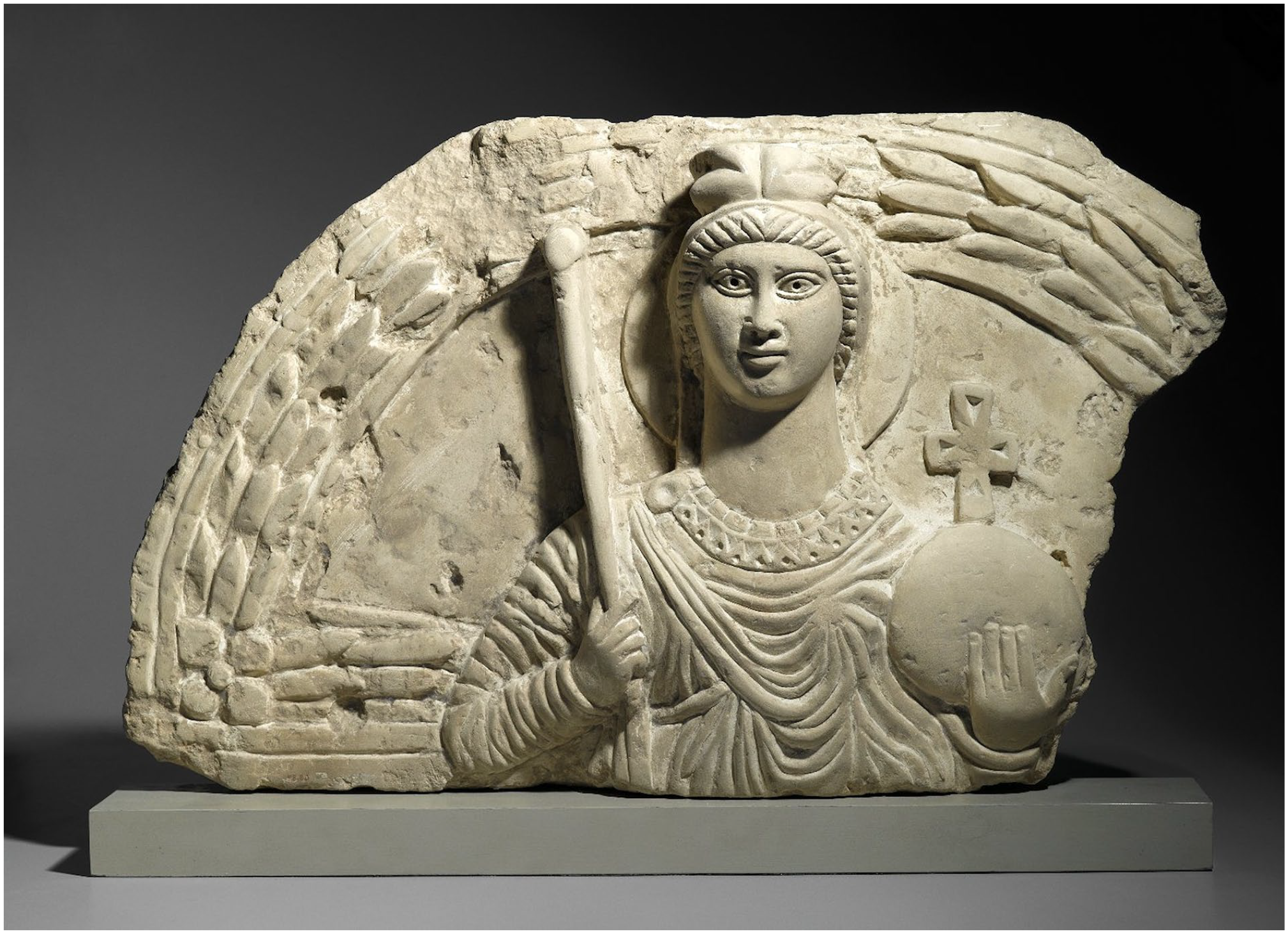
The so-called Haghia Sophia relief. Brooklyn Museum inv. 58.80 (photo: courtesy of the Brooklyn Museum. https://www.brooklynmuseum.org/opencollection/objects/74514).
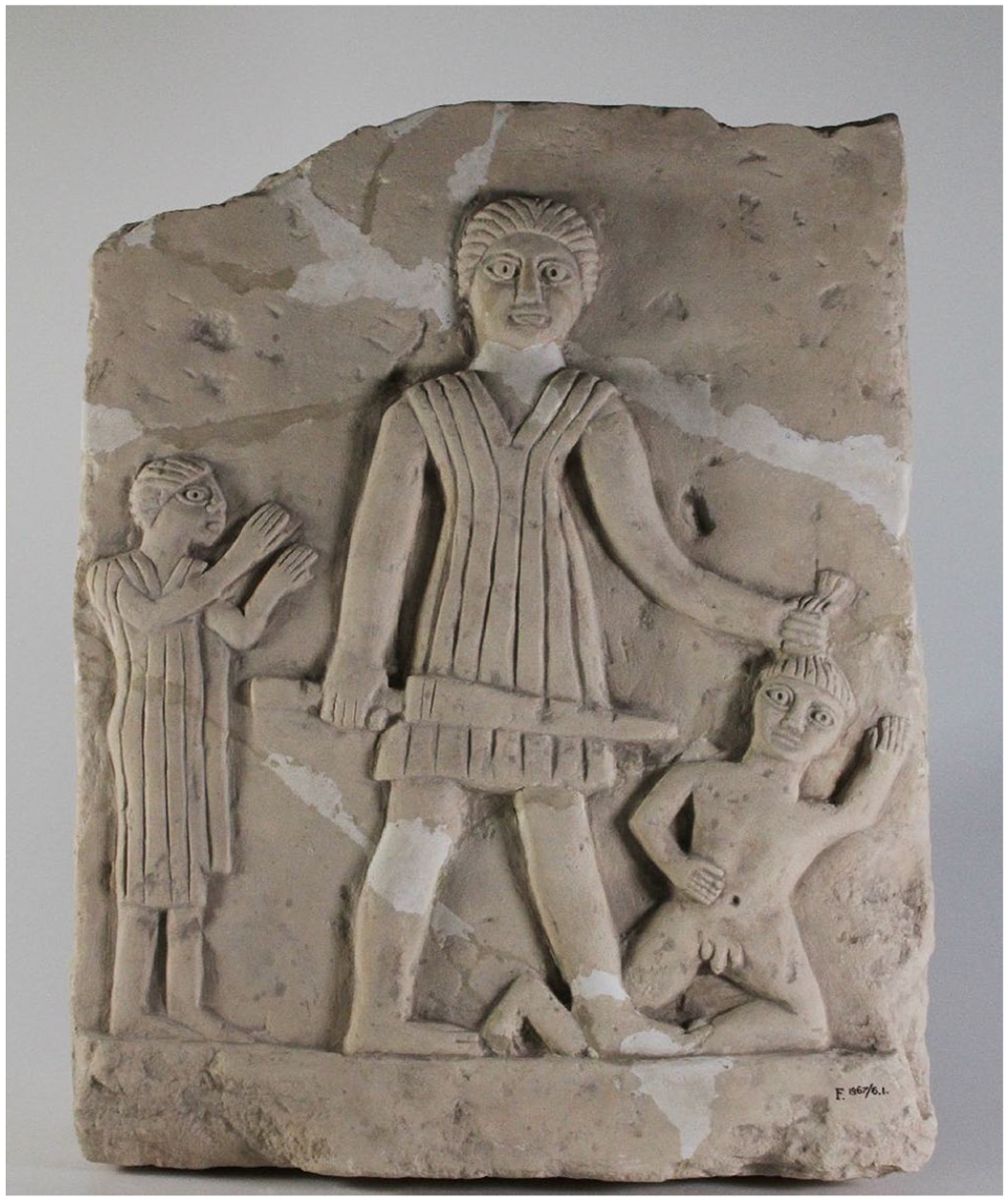
Abraham sacrificing Isaac. RMO, Leiden inv. F 1967/6.1 (photo: courtesy of the RMO, Leiden. https://hdl.handle.net/21.12126/19807).
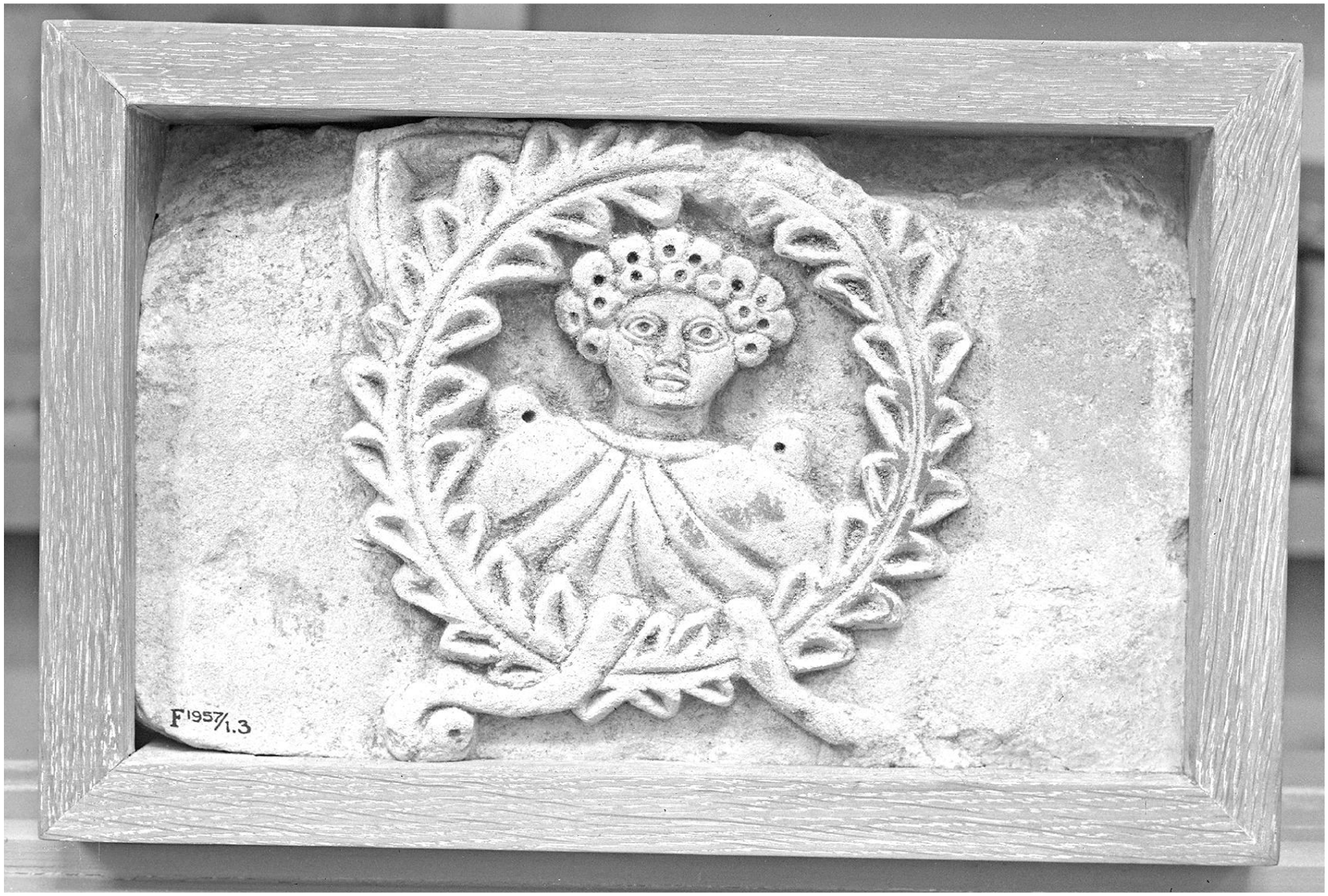
Relief plaque with figure in wreath. RMO, Leiden inv. F 1957/1.3 (photo: courtesy of the RMO, Leiden https://hdl.handle.net/21.12126/964).
Conclusion
For several decades in the middle of the twentieth century the Sheikh Ibada fakes heavily shaped the study of Late Antique Egyptian sculpture. Their composition, content, and falsified provenience erroneously supported problematic conclusions and introduced corrupting ‘knowledge’ to the study of Late Antique Egyptian sculpture, which further distorted understandings of Late Antique Egypt. While the works of scholars like Vikan, Spanel, Thomas, and others helped to largely remove these fakes from mainstream academic discourse, the RMO sculptures make it clear that, even today, some of these fakes continue to be accepted as authentic works and erroneously inform how people view Late Antique Egypt. At the time of writing, three of the four sculptures discussed here remain on display as authentic works and have also been published in the late twentieth century or early twenty-first century as authentic. Each of the four sculptures discussed here, however, feature concerning damage patterns and stylistic features that find direct parallels within the accepted Sheikh Ibada corpus. It is, therefore, evident that they should be considered part of the corpus of Sheikh Ibada fakes and discussed as such. If there are those who wish to discuss these sculptures as authentic, or any that are or once were associated with Sheikh Ibada, the onus is on them to explain first why these features should be considered authentic. It is their responsibility to find securely provenienced comparisons that allow the problematic features that align these sculptures with the Sheikh Ibada fakes to be explained as authentic products of Late Antique Egypt. Until that time, these sculptures should be considered fakes.
Postscript
When this paper was submitted for publication, three of the four sculptures discussed were on public display as authentic works. I have since been informed by Daniel Soliman, curator of the Egyptian and Nubian collections at the RMO in Leiden, that the museum plans to remove these sculptures from display, and is planning on undertaking a detailed study of the tool marks and visible pigment in the future. This decision was made by the museum on the basis of earlier concerns about the authenticity of the sculptures as well as the results presented above, a draft of which Soliman was kind enough to read over. Further scientific investigation of these fakes will offer new insight into their manufacture and the techniques used by forgers – of which little is currently known. The willingness of the RMO to react to the concerns raised in this paper is positive and is hopefully indicative of a changing of attitudes towards issues of authenticity within the museum sector.
Footnotes
Acknowledgements
First and foremost, I would like to thank Daniel Soliman for his willingness to discuss these sculptures with me and check their provenance, and for reading a draft and making a number of helpful suggestions. Mariëlle Bulsink and the other staff members from the RMO’s archives and library were immensely helpful, accessing and navigating a number of publications and records relating to the sculptures discussed here. Malcolm Choat read an earlier version of this paper and made many useful suggestions. Abbie Hartman was kind enough to cast her critical eye over sections of this paper. Finally, I would like to thank the reviewers for their helpful comments and suggestions. All remaining errors are my own.
Statements and declaration
Part of this article is based on research undertaken as part of my MRes thesis undertaken at Macquarie University. This article forms part of the work for the Forging Antiquity project funded by the Australian Research Council (DP170104196).
Funding
Part of this work was made possible Macquarie University Postgraduate Research Fund (PGRF).
2.
Cooney 1963: 42–44 (Brooklyn Museum inv. 62.44). See also Badawy 1978: 152;  : 118–119.
3.
This was following a paper delivered by Gary Vikan at the Third Annual Byzantine Studies Conference at Columbia University. Although this paper has not been published, Vikan was kind enough to provide me with a copy. As such, unless one counts the abstract for Vikan’s (1977b) talk, the Sheikh Ibada fakes were not discussed properly in print as fakes until : 9.
4.
Vikan 1977a; Kakovkin 1993: 227; : 89.
5.
Sheikh Ibada fakes can still be found in collections as authentic antiquities. From November 2020 to September 2021 the Georgia Museum of Art held an exhibition entitled Modernism Foretold: The Nadler Collection of Late Antique Art from Egypt. The exhibition catalogue features at least seven pieces that are clearly part of the Sheikh Ibada corpus. Although the catalogue does note that most of these pieces are problematic, each entry stops short of labelling the pieces fakes and instead informs the reader that, at most, the sculptures have been ‘substantially recut’. See : 98–107, nos 3, 9, 14–18. In addition, there are at least two Sheikh Ibada pieces in Detroit Institute of Art (invs 74.208 and 1987.62), at least one in the National Museums of Scotland collections (inv. A.1963.515 is a clear example of a Sheikh Ibada fake, and inv. A.1967.529, judging by the description, may be too).
6.
Nørskov 2002: 259; Mackenzie 2005: 32–35; : 207–210.
7.
8.
E.g. Boardman 2009: 121; Westenholz 2010: 257. On these assumptions more broadly, see : 136.
9.
For an overview of the Gospel of Jesus’s Wife case see Choat 2019: 566–568. The post-2002 Dead Sea Scrolls were accepted as authentic by a number of well-regarded scholars. For an overview of the market for the post-2002 Dead Sea Scrolls, see Justnes and Kjeldsberg 2023. Finally, for an overview of the Jehoash Inscription (the authenticity of which is not settled) see : 190–192.
11.
For example: fake cuneiform tablets are often assumed to be difficult to produce and it is therefore assumed that fake tablets are easily identifiable. However, there are several cases where convincing forgeries have been identified only decades after they were acquired. See, for example, Leichty 1970; Michel 2020: 43–50. More broadly see : 66–71 on the success of the forger Brígido Lara, who produced many pre-Columbian fakes. Lara’s fakes were so convincing that he was arrested by Mexican authorities for looting and smuggling antiquities. According to Kelker and Bruhns 2010: 68–69, Lara’s fakes were authenticated by experts at trial, and he was sentenced to ten years in prison. It was only after he produced fakes in his prison cell, which were then authenticated by the same experts, that his sentence was overturned.
12.
Although reports are limited, the available evidence does suggest that some forgers keep abreast of the scholarship and use this knowledge to produce more convincing fakes. As such, it is necessary that the criteria by which authenticity is disproven or supported are consistently interrogated. For an example of the methods used by forgers see: Tsirogiannis, et al. 2022: 372–373.
13.
Important works include: Boyd and Vikan 1981: 8–9; Kakovkin 1993; Severin 1995; Spanel 2001; Thomas 1990, I: 139–149; : 24–30.
14.
Given the Sheikh Ibada pieces did not surface through excavation, they can really only be understood through connoisseurship. Because connoisseurship functions on the premise that there are stylistic criteria restricted geographically, temporally, and often culturally to the corpora of works produced by certain groups at specific times and places throughout history, if objects surface with qualities that isolate them from an accepted corpus they should be rejected as forgeries. On connoisseurship see: Spier 1990: 623–625; Lapatin 2000: 45; Neer 2005: 3, 19; Simpson 2005: 29; Baker 2012: 22; Marlowe 2013: 4; Arrington 2017: 24; : 83.
15.
16.
RMO invs F 1957/1.3; F 1961/9.1; F 1962/8.2. Two of these pieces, RMO invs F 1961/9.1 and F 1962/8.2, have been mentioned briefly in other Sheikh Ibada publications, but these discussions have been only brief and have not impacted how these pieces are discussed. See, for example, Severin 1995: 291 n.15 and : 26 respectively.
17.
See, for example, : 188–192 for an overview of several cases from the twentieth and early twenty-first centuries that demonstrate well the difficulties faced by scholars when arguing something is a fake or forgery. These same obstacles do not typically need to be overcome when a scholar wishes to publish a fake or forgery as authentic.
19.
Boardman 2006: 40–42; : 25–38.
20.
A number of the early publications of the Sheikh Ibada fakes made specific references to the market both as the source of the sculptures and for their attribution to Sheikh Ibada to justify the reliability of both object and information. See, for example, Cooney 1961: 1; Cooney 1963: 37; Müller 1960: 267; Wessel 1965: 92. Other scholars also noted that the Sheikh Ibada fakes were not found during sanctioned excavation, but – and citing the works of Müller, Cooney, and Wessel as support – did not take issue with the provenance. See, for example, Jones 1962: 53; Parlasca 1966: 204; and : 46.
21.
Müller 1960. The niche stelae, or at least some of the supposed pagan variants, do have authentic parallels. See : 289–290 for a discussion of why the Sheikh Ibada variants can be considered fakes.
22.
Müller 1960: 267. See also Boyd and Vikan 1981: 9; Severin 1995: 289–293 pls 15b–16b. The example found by Flinders Petrie is now in the British Museum (inv. EA1795). There were also several unpublished examples of the niche stelae in the Coptic Museum in Cairo and in the Graeco-Roman Museum in Alexandria found during excavations in the 1920s. The term ‘Coptic’ has been used somewhat inconsistently in discussions of Egyptian art history. Some have seen Coptic art solely as the art of Egyptian Christians (and in particular anti-Chalcedonian Christians), while others have interpreted it to be the art produced in the Nile valley (the chora) compared to that manufactured in Alexandria. On account of this, and following , xxvi-xxvii, Late Antique Egyptian art is preferred here but ‘Coptic’ is used occasionally when discussing the work of those scholars who accepted the Sheikh Ibada fakes as authentic as ‘Coptic’ was the preferred designation during much of the twentieth century.
23.
Although many use ‘provenance’ to refer to both ownership history and findspot, a distinction between these two ideas is made in this paper. ‘Provenance’ is used specifically to refer to ownership history, and ‘provenience’ is preferred when discussing an object’s (alleged) findspot. This distinction is made to allow for a more reliable discussion of the reliability of the objects in question. As Marlowe 2013: 5 points out, many objects with reliable ownership histories would never be described as unprovenanced despite never being excavated. This lack of nuance can then obscure the fact that there is no reliable findspot that might vouchsafe an object’s authenticity. See also .
25.
Although many of the Sheikh Ibada pieces were said to have been found at the site when they first surfaced, others for some reason were without a reported provenance. Using the framework introduced by Müller, and celebrated by Wessel, a number of these pieces were assigned to Sheikh Ibada (Antinoë). See, for example, No. 1 below.
26.
Wessel 1963. An English translation of Wessel’s work was then published in 1965 (which is the version most commonly referred to here). The importance of Wessel’s book was such that : 55 referred to it as ‘the definitive book on Coptic art’ of the twentieth century.
27.
Török 2005: 29 n. 105. Török identifies Wessel’s pls III, 7, 8, 11, 18, 20, 30, 44, 45, 46, 47, 49, 59, 61, 69, 73, 76, 77, 90, 91, 96, 97, and 98 as fakes. He misses pl. V, which is noted as being heavily reworked by von Falck 1996 and labelled a fake by Gonosová and Kondoleon 1994: 394 n. 2, and pl. 40, listed as a fake in Thomas 1990, I: 128–129 n. 163, II: 206–208, and : 92 n. 23.
28.
The earliest noted objection to the authenticity of some of the Sheikh Ibada fakes came from Wolfgang Volbach, who refused to include 22 sculptures in the Villa Hügel exhibition, believing them to be fakes. On this event, see Severin 1995: 293–295; Spanel 2001: 92 n. 24. John Beckwith, in reviews of the Villa Hügel exhibition, Wessel’s Coptic Art, and Arne Effenberger’s Koptische Kunst, also raised concerns about the authenticity of some of the Sheikh Ibada pieces. These concerns, however, were never fully articulated with Beckwith simply stating some Sheikh Ibada fakes appeared ‘strange’, and their ‘authenticity is doubtful’. See Beckwith 1963: 290, 292; 1977: 329. : 36 might also be included here. In a review of the literature and exhibitions of the early 1960s he states that increasing interest in Coptic art has led to the appearance of ‘dubious pieces on the market’. Unfortunately, he does not specify which pieces he thinks are ‘dubious’.
31.
The stelae were also the first of the fakes to be published. See Müller 1960 and .
32.
Severin 1995: 289; .
33.
See, for example, the stele of a boy holding a cross in the Staatliche Sammlung Ägyptischer Kunst München inv. ÄS 5529. For an unframed example see Recklinghausen, Ikonenmuseum inv. 518.
34.
Boyd and Vikan 1981: 9; : 289–293 pls 15b–16b.
35.
Vikan 1977a. Those stelae widely accepted as authentic, some of which are excavated, are typically in much worse condition than the Sheikh Ibada pieces. Compare British Museum inv. EA1795 (authentic) with Staatliche Museen zu Berlin inv. 3/59 (fake). See also Boyd and Vikan 1981: 9; : 289–293.
39.
43.
For example: Recklinghausen Ikonenmuseum invs 547, 566, 567.
44.
46.
Vikan 1977a; : 90, 97–103. This subgroup is broad and includes friezes, capitals, tympana, niche heads, and cornices. For further examples, see Brooklyn Museum invs 58.50, 63.36.
47.
Brooklyn Museum inv. 62.44.
49.
Spanel 2001: 98–99; : 68.
50.
51.
52.
Boyd and Vikan 1981: 9; Spanel 2001: 90, 103–106; .
53.
Boyd and Vikan 1981: 9; : 103.
54.
Russmann 2009: 80–83; : 90, 90 nn. 9–10. Several large funerary sculptures from Oxyrhynchus were carved from nummulitic limestone, including the niche stele excavated by Petrie.
55.
Swelim 1999: 140; : 324.
57.
For the more recent, and ongoing, excavations under Pintaudi, see Pintaudi 2008; Pintaudi 2014a; and Pintaudi 2017. There were also excavations during the twentieth century, although these were often interrupted. See Fluck 2013: 86–89 for an overview of these sporadic excavations. See O’Connell 2014 for an overview of the 1913/14 Egypt Exploration Fund’s excavation at Antinoë. Some sculpture (much of it architectural) has been found at Antinoë, although nothing resembling the Sheikh Ibada fakes. See for example Calament 2005, I: 6, 35, 42; Severin 2014. On the basis of these excavations, Antinoë, as a site, became famous for its papyri, textiles, mummies, and mummy masks, which led van Minnen 2007: 218 to claim ‘the greatest variety of literature seems to come from this city [Antinoë] not Oxyrhynchus’. Finally, it is worth noting that Antinoë has been subject to looting. See Pintaudi 2014b for the most detailed account of recent looting. See also Abd El Salm 2018: 25; Grossman 2011: 88; : 75.
58.
Vikan 1977a; Spanel 2001: 89–90; : 395.
59.
Vikan 1977a; : 291–292.
60.
63.
64.
See, for example, Brooklyn Museum of Art inv. 60.212 discussed as a forgery by Spanel 2001: 99–100. See also Princeton University Art Museum inv. 1962-46 discussed as a forgery by : 25.
65.
69.
Louvre inv. E26106.
70.
, I: 133; Vikan 1977a. See Thomas 1990, II: 209–211 for full discussion of other issues associated with this piece. It seems that this fake has been extensively reworked.
71.
Thomas 1990, I: 144; Vikan 1977a; Severin 1995: 29. The absence of a patina is often an indicator that an antiquity has been at least retouched in modernity. See : 9.
75.
Severin 1995: 290–293; Boyd and Vikan 1981: 8–9; Vikan 1977a; , I: 147.
76.
Severin 1995: 290–293; Boyd and Vikan 1981: 8–9; Vikan 1977a; , I: 147.
81.
Spanel 2001: 106; .
85.
87.
This stele measures: 52.5 (h) x 26.4 (w) cm. Although not an exhaustive list, it has been published in: Morehouse 2024: 221; Müller 1960: 268; Schneider 1982: 46–47; Schneider 1992: 91; Schneider 1997, 163; Schneider and Raven 1981: 152–153; : 291 n. 15.
88.
89.
Pers. comm. Daniel Soliman 07/07/2022.
91.
Pers. comm. Daniel Soliman 17/07/2024. This information is recorded in the RMO’s accession book for 1961.
92.
93.
95.
96.
97.
Vikan 1977a; : 291–292.
98.
Severin 1995: 291 n. 15 refers specifically to this sculpture when noting the eyes of the recut Sheikh Ibada pieces, including the birds the figures hold, were often made overly distinctive by the forgers when painting them. : 46–47 also notes that this piece has been repainted in modernity but treats it as authentic.
99.
This relief measures: 22.5 (h) x 26 (d) x 42 (w) cm. It has also been published in: Badawy 1978: 124–125; Schneider and Raven 1981: 153–154; Schneider 1992: 92–94; Jongste and Immerzeel 1994a: 114–115; Jongste and Immerzeel 1994b: 13–16; Schneider 1997: 162; : 17.
100.
According to the RMO’s records, this relief is thought to possibly come from el-Behnasa and was purchased from an ‘M Sameda in Cairo’ with the art dealer Ernst Kofler in Lucerne acting as an intermediary; pers. comm. Daniel Soliman 07/07/2022. M. Sameda is presumably Maguid Sameda, a known dealer during this period. Kofler and Sameda had a close professional relationship. According to letters relating to David Robinson’s purchase of papyri from Sameda, which are preserved in the Williams Library at the University of Mississippi, Sameda stayed with Kofler when visiting Lucerne and ‘conducted business through him’. Sameda even apparently asked that Robinson pay Kofler for the papyri acquired from Sameda. This is only the second time (that the current author is aware of) that Sheikh Ibada fakes can be linked to an Egyptian dealer. The only other time a link has been made was in an interview with Jerome Eisenberg where he claimed that he bought the fakes he sold from a Kamel Hammouda. This was following the Brooklyn Museum’s announcement that there were several Sheikh Ibada fakes in their collection, which were showcased in their famous Unearthing the Truth: Egypt’s Pagan and Coptic Sculpture exhibition. For Eisenberg’s interview see Bailey 2008. For the Brooklyn Museum’s exhibition, see Russman 2009 and Kruglov 2010 for a review. For Robinson’s purchase of papyri from Sameda, his link with Kofler, and references to the correspondence see Sharp 2023: 174 n. 60–64. For general background on Sameda and Kofler see Dawson, et al. 2012: 300; : 234–235.
101.
Török 2005: 26. This piece was also noted as a forgery by : 93 n. 29), although he included no description of the piece.
102.
Török 2005: 26. The claim that the four figures are priests of Suchos seems to come from Badawy 1978: 124. Others, like : 162, have suggested they represent ‘cubits, which were used to indicate the height of the rising Nile waters’.
104.
It has also been published several times and included in a number of exhibitions. See, for example, Schneider 1992: 92–93; : 13–16 pls 9–10.
108.
This relief is sizeable, measuring: 52.5 (h) x 40.8 (w) x 8.6 (d) cm. It is currently unpublished.
109.
Pers. comm. Daniel Soliman 07/07/2022. See, for example: Eisenberg 1960: 10–13, 15, 25 pls 8, 10, 17 nos 16, 17, 18, 20, 31. Spanel 2001: 91 n. 15 lists all these as fake. Pl.8 no. 20 is Brooklyn Museum inv. 60.212. : 26–30. The role of dealers in the distribution of the Sheikh Ibada fakes will be dealt with in a future treatment.
110.
Pers. comm. Daniel Soliman 17/07/2024. Whether the suspicion that this piece was a fake was responsible for the delay in accessioning it is, at this time, unclear.
111.
There is at least one other Late Antique Egyptian sculpture identified in the RMO’s catalogue as a fake: F 1984/4.1, a frieze with two antelope separated by a cross. It was identified as a fake by : 97 n. 1, who suggested it is a copy of a frieze in the Dumbarton Oaks collection (BZ.1940.61). Frankfurter posited that it might be part of the Sheikh Ibada corpus, but it differs too much stylistically to align with those pieces from the Sheikh Ibada corpus. Additionally, the RMO’s records do not indicate that it was thought to have a Sheikh Ibada provenance.
112.
It measures: 19 (h) x 31 (w) cm. Like some of the above, it has also been published several times. See: Jongste and Immerzeel 1994a: 113; Jongste and Immerzeel 1994b: 15–16; Greco, et al. 2012: 31.
113.
Pers. comm. Daniel Soliman 07/07/2022.
114.
See, for example, Staatliche Museen zu Berlin, Skulpturensammlung und Museum für Byzantinische Kunst inv. 4453.
117.
Princeton University Art Museum inv. 1962-46. This relief was published as authentic by Turnure 1963 and was thought to depict either the judgement of Paris or Thetis presenting armour to Achilles. It is now widely considered to be fake. See : 90 n. 8. Another famous example featuring a similar face (although not a plaque) and the ‘wreath’, widely accepted as a fake, is Brooklyn Museum of Art inv. 60.212.
118.
: 100–103 nos 15–16. Both these sculptures have a single row of balls for hair instead of the two found on the RMO piece. It should be noted that neither sculpture is labelled as an outright fake by Marsengill. Nonetheless, stylistically, it is evident that they belong to the Sheikh Ibada corpus and should be viewed as such.