




Abstract
The article examines how the life experiences of a Tibetan female thangka painter, Lutsojam (known as Lutso), are intertwined with the meaning of her artworks, in particular, with the thangka painting, “Avalokiteśvara with Mind at Rest,” which I followed from its birth in Amdo Rebgong (Qinghai, China), to its visit to an art gallery in Beijing, and finally to its entry into the collection of an ethnographic museum in New York. Through painting thangkas and training her own apprentices (especially female apprentices), Lutso is able to support her family, empower other Tibetan women, and authenticate a religious identity that has been elided in the official narrative of Tibetan thangka art.
Introduction
February 2019. In a five-star hotel in Beijing, a Tibetan woman from Rebgong, Lutso (Figure 1), 1 pulled out a roll of thangka paintings from a poster tube and carefully unfolded them in front of the owner of an art gallery—Lutso made this trip to Beijing to foster new connections in the art market. “This is a red thangka of Avalokiteśvara with Mind at Rest, 2 my recent artwork.” Lutso pointed at the one on the top. The background of this thangka painting is vermillion—in Tibetan, this type of thangka painting is called mtshal thang—the pigment is made from red coral stones, carefully ground and mixed with a specific type of animal glue. In the painting, Lutso posed Avalokiteśvara off-center under a Bodhi tree in a meditative posture. His primordial teacher, Amitābha Buddha, is on the top left, with Vasudhārā, the deity associated with wealth, on the bottom. Cranes and deer stroll around Avalokiteśvara. The auspicious eight treasures float above the water in front of him.
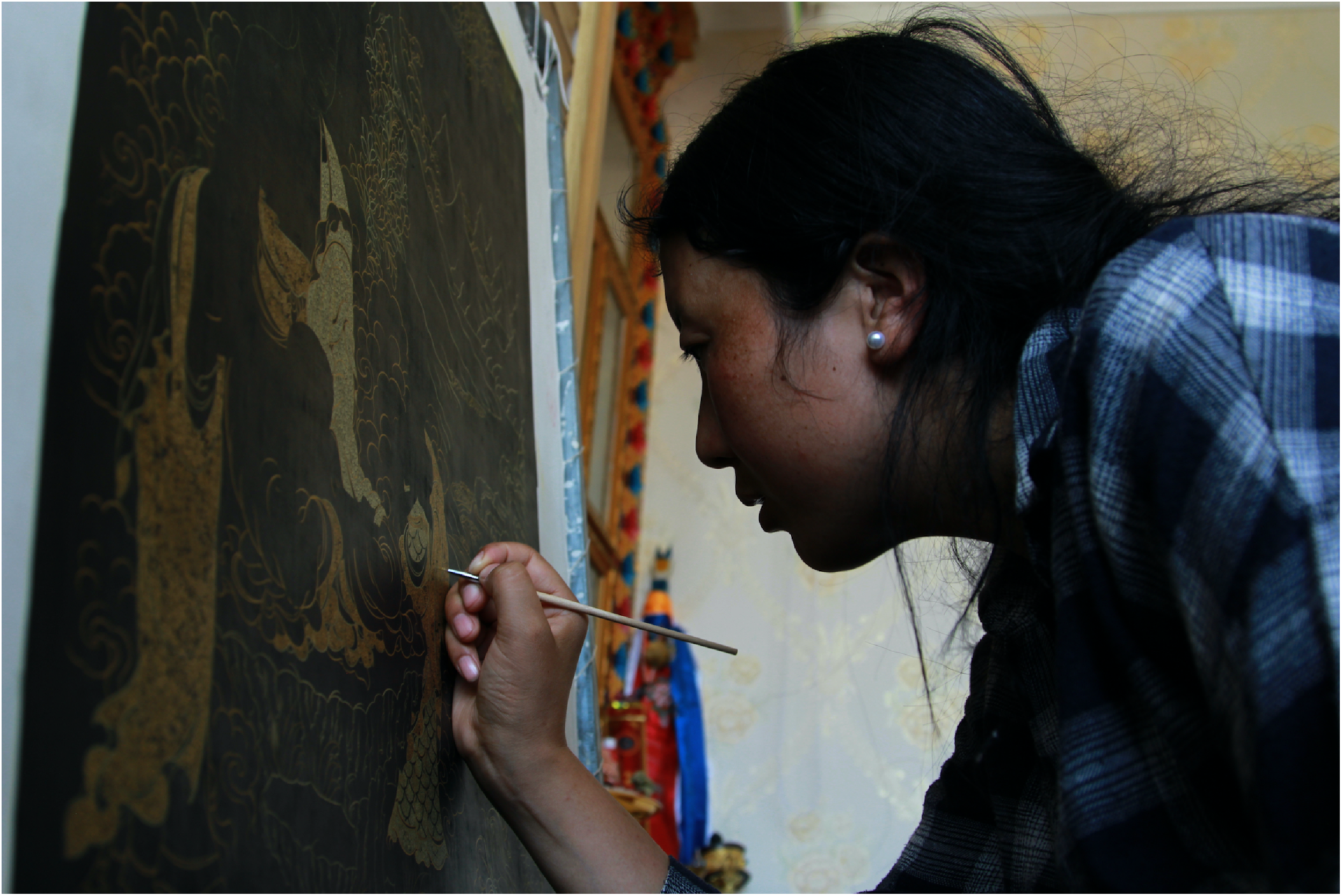
Lutso, the first Tibetan woman to open a thangka studio and train her own apprentices in Rebgong. Photo by author, 2018.
After this, Lutso laid out her other paintings on a small desk: thangkas of White Tārā, Mañjuśrī, Buddha Śākyamuni and so on. The gallery owner looked at these paintings with great interest. She took photos of the paintings with her iPhone from time to time. After a while, the gallery owner raised her head and asked Lutso: “Your thangkas are nice. But others can also paint what you’ve done. Why are yours different? What makes you unique?” Lutso was puzzled. She looked at me, as if she could seek answers from me.
As an anthropologist who has been doing research with thangka painters (Tib. lha bzo pa) in Amdo Tibet, I sensed there must be some misunderstanding between the gallery owner and Lutso, about “uniqueness” or creativity in the context of Tibetan Buddhist art. Nowadays, Rebgong thangka paintings are not only produced for religious use within Tibetan communities but also promoted on China's national art market as decorative or folk art (Catanese, 2019: 113; Linrothe, 2001: 34). The gallery owner might have agreed with Walter Benjamin (1969), who thinks the “aura” of art lies in its uniqueness and originality, whereas the endless reproduction of copies destroys the value of art. The gallery owner might also speak on behalf of her affluent Han Chinese clients who constantly pursue the novelty that has characterized Western or modern art production (Ledderose, 2000) or treat thangka paintings, or Tibetan Buddhism in general, as “an extension of worldly projects of social distinction and wealth accumulation” (Osburg, 2020: 69).
She acknowledged the fact that Lutso is one of the few Tibetan female thangka painters in Rebgong, but was not too excited about it—neither the religious authenticity nor the gender politics were likely to help the gallery owner sell enough artworks to cover the rent in this five-star hotel. I tried to rephrase the gallery owner's question in a more specific and constructive way. I whispered to Lutso: “She wanted to know your specialty, what you are good at.”
“I see.” Lutso seemed relaxed a little bit. She pointed to the detailed golden lines and meticulous patterns on deities’ halo and clothing and said: “I am good at the gold lining. Look, these are my own designs.” The gallery owner took another look at those details, tapping the gold lining with her fingers. “You do have talent.” she nodded.
Rebgong is located in Huangnan Tibetan Autonomous Prefecture in Qinghai province in China (Figure 2) and has been an important center of Tibetan Buddhist art since at least the eighteenth century (Linrothe, 2001: 7). Tibetan thangkas are scroll paintings depicting the Buddha and Buddhist deities, religious figures, historical scenes, or mandalas. Tibetan people commission thangka paintings for various reasons in their daily lives, for instance, to dispel illness and misfortune, or to assist the rebirth of a recently deceased person (Bentor, 1993: 110; Jackson and Jackson, 1988: 9; Lopez, 2018: 150). Beginning in the 1980s and intensified after 2000, when China launched the Great Western Development campaign, the state-led commodification of Tibetan thangka has redefined it for a new audience of secular art consumers (Linrothe, 2001; Stevenson, 2002). This new demand has made thangka painting a lucrative profession for Rebgong residents (Catanese, 2019) and drawn Tibetan women into the production and circulation of thangka art.
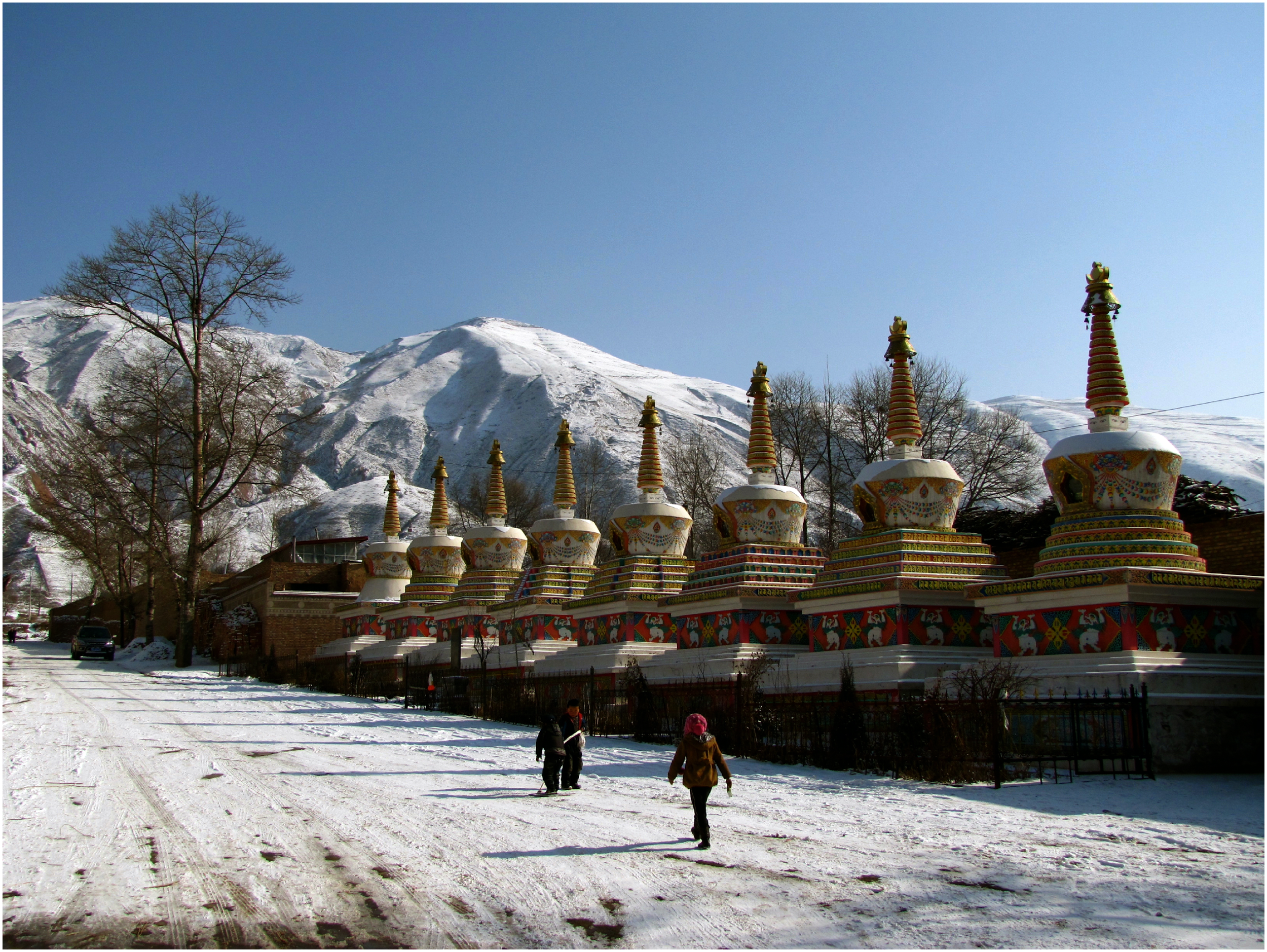
The eight stupas in Seng ge gshong village, Rebgong. Photo by author, 2012.
The emergence of female thangka painters is a new phenomenon (Reynolds, 2011; Xue, 2016). Rebgong did not have any female thangka painters until the late 2000s. I first met Lutso in 2013. At that time, Lutso was one of the few Tibetan women who received professional training of thangka painting as men did. Six years later, Lutso opened a thangka studio and is the first Tibetan woman to operate a studio and train her own apprentices in Rebgong. How does Lutso pursue a career path as a professional lha bzo pa with still-operable gender and cultural expectations on Tibetan women in the village? How does she navigate in a market that has been dominated by male painters? And more importantly, what does painting thangkas mean to Lutso, and in turn, how does her practice reshape the meaning of Tibetan thangka art?
Although Tibetan women's involvement in thangka painting is usually featured in the official narrative as an example of women's empowerment, focusing on their improved economic status and individual competence, 3 I argue that the canvas could be a trap. While an increasing number of families send their daughters to learn thangka painting nowadays, few expect women painters to eventually open thangka studios of their own or become professional lha bzo pa on their own right. Besides being incentivized by the well-paid apprenticeship through art making, many families see the work of a stationary painter “fixing” most Tibetan women to the village or at home, where their presence is expected and crucial to keeping the notion of “family” or “village” intact and alive (cf. Makley, 2002; Rajan, 2015; Schein, 2000). This is rendered even more acute by the heightened mobility of Tibetan men who are pushed to travel further to China's urban places to look for economic fortune (Fischer, 2013; Grant, 2022; Makley, 2018). The market biases (e.g., women's painting is not authentic) and gendered scapegoating (e.g., women entrepreneurs are promiscuous) make it very challenging for Tibetan women to establish themselves as professional painters following the path available to their male counterparts.
Instead of viewing Tibetan women painters like Lutso as embodiments of the triumph of women's liberation or seeing structural arrangements as absolute restrictions, I closely follow Lutso's practices in art making to reveal the constraints and choices Tibetan women painters face. Tibetan thangkas, like ritual masks and shaman paintings produced in some Asian places, have long histories of skilled production that predate their entrance to the national and global marketplace as tourist or folk art (cf. Kendall, 2021; Myers, 2002; Price, 2007). Unlike Pueblo potters (Babcock, 1993) or Zapotec weavers (Stephen, 2005), Rebgong female thangka painters are mastering what was historically a male domain. Within a social system that places Tibetan monks at its pinnacle and laywomen at its bottom (Chen, 2013; Gyatso and Havnevik, 2005), Tibetan women often find themselves on the periphery of religious practices or muted in major social discourses dominated by male voices (cf. Makley, 2003; Rajan, 2015; Robin, 2013). Since thangka painting brings merit to both the patron and the painter (Catanese, 2019: 75), painting provides a new way for female painters to accumulate religious merit and reimagine their place in the society. In that sense, Tibetan women painters are empowered, not only by the improved economic status or novel personal skills, but also by depicting an image of the sacred and by helping those who are in need with their artistic skills. By Buddhist logic, the “meritorious work” (Tib. dge las or dge ba) could elevate women from their religiously inferior positions, especially in the afterlife.
Relying on a multi-sited ethnography in the following-the-thing style (Marcus, 1995), I examine the biography (Brox, 2019; Kopytoff, 1986) of Lutso's artworks—in particular, her thangka painting Avalokiteśvara with Mind at Rest—which are intertwined with the life experiences of Lutso as she navigates in different social spaces and enters into competing regimes of value (Appadurai, 1986; Myers, 2002). Lutso's experiences are exceptional. Unlike many other women painters in Rebgong who work with their husbands or stay in the art school, Lutso has chosen a pathway without marriage and without support from any art institution. Through painting thangkas and training her own apprentices (especially female apprentices), Lutso is able to support her family, empower other Tibetan women, and authenticate a religious identity across very different social spheres. The research is based on my visits and travels with Lutso, as well as my fieldwork and filmmaking in Rebgong with other thangka painters (including 28 female painters) across 6 years of time—three summers in 2013, 2016, and 2018, and the winter and the summer of 2019. Some interviews are based on my online communication with Lutso in 2020 and 2021. Most interviews were conducted in Mandarin, while conversations about religious and artistic subjects were primarily in Amdo Tibetan. When the conversation was in Tibetan or in another language, 4 a research assistant and a local scholar helped with the translation.
The divination
Fifteen years prior to her gallery visit in Beijing, Lutso and her father visited a diviner.
Lutso was in the sixth grade in an elementary school and lived with her parents in Tho'a kya village. She said she did not like school, but really loved painting. She kept on thinking about dropping off from school and becoming a professional thangka painter.
At that time, Tibetan women were not allowed to learn or to paint thangkas. Lutso's father was a migrant worker. He was very open-minded, compared to other people in the same village, possibly because he spent most of the time traveling and residing in China's urban centers. He was supportive to his daughter's painting dream. Nevertheless, he still wanted Lutso to continue school with the hope that even if she could not graduate from college and get a job at a government office, 5 she could at least attend professional school and become a nurse or accountant. To him, such professions seemed more modern and secure than being a thangka painter. However, he did not force Lutso to stay at school. He left her daughter's fate to a diviner.
The diviner was a well-respected old man in the village. The diviner took out some Buddhist scriptures and asked about Lutso's birthday. The air was intense around the table. There was the self-conflicted father who wanted to support his daughter and her painting dream, yet knew it would be difficult for Lutso to become a thangka painter because of the social pressure in this small village. There was the diviner, likely facing for the first time a Tibetan girl who wanted to paint thangkas. Finally, there was the young Tibetan girl, who so fearlessly chose to become a thangka painter, yet nervously looked at the few pages of the scripture—her fate was still at men's mercy.
The room was quiet, until the diviner closed the scripture and said: “If she wants to paint, let her paint.”
Lutso told me this story in 2013, when she was in her early twenties and was a student in a private art school. In the late 2000s, a handful of Tibetan-owned thangka art schools began to appear in Seng ge gshong village. In contrast to family workshops, these art schools accept students from various places and can accommodate over a hundred students at a time. Nevertheless, most of these art schools follow the apprenticeship style of teaching (Jackson and Jackson, 1988): the teacher does not charge tuition from students; students help the teacher with art commissions as a way of learning thangka painting skills. The establishment of these art schools made it possible for Tibetan women to acquire a full complement of painting skills and make money through paid apprenticeships (Figure 3). Lutso's school was founded by Namgyal, a renowned thangka painter in Rebgong. The unequal social status between men and women in Rebgong was highlighted for Namgyal when he traveled to urban places in China. He was first shocked to see female artists and then later impressed by their artworks. He began to question why Tibetan women were not allowed to paint since no Buddhist teaching unequivocally prevents women from painting thangkas. Namgyal developed the idea of accepting female students in his school in the late 2000s.
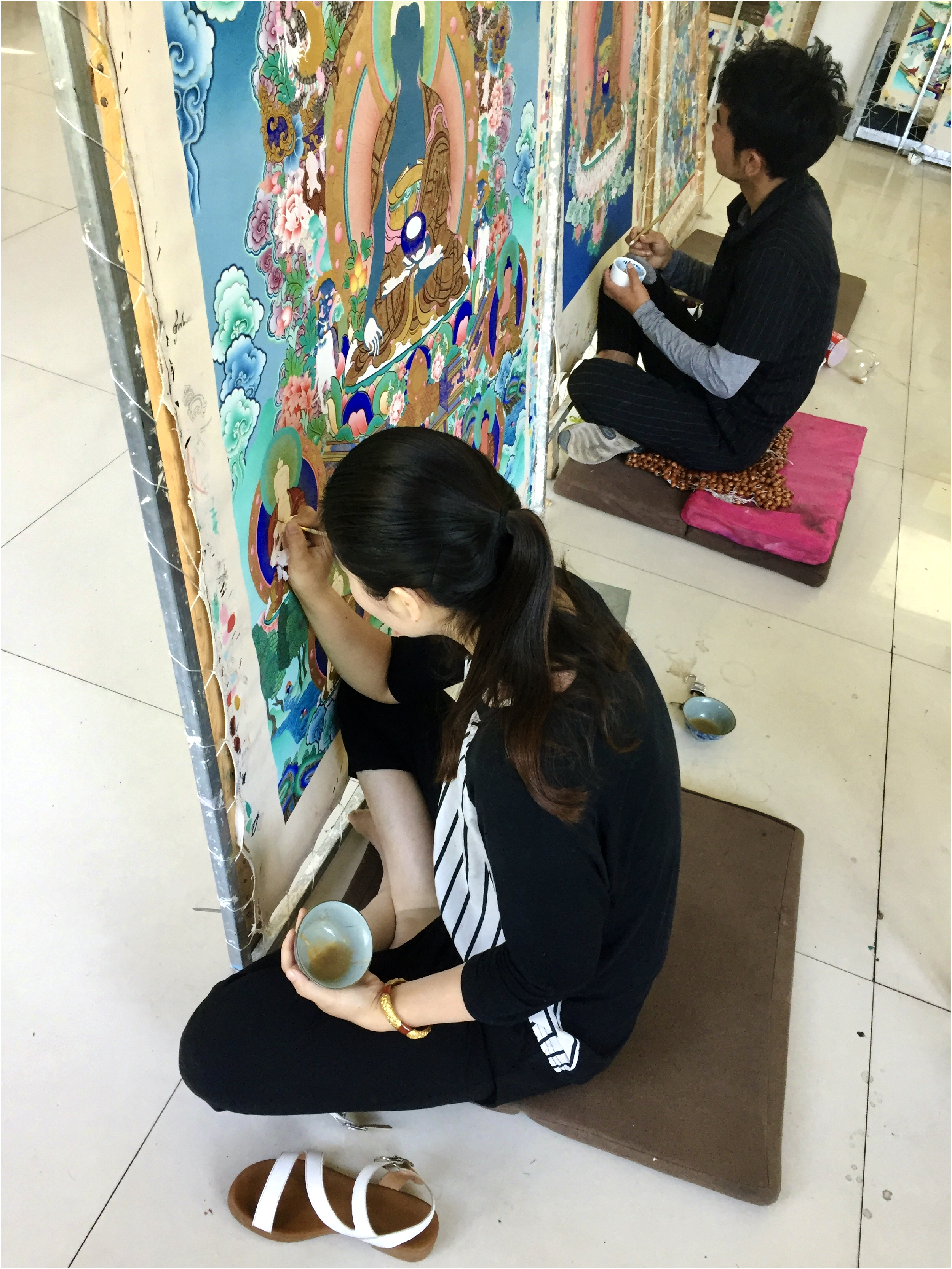
A female apprentice in a local art school. Photo by author, 2019.
At the painting school, Lutso kept a simple routine. She got up around seven in the morning and stayed in front of the canvas and painted until the sunset; after dinner, she usually practiced drawing on a sketchbook for a few hours. Back then, she did not know when Namgyal began to accept female students, many people in Rebgong objected to this idea. They expressed worries, such as “How can women paint the Buddha: it's pollution (Tib. grib)!” or “Men want wives to farm, not paint.” In order not to provoke hostility towards him and his female students, Namgyal did not publicly admit female students to his school in the beginning. Instead, he invited some of his female relatives and friends’ daughters to learn thangka painting and hoped it would be more convincing to other villagers after they saw that women could actually paint, and could paint very well. Lutso was admitted to the painting school because her father and Namgyal used to be middle school classmates.
Lutso liked the art school, where she had nothing to worry about except painting. From Namgyal, Lutso learned not only painting techniques, but also Tibetan Buddhist teachings and Tibetan histories. According to Lutso, this kind of knowledge was not accessible to most Tibetan women, like her female relatives in the village. Lutso loved chanting scriptures with Namgyal, who used to be a monk in a local monastery, and hearing him tell stories about religious subjects or historical figures in thangka paintings. Although she heard people in the village questioning her parents, “Why don’t you find her a husband?” her father let her stay in the school without pressing her into marriage. At the end of each year, students in the art school received some allowances as paid apprenticeships. Lutso used the money to buy food and gifts for her relatives during the New Year celebration. It made her very proud. Lutso hoped that she could stay in the painting school as long as she wanted. Such a wish turned out to be unrealistic.
A good Tibetan daughter
Lutso had become a wife and a mother of a 1-year-old before she could sit down and think about a painting of her own design.
I visited her apartment in town in 2018, when Avalokiteśvara with Mind at Rest was just a sketch on canvas. The face of Avalokiteśvara was left empty. Before his eyes were painted (Tib. spyan dbye), usually the last step of a thangka painting, we were not able to judge the quality of the thangka. In the bedroom-turned-studio, Lutso told me this painting was not a commission from anyone. Avalokiteśvara is one of her favorite bodhisattvas in thangka art. Lutso had never painted his meditating posture before. Besides wanting to try something new and exercise her painting skills, she intended to have one virtuoso piece to showcase her artistic achievement—for occasions like her visit to the gallery in Beijing—since painters cannot keep commissioned thangaks for themselves.
Lutso had left the art school in 2014. While Namgyal recognized her talents and wanted her to stay a few more years in the school to advance her painting skills, Lutso decided to leave for Beijing where she made better money and was able to help her father pay his debts. In Beijing, Lutso painted thangkas as a wageworker for a gallery featuring Tibetan art. She told me she missed that year spent in Beijing because, besides the well-paid salary and varieties of entertainment in the metropolitan area, she saw opportunities. She had once been interviewed by a TV channel in Beijing. Her co-workers encouraged her to socialize with the news people, or to seek clients using this interview as a promotion. However, she left behind her network and “opportunities” in Beijing, including that 5-min interview, and returned to Rebgong largely because her parents wanted her to get married and have children.
Lutso was the older daughter in the family. Her younger sister was still at school. When it came to fixing the house, planting or harvesting the field, her mother always called her. Lutso felt obliged to help: since her father was away working in other cities, she felt she was the only person her mother could count on—nothing would make her mother feel more secure than Lutso getting married and settling down in Rebgong. Ironically, having a baby imposed stronger economic insecurity on Lutso. Lutso's husband is a fine painter himself. Lutso said that if they painted together, they could produce an excellent piece of thangka painting. However, after the baby was born, Lutso had little time to paint. While her husband painted with apprentices in his thangka studio, another apartment they rented in the same building, Lutso stayed with the baby and could only paint mini-thangkas 6 when the baby took naps—she usually finished a mini-thangka in a day or two. “It's really not exciting to paint mini-thangkas, but they sell fast. I can make some pocket money from mini-thangkas to buy diapers or baby food.” Lutso said.
Lutso's conundrum was by no means unique. When male painters in Rebgong embrace the aspirations brought by the new markets and expand their travel all over China (Catanese, 2019; Xue, 2021), painting “fixes” most Tibetan women to the village, where their time and labor for household chores, agricultural works, and communal events are expected and vital. Even though some women have received years of training in thangka painting, they find that familial and social obligations make it hard for them to concentrate on painting. Some of Lutso's female cohorts in the art school gave up painting completely after they got married. When Lutso needs to help out her mother in the village, her day is spent on childcare, feeding, washing, cooking, farm works, household errands, and helping neighbors (Figure 4).
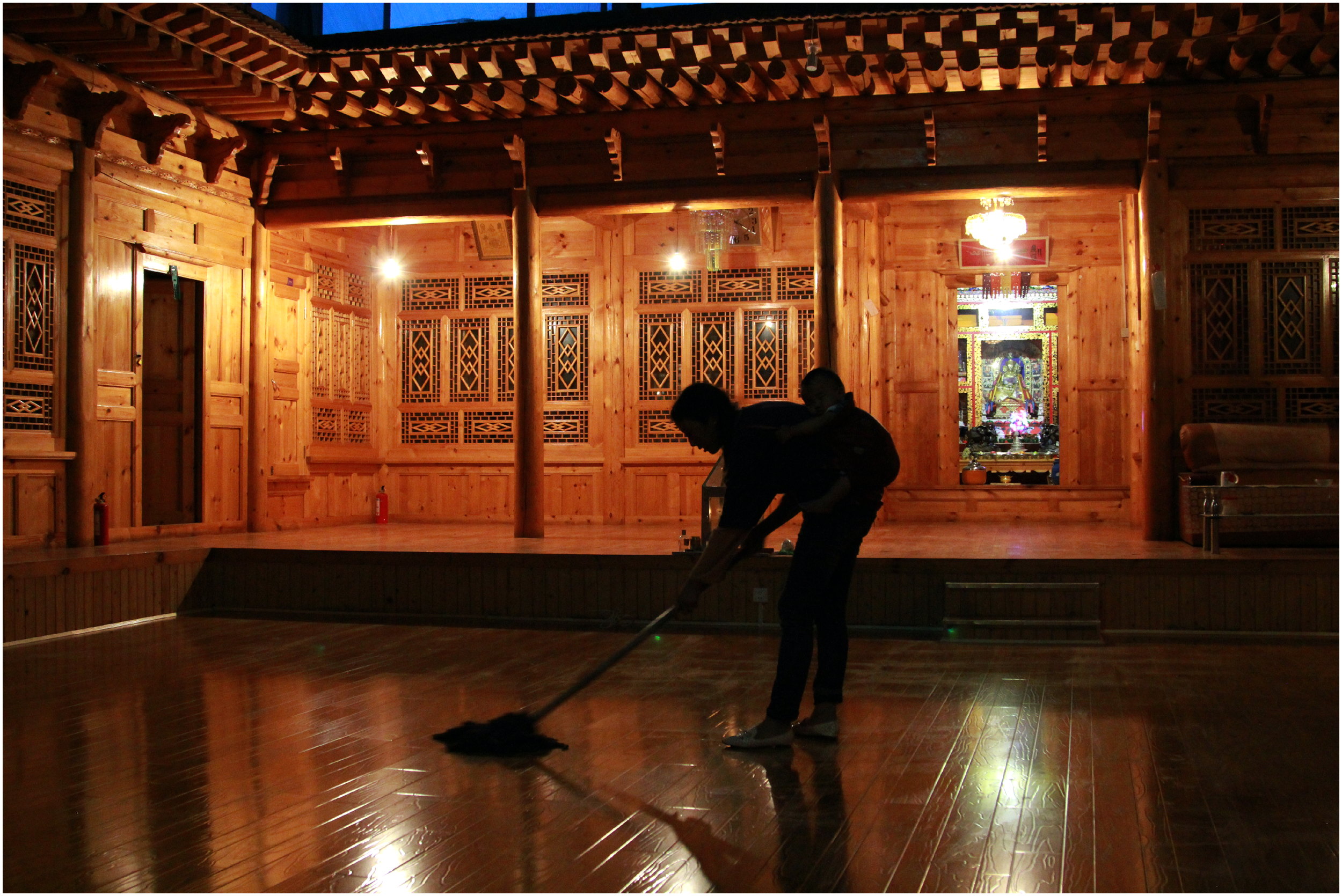
Lutso cleaning her parents’ floor while carrying her son in the village. Photo by author, 2018.
Lutso never blamed her father for causing her to leave the art school or Beijing. Although her father spent most of the time working outside, she felt close to him, because “he knows a lot.” If Lutso needs to make a decision, she talks to him. When I visited Lutso in her apartment in 2018, her father was taking a break from work and helping Lutso look after her son. Lutso finally had some time to work on a regular-sized thangka and figure out a design of her own. I looked at her sketch of the Avalokiteśvara with Mind at Rest—the elaborately crafted patterns on deities’ halo and clothing, Lutso's creative touch, caught my eye. I said to her: “It must be ‘sold’ at a high price, when it is finished.” Lutso nodded and said: “I hope I can make a lot of money. I hope I can support the family one day so that my dad won’t need to work so hard.”
A woman painter in the art market
One spring day in 2019, I sat in my office in New York. I checked the time, 10:30am. Lutso, who was in Rebgong, might not have gone to bed yet.
Laurel Kendall, curator of Asian Ethnology at the American Museum of Natural History, proposed to collect one thangka painting from Lutso, as an example of the contemporary practice by a woman painter. I thought of Avalokiteśvara with Mind at Rest, but was unsure if it had been “sold” already. I dialed Lutso's number. “Yah, what's going on, a ce (sister)?” Lutso always answered my call like this.
“Do you still have the thangka, Avalokiteśvara with Mind at Rest?”
“Yes, I do.”
“Do you think it's possible for the museum to purchase this painting and add it to our Tibetan collection?”
“Oh, it sounds good.”
After a while, Lutso asked me: “A ce, is it a good thing to be collected by a museum?”
I laughed, but silently on the other end of the line, knowing that there must be hundreds of thangka painters who wanted to squeeze their paintings to museum collections (let alone the collection in a world-famous museum), in order to obtain a “certificate” of some kind.
In my recent visits to Rebgong, I sensed an intensified competition among thangka painters in the art market (Figure 5). Under the agenda of the state-led development, the local government has fostered an ethnic tourism and cultural industry centered on Tibetan thangka (Catanese, 2019: 217). Thangka art is treated as an exploitable “cultural resource” (Makley, 2018: 237) with painting as a useful skill that can boost the local economy, especially for rural Tibetans who are often disadvantaged in China's regular job markets (Catanese, 2019; Fischer, 2013; Saxer, 2012; Washul, 2018). An abundant number of painters are trained in home studios, private art schools, and government-sponsored accelerated programs 7 for an increasingly competitive market. In 2006, when Rebgong art was listed as a national Intangible Cultural Heritage (ICH), the official count of thangka painters was about 2000; the number had increased to more than 16,000 in 2020. 8 In Seng ge gshong village, most villagers make and sell thangka paintings as the major source of household income. For them, summer usually means busy “business hours,” when tourists from around China come to Rebgong. Some painters had made wooden signs carved with “Rebgong artist family” or “Excellent thankga artist” in Mandarin and hung them in front of their home gates. Some painters wore their hand-painted mini thangkas on their chests or hung them on the back mirror of their cars. Once a tourist revealed any interest to these thangkas, the painter would start chatting and selling. I was also told that some painters invited, or even forced, tourists to their home to have tea and take a look at their paintings.
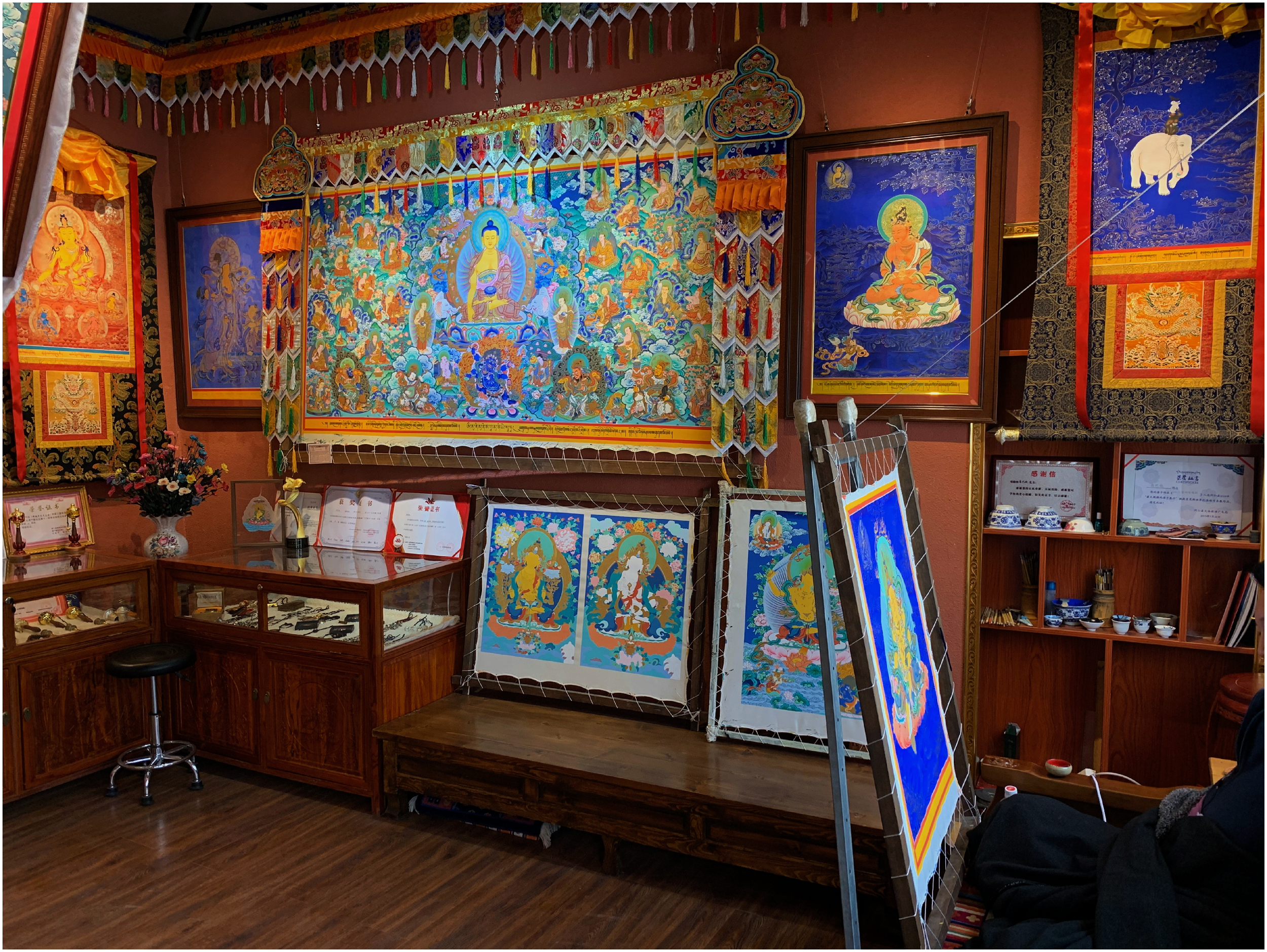
The interior of a male painter's thangka shop in Seng ge gshong village, Rebgong. Photo by Tamgrin Tsering, 2021, used with permission.
Although many local residents gave a snort of contempt to such behaviors, every young painter faces the challenge of finding clients and establishing one's business network after leaving his teacher. According to my interviews with male painters, a painter needs to watch for art competitions and cultural expos held in the prefecture or in Qinghai province, where painters often demonstrate their artistic skills, obtain official accreditations, and get to know potential patrons, including gallery owners, private collectors, and non-Tibetan Buddhist practitioners. When there is a voting for “Outstanding thangka painter” or the “Representative of the ICH,” a painter needs to gather the most votes from his fellow villagers. Or, it would be ideal if a painter could appear in a TV show, have one's name and paintings in the news report, or be mentioned in the blog (or vlog) of an internet celebrity who has millions of followers. Behind all this, there are endless social banquets, a “ritual” among business people to maintain and develop one's social network in China (Bian, 2018; Osburg, 2013).
For Lutso, it is unthinkable. Although she is one of the few Tibetan female thangka painters in Rebgong, this title did not win her any advantage. Like those male painters in Dharamsala who describe that they feel “awkward” if a thangka is painted by a woman (McGuckin, 1996: 39), some male painters in Rebgong, for reasons of having misread the Buddhist texts or out of jealousy, told non-Tibetan clients that women's paintings are not “efficacious” or “authentic.” Two male painters from Seng ge gshong considered women's participation in thangka painting as a tokenistic gesture supporting the government's claim to have brought this “backward” region, and its women, into the process of national modernization. The market became an even more challenging place for Lutso after she left her husband in 2019, because she did not want to fight with her in-laws who constantly urged her to give up painting and move back to the village as a normal housewife.
Lutso told me that she avoided social gatherings or business-related banquets, where collaborations were forged but where the atmosphere might turn, or be assumed to turn sexual (Osburg, 2013; Zheng, 2006). Moreover, Lutso felt her behavior in the market was always under scrutiny of other villagers: people spread the rumor that she must have been taken advantage of by a local cadre to win a prize in an art competition, or gossiped that she had tried to hook up with a “wealthy man” when a male gallery owner from another province came to Rebgong and wanted to see her paintings. Visiting a gallery in Beijing is an exceptional opportunity for Lutso, but not at all unusual for her male counterparts. Being very careful about her public profile, she met most of her clients and accepted commissions online. When someone ordered her thangkas, she discussed the design of the painting and the price with the client via text messages and sent out the artwork by express mail.
Lutso, much less experienced than her male counterparts, was unclear about what “museum collection” means to the career of a painter when I first mentioned it to her. Her visit to the gallery in Beijing was unproductive, as the gallery owner subsequently closed that site and shifted her marketing focus on Chinese contemporary art. Lutso returned to Rebgong with Avalokiteśvara with Mind at Rest and kept the painting until I called her. I, now her patron, explained to her that being collected by a museum could boost her professional profile and possibly bring her more clients.
“A ce (sister), I don’t know how to thank you. You’ve helped me a lot.” Lutso said to me over the phone, “But if you were a man, people would have gossiped that we had some sort of secret ‘exchange.’” We both laughed unreservedly.
A reimagined social space for women
A few months later, I returned to Rebgong with a check from the museum. Lutso led me to her new thangka studio in town (Figure 6).
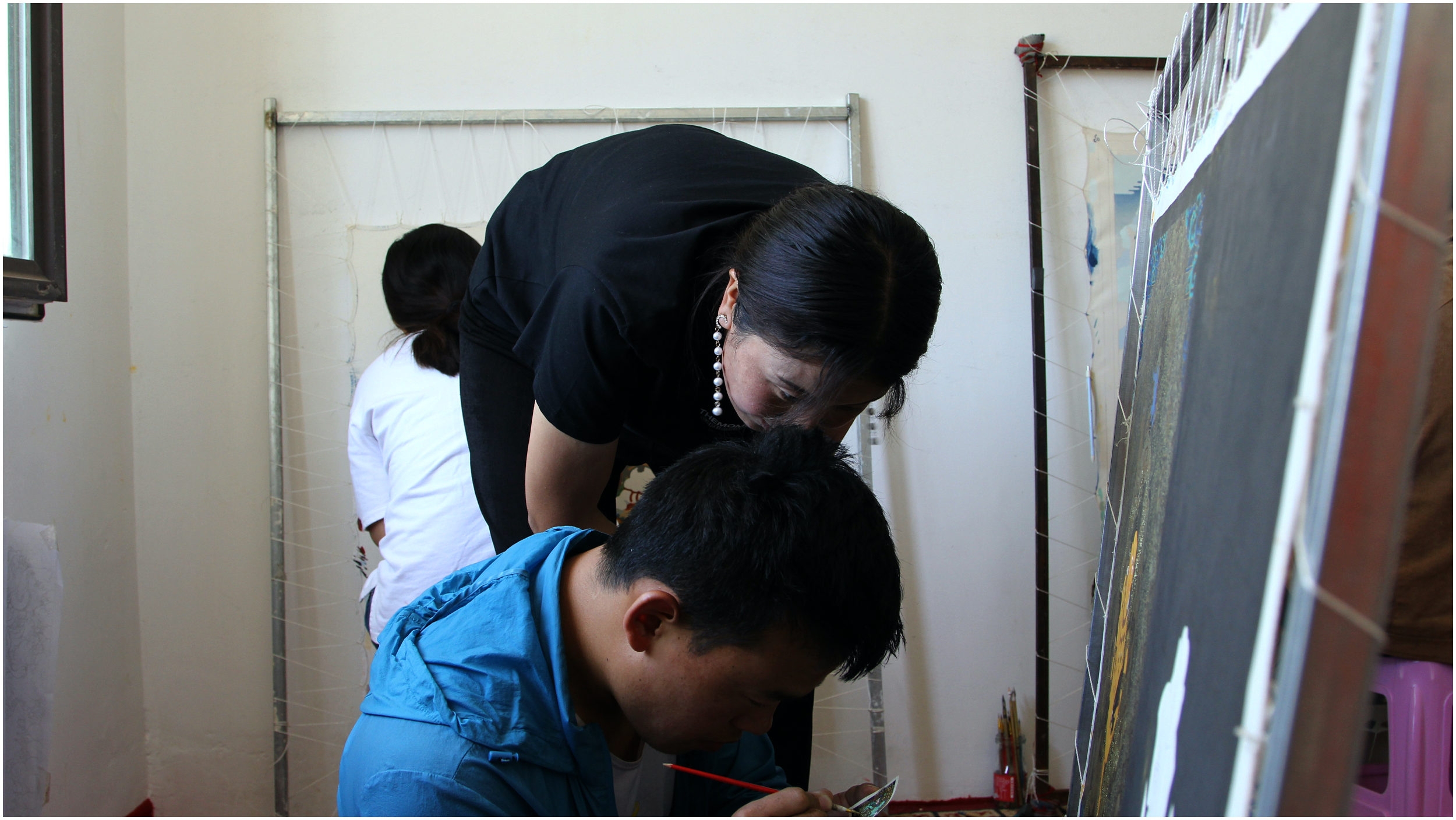
Lutso advising an apprentice in her thangka studio in town. Photo by author, 2019.
This is a very small apartment. Lutso rented this place after she split with her husband, also after her mother agreed to take care of her son in the village. The apartment only has two rooms, one used as a painting studio, the other as the bedroom for Lutso and her two female apprentices. Her male apprentices sleep on temporary metal beds in the living room. The walls of the painting studio are stacked with canvases mounted on stretchers. Lutso and her apprentices sit in front of the canvas and paint under the generous sunshine coming through the window. All pigments are put on a tiny table in one corner of the room. The space is so limited that if someone would like to stretch her back, she will bump into another one's back or canvas.
In this studio, Lutso returned to the routine she had followed when she was in Namygal's art school—except that she is now the teacher (Tib. dge rgan). Over the years, I have heard a similar expression from her—“painting makes me happy from the bottom of my heart”—when I met her in the art school, when she was able to work on a regular-sized thangka, Avalokiteśvara with Mind at Rest, for the first time after her childbirth, and when she sat with her apprentices in front of the canvas in her own studio. What can we read from such an expression? Beyond economic returns, what makes Lutso devoted to thangka painting in spite of all the challenges she has had in her personal and professional lives?
Trine Brox (2019) advises us that it's hard to determine the value of a Buddhist object unless we know how people interact with it in their everyday lives. To comprehend the relationship between Tibetan women painters and the thangkas they produce, it is essential to understand the particular characters of the work they do. Despite the state-led commodification of Tibetan thangka art, most painters, local residents, and non-Tibetans who practice Tibetan Buddhism still view and commission thangkas as ritual/functional images. Besides accumulating religious merits from painting, we shall see another level of empowerment in Rebgong women's art making practices. Since thangka paintings are commissioned to meet the particular needs of the patron, the painter becomes an important medium, through whom the manifestation of the Buddha and deities, the protection and blessings, could reach out to the person in need. Lutso explained to me that making a thangka of Tārā (Tib. sgrol ma) for another villager or a Buddhist patron is significantly different from calling Tārā's names or reciting her mantra when Lutso herself needs the deity's blessing to conquer fear, illness, or difficulties. 9 “Because I am able to help others,” said Lutso. If we understand that an image is the result of personal or collective knowledge and intention (Belting, 2014: 9; Gell, 1998), we shall view a thangka not simply as an art commission, but also as a commission of the painter's karma or action when she exercises her selfless and virtuous nature to help the person in need with her paintbrushes.
Like many other male painters, most of Lutso's commissions come from non-Tibetan clients. No matter whom or what the painting is made for, Lutso attends to the religious protocols of art production. For instance, to depict Avalokiteśvara without a commission is “unconventional.” However, as the museum decided to collect this painting, Lutso had it consecrated (Tib. rab gnas) in a local monastery—an act that invites sacred beings to reside in the image as living essence, so people who view and worship this thangka will receive religious merits. Lutso also accepts commissions from local residents, mostly from Tibetan women. For instance, Lutso painted a thangka of Green Tārā (Tib. sgrol ma ljang khu) for a pregnant woman from the same village, since Tārā is believed to have positive influence on childbirth (Beyer, 1988: 289; Makley, 2003: 612). 10 In the beginning of her own pregnancy, Lutso also painted the Green Tārā and donated the thangka to the newly renovated village shrine. According to the village head, this was a meritorious thing for Lutso and her baby because her Green Tārā thangka would bestow blessings to villagers who circumambulated and made offerings to the village shrine.
Lutso particularly welcomes Tibetan women to her studio and to learn thangka painting from her. From her own experiences, she knows that women apprentices often feel intimidated in male painters’ studios and are likely to drop off learning before they have acquired all painting techniques. Some parents have told Lutso that precisely because she is a woman that they agreed to send their daughters to her thangka studio, as they considered it “inconvenient for a girl to spend so much time with a male dge rgan.” Without any prior experience, Lutso's female apprentices start from doing sketches on paper 11 and proceed to do some simple coloring on the commissioned thangkas. In a few years, they are expected to draw the sketch of main deities on canvas, to do gold linings, or even to “open the eyes” (spyan dbye) for deities—the last step currently done by Lutso or assigned to her most experienced male apprentices. Besides painting skills, her two female apprentices have observed Lutso's personal experiences—in their words, “possibilities a Tibetan woman could have”—as Lutso participates in the art market and balances her family and career as a female lha bzo pa. In that sense, Lutso's studio materializes a reimagined social space for her female apprentices, whose choices are still circumscribed by gendered and cultural expectations in this society.
Although Lutso did not form any type of collaboration with the gallery in Beijing, she has been forced to think about the question of “uniqueness” as she operates her own studio. Since the official narrative frames Rebgong thangka as an ICH and elides the religious meaning or historical context of Tibetan thangka (Catanese, 2019; Saxer, 2012), thangka painters are easily imagined as “copyists” of existing images. Some popular images like Yellow Jambhala (the “wealth god”), Four-armed Avalokiteśvara, and Green Tārā have been repeatedly shown in state-organized cultural expos, exhibits, or TV programs and become Tibetan “motifs.” These images are therefore in high demands of non-Tibetan clients who are unfamiliar with Tibetan Buddhism or Buddhist art. In this new context, the “uniqueness” of Rebgong thangka art is conveyed with an emphasis on the rarity of natural mineral pigments, the manual labor involved in art making, or simply on its status as an ICH recognized by UNESCO.
Instead of being constrained by rules of iconography and composition, a painter could have certain amount of freedom in doing his or her paintings (Harris, 1999; Jackson and Jackson, 1988; Tashi, 2018), for instance, to design non-religious content such as plants and decorative patterns, to create scenarios from Buddhist text that have not been depicted before, or to critically examine the life story of a religious or historical figure and visualize such research through the paintbrush. From an online conversation I had with Lutso in 2021, 2 years after she opened her thangka studio, I could see that she had become more confident as the dge rgan of the art studio. “Several years ago, if you showed me a thangka of another painter and commissioned the same thing, I would just replicate the exact same image for you,” said Lutso, “But now, if you show me a thangka by another painter, I can tell you where he/she did a good job and where he/she did a bad job. I would know how to improve on it.” These could be small improvements such as adding flowers to the background and redesigning gold linings, or more substantial changes like on the composition of the painting or the use of colors. According to Lutso, her clients, new and old, usually approve of and like her designs. Moreover, Lutso does not choose quantity over quality when she operates the art studio, despite the rising market demand and competition among local painters. In her studio, Lutso and her apprentices spend time reading Buddhist scriptures, as what she did with Namgyal, and visit monks to consult the religious content of a painting that she is uncertain about. Although Lutso does not expect to achieve the level of Buddhist knowledge or painting skill her dge rgan Namgyal has, she hopes ultimately she can paint stories and scenes that are rarely depicted, especially subjects associated with female deities and their various manifestations that have religious significance for Tibetan women (e.g., manifestations of Tārā, see: Drolma, 2007).
In the studio, Lutso took out the painting of Avalokiteśvara with Mind at Rest from a poster tube she kept in her bedroom (Figure 7). As she was unfolding the painting in front me and her apprentices, I caught the conversation between Lutso and one of her apprentices. “Where will this painting go?” A male apprentice asked.
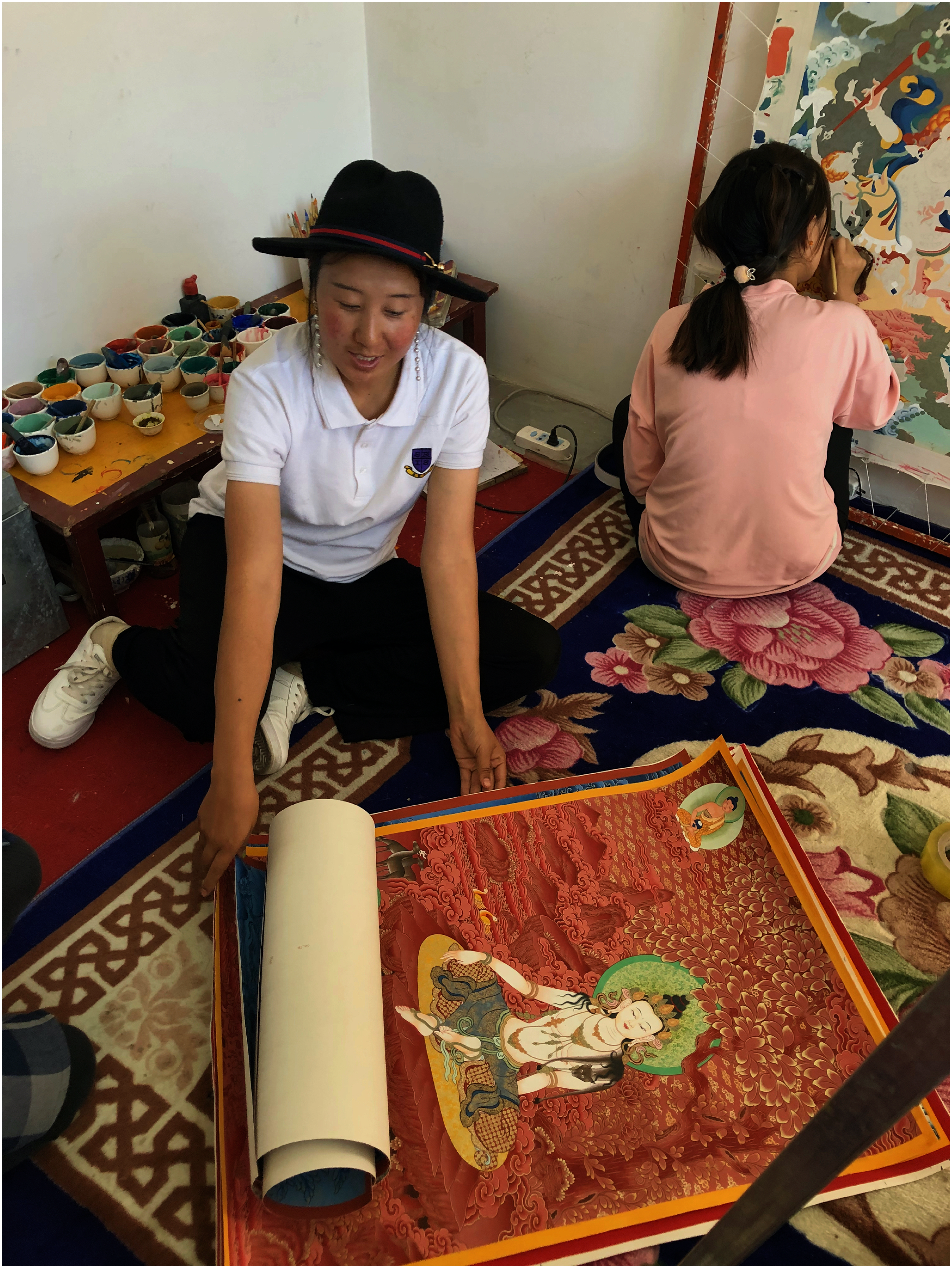
Lutso unfolding the thangka, Avalokitesvara with mind at rest, in her studio, with one of her female apprentices sitting next to her. Photo by author, 2019.
“To New York, the museum where a ce is working.” Lutso answered.
“Next time we want to see it, we will have to buy a ticket.” The apprentice joked. Everyone laughed.
“We can always paint another one. A better one.” Lutso said.
Conclusion
In the fall of 2019, I brought Lutso's thangka, Avalokiteśvara with Mind at Rest back to the American Museum of Natural History. The painting enters the museum collection with values beyond its exceptional artistic quality—it tells a story of how the personal, the political, and the religious intersect with one another through the lens of gender.
In this article, I highlight the fact that the practice of Tibetan female thangka painters is fundamentally different from that of many women artisans who transform locally produced textiles, embroidery, ceramics, and the like into “crafts” for the global market (e.g., Babcock, 1993; Nash, 1993; Stephen, 2005). Tibetan women painters in Rebgong are mastering what was historically a male domain—a domain requiring an extended period of study to acquire the full complement of artistic skills as well as religious protocols and knowledge behind art making. Moreover, unlike Tibetan women poets who give novel voices to the female body and motherhood (Robin, 2013) or Tibetan female contemporary artists who explore various mediums (e.g., oil paint, acrylics, sculpture) to create modern arts from a feminist point of view (Schneider, 2020; Tashi, 2018: 236–239), Rebgong women painters do not use thangka painting as an artistic outlet for self-expression. Although painters like Lutso constantly contribute their artistic innovations to thangka painting, such creativity is not “at the expense of the religious intentions of the artist and patron or the functions of the work of art in its totality” (Linrothe, 2001: 16).
However, after Rebgong thangka art has been promoted on China's national market as an ICH or folk art, painters like Lutso often find themselves in a seemingly contradictory process. When Lutso took Avalokiteśvara with Mind at Rest to the gallery in Beijing, her artwork was largely appreciated as a piece of art commodity awaiting for a marketable narrative—a narrative appealing to various secular consumers but distant to the core belief of many thangka painters and local residents in Rebgong. Moreover, although self-improvement (including acquiring thangka painting skills) is encouraged among Tibetan women today, many Tibetan residents, activists included, emphasize the “unity and harmony of families” in order to defend the core of “Tibetanness”—such belief often reinforces Tibetan women's immobility (Makley, 2002) and their periphery status in both familial, social, and religious lives (Rajan, 2015). The painting, Avalokiteśvara with Mind at Rest, was probably depicted at a time when Lutso's mind was hardly at rest. Her new roles at that time, a wife, a daughter-in-law, and a mother, as well as her regular responsibilities as a “Tibetan daughter,” had prevented her from working on a regular-sized thangka for over a year, while the work of her husband or her father was largely undisrupted.
Nevertheless, in a society where religious identities are highly esteemed but deeply gendered, Lutso expects to achieve self-improvement through painting thangkas, not merely because of its economic return, but because of its religious significance and benefit. She further proclaims her religious identity through accepting female apprentices, who occupy the same inferior status as she does, and painting thangkas for Tibetan women in the village. Unlike many Rebgong women painters who take auxiliary roles by helping their husbands at home or stay in the art school, Lutso has chosen to open her own studio, train apprentices, and navigate in an art market that has been dominated by male painters. Though I don’t know if painting the resting posture of Avalokiteśvara had helped Lutso obtain a peaceful mind, from this painting, Lutso has reasserted her identity as a professional painter—a married Tibetan woman with a 1-year-old could paint like male painters do and make the painting a virtuoso piece—a battle she has seen as her destiny since the oracle of the diviner.
Relying on the nuanced ethnography about Lutso's life experiences and the biographical approach to examine her artworks, my research highlights Tibetan women's constraints and choices between the state's overarching agenda of cultural development, the seemingly overwhelming forces of commodification, and the still-operable gender and cultural expectations on Tibetan women in the village. Through making Buddhist images and navigating in the art market, Lutso and many other women painters find a new pathway to connect with their religion and culture, and, to various extents, to reclaim their ethnic and religious identities, which have been omitted or reduced to economic incentives in the official rhetoric of thangka painting. Because of this, Lutso was able to complete the thangka painting of Avalokiteśvara, whose eyes are full of dignity, benevolence, and peace, and to bring the deities’ protection and blessing to those who are in need with her artistic skills—the responsibilities of a lha bzo pa.
Footnotes
Declaration of conflicting interests
The author declared no potential conflicts of interest with respect to the research, authorship, and/or publication of this article.
Funding
The author disclosed receipt of the following financial support for the research, authorship, and/or publication of this article: This work was supported by the American Association of University Women, (grant number American Fellowship 2018-19).

Notes
Author biography
Ming Xue received her PhD in anthropology from UCLA in 2014. She works at the American Museum of Natural History. Her research looks at how people relate to things and how people relate to each other through things. She is also a documentary filmmaker, curator, and writer. Her documentary films were selected for screening at international film festivals and conferences, including the Margaret Mead Film Festival, IUAES annual meeting, and AAS Film Expo.