




Abstract
This essay examines the heterotopic and heterochronic material afterlives of cemeteries through a comparative focus on two cities of the dead: Zagreb's Mirogoj Cemetery, which was established during the late 19th century, and Thessaloniki's Zeitenlik World War I Military Cemetery, which entombs Allied victims from the Salonika Front. My principal aim is to highlight the contrasts and contradictions between nationalized collective memories and unsettling imperial legacies that define the material afterlives of each of these cemeteries. In Mirogoj, material afterlives take shape as a palimpsest of eras, only some of which are monumentalized as collective memories. In Zeitenlik, the material afterlife of a single event of death-dealing, the Great War, constitutes an archive of bygone imperial socialities that defy the homogenizing logics of national identity in the present.
Introduction: When is a cemetery?
When is a cemetery? This is an untoward question—grammar resists temporal queries of static nouns. Yet temporal ambiguity is fundamental to the cemetery as a social and material space. Societies of the dead, cemeteries materialize multiple afterlives, both individual and collective. Even a newly established graveyard is an archive of the biographies of its interred residents. The labor of maintaining a cemetery is ceaseless, lest abandon, overgrowth, and dilapidation transform it into a ruin, a place of the past seemingly without a present. As the spectral narrator of bluesman Blind Lemon Jefferson's famous dirge laments, the dead depend on the living to “see” that their graves are “kept clean” (Jefferson, 1928).
Beyond the biographies of individual denizens, cemeteries are also privileged sites of memory (Nora, 1989), where collective pasts achieve form and force in the present. This is especially true of monumental and memorial cemeteries. As temporal fulcrums and points of passage between past and present, graveyards assemble material for the politics of the past. By consolidating “dominant” collective memories (Nora, 1989: 23), they function as a technology for neutralizing the uncanniness of death and harnessing it to the aims of the living. Yet the plethora of afterlives that cemeteries materialize equally unsettles and contradicts the sanitization of the past for the purposes of the present. Cemeteries are sites for multiple material afterlives, both sanctioned and unruly.
My aim in this essay is to elucidate the relationship between collective memories and historical legacies that defines the material afterlives embodied by cemeteries. Collective memory, as a host of theorists from Halbwachs (1992) onward has emphasized, encompasses the explicit orientation of subjects in the present toward the past. More formally: Collective memories have the present as their subject and the past as their object. Legacies—what Stoler (2016) has described as the “duress” of the past's “durability”—are the inverse of collective memories. Legacies are the pressure that the past exerts on the present (Todorova, 2009), even—especially—when subjects in the present are unaware of this pressure (Stoler, 2016: 10). More formally: Legacies have the past as their subject and the present as their object. The present acts on the past through collective memories; the past acts on the present through the pressure of historical legacies. Accordingly, material afterlives are syntheses of memories and legacies that are irreducible to either one or the other.
Two evocative necropolises orient my exploration: Mirogoj Cemetery in Zagreb, Croatia, and Zeitenlik World War I Memorial Cemetery in Thessaloniki, Greece. Mirogoj and Zeitenlik evince striking continuities and provocative contrasts. The material afterlives of the two cemeteries differ dramatically: the first is a living cemetery, which still welcomes the newly dead, whereas the latter is a military graveyard that exclusively entombs victims of the Great War. Mirogoj and Zeitenlik elicit different responses to our guiding question, “when is a cemetery?”; the atmospheres and moods that emanate from and enshroud them contrast sharply. Mirogoj comprises a palimpsest of partial dilapidation, while Zeitenlik is an ordered, homogeneous space in a manner that befits its regiments of interred soldiers.
Despite these divergences, Mirogoj and Zeitenlik both exhibit striking formations of nationalized collective memories and unsettling imperial legacies. My exposition emphasizes how these two cemeteries simultaneously bolster nationalist images of the past and unsettle these images by materializing discordant afterlives and “subaltern pasts” (Chakrabarty, 1997). In both Mirogoj and Zeitenlik, the material afterlives of empires nourish counterarguments to curated images of the past that animate nationalist collective memories. I aspire to illuminate these material afterlives in order to foster modes of memory rooted in heretofore neglected legacies (Stepanova, 2021).
Throughout, I till the conceptual ground broken in Michel Foucault's essay, “Of Other Spaces: Utopias and Heterotopias” (1984). As Foucault (1984: 5) famously declared, cemeteries are exemplary heterotopias. To enter a cemetery is a venture of spatial transformation, differentiation, and displacement. For Foucault, the cemetery qua heterotopia achieves definition in relation to the modern city as a whole: The cemetery is certainly a place unlike ordinary cultural spaces. It is a space that is however connected with all the sites of the city, state or society or village, etc., since each individual, each family has relatives in the cemetery … cemeteries then came to constitute, no longer the sacred and immortal heart of the city, but the other city, where each family possesses its dark resting place (Foucault, 1984: 5–6).
As an “other city,” the cemetery acts as a distorting mirror of urban society, reflecting and refracting a city's spaces, places, and subjects. 1 With the potency of liminality, cemeteries both trouble and fortify hegemonic social space and time. 2
While Foucault's sketch for an analysis of the cemetery as heterotopia focused on its relationship to the city at large—what, following de Certeau (1984: 117), we might call the cemetery's “place” rather than its “space”—his remarks open another avenue of inquiry. Heterotopic otherness partially results from the integration of multiple spaces that are otherwise contradictory: “The heterotopia is capable of juxtaposing in a single real place several spaces, several sites that are in themselves incompatible” (Foucault, 1984: 6). Cemeteries exemplify heterotopic juxtaposition. Within them, social distances, the segmentations of everyday life, yield to spatial proximity in death. Incompatible lives are counterpoised in the afterlife. This mortuary nearness is not a total leveling of difference and hierarchy—most cemeteries remain segregated by nationality, race, ethnicity, religion, and class. Nevertheless, through heterotopic juxtaposition, cemeteries render social cleavages uniquely legible.
The heterotopic quality of the cemetery is inseparable from its temporal ambiguity and multiplicity. Space within a cemetery is heterotopic because the question, “when is the cemetery?,” defies a simple answer. Like heterotopias generally, cemeteries are also what Foucault calls heterochronies, “other times”: “Heterotopias are most often linked to slices in time—which is to say that they open onto what might be termed, for the sake of symmetry, heterochronies” (1984). With this point in mind, we can pose the following question, inspired by Foucault's original formulation: How do heterotopias—cemeteries in particular—juxtapose in a single real place multiple afterlives that are in themselves incompatible?
Cities of the dead materialize and juxtapose “incompatible afterlives” on multiple scales (see İlengiz, 2020; Zengin, 2020). Specific graves bring individuals who lived in different eras into contact; distinct pasts are simultaneous in the present. More capaciously, cemeteries materialize heterochronic political ideologies and social histories that contradict one another elsewhere. This funereal simultaneity of otherwise incompatible collective memories and historical legacies dramatically saturates cemeteries. Nor do cemeteries age in a singular manner. Within any city of the dead, some tombs are more susceptible to dereliction and elimination than others, for political and economic reasons alike. Different cemeteries age differently, as well—a point born out by the contrast between Mirogoj, with its palimpsestic character, and Zeitenlik, with its fixed relation to a brief period of a few years.
The material afterlives led in cemeteries are as multiform as the biographies of those they inter. Sepulchral space, as both heterotopia and heterochrony, is a hodgepodge of historicities and afterlives. In pursuit of a textured reading of these historicities (Hartog, 2015; Stewart, 2016; Walton, 2019), I recruit a variety of metaphors as tools for “concept work” (Stoler, 2016), among them palimpsest, erasure, fossil, and archive. Above all, these concept metaphors (Walton, 2019: 358; see also Fennell, 2018) encourage heightened sensitivity to the phenomenological textures of material afterlives in the cemetery, textures that “brush against the grain” (Benjamin, 1968: 257) of the burnished surfaces of hegemonic narratives of the past.
Mirogoj: Erasure, Palimpsest
Perched on the verdant slopes of Medvednica Mountain above Zagreb, Mirogoj Cemetery was founded in 1876 on land purchased by the city from the family of Ljudevit Gaj, one of the protagonists of the Illyrian Movement (Ilirski pokret), which envisioned the cultural, ethnic, and political unity of South Slavic speakers within the Habsburg Empire (Blau and Rupnik, 2007: 54). The necropolis’ ground-breaking constituted a moment of centralization and secularization in the city. With a steeply rising population of both living and dead, Zagreb's municipal government elected to eliminate most existing graveyards, attached principally to local Catholic parishes, and to mandate burial for all citizens, regardless of confession or surname, in the single expanse of Mirogoj (Damjanović, 2016). This interdenominational centralization prefigured the cemetery's eventual status as a proscenium for political performances and a palimpsest of neglected pasts.
To visit Mirogoj Cemetery is to enter an overdetermined space. Within it, a plethora of collective memories is objectified, and a myriad of afterlives materialized. Not only is the cemetery as a whole a characteristic heterotopia—nested within Mirogoj are congeries of spaces and times that otherwise remain incompatible with one another. This incommensurability is accentuated by their spatial propinquity.
As one passes through Mirogoj's wrought-iron gate, the façade and oxidized copper dome of the cemetery's Catholic chapel rise austerely to form the rear of a small square, dominating the field of vision. To the left and right stretch Mirogoj's ivy-clad arcades (see Figure 1), their walls and pavilions replete with ornamental memorials to many of the city's prominent bygone individuals and families. The monumental entryway and arcades supply iconic images of Mirogoj for tourist brochures and postcards. This section of the cemetery also entombs its most famous deceased residents, including Hermann Bollé, the German-Austrian architect who designed the arcades, as well as many of city's other signature fin-de-siècle buildings (Damjanović, 2013; Premerl, 2000); Ivan Zajc, the composer best known for the opera and national touchstone, Nikola Šubić Zrinjski (Walton, 2020b); and the early 20th century Croat politician, Stjepan Radić. Nearby, the monumental crypt of Franjo Tuđman, the first president of Croatia following the disintegration of socialist Yugoslavia in the 1990s, recruits Mirogoj's space to the Croatian nationalist project. Beyond the cemetery gates and postcard vistas, however, political histories rooted in monumental materiality are more difficult to sustain, partially because they proliferate wildly.
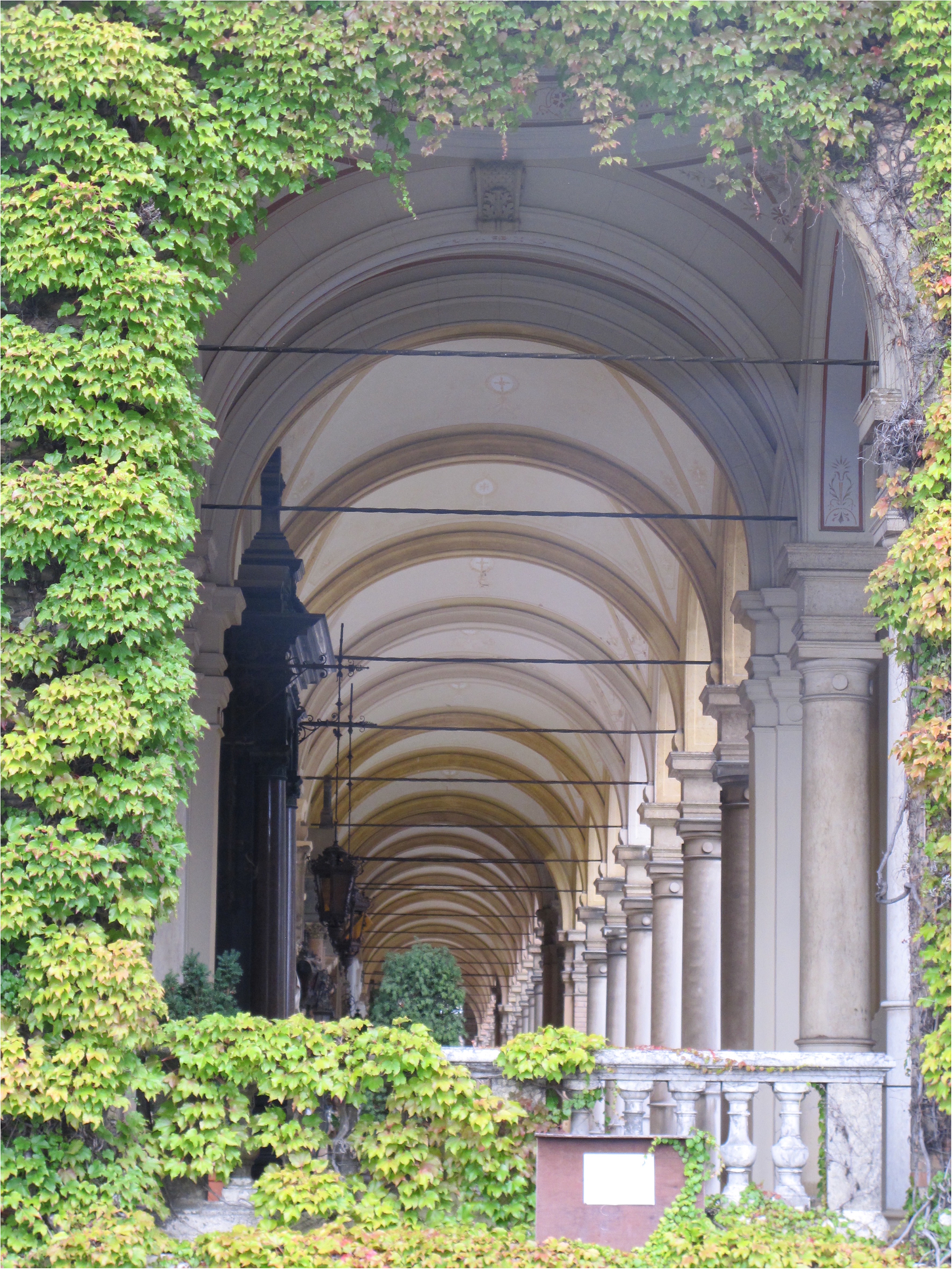
Mirogoj's iconic arcades, designed by Hermann Bollé (1845–1926). Photograph by the author.
Neglect, ruination, erasure, and amnesia are indelible features of Mirogoj, as they are in many cemeteries, and endow its graves, mausolea, and crypts with a lachrymose atmosphere. To the south of the entrance, plots devoted to Orthodox (pravoslavac) dead are frequently overgrown, their tombstones chipped or rusted. In recent decades, the history of Zagreb's Orthodox minority has been consigned to a “subaltern past” (Chakrabarty, 1997). While never large, the city's Serbian Orthodox community remained robust throughout the Habsburg and Yugoslav eras (Oberknežević, 1996), only to succumb to near-total collapse and marginality after the conflagration that engulfed Socialist Yugoslavia in the early 1990s. These tombs evince a “patina” of desuetude, in Dawdy's sense (2016: 4). The material afterlife of Orthodoxy in Mirogoj foregrounds the erosive effects of time's passage and the irreconcilability of past and present; the social imaginary that it enunciates is one of decline and loss. A potent index of this pessimistic imaginary is visible when one gazes upward while ambling through the Orthodox section of the cemetery. Ornamental stone crosses rise from the apexes of each of the elegant domes of the arcades, save one. A dome corresponding to the Orthodox section of Mirogoj once signaled the distinction of the space with an Orthodox cross, featuring a second, lower diagonal crossbar (a Patriarchal or three-bar cross, as opposed to a Latin cross). At some forgotten point in the past, however, vandals destroyed this cross; it has not been restored (see Figure 2). 3
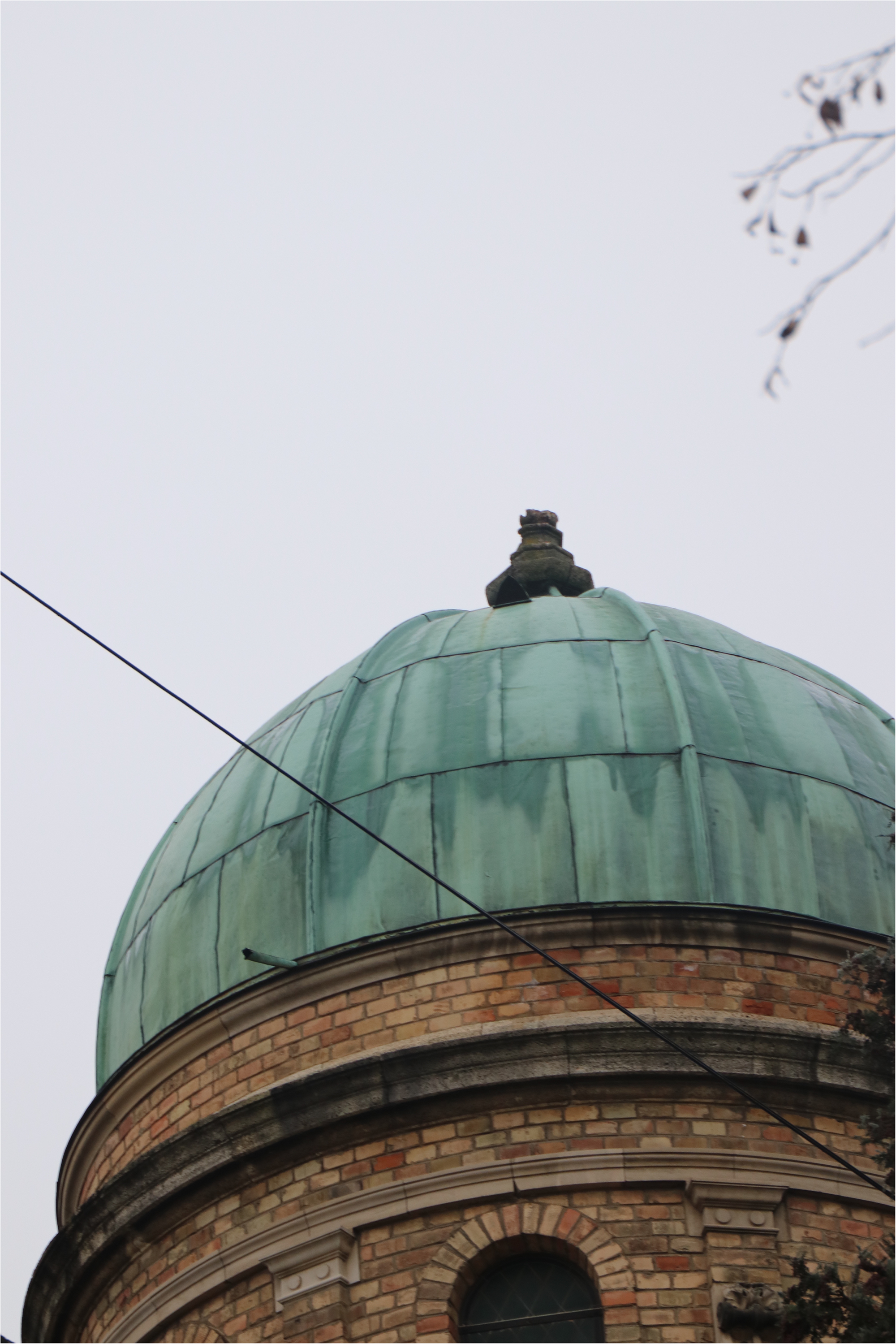
The decapitated Orthodox cross on Mirogoj's Arcades. Photograph by the author.
Dilapidation is evident, too, in the large section of Mirogoj reserved for Jewish dead. Graves overgrown with ivy abound, scattered among modest headstones featuring the Star of David (see Figure 3). Here, the causes of erasure are rooted in political history and contemporary socioeconomic stringency alike. As in most Habsburg provincial centers, Jews were a key thread in Zagreb's socioeconomic fabric (Goldstein and Goldstein, 2016), but the community was eviscerated in the Holocaust by the fascist Ustaša regime of the Independent State of Croatia, a Nazi auxiliary. A funerary slab in the arcades evokes this history of violence: one member of the Freund family was murdered in Auschwitz, and another in the notorious Croatian concentration camp of Jasenovac. Mirogoj's Jewish graves articulate this tragic history, and constitute an archive of and for a community that has dwindled to a few dozen families—most of the city's surviving Jewish residents emigrated following World War II—yet these tombs are disappearing in their own right. The cemetery administration levies an annual fee to sustain each grave plot in Mirogoj; after several years of non-payment, a plot can be purchased anew. The preponderance of the cemetery's Jewish graves entomb individuals whose descendants now reside far from Zagreb, and are therefore highly vulnerable to erasure and replacement due to financial delinquency. While tombs deemed to have notable artistic or historic value are eligible for conservation as “heritage” objects, most of the cemetery's Jewish resting places fail to meet this standard. Throughout Mirogoj's Jewish section, older tombstones in Hebrew are interspersed with newer Catholic graves. The same is true, for broadly the same reasons, in the Orthodox section. Even after death, the effects of ethnic cleansing in the past persist in the present.
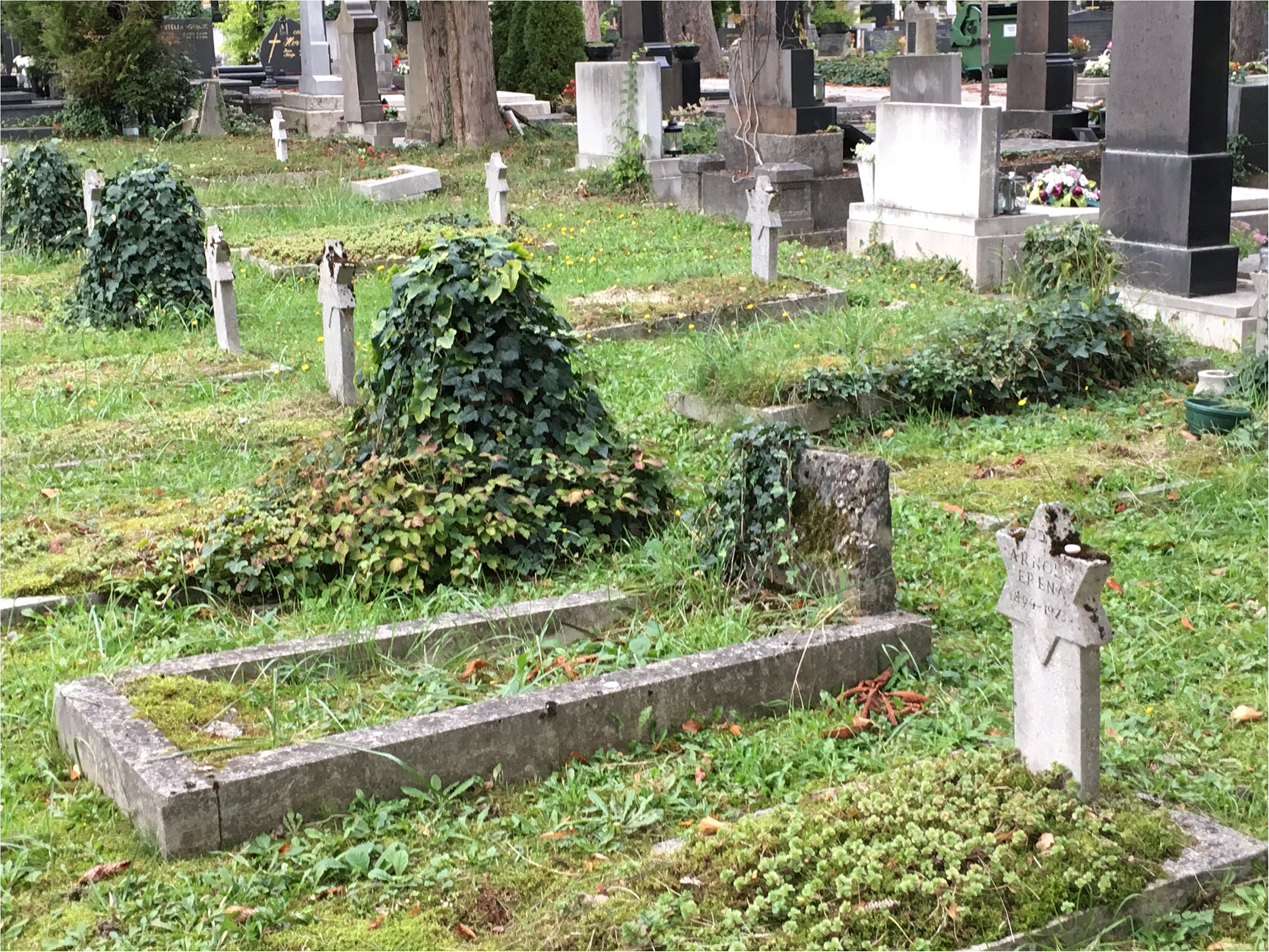
Overgrown grave plots in Mirogoj's Jewish section. Photograph by the author.
Elsewhere in Mirogoj, monumental commemorations seek to arrest staggered processes of erasure and amnesia. Mirogoj's monuments form a historical and political palimpsest, in Huyssen's (2003) sense—rather than the total elimination of previous epochs and regimes, the cemetery incorporates the material afterlives of multiple ideologies, lapsed and robust alike. Near the potters’ field where German war dead, soldiers of the Wehrmacht, are inhumed—the Deutsche Kriegsgräberstätte, 4 a recent addition to the cemetery—multiple memorials solemnify the political violence of the 20th century. Bygone adversaries on battlefields—fascists and Partisans—repose in proximity. Another newcomer to the cemetery's monumental landscape memorializes the violence of the Bleiburg Repatriations, during which Partisan forces massacred many fleeing fascist Ustaše, their families, and sympathizers near the Carinthian Austrian town of Bleiburg in May 1945. Such a memorial was unthinkable until recently—during the Socialist era (1945–1991), the Ustaše were Yugoslavia's villains par excellence. More recently, however, neo-fascist iconography and attitudes have experienced a chilling restoration in Croatia (Vladisavljevic, 2018), and Bleiburg has become an object of collective memory and identification (Pavlaković et al., 2018). Mirogoj's monument to Bleiburg's victims resonates with this recent restoration of Croatia's brief fascist era.
To the north of the cemetery's arcades, a monument to Partisan deaths in World War II and a memorial to Croatian military deaths in the Homeland War (Domovinski rat) of the 1990s face each other. The contrast between the iconography of the two sites is telling. The Socialist-era monument recreates the Yugoslav flag in marble and salutes collective sacrifice; other than a few famous Partisans, no individuals are commemorated. Only a few meters away, the monument to the Homeland War—one of the final works of the prominent Serbian-Croatian-Yugoslav sculptor and architect, Dušan Džamonja, which was inaugurated in 2006—depicts the relationship between collective identity and individual death quite differently. With a nod to Maya Lin's iconic Vietnam Veterans Memorial in Washington D.C., Džamonja's design alphabetically enumerates the names of every soldier who died fighting for Croatia in the 1990s. A sculptural cross with an eternal flame at its center punctuates the dense relationship between Catholicism and nationality that the monument memorializes. Here, historian Marcus Tanner's salutary phrase, “Croatia: a nation forged in war” (2010), achieves material substance, as each individual victim's military sacrifice constitutes part of the collective whole. Nor are the differences between the Yugoslav and Croatian war memorials solely a matter of explicit symbolism. Red plastic candles, many illuminated, and fresh bouquets ornament Džamonja's monument to the Homeland War; the sparse garlands at the foot of the marble rendition of the Yugoslav flag are tattered and desiccated. The former is an active site of memory in a manner that the latter is not. Some material afterlives are more vivacious than others.
Mirogoj's dominant monumental space rests behind the Catholic chapel that stands sentinel at the cemetery gates. It is also recent, two decades old: the austere, massive gray grave of Franjo Tuđman (1922–1999). Tuđman is a polarizing figure in Croatia today, venerated by some as the architect of Croatia's independence, demeaned by others as a war criminal. Nevertheless, his crypt, anchored at Mirogoj's spatial center, is the cemetery's dominant site of nationalized collective memory, a place of and for the production of a national history that is often difficult to extract from the cemetery's dense tissues of times past. Like the Homeland War Memorial, this site of memory exceeds official sanction. Large numbers of cheap crimson candles reliably flicker here, and a homemade plaque expressing gratitude to Tuđman has become a permanent fixture beside the tomb. Especially at times of the year such as the Day of the Dead (Dan mrtvih, 2 November), Tuđman's grave is inundated by well-wishers, and constitutes a centripetal site for national(ist) pilgrimage.
Mirogoj's palimpsestic quality—its heterochronic embodiment of disparate material afterlives, each of which reconfigures the others—is not only a feature of its monumental space. A palimpsest of dwindling socialities and bygone intimacies is materialized by the cemetery's interdenominational gravestones. A plait-work cross and a crescent indicate a Catholic-Muslim family. On a single tombstone, the script shifts from Cyrillic to Latin, an index of an erstwhile Orthodox–Catholic union (Walton, 2020a: 32). Elsewhere, the six-pointed Star of David and the five-pointed socialist star coincide. These gravestones are the material afterlives of social formations that are increasingly absent in Zagreb and Croatia today: kinship across the partitions of ethnic, religious, and political boundaries. The same might be said of the cemetery's Jewish, Orthodox, and Muslim graves generally. The interconfessional urban world of provincial Habsburg Zagreb that Mirogoj accommodated, and that found a new lease on life in Yugoslavia, is now chiefly available as a funereal palimpsest.
Mirogoj's recent monuments assert themselves against these potentially disruptive pasts that remain materially present. In contrast to the dilapidated, sepulchral heterotopia of Habsburg and Yugoslav vintage that comprises much of Mirogoj, a hegemonic national deathscape, articulated above all by the Homeland War Memorial and Tuđman's tomb, endeavors to render the cemetery's space “Croatian.” This deathscape rejects the layering of a palimpsest in favor of a sanitized, “whitewashed” (Jovanović, 2019) national memory that consigns religious, ethnic, and political heterogeneity to silence (Trouillot, 1995) and oblivion (Augé, 2004).
In relation to Mirogoj's heterotopic space at large, this whitewashed image of a nationalist past is difficult to sustain. The simultaneous legacies of otherwise incompatible pasts—Habsburg, Fascist, Socialist, and post-socialist nationalist—renders Mirogoj's space dramatically heterochronic. More recent monumental incursions that seek to homogenize this heterochrony attempt to do so in vain—they only add another layer to the sepulchral palimpsest of material afterlives. Mirogoj ultimately testifies to the divergences, and potential conflicts, between past(s) and present, between legacies and memories. Nationalist collective memory, the present acting upon the past, sculpts a selective, sanitized version of history amenable to contemporary political ends. Yet the multiple legacies and afterlives that the cemetery materializes—the past's pressure on the present—disrupt the claims of collective memory to coherence due to their heterotopic and heterochronic effects.
Zeitenlik: Fossil, archive
While the material temporality of Mirogoj oscillates between heterotopic palimpsest and monumental deathscape, that of another Balkan necropolis, the Zeitenlik World War I Allied Military Cemetery in Thessaloniki, suggests a fossil preserved in amber or a photograph removed from its moment of origin. Like a fossil or a photograph, Zeitenlik conveys a consolidated, two-dimensional “cut” of the past without mark of duration, transformation, or decay. The metaphor of a fossil suggests a singular relationship between the present and the past that militates against time's passage. Like amber encasing an antediluvian arthropod, this mode of material afterlife figures the present as a means and medium for the pristine preservation of the past. Concomitantly, Zeitenlik is not palimpsestic or heterochronic in the manner of Mirogoj. However, by assembling the dead of multiple bygone empires and monarchies, Zeitenlik forms a unique heterotopia of imperial polities past.
In contrast to the graves of Mirogoj, which range in vintage from 19th-century mausolea to freshly turned earth, those of Zeitenlik date from a narrow span of several years, 1915 to 1918, the period of hostilities along the Macedonian Front in World War I. 5 Plans for the memorial graveyards of Zeitenlik, located on the site of the Serbian Army Hospital during the war, were established in 1920, shortly after the cessation of hostilities, but the cemetery was not completed until 1933 (World Heritage Encyclopedia, 2017). In addition to the construction itself, the deceased soldiers now interred in Zeitenlik had to be gathered from some 250 informal cemeteries along the former front (World Heritage Encyclopedia, 2017). The cemetery's distinct sections gather the dead of each of the Allied Powers that battled on the front: Great Britain, France, Italy, Russia, and Serbia. Each division of Zeitenlik is aesthetically uniform. The identical tombstones that commemorate Allied soldiers in death gesture to their occupants’ fungibility as cannon fodder in life. Italian graves are marked by simple marble crosses. British tombstones are uniform limestone tablets, varying solely in the insignia of the different regiments to which their occupants belonged. French, Russian, and Serbian graves are also simple crosses; the latter two feature slightly acute angles to signal Orthodoxy. A plethora of larger national monuments demarcate the otherwise homogeneous graveyards, as do two memorial chapels, one French-Catholic and one Serbian Orthodox.
Unlike active cemeteries such as Mirogoj, which are enlivened by a variety of funerary and post-funerary practices, Zeitenlik exudes the static, somber atmosphere of a memorial park. Wreaths and bouquets embellish collective monuments rather than individual tombs, lamenting mass bodies rather than specific remains. The Serbian Orthodox chapel, especially, is a site of collective imagery and imagined community. On the day of my pilgrimage to Zeitenlik in January 2018, five wreaths and a Serbian flag adorned the commemorative plaque on the exterior of the chapel, situated beneath a solemn mosaic of the Archangel Michael (see Figure 4). A poem in Serbian by one V. J. Ilić mlađi (Jr.), which adorns a plaque on the chapel, urges the visitor to revere the romance of military sacrifice: “Unknown stranger, when you accidentally stroll; By this holy cemetery (collective grave); Know that this is where the greatest heroes of our age; Found their eternal rest.”
6
At the rear of the chapel, I encountered headier evidence of frequent visitation to Zeitenlik's Serbian graveyard
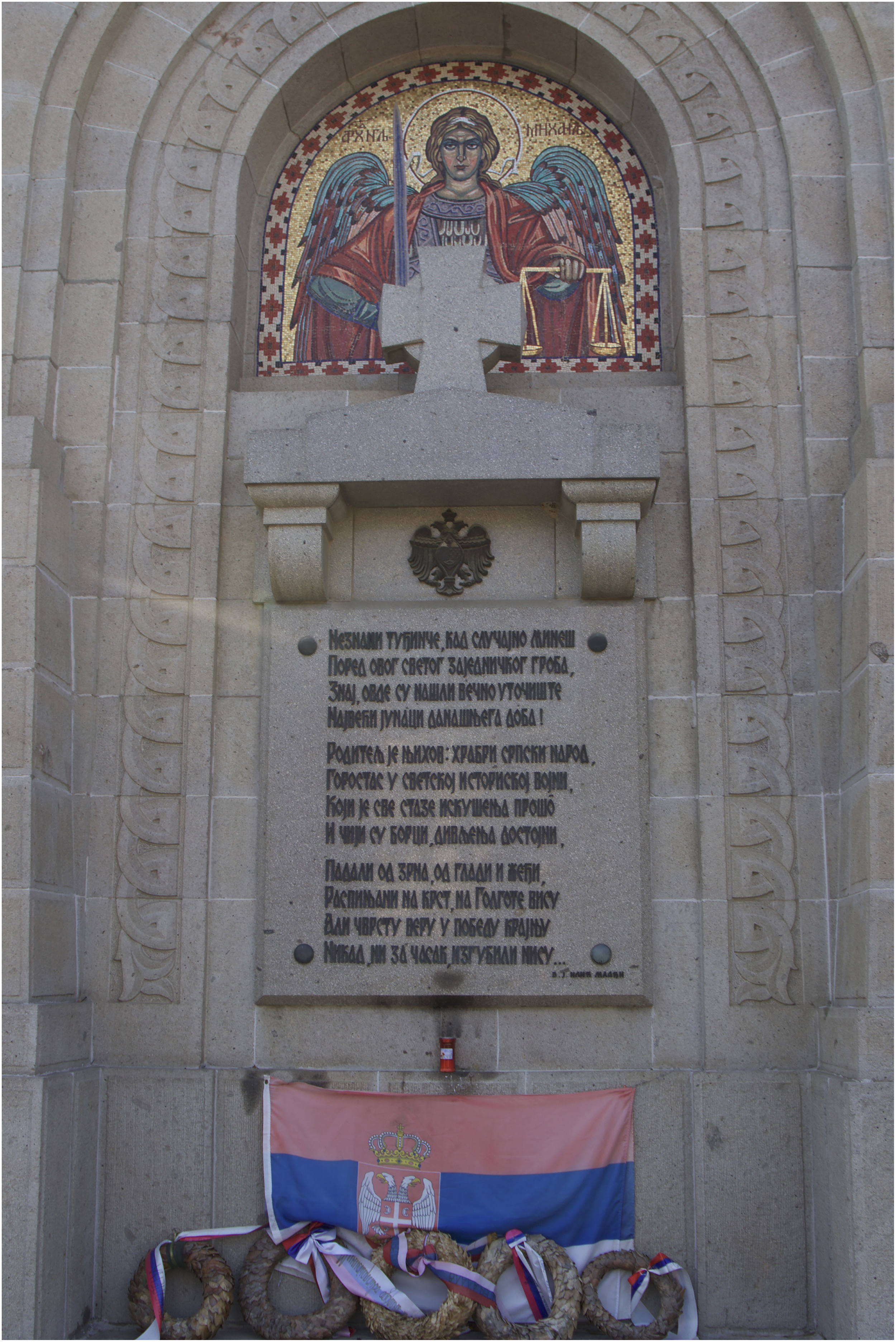
Zeitenlik's Serbian Orthodox chapel. Photograph by the author.
In the wake of the collapse of Yugoslavia in the 1990s, this monarchical political past has achieved new vitality in Serbia as an object of “restorative nostalgia” (Boym, 2001), like a fossil retrieved from dirt and rock, dusted off for new scrutiny and appreciation. The logic of the recovered fossil even applies to the official guardian of the Serbian section of Zeitenlik, 93-year-old Đorđe Mihailović, whose own grandfather fought on the Macedonian Front and served as the first caretaker for the cemetery, after helping to convey the bodies of his comrades from the battlefield (Marković, 2013). Mihailović is a minor celebrity in Serbia. He reliably dons World War I military costume for commemorations at Zeitenlik, such as the memorial in 2019 marking the 101st anniversary of the fall of the front: “Although barely able to stand, George endured and applauded at the end of the (Serbian) anthem, with a video from the event posted on social networks” (The Srpska Times, 2019). Mihailović, with his weathered skin and anachronistic military fatigues, is a living fossil, a relic from a Serbian past that speaks with surprising vigor to the present.
Like many contexts of “extraterritorial nationalism” (Bennett, 2016; see also Winland, 2007), Zeitenlik's location outside of Serbia buttresses its status as a crucible for nationalist collective memory. 8 While Zeitenlik is heterotopic to the national space of Greece—collective memories of the war among the Great Powers of the early 20th century are peripheral to Greek national identity in the early 21st century—it constitutes a utopia for many Serbs. Foucault's remarks on utopias are apposite here: “Utopias are sites with no real place. They are sites that have a general relation of direct or inverted analogy with the real space of Society. They present society itself in a perfected form” (1984: 3). Zeitenlik is a powerful, funereal utopia that presents Serbia to itself in “a perfected form.” As a pop-folk song by the crooner Lukas (1995) proclaims, Zeitenlik “is Serbia” (Ovo je Srbija). 9 A Serbian-run giftshop outside the cemetery gates, which sold postcards, icons, and souvenirs until its closure in 2017, also underscored the utopian, utopic aspect of Zeitenlik. Its name was “Tamo Daleko”—“Far Away,” or, more literally, “There in the Distance”—after the title of a well-known Serbian folk song that was composed on the Greek island of Corfu during the Great War (Hudson, 2007). From the perspective of the ballad's narrator, lamenting wartime exile, Serbia itself is “far away”: “Far away, far from the sea, there is my village, there is Serbia.” 10 Now, however, it is Zeitenlik that is “far away” from Serbia, a sepulchral utopia that, by virtue of its distance, serves as an “analogy” for Serbia in a refracted, selective form. This analogous, utopian Serbia is one of military sacrifice of and for the nation. The material afterlife of the Serbian monarchy in Zeitenlik constitutes a potent resource for Serbian nationalism in the present.
More generally, Zeitenlik's spatial arrangement in a series of internally-homogeneous graveyards resonates with a nationalist image of political life and death. Each section of the cemetery corresponds to a nation-state in existence today. Nevertheless, the cemetery, like the Great War generally, more properly warrants interpretation in relation to the rapidly shifting geopolitical sands of its age, when imperial and national polities and identities underwent simultaneous fragmentation and concretization. Viewed in this light, Zeitenlik is not merely a fossil, but the material afterlife and archive of an era that uncannily refracts the concerns and dilemmas of the present. The tombstones of Zeitenlik are records of “imperial duress” (Stoler, 2016) that endure in sepulchral form. In Zeitenlik's Serbian section, the dead of a bygone kingdom are summoned by nationalist overtures today. Meanwhile, in the French section, 11 marble and granite memorials offer evidence of colonial-military necropolitics (Mbembe, 2003) that haunts the nation-state heirs to bygone empires.
While every French gravestone—a total of 8089—is an identical gray cross, the names of many of the dead defy Christian mortuary symbolism. The cruciform headstones of Muslim North African soldiers incongruently feature small, abstract crescent moons to denote their religious distinction. Cadets from Southeast Asia are commemorated with an “IC” (Indochina), those from Senegal with an “S,” and those from Madagascar with an “M.” At one evocative location, a North African, a Madagascan, a Senegalese and a Frenchman lie side by side (see Figure 5). As a collective, the French imperial soldiers who fought and perished on the Macedonian Front are an uncanny reminder of the founding military violence of today's post-imperial nation-states, which dealt death to colonized subjects who would be preemptively excluded from the successor nation-states for which they died. The necropolitics of empire eagerly recruited bodies that the biopolitics of the nation-state sought to exclude with comparable vigor. The graves of colonial recruits are unsettling material afterlives of empire that the homogenizing imperatives of nationalist collective memory cannot entirely silence or occlude.
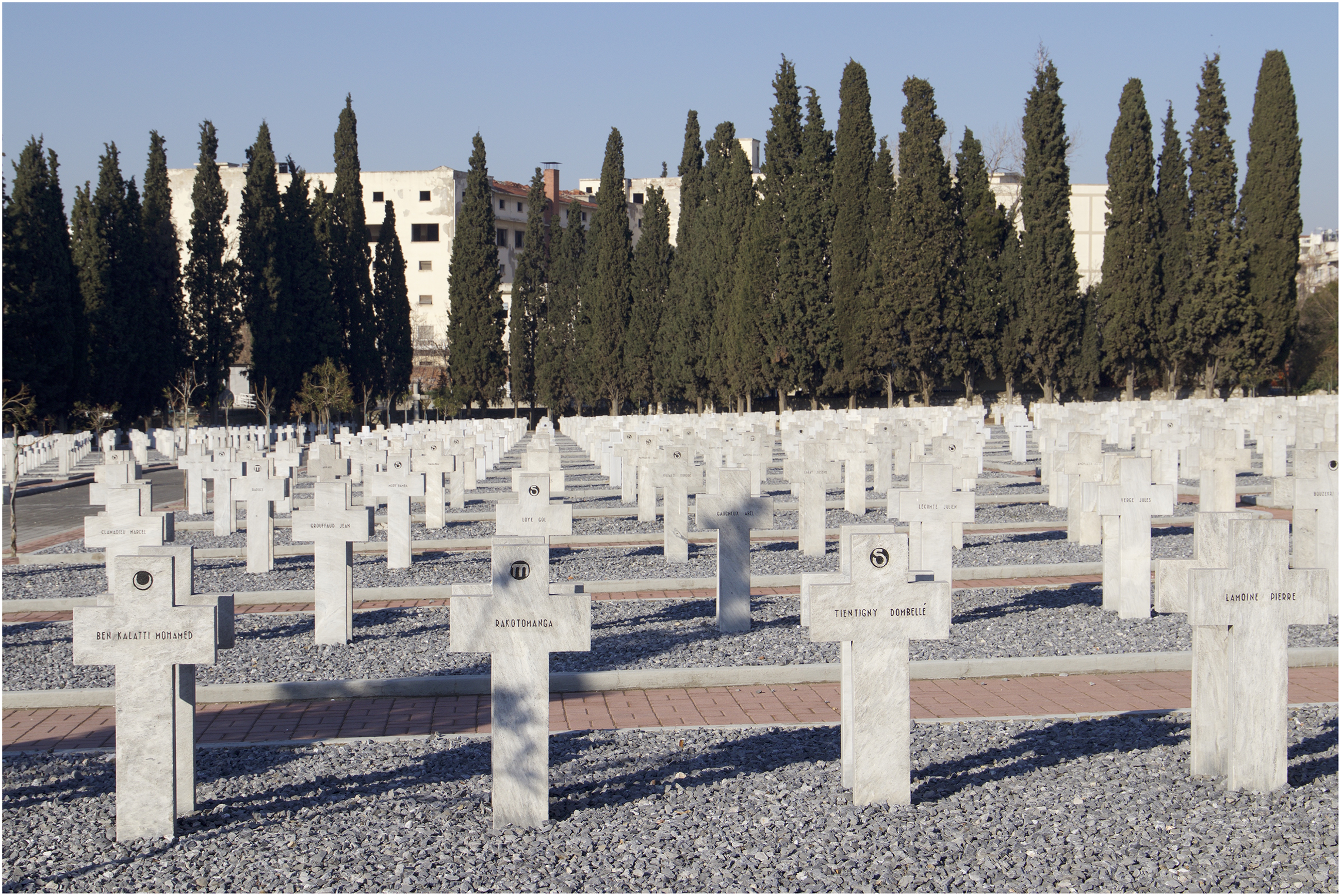
Material afterlives of the French Empire. Photograph by the author.
The heterotopia of Zeitenlik contrasts sharply with that of Mirogoj primarily because Zeitenlik is not heterochronic in the manner of Mirogoj. Rather than integrating a myriad of divergent pasts in a mortuary chiaroscuro, Zeitenlik conveys a single “slice in time” (Foucault, 1984: 6), the Great War. In this, it is much like a fossil. Nevertheless, Zeitenlik's relationship to a broader field of times, spaces, and places—the dominant “chronotope” (Bakhtin, 1981) of a world of nation-states—is highly heterotopic and heterochronic. The past refuses to be occupied fully by the present; the imperial affiliations and powers that its tombs materialize irritate the homogenized social and political spacetime of the nation. Zeitenlik's stone and concrete afterlives demand to be read as an archive: a record of the past that bears profound lessons for the present.
Conclusion: A spark of hope in the past
Only that historian will have the gift of fanning the spark of hope in the past who is firmly convinced that even the dead will not be safe from the enemy if he wins. Walter Benjamin (1968: 255, emphasis in original)
Who is this enemy? When Benjamin composed his “Theses on the Philosophy of History,” historicism, with its positivist image of time as homogeneous and linear, was an agent of conformism that threatened to flatten and depoliticize the past. Today, as Hartog (2015) has argued, hegemonic collective memories conspire closely with “presentism,” the dominant “regime of historicity,” to quarantine the past, to reduce it to its use value in the present. As Benjamin augured, even the dead are not safe from this campaign of sanitization. Yet the dead also offer surprising resources for “fanning the spark of hope in the past” (Benjamin, 1968: 255). Their heterotopic necropolises are replete with material afterlives of times past that incite discordant visions of, and narratives for, the present.
As we have witnessed, both Mirogoj and Zeitenlik host startling “constellations” (Benjamin, 1968: 263) of memories and legacies. Both cemeteries are recruits to the ranks of nationalist memory. In Mirogoj, the most prominent, recent layer of the funereal palimpsest stresses national sacrifice in the Homeland War of the 1990s, and elevates Franjo Tuđman as the personification of a triumphant, whitewashed, Croatian history. In Zeitenlik, the graves of Serbian soldiers in the Great War materialize a utopia of the nation for the present that relies on fossils of the early 20th century. Conversely, in Zagreb and Thessaloniki alike, the past exerts pressure on the present through multiple legacies, cacophonous material afterlives. In Mirogoj, subaltern pasts—overgrown Orthodox and Jewish graves, interconfessional tombstones—persist in states of dilapidation that are not yet totally consigned to oblivion. The resting places of colonial soldiers in Zeitenlik eerily enunciate disavowed formations of imperial violence that undergird the nation-state. In both Mirogoj and Zeitenlik, the dead wait. Waiting, they speak clearly and provocatively, with an agglomeration of tongues and tales, provided we are attuned to their cadences. Their most exceptional afterlife is a spark of hope in the past worthy of the bellows of the present.
Footnotes
Acknowledgements
I would like to thank Hilal Alkan, Robert Bednar, Dragan Damjanović, Karin Doolan, Patrick Eisenlohr, Çiçek İlengiz, Sasha Newell, Vjeran Pavlaković, Sofia Pinedo-Padoch, and Jelena Radovanović for their generous contributions to this article.
Declaration of conflicting interests
The authors declared no potential conflicts of interest with respect to the research, authorship, and/or publication of this article.
Funding
The authors received no financial support for the research, authorship, and/or publication of this article.

Notes
Author biography
Jeremy F. Walton is a cultural anthropologist whose research resides at the intersection of memory studies, urban studies, the comparative study of empires and imperialism, and critical perspectives on materiality. He recently inaugurated the research group “REVENANT–Revivals of Empire: Nostalgia, Amnesia, Tribulation” at the University of Rijeka, Croatia, with support from a European Research Council consolidator grant (#10100290). Prior to this, he led the Max Planck Research Group, “Empires of Memory: The Cultural Politics of Historicity in Former Habsburg and Ottoman Cities,” at the Max Planck Institute for the Study of Religious and Ethnic Diversity in Göttingen, Germany. His first book, Muslim Civil Society and the Politics of Religious Freedom in Turkey (Oxford University Press, 2017), is an ethnography of Muslim NGOs, state institutions, and secularism in contemporary Turkey. His writing has appeared in a plethora of scholarly and popular journals, including American Ethnologist, Die Welt Des Islams, History and Anthropology, The Journal of the Ottoman and Turkish Studies Association, Jadaliyya, and Sidecar (The New Left Review).