




Abstract
Fieldwork at Amarna in 2022 included excavation at the Great Aten Temple and the North Desert Cemetery, and the continuation of several post-excavation projects. Those post-excavation projects reported on here are the study of skeletal materials, pottery, plant and organic remains, and inscriptions from the North Desert Cemetery; pottery, plant and other organic remains from the North Cliffs Cemetery; and digital modelling of the North Desert Cemetery. A programme of community outreach in collaboration with the Amarna Visitor Centre also recommenced.

Keywords
Introduction
In 2022, the Amarna Project 1 undertook two periods of fieldwork: a Spring season (1 February to 31 March) centred on the Great Aten Temple; and an Autumn season (15 September to 19 December), which focussed first on the Great Aten Temple and then on the North Desert Cemetery (fig. 1). This preliminary report summarises work undertaken in the Autumn season at the East Gateway of the Temple and at the North Desert Cemetery. 2 It also presents ongoing projects to record human remains, ceramics, plant remains and inscribed objects from the cemeteries; a programme of digital recording and reconstruction; and the relaunch of a community outreach programme in partnership with the Egyptian Ministry of Tourism and Antiquities (MoTA).
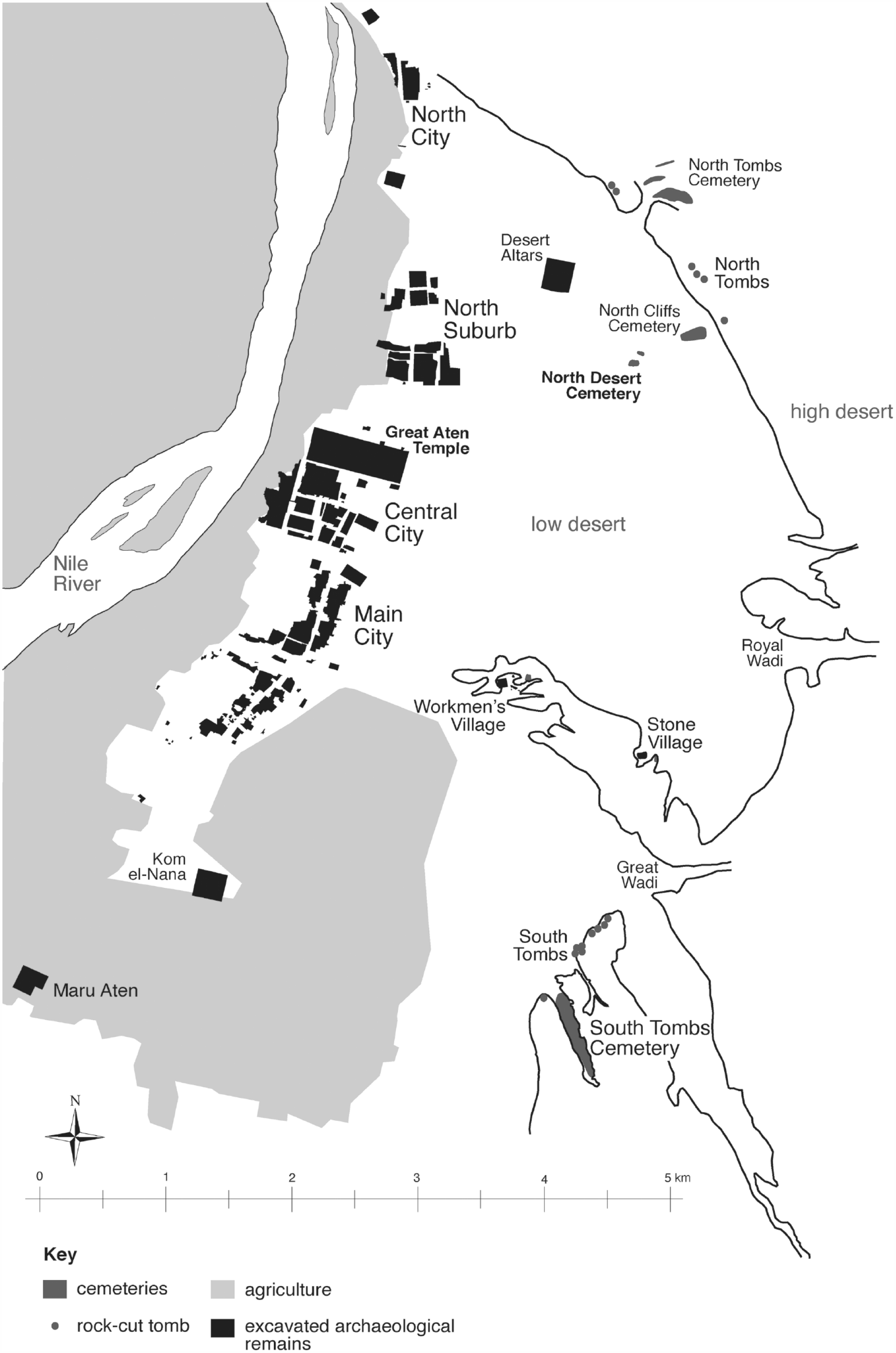
Map of Amarna, including the locations of the Great Aten Temple and North Desert Cemetery (base map: Barry Kemp and Helen Fenwick, with additions by Anna Stevens, the Amarna Project).
The Great Aten Temple: East Gateway Excavations, Autumn 2022 (F. Balestra)
Background
Although the Great Aten Temple was excavated in the first half of last century, with a focus on the stone-built Long Temple (possibly the Gem-pa-Aten), the eastern side of its compound has been less extensively investigated (fig. 2). The East Gateway at the back of the temple was first examined in the 1932/33 Egypt Exploration Society (EES) season. This work, however, is only briefly mentioned in the excavation monograph. 3 The East Gateway report comprises only two sentences, the entrance is not included in the final plan, and artefacts from the area are entirely omitted. 4
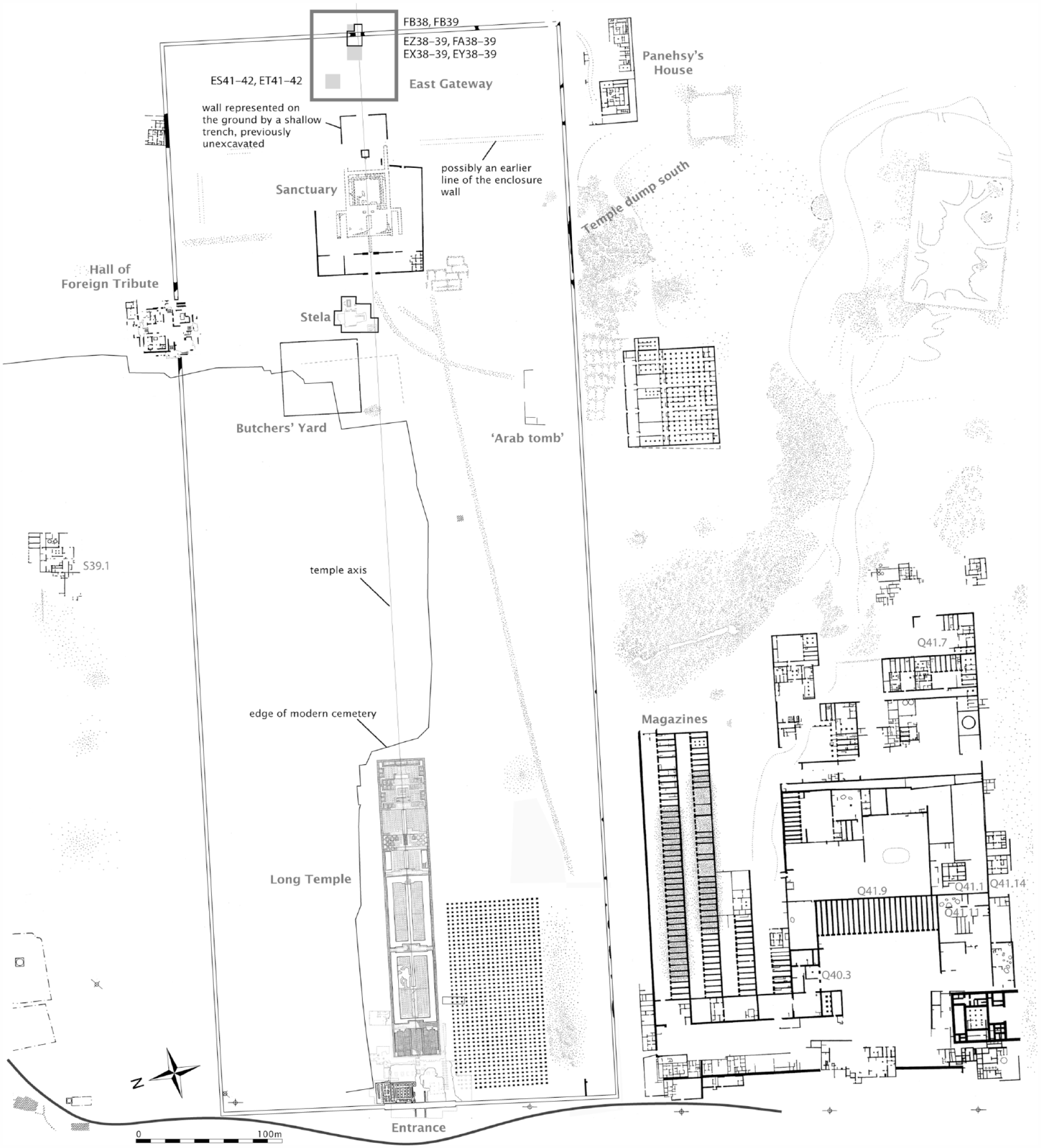
Plan of the Great Aten Temple showing in thick grey outline the location of the excavation at the East Gateway in 2021 and 2022 (plan: Barry Kemp, the Amarna Project).
The Amarna Project has been reinvestigating the Great Aten Temple since 2012. 5 While much of the work focusses on the Long Temple, another research goal is to understand the function of the huge amount of open space surrounding the stone temples and subsidiary structures (the so-called Hall of Foreign Tribute, Butchers’ Yard, Stela site, and over 900 offering-tables: fig. 2). A possible explanation is that the space provided the city’s population with a place for large-scale gatherings, although other motives remain possible. 6 More needs to be done, as well, to reconstruct and understand the distribution patterns of artefacts and environmental materials across the temple complex.
These issues led, in 2021 and 2022, to new excavations at the East Gateway, which has been tentatively suggested as a public entranceway (fig. 2). 7 The first season demonstrated that, while the area was severely denuded, the gateway was clearly more than just a break in the wall. 8 It was approached from the east by an external ramp (fully exposed in 2022). The entranceway was flanked by buttresses projecting from the outer face of the enclosure wall and was aligned almost exactly with the axis of the Sanctuary (fig. 3). The thickness of the mud-brick enclosure wall gives the entrance an imposing feel, with a threshold measuring 3.5 m wide. Excavations in 2021 had also provided glimpses of on-site human activities (e.g., fireplaces, pot holes and post holes) and an artefact record that included incense and incense bowls, jar sealings, worked stone and stone tools, metal, faience and glass, as well as organic remains.
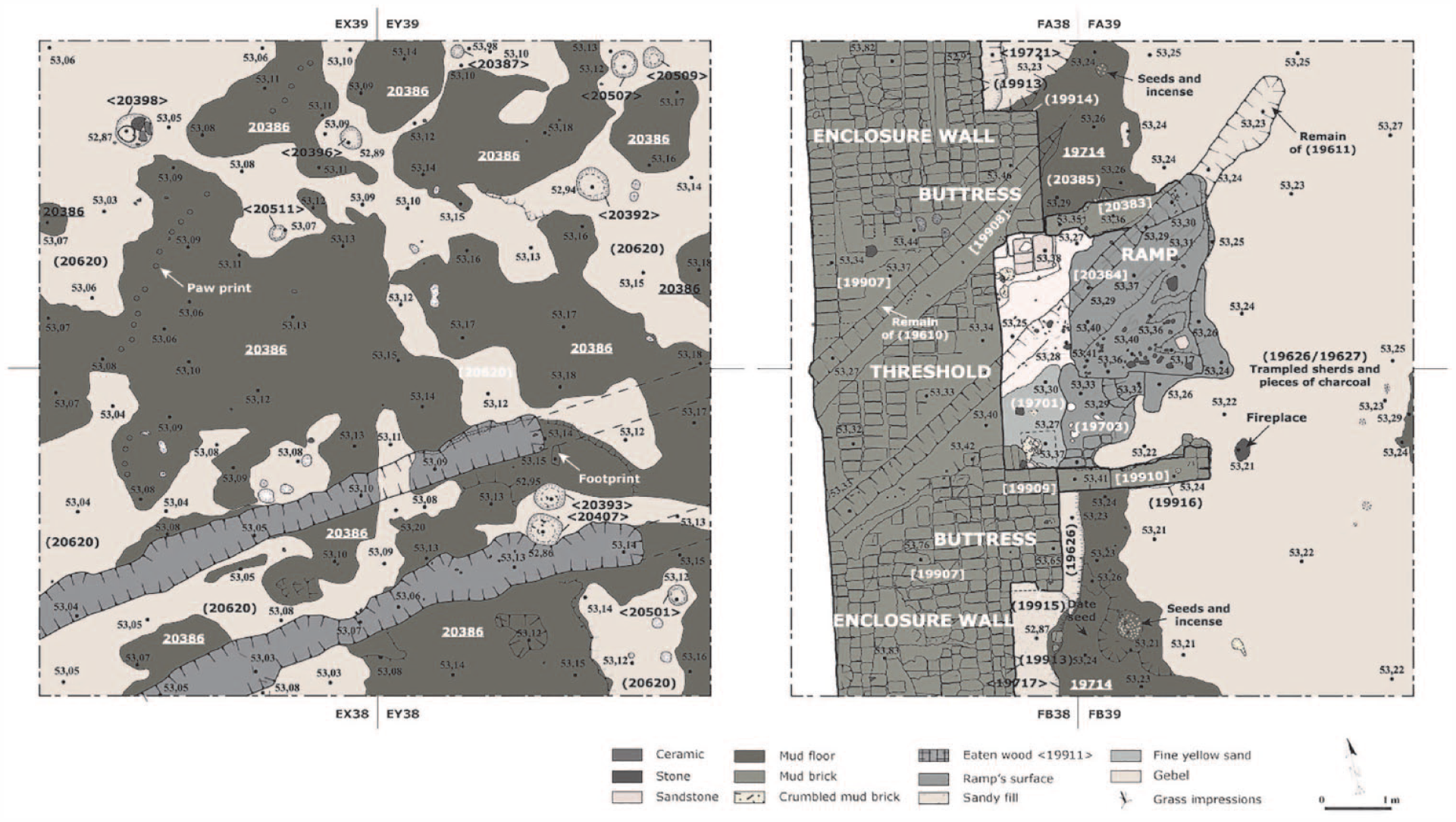
Left: Final plan of the internal mud floor (Sector 1) following the East Gateway axis with the modern tyre tracks which cross the area towards the gateway. Right: Final plan of the ramp leading to the gateway (Sector 1) (plans: Fabien Balestra, the Amarna Project).
From 26 September to 27 October 2022 the excavations continued, led by the author with the assistance of Waleed Mohamed Omar, Ahmed Mokhtar Mahmoud, Yahya Saddiq Abdel Fattah, Ahmed Mohamed Abd el-Rashid and Mohamed Rabia Fatih. The excavations covered an area of 250 sq. m across ten excavation squares of 5 x 5 m, divided into two sectors. Sector 1 comprised six squares across the East Gateway proper (EX38–39, EY38–39, FB38–39: fig. 3). Sector 2 encompassed four squares located slightly to the north, where there was a concentration of potsherds on the surface of the sfite (ES41–42, ET41–42). The stratigraphy in these areas represented two broad temporal phases: Amarna Period and post-Amarna Period activity.
Amarna Period
Sector 1: The excavation around the gateway first concentrated on the ground outside the complex to the east, partly cleared in 2021, and then progressed to the squares inside the enclosure (figs 3–4). The removal of predominantly wind-blown deposits exposed the mud-brick ramp [20384], which had been flanked by two rectangular mud-brick buttresses, [19908] and [19909]. Although the ramp was heavily eroded, and damaged by modern vehicular traffic (figs 3–4), observations could still be made on how it had been built. Two mud-brick walls, [19910] and [20383], were constructed to act as an external frame that was then packed with layers of fill. Inside the frame, an initial thin mud surface had been spread over the desert, perhaps to seal in the rest of the fill, which consisted of various mud deposits of different thicknesses. In some cases, traces of whitewash were found between the layers. The ramp was 3.2 m wide. It survived to a length of 5.5 m but was truncated at its eastern end. The south wall survived to a maximum height of 0.5 m, becoming more eroded eastwards, while the north wall survived only to 10 cm throughout its length. The outer face of the south wall bore small traces of white plaster, but no surface treatment remained on its northern counterpart. During the early EES work, the eroded remains of sandstone blocks, perhaps serving as a step, were found in situ between the ramp and the mud-brick threshold. 9 Some traces of sandstone are still preserved in this area today.
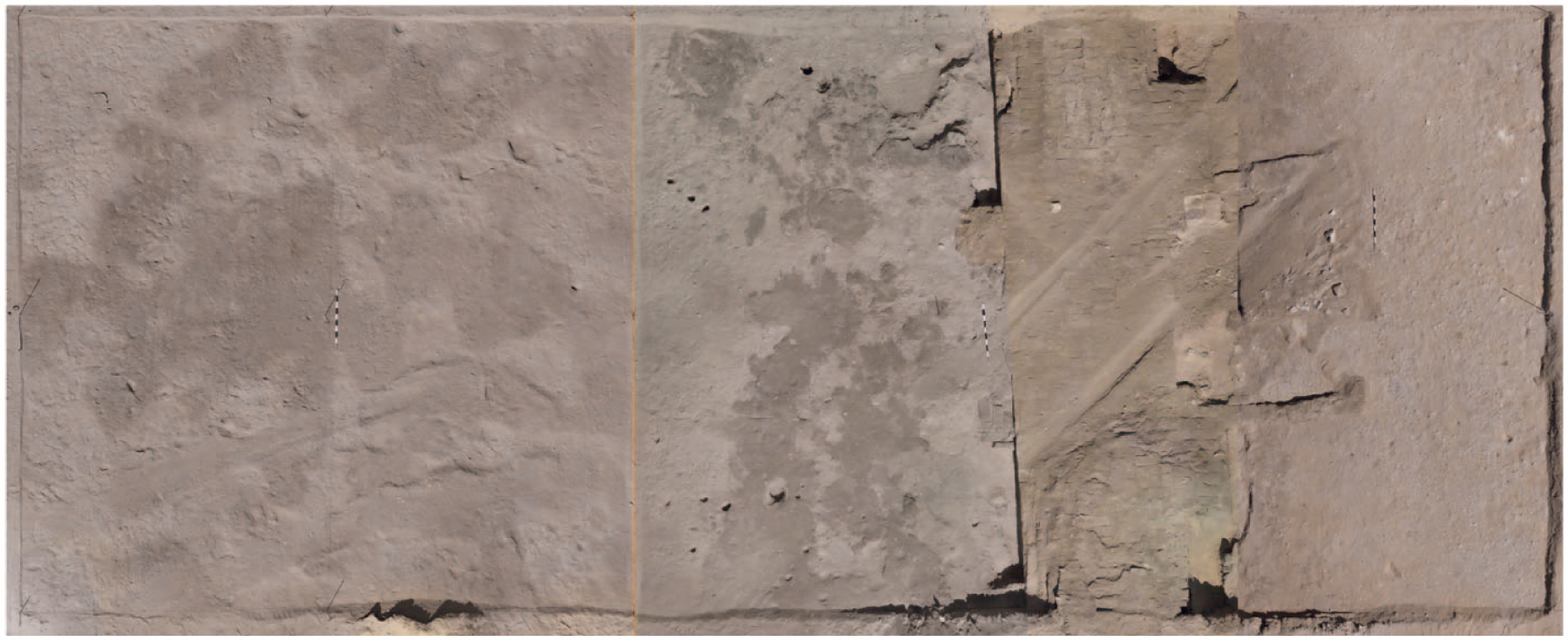
Collage of the ten squares excavated at the East Gateway in 2021 and 2022. North is towards the top. The gateway and ramp are in the right side of the image; note the tyre tracks running across the ramp and threshold (orthomosaics: Fabien Balestra and Paul Docherty, the Amarna Project).
A c. 3-cm-thick mud floor
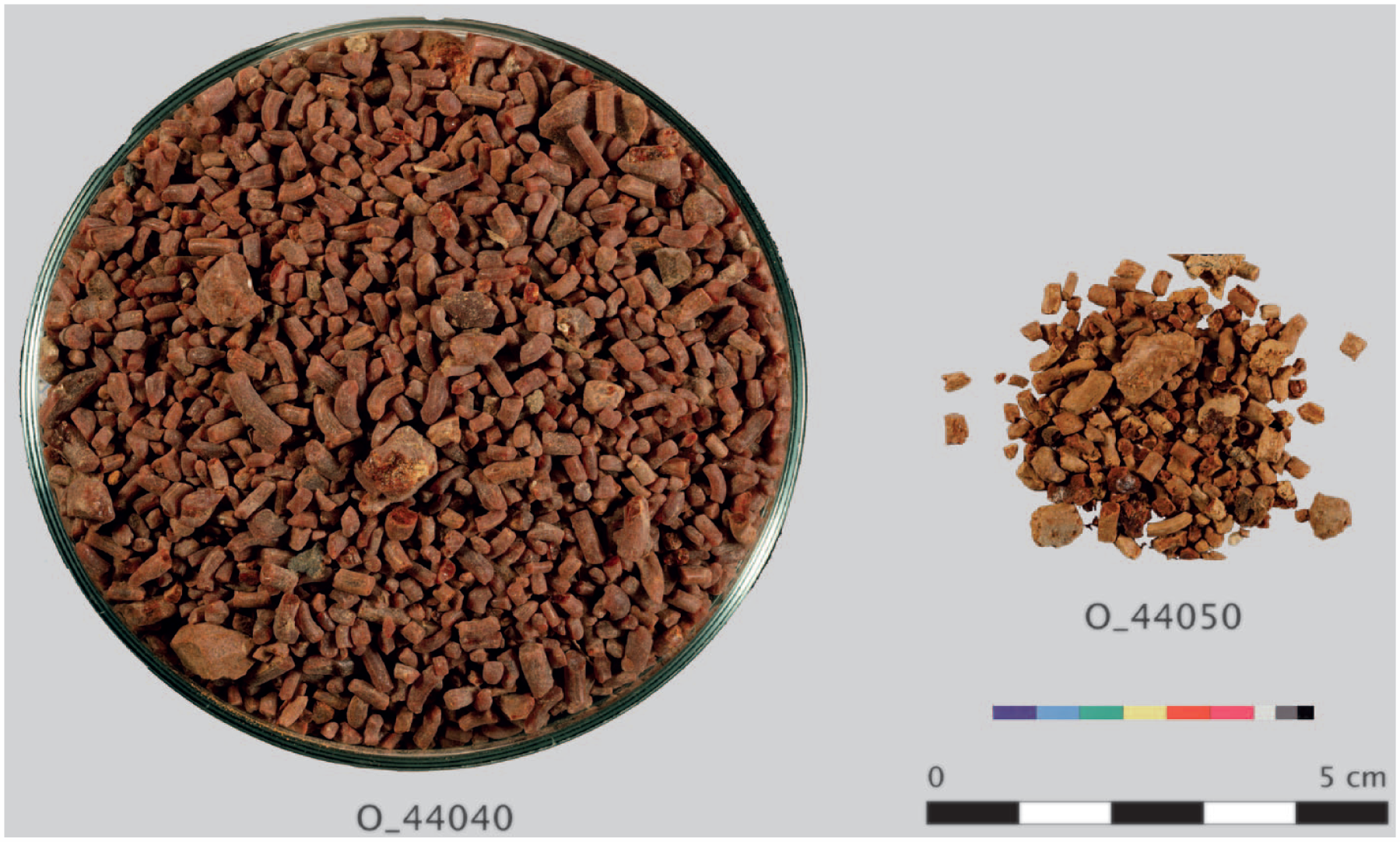
Incense samples collected from the exterior mud floor
In the squares inside the entranceway, the work exposed more of a mud floor
Summary of hollow structures discovered within floor
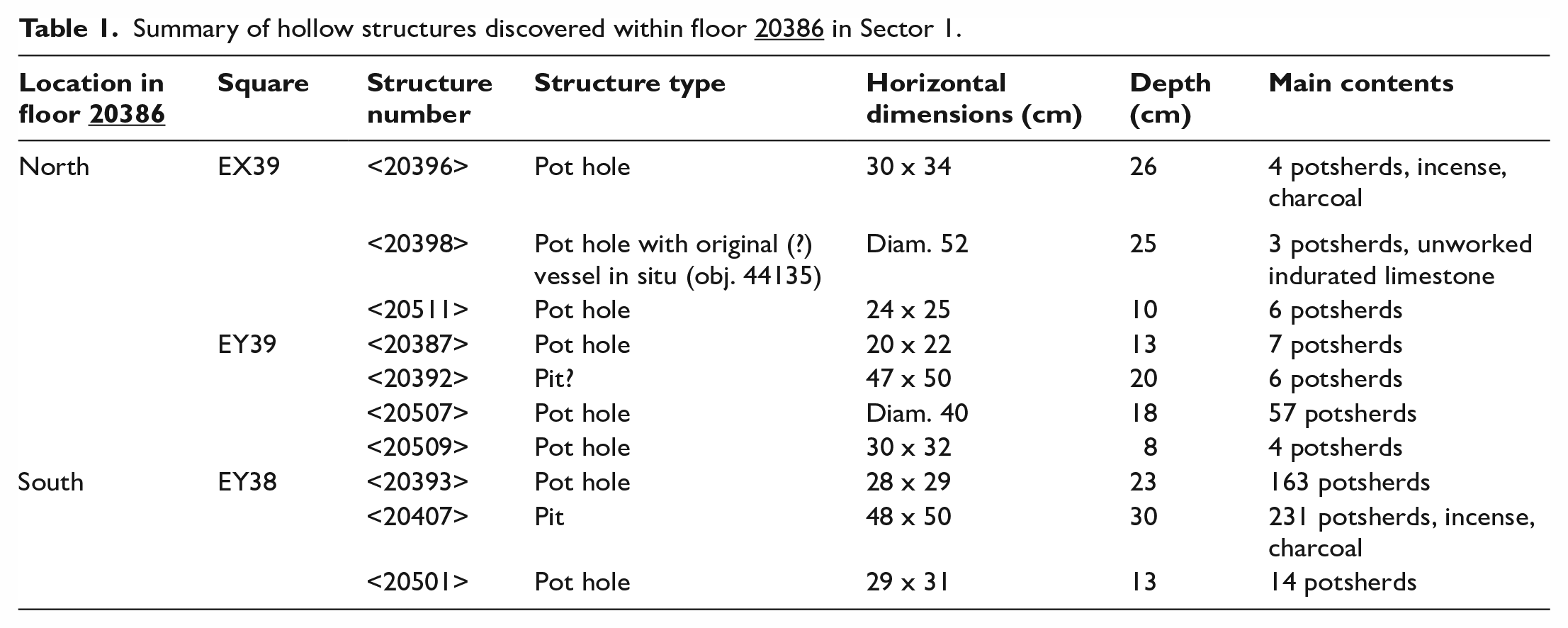
Most of the hollow forms were located along the northern edge of the floor, with three to the south. Perhaps the most notable, <20398>, was located in the westernmost margin and contained the top of a zir (fig. 6) held upright by a piece of limestone and a broken hearth rim. 10 The fill of the zir mouth contained tiny pieces of charcoal and a few possible fragmented seeds, which may be secondary fill. The zir mouth seems to be in situ. It was perhaps used as a pot stand, although there was no abrasion to suggest that it supported another container. Since the pit itself is much larger than the zir mouth, it may originally have accommodated a larger vessel. Also of note is pit <20407>, which yielded a large quantity of potsherds and a little incense. It lay only 5 cm from a probable pot hole <20393> (which also contained potsherds) raising the possibility that the two emplacements were related. Perhaps the pit was a disposal pit related to the pot hole.
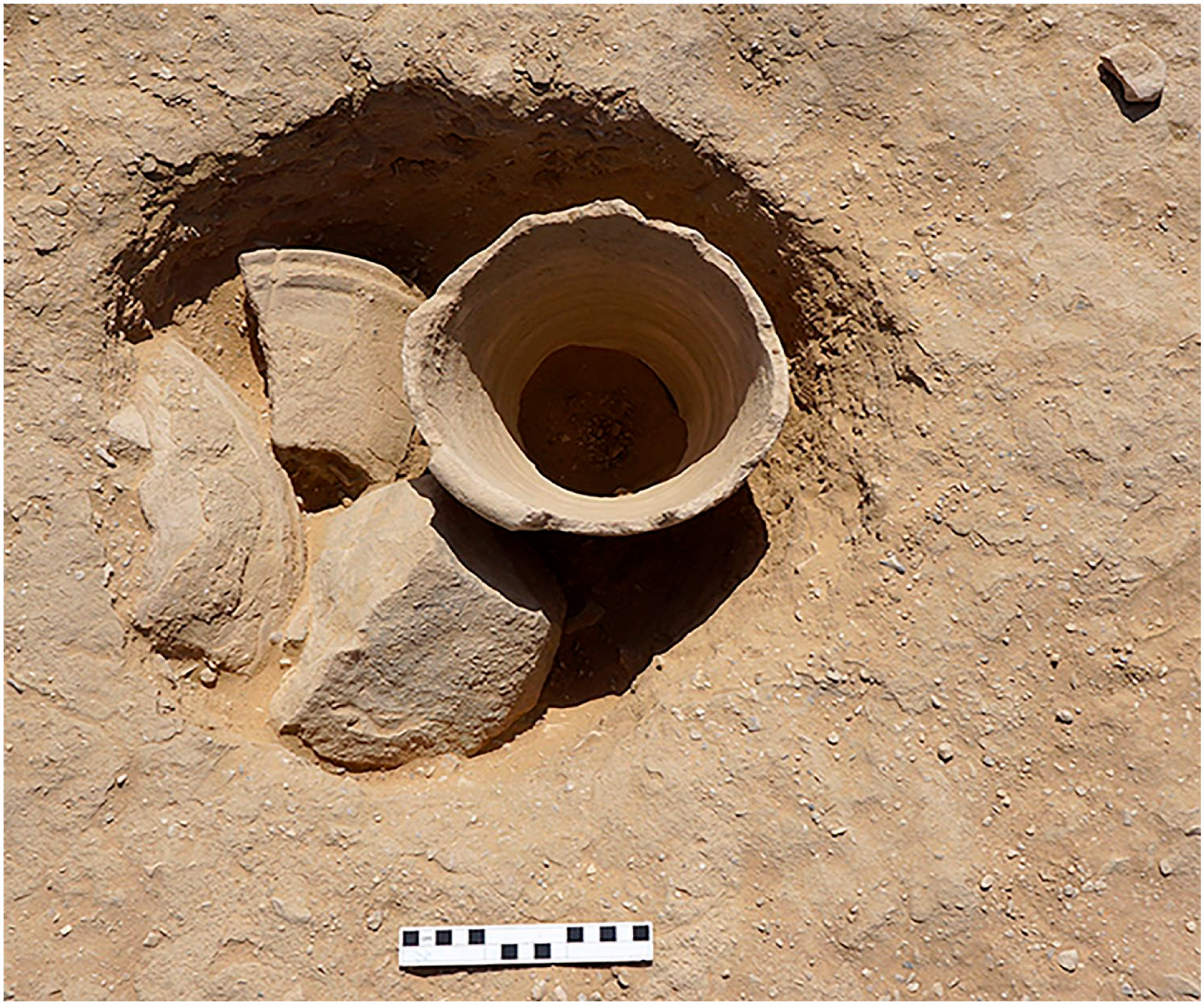
The pot (obj. 44135) in situ within pit <20398> and stabilised by a medium-sized unworked lump of indurated limestone and a large broken hearth (obj. 44121). A fragment of a miniature vessel lies on the mud floor in the top-right corner. South is towards the top (photo: Fabien Balestra, the Amarna Project).
Sector 2: The 2022 season enabled the examination of a second zone of 100 sq. m, situated 5 m north and 15 m west of Sector 1 (figs 2, 7). The excavation suggested that the ground surface may have been levelled using a mixture of fine yellow sand, potsherds, alluvial mud, gypsum debris and jar sealings. A large and dense spread of potsherds covered the ground surface and excavations targeted the most concentrated part of the sherd scatter. The work revealed several further pot holes (Table 2), pits, a clay-lined pit resembling a potter’s puddling-pit and a sunken fireplace. All of these hollow structures had cut a brownish trampled mud floor
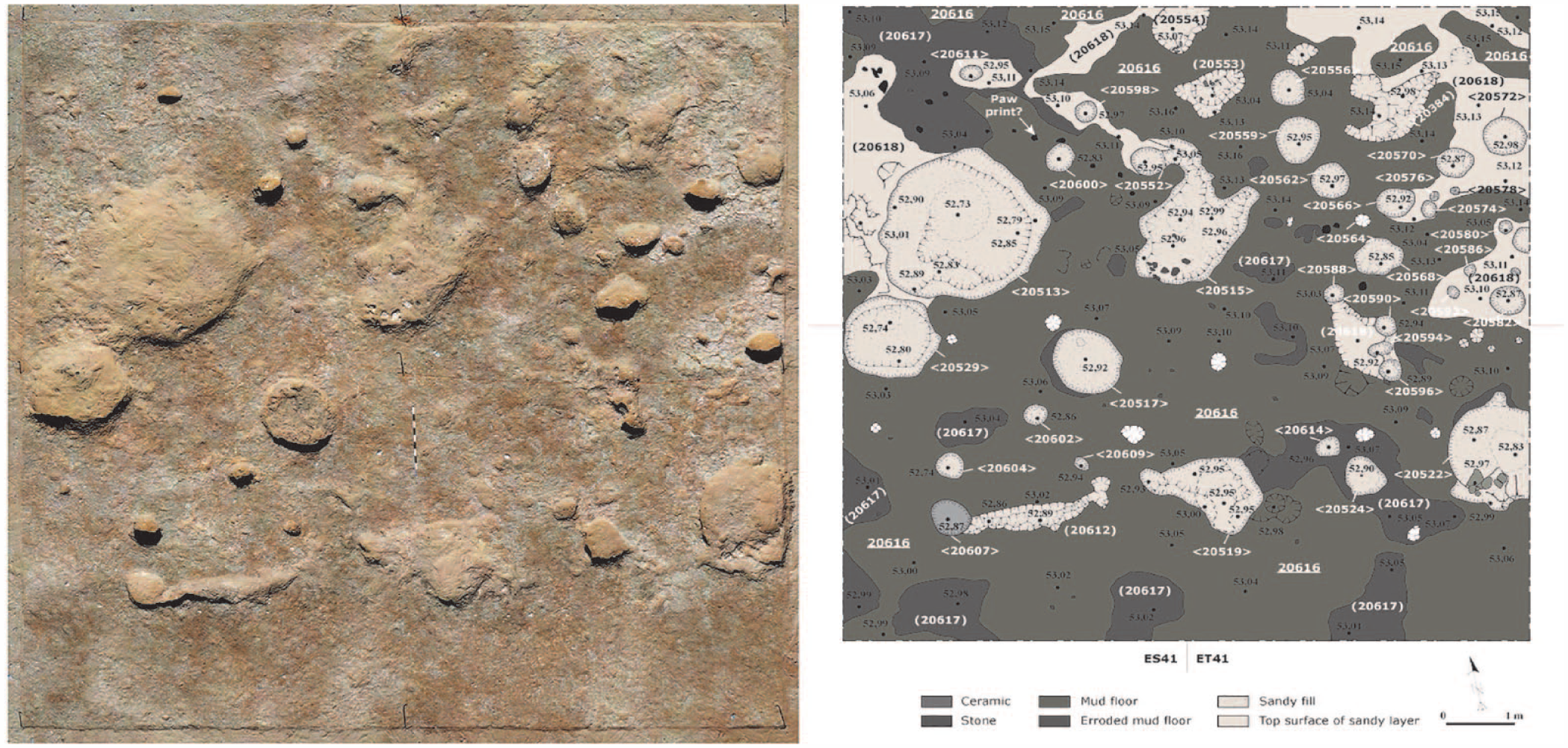
Left: Orthomosaic of Sector 2 at the end of the work. North is to the top. Right: Final plan of Sector 2 (images: Fabien Balestra, the Amarna Project).
Summary of the pot holes and pits discovered in Sector 2.
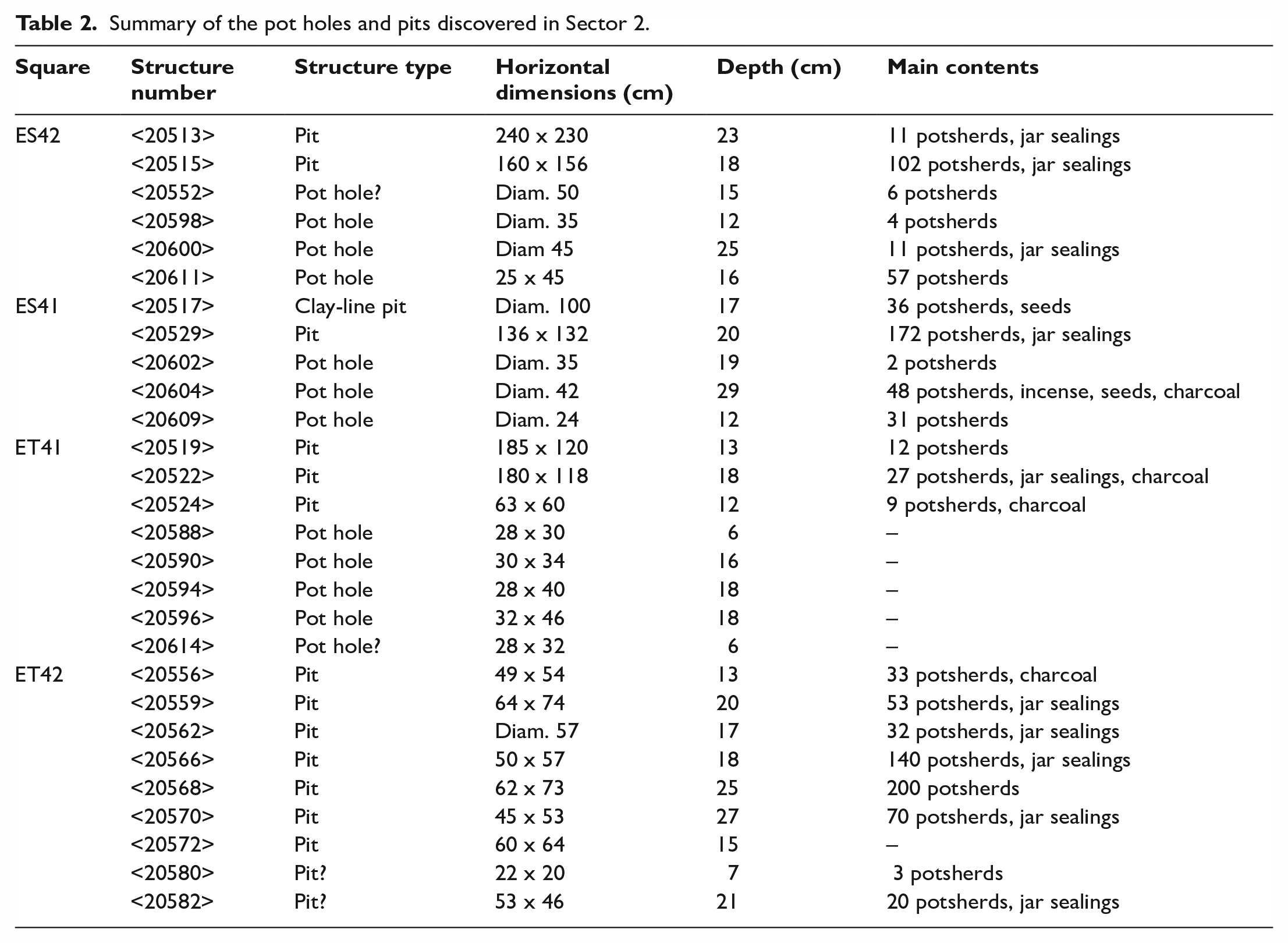
The hollow structures seemed gradually to diminish towards the temple axis, resulting in an untouched floor along the southern edge of the excavation area. Most contained potsherds and several contained jar sealings (fig. 8). A few of the hollow structures can again be singled out for further comment. Pot hole <20604> yielded a group of sherds with attached mud (mortar?) that bore plant and stem impressions. The mud was similar to roofing-plaster, although finer. The pit fill also included grape seeds, 11 and some incense (fig. 5). While most incense this season comprised dark ruddy-orange filaments, these pieces took the form of fine brownish filaments and lumps. Similar material has been found under a gypsum-concrete foundation in the Fourth Court of the Long Temple. Further analysis is needed to ascertain why there is this difference in colour and appearance. Is it perhaps a result of different qualities and components of the incense or its preparation (e.g., pouring the liquid resin through a strainer)? In the centre of the excavation area, two pits are worth citing: pit <20515>, of irregular shape, contained an undecorated wavy-rimmed pottery bowl. 12 Pit <20517>, measuring 1 m in diameter and 17 cm deep, had a clay base layer extending up the edges, and in its size and clay lining is reminiscent of a potter’s puddling-pit. 13 Its excavation revealed grape seeds in large quantities and good condition. 14 Circular marks in its base were perhaps the impressions of small pots, or the remains of animal burrows (fig. 8). Finally, the distribution of the pits in the north-west corner of the excavation area may imply that they belong to a contemporaneous event: they all gather in a roughly circular pattern, although their full extent remains to be exposed (fig. 7).
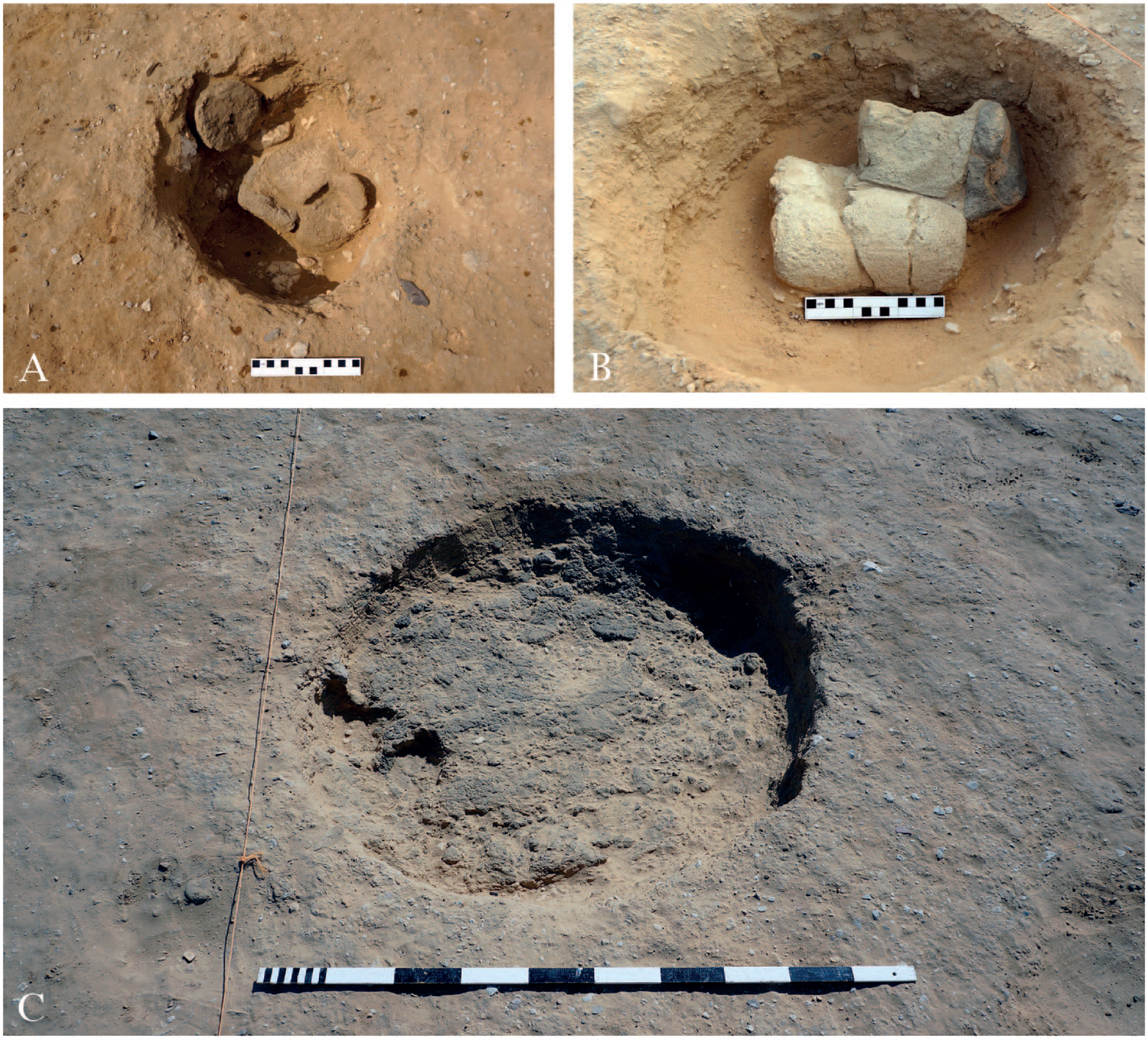
Groups of jar sealings found (A) in pot hole <20600> and (B) in pit <20582>. C: The clay base of the possible puddling-pit <20517>. Two potential pot impressions or animal burrows are on the left. North is to the left (photos: Fabien Balestra, the Amarna Project).
Post-Amarna Period
After the Amarna Period, the temple was no longer maintained and started to be an open quarry. 15 The desertion of the area is visible in the few layers of windblown sand deposited over time, including after the early EES excavation, which left the zone open to the elements. In 2021, some remains of architectural collapse were encountered, but none were present this season. Modern tyre tracks were noted crossing the excavation area; the tracks penetrate deep into the upper fill of the ramp before turning northwards, flattening part of the north ramp wall. The archaeological site also remains under threat from natural elements, including strong rains and eroding winds.
Artefacts, pottery and biological materials
The excavation yielded many small artefacts (including beads, inlays and working pieces) and some environmental materials (charcoal, animal bone and others). Faience items are exemplified by very thin unidentifiable lumps and some beads. The glass objects are illustrated by rods and some tiny lumps. A few worked alabaster pieces were discovered, mainly of conical shape with one or two smooth surfaces. One very small piece of gold leaf and samples of gypsum complete the list. Surprisingly, although the excavation area lies close to the Sanctuary, no broken stonework that could have derived from its destruction was found. In terms of botanical materials, a first survey has identified seeds from dates, grapes, barley, nabq (Christ’s thorn), as well as probable vegetables. 16 The faunal material consists only of a couple of tiny bone fragments that require specialist study.
Full study of the pottery also awaits, but some preliminary observations can be made. The general amount of pottery predictably outnumbers other artefact kinds, with a large representation of standard Nile-clay vessels. This season provided a group of incense-burner fragments, along with a few pieces of charcoal with resin residues. Blue-painted pottery is barely represented. The full study of the ceramic assemblage may give insights into the nature of human activity in the area and perhaps on relationships between the Stela Site and the Sanctuary itself. The large quantity of ceramics found in some pits, particularly from the north-east corner of Sector 2, gives rise to the possibility that some sherds are the consequence of deliberate breakage.
The jar sealings (M. Bertram)
69 fragments of jar sealings from amphorae were recovered from pits and pot holes in Sector 2, which also contained large quantities of broken pottery (Table 2). The number of fragments does not represent the actual number of sealings, since these broke into pieces when the amphorae were opened. The fragments measure roughly 7 x 8 x 3.5 cm on average and most are very fragile. Nevertheless, some nearly complete tops of sealings were found. They measure c. 12 cm in diameter at the top, and often show stamp impressions. All were flat-topped. The mud is mostly of greyish-brown colour and gritty. Whilst some sealings are too delicate for further examination, figure 9 shows one of the better-preserved examples.
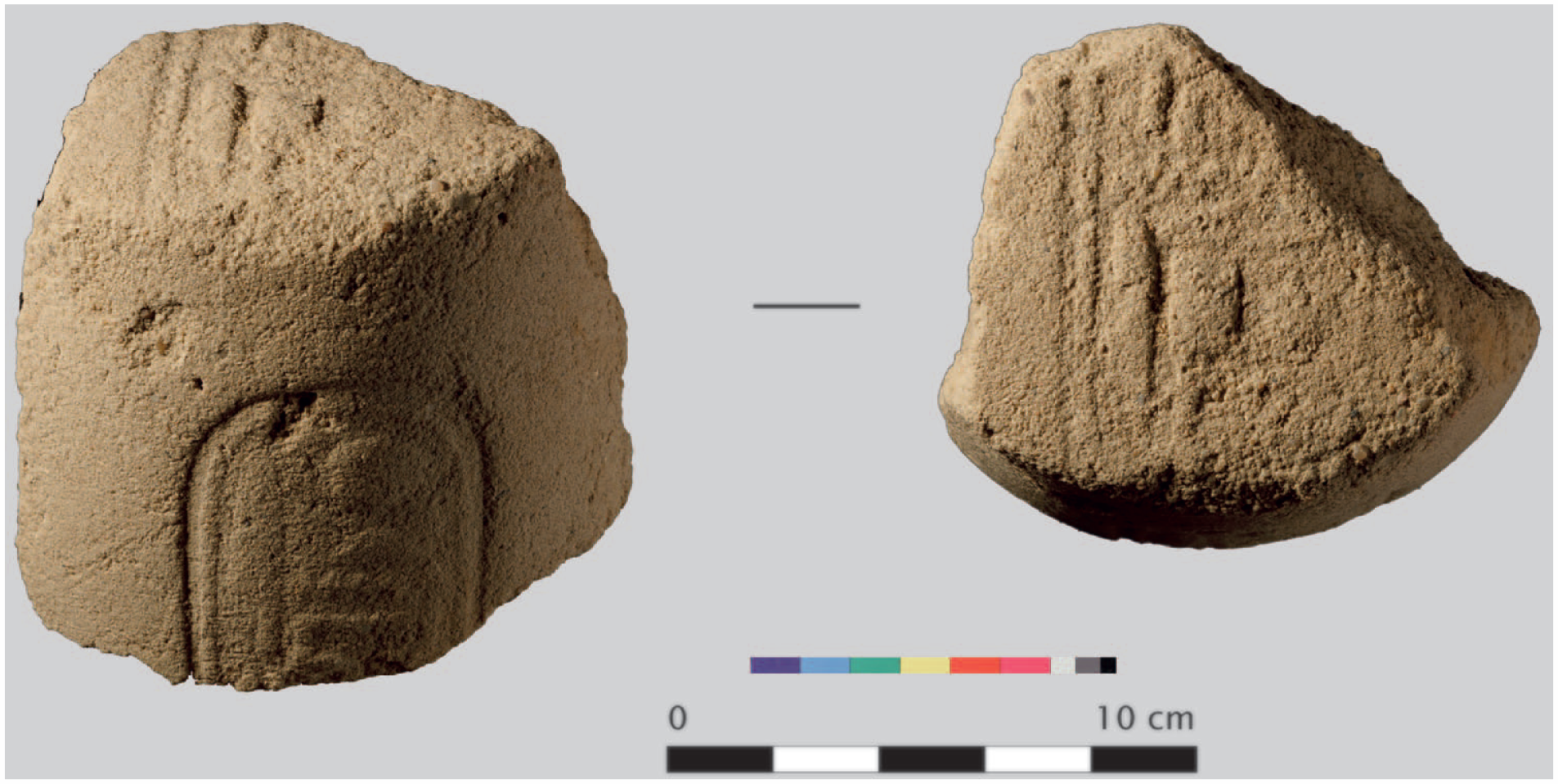
Mud jar sealing 44085 from the East Gateway site. The stamp reads ‘Wine of the House of the Aten’. For the stamp, cf. Pendlebury 1951: pl. LXXXI.43 (photos: Andreas Mesli, the Amarna Project).
All legible stamps refer either to the pr ỉtn, the ‘House of the Aten’ (Great Aten Temple) or to ỉrp (wine) or both. Some also preserve, on the inside, the impressions of the mouth, neck and/or shoulder of the jar, and occasionally imprints of the fibre or rope which was used to form a plug to prevent contamination of the wine. Some show impressions of rope that was wrapped around the neck. The origin of the wine is not stated. In general, very few fragments of amphorae were recovered from the pits. This suggests that the amphorae were re-used, probably as vessels for water carriage and storage. No stamps referring to the wine as nfr (‘good’, sometimes nfr nfr ‘of best quality’, as found at the front of the temple, for example) were amongst those examined. This and the poor quality of the sealings (compared to the more solid examples from the front of the temple) might lead to the conclusion that the wine used at the back of the temple was of poorer quality. The obvious place of origin of the sealings is the Sanctuary; the pits may represent a practice of disposal connected to the activities within this building. Scenes in the rock tomb of Meryra suggest that amphorae were amongst the offerings in the Sanctuary, though it cannot be proved that they contained wine. 17 The reliefs show them as unsealed vessels set up at the entrance to the Sanctuary.
Discussion
After two seasons, ten squares have now been excavated in the vicinity of the East Gateway (Sector 1). The excavation provides evidence of only one main activity/building phase here, whereas several have been observed in the western part of the temple complex. The fieldwork documents the existence of the (public?) eastern entrance, accessible from a low mud-brick ramp and threshold which appears to lead people towards the back door of the Sanctuary. The excavation has revealed evidence of activities having taken place on the sides of the pathway immediately inside the temple entrance, although their nature remains unclear. Thus far, no trace has emerged of a built structure of any kind, even one of wooden poles. Only pits, pot holes and fireplaces were noticed, some of which were possibly linked to guarding in view of their proximity to the entranceway.
In Sector 2, in the open space further inside the enclosure, the four squares excavated in 2022 revealed several hollow structures (pits and pot holes) which contained a significant quantity of pottery. Botanical remains and fragments of jar-sealings were also encountered, the latter of different composition from those uncovered elsewhere at the Great Aten Temple. The structures seem gradually to diminish in the direction of the temple axis, leaving an untouched area of mud-floor. A preliminary interpretation of the hollow structures found in Sector 2 is that they represent a practice of disposal connected to activities related to the nearby Sanctuary. Located about 15 m west of the excavation area, the back door of the Sanctuary almost faced Sector 2, as shown in the scenes in the tombs of Meryra and Panehsy. 18 These scenes depict offering-tables and offering-stands within rooms and courts, upon which are laid food, jars for liquids (including amphorae), incense burners and floral bouquets. The intentional breakage of vessels during a specific ritual may also be a possibility. 19 Finally, the excavation seems to demonstrate that the ground surface was raised during the Amarna Period, presumably after the remodelling of the Sanctuary.
Excavations at the North Desert Cemetery (A. Stevens)
Background
From 7 November to 19 December, the Amarna Project continued its long-term study of the non-elite cemeteries of Amarna, with a third season of excavations at the North Desert Cemetery. This was the last season of fieldwork planned at the Amarna cemeteries, at least for the immediate future, although substantial post-excavation work remains. The 2022 excavation team comprised Anna Stevens, Melinda King Wetzel and Wendy Dolling (site supervisors), Gretchen Dabbs (bioarchaeological director), Sarah Ricketts, Nick Brown, Sofie Schiødt and thirteen workmen from El-Hagg Qandil and El-Till: Waleed Mohamed Omar, Ahmed Mokhtar Mahmoud, Abdel Hafiz Abdel Aziz, Abdel Malek Mohamed, Mohamed Saleh Osman, Ahmed Mohamed Abdel Moyein, Bakr Amin Abdel Rahman, Abu Zeyd Ezz El Din, Mohamed Rabia Fatih, Mohamed Mahmoud Mohamed, Shahata Mohamed Sayed, Yahya Saddiq Abdel Fattah, Nassar Sayed Nassar and Mohamed Rafat Rabia. Other members of the research team were Pamela Rose and Anna Garnett (ceramics), Alan Clapham (archaeobotany), Amandine Mérat (textiles), Jolanda Bos (hair), Ciarra Myers-Rinehart (bioarchaeology), Alice Salvador (illustrator), Amélie Deblauwe (photography) and Paul Docherty (photogrammetry).
The North Desert Cemetery is one of three burial grounds in the northern part of the Amarna bay (fig. 1), lying in the low desert around 600 m west of the North Tombs. Two previous field seasons had been conducted here, in 2018 and 2021. 20 The cemetery is located at the end of a low plateau of outcropping desert clay and soft rock which branches across the desert floor (figs 10–11). Burials of different types occur here in four main zones. There are:
Pit graves on a low sandy terrace on the desert floor north of the low plateau.
Shaft-and-chamber tombs on top of the plateau.
Pit graves and shaft-and-chamber tombs within a small wadi that extends down from the plateau to the desert floor.
Pit graves situated around the sloping edges of the plateau.
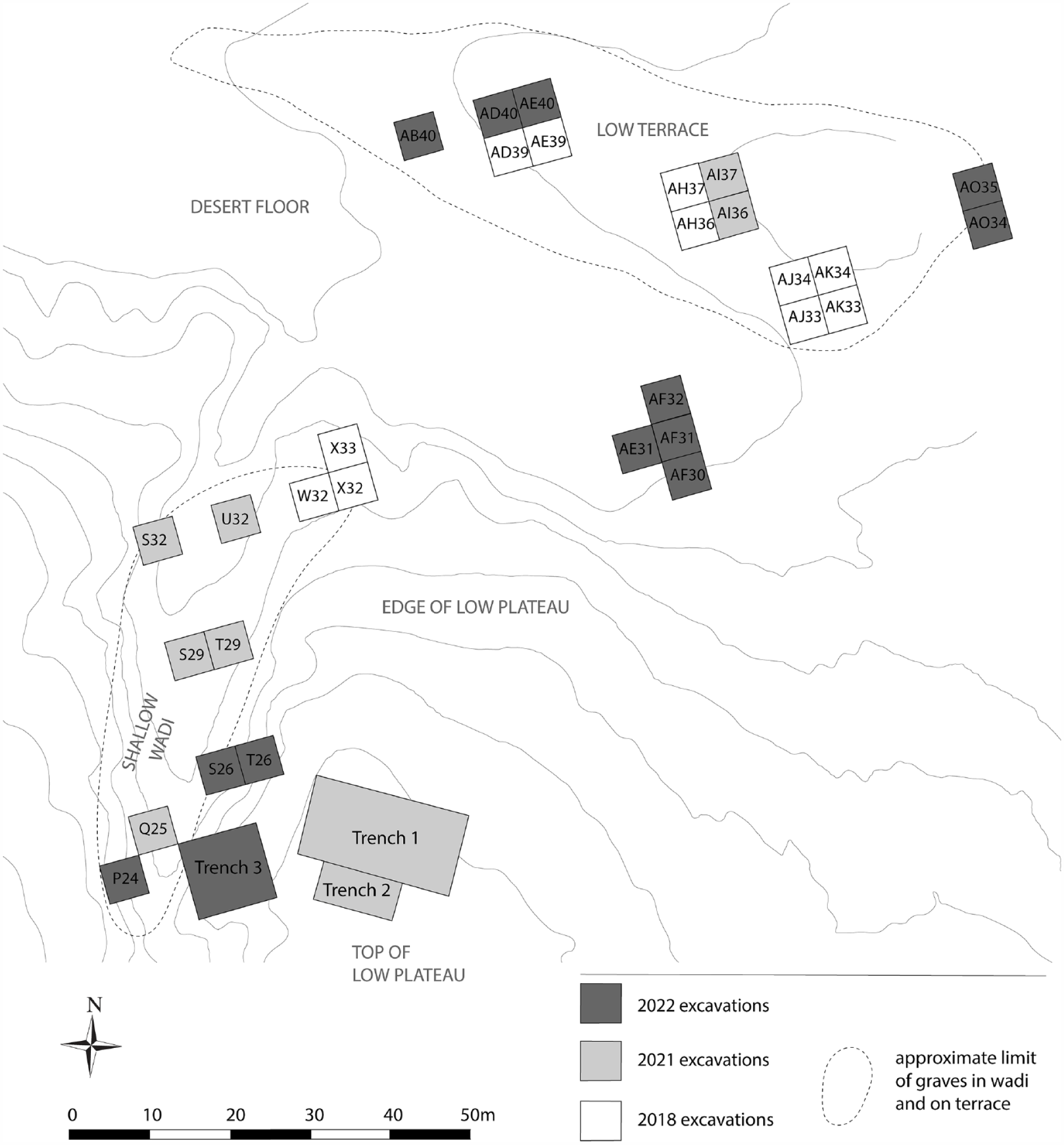
Preliminary map of the North Desert Cemetery, showing the areas excavated across the three excavation seasons in 2018, 2021 and 2022. Note that Trench 3 and square P24 were investigated across 2021 and 2022. The contour lines are at 50 cm intervals (base map: Wendy Dolling).
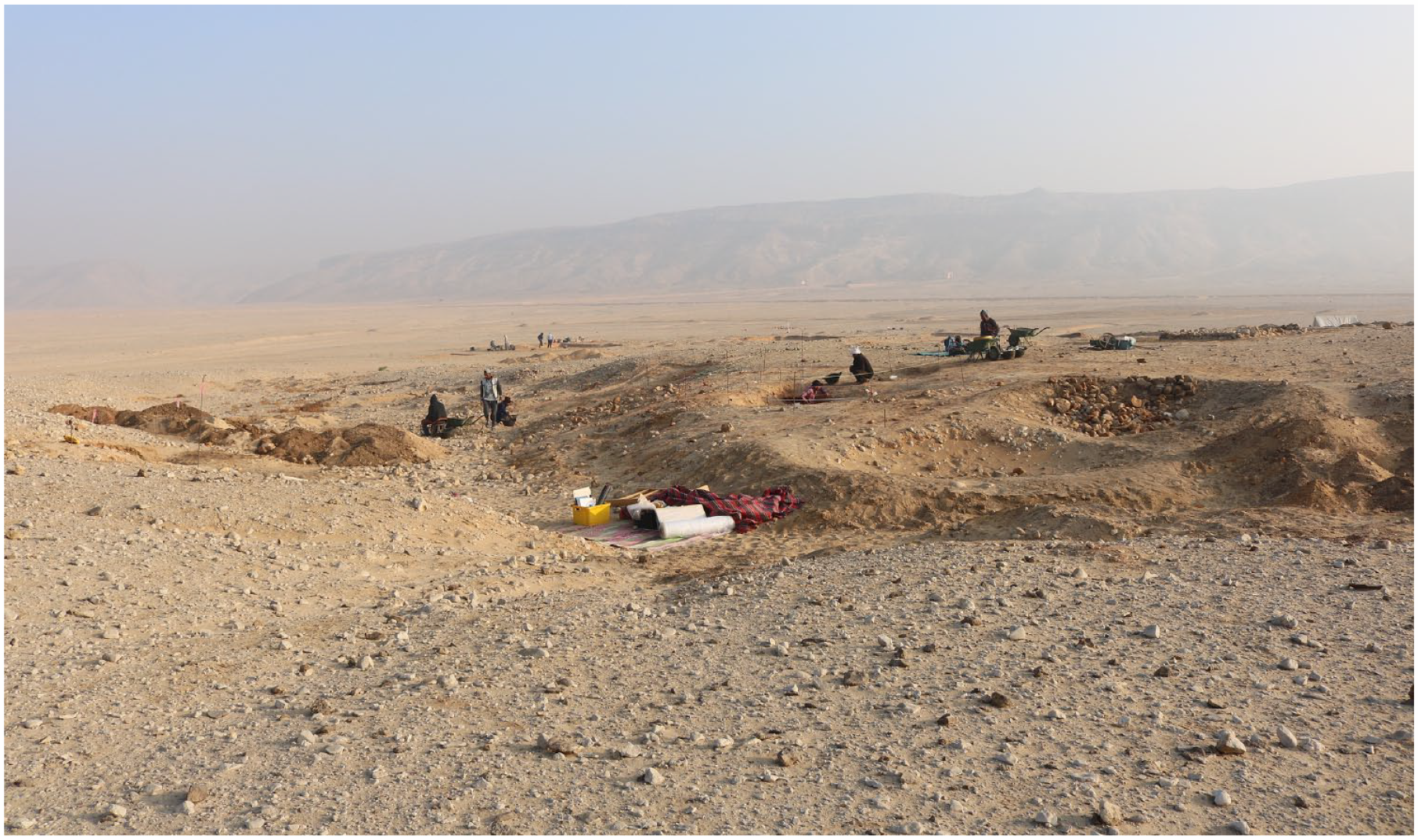
A view across the North Desert Cemetery during excavations in 2022, facing north-east. The dark spoil heaps in the immediate left of the image surround Tomb 3 in square P24. Tomb 2 in Trench 3 is in the centre of the image. In the distant background, excavations are underway on the low terrace. (Photo: Anna Stevens, the Amarna Project).
The 2018 and 2021 excavation seasons investigated a total of 43 pit graves from the low terrace, the wadi and the edges of the plateau (figs 12–13). Across the two seasons, one large and heavily robbed shaft-and-chamber tomb was cleared on top of the plateau (Tomb 1, in Trench 1), along with an adjacent rectangular structure, probably a chapel (Structure 1, in Trench 2) (see figs 22–23). In total, at least 64 individuals were recovered during these two field seasons. In 2021, two further shaft-and-chamber tombs had been partly cleared: a large tomb to the southwest of Tomb 1 on top of the plateau (Tomb 2 in Trench 3), and a smaller tomb in the wadi nearby (Tomb 3 in square P24). The main aim of the 2022 season was to complete the excavation and recording of these two tombs. The season also provided the opportunity to increase the sample of pit graves from the low terrace, to further investigate the wadi, and to examine a few robbers’ pits and some scattered surface bone on the northeast side of the plateau (figs 12–13). Three small drystone structures built of limestone boulders on the outskirts of the cemetery were also recorded. One was a U-shaped structure measuring c. 3 x 2.5 m located on the low desert c. 30 m north-east of the cemetery. It may originally have been built to two or three courses of stone. It was cleared of the windblown sand that had banked around the stones, and then planned. The other two structures were located on top of the low plateau to the west of the cemetery. Both were small and oblong, and perhaps never built up beyond one course, at least in stone, to judge from the limited stone rubble in their vicinity. They were planned but left unexcavated. All have the appearance of small guard posts, or similar emplacements, connected with the policing of the eastern desert border of Akhetaten, and perhaps of the North Desert Cemetery itself.
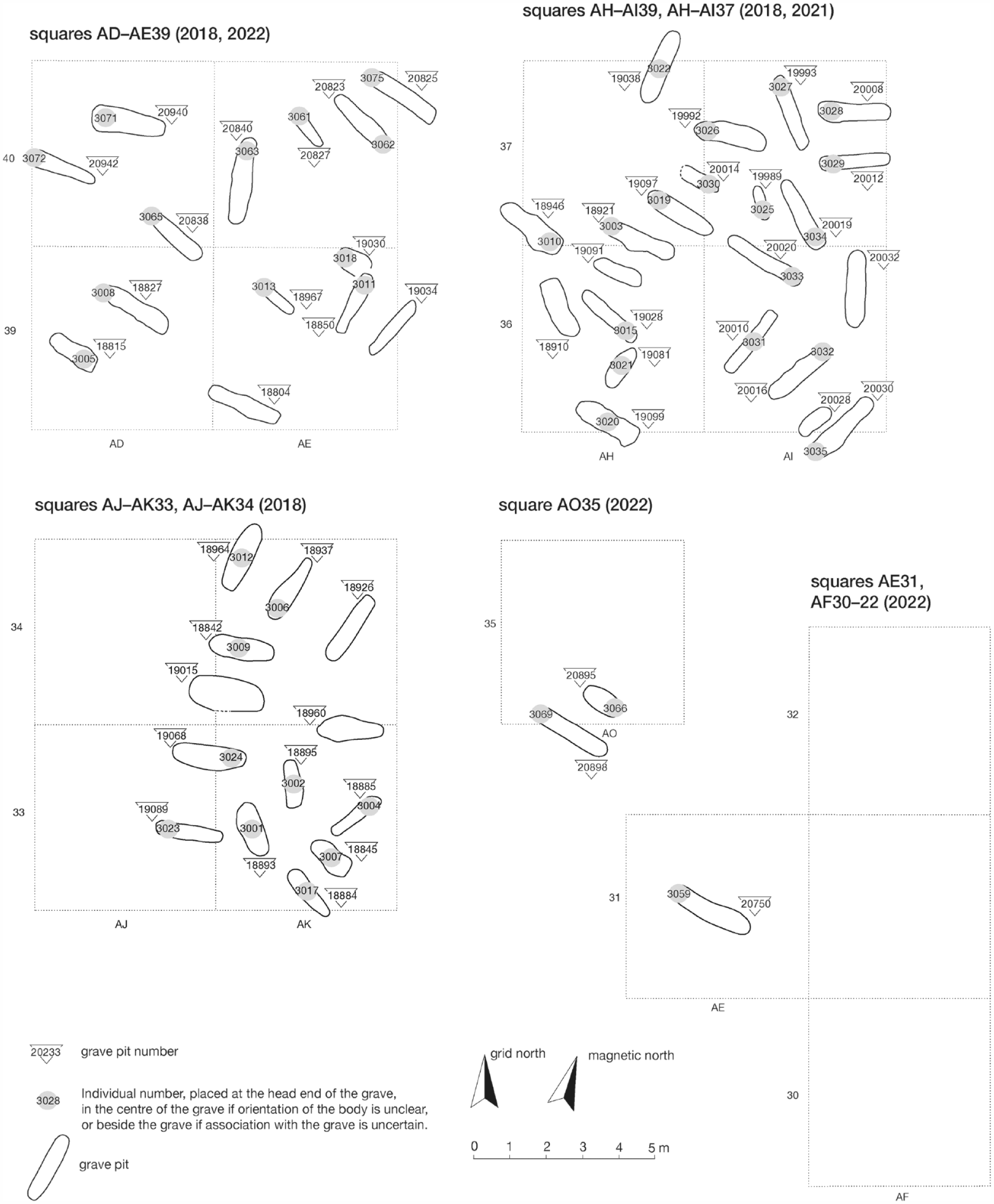
Pit graves excavated on the desert terrace and around the north-east edge of the low plateau across 2018, 2021 and 2022. See figure 10 for the locations of the grid squares (map: Anna Stevens, the Amarna Project).
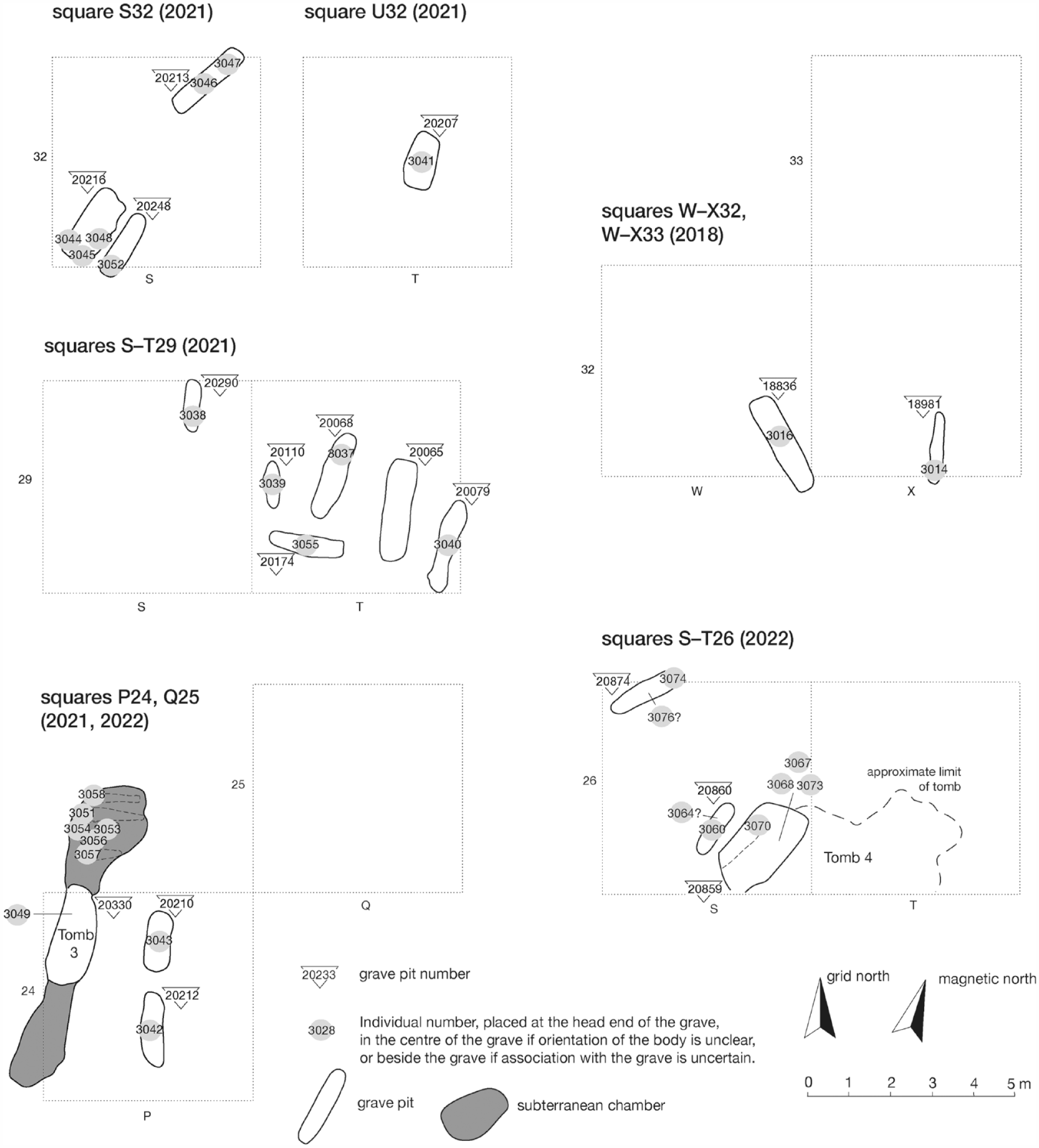
Pit graves excavated in the wadi across 2018, 2021 and 2022. Tomb 3 is also marked, in square P24. See figure 10 for the locations of the grid squares (map: Anna Stevens, the Amarna Project).
Preliminary excavation results
Low terrace. This area of the site is covered by looters’ pits, partly filled with windblown sand, that have been cut into ancient graves, with adjacent piles of spoil. Human bone and pottery are scattered over the surface of the site. In 2022, five squares were opened here: AB40, AD40, AE40, AO34 and AO35 (fig. 12). Square AB40 was situated beyond the western edge of the robbers’ pits to test whether graves extended this far, but none were encountered. All of the other squares contained graves: nine in total, with individuals recovered from each of these. All individuals had been buried singly and, as standard for the Amarna cemeteries, wrapped in textile and matting. Gereed matting was the most common. Apart from occasional potsherds, no objects were recovered from these graves, although all but one had been disturbed by looters.
Plateau edges
Four excavation squares were situated on the north-east edge of the low plateau, near two small water channels that branch down to the desert floor (figs 10, 12). AE 31 had a robbers’ pit cut into the surface, which resolved during excavation into a grave that contained the disturbed remains of one individual (Ind. 3059). The removal of surface sand and gravel in the other squares quickly exposed the reddish clay gebel with no sign of additional graves. There are few other obvious robbers’ pits and little surface bone and pottery in this part of the site which suggests that the grave of Ind. 3059 was an isolated burial.
Wadi
Tomb 3 in square P24: 21 Tomb 3 consists of a rectangular shaft c. 2.2 x 1 m across and 3 m deep, with small chambers extending to the north and south (figs 13–14). In the 2021 season, the shaft and north chamber were partly cleared of fill, and the tomb was fully excavated in 2022. The tomb is cut into the natural gebel clay, which was devoid of any brick or plaster facing. Both chambers are similar in construction, although the northern chamber (c. 2.1 m long x 2.2 m wide, 1.1 m high) is larger than the south (c. 2.5 x 1.1 x 0.8 m). The tops of both entrances are arched and there is some evidence that each was sealed with mudbrick, though none remained in situ. The floors of the chambers are relatively flat and sit approximately 1 m above the floor of the shaft. The tomb had been looted. The south chamber had been completely emptied of its contents, although its elongated shape and its size could suggest that it held a painted wooden coffin, small pieces of which were found in the tomb fill. The north chamber, however, still contained six interments, while parts of an infant (Ind. 3049), an adult skull (Skull 3029) and other fragmentary adult skeletal remains were recovered from disturbed deposits within the shaft.
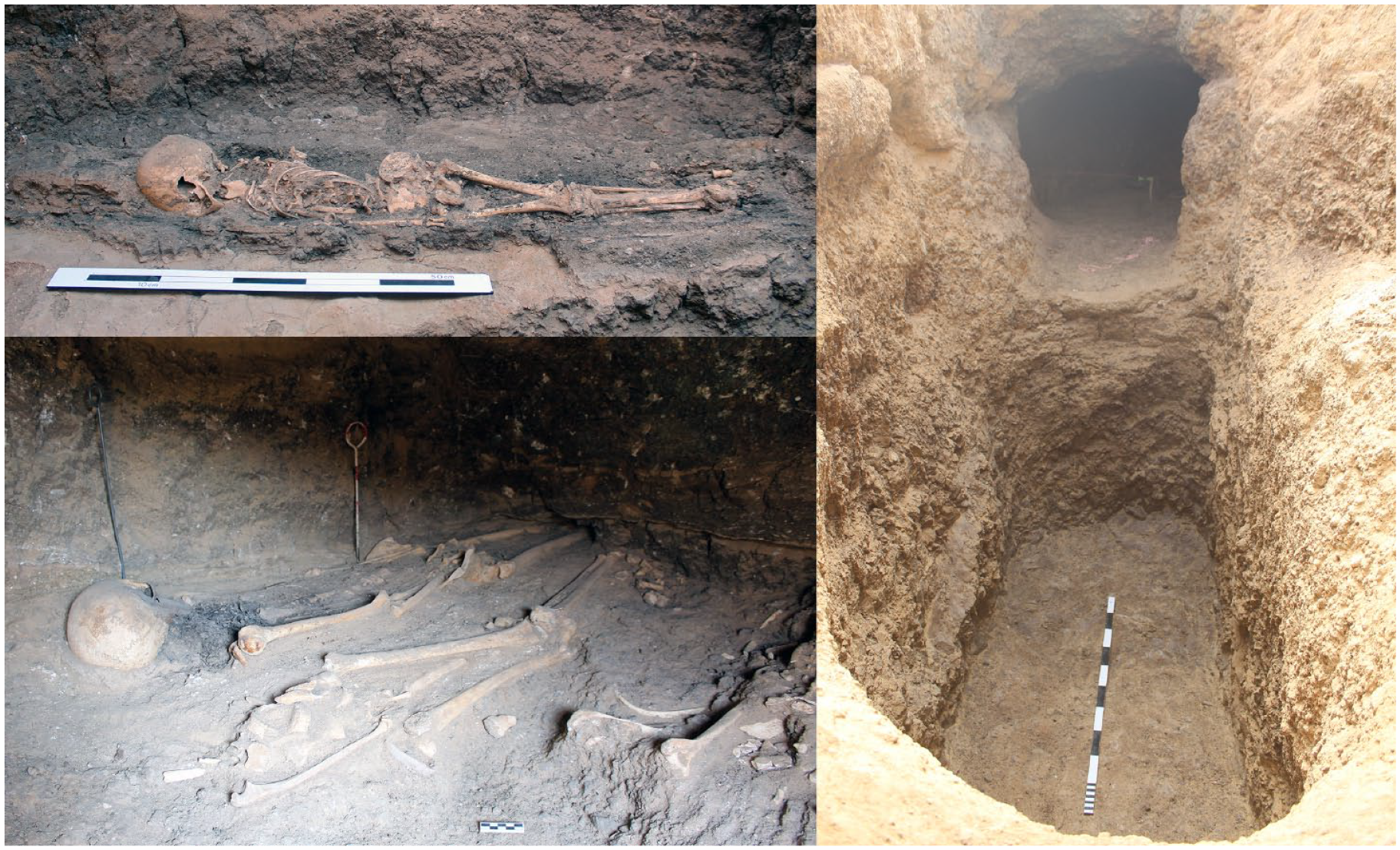
Tomb 3 during excavation. The image on the right shows the shaft with the north chamber in the background (facing north). On the bottom left are some of the interments in the north chamber (facing northwest). The undisturbed interment of Ind. 3051 is on the far left. As the dense fill to the left of this individual was excavated, the intact burial of Ind. 3058 was exposed. It is shown in the top left (facing northwest) (photos: Melinda King Wetzel, the Amarna Project).
The north chamber was filled with brown silt and sand that was difficult to distinguish from the gebel and which grew increasingly dense northwards. The four interments nearest the entrance were all partly disturbed, and some skeletal elements were comingled (Inds 3053, 3054, 3056, 3057); 22 all were likely once wrapped in textile and matting. At the north end of the chamber there were two undisturbed burials: a young adult female aged around 18–21 years (Ind. 3051) and a subadult (Ind. 3058), each in a mat coffin. No textile wrapping survived on Ind. 3051, but a few small patches were preserved on Ind. 3058.
Individual 3051 wore a necklace made of hollow drop-shaped gold beads and three rings, the latter all on the left fourth digit (fig. 15):
Obj. 44137: A solid gold ring with oval bezel showing a dancing Bes figure in sunk relief holding a sȝ-sign and a snake or snake-shaped wand.
Obj. 44138: A gold ring with a swivelling bezel formed of a steatite scarab in a gold frame. The surface of the scarab is somewhat degraded, but is not obviously inscribed or decorated.
Obj. 44139: A steatite cowroid bead set in a gold frame to form a bezel that was perhaps attached to the finger with a piece of string (which did not survive). The underside of the bezel is finely carved with a hieroglyphic inscription, described below.
Obj. 44147: A necklace of 56 hollow drop-shaped pendants and four small ring beads, all made of gold sheet.
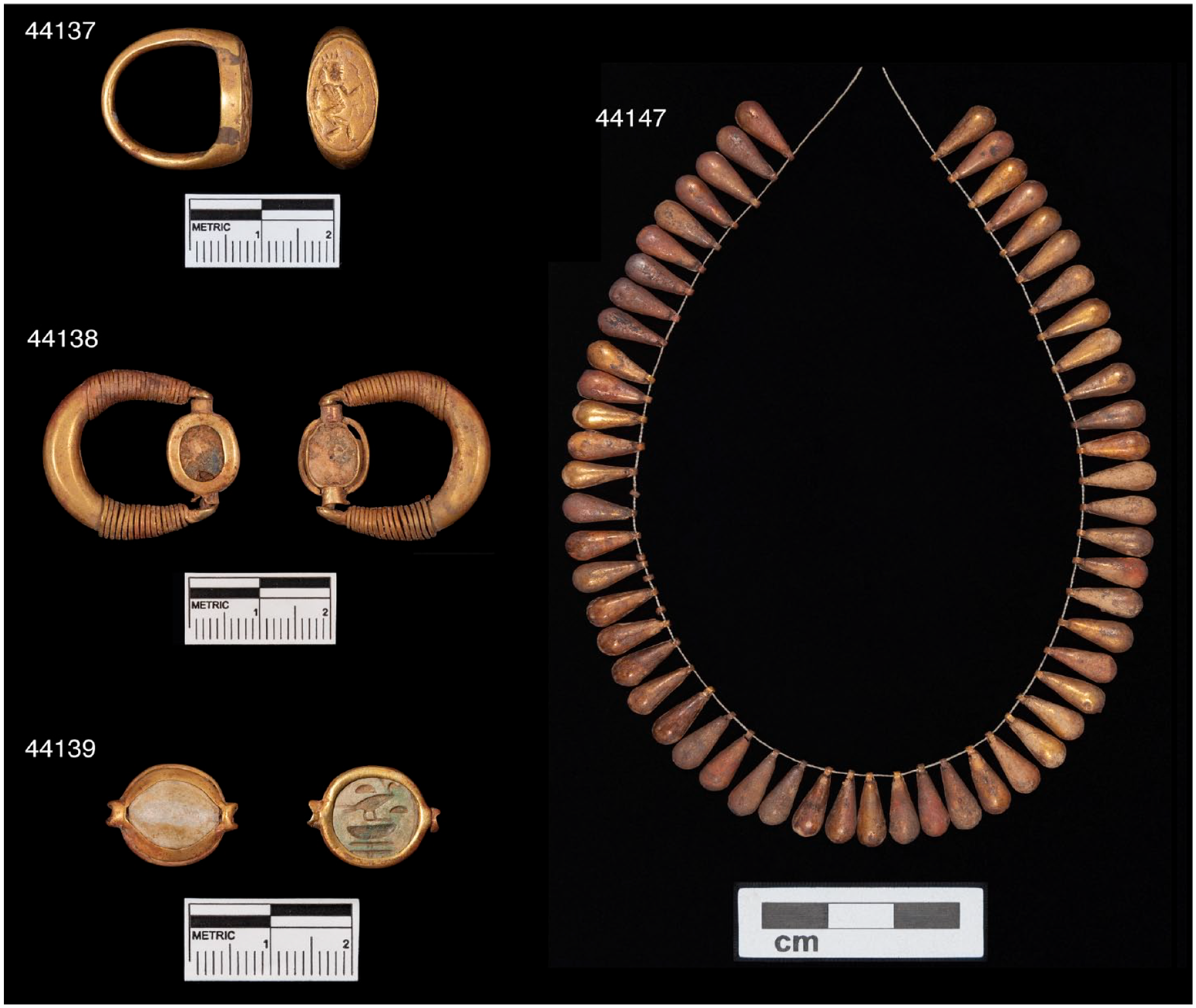
Finger rings and necklace from the interment of Ind. 3051 in Tomb 3. The string and stringing order of the pendants are not original (photos: Amélie Deblauwe, the Amarna Project).
Also associated with Ind. 3051 was part of a wooden kohl tube, a piece of kohl, and four flat ivory or bone elements, which are probably inlays. Ind. 3058 lay parallel and just to the north of Ind. 3051. As the lower layer of its mat coffin was lifted, a small piece of degraded tamarisk was noted, lying in a void in the floor of the chamber. The void seemed to be an impression of an anthropoid figure. Dental-grade putty was used to make a cast of the hollow, producing a copy of the back of the figure showing a striated wig or hair, two arms bent at the elbows, and the body down to the ankles. The figure is presumably a shabti, and is the first example of such recovered from the non-elite cemeteries at Amarna.
Squares S26 and T26, including Tomb 4: 23 There were two disturbed pit graves in square S26 (fig. 13), one containing a single individual and the other a double burial. The removal of surface deposits across S26 and T26 also revealed a large looters’ pit, which had been cut into a further shaft-and-chamber tomb (Tomb 4). There was not enough time to fully expose and record the tomb, so excavation was stopped after the looters’ pit was cleared, at a depth of c. 1.5m. This exposed one interment, an adult (Ind. 3070) wrapped in matting. It probably lay in a chamber that the robbers had tunnelled into from above. To the north and south there were two voids that may represent a continuation of the chamber, while the original shaft seems to lie to the east, filled with compact layers of sand, gravel and redeposited gebel.
Plateau surface
Tomb 2 in Trench 3: On top of the plateau, the excavation and recording of Tomb 2, a large shaft-and-chamber tomb initially opened in 2021, was completed (figs 16–17). The tomb has a rectangular brick-lined shaft, measuring c. 2.1 x 0.9 m (excluding the brick lining) and c. 3.8 m deep, its base cut flat into the gebel. There are two small chambers, one to the north (c. 2.5 x 1.9 m and 0.8 m high) and another to the south (c. 2.0 x 1.4 m and 0.7 m high). Both were largely empty, the tomb having been badly robbed, although its fill, especially within the shaft, contained many potsherds, as well as some disarticulated bone and probable coffin wood. The north chamber had brick-lined walls and a thick brick-lined ceiling. The gebel above the chamber had, at some stage, slumped and pushed the ceiling down towards the floor. Flooding had also washed dense silt into the chamber, and robbers had subsequently cut a tunnel through part of the ceiling collapse and the floor. The southern chamber had been left unfaced, its walls and ceilings formed of the reddish-brown gebel clay. The chamber fill contained a few loose bricks, and two pieces of brick on around floor level in the south end of the chamber were possibly in situ. The entrances to both chambers had brick jambs that projected into the shaft and bore traces of red paint. The lower part of the brick lining of the shaft also preserved patches of whitewash.
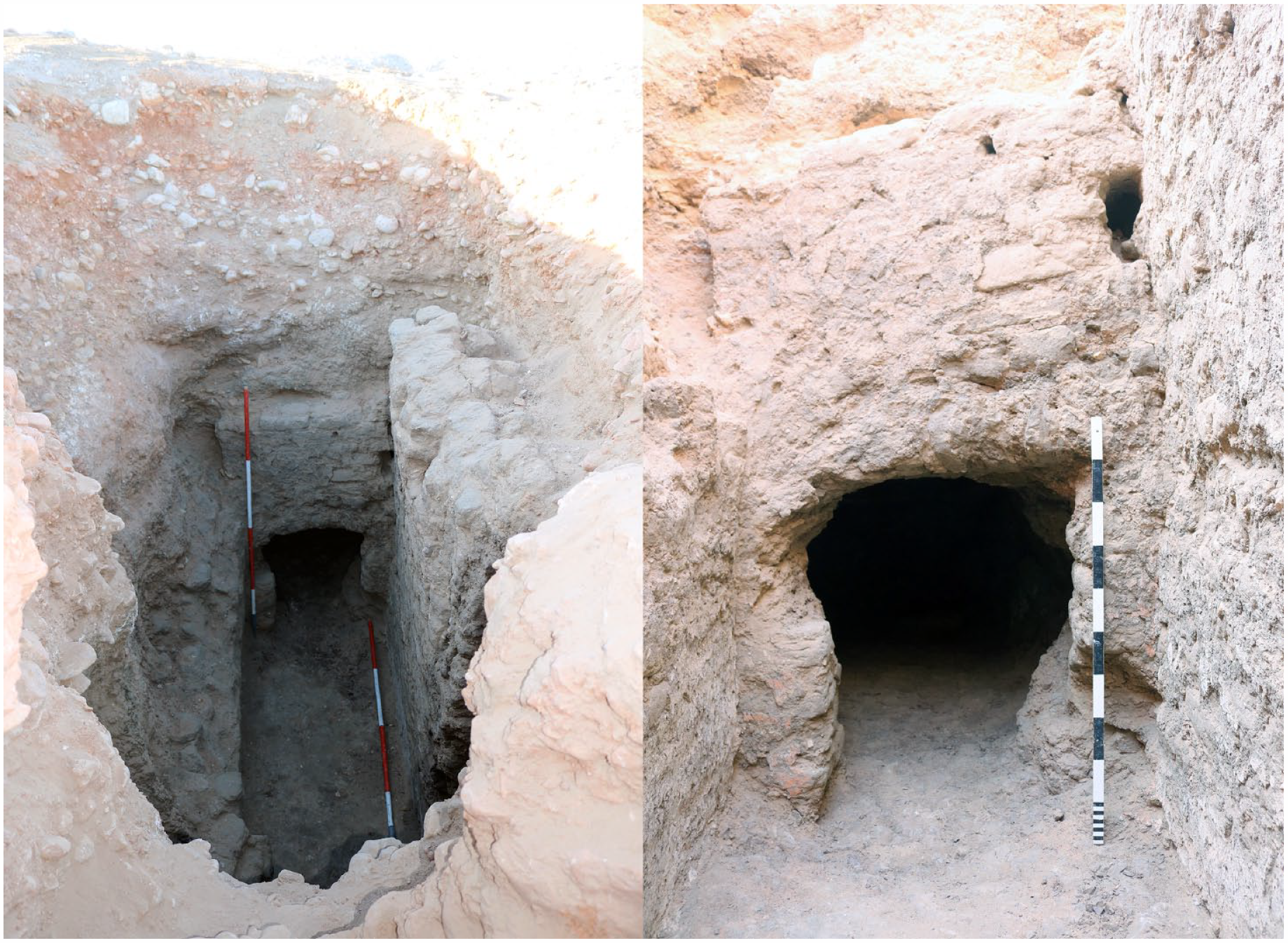
Tomb 2 post excavation, showing the view across the shaft and into the south chamber (left) and the entrance of the latter with traces of red paint on the brick jambs (right). Facing southwest (photos: Anna Stevens, the Amarna Project).
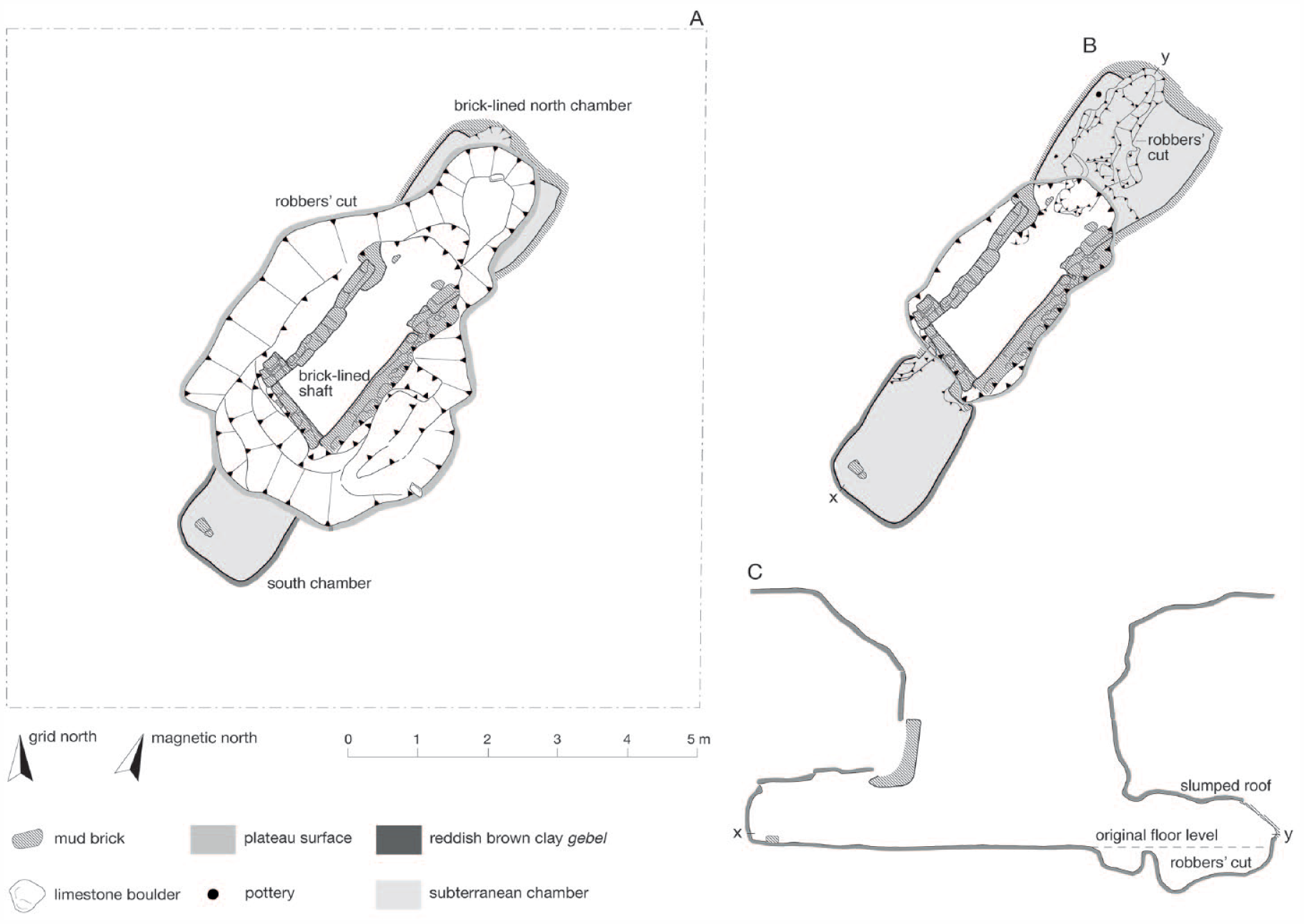
Tomb 2 in Trench 3. A: Surface-level plan showing the tomb relative to the trench edges, and the large robbers’ pit cut into the tomb shaft. B: Plan of the tomb with the detail of the robbers’ pit removed. C: Section through the shaft and tomb chambers (plans: Anna Stevens, the Amarna Project).
The bone from this tomb represents the remains of at least five individuals: one adult female, two adult males, a teenager and an infant or late-term foetus. Further analysis is needed to ascertain how many of these individuals are likely to have been buried in the tomb originally, or whether some might be intrusive.
Pottery from the North Desert Cemetery (P. Rose)
Work in 2022 concentrated on the examination and recording of the pottery from excavations in the North Desert Cemetery in 2018 and 2021. This was not completed – and work at the cemetery was ongoing during the season – so the following simply gives an overview of the material examined up to now.
The ceramics from the cemetery were, in general, in very poor condition and frequently so badly eroded that little could be said about them. This was true of both surface material and sherds found within the tombs. By far the largest quantities of ceramics came from around and within the shaft tombs; the pit graves that made up most of the cemetery had very little in or around them, and currently it does not seem likely that ceramics formed a significant component of these burials. The shaft tombs, however, clearly contained a large number of vessels, sherds of which were scattered throughout the contexts associated with the tomb. Beer jars and funnel-necked jars are the most common types found; 24 some may have been blue painted, but the effects of erosion have destroyed any remains. For an inscription on one of the funnel-necked vessels, see Schiødt below. Open silt forms are far less common, consisting of small offering dishes, simple bowls and occasional larger hearth-like forms, and marl vessels, whilst present, are rare: they include a mug of marl A4 25 and amphorae of marl D. 26 Fragments of imported Canaanite amphorae only occurred in deposits from Tomb 2/Trench 3. This tomb produced the largest quantity of sherds of those excavated so far including small sherds of a very fine silt blue-painted bowl.
In and around Tomb 1 were late Roman ceramics, and the tomb presumably lay open at that time. They represent a range of types, including amphorae of Dixneuf’s type AE7 (at least 10, from the number of toes recovered), 27 bowls of both silt and Aswani manufacture, silt cooking vessels (apparently pots rather than casseroles), and at least two marl clay ribbed spouted flasks with filter necks and painted decoration. The quantity and range of types suggest longer-term activity there rather than, for example, supplies for those involved in looting. All the types found, except the marl clay flasks, can be paralleled amongst the late Roman ceramics from the Christian Period settlement at the North Tombs. 28 Since the tomb’s elevated position gives it an excellent view over the desert to the north and east, including the North Tombs, the outpost represented by the pottery may have been connected with control of people or supplies going to the North Tombs settlement.
Two other vessels post-dated the New Kingdom. One was a complete and heavy silt jar from Tomb 3 and the other the central part of a large, handled silt jar, the sherds of which came from numerous contexts in and around Tomb 1 and one from the surface over 50 m to the northeast. This preserved the entire body but no rim nor lower body/base. On the basis of parallels with ceramics from the South Tombs, these date to c. the 25th Dynasty. 29 Currently, no other vessels of this date have been found in the North Desert Cemetery and it is uncertain why the vessels – particularly given the apparently reused nature of the large jar – were present.
Throughout the assemblage were sherds that were repurposed as scrapers. Whilst some of these might result from wind erosion, some were certainly used for digging and attest to the looting of the tombs. All the identified scrapers are of New Kingdom date and presumably were selected from the pottery scattered from the tombs themselves.
Inscribed objects from the North Desert Cemetery (S. Schiødt)
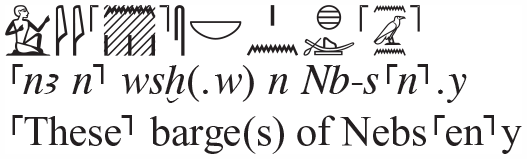
Jar with hieratic label: During the 2021/22 seasons, much of an inscribed vessel (pottery number 158002; fig. 18) was reconstructed from contexts around the mouth of Tomb 1 in the North Desert Cemetery and is assumed to originate from that tomb. Two of the fragments show a hieratic inscription written in a neat uncial hand that reads as follows:
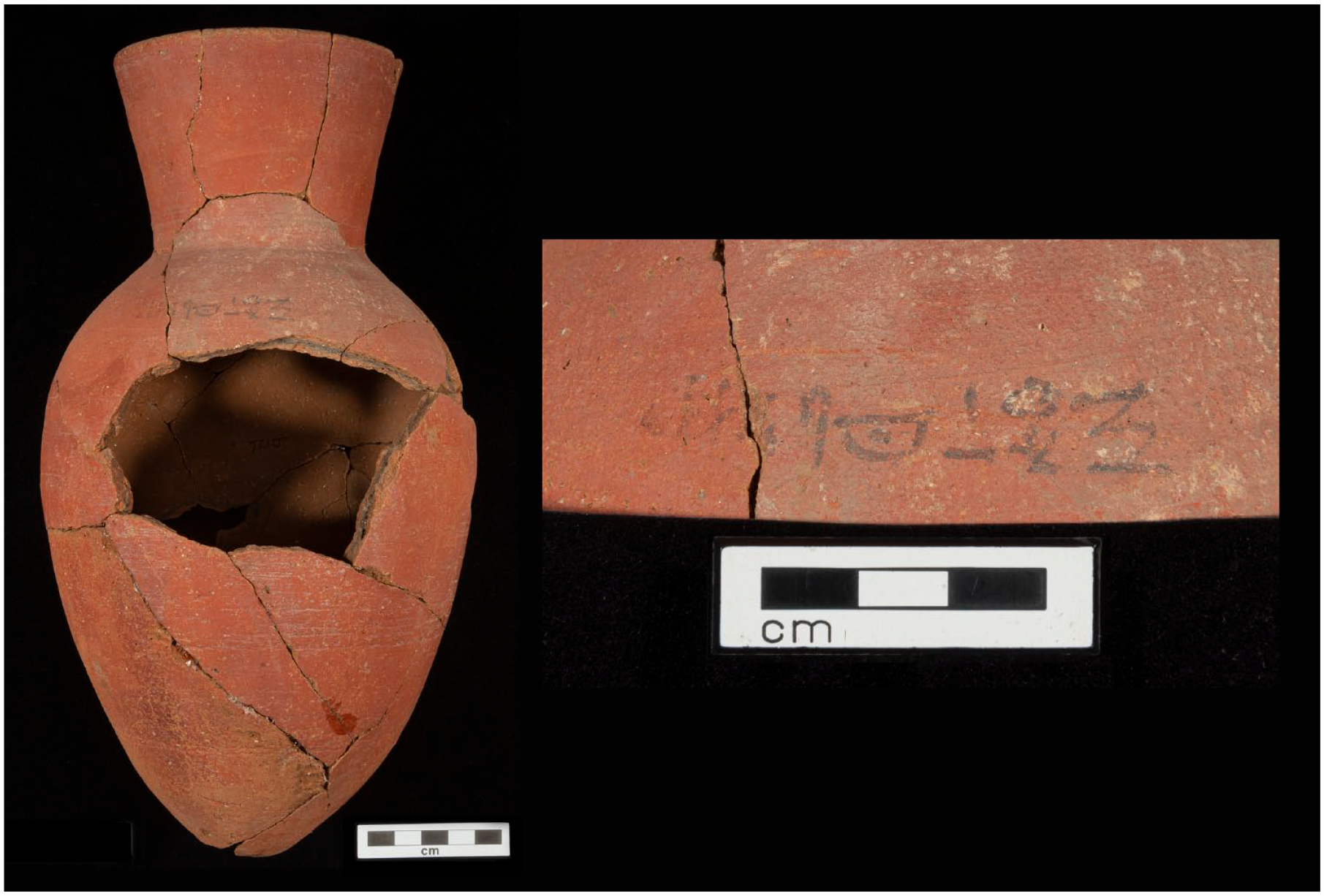
Jar with hieratic label from Tomb 1 at the North Desert Cemetery (photo: Amélie Deblauwe, the Amarna Project).
Textual notes:
The first sign group remains enigmatic. It could represent a demonstrative pronoun, perhaps the plural nȝ n, although the group is very angular. Of course, this may be due to the writing surface. Alternatively, the sign group could represent the preposition m-ʿ, ‘from’, but the uppermost stroke, especially, is a difficult fit.
Note the abbreviated form of wsḫ  , an orthography that is typically found in administrative texts.
30
Wsḫ refers to a type of boat used for transporting goods.
, an orthography that is typically found in administrative texts.
30
Wsḫ refers to a type of boat used for transporting goods.
The final part of the inscription provides a name which is partly disturbed by a break in the vessel but seems to read Nb-sn.y. 31
Commentary: Vessel inscriptions from funerary contexts typically identify the substance kept within the vessel, which either forms part of the grave goods (wine, beer, etc.) or represents remains from the mummification process (unguents, natron, etc.). The inscription in question obviously does not belong to this category of dockets but must serve some other function. I am unaware of any analogous inscriptions apart from labels consisting of a name (and occasionally title) as attested from several New Kingdom funerary contexts, which presumably identify either the donor of the vessel or someone involved in the manufacture of its content. 32 It seems unlikely, however, that the reference to ‘┌these┐ barges of Nebs┌en┐y’ serves a similar function. Instead, the inscription does not appear to relate to the ultimate funerary use of the vessel but is perhaps better categorized as a transportation/delivery note or a mark of ownership, as suggested to me by F. Hagen. 33 It is noteworthy that while the vessel type is very common both in the Amarna cemeteries and in the city, I have not come across any other inscribed examples.
With next to no information provided by the inscription, it is practically impossible to identify the individual mentioned. However, K. Gabler has brought some evidence to my attention that might be relevant in this context. It includes an 18th Dynasty letter (P. Leiden F 1996/1.1)
34
addressed to the policeman Nebseny (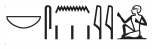 ) from the police chief Dedu and concerns a matter of some obscurity. Leaving aside the topic of the letter, it is clear from the address that Dedu is Nebseny’s superior and presumably also the superior of another man mentioned in the letter, Mahu. While Mahu is a very common name in this period, it is possible that this Mahu is to be identified with the police chief Mahu buried at the South Tombs at Amarna (ST 9). As noted by Demarée ‘the sender of this letter most probably is the captain of police Dedu known from his tomb at Khôkha, TT 200’, who held office under Thutmose III (c. 1479–1425 BCE) and Amenhotep II (c. 1427–1400 BCE).
35
Thus, in order for Dedu to overlap with Mahu, who held office under Akhenaten (c. 1352–1336 BCE), Mahu would have needed to serve as policeman at least some 50 years. Whether this is feasible is dubious, but if correct, it could provide a link between the Nebseny mentioned in the letter and the Nebseny cited on the vessel.
) from the police chief Dedu and concerns a matter of some obscurity. Leaving aside the topic of the letter, it is clear from the address that Dedu is Nebseny’s superior and presumably also the superior of another man mentioned in the letter, Mahu. While Mahu is a very common name in this period, it is possible that this Mahu is to be identified with the police chief Mahu buried at the South Tombs at Amarna (ST 9). As noted by Demarée ‘the sender of this letter most probably is the captain of police Dedu known from his tomb at Khôkha, TT 200’, who held office under Thutmose III (c. 1479–1425 BCE) and Amenhotep II (c. 1427–1400 BCE).
35
Thus, in order for Dedu to overlap with Mahu, who held office under Akhenaten (c. 1352–1336 BCE), Mahu would have needed to serve as policeman at least some 50 years. Whether this is feasible is dubious, but if correct, it could provide a link between the Nebseny mentioned in the letter and the Nebseny cited on the vessel.
Inscribed ring: One of the three rings excavated in 2022 in Tomb 3 bears a short inscription written in hieroglyphs (obj. 44139; fig. 15):
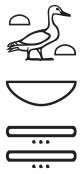
To my knowledge, this construction is found in only one other inscription (likewise dating to the New Kingdom) and is probably to be identified as a name: sȝ.t-nb-tȝ.wỉ, ‘daughter of Nebtawi’. 36 It is very unlikely that it instead provides a title, i.e., sȝ.t nb-tȝ.wỉ, ‘daughter of the Lord of the Two Lands’, since the king’s daughter is normally referred to as sȝ.t-nswt. 37
Demographic analysis of the North Desert Cemetery skeletal remains (G. R. Dabbs)
The skeletal remains of 85 individuals have been excavated in the three seasons of excavations at the North Desert Cemetery. In 2022, the demographic profile of these individuals was assessed. Sex estimations are based on the morphology of the pelvis and cranium 38 and metric analysis of the postcranial remains. 39 Age estimations are based on the morphology of the pubic symphysis 40 and auricular surface 41 for adults, and the dental development, 42 postcranial metrics, 43 and epiphyseal fusion 44 for subadults. The overall preservation of the skeletal materials was variable, and often very poor, which resulted in an inability to precisely identify the age of many individuals, especially those buried in the wadi. In total, 36 subadults (<15 years) and 49 adults were identified (fig. 24). The age division of this sample is consistent with what is expected for bioarchaeological samples, 45 with subadults representing a large proportion (42.6%) of the sample.
Poor preservation also limited the ability to estimate adult sex. Only 33 of the 49 adults (67.3%) were preserved to a degree that allowed for sex estimation (fig. 19): fifteen individuals were identified as female (45.5%) and eighteen as male (54.5%). The sex distribution is similar to that observed in the South Tombs and North Cliffs Cemeteries, 46 although in both of those samples, females have a slightly higher representation than males. This difference may be due to the small sample size from the North Desert Cemetery, or the inability to assess sex on a large proportion of the adult sample.
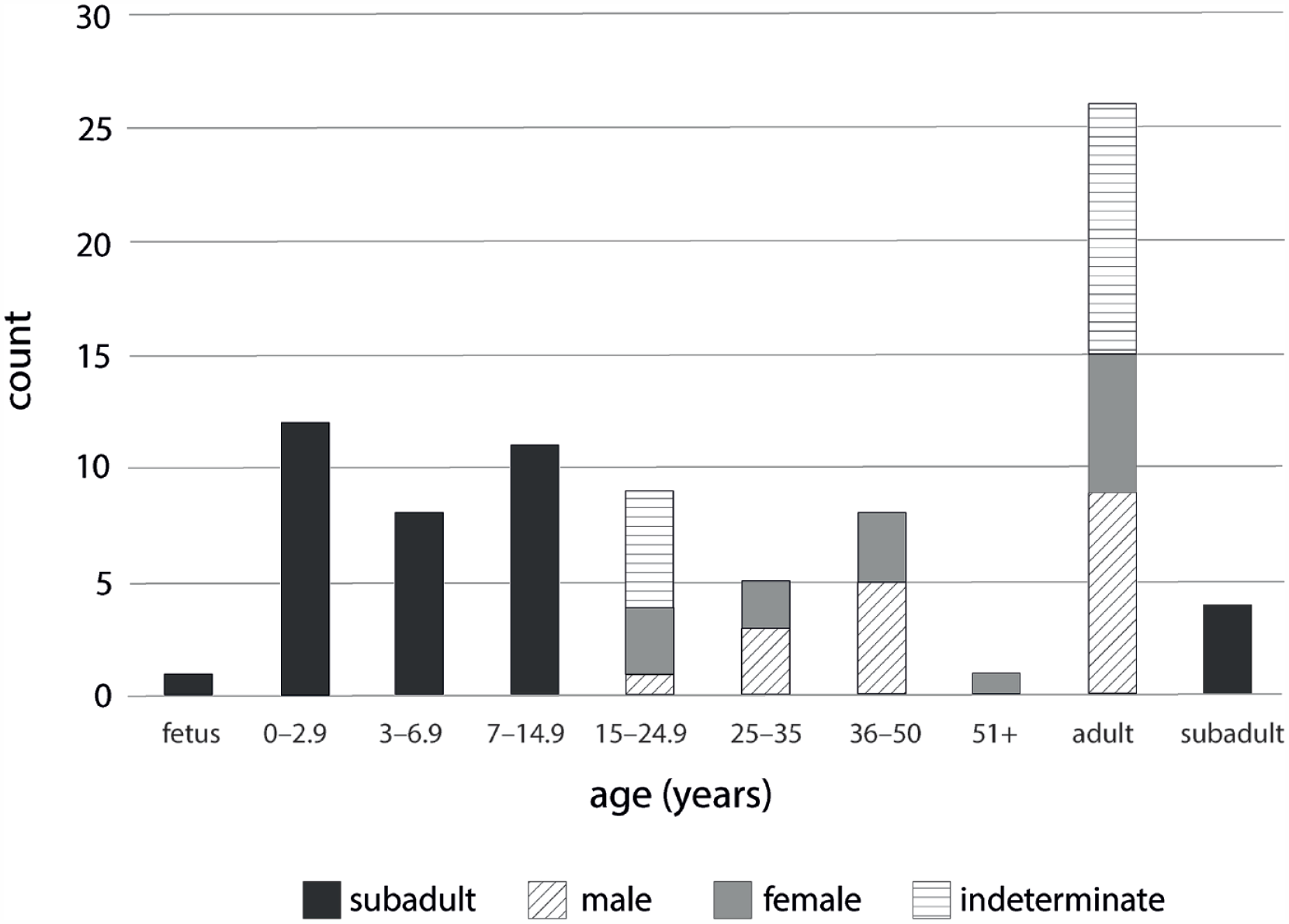
North Desert Cemetery demography (chart: Gretchen Dabbs, the Amarna Project).
The individuals for whom sex could not be assessed cluster in two age groups (fig. 19). The first is individuals identified only as ‘adult’, a group that often includes individuals that are poorly preserved, making both aging and sexing difficult. The second is young adults (15–24.9 years), who are also commonly difficult to assess for sex because the secondary characteristics used to estimate sex are not yet fully developed, especially for males. Although there would seem to be a dramatic difference in representation between males (75%) and females (25%) in this age group, this is likely a factor of preservation and the difficulty in identifying young adult males. It should not be interpreted as suggesting a demographic pattern similar to that of the North Tombs Cemetery, where females predominate. 47
The plant and other organic remains from the North Desert and North Cliffs Cemeteries (A. Clapham)
In November 2022, matrix and handpicked samples from the North Cliffs and North Desert Cemeteries collected in the 2018, 2021 and 2022 excavation seasons were studied. Matrix samples were collected from grave fills and, where present, from pots. The handpicked samples consisted of larger items either collected by the excavator or recovered from the sieving of grave fills. Most handpicked material consisted of animal dung including ovicaprid (most likely domesticated), gazelle, and canid (jackal and fox). Horse/donkey dung fragments were also encountered. Occasionally date (Phoenix dactylifera) stones were found. It is most likely that these remains were not associated with the burials but with later post-burial activity. Remains of maize (Zea mays) leaves, sorghum (Sorghum bicolor ssp durra) processed heads and wild plants were also identified and most likely represent later windblown material. Other handpicked samples were of textile and matting fragments used in wrapping the body, and fragments of sycomore (Ficus sycomorus) and conifer wood (most likely cedar (Cedrus sp)) which were most likely the remains of coffins.
One of the handpicked samples (unit 18399) from the fill of a grave at the North Cliffs Cemetery contained what was possibly pig or human dung, composed of coarse and finely comminuted plant material. Whole spikelets of barley (Hordeum vulgare) were present which had the appearance of either being digested or fermented, with the contents of the grains completely dissolved leaving just the husks. Further work is required to ascertain whether the remains are in fact of dung, or whether they might be a remnant of beer brewing. Another of the grave fills at the North Cliffs Cemetery (unit 18321) included a possible grave offering represented by desiccated date stones, nabq (Ziziphus spina-christi), and grapes (Vitis vinifera).
The matrix samples from the two cemeteries can be considered mostly sterile, consisting of clean sand and gravel with occasional human remains (flesh/bone), textile, matting and coffin fragments. In a few cases there were some interesting finds. From the North Cliffs Cemetery, a matrix sample from the base of a grave (unit 18713) consisted of desert sand and gravel with some decomposed human flesh, amongst which hundreds of complete beetles were noted. Many whole and fragmentary beetles of a different species were also found in two matrix samples from the North Desert Cemetery, one from a sample taken from where the stomach would have been (unit 19969) and the other from a different grave in the neck/shoulder area (unit 20031). In both cases complete insects and fragments were present. Whether the beetle remains were associated with the decomposition of the body or were feeding on the remains of grave offerings can only be established with proper identification. This will be carried out in future seasons.
Photogrammetry at the North Desert Cemetery (P. Docherty)
During the first week of the cemetery season, a photogrammetric survey was conducted focusing on Tombs 1–3 and a general site overview. Both still image capture with a digital SLR camera and video footage using a 4k resolution DJI Osmo Pocket camera mounted to a 3 m pole were used. The video capture method extracts still frames from video footage to be used in the standard photogrammetric workflow. This method has been found to be particularly effective in capturing large, generally featureless, areas in a short period of time.
The main site survey capture method involves the operator walking the entire site in a series of overlapping parallel strips with the pole-mounted Osmo. Coded target markers were positioned at the extents of the capture area with some additional targets placed near Tombs 1–3. All markers were surveyed to allow for correct scaling and orientation to be implemented during photogrammetric processing. The capture area measured approximately 150 m x 150 m. The resulting 3D model can be seen in figures 20 and 21. The patches of white in the DEM show areas of excessive activity which prevented accurate feature detection for the reconstruction of areas of limited ground features which also are problematic for reconstruction.
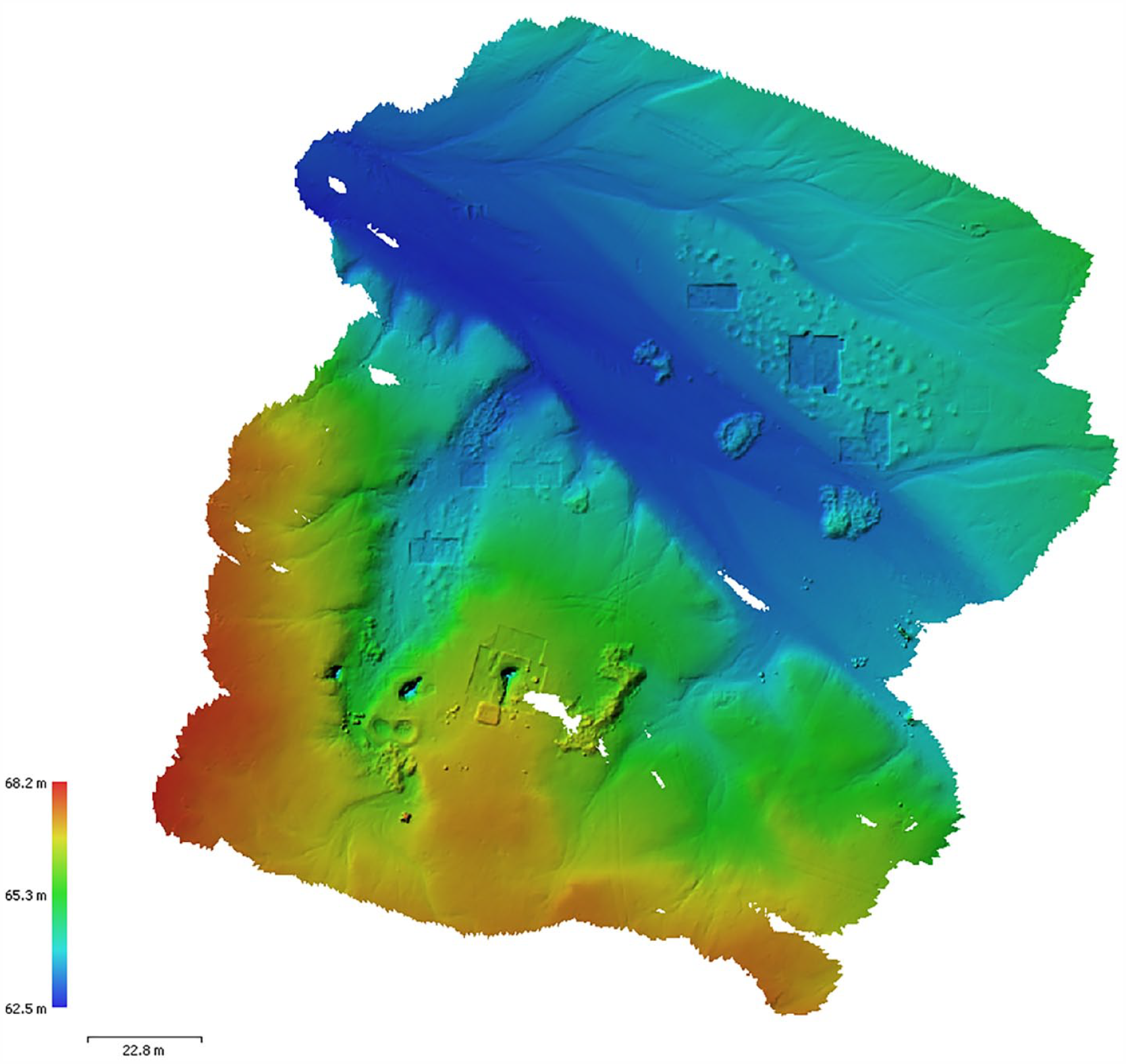
The North Desert Cemetery site overview presented as a height map (north towards the top of the image) (model: Paul Docherty, the Amarna Project).
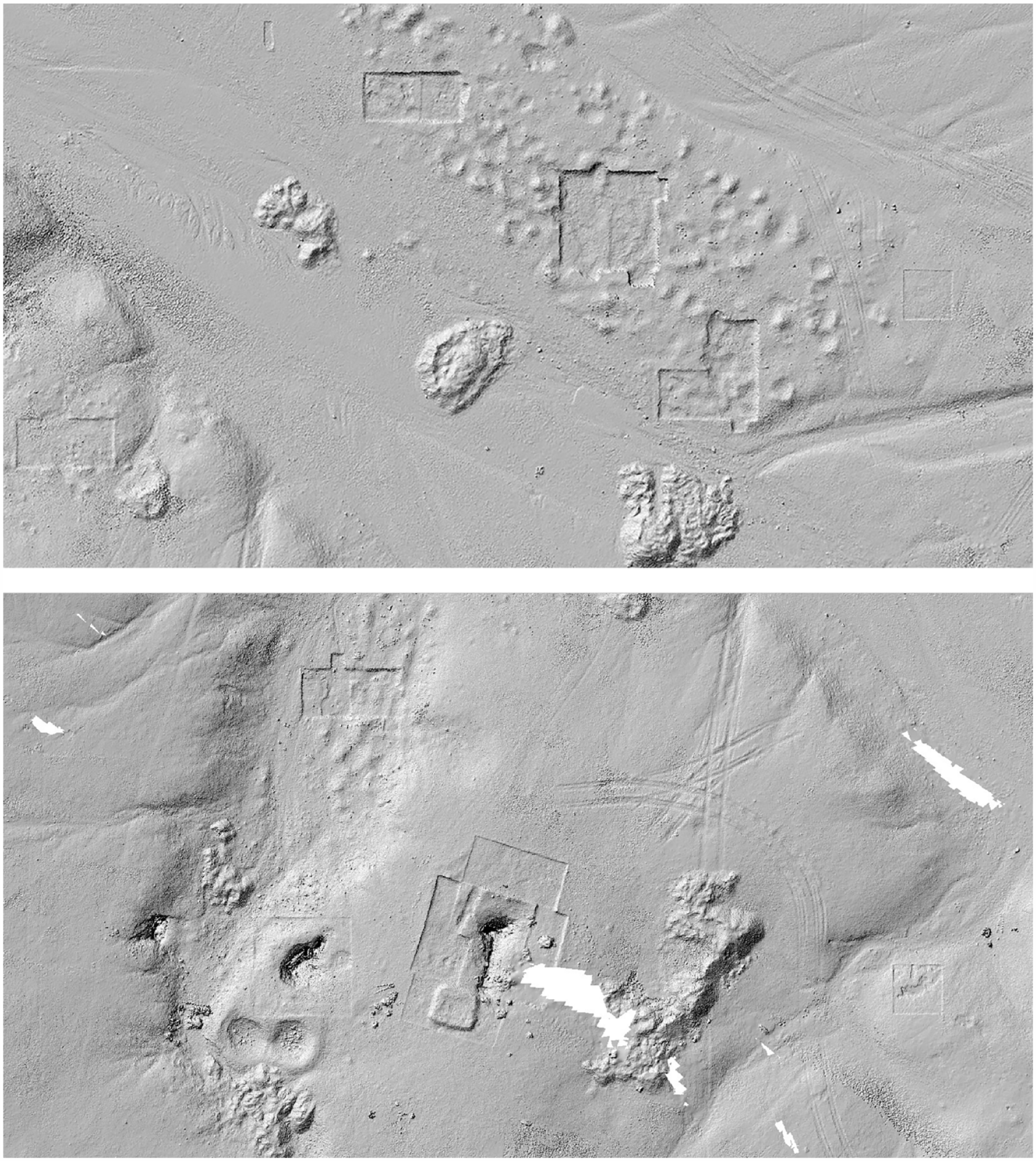
Hill-shaded relief of the low terrace (top) and the plateau and wadi (bottom) (model: Paul Docherty, the Amarna Project).
Tomb 1, excavated in 2018 and 2021, was cleared of backfill and captured using the Osmo camera and the resulting 3D model scaled through coded target markers surveyed around the site. Figure 22 shows a height map of the tomb and figure 23 is a composite image showing the exterior plan along with an interior chamber plan and section. Tombs 2 and 3 were photographed by the excavators at the end of the season, and the images sent to the author for processing. Preliminary 3D models have been developed and once each of these has been finalised a single composite model will be constructed.
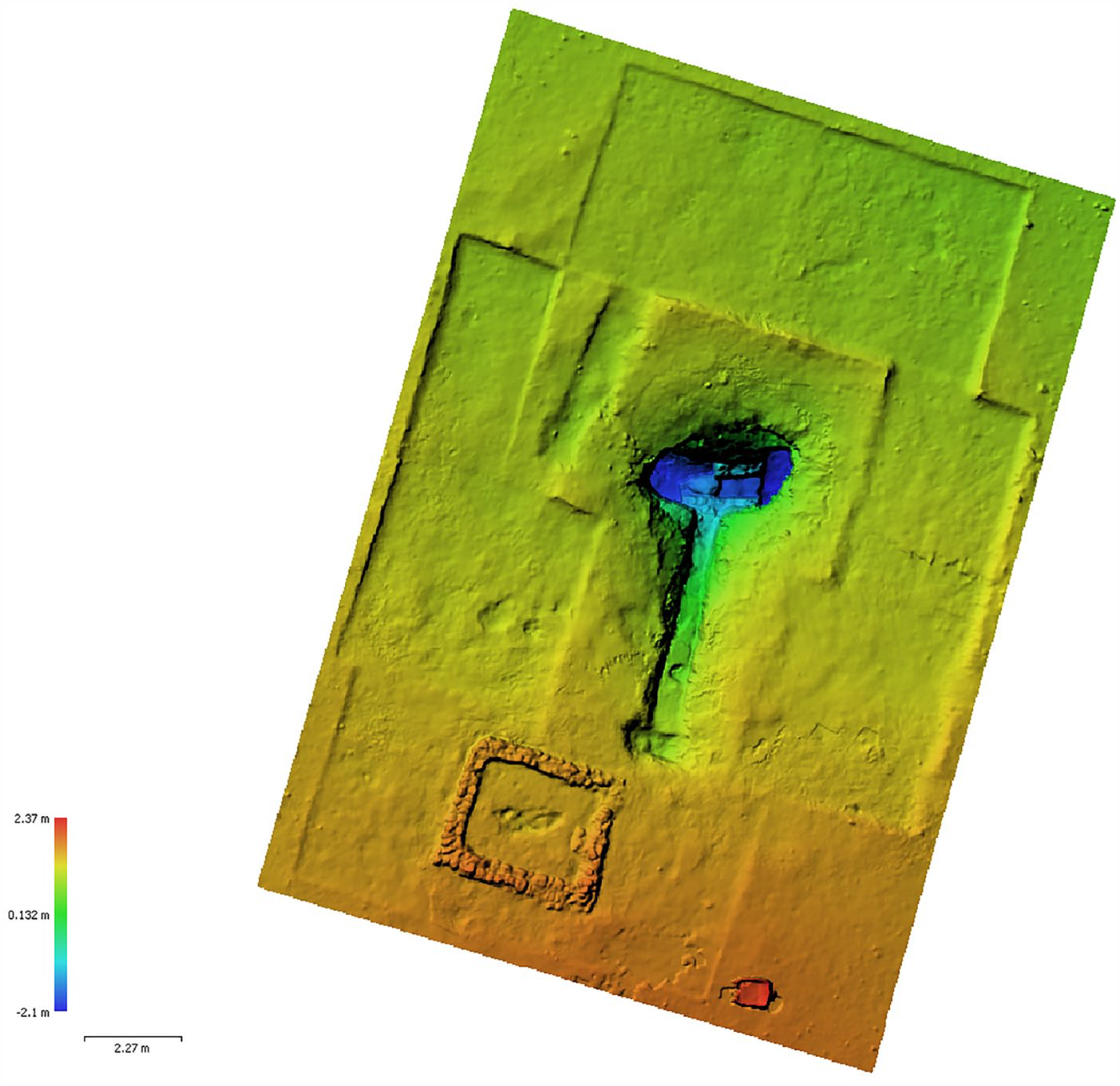
Height map of Tomb 1 and its probable chapel (north to the top) (model: Paul Docherty, the Amarna Project).
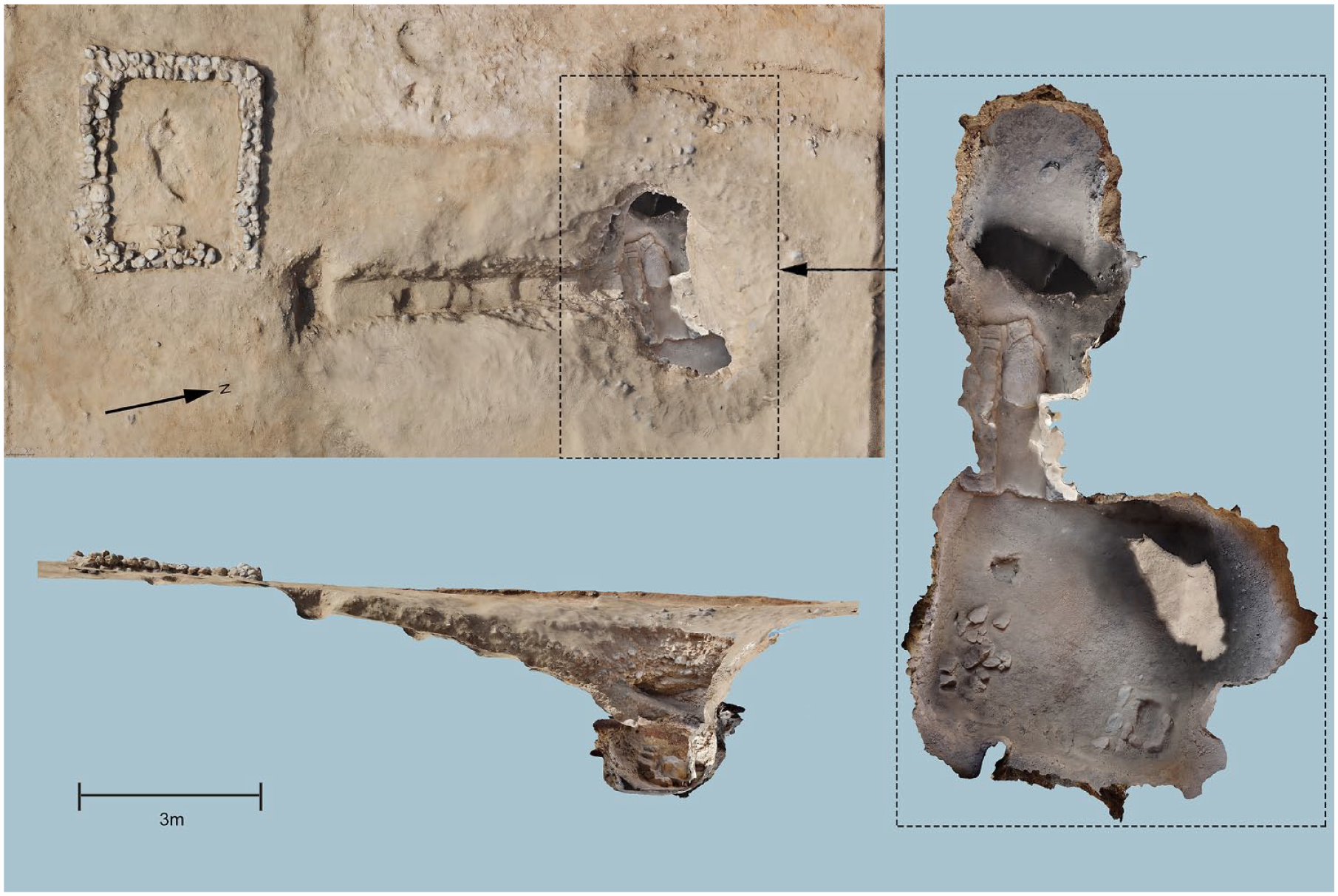
Tomb 1 and its probable chapel, showing the exterior plan (top left), section (bottom left) and internal ground plan (right) showing the large eastern chamber and smaller western chamber (model: Paul Docherty, the Amarna Project).
North Desert Cemetery 2022: Final remarks
The two previous seasons of fieldwork demonstrated that the North Desert Cemetery is one of the most diverse of the Amarna cemeteries, with both pit graves and shaft-and-chamber tombs (at least one with a probable chapel) in a landscape that is also strikingly variable in its topography. The 2022 season brings the number of shaft-and-chamber tombs that can be identified from excavation data and surface remains to at least five, and further shows the range in scale and layout of these tombs. Preliminary demographic analysis suggests a broadly typical ancient urban profile, and the number of people buried here probably numbers around 450–550. While it is unclear where this population originated from at Akhetaten and why they were buried separately, the site clearly points to a community that included individuals who could create tombs that were more complex than most, situated on a fairly prominent rise on the route out to the North Tombs. Finally, the survival of intact burials in Tomb 3, including an individual with multiple pieces of gold jewellery, provides an important point of intersection between burial goods, body treatment and burial architecture that will further inform on gradations in mortuary experience and expression at Akhetaten.
The North Cliffs Cemetery Ceramic Assemblage (A. Garnett)
In Autumn 2022, the study of the ceramics from the North Cliffs Cemetery continued. 48 This assemblage was excavated in a single season in 2018. The assemblage is broadly consistent with the South Tombs Cemetery corpus. The majority of the pottery examined represents closed forms in Nile silt clay, including, most commonly, ‘beer jars’ and globular jars, with sherds from carinated bowls and large open vessels (hearths) also present in smaller quantities. Marl clay sherds are notably rarer but include fragments of miniature vessels, such as a rare double jar and ‘meat jar’ form. Blue-painted Nile silt sherds are also present in small numbers. Reused sherds of varying sizes occur frequently in the burials, the majority of which are of Nile silt clay with significantly fewer extant examples in marl clay. Many of these may have been used as digging tools, including by tomb robbers. Two fragmentary ‘wavy-rim’ sherds with traces of blue-painted decoration on cream slip, likely from a ‘cobra bowl’, were identified. 49 They originated from the fill of the partially disturbed pit grave of Ind. 2008, a 30–40 year-old male. 50 These vessels are extremely rare at Amarna, and the presence of this example may represent cultic activity connected with this burial or in its vicinity.
Much of the assemblage is highly eroded due to water and salt damage, which has led to significant loss of surface detail. Nonetheless, whilst the poor condition of the sherds overall often prevents joins being made across contexts, visual study suggests that pieces from individual vessels can be quite widely dispersed. This probably reflects the substantial looting of this cemetery, which was also visible in the stratigraphic record during excavation. 51 The completion of the study of the North Cliffs Cemetery ceramic assemblage in 2023/24 will produce a significant data set to facilitate inter-site comparisons across the other non-elite cemeteries and Amarna as a whole. This is anticipated to provide further insight on ritual activities and on the socioeconomic status of those buried across the different cemeteries.
Community Engagement (G. Tully)
The community centred elements of the Autumn 2022 season built on existing relationships at Amarna and outcomes from a 2017–2020 British Council Institutional Links Project between the MoTA and the University of Cambridge. 52 The new initiatives focused on two workshops at the Amarna Visitor Centre, which were developed in response to findings from the Amarna Site Management Plan 53 and feedback on the children’s book Amarna: Life Under the Sun. 54 Run in partnership with the MoTA, the workshops explored two overlapping themes with over 80 local children and their families (c. 30 adults). 1: Tutankhamun’s childhood and wider experiences of childhood at Amarna; 2: excavations at Amarna’s non-elite cemeteries. The first aspect linked to the project, Tutankhamun the Boy: Growing Up in Ancient Egypt. 55 The second aspect is part of a 3-year project, Preservation through Education: Protecting Ancient Settlements through Outreach at Amarna, Egypt. 56 Both projects have similar aims to co-create child-led content about Amarna – past and present – focused on underrepresented themes, individuals and demographics.
The projects’ themes were explored concurrently via workshops centred on local children’s ideas, interests and awareness of the topics, the archaeological methods used to interpret them and their relevance to life in the area today. The workshops involved short talks, role play, question-and-answer sessions and hands-on activities led by Gemma Tully and Hamada Kellawy. One activity involved a child being dressed as a young Tutankhamun, and another as a child from the general population from Akhetaten. After being provided with some information to set the scene, children asked Tutankhamun and the non-elite child questions about their daily lives to gauge interest in this theme. Another session saw local excavators (all fathers, grandfathers and uncles of the participants), demonstrate to the children the methods they use to excavate ancient graves in the cemeteries (fig. 24), using sandpits, and replicas of a skeleton and burial goods (3D prints of amulets, potsherds, plant remains, basketry). The children then took over, exposing and lifting the disarticulated skeleton and artefacts. The bioarchaeological team explained how to reassemble the skeleton and what we can learn about individuals, their lives and wider society from human remains. The excavation team worked with the children to categorise and label the artefacts and to help them think about the sorts of clues objects can provide about people, status, daily life, beliefs and community. Other activities involved reinforcing what had been learnt during the excavation activity by cutting out and reassembling paper skeletons and designing personal amulets from colourful modelling clay.
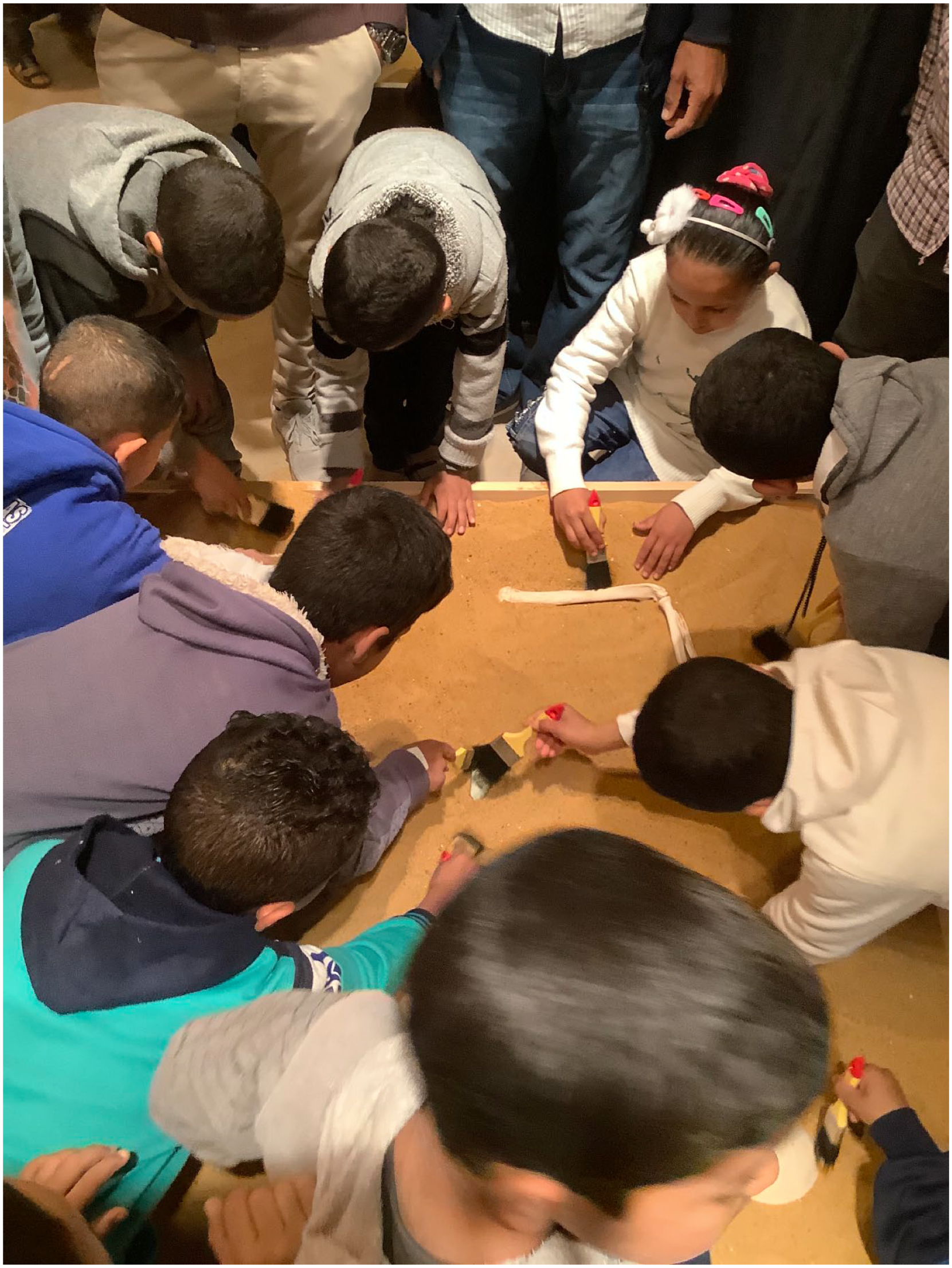
Children practice archaeological methods for excavating skeletons (photo: Gemma Tully, the Amarna Project).
This was the first time many of these children had taken part in a workshop of this nature or met international archaeologists. For around 50%, it was also their first time in the Amarna Visitor Centre. Inevitably, some participants were initially quite overwhelmed by the setting, the expectation to voice opinions and to actively engage with practical tasks. The fact known adults and family members accompanied the children, and were called upon to offer their ideas or demonstrate activities, helped give the children the confidence to participate. It was also clear that the practical tasks – excavating, reassembling the skeleton, classifying finds and making amulets – were the most popular when viewed in comparison with discussions and question-and-answer activities.
After the first workshop, children started turning up at the Visitor Centre each Friday hoping to take part in another event, demonstrating the demand for ongoing activities of this kind and impact of these programs. Having items to take home – e.g., amulets, skeleton sheets, certificates of attendance – was also important, both as souvenirs, hopefully promoting longer term memories of the day, but also to demonstrate the children’s ownership of workshop outputs. In terms of limitations, more children turned up to each session than expected, which meant that resources and space were sometimes insufficient. This was mitigated by turning solo activities into group tasks, which provoked interesting discussions among the children.
The children’s ideas and feedback from the sessions will shape co-curated displays and 3D-printed handling collections linked to Tutankhamun and childhood in ancient Egypt at the Petrie Museum and Amarna Visitor Centre. The outputs will also provide the basis for a folio of activities, primarily for use in the Amarna Visitor Centre. The folio aims to provide site-specific learning resources, building from the children’s questions and responses regarding archaeological methods and site preservation, comparisons of ancient and modern daily life, and findings from the non-elite cemeteries. The folio sets itself apart from more generic ‘ancient Egypt’ learning resources in that the activity sheets promote local history and encourage children and their families to visit relevant areas of Amarna. Each learning theme will have multiple worksheets, enabling children to progress from basic to more detailed levels of information, activities and tasks.
In addition to the workshops, around 500 children were visited at the Tell Beni Amran Primary School to hear their questions about archaeological methods, Amarna and where their interests lie in terms of future activities and resources. For adult audiences, two lectures were held at the Visitor Centre: Anna Garnett and Gemma Tully held a lecture for MoTA Inspectors and Visitor Centre staff, highlighting the aims and opportunities of the Petrie Museum’s Tutankhamun project and setting the scene for the children’s workshops; and Anna Stevens and Gretchen Dabbs reviewed the last fourteen seasons of excavations at the non-elite cemeteries with the team of local excavators who have been involved with this fieldwork.
Every aspect of the season’s engagement initiatives will contribute to the long-term goals of the MoTA and Amarna Project to enhance site access, preservation, understanding and learning resources about Amarna for local children and family audiences at the Visitor Centre. These outcomes also link to the development of associated initiatives and materials in international museums and online, and will contribute to wider discussions of best practice in community archaeology and co-production of resources both within and beyond Egyptology.
Other Projects in Autumn 2022
Amandine Mérat continued her study of the textiles from the Amarna cemeteries, checking details of samples from the South Tombs Cemetery in advance of final publication. Jolanda Bos completed the study of the small sample of hair from the North Desert Cemetery, apart from a few samples recovered near the end of the 2022 season. Alice Salvador illustrated finds from the North Tombs Cemetery, along with two naturally desiccated individuals with preserved textile from the North Cliffs Cemetery. Amélie Deblauwe brought the photography of objects from the North Tombs Cemetery up to date, and undertook, with Gretchen Dabbs, an extensive photographic survey of the skeletal sample from the South Tombs Cemetery, to illustrate the forthcoming monograph on this site.
Footnotes
Acknowledgements
The Amarna Project is grateful for the support of the Egyptian Ministry of Tourism and Antiquities, particularly from the staff of the Minia and Mallawi MoTA offices, including Gamal Abu Bakr, Fathi Awad and Hamada Kellawy. Site inspectors for the work at the East Gateway were Zahara Ahmed Abd el-Fadil and Martha Aatef Essa, and for the North Desert Cemetery excavations were Shimaa Sobhi Omer Hassanin and Joseph Elia Michael. Mustafa Khalaf Mansour oversaw work in the Amarna magazines. The community outreach work was possible thanks local MoTA colleagues, in particular Hamada Kellawy, Joseph Qased Fanus, Mazar Khalifa Mohamed, Mohamed Ibrahim Abdel Samei, Hesham Ahmed Mohammed Abdel-Kader, and Farid Fathi Hashem Fathi, along with the team of local excavators and international participants on site during the cemetery excavations, as named earlier in this report. We also thank Abdu Mohamed Omar, who has played a central role in distributing the Arabic guidebook.
Funding
The East Gateway excavation is part of the Great Aten Temple research project, which is funded by grants from the Amarna Trust and the Amarna Research Foundation. The 2022 excavations at the North Desert Cemetery were supported by the Institute for Bioarchaeology (British Museum), G. A. Wainwright Fund (University of Oxford), Southern Illinois University and the Amarna Trust. The project Tutankhamun the Boy: Growing Up in Ancient Egypt is funded by the Esmée Fairbairn Collections Fund, administered by the Museums Association, and the Friends of the Petrie Museum. The project Preservation through Education: Protecting Ancient Settlements through Outreach at Amarna, Egypt is funded by the Archaeological Institute of America.
1
British Mission to Tell el-Amarna, McDonald Institute for Archaeological Research, University of Cambridge, directed by Barry Kemp.
2
4
9
Visible in the photograph taken after the work: TA.NEG.32–33.A.41.
11
Alan Clapham, personal communication, 11.2022.
13
Similar pits have been excavated at pottery workshops Q48.4 and O45.1 at Amarna. They contained unfired sherds and were interpreted as puddling-pits for clay preparation where the potter reused unfired sherds: Kirby 1989: 27–29; Rose 1989: 82–84;  : 49–50. Their average dimensions recall those of pit <20517> but the clay-base deposits appear to be different. There, a thick clay layer of a very fine texture without any inclusions was spread over the cut. Some members of the mission have theorised that pit <20517> might have been used in the process of recycling jar-sealings, which occur in considerable numbers in the surrounding pits. The problem here is that most of these jar sealings were made of a pale, greyish, sandy-coloured matrix, quite different from the clay-base of the pit.
14
Alan Clapham, personal communication, 11.2022. The seeds seem to have spent time in a liquid of some sort.
16
Alan Clapham, personal communication, 11.2022.
18
Davies 1903: pls X, XXXIII; : pl. XIX.
19
For rituals involving the breaking of vessels in funerary contexts: Elsharnouby 2018; Budka 2014. There also exists an example from a temple context in the Luxor Temple from the reign of Amenhotep III: : 177–188.
20
Stevens et al. 2020a: 3–8; : 9–20.
21
Tomb description by Melinda King Wetzel.
22
Based on preliminary skeletal analysis, Ind. 3053 is a subadult, Ind. 3054 is a young adult, Ind. 3056 is an adult and possibly male, and Ind. 3057 is a young adult and possibly female.
23
Tomb description by Wendy Dolling.
29
For the complete jar, see : 179 SJ5.10, SJ5.11, 185 Silt base type 1. See also 187 no. 5, and for vessels similar to the large-handled jar body, French 1986: 187 no. 4; 175, SJ2.2.3(E).
32
Compare, e.g., a jar label from the tomb of Senneferi (TT 99, reign of Thutmose III) labelled ‘Regnal year 28. Djehuti’, Bohleke 2016: 243, 244 (fig. 193). Similar jar labels are attested in royal contexts, for instance in the tomb of Tutankhamun, where a jar label naming ‘the vizier Pentu’ was found, Černý 1965: 4, 24, pl. V no. 26. Compare KV 40, where a number of such inscriptions apparently identify the recipients rather than the donors of the vessels, : 104–107.
33
Fredrik Hagen, personal communication, 04.2023.
43
The post-cranial metric standards specific to Amarna growth and development are based on individuals from the South Tombs Cemetery with dental remains. Postcranial metrics were collated by dental age to provide an age estimation technique for individuals without dental remains.
46
For the South Tombs Cemetery demography, see Dabbs, et al. 2015; for the North Cliffs Cemetery, see .
48
Building on work undertaken in 2018 and 2019: Rose 2018; Garnett 2020; Stevens, et al. 2020b.
50
Gretchen Dabbs, personal communication, 04.2023.
52
Tully and Stevens 2018; . The Autumn 2022 season also provided the opportunity to begin distributing copies of the recently published Arabic guidebook to Amarna, produced as part of the British Council project. As a first step, these are being placed in outlets that include schools, clubs, libraries and other public organisations around Amarna and in Minia province.
55
Taking place at the Petrie Museum of Egyptian and Sudanese Archaeology, UCL, and the Amarna Visitor Centre.
56
A partnership between the Amarna Project and Southern Illinois University, Carbondale.