




Abstract
The formation of archives has been a key facet of the archaeological discipline since its inception, critical in the production of knowledge from the destructive excavation that occurs in the field. The ongoing ‘archival shift’ within the humanities from archives as mere sources of secondary information to primary topics of research has presented new potential for the study of historic archaeological archives. This article explores the personal archives of two great scholars of Iron Age Celtic art, Paul Jacobsthal and EM Jope, held at the Institute of Archaeology, University of Oxford. Shedding new light on their engagement and interaction with the objects that they studied, the author explores the archive’s power to illuminate the ways in which the scholars’ methods, experiences and encounters shaped the knowledge that they produced about the past. Through presenting the archives as both primary sources of historical information and vibrant material entities, worthy of ‘excavation’ in their own right, the article advocates an assemblage-based archaeological approach to archival engagement.
Introduction
The accumulation of archives has always been a key facet of archaeological practice. The effective production, recording and storage of information is particularly critical to a discipline that is so intrinsically destructive. In this way, the destruction of the primary, ‘raw’ archaeological record also fuels the creation of a secondary record, as the ‘great archives of earth’, as Harry Godwin (1981) would have it, are transferred and translated into institutional archives. This process takes place in a whole series of different ways, and there has been a growing interest in the impact that the subjectivity of historic archaeological recording practices has had on the discipline (Baird, 2011; Baird and McFadyen, 2014; Lucas, 2012; Riggs, 2017). This kind of reflexivity has also cultivated an increasing recognition of the value of historic archaeological archives, not just in the secondary information they contain, but as a primary topic of study in their own right. As Schlanger and Nordbladh (2008: 3) put it, they enable us to access an extra dimension of the archaeological process and engage with those operational practices that are often left unsaid or unpublished. They allow us to peel back the sanitized film of the ‘end products’ of an excavation or other archaeological project – books, journal articles, television programmes or exhibitions, and view the unfiltered substrate beneath. This article explores the reflexive potential of two personal archives held at the Institute of Archaeology, University of Oxford – those of Paul Jacobsthal (1880–1957) and Edward Martyn Jope (1915–1996). Having both produced major volumes on European Iron Age metalwork (working together for a short period), these archives have provided a unique insight into their very different approaches to the study and recording of so-called Celtic art objects from Britain and the Continent, and illuminated the ways in which those approaches affected the outcomes of their research.
This article takes its name from an observation made by philosopher Michel Foucault about the famous 1656 Diego Velázquez painting, ‘Las Meninas’ (‘The Ladies-in-waiting’). The indoor scene depicts a mirror and several figures, including the Infanta Margaret Theresa of Spain and the artist himself, who has momentarily paused work on a large canvas that can be seen from the reverse. As Foucault (2002) discusses in detail, Velázquez positions the viewer at the centre of the scene through the composition of the objects and the gaze of the subjects. As historian Antoinette Burton (2010: 66) has pointed out, Foucault uses the painting as an allegory for the power of any given archive to show us quite simply, and in shadow, what all those in the foreground are looking at. For him, it encapsulated the archive’s potential as a particular way of seeing and a particular way of knowing (Steedman, 2002: 2). Drawing on this analogy, the focus here is on the power of the archival material to locate us between the subject and the object, allowing us to see the pieces of Celtic art that the two scholars were studying from their perspectives. This study builds on Jennifer Baird and Lesley McFadyen’s (2014) recent move toward an archaeology of archaeological archives by exploring archives of a fundamentally different nature. Unlike their example of the principally photographic archive formed from an expedition to Dura-Europos, Syria, in the 1920s and 30s, the case studies here are personal archives formed over a long span of two academics’ respective careers (see Diaz-Andreu et al., 2009, for an account of the personal archives of Jacobsthal’s contemporary, Christopher Hawkes). Being more (although not entirely) incidentally conflated than an archive of a particular project, they open up a different set of possibilities, allowing a unique insight into the multiple ways that these scholars have translated Celtic art objects into forms of archaeological knowledge.
About the archives
The Paul Jacobsthal and EM Jope archives were donated to the Institute of Archaeology, University of Oxford, and have been, or are in the process of being, catalogued by university staff and a small team of volunteers. The majority of the archival material has been deposited into A3-size archive boxes, with oversized items and notebooks being stored separately. The archives have not yet been made available online, but can be consulted in person upon request. The Jacobsthal archive came to the Institute from its original location at Christ Church College, Oxford where Jacobsthal had his office. He was appointed Professor of Classical Archaeology at the University in 1937, continuing in this role until his retirement in 1950, and the majority of the archive originates from this time in England and research for his seminal publication Early Celtic Art (Jacobsthal, 1944). It remained in storage for many years until grants in 2010 from the Heritage Lottery Fund and the David and Reva Logan Foundation made it possible for it to be properly catalogued. Comprising 57 boxes and containing over 2500 letters, 127 notebooks, photographs, drawings and typescripts, it is the most substantial body of records relating to Jacobsthal. It is a curated archive – Jacobsthal having chosen what to deposit in it with the intention of it being made available for future scholars to consult and, as such, it has retained a sense of organization and order. The archive has been fully catalogued and indexed, and has been the subject of several publications prior to this one (Crawford and Ulmschneider, 2011, 2012; Jacobsthal et al., 2014).
The Jope archive arrived at the Institute in 2008 and was donated by his estate after his death. No instructions were left by Jope about the archive and, unlike Jacobsthal’s, it was unsorted, apparently unfiltered, and chaotic (see Figure 1). It is also vast, currently occupying over 80 archive boxes (Figure 2). Thus, even with the aid of the archive’s diligent team of volunteers, engagement with it has been far from exhaustive, and material from the Jope archive has not been published prior to this article. During its initial accessioning, a considerable quantity of material that had once belonged to the Jacobsthal archive was discovered amongst it. This material had been utilized by Jope during the years after Jacobsthal’s death when he was permitted to use Jacobsthal’s former office while continuing work on the British Celtic art volume that they had begun work on together. The book was eventually published posthumously as Early Celtic Art in the British Isles (Jope, 2000). This material was identified primarily through the presence of Jacobsthal’s handwriting and script typed using his typewriter, and it was removed and stored separately. This new ‘hybrid’ Jacobsthal/Jope archive comprises around 25 boxes of material.
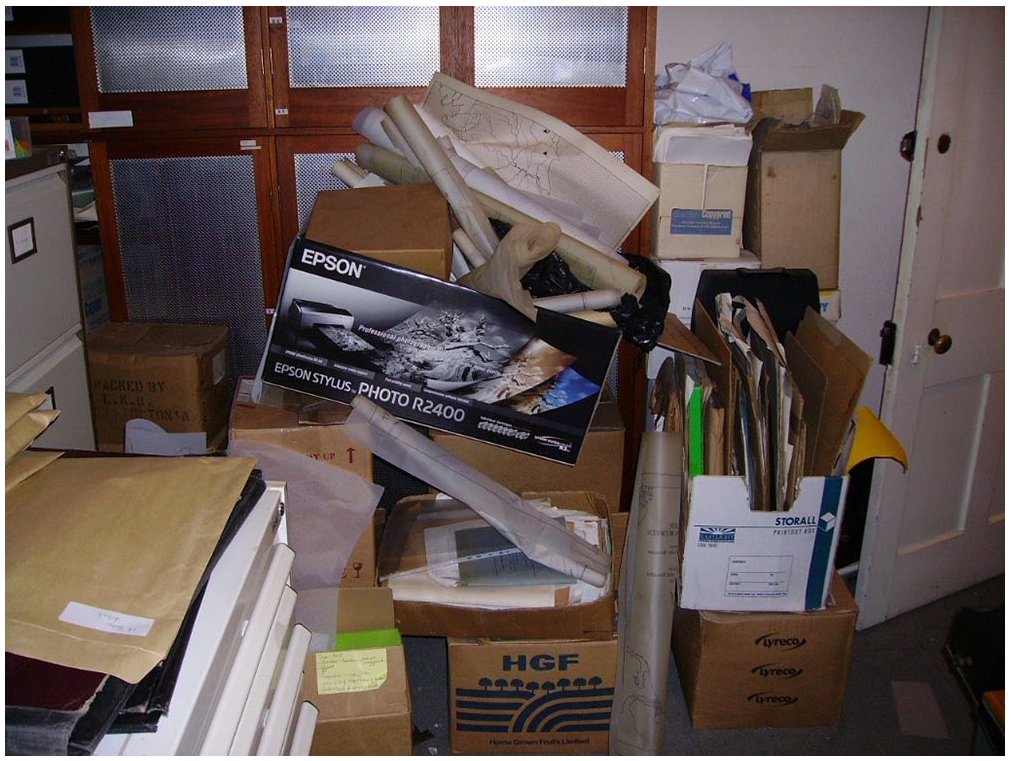
The Jope archive, photographed in the form in which it arrived at the Institute of Archaeology, Oxford in 2009. © Photograph: Sally Crawford. Reproduced courtesy of the Institute of Archaeology, Oxford.
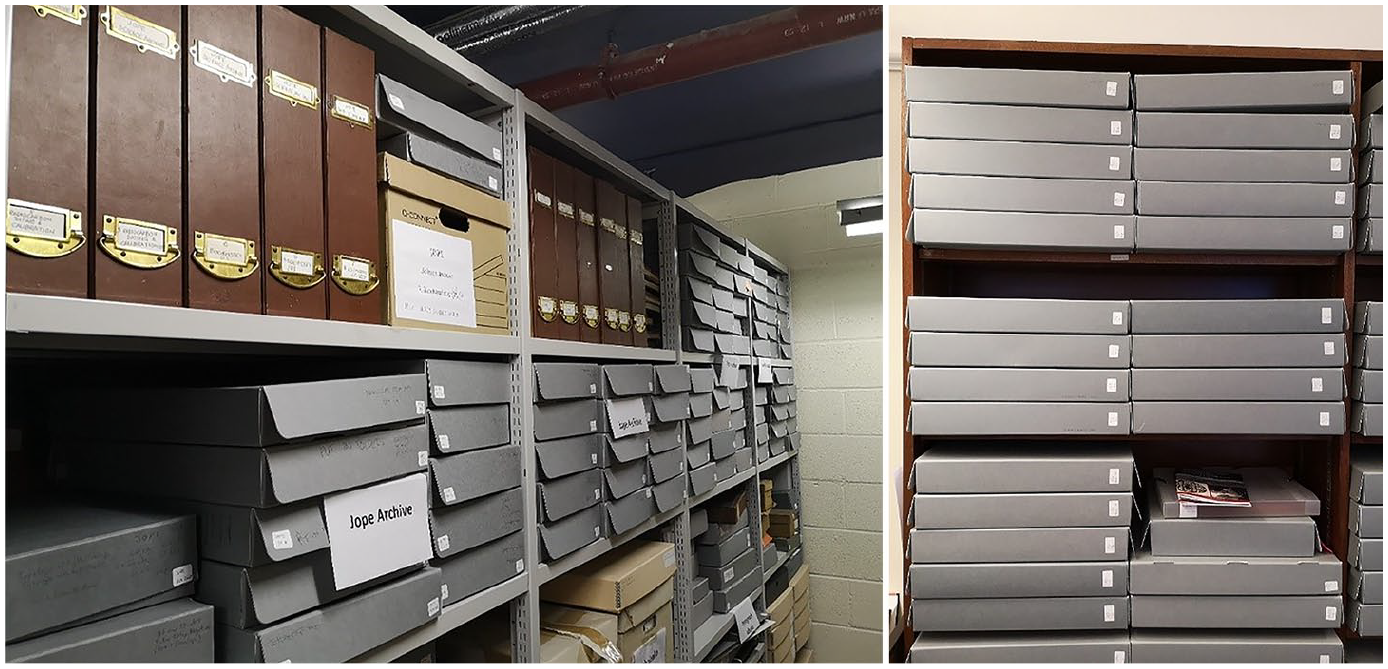
Left: The Jope archive in its current form, after being accessioned and the material identified as belonging to Jacobsthal removed. Right: Part of the Jacobsthal archive, now stored in catalogued archive boxes. © Photographs: Matthew William Hitchcock. Reproduced courtesy of the Archaeology Archives, Oxford.
Excavating archaeological archives
A major component of this research is to explore what an archaeological approach might bring to the study of archives, and here it has been founded on the conceptual approach adopted by Sally Crawford and Katharina Ulmschneider (applied in Crawford and Ulmschneider, 2011, 2012; Jacobsthal et al., 2014); that is, to treat the archival encounters like an archaeological excavation in the field. The analogy of digging through earth and digging in an archive is one that has been made before (e.g. Baird, 2011; Beisaw, 2010; Mulvaney, 2000; Williams, 2014) – but previously it has been employed metaphorically and has not been explored conceptually in depth. It is argued here that the methodological and ideological synergies are worthy of more serious critical evaluation, and this will be illustrated through the following key points.
Like archaeology in the field, some archival objects are purposely deposited whilst others appear incidentally, and it is important to appreciate that they constitute ‘evidence’ in different ways. For example, the majority of Jacobsthal’s curated archive was selected and deposited by him intentionally, whereas Jope’s appears to have been far less carefully curated. Comprising letters, formal photographs and manuscript drafts, as well as informal doodles, scribbles, receipts and other ephemera, it allows different sets of inferences to be made. As demonstrated by the missing material from the Jacobsthal archive that was later rediscovered in Jope’s, archives are also incomplete, fragmented and can become displaced from their original context. As with archaeological sites, archives also come with a sense of degradation and loss, and it can be useful to identify gaps in what is archived, and to consider what might be ‘absent’ as, sometimes, conspicuous absences can be reconciled through dialects with other assemblages. To illustrate this, both scholars were meticulous in adding the date to even rough notes, so it is often clear where there are gaps in field notes or series of correspondence. Even when related letters have been kept together, we often only get one side of the conversation. However, in one instance detailed in Jacobsthal et al. (2014), it was possible to locate Jacobsthal’s replies to a series of letters from his colleague Hugh Hencken by co-ordinating with the Peabody Museum, Harvard University, where Hencken’s archive is held. Finally, and crucially, like archaeological material in the field, archives also require time, money and human resources to gather, house and conserve. I do not wish to push this too far – there are of course also many ways in which digging in the field and dealing with an archive are vastly different. However, the consideration of archival engagement as a form of archaeological practice is key in the reframing of the archive as a material entity. Archives are material remains of the past which have been formed, accumulated, deposited, rediscovered, conserved and curated, and the telling of stories through our encounters with this material is at the core of what we do as archaeologists.
Archives can seem like static and immutable things, shut away and rarely accessed. The very idea of an archive is to bind together a collection of coherent material and store it safely for possible future consultation – a material record. This might conjure images of dusty boxes, secure rooms, shelves, roller-racking, or dark basements. Archives also tend to possess a monolithic character – once they have been assembled, constituent parts do not then tend to become estranged. In a way, to archive something is to attempt to remove it from the usual processes of time. They are not things that are normally associated with vibrancy and change, and it might be said that their very purpose is in direct opposition to this. However, some scholars have begun to think about archives in a more dynamic way, shifting focus to archives-as-process rather than archives-as-things (e.g. Stoler, 2009: 20). Jane Bennett’s (2010) concept of ‘vibrant matter’ has been adapted into archaeological theory since its inception (e.g. Crellin, 2017), and has instigated a shift in how we think about apparently ‘inert’ matter which, rather, is in a continuous state of flux. Illustrating this, several pages of an early typescript for Early Celtic Art in the British Isles in the Jope archive (Jope box 3a) bear marks where their original metal paperclips have oxidized, depositing rust. They have since been replaced with plastic paperclips. Some documents in the Jacobsthal archive have become discoloured over time, and are now stored in chemically neutral transparent sleeves. Although these changes occur slowly, they demonstrate that the archive is far from immutable. Like conservators or museum curators, a key role of an archivist is to react to the changing material state of the archive, and this might mean removing or adding elements or rethinking how particular objects are stored. The archive and its contents are always in motion.
Also articulated by Bennett (2010), and ultimately derived from the work of Gilles Deleuze and Felix Guattari (1987), assemblage theory has been explored in archaeological contexts over the last decade in a series of new ways (e.g. Cobb and Croucher, 2014; Crellin, 2017; Harris, 2014). Whilst archaeological assemblages as a concept have been present since at least 1950, recent focus has shifted to their dynamism and agency (Hamilakis and Jones, 2017: 77), and assemblage thinking is also useful in characterizing our archival interactions in an archaeological sense. Gavin Lucas (2012) has emphasized the double meaning that the term ‘assemblage’ has for archaeologists. It can refer to material that is united by a typological similarity – Samian Ware, for example – and it can also refer to a group of objects that have been deposited together, such as a burial assemblage. Objects can also be part of several different assemblages simultaneously. Illustrating this point, the Jacobsthal/Jope archive (Figure 3), formed from the Jacobsthal material that was removed and kept by Jope is, in effect, an assemblage of material which ‘typologically’ relates to the Jacobsthal archive but ‘contextually’ relates to the Jope archive. One could also isolate, for example, the photographs, drawings, or letters from the archives, and each assemblage has the potential to frame the scholar’s work on Celtic art in different ways.
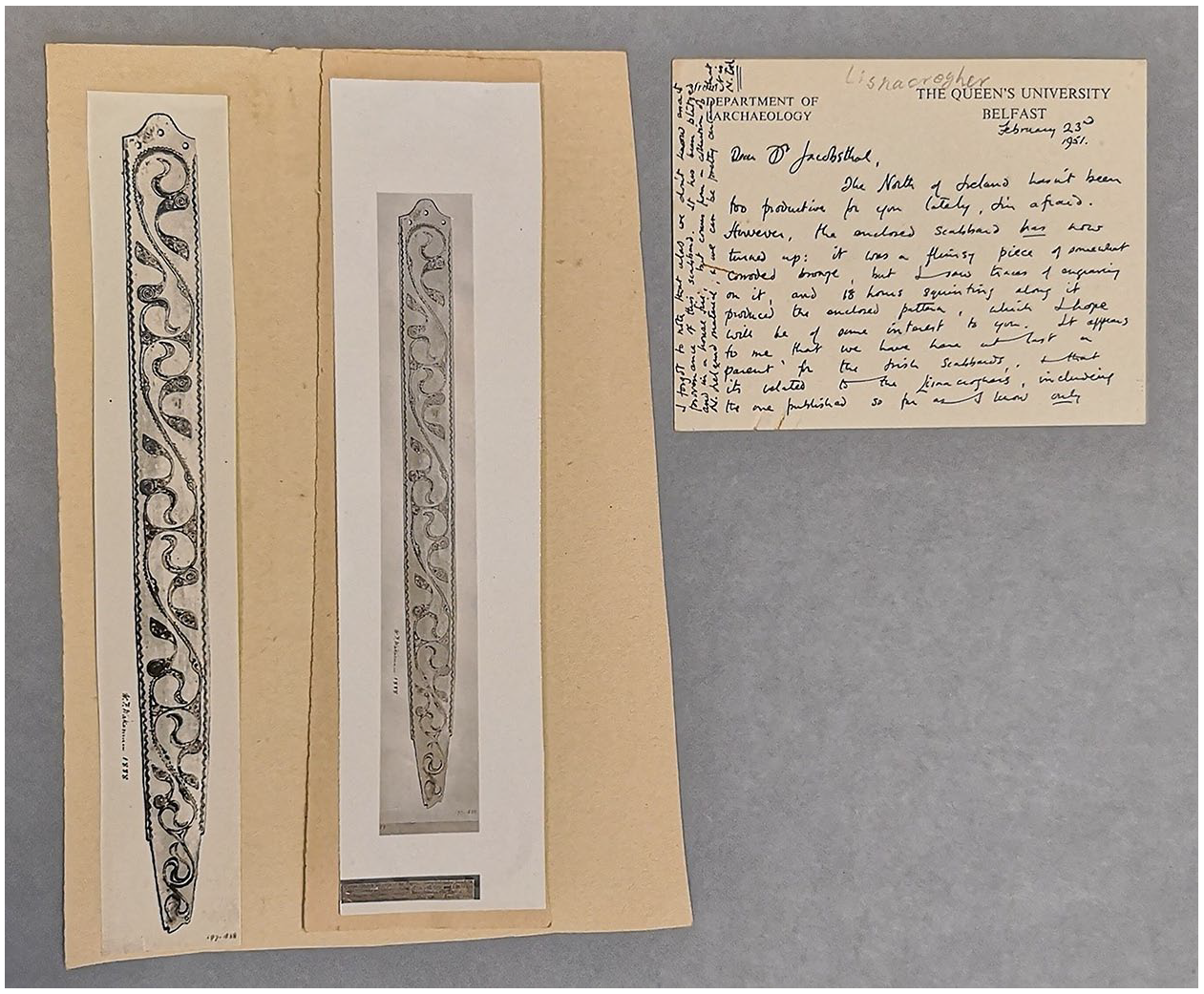
Two copies of an 1888 illustration of an Iron Age sword scabbard from Lisnacrogher, Northern Ireland, that Jacobsthal had prepared for a mock-up of the plates for a volume on British Celtic material and a postcard that Jope had sent to Jacobsthal about the scabbard in 1951. These objects once belonged to the Jacobsthal archive, but had been removed by Jope and were later discovered in the Jope archive. They now belong to the Jacobsthal/Jope archive (J/J archive, box 21). © Photograph: Matthew William Hitchcock. Reproduced courtesy of the Institute of Archaeology, Oxford.
Particularly important here, Chris Fowler (2013, 2017) advocates an assemblage approach which incorporates our own interactions with archaeological material. He argues that composite objects, although being assemblages themselves, become extended outwards through being translated (e.g. drawings, photographs, reproductions and written interpretations), thus becoming part of many different assemblages simultaneously (Fowler, 2013: 56). Archaeological ‘intra-actions’ with (or within) these ‘extended assemblages’ thus change the extent and effects of their properties (p. 55). In this way, items in the Jacobsthal and Jope archives can be seen as part of the extended assemblages of the Celtic art objects they reproduce, and our intra-actions with them reinvigorate past relations with the object, whilst leaving our own material traces. For example, index cards in the Jacobsthal archive bear the archaeologist Vincent Megaw’s handwritten notes, from time spent researching and cataloguing it for a publication (Megaw and Megaw, 1998). The author has also left his or her own trace by beginning to reorder the contents of the Jope archive by theme.
Their conceptualization as a vibrant material assemblage is, I argue, a key facet of the archaeology of archaeological archives that Baird and McFadyen (2014) set out on a path toward. I argue that taking a contemporary, assemblage-based archaeological approach as explored here is critical in realizing the potential that archaeological archives have in knowledge production. However, like archaeological material in the field, this knowledge does not simply lie dormant within, waiting to be extracted. Rather, it is produced mutually through our interactions with them – a collaboration rather than an interrogation. The archives in this article represent multiple series of extended assemblages, both of Celtic art objects and the scholars that reproduced them (including the author). The following sections illustrate the ways in which the author’s archival interactions have reinvigorated past relations with these objects, and how this new knowledge might inform our practices in the present.
Paul Jacobsthal (1880–1957) and Early Celtic Art
The archive revealed many previously unknown details of Jacobsthal’s life of persecution and survival, detailed accounts of which have been published by Crawford and Ulmschneider (2011, 2012). The focus here, however, is on the ways in which the archive might illuminate Jacobsthal’s approach to the study of Celtic art, and how those experiences might have influenced his interpretations. Leading from a keen interest in Ancient Greek art and sculpture which developed at university, Jacobsthal was made Professor of Classical Archaeology at the University of Marburg, Germany, in 1912 (Crawford and Ulmschneider, 2012: 4). However, like many Jews in positions of office after the passing of the Nuremberg Aryan Race act, he was unceremoniously dismissed from his post, losing all but what little could be passed to him through a window by some loyal students (p. 6). Fortunately for Jacobsthal, he was already internationally renowned for his work. Good friends with Sir John Beazley, a Professor of Classical Archaeology at Oxford, Jacobsthal secured a lecturing post there, paying Beazley sincere gratitude for his assistance (Jacobsthal, 1944: vi). Despite avoiding what would have almost certainly been a far worse fate had he remained in Germany, life was not easy in Oxford for Jacobsthal. He mentions in a letter to old friend and Marburg colleague Professor Gero Merhart von Bernegg, that he was just a ‘bloody foreigner’, reliant on powerful characters like Christopher Hawkes (Jac. Archive, Box 49, Letter 351, 20 January 1948). As Jacobsthal himself explains in the preface to Early Celtic Art (1944: vi–vii, hereafter ECA), he also had to learn to write academically in English, reproduce the lost draft manuscripts and, perhaps most crucially in its formation, rebuild his collection of photographs through the help of ex-colleagues and friends on the Continent.
After an initial consultation with the Jacobsthal archive, Vincent and Ruth Megaw (1998: 121) concluded that it comprised ‘little theoretical or interpretive material’ and they instead focused on the content of the notebooks in the archive. However, I argue here that the archival material provides more of an insight into Jacobsthal’s analysis of Celtic art than may initially be apparent, and one of the principal elements in which this comes through is the employment of photography. Christina Riggs (2017) has argued that, since the middle of the 19th century, the creation and circulation of the archaeological artefact relied heavily on object photography, and refers to the kinds of objects that were selected for photography, how they were photographed and the fate of both the object and the photograph, as aspects of ‘the object habit’. Analysing some of Harry Burton’s original glass negatives from the excavations of the tomb of Tutankhamun housed at the Griffith Institute, mere metres away from the Jacobsthal archive, it is argued that the implementation of the object habit has been crucial to the development and perception of Egyptian archaeology as a discipline (Riggs, 2017). This is also true, I argue, of Celtic art, and the archive highlights the effects that Jacobsthal’s photographic method had on the production of ECA.
Jacobsthal, as far as we know, never participated in any archaeological excavation – the practice that, in public eyes at least, is considered to be the defining characteristic of archaeology (Bradley, 2003: 152). For Jacobsthal, as with Burton, photographs acted as a substitute for the represented object – and, far from being neutral, their creation, reproduction and circulation relied on ‘the politically imbricated act of imaging an “Other”’ (Riggs, 2017: 157). The ‘Other’, in this case, was the idea of ‘the Celts’ – their portrayal as a homogeneous race, as European ancestors and as prehistoric influencers of Ancient Greek art. The latter, in particular, was a concept that went against the predominant narrative created by the Nazis, who seized control of Jacobsthal’s teaching collection in 1935 (Crawford and Ulmschneider, 2011: 130). As Beazley explains in a letter in the archive, ‘he lost his collection of thousands of photographic negatives, which became the property of the Archaeological Institute of the Reich’ (Jac. archive box 51). Perhaps because of this, Jacobsthal seemed to subsequently employ the object habit to different ends, using photography to focus on the decoration above all else, thus divorcing the ‘art’, as he saw it, both from the objects themselves and from the people who made it.
Jacobsthal’s focus on decoration also seems to have been cultivated by his disciplinary background in Classics and Art History, and even at the time of ECA’s publication, there were critical comments made about the ways in which the objects had been photographed. One commentator, the archaeologist William Grimes (1947), argued that, although the photographs in the second volume of the tome were impressive, Jacobsthal had sacrificed a sense of scale, technical information and the strategic use of lighting in favour of a distinct fine-art aesthetic. Grimes goes on to comment: ‘while the camera never lies, it may frequently fail to tell the truth’ (p. 54). The example folder in Figure 4 contains a collection of photographic prints, some of which were used in the plates for ECA. It is representative of both Jacobsthal’s very methodical catalogue-style of archiving and of his style of photography. Often, objects would be cropped to best show their decorative ‘Celtic art’ elements, leaving the decoration or motif complete but the object incomplete. Symptomatic of his primary interest in decoration and, perhaps, also of his restricted post-war access to the material, the focus of Jacobsthal’s photographs and notes was almost solely on visual characteristics rather than form or function. Sometimes also producing small sketches and line drawings of the objects, the contemporary methods of imaging processes effectively reduced the three-dimensional to two-dimensions, reinforcing this visual approach. The archive hints that, with the overview or close-up of decorative detail being the dominant trope of visualization, thinking in three-dimensions was rendered difficult.
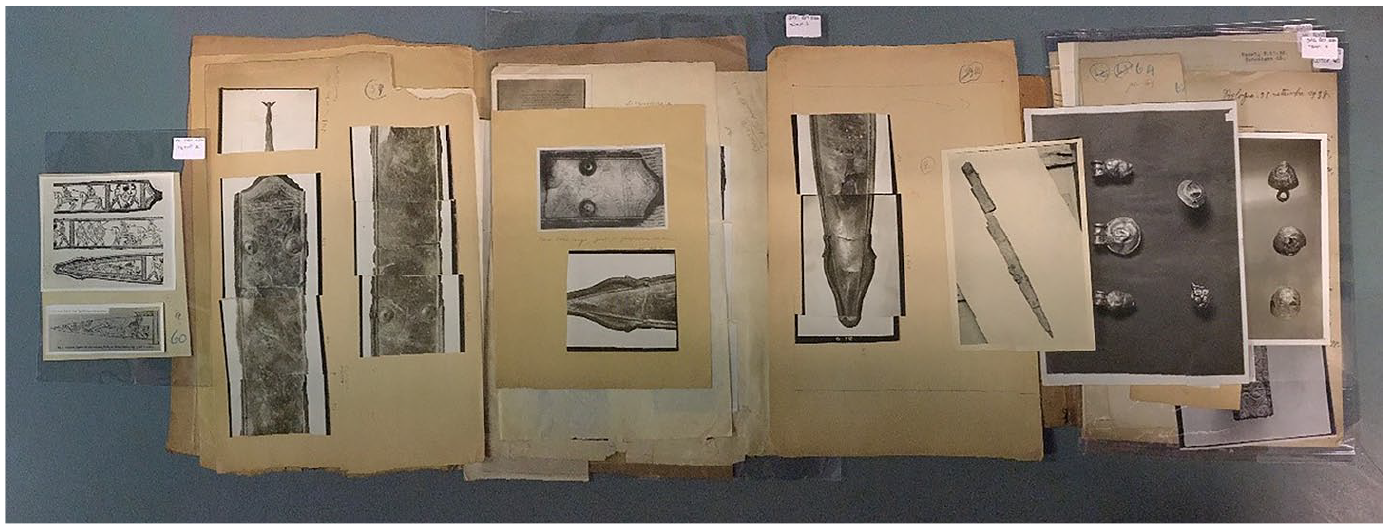
An example folder from the Jacobsthal archive, with some of the photographs of objects
Perhaps surprisingly, Jacobsthal made explicit his intentions to analyse Celtic art objects solely in terms of their internal visual characteristics and showed little interest in their wider archaeological context. He seemed thwarted by the Roman period and did not engage with late and ‘conquest period’ Celtic art objects in the way that many of his contemporaries did. In a short article that preceded ECA, he remarked that the analysis of the ‘Celtic soul’ should not be a concern of archaeologists. Rather, they should merely be tasked with ‘describ[ing] what is visibly and clearly expressed in stone, bronze, or clay’ (Jacobsthal, 1941: 20). Accordingly, there are relatively few instances of him expressing a more emotional response or unfiltered initial thought about the objects that he encountered. These sentiments are encapsulated when Jacobsthal says ‘in Celtic art this haunted and magic world soon faded away: where it went and hid I cannot tell’ (p. 20). It is as if he could sense a rich and beguiling Iron Age world filled with magic, river gods and artistic expression hidden just beneath the surface, but it was one that he could never quite reach – and these occasional moments of frustration crept through into his publications.
Despite Jacobsthal’s decoration-orientated remit for ECA which could be seen as theoretically constraining, he went far beyond producing what was once to be merely a catalogue. Something about his tumultuous upheaval from Germany and his treatment as a refugee and foreign ‘other’ changed his mind about its content and he states in the prologue that it was not only re-written, but re-thought (p. vi). His analysis, particularly on the transmission of Iron Age art forms and styles made a significant and lasting impact on the discipline, and made his successors, as Christopher Hawkes (1963: 12) famously said, ‘all his commentators’. ECA is a sensitive account of the art from Celtic Europe – something Jacobsthal (1941: 163) characterizes as a medium ‘of contrasts . . . attractive and repellent . . . full of paradoxes . . . rational and irrational; dark and uncanny’ (p. 163).
One of the more unexpected finds from the Jacobsthal archive was a previously unpublished essay written as a birthday present to Beazley. In the first section of the essay, Jacobsthal describes four British and Irish sword scabbards, arguing for the strong Hungarian parallels in their style of decoration. A light-hearted explanation for the apparent transmission of motifs is posited in the second section, where Jacobsthal writes of an Iron Age craftsmen ancestor of the Jewish protagonist from James Joyce’s Ulysses, Leopold Bloom I, who travels from Hungary to Lincoln to craft swords. Despite the fictitious and satirical nature of this latter half of the manuscript, it does constitute a more explicit instance of Jacobsthal appropriating the archaeology of Iron Age Europe to reflect on the contemporary political landscape. Despite strong written encouragement from his peers to publish this work, such as from his good friend Hugh Hencken at Harvard, Jacobsthal, in a reply to Hencken, saw it as ‘dangerous stuff’ that should be ‘shown only to the very, very few’ (Jac. Archive, Box 49, Letter 182: 19 July 1949). Taking the view that Jacobsthal’s worries were now obsolete and that the article has important academic significance, the essay was published in its original form in 2012, in a festschrift for the Celtic art scholar Vincent Megaw (Jacobsthal et al., 2014).
This posthumous publication might at first seem as if it contradicts Jacobsthal’s wishes, given that he so strongly resisted making the paper available to a general readership. On the contrary, Jacobsthal’s fears about publishing this particular manuscript were a symptom of his historic persecution, and its publication, along with others about his archive, is both a telling of his remarkable story and a celebration of his contributions to scholarship. This demonstrates anthropologist David Zeitlyn’s point that, drawing on Derrida and Foucault, archives can be used to challenge the hegemony under which they are created, allowing us to excavate subjugated and silenced voices (Zeitlyn, 2012: 464). The paper also signifies that archives can not only provide insight into the production of published works, but also bring previously unpublished historic scholarship to light for the benefit of current and future scholars in related fields. Part of the allure of the archive is undoubtedly this discovery of the unseen and the unknown, and even carefully curated archives like Jacobsthal’s can contain ‘secrets’. However, as we shall see next, uncurated archives can hold equally compelling, if different, sets of possibilities.
Edward Martyn Jope (1915–1996) and Early Celtic Art in the British Isles
Progress on Jacobsthal’s next publication, which concerned British insular Celtic art had been underway since well before the publication of ECA (Jacobsthal et al., 2014: 214). However, requiring assistance with the completion of this second instalment, an aging Jacobsthal enlisted Edward Martyn Jope as his assistant and collaborator (Stead, 2000: v). The two scholars worked on the publication together for several years before Jacobsthal died in 1957, and Jope continued to work on it alone. For several years after his death, Jope was allowed to use Jacobsthal’s old office at Christ Church College, during which time he had access to items from his archive. Despite mentioning it as being ‘in press’ as early as 1971, the work on what would become Early Celtic Art in the British Isles (hereafter ECABI) continued on through the 70s and into the 80s. Ultimately, Jope never quite finished it before he died, and the work was published posthumously in 2000. As the archaeologist Ian Stead notes in the preface to the work (Jope never got round to writing one), the publication date of ECABI became somewhat of a running joke in the end and, despite publishing numerous other articles on Iron Age objects in the meantime, the book had a gestation period of almost 40 years (Jope, 2000: v).
As previously mentioned, a first pass through the archive revealed material belonging to Jacobsthal that Jope had removed during work on ECABI, and this comprised some unexpected material. Stead mentions that, in a draft blurb for ECABI, Jope stated upon Jacobsthal’s death that ‘almost no usable text had been completed’ (Stead, 2000: v). However, the Jope archive contained over 70 pages of Jacobsthal’s original proofs for ECABI (they had been produced using Jacobsthal’s typewriter), which had been kept and annotated by Jope. Some of Jacobsthal’s photographs have also been reused. This is not by any means to say that Jope plagiarized this material – the publication was always intended to be a collaboration. However, it does suggest that some parts of the material may have been more derivative than previously thought. Certainly, with the publication of ECABI constantly on the horizon, Jope commanded a certain authority over the British insular material, and the work of many other scholars in the field might have been quite different had it been published in the 70s as planned. As we shall see, the archive provides clues as to why it was that the volume had such a long period ‘in prep’.
In contrast to Jacobsthal’s background in classics and art history, Jope completed an undergraduate degree in chemistry at Oriel College, Oxford, in 1935, and went on to work as a biochemist during the Second World War (McNeill, 1996). This cultivated Jope’s interest in and understanding of the chemical composition and production of the iron and copper alloys used in Celtic art objects. A sheet of handwritten X-ray spectroscopy results in the archive detail of the relative elemental composition of an iron dagger from Minster Ditch and an iron sword from Standlake, both near Oxford, and reveal much more of an interest in the materiality of metalworking than his predecessor had shown. He had also developed an interest in archaeology alongside his study of the sciences, particularly in the local Oxfordshire area and, having joined a local archaeology group, Jope accumulated extensive excavation experience. Having been appointed to the Royal Commission on Ancient Monuments in Wales in 1938, he eventually secured a lectureship in archaeology at Queens University, Belfast, in 1949 (McNeill, 1996). This contrasting suite of experience is reflected in a style of analysis that made ECABI very different to Jacobsthal’s previous instalment on the Continental material. A short but representative section of Jope’s description of a Northern Irish sword scabbard (pictured in Figure 3) discovered at Lisnacrogher, Co. Ballymena reads as follows: A sinuous continuing thread thus meanders through the composition, from the top right-hand sickle end trumpet right down into the chape-tip. At the bottom one smaller volute penetrates into the chape-frame, and below this the strand meanders down like a stream, through pools in the bends, fed by winding tributaries. (Jope, 2000: 33)
Chris Gosden (2010: 112–113) has argued that, through Jope’s real sensory and sensual engagement with the objects, he has been able to develop his own kind of archaeological ‘thick description’, which is vividly evocative of the object, even to the extent that some of the original ‘Iron Age charge’ of the object comes through. Gosden goes on to suggest that Jope’s descriptive style even borders on being ‘erotic in its sensibility’ and, although I would not go this far, Jope was successful in coming to terms with and expressing the sensory impact of decorated Iron Age metalwork. Celtic art objects are notoriously difficult to define and categorize because of their variety, complexity, ambiguity and abstraction in terms of their form and decoration (Garrow and Gosden, 2012). Jope, however, was able to achieve this with a striking degree of success and a key component of this was his use of descriptive language. Jope realized that existing modes of description were not satisfactory for a category of art object so elaborate and unusual. Thus, he looked to the natural sciences, art history and even musical theory to expand his vernacular, of which he provides a glossary for the reader (Jope, 2000). In order to proficiently describe and evoke an object, however, one must first spend time coming to terms with it in the first instance. The Jope archive arrived at the Institute archives after Gosden’s analysis of his interpretations were published, and they shed new light on how Jope was able to achieve his ‘thick description’ in some quite surprising ways.
Starkly contrasting with the sense of respectful distance to objects that was observed by Jacobsthal, Jope’s grounding in chemistry and archaeological excavation seems to have cultivated a much stronger desire for bodily engagement with the objects. One of the most surprising finds from the Jope archive was a series of rubbings that had been made by Jope with a pencil on several sheets of tracing paper, one of which is pictured in Figure 5. Jope, presumably without thought of the damage it could have caused, laid the paper over the Lisnacrogher sword scabbards and created the images by applying a considerable amount of pressure to the undulations in their surfaces. Jope then retraced elements of the motifs with contrasting red ink. Through these rubbings, Jope physically translated the Celtic art designs on these objects into something that he could experience physically. They evoke the image of Jope holding the scabbards, feeling their coolness, weight and their immediacy to the body, running his fingers over their roughness and following the swirling lines with his pen. These are all things that are not normally possible for researchers but that come through in Jope’s almost anatomical familiarity with them. Whilst this may represent a practice that would be abhorred, understandably, by modern curators and conservators, it vividly illustrates the lengths that Jope was prepared to go in order to create a deeper understanding of the objects he studied.
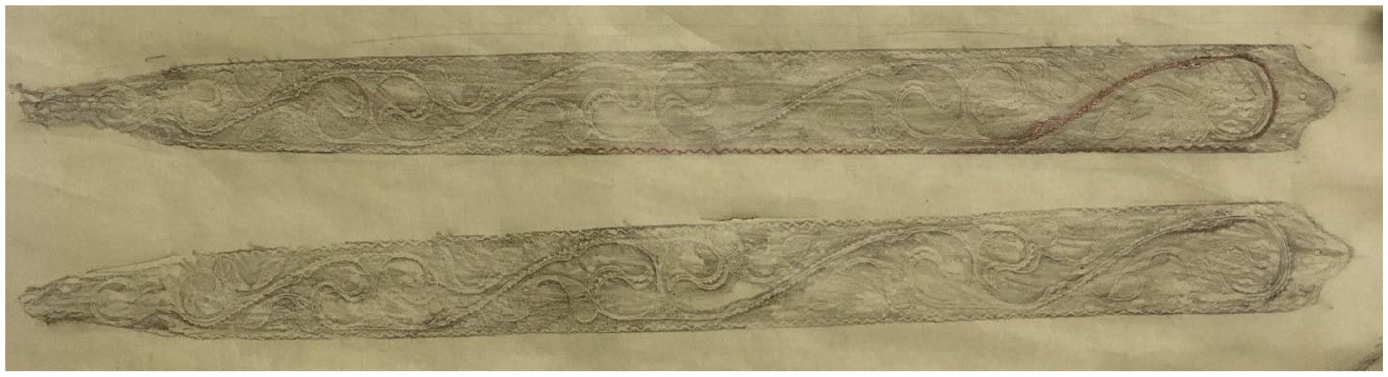
One of several pencil rubbings produced by Jope of the Iron Age sword scabbards discovered at Lisnacrogher, County Antrim, also pictured in Figure 3. He has retraced some of the swirling decoration with a red pen. (Jope Archive, oversized images: drawer 3). © Photograph: Matthew William Hitchcock. Reproduced courtesy of Archaeology Archives, Oxford.
Somewhat more traditionally, Jope also produced sketches of Celtic art objects. In a letter to Jacobsthal (pictured in Figure 3) that was sent with an illustration of one of the Lisnacrogher scabbards, he mentions that he ‘saw traces of engraving on it, and 18 hours squinting along it produced the enclosed pattern’ (Jope archive, box 3a). However, as well as being employed as a means of conveying or recording visual information, Jope also used sketching as an analytical tool. For example, the archival document in Figure 6 is the printed agenda from a faculty meeting at Queens University, Belfast, that Jope presumably attended. On it, he has sketched and doodled extensively, and many of the images are elements of the Lisnacrogher sword scabbards, from which he also produced the rubbings. The resulting doodles appear almost as a mind-map, as if Jope’s thought processes on the form and decoration of the scabbards and their links to other objects have been laid out and made visible. The architect Raymond Lucas (2014: 202) emphasizes the importance that sketching in this way, which allows for ‘multiple projections’ of the object to be seen simultaneously, has in facilitating the description and exploration of objects. Whether drawn from life or from a photograph, sketches require the sketcher to look, quite systematically, at every part of the object that is visible. The anthropologist Andrew Causey refers to this active process as ‘drawing–seeing’ (Causey, 2017: 11). It can even be seen as a form of ‘participant observation’, to use the anthropological term, with the sketcher required not just to observe ‘from the outside’, but to ‘take part’ and translate between (Taussig, 2011). In many ways, the drawings themselves are a by-product – clearly, Jope never intended for these images to be published or seen by anyone. It was the process of creating the image and the dialogue this embodied that was important. The anthropologist Michael Taussig has described the act of drawing as ‘pulling on some thread, pulling it out of its knotted tangle’ (Taussig, 2011: xii), and this sentiment seems particularly suited to Celtic art, with Jope not just depicting the coiling motifs, but attempting to unravel them through a series of different iterations. In contrast to Jacobsthal’s two-dimensional methods of visualization, Jope renders many different views and angles at once, contributing to a better understanding of the three-dimensional object.
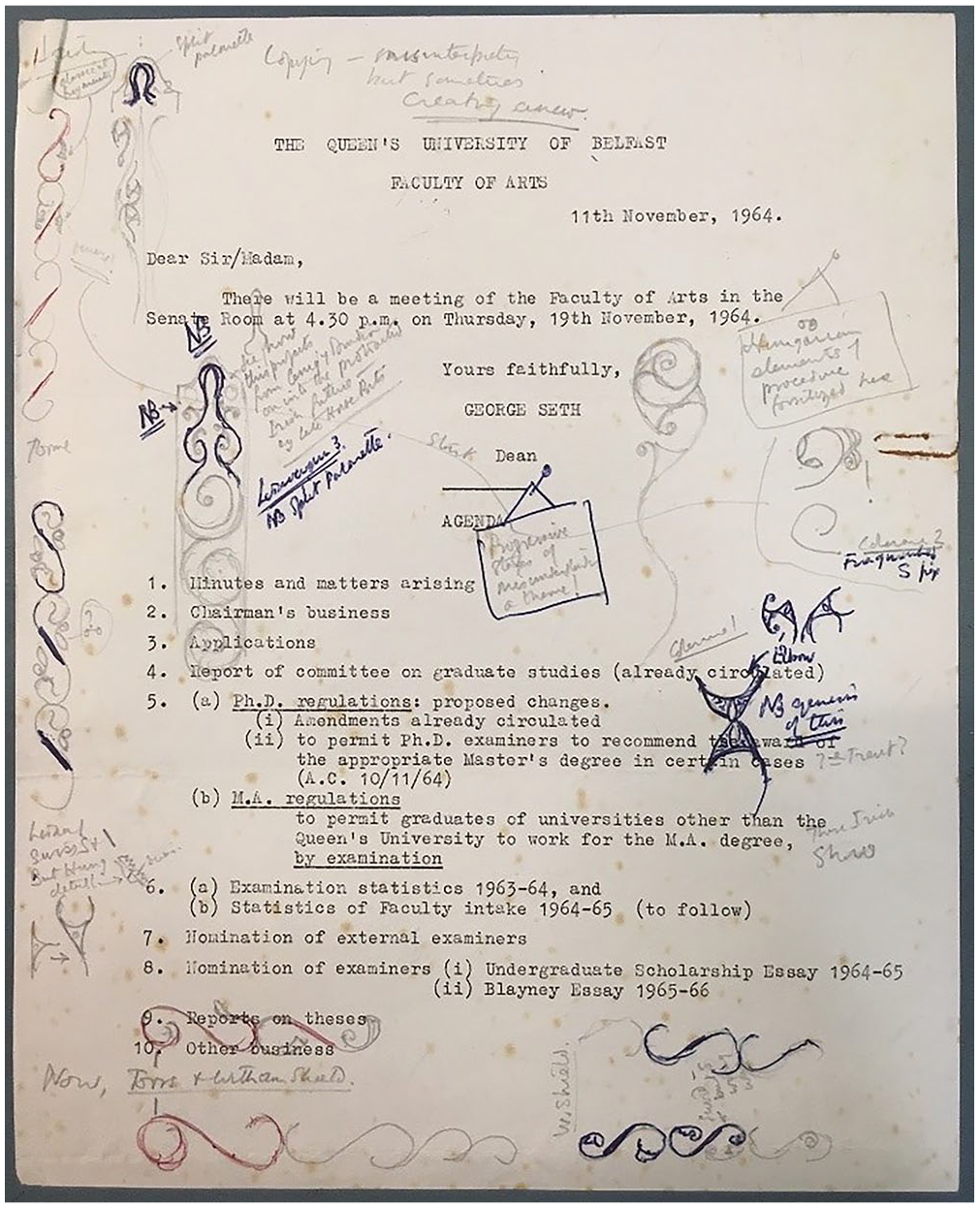
A faculty meeting document with Celtic art designs doodled on top by Jope (Jope archive, box 3a). © Photograph: Matthew William Hitchcock. Reproduced courtesy of Archaeology Archives, Oxford.
A key part of what we do as archaeologists is to examine material remains which are degraded, fragmented, displaced, unfamiliar and often chaotic, processing them in a way in which they become intelligible to us and to others – but this is rarely straightforward. Jope was particularly proficient at doing this and his well-informed brand of ‘thick description’ is capable of evoking the object, even to those who have not encountered it first-hand (Gosden, 2010). However, the archive has provided insight into the meticulous lengths to which Jope went in order to achieve this. Ultimately, his extraordinary capacity to come to terms with Celtic art objects seems to have bordered upon obsession as far as ECABI was concerned. Baird and McFadyen (2014) argued that the form of an archaeological archive is directly related to the form of archaeological knowledge produced from it, and this is certainly the case here. Jope’s vast and chaotic collection of notes, doodles, sketches and drafts – sometimes written out again and again over several days – resulted in a book which is sprawling, idiosyncratic, cyclical and very difficult to navigate (Gosden, 2010). Despite this, and the fact that work on the volume ultimately outlived the author, ECABI is an astonishing achievement in the synthesis and analysis of British Iron Age Celtic art and remains an invaluable of reference on the topic.
Conclusions
Bjornar Olsen (2003: 100) has pointed out that archaeologists rarely talk about the ‘dirty practices’ of archaeology – of digging through earth, sieving soil, sorting finds into bags and so on. Extending also to the kinds of archaeological practices that are conducted in museums and academic institutions, these primary processes are key in the creation and transmission of information but often become obscured and even forgotten. As this article has demonstrated, historic archaeological archives can illuminate the unwritten and the unsaid in ways both subtle and shocking, as modes and methods of analysis are translated into matter and made visible. Jacobsthal’s application of his familiar Art-Historical techniques resulted in an impressive written and visual synthesis of Iron Age metalwork from Britain. In Celtic art, Jacobsthal (1944: 163) saw an alternative vision of the world to that represented in Classical art, but one which, crucially, he saw as no less of a ‘real style’. However, the objects’ stubborn resistance to his almost sole focus on their isolated decorative elements and the circumstances of his persecution and upheaval discouraged him from trying to reach the people whose lives of which they were once a part. Jope, I argue, was much more successful in being able to evoke the Iron Age power and cultural salience of Celtic art, and this is due to the unsaid, unpublished and almost subconscious ways he went about building up an affinity with it. The process of archiving an object produces as much as it records (Baird and McFadyen, 2014: 15) and Jope was able to produce objects more vividly because he archived them more thoroughly.
This article has outlined an assemblage-based archaeological approach to exploring archives, arguing that the practical and theoretical tools of the archaeological discipline are well placed in dealing with key concepts such as degradation, fragmentation and scale. As Basu and De Jong (2016: 15) have pointed out, the relationship between the disjointed fragments of an archive and the imagined whole is a ‘fundamental dynamic in knowledge production’. Freud famously used archaeological excavation as a metaphor for psychoanalysis, as both archaeologists and psychoanalysts ‘draw [their] inferences from the fragments of memories’ (Freud, 1937: 360; see also Thomas, 2009), and here this metaphor has been made physical as the archaeologists themselves became excavated. Constituting a ‘transfer of material memory from one form to the other’ (Baird and McFadyen, 2014: 16), archives, like the archaeological record itself, can be used to produce new knowledge about both the ancient and very recent past. However, it is only through our interactions with them that those forms of memory become reinvigorated. As with Foucault’s observation of ‘Las Meninas’, it is in the presence of the viewer that the focus of the subjects, like shadowy reflections, become revealed. Crucially, we must remember a key point stressed by Derrida (1995): that archives not only create, translate and maintain memory, but they also bury it – and what are archaeologists if not the retrievers of things buried?
Footnotes
Acknowledgements
I would like to thank Sally Crawford and Katarina Ulmschneider for their generous help and support in the production of this article. I am also grateful to Melanie Giles, Julian Thomas and Helen Chittock for their helpful advice on an earlier version of this article and to three anonymous referees for their generous and useful comments. All errors remain my own.
Funding
The author(s) received no financial support for the research, authorship, and/or publication of this article.
