




Abstract
Message sticks are tools of graphic communication, once used across the Australian continent. While their styles vary, a typical message stick is a flattened or cylindrical length of wood with motifs engraved on all sides. Carried by special messengers over long distances, their motifs were intended to complement a verbally produced communication such as an invitation, a declaration of war, or news of a death. It was only in the late 1880s that message sticks first became a subject of formal anthropological enquiry at a time when the practice was already in steep transition; very little original research has been published in the 20th century and beyond. In this article, the author reviews colonial efforts to understand these objects, as recorded in documentary and museum archives, and describes transformations of message stick communication in contemporary settings. He summarizes the state-of-the-art in message stick research and identifies the still unanswered questions concerning their origins, adaptations and significance.
When Prince Charles visited the Gove Peninsula in 2018, Yolŋu leaders presented him with a rectangular wooden stick displaying a sequence of geometric motifs. The object embodied a formal request for the royal representative to intervene on behalf of Yolŋu people in treaty negotiations with the Australian federal government. Although carefully stage-managed for the assembled media, the interaction continued a tradition of solemn diplomatic exchanges that have been taking place in Australia since well before the British crown claimed sovereignty. In all corners of the continent, special envoys journeyed vast distances with the task of consolidating alliances, declaring war, announcing ceremonial activities or coordinating population movements. To facilitate their mission, the messengers carried engraved wooden sticks in varied styles that were produced simultaneously as tokens of authority, mnemonic prompts and explanatory diagrams. By the late 19th century, the use of ‘message sticks’ for the purpose of long-distance communication was all but abandoned in most regions, just as newcomers from Europe were beginning to document the practice for the first time. From the early 20th century, Indigenous people began to manufacture them as aesthetic objects for sale or display and, in certain regions such as Arnhem Land, they continue to be used to formalize political interactions between Indigenous and non-Indigenous institutions. In the following review, I assess the surviving documentation of earlier message stick use and trace more recent transformations in the practice. In so doing, I identify unanswered questions concerning the history and use of message sticks and suggest productive new directions in research.
While their styles vary, a typical message stick is a flattened or cylindrical length of wood, tapered at one or both ends with motifs engraved on all sides (see Figures 1, 2, 3 and 4). The motifs take a range of forms including straight, oblique or intersecting lines, as well as shapes such as diamonds, crescents and chevrons. Message sticks are often notched on their long edges and may also be painted with ochre, pipeclay or other pigments. A motif may be associated with a specific meaning, such as a single named individual, or the meaning may be relatively generic, such as a group of unnamed people. Other motifs serve as decorative fillers, sometimes termed ‘flash marks’ by Indigenous consultants (Hamlyn Harris, 1918; Roth, 1897; Spencer, 1915). It is common, for example, for flat message sticks to have one interpretable surface while the reverse side, bearing similar motifs, is intended to be ornamental only. It is important to note, however, that all elements of a message stick hold the potential to express meaning, including their size and shape, and even the variety of wood. The messenger who carried the object was the primary interpreter of a message stick’s meaning, and this individual was expected to deliver an explanatory verbal statement to the intended recipient.

Message stick from Queensland, held in the Pitt Rivers Museum (1989.46.4). Pigmented with blue laundry soap, it was sent by a Yagalingu man to a Wadjalang man in the late 19th century and bears an invitation to hunt emu and wallaby that were sequestered by a wire netting fence near Clermont. The two central horizontal lines represent the fence. The type of wood is Acacia homalophylla, a species associated with the Wutheru moiety shared by both sender and recipient (Howitt, 1889).

Sketch of the reverse facet showing two vertical bands enclosing zig-zags to represent ‘emu’, and four central rectangles with cross-hatching for ‘wallaby’ (sketch by Julia Bespamyatnykh, after Howitt, 1889).
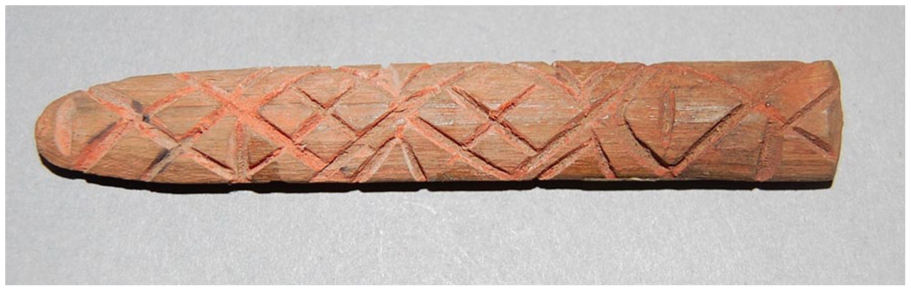
Message stick from Queensland in the British Museum (Oc1900,0723.58), collected by W Charles Handley in c. 1900. According to the catalogue, the object communicates the deaths of three children. On the basis of Roth’s (1897) glossing of Kalkatungu message sticks, the two central diamonds enclosing a cross would represent ‘male’ and the adjacent diamond enclosing a vertical line would stand for ‘female’. If these motifs had wide currency in Queensland, this might indicate the genders of the three deceased children.
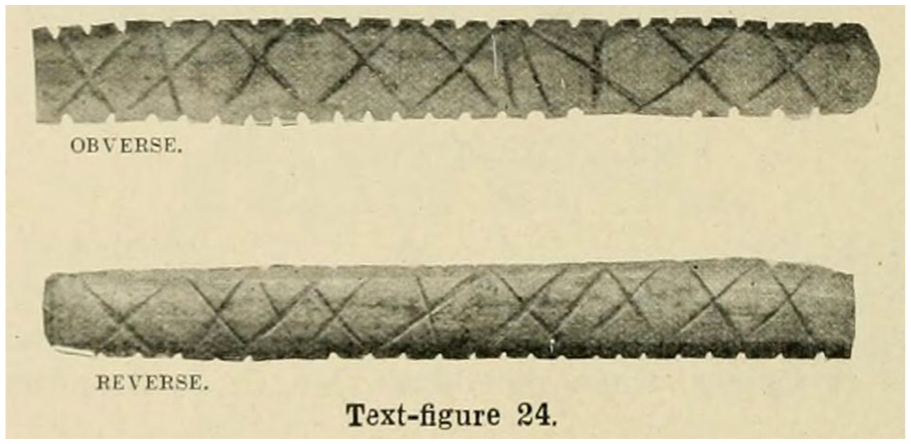
Message stick sent between Darwin and Daly Waters in the care of Gilbert White some time between 1900, when he became Bishop of Carpentaria, and 1918 when Hamlyn Harris published the image. The accompanying verbal statement, withheld by White, was ‘Want ‘em pretty fellow alonga head, boomerang’ (‘I want headbands and boomerangs’).

Message stick from the Boulia district of Queensland, collected and sketched by Roth (1897: 235). The message is a request for a meeting and the motifs refer to geographic features. ‘H’ is the proposed meeting place.
Although colonial scholars broadly agreed on how message stick communications were enacted, they were far from unanimous on the particulars. As we will see, settlers of varied experience differed in their understandings of how much information was encoded, and how denotational these encodings were in practice. 1 In effect, this amounted to a debate over whether the bulk of informational redundancy lay in the graphic text or in its accompanying verbal message. These discussions, however, remained speculative and sterile. Collectors and anthropologists rarely sought out Indigenous messengers for their expertise. Moreover, the fact that message sticks were documented in isolation from one another made it difficult to apprehend their full range of uses, let alone diversity and change over time. As a result, several issues concerning the history, function and significance of Australian message sticks remain either unaddressed or unresolved to this day.
What is known about message sticks
The state-of-the-art research on Australian message sticks is bounded by two constraints on data availability: there is no material evidence for their use prior to British colonization in 1788, and Indigenous people no longer employ them today for their traditional purpose of facilitating long-distance communication. The absence of evidence in the archeological record does not, however, indicate evidence of absence. Due to Australia’s unique climate and soil composition, objects made of wood survive only in extraordinary conditions. For this reason, fewer than 100 pre-contact items of wooden technology, from spears to boomerangs and digging sticks, have ever been recovered from archeological sites (Langley et al., 2016), despite the continent’s 65,000 years of human occupation (Clarkson et al., 2017). Among these, the single object identified as a message stick, recovered from Cahill’s Crossing in Western Arnhem Land, is disputed as such by specialists including Indigenous consultants (Meehan, 1984; Schrire, 1982). Accordingly, a thick evaluation of message stick communication must lean on evidence from post-contact material culture collections and ethnographic commentaries.
19th-century ethnography
It was not until 1840 that the first eye-witness testimony of message sticks was recorded in colonial documents (McReachie in Howitt, 1889), and it took several more decades for the practice to attract wider international attention. Among the first scholars to make message sticks the subject of scientific inquiry were French and German anthropologists. While stopping in Cooktown in 1880, the German anthropologist Adolf Bastian described his chance encounter with message sticks as a surprising discovery that challenged his assumption that ‘civilization’ was synonymous with Western literacy (Bastian, 1880). Further international interest soon followed with reports from Rudolf Virchow (1882) and the physical anthropologists Emile Houzé and Victor Jacques (1884). Referring to artefacts they had collected, these scholars were impressed by how much information was apparently communicated with so few marks on the surface of the wood. Virchow (1882: 34) wondered: Nothing would be more important than to know whether these drawings have a constant, generally accepted meaning, or whether they represent a kind of free invention in a particular case. In the former case, which is more probable because of the frequent recurrence of the same signs, it would again be necessary to ascertain whether the sign signifies only the object to which it corresponds in form, or whether it has another value extending beyond the object. (author’s translation)
At the time, the important mediating role of the messenger was not fully appreciated, but new research would soon clarify the situation. It was during this period that the amateur scholar Edward M Curr launched a pan-continental survey to elicit ethnographic data and vocabulary from Indigenous communities. Sent to station owners, police officers and other foreigners who interacted regularly with Indigenous people, the survey included the question: ‘It has been said that messages are sent from one tribe to another by figures painted on bark or cut on sticks; will you give me your experience on the subject?’ The results of his study, published in fragments throughout the five-volume work The Australian Race (Curr, 1886–1887), revealed that message sticks were known among at least 20 different language groups located across the whole continent. Many of Curr’s correspondents volunteered the information that the message sticks could not be interpreted independently of an oral statement provided by their messengers.
In the same period, the anthropologist and explorer Alfred William Howitt sent out a more detailed questionnaire designed to probe the actual pragmatics of the system, including the precise role of the messenger, and the relationship between the carved motifs and the verbal message (Howitt, c. 1888). The resulting paper, published as ‘Notes on Australian message sticks and messengers’ (1889), remains the most valuable work on the subject to this day. Howitt showed that message stick communication was even more widespread than Curr’s account indicated, and that it unfolded according to a conventional routine. According to Howitt, a man might decide to send a message to another camped in a neighbouring locale. To do this, he would first appoint a messenger of the same kin category as the recipient before carving a message stick in his presence. After the sender had explained its contents, his messenger would carry the stick overland, displaying it prominently in order to signal his privileged role as messenger. Upon arriving at his destination, the messenger delivered the stick to the intended recipient and produced an oral recapitulation of its message while referring to the marks. When the message was intended for the entire group, the recipient orated the message to an assembly. Messengers might also bring additional emblematic tokens as communicative props, depending on the content of the message. Thus, a message concerning male initiation might be accompanied by a bull roarer, or if it concerned war, a shield. Howitt ascribed three functions to message sticks. The first was to identify the messenger as having the right to cross into a neighbouring country without having to negotiate permission and without fear of violence or rejection (much like a passport); the second was to lend authority to an oral message that he delivered (like a signature or royal seal); and the third was to help the messenger recall the details of an oral message by means of a visual prompt (like a knot in a handkerchief). In some instances, only the first two functions needed to be activated as a vouchsafe for an already well memorized verbal statement. Howitt took pains to point out that message sticks were not a form of language-based writing since the motifs could never be interpreted without assistance from the sender or his messenger. In his estimation, the motifs themselves were entirely arbitrary. Nonetheless, he provided sketched illustrations of 12 message sticks, and gave the glosses for a number of motifs as provided by the senders or messengers (see Figures 1a and 1b). If these motifs had consistent conventional meanings with wider currency, it would leave open the possibility that they were more than the personal mnemonic devices of the sender. In other words, Howitt’s documentation left room for an implicit fourth function of message sticks: to encode conventionalized information in graphic form to be interpreted later by a recipient.
Neither Curr nor Howitt based their analysis on direct consultation with Indigenous people, let alone original or sustained fieldwork. The first in situ description of message-stick use is owed to Walter Roth who devoted a section to them in his Ethnological Studies among the North-West-Central Queensland Aborigines (1897). Importantly, Roth situated message sticks within a wider context of Indigenous communication techniques including the use of track signs and smoke signals. He also collected and sketched 15 artefacts, recording their interpretations as provided by his consultants. Roth confirmed that many of Howitt’s earlier findings on message sticks held true for Indigenous groups in northwest Queensland; however, he also determined that their motifs were by no means arbitrary. According to his consultants, certain motifs were indeed intended to be ornamental but others had stable and conventional meanings, including signs for women and men, geographic features, named colonial settlements, durations and seasonal events. Despite Roth’s careful documentation of these signs and their meanings, most subsequent scientific commentaries held fast to the position that message stick motifs were essentially meaningless or idiosyncratic.
Early observers often conjectured that message sticks had principles in common with writing. Bastian (1881) would classify message sticks as an ‘Australian substitute for writing’ (australischer Schriftsubstitute) while others surmised, in social evolutionist terms, that they constituted evidence of a ‘germ of writing’ (Curr, 1886a: 151), ‘the savage mind originating an idea which might develop into writing’ (Scrivener in Curr, 1886b: 184), ‘a first step towards the ultimate result of a system of writing’ (Howitt, 1889) or ‘the first primitive step towards a written language’ (Hamlyn Harris, 1918). The ethnographer Friedrich Ratzel (1894: 317) went so far as to refer to the motifs as ‘primitive hieroglyphics’ and argued that they were a language-independent ideographic system. However, progressivist thinkers more often presented message sticks as a rudimentary form of information technology, a mere stepping stone on the path towards Western alphabetic literacy. Thus Virchow (1882) likened message sticks to engraved bone artefacts retrieved from Palaeolithic sites in Europe while Brough Smyth (1878: 54) argued that their use indicated a ‘gradual advancement in knowledge and invention’ and that Indigenous Australians would have inevitably achieved ‘civilization’ on their own merits if this trajectory had not been disrupted by colonization.
Nonetheless, Ratzel’s (1894) stronger contention that the motifs constituted a true, independent form of writing became a recurrent straw man in a late 19th-century ‘debate’ on the issue. In a revised version of his 1889 paper, Howitt (1904: 679) referred disparagingly to a supposedly popular but erroneous view that Indigenous people ‘can read the marks with as much ease as educated people can read the words inscribed on one of our letters’, while restating his earlier position that message sticks acted primarily as a guarantee of good faith in an oral statement. In the same period, the German ethnologist Erhard Eylmann (1908) alluded to similar public opinions that message stick motifs were a form of writing, a view he dismissed on the basis of his own inquiries into the matter, presumably from among the Malak-Malak and Warumungu from whom he collected specimens. By implication, there could be no room for a middle ground. If message sticks were not a fully fledged writing system, in Howitt and Eylmann’s view, they could have no intrinsic communicative content. This attitude was not universally shared. Others such as Brough Smyth (1878), Houzé and Jacques (1884) and Bonwick (1887) had a more comparativist perspective, placing message sticks in the same category as khipus, a knotted string code used in the Andes, and other non-linguistic sign systems. In other words, they acknowledged the possibility that graphic codes such as message sticks were systematic and rule-governed technologies of communication, even if they did not encode spoken language. It is significant, too, that variation in the practice was barely acknowledged by 19th-century anthropologists who tended towards homogenized idealizations of Indigenous cultural forms. It is plausible, therefore, that some message sticks were indeed more like passports, others like signatures, while others had mnemonic or writing-like characteristics, or any combination of these functions. The relative prominence of one or other function may have come down to the immediate context of the interaction as well as local communicative conventions.
Message sticks in the 20th century
Little in the way of significant new research on message sticks was published in the 20th century. A notable exception is ‘On messages and “message sticks” employed among the Queensland Aborigines’ (1918) by Ronald Hamlyn Harris, a paper representing a break with earlier studies that defined message sticks solely through their relationship to writing. Instead, he called for a relativist approach to the subject arguing that ‘it must be exceedingly difficult for the white man to understand the proper significance of the “message stick” from the black man’s standpoint, and it is because an endeavour to explain the “message stick” from our own has so often been made, that we have been at a loss to understand this subject properly’ (Hamlyn Harris, 1918: 14). Like Bastian before him, Hamlyn Harris surmised that message stick communication was likely to be governed by its own set of rules and pragmatic conventions. He acknowledged that message sticks were indeed tokens of authority as well as mnemonic devices, but he was also to support Roth’s position on the semantic values of motifs, asserting that ‘certain marks are undoubtedly known and recognized by tribal customs, so that, however many meaningless marks such a token might contain, there are nevertheless certain signs which would always be readily understood’ (p. 13) . In other words, although he agreed that the motifs could not be easily ‘read’ without a messenger, he rejected the more sceptical view that they had no semantic associations whatsoever. In support of this, he reproduced photographs of 28 collected message sticks of which 10 included their intended interpretations as provided by Indigenous experts. Some motifs were glossed with highly specific conventional meanings, such as ‘floodwaters’, ‘moon’, ‘spear’ and ‘police’.
This claim was reinforced by his convincing account of message sticks that were successfully interpreted without their messengers. In one reported instance, the designated messenger had died on route but the message stick was recovered and confidently interpreted. More intriguing still is his account of an ad hoc experiment conducted by the bishop Gilbert White. Having been entrusted with both a message stick and an oral message by an Indigenous sender in Darwin, White agreed to deliver it to Daly Waters. Yet, after he had dispatched the stick to its rightful addressee, the bishop decided to withhold the verbal message and was astonished to discover that the recipient interpreted the motifs accurately: a request to deliver boomerangs and headbands (Figure 3). Although non-Indigenous accounts must be treated with appropriate caution, these were not the only instances of message sticks interpreted without their sender, apparently with accuracy (see, for example, Brough Smyth, 1878: 354, 356; Edye, 1903; Smith, 1907). Even Howitt (1889), who had adopted the most uncompromisingly sceptical stance, had described in some detail an instance of a man successfully reading a complex message without the aid of a messenger (p. 329).
After Hamlyn Harris’s (1918) paper there followed few further descriptions of message sticks based on original fieldwork, and later commentaries largely referred to existing documentation. The Viennese anthropologist Amalie Maria Frank produced a dissertation on message sticks and waymarkers during World War II (Frank, 1940). However, this work is largely a synthesis and reinterpretation of published 19th-century analyses. The most recent fieldwork-based account of message stick use was produced after the war by CP Mountford. In the first volume of results from the 1948 American–Australian scientific expedition to Arnhem Land, he sketched and described 14 message sticks with information associating their motifs with their intended meanings (Mountford, 1956). Later, he would describe 17 more from his 1954 fieldwork in the Tiwi Islands (Mountford, 1958). This exceptional work was nonetheless published in the midst of a general decline in commentaries across the 20th century, a situation that might be attributed to the fact that traditional message stick communication was now rare and largely taking place on the outer periphery of the colonial administration. Other isolated examples of 20th-century message sticks are recorded in the Torres Strait Islands (Haddon, 1935) and the Nullabor Plains (Mountford, 1938). The most recent to be registered in museum holdings are three message sticks at the Rijksmuseum Amsterdam collected in East Arnhem Land in the 1960s, one of which conveys an invitation to ceremony.
Hybrid communication and new traditions
Across the 19th and 20th centuries, the ever-expanding colonial frontier disrupted Indigenous networks that were formerly consolidated through kinship alliances, ceremonial obligations, trade and war. Overwhelmed by violent and relentless frontier incursions, Indigenous people faced new limitations on their movements, imposed by missions, pastoral stations and police. As a result, it is perhaps not surprising that the communication system came under pressure. The puzzling phenomenon of messenger-less messages, as reported by Hamlyn Harris and others, may well have been a consequence of changing conditions on the ground that left intermediaries with far less freedom to move. It is in this context that we witness the emergence of hybrid communicative traditions developed at the interface between Indigenous and settler worlds. From the late 19th century onwards, it was not unheard of for settlers to produce their own message sticks for communication with Indigenous groups (Aldridge via Howitt, 1889: 324). Others employed Indigenous messengers to send ordinary pen-on-paper letters to non-Indigenous recipients along traditional routes (Fraser, 1892: 42; Howitt, 1889: 322; Meston, 1897; Spencer and Gillen, 1912: 469–470, 472; Thorpe, 1926). Indigenous people, meanwhile, sent message sticks in the care of non-Indigenous messengers (Brough Smyth, 1878: 355; Howitt, 1889: 329), or through the regular postal service (Banfield, 1908; Edye, 1903), a fact that suggests that both senders and recipients were confident that their messages could be deciphered without verbal mediation. The most recently recorded case of a mailed message stick involved an Indigenous solider serving in World War II who sent a message stick through the military post to a kinsman in the Northern Territory (Anonymous, 1942).
As amateur collectors became increasingly interested in ‘native’ products, Indigenous artisans began to manufacture message sticks for sale or barter in local economies. From at least the early 20th century, message sticks were created and circulated as aesthetic objects without specific communicative content, an innovation that in some ways complicates their formal investigation. Hamlyn Harris (1918: 30) disparaged such artefacts as having no ‘real ethnological value’ and excluded them from his analysis. However, the artistic production of message sticks represents a crucial development in the history of the practice, as it directly preceded the rise of modern genres of Indigenous art. To take a parallel example, Indigenous people at the Lutheran Killalpaninna Mission in South Australia began producing a hitherto undescribed variety of waymarkers in about 1904. Known as toas they were designed to be placed in an abandoned camp in order to direct followers to a new site. Unlike message sticks, toas were always supposed to be interpreted independently of their makers, even though in practice their meanings would sometimes have been coordinated ahead of time (Morphy, 1977). While the German missionary Johann Reuther believed that toas constituted a pre-contact Indigenous sign system, others regard them as a hybrid genre stimulated in part by a new demand for Indigenous products, including message sticks (Jones, 1995, 2007). Elsewhere, Indigenous artists began reviving message sticks in locations where their traditional use had long been abandoned. Indeed, in the 1930s made-for-market message sticks could be bought at the Hermannsburg general store (Jones, 1995). The Grassi Ethnologisches Museum in Leipzig has conserved eight examples of Central Australian message sticks sourced from Angas Downs station, where Anangu artists began creating and circulating a range of new artistic products in the 1950s and 1960s (Palmer, 2016). To this day, Indigenous artists continue to produce message sticks and message-stick inspired artworks for sale and display.
A persistent yet evolving message stick tradition concerns their use in political negotiations, performances and tributes: an extension of their diplomatic or ‘passport’ function (described above). Over the 20th century, this diplomatic function appears to have acquired greater prominence, especially in the north of Australia. In 1935, message sticks delivered by the anthropologist Donald Thomson were crucial in establishing a peaceful dialogue during the Caledon Bay crisis that erupted after Yolŋu men speared and killed a party of Japanese trepang fishers (Allen, 2015). Some years later Indigenous representatives from Bathurst and Melville islands sent a message stick to then Prime Minister Robert Menzies as a tribute for the 1951 jubilee celebrations marking Australia’s federation. Representatives at Mornington Island and Aurukun in north Queensland sent a message stick to Prime Minister Gough Whitlam, demanding land rights (Anonymous, 1974). Most recently, as we have seen, Yolŋu leaders presented a message stick to Prince Charles during his visit to Arnhem Land (Graham, 2018; Marks and Hitch, 2018). What all such political message sticks have in common is the presence of a ‘signature’ motif identifying the sender or recipient. In other words, it appears that the ‘royal seal’ function of message sticks, emphasized by Howitt, continues to this day.
Museum collections today
The paucity of direct ethnographic observations on early message stick use contrasts with their representation in cultural institutions. Between the 1880s and the 1920s, collectors went to enormous lengths to secure samples and these are still conserved in collections around the world. The greatest numbers are held by the South Australian Museum (283 message sticks), the Australian Museum (230), the British Museum (74), the Penn Museum (54), the National Museum of Australia (52), the Grassi Museum für Völkerkunde Leipzig (50), the Ethnologisches Museum Berlin (33), the Peabody Museum Harvard (32), and the Pitt Rivers Museum Oxford (25). Other institutions hold smaller collections. Very few message sticks have ever been on public display, and even in major cultural institutions the metadata that accompanies the objects is sparse. For the most part, catalogue descriptions are limited to recording the geographic sources as well as their physical properties: dimensions, species of wood, marking techniques, etc.
Among the best described artefacts are older specimens collected in the 1870s and 1880s. For instance, the catalogue information accompanying the 33 message sticks in the Ethnologisches Museum Berlin, collected by Bastian, Virchow and other European visitors, is especially thick in detail concerning the meaning of the motifs and the context of the original communicative encounter. There are several possible explanations for the intensity and subsequent decline in documentation over the collection period. Firstly, the earlier artefacts were acquired at a time when message sticks were largely unknown to anthropology, and received wisdom about them had not yet taken hold. In later decades, by contrast, the notion that message stick motifs did not encode any semantic information may have encouraged collectors and curators to document them as if they were any other article of material culture whose purpose was self-evident. After all, the prevailing progressivist dogma assumed Indigenous artefacts were unchanging ‘fossilized’ traces of a universal human past; thus it was sufficient for a museum to hold ‘pristine’ exemplars of Indigenous artefacts without concern for how local traditions may have evolved from year to year. Accordingly, the fact that only a few decades of message-stick history are represented in contemporary museum collections means that generational change is nearly impossible to detect (on this problem, see Torrence, 1993). However, another explanation for the shift towards less-informative documentation is the likelihood that only a small proportion of the later-collected items were manufactured for local use in real communicative interactions. This does not render the objects inauthentic or spurious. After all, very few items of Indigenous material culture in ethnographic collections were originally made for local use. However, it does suggest that a more meaningful context for the interpretation of under-documented message sticks lies in the shifting economic relations between settlers and Indigenous people. From this perspective, we cannot assume that Indigenous people played a passive role in driving the market for message sticks and shaping settler imaginations about them.
Remaining questions
In order to revisit wider questions concerning the history, function and significance of message sticks, it is first necessary to accumulate the existing documentary evidence into a single unified dataset. Such a dataset is currently available via the Centre for Digital Humanities Research at the Australian National University and the Max Planck Institute for the Science of Human History in Jena (https://amsd.clld.org/) and includes every available description of individual message sticks in published and unpublished sources, including letters, explorer diaries, newspapers, journal articles and books. In addition, the dataset provides images and catalogue metadata for surviving message sticks conserved in museums worldwide. In total, over 1000 individual message sticks are represented. Although currently restricted to Indigenous communities, scholars and museum staff, the data is being prepared for wider release after consultation with relevant groups and institutions. Despite the fact that almost no original fieldwork-based research on message sticks has been carried out in the past century, the mass aggregation of message stick data offers new scope for comparative analysis. Accordingly, I have identified five far-reaching questions that the dataset could be mobilized to address: (a) How are message sticks to be defined as a class of material artefacts? (b) Can the pre-contact history of message sticks be reconstructed? (c) How did message stick communication unfold in practice? (d) How did message sticks evolve and adapt in the colonial era? and (e) How do message sticks compare to other forms of graphic communication? These questions are briefly expanded upon below with the aim of encouraging a renewed interest in message sticks and of outlining an agenda for their reanalysis.
How are message sticks to be defined as a class of material artefacts?
Message sticks are a polythetic category eluding easy definition or recognition. Although I have argued that there is a prototypical or core form, the objects nonetheless range widely in size and modes of embellishment. The shortest message stick I have recorded is 4.5 cm and the longest 1.4 metres. 2 While most are simply carved and engraved, others are finished with a variety of techniques including polishing, painting or adornment with feathers. Future work, in which the artefacts are systematically coded for formal properties would give some insight into patterns of distribution as well as material–semiotic conventions, given that even the choice of timber may convey important information as we have seen in Figure 1.
The material diversity of message sticks has had consequences for their historical classification by scholars and collectors. As we have seen, the archeological analysis of the supposed Cahill’s Crossing ‘message stick’ is disputed, and auction houses are still liable to mislabel an object as a message stick if its form coincides with the prototypical morphology of a flattened and tapered oblong. As a result, sacred tjurungas from central Australia, identifiable by a restricted set of recurrent ritual motifs (Anderson, 1995) are advertised by auctioneers as ‘message sticks’, leading to functional as well as terminological confusion.
Lindy Allen (2015) has taken a useful approach by decentring the message stick and focusing on the communicative encounter itself. In Allen’s account, emissaries relayed messages with the aid of an object that was ‘usually a message stick’ (p. 120), although alternative props – what Howitt (1889) termed ‘emblematical tokens’ – might also serve just as well as credentials. Allen’s approach suggests a more expansive category, into which tjurungas and other objects could also be fitted. Mountford, meanwhile, proposed a distinction between ‘ceremonial message sticks’ that conveyed invitations to attend ritual proceedings and ‘secular message sticks’ with ordinary requests (Mountford, 1956: 467, 1958: 106); however, these were etic categories that could not be assigned on material or lexical grounds. Lexical evidence from across the continent indicates that, from an Indigenous linguistic perspective, ‘message stick’ is a concept that is semantically distinct from other items that are lexified differently. Unlike tjurungas they are necessarily non-restricted objects that are designed to be displayed publicly in order to signal the messenger’s rights to cross borders and, unlike toas or artistic products, they are intended to be carried and explicated. Materiality nonetheless remains a property that is hard to capture: in at least one instance, a spear thrower was transformed into a message stick simply by virtue of being engraved with marks and repurposed for communication (Bastian, 1881; Dawson, 1881: 73). In short, an object is seen to be a message stick when it serves as the centrepiece in a communicative interaction and when its markings are understood to correspond to a verbal communication produced by its bearer. Future research should seek to reconstruct the varying terms of the relationship between the message, the messenger and the object in order to understand how message sticks are to be defined as a special kind of semiotic tool.
Can the pre-contact history of message sticks be reconstructed?
Nineteenth-century scholars occasionally speculated on the origins and evolution of message sticks. As we have seen, social evolutionist dogma encouraged the view that message sticks were a transitory stop-over on the road towards full writing. A related view saw message sticks as a post-contact innovation inspired by interactions with literate populations (Mathew, 1889: 381; Scrivener in Curr, 1886b: 183; Virchow, 1882). Such contact hypotheses were typical of an attitude in anthropology that denied cultural or technological sophistication to colonized peoples. The complexity of Australian Indigenous art, languages and kinship systems, for example, was often ascribed to imitation of outside groups (e.g. Chauncy in Brough Smyth, 1878: 251; Grey, 1841), or degeneration from an earlier state of ‘higher’ civilization (e.g. Lang, 1861). If message stick communication was indeed a cultural borrowing we would expect to discover ‘homelands’ in the vicinity of colonial settlements, or to the sites of interaction with Macassan visitors to northern Australia who were potentially literate in Indic scripts of island Southeast Asia. Further, their distribution would have limited range, given the comparatively short history of outsider contact. Thus, whether or not the question of origins proves to be tractable, it is clear that it cannot be properly considered without first plotting the actual distribution of message sticks at the time of contact.
Amalie Maria Frank (1940), who mapped the locations of 95 artefacts, showed that message sticks were collected or described in almost every region of Australia with denser clusters in central west Queensland, the goldfield region of Western Australia, and the Murray–Darling Basin. On its own, Frank’s distribution is inconsistent with a post-contact origin; however, she herself never conducted fieldwork in Australia and her map was based solely on the limited published sources available to her. In the present dataset, the number of known message sticks has increased 10-fold, yet only around 40 percent have sufficient metadata to associate them, at least in theory, with a specific location or ethnolinguistic group within Australia.
In the absence of new archeological or archival findings, I propose two additional methods for expanding our understanding of where message sticks were used. A consultation of the Chirila lexical dataset (Bowern, 2016) returns terms for ‘message stick’ in 57 distinct Australian languages. It is reasonable to assume that the existence of a lexeme is evidence for familiarity, if not intimate knowledge, of the item it stands for. Further, if terms for message stick are attested in such a wide range of languages it raises the possibility of lexical reconstruction via comparative-linguistic methods. Thus, through the comparative analysis of related terms in neighbouring languages, it may be possible to trace the diffusion of message stick technology across historical time, and perhaps isolate centres of diffusion. Precise methodologies are not outlined here; however, precedents for reconstructing cultural borrowing and diffusion via Australian lexical evidence are numerous (see, for example, McConvell and Evans, 1997; McConvell et al., 2018).
In addition to lexical reconstruction, Indigenous storytelling traditions provide vivid glimpses into pre- and post-contact Australian history (see Hercus and Austin, 1986, inter alia) while recent research has demonstrated the surprising accuracy of Australian oral transmissions at a millennial scale (Nunn, 2018). To date, a very small number of stories involving message sticks have been elicited indirectly as part of language documentation efforts (Bradley, 2016; England et al., 2014; Kemarr and Moore, 1999). However, targeted oral history documentation with a thematic focus on message stick communication would not only help fill in the picture of where the technology was used, but would also inform two other questions raised in this article: how communicative events actually unfolded, and how the system has evolved and adapted into the present era.
Even with the benefit of archival, museological, lexical and oral-historical evidence, many areas of Australia will not be directly accounted for. In these zones, I propose the use of indirect evidence on the basis of known political or ceremonial alliances at the time of contact. Thus, if it is established that message sticks were used by a given community for inviting neighbouring groups to ceremonial events, we can infer that they were also known, if not used, by those same allied groups.
How did message stick communication unfold in practice?
Howitt’s (1889) reconstructions of message stick interactions, as relayed by his correspondents in eastern and southern Australia, serve as a useful point of departure for examining the pragmatics of accurate communication. While Howitt downplayed the importance of the motifs in these interactions, their role was given greater emphasis by Roth and Hamlyn-Harris who had consulted messengers directly. Roth, in fact, sketched one message stick (Figure 4) together with instructions that included the reading order of each motif as well as the correct orientation (‘from below up’). Arguably, therefore, motifs were not merely diagrammatic but were aligned into sequences and conventional reading orientations. Wherever descriptions are adequate, such motifs might be isolated and associated with their meanings, shedding light on their role as a semiotic system.
The notion that message sticks are mnemonic devices may also bear reevaluation. After all, the accompanying verbal statements that have been documented are between one and six sentences in length and might easily be recalled in memory by those capable of reciting epic song cycles, even after a long journey. Thus the mnemonic interpretation may, to some extent, be a prejudice of a Western literate mindset where memory is so often outsourced to the written or digital page. A more nuanced interpretation would see the motifs and their meanings as mutually reinforcing and mutually constitutive of authority. In other words, they amplify communicative credibility, of which accurate recall is just one aspect.
Regardless of the semantic stability of the motifs, or the degree to which they had mnemonic power, the context of the encounter was crucial. Since message sticks themselves tended to encode a limited range of message types (requests, invitations, declarations, etc.), the number of plausible readings of a given message stick was finite. The use of supplementary communicative props, such as bull roarers in the case of male initiation or white body paint for a funeral, would further narrow the scope of interpretation. Shared information, together with the semiotic conventions between sender and recipient, are thus key to understanding how message sticks might be interpreted successfully even in the absence of a verbal statement. There is evidence, too, that messengers travelled over several linguistic boundaries, raising the possibility that the signs served a role in mediating multilingual interactions. In effect, communication was all about balancing the variable information load carried by the message stick itself, the messenger’s verbal statement and shared prior knowledge between sender and recipient.
The identity of the messenger clearly mattered. The question of kinship and social categories, raised earlier, is therefore vital for understanding communicative pragmatics. In Indigenous Australia, an individual’s classificatory relationship to another individual has a direct bearing on expected modes of interaction and communication. For ‘avoidance’ relationships, any kind of communication may be strictly forbidden or mediated through alternative channels. Other kinds of relationships may prescribe the manner or topic of communication. Social categories and their associated communicative prescriptions are therefore likely to have provided yet another productive constraint on the reception and interpretation of messages. In fact, the relationship between sender and recipient is often inscribed into the message stick itself by means of identifying marks – often simple notches but sometimes more elaborate ‘signatures’ – that stand for the sender and the recipient, much like a letter beginning ‘Dear John’ and ending ‘With love, Jane’. In so doing, the context of an addressed message becomes restricted to the relationship between two individuals, their shared reference and their expected communicative behaviours.
Many scholars have asserted that message sticks could only ever be carried and interpreted by men (Bulmer in Brough Smyth, 1878: 355; Hamlyn Harris, 1918; Roth, 1897; Spencer, 1915). However it is likely that the situation was more complex. Women, according to Howitt (1891), were the privileged intermediaries among the Dieri even though message sticks are not attested in this community, and there is some evidence that women carried certain kinds of message sticks on the Cobourg Peninsula (Robinson in Howitt, 1889: 330). It is also possible that women were permitted to manufacture and send message sticks, even if, in practice, they did not adopt the role of a messenger. A message stick from Queensland, now held at the British Museum (Oc1901,1221.18) was carved by a certain ‘Mary’ who used it to report an injury and request clothes. Much more remains to be understood about the role of identity in historical message stick interactions, including gender and social category.
How did message sticks evolve and adapt in the colonial era?
Every known historical instance of message stick communication took place between Indigenous communities that were in contact with settler populations. Thus, unless pre-contact archeological evidence comes to light, the primary context for understanding message sticks is one in which colonial and Indigenous worlds were already interacting. Since almost all message sticks that survive today were collected in a relatively brief period, it is impossible to reconstruct broad historical trends over the period of colonization. By contrast, micro-historical questions offer greater scope for investigation in terms of material adaptations, e.g. the use of introduced products like laundry soap (Figure 1a), as well as historically specific content recorded on the objects themselves. Today there are at least 126 message sticks that are sufficiently well documented as to include the site or circumstances of collection, the context of the communicative encounter and a reproduction of the intended message. These objects, here termed ‘interpreted artefacts’, are of central importance in the task of reconstructing the pragmatics of the system but they also serve as historical documents in their own right, expressing a largely unmediated Indigenous perspective on events of local importance. For example, the first ever message stick to appear in settler records was intercepted at Brisbane gaol in 1870 and was alleged to have been used to coordinate an escape attempt. Another collected by Emile Houzé and Victor Jacques in 1884 was manufactured by Tambo, one of 17 Indigenous people recruited as performers in Barnum and Bailey’s circus (Poignant, 2004). The message stick, acquired by Tambo’s recruiter Robert A Cunningham, marks events on the journey to America in the previous year. Tambo was among the many Indigenous performers who died on the tour; his mummified body was rediscovered in Cleveland in 1993. In tune with ethnographic turns in Australian history, message sticks offer an opportunity for Australianist historians to read against the grain of colonial sources, and to reclaim and amplify otherwise absent Indigenous voices. Significant precedents for the use of Indigenous graphic codes as primary historical sources are to be found in the Americas, for example, through the work of Gary Urton (2017) and Elizabeth Hill Boone (2000). In like manner, Australian message sticks hold the potential to serve as Indigenous sources bearing witness to past experiences. Yet the fact that message sticks continue to have political and symbolic resonance is evidence that they belong to an adaptive tradition with powerful continuities into the contemporary era.
How do message sticks compare to other forms of graphic communication?
For some time, paleographers have assumed that glottography, a term referring to sign systems that model language, was prefigured and enabled by semasiography, sign systems that convey meaning without modelling language. After all, the world’s earliest glottographic system, Sumerian cuneiform, was indeed derived from an earlier semasiographic code. Those who first commented on Australian message sticks likewise approached their motifs as a form of proto-writing with the capacity to inform research into the pre-history of Western alphabets. However, in recent decades, there has been a renewed focus on investigating semasiographic systems on their own terms, rather than as presumptive precursors to glottographic writing (see, for example, Boone and Mignolo, 1994; Brokaw, 2010; Déléage, 2013; Haring, 2018; Urton, 2017).
As a successful method for coordinating populations over long distances, message sticks draw attention to the inherent communicative potential of non-linguistic graphic codes, as well as their structural constraints. From a typological perspective, therefore, message sticks would benefit from a systematic comparison with other semasiographies that may share some of their principles. A common characteristic of codes used by traditionally non-literate societies is the fact that orality and context both play a central supporting role in the interpretation of the graphic text. Andean khipus, to reprise an earlier example, relied on the oral explication on the part of the khipu’s maker to render the code meaningful. Like message sticks, khipus were also tuned to a finite set of genres and purposes that narrowed the context of interpretation. In turn, the motifs in both codes belonged to a even more limited set of semantic domains: people, goods, countable items, durations and geographic locations. This progressive funnelling of relevant context would have made the message more precise, reducing the likelihood of misunderstandings and, in some cases, allowing the motifs to be interpreted without oral assistance. If such methods are found to be applicable to other non-linguistic codes, it would help us to generate typologies of graphic communication, with implications for the study of pragmatics and cross-cultural semiotics.
Conclusion
For several decades, Australian message sticks captured the interest of both local international scholars before discussions quickly faded from public discourse. In this brief period, anthropologists did not always agree on how the objects were deployed or interpreted in ordinary communicative encounters. Furthermore, collectors routinely failed to record the intended meaning of the message stick or its circumstances of manufacture. Message stick use has nonetheless flourished in the domain of negotiations between Indigenous and non-Indigenous groups, and earlier traditions of using message sticks for long-distance communication are still remembered by Indigenous communities. Today, the popular television programme ‘Message Stick’, devoted to Indigenous news and current affairs, attests to their continued indexical power to evoke the dissemination of important information.
Yet, despite their tenacity, the historical continuity between earlier and contemporary message stick traditions is underexplored and key questions concerning the histories and functions of message sticks remain unanswered. These questions could not be addressed in the present review. Instead, I have summarized existing discussions and controversies, and organized remaining questions about message sticks into five key research areas: (a) their status as Indigenous objects of material culture; (b) their origins and precontact history; (c) their role in actual communicative practice; (d) their adaptation and evolution into the present era; and (e) their typological relationship to other graphic codes in global perspective. It is my hope that this review serves as a foundation for building a new research agenda for this ingenious but little understood system of long-distance communication.
Footnotes
Acknowledgements
Alexandra Roginski, Sally Dixon and Michael Erard gave invaluable feedback on an earlier draft. I would also like to acknowledge the assistance of Olena Tykhostup, Julia Bespamyatnykh and Junran Lei in managing the original dataset, and Anneke Hamann who provided expert decipherments of scrawled comments in museum catalogues.
Declaration of conflicting interests
The author(s) declared no potential conflicts of interest with respect to the research, authorship, and/or publication of this article.
Funding
The author(s) received no financial support for the research, authorship, and/or publication of this article.
