



Abstract
While studies have quantitatively linked bedtime procrastination and health-related outcomes among university students, qualitative evidence remains limited. This qualitative study explored bedtime procrastination experiences by conducting semi-structured interviews with 20 students (mean age: 20.85 years) from five Hong Kong universities. Students were recruited via purposive sampling and interviewed between September and December 2024. Conventional content analysis of the data generated five themes: (1) being a master of myself before bedtime at night; (2) bedtime procrastination as a reward and celebration; (3) bedtime procrastination as an automatic process; (4) bedtime procrastination impairing productivity, body image, and emotions; and (5) refraining from bedtime procrastination is not easy. Findings suggest that bedtime procrastination stems from a combination of intentional and unintentional behaviors, reflecting both reflective and automatic cognitive processes. Future interventions could be enhanced by adopting a dual-process approach, alongside strategies like sleep hygiene education and emphasizing the negative effects of peer influence.
Introduction
Bedtime procrastination is the volitional delay of going to bed without any external justification (Kroese et al., 2014, 2016a). This phenomenon is particularly prevalent among university students, with rates reaching as high as 39.42% (Ma et al., 2022; Shukla and Andrade, 2023; Xu et al., 2024). Given that university students are already susceptible to mental issues (Bethune, 2019), which bedtime procrastination exacerbates (Xu et al., 2024), investigating this phenomenon in this population should be a priority.
While several quantitative studies have identified various potential factors associated with bedtime procrastination (e.g. fidgeting, inattention, perceived stress, and boredom proneness; Chung et al., 2020; Hill et al., 2022; Miyagawa et al., 2024; Rapoport et al., 2025; Schmidt et al., 2024), none of them thoroughly explored the subjective experience of, and underlying reasons for, engaging in bedtime procrastination. Using qualitative research to understand the subjective experiences and causes of bedtime procrastination is crucial, as it can provide deeper insights into personal and psychological factors that quantitative studies alone may overlook. Ultimately, such research can inform more effective interventions and support strategies for university students.
Despite growing interest in bedtime procrastination, only two qualitative studies have been conducted. One involved 17 adults from the Netherlands aged 20–62 years, and the other focused on 28 new career starters in Australia (Hill et al., 2024a; Nauts et al., 2019). Given that qualitative research treats experiences as being shaped by historical, cultural, social, and individual contexts (Korstjens and Moser, 2017) and that cultures, healthcare systems, and socioeconomic status vary, the findings of these two studies may be too narrow to improve our understanding of bedtime procrastination experiences among university students. To date, no qualitative studies have specifically explored this phenomenon in this population. Understanding bedtime procrastination in this demographic is crucial for developing interventions that address their unique challenges and lifestyle factors. Therefore, the present study explored the underlying reasons for bedtime procrastination among university students in Hong Kong with the aim of describing their experience of this phenomenon.
Methods
Research design
We employed a descriptive qualitative approach that follows the general tenets of naturalistic inquiry, which aims to provide a straight description or comprehensive summary of an experience or event (Sandelowski, 2000). This study is reported in accordance with the COREQ checklist for qualitative research (Tong et al., 2007; Supplemental File 1).
Participants and recruitment
A purposive sampling strategy was used, distributing social media advertisements (Facebook) and recruitment posters on campus to recruit potential participants likely to offer rich information regarding the research topic. Participants were included if they (1) had experienced bedtime procrastination, assessed by asking whether they agree with the statement, “I often needlessly and voluntarily delay going to bed when I should” (Hill et al., 2024a; Kroese et al., 2016b); (2) were willing to share their bedtime procrastination experiences; (3) were fluent in Cantonese or Mandarin; and (4) were willing to provide informed consent. Students with self-reported serious medical comorbidities or diagnosed sleep disorders were excluded (Nauts et al., 2019).
Data collection
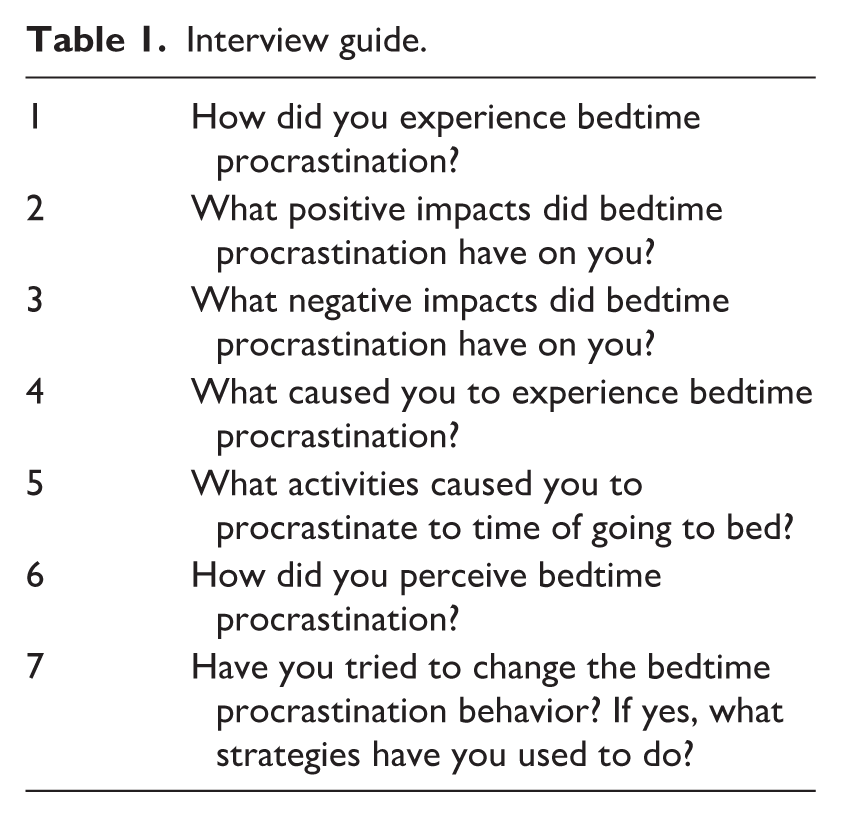
To explore participants’ experiences of and rationales for bedtime procrastination, we conducted semi-structured individual interviews either face-to-face or online. One-on-one interviews with each participant were conducted either by the researcher (JYR, who was a female PhD candidate in nursing since the start of the research and later obtained her PhD degree during this research period) or by a research assistant. An initial interview guide was developed based on existing qualitative literature on bedtime procrastination (Hill et al., 2024a; Nauts et al., 2019), as shown in Table 1. During the study, the open-ended interview questions gradually became more focused.
Interview guide.
Interviews were conducted either in a quiet, private classroom at Hong Kong Polytechnic University (n = 15) or via Zoom (n = 5). All interviews were audio-recorded and transcribed verbatim. Field notes were taken to record the participants’ nonverbal cues. Each interview lasted an average of 48.65 minutes, ranging from 34 to 63 minutes. Saturation was achieved after the 15th interview, with an additional five interviews conducted to ensure that no new subthemes or themes regarding bedtime procrastination experiences would emerge (Saunders et al., 2018).
Ethical consideration
This study received approval from the Human Subjects Ethics Committee of the Hong Kong Polytechnic University (Approval No: HSEARS20240508001, Date: 27/05/2024). Written informed consent was collected from each participant.
Data analysis
Data analysis co-occurred with data collection and was performed by JYR (Ruan et al., 2023a, 2023b), who has rich experience with conventional content analysis (Hsieh and Shannon, 2005). First, the coder read and re-read the interview transcripts to gain a comprehensive understanding of the students’ experiences of procrastination before bed. Then, the coder manually conducted line-by-line coding to identify units that captured key descriptions and ideas regarding participants’ experiences of bedtime procrastination. Coding units were then compared and condensed to a more abstract level based on shared similarities. Finally, some abstracted coding units were grouped into subthemes and themes through an iterative, inductive process. The team held discussions whenever subthemes and themes were generated and needed review.
Rigor
We ensured credibility and authenticity by checking transcripts twice for accuracy and by developing trusting relationships with participants. This rapport was evidenced by most participants freely, openly, and extensively discussing their bedtime procrastination experiences with the interviewer, resulting in rich, in-depth narratives. Integrity and criticality were maintained by keeping reflective journals throughout the whole research process.
Results
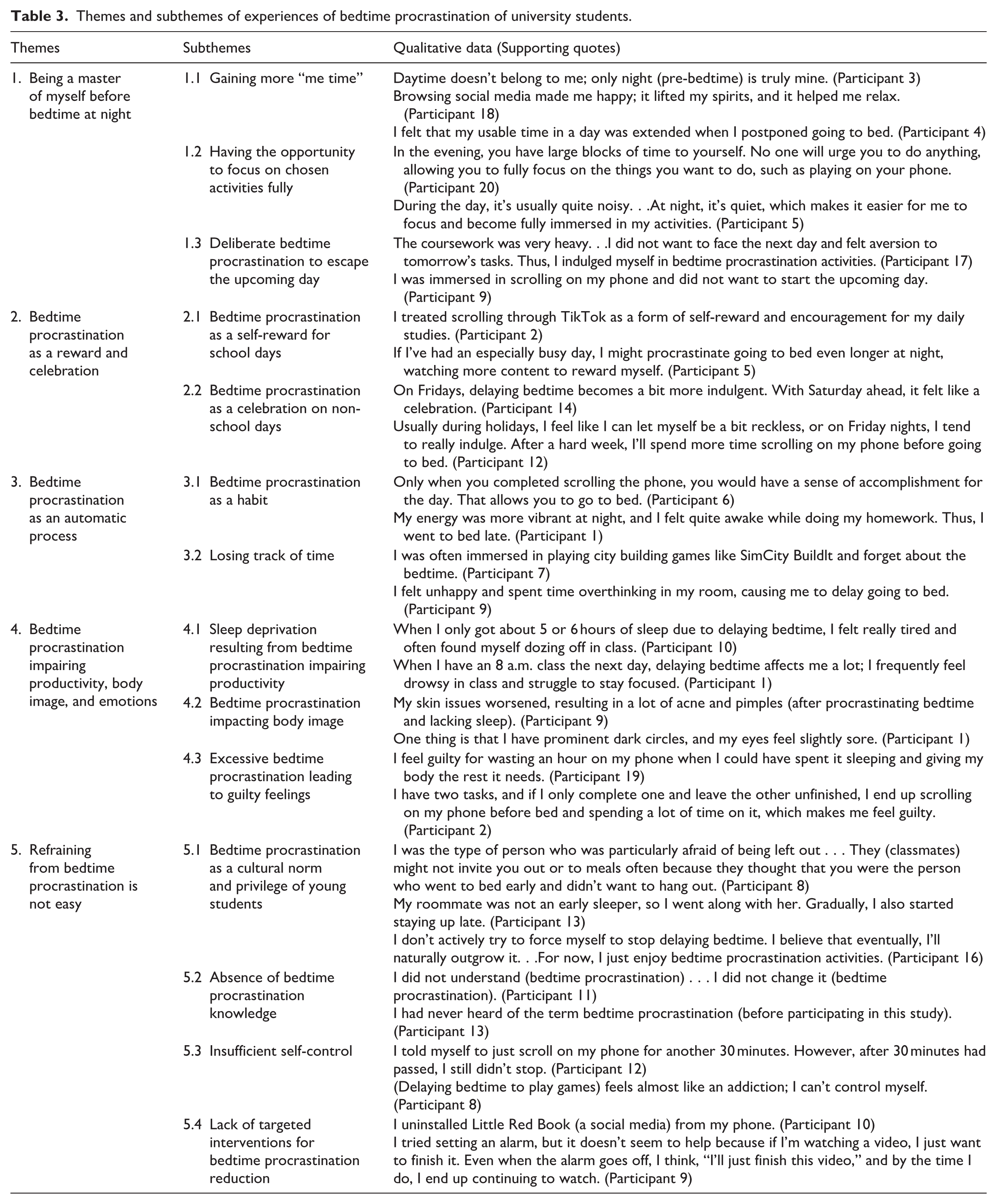
A total of 20 university students participated in the study (Table 2). Table 3 presents the five themes and 14 subthemes generated, along with supporting quotes, which illustrate the bedtime procrastination experiences of Hong Kong university students.
Sample characteristics (n = 20).
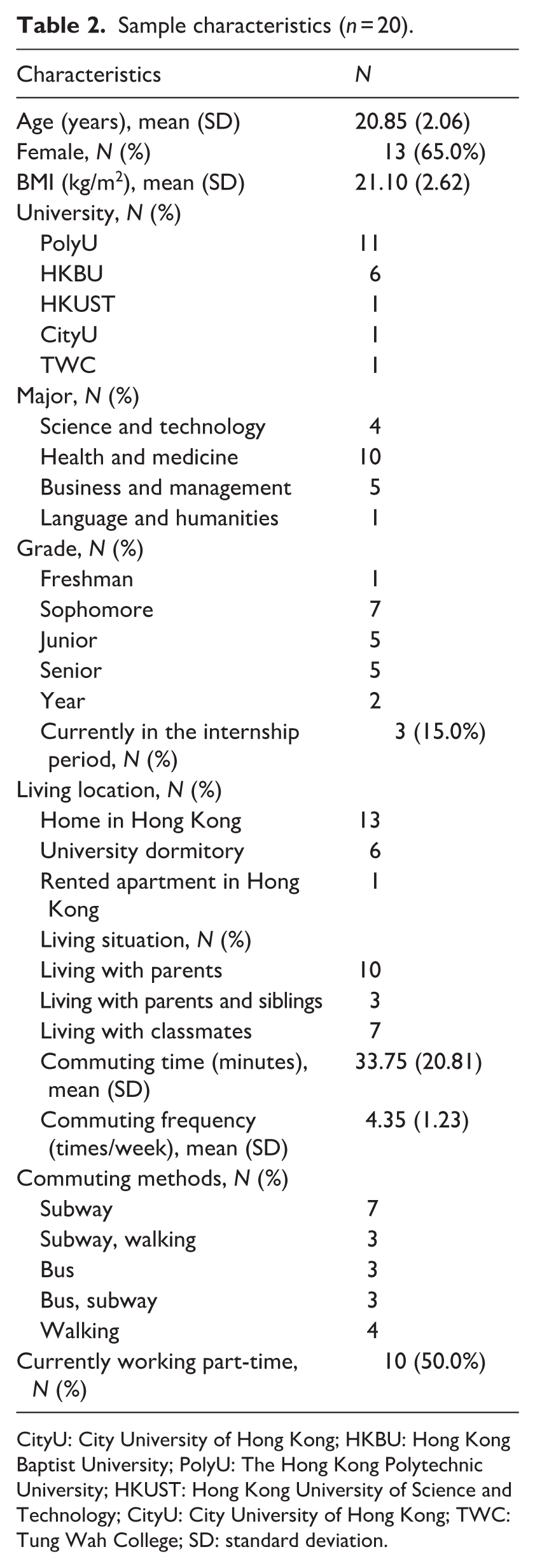
CityU: City University of Hong Kong; HKBU: Hong Kong Baptist University; PolyU: The Hong Kong Polytechnic University; HKUST: Hong Kong University of Science and Technology; CityU: City University of Hong Kong; TWC: Tung Wah College; SD: standard deviation.
Themes and subthemes of experiences of bedtime procrastination of university students.
Theme 1: Being a master of myself before bedtime at night
Theme 1 indicates that university students procrastinate at bedtime due to a desire for more “me time” and the chance to fully focus on their chosen activities.
Gaining more “me time”
During the day, university students’ lives were structured around studying or engaging in internship activities. However, students rarely set these tasks themselves and were often working to the demands of their universities or internship organizations. The moments before bedtime were the only time they had to themselves in the entire day. They therefore considered the time gained by delaying sleep to be free, enjoyable, autonomous, and completely personal.
Daytime doesn’t belong to me; only night (pre-bedtime) is truly mine. (Participant 3) I need to have one or two hours of “me time” for entertainment before bedtime. (Participant 15)
Engaging in pre-bedtime procrastination activities allowed students to mentally unwind, find meaning in life, and gain psychological empowerment, with some participants describing it as “mental yoga.”
Browsing social media made me happy; it lifted my spirits, and it helped me relax. (Participant 18)
Some participants would rather delay bedtime and sacrifice sleep to gain “me time” and enjoy and cherish it.
I felt that my usable time in a day was extended when I postponed going to bed. (Participant 4)
Having the opportunity to focus on chosen activities fully
Unlike during the day, the pre-bedtime environment was often quiet, and participants talked about how they could fully enjoy uninterrupted time and immerse themselves in the activities they love.
In the evening, you have large blocks of time to yourself. No one will urge you to do anything, allowing you to fully focus on the things you want to do, such as playing on your phone. (Participant 20)
Deliberate bedtime procrastination to escape the upcoming day
Some participants felt an aversion toward the forthcoming day when their academic workload was particularly heavy. During these periods, they tended to indulge themselves, excessively delaying bedtime and deliberately engaging in procrastination activities to prolong the start of daytime study.
The coursework was very heavy. . .I did not want to face the next day and felt aversion to tomorrow’s tasks. Thus, I indulged myself in bedtime procrastination activities. (Participant 17)
Theme 2: Bedtime procrastination as a reward and celebration
Theme 2 centers on university students delaying their bedtime to reward themselves for productive workdays and to celebrate on non-school days.
Bedtime procrastination as a self-reward for school days
On school days, students were occupied with courses, academics, and internships. Having been engaged in these tasks during the day, some participants treated bedtime procrastination activities as a reward for their hard work.
I treated scrolling through TikTok as a form of self-reward and encouragement for my daily studies. (Participant 2)
The urge to procrastinate about going to bed as a form of self-reward appeared to be stronger on days with higher stress and more study-related tasks.
If I’ve had an especially busy day, I might procrastinate going to bed even longer at night, watching more content to reward myself. (Participant 5)
Bedtime procrastination as a celebration on non-school days
Some participants noted that their bedtime procrastination became more pronounced and indulgent when the following day was a weekend or holiday. On these evenings, they perceived the delay as a celebratory act in anticipation of the upcoming break.
On Fridays, delaying bedtime becomes a bit more indulgent. With Saturday ahead, it felt like a celebration. (Participant 14)
Theme 3: Bedtime procrastination as an automatic process
Theme 3 illustrates bedtime procrastination as an automatic process that encompasses habitual delays in going to bed and losing track of time.
Bedtime procrastination as a habit
Some participants described bedtime procrastination as a habit, particularly scrolling on their phones before sleep. For them, this routine had become part of the bedtime process and was difficult to stop.
Only when you completed scrolling the phone, you would have a sense of accomplishment for the day. That allows you to go to bed. (Participant 6)
Some participants described having an evening chronotype (naturally feeling more alert and productive at night), a contextual factor that made them biologically predisposed to developing bedtime procrastination as a habit. Over time, staying awake and engaging in stimulating activities, such as completing schoolwork or scrolling through their phone, became automatic rather than deliberate.
My energy was more vibrant at night, and I felt quite awake while doing my homework. Thus, I went to bed late. (Participant 1)
Losing track of time
Some participants reported losing track of time while deeply immersed in certain bedtime procrastination activities. By the time they realized how late it was, their intended bedtime had been significantly delayed.
I was often immersed in playing city building games like SimCity BuildIt and forget about bedtime. (Participant 7)
Additionally, negative emotions (induced by academic and internship pressures, interpersonal relationships, and varying parental expectations) also led university students to unconsciously delay going to bed, causing them to lose track of time.
I felt unhappy and spent time overthinking in my room, causing me to delay going to bed. (Participant 9)
Theme 4: Bedtime procrastination impairing productivity, body image, and emotions
Theme 4 summarizes the negative impacts of bedtime procrastination on productivity, body image, and emotions.
Sleep deprivation resulting from bedtime procrastination impairing productivity
Bedtime procrastination caused some participants to feel sluggish and tired during the day, making it difficult to concentrate and leading to reduced comprehension and memory retention.
When I only got about 5 or 6 hours of sleep due to delaying bedtime, I felt really tired and often found myself dozing off in class. (Participant 10)
Bedtime procrastination impacting body image
Some participants expressed that delaying bedtime affected both their appearance and their physical function.
My skin issues worsened, resulting in a lot of acne and pimples (after procrastinating bedtime and lacking sleep). (Participant 9)
Excessive bedtime procrastination leading to guilty feelings
Excessive procrastination at bedtime created feelings of guilt among some participants. This sense of guilt increased if they had not sufficiently completed their study tasks or had failed to execute their self-set plan to modify their bedtime procrastination behavior.
I feel guilty for wasting an hour on my phone when I could have spent it sleeping and giving my body the rest it needs. (Participant 19)
Theme 5: Refraining from bedtime procrastination is not easy
Theme 5 addresses the difficulty students face in refraining from bedtime procrastination.
Bedtime procrastination as a cultural norm and privilege of young students
Hong Kong is a bustling city often referred to as the “city that never sleeps.” Late nights and bedtime procrastination are common phenomena in this modern metropolis. By going to bed early, these university students felt that they might miss out on opportunities for social interaction or topics of conversation with their peers. Consequently, some participants chose to delay their bedtime to fit in with the culture of staying up late.
I was the type of person who was particularly afraid of being left out . . . They (classmates) might not invite you out or to meals often because they thought that you were the person who went to bed early and didn’t want tohang out. (Participant 8)
Some participants mentioned that their bedtime procrastination behavior was influenced by their roommates, who also often procrastinated at bedtime.
My roommate was not an early sleeper, so I went along with her. Gradually, I also started staying up late. (Participant 13)
Some students noted that they were in a youthful stage of their lives and that even if bedtime procrastination led to sleep deprivation, they could recover easily. Furthermore, they believed that having the freedom to delay bedtime would likely be difficult to maintain once they entered society and became working professionals. Therefore, they preferred to enjoy this freedom rather than change their behavior.
I don’t actively try to force myself to stop delaying bedtime. I believe that eventually, I’ll naturally outgrow it. . .For now, I just enjoy bedtime procrastination activities. (Participant 16)
Absence of bedtime procrastination knowledge
Most participants reported rarely receiving any information regarding bedtime procrastination in Hong Kong and were therefore unaware of its negative consequences.
I did not understand (bedtime procrastination) . . . I did not change it (bedtime procrastination). (Participant 11)
Insufficient self-control
While many participants intended to limit bedtime procrastination by setting specific times to engage in activities, a lack of self-control ultimately led them to delay going to bed.
I told myself to just scroll on my phone for another 30 minutes. However, after 30 minutes had passed, I still didn’t stop. (Participant 12)
Lack of targeted interventions for bedtime procrastination reduction
Targeted interventions to prevent bedtime procrastination have been sparse or unavailable. Participants explored various strategies on their own to reduce bedtime procrastination, such as setting reminders, setting a screen time limit on their phone, or adjusting mobile device settings or uninstalling apps to avoid addictive content.
I uninstalled Little Red Book (a social media platform) from my phone. (Participant 10)
However, these strategies were often challenging to maintain and were easily influenced by a lack of personal willpower, leading participants to fall back into procrastination.
Discussion
To the best of our knowledge, this is the first qualitative study to explore the in-depth experiences of bedtime procrastination among university students, a population that is prone to this behavior. Five themes and 14 subthemes were generated that characterize bedtime procrastination among university students as a multidimensional, multifactorial construct.
Theme 1, “being a master of myself before bedtime at night,” and Theme 2, “bedtime procrastination as a reward and celebration,” highlight the positive aspects of delaying bedtime. Engaging in bedtime procrastination activities provides valuable personal time for university students to achieve freedom, autonomy, enjoyment, self-reward, and encouragement. Similar findings, such as “delaying going to bed due to deserved me time,” were also reported among new career starters (Hill et al., 2024a) and adults in the Netherlands (Nauts et al., 2019). “Self-concept” refers to a cognitive perception of an individual’s treatment of themselves and expresses the extent to which they value themselves as a person (Markus et al., 1985). Previous studies have demonstrated that engaging in personally enjoyable activities and achieving freedom and autonomy are related to positive self-concept and personal satisfaction (Ruiz and Yabut, 2024; Spear and Kulbok, 2004). Thus, participants may use bedtime procrastination activities as a strategy to maintain a positive self-concept and promote their psychological well-being. Further investigations into the potential mechanisms linking self-concept, bedtime procrastination, and mental health among university students are warranted.
Theme 3, “bedtime procrastination as an automatic process,” aligns with the theme identified by Hill et al. (2024a): “influence of automatic processes.” Habit is one mechanism underpinning this automaticity, as reflected in subtheme 3.1. According to Gardner (2015), habit is a cognitive process whereby a contextual cue automatically triggers an impulse to act, based on cue–behavior associations learned through repeated performance. In our study, phone scrolling before sleep had become a habitual routine for some participants. Coping with boredom may contribute to the development of this habit (Teoh et al., 2021; Teoh and Wong, 2023; Zhu et al., 2023). However, existing literature suggests that smartphone and social media use may intensify boredom rather than alleviate it (Barkley and Lepp, 2021; Dwyer et al., 2018). Subtheme 3.2, “losing track of time,” may represent habitual execution, meaning that bedtime procrastination continues automatically through a sequence of subactions that are required to complete the routine (Gardner et al., 2016). This may prolong sleep delay and lead to negative consequences. To date, the effects of habitual behavior are understood to arise primarily from habitual instigation, rather than execution (Gardner et al., 2016). Therefore, further research exploring habitual execution in bedtime procrastination is needed, as are intervention strategies for disrupting established maladaptive procrastination patterns.
“Getting lost in negative emotions,” described under subtheme 3.2, “losing track of time,” also led some participants to delay their bedtime. This aligns with previous research demonstrating an association between bedtime procrastination and higher levels of anxiety, depression, and rumination among university students (Hong et al., 2024; You et al., 2023). Notably, our participants (aged 18–26) belong to Generation Z (born between 1997 and 2012; Dimock, 2019), a generation that accumulating evidence suggests is particularly vulnerable to mental health challenges compared with previous cohorts (Bethune, 2019).
Theme 4, “bedtime procrastination impairing productivity, body image, and emotions,” highlights the negative dimension of bedtime procrastination. Notably, subtheme 4.3 showed that excessive bedtime procrastination can lead to negative feelings such as guilt, which may be related to the negative self-image resulting from the attempt and subsequent failure to change bedtime procrastination behavior. The presence of these negative emotions suggests that the application of targeted psychological and behavioral interventions, such as acceptance and commitment therapy, may be beneficial (Ruan et al., 2023d, 2023c). Additionally, the potential bidirectional relationship between bedtime procrastination and negative emotion should be examined in future longitudinal and experimental research.
Based on the themes described above, bedtime procrastination in university students incorporates reflective (Themes 1 and 2, which involve deliberate plans and goal setting) and automatic (Theme 3, which reflects habits, and Theme 4, which encompasses emotional responses) processes, aligning with the dual-process model (Strack and Deutsch, 2004). Suitable theory-based interventions are closely related to the effectiveness of health-related behavior change, including bedtime procrastination (Bartholomew and Mullen, 2011). It is therefore recommended that dual-process theory be incorporated into future interventions to reduce bedtime procrastination, as it is potentially a particularly effective framework for describing and understanding this behavior (Hill et al., 2024a). The model developed by Vanessa et al. represents one example (Hill et al., 2024b). Additionally, evidence-based knowledge about bedtime procrastination, together with sleep hygiene education, could be included as components of the intervention (Ruan et al., 2025e; Zhu et al., 2020). The reduction of negative peer influence should also be considered because university students, the majority of whom are adolescents or young adults, are at a life stage when their health behaviors tend to be strongly influenced by peer groups (detailed description presented within subtheme 5.1, “bedtime procrastination as a culture norm and privilege of young students”; Van Ryzin and Roseth, 2018).
Limitations
This study has some limitations that should not be overlooked. First, participants were recruited from five Hong Kong universities, including seven university students from Mainland China who were studying in Hong Kong. The current findings could be enriched by expanding the sample to include participants from other universities in Hong Kong as well as more local Hong Kong students. Second, because of the qualitative design, it is unknown whether the findings can be generalized to all Hong Kong university students.
Conclusion
This study offers insights into the complex and multifaceted experiences of bedtime procrastination among university students in Hong Kong, highlighting its negative impacts and the challenges involved in changing this behavior. The findings affirm that bedtime procrastination in this population is a multidimensional and multifactorial construct, encompassing “being a master of myself,” “achieving a reward and celebration,” and “being an automatic process.” These results underscore the need for future interventions grounded in dual-process theory to address this issue effectively. Additionally, complementary strategies, such as increasing awareness of bedtime procrastination, promoting sleep hygiene education, and addressing negative peer influences, should be incorporated to support meaningful behavioral change.
Supplemental Material
sj-docx-1-hpq-10.1177_13591053261426521 – Supplemental material for Experiences of bedtime procrastination in university students: A qualitative study
Supplemental material, sj-docx-1-hpq-10.1177_13591053261426521 for Experiences of bedtime procrastination in university students: A qualitative study by Jia Yin Ruan, Katy Y. Y. Tam, Sha Li, Yim Wah Mak and Wing Fai Yeung in Journal of Health Psychology
Footnotes
Acknowledgements
We sincerely appreciate the twenty university students from five Hong Kong Universities who generously dedicated their time and shared their experiences of bedtime procrastination in this study.

Ethical considerations
This study received approval from the Human Subjects Ethics Committee of the Hong Kong Polytechnic University (Approval No: HSEARS20240508001, Date: 27/05/2024).
Consent to participate
Written informed consent was obtained from all individual participants included in the study.
Consent for publication
Participants were informed that anonymized data may be used for publication purposes.
Funding
The authors received no financial support for the research, authorship, and/or publication of this article.
Declaration of conflicting interests
The authors declared no potential conflicts of interest with respect to the research, authorship, and/or publication of this article.
Data availability statement
The raw/processed data required to reproduce the findings of the current study are not publicly available nor are they available on request due to privacy or ethical restrictions. All material that can be shared is included in the manuscript.
Supplemental material
Supplemental material for this article is available online.