



Abstract
Bedtime procrastination (BP), recognized as a common self-regulation issue, is linked to insufficient sleep and in turn, adverse health outcomes. However, the specific contributions of different components of self-regulation – particularly the biological underpinnings – remain insufficiently understood. This cross-sectional study aims to explore the relationship between BP and self-regulation components, namely vagally-mediated HRV (vmHRV) as physiological concomitant of self-regulation, behavioral regulation, and emotion regulation. A final sample of N = 135 adults completed a baseline vmHRV assessment and self-report questionnaires. The results show that higher BP was significantly predicted by lower vmHRV and greater difficulties in behavioral and emotion regulation. Additionally, brooding rumination significantly predicted BP, whereas cognitive reappraisal and reflective rumination did not. VmHRV was not significantly correlated with either behavioral or emotion regulation. Although the question remains whether self-regulation constitutes a unified construct, vmHRV, behavioral and emotion regulation each made unique contributions to the prediction of BP.
Keywords
Introduction
BP is a context-specific form of procrastination characterized by the voluntary delay of going to bed, despite awareness of negative consequences (Kroese et al., 2014; Steel, 2007). Individuals who engage in this behavior postpone sleep without external pressure, even though they need to wake up at a fixed time next morning. As a result, reduced sleep duration is a common and significant outcome – an issue increasingly recognized as a major public health concern (Itani et al., 2017; Kroese et al., 2014). While BP is a key behavioral contributor, it is not the only reason many adults fail to achieve the recommended 7–9 hours of sleep per night (Liu et al., 2016). Long work hours, irregular work schedules, screen exposure before bedtime and psychological factors such as stress also play a significant role in delaying sleep onset (Hill et al., 2022; Kroese et al., 2016a).
Chronic insufficient sleep and impaired sleep quality have been linked to various adverse health outcomes, including physical conditions (e.g. cardiovascular disease, obesity) and mental health problems (e.g. depressive symptoms, cognitive impairments; Benham, 2010; Bubu et al., 2017; Cappuccio et al., 2008; Cui et al., 2021; Hoevenaar-Blom et al., 2011). Given the high prevalence of BP in the general population (Kroese et al., 2014, 2016b) and especially its elevated rates among students (Herzog-Krzywoszanska and Krzywoszanski, 2019) and the widespread health consequences of sleep deprivation, it represents a critical behavioral issue that warrants targeted interventions and prevention strategies (Carlson et al., 2023).
Self-regulatory perspective on bedtime procrastination
Multiple theoretical perspectives have been proposed to explain why BP occurs. From a behavioral standpoint, some individuals may simply fail to create conditions necessary for falling asleep (Kroese et al., 2016a) – for instance, by not disengaging from stimulating environments or activities. Others may become so absorbed in ongoing tasks or activities that they lose track of time, inadvertently delaying bedtime (Magalhães et al., 2021; Nauts et al., 2019). Moreover, BP is widely conceptualized as self-regulation failure. According to this perspective, individuals with lower self-regulatory capacity are more prone to delaying bedtime (Bernecker and Job, 2020; Hill et al., 2022; Kroese et al., 2014, 2016b). Similar to traits like openness and neuroticism, poor self-regulation skills seem to increase susceptibility to environmental distractions and the preference for short-term gratification over long-term goals (Huang and Pluess, 2025; Kroese et al., 2016b).
Two well-established models offer valuable insight into the relationship between self-regulation and BP. The first is the Strength Model of Self-Regulation (Baumeister et al., 2007, 2018), which posits that self-regulation operates as a limited resource depleted through repeated use. As the day progresses, capacity diminishes (Baumeister et al., 2007; Inzlicht et al., 2021), making it increasingly difficult to translate intentions into actions. Consequently, individuals may resort to procrastination (Dewitte and Schouwenburg, 2002; Kadzikowska-Wrzosek, 2018; Steel et al., 2001), broadly defined as the voluntary postponement of an intended behavior (Steel, 2007; van Eerde, 2003). In the context of BP, individuals may intend to go to bed at a reasonable hour, but fail to act on this intention (Loft and Cameron, 2013, 2014). Although often treated as a subtype of general procrastination, BP may involve unique mechanisms not fully captured by broader procrastination frameworks.
The second framework, the Temporal Self-Regulation Theory (Hall and Fong, 2007), emphasizes the role of temporal discounting – the tendency to favor immediate rewards over delayed benefits. Applied to BP, it suggests that individuals prioritize immediate gratifications (e.g. watching television, browsing social media) over long-term benefits (e.g. sufficient sleep; Zhang et al., 2025). Supporting this view, prior research demonstrates that procrastination often follows a hyperbolic delay pattern in academic settings: students show low study activity until shortly before examinations, followed by a sharp increase (Dewitte and Schouwenburg, 2002; Schouwenburg and Groenewoud, 2001). This reduced ability to resist immediate temptations for distant rewards has been conceptualized as self-regulatory failure (Howell et al., 2006).
Components of self-regulation
Self-regulation describes the flexible regulation of emotion, cognition, and behavior in pursuit of goal-directed outcomes (Bridgett et al., 2015; Hofmann et al., 2012; Koole et al., 2011). Within the broader debate on the structure of self-regulation, two core components of top-down self-regulation have been identified: behavioral regulation and emotion regulation (Holzman and Bridgett, 2017). Behavioral regulation involves top-down mediated regulatory processes which aim to modulate behavior (Holzman and Bridgett, 2017), including executive functions (Miyake et al., 2000), whereas emotion regulation involves adjusting the timing, expression, and intensity of emotional responses (Gross, 1998; Holzman and Bridgett, 2017).
Both domains have been linked with BP. Difficulties in behavioral regulation, particularly in terms of executive functioning, have been associated with general and academic procrastination (Gustavson et al., 2015; Rabin et al., 2011; Rinaldi et al., 2021) and more recently with BP. Carlson et al. (2023) found a positive association between self-reported difficulties in executive functions and BP but objective performance measures did not show a significant relationship.
Previous research has also identified negative associations between emotion regulation and various forms of procrastination, including BP (Eckert et al., 2016; Kim et al., 2021; Sirois and Pychyl, 2013). Specific strategies, such as cognitive reappraisal and rumination, appear particularly relevant. Cognitive reappraisal for instance – an adaptive strategy involving the reinterpretation of a situation or emotional event – has been negatively associated with BP (Sirois et al., 2019; Zhang et al., 2025), suggesting it may reduce the emotional stress linked to delayed sleep.
Conversely, rumination predicts a greater susceptibility to BP (You et al., 2023). Defined as a persistent, maladaptive focus on one’s feelings and problems (Nolen-Hoeksema et al., 2008), rumination heightens emotional stress (Harvey, 2002; Takano et al., 2012) and is emphasized in cognitive models of insomnia (Espie, 2007; Harvey, 2002) as a key source of pre-sleep arousal that can disrupt the ability to fall asleep quickly. Moreover, individuals who procrastinate at bedtime often become absorbed in evening activities (Nauts et al., 2019), a tendency that parallels rumination, where attention is captured by repetitive self-focused thoughts (You et al., 2023). Rumination comprises two components: reflection, which involves purposeful turning inward to solve problems, and brooding, a passive comparison between one′s current status and unmet goals (Flett et al., 2016; Treynor et al., 2003). Although rumination is generally viewed as maladaptive, its components may differ in their psychological impact. Brooding is consistently linked to negative outcomes whereas reflection may be adaptive under certain conditions (Nolen-Hoeksema et al., 2008; Treynor et al., 2003). For instance, reflection correlates with higher concurrent but lower long-term depression levels (Treynor et al., 2003). In procrastination research, brooding shows a consistent positive association (Constantin et al., 2018; Flett et al., 2016; Rebetez et al., 2018) although some studies report no predictive effect (Gort et al., 2021; Hou and Hu, 2023). Reflection has been less examined in this context, but one study reported a positive link with decisional procrastination (Cohen and Ferrari, 2010).
In addition to the core components of self-regulation, Blair and Ku (2022) emphasize the fundamental role of physiological processes in enabling higher-order regulatory functions, framing physiological regulation as integral to self-regulation rather than distinct from it. The Polyvagal Perspective (Porges, 2001, 2007) and the Neurovisceral Integration Model (Thayer et al., 2009; Thayer and Lane, 2000) propose that heart rate variability (HRV) serves as a physiological concomitant of self-regulatory capacity (Cacioppo and Tassinary, 1990). HRV, which refers to the variation in time intervals between successive heartbeats, indexes autonomic flexibility and the dynamic balance between sympathetic and parasympathetic nervous system activity (Holzman and Bridgett, 2017; Laborde et al., 2017; Thayer and Lane, 2000). Of particular importance is vagally-mediated HRV (vmHRV), which reflects vagal control of cardiac function. Higher vmHRV is linked to greater adaptability to stress and emotional challenges (Laborde et al., 2017; Porges, 2001, 2007; Thayer et al., 2009; Thayer and Lane, 2000) and with stronger self-regulatory capacity (Segerstrom and Nes, 2007).
Higher vmHRV has been associated with enhanced behavioral regulation, particularly executive functioning (Ottaviani et al., 2018; Thayer et al., 2009), and more effective emotion regulation (Appelhans and Luecken, 2006; Balzarotti et al., 2017; Mather and Thayer, 2018). Meta-analytic findings further support the link between vmHRV and specific components of self-regulation, while also suggesting that HRV may serve as broader physiological marker (Holzman and Bridgett, 2017). However, recent findings did not confirm a significant association between vmHRV and executive task performance or specific emotion regulation strategies (Grabo et al., 2025), suggesting a more complex relationship between physiological indicators and self-regulatory processes than previously assumed.
Although HRV has been proposed to be a physiological correlate of procrastination (Sirois and Pychyl, 2016), to the best of our knowledge, no study linked vmHRV to BP so far. Prior research associated HRV with related self-regulatory failures, such as distractibility (Steel, 2007; You et al., 2021) and unhealthy eating (Maier and Hare, 2017), but has not directly examined procrastination/BP. More recently, potential physiological correlates of procrastination (skin temperature, eye movements, and heart rate) were investigated, yet HRV was not included (Sun et al., 2023). Given this gap, several considerations arising from aforementioned research suggest why vmHRV might be relevant to BP. When resources are depleted in the evening, individuals with lower vmHRV may be particularly vulnerable to self-regulatory lapses such as BP. Moreover, reduced vmHRV may impair the management of negative emotions, increasing reliance on short-term mood-repair behaviors before bed. Finally, lower vmHRV may reflect chronic stress or hyperarousal, hindering physiological downregulation needed for sleep and contributing to delayed bedtime. To advance our understanding of procrastination, particularly BP, it is therefore essential to integrate vmHRV into further investigations.
Aim and hypotheses of the present study
To date, few studies have examined procrastination using multiple markers of self-regulation, combining physiological, behavioral and emotional components; notably none have investigated BP in relation to vmHRV.
The present study therefore aimed to address this gap by integrating measures of behavioral regulation, emotion regulation, and vmHRV within a cross-sectional design:
We hypothesized that (1) lower levels of (a) resting vmHRV, (b) behavioral regulation, and (c) emotion regulation would be associated with higher levels of BP.
We further predicted that (2) specific emotion regulation strategies would play a role, such that (a) lower cognitive reappraisal, (b) higher brooding rumination, and (c) higher reflective rumination would be associated with greater BP.
Finally, given theoretical and empirical evidences linking HRV to central components of self-regulation, we hypothesized that (3) vmHRV would be positively associated with behavioral regulation (a) and emotion regulation (b).
Method
Procedure and sample
The study protocol was approved by the local ethics committee and all participants provided written informed consent. To control for factors affecting HRV, participants followed established preparatory guidelines (Laborde et al., 2017; Nunan et al., 2010), abstaining from alcohol and intensive exercise (24 hours), tobacco use (12 hours), and avoiding heavy meals, licorice, coffee, black tea or energy drinks (2–3 hours) before study participation. Participants then completed a baseline HRV measurement and questionnaires assessing sociodemographic variables and relevant constructs in a university laboratory.
Based on a-priori sample size calculations and the pre-registered protocol, 157 adults were recruited via personal contact, flyers, and social media from June 2024 to January 2025. Seventeen participants were excluded due to antidepressant, antihypertensive or sleep medication intakes and five participants due to technical issues (i.e. insufficient duration of HRV measurement), yielding a final sample of 135 participants aged 18–82 years (M = 29.38 years, SD = 12.15). About 65% identified as female, 35% as male. Participants included students (67%, e.g. teaching, engineering), employees from various sectors (28%, e.g. health care, IT, commerce), and individuals in other roles such as vocational training (4%). Most participants (90%) reported no engagement in shift work. Sleep duration was assessed with a single Pittsburgh Sleep Quality Index item (Buysse et al., 1989). About 74% reported sleeping ⩾ 6 hours sleep per night, with 34% sleeping 6–7 hours and 40% >7 hours. The mean heart rate of the sample, which was assessed during the baseline HRV measurement, was 78.31 (SD = 11.95) with a mean standard deviation of 3.84 (SD = 1.86), showing no unusual values (e.g. Aeschbacher et al., 2017).
Measures
Bedtime procrastination
BP was assessed with the German translation (Bernecker and Job, 2020) of the Bedtime Procrastination Scale (BPS; Kroese et al., 2014). The BPS is a unidimensional construct, linked to self-regulation, general procrastination, and sleep related outcomes (Kroese et al., 2014). Participants rated nine items on a 5-point Likert scale (1 = never, 5 = always). Scores were averaged, with higher values reflecting greater tendencies toward BP. Internal consistency was high, with McDonald’s Omega = 0.92.
Behavioral regulation and emotion regulation
Both were assessed with a German translation of the Executive Skills Questionnaire – Revised (ESQ-R; Strait et al., 2020). The 25-item ESQ-R has shown validity across student and working adult samples and has demonstrated moderate correlations with other measures of executive functioning (Nasir et al., 2021; Strait et al., 2020). Responses were given on a 4-point scale ranging from 0 (never/rarely) to 3 (very often), indicating how frequently specific difficulties are experienced. Internal consistency was acceptable (behavioral regulation: McDonald’s Omega = 0.69; emotional regulation: McDonald’s Omega = 0.71).
Cognitive reappraisal
Reappraisal was assessed with the four-item subscale of the Heidelberg Form for Emotion Regulation Strategies (HFERST; Izadpanah et al., 2019). Evidence for construct and criterion validity has been provided by the original authors. Items were rated on a 5-point scale (1 = totally disagree, 5 = agree), with higher scores reflecting greater use of cognitive reappraisal. Internal consistency was acceptable (McDonald’s Omega = 0.76).
Rumination
Reflection and brooding were assessed with the German 10-item version of the Response Styles Questionnaire (RSQ-10D; Huffziger and Kühner, 2012). The RSQ has been validated in relation to depression, anxiety, and well-being (Huffziger and Kühner, 2012; Treynor et al., 2003). Participants responded on a 4-point scale (1 = almost never, 4 = almost always). Higher subscale scores indicate stronger tendencies toward reflection or brooding respectively. Internal consistency was acceptable (reflection: McDonald’s Omega = 0.79; brooding: McDonald’s Omega = 0.78).
Vagally-mediated heart rate variability
VmHRV is commonly operationalized using the root mean square of successive differences (RMSSD), a time-domain parameter known for its robust statistical properties and relative insensitivity to respiratory influences (Laborde et al., 2017; Task Force of the European Society of Cardiology and the North American Society of Pacing and Electrophysiology, 1996). An additional analysis was conducted using high frequency (HF) power, a frequency-domain parameter that also reflects vagal tone (Laborde et al., 2017).
Beat-to-beat heart rate data were recorded during a 10-minute seated rest using a Polar H10 chest belt and a Polar Pacer watch (Polar Electro Oy, Kempele, Finland), which have been validated against ECG measurements under resting conditions (Gilgen-Ammann et al., 2019; Schaffarczyk et al., 2022). During data collection, participants were instructed to sit quietly without movement remaining in the position that is recommended by Laborde et al. (2017). Any disruptions and disturbances during the measurement were documented. A 5-minute artifact-free segment (excluding the first and last minutes to minimize effects of acclimatization and potential end-of-session disturbances) was analyzed with Kubios HRV Standard 3.4.0 (Tarvainen et al., 2020). Artifacts and ectopic beats were corrected using a threshold method and cubic spline interpolation, allowing a maximum artifact rate of 5%, with thresholds adapted to each participant’s data (Tarvainen et al., 2020). The interpolation rate was set to the default of 4 Hz (Tarvainen et al., 2020). HF power was computed via Welch’s periodogram based on Fast Fourier Transformation, with a window width of 300 seconds and a 50% window overlap (Tarvainen et al., 2020).
Confounding variables
We controlled for age, sex, body-mass-index (BMI), and habitual physical activity, as these variables are known to influence HRV (Laborde et al., 2017; Nunan et al., 2010; Ottaviani et al., 2018). Physical activity was assessed using the German version of the Godin-Shephard Leisure-Time Physical Activity Questionnaire (Godin, 2011), which calculates a score from self-reported weekly frequencies of strenuous, moderate and mild exercise, with higher scores indicating greater levels of physical activity.
Because shift work has been linked to inadequate sleep (Hill et al., 2022; Kroese et al., 2014), participants were also asked with a single item whether they currently engage in shift work.
Transparency and openness
The study followed STROBE cross-sectional reporting guidelines (von Elm et al., 2008). Detailed information on the sampling plan, exclusions, and analytical procedures is provided. Data are owned by the authors and were collected as part of a larger research project on sleep and HRV, that also included variables such as sleep prioritization and stress, addressing research questions beyond the present study. Analysis was conducted in R (version 4.3.2; R Core Team, 2020) using the stats package for hierarchical regression analysis. The data set and an R Notebook with analysis code are available at [https://osf.io/rv9m7/overview?view_only=b47e435cdf434669ad827dca8fd0937f]. The design, hypotheses and statistical analysis plan were preregistered [https://aspredicted.org/fxcs-ph5h.pdf], and later extended to include the second hypothesis of the present study.
Results
Statistical analysis
HRV values were log-transformed to approximate a normal distribution (Nunan et al., 2010). Five participants with missing data on habitual physical activity were excluded from relevant analyses. To predict BP, hierarchical regression analyses were conducted. In the preregistered model, covariates (age, gender, BMI, habitual physical activity, and shift work) were entered in block 1, RMSSD in block 2 and behavioral and emotion regulation in block 3. An additional model examined the role of specific emotion regulation strategies, with shift work in block 1, cognitive reappraisal in block 2, and rumination in block 3. For each regression model, a post-hoc power analysis was conducted based on the most complex model, which accounted for a significant proportion of variance. Pearson’s correlation analyses were conducted to examine the association between vmHRV (i.e. RMSSD) and core components of self-regulation. To assess the robustness of the findings, statistical analyses were repeated using HF power as an alternative indicator of vagal tone (see Supplemental Materials, Tables A.1 and A.2).
Descriptive statistics and test of hypotheses
Means, standard deviations, internal consistency estimates, and Pearson’s correlations among the study variables are presented in Table 1. Higher levels of BP were moderately associated with shorter sleep duration (r = −0.48, p < 0.01) and poorer sleep quality (r = −0.44, p < 0.01). VmHRV (i.e. RMSSD) was not significantly correlated with behavioral regulation or emotion regulation (all r < |0.09|). Results of the hierarchical regression analysis examining the predictive value of self-regulation components on BP are displayed in Table 2. Only block 3 contributed significantly to the explained variance (R2 = 0.17, p < 0.01). In this final model, BP was significantly predicted by RMSSD, behavioral regulation and emotion regulation. A power analysis for this model (N = 130, alpha = 0.05, effect size = 0.20) indicated high statistical power (1 − β = 0.96). Table 3 presents the results of the hierarchical regression analysis focusing on specific emotion regulation strategies. Both block 2 (R2 = 0.03, p < 0.05) and block 3 (R2 = 0.15, p < 0.01) explained a significant proportion of the variance in BP. In block 2, BP was significantly predicted by reappraisal. In block 3, only brooding remained a significant predictor. A power analysis for block 3 (N = 135, alpha = 0.05, effect size = 0.18) confirmed excellent power (1 − β = 0.98).
Means, standard deviations, internal consistencies, and Pearson’s correlations.
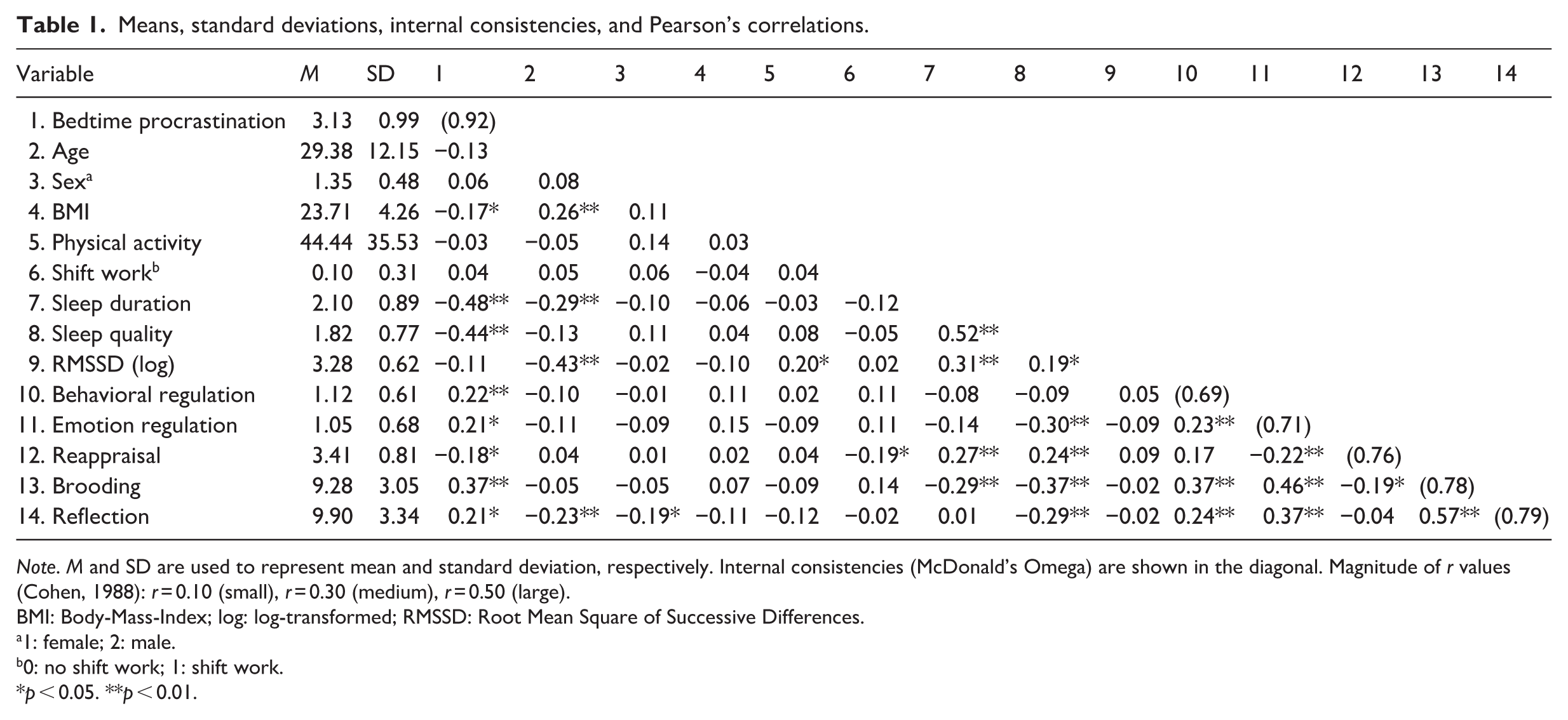
Note. M and SD are used to represent mean and standard deviation, respectively. Internal consistencies (McDonald’s Omega) are shown in the diagonal. Magnitude of r values (Cohen, 1988): r = 0.10 (small), r = 0.30 (medium), r = 0.50 (large).
BMI: Body-Mass-Index; log: log-transformed; RMSSD: Root Mean Square of Successive Differences.
1: female; 2: male.
0: no shift work; 1: shift work.
p < 0.05. **p < 0.01.
Hierarchical regression analysis with RMSSD, behavioral regulation, and emotion regulation predicting bedtime procrastination.
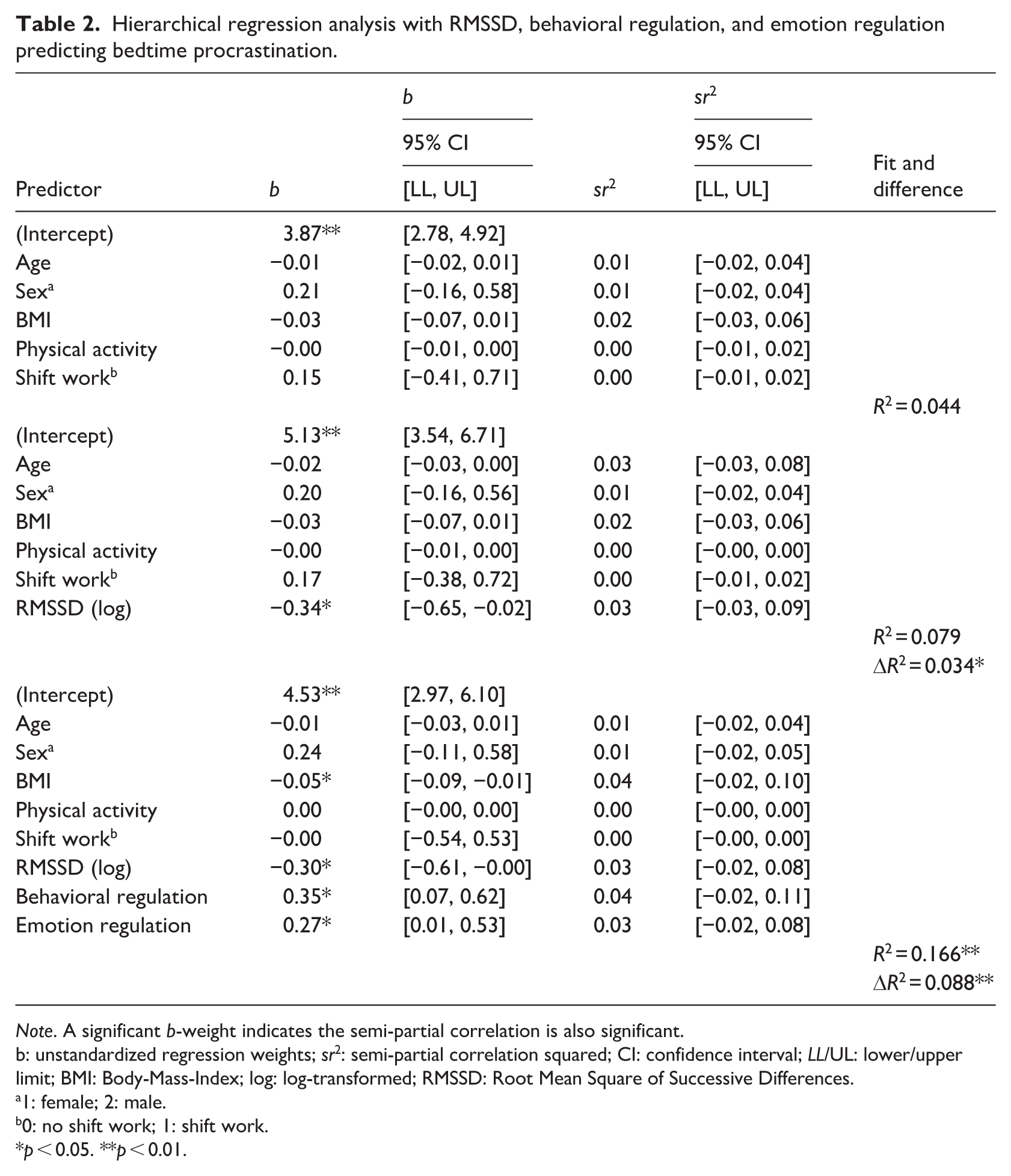
Note. A significant b-weight indicates the semi-partial correlation is also significant.
b: unstandardized regression weights; sr2: semi-partial correlation squared; CI: confidence interval; LL/UL: lower/upper limit; BMI: Body-Mass-Index; log: log-transformed; RMSSD: Root Mean Square of Successive Differences.
1: female; 2: male.
0: no shift work; 1: shift work.
p < 0.05. **p < 0.01.
Hierarchical regression analysis with reappraisal and rumination (i.e. brooding and reflection) predicting bedtime procrastination.
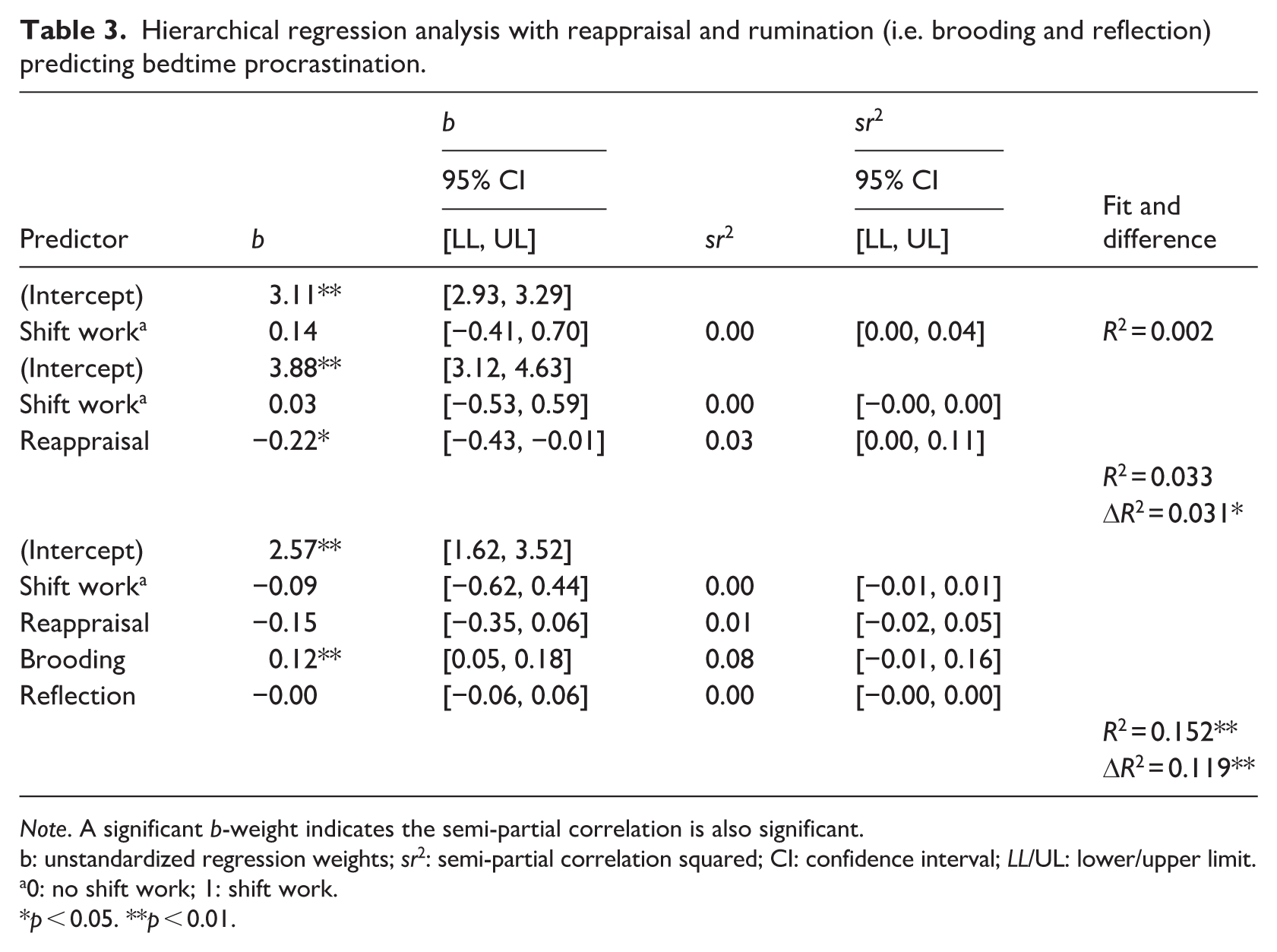
Note. A significant b-weight indicates the semi-partial correlation is also significant.
b: unstandardized regression weights; sr2: semi-partial correlation squared; CI: confidence interval; LL/UL: lower/upper limit.
0: no shift work; 1: shift work.
p < 0.05. **p < 0.01.
When HF power was used instead of RMSSD, the results were largely comparable. However, in the final regression model predicting BP HF power did not reach statistical significance (see Supplemental Materials, Table A.2).
Discussion
First, the observed link between BP, reduced sleep duration, and poorer sleep quality highlights its significance as a behavioral issue that demands both further research and practical interventions. Confirming hypotheses 1a, b, c, higher BP was significantly associated with lower vmHRV in terms of RMSSD and greater difficulties in behavioral and emotion regulation. These findings support the self-regulatory perspective on BP and suggest that each domain – physiological, behavioral and emotional – makes unique contributions to its prediction. Interventions should therefore target multiple facets of self-regulation. Within the Strength Model of Self-Regulation (Baumeister et al., 2007, 2018), BP is understood as a failure to bridge the intention-behavior gap under conditions of depleted resources (Dewitte and Schouwenburg, 2002; Kadzikowska-Wrzosek, 2018; Steel et al., 2001). Implementation intentions, by specifying concrete if-then plans, strengthen goal commitment and facilitate translating intentions into action (Gollwitzer and Sheeran, 2006; Inzlicht et al., 2021), and may serve as an effective strategy to reduce BP. However, recent evidence remains inconclusive: While an online self-regulation exercise including implementation intentions successfully reduced the discrepancy between planned and actual bedtimes, it did not improve sleep duration (Valshtein et al., 2020). Emerging interventions provide further insight: Behavioral modification and motivational interviewing techniques showed promising effects (Jeoung et al., 2023; Suh et al., 2022) and an online behavior change intervention addressing pre-sleep electronic device use yielded preliminary benefits (Hill et al., 2025). A recent brief multimodal intervention targeting BP through self-compassion and sleep hygiene also showed promising results, emphasizing the role of emotion regulation (Bistricky et al., 2026). Furthermore, biofeedback training was shown to reduce academic procrastination (Kaur et al., 2021). Biofeedback techniques, particularly those involving slow paced breathing, can elevate HRV, thereby potentially improving self-regulation, suggesting benefits also for BP (Segerstrom and Nes, 2007; Sevoz-Couche and Laborde, 2022).
Contrary to prior research and hypothesis 2a, cognitive reappraisal did not significantly predict BP in the final regression model. This may reflect differences in the form and effectiveness of emotion regulation strategies (Pychyl and Sirois, 2016). Meta-analytic evidence suggest reappraising stimuli is more effective than reappraising emotional responses and effectiveness varies by affect type (positive affect compared to neutral or negative affect was more effectively regulated) or the strategy purpose (Webb et al., 2012). Reappraisal relates to both positive and negative affect, but only negative affect is linked to greater BP (Sirois et al., 2019), suggesting unmeasured affective states may have influenced our results. Supporting this, the ability to tolerate and modify aversive emotions is associated with lower procrastination (Eckert et al., 2016). In BP, difficulties in tolerating aversive emotions (e.g. triggered by unpopular evening routines) may result in delayed bedtimes.
Confirming hypothesis 2b, brooding rumination was significantly associated with higher BP, consistent with both theoretical expectations and previous research (Espie, 2007; Flett et al., 2016; You et al., 2023). In contrast, reflective rumination did not predict BP (hypothesis 2c). This pattern aligns with Burwell and Shirk (2007), who showed that only brooding, associated with maladaptive coping, predicted increases in depressive symptoms over time. By comparison, reflection was linked to more adaptive strategies. Together, these findings underscore the differential roles of rumination subtypes in shaping health-related outcomes and behaviors, highlighting the importance of distinguishing between brooding and reflection in further research (Gort et al., 2021).
Contrary to hypotheses 3a and 3b, vmHRV was not significantly associated with two key components of top-down self-regulation. While Carlson et al. (2023) reported strong interrelations among emotion regulation, behavioral regulation and executive functioning (self-report) correlating significantly with BP, our results align with Eisenberg et al. (2019) and Grabo et al. (2025) suggesting that self-regulation components may be less coherent than previously assumed. Although resolving desire-goal conflicts is central to self-regulation (Inzlicht et al., 2021; Kotabe and Hofmann, 2015), the underlying psychological and physiological mechanisms may operate differently across domains (Eisenberg et al., 2019). Different theoretical models of self-regulation emphasize distinct processes and constructs allowing the examination of self-regulation in its various facets (Inzlicht et al., 2021). This diversity however underscores the need for more integrative research, combining physiological measures with behavioral, cognitive and emotional assessments. Developing a unified framework is crucial for elucidating the mechanisms underlying self-regulatory behaviors such as BP.
Limitations
A primary limitation of the present study is its cross-sectional study design, which precludes conclusions about causality and reciprocal effects. Procrastination is likely cyclic, with long-term consequences influencing subsequent behavior (Gort et al., 2021; Höcker et al., 2017). Indeed, recent longitudinal research indicates bidirectional links between BP and poor sleep quality (Cemei et al., 2024; Cui et al., 2021; Zhang et al., 2025). Future studies should adopt longitudinal designs that integrate the central components of self-regulation and physiological concomitants to clarify temporal and causal dynamics.
Another limitation is the reliance on self-report sleep measures, which are vulnerable to bias. Objective assessments such as sleep EEG or actigraphy would enhance validity and future research should prioritize device-based measurement methods.
The sample was diverse in terms of age, sex and occupation, which accounts for representativeness of the results. Nevertheless, subpopulations with distinct characteristics such as shift workers warrant further investigation.
The study focused on BP from a self-regulatory perspective, yet other factors – such as behavioral aspects or chronotype – may contribute to late bedtimes (Hill et al., 2022; Kühnel et al., 2018). Chronotype was indeed assessed within the broader research project (see Transparency and openness) using a multidimensional questionnaire by Randler et al. (2016) but not included due to measurement constraints. Supplementary analyses controlling for chronotype are provided (see Supplemental Materials, Tables B.1–B.4), but should be interpreted cautiously. This underscores the multi-faceted nature of BP, highlighting the need for nuanced, multidimensional approaches.
Finally, findings were not fully consistent when using an alternative parameter of vmHRV. Discrepancies between RMSSD and HF power are not unusual and likely reflect their different sensitivity to respiration, artifacts, and computational methods (Laborde et al., 2017; Sheridan et al., 2020; Stapelberg et al., 2018), underscoring the need to consider multiple indices of vmHRV when examining behavioral outcomes and to further investigate the relationship between vmHRV and BP.
Conclusion
Taken together, the findings highlight BP as a problem of diminished self-regulatory capacity reflected in both physiological (lower vmHRV) and psychological (poorer behavioral and emotion regulation) domains, yet they also suggest that self-regulation is not a unitary construct. The unique role of brooding rumination – rather than broader emotion regulation strategies – in predicting BP further points to maladaptive repetitive thinking as a specific mechanism of risk. Future work should clarify how distinct components of self-regulation interact and identify targets for interventions aimed at reducing BP.
Supplemental Material
sj-docx-1-hpq-10.1177_13591053261425412 – Supplemental material for Bedtime procrastination as a typical problem of self-regulation? Insights from the examination of heart rate variability, behavioral regulation and emotion regulation
Supplemental material, sj-docx-1-hpq-10.1177_13591053261425412 for Bedtime procrastination as a typical problem of self-regulation? Insights from the examination of heart rate variability, behavioral regulation and emotion regulation by Lena Mareen Grabo and Silja Bellingrath in Journal of Health Psychology
Footnotes
Acknowledgements

Ethical considerations
This study was approved by the ethics committee of the institute of psychology at the University of Duisburg-Essen (approval no. EA-PSY07/24/27052024) on July 01, 2024.
Consent to participate
Participants were informed about the study background, study procedures and requirements for study participation as well as the voluntary nature of study, insurance coverage, anonymity, data security, data protection, and compensations. Prior to study participation, all participants gave their written informed consent.
Consent for publication
The data were collected anonymously. All participants provided their informed consent for publication of the fully anonymized data and the storage as open data in a secure, internet-based data archive (e.g. OSF, ZPID, GESIS).
Author contributions
Lena Mareen Grabo (ORCID ID: 0000-0002-0488-016X ): Conceptualization, Data Curation, Formal Analysis, Investigation, Methodology, Project Administration, Resources, Visualization, Writing – Original Draft, Writing – Review and Editing. Silja Bellingrath (ORCID ID: 0009-0001-6431-4258 ): Conceptualization, Methodology, Project Administration, Resources, Supervision, Writing – Original Draft, Writing – Review and Editing.
Funding
The authors received no financial support for the research, authorship, and/or publication of this article.
Declaration of conflicting interests
The authors declared no potential conflicts of interest with respect to the research, authorship, and/or publication of this article.
Supplemental material
Supplemental material for this article is available online.