



Abstract
This study examined the relationships between earthquake obsession, psychological well-being, future anxiety, and hope in adults who experienced the earthquakes in southern Türkiye in 2023. The study sample consisted of 528 adults aged between 18 and 55 years. The results of the study showed that high earthquake obsession is associated with low mental well-being; however, high hope acts as a buffer in this relationship. At the same time, future anxiety mediates the relationship between earthquake preoccupation and mental well-being. In addition, we found that married individuals have more earthquake obsession and lower mental well-being than single individuals, and future anxiety has a more negative effect on well-being in single individuals. These findings will provide insights for mental health professionals to enhance well-being in intervention studies.
Introduction
On 6 February 2023 in Türkiye, two significant earthquakes of 7.7 and 7.6 occurred, resulting in 45,089 deaths, according to official figures (AFAD, 2023). Earthquakes are unpredictable and uncontrollable natural disasters that have life-threatening effects and cause widespread destruction (Wu et al., 2014). In addition to social and economic consequences, earthquakes also have psychological effects (Kapur and Tucci, 2016). These psychological effects are not limited to the acute period; they tend to cause long-term effects such as PTSD, depression, and anxiety (Caia et al., 2010; Fergusson et al., 2014; Wang et al., 2000). Even after a long time since the earthquake, negative obsessive thoughts and feelings about the earthquake may negatively affect daily life and well-being (Kartol et al., 2025). Some studies indicated that earthquakes negatively affect individuals’ well-being (Satıcı et al., 2024; Spittlehouse et al., 2014; Zhang et al., 2011). Cengiz and Peker (2024) found that post-earthquake depression levels negatively affected life satisfaction in their study on people affected by the 2023 Türkiye earthquake. Gökkaya et al. (2025) investigated the prevalence of post-traumatic stress disorder (PTSD), depression, anxiety, and stress among earthquake victims after the 2023 Kahramanmaraş earthquakes. They found prevalence rates of 17.4% for PTSD, 61.2% for depression, 79.4% for anxiety, and 58.4% for stress. It can be said that these studies emphasize that post-earthquake mental health studies are necessary and important. This study explored the mechanisms (future anxiety, hope, marital status) that may influence the relationship between earthquake obsession and well-being.
Individuals can adapt to various natural events (Oishi et al., 2015). However, keeping up with adverse life events can be much more complex than keeping up with and adapting to positive developments or innovations (Diener et al., 2009). Obsessive thoughts are uncontrollable, dysfunctional thoughts that cause a person to experience anxiety (Purdon and Clark, 2005). Studies conducted during the COVID-19 pandemic have shown that obsessive thoughts are triggered during mass casualty disasters (Munk et al., 2020; Srivastava et al., 2020). With the concept of “earthquake obsession,” first introduced after the 6 February 2023 earthquake in Türkiye, Kartol et al. (2025) highlighted the existence of negative obsessive thoughts about the earthquake, even though time has passed since the earthquakes. Earthquake obsession can be defined as “repetitive, maladaptive, and ruminative thoughts about earthquakes.” With this study, they emphasized that earthquake obsession is a phenomenon that negatively affects daily life and mental well-being. A natural catastrophe is a large-scale adverse event caused by a natural hazard, frequently involving loss of life, injury, and property damage (Saeed and Gargano, 2022). Focusing on mental well-being after disasters that affect society is critical. Disasters lead to an increased risk of mental health problems because of the direct effects of the disaster and subsequent events (Fergusson et al., 2014). Studies have shown significant associations between disasters and mental health problems (Jafari et al., 2020; Keya et al., 2023; Newnham et al., 2022). For this reason, focusing on mental well-being after an adverse life event is considered very important.
According to hope theory, hope is the ability to identify goals, develop strategies to achieve those goals, and initiate and maintain motivation to use those strategies. Individuals with high hopes are more likely to achieve something more complex than those they have already completed (Singh et al., 2013). These beliefs that individuals can achieve their goals affect their psychological well-being (Snyder, 2002). We know that hope can heal individuals after adverse life events and is an essential stress-coping mechanism (Folkman, 2013). Stressful and unexpected events can reduce hope and make the person more pessimistic about the future. This situation may be caused by uncertainty about what will happen in the future and may make the person anxious. Zaleski et al. (2019) defined future anxiety as the state of worrying about the future after adverse life events. Zaleski (1996) emphasized that future anxiety is based on several personality traits, personal experiences, and current events that have a significant impact on the way people respond to anxiety. In their study, Kaya and Bayram (2024) found that after the 6 February 2023 Kahramanmaraş Earthquakes, people who experienced the quake had high anxiety and low hope levels. Gümüş Şekerci et al. (2024), in their study investigating the long-term psychological effects of the earthquake, revealed that depression and hopelessness increased 1 year after the earthquake, increasing death anxiety.
Natural disasters have short- and long-term effects on the psychological well-being of individuals (Galea et al., 2005; Yzermans et al., 2005). In this sense, post-earthquake mental health intervention programs must be planned for the long term without relying on immediate trauma. We see that the traumatic effects on individuals who survived the earthquake continue for a long time (Başoğlu et al., 2002; Madianos and Evi, 2010). The losses experienced in the aftermath of the earthquake, and the fear that it could happen again, led people to despair about the future. This hurts their well-being. Mental health services are essential in helping people to adjust to life sooner after an earthquake. It can be a healthy strategy to ensure that individuals focus on their strengths and reinforce these aspects rather than negativity and loss.
Current study
Maladaptive behaviors such as exaggerated pre-disaster planning activities, avoidance of specific areas, and constant monitoring of seismic activity can result from an intense focus on earthquakes. These behaviors can disrupt daily life and contribute to societal stress. We believe that even after the earthquake has passed, obsessive thoughts about the earthquake will persist for a long time and can negatively affect well-being and lead people to despair about the future. So it is essential to understand the factors driving earthquakes to develop effective interventions to reduce its impact on individuals and communities. Our perceptions of the future can directly impact our emotions and behavior in the present (Pleeging et al., 2021). During stressful life events, individuals cannot see what lies ahead and experience uncertainty. This state of uncertainty makes the individual anxious. It leads to doubt about the future, but hope comes into play in such situations and reminds the individual that uncertainty can occur in stressful situations (Folkman, 2013). According to Snyder’s (2000) hope theory, as levels of hope increase, so does well-being. Hope is critical in increasing the individual’s well-being and predicts lower negative affect and, thus, more subjective well-being by increasing life satisfaction and positive affect (Murphy, 2023). This study also investigated the effect of being married or single on well-being. It is well known that social support is a protective factor against the negative psychological effects of natural disasters. In his study, Lee (2022) revealed that social support increases disaster resilience. Cao et al. (2013) found that family functioning and social support increased quality of life and well-being in their study after the Wenchuan earthquake. Studies also show that family support protects against traumatic negative life events (Feder et al., 2013; Warner et al., 2015).
This study focused on the antecedents underlying the relationship between earthquake obsession and mental well-being. We predicted that hope and future anxiety might affect mental well-being. In their study, Kartol et al. (2025) found a negative relationship between earthquake obsession and mental well-being. In addition to this study, we thought it was essential to identify the factors that positively and negatively affect mental well-being in the background. Also, it was explored how being married or single affects these relationships.
Given the conceptual framework and literature sketched above, the current study investigated the serial mediation effects of hope and future anxiety and the moderating effects of marital status in the relationship between earthquake obsession and mental well-being. For this purpose, the following research question (RQ) was addressed, and then hypotheses (Hs) were proposed:
RQ: How and in what direction are there relationships between these five variables above?
• H1: Earthquake obsession negatively predicts mental well-being.
• H2: Hope mediates the relationship between earthquake obsession and mental well-being.
• H3: Future anxiety mediates the relationship between earthquake obsession and mental well-being.
• H4: Hope and future anxiety mediate the relationship between earthquake obsession and mental well-being.
• H5: Earthquake obsession and marital status interact to predict mental well-being.
• H6: Marital status moderates the mediating effect of hope in the relationship between earthquake obsession and mental well-being.
• H7: Marital status moderates the mediating effect of future anxiety in the relationship between earthquake obsession and mental well-being.
• H8: Marital status moderates the serial mediation effect of hope and future anxiety in the relationship between earthquake obsession and mental well-being.
Method
The current study used a multifactorial predictive correlation design to explore the complex relationships between variables (Fraenkel et al., 2012). We defined earthquake obsession as a predictor, mental well-being as a predictor, hope and future anxiety as mediators, and marital status as a moderator.
Procedures and participants
The research was conducted with 528 adults (64.4% female, 38.2% married) who personally experienced the earthquakes in southern Türkiye on February 6, 2023. The participants’ ages ranged between 18 and 55 (mean age = 25.65, SD = 8.17), and about 45% of them had lost at least one relative in the 2023 Türkiye earthquakes. This study focuses on adults. The psychological effects of this earthquakes might differ depending on whether the participants were married or single. The February 2023 earthquakes slightly damaged the houses of 26% of the participants. Approximately 9% had had their house destroyed in the earthquakes. 54% of the participants reported having difficulty falling asleep, and 48% reported waking up frequently. Approval was obtained from the university ethics committee before data collection. The working procedures were designed in accordance with the principles of the Declaration of Helsinki. The data was collected through an online survey platform. All participants were asked to read and mark the informed consent form before participating in the survey. All participants participated in the study voluntarily and were not paid. Participants were assured that their personal information would be kept confidential.
Measures
Earthquake Obsession Scale
We used the “Earthquake Obsession Scale” (Kartol et al., 2025) to measure earthquake obsession. The scale comprises 12 items and two subscales (low quality of life, earthquake rumination). The increase in the scores obtained on the scale, which is graded with a five-point Likert-type scale, indicates that the earthquake obsession levels of the individuals also increased (Sample item: “I cannot stop thinking about what I would do if my house collapsed in an earthquake.”). Confirmatory factor analysis (CFA) indicated that the original two-factor structure of the scale was confirmed, and the fit indices were at an acceptable level: χ2/df = 5.15, RMSEA = 0.08, SRMR = 0.03, CFI = 0.96, TLI = 0.94 (Kline, 2015). We calculated the alpha internal consistency coefficients of the sub-dimensions as 0.90 and 0.93, respectively. The alpha internal consistency coefficient for the whole scale is 0.95.
Warwick-Edinburgh Mental Well-Being Scale Short Form
We used the “Warwick-Edinburgh Mental Well-Being Scale Short Form” (Tennant et al., 2007; Turkish Adaptation = Demirtaş and Baytemir, 2019) to measure mental well-being. The scale consists of seven items (Sample item: “I am optimistic about the future.”). The increase in the scores obtained on the scale, graded with a five-point Likert-type scale, indicates that individuals’ mental well-being levels also increase. The CFA indicated that the scale’s original one-factor structure was confirmed, and the fit indices were at an acceptable level: χ2/df = 4.28, RMSEA = 0.08, SRMR = 0.03, CFI = 0.97, TLI = 0.96. We calculated the scale’s alpha internal consistency coefficient as 0.87.
Dark Future Scale
We used the “Future Anxiety Scale” (Zaleski et al., 2019; Turkish Adaptation = Yıldırım et al., 2023) to measure future anxiety. The scale consists of five items. Increasing scores on the scale, which is graded with a six-point Likert-type scale, indicate that individuals’ future anxiety also increases (Sample item: “I am afraid that my life will get worse in the future.”). The CFA confirmed the scale’s original one-factor structure, and the fit indices were excellent: χ2/df = 0.626, RMSEA = 0.01, SRMR = 0.01, CFI = 0.99, TLI = 0.99 (Kline, 2015). We calculated the scale’s alpha internal consistency coefficient as 0.90.
Dispositional Hope Scale
We used the “Dispositional Hope Scale” (Snyder et al., 1991; Turkish adaptation; Tarhan and Bacanlı, 2015) to measure hope. The scale consists of eight items and two sub-dimensions (Alternative ways of thinking and actuating thinking). The increase in the scores obtained on the scale, which is graded with an eight-point Likert-type scale, indicates that the hope levels of individuals also increase (Sample item: “I know that I can find a way to solve the problem, even when others despair.”). CFA confirmed the scale’s original two-factor structure, and the fit indices were excellent: χ2/df = 3.26, RMSEA = 0.05, SRMR = 0.02, CFI = 0.99, TLI = 0.98. We calculated the subscales’ alpha internal consistency coefficients as 0.92 and 0.88, respectively. The alpha internal consistency coefficient for the whole scale was 0.93.
Statistical analyses
The dataset was examined for normality, one-way outliers, and multilinearity in the first stage. As can be seen in Table 1, the normality assumption is met because the skewness and kurtosis values are within the recommended range (skewness and kurtosis ≤ |1|; Kline, 2015). Standardized Z-scores of variables were checked to detect one-way outliers. All standardized Z-scores were from −3 to +3, confirming no one-way outliers in the data set (Schumacker and Tomek, 2013). Inflation Factors of Variance (VIF) values were examined to test possible multilinearity between the variables predicting the dependent variable (earthquake obsession: 1.36, future anxiety: 1.38, hope: 1.09, marital status: 1.07). Since this value is between 1 and 5, it can be said that there is no multicollinearity problem between the variables (Frost, 2019). Descriptive statistics and Pearson product-moment correlation analyses between moments were performed in the second stage. Two serial and moderated mediation analyses were carried out in the last stage. In these analyses, Models 6 and 89 were used in the PROCESS macro developed by Hayes (2022). For the indirect effect, the absence of zero between the lower bound (LL) and upper bound (UL) in the 95% confidence intervals (CI) indicates that the mediation effects are significant (Hayes, 2022). Statistical significance was defined as 0.05 < p-value.
Descriptive statistics and correlation analysis (N = 528).
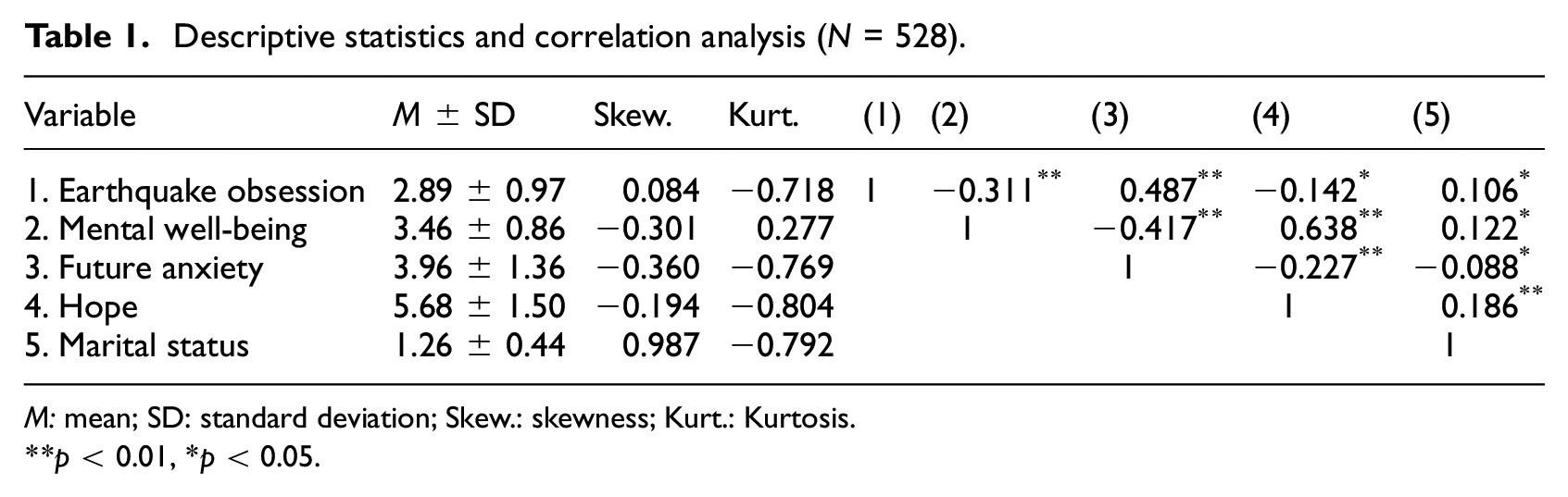
M: mean; SD: standard deviation; Skew.: skewness; Kurt.: Kurtosis.
p < 0.01, *p < 0.05.
Results
Descriptive statistics and correlations
Table 1 presents descriptive statistics and correlation coefficients of the variables.
Earthquake obsession was negatively associated with mental well-being and hope and positively associated with future anxiety and marital status. Mental well-being was negatively associated with future anxiety and positively associated with hope and marital status. Future anxiety was negatively associated with hope and marital status. There was a positive relationship between hope and marital status.
Serial mediation model
Figure 1 presents the standardized coefficients for the serial mediation model.

Serial mediation model, N = 528.
Earthquake obsession negatively predicted mental well-being, and H1 was confirmed (β = −0.311, t = −7.502, p < 0.001). The model was significant, and approximately 10% of the variance in mental well-being was explained by earthquake obsession (p < 0.001, R 2 = 0.097). Earthquake obsession negatively predicted hope (β = −0.142, t = −3.300, p < 0.001) and positively predicted future anxiety (β = 0.465, t = 12.270, p < 0.001). Hope predicted future anxiety negatively (β = −0.161, t = −4.256, p < 0.001). Mental well-being was negatively predicted by future anxiety (β = −0.231, t = −6.380, p < 0.001) and positively predicted by hope (β = 0.569, t = 17.824, p < 0.001).
As seen in Figure 1, earthquake obsession directly predicted mental well-being through hope and future anxiety (β = −0.118, t = −3.303, p < 0.001). Mediating variables accounted for 62% of the total effect (−0.193/−0.311 = 0.62). Earthquake obsession, together with hope and future anxiety, explained approximately 50% of the variance in mental well-being (p < 0.001, R2 = 0.495). All these findings showed that hope and future anxiety had a serial mediation effect between earthquake obsession and mental well-being. We tested the significance of the serial mediation effect at a 95% confidence interval with 5000 bootstraps and presented it in Table 2.
The bootstrapping for the serial mediation model (N = 528).

EO: earthquake obsession; HP: hope; FA: future anxiety; MW: mental well-being; SE: standard error; * = 95% confidence interval.
As can be seen in Table 2, the indirect path coefficient of hope did not include zero value among the confidence intervals, and H2 was confirmed (β = −0.081, SE = 0.026, 95%, CI [−0.132, −0.029]). The indirect path coefficient of future anxiety did not include a zero value among the confidence intervals, and H3 was confirmed (β = −0.107, SE = 0.021, 95%, CI [−0.149, −0.069]). There was no zero value among the confidence intervals of the indirect path coefficient of hope and future anxiety together, and the H4 hypothesis suggesting that hope and future anxiety have a serial mediation effect between earthquake obsession and mental well-being was confirmed (β = −0.107, SE = 0.021, 95%, CI [−0.149, −0.069]).
Moderated mediation model
Table 3 presents the unstandardized regression coefficients of the moderated mediation model.
Regression coefficients of moderated mediation model (N = 528).

EO: earthquake obsession; FA: future anxiety; MW: mental well-being; SE: standard error; CI: confidence interval, df: degrees of freedom.
When Table 3 is analyzed, earthquake obsession predicted hope (B = −0.221, t = −3.300, p < 0.05) and future anxiety (B = 0.655, t = 12.270, p < 0.05) in a statistically significant way. The effect of hope on future anxiety was statistically significant (B = −0.147, t = −4.255, p < 0.05). Mental well-being was significantly predicted by earthquake obsession (B = 0.234, t = 2.421, p < 0.05), hope (B = 0.269, t = 4.791, p < 0.05) and future anxiety (B = −0.318, t = −4.622, p < 0.05). However, the direct predictive effect of marital status on mental well-being was not significant (B = 0.042, t = 0.118, p > 0.05).
As can be seen in Table 3, the mediator effect of future anxiety on the effect of X (earthquake obsession) on Y (mental well-being) was significant when marital status was single (B = −0.119, SE = 0.022, 95%, CI [−0.162, −0.077]). When marital status was married, the mediator effect of future anxiety on the effect of X on Y was not significant (B = −0.030, SE = 0.028, 95%, CI [−0.085, 0.025]). The coefficient of the moderating effect of marital status on the mediator role of future anxiety in the relationship between the predictor variable and the predicted variable was nonzero between the confidence intervals (B = 0.089, SE = 0.035, 95%, CI [0.025, 0.159]). This finding indicated that hypothesis H7, which suggested that marital status moderated the relationship between X and Y mediated by future anxiety, was confirmed.
As can be seen in Table 3, the serial mediator effect of hope and future anxiety on the effect of X on Y was significant when marital status was single (B = −0.006, SE = 0.003, 95%, CI [−0.013, −0.002]). In the case of being married, the mediator effect of hope and future anxiety on the effect of X on Y was statistically insignificant (B = −0.002, SE = 0.002, 95%, CI [−0.005, 0.001]). The moderating effect of marital status on the mediator effect of the mediator variables was nonzero between the confidence intervals of the coefficient (B = 0.004, SE = 0.003, 95%, CI [0.001, 0.011]). Accordingly, our hypothesis H8, which suggested that marital status has a moderating effect on the serial mediation of hope and future anxiety between earthquake obsession and mental well-being, was confirmed. Figure 2 visualizes the moderated mediation model.

Moderated mediation model, N = 528.
Earthquake obsession × marital status
As can be seen in Table 3, the interaction value of “earthquake obsession × marital status” significantly predicted mental well-being (B = −0.268, t = −3.709, p < 0.05) and hypothesis H5 was confirmed. The contribution of the detected effect to the explained variance was around 1% and significant (ΔR2 = 0.013, p < 0.05). In Figure 3, we present simple slope analyses revealing the conditional effects of earthquake obsession on mental well-being at different moderator values.

The moderating effect of marital status on the direct relationship between earthquake obsession and mental well-being.
As seen in Figure 3, the conditional effect of earthquake obsession on mental well-being was negative and insignificant when marital status was single (B = −0.034, t = −0.917, p > 0.05). When marital status was married, the conditional effect of earthquake obsession on mental well-being was negative and significant (B = −0.302, t = −4.868, p < 0.05).
Hope × marital status
As Table 3 shows, the conditional effect of the “hope × marital status” interaction value on mental well-being was positive and statistically insignificant, and H6 was rejected (B = 0.044, t = 1.029, p > 0.05).
Future anxiety × marital status
As can be seen in Table 3, the conditional effect of the interaction value of “future anxiety × marital status” on mental well-being was positive and significant (B = 0.136, t = 2.691, p < 0.05). The contribution of the conditional effect to the explained variance was approximately 1% and significant (ΔR2 = 0.007, p < 0.05). Simple slope analyzes demonstrating the conditional effects of future anxiety on mental well-being at different values of the moderator are shown in Figure 4.

The moderating effect of marital status on the direct relationship between future anxiety and mental well-being.
As can be seen in Figure 4, when marital status was single, the effect of future anxiety on mental well-being was negative and significant (B = −0.182, t = −6.752, p < 0.05). When marital status was married, the effect of future anxiety on mental well-being was negative and insignificant (B = −0.046, t = −1.079, p > 0.05).
Discussion
In this study, we investigated the mediating roles of hope and fear of the future in the relationship between earthquake obsession and psychological well-being. Since earthquake obsession is a new concept, we found no previous study combining these variables. The first hypothesis of our study is that earthquake obsession negatively predicts psychological well-being (H1). Kartol et al. (2025) found that individuals with high earthquake obsession had low psychological well-being. Repetitive, negative, and dysfunctional thoughts about the earthquakes negatively affect individuals’ ability to stay in the moment and cause them to be trapped between the negative past and the negative future. Reducing obsessive thoughts may help individuals return to their daily lives after the earthquakes and improve their mental health.
In our second hypothesis, we hypothesized that hope would mediate the relationship between earthquake obsession and mental well-being, and this hypothesis was confirmed. Previous studies have shown that hope contributes positively to mental well-being (Genç and Arslan, 2021; Griggs, 2017; Venning et al., 2011). Hope is an important coping mechanism that enables individuals to have positive feelings about the unknown future, especially to survive after negative experiences. In this context, Murphy (2023) stated that hope contributes to the well-being of people of all ages, whether children, adolescents, or adults. Our study indicated that highly hopeful individuals contribute to lower obsessions and thus higher mental well-being. It can be said that hope has a protective and enhancing effect on mental well-being.
The third result of our study is that future anxiety mediates the relationship between earthquake obsession and psychological well-being (H3). Paredes et al. (2021) found in their study that future anxiety negatively predicts psychological well-being. Similarly, Holman and Silver (2005) found that negative thoughts about the future hurt an individual’s well-being. Negative and dysfunctional obsessive thoughts about the future directly affect emotions and lead individuals to a more pessimistic perspective. Although it is considered normal for individuals to be anxious about the uncertain future after the earthquakes, continuing these thoughts for a long time poses a psychological risk and negatively affects their functionality. In this respect, reducing anxiety about the future will positively contribute to mental well-being.
The fourth result of our study is that hope and future anxiety mediate the relationship between earthquake obsession and mental well-being (H4). We found that future anxiety negatively affects mental well-being, while hope is an effective variable for future anxiety. In his study, Van Horn (2019) emphasized that the darkening of hope leads to negative feelings toward the unknown future with the concept he introduced as “dark hope.” Indeed, studies have shown that negative life events such as the COVID-19 pandemic (Duplaga and Grysztar, 2021) and earthquakes (Kartol et al., 2023) increase future anxiety. According to our current research, hope is a fundamental and nourishing resource that enables a more positive outlook on the future. It was observed that people with high levels of hope had lower levels of future anxiety and higher levels of psychological well-being.
The fifth result is the hypothesis that earthquake obsession and marital status interact in predicting mental well-being (H5). Our results showed that married individuals had higher earthquake obsession, and this negatively affected their mental well-being. Oral et al. (2015) found that married individuals made more earthquake preparations than single individuals in their post-earthquake study. In another study, it was found that married individuals showed more depression, anxiety, and stress symptoms after the earthquakes than single individuals (Aslam and Tariq, 2010). Although marriage has a positive effect on mental well-being (Dolan et al., 2008; Helliwell, 2003), the fear of losing one’s family may worsen this situation in the event of a natural disaster such as an earthquakes that occurs beyond our control and results in the loss of jobs, spouses and loved ones. The presence of someone in the life of married individuals may also increase anxiety.
Our sixth result is that marital status moderates the mediating effect of hope in the relationship between earthquake obsession and mental well-being (H6). According to this result, marital status does not significantly affect the effect of hope on mental well-being. The seventh result is that marital status moderates the mediating effect of fear of the future in the relationship between earthquake obsession and mental well-being (H7). In this result, it was observed that the effect of future anxiety on mental well-being was higher for single individuals. Ta et al. (2017) found that loneliness leads to stress and anxiety in their study. The increase in future anxiety in single individuals with increased earthquake obsession may be due to lack of social support. Married individuals who support each other during complex life events may have a protective effect. Our eighth result is that marital status moderates the serial mediation effect of hope and future anxiety in the relationship between earthquake obsession and mental well-being (H8). Williams et al. (2010) emphasized that marriage is suitable for individuals because it provides psychological, social, and economic benefits. Although single individuals try to save their own lives at the time of the earthquakes, married individuals enter into a collective struggle by considering their children’s lives and whether they have a spouse. After surviving the earthquakes, the loss of a family member may have a more negative impact on the individual’s well-being and increase future anxiety. In other words, the responsibility of married people is higher than that of single people. In this respect, married people prioritize ensuring that their family is alive and well in addition to themselves. Divorced people may struggle more with the sadness and regret of not being with their family at the time of the earthquakes. It is thought that a divorced person who lost a family member in the earthquake may be more likely to blame themselves for not being with their spouse or child. Like married individuals, people living together will act with common concerns and try to stay together because they live under the same roof, even though they are unmarried. The loss of a family member will tend to prolong the recovery process by directly affecting the earthquake stress, future anxiety, and well-being of other surviving family members. Bırni et al. (2023) found that the psychological well-being of those who themselves or a member of their nuclear family was an earthquake survivor was low. With this study, we showed how marital status has a moderating effect on mental health. From this perspective, we found that future mental health studies should reveal how demographic characteristics mediate and mediate. Mental health intervention studies are critical after natural disasters such as earthquakes, which are unpredictable and unpredictable. These studies guide us through natural disasters that may occur at any time. There is a need to increase post-earthquake studies so survivors can continue their lives with good mental health.
Our study has some limitations. We conducted a study on adults who had experienced the earthquakes. It is a cross-sectional study. A longitudinal study could have provided more information about psychological changes. We included people who experienced the earthquakes in Türkiye on February 6, 2023. We could not examine the participants’ previous earthquake experiences. The sample of our study consists only of adults. Different psychological changes can be observed in future studies in different age groups. Effects on children can be investigated in future studies. We only asked about the relationship status of adults as married and single. We did not have any information about other variables that may be related, such as having children, being divorced, or being widowed. Different variables that may affect post-earthquake mental well-being can be addressed in future studies.
Conclusion
This study investigated the factors that mediate and moderate the relationship between earthquake obsession and mental well-being in adult survivors. It was found that hope and future anxiety mediate this relationship and that marital status is also a moderating variable in these relationships. Considering the results, it is emphasized that improving hope and reducing future anxiety will positively contribute to mental well-being after earthquakes, whose destructive effects are pretty significant and uncertain. In addition, it was found that individuals’ married or single status moderated these relationships. Focusing on earthquake survivors’ mental well-being is essential to help them return to their daily routines and regain their individual and social functioning as soon as possible. Future studies could investigate individual or group interventions that increase hope and reduce future anxiety, which may contribute to the well-being of survivors. In general, disaster recovery frameworks aim to capture the multi-stage process of returning to normal in the aftermath of a disaster. Cognitive-behavioral interventions (Kar, 2011), attachment-based approaches (Lazaratou, 2017), or resilience-building strategies (Huang and Farboudi Jahromi, 2020), trauma theories offer frameworks for enhancing psychological well-being and supporting long-term recovery after earthquakes. In other studies to be conducted from these perspectives, studies can be conducted to increase the well-being of individuals by integrating the results of this study in the context of trauma theories.
Footnotes
Correction ( July 2025):
The article type has been revised to “Research Article”
Author contributions statement (CRedIT statement)
Conceptualization: AK, SU, AG; Data curation: AK, SU, AG; Formal analysis: SU, AG; Investigation: AK, SU; Methodology: AK, SU, AG; Resources: AK, SU, AG; Software: SU, AG. Supervision: AK, SU. Validation: SU, AG; Visualization: SU, AG; Writing- original draft: AK, SU, AG; Writing - editing & review: AK, SU, AG.
Data availability statement
The original form and data of this study are available from the corresponding author upon reasonable request.
Declaration of conflicting interests
The authors declared no potential conflicts of interest with respect to the research, authorship, and/or publication of this article.
Funding
The authors received no financial support for the research, authorship, and/or publication of this article.
Ethics approval
All procedures performed in studies involving human participants were by the ethical standards of the institutional and/or national research committee and with the 1964 Helsinki Declaration and its later amendments or comparable ethical standards. Ethics approval was granted by the Trakya University Ethics Committee (Ethics Number: 653201).
Informed consent
Informed consent was obtained from all participants included in the study.
