



Abstract
Societal resources (e.g. recreational facilities, free online information, healthy food retail) are consistently found to be important facilitators for healthy eating. In the current research, we propose that healthy eating is not only facilitated by the actual available support in society, but equally well by individuals’ subjective perception on how helpful the provided support truly is. We refer to the latter as “perceived societal support” and examine how this influences healthy eating. Across two experimental studies, we observe that perceived societal support positively affects healthy eating: People who perceive the available support as helpful are more likely to choose healthy food over unhealthy food (study 1) and consume less from an unhealthy food product (study 2) compared to people who perceive the available support as less helpful. These findings do not only contribute to existing literature on societal support and healthy eating behavior, but also provide important policy implications.
Introduction
Imagine two people, both living in the same neighborhood and sharing a similar goal: They want to live more healthily and get fitter. Luckily, like many of us, they both have the opportunity to do so. Society provides ample support to turn their ambitions into a success: They both live in an area that provides affordable exercise opportunities, they live close to a supermarket providing a large variety of healthy food, and they have access to the internet allowing them to look for tips and tricks on healthy eating. However, if we fast-forward to a few months later, chances are high that one person was more successful in living healthily than the other was. How could that happen?
To study this phenomenon, we introduce the concept of “perceived societal support,” referring to the extent to which an individual perceives the existing societal support to be helpful in reaching one’s long-term goals—and examine how this affects healthy weight control behavior (i.e. weight control through healthy eating; Elran-Barak, 2021; Larson et al., 2009). Prior research, within the context of healthy eating, has consistently emphasized the importance of societal support (i.e. a societal environment that provides facilities to an individual to reach his or her goal) in facilitating healthy eating behavior (e.g. Ng et al., 2012; Roux et al., 2007; Wagemakers et al., 2010). Roux et al. (2007), for example, found that there is more physical activity in areas with a higher density of sport-related facilities. In the current research, however, we propose that healthy eating is not only facilitated by the actual available support in society, but equally well by individuals’ subjective perception on how helpful the provided support truly is.
Conceptual framework
Providing societal support has been consistently found to positively influence goal-consistent behavior (Whale et al., 2014). For example, supportive social environments in the health context have been found to positively affect health outcomes (e.g. improved self-reported health status and less diseases; Wagemakers et al., 2010) and providing recreational and sport-related resources correlates with more physical activity (Ng et al., 2012; Roux et al., 2007). Likewise, a supportive work environment (e.g. a situation in which there is support from management) has been found to increase job satisfaction (Taylor, 2008). Furthermore, social support (i.e. support from friends, family and significant others) has been found to decrease feelings of loneliness (Ai and Hu, 2016) and positively affect self-assessed health (Park et al., 2013). These findings underscore the idea that introducing sufficient support to achieve one’s long-term goals fosters goal-consistent behavior. Without the availability of supporting resources and means, long-term goals will be considered as unattainable—ultimately lowering the motivation to make goal-consistent choices (e.g. Kopetz et al., 2012; Kruglanski et al., 2011).
The current research extends this line of thinking and focuses on subjective perceptions of—rather than actual—societal support. We thus examine how the mere perception of societal support impacts healthy eating. It has been widely established that perceptions play a crucial role in human behavior, and are often more decisive than actual numbers or facts. For example, it has been observed that it is particularly the perceived—rather than the actual—healthiness of a food product that influences consumption intention (e.g. Manippa et al., 2020; Stremmel et al., 2022). Similarly, perceived waiting times influence behavior and satisfaction with the service more than actual waiting time (Hornik, 1984; Pruyn and Smidts, 1998). The role of perceptions has also been demonstrated in the context of mobility perceptions, that is the perception that one is stuck in one’s current position versus rather free to move upwards. For example, subjective perceptions of socio-economic mobility—which are typically inaccurate (Kraus and Tan, 2015)—are found to trigger compensatory behavior among consumers with a lower socio-economic status (Yoon and Kim, 2018).
We thus expect subjective perceptions of high societal support—keeping actual support constant—to positively impact healthy eating behavior. First, similar to actual societal support, we expect mere perceptions of high societal support to make one’s goal striving more attainable, which fosters goal-consistent behavior (Kopetz et al., 2012; Kruglanski et al., 2011). Second, failing to consume healthy is more difficult to attribute to an environment that is perceived to be supportive. As such, these perceptions shift the behavioral responsibility toward the individual. The latter has been shown to positively influence behavior (e.g. Aspinwall and Taylor, 1992; Eccles and Wigfield, 2002; Ryan and Deci, 2000) and hence is expected to positively affect healthy eating.
In two experimental studies, we examine how perceived societal support affects healthy eating. In study 1, we observe that high—compared to low—perceived societal support makes individuals prefer healthy over unhealthy food options. Study 2 replicates the findings, but using a real food intake task. Additionally, we investigate the effect of restraint and BMI as possible moderators in our studies. Previous research has shown mixed results on whether the effectiveness of interventions depends on levels of restraint and BMI (e.g. Keegan et al., 2019; Ogden et al., 2017; Rotenberg and Flood, 2000). We aim to shed more light on the role of these variables. The work described has been carried out in accordance with The Code of Ethics of the World Medical Association (Declaration of Helsinki) for experiments involving human subjects and was ethically approved by the university’s ethics committee (Behavioral and Experimental Economic Laboratory) for both our studies. For both studies in this article, we report all measures, manipulations, and exclusions, and we confirm that no data were analyzed prior to completion of data collection.
Study 1
Study 1 aimed to test our hypotheses: Whether perceived societal support fosters healthy eating, and whether this effect is qualified by restraint and BMI. Note that in both studies, we did not manipulate actual support, but merely manipulated perceptions on how helpful the available support truly is.
Study 1: Participants
We recruited 211 female students (Mage = 18.60, SDage = 0.87) of a Western European university who participated in the online study in exchange for course credits. In line with existing research on health-related goals, we only included females in our studies (e.g. Geyskens et al., 2010; Ogden et al., 2017). Participants signed informed consent at the beginning of the study.
Study 1: Design and procedure
The study used a two conditions between-subject design with one manipulated factor (perceived societal support: low vs high). Participants were randomly assigned to one of two conditions. In both conditions, participants read a short article that either described available societal support as helpful (vs not; Yoon and Kim, 2016). Participants in the low societal support condition read the following article: In today’s society, not everyone has a fair chance at reaching his or her own ideal body shape and weight. For example, there is so much information and advice available on the internet, coming from people who might or might not be experts in the field of exercise and nutrition. It is almost impossible to filter this information and determine what is best for you personally. Moreover, people’s financial situation can limit the chance at reaching their ideal body shape and weight. Joining a gym or another sports club can cost a substantial amount of money and time, not to mention hiring a personal trainer or dietitian. Also, healthy food is oftentimes more expensive and harder to acquire than its unhealthy alternatives. Participants in the high societal support condition read: In today’s society, everyone has a fair chance at reaching his or her own ideal body shape and weight. For example, many dietitians share their advice and healthy diets on the internet, and sport instructors share tips, tricks and workout videos that are freely available for everyone. Given that most of us are able to understand and process these pieces of information, everybody can freely choose what works best for them personally. Moreover, the perception that getting in shape always costs a lot of money does not necessarily hold in modern society. Exercises such as running and home workouts are free of charge and can be executed at any time and place. In addition, every supermarket offers (and advertises) more and more cheap alternatives for all kinds of food products that fit in a healthy diet. Next, we assessed participants’ status in terms of body shape and weight, and food choice. At the end of the survey, we administered restraint (Polivy et al., 1978), BMI, hunger, and age.
Study 1: Pre-test manipulation of perceived societal support
As our perceived societal support manipulation was custom designed for this particular study, we first tested in a separate pre-test (n = 120) whether it indeed manipulated perceived societal support as intended. Participants in this pre-test were asked to read the article (low vs high societal support) and complete a 3-item scale (1 = strongly disagree–5 = strongly agree) that measures their perceptions regarding societal support—for example, “the means provided by society enable people to eat healthy” (α = 0.951). Results indicated that participants in the high societal support condition (M = 3.29, SD = 1.21) indeed reported higher perception scores compared to participants in the low societal support condition (M = 2.77, SD = 1.03; t(118) = −2.542, p = 0.012, d = 0.464).
Study 1: Measures
Status
We assessed participants’ status in terms of body shape and weight by asking them to indicate how they would rate themselves (1 = those would judge themselves as having the worst body weight and shape, 10 = those who judge themselves as having the best body weight and shape; Yoon and Kim, 2018).
Food choice
To assess food choice, we created three subsequent choice tasks that were presented in randomized order. Within each choice task, participants were asked to indicate their preference between an unhealthy and a healthy food option using an 8 point scale (1 = unhealthy option – 8 = healthy option; Townsend and Sood, 2012). Specifically, participants were asked to choose between: chocolate mousse with cream versus fat-free yogurt with granola, apple crumble pie with butter pie crust versus oatmeal apple crumble pie, and chocolate chip cookie versus banana oatmeal cookie. To construct our dependent variable, we averaged the three food choices.
A separate pre-test among 100 female participants—asking participants to rate the food options in terms of healthiness on a 100-point scale—confirmed that the healthy options were perceived as significantly healthier than the unhealthy options. More specifically, a series of paired samples t-tests showed that the fat-free yogurt (M = 69.72, SD = 18.18), was perceived as healthier than the chocolate mousse (M = 9.56, SD = 12.68; t(99) = 28.88, p < 0.001), the oatmeal apple crumble pie (M = 54.19, SD = 19.82) as healthier than the apple crumble pie with butter pie crust (M = 17.49, SD = 17.01; t(99) = 16.34, p < 0.001), and the banana oatmeal cookies (M = 49.47, SD = 19.27) as healthier than the chocolate chip cookies (M = 17.25, SD = 17.12; t(99) = 15.06, p < 0.001).
Covariates
Restraint was measured by the Restraint Scale (Polivy et al., 1978). BMI was assessed by asking participants’ height and weight, from which we calculated their BMI. Hunger was measured on a 100-point slider (ranging from “Not hungry at all” to “Extremely hungry”) and participants indicated their age in a text box.
Study 1: Data analyses
When screening the data, we did not find any statistical deviations in terms of outliers, normality, skewness and kurtosis.
To test the effect of perceived societal support on food choice, we first ran an ANOVA with “perceived societal support” as independent variable and “food choice” as dependent variable. Next, to determine the role of covariates (i.e. status, restraint, BMI, hunger, and age), we ran ANCOVA’s.
Study 1: Results
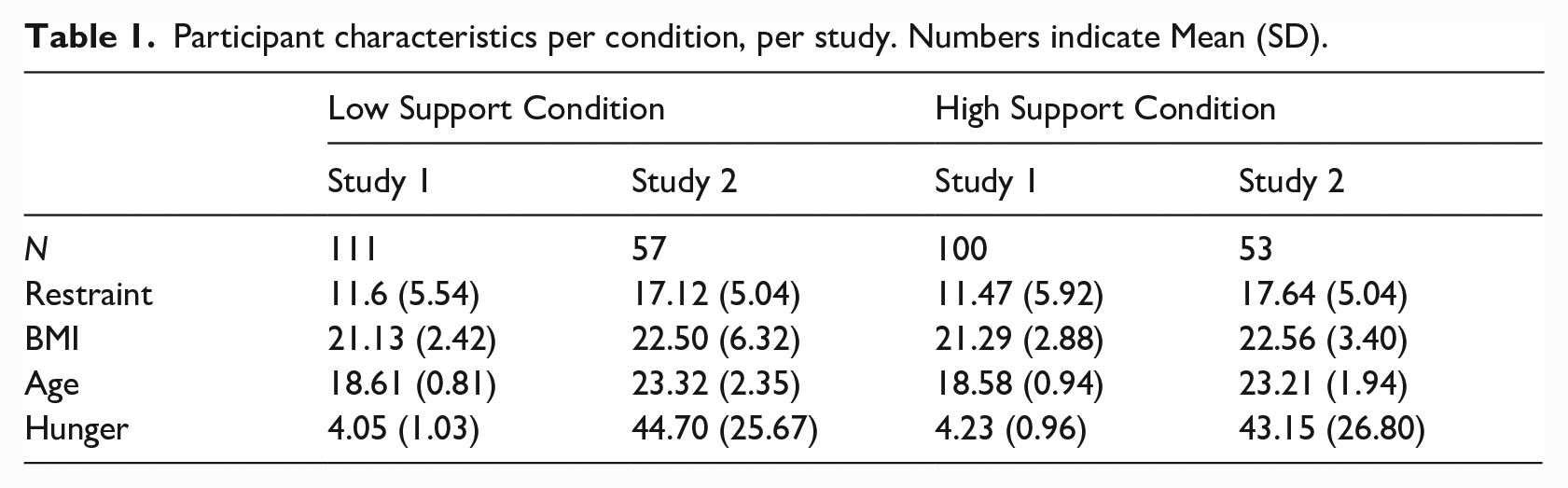
An overview of the participants’ characteristics of both studies is provided in Table 1.
Participant characteristics per condition, per study. Numbers indicate Mean (SD).
In line with our prediction, we observed that perceptions of societal support had a significant effect on food choice; F(1, 209) = 4.034, p = 0.046, ηp2 = 0.019. Participants in the high societal support condition (M = 4.67, SD = 1.64) indicated a higher preference for the healthy food options than participants in the low societal support condition (M = 4.23, SD = 1.48).
Next, we examined the role of the covariates (i.e. status, restraint, BMI, hunger, and age) in our model. First, we investigate the main effects of the covariates. Second, we test how the covariates interact with our main independent variable (perceived societal support). The main effect of perceived societal support on food choice remained significant when controlling for our covariates F(1, 201) = 4.710, p = 0.031, ηp2 = 0.023 (Mlow = 4.21, SDlow = 1.48, Mhigh = 4.66, SDhigh = 1.65). Restraint (F(1, 201) = 7.248, p = 0.008, ηp2 = 0.035) and status (F(1, 201) = 4.670, p = 0.032, ηp2 = 0.023) had a significant positive effect on food choice. Age (F(1, 201) = 2.860, p = 0.092, ηp2 = 0.014), hunger (F(1, 201) = 1.511, p = 0.220, ηp2 = 0.007) and BMI (F(1, 201) = 1.987, p = 0.160, ηp2 = 0.010) did not have a significant effect. Three participants did not indicate their height and/or weight. Hence, BMI is missing for these participants and the degrees of freedom for the models including BMI is calculated using N = 208. Excluding BMI as covariate in the model resulted in similar effects for perceived societal support, age, restraint, hunger and status.
Furthermore, the effect of perceived societal support on healthy eating did not interact with status (F(1, 196) = 2.378, p = 0.125, ηp2 = 0.012), BMI (F(1, 196) = 0.130, p = 0.719, ηp2 = 0.001), hunger (F(1, 196) = 0.513, p = 0.475, ηp2 = 0.003), restraint (F(1, 196) = 0.002, p = 0.967, ηp2 = 0.000) or age (F(1, 196) = 3.668, p = 0.057, ηp2 = 0.018). Hence, the effect of perceived societal support on food choice was not contingent on these variables.
In line with our predictions, the first study confirmed that perceived societal support positively affects healthy food choices. Participants in the high societal support condition indicated a higher preference for the healthy food options than participants in the low societal support condition.
Study 2
Study 2 aimed to increase the generalizability of our observations. Unlike study 1, which used hypothetical choice tasks as a measure of participants’ healthy eating behavior, this study looks at consumption behavior directly (i.e. intake of chocolate chip cookies) with the help of a bogus taste test (e.g. Coelho et al., 2014; Robinson et al., 2017; Smith et al., 2020).
Study 2: Participants
One hundred and twenty-one female students from a Western European university (Mage = 23.25, SDage = 2.13) participated in our study. Eight participants indicated to be allergic for (an ingredient of) the cookies and were excluded from the analyses.
Study 2: Design and procedure
Upon arrival at the university’s research lab, participants were assigned to private cubicles.
After providing informed consent, participants completed two separate studies. In the first study, similar as in Study 1, participants were asked to read a short article that described the available societal support as helpful (high perceived support condition) versus not (low perceived support condition). Next, after answering some filler questions about the article, participants completed demographic questions and indicated their level of hunger.
Participants then continued to an ostensibly unrelated second study. In this study, participants were informed that they would be taking part in a taste test (i.e. bogus taste test; Robinson et al., 2017) for which they could eat as much of the given food as they wanted. An experimenter brought a bowl generously filled with mini chocolate chip cookies. Each bowl contained 135 g of cookies (3–4 g per cookie). While eating, participants rated the cookies on several criteria (e.g. how crispy the cookies were, whether they had a nice texture, etc.). After they finished the taste test, the experimenter took the bowl away. The bowl was weighted out of sight of the participants to determine how many grams of cookies have been consumed. Lastly, we administered restraint, BMI, and age.
Study 2: Measures
Food intake
Food intake refers to the amount of cookies (in grams) eaten by the participants and was calculated directly by weighing food intake.
Covariates
We measured hunger, restraint, BMI, and age in a similar way as in study 1.
Study 2: Data analyses
We screened the distribution of our continuous outcome variable. First, we identified and deleted three outliers (i.e. 3SD ± mean), leaving 110 participants for the analyses. Statistical tests including the three outliers revealed similar results as reported below. Furthermore, we assessed the outcome variable on normality, skewness and kurtosis. We found deviation from normality based on the quantile-quantile plots, and a case of kurtosis (1.25). Hence, we log-transformed the outcome variable for the analyses (e.g. Cupertino et al., 2012; Currie et al., 2020). To facilitate interpretation, we report the non-log-transformed means.
To test the effect of perceived societal support on food intake, we first run an ANOVA with “perceived societal support” as independent variable and “food intake” as dependent variable. Next, we used ANCOVAs to examine the role of the covariates (i.e. restraint, hunger, BMI, and age).
Study 2: Results
In line with the previous study, our results showed that perceived societal support had a significant effect on food intake; F(1, 108) = 6.422, p = 0.013, ηp2 = 0.056. Specifically, participants in the high societal support condition (M = 20.18, SD = 15.09) ate less cookies than participants in the low societal support condition (M = 25.48, SD = 14.96).
This effect remained significant when controlling for restraint, hunger, BMI, and age; F(1, 104) = 6.268, p = 0.014, ηp2 = 0.057 (Mlow = 25.27, SDlow = 14.96, Mhigh = 20.41, SDhigh = 15.09). Restraint (F(1, 104) = 6.766, p = 0.011, ηp2 = 0.061) negatively affected food intake and hunger (F(1, 104) = 12.360, p < 0.001, ηp2 = 0.106) had a positive effect. Age (F(1, 104) = 0.586, p = 0.446, ηp2 = 0.006) and BMI (F(1, 104) = 0.967, p = 0.328, ηp2 = 0.009) did not have a significant effect. Furthermore, the effect of perceived societal support on food intake was not qualified by hunger (F(1, 100) = 2.393, p = 0.125, ηp2 = 0.023), BMI (F(1, 100) = 2.189, p = 0.142, ηp2 = 0.021), age (F(1, 100) = 3.428, p = 0.067, ηp2 = 0.033), or restraint (F(1, 100) = 1.227, p = 0.271, ηp2 = 0.012).
Hence, we replicate our findings of our first study—using a different dependent measure—and show that a perceived supportive society helps individuals to control their food intake of unhealthy food.
General discussion
Discussion of findings and implications
The aim of this paper was to investigate the effect of perceived societal support—defined as the extent to which an individual perceives the available societal support to be helpful in reaching one’s long-term goals—on healthy eating behavior. Consistent with our predictions, two experimental studies showed that perceived societal support positively influences healthy eating: Individuals who perceive societal support to be high are more likely to choose healthy food over unhealthy food (study 1) and consume less from an unhealthy food product (study 2) than individuals who perceive the societal support to be low.
These findings corroborate existing research showing the importance of providing societal support to individuals. Societal support (e.g. the creation of recreational areas or sport facilities) has been consistently found to successfully improve goal-consistent behavior (e.g. Ng et al., 2012; Roux et al., 2007; Wagemakers et al., 2010). Kruglanski et al. (2011) for example, demonstrated that a greater number of supporting resources positively influences goal commitment. Similarly, Huang and Zhang (2013) showed that providing multiple resources increases an individual’s motivation in the initial stage of goal pursuit. Although our findings are in line with the general premises of this literature, the current research line stresses that—besides the absolute number of available means or resources—the subjective perception of its usefulness also matters.
Within our studies, we also tested for possible interactions of our manipulation with personal traits and characteristics. Firstly, a number of studies have suggested that subjective perceptions do not affect everyone equally. Perceptions of economic mobility, for example, are found to only affect compensatory behavior for people with a lower economic status. These people—feeling stuck in their low status and low mobility position—have a higher need to compensate (Yoon and Kim, 2018). We therefore tested whether our observed effect—that is the positive effect of perceived societal support on healthy eating—also depends on people’s current status (i.e. BMI and body shape status). However, our effects were not qualified by BMI (study 1 and 2) or status (study 1) in our studies. Secondly, how societal factors affect behavior has been found to depend on a person’s salient goal (Yoon and Kim, 2016) and restraint (e.g. Rotenberg and Flood, 2000; Tonkin et al., 2019). Likewise, we measured restraint as a proxy to estimate people’s health-related goals (Polivy et al., 2020). However, our effects were not qualified by restraint in our studies. At the same time, this could also imply that our female participants—to some degree—all have a goal that is related to their health or body (Middleman et al., 1998).
This article is not only important theoretically, but also provides important implications for policy makers. Considering the increasing worldwide overweight and obesity problems (Ng et al., 2014), it is important to gain insight into what factors foster healthy eating. Our findings identify an important driver of healthy eating behavior and underscore the importance to explain to individuals that the available societal support is helpful for every one of them. Stressing the helpfulness of the available resources and means in society could help individuals to make healthier food choices. As such, it is important for policy makers to recognize the importance of individuals valuing and believing in the provided resources and means for goal attainment. Without having to invest in additional resources, a simple form of communication can help consumers in making better choices, which can have a significant impact on long-term health goals.
It is important to note that this research merely manipulates subjective perceptions. Unlike prior research—which typically manipulates the number or the composition of actual means for goal attainment (Bélanger et al., 2015; Huang and Zhang, 2013; Kruglanski et al., 2011)—we refer to existing support that is available to all members of the society and manipulate beliefs about the usefulness of the latter. It is thus not about providing societal investments (e.g. additional sport facilities), but rather about subjective perceptions on the helpfulness of the societal resources and supportive means. This allows for a rather simple operationalization in daily practice.
Limitations and further research
The studies in the present paper have some limitations, providing opportunities for future research. First, we included food choices (study 1) and food intake (study 2) as dependent variables in our studies. Future research might wish to examine whether perceived societal support also affects other types of healthy weight control behavior (e.g. working out). Theoretically, one would expect perceived societal support to affect a wide set of behaviors—as long as they serve active weight-control goals.
Second, following previous studies on weight control behavior (Schmid, 2020), we only included females in our studies. Although it is common knowledge and shown in studies that females are more concerned about weight-related goals (e.g. Vila-López and Kuster-Boluda, 2016), males often also care about body shape and weight (Middleman et al., 1998). Hence, we encourage further research to examine gender differences in the effect of perceived societal support on healthy eating.
Third, future research could examine the underlying mechanisms of our observed effect. To not bias our results, we decided to not directly measure details about our participants’ active goals regarding weight control (Spencer et al., 2005). However, it is possible that goal attainability and causal attribution play a role in the effect of perceived societal support on consumption behavior. First, higher societal support perceptions—which imply available and useful means—might make people perceive their long-term goals (i.e. ideal body shape and weight) as more attainable (Yoon and Kim, 2016), which is expected to foster goal-consistent decision-making such as healthy food choices (Bagozzi and Dholakia, 1999; Buhrau, 2020). Second, perceiving the available societal support to be helpful in reaching one’s long-term goals might shift the causal attribution and responsibility of behavior toward the self. Such an internal attribution focus has been shown to positively influence goal-directed behavior (e.g. Aspinwall and Taylor, 1992; Eccles and Wigfield, 2002; Ryan and Deci, 2000). Future research may want to further investigate these potential underlying mechanisms.
To conclude, our research shows that societal support perceptions play an important role in food decision-making. Feeling well surrounded by society seems to be a necessary condition for eating healthy. Policy makers should thus be aware that a bit of support, even if it is merely about subjective perceptions, can be a potent trigger for individuals to act in a better—future-proof—manner.
Research Data
sj-pdf-1-hpq-10.1177_13591053231178093 – Supplemental material for Feeling well surrounded: Perceived societal support fosters healthy eating
Supplemental material, sj-pdf-1-hpq-10.1177_13591053231178093 for Feeling well surrounded: Perceived societal support fosters healthy eating by Gitta van den Enden, Kelly Geyskens and Caroline Goukens in Journal of Health Psychology
Research Data
sj-sav-2-hpq-10.1177_13591053231178093 – Supplemental material for Feeling well surrounded: Perceived societal support fosters healthy eating
Supplemental material, sj-sav-2-hpq-10.1177_13591053231178093 for Feeling well surrounded: Perceived societal support fosters healthy eating by Gitta van den Enden, Kelly Geyskens and Caroline Goukens in Journal of Health Psychology
Research Data
sj-sav-3-hpq-10.1177_13591053231178093 – Supplemental material for Feeling well surrounded: Perceived societal support fosters healthy eating
Supplemental material, sj-sav-3-hpq-10.1177_13591053231178093 for Feeling well surrounded: Perceived societal support fosters healthy eating by Gitta van den Enden, Kelly Geyskens and Caroline Goukens in Journal of Health Psychology
Research Data
sj-sps-4-hpq-10.1177_13591053231178093 – Supplemental material for Feeling well surrounded: Perceived societal support fosters healthy eating
Supplemental material, sj-sps-4-hpq-10.1177_13591053231178093 for Feeling well surrounded: Perceived societal support fosters healthy eating by Gitta van den Enden, Kelly Geyskens and Caroline Goukens in Journal of Health Psychology
Research Data
sj-sps-5-hpq-10.1177_13591053231178093 – Supplemental material for Feeling well surrounded: Perceived societal support fosters healthy eating
Supplemental material, sj-sps-5-hpq-10.1177_13591053231178093 for Feeling well surrounded: Perceived societal support fosters healthy eating by Gitta van den Enden, Kelly Geyskens and Caroline Goukens in Journal of Health Psychology
Research Data
sj-spv-6-hpq-10.1177_13591053231178093 – Supplemental material for Feeling well surrounded: Perceived societal support fosters healthy eating
Supplemental material, sj-spv-6-hpq-10.1177_13591053231178093 for Feeling well surrounded: Perceived societal support fosters healthy eating by Gitta van den Enden, Kelly Geyskens and Caroline Goukens in Journal of Health Psychology
Research Data
sj-spv-7-hpq-10.1177_13591053231178093 – Supplemental material for Feeling well surrounded: Perceived societal support fosters healthy eating
Supplemental material, sj-spv-7-hpq-10.1177_13591053231178093 for Feeling well surrounded: Perceived societal support fosters healthy eating by Gitta van den Enden, Kelly Geyskens and Caroline Goukens in Journal of Health Psychology
Footnotes
Author contributions
Gitta van den Enden: Conceptualization, Methodology, Validation, Formal analysis, Investigation, Writing—original draft, Writing—review & editing, Visualization. Kelly Geyskens: Conceptualization, Methodology, Writing—original draft, Writing—review & editing, Supervision. Caroline Goukens: Conceptualization, Methodology, Writing—original draft, Writing—review & editing, Supervision. All authors have approved the final article.
Data sharing statement
The current article is accompanied by the relevant raw data generated during and/or analysed during the study, including files detailing the analyses and either the complete database or other relevant raw data. These files are available in the Figshare repository and accessible as Supplemental Material via the Sage Journals platform. Ethics approval, participant permissions, and all other relevant approvals were granted for this data sharing.
Declaration of conflicting interests
The authors declared no potential conflicts of interest with respect to the research, authorship, and/or publication of this article.
Funding
The authors disclosed receipt of the following financial support for the research, authorship, and/or publication of this article: This work was supported by the Dutch Science Foundation NWO (VIDI – 185.075).
Ethics approval
The Code of Ethics of the World Medical Association (Declaration of Helsinki) for experiments involving human subjects and was ethically approved by the university’s ethics committee (Behavioral & Experimental Economic Laboratory) for both our studies.

References
Supplementary Material
Please find the following supplemental material available below.
For Open Access articles published under a Creative Commons License, all supplemental material carries the same license as the article it is associated with.
For non-Open Access articles published, all supplemental material carries a non-exclusive license, and permission requests for re-use of supplemental material or any part of supplemental material shall be sent directly to the copyright owner as specified in the copyright notice associated with the article.
