




Abstract
There is a large and widening gap between the need for mental health help and timely access to services for adolescents. To enable adolescents to access evidence-based help when they first begin to struggle, we need widespread public health messaging which promotes prompt problem recognition and encourages and facilitates help-seeking. Current messaging approaches are often to share information on websites, but adolescents do not tend to look at these. Adolescents have an almost ubiquitous presence on social media, including using these platforms to seek information and support. As mental health professionals and researchers, we need to capitalise on their presence in this space and share messages about early help and support in ways that are engaging, relevant, credible, and perceived to be trustworthy by adolescents. To do this, we need to learn from our interdisciplinary colleagues with social marketing expertise, and from co-designing messages and messaging strategies with adolescents themselves. We illustrate the unique value that each of these partners can bring to improve how information about early help for mental health is shared.
Practitioner points
• The ways in which we currently provide information about early help for adolescents who are struggling with their mental health may not match with where they actually look for help. • Adolescents have an almost ubiquitous presence on social media and do use this as a place to look for information and support. • By partnering with adolescents and social marketing experts, we could better reach adolescents where they are and in ways that are engaging, relevant and credible to them.
Mental health need amongst adolescents is high; in the UK in 2020, an estimated one in six adolescents had a probable mental health disorder and around 40% of 6- to 16-year-olds and more than 50% of 17 to 23-year-olds had experienced a deterioration in mental health (NHS Digital, 2020). Whilst evidence-based treatments can alleviate this burden, there is a lack of (timely) access to services. In part, this is because adolescents do not always know when they need to seek help and even if they do recognise that they need help, they may not know how or from whom to seek it (Aguirre Velasco et al., 2020).
The current generation of adolescents are digital natives; technology is endemic in their lives. In 2020, 96% of UK households had internet access (ONS, 2020), 83% of 12- to 15-year-olds owned a smartphone, and 71% had a social media profile (OFCOM, 2021). However, adolescents do not necessarily use websites, which is where public health information tends to be provided; even when instructed to look at a website to support treatment uptake for depression and/or anxiety, only half of the participants did so (Radovic et al., 2018). Adolescents do look to social media for information and support, including when they are struggling with their mental health, with attractions being anonymity and ease of access.
Therefore, we need to better understand how and where adolescents seek their digital experiences (e.g., Tik-Tok) including early help for mental health symptoms, to capitalise on morphing their digital presence with early help messaging. To do this, we need to work in partnership with adolescents themselves, with those who are actively involved in communications about mental health services, and with academics with expertise in social marketing.
Marketing is directed at satisfying needs and wants through an exchange process which meets the needs of both buyer (or user) and seller (or provider). Social marketing initiatives rely on the same principles to change the behaviour of individuals for the good of society. The success of these campaigns can be attributed to using a theoretical framework for the research-based development of the message content and media selection. One example is the award-winning The Real Cost anti-tobacco campaign in the USA, which implemented the best practices developed by The Centers for Disease Control and Prevention (CDC), including (1) achieving sufficient levels of ad awareness through the appropriate media selection, (2) changing campaign-targeted attitudes and beliefs through the implementation of behavioural change models, and (3) ultimately, changing smoking intentions and behaviours among adolescents (King et al., 2014). What is important is that the social marketing campaign was informed by knowing what messaging strategies were really meaningful and persuasive to adolescents; that is using messages about smoking making your skin bad, costing lots of money, and loss of independence rather than those focused on the long-term health consequences.
From the adolescents’ perspective, looking for mental health help has never been more confusing. A simple search for “mental health help for teenagers” will return at least a thousand websites, and this is overwhelming to look through, especially for a generation who are used to finding any information they would like in a fraction of a second. We need to think more about how we ‘market’ available help for adolescent mental health. Social media offers an easier and more familiar avenue to adolescents who have grown up using social media as a source of news, entertainment, and social interactions. Furthermore, seeking mental health help can often feel intimidating, especially when the help available is presented in a way that does not resonate with them or make them feel understood. Therefore, involving them in designing messaging strategies and adverts can help overcome this barrier because adolescents can better empathise with other adolescents, thus having a better understanding of what language makes messages more digestible, the incentives to use to increase engagement, and the aesthetics that make adverts more appealing. Social media is adolescents’ territory, so listening to their voices when advertising in this space is essential. Codesigning messaging strategies and adverts helps an adolescent feel that they are being spoken to by a peer, rather than just another adult telling them what to do, and can help with engagement.
As a practical example, The Liverpool CAMHS Partnership uses social media (X/Twitter, Facebook, LinkedIn and Instagram) to reach out to and engage multiple audiences using a range of messages (see an example in Figure 1.). The online referral form, which allows adolescents, parents/carers and professionals to make a direct referral to services, is heavily promoted via social media. It is accessed through the website (https://www.liverpoolcamhs.com/), which also includes psychoeducation and links to various apps and websites. Training events for professionals and parents/carers are also advertised on social media. Underpinned by therapeutic models, this training is designed to educate, empower, and improve the knowledge and understanding of mental health among children and adolescents. Messaging aimed at children and adolescents is focused on a combination of resilience-building and self-care techniques, and participation opportunities are shared. Examples are Instagram Live sessions aimed at adolescents and during Children’s Mental Health Week, daily, live sessions to primary schools that pupils can engage with during lessons. Co-production with adolescents, which plays a big role in the CAMHS partnership, includes working with them on creating the brand identity, support materials and communications tools, including social media assets. One example is an animation that outlines the Eating Disorders Pathway (https://www.liverpoolcamhs.com/films/eating-disorders-pathway/). The characters, script and storyboard were all developed with adolescents, and the voiceover was provided by a member of the partnership’s young people’s participation group. Clips from the animation are used to promote Eating Disorders training (Figure 1. Advertises this training). Example social media advert for eating disorders training from Liverpool CAMHS Partnership.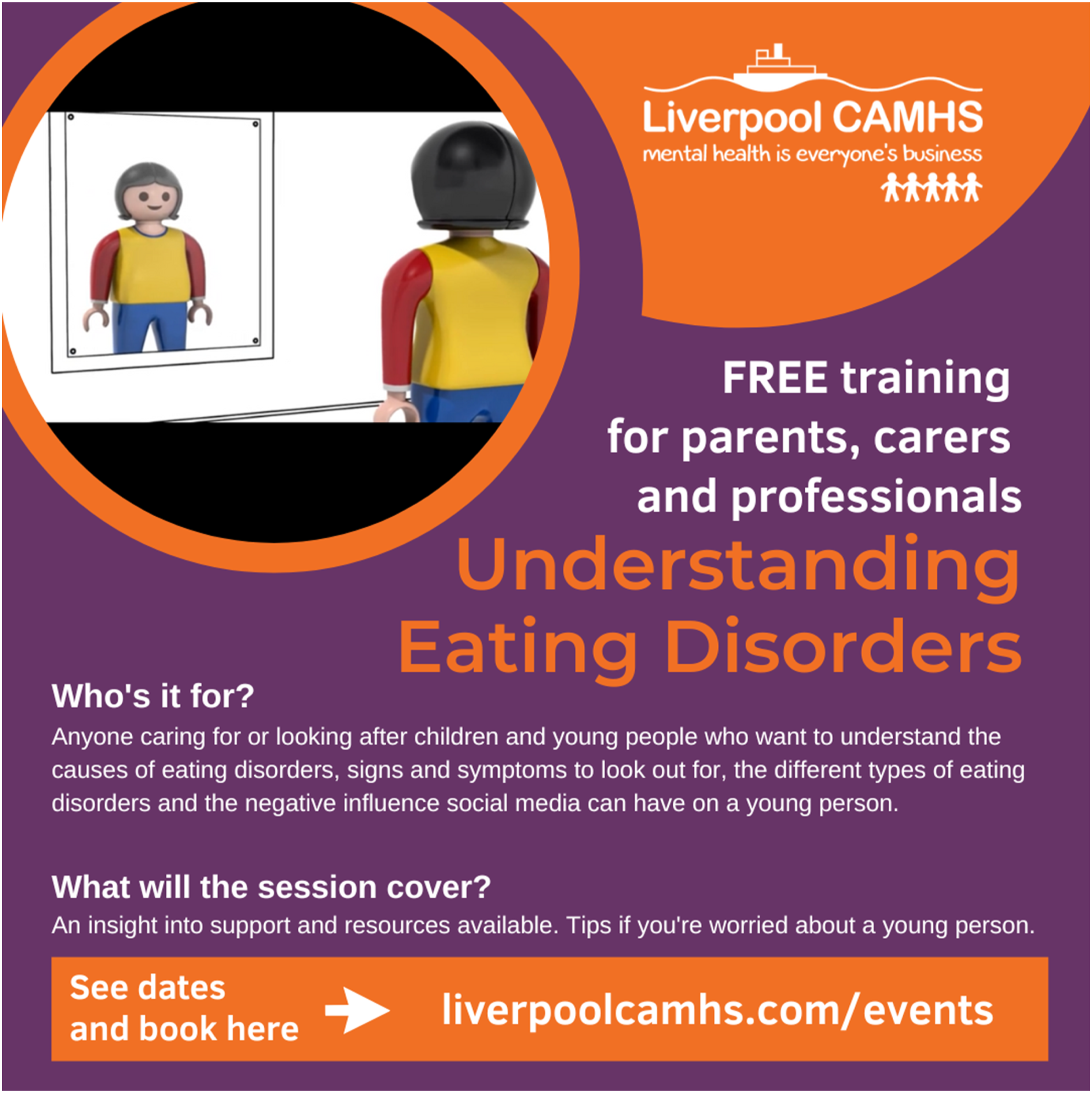
In summary, reach and access to early help for adolescent mental health could be improved if healthcare professionals and researchers work together with people with skills in marketing and with adolescents themselves to ensure that help and support is advertised in ways that are relevant, credible, and engaging to all.
Footnotes
Declaration of Conflicting Interests
The author(s) declared no potential conflicts of interest with respect to the research, authorship, and/or publication of this article.
Funding
The author(s) disclosed receipt of the following financial support for the research, authorship, and/or publication of this article: This work was supported by the MEL (Advanced Fellowship 302929) is funded by the National Institute for Health Research (NIHR) for this research project.
Disclaimer
The views expressed in this publication are those of the author(s) and not necessarily those of the NIHR, NHS or the UK Department of Health and Social Care.

Author biographies