




Abstract
Anxiety comorbidity is quite common in children with attention-deficit hyperactivity disorder (ADHD). What is known about the relationship between anxiety, attachment and emotion regulation in such children is still limited. We aimed to investigate the associations between attachment, emotion regulation and comorbid anxiety in children with ADHD. 100 children with ADHD and 100 children without any diagnosis aged 8–13 years were included. After the participants were clinically evaluated, Turgay ADHD Scale, Emotion Regulation Checklist, Revised Child Anxiety and Depression Scale-Child Version (RCADS-CV) and Kerns’ Security Scale were completed. According to the RCADS-CV scores, ADHD/ANX(+), ADHD/ANX(−), and control groups were formed. The emotional lability/negativity levels were higher in the ADHD groups compared to the non-ADHD controls. Paternal and maternal attachment security levels were lower in the ADHD/ANX(+) group compared to the controls. The regression analysis indicated that higher hyperactivity/impulsivity symptom levels and lower maternal attachment quality were associated with higher anxiety in children with ADHD. These results suggest that focusing on attachment quality and emotion regulation problems may be significant in management of core symptoms and comorbid anxiety problems in children with ADHD.
Introduction
Attention deficit hyperactivity disorder (ADHD) is one of the most common neurodevelopmental disorders in childhood, and impairments in daily functioning refer to the difficulties experienced by the child and family in many areas, including social, academic, or occupational (Cortese et al., 2018). ADHD is defined as a self-regulation disorder since problems in self-regulation skills such as impulse control, calming, and focusing on a goal constitute the core symptoms of ADHD. In addition to the core symptoms, comorbidities appear to be associated in most cases, such as anxiety disorders with a prevalence of approximately 12% (Reale et al., 2017). Most externalizing disorders show an intertwined nature with internalizing disorders such as anxiety and depression (Isdahl-Troye et al., 2022). The presence of comorbid anxiety in ADHD affects overall global functioning negatively, causes higher placement rates into special classes, and is associated with increase in the need for mental health treatment (Hammerness et al., 2010).
Although comorbidities are common in ADHD and anxiety, the underlying mechanisms have not been clearly explained. Uncovering the nature of anxiety comorbidity in ADHD may help explain the etiology and underlying neurobiological basis of these disorders, leading to more effective treatment approaches (Koyuncu et al., 2022). Gair et al. showed that ADHD symptoms predict later anxiety symptoms, but anxiety symptoms do not predict later ADHD symptoms (Gair et al., 2021). ADHD symptoms may cause negative feedback from the environment causing peer rejection, which can increase anxiety (Bubier & Drabick, 2009). The neurobiological approach suggests that ADHD and anxiety disorders share common neurobiological dysfunction and genetic risk factors (D’Agati et al., 2019). Dopamine transporter availability in the striatum was documented to be lower than the control group in both ADHD and anxiety patients (Curatolo et al., 2009; Lee et al., 2015).
Attachment theory gains importance in understanding the etiology of ADHD. Children with problems in attachment may have difficulties in emotional and behavioral regulation, impulse control, self-calming, and maintaining social ties (Cavallina et al., 2015). The quality of the relationship between the infant and the caregiver forms the basis for development of secure attachment patterns in later life. Individuals with insecure attachment styles are more likely to exhibit risk-taking behaviors in adolescence and adulthood. Similar risky behaviors can also be seen in individuals with ADHD as a result of impulse control problems. Individuals with emotion regulation problems may have difficulty regulating their situation-specific negative emotions, which is also a common feature in ADHD. The links between insecure attachment, emotion regulation problems, and ADHD symptoms were reported (Asadi et al., 2021). In a recent study, attachment insecurity was found to be positively correlated with ADHD symptoms through problems of executive functioning and emotion regulation. It was reported that poor emotion regulation also contributed to increased anxiety at two-year follow-up in these patients (Frick et al., 2022).
In this study, we aimed to investigate the associations between attachment and anxiety in children with ADHD. We hypothesized that higher levels of externalization problems, attachment insecurity, and emotion regulation problems would be associated with higher rates of comorbid anxiety symptoms in children with ADHD. Our other hypothesis was that children with ADHD would have lower attachment quality and higher emotion regulation problems than their peers without ADHD.
Materials and method
Participants
The study was conducted with 8-13-year-old unmedicated children with a diagnosis of ADHD and volunteer controls matched by gender and age. While the ADHD group consisted of children who applied to the Child and Adolescent Psychiatry outpatient clinic, the control group consisted of children who applied to the Pediatrics outpatient clinic of our hospital in the years 2020-2021 mostly with flu-like symptoms. The exclusion criteria from the study were having a past or current diagnosis of autism spectrum disorder, psychotic illness, intellectual disability or specific learning disorder, having a neurological or genetic disease, a history of traumatic brain injury, a chronic and serious physical illness or vision and hearing problem. ADHD diagnoses were made by clinical interviews in compliance with the ADHD module of the Schedule for Affective Disorders and Schizophrenia for School-Age Children Present and Lifetime Version (K-SADS-PL) designed for DSM-5 criteria. 5 patients with comorbid dyslexia and 7 patients with chronic medical illnesses were excluded from the study. Control group consisted of 36 females and 64 males. ADHD group consisted of 24 females and 76 males. After the participants were clinically evaluated, Turgay ADHD Scale, Emotion Regulation Checklist, Revised Child Anxiety and Depression Scale-Child Version (RCADS-CV) and Kerns’ Security Scale were completed by all participants. Then ADHD group was divided into two subgroups according to anxiety scores obtained from The Revised Child Anxiety and Depression Scale-Child Version (RCADS-CV). Children with ADHD with a score below 65 on the RCADS-CV were grouped into the ADHD(+)/ANXIETY(−) subgroup, whereas children with ADHD with a score of 65 or more were grouped into the ADHD(+)/ANXIETY(+) subgroup. Statistical comparisons were conducted between the control group, the ADHD/ANX(−) subgroup, and the ADHD/ANX(+) subgroup. This study was approved by the ethics committee of the Istanbul University-Cerrahpaşa, Cerrahpaşa Medical Faculty (20/07/2020-92540). Verbal and written consents were obtained from the children and their parents for participation in the study.
Measures
Sociodemographic questionnaire included age, gender, family unity, family income, familial psychiatric history of the participants.
Schedule for affective disorders and schizophrenia for school age children present and lifetime version (K-SADS-PL)
This semi-structured interview method was developed by Endicott and Spitzer and reorganized by Kaufman et al. to adapt the diagnostic procedure to DSM-5 diagnoses (Kaufman et al., 2016). It is used by health care professionals to screen and diagnose present psychopathologies in children and adolescents aged between 6–18 years (Kaufman et al., 1997). Validity and reliability study of its Turkish version was conducted by Ünal et al. in 2019. The consistencies of the diagnoses were good giving a Kappa coefficient more than .60 (Unal et al., 2019).
Turgay DSM-IV based child and adolescent behavior disorders screening and rating scale
The Turgay DSM-IV-Based Child and Adolescent Behavior Disorders Screening and Rating Scale administered to the parents was used to measure the attention, hyperactivity, and impulsiveness of the participants. This scale was developed by Turgay (1995) with the aim of screening for disruptive behavior disorders based on DSM-IV diagnostic criteria. Its validity and reliability have been studied in Turkey (Ercan et al., 2001). The scale consists of three sections that evaluate attention deficit, hyperactivity/impulsivity, and comorbid features associated with ADHD using a three-point Likert scale (0 = rarely, 1 = sometimes, 2 = often, and 3 = very often). Higher scores indicate more severe psychopathology (Ercan et al., 2001).
The revised child anxiety and depression scale-child version (RCADS-CV)
The Revised Child Anxiety and Depression Scale-Child Version (RCADS-CV) was developed to screen for DSM-IV symptoms of anxiety disorders and depression in children and adolescents (Chorpita et al., 2000). It is a three-point Likert scale that consists of six subdivisions and forty-seven items assessing symptoms of generalized anxiety disorder, separation anxiety disorder, panic disorder, obsessive compulsive disorder, social phobia, and major depressive disorder. Validity and reliability study of the Turkish version of the scale was done in 2017 giving a Cronbach’s alpha coefficient value of .95 (Gormez et al., 2017). Scores of 65 and above indicate borderline clinical thresholds, while scores of 70 and above are considered as clinical thresholds (Chorpita et al., 2000).
Emotion regulation checklist
We used The Emotion Regulation Checklist (ERC) to evaluate emotion regulation in each group. ERC was developed by Shields & Cicchetti (1997). It measures the emotion regulation abilities of children in 6–13 age group. The scale consists of 24 items administered to the parents. Scale items are scored between ‘never (1)’ and ‘almost always (4)’ and evaluated as a four-point Likert scale. The scale has Emotional Lability/Negativity and Emotion Regulation subscales. Higher scores on Emotional Lability/Negativity subscale indicate a rise in emotion regulation problems. In contrast, higher scores on Emotion Regulation subscale indicates an increase in emotion regulation strength. Turkish validity and reliability study of the scale was done, and Cronbach’s alpha coefficient was found to be .84 (Kapçı et al., 2009).
Kerns’ security scale
Attachment aspects were studied using the Kerns’ Security Scale (KSS), a self-report instrument assessing the attachment security of the subjects. The scale, developed by Kerns et al (1996), consists of 15 items. It is used to evaluate attachment security in middle childhood and preadolescence. Turkish validity and reliability study of the scale was conducted by Sümer and Şendağ. The mother form of the scale assesses the attachment quality between the mother and the child whereas the father form assesses the attachment characteristics between the father and the child. The Cronbach’s alpha coefficient for the mother form of the scale was .84 and the Cronbach’s alpha coefficient for the father form was .88 (Sümer & Şendaǧ, 2009). Higher total scores correspond to a more secure attachment to the mother and the father.
Statistical analyses
Statistical analyses were performed using SPSS version 27.0 for Windows. Kolmogorov-Smirnov (K-S) test is used to determine if the data were normally distributed. Chi-square test was used for statistical comparison of categorical variables such as gender, family unity, income level and psychiatric history of the parents. Statistical comparison of numeric variables like age, Turgay ADHD, RCADS-CV and KSS scores between groups was done with Kruskal-Wallis test. The relationship between the Turgay ADHD, ERC and KSS scale and subscale scores of the participants with ADHD was evaluated with Pearson correlation analysis. The predictive effects of ADHD symptom severity, emotion regulation problem levels and maternal and paternal attachment levels on presence of accompanying anxiety in the ADHD group was evaluated by binary logistic regression analysis. Statistical significance was set at p < .05.
Results
Comparison of Sociodemographic Data Between the Groups.
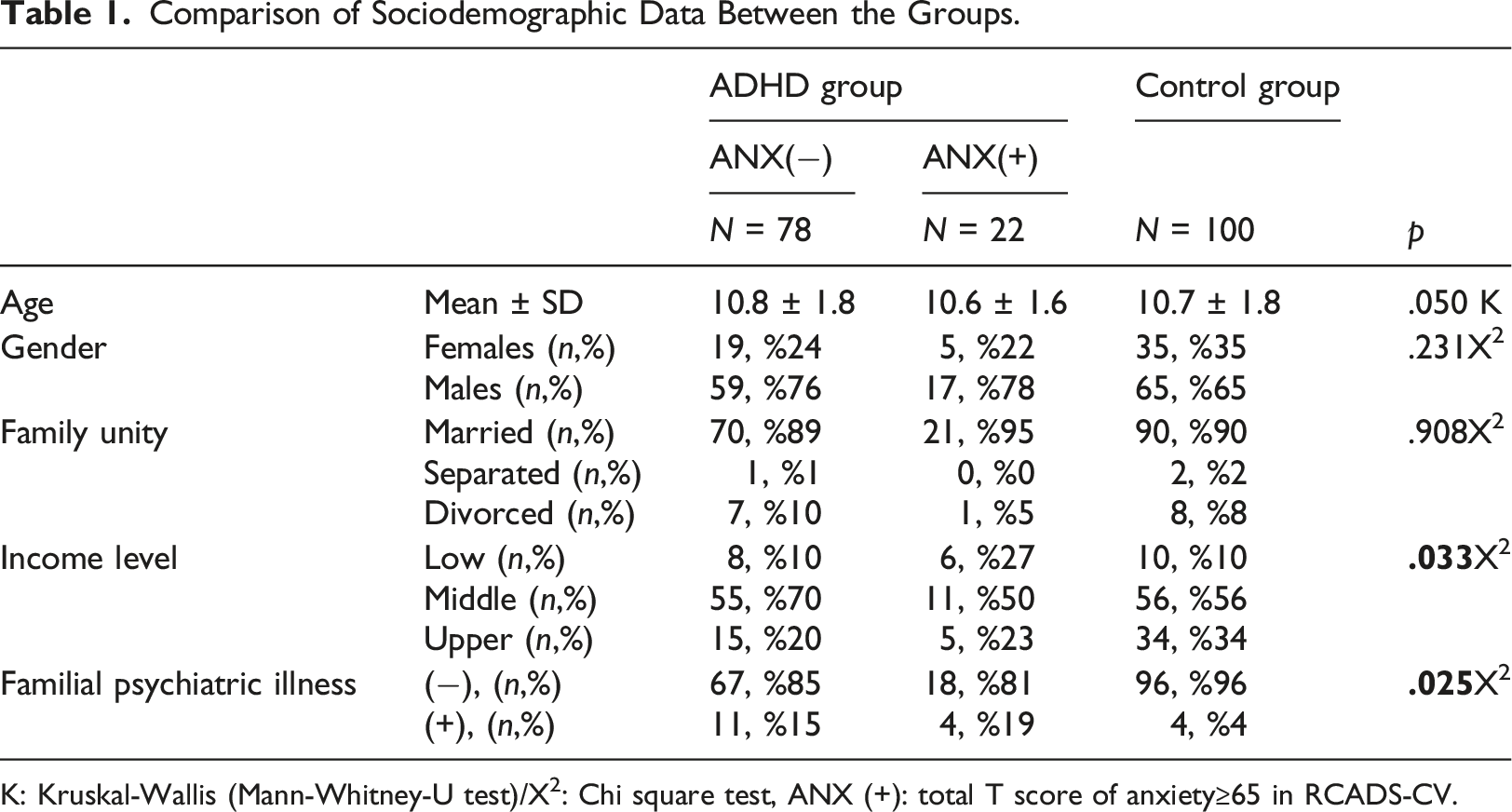
K: Kruskal-Wallis (Mann-Whitney-U test)/X2: Chi square test, ANX (+): total T score of anxiety≥65 in RCADS-CV.
The Scale Scores’ Comparison of the ADHD and the Control Groups.
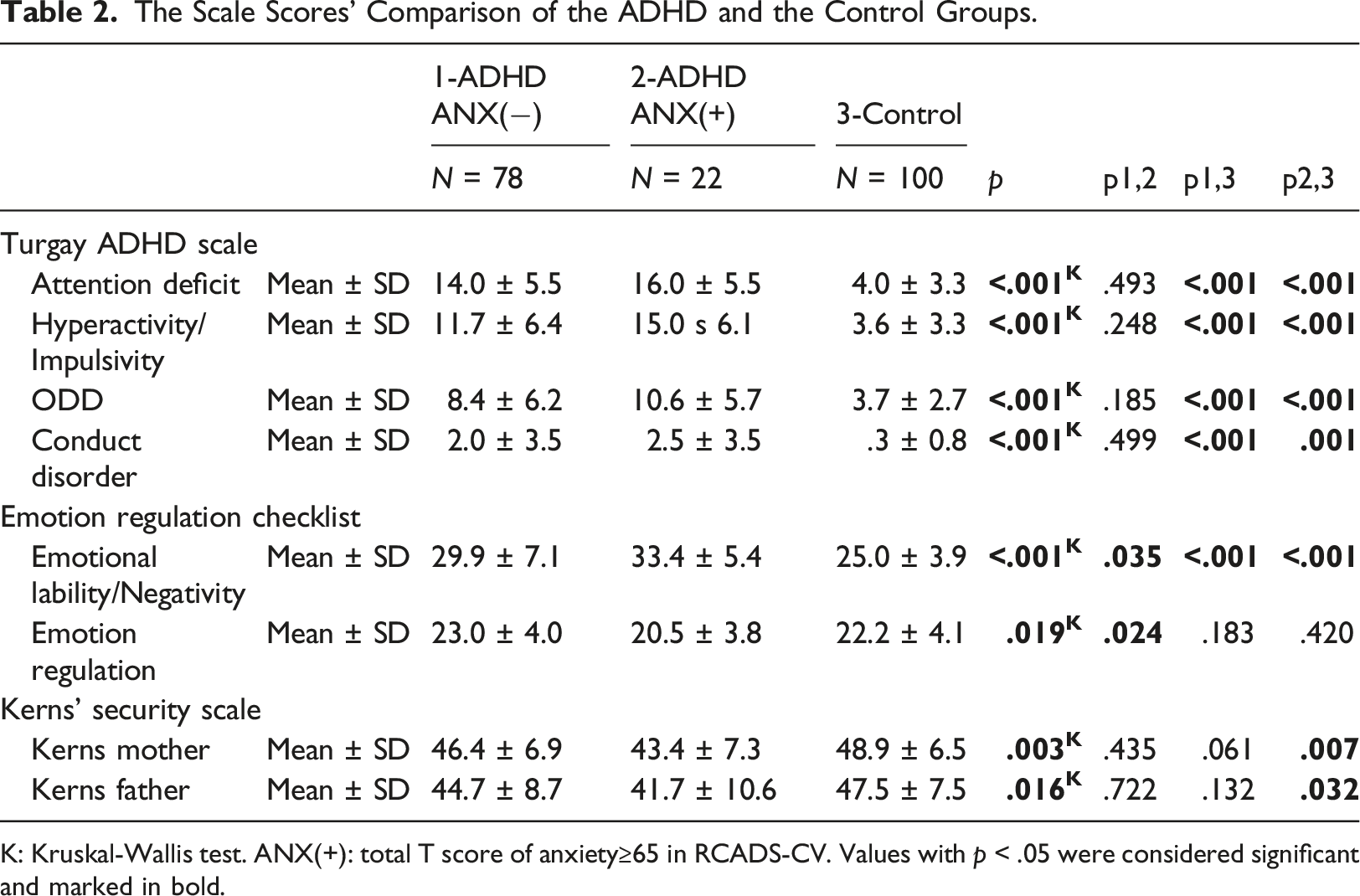
K: Kruskal-Wallis test. ANX(+): total T score of anxiety≥65 in RCADS-CV. Values with p < .05 were considered significant and marked in bold.
Results of the Correlation Analysis of the ADHD Group’s Scale Scores.
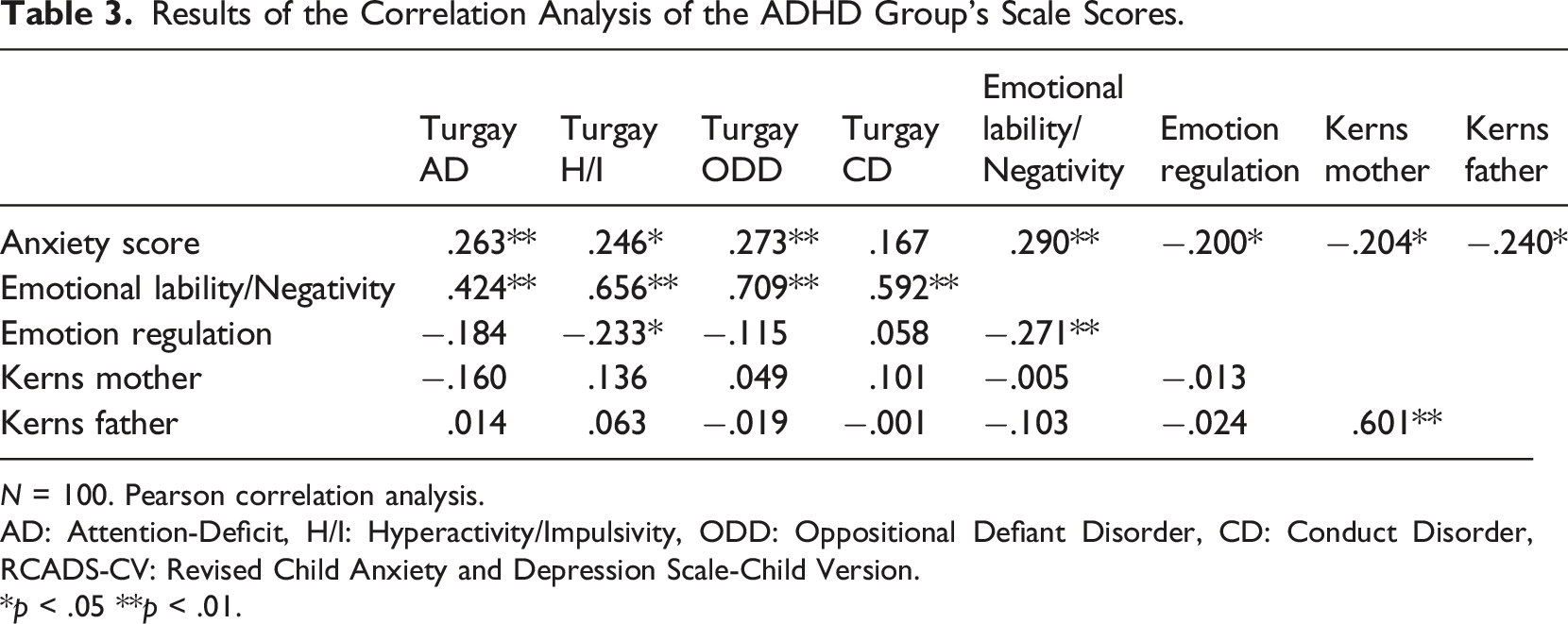
N = 100. Pearson correlation analysis.
AD: Attention-Deficit, H/I: Hyperactivity/Impulsivity, ODD: Oppositional Defiant Disorder, CD: Conduct Disorder, RCADS-CV: Revised Child Anxiety and Depression Scale-Child Version.
*p < .05 **p < .01.
Regression Analysis for the Prediction of Anxiety Levels in Children With ADHD.
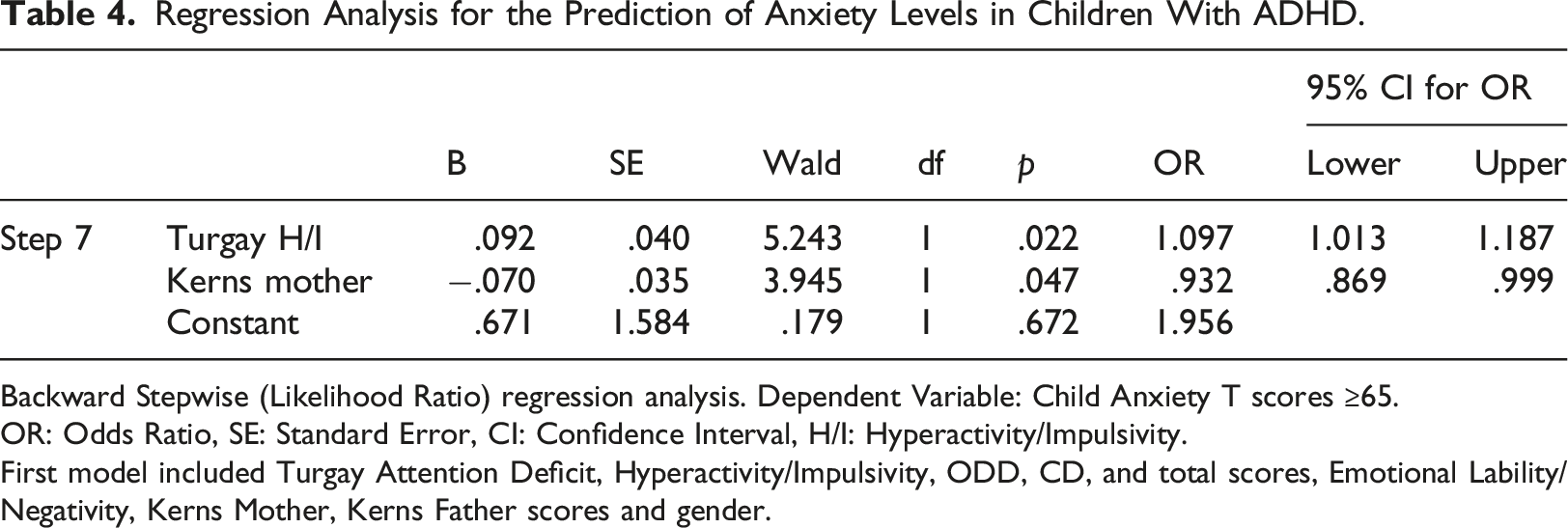
Backward Stepwise (Likelihood Ratio) regression analysis. Dependent Variable: Child Anxiety T scores ≥65.
OR: Odds Ratio, SE: Standard Error, CI: Confidence Interval, H/I: Hyperactivity/Impulsivity.
First model included Turgay Attention Deficit, Hyperactivity/Impulsivity, ODD, CD, and total scores, Emotional Lability/Negativity, Kerns Mother, Kerns Father scores and gender.
Discussion
In this study, the associations between attachment quality, emotion regulation skills and comorbid anxiety in children with ADHD were investigated. In accordance with the hypotheses, children with ADHD with and without comorbid anxiety were found to have more externalization problems and higher levels of emotional lability/negativity than typically developing children. Anxiety comorbid ADHD group had also higher emotional lability/negativity than the ADHD without anxiety group. Likewise, comorbid anxiety group had poorer emotion regulation abilities compared to the anxiety negative ADHD group. Secure attachment levels of the children with ADHD and comorbid anxiety were found to be lower than those of the control group. The regression analysis indicated that higher hyperactivity/impulsivity scores and poorer maternal attachment quality were associated with comorbid anxiety in children with ADHD.
Even though several studies show a link between the type of attachment and the presence of attentional difficulties and hyperactivity in children, the nature of this link remains unclear (Wylock et al., 2021). A review showed that there is a reciprocal relationship between ADHD and attachment problems, and when one occurs, the risk of developing the other increases (Storebø et al., 2016). Similarly, in a study examining the attachment characteristics of children with ADHD between the ages of 6 and 10, showed that ADHD symptoms were more severe in children with disorganized attachment than in those with secure attachment (Scholtens et al., 2014). It has been reported that attachment problems may influence self-development and interaction with other people negatively by affecting the internal working models (Zimmermann & Iwanski, 2019). In our study, we would expect insecure attachment levels to be higher in all of the children with ADHD than in non-ADHD controls. However, the results unexpectedly showed that insecure attachment levels were higher only in children with ADHD and comorbid anxiety but not in those without anxiety, when compared to non-ADHD controls. This finding suggests that poor attachment quality may be detected in children with ADHD, especially when comorbid anxiety problems are present. As the current study focused only on anxiety comorbidity in ADHD, further studies are needed for other comorbid conditions as depression.
When we investigated the effect of parental attachment on ADHD and anxiety association, results showed that insecure attachment to the mother is associated with comorbid anxiety problems in children with ADHD. This finding supports that maternal attachment problems may be linked to development of anxiety in children with ADHD. It can be assumed that an individual with ADHD who has emotion regulation problems due to insecure attachment patterns may have high levels of anxiety (Laible et al., 2000). Although the advantages of secure attachment to more than one attachment figure were stated in the literature, especially maternal attachment was found to be mainly effective on developing of attachment patterns of an individual (Bretherton, 1985). Duchesne et al. stated in their longitudinal studies that maternal attachment problems were associated with development of depressive symptoms during adolescence, while paternal attachment problems did not have a determining effect on that (Duchesne & Ratelle, 2014). They attributed this result to the fact that the mother was more active in emotional support within the family and that the adolescents' negative emotions were regulated more easily and effectively with interaction with the mother. Consistent with these data explaining the underlying factors that contribute to the development of depressive symptoms in teens, our study also showed that anxiety in children with ADHD is associated more with maternal than paternal attachment problems.
Attachment problems can influence emotion regulation (Brumariu, 2015). Emotion regulation problems were reported as 38% in a community sample (Althoff et al., 2006) and as 24%–50% in a clinical sample of children with ADHD (Shaw et al., 2014). Researchers report that children with ADHD show high negative emotionality and overly reactive positive emotionality (Martel & Nigg, 2006; Sanson & Prior, 1999; Steinberg & Drabick, 2015). Emotion regulation problems in children with ADHD can affect daily functioning due to high comorbidity (Steinberg & Drabick, 2015). Our results showed that the emotion regulation skills of children with ADHD were worse than those of control group and accompanying anxiety increased the level of emotional lability/negativity in these patients. In a study evaluating emotion regulation skills during a competitive task with peers, children with ADHD had more difficulty in hiding their emotions and calming themselves than children without ADHD (Walcott & Landau, 2004). Another recent study, comparing children with and without ADHD in terms of parasympathetic and sympathetic system functions, showed that childhood ADHD is associated with abnormalities in parasympathetic mechanisms responsible for emotion regulation (Musser & Nigg, 2019).
The current study suggests that hyperactivity/impulsivity symptoms are associated with anxiety problems in children with ADHD. This can be explained by the similarity of the symptoms of restlessness/nervousness seen in hyperactivity and impulsivity as well as in anxiety disorders (Jarrett & Ollendick, 2008). Another way of understanding the relationship between anxiety and ADHD could be through the excessive arousal model. According to this model, overstimulation in ADHD causes attention dysfunction, hyperactivity and impulsivity, leading to increased threat perception and development of anxiety (Schatz & Rostain, 2006). Since this is a cross-sectional study, data on casualty is limited. Therefore, further studies are needed in this area.
In children with ADHD, as the severity of symptoms and comorbidities increase, academic and social functioning becomes more impaired, and difficulties in these areas become more evident (DuPaul et al., 2016). In cases with comorbid anxiety, increase in symptom severity and additional problems may lead to worsening of functionality. Since studies up to date have focused mainly on bilateral relations between attachment, emotion regulation, ADHD and anxiety, our study may contribute to the literature in terms of examining these variables all together.
Conclusion and practical implications
As a result of our study, hyperactivity/impulsivity and poor attachment quality were associated with comorbid anxiety in children with ADHD. It was found that especially attachment to the mother was associated more with anxiety symptoms in ADHD than the attachment to the father.
In addition, while externalizing problems were found to be higher in children with ADHD regardless of comorbid anxiety, emotional lability/negativity levels were much higher in these patients if comorbid anxiety was present. Our study has important implications for exploring ADHD-anxiety comorbidity and its relations to attachment and emotion regulation. Considering this, preventive and target-specific interventions gain importance to help such children in clinical settings. Regulation of parental relationships and emotional problems along with appropriate treatment of hyperactivity/impulsivity in children with ADHD may help improve anxiety symptoms and functionality of these patients. Since it was a cross-sectional study, obtained information about causality between these clinical situations was limited. Limited sample size and the adequacy of measuring attachment patterns in school-age children by a questionnaire may also be considered as limitations. It should be kept in mind that challenges of parenting a child with ADHD may also have effects on parent-child attachment. Further studies are needed to thoroughly uncover the nature of ADHD, attachment and anxiety coexistence.
Footnotes
Declaration of conflicting interests
The author(s) declared no potential conflicts of interest with respect to the research, authorship, and/or publication of this article.
Funding
The author(s) received no financial support for the research, authorship, and/or publication of this article.
