




Abstract
Over the last decade, a substantial number of studies have addressed children’s use of technologies and their impact on well-being. Nonetheless, there is still a lack of clarity on the operationalisation of technology use, well-being, and the relation between the two. This scoping review intended to shed lights on Digital Technologies Use, its operationalisation, and the relation between Digital Technologies Negative Use (DTNU) and children’s well-being. For the scope of the special issue we focused on negative use. Results showed two conceptualisations of DTNU: compulsive/addictive use of devices and the Internet (e.g., Internet addiction) and negative online experiences/risky behaviours (e.g., cyberbullying). Well-being in relation to DTNU was mainly studied in terms of psycho/social dimensions (e.g., depression), and a gap in cognitive well-being studies was identified. Study designs were largely quantitative, and, in most studies, well-being was considered as a predictor of DTNU. Also, research with children under 12 years was lacking. Future research on DTNU should look at: how dimensions of addiction and negative online experiences relate; provide more evidence on cognitive well-being; explore the interplay of well-being multiple components relying on integrative conceptual frameworks. The recent notion of digital well-being should also be explored considering the results of this review.
Keywords
Introduction
Over the last decade, the time children spend online has doubled and children’s Digital Technologies Use (DTU) has started at an earlier age (Eukidsonline, 2010-2020: Livingstone et al., 2011; Smahel et al., 2020). The recent Covid-19 pandemic has even increased children’s time online as an essential way not only to keep connections with their social contexts but also to give continuity to learning tasks (Nagata et al., 2020). Therefore, digital technologies have become an integral part of children’s daily activities: Socialization, education and entertainment are now also happening in the digital world (Navarro & Tudge, 2022).
A substantial number of studies have looked at children’s safety and protection related to DTU and their impact on children’s wellbeing, e.g. missing out on social experiences (Turkle, 2011), addiction to technological devices, and physical and mental health related problems (Twenge et al., 2018; Young, 1996). Despite the significant implications of these results for research and interventions, clarity on the definitions and operationalisations of Digital Technologies Negative Use (DTNU) seems to be lacking.
The notion of ‘use’ itself is problematic since it can include different aspects related to child-technology interaction: the types of devices used, the ways in which children use the devices and the Internet (frequency, time spent online), the type of activities (production, entertainment), the motives and the characteristics of the online experience, and the societal regulations (mediation processes, country legislation, etc.) (see Smahel et al., 2020).
Operationalisation problems also apply to the notion of well-being (Dickson et al., 2018; Dodge et al., 2012): Well-being is a multidimensional construct (Colombo, 1986) that encompasses positive mood, emotions, and self-evaluations (Diener et al., 1999), health, physical functioning, and absence of disease (Minkkinen, 2013), social acceptance and good quality of relationships with family and friends (Keyes, 1998). Research showed that DTNU can affect not only psychological and social dimensions, but also physical and cognitive dimensions of well-being (Iannitelli et al., 2018; Kwong & Fong, 2019). Studies on the relation well-being-DTU have pointed out that it is the intertwinement of individual, social and country level variables having an impact on well-being. These variables impact on children’s DTU, in terms of opportunities and risks that, in turn, affect short-term effects and long-term effects of well-being, and physical, psychological, and social aspects (Livingstone, 2016; Livingstone et al., 2015).
Taken together these studies signal a need for better understanding the conceptualisation and operationalisation of DTNU and well-being, as well as their relation while focussing on children’s perspectives (Dickson et al., 2018; Orben, 2020). In this sense, the purpose of this scoping review was to identify, illustrate and critically analyse the studies with school-age children that have addressed these aspects. This will allow scholars to rely on an overview of existing literature on the topic that can orient future research.
Method
Scoping review method was chosen as a systematic and explorative method to search and analyse existing literature (see Munn et al., 2018).
Study selection process
Systematic review search terms.
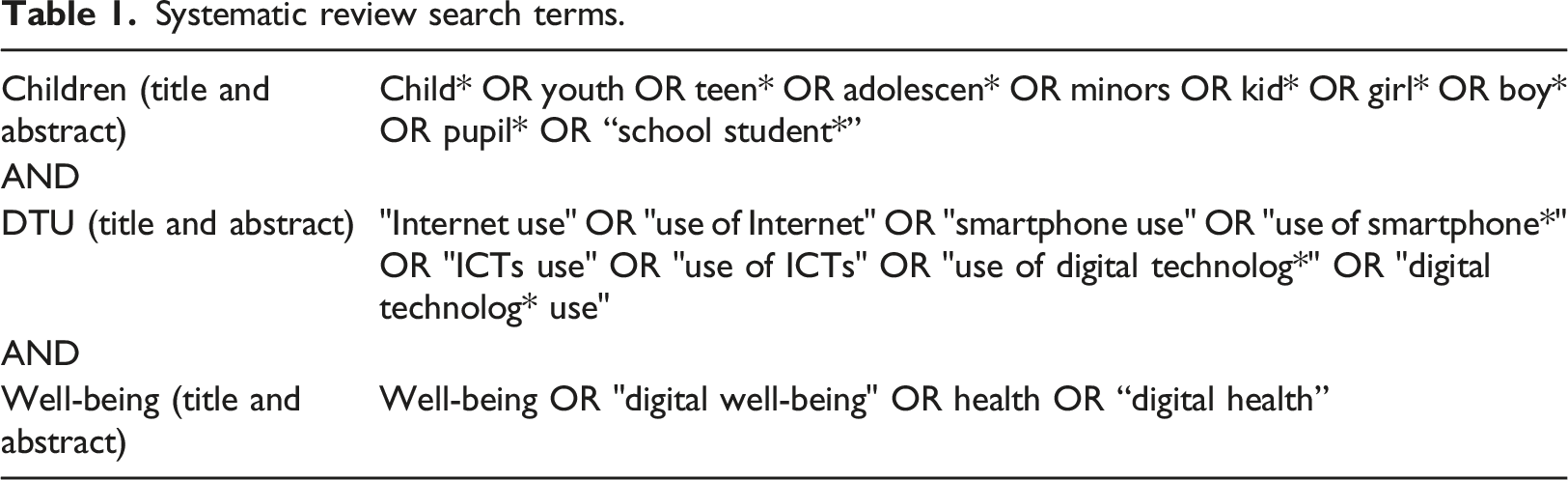
Screening and coding process
The screening was iterative rather than linear and was carried out in a four-step process (Figure 1).
1
After the first screening of titles and abstracts which resulted in 692 articles, a further limitation was added, resulting in 363 records.
2
Two reviewers screened titles and abstracts and independently coded the articles (Colquhoun et al., 2014; Levac et al., 2010). The operational definition of DTU was informed by the Activity Theory framework (Leont’ev, 1974) and its recent developments on technologies use (Everri, 2017; 2019; Lahlou, 2017; Yardi & Bruckman, 2011). In this framework, “technology [is considered] as part of the larger scope of human activity” (Kaptelinin & Nardi, 2006, p. 5). Therefore, for ‘use’ we intended every activity referred to or supported by digital technologies. Search results presented using the PRISMA flow diagram (Page et al., 2021).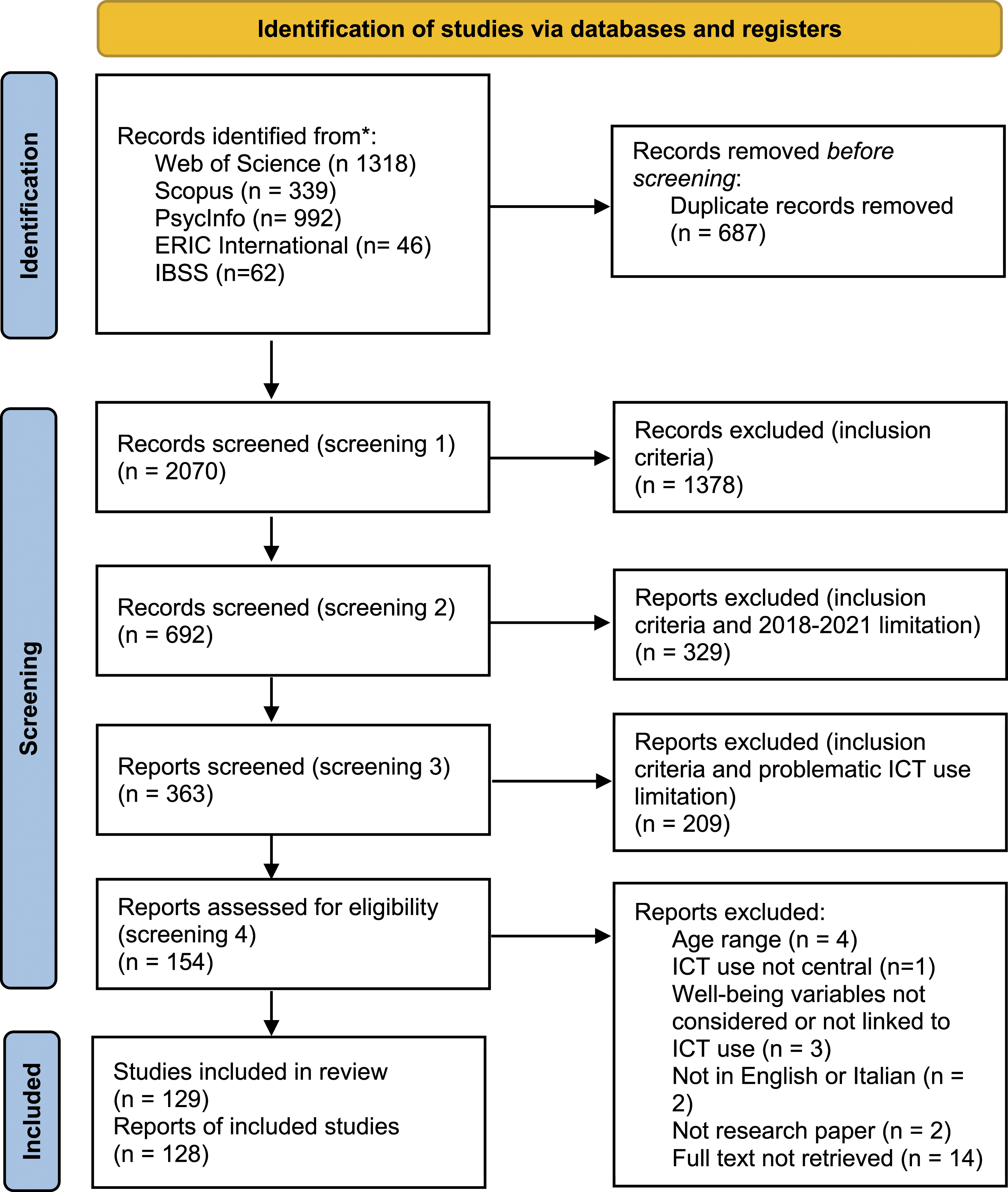
As for well-being, variables pertaining psychological (depression, anxiety), physical (sleep quality, dietary habits), social and cognitive (academic achievements) dimensions were included (Pollard & Lee, 2003). One-hundred-one studies were removed as they did not meet the inclusion criteria. Hence, two categories of studies on DTU were identified: (a) negative conceptualisations of use (n = 154), (b) ‘neutral’ conceptualisation of use (n = 108). For the topic of the special issue and for reason of space, this article will focus on the first category of studies (N = 154). The final sample consisted of 129 studies (see Figure 1).
Data extraction
The conceptualisation of DTNU was extracted together with information related to the study construct operationalization when provided. Well-being dimensions were extracted and categorised following Pollard and Lee (2003).
Results
Summary of included studies (N = 129).

Sample characteristics
Most of the studies (86 out of 129) recruited samples of adolescent children in the age range 12–19 years. Excluding literature reviews, nearly all studies (N = 123) recruited a sample of both male and female, whereas two studies included only females, and one study included only males. Moreover, the large majority addressed a general sample of students (N = 111).
Study design and methods
Quantitative research design represented most of the surveyed studies (N = 124): 109 were cross-sectional, 12 longitudinal, one pre-post-test experiment, one prospective trial, and one meta-analysis. Two were mixed-method studies, and three literature reviews. Overall, 104 studies presented causal relations, while 25 presented correlations.
Definition and operationalization of children’s DTNU
Two strands of studies emerged from our analysis: (1) Studies that operationalised DTNU in terms of excessive use and addiction; (2) Studies that operationalised DTNU in terms of children’s risky /negative online experiences or behaviours.
DTNU as excessive use and addiction
A small number of studies (N = 4) used broad definitions of technologies (electronic devices, ICT, or screen devices) and measured DTNU with frequency of use indicators, where excessive use corresponded to ≥ 3 hours of use. Instead, a larger number of studies (N = 116) looked at the specific negative use of the Internet, of the smartphone, and of social network sites use (SNS). Studies on negative use of the Internet referred to the construct of Internet addiction. The most considered dimension of addiction (N = 58) was the interference of Internet use with daily life routines and tasks and the related disturbance of adaptive functions; followed by compulsion/loss of control (N = 49), and concern, fears or worries related to not being able to access the Internet (N = 43). A smaller number of studies considered, respectively, withdrawal and intolerance (N = 17), and social comfort/preference for online social interactions (N = 15). Nine studies included either escaping, namely using the Internet to change negative mood (N = 6), or feeling lonely, depressed, or moody (N = 3). In seven studies, the negative use of the Internet was also defined by problems with time management and relapse (i.e. trying unsuccessfully to spend less time on the Internet), whereas six studies included dimensions of addictive automatic thoughts/positive anticipation, and deviant behaviours. Other dimensions considered for Internet negative use were salience (skipping lunch or sleeping less because of the use of Internet) (N = 5), deficient self-regulation and conflicts (N = 4), lying to hide addictive behaviours and interpersonal and health-related problems (N = 3), primacy (i.e. Internet use occupies the centre of users’ thinking and behaviours), the physiological responses and negative emotions caused by relapse (i.e. unsuccessfully try to spend less time online), and anxiety/nervousness (N = 2). Only one study considered excessive gaming as part of Internet negative use. Continuation, obsession, excessive use, and addictive behaviours were dimensions studied separately in single studies.
Studies on the negative use of the smartphone operationalised DTNU using addiction dimensions. The most studied dimension was withdrawal (N = 23), followed by difficulties in daily living/disturbance for adapting functions (N = 18), tolerance (N = 16), and virtual orientation (N = 14). Six studies included the excessive use/overuse dimension, whereas the loss of control was considered in five studies. Symptoms of anxiety, escaping, loss of productivity, and compulsive behaviours were used in four studies, whereas physical symptoms and positive anticipation in three. Single studies included smartphone craving and peer dependence. One study used the concept of phubbing, i.e. disturbance in communication while being with others and obsession with the phone. Among the 11 studies that investigated the negative use of SNS, withdrawal symptoms were the most considered indicators of negative use (N = 10), followed by conflict with other people or activities (N = 9). Escaping and tolerance were included in six studies, whereas cognitive and behavioural salience and relapse in five. Persistence (i.e. being unable to stop using social media, even though others told the person that she really should), displacement (i.e. loss of interest in other activities), deception (using social media secretly), and preoccupation were included in four studies. Reinstatement, euphoria, loss of control were indicators of SNS negative use in three studies, whereas only one included compulsion.
DTNU as negative online experiences or risky behaviours
Another strand of studies on DTNU included studies on: (a) cyberbullying, (b) sexual solicitation online, sexting and cyberdating abuse, and (c) gaming. Most studies that referred to DTNU as cyberbullying focused on social exclusion dimensions (N = 8). One study addressed specifically the exclusion from WhatsApp classmate groups. Spreading rumours, lies or secrets was the second most considered dimension (N = 6), followed by visual forms of cyberbullying such as disseminating compromising or embarrassing photos or videos online (N = 5). Online threats were indicators of cyberbullying in 4 studies, whereas written forms of cyberbullying (e.g. aggressive/nasty texts), verbal forms (e.g. frightening phone calls), insults, and name-calling were reported as indicators in three studies. Slandering and uploading fake photos/videos online were included in two studies. Also, two studies considered sexual harassment as a dimension of cyberbullying. One study referred to impersonation.
The frequency of sexual solicitations and interactions online with an adult were experiences investigated in two studies, whereas sexting was addressed by three studies measuring the frequency of voluntarily sending text, photos, video, or sharing images via webcam with sexual content. One study defined the concept of cyberdating abuse, operationalizing it in terms of controlling the partner’s mobile phone and insulting.
Studies on gaming were 11 and ten operationalized the construct of negative use considering diagnostic criteria provided by the DSM V. One study referred to the Minnesota Impulsive disorder Interview which assesses a series of dimensions such as craving and neglecting other activities and being aware of having a problem with gaming.
Children’s well-being and DTNU
Psychological well-being was the most studied aspect in relation to children’s DTNU (110 studies included at least one psychological variable). Social well-being variables were addressed in 54 studies, physical well-being in 35, and cognitive well-being in seven. Among the psychological well-being variables, depression or other mood variables (dysthymia) were the most investigated (41 out of 110 studies), as well as emotions and affection factors (emotion dysregulation, anger) (N = 22). Anxiety was addressed in 14 studies, and behavioural problems (e.g. internalizing/externalizing symptoms) in 14 studies. Stress-related factors were found in 13 studies, whilst self-harm or suicidal behaviours/ideation were included in 11. Fewer studies focused on life satisfaction or psychological components of quality of life (N = 10), self-esteem (N =9 ), fear of missing out (N = 4) and coping strategies (N = 2).
Fifty-four studies focused on social well-being: 16 studies considered family-related well-being variables (e.g., quality of parent-child relationship). Fourteen studies included peer-related variables (bullying/aggression or support); while 10 considered a broad definition of quality of life or well-being related to social factors. Five studies considered general social support, social isolation/dysfunction, and school-related well-being variables (e.g., teacher-student relationship, school adjustment). Antisocial behaviours were included in one study, and three studies dealt with stress or constraint factors related to the social context. Lastly, one study considered adverse childhood experiences.
Half of the studies on physical well-being focused on sleep-related factors such as sleep quality/duration or insomnia (18 out of 35). Nine studies included a physical component of well-being, six studies investigated well-being variables related to dietary habits and body shape (e.g., obesity), whereas five studies included factors related to substance abuse. Lastly, two studies dealt with somatic symptoms, other two studies investigated oral health factors. Cognitive well-being was the least investigated dimension: Six studies focused on school performance and one study was on academic achievements in relation to children’s DTNU. Interestingly, one study conceptualized mental health in terms of cyberbullying, Internet pornography and Internet fraud.
The relation between children’s DTNU and well-being
Among the quantitative studies, 57 records considered well-being variables as predictors of children’s DTNU, whereas 38 considered well-being variables as an outcome. In the first group (well-being as predictor), 15 studies tested the mediation of other well-being variables, three of which proposed complex models with the moderation of a third variable. Lastly, one study addressed the moderation of self-control on the association between sedentary behaviours and smartphone addiction.
As for the second group (well-being as outcome), 11 studies tested the mediation of well-being variables, and two mediations were moderated by a third well-being variable; three studies investigated a moderated model. Moreover, three studies investigated well-being variables as both antecedents and outcomes with the mediation of DTNU variables: One tested the mediation of Facebook intrusion in the association depression-sleep problems, the other investigated the mediation of pathological Internet use in the association perceived personal discrimination-problem behaviours, and the third considered the mediation of Internet addiction in the relationship between bullying, victimization and psycho-physical well-being. One study investigated cyberbullying as the antecedent of negative Internet use with the mediation of depression.
Most correlational studies presented associations between well-being and excessive/addictive use (16 out of 25). Among them, physical and cognitive well-being dimensions were the least considered. Six studies presented correlations between psychosocial and physical well-being and negative experiences: For instance, cyberbullying experiences, sexting, and online grooming were associated with personality disorders, emotional symptoms, and behavioural problems. Additionally, three correlational studies focused on both excessive/addictive use and negative experiences. Three reviews looked at the impact of excessive/addictive use on physical wellbeing, in particular sleep quality and duration, physical activity and obesity, musculoskeletal outcomes/pain, ocular health, and migraine/headaches.
Discussion and conclusion
Our literature review addressed the negative side of DTU in relation to children’s well-being to clarify the use of terms and leverage insight on the relation between DTNU and wellbeing. The conceptualisation of DTNU was twofold: one concerned excessive/addictive use of devices of the Internet and of social media platforms; the other referred to the children’s negative experiences or risky behaviours. The first conceptualisation was found in most of the studies surveyed and concerned a strand of studies on Internet and smartphone addiction, overuse, and the different nuances of dependency and compulsive behaviours. A minority of studies measured DTNU in terms of frequency of use/screen time. This indicates an important advancement in the field of DTNU research, since the frequency of use as an indicator of negative use has been extensively criticised (Orben, 2020; Sewall et al., 2020). In fact, most studies used operationalisations of the construct of technology addiction to refer to DTNU. Nonetheless, the concept of technology addiction continues to be problematic as it considers the Internet, the device, or the applications, as singular entities, although they afford an array of potential activities (Ryding & Kaye, 2018). In other words, the operationalisation of DTNU should not only address the type of medium used, but also the different possible activities supported by the medium, which could contribute to addictive behaviours. Researchers should further develop this line of investigation since the debate on Internet and smartphone addiction is vivid, not only in scientific communities, but also in the public discourse.
The second conceptualisation of DTNU concerned negative experiences of children with digital technologies, namely risky and harming behaviours such as cyberbullying, sexting, and gaming. Within an activity theory framework, the experiential aspect of use and the dependency deriving from the use can be linked as they are different components of an activity. Two recent studies have addressed these aspects by studying the relation between Internet addiction and children’s cybervictimization, sexting, and online grooming (González-Cabrera et al., 2021) and cyberbullying as the antecedent of Internet addiction (Liu et al., 2020). Moreover, as suggested by the recent developments of the activity theory (e.g., Lahlou, 2017) additional aspects should be considered such as the specific type of device/platform used and the societal regulations (e.g. parental mediation, legislation) in place.
As for the conceptualisation of well-being in relation to DTNU, the literature has largely addressed psychological individual dimensions with most studies focussing on depression and anxiety. Also, if some social and contextual dimensions have been considered (e.g., Mo et al., 2019; Mikuška et al., 2020), there is a neglect of studies that have included learning difficulties and school attainment variables. The relation between DTU and well-being is anything but simple and unidirectional: a higher number of studies considered well-being dimensions as predictors of DTNU; nonetheless, consistent studies have shown that DTNU can also contribute to the development of psychological problems. The most recent studies proposed mediation and moderation models in which different dimensions of well-being, various DTNUs as well as psychosocial variables (e.g., perceived discrimination) were included as mediators or moderators. This signals an emerging trend in the literature: the design of complex models which can account for the interplay of various dimensions when children’s use of technologies is concerned. Hence, ecological, and integrative conceptual frameworks (e.g., Hertlein, 2012; Livingstone et al., 2015) could become important points of reference for scholars interested in searching the area of DTU and well-being.
Elaborating further on DTNU and wellbeing-related outcomes, researchers should consider the recently developed notion of digital well-being (Gui et al., 2017; Vanden Abeele, 2021). Theoretically, digital well-being can derive from a plausible causal chain going from digital practices to well-being through experiences of harms and benefits (Büchi, 2020). This is an emerging line of inquiry which requires to be explored further in the light of the analysis of the studies presented in this review.
Lastly, one concluding remark on sampling and method. The vast majority of the surveyed studies recruited samples of adolescents, while studies with children under the age of 12 years were underrepresented; yet children’s DTU starts at an earlier age (Smahel et al., 2020). Future research should start involving younger children in research on DTU as well as devise methods suitable for this cohort of participants. In fact, self-reported measures of use were privileged in DTNU studies. This can be problematic not only for the accuracy of children’s estimate of the use (Sewall et al., 2020), but also for devising interventions based on children’s reports. Researchers should consider adopting research practices that resonate with children’s cultures of communication (Cristensen & James, 2017), as well as exploring emerging methods for data collection based on technologies’ features, e.g. applications on participants’ smartphones, for tracking use. Digital ethnography and participatory methods (Christen & James, 2017; Pink, 2016) can also be considered for actively involving children in the data collection, as well as for the combination with self-reported measures in mixed methods research designs (Everri, 2017). We hope that this review will contribute to clarifying a complicated but much needed line of inquiry as well as encouraging the design of further empirical works based on a child-centred approach.
Footnotes
Acknowledgements
The authors are grateful to the anonymous referees who provided fruitful comments to the article. We believe their comments and reflections have substantially improved the quality of our work.
Declaration of conflicting interests
The author(s) declared no potential conflicts of interest with respect to the research, authorship, and/or publication of this article.
Funding
The author(s) disclosed receipt of the following financial support for the research, authorship, and/or publication of this article: The research conducted in this publication was jointly funded by the Irish Research Council and by CyberSafeKids under grant number EBPPG/2020/14.
