




Abstract
Globally, TikTok is now the fastest growing social media platform among children and young people; but it remains surprisingly under-researched in psychology and psychiatry. This is despite the fact that social media platforms have been subject to intense academic and societal scrutiny regarding their potentially adverse effects on youth mental health and wellbeing, notwithstanding the inconsistent findings across the literature. In this two part study, we conducted a systematic review concerning studies that have examined TikTok for any public health or mental health purpose; and a follow-up content analysis of TikTok within an Irish context. For study 1, a predetermined search strategy covering representative public and mental health terminology was applied to six databases – PSYCINFO, Google Scholar, PUBMED, Wiley, Journal of Medical Internet Research, ACM – within the period 2016 to 2021. Included studies were limited to English-speaking publications of any design where TikTok was the primary focus of the study. The quality appraisal tool by Dunne et al., (2018) was applied to all included studies. For study 2, we replicated our search strategy from study 1, and converted this terminology to TikTok hashtags to search within TikTok in combination with Irish-specific hashtags. As quantified by the app, the top two “most liked” videos were selected for inclusion across the following three targeted groups: official public health accounts; registered Irish charities; and personal TikTok creators. A full descriptive analysis was applied in both studies. Study 1 found 24 studies that covered a range of public and mental health issues: COVID-19 (n = 10), dermatology (n = 7), eating disorders (n = 1), cancer (n = 1), tics (n = 1), radiology (n = 1), sexual health (n = 1), DNA (n = 1), and public health promotion (n = 1). Studies were predominately from the USA, applied a content analysis design, and were of acceptable quality overall. In study 2, 29 Irish TikTok accounts were analysed, including the accounts of public health authorities (n = 2), charity or non-profit (n = 5), and personal TikTok creators (n = 22). The overall engagement data from these accounts represented a significant outreach to younger populations: total likes n = 2,588,181; total comments n = 13,775; and total shares n = 21,254. TikTok has been utilised for a range of public health purposes, but remains poorly engaged by institutional accounts. The various mechanisms for connecting with younger audiences presents a unique opportunity for youth mental health practitioners to consider, yet there were distinct differences in how TikTok accounts used platform features to interact. Overall, there is an absence of high quality mixed methodological evaluations of TikTok content for public and mental health, despite it being the most used platform for children and young people.
Introduction
The pervasive use of social media worldwide has generated an ideal platform for promoting public and mental health information to children and young people (CYP). Amidst the ongoing global pandemic, coupled with evidence of increasing youth psychological difficulties, public health officials and clinicians are increasingly recognising the need to understand and engage social media including TikTok for public communications (Eghtesadi & Florea, 2020).
Recent reviews have found that popular social networking sites are the most important digital health resources for CYP (Lupton, 2021; Montag et al., 2021). Where supply exceeds demand for in-person mental health services, digital solutions can provide stakeholders with the opportunity to engage with large portions of the youth population with informative content (Liu et al., 2020). However, there is a limited understanding of the functionality of TikTok among mental health professionals. Based on receptiveness to other dominant social media platforms, this lack of understanding may be attributable to: the speed of the cultural embeddedness of TikTok; generational differences in uptake, digital literacy and competencies; and a traditional scepticism of new technologies amongst professionals.
What is TikTok?
TikTok allows users to consume and create short videos between 15–60 s in length; using various filters, music and lip-syncing templates. TikTok’s unique selling point is that the content presented to an individual is algorithm-driven, and tailored to their indicated preferences and previously liked content (Anderson, 2020). It is particularly popular with the traditionally hard-to-reach 13–29 age cohort – data from the United States show that 32.5% of users are aged 10–19, and 29.5% aged 20–29 (Clement, 2020). Globally, it is assumed that the majority of TikTok users are of pre-teen age.
TikTok has been conceptualised as a highly unique video-based social media app with distinct technical structures and unparalleled user adoption unlike any other platform, thereby making it a specific online network wherein imitation and memetic features further accelerate its diverse user interactivity (Zulli & Zulli, 2020). As a result, there have been waves of viral TikTok videos among CYP, with accompanying hashtags relating to topical issues, including COVID-19, mental health, eating disorders, developmental issues, and health (Montag et al., 2021). Indeed, despite the notable lack of psychology professionals effectively utilising TikTok, there have been interesting exceptions. For example, Dr. Julie Smith is considered to be one of the first accredited psychologists to successfully use TikTok to disseminate mental health information on a range of topics from anxiety to suicidality. At present, her TikTok profile has garnered 33.4 million likes and amassed over 2.9 million followers, from presenting bite-sized psychoeducational content from her professional background (Smith, 2022).
Critically appraising the role of TikTok
Across the social media landscape, there has been heated debate about the potentially harmful effects of popular platforms, including Facebook, Instagram and Snapchat. More broadly, the overall effect of screentime itself on CYP has been under extensive investigation. Several high profile media exposes have prompted clinicians and parents to re-evaluate the relationship between social media and the CYP. For example, a recent article in The Wall Street Journal leaked internal research by Facebook (who also own Instagram) purporting to show that the platform holds evidence demonstrating the harms caused to the mental health of approximately 20% of its users. However, upon closer inspection, the referenced research reflects much of the characteristics in the broader literature on the clinical effects of social media consumption on CYP (insert Ritchie). That is, the overall studies are largely correlational, overly reliant on self-reported and thus unreliable measures, lacking in construct validity, and of significantly varying quality to draw any definitive conclusions.
Although there is no specific clinical literature on TikTok use, similar concerns exist given its significant pre-teen userbase (Bucknell Bossen & Kottasz, 2020). Expectedly, the same challenges regarding the online safety, content moderation, data regulation and the ethics of targeted advertising of CYP are applicable to TikTok (De Leyn et al., 2021). For example, a recent content analysis found that alcohol-related content on TikTok showed a propensity to promote rapid consumption of multiple drinks and to align alcohol consumption with positive associations (i.e., humour), while rarely communicating the known negative outcomes (Russell et al., 2021).
From a theoretical standpoint, the unique mimicry and imitation in-built into TikTok creates a new form of interaction between users and video content – the perceived realism of which could lead to behavioural change in CYP, in line with the principles of social learning theory (insert REF). Of the scant research available, data suggests that user motivations – archiving, self-expression, social interaction and peeking – were significant predictors of TikTok behaviours more so than personality traits (Omar & Dequan, 2020). Relatedly, a frequently applied theoretical framework to TikTok research is that of the uses and gratifications approach (Montag et al., 2021) which states that individuals use media in particular ways to satisfy their own needs, and thus feel satisfied and engaged (Katz et al., 1974). In applying this theory, recent survey research from China (n = 1051) found that novelty was the distinct gratification point for TikTok use across all users (Scherr & Wang, 2021) – that is, TikTok’s algorithm continually produced novel yet relevant content outside of the user’s immediate social network.
As a platform, TikTok has acknowledged the positive and negative uses of their technology; and has recently issued advice about overusing the app at night, in addition to providing resources to users searching for suicide-related content (TikTok, 2020, 2021).
The present study
To address the gap in the psychology and psychiatry literature on TikTok, this study set the following two aims: 1) Conduct a systematic review on the use of TikTok for any public and mental health purpose 2) Contextualise and supplement the review findings with a content analysis, using an Irish specific case study.
Method
Study 1
Search strategy
A predetermined search strategy covering representative public and mental health terminology and blended with the word TikTok was applied to six databases – PSYCINFO, PUBMED, Wiley, Journal of Medical Internet Research (JMIR),– within the period 2016 to 2021. This is fully detailed in our supplementary materials. The search was conducted between June and July 2021, with 275 studies initially screened. The flow diagram for the identification of studies is provided in our PRISMA in Figure 1 (Page et al., 2021). PRISMA flow chart for study 1.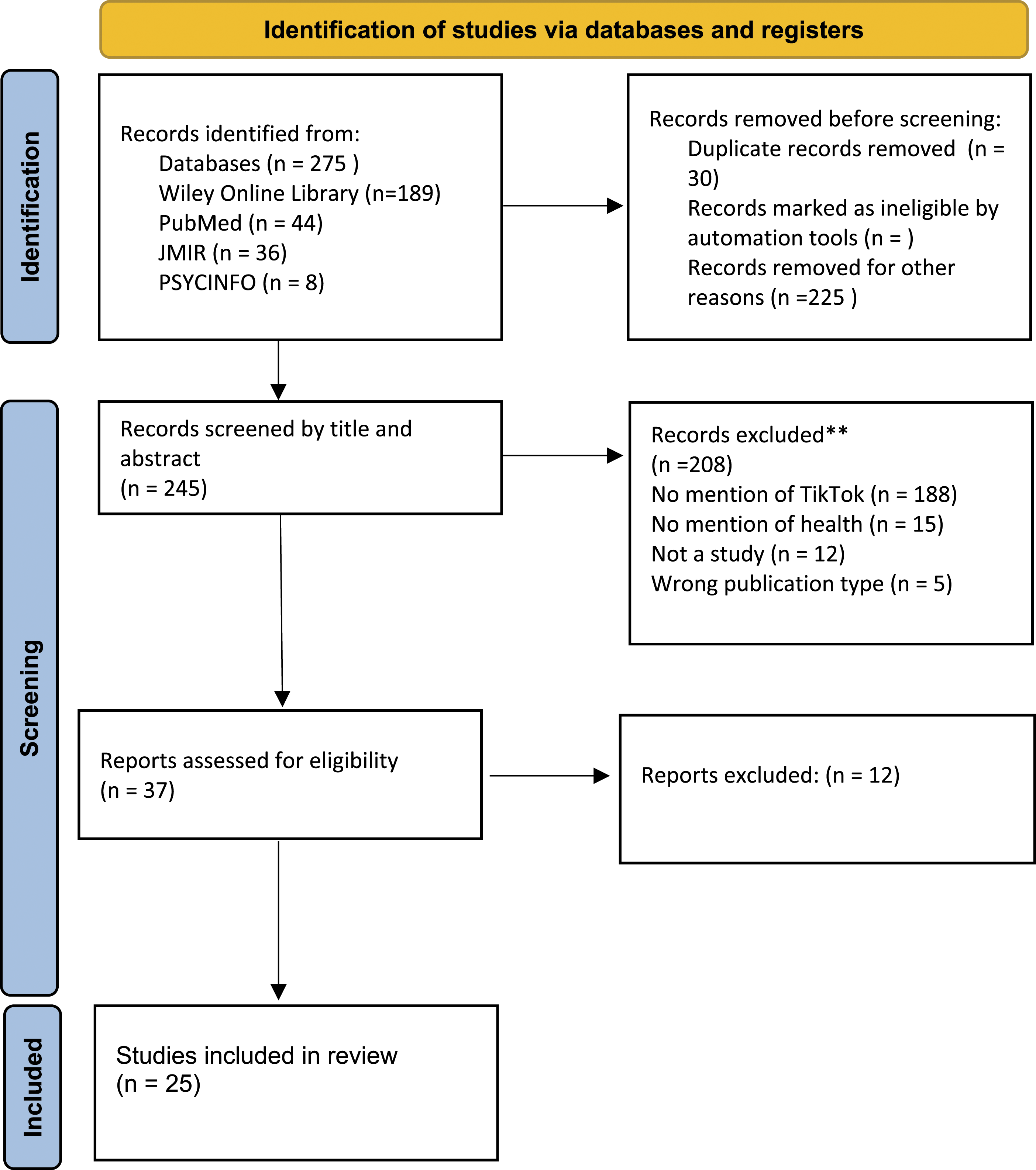
Selection criteria and quality appraisal
Included studies were limited to English-speaking publications of any design where TikTok was the primary focus of the study. The quality appraisal tool by Dunne et al. was applied to all quantitative studies (Dunne et al., 2018); and the CASP (2018) checklist was applied to all qualitative studies. The second author (CM) conducted full title and abstract screening, with both authors then deliberating until consensus regarding any articles with unclear eligibility.
Study 2
Search strategy and data collection
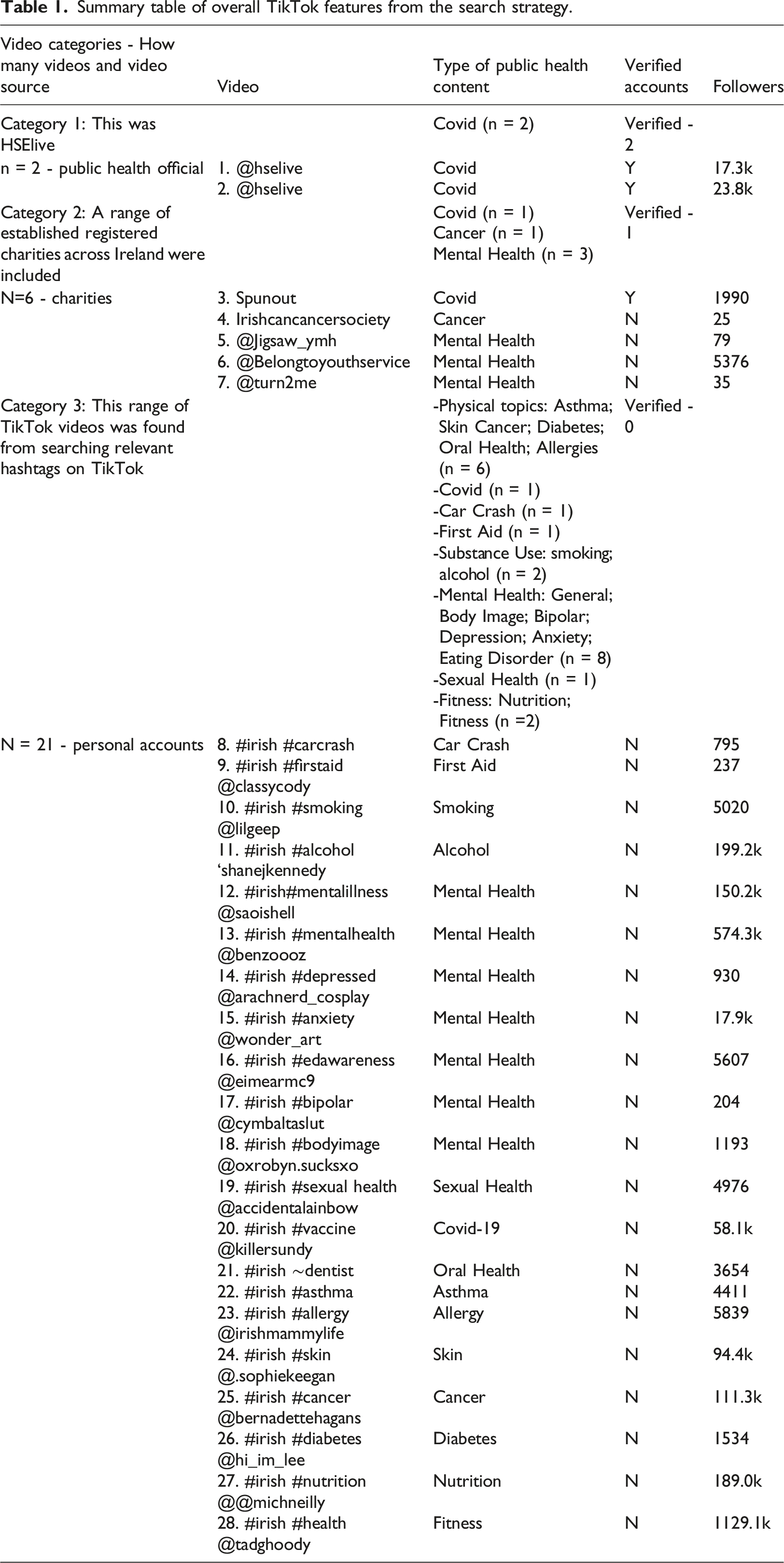
Summary table of overall TikTok features from the search strategy.
Coding approach
A full descriptive table was built a priori to centralise all useful information across our findings. This included engagement data, such as number of likes, followers, comments; in addition to video characteristics, summaries, and length. Similar to other comparable studies, the presence of dialogic loop was deemed important and relevant to TikTok in particular – this refers to the posing and answering of questions to promote further engagement (Chen et al., 2021; Wang & Yang, 2020). As such, a frequency count was performed across all included content. The second author manually performed all data extraction and synthesis using Microsoft Excel.
Results
Study 1
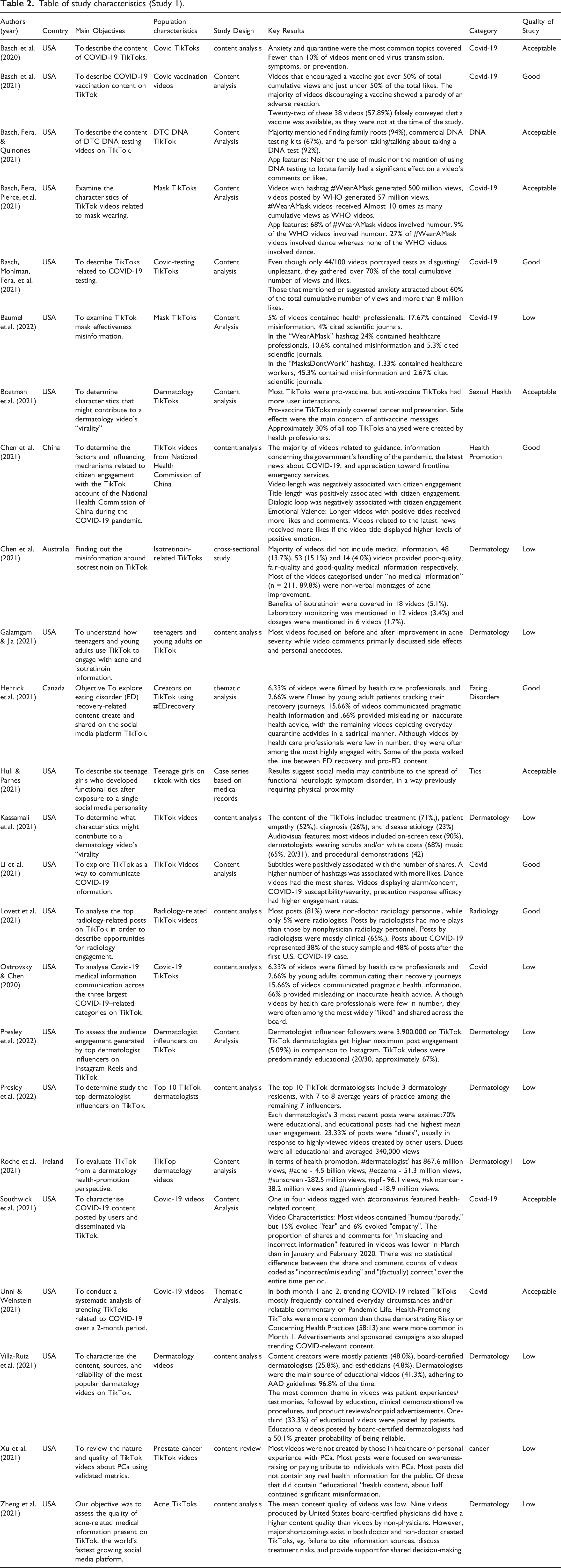
Table of study characteristics (Study 1).
Study 2
Content analysis output table.

Overall discussion
This two-part study aimed to provide what we think is the first systematic review of TikTok and its use within mental and public health for young people, in addition to contextualising this with a content analysis. Study 1 collated 24 studies across a range youth mental and public health issues, demonstrating the versatility of TikTok in the current ecosystem. Study 2 provided a follow-up example of how TikTok is being used within an Irish context, and found high engagement rates across public health, charity and personal creator TikTok accounts (n = 29); but with personal creator accounts significantly utilising the full range of features of the platform more so than other account-types. Taken together, and in light of the young user-base of TikTok, these results tentatively indicate the creative and novel opportunities for leveraging the platform for positive mental and public health outcomes. Nonetheless, given the ubiquitous nature of TikTok amidst the scant evidence for its effects on CYP, caution must still be reserved for its potentially negative outcomes. Indeed, many of the included studies in the review found that TikTok was being used by both professionals and creators alike to communicate short-form audio-visual content relating to key issues for young people, including acne, pandemic information, and eating disorders. However, professionally accredited information was often in the minority. This presents a dilemma to the wider TikTok audience – to what extent can a pre-teen userbase distinguish between reputable mental and public health professional information versus non-professional equivalents? Our follow-up content analysis using Irish hashtags elicited a highly diverse sample of accounts that addressed a range of mental and public health issues. TikTok is clearly seen as an outlet to interact about many serious issues, but often using humour as the means of delivery. Personal TikTok creators significantly used the full range of features to execute their message, whereas charity and public health accounts only engaged a limited amount of features. Consequently, their engagement metrics were demonstrably lower. For example, dialogic loop was consistently higher across all personal TikTok accounts thereby encouraging the respective audience to maintain engagement. Creative integration of information, titles, text, graphics, dance, sound syncing, lighting, and acting allowed personal creators to elevate their message; whereas other accounts typically relied on more traditional social media formats. This underscores a key difference between uptake and novelty of effective TikTok use – until mental and public health stakeholders critically understand the vast functionalities of TikTok, they will likely continue to miss the opportunity to use it as an efficient means of communicating with CYP.
Limitations
Compared to the broader literature concerning other dominant social media platforms, this study found relatively fewer papers from which to offer generalisable points. Additionally, the highly variable quality of studies in the systematic review and the disproportionate reliance on certain methodologies from predominately North American researchers should also be critically considered when interpreting our overall findings. With respect to Study 2, there are clear drawbacks from conducting an analysis on a limited set of hashtags blended with our search terminology. This method of discovering TikTok content may not be reflective of the complex ways in which CYP encounter mental and public health information on the platform. Larger automated means of distilling a wider corpus of data related to such topics would likely achieve more representative results.
Future research
Unquestionably, future research should seek to apply a wider range of methodological approaches to understanding the mental and public effects of TikTok on CYP. Controlled studies examining relationships between behavioural change and TikTok engagement across different topics will advance our understanding of the precise factors influencing either positive or negative outcomes. More multidisciplinary in-depth studies that blend data science approaches to collecting qualitative data, alongside clinical interpretation, will assist in building best practice guidance for professionals who would like to use TikTok to convey important and likely impactful information to CYP.
Recommendations for mental health professionals
Due to the absence of any established evidence base for mental health professionals interested in using TikTok, the following ethically-minded best practice recommendations are provided based on the available literature and current observations of how TikTok functions:1) Establish a clear a prior content policy as to the purpose of engaging TikTok for communication purposes – why, and for whom, is the proposed content appropriate? A clear disclaimer about content being for educational and not directive purposes should be communicated. All content should be aligned with the respective professionals’ governing body, and any relevant social media policy therein. 2) To optimise the engagement, professionals should ensure that the full range of TikTok features are utilised such that content is not merely a replication of multimedia used on other platforms. 3) Ongoing critical analysis should be applied to engagement data – are the analytics reflective of in-depth user engagement that may lead to positive outcomes, such as increased help-seeking behaviours, higher uptake of services, or application of material to real-world scenarios. On the other hand, what are the consequences of providing TikTok content given the difficulty of knowing how the content is specifically used?
Footnotes
Declaration of conflicting interests
The author(s) declared no potential conflicts of interest with respect to the research, authorship, and/or publication of this article.
Funding
The author(s) received no financial support for the research, authorship, and/or publication of this article.
