



Abstract
What is Achenbach syndrome?
Achenbach syndrome, also known as paroxysmal finger hematoma, can be an unwelcome and anxiety-provoking surprise for patients. Fortunately, though this condition can cause discomfort, it is
What causes Achenbach syndrome?
The exact cause of Achenbach syndrome is not known. Localized bleeding under the skin causes a small hematoma or bruise that can result in symptoms due to the compression of surrounding tissues. The bleeding is believed to be related to the fragility of small blood vessels. 4 Some patients may report a history of minor trauma preceding the onset of symptoms. 4 Interestingly, a recent study suggested a possible genetic predisposition for developing Achenbach syndrome, though additional research is needed in this area. 5
Who is at risk for Achenbach syndrome?
Both men and women can develop Achenbach syndrome. However, studies have shown that women are affected much more frequently than men. 3 The median age of presentation is around 50 years. 3 No other risk factors have been identified.
What are the symptoms of Achenbach syndrome?
Symptoms of Achenbach syndrome often appear suddenly, which can be alarming for patients. The condition typically affects the fingers on the palmar surface of the hand. 3 In one study, the third (middle) finger of the right hand was the most likely to be affected, though Achenbach syndrome can occur on any finger on either hand. 3
Usually, the hematoma (bruise) appears as a bluish discoloration around the first segment of the finger closest to the palm of the hand. In contrast to other conditions that can cause a blue finger, the tip of the finger appears normal in Achenbach syndrome. 6 Achenbach syndrome has also occasionally been reported on the soles of the feet and the toes. 4
Some patients may experience ‘prodromal symptoms,’ which occur minutes to hours before the appearance of the bruise. These symptoms can include pain, itching, numbness, burning, and/or tingling of the area. 3 Pain and bruising are the most commonly reported symptoms. 3 Swelling can accompany the discoloration, and movement of the finger may temporarily be limited due to the pain and swelling. Figure 1 depicts the typical appearance of Achenbach syndrome.
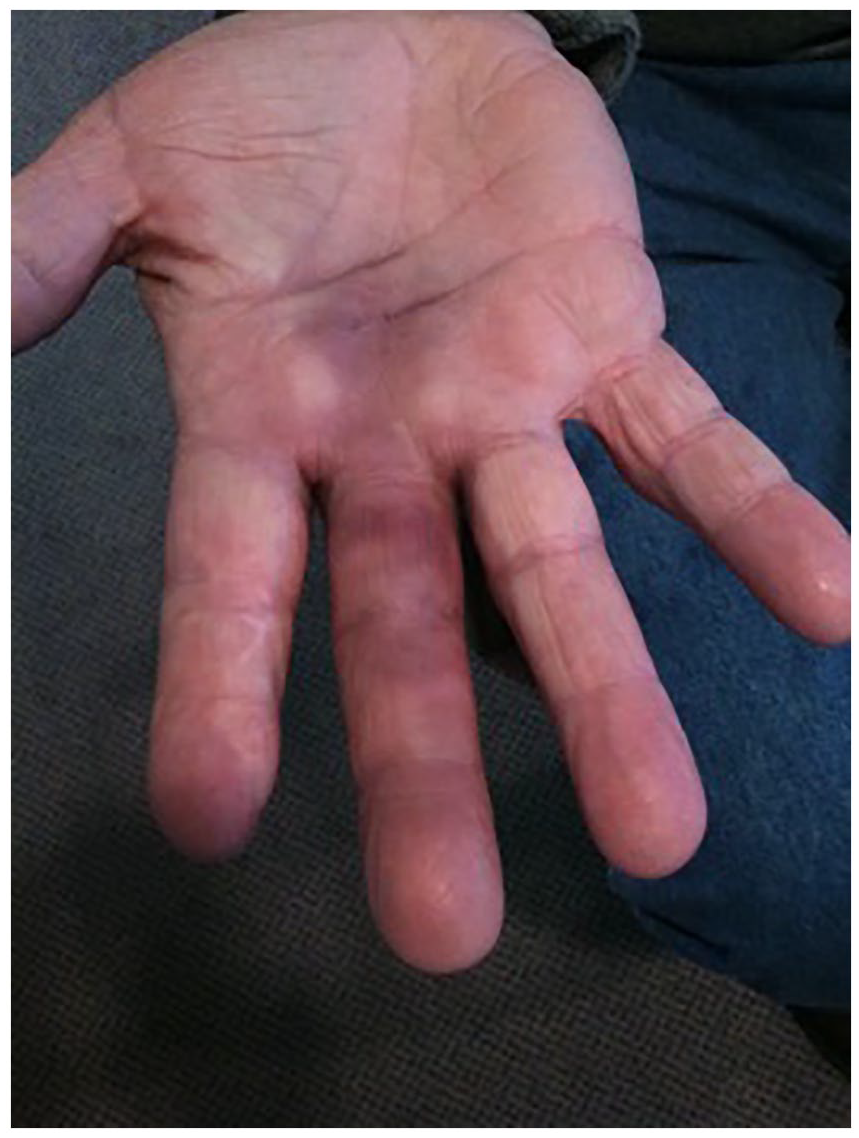
Typical appearance of Achenbach syndrome. The middle finger is discolored due to bruising under the skin.
How is Achenbach syndrome diagnosed?
Generally, the diagnosis of Achenbach syndrome can be made based on the history and classic clinical appearance alone (summarized in Figure 2). Other than the finger symptoms, there should
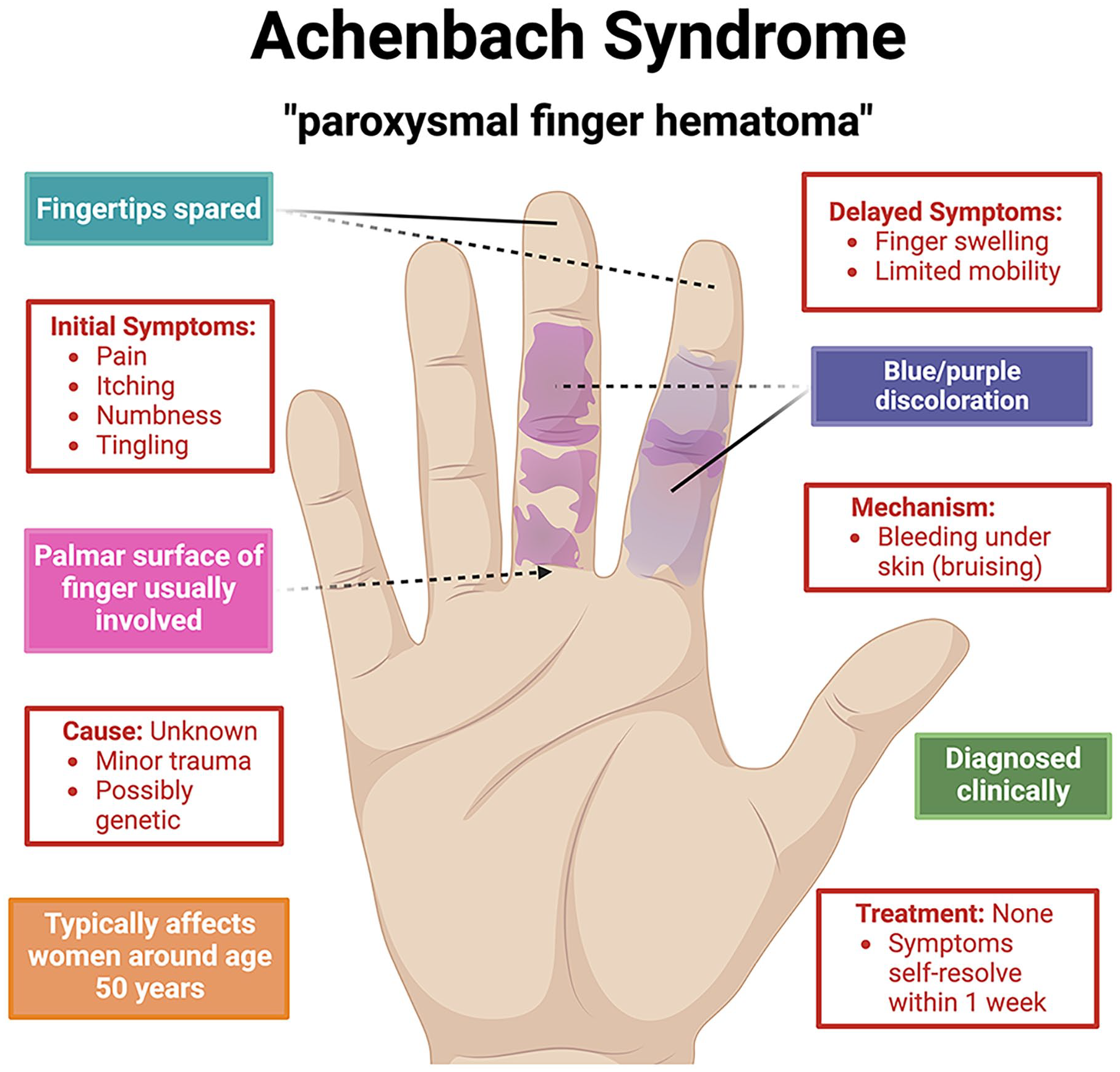
Clinical presentation of Achenbach syndrome.
How is Achenbach syndrome treated?
There is no particular treatment for Achenbach syndrome because the bleeding under the skin that causes the bruise usually stops on its own (or with the application of localized pressure). 3 Generally, the symptoms resolve on their own within 3–7 days. 3
What other conditions have symptoms similar to Achenbach syndrome?
Medical conditions that can cause similar symptoms include Raynaud’s phenomenon, acrocyanosis, thoracic outlet syndrome, acute ischemia due to embolic occlusion (complete blockage) of a digital (i.e., finger) artery, vasculitis, pernio (also called chilblains), and Gardner–Diamond (psychogenic purpura) syndrome.
Raynaud’s phenomenon is a blood vessel disorder that causes the fingers (and sometimes toes) to change colors. 7 This color change occurs when the small blood vessels in the fingers spasm (or narrow), causing a temporary decrease in blood flow to the fingertips. The fingers may initially turn white and/or bluish and then red. These color changes can be accompanied by pain, discomfort, numbness/tingling, or extreme cold. 7 Cold temperatures, emotional distress, or even some medications can trigger an episode. 7 This phenomenon is usually seen in women of childbearing age. Raynaud’s is said to be ‘primary’ when no clear cause can be identified and is considered ‘secondary’ when it is caused by another condition, such as an underlying autoimmune disorder, which often warrants additional diagnostic testing. Secondary Raynaud’s may lead to wounds and skin changes of the affected fingers. Unlike Achenbach syndrome, Raynaud’s affects the fingertips and is generally more of a chronic and recurrent condition associated with identifiable triggers.
Acrocyanosis is a diffuse, symmetric, bluish/purplish discoloration of the hands, feet, and face. 8 This disorder is also caused by a spasm of blood vessels and is worsened by cold temperatures. In contrast to Achenbach syndrome, acrocyanosis is painless, persistent, involves the fingertips, and is often associated with sweating of the hands and feet. 8
Thoracic outlet syndrome (TOS) can occur when veins, arteries, and/or nerves become compressed as they travel down from the neck into the chest cavity through a region of the body around the shoulder known as the thoracic outlet. 9 This compression can occur due to a traumatic injury, activities that involve long-term repetitive arm movements, or anatomic reasons (e.g., getting stuck between a bone and muscle – some patients have an extra ‘cervical’ rib). In contrast to Achenbach syndrome, TOS symptoms often involve the entire arm (including the hand), with pain, numbness, weakness, swelling, or color changes. Symptoms are typically aggravated with movements or positions that worsen the degree of compression. 9 The diagnosis of TOS usually requires further testing, often including vascular imaging studies and neurologic examination. Depending upon the structure being compressed, TOS can lead to blood clots, which require immediate treatment with a blood thinner or sometimes surgery. 9
Acute ischemia due to embolic digital artery occlusion means a sudden lack of blood flow to the finger due to an arterial blood clot. 3 This situation can occur with TOS, abnormal heart rhythms, blood clots that start in the heart and travel to other parts of the body, cholesterol plaque in the arteries, abnormal blood vessel outpouchings (aneurysms) or certain blood disorders that increase the risk of clotting. Acute ischemia due to embolic digital artery occlusion is a vascular emergency in which the finger (or toe) becomes pale (or blue), painful, cold, numb, weak, and pulseless. Unlike Achenbach syndrome, the results of arterial testing, cardiac, and/or vascular imaging studies are abnormal. Prompt action is imperative.
Vasculitis is a nonspecific term for blood vessel inflammation, usually related to an underlying autoimmune disease. Vasculitis can be exquisitely painful. 3 As opposed to Achenbach syndrome, vasculitis can cause wounds on the fingers that can lead to necrosis (tissue death and loss) and is often accompanied by symptoms in other parts of the body (e.g., joint pain, rash, weight loss, fatigue, headache). The evaluation of a patient with signs and symptoms of vasculitis usually includes blood tests for inflammation and autoimmune disorders, as well as a biopsy of the affected skin area.
Pernio or ‘chilblains’ are toe and finger lesions that typically occur during cold, damp weather. 10 The affected digits can become itchy and painful with the appearance of reddish, brownish, or purplish spots. 10 Sometimes, wounds may form. These lesions generally disappear on their own with improvement in the weather but can recur at the same time the following year. Unlike Achenbach syndrome, pernio usually affects the toes and occurs seasonally.
Gardner–Diamond syndrome is a rare condition of unknown cause that mainly affects women. 3 It is also called psychogenic purpura and involves the sudden appearance of painful, swollen skin lesions that turn into a bruise within 1 day and can be accompanied by finger swelling. 3 In contrast to Achenbach syndrome, these symptoms often follow severe emotional distress and can affect any part of the body. 3
What is the long-term prognosis for Achenbach syndrome?
Achenbach syndrome resolves on its own within 1 week of symptom onset. There are no lasting effects, and the prognosis is generally excellent. Notably, episodes can recur over time in the same finger or other fingers (or toes). However, patients recover fully after episodes and are not at risk of losing fingers or toes due to this condition.
Summary
Achenbach syndrome is a vascular condition of unknown cause that leads to minor bleeding under the skin of the finger(s) and results in the sudden onset of swelling, pain, and a bluish discoloration. Women are most often affected, and there may be a history of minor trauma. Although Achenbach syndrome itself is not dangerous, the symptoms provoke fear and anxiety for many patients as they can resemble those of more threatening vascular disorders. Fortunately, the diagnosis of Achenbach syndrome can usually be made from the history and classic physical examination findings alone. Because the symptoms typically resolve on their own within 1 week of onset, no treatment is necessary, and reassurance by the vascular medicine provider is appropriate.
The ‘Vascular Disease Patient Information Page’ is a regular feature of Vascular Medicine. All articles in the collection are available for free online at http://journals.sagepub.com/vmjpatientpage.
The Vascular Disease Patient Information Page is provided for educational purposes only and is not a substitute for medical advice.
Footnotes
Declaration of conflicting interests
The authors declared no potential conflicts of interest with respect to the research, authorship, and/or publication of this article.
Funding
The authors disclosed receipt of the following financial support for the research, authorship, and/or publication of this article: Dr Elizabeth Ratchford’s work was supported in part by the generosity of David Kotick (1926–2021).
