




Abstract
Editorial Office Perspectives
Over the past decade, Vascular Medicine and our Editorial Office has experienced significant growth in terms of the number of manuscripts received and published as well as the international profile of our Journal and its performance in publication metrics. 1 Although we have celebrated this terrific growth, we also became aware of the need to recruit and train a pipeline of qualified individuals who can help us lead a more expansive Journal enterprise forward in the decade to come. Indeed, for much of the history of Vascular Medicine, training of our Editorial Board members, Associate and Section Editors, and, indeed, even our Editor-in-Chief was informal, experiential, and truly on the job, along the lines of “see one, teach one, do one”, which is so common in academic medicine. In 2019, we realized that we needed to change paths with regard to how we develop our journal leadership to ensure that future journal editors step into their roles on day one with formal training and skills in addition to mentorship and experience.
In partnership with the Society for Vascular Medicine, Vascular Medicine initiated its Next Generation Editorial Board program in 2020. The program was established to strengthen the pipeline of our Journal’s editorial leadership by providing early career vascular medicine specialists and investigators with a broad portfolio of experience in peer review and requisite knowledge and skills to serve as Associate Editors. 1 After a competitive selection process by a subcommittee of our Editorial Board, the Next Generation Editorial Board participated in a 3-year curriculum designed to develop skills in peer review, authorship, and editing, including knowledge of publication ethics and journal production and management. Among the five individuals in cohort one (2020–2022), four successfully graduated from the program after completing the curriculum and three are advancing into leadership positions within Vascular Medicine. As of January 2023, Drs Stan Henkin and Mary Whipple are serving as Associate Editors, Dr Pulkit Chaudhury is serving as our Social Media Editor, and Dr Amy Harwood is serving on the Editorial Board. As further reflection of their dedication and knowledge, all four of the graduating members of cohort one also received special recognition as Blue Ribbon Peer Reviewers for Vascular Medicine in 2021 and 2022, a distinction reserved for the small percentage of individuals who provide the most and highest quality peer reviews for our Journal during the preceding year.
A second cohort of the Next Generation Editorial Board was selected in Fall 2021 and began their VMJ journey in January 2022. Cohort two includes seven upcoming stars in the field of vascular medicine and potential future leaders of our Journal. Cohort one members now serve as mentors to cohort two, helping them learn the ropes as peer reviewers and future editors. The curriculum for the 2022–2024 program has been updated slightly based on the experience of cohort one (Table 1).
Vascular Medicine Next Generation Editorial Board Curriculum.
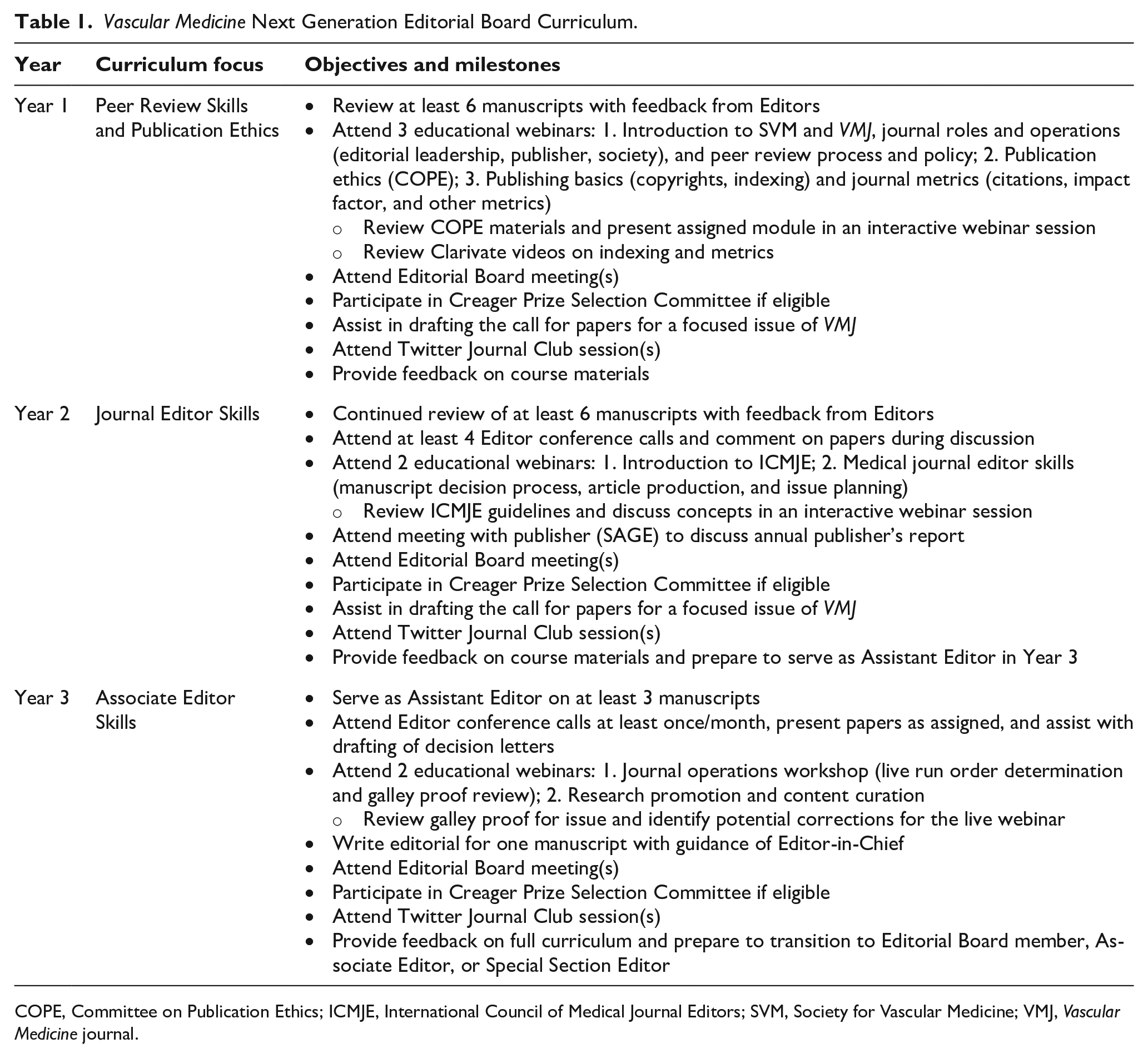
COPE, Committee on Publication Ethics; ICMJE, International Council of Medical Journal Editors; SVM, Society for Vascular Medicine; VMJ, Vascular Medicine journal.
During the initial years of our Next Generation Editorial Board, Vascular Medicine has continued to experience significant growth with record-high numbers in key metrics from 2020 to 2022. The Journal has received 600-700 manuscript submissions per year (Figure 1), downloads exceeded 530k in 2021, and the current impact factor is 4.739 (Figure 2). Journal circulation among SVM members has increased 158% since 2020. With the help of this program, we have expanded the Associate Editor panel from six in 2020 to nine in 2023. As we enter the 28th year of VMJ, we are proud of our Journal’s success and the stocked pipeline of well-trained Next Generation Editorial Board members. With their fresh ideas, energy, and broad portfolio of journal editing skills, we know our Journal is in terrific health, and we look forward to much more progress and growth in the years to come.
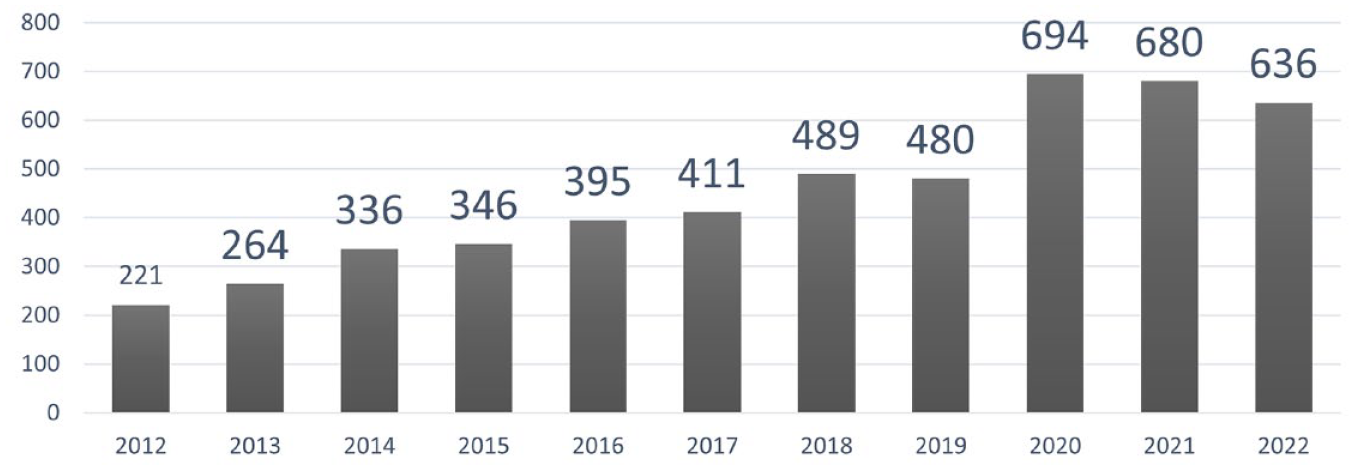
Annual manuscript submissions to Vascular Medicine, 2012–2022.
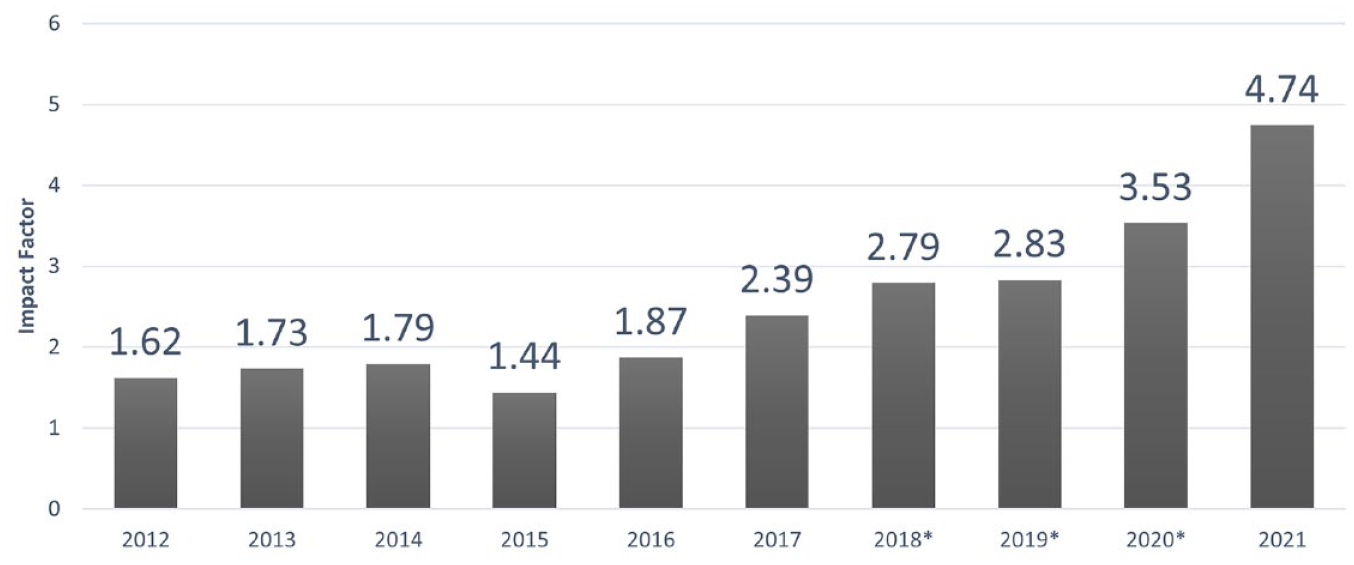
Vascular Medicine journal impact factor trend (2012–2021).
Next Generation Editorial Board member perspectives
As members of cohort one of the Vascular Medicine Next Generation Editorial Board, we agree that this unique 3-year program had a significant impact on our careers and next steps within the Journal and the Society. In the most recent Core Cardiovascular Training Statement 4 from the American College of Cardiology, 2 research is noted as an important component of a cardiovascular medicine fellowship program. Key training elements include didactics to understand research methodology and interpretation; opportunities to review and analyze studies; and hands-on research experience. Although manuscript preparation is a common task for many trainees in an academic setting, events that occur after manuscript submission to a journal are often seen as a mystery. Thus, trainees and junior faculty often rely on more senior colleagues to demystify what happens to a manuscript after submission. Additionally, trainees and junior faculty may not often be chosen to peer review manuscripts. In our training programs, there is not a formal curriculum regarding best practices for peer review. This leads to a superficial working knowledge of the inner workings of a journal and the many steps from submission to publication. These sentiments were shared by all members of the Next Generation Editorial Board, both MDs and PhDs. Frankly, it is remarkable that for many of us, our academic promotions, dedicated research time, and compensation are linked to academic productivity, yet so little time is devoted to structured learning and understanding the nuances of this process. The VMJ Next Generation Editorial Board program addressed this very need.
The Next Generation Editorial Board program is unique, and we are grateful to have had this opportunity. As Dr Chaudhury stated, “this program allowed us to look ‘under the hood’ of a well-oiled, successful journal and, more importantly, allowed us to play an active role in the process under the guidance of seasoned professionals”. Although the members of our cohort had prior opportunities to publish our own work in collaboration with mentors, our experience in reviewing and understanding of the role of an editor or associate editor was decidedly more limited.
Through this program, we received feedback on our reviews from Associate Editors and had the opportunity to join editor calls to hear how manuscripts are discussed and the process for making publication decisions. This helped us to not only become more proficient consumers of scientific literature, but also helped us to become better investigators, writers, and critical appraisers. Over time, we feel that we have become stronger reviewers who are better able to focus on broad issues. The Associate Editor calls were perhaps one of the most enlightening experiences of the program. The opportunity to listen to different perspectives on the same paper, engage in rigorous scrutiny of the scientific process, assess the validity of various author statements/conclusions, and learn about journal priorities was incredibly informative and provided us all with a unique, new perspective on the Journal.
Finally, this experience also gave each of us the opportunity to meet and learn from leaders in the field of vascular medicine. Dr Whipple stated, “I would strongly recommend this experience to any early career scientist looking to gain experience in reviewing and publishing. It has piqued my interest in the role of an editor, and I look forward to continuing to contribute to the Society and Journal for years to come.” We would whole-heartedly recommend this program to everybody. Undoubtedly, it has made us more thoughtful and overall better reviewers, writers, investigators, clinicians, and educators. We all hope to stay involved with the Journal and use this knowledge and platform to promote our specialty and advance the field.
Footnotes
Declaration of conflicting interests
The authors declared no potential conflicts of interest with respect to the research, authorship, and/or publication of this article.
Funding
The authors received no financial support for the research, authorship, and/or publication of this article.
