




Abstract

I was privileged and honored to deliver the Founder’s Lecture at the 28th Annual Scientific Sessions of the Society for Vascular Medicine in New Orleans, Louisiana, in June 2017. The title of my lecture, ‘What’s past is prologue’, came from a line in the second act of Shakespeare’s The Tempest, written about 1610. Though it refers to the events affecting the King of Naples and his royal family who are shipwrecked during a storm, I chose it to speak about how the events stemming from the founding of our Society have set the stage for its future.
Those of us who met in Anaheim, California, in March 1989, only dared to hope that the Society would blossom into this nationally and, indeed, internationally, acclaimed organization that so profoundly impacts the care of patients with vascular diseases. What we did know was that science and technology were converging around the blood vessel. Our understanding of vascular biology was about to increase exponentially, knowledge of vascular diseases was expanding, new drugs were on the horizon, and devices were emerging to enable less invasive treatment of vascular diseases than with conventional surgical approaches. Russell Ross and others were uncovering the pathogenesis of atherosclerosis. Robert Furchgott had recently described endothelium-derived relaxing factor, soon determined to be nitric oxide. 1 Led by pioneers such as John Shepherd and Frank Abboud, we understood more about the role of the sympathetic nervous system in circulatory regulation. Art Sassahara was studying the efficacy of thrombolysis to dissolve pulmonary emboli, and Andreas Gruentzig had recently introduced PTA (percutaneous transluminal angioplasty) into the therapeutic armamentarium.
How best, then, to converge experts in vascular science with those skilled in the management of patients with vascular disease and by so doing enable rapid translation of novel discoveries to implementation of effective therapies? We needed a forum – an organization of forward-thinking and highly charged individuals – who were ready to take a nascent interest area with several well-recognized islands of expertise and thrust it into a major field of study and practice.
For many years, there had been acclaimed departments of vascular medicine. Brilliant clinicians at the Mayo Clinic, such as George Brown and Ray Gifford (who moved from the Mayo Clinic to the Cleveland Clinic), carefully recorded their observations of patients with vascular diseases and trained generations of notable vascular physicians. At Cleveland Clinic, vascular medicine was thriving under the leadership of Drs Jess Young; at Boston University, vascular medicine was developing as a complementary, but distinct, program from Vascular Surgery, led by Jay Coffman. At Brigham and Women’s Hospital in Boston, Eugene Braunwald created its first Division of vascular medicine, appointed Victor Dzau as its chief, and included me, Joe Loscalzo, Dave Levenson, and soon thereafter, John Cooke, Alan Hirsch, and Gary Gibbons. These were heady times, and there was a constant air of excitement and impending discovery.
John Cooke and Victor Dzau wrote an opinion piece in the Annals of Internal Medicine entitled, ‘The time has come for vascular medicine’.
2
In it, they stated:
Advances in the diagnosis and treatment of patients with vascular disorders have led to the emergence of a new kind of internist with special skills in vascular medicine. The growth of this field will accelerate as recent major advances in vascular biology attain clinical application … . Internists trained in these programs fill major needs; they will advance the field of vascular medicine by forming a bridge with vascular biologists to bring research advances to clinical fruition; they will apply the latest therapeutic and diagnostic tools to give optimum care to patients suffering from vascular disease and associated medical disorders.
In 1989, 13 vascular physicians and scientists gathered in Anaheim, California to create an organization that would serve as a center piece for reporting innovative research, exchanging new information, sharing best practices, and training future vascular scientists and physicians. Our original name was the Society for Vascular Medicine and Biology.
3
Our original mission statement was:
To promote and advance the field of vascular medicine and biology, and to maintain the highest standards of practice, research, education, and exchange of scientific information; and to stimulate the formation of fellowship training programs in vascular medicine and research, and the teaching of these disciplines to medical schools and house officer training programs; and to provide consultation to educational institutions, government agencies, and other such organizations.
We put together articles of incorporation, created bylaws, and elected our first slate of officers. We were underway. Our first scientific meeting was held in 1990 in New Orleans and was attended by about 40 members. In 1994, our first international symposium took place in Washington, DC. This was the first time an entire meeting was devoted to the research, development, and release of pharmacologic agents to treat patients with peripheral artery disease (PAD).
Our meetings grew, young investigator award competitions were introduced, poster sessions expanded, vascular laboratory programs were added, and we inaugurated Vascular Jeopardy. We also launched a new journal, the Journal of Vascular Medicine and Biology, published by Blackwell Scientific. It lasted 5 years, until the publisher was no longer able to support it. We then merged with a foundling journal called Vascular Medicine Review, which was published by Arnold Publishers, and renamed it Vascular Medicine. Arnold was later acquired by Sage Publications, our current publisher. I had the privilege of being the Editor-in-Chief of Vascular Medicine for 18 years, and worked with an incredible group of associate editors to publish original research, reviews, editorials, guidelines and collaborative societal documents, case reports, and interesting images. The journal has climbed to new heights under Heather Gornik and her associate editors and editorial board, providing better content than ever.
The Society for Vascular Medicine (SVM) has also published monograph series on various aspects of vascular disease, co-sponsored practice guidelines, training and competency statements, performance measures, and appropriate use criteria and held leadership positions in the Intersocietal Commission for the Accreditation of Vascular Laboratories (ICAVL; now the Intersocietal Accreditation Commission, IAC). Also, to provide a mechanism for recognition of expertise in the fields of vascular medicine and endovascular intervention, the SVM, under the leadership of Bruce Gray, spawned the American Board of Vascular Medicine (ABVM), which has issued certifying examinations in these vascular specialty areas for the past 13 years.
Our list of accomplishments is long, and our impact is disproportionate for our size; however, there is so much more we can do … we must do. Vascular diseases, including atherosclerosis and thrombosis, are responsible for the most common causes of death in the world, and peripheral vascular manifestations of vascular diseases are prevalent. As this readership knows well, over 200 million persons worldwide are affected by PAD, and PAD is as prevalent in low- and middle-income countries as it is in high-income countries. 4 Venous thromboembolism (VTE) is common as well: hospital-associated VTE affects 9.9 million people across the globe each year, including 6 million in low–middle-income countries. 5 Aortic diseases are often unrecognized until catastrophic complications occur, and millions of people are suffering the disabling consequences of critical limb ischemia, venous insufficiency, or lymphedema. What specialty out there really has a comprehensive grasp on these diseases, as well as vasospasm, thrombophilia, and vasculitis? Who has the expertise to identify and treat these diseases without garnering a diffuse range of consultations? Who is stimulating the scientific questions that lead to new discoveries and advances in treatment? You know the answer. It’s us.
Consider the scientific advances that have occurred over the SVM’s 28 years of existence, and particularly those of the past decade: new antithrombotic medications for VTE and PAD, novel stents and drug delivery systems, endovascular treatment for aortic aneurysms and dissections, genomics, proteomics, metabolomics, cell-based therapies, and novel anti-inflammatory drugs. I would argue, as we did when we founded the SVM, that the care of patients with vascular disease, though much improved, is still too diffuse … undertaken by primary care physicians, vascular surgeons, interventional radiologists, general cardiologists, hematologists, neurologists, nephrologists, and others. While primary care physicians are the principal gatekeepers, and each of these specialty areas has unique areas of expertise that can benefit patients with vascular disease, none can provide the comprehensive care that often is required and do so with the efficiency and quality outcomes as those with expertise in vascular medicine.
So, what’s next? What must we do as an organization, and as vascular clinicians and scientists, to reduce death and disability from vascular disease and improve the vascular health of our patients, and the public? Here are five steps I believe we must take (Figure 1).
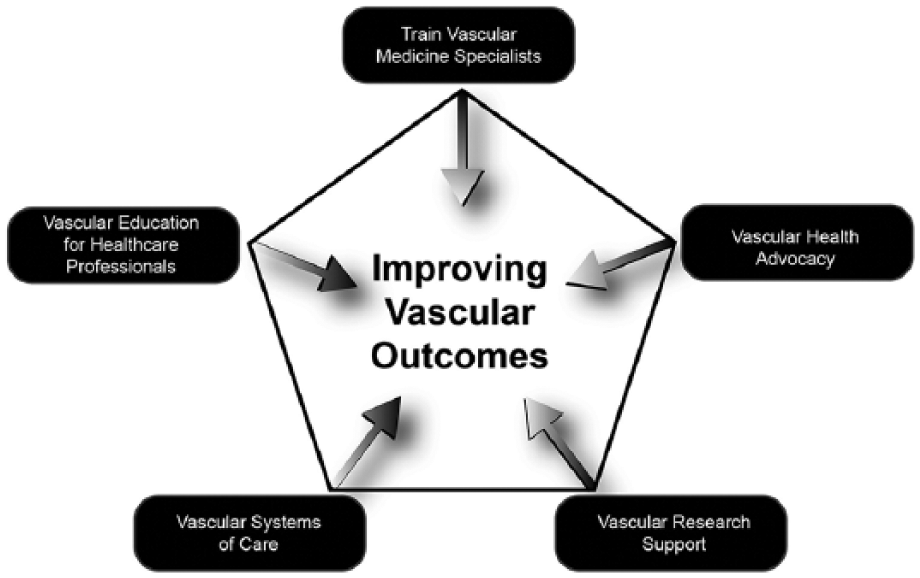
Five steps we must take as an organization and as clinicians and researchers to reduce death and disability from vascular disease and improve the vascular health of our patients and the public.
The first is to
One of our great successes a few years back was convincing the National Heart, Lung, and Blood Institute (NHLBI) to sponsor an academic training program in vascular medicine. Seven centers successfully competed for a 5 year award: Mayo Clinic, Brigham and Women’s Hospital, Boston Medical Center, Northwestern University, University of Pennsylvania, Stanford University, and Wake Forest Medical Center. We trained over 30 vascular medicine fellows, who are now emerging leaders in the field, and many of whom are active in the SVM today. That’s what I call a successful program. Unfortunately, the program was not re-funded. What a lost opportunity! We need to find more ways to fund vascular medicine fellowship programs and encourage trainees to enter this field. The SVM and the American College of Cardiology have published training documents that outline steps to achieve competency in vascular medicine, and we need to encourage more physicians to pursue fellowships. 6
The second reason for the insufficient number of vascular medicine specialists is that neither the American Board of Internal Medicine (ABIM) nor its parent organization, the American Board of Medical Subspecialties, offers board certification in vascular medicine. Board certification is a prerequisite for being accredited by the Accreditation Council for Graduate Medical Education (ACGME). ACGME accreditation would provide a mechanism for graduate medical education programs to subsidize fellowship training in vascular medicine, and ABIM board certification would encourage more trainees to enter fellowship programs. The ABVM has done a phenomenal job in establishing board certification in vascular medicine, as well as peripheral endovascular intervention, but it has not given us sufficient clout to accredit our training programs. Our lack of success in securing an ABIM certification exam has not been for lack of trying. Under the leadership of Drs Josh Beckman, Suman Wasan, and Thom Rooke, we have applied not once, but twice, and the rationale has been quite persuasive. However, concerns expressed by some about the need for vascular medicine specialists, competition from other subspecialties who were seeking a certification exam, and then a shift of ABIM resources to Maintenance of Certification has hindered our progress. Nonetheless, we will continue our dialogue with the ABIM and hopefully achieve success in the relatively near future.
The second step is to
The third step is for the SVM to
The fourth step is to
Fifth,
As we evolved as an organization, and as reflected in the change of our name to the Society for Vascular Medicine, we shifted emphasis toward the practice of vascular medicine, and other organizations took the mantle of vascular biology. Perhaps the pendulum has shifted too far. I am not proposing that we apply our resources to fund research, as that is beyond or current capabilities. I am suggesting, however, that we advocate for more federally funded research, particularly at a time when such support is being threatened. I encourage our members to contact their senators and representatives. For those of you interested in conducting research, do not be disheartened and do continue to seek funding from the National Institutes of Health and foundations such as the American Heart Association, which recently announced an RFA (request for application) for a Strategically Focused Research Network in Vascular Disease.
What the SVM has done, and will continue to do, is disseminate scientific knowledge via our scientific meetings and our Journal. I encourage all of you to attend the Jay D Coffman Young Investigator Award Session and the poster sessions at our annual meeting to learn about emerging science and support our young investigators. Our premier journal, Vascular Medicine, publishes original research and comprehensive reviews of contemporary vascular science. Please continue to support our Journal by selecting it for publication of your research.
It has been 28 years since the Founders visualized a professional organization dedicated to vascular medicine. We have grown and evolved as our field has gained prominence. I am confident that I can speak for all of the Founders when I say how proud I am of what our Society has become and the impact it has had in the treatment of patients with vascular diseases. However, there is much more to do. It is up to you, the members of the Society for Vascular Medicine, to carry this torch forward, with your knowledge, your enthusiasm, your passion, and your dedication to our mission, so that our patients have the chance to live healthier lives without the burden of vascular disease.
Footnotes
Acknowledgements
Based upon the Founder’s Lecture delivered at the 28th Annual Scientific Sessions of the Society for Vascular Medicine, New Orleans, Louisiana, June 15, 2017.
Declaration of conflicting interests
The author declared no potential conflicts of interest with respect to the research, authorship, and/or publication of this article.
Funding
The author received no financial support for the research, authorship, and/or publication of this article.