




Abstract
Peripheral artery disease (PAD) affects approximately 200 million patients worldwide, with a prevalence of 30% in individuals aged over 70 years. The clinical spectrum of disease is wide and includes individuals who are asymptomatic as well as those with intermittent claudication or critical limb ischemia (CLI). It is well known that patients with PAD have an increased risk of death from cardiovascular (CV) disease. 1 In addition to traditional CV risk factors, 2 vitamin D deficiency was shown to be independently associated with PAD,3,4 as confirmed in two recent meta-analyses.5,6 Moreover, low vitamin D levels were associated with faster decline in functional performance among individuals with PAD. 7 Vitamin D is involved in several phases of the atherosclerotic process, with direct effects on endothelial cells forming the vascular wall 8 and indirect effects through its association with proatherogenic risk factors such as hypertension, 9 insulin resistance, 10 and unfavorable lipid profile. 11
We evaluate the association between vitamin D status, clinical severity of PAD, and CV risk factors in 190 patients with symptomatic PAD. Demographics and clinical aspects were extracted from electronic medical reports. PAD was confirmed by angiographic evidence of stenosis > 50% in the iliac and femoral-popliteal arteries of infrapopliteal vessels. The study was performed in accordance with the current legislation on Observational Studies and the Helsinki Declaration. Patients have given consent to the processing of personal data. Study design was approved by the local ethics committee (Internal Board DAME, University of Udine, Italy).
Values of normally distributed variables are expressed as mean ± SD. The normality of distribution was assessed by the Kolmogorov–Smirnov test, and variables with a skewed distribution were analyzed after logarithmic transformation. Pearson’s chi-squared test was used to compare frequency distributions. ANOVA tests were used to examine differences in variables through 25(OH) vitamin D tertiles. Relationships between continuously distributed variables were examined by linear regression analysis, and the correlation was expressed by Pearson’s correlation coefficient. Stepwise multivariate linear regression analysis was used to ascertain which variables were independently related. A two-tailed probability value of less than 5% was considered to indicate statistical significance. Data analyses were performed using XLSTAT 2020 (Addinsoft, New York, NY, USA).
Most patients had a history of hypertension (82.6%), diabetes (44.5%), and coronary or cerebrovascular disease (31.6% and 60.5%, respectively). A total of 19.4% of patients were current smokers. Almost all patients were treated with an antiplatelet drug or statin (89.5% and 81.5%, respectively). Other demographics and clinical aspects are summarized in online supplement 1. Among our population, 54.3% of patients had serum 25(OH)D levels below 30 ng/ml. Patients with more severe PAD had significantly lower serum levels of 25(OH) vitamin D (Figure 1). In univariate analysis, serum 25(OH)D levels were significantly and inversely associated with total cholesterol (r = −0.178; p = 0.014), apolipoprotein B (r = −0.181; p = 0.012), D-dimer (r = −0.168; p = 0.021), and prothrombin fragment 1+2 (F1+2) (r = −0.212; p = 0.003). In the multivariate model, vitamin D remained independently associated with Leriche Fontaine Stage, apolipoprotein B, and F1+2, even after correction for possible confounders such as age, sex, HbA1c, active smoking, and body mass index (online supplement 2).
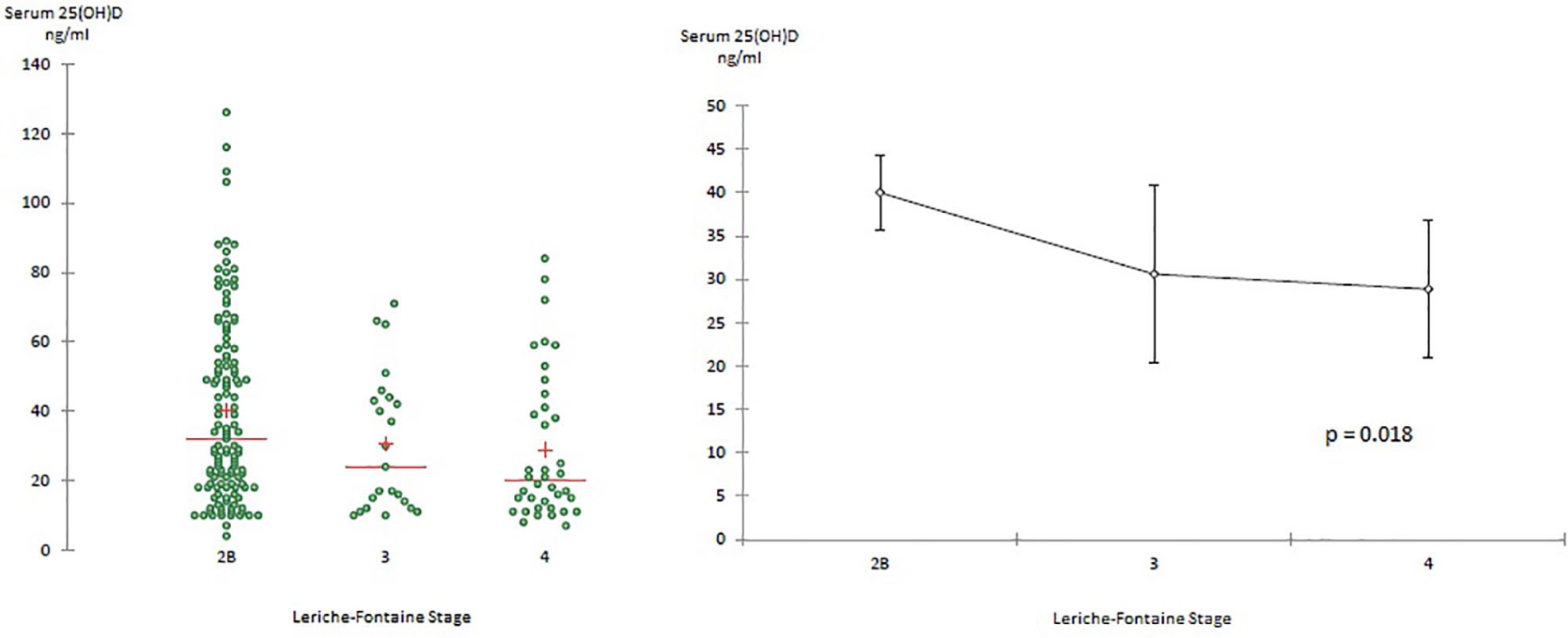
25(OH) vitamin D levels across Leriche Fontaine stages. Scattergram (left) shows distribution of mean (red line) and median (red cross). Curve (right) shows mean ± SD per ANOVA.
In our study sample of patients with symptomatic PAD, 25(OH)D deficit was a widespread condition. Vitamin D defects were more pronounced in patients with more severe disease, and 25(OH)D levels were inversely associated with apolipoprotein B, D-dimer, and F1+2, even after correction for major confounders. With the limits of the observational study design, our findings suggest that a vitamin D defect could be associated with more severe clinical manifestations of PAD, perhaps due to its interactions with lipids and prothrombotic factors. More studies are needed to better clarify the causal role of vitamin D in the pathogenesis and progression of PAD.
Supplemental Material
sj-pdf-1-vmj-10.1177_1358863X20979360 – Supplemental material for Interactions between vitamin D levels, cardiovascular risk factors, and atherothrombosis markers in patients with symptomatic peripheral artery disease
Supplemental material, sj-pdf-1-vmj-10.1177_1358863X20979360 for Interactions between vitamin D levels, cardiovascular risk factors, and atherothrombosis markers in patients with symptomatic peripheral artery disease by Andrea Da Porto, Alessandro Cavarape, Cristiana Catena, Gianluca Colussi, Viviana Casarsa and Leonardo Alberto Sechi in Vascular Medicine
Footnotes
Declaration of conflicting interests
The authors declared no potential conflicts of interest with respect to the research, authorship, and/or publication of this article.
Funding
The authors received no financial support for the research, authorship, and/or publication of this article.

Supplementary material
The supplementary material is available online with the article.
References
Supplementary Material
Please find the following supplemental material available below.
For Open Access articles published under a Creative Commons License, all supplemental material carries the same license as the article it is associated with.
For non-Open Access articles published, all supplemental material carries a non-exclusive license, and permission requests for re-use of supplemental material or any part of supplemental material shall be sent directly to the copyright owner as specified in the copyright notice associated with the article.
