




Abstract

SVM Next Generation Committee Update
Christina Fanola MD and Yogen Kanthi MD
SVM NextGen Networking Dinner at ACC2018.
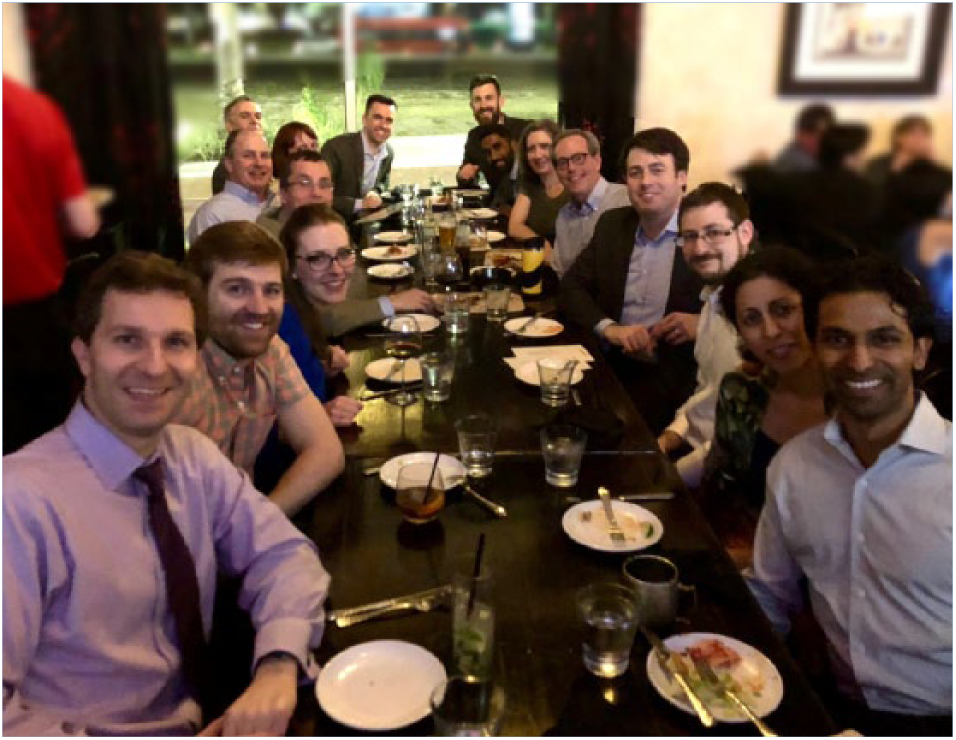
The newly formed Society for Vascular Medicine (SVM) Next Generation (NextGen) Committee consists of early career faculty, fellows, and others who practice or are training in vascular medicine. The NextGen Committee supports the mission of the SVM by promoting and advancing the discipline of vascular medicine and the care of patients with vascular disease by: (1) stimulating the formation of vascular medicine training programs; (2) developing educational activities, including continuing medical education programs for trainees and health care providers; (3) fostering fellow involvement in research in clinical vascular medicine and vascular biology through mentorship activities; and (4) engaging early career members in the promotion of interdisciplinary care teams and quality improvement activities. We encourage all early career SVM members who are interested in participating to contact us about ongoing activities and involvement in the Committee.
The NextGen Committee has a growing social media presence. Using the Twitter platform and hashtag #SVMNextGen and handle @SVM_Tweets, the Committee presents late-breaking science in vascular medicine from major journals and multinational scientific sessions, and also promotes educational activities through short case presentations, clinical discussions, and ‘virtual’ journal clubs. The NextGen Committee plans to utilize social media to facilitate networking in vascular medicine and related specialties, across institutions, both nationally and internationally.
On Saturday, March 10, 2018 during the American College of Cardiology Scientific Sessions, the SVM Next Generation Committee hosted its first networking event in Orlando, Florida at Tapa Toro. There was a high turnout of professionals in vascular medicine, cardiology, pharmacology, and vascular surgery who came together to share a meal and discuss scientific progress in the field of vascular disease, as well as ways to increase training opportunities and collaborations between individuals within the field and in other specialties. Several key SVM leaders were in attendance, including current and past Trustees Drs Naomi Hamburg, Nick Leeper, and Rob Eberhardt, and Past President Jim Froehlich. Additional attendees were: Aaron Aday, Lindsay Arnold, Geoff Barnes, Matt Corriere, Dave Currie, Stanislav Henkin, Aaron Kithcart, Bhala Mani, Alec Schmaier, and Jeremy Vant Hof. This was a successful kick-off event organized by the Next Generation Committee and will be the start of many more to come at upcoming scientific meetings.
Growing the Vascular Medicine journal impact through Twitter
Geoff Barnes, MD, FSVM (@GBarnesMD)
Twitter has rapidly become a platform for scientists and clinicians to engage in discussion, share educational materials, and keep up with the rapidly changing field of medicine. The SVM and the Vascular Medicine journal have been active participants on social media. Through the use of their respective Twitter accounts known as ‘handles’, @SVM_tweets and @VMJ_SVM, they connect with thousands of followers.
Following in the footsteps of Dr Anne Albers, @DrAnneAlbers, who was the inaugural social media editor for Vascular Medicine, I have been leading the effort to grow our journal’s impact via social media. Over the past 18 months, our Twitter feed has increased engagement with followers through a number of new initiatives. First, most of the daily tweets include key graphics from our recently published articles, aimed at grabbing the readers’ attention and increasing their likelihood to read the abstracts and manuscripts. Our top tweet in the last year was ‘A review of iliocaval recanalization from the @umichCVC @MichiganVIR group @VIRkhaja @KyleCooperMD @GBarnesMD @SIRspecialists #IRadSecond’ that had over 5000 impressions. In addition, we now regularly publish #VisualAbstracts like the recent one below about ankle–brachial index (ABI) screening:
These eye-catching graphics are an innovative method to quickly capture the key study design, results, and conclusions from a manuscript.

Finally, @VMJ_SVM hosted its first Twitter Journal Club #VascMedJC on February 22, 2018. This online discussion brought together three recent Vascular Medicine authors, @akhileshsistaMD, @jameshorowitzmd, and @jaygirimd, to discuss the pros and cons of Pulmonary Embolism Response Teams. With over 25 participants, more than 150 tweets, and over 200,000 impressions, this was a great success.
We encourage anyone on Twitter to follow both the journal and the society accounts, and to contribute to the online discussion.
Pulmonary Embolism Toolkit launched – mypulmonaryembolism.com
Thanks to a corporate support package from Janssen (a division of Johnson & Johnson), SVM has created and launched its Pulmonary Embolism (PE) Toolkit geared towards patients and health care providers. The toolkit can be found at www.mypulmonaryembolism.com. This is a sister site to the previously created www.mydeepveinthrombosis.com. There are two components of the toolkit – one with information on PE for patients and the other with key clinical information for health care providers. This resource is designed for use by family medicine or other primary care providers, emergency room physicians, and others to have ready access to tools to diagnose and treat patients with low-risk PE. The goal of the project is to provide more of these patients with the proper care and to avoid hospitalization, if appropriate. Please share the availability of the PE (and DVT) toolkits with your colleagues and help us disseminate this valuable information.
Many thanks to the committee of SVM volunteers who developed the toolkit, as well as to our Janssen collaborators.
Chair, Jerry Bartholomew, MD, MSVM
Aditya Sharma, MBBS, RPVI, FSVM
Greg Piazza, MD, MS, FSVM
Jay Bishop, MD, FSVM
Mike Palladino (Janssen)
Courtney Leslie (Janssen)
SVM is extremely grateful for the continued support of Janssen in the development of these clinical practice tools. Watch for another toolkit related to PAD later this year!
Updated online Board Review Course now available
The vascular medicine Board Review Course (BRC) held in conjunction with the 2017 Annual Scientific Sessions is now available online. This course provides 14.5 hours of CME and meets the requirements for ACCME and ANCC. The primary goal of the Comprehensive Review Course on Vascular and Endovascular Medicine is to provide current treatment perspectives and management approaches on vascular disease, as well as expert background information, to SVM members and colleagues from related disciplines.
These courses will prepare physicians for the American Board of Vascular Medicine (ABVM) certification examinations in general vascular medicine and endovascular interventions. Many thanks to Drs Herbert Aronow, Aditya Sharma, and Greg Piazza for their guidance as course directors.
The online course offers eight sessions, including review questions following each session, as well as two mock examination style review sessions. Users can return to the course and take the session review questions up to three times in preparation for the ABVM examinations. The sessions include:
General Vascular Medicine
Venous and Lymphatic Disease
Aortic and Major Branch Diseases
Cerebrovascular Disease and Upper Extremity Disorders
Peripheral Artery Disease
Vasospastic Disorders
Endovascular Interventions (two sessions).
Sessions can be purchased individually or as a complete course with variable prices depending on session length and SVM membership status. The Vasospastic Disorders session is available as a free download to all for a preview of the program format and quality.
For more information and to purchase the BRC, visit www.vascularmed.org/BRC.
Please share the availability of this course with your colleagues and fellows. The Board Review Course live sessions will be held again next year in conjunction with SVM’s 30th Annual SVM Scientific Sessions Anniversary at the Ritz Carlton Tysons Corner in McLean, Virginia, May 29 to June 2, 2019.