




Abstract

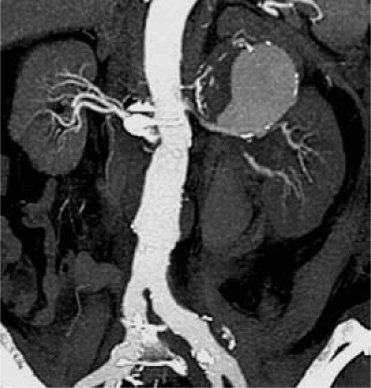
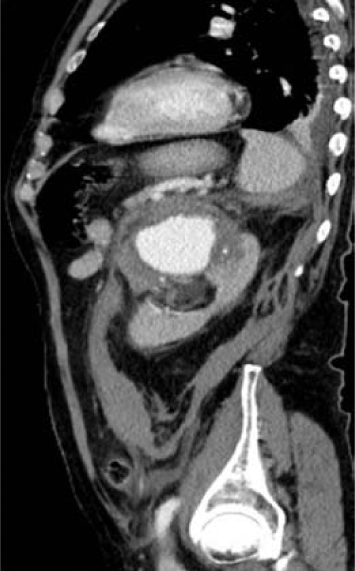
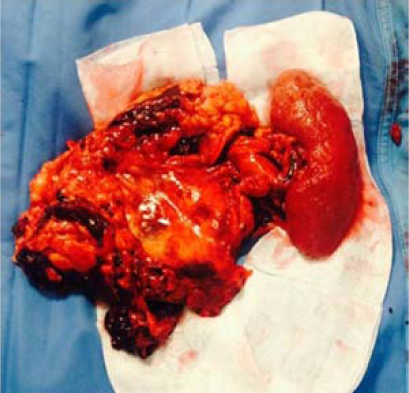
An 82-year-old white male with a history of heart failure, hypertension and hypercholesterolemia was admitted to the emergency room with sudden and severe left flank pain that radiated to the back. An abdominal computed tomography (CT) scan revealed a giant saccular 8 × 7.5 cm ruptured left renal artery aneurysm (RAA) with active bleeding spreading through the peri and pararenal spaces into the left retroperitoneum (Panel A: coronal plane – maximum intensity projection (MIP); Panel B: sagittal plane). Additional findings included both an unruptured aortic abdominal aneurysm and a left common iliac artery aneurysm. Owing to evolving hemodynamic instability, the patient underwent successful emergency operative obliteration of the aneurysm with a suture ligation of the left renal artery orifice and nephrectomy (Panel C).
Non-traumatic RAA is a rare disease, with an incidence ranging from 0.01% in an unselected autopsy population to 0.97% in recent studies using computed tomography and visceral angiography. Factors contributing to its formation are not well known, but atherosclerosis, fibromuscular dysplasia, polyarteritis nodosa or Ehlers–Danlos syndrome are known to be related. Atherosclerosis may be the predominant cause in elderly individuals but it is a secondary reaction from primary degeneration of the media in young people. 1 Although pregnancy is not associated with an increased incidence of RAA formation, it is associated with a higher rate of rupture. Clinical manifestations of RAA vary from being asymptomatic to fatal rupture. The spontaneous rupture of RAAs is very rare since it occurs only in 3% of affected patients; however, it is the most catastrophic complication. Initial diagnostic tests typically include Doppler ultrasound and CT scan with a well-timed contrast injection. Although there has been no consensus on the treatment of asymptomatic RAAs, any patients with symptoms, those with aneurysms larger than 2 cm and women with RAAs anticipating pregnancy should be treated. 2 Aneurysm exclusion, artery reconstruction and kidney preservation are the treatment goals during repair. However, in case of rupture, an emergency midline approach with infrarenal/supraceliac aortic control and nephrectomy is usually required to control hemorrhage and prevent death. 3 Although the long-term results remain unclear, when feasible, endovascular treatment with embolization and/or stent grafting may prevent the need for emergency surgery and also provides an alternative treatment for poor surgical candidates. 4
‘Images in vascular medicine’ is a regular feature of Vascular Medicine. Readers may submit original, unpublished images related to clinical vascular medicine. Submissions may be sent to: Heather L Gornik, Editor in Chief, Vascular Medicine, via the web-based submission system at http://mc.manuscriptcentral.com/vascular-medicine
Footnotes
Declaration of conflicting interest
There are no conflicts to disclose.
Funding
This research received no specific grant from any funding agency in the public, commercial, or not-for-profit sectors.