




Abstract
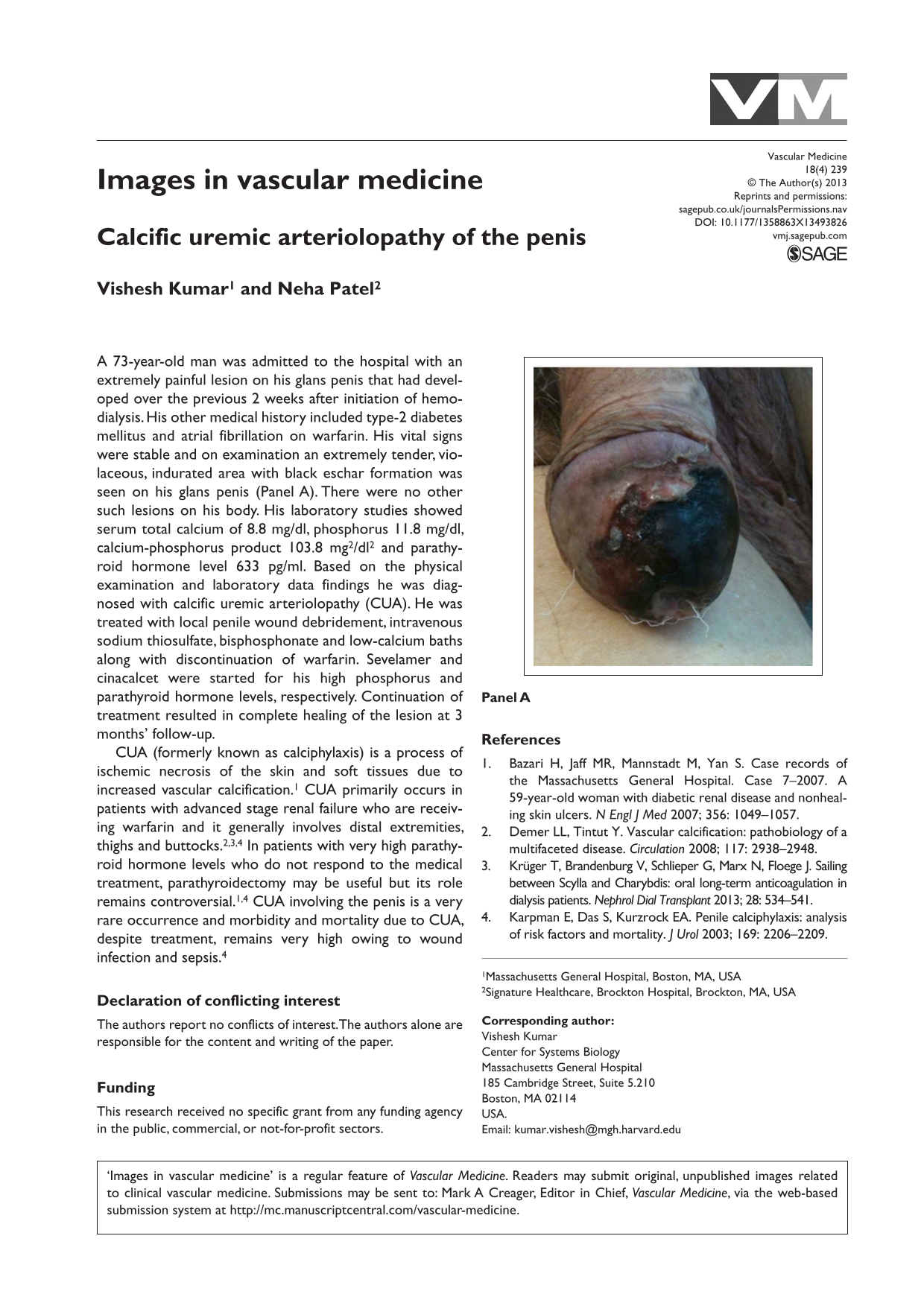
A 73-year-old man was admitted to the hospital with an extremely painful lesion on his glans penis that had developed over the previous 2 weeks after initiation of hemodialysis. His other medical history included type-2 diabetes mellitus and atrial fibrillation on warfarin. His vital signs were stable and on examination an extremely tender, violaceous, indurated area with black eschar formation was seen on his glans penis (Panel A). There were no other such lesions on his body. His laboratory studies showed serum total calcium of 8.8 mg/dl, phosphorus 11.8 mg/dl, calcium-phosphorus product 103.8 mg2/dl2 and parathyroid hormone level 633 pg/ml. Based on the physical examination and laboratory data findings he was diagnosed with calcific uremic arteriolopathy (CUA). He was treated with local penile wound debridement, intravenous sodium thiosulfate, bisphosphonate and low-calcium baths along with discontinuation of warfarin. Sevelamer and cinacalcet were started for his high phosphorus and parathyroid hormone levels, respectively. Continuation of treatment resulted in complete healing of the lesion at 3 months’ follow-up.
CUA (formerly known as calciphylaxis) is a process of ischemic necrosis of the skin and soft tissues due to increased vascular calcification. 1 CUA primarily occurs in patients with advanced stage renal failure who are receiving warfarin and it generally involves distal extremities, thighs and buttocks.2,3,4 In patients with very high parathyroid hormone levels who do not respond to the medical treatment, parathyroidectomy may be useful but its role remains controversial.1,4 CUA involving the penis is a very rare occurrence and morbidity and mortality due to CUA, despite treatment, remains very high owing to wound infection and sepsis. 4
‘Images in vascular medicine’ is a regular feature of Vascular Medicine. Readers may submit original, unpublished images related to clinical vascular medicine. Submissions may be sent to: Mark A Creager, Editor in Chief, Vascular Medicine, via the web-based submission system at http://mc.manuscriptcentral.com/vascular-medicine.
Footnotes
Declaration of conflicting interest
The authors report no conflicts of interest. The authors alone are responsible for the content and writing of the paper.
Funding
This research received no specific grant from any funding agency in the public, commercial, or not-for-profit sectors.