



Abstract
Ireland ratified the Convention on the Rights of Persons with Disabilities (CRPD) in 2018. However, the CRPD’s provisions on inclusive education have not been widely considered in relation to Irish third level education. This article outlines the findings from two research projects that examined the experiences of students with disabilities at one Irish university. It begins by considering the scope of inclusive education in the CRPD, addressing this through the prism of two cross-cutting rights, accessibility and reasonable accommodation. It outlines the Irish legislative context, identifying significant gaps between existing legal provisions and Ireland’s CRPD obligations. It then explores the practical realisation of inclusive education at the case study university. The article argues that accessibility in the CRPD is broader than both Irish legislative requirements and the general institutional understanding. Noting that students face significant difficulties accessing effective reasonable accommodations in practice, the paper contends that this may be partly attributable to the silo-ing of institutional knowledge and the lack of a ‘whole educational environment’ approach, as well as attitudinal barriers. These impediments prevent the full and equal participation of students with disabilities in tertiary education. The paper then draws on the CRPD to offer suggestions for enhancing inclusive practice.
Keywords
Introduction
Ireland ratified the United Nations Convention on the Rights of Persons with Disabilities (CRPD) in 2018, thereby committing to providing inclusive education at all levels. To date, however, there has been limited consideration of the implications of the CRPD in relation to tertiary education. Much of the Irish literature on inclusion at third level has focused on quantitative data highlighting the numbers of students from diverse groups participating in third level education, with less attention to their experience. This article addresses the findings from two research projects that examined student experiences of inclusion and exclusion in the learning environment at one Irish university. Both projects addressed students from multiple diverse backgrounds, but for this paper we focus on the experiences of students with disabilities. The goal of both projects was to identify and address barriers to participation, and highlight where the institution could do more to promote inclusion. The research commenced in 2018, coinciding with Ireland’s ratification of the CRPD, and ended in 2021. It thus provides a good baseline on inclusive practices in the university that can be built on and developed.
The paper begins by considering the CRPD and what is meant by inclusive education, addressing this through the prism of two cross-cutting rights, accessibility and reasonable accommodation. It outlines some key features of the Irish legislative context, identifying significant gaps between existing legal provisions and Ireland’s CRPD obligations. It then explores the practical realisation of inclusive education, using an Irish university as a case study. After outlining the institutional context of the projects, methodology and findings, the paper considers those findings in light of the CRPD. It argues that accessibility in the CRPD is broader than both Irish legislative requirements and the (apparent) institutional understanding. Noting that students face significant difficulties accessing effective reasonable accommodations in practice, the paper contends that this may be partly attributable to the silo-ing of institutional knowledge and the lack of a ‘whole educational environment’ approach, as well as attitudinal barriers. These impediments prevent the full and equal participation of students with disabilities in tertiary education. The paper therefore draws on the CRPD to highlight ways in which inclusion could be enhanced in third level institutions more generally, with many suggestions of broader international relevance.
The Convention on the Rights of Persons with Disabilities and inclusive education: Reasonable accommodation and accessibility
The CRPD is the first human rights treaty to expressly reference the duty to provide inclusive education at all levels.
1
Although the CRPD does not define inclusive education, General Comment No. 4 on the right to inclusive education clarifies that it involves a process of systemic reform embodying changes and modifications in content, teaching methods, approaches, structures and strategies in education to overcome barriers with a vision serving to provide all students of the relevant age range with an equitable and participatory learning experience and environment that best corresponds to their requirements and preferences.
2
Although the term ‘inclusive education’ is somewhat contested in the literature and its implementation has always been problematic, 3 the definition espoused by General Comment No. 4 fits well with leading inclusion models. It is particularly compatible with the framing of Ainscow et al. 4 In this understanding, inclusion is a process, an ongoing search to find ways to respond to diversity. It is about the identification and the removal of barriers, with the goal of improving the presence, participation and achievement of all students. Inclusion therefore requires us to pay particular attention to those at risk of marginalisation, exclusion or underachievement, and to address both the barriers to inclusion and the requirements of inclusive systems. Likewise, General Comment No. 4 refers to the need to respect and value diversity, 5 to address barriers, 6 for ongoing monitoring, 7 and to ensure that students feel ‘valued, respected, included and listened to’. 8 While perhaps best known in relation to primary and secondary inclusive education, repeated references in the General Comment make it clear that it applies to all levels of education, including vocational, tertiary, university, technical and life-long learning. 9
Article 24(5) requires States Parties to ensure that persons with disabilities are able to access tertiary education on an equal basis with others. This again requires that barriers to education must be identified and removed. Such barriers can be attitudinal, physical, linguistic, communicational, financial or legal. 10 This paper highlights some of the barriers that students identified in the provision of inclusive education in the case study university, focusing particularly on two cross-cutting rights, accessibility and reasonable accommodation. The rationale for focusing on these rights derives from the broad definition of disability discrimination contained in Article 2 of the CRPD, which ‘includes all forms of discrimination, including denial of reasonable accommodation’. The explicit inclusion of the duty of accommodation ensures that there is an individualised positive duty to provide for adjustments and modifications to eliminate barriers an individual may encounter. Degener further contends that the ‘non-discrimination and equality concept enshrined in the CRPD has a group component extending the notion of non-discrimination’. 11 This group element is a result of the CRPD Committee interpreting ‘accessibility as part of the equality principle’. 12 The CRPD thus incorporates a dual approach to non-discrimination, both group and individual.
The relationship between inclusive education and the duty to provide reasonable accommodation is evident throughout Article 24, and is specifically referenced in respect of the sub-section on tertiary education. Reasonable accommodation will vary from student to student, there is no ‘one size fits all’ approach; moreover, it is an individualised reactive duty ‘applicable from the moment a request for accommodation is received.’ 13 The duty to accommodate can be broken down into two parts. First, there is a positive legal duty to provide a reasonable accommodation where needed in a particular case. Second, that accommodation cannot impose a disproportionate or undue burden on the duty bearer. 14 General Comment No. 4 elaborates on this duty in the educational context, specifically referring to the need to provide reasonable accommodation for both assessment and examination procedures. 15
General Comment No. 4 also highlights the need to address both systemic and structural discrimination, and that States Parties should ‘take affirmative action measures, such as removing architectural and communicative or other barriers to mainstream education’. 16 It therefore emphasises that accessibility and inclusive education are ‘closely interconnected.’ 17 It describes accessibility as a precondition for the full and equal participation of persons with disabilities in society; 18 hence, accessibility must focus on the whole environment in which students with disabilities learn, and design this in such a way as to foster inclusion. 19 Importantly, accessibility is more complex than merely addressing physical barriers; it is also necessary to ‘change attitudes towards persons with disabilities.’ 20 General Comment No. 2 on accessibility likewise emphasises that ‘the entire process of inclusive education… must be accessible.’ 21
While accessibility and reasonable accommodation may have similar aims regarding making systems more accessible and therefore inclusive for students with disabilities, they are distinct concepts. Accessibility is an ex ante duty that provides benefits for a group of people through standards or systems like universal design, which seek to eliminate common barriers to inclusion. In contrast, reasonable accommodation is an ex nunc duty, which relates to a particular individual and is reactive rather than pre-emptive in nature. 22
Inclusive education in Irish law
The CRPD requirements on accessibility and reasonable accommodation in education are not fully implemented in Irish law. The legislative framework with primary relevance to students with disabilities includes the Irish Human Rights and Equality Commission Act 2014 (the 2014 Act); the Equal Status Acts 2000–2018 (ESA); the Universities Act 1997; the Disability Act 2005 (the 2005 Act) and the EU (Accessibility of Websites and Mobile Applications of Public Sector Bodies) Regulations 2020 (the Web Accessibility Regulations). 23 The key relevant provisions are outlined below.
The 2014 Act introduced a broad public sector equality and human rights duty, which directly impacts on accessibility. 24 This requires public bodies, including universities, to protect human rights, promote equality of opportunity, and eliminate discrimination in the performance of their functions. The duty is positive obligation to promote equality, not merely a duty to refrain from unlawful discrimination. The Irish Human Rights and Equality Commission (IHREC) has identified a three-step process to implementing the public sector duty, namely to assess, address and report. 25 In practice, this means that a public body must undertake an evidence-based assessment to identify the key equality and human rights issues for those who use or work in that organisation. It must then take steps to address those issues and report on its progress. 26 Although not specific in nature, the public sector duty represents an important obligation which may contribute to the advancement of accessibility in third level education.
Accessibility is also advanced by the 2005 Act, which requires public service providers to support access to services and facilities for persons with disabilities. 27 It also requires all public bodies to make their buildings and services accessible to persons with disabilities. 28 However, the duty to provide accessible services may be limited by practicability, cost considerations, or if accessibility requirements would cause an unreasonable delay in making goods and services available to others. 29
Most recently, accessibility in education is impacted by the Web Accessibility Regulations, which implement the Web Accessibility Directive 30 in Irish law. The Regulations require public bodies to ensure that their websites and mobile apps are accessible to all persons, including those with disabilities. Harmonised accessibility standards are applied, and a public body must also publish and maintain an accessibility statement about its website or mobile apps. 31 This is particularly challenging for educational practice as it applies to most online teaching tools and resources, including video and audio recordings, online forms, intranets, extranets and office file formats. Finally, the public body’s accessibility statement must contain a link to the complaints and redress mechanisms of either the ESA (discussed below) or the 2005 Act, whichever is more relevant.
The most important equality provision relevant to tertiary education is the ESA, which applies to the provision of goods and services, including educational establishments. ‘Educational establishment’ is broadly defined to include all providers of education, public or private, from pre-school through to adult and continuing education, including universities. 32 Educational establishments may not discriminate regarding admission, access to any course, facility or benefit provided, or any other term or condition of participation in the establishment, including expulsion or sanction. 33 Discrimination includes direct discrimination, indirect discrimination, discrimination by association, 34 and the denial of reasonable accommodation to persons with disabilities. 35 However, the reasonable accommodation duty is limited to a duty to do ‘all that is reasonable’, 36 which cannot give rise to more than a ‘nominal cost’. 37 The Act also prohibits harassment, sexual harassment and victimisation, 38 and permits positive action to promote equality. 39
The statutory obligations fall significantly short of CRPD requirements. Buckley and Quinlivan have highlighted key shortcomings regarding the ESA’s reasonable accommodation duty; for instance, there is no statutory obligation to consult or engage with the person with the disability, the ‘nominal cost’ standard falls far short of the CRPD standard of ‘disproportionate burden’, and the duty to do only ‘what is reasonable’ is conceptually inconsistent with the CRPD, where ‘reasonableness’ is not a limitation of the duty. 40 The public sector equality duty is very limited, being only a duty to ‘have regard’ to equality concerns, 41 and there is no requirement for public bodies to consult with affected groups, such as persons with disabilities. Indeed, the only explicit references to accessibility in the 2014 Act relate to public reporting. 42 It is therefore entirely a matter for a public body to identify accessibility as an equality concern, to interpret what accessibility requires in a particular context, and to decide what measures to adopt. There is no individual cause of action in relation to the performance of the duty, 43 although IHREC may ‘invite’ (though not require) a public body to review its own performance and/or implement an action plan to address shortcomings. 44 The accessibility duty under the 2005 Act is also low, requiring only that a public body comply with the (minimal) requirements of the relevant building regulations; non-physical aspects of accessibility, outlined in General Comment No. 4, are not addressed. The duty in the 2005 Act is also considerably limited by statutory exceptions. The Web Accessibility Regulations significantly extend the scope of legal accessibility requirements but are subject to a ‘disproportionate burden’ limitation for public bodies. 45 While reflective of the text of the Web Accessibility Directive (particularly Recital 39 and Article 5), the disproportionate burden standard is clearly incompatible with CRPD requirements. General Comment No. 4 states explicitly that, while accessibility can be implemented gradually, ‘[d]isproportionality or undue burden cannot be claimed to defend the failure to provide accessibility’. 46
Institutional context of the research
Having discussed the legal context for this study, the paper will next outline key features of the research projects, looking first at the institutional context. The research focuses on a single institution in the Irish context. The University of Galway 47 (the university) is a long-established, publicly funded university, with over 19,000 students and almost 3000 staff. 48 In recent years, it has seen a significant rise in students registered with its Disability Support Service (DSS). This includes a 64% rise in registrations in the four academic years to 2022. 49 The most recent EDI report notes that 1,145 students were registered with DSS in 2019/2020. 50 A similar rise in the number of students with disabilities registering with support services in HEIs is also evident at national level, with registrations increasing by 226% over the last 11 years. 51
The university’s current strategy (2020–2025) identifies four core values, Respect, Openness, Excellence and Sustainability. 52 Of these, Respect and Openness are particularly relevant to disability inclusion, reasonable accommodation and accessibility; for example, under Respect, the university commits to ‘proactively remove barriers to equality and diversity in our University, recognising the individuality of our people’s journeys’ 53 , and to fulfilling its Public Sector Equality and Human Rights Duty ‘across all of the University’s functions and relationships.’ 54 Under Openness, the university is ‘committed to social inclusion and providing a welcoming environment where everyone has a sense of belonging and can thrive’. This includes ‘build[ing] an inclusive culture that proactively seeks to improve access to education…’ 55 and ensuring that the university is physically ‘open and accessible to all our communities.’ 56 The adoption of the Principles of Universal Design in the learning and working environment is a flagship goal. 57
These strategic objectives have not yet been fully implemented in practice, despite good progress. The university has adopted an EDI governance structure which includes a Universal Design and Accessibility Working Group. 58 It has also adopted a range of relevant policies, including an Equal Opportunities Policy, a Universal Design and Accessibility Policy, an Alternative Assessment Policy for Students with Disabilities and a Student Mental Health Strategy. 59 Notably, the Universal Design and Accessibility Policy commits to developing university policies, procedures and practices that comply with the UN Convention on the Rights of Persons with Disabilities. 60 The university’s Academic Strategy also references Universal Design for Learning (UDL) as a key goal, in line with the University Strategy. 61 This has been significantly progressed through the local roll-out of a digital badge for completing basic UDL training.
An important gap in the institutional policy framework relates to reasonable accommodation. Students with disabilities may register with DSS; following evaluation, they may be issued with a Learning Educational Needs Statement (LENS) report, which specifies the particular accommodations or learning supports they require. However, there is no clear process for communicating LENS reports to the appropriate persons for implementation. Students have historically been instructed to send their LENS reports to all their lecturers and programme directors, requiring them to share highly personal information with multiple members of staff. A planned centralised system to replace this practice is not yet active. 62
A second gap relates to funding for reasonable accommodations. State funding is available to support Irish and EU students through the Fund for Students with Disabilities (FSD). However, this fund uses a narrower definition of disability than in the ESA. 63 Consequently, not all Irish and EU students with disabilities will be covered by the FSD fund, and international students are not covered at all. The university has not made ongoing provision for these gaps in funding. Instead, DSS apply annually for once-off funding, which is not guaranteed and may be inadequate. International students with disabilities may therefore be exposed to intersectional disadvantage.
A third gap relates to accessibility. Although the university has adopted a Universal Design and Accessibility Policy, its application is expressly restricted ‘in so far as institutional capacity and the balancing of University resources allow.’ 64 The university has not yet adopted a policy on web accessibility. Physical accessibility is largely the responsibility of the Buildings and Estates Office, but there is no oversight of accessibility in relation to learning resources.
Methodology
This paper draws on data from two projects on inclusive learning at the university. The first addressed the experiences of undergraduate students in a single college with three constituent schools. 65 The second focused on the experiences of postgraduate students in the same college, with two additional schools from a second college. 66 The project drew on action research methodology, which uses systematic inquiry to improve personal practices 67 and bring about change in specific contexts. 68 The object of the research was to develop a more inclusive learning environment in the university by identifying and addressing barriers to educational participation, raising awareness and supporting the development of inclusive pedagogy. Both projects were designed using a participatory approach, with significant student involvement. A guiding principle throughout was centring the student voice.
Ethical approval for the research was granted by the university’s Research Ethics Committee. Both projects used qualitative methods to explore student perceptions regarding their teaching and learning experience in the university. These included eight online surveys as well as 54 individual interviews and six focus groups to generate more in-depth information from selected student groups, including students with disabilities. Undergraduate (UG) data were gathered between October 2018 and March 2021. Postgraduate (PG) data were gathered between March and December 2020, from students on both taught and research programmes. Both studies therefore comprise data gathered prior to and during the Covid-19 pandemic.
All survey questions were optional. The students were asked to respond to various statements using a five-point scale, ranging from ‘strongly agree’ to ‘strongly disagree.’ The statements related to the inclusiveness of the learning environment generally (broadly defined), of the teaching staff, of other students, and of social events in their discipline. Optional comment boxes were provided following each question. Students were also asked if they could give examples of occurrences or practices they had experienced or observed, which they regarded as inclusive or exclusionary. Following the move to remote learning during the Covid-19 pandemic, students were also asked how the pandemic had affected their learning environment, with an optional comment box. Only survey responses that answered at least one of the substantive questions were deemed admissible. Where the analysis refers to a particular group, such as students with disabilities, it means those who expressly identified as being in that group. The surveys do not claim to be representative.
Overview of survey response numbers.
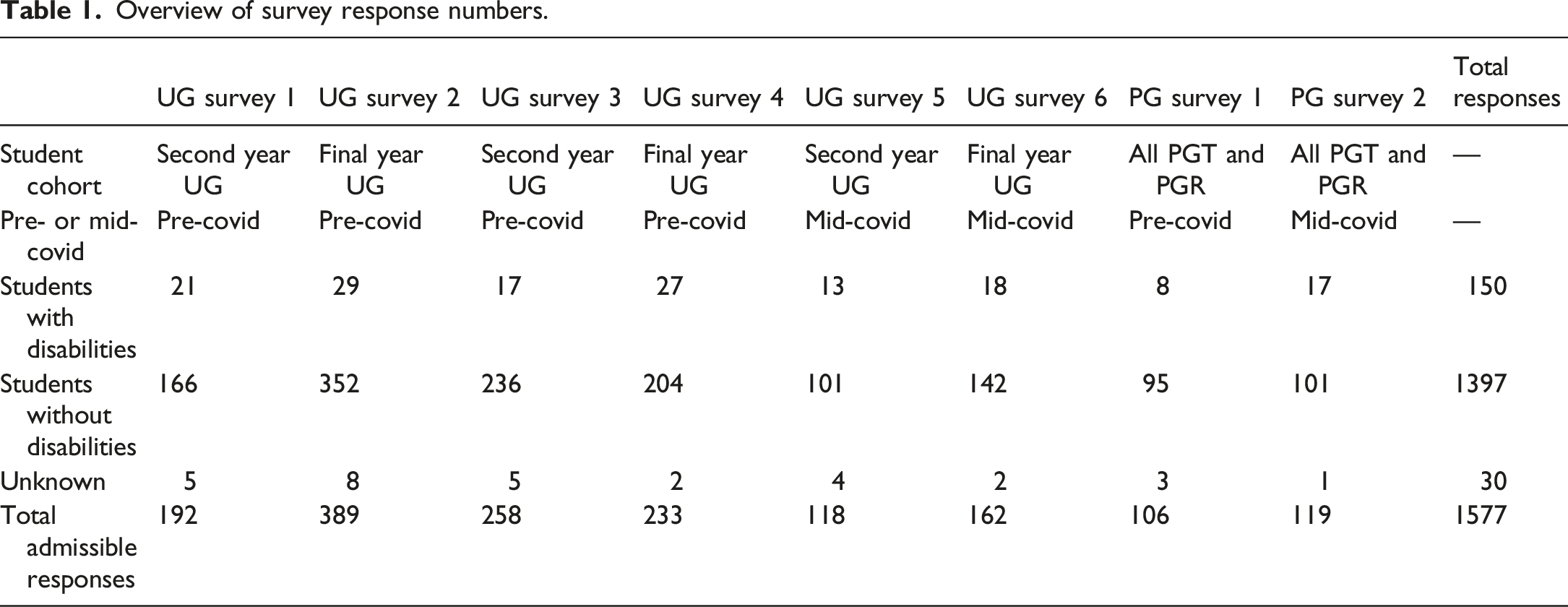
Additional qualitative data was obtained from the interviews and focus groups. Eleven individual interviews and one focus group were with students with disabilities. The individual interviews were with seven undergraduate students and four postgraduate students. An additional four undergraduate students participated in the focus group.
Comments from the surveys, interviews and focus groups were subjected to thematic analysis. 69
Following Braun and Clarke, thematic analysis was selected for its flexibility and for its potential to ‘provide a rich and detailed, yet complex, account of data.’ 70 The names of interview and focus group participants were anonymised and survey respondents were given descriptors. This paper focuses on the experiences of student participants with disabilities with regard to accessibility and reasonable accommodation.
Findings
Surveys
Most undergraduate students felt their learning environment was (to some degree) inclusive. 71 This was quite consistent, with 75–83% agreement in all surveys other than UG Survey 5 (mid-Covid). 72 Most undergraduate students with disabilities also found their learning environment inclusive, with positive responses from 69 to 89% of students in this category pre-Covid. There was a very significant dip mid-Covid, with only 46% of students with disabilities expressing a positive view in UG Survey 5. However, 67% of students with disabilities considered their learning environment inclusive in UG Survey 6 (also mid-Covid). Similarly, in PG Survey 1 (pre-Covid), 85% of all respondents indicated that they felt included in their learning environment, though this fell to 66% in PG Survey 2 (mid-Covid).
Overview of students with disabilities.
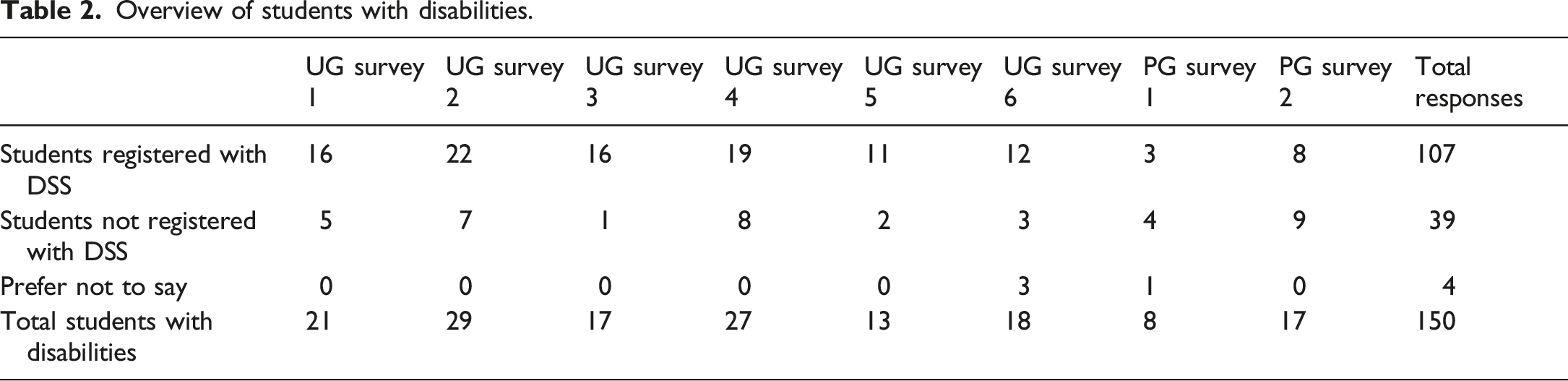
Thematic analysis
Thematic analysis identified a range of issues related to inclusive learning. While this paper focuses on the themes of accessibility and reasonable accommodation, it should also be noted at the outset that many students highlighted the help they received from university support services as hugely beneficial in supporting their learning. These included, particularly, DSS, the library, the student counselling service, and the assistive technology service. However, students also highlighted that these services were often insufficiently resourced, leading to a shortfall in the support they could offer.
Accessibility
Many student comments related to physical accessibility; for example, regarding access to lecture theatres, the library, and other learning spaces. However, broader issues were raised in relation to access to learning materials and online resources (particularly following the move to remote learning). In this regard, the crucial role of support services was consistently highlighted, as were perceived shortcomings in services and attitudinal barriers on the part of service providers and staff. Significantly, some students also identified that accessible education was contingent on accessibility in other contexts, such as the provision of suitable accommodation.
Regarding physical accessibility, the most positive remarks related to the library, particularly the availability of separate study spaces for students with disabilities. This was seen as essential because it offered an escape from the large numbers and disturbance in larger library spaces. One student commented:
… I got access to the disability library which is probably one of the things that I have benefitted the most from… In the main library hall is so big like I wouldn’t have really brought out my blood sugar and stuff like that. So, it was nice to be in an environment I suppose where other people are in similar situations to you.
Maeve – UG Interview
For other students, the difficulty was getting into venues. One student highlighted ongoing problems with a lift that gave access to the library. Her mobility impairment meant that it was exceedingly difficult for her to use the stairs, or even the ramp (as this significantly increased the walking distance). She commented:
I got out of a wheelchair, I don’t want to have to go back to a wheelchair, I want to be mobile on my legs with two sticks. That’s my decision, but the access barriers make that difficult. And if that lift is broken, then I’m toast, I can’t get into the library…
Ramona – PG interview
This student highlighted that accessibility meant more than physically being able to access a venue. This was often technically possible, but the room design made it extremely difficult for her to participate on an equal basis with others. She commented: … Often, I have to sit at the top of the very big lecture halls because I can’t get down closer to the group, so I’m isolated in those bigger classes… It feels that we’re very much not thought about in the way the larger lecture rooms are designed. Ramona - PG interview
Accessibility meant more than simply providing the relevant facility, for example toilets that were physically accessible. Students highlighted that they needed to be maintained in a suitable condition, so they could be used for daily health care requirements, such as monitoring diabetes, taking medication and bladder care.
Students also raised broader accessibility issues. For example, accessible accommodation is essential for students to be able to participate independently and equally in the learning environment. One student commented on cooking facilities in his student accommodation:
I cannot use that stove; it is very much impossible to use that stove because the touch buttons… cannot be accessed by somebody who cannot see.
Charles - PG interview
The touchscreen on the accommodation phone was also inaccessible to this student, while the lack of a phone signal meant he could not use his own phone. These issues significantly undermined his ability to participate.
Accessibility was also raised in relation to online classes and the availability of learning resources, particularly regarding remote learning. Some students with disabilities found online learning significantly more accessible:
I have a visual impairment and therefore, I feel like working from home has helped me more then (sic) if I had to sit in a class far away from the board/lecture and not being able to see anything. The video lectures are amazing as I can watch them with the magnifying tool on my computer to know what the lecture is saying and doing.
Female Business Student – PG Survey 2
Other students found remote learning more accessible because they no longer had to commute. This applied also to students without disabilities (particularly those with caring responsibilities), but could be particularly beneficial to students with disabilities who found commuting onerous.
However, online learning was not always regarded as beneficial. Some students, who suffered from anxiety, found it harder to participate in online discussions, while others criticised the lack of captioning, the lack of visual aids, and the placement of resources in difficult online locations. Several students noted issues in relation to the provision of notes and other basic information. These issues could be addressed, but technology itself was challenging for some students. One commented:
… I have a difficulty with hearing which is made worse when I have to try and hear what is being said to me over technologies, especially when I have no visual aid to help me. I have had a lecturer dismiss my concerns over this; I also have a lecturer whose microphone is a very low quality one and make the lectures very hard to understand and focus in. I try not to let these things get to my head though.
Female Law Student 1 – UG Survey 6
The availability of class recordings was particularly problematic. Students complained that some lecturers refused to record and upload lectures, or made them available only temporarily, or uploaded them very late (for example, shortly before exams). Where recordings were available, students highlighted how helpful it was to be able to review material in their own time, and how this assisted with the preparation of notes and understanding the material. The availability of recorded lectures was particularly useful for students who had previously struggled to keep up in class:
… although learning during COVID19 has been particularly challenging I think the fashion in which it has unfolded has removed most barriers I would have faced in a normal college year. The pre-recorded lectures and podcasts has allowed me to listen and learn at my own pace, take proper notes while doing so and have a full understanding of a topic when finished. Typically, in a normal lecture I would not be able to take proper notes as I could not keep up and where I did need to I would then be lost and unfocused in lectures. I would rarely have an idea of what went on in lectures after and I would need to immediately study it again at least 2 times before grasping it. The recorded lectures have also allowed me to concentrate on my health more, whereas in normal years I would attended lectures even where I was not well, as the fear/stress of being so far behind was to much. (sic)
Female Law Student 2 – UG Survey 6
Overall, while remote learning significantly enhanced accessibility in some respects, the benefits were not universal.
Reasonable accommodation
Mixed experiences were reported by students who needed reasonable accommodations in relation to learning or assessment. Many highlighted the helpfulness of individual staff, and of particular accommodations, including technological supports. One commented:
I found there was great facilities and everything for people with disabilities. I am signed up for the disability service and one of the first things I did when I got to college, four years ago, was they gave me some accessible technology like a smart pen which records lectures while I am writing. Then I can play it back after while I am reading my notes. I get extra exam time as well when I am doing exams. So, there are a lot of ways that they kind of take into account if you have a learning disability or anything like I have ADD.
Síofra - PG interview
However, other students reported that particular lecturers did not adhere to LENS reports, or seemed pleasantly surprised when they did. For example, one student cited ‘Lens reports being considered and students with them getting the attention they need’ as an example of inclusive practice,
73
rather than compliance with a legal obligation. Some lecturers appeared to actively prevent reasonable accommodations and accessibility measures. One student gave the following example of exclusionary practice:
Preventing me use a device that would assist me in my learning and requesting me to disclose my disability to the class.
Male Business Student – PG Survey 2
Some students did not appear to be aware that they could ask for a LENS report, what one could do for them, or where to send the report. For example, when asked if she had communicated her LENS report to her lecturers, a student replied, ‘No, I didn’t know that was a thing’. 74 Another said, ‘I’ve actually never done any exam with the accommodations… Because I was never given them.’ 75
One student expressed anxiety at the idea that her personal information would be made known to lecturers, making her reluctant to engage with the LENS system. She commented, ‘I think that the less the lecturers know about the anxiety, the better’.
76
Other students highlighted that reasonable accommodations were not always implemented in a useful way. This demonstrated a lack of joined-up thinking at institutional level, as well as a lack of empathy.
… [L]ast year I was in the final year of my undergrad and I was taking an… exam and I have a separate exam centre with like three or four people in it and a no distraction venue because I have ADD, so I get distracted very easily. They put above us, in the exam hall, a music exam… I also have anxiety. So, exactly when my exam started, the music upstairs was really intense, kind of classical music started playing and it was all I could hear and it was like giving me anxiety and distracting me. I didn’t write anything for the first forty-five minutes of my exam… It was so loud… [the supervisor] had to leave the room to go and tell them to make it quiet. They were having an exam at the same time so there was not much that she could do. … I did tell her I was quite upset and angry… I was really shook after it and I had an exam later that day as well. It was a horrible experience.
Síofra - PG interview
Another student explained:
I get good support, but the only thing that bothers me is I need a reader and say for exams, we’re in a room, we’re in a different room, because we get extra time, but there’s like eight of us and say you’re sitting up there, so if I need someone to read for me, they say… put up your hand and ask them, but I wouldn’t, that’s embarrassing for me. I wouldn’t just put my hand up and ask someone to come down and read for me, because during my Leaving Cert I was in a room by myself and someone read for me and I found it way better. Like I’m not going to put my hand up and ask someone to read.
Caoimhe – UG Interview
In both these instances, the required accommodations were provided in theory, but were ineffective in practice.
Discussion
The research demonstrates considerable institutional commitment to inclusion. The university’s policy framework is largely compliant with its national legal obligations, the primary exception being the failure (to date) to implement the Web Accessibility Regulations. The survey findings indicate that most students, including those with disabilities, found their learning environment inclusive.
However, the research also highlighted ways in inclusion could be enhanced in light of the CRPD. This particularly applied to the institutional understanding of inclusion, which was significantly narrower than that elaborated by General Comment No. 4. As previously noted, inclusion requires the identification and removal of barriers, in which accessibility and reasonable accommodation concepts play a key part. However, while General Comment No. 4 highlights a wide range of barriers (such as attitudinal, physical, linguistic, communicational, financial and legal barriers), 77 the institutional focus was primarily on physical accessibility, with some recent attention to web accessibility and access to learning and educational resources (particularly through UDL, discussed below, and the provision of reasonable accommodations).
Our findings demonstrate that the barriers faced by students with disabilities were far more wide-ranging than the institutional focus. The barriers we identified were consistent with the literature. Barriers to accessibility certainly included issues with building design and maintenance, and problems with learning materials, but also included attitudinal barriers, such as the fear of being stigmatised or identified as disabled. 78 Reasonable accommodations were helpful to address some impediments, but reasonable accommodation itself was also subject to barriers, including lack of knowledge around potential supports and resources, and fear of negative reactions if accommodations were requested. 79 Many of the barriers identified in General Comment No. 4 were also evident. These included a lack of knowledge about inclusive education on the part of staff, 80 often combined with a lack of understanding of the human rights model of disability 81 and the impact of socially-constructed barriers. 82 This manifested in inappropriate responses to requests for support, such as refusing or failing to implement required accommodations, or requiring students to explain (and effectively justify) to their peers why they need particular supports. There was little evidence that attitudinal barriers of these kinds were being proactively addressed by the university.
The findings emphasised the vital role played by university support services. While many of these received very considerable praise, students also highlighted that services were inadequately resourced and insufficient to demand. Furthermore, the study identified significant gaps in the funding structure, 83 for example, the lack of a recurring budget to support reasonable accommodations beyond the scope of the FSD. Systems were not always thought-out; for example, an important barrier relates to the lack of clear redress mechanisms. 84 The findings identified that required accommodations are not always provided, due to staff resistance or systemic failures. However, the lack of a formal reasonable accommodation policy means there is no designated complaints mechanism where effective accommodations are not provided. Students must therefore identify informal, ad hoc avenues for complaint (such as appealing to relevant units or members of academic management), or take a grievance or legal case, which will not usually be a viable option. All this demonstrates the need both for greater resourcing to support inclusion, and for more consistent and thought-out processes.
In terms of how the university might address some of the above, General Comment No. 4 again offers helpful guidance as it identifies core features of inclusive education. 85 This is particularly appropriate given the university’s commitment to CRPD compliance, referenced above.
First, the General Comment’s emphasis on the ‘whole educational environment’ refers to the need for all system participants being committed to and working towards inclusive education, at all levels. 86 Our research found significant evidence of a committed leadership working to ensure an inclusive learning environment. For example, the University President established a high level Universal Design/Accessibility Policy Development Steering Group in 2021. The membership included key stakeholders across the institution, ensuring both sufficient expertise and broad buy-in to the policy. The President also established a Universal Design and Accessibility Implementation working group, chaired by the Vice President for Equality, Diversity and Inclusion, to ensure that key gaps in policy and practice are addressed. 87
Despite this progress, a ‘whole educational environment’ is far from achieved in practice. Much of this is due to structural shortcomings. For example, our research found that much of the university’s disability expertise is currently siloed within one unit, DSS. DSS relies on other offices and individuals to give effect to particular interventions, for example the provision of reasonable accommodations in class, exams and assessments. However, those other actors may not have the same commitment or knowledge regarding the delivery of an inclusive education system. Consistent with previous literature, 88 our research suggests that reasonable accommodations are not always provided effectively, even where students have been formally allocated necessary supports. There was evidence of poor provision of some accommodations, and an unwillingness by some staff to give effect to required accommodations. The absence of a formal reasonable accommodation policy has also resulted in poor practices, 89 such as inadequate and unclear notification processes in relation to LENS reports. This impacts directly on reasonable accommodation provision (for example, by deterring students from disclosing their disabilities or making accommodation requests). 90
Second, the General Comment identifies the need for a ‘whole person’ approach. 91 This requires an inclusive learning environment to be accessible, but our research identified ongoing accessibility issues. These included the obvious physical accessibility concerns, particularly around access to the library. However, our findings also demonstrate that physical accessibility is not the same as inclusion: for example, students with disabilities may be able to enter teaching venues but then be confined at the back, making equal participation difficult. 92
A whole person approach also includes flexible curricula, with teaching and learning methods adapted to different strengths and requirements. Again, we see an institution that is working towards achieving this goal. The institutional strategic plan, the academic strategic plan and the equality, diversity and inclusion strategic plan all commit to the introduction of UDL, which may play an important role in enhancing accessibility. 93 The core principles of UDL include multiple means of engagement (which may include flexible curricula and learning activities), and multiple means of representation, including the provision of information in multiple formats. The value of multiple means of representation was clearly demonstrated during the period of remote learning. However, the university has recently committed to a full return to synchronous, on-campus classes, and no general availability of lecture recordings (specific reasonable accommodations excepted). 94 This is in response to poor engagement over the previous academic year, but appears to lack nuance, particularly for an institution committed to UDL.
Third, inclusive learning systems also support teachers. 95 That means that teaching staff will receive training on inclusive learning. Institutional commitment to this is demonstrated by the provision of UDL training by the university’s Centre for Excellence in Learning and Teaching, among other bodies. Senior leadership has also strongly encouraged staff participation in UDL training at staff events. However, such training is voluntary and upskilling is not commonly recognised in academic workloads, potentially discouraging staff participation.
Fourth, an inclusive learning environment is one ‘where everyone feels safe, supported …’ 96 Our research particularly highlights the importance of DSS in achieving this, as students referred to that unit’s ongoing support, student capacity-building, and inclusive approach. However, our findings also indicate that many students with disabilities are not registered with DSS, and that some students are uncomfortable with disclosure of their disability to their lecturers. The literature highlights that the fear of being stigmatised or identified as disabled is a real concern for students 97 and our research also reflects that point.
Finally, both Ainscow et al. and General Comment No. 4 highlight the necessity of continuous monitoring and evaluation. Ainscow et al. refer to the need to pay particular attention to those at risk of marginalisation, exclusion or under achievement, 98 whereas the General Comment refers to a continuous process of evaluating inclusion to ensure that neither segregation nor integration is happening, either formally or informally. 99 However, our research found a lack of disaggregated data to evaluate practice or support effective policy development. 100 Although the university generates data on the number of students registered with DSS, not all students with disabilities were registered and no data were available on the progression, retention and attainment of registered students with disabilities, as compared with other students. This deficit may be addressed shortly as the university is due to adopt a more advanced student record system. 101 However, it is not yet clear what kinds of data the new system will record.
The General Comment also refers to the need for persons with disabilities to be involved in the evaluation process. 102 Our research was co-designed with students and entirely focused on the student experience. As the methodology indicates, we consulted with students, through surveys, focus groups and interviews. The student voice was therefore integral to the project, from development of that project through to the findings. The concern we would raise is that this level of engagement happened only as part of a project, driven by individuals with a strong inclusion focus. Consideration must be given to regular evaluation by third level institutions of the experiences of students with disabilities to ensure constant progression.
Conclusion
This paper drew on the experiences of students with disabilities at one Irish university, to explore the nature of inclusive education at tertiary level. Drawing on the expansive conceptualisation of inclusion in the CRPD, as elucidated in General Comment No. 4, the paper focused particularly on accessibility and reasonable accommodation as key requirements for inclusion. Noting that the Irish legal framework is not fully compliant with CRPD requirements, the paper highlighted that institutions with a commitment to inclusive education need to go beyond legislative duties to develop a broader understanding of inclusion and accessibility.
Many of the paper’s findings are of broader international relevance. These include the importance of staff awareness and training in disability across the institution, the need for properly funded institutional support systems, the need for clear policies and complaint mechanisms, and the importance of institutional data gathering to support effective policy development. Consistent with the literature, the paper particularly highlighted the impact of attitudinal and systemic barriers, including the silo-ing of expertise in particular units and the need for a coherent and informed institutional approach, particularly in the provision of reasonable accommodations. To address these issues, the paper emphasised the need for a ‘whole educational environment’ and ‘whole person’ approach, as advocated in General Comment No. 4. These key findings – the shortfall in institutional understandings of inclusion and accessibility, and the need for a whole institution approach when implementing reasonable accommodation, in particular – apply beyond the Irish context and offer food for thought in other higher education institutions.
Footnotes
Acknowledgements
The assistance of Dr Dinali Wijeratne with data collection for these projects is gratefully acknowledged, as are the many contributions of the extended project team: Dr Sharon Flynn, Cameron Keighron, Jane Ennis, Kate Molloy, Dr Niall Madden, Dr Miriam Byrne, Dr Daniel Savery, Imelda Byrne, Anna Ní Fhlatharta and Michael Coyne.
Declaration of conflicting interests
The author(s) declared no potential conflicts of interest with respect to the research, authorship, and/or publication of this article.
Funding
The author(s) disclosed receipt of the following financial support for the research, authorship, and/or publication of this article: NUI Galway Student Project Fund. National Forum for the Enhancement of Teaching and Learning in Higher Education.
