



Abstract
A small internal investigation by the University of Queensland (UQ) Union Disability Collective resulted in a student-led project supported by academics across three Australian universities. The project seeks to gain new insights into the experience of students with disabilities studying at Australian universities. Universities conduct disability surveys from time to time, but these tend to be forgotten as time passes and priorities change. This project involved the co-design and development of a survey, using qualitative and quantitative questions, to investigate students’ experiences, including of barriers to education and participation in the Australian tertiary (or post-secondary) sector. This is planned to be the first of several research projects to transparently and accountably track issues faced by disabled tertiary students, and what is working to improve education outcomes and reduce discrimination. The survey has been piloted with UQ students with a view to roll it out to other universities. This paper focuses on the survey instrument and describes the project’s formation and development. It also identifies challenges that have arisen in the process and future directions.
Background
Introduction: the need for this research
The University of Queensland (UQ) aims to provide an inclusive and supportive environment for all members of the university community, including students with disability. 1 UQ has a formal policy of providing ‘reasonable adjustments’ for students with disability, 2 which include the university working with the student to develop a Student Access Plan (SAP) to be communicated to relevant staff to implement the adjustments.
As an undergraduate student at UQ active in the Disability Collective of the student union at the university (UQU), the lead author has personally experienced and heard of many difficulties facing students with disabilities across the spectrum. This included a sense that course co-ordinators have not necessarily fully understood what they need to do to implement SAPs. Australia has had legally enforceable disability discrimination protections in education at both the state/territory and federal levels for more than 30 years. It has also accepted relevant human rights obligations under the UN Convention on the Rights of Persons with Disabilities (CRPD) through Australia’s ratification on the CRPD in 2008. Despite this, real-world equity in education has not yet been achieved for people with disability in Australia.
Having discussed these concerns and having a growing sense that the student experience was not being understood or even captured, the lead author spoke with others within the UQU and was encouraged to apply for funds for a research project to gather data on those experiences and to begin to answer the question, ‘How effectively is the University of Queensland meeting its obligations to provide non-discriminatory and equitable education for students with disability?’
She also raised the project idea with the UQ Disability Inclusion Group (DIG) and found that the Chair, Dr Paul Harpur, was enthusiastic. Dr Harpur identified a general lack of research into the experience of students with disability at universities in Australia. This is despite the obligation on Australia as a State Party to the CRPD to collect data to enable it to ‘identify and address the barriers faced by persons with disability’. 3
It was this shared concern and experience that led to the building of this research project, bringing together Professor Winnifred Louis from the School of Psychology at UQ who has expertise in allyship research, intergroup relations, and survey methodology including quantitative research methods, and Robin Banks from the Faculty of Law at the University of Tasmania who has expertise in disability discrimination law and disability rights in education.
The UQU provided funding for the development of a mechanism to report on the experience of students with disability at UQ. This funding has been used primarily to cover the costs of a research assistant to undertake analysis of the survey data.
The research team sought to develop a research project that would make a valuable contribution to improving outcomes for students with disability in tertiary education. Key to this aim was understanding how to ensure effective methods of gathering relevant data, particularly about the current diverse experiences of students with disability.
Legal context and guidelines
As a federation, Australia has state and territory discrimination laws 4 as well as federal discrimination law 5 that prohibit discrimination on the ground of disability or impairment. (The ground is referred to as ‘disability’ in the federal law and all of the state and territory laws other than Queensland and Western Australia, where it is referred to as ‘impairment’. In spite of this language difference, the definitions and scope of the ground are fairly consistent across all Australian jurisdictions.)
Since 1992, Australia has had a federal discrimination law specifically prohibiting discrimination on the ground of disability: the Disability Discrimination Act 1992 (Cth) (DDA). This law defines disability broadly using a functional impairment approach. 6 It expressly prohibits direct and indirect discrimination, 7 and since 2009 has expressly included a prohibition on failing to make reasonable adjustments. 8
The DDA prohibits discrimination in a range of life areas, including education, with obligations on educational authorities, educational institutions and education providers. It applies to all types of education: private and public; primary, secondary, post-secondary (generally referred to as ‘tertiary’ in Australia); vocational; professional; short courses, etc.
Unlike earlier discrimination laws in Australia, the DDA introduced a compliance mechanism–‘disability standards’–that enable the development of subordinate legislation to specify what is required to comply with the obligation to not discriminate in specified areas, including education. 9 The DDA specifies that compliance with a disability standard is a complete defence to an allegation of discrimination in the relevant area, 10 and that contravention of a disability standard is unlawful. 11 Such an unlawful act then falls within the scope of ‘unlawful discrimination’ under the Australian Human Rights Commission Act 1986 (Cth) 12 and can be the subject of a complaint by a person ‘aggrieved by the alleged acts’. 13
In 2005, the federal Government enacted the Disability Standards for Education 2005 (Cth) (Education Standards). 14 These standards set out obligations of education providers in relation to making reasonable adjustments, 15 enrolment, 16 participation, 17 curriculum development, accreditation and delivery, 18 student support services, 19 and harassment and victimisation. 20 Part 10 sets out exceptions to the Education Standards: these are effectively defences to a complaint alleging a contravention.
As noted above, in 2008 Australia ratified the CRPD, becoming a State Party to the Convention with all its attendant obligations. The CRPD reinforces access to education as a human right and specifically addresses tertiary education. Article 24 of the CRPD details the application of this right to people with disability and clearly sets out in article 24(1) that States Parties are to ‘ensure an inclusive education system at all levels’. This article, at 24(5), makes it clear that people with disability are to have ‘access to general tertiary education … without discrimination and on an equal basis with others’ and that this includes the provision of ‘reasonable accommodation’. Of particular relevance to this study is the requirement in CRPD article 31 that States Parties ‘collect appropriate information, including statistical and research data’, including to enable them to ‘identify and address the barriers faced by persons with disability in exercising their rights’.
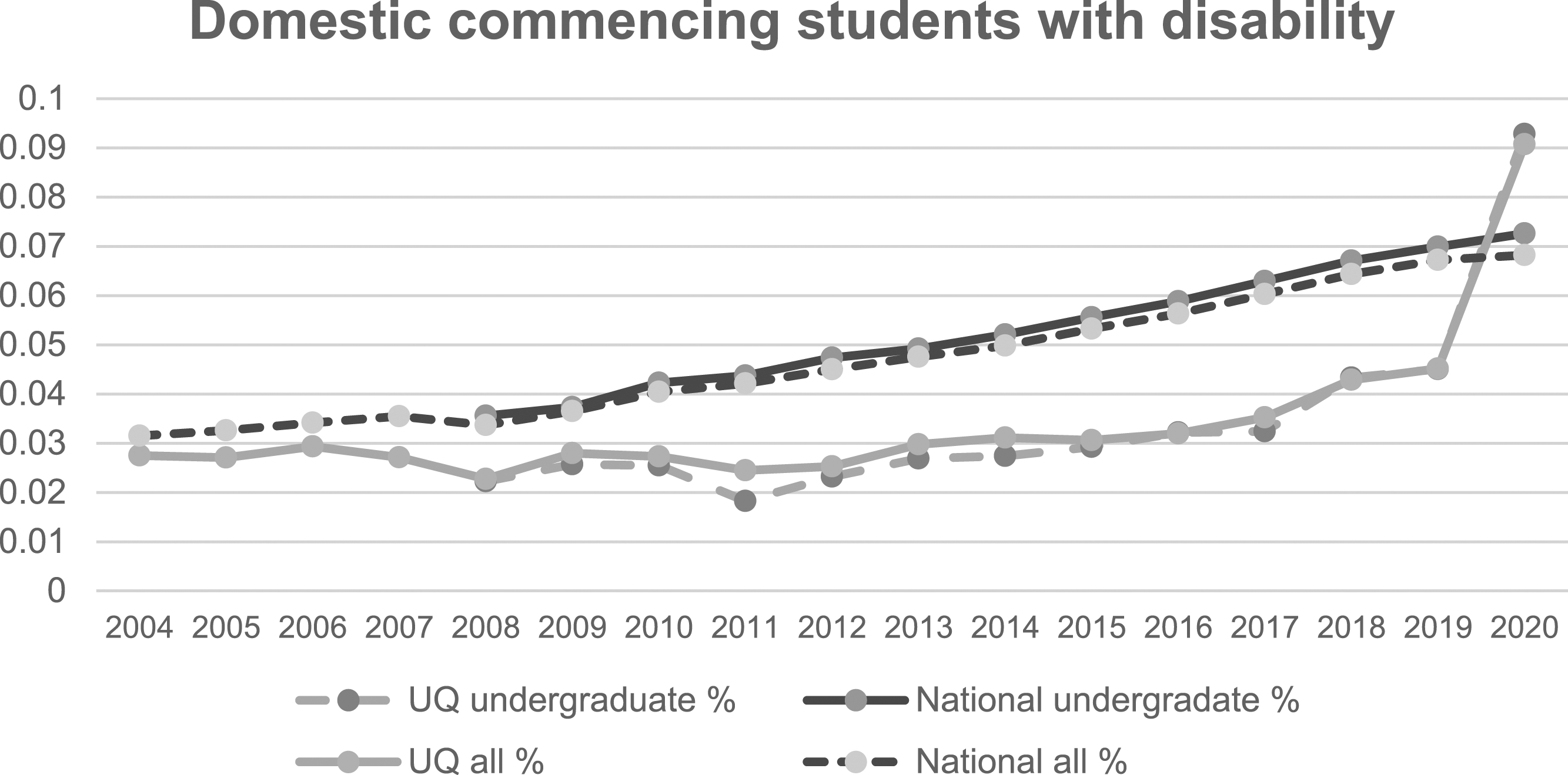
Despite the existence of protections against disability discrimination in education in some states since the early 1980s and nationally since 1992, data on enrolments of students with disability were not nationally reported before 1996. 21 These data indicate increasing numbers of students with disabilities attending universities in Australia. In 1996 there were 4647 domestic students with disability commencing in tertiary education (1.94% of all commencing domestic students). 22 This had risen to 8123 domestic students with disability commencing tertiary studies at universities in 2005 (3.26% of all commencing domestic students), 23 of whom 263 were at UQ (2.71% of all commencing domestic students at UQ). By 2015, there were 19,742 commencing domestic students with disability at universities (5.33% of all commencing domestic students at universities), and 14,212 commencing undergraduate domestic students with disability at universities (5.56% of all commencing undergraduate students), of whom 245 were at UQ (2.93% of all UQ commencing undergraduate students).
The latest available figures are for 2020.
24
In that year, there were 27,984 commencing domestic (CD) students with disability at universities (6.92% of all CD students), and 19,462 commencing domestic undergraduate (CDU) students with disability (7.26% of all CDU students), of whom 667 were at UQ (9.28% of all CDU students). As Figure 1 below indicates, this is the first time in the years covered by the datasets that UQ has been above the national average for CDU students with disability. Domestic commencing students with disability: UQ compared to the national average. Source: Department of Education, Skills and Employment.
25
While these data provide some basis for assessing the situation of people with disability in tertiary education in Australia, the absence of comprehensive data (including qualitative data) reporting on the experience of tertiary students with disability is notable. This absence limits the capacity of federal, state and territory governments and providers to accurately identify and address barriers faced by people with disability in tertiary education.
Research and academic context
As has been found in other parts of the world, 26 the DDA has not translated into real world equity in education for Australian students with disability. 27 Researchers have identified a need for universities to be more proactive in monitoring and facilitating disability inclusion. 28 Yet, in a report that examined all universities in Australia, Kilpatrick et al. noted ‘Regardless of university performance, the monitoring of retention and success of students with disability was either not being done or not being done well’. 29
The research to date indicates something of a gap between intent and practice domestically and internationally. Barriers to fully inclusive practice identified by such research includes inefficient systems for implementing approved adjustments, 30 failure to effectively consult with the student about their disability-related needs, 31 and limited resourcing for student support staff. 32
Other research indicates a range of negative impacts for disabled students. These include students facing negative reactions to disability disclosure, 33 being forced to accept less effective adjustments, such as relying on another person to provide direct support rather than reliable technological solutions, 34 feeling burdened by the extra work required to help staff understand and implement their approved adjustments, 35 and being scared to raise their concerns with staff for fear of negative impacts due to power differentials. 36 Students with disability have also indicated concern that their role in consultations on improvements is tokenistic. 37
Evidence suggests that compliance with the DDA is inconsistent and effectively voluntary. For example, an audit of 41 tertiary institutions found that five did not have registered Disability Action Plans and three had plans that had expired. 38 The same research found that most institutions described having inclusive practices and policies yet students with disability were rarely involved in policy making. Existing assumptions made by the tertiary sector are that support and reasonable adjustments for students with disabilities are already available and provided, yet students have reported finding the process of accessing adjustments is complex, confusing and stressful. 39
While Australian universities have rising levels of enrolment of students with disability, such students have lower retention and success rates than overall student populations. 40 A study of Australian universities for the years 2007–2013 revealed that, over the 7 years of the study, the ratio of success for students with disability to the overall student success rate was between 0.938 and 0.948:1. 41 Consistently poorer success rates were identified for students having learning disability (0.931–0.943), medical disability (0.930–0.943) or ‘other’ (0.899–0.932), as did students who required ‘services to assist in their studies’ (0.919–0.940). 42 Higher success rates were reported for students with hearing (0.955–0.977), vision (0.944–0.969) and mobility impairments (0.942–0.957). 43 Similarly, the ratio of retention of students with disability to the total student population was between 0.971 to 0.981:1. 44
Unfortunately, the absence of a nationally consistent system for categorising students with disability affects the capacity to understand the situation for students and universities across Australia. 45 This, in turn, limits the quality of information available to prospective students about their university options. More consistent data could contribute to work on equity rankings of universities in Australia. 46 Just as prospective students have access to global rankings for universities on a number of measures, such rankings should be available on equity issues, including disability. 47
Research found that while support staff at Australian universities felt knowledgeable about the supports available to students with disability, the students themselves were confused about those supports, suggesting breakdowns of communication between students and support staff. 48 This research reported that both students with disability and disability support staff ‘described negotiating and implementing reasonable adjustments as a complex and variable process’. 49 The research found that the willingness of teaching staff to implement the agreed reasonable adjustments was variable. In Australia, 50 and elsewhere, 51 students described experiencing stress due to the onus placed on them to navigate implementation of adjustments, and at times having implementation denied by teaching staff, even after reasonable adjustments had been approved. 52 This phenomenon of students experiencing stress due to the onus placed upon them is also observed in international research. 53
Harpur and Stein 54 argue that universities can act as agents for change in the field of disability rights. They propose this can be achieved by helping to bridge gaps between disabled students and potential employers, by providing positive representations of disability through having people with disability in a range of academic and professional roles, and by encouraging student participation in the development of inclusive practices. This aligns with emergent research around the concept of ‘student voice’. 55 Student voice is related to the more established research field of ‘employee voice’.
Employee voice examines the ways in which employees influence the systems, structures and functions of the organisation they work for, whether through informal peer-based networks or through formal processes. 56 While employee voice recognises the role of employees as stakeholders whose influence and participation can benefit an organisation, 57 student voice recognises the role that students can play to benefit their institution, and to improve inclusion and equitable educational practices. 58 Several studies have concluded that a greater emphasis on student voice, and more proactive approach from institutions towards disability access, is required for institutions to be truly inclusive and provide equitable education, 59 and by extension, achieve compliance with legal obligations.
Surveying students with disability using open and closed questions has been shown to provide important information on the student experience as well as greater understanding of the types of difficulties students with disability face and, by being able to identify difficulties by disability type, begin to understand why these problems arise and their impacts. A pilot study of Swedish students with disability in higher education demonstrated the need to supplement Likert-type measures with open-ended questions, in that case to explore the perceived reasons for the problems identified. 60 Open-ended or qualitative questions also provide a mechanism for recording and analysing student voice.
An emerging area of academic research is on the impact of COVID-19 measures on inequality and marginalised groups, 61 as well as specifically on education, 62 including on education for students with disability. 63 As is the case across the world, many changes were implemented that affect face-to-face teaching at universities in Australia. The extent to which these changes have had positive or negative impact on the experiences of students with disability is of interest given the timing of the pilot survey.
Surveys of students with disability, which identify areas for improvement, may serve to highlight legal compliance issues and encourage universities to take a more active approach. If undertaken consistently over time and across institutions the body of data about student experience—both positive and negative—can help identify what has been effective. It could also help prospective students to make more informed choices about both which institutions they might seek to study at and the types of reasonable adjustments that have been effective for students with similar disabilities.
The research question
The initial research plan, funded by the UQU, was to have a small internal report on the experience of students with disability at UQ. This quickly attracted the attention of others with an academic interest in university inclusion practices and morphed into a more expansive plan to undertake an extensive survey across multiple universities.
As a result of the initial project development discussions across the team, two broad research questions were identified: 1. Are Australian universities meeting their obligations to provide: a. non-discriminatory education for students under the Disability Discrimination Act 1992 (Cth); and b. equitable education for students with disability in accordance with the Convention on the Rights of Persons with Disabilities? 2. If not: a. in what ways are they not; and b. what can be done to improve?
As the project developed further it became apparent that its scope was beyond the resources and time available and, as a result, the team decided to refocus it to the original internal report based on a UQ-only pilot survey, with a view to expand the project in the future.
As such, the research questions for this discrete pilot project are: 1. How effectively is the University of Queensland meeting its obligations to provide: a. non-discriminatory education for students under the Disability Discrimination Act 1992 (Cth); and b. equitable education for students with disability in accordance with the Convention on the Rights of Persons with Disabilities? 2. If not: a. in what ways is it not; and b. what can be done to improve?
Development of the survey
It was agreed early in the project development that the research should use both qualitative and quantitative questions to provide a rich data set for analysis. Given the three decades of operation of the federal DDA and almost two decades that have passed since the enactment of the Education Standards, it also is relevant to link the experience of students with disability in education with the obligations of educational institutions and providers under those legislative instruments.
Methodology of survey development
Early in the project, the research team identified that the survey would benefit from a co-design approach. This stemmed in part from the student researcher having disability, as well as involvement of members of the research team in disability rights activism over many years. A core value of disability rights activism is ‘nothing about us without us’, 64 which more recently is sometimes adapted to, ‘nothing without us unless led by us’. 65 The authors sought to bear in mind that it is students with disability who are the experts at being students with disability. The researchers also recognised that a co-design approach would help to manage the scope, accuracy and validity of the survey by having direct input from students about the areas of university life that most affected them.
In researching the situation of people with disability in Australia, co-design has come to be considered best practice. 66 The commitment to co-design has been taken a step further in Australia in relation to research about Aboriginal and Torres Strait Islander peoples with the National Health and Medical Research Council publishing an additional guideline that states ‘It is important that research with Aboriginal and Torres Strait Islander people and communities is led by Aboriginal and Torres Strait Islander people and communities.’ 67
The benefits and challenges of a co-design approach to research design and outcomes have been considered in a meta-analysis reported by Brett et al. in 2012. That analysis considered studies reporting on the impact of what they termed ‘patient and public involvement (PPI) in research’. 68 They found that such an approach to research has positive impacts across all stages of the research process from initial design, development of research protocols and data collection, analysis and reporting, and dissemination and implementation. They also noted that there are challenges of this approach, again at each stage of the process. One particular challenge that affects all stages is the additional time and cost involved in ensuring genuine co-design. Another challenge identified—‘the problem of colliding worlds’ which is described as arising when ‘priorities, motivations and ways of working differ and science gets contested, causing conflict and power struggles between researchers and service users’ 69 —also has potential to impact across all stages and can also arise within multi-disciplinary research teams. The research team’s experience of the benefits and challenges of a co-design approach are considered further in the ‘Discussion’ below.
The survey design began with a ‘green-field’ approach: brainstorming what issues the student researcher considered were relevant to explore given the extensive conversations she had been having with students with disability at UQ through online fora. These conversations included students complaining about particular aspects of their university experience and identifying problems they were having. These problems included, for example, gaps in support needed to ensure their disability-related needs were accommodated, lack of effective response when they raised issues about aspects of the university environment and systems, the impacts of these and other experiences on their progress at university and their broader inclusion in university life. This resulted in extensive notes that were referred back to in the next stage of the development process.
The next stage was a review of other relevant research including surveys and questionnaires conducted with people with disability. These included higher-education-specific research, education-specific research, and broader data-collection tools, such as the Australian Census. 70 Questions from two reported studies—Black et al., and Holloway 71 —were included in the drafts of the survey.
The team sought to ensure that the survey development process was informed by students with disability at UQ. This was done through the student researcher using the UQU Disability Collective’s networks. The Disability Collective is established under the auspices of the UQ Union. 72 It comprises students with ‘disability, chronic illness, mental illness, neurodiversity and/or who are Deaf’. 73 The Disability Collective has a range of functions including advocacy on behalf of students with disability to the university, peer support to students with disability, promoting awareness of issues affecting students with disability to the broader university community and beyond, and maintaining a ‘positive, welcoming and supportive community’ for students with disability. The Disability Collective has approximately 400 active members consisting of current UQ students and alumni who experience disability. The student researcher, as the Collective’s elected Disability Officer, was involved in running the Disability Collective, including hosting formal and casual meetings, and administering the Disability Collective’s social media spaces. The main ways that members of the Disability Collective interact are online, including in a members-only Facebook group, through various Facebook messenger chats, via a members-only Discord 74 server with multiple discussion channels, and at regular formal meetings of the Collective (held online using Zoom or Teams and in person every 4–6 weeks).
In their role as Disability Officer, the student researcher used both informal and formal mechanisms to seek input and engagement from members about the survey during the development process. Even before the survey design work commenced, there were questions, issues raised and discussions in the Disability Collective’s online community spaces, and at meetings of the Collective that were identified as relevant to identifying key areas for inclusion in the survey. These discussions continued throughout the survey design process and helped to further shape the scope and inform the specific survey questions to be included.
The student researcher also specifically put out calls to members through the various communication channels seeking feedback on specific issues and questions. 75 This included, for example, inviting members to provide input on the overarching issues to be explored as well as to consider the ways in which particular enquiries, such as the collection of data on disability identity, might be most effectively and sensitively framed. This latter area of enquiry led to general discussions with about a dozen members about the approach to categorisation of disability in research studies and whether research such as this should collect data on diagnosis, functional impacts of disability and/or how students self-identified.
Through the process, a small number of members indicated they were available to be more involved in the survey design. These students were invited to help in the work of identifying other relevant research and engaged with the process by reading through the draft and final survey to provide feedback on the wording and scope.
Despite the size of the Disability Collective’s active membership, only around 20 members actively engaged with direct requests for specific input as part of the survey design process. Many more expressed a desire to contribute but could not. Reasons given included a lack of time or energy, and concerns about their ability to balance additional commitments with existing demands on them as a student with disability. This points to a need for a large pool of contributors who may choose how and when to contribute, and to a need for multiple opportunities to contribute via more organic and informal avenues throughout the survey design process.
The first iteration of the survey was expansive with 108 separate questions—not including sub-questions, individual Likert statements, and individual functional impact statements—drawn from a range of sources as well as questions developed by the research team to address areas of enquiry identified by them and through the student discussions. The team identified that a survey of this length would be ineffective due to the risk of participants being unwilling to allocate the amount of time needed to complete all questions. As a result, the survey was cut back significantly, with the final survey comprising 35 questions, of which 23 focus on student experiences at UQ across key domains of university life.
Identifying a suitable platform for the survey was also part of the development process. The intention was to conduct the survey online, providing the link to UQ students with disability through various online groups and networks and potentially through relevant UQ student email lists. The survey was initially developed in Qualtrics but was subsequently moved to Microsoft Forms. It was recognised that Microsoft Forms is not an ideal format in part because of disadvantages such as the inability to save when part way through the survey and return to the saved version later. In the end, the decision to use Microsoft Forms was made because this platform had the lowest barriers for use as it is a free and accessible tool for all students at UQ.
As noted earlier, the survey design includes both qualitative and quantitative questions, intended to amplify student voices in a manner that can be adapted to later gather comparative student data from multiple Australian universities. The survey deliberately includes questions designed to elicit positive reflections so students with disability are not left in an overall negative emotional state on completion.
Ethics
As a result of the decision to use the survey as the basis for an internal report to UQU, there was no requirement for formal ethics approval. Despite this, the introductory materials for the survey include an explanation of the rights of participants and potential impacts on participants.
The team also considered it important to include information about the UQU Disability Collective, rights under discrimination law and where assistance could be obtained if needed. This material forms the final sections of the survey and has also been replicated as a downloadable Word document on the UQU Disability Collective webpage. 76
It is hoped that future iterations of the survey, including beyond UQ, will be conducted as a formal process that contributes to the Australian academic literature on the experience of students with disability in post-secondary/tertiary education. The publication of the survey instrument is intended to facilitate comparative research nationally and internationally.
The survey
The development process resulted in a survey with 35 demographic, qualitative, and quantitative questions. A copy of the final survey is available at https://osf.io/ngkxc.
After the introductory material discussed briefly above which comprises Part 1, the substantive survey is divided into four parts. Part 2 seeks demographic data. Part 3 seeks specific data on impacts of disability in terms of supports, aids, and equipment. Part 4 focuses on quantitative data relating to students’ experiences of key domains of university life, and the final part, Part 5, focuses on qualitative data about those experiences.
In Part 2, the student demographic data includes their student status at UQ, including whether they are domestic or international students, their main mode of study (ie, on campus or external), the degree level they are undertaking (ie, undergraduate or otherwise), years of study at UQ, their age, gender and Aboriginality. 77 The final two questions in this part focus on identity as a student with disability. Participants are first given an opportunity to name and describe their disability. This question was included in direct response to concerns from students consulted in the design about the need to recognise the importance of each student’s own identity. The second provides an opportunity to identify the impact of the student’s disability on the following particular functional areas: vision, hearing, mobility and physical functions, mental health, neurological functions, cognitive processes, communication, energy levels and other functional impacts.
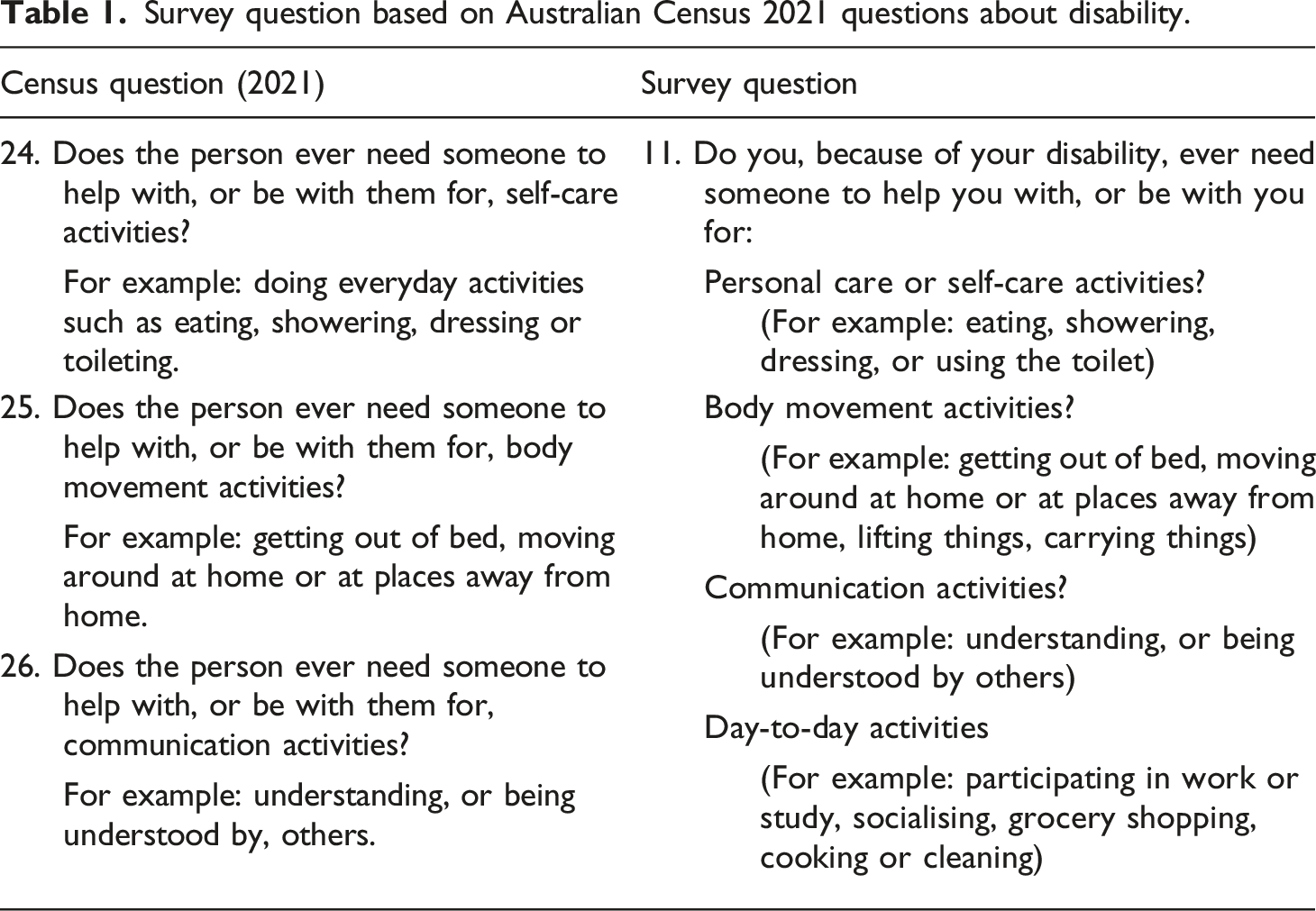
Part 3 explores further the impact of disability on the person’s support and equipment needs. It contains only two questions, the first of which reflects three questions asked in the 5-yearly Australian Census.
The Census questions have been modified and supplemented to reflect wide-spread public feedback from people with disability in Australia after the Census, criticising the narrowness of the questions which had the effect of excluding some people with disability from having that identity accurately reflected. 78 The key concern has been that there are many people with disability who do not require assistance from another person, but who do use adaptive technology, assistive equipment or an assistance animal. This community identification of a gap in the Census is relevant, not only to a survey of this sort, but also to the extent to which Australia is fulfilling its obligations under the CRPD article 31 to collect data to inform policy development. The failure to identify a significant cohort of people who identify as having disability, but who cannot have this recognised in the current Census results in under-counting of the population of people with disability. It also means governments are working with (potentially significant) under-estimates of the level of non-human accommodations being used by people with disability. Both have impacts for policy development and budgeting.
Survey question based on Australian Census 2021 questions about disability.
Part 4 of the survey seeks to understand aspects of the participants’ experiences at UQ. The aspects of university life that students are asked to respond to include physical access on campus; digital spaces managed by the university; course delivery, structure and content; administrative procedures, policies and/or bureaucratic processes; course materials; exams and assessments; and support services provided by the university. Each aspect is rated using 5-point scales in terms of being difficult to navigate, not accessible, discrimination, causing problems or satisfactory (reverse scored).
The inter-relationships of these ratings by students are a matter of research interest. For example, an aspect that is not accessible may in legal terms be considered discriminatory: the data may indicate the level of understanding of students of what is discrimination and/or their willingness to name experiences as discriminatory.
Part 4 also includes questions regarding whether or not students have ever made a formal complaint (which is defined in the question) about a negative experience, and if not, why not. The questions provide an opportunity to explore important issues about formal complaint mechanisms, including levels of awareness of such mechanisms, and perceptions of such processes.
Participants are also asked in this Part to report particular experiences, for example, whether they have considered dropping a subject because their required adjustments were not being made, or they had to wait for course materials to be made accessible. Their options for responses to these questions are ‘Yes, always’, ‘Yes, sometimes’, or ‘No’. These questions reflect some of the issues that had been identified by students to the student researcher as a Disability Representative, and also by students involved in the survey design phase.
The last of the quantitative questions in this Part uses a 7-point Likert scale asking students about their level of agreement or disagreement with a range of statements about their experiences at UQ, for example, ‘UQ meets my needs’, ‘I am confused about what supports are available to me’, etc. These include statements that are positive about the university experience and others that are negative. The final statement in this question is ‘I would recommend UQ to other students with disability.’ A deliberate decision was made to ensure a mix of positive and negative questions, both to integrate a strength-based approach and to minimise the extent to which participants were left in a negative emotional state by the survey. This concern was also strongly factored into the final part.
Part 5 contains 12 qualitative questions. These are introduced with text indicating that participants need not respond to all of them and then summarising the content of the questions to enable students to readily identify the questions of particular interest or relevance to them.
One aspect of this Part is particularly notable: questions about the impact of the COVID-19 pandemic. The questions were developed in response to feedback from students with disability about changes to university life resulting from COVID-19 pandemic measures. As with the situation of many people with disability in employment, measures implemented to reduce risk of transmission had the potential to improve some aspects of university procedures for students. For example, online classes may be more accessible to students with anxiety disorders or who face physical barriers to transport and within the university campus. Significantly, however, such measures could also have negative impacts for other students, with perhaps the most obvious being the impact of face masks on students with hearing impairments who rely to some extent on lip reading.
Pilot and roll out
This pilot survey was rolled out in two stages. The first stage involved the survey being completed by members of the Executive of the Disability Collective in mid-March 2022. That first-stage process did not identify any changes needed to the survey, enabling those responses to form part of the final survey data.
The second stage was distribution of the survey to the UQ disability community more broadly. The survey went live for students on 3 April 2022 and was promoted through a range of networks–UQU Disability Collective, UQ First Years, UQU, Discord and shared through various other special interest cohorts within UQ–and social media platforms. Reminders were sent out in late April, late May and at the end of the Semester One exam period in June. The survey remained open until the end of June 2022.
The data analysis was conducted in the second half of 2022 with the survey report published by UQU in December 2022. The report is now publicly available through the OSF project page: https://osf.io/mcbn8.
Additional feedback was obtained from UQU Disability Collective members and key stakeholders following the second stage and during and after data analysis. Responses were reviewed along with feedback from Collective members on aspects of the survey they found difficult or confusing. Feedback was also sought from researchers, education administrators, and disability sector organisations prior to publishing the final report. Suggested amendments to the survey arising from this feedback are contained within the final report and mentioned in the Future Directions section below.
Discussion
There have been, as is inevitable with such a project, a number of challenges that the research team have had to overcome to get the survey out into the student community at UQ.
The first of these was the challenge of having too many areas of inquiry and, as a result, too many questions. As noted, the initial draft survey included many more questions than the final survey and specifically included questions about ideas for improvements. Achieving this shorter survey required consideration of whether it would be more beneficial to maintain a breadth that enabled collection of data on problem causation and solution and inevitably achieve less depth of inquiry, or to seek to better understand the student experience without asking students for their views about what might give rise to those experiences and how the problems they have experienced might be resolved. The decision to focus on student experience reflects the importance to the research team of validating student voice.
As noted above, a key concern in terms of data collection and student voice was around how to define and group disability and for what purpose. The most obvious concern was to be able to group responses meaningfully in the analysis, for example, to identify the scope of responses from people with vision impairments and be able to compare that scope with people with other disability types. We also faced the challenge of ensuring that participants’ self-identity was not lost in this process. Of relevance also was the extent to which we could meaningfully collect information about functional impacts to contribute to the comparative analysis of experiences. By enabling both self-identified disability and functional impacts to be recorded, we hope that we will be able to undertake data analysis of patterns of experience, particularly in terms of the university domains across functional impacts.
Another challenge arose from the strong benefits of having diverse disciplinary and life expertise in the research team. 80 Anyone who has undertaken trans-disciplinary community-engaged research will be aware of the different research approaches and methodologies and that these differences need to be understood and worked through to ensure the resulting research tool meets the needs and expectations of the team. This is the ‘problem of colliding worlds’ referred to by Brett et al. 81 The current research team crosses the disciplines of law, psychology, and business and management as well as having diverse experiences in respect of disability.
Delays, complexity and funding constraints resulted in significant changes in approach, particularly the shift in focus to an internal report rather than peer reviewed report. Internal university approvals for distribution were sought but the likely delays identified by the university in achieving the necessary approvals for distribution resulted in the decision to go ahead without using formal university distribution channels. This meant the research process relied on distribution through the disability collective, student union, and social media distribution channels.
While having a student with disability as the key researcher on this project has many benefits in terms of awareness and networks, the student began the project as a relative novice in both qualitative and quantitative research methods. This has presented both a challenge and an opportunity, with the student researcher not coming with preconceived notions of what a study of this sort should look like. As noted earlier, she was encouraged by her mentors to begin this work by brainstorming the issues and range of potential questions before reviewing published surveys. As a student with disability, the researcher also had the demands of her own study program and the episodic impacts of her disability to factor in. During the course of the project, there were several times when her disability was affecting her more severely, resulting in delays.
Of critical importance to this pilot project was the existence of both formal and informal mechanisms for students with disability to contribute to the co-design process. Students who were able to participate indicated a strong preference for having opportunities to make informal contributions to co-design over formal contributions. Reasons for this might include fluctuating personal capacity due to disability and fluctuating work capacity due to subject study demands. This highlighted for the research team the importance of providing informal and organic mechanisms for contributing, alongside formal mechanisms, to afford opportunities for participation to people who may be unable or unwilling to participate in co-design processes though formal means. This pilot project has had the benefit of a large and well-resourced student union body, which in turn supports an active student disability collective. Future studies that wish to employ a similar co-design process should consider how to support the cohort of students with disability to develop their capacity to engage with such research and how to enable organic and informal, as well as formal, contributions to co-design using the resources and networks they have available.
It is notable that during the development process, UQ was working on improvements to its Disability Action Plan. This has had little if any impact on the project direction as members of the Disability Collective remain concerned about implementation and accountability of any new goals in the forthcoming Action Plan. It is likely that this research and similar future research and its impact will be affected by a range of factors including, for example, the level of focus or priority on disability inclusion within the particular university’s management.
Future directions
Members of the team have discussed a range of possible future directions, from the practical and immediate to much more ambitious options.
At the practical and immediate level, the survey data of course had to be analysed and reported on. This took place in the second half of 2022. The report has been published and presented to the UQ senior leadership with the aim of informing policy and practice improvements. It is available on the website of the UQU at https://www.uqu.com.au/disabilityreport and at the OSF project page: https://osf.io/tbh5p/.
Over the next six to 12 months, the team will work with the UQ leadership team to secure commitments for resourcing and co-operation to repeat the survey every two to 3 years to provide longitudinal comparative data.
As already indicated, the final survey is significantly less ambitious than the original project idea. This fact shapes at least part of what the team hope to achieve in future: a survey that can be rolled out to the other 42 universities in Australia (and perhaps even more broadly to overseas universities) to gain comparative data.
The report includes recommendations for refinements to the survey instrument as well as a set of final recommendations focussing on the goal of the survey being conducted in all Australian universities every 3 years, with suggestions for modifications to take account of what has been learnt from this pilot. The recommendations identify key stakeholders in the form of the national peak body, Universities Australia, and the federally funded Australian Disability Clearinghouse on Education and Training (ADCET). 82 To do this would require resources to enable work with relevant personnel in each university to modify the language of the questions to reflect the terms used and approaches to reasonable adjustments and other supports. The team would also seek to ensure that the information about education rights and support services is amended to reflect the situation relevant to other universities. In this regard, the easiest extension would be within Queensland to the eight universities in this state.
Of particular relevance to such future research is the identification within each university of the organisations—both formal and informal—of students with disability. These groups should, as with this pilot project, play a central role in the work of modifying the survey instrument and encouraging students to engage with the survey.
The potential for roll-out to other universities in Queensland and beyond will be greatly enhanced by developing relationships with ADCET. 83 Developing links with the Disability Rights Working Group of the Berkeley Center on Comparative Equality & Anti-Discrimination Law 84 also provides an opportunity to explore international collaborations.
Conclusion
The complexity of some aspects of the work done to develop the survey highlights the benefit of sharing this work with others in an effort to achieve a national (or broader) dataset of the experiences of students with disability in university education.
As noted in the discussion, a key element of this project was the research team’s access to a body of students with disability which had in place a range of mechanisms for formal and informal interaction. This enabled the team to draw on the experiences of those students to guide the research and shape the scope and focus. For researchers in other universities, both in Australia and overseas, finding ways to gain the trust and tap into the experience of people with disability at their institutions will be critical to relevance and success of disability research and initiatives to improve inclusion and equitable access.
The potential for this research to ground a longitudinal study is clear and it is hoped that this can be achieved. While there are clear benefits of such a longitudinal study survey becoming embedded in institutional practices with public reporting, there may be more reluctance of students to participate in such a survey if they have had negative experiences.
How such a survey would be deployed is an empirical question. A well-resourced deployment backed by the institutional agreements of strong partners is in theory possible and perhaps ideal. However, informal partnerships between groups of students with disability and local academics might also be achievable, perhaps more quickly. This latter approach is enabled by the research team making the full survey instrument freely available as well as identifying, in the research report, areas for improvement. Scholars and students might first attempt to launch nationally co-ordinated efforts best placed to yield substantive change. If negotiations to achieve these seem stalled, those scholars and students could seek to bring together like-minded colleagues to co-ordinate intermediate efforts in a series of iterative informal approaches that ultimately seek institutional support and co-ownership or adoption.
There are clear and significant benefits to future students with disability from publicly reported survey results across universities. To be useful to prospective students, such results could feed into equity rankings and indicate scores for disability, and even, given the breadth of needs arising from different disabilities, for specific disability needs or adjustments. We hope that this survey can be a step towards having comprehensive, publicly available reporting on disability equity across Australian universities.
Footnotes
Authors’ note
The authors and research team acknowledge with thanks the following, without which this project would not have been possible:
• the University of Queensland Union for funding;
• Glenda Jacobs, University of Queensland Union General Manager of Student Affairs, for suggesting that the Disability Collective consider conducting a survey to support the Collective’s advocacy efforts
• Dr Paul Harpur, T C Berne School of Law, University of Queensland; Professor Adrian Wilkinson, Centre for Work, Organisation and Wellbeing, Griffith University; and Dr Susilo Wisibono, School of Psychology, University of Queensland for their generous, expert input;
• Brooke Szucs and Anthea Burton, members of the UQU Disability Collective, for assistance provided to develop this survey;
• Jane Hawkeswood, Australian Disability Clearinghouse on Education and Training (ADCET), for circulating a call for materials and contacts;
• Leona Holloway for providing us with her survey tool for vision impaired students (see Holloway, n 71);
• Jessica Buhne, National Disability Co-ordination Officer, for providing an unpublished survey tool;
• Dr Eleanor Browne, (then) University of Queensland, for reviewing the draft questionnaire and providing feedback; and
• all of those students and staff who informed the design of the survey.
Declaration of conflicting interests
The authors declared no potential conflicts of interest with respect to the research, authorship, and/or publication of this article.
Funding
The authors disclosed receipt of the following financial support for the research, authorship, and/or publication of this article: This work was supported by the University of Queensland Union.
