




Abstract
Dutch legislation has prohibited disability discrimination with regard to post-secondary education since 2003, when the Equal Treatment of Disabled and Chronically Ill People Act came into force. The Act prohibits disability discrimination with regard to, inter alia, further and higher education. The Netherlands Institute for Human Rights (NIHR) plays an important role in interpreting and applying all Dutch equality legislation. It has a quasi-judicial task and, in this capacity, hears individual complaints and issues Opinions. The NIHR, and its predecessor, the Equal Treatment Commission, have issued numerous Opinions in the context of post-secondary education and (alleged) disability discrimination. For this reason, the Netherlands has been selected for a case study on disability discrimination in post-secondary education. This article examines 70 Opinions in this area and explores: whether individuals with particular forms of disabilities or chronic illnesses are over-represented in the cases brought; the main areas in which cases (alleging) disability discrimination in the context of post- secondary education have arisen; and the types of (alleged) discrimination which are at issue.
Keywords
Dutch legislation has prohibited disability discrimination with regard to post-secondary education since 2003, when the Equal Treatment of Disabled and Chronically Ill People Act 1 (the Act) came into force. The Act therefore prohibits disability discrimination with regard to further and higher education, which covers, inter alia, middle level technical vocational training (middelbaar beroepsonderwijs); higher level technical and vocational training (hoger beroepsonderwijs); and university education. Adult ‘lifelong learning courses’ are also covered. 2 The Netherlands Institute for Human Rights (College voor de Rechten van de Mens) (NIHR) plays an important role in interpreting and applying all Dutch equality legislation. 3 It has a quasi-judicial task and, in this capacity, hears individual complaints and issues Opinions. While these Opinions are not binding, and the NIHR does not have the power to impose sanctions, the Opinions are nevertheless influential. According to the Institute’s own monitoring, its Opinions which involve a finding of discrimination are acted on by the defendant institution in about four out of five cases. 4 The Opinions may address a measure which only applies to the complainant, a structural measure, or a combination of the two. 5
The NIHR, and its predecessor, the Equal Treatment Commission (ETC), have issued numerous Opinions in the context of post-secondary education and (alleged) disability discrimination. This is in contrast to many other European states, where there has not been a plethora of (quasi-)judicial rulings in this field. For this reason, the Netherlands, and specifically the Opinions of the NIHR and ETC, provide a basis for a case study on disability discrimination in post-secondary education, and specifically the application of non-discrimination legislation and related litigation. This paper carries out such a case study through an examination of 70 Opinions of the NIHR and ETC involving (alleged) disability discrimination in the context of post-secondary education. These Opinions cover the period since the Act came into force until early 2021. Amongst the issues explored in the paper are whether individuals with particular forms of disabilities or chronic illnesses are over-represented in the cases brought, the main areas in which cases (alleging) disability discrimination in the context of post-secondary education have arisen, and the types of (alleged) discrimination which are at issue. The paper also identifies prominent or noticeable trends in how the NIHR and ETC have applied the Act. In this way, the paper provides a case study which explores the issues students with disabilities and chronic illnesses experience in the context of post-secondary education.
The 70 Opinions were identified using the search engine of the NIHR. The searches were carried out in December 2021. 6 The limitations with the search engine mean that it is not possible to know whether every single Opinion relating to (alleged) disability discrimination in the field of post-secondary education was identified. 7 Nevertheless, these 70 Opinions provide a substantial basis for an analysis, even though one cannot be certain of the percentage of the total number of Opinions concerning post-secondary education which they represent.
The paper begins by briefly introducing the relevant Dutch legislation and explaining the organisation of post-secondary education in the Netherlands. The paper then focuses on a number of aspects or themes which are revealed by an examination of the Opinions, including the disability/chronic illness of the claimants and the areas in which discrimination claims were brought. The paper also pays attention to how the NIHR and ETC has interpreted and applied the Equal Treatment of Disabled and Chronically Ill People Act in specific cases.
Disability non-discrimination legislation
The Equal Treatment of Disabled and Chronically Ill People Act was adopted in 2003 to implement the EU Employment Equality Directive 8 and, in line with the Directive, prohibits disability discrimination in the field of vocational training, which also includes university education. The Act did not originally prohibit discrimination with regard to primary or secondary education. However, the material scope of the Act has since been expanded, and Article 5b of the Act now prohibits discrimination with regard to the supply of, and access to, goods or services, including all forms of education. Direct and indirect discrimination are prohibited, as well as an instruction to discriminate and harassment. The Act’s prohibition of discrimination also means that a duty bearer is prohibited from denying a person with a disability or chronic illness a reasonable accommodation, unless making the accommodation would amount to a disproportionate burden (Article 2 (1)).
Since 2011, the Act has included definitions of direct discrimination and indirect discrimination which are in line with the Directive. The one notable difference with the wording used in the Directive is that the Act, along with all Dutch non-discrimination law, does not use the word ‘discrimination’, but instead refers to ‘distinction’. The Dutch legislature opted to use the term ‘distinction’ rather than ‘discrimination’, as the latter is regarded as a highly loaded and pejorative term. Marianne Gijzen has argued that the term ‘discriminate’ (discrimination) in EU law has far less negative connotations that the same term in Dutch law, and specifically in Dutch criminal and constitutional law. For this reason she feels that the approach followed by the legislature was appropriate and compatible with the Directive. 9
The definition of ‘direct distinction’ in the Directive reads: Where a person is, or would be, treated differently to another person in a comparable situation on the grounds of disability or chronic illness (Article 1(b)).
10
While the definition of ‘indirect distinction’ reads: where an apparently neutral provision, criterion or practice affects persons with a disability or chronic illness in a particular way (Article 1(c)).
11
The Act allows for indirect distinctions to be justified, and therefore not amount to a prohibited form of distinction, in line with the Directive. 12
Lastly, as noted above, the Act imposes a duty to make a reasonable accommodation. Here too there is a deviation from the wording of the Directive, with duty bearers being required to make an ‘effective accommodation’ rather than a ‘reasonable accommodation’. This terminology was used to emphasise that a specific accommodation had to achieve the desired effect.
13
This is judged according to the ‘suitability’ or ‘appropriateness’ (‘geschiktheid’) and ‘necessity’ (‘noodzakelijkheid’) of a specific accommodation.
14
A second, and separate, stage of the assessment involves a consideration of whether a specific accommodation would amount to a disproportionate burden for the duty bearer.
15
The Act therefore reads: The prohibition of making a distinction includes the duty for the person to whom the prohibition is addressed to make effective accommodations in accordance to the need for this, unless doing so would constitute a disproportionate burden for him. (Article 2 (1)).
16
The organisation of further and higher education in the Netherlands
Three main forms of further and higher education are offered in the Netherlands: Middle-level applied or vocational education (MBO); Higher-level professional education (HBO); and Academic or University education (WO). Middle-level applied education involves vocational training, and lasts between 1 and 4 years. Students are trained and obtain qualifications which enable them to enter skilled trades and technical occupations, or work in support roles, in professions such as engineering, business administration or nursing. Students can commence such education at the age of 16, which is 2 years below the school leaving age. MBO education is typically provided by Regional Education Centres (Regionaal Opleidingen Centrums or ROC). In the school year 2020-2021, 509 797 students followed a MBO programme, meaning that it is the most common form of further and higher education followed in the Netherlands. HBO education involves vocational education at a higher level than offered at MBO level, and is provided by vocational universities or universities of applied sciences. The education is offered at both professional bachelor and master level, and lasts between 2 years for the lowest level of qualification, and 4/5/6 years, for the bachelor and master qualification. In the school year 2020-2021, 489 387 students followed a HBO programme. Academic education is offered at universities, which offer bachelor and master level education. In the school year 2020-2021, 331 505 students followed a university programme. 17
An analysis of Opinions of the NIHC/ETC concerning disability discrimination and further and higher education
The paper now proceeds to explore the 70 Opinions to identify trends and patterns in the kind of cases being brought before the Institute, as well as in how the Institute interprets and applies the legislation.
What disabilities/chronic illnesses do claimants have?
An analysis of the 70 Opinions reveals some clear trends in terms of the kind of disabilities or chronic illnesses of claimants. The condition which claimants most commonly had was dyslexia (16 cases). 18 In seven of these cases, individuals also had another (related) condition. Two claimants also had dyscalculia, which results in difficulty in making mathematical calculations (2012-202 and 2016-13); one claimant also had dysorthography, which results in difficultly spelling (2010-197); one claimant also had dyspraxia, which results in difficultly with movement and physical coordination (2021-33); and one claimant also had PTSD (2016-74). A further claimant had dyscalculia (2015-132), while one claimant had dyspraxia (2020-56). Neither of these two claimants had dyslexia alongside these conditions.
The second most common condition which claimants had was autism, including Asperger’s syndrome. Nine claimants had some form of autism (2013-1, 2016-52, 2018-103, 2019-730), five of whom identified as having Asperger’s Syndrome (2008-30, 2008-140, 2013-27, 2013-98 and 2014-102). Five claimants had ADHD (2015-57, 2015-97, 2021-77), two of whom also had autism (2013-1 and 2016-52). One student had a condition which impacted on language development (2016-56). Given that all these conditions can impact on the ability to learn and/or demonstrate knowledge when taking exams organised in the conventional way, it is perhaps not surprising that they make up almost half (n31) of the cases studied for this paper. The kinds of discrimination alleged by these students is discussed further below.
Claimants also had a number of other conditions. Six claimants had a hearing impairment (2005-140, 2006-35, 2010-109, 2011-18, 2015-26, 2012-10), while four had a visual impairment (2005-14, 2009-62, 2010-90, 2016-77). Seven claimants used a wheelchair. This was the result of differing impairments, including cerebral palsy (2006-59) and rheumatism (2009-4). In some cases, the underlying impairment which led to the use of a wheelchair was not identified (e.g. 2007-37 and 2005-65, in which the Opinion notes that the claimant used a wheelchair following an accident). Three claimants had muscle wasting conditions (2006-60, 2013-106 and 2014-137). A perhaps surprisingly small number of claimants had a psycho-social disability: four in total. Two claimants had (experienced) (manic) depression (2006-81 and 2016-49); one claimant had PTSD (2016-74); while one claimant had both conditions (2019-84).
Figure 1 shows the disabilities, chronic illnesses or conditions which claimants most commonly identified as having. As noted above, some claimants had more than one disability, chronic illness or condition. Disabilities most commonly identified by claimants. Areas in which discrimination was most commonly alleged. Number of Opinions concerning disability and further and higher education and overview of findings of discrimination 2005-2020.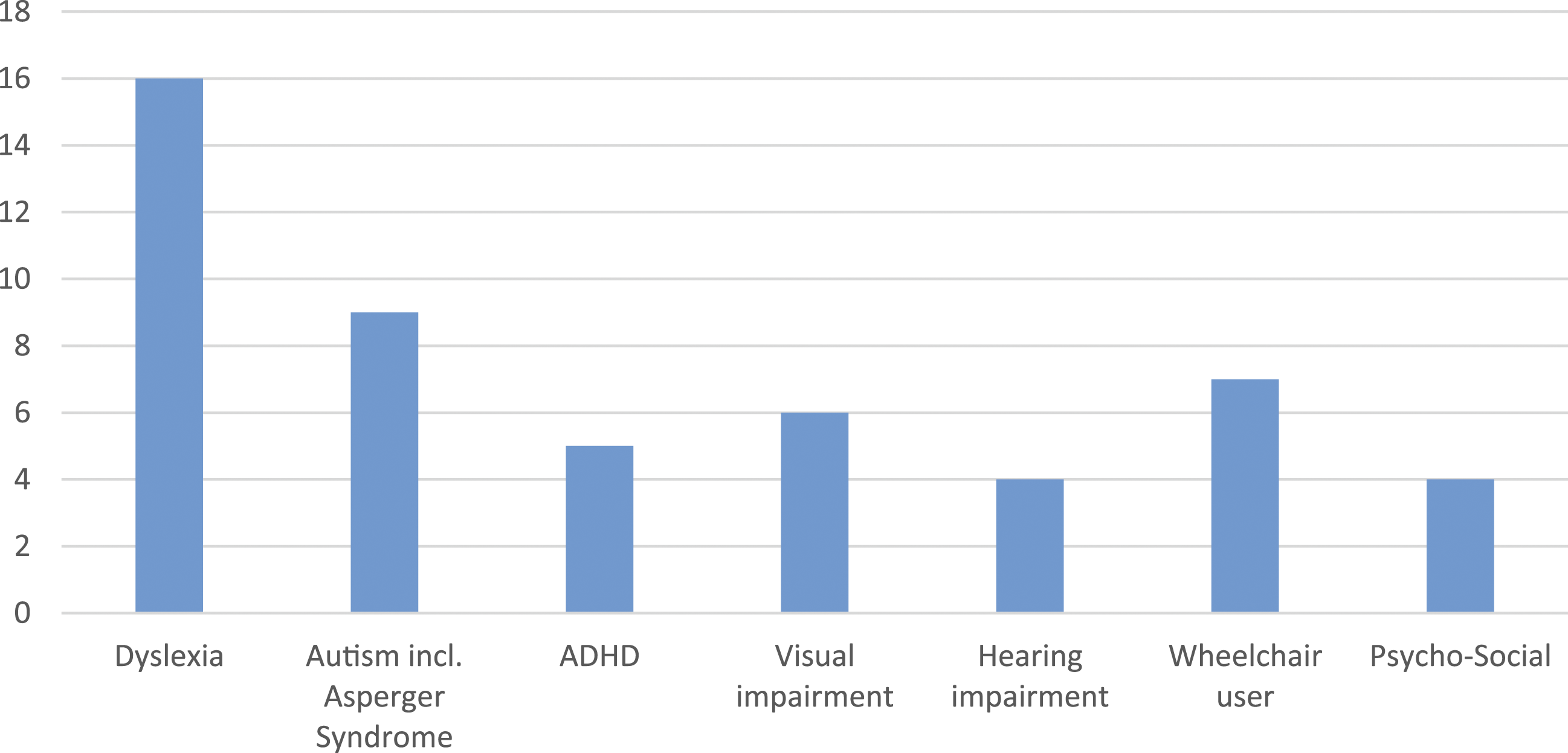
A wide range of other disabilities or chronic illnesses were identified by the remaining claimants. Some of these concerned physical or neurological conditions which were clearly visible, such as being short in statute (2011-14), brittle bones and being short in stature (2012-102), a brain illness which led to a physical impairment (2016-15), or partial amputation of a limb (2020-70). However, many claimants had invisible conditions which resulted in pain and fatigue, including narcolepsy (2007-26), Chronic Fatigue Syndrome/ME (2007-29), Crohn’s Disease (2009-4), Repetitive Strain Injury (2010-187), Irritable Bowel Syndrome (2019-84), or other conditions which led to the claimant experiencing pain (2009-62) or needing to spend a great deal of time in bed (2013-38). Other invisible conditions which claimants had include diabetes (2015-85) and bone cancer (2017-127).
Most claimants identified as having one disability or chronic illness. A limited number of claimants indicated that they had two or more conditions which were relevant in the context of discrimination, including, as noted above, claimants with dyslexia in combination with dyscalculia, dysorthography, dyspraxia or PTSD, and claimants with ADHD and autism. Four claimants alleged discrimination on the ground of disability and chronic illness in combination with age (2008-140, 2013-102), race (2012-120) or both age and race (2019-73). On the whole therefore, discrimination was alleged in the context of a single disability or illness, and claims regarding multiple or intersectional discrimination were generally not made.
What is noticeable is that the NHRI/ETC did not find that a single claimant had a condition which did not amount to a disability or chronic illness. While, as will be seen below, the majority of claimants were not successful before the NHRI/ETC, none of them lost their case because they were not disabled or did not have a condition which amounted to a chronic illness. A second noteworthy aspect of the disabilities or chronic illnesses which claimants had is that the majority were invisible. The educational institutions could therefore only be aware of the claimant’s status as a person with a disability or chronic illness if this was explicitly brought to their attention.
Which kind of educational institutions were involved in the cases?
Of the 70 cases identified, 64 involved complaints against institutions providing education. 17 cases were brought against universities; 20 cases were brought against institutions providing higher level vocational education (HBO); 26 cases were brought against institutions providing middle level vocational education (MBO); and two concerned institutions offering a different kind of education. This is roughly proportionate to the number of students following these different forms of education (university; HBO; MBO) in the Netherlands. Of the remaining six cases, four concerned organisations which offered exams (2007-37; 2014-35, 2018-72, 2020-56); one concerned an employer which provided an apprenticeship (2006-35); and one concerned a bank which hosted students doing internships (2014-154). This reveals that, while most cases concerned institutions offering higher and further education, a number of other kinds of organisations were also covered by the prohibition of disability discrimination in the context of higher and further education.
In which areas did the alleged discrimination arise?
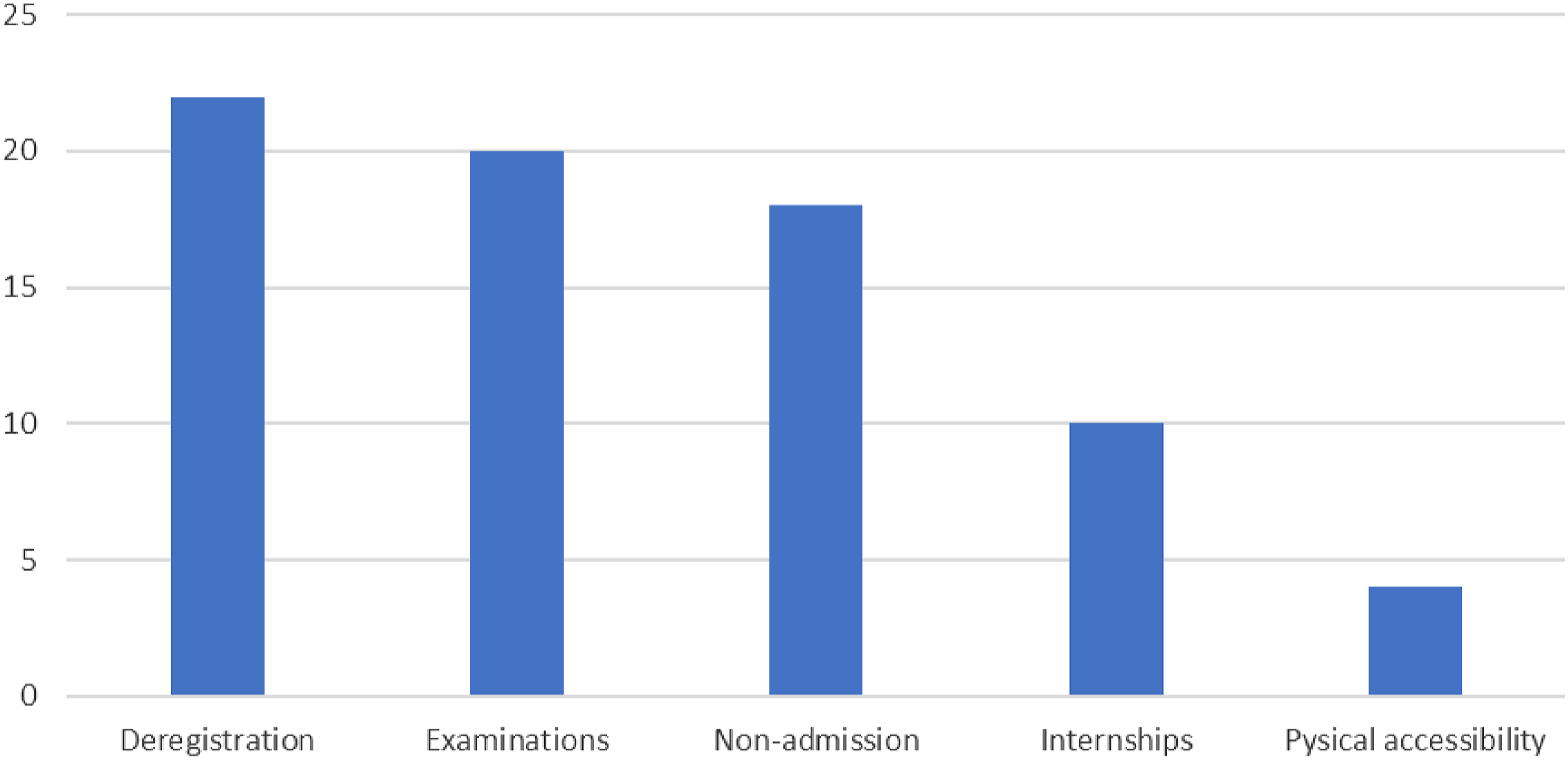
A clear pattern emerges when one examines the areas in which claimants alleged discrimination. A large number of cases involved deregistration or exclusion from a course or study programme which the claimant had been following (22 cases) or issues related to exams (20). Slightly fewer cases involved failures to enrol a claimant in a course or study programme (18). Other areas which were the subject of a number of discrimination claims were internships (10) and physical accessibility (4). A variety of other issues were raised in the remaining cases. In some cases, several areas were addressed.
Figure 2 shows the areas in which discrimination was most commonly alleged by claimants.
The following sub-sections explore some of the Opinions on the basis of the areas in which discrimination was alleged. What becomes apparent from this analysis is that there are many commonalities across these Opinions, both in terms of the factors which led the Institute to find that discrimination had occurred, and, in the alternative, the factors which led it to conclude that no discrimination had occurred. These commonalities are explored further in the section on Prominent patterns in the Opinions below.
Deregistration
In the context of deregistration, at least seven of the cases involved claimants who had received (substantial) reasonable accommodations from the educational institution, but who had nevertheless failed to make sufficient progress in their studies, and who were then deregistered. The claimants argued that the institutions in question had failed to make sufficient accommodations to enable them to progress, and had therefore discriminated against them. Opinion 2013-1 is one such case. The case concerned a student who had ADHD and a form of autism (PDD-NOS) who registered for a course at a college providing middle level vocational training. The college admitted the student and drew up and implemented a plan of action, including weekly meetings with a coach. Nevertheless, the student was disruptive in class and did not pass exams, and the college deregistered him at the end of the school year. The student’s father asked the NHRI/ETC to find that the college had discriminated against his son by providing him with insufficient reasonable accommodations and deregistering him from the course. The NHRI/ETC found that the college had provided extensive supervision and support. The student’s supervisor had advised that the student needed one-to-one supervision, which was not possible in the college setting. The college’s care team had assessed the situation on the basis of anonymous information and had reached the same conclusion. Arguably, this revealed that particular care had been taken in assessing the student’s situation and what the college could do for the student. The NHRI/ETC found that providing such supervision would have amounted to a disproportionate burden. It therefore held that no discrimination had taken place, and the duty to provide reasonable accommodation had been met.
As noted above, the NHRI/ETC found that educational institutions had met their duty to provide a reasonable accommodation before excluding a student in several cases. In all such cases, the education institute had provided additional supervision for the student. Other accommodations provided including adopting and implementing a plan of action (2010-109, 2011-18), providing additional possibilities to sit exams (2006-81) or allowing the student extra time or to use non-standard equipment when sitting exams (2006-90, 2015-57), allowing the student to always sit at the front of the class (2011-18), providing additional information to tutors regarding the student’s impairments (2011-18), and paying for the student to follow courses at the Open University (2016-74), 19 which is a distance learning institution.
In a number of other Opinions, which addressed areas other than deregistration, the NHRI/ETC has also found that an institution had made sufficient reasonable accommodations, and therefore no discrimination was found. One such case is Opinion 2010-11 (see the sub-section on Physical accessibility below), where the NHRI/ETC found that a university had made sufficient reasonable accommodation efforts to allow a student who used a wheelchair to access parts of university buildings. A challenge to a decision not to admit a student to follow a course also failed for the same reason in in Opinion 2006-59 (see the sub-section on Non-admission below). The finding that sufficient accommodation efforts have been made can therefore arise across different areas, and will lead to the conclusion that the duty to provide an accommodation was not breached.
The NHRI/ETC also found that claimants had not been discriminated against following their deregistration in cases which did not turn only on the issue of reasonable accommodation. One such case was Opinion 2007-26, in which the NHRI/ETC found that a college was entitled to deregister a student who, as a result of a disability/chronic illness (narcolepsy), was unable to carry out part of her course work as a beauty specialist in a safe manner, resulting in a possible threat to fellow students and other individuals. No accommodation was identified which could remove this risk. Opinion 2016-74, which is discussed below in the sub-section on Non-admission below, also involved a student who was not qualified to follow a course, and who did not meet the entrance requirements. In this case too, the NHRI/ETC found that no discrimination had occurred when the college did not admit the student, given that it had made several attempts to accommodate the student to allow him to reach the necessary academic level. Inability to follow a course, even with the provision of a reasonable accommodation, can therefore be a ground both for a refusal to admit a student to follow a course and for de-registering a student.
While the NHRI/ETC did not find discrimination in most cases concerning deregistration, Opinion 2010-197 did involve such a finding. The claimant in this case had dyslexia and dysorthgraphy and requested a study adviser, on numerous occasions, that he be allowed extra time and some further accommodations when taking exams. He also provided the university with medical documentation. However, he did not follow the procedure mandated by the university to request exam-related accommodations, and was only occasionally granted the requested accommodations. He failed a number of exams, and was consequently de-registered at the end of his third year. The NHRI/ETC found that the university had failed to communicate clearly with the student regarding the procedure he had to follow to request accommodations when taking exams, and, in that situation, the student should not be disadvantaged because he had only requested the accommodation via a study adviser. The NHRI/ETC found that while the university had an appropriate procedure in place for granting such accommodation requests, it had failed to inform the student of this in a sufficiently clear way, and had discriminated against him by failing to provide a reasonable accommodation. Poor communication has also arisen in some other cases (e.g. Opinion, 2007-37 discussed in the sub-section on Examinations below).
Examinations
Many of the cases involving deregistration also involved examinations, in that students claimed that they had failed their exams, and were therefore being deregistered, because the university or college had failed to provide them with the necessary accommodations. As noted above, such claims were often unsuccessful, in that the NHRI/ETC found that sufficient accommodations had been made. A further reason why claims alleging discrimination related to exams, and more specifically claims that an educational institute had failed to make a reasonable accommodation, were unsuccessful, was that the NHRI/ETC found that claimants had not (adequately) informed the educational institution about their need for an accommodation before the exam took place. 20
Opinion 2007-37 was one such case. After failing some exams, a man who used a wheelchair complained to the exam institution that the location where the exams were taken was not sufficiently accessible for wheelchair users, and this meant that he arrived late. The NHRI/ETC found that the claimant had only informed the relevant organisation that he used a wheelchair after the exams had been taken. Given that the organisation was not previously aware of the need for a reasonable accommodation, and could not be expected to have known this, the NHRI/ETC found that there was no breach of the duty to provide a reasonable accommodation. A further such case was Opinion 2008-56, which concerned a claimant with dyslexia who failed an exam to gain admission to a college of higher vocational training. While she provided the college with proof that she had dyslexia before the exam, she did not make a request for an accommodation during the exam, and none was provided. Following receipt of the medical information, the college also did not ask the claimant whether she required any accommodations when taking the exam. The claimant informed the NHRI/ETC that she had not requested any accommodations because she thought she did not need them. In light of this, the NHRI/ETC found that the college had not breached its duty to provide a reasonable accommodation. The NHRI/ETC nevertheless noted that the college had not been sufficiently careful in interacting with the claimant, and recommended that in the future the college should better communicate its policy regarding the making of accommodations to students, and make the process for requesting accommodations less formal. As noted above (see the sub-section on Deregistration), poor communication was also at issue in Opinion 2010-197, which involved a discriminatory failure to provide a reasonable accommodation prior to deregistering a student who had failed a number of exams.
Claims can also fail if a student has failed to provide necessary medical evidence establishing the need for the accommodation. Opinion 2021-71 concerned a student with ADHD who had requested permission to use a laptop during exams. He argued this was because he had very poor handwriting. A study adviser had asked the student to provide expert medical advice confirming the need for this accommodation. The student claimed this was unreasonable, inter alia because the university required that the advice come from the medical specialist who had made the initial diagnosis or a hand writing expert, and this would be expensive for him to arrange. The NHRI/ETC found that the university could only require that the student provide such medical evidence when this was absolutely necessary. The NHRI/ETC found that this was the case, since poor handwriting was not necessarily associated with a disability or chronic illness. The NHRI/ETC also found that the university had not required the student to obtain the advice from any specific person. Consequently, the NIHR/ETC found that the college had not discriminated against the student by requesting this information.
A further reason why such claims can fail is because the claimant does not establish that an accommodation is actually needed. In Opinion 2018-72, the NIHR/ETC found that no discrimination had taken place for this reason. In this case, the claimant experienced fatigue and problems with memory and concentration as a result of a thyroid problem. One of the accommodations she requested from an organisation providing exams for trainee lawyers was to be allowed to take oral instead of written exams. A medical advisor had confirmed in writing that the claimant was better able to express herself orally. However, the NHRI/ETC found that the claimant had not established the necessity for an oral over a written multiple choice exam, and that the medical advice was so general that the respondent exam commission should not have concluded that allowing the claimant to do an oral exam would have removed the limitations she experienced. Therefore this claim failed because the need for the accommodation was not established.
While most claims concerning reasonable accommodation and exams failed, a number were successful. In Opinion 2013-58, a student with dyslexia submitted a request for accommodations using the appropriate form and included the report of a dyslexia examination, which confirmed her diagnosis. The college refused to provide the requested accommodations, including the use of a laptop and an audio version of the exam paper, because these were not explicitly mentioned in the medical report. The NHRI/ETC acknowledged that the requested accommodations were not mentioned in the report, but noted that they were not excluded either. It found that the college had not undertaken sufficient action to establish whether the requested accommodation were needed or not, and the fact that the requested accommodations were not mentioned in the report was insufficient to establish that the accommodations were not needed. The NHRI/ETC therefore found that the college had breached its duty to provide the claimant with a reasonable accommodation, and had discriminated against her. 21 This case can be distinguished from Opinion 2021-71 discussed above, where the NHRI/ETC found that it was necessary to require a student to submit medical information to confirm the need for an accommodation.
In Opinion 2014-36, the NHRI/ETC found that a college providing higher vocational education had breached the reasonable accommodation duty by failing to make written agreements with the claimant, who had dyslexia, regarding the accommodations which would be provided, including extra exam time for written exams and oral exams instead of some written exams. The claimant was instructed to request the accommodations on an ad hoc basis from tutors. This arrangement left the claimant uncertain as to whether she would receive the accommodations, and was therefore not effective. The failure to record the agreement in writing also meant that it was not clear that the accommodations had been approved.
A further reason why a breach of the reasonable accommodation duty can be found is because an educational institution fails actually to provide an accommodation previously agreed to. This was at issue in Opinion 2020-56. An exam body had agreed that a claimant with dyspraxia would not be asked to use a dictionary during oral exams for English and German. The examiners did ask her to do this, and therefore discriminated against her by failing to provide an agreed reasonable accommodation.
In summary, discrimination in the form of a failure to provide a reasonable accommodation was established in these cases because educational institutions failed to provide a requested accommodation which the claimant was entitled to, including a failure to investigate whether the requested accommodation was appropriate and needed; failed to make clear written agreements with the claimant regarding the requested accommodation; or failed to provide a previously agreed to accommodation. On the other hand, reasons why such a claim of discrimination fail include that the claimant had not informed the educational institution that he or she had a disability, or requested a reasonable accommodation, before the exam took places; failed to provide medical evidence establishing that the requested accommodation was necessary; or failed to establish that a requested accommodation was needed, in that it would remove a limitation related to an impairment.
It is worth noting that none of these cases turned on factors which are specific to exams. Instead, in all cases, a reasonable accommodation claim could succeed or fail before the NHRI/ETC on the same basis in other areas relating to further and higher education. Indeed, in a number of other cases examined in this paper the NHRI/ETC found, as in Opinion 2013-58 (see above), that an educational institution had failed to meet its reasonable accommodation duty because it had taken insufficient action once it had been informed of the need to accommodate. This was identified in cases involving both non-admission (e.g. Opinions, 2015-26 and 2017-57. See the sub-section on Non-admission below) and internships (e.g. Opinion, 2014-154. See the sub-section on Internships below). Meanwhile, reasonable accommodation claims have failed because the claimant had not (adequately) informed the educational institution of their need for an accommodation/that they were experiencing barriers not only with regard to examinations (Opinion, 2007-37 above), but also in other areas (e.g. Opinions, 2011-14 and 2016-56 regarding internships. See the sub-section on Internships below). One prerequisite for a successful reasonable accommodation claim is therefore that the duty bearer is informed of the existence of a barrier which needs to be removed. These trends found in Opinions covering different areas relating to further and higher education are discussed further below in the section on Prominent patterns in the Opinions.
Non-Admission
Many of the cases concerning admission also turned on the question of whether an educational institution had provided (sufficient) reasonable accommodations.
In Opinion 2006-59, the NHRI/ETC found that an educational institution was not obliged to provide medical care, and specifically assistance to remove saliva and mucus, for a claimant who wished to study with them and who used a respirator. The college, which provided higher level vocational training, was willing to admit the claimant as long as he was able to make his own arrangements for this care to be provided. The NHRI/ETC found that the refusal to provide the necessary medical care did not amount to a breach of the reasonable accommodation duty, as the college was not obliged to provide care or support needed for daily living. 22
Other cases have involved a refusal to admit a claimant on the basis that he or she did not meet the requirements to follow the course, and no reasonable accommodation was possible to enable the claimant to reach this level or be able to follow the course successfully. In Opinion 2016-74, the claimant, who had PTSD, was not admitted to a study at a higher level vocational training college because he did not meet the entrance requirements, which involved passing exams in science and maths. The college allowed him to follow his chosen programme on a therapeutic basis for a year, but required him to meet the entrance requirements by the end of that year. The claimant did not do this, and was not allowed to continue with the course. Nevertheless, the college allowed the claimant to remain registered with them, and paid for him to follow courses with the Open University. He also failed to pass the exams at the Open University, and was then de-registered. The claimant alleged that the college had failed to make the necessary reasonable accommodations to allow him to follow his chosen programme. The NHRI/ETC found that the college had provided the claimant with appropriate accommodations, in that he could initially follow the course on a therapeutic basis and was given more time than normal to meet the entrance requirements. In light of this, the college had not discriminated against the claimant by refusing to allow him to follow the course, because he was not qualified and he did not meet the entrance requirements.
In some cases the NHRI/ETC found that the failure to admit a student to a programme was unrelated to a disability or chronic illness. Such was the case in Opinion 2016-13, when a college providing middle level vocational training refused to admit the claimant, who was already studying with them, to a fast track programme. The student, who had various disabilities including dyslexia, dyscalculia and learnt more slowly, had not passed the first year of his programme, even though he had been granted an extension. The NHRI/ETC found that the college had not admitted the claimant to the fast track programme because he had failed too many exams, and that the refusal was unrelated to his impairments. Similarly, in Opinion 2019-73 a claimant challenged the decision of a middle level vocational training college to not admit him to a programme. The claimant had applied to the college three weeks after the educational programme had started. The college identified the claimant as having ‘multiple problems’. He had autism, was an occasional drug user, took anti-depressant medication, had not attended college for seven years, and had debts. The NHRI/ETC found that the claimant could not establish that a student with the same ‘multiple problems’, but without autism, who had applied to the college three weeks after the course had started, when the classes were already full, would have been admitted. In both of these cases the alleged adverse treatment was therefore found to be unrelated to disability or chronic illness.
The NHRI/ETC also has the competence to advise an educational institution as to whether its planned actions, for example with regard to an admissions policy, are compatible with the Act. Opinion 2008-74 involved such a request from an educational institution. The college proposed to require that applicants for a course on sport and management pass a physical fitness test in order to be admitted. The NHRI/ETC found that the test was appropriate and necessary, and that the college had taken account of the situation of applicants with a disability or chronic illness when setting the entrance requirements. As a result, the physical fitness test was found to be compatible with the Act.
In a series of other cases, claimants were able to establish that they had been discriminated against in terms of admission, and, once again, many of these cases involved reasonable accommodations. Opinion 2015-26 concerned a claimant with a visual impairment whose application to study at a middle level vocational training college had initially been rejected. The college concluded that the claimant would be unable to undertake successfully some of the core elements of the programme, which concerned training in the provision of legal services. At the time, the college was trialling a programme to provide extra support to students who needed this, but did not apply it to the claimant. Following a complaint by the claimant, the college decided to admit her on a provisional basis. However, the claimant rejected this offer and registered for the same programme at another college. The NHRI/ETC found that the college had discriminated against the claimant by not providing the necessary reasonable accommodations so that the claimant could study at the college, and by not investigating, in a timely manner, what accommodations the claimant needed. These findings applied to both the initial rejection and the later offer to allow the claimant to study at the college on a provisional basis.
A rejection of an application to study and discrimination in the form of a failure to make a reasonable accommodation was also at issue in Opinion 2017-57. 23 A middle level vocational training college rejected the application of the claimant, who had reduced use of his tongue and stuttered. The college concluded that the claimant was insufficiently independent and that he could not meet the exam requirements of the programme in Dutch and English because he stuttered. The NHRI/ETC found that the college had not demonstrated why the reduced ability to study independently meant the claimant was not able to follow the programme, and why he could not have developed these skills, for example through a reasonable accommodation in the form of being provided with coaching, over the 3 years of the programme. The NHRI/ETC also found that the college should have investigated with the claimant whether the exams concerning spoken language skills could have been organised in a different way, or whether a reasonable accommodation could have been provided, in this respect, before rejecting the claimant.
Failure of an educational institute to investigate whether an accommodation is needed lies at the heart of several of the cases examined in this paper which concern a breach of the reasonable accommodation duty. It is a factor which cuts across the different areas in which discrimination can occur in the context of further and higher education, and indeed beyond. This is discussed further in the section on Prominent patterns in the Opinions below (in the sub-section on The educational institution must investigate whether a reasonable accommodation can be made once a request is made, and respond in a timely manner below).
In some instances the NHRI/ETC found that educational institutions had indirectly discriminated against applicants with a disability or chronic illness by failing to adapt entrance requirements to meet the needs of applicants with a disability. One such case was Opinion 2016-49 where a claimant, who had previously been required to drop out of a programme at a higher level vocational training college because of poor grades, was not allowed to reregister for the programme. Students who are required to drop out by a college or university in the Netherlands are frequently not allowed to reregister for the same programme for a number of years. The claimant argued that she had initially failed to pass the necessary exams because she had depression. However, she no longer experienced limitations related to depression, and claimed that she would be able to follow the programme successfully if readmitted. The NHRI/ETC found that the claimant had provided the college with proof that she had previously had depression, but that, at the time she sought to reregister, no longer experienced limitations related to depression. Therefore the college had indirectly discriminated against her by applying the standard rules concerning reregistration and by failing to allow her to reregister for the same programme. More recently, in Opinion 2021-33, a university rejected the application of a claimant, even though he was ranked 14th out of 519 candidates in an entrance exam. The results of the entrance exam were combined with the results of high school exams to determine which students would be admitted to a criminology programme. The claimant had obtained low grades at school because he had dyslexia and dysgraphia, which had only been diagnosed at a late stage. As a result, his combined score was low and he was not admitted to the programme. The university refused to take any account of personal circumstances and strictly applied its admission procedure to all applicants. The NHRI/ETC found that the university had indirectly discriminated against the claimant by refusing to adapt its entrance examination procedure. These findings of indirect discrimination are discussed further in the sub-section on What forms of (alleged) discrimination were at issue? below.
Discrimination was also found in Opinion 2008-51, in which a middle level vocational training college initially refused to admit the claimant, and advised him to follow a course at an institution which only provided education for students with disabilities. The college later agreed to admit the claimant, but asked that he sign an agreement that his progress would be reassessed after several months. The claimant understood that he had to sign this agreement in order to be admitted. He refused to sign and this meant he could not study at the college. The NHRI/ETC found that the college had discriminated against the claimant both by advising him to study at an institution which only provided education to students with disabilities and by asking him to sign the agreement.
This overview of Opinions reveals that a large number of complaints regarding failure to enrol a claimant concerned alleged failures to make a reasonable accommodation. Discrimination, in the form of an unjustified denial of a reasonable accommodation, will be found to occur where an educational institution fails to enrol a claimant on the grounds that the claimant is unqualified or not able to follow the educational programme, where an accommodation would allow the claimant to reach the necessary skill level. While this was found to be the case in some of the Opinions discussed above, the NHRI/ETC also sometimes found that some claimants were not qualified to follow a programme, and no accommodation could be made to enable the claimant to achieve the necessary skills. This is discussed further in the section on Prominent patterns in the Opinions below (in the sub-section on The NHRI / ETC sometimes assesses whether the claimant is qualified/able to follow a course or degree programme). The reasonable accommodation duty only extends to accommodations related to education, and not to assistance needed for everyday living, even if that support is needed by a claimant when attending an educational institution. The NHRI/ETC has also sometimes recognised that entrance examinations and requirements can disadvantage claimants with a disability or chronic illness and, where such requirements cannot be objectively justified, the NHRI/ETC has found that they amount to indirect discrimination (for further discussion see the sub-section on Indirect Discrimination below).
Internships
Mandatory internships frequently constitute an essential element of middle and higher level vocational training programmes in the Netherlands, and ten Opinions involved alleged discrimination in this context. One such case was Opinion 2012-179, which involved a claimant who used a wheelchair and who was training to be a music teacher. The claimant tried to arrange an internship at a location which was accessible for her, and complained that the college had not assisted her in this. The college argued that the claimant was responsible for finding a suitable internship location, which the NHRI/ETC concurred with. This meant that the fact that the claimant had attempted to arrange her own internship did not as such lead to the conclusion that the college had breached its duty to provide a reasonable accommodation. In addition, the college had offered the claimant the possibility to do an internship at a location with a lift, and another at a location which would have involved climbing stairs. Consequently, the NHRI/ETC found that the college had not discriminated against the claimant. In Opinion 2010-109, a claimant, who had a hearing impairment, also argued that a middle level vocational training college had failed to provide him with sufficient support in finding an internship. The NHRI/ETC found that while students are responsible for finding their own internship placements, the college had offered him a number of possibilities to do an internship and invited him to a meeting to discuss the internship, but that the claimant had not taken the college up on these offers. He had attempted to arrange his own internship, but had not succeeded. The NHRI/ETC therefore found that the college had not discriminated against the claimant, and had met its obligations to support the claimant find an internship placement.
An alleged failure to provide a reasonable accommodation, in the form of additional supervision during an internship, was at issue in Opinion 2016-56. The claimant in this case had a condition which led to problems with language development and had requested additional supervision during an internship. This supervision was provided by the college. However, the claimant ended the internship early because she found the internship location to be noisy and chaotic. Since the claimant had not informed the college of these problems, the NHRI/ETC found that the college could not have been expected to provide further accommodations, and that it had fulfilled its duty to provide a reasonable accommodation.
An allegation of discrimination by an internship host was also made in Opinion 2011-14. The claimant, who was very short in stature and was carrying out an internship at a nursery school, argued that a college had failed to protect her from discrimination she experienced when doing the internship. Her internship supervisor at the nursey had told her that she was not able to work at a nursery because of her impairment and that she had no future in the sector. The claimant had reported this to the college, which followed up with the internship host. The claimant had then met with her mentor at the nursery, but did not inform him/her that she had fell discriminated against. The NHRI/ETC therefore concluded that the college could not have known that the claimant felt that she had been discriminated, and had not failed in its duty to protect her from discrimination during the internship. As noted above (see the sub-section on Examinations below), a claimant must inform an educational institution of the need for an accommodation, or that they are experiencing a disability-related barrier, in order to trigger the reasonable accommodation duty. This finding of the NHRI/ETC is discussed further in the section on Prominent patterns in the Opinions below (in the sub-section on The claimant must inform the educational institutions of the need for a reasonable accommodation, and the kind of accommodation needed).
Opinion 2014-154 also involved a claim of discrimination in the context of an internship. The Opinion is unusual in that it did not involve an educational institution, but rather a bank which hosted students doing internships. The claimant, who used a wheelchair, applied to do a 5 month internship at a bank. She was rejected because the bank assumed that she would need to use a lift and a disability accessible toilet, and these were not present in the rented accommodation at which the bank was located. The bank argued that installing these facilities for the claimant would have amounted to a disproportionate burden. The NHRI/ETC found that the bank had discriminated against the claimant by rejecting her application to do an internship. The bank had not investigated what the cost would be of installing the facilities or discussed the installation of such facilities with the landlord. As noted above (see the sub-section on Examinations below), the failure of a duty bearer to investigate the possibility of providing an accommodation, once informed of this need, has been identified as a factor which frequently leads the NHRI/ETC to find that the reasonable accommodation duty has been breached. This is discussed further in the sub-section on The educational institution must investigate whether a reasonable accommodation can be made once a request is made, and respond in a timely manner below. In this case, the NHRI/ETC also found that the bank could not establish that installing these facilities would have amounted to a disproportionate burden.
As with some of the cases concerning alleged discrimination regarding deregistration, exams and non-admission, claims of discrimination in the context of internships can fail because the educational institution is not aware of relevant information regarding the need for further accommodations or barriers experienced by claimants. Claims can also fail because, in the view of the NIHR/ETC, an educational institution has made adequate accommodation efforts, and no further action is required. On the other hand, Opinion 2014-154 discussed above reveals that some concrete action must be taken by the duty bearer before it can rely on the claim that making a (quite far reaching) accommodation would amount to a disproportionate burden.
Physical accessibility
A perhaps surprisingly small number of Opinions involved claims related to discrimination in the form of physical inaccessibility of locations. Only four such Opinions were identified, all of which involved claimants who used wheelchairs. 24 Issues relating to physical accessibility were addressed in some detail is Opinion 2010-11. In this case the claimant argued that the university buildings where he studied were not accessible for him. He alleged this was partly because the buildings were not compatible with building regulations, and partly because the university had failed to provide reasonable accommodations for him. The claimant raised a number of issues concerning the physical accessibility of the buildings with the university, including complaining that some doors were too narrow for a wheelchair to pass through, some doors did not open automatically, and that the second floor of the library was not accessible to him. In response, the university made some physical changes to the buildings, including installing less steep ramps, and agreed to look into making further changes. It also unsuccessfully attempted to contact the claimant by phone to discuss the situation. The NHRI/ETC commissioned an expert on building law to advise on whether the building regulations had been breached by the university. The expert found that all relevant requirements had been complied with. The NHRI/ETC therefore held that the university had not indirectly discriminated against the claimant in this respect. The NHRI/ETC also found that the university had made sufficient efforts to provide the reasonable accommodations to meet the needs of the claimant. This was the case even though the accommodations were not always made within the time frame requested by the claimant or were the specific accommodations requested by the claimant. It found, for example, that making the library fully wheelchair accessible, as the claimant requested, would have cost many thousands of euros, and that the alternative accommodation offered by the university, namely allowing the claimant to request literature which would be brought to him, was an effective accommodation. The NHRI/ETC therefore did not find any discrimination had occurred.
Other areas
The remaining Opinions identified for this paper cover a variety of other areas in which disability discrimination was alleged. These Opinions will not be examined here, but it is worth noting the fields that they covered: careers advice (2005-22), failure to guarantee a discrimination-free environment (2005-65), failure to respond to a request in a timely way (2007-29), permission to drop courses, or take courses in a different order from that foreseen in the degree programme (2006-132), possibility to follow training courses by someone employed in a sheltered workshop (2010-90), a ski trip organised by a college (2013-2), registration fees charged by a university (2014-14), exemption from attending classes in person, and the possibility to attend classes remotely (2015-85), and adopting a plan of action (2016-52).
What forms of (alleged) discrimination were at issue?
This section considers what forms of discrimination were alleged or found to have occurred in the Opinions. This is somewhat complicated, as the NHRI/ETC concludes all its Opinions by a finding of whether discrimination has occurred or not, but does not specify what kind of discrimination was at stake. The identification of the kinds of discrimination which were at issue is therefore based on the author’s reading and interpretation of the Opinions.
Reasonable accommodation
A failure to make a reasonable accommodation was by far the most common form of discrimination addressed in the Opinions. In many cases the claimants explicitly argued that educational institutions had failed to make accommodations; however, in some Opinions the NHRI/ETC raised the issue itself, for example by noting that no reasonable accommodation was available which could enable the claimant to meet legitimate requirements related to the study programme, and the educational institution was therefore justified in failing to admit the claimant, or in de-registering the claimant. In total, reasonable accommodation was addressed in 63 Opinions. The NHRI/ETC only found that an educational institution had breached the reasonable accommodation duty in 13 of these Opinions. There were a number of reasons why the NHRI/ETC found that an educational institution had not discriminated against a claimant by failing to provide a reasonable accommodation in the remaining 50 Opinions. Common reasons included that adequate reasonable accommodation efforts had been made; the claimant had not informed the educational institution that he/she had a disability or chronic illness or that he/she needed specific reasonable accommodations (see the sub-section on The claimant must inform the educational institutions of the need for a reasonable accommodation, and the kind of accommodation needed below); or that no reasonable accommodation could be made which would be effective, in that it would allow the claimant to carry out the study related tasks which needed to be completed. Occasionally the NHRI/ETC found that making a requested accommodation would amount to a disproportionate burden (e.g. Opinion 2013-98). However, it was quite unusual for the NHRI/ETC to find that an educational institution was not obliged to make an accommodation for this reason.
Similarly, the reasons for finding that an educational institution had breached the reasonable accommodation duty were varied. The most common reason why the NHRI/ETC found that an educational institution had breached the reasonable accommodation duty was because it had made insufficient effort to investigate the provision of a reasonable accommodation, once it had been informed that this was needed (2013-58, 2014-35, 2014-154, 2015-26, 2017-57, 2019-10) (see the sub-section on The educational institution must investigate whether a reasonable accommodation can be made once a request is made, and respond in a timely manner below). Other breaches related to the finding that insufficient accommodations had been made (2009-62), the accommodations had not been provided within a reasonable time (2009-62), the claimant had been provided with insufficient information about how to request an accommodation (2010-197), the agreed accommodations had not been set out in an agreement and properly implemented (2014-36), the educational institution failed to establish that the requested accommodation amounted to a disproportionate burden (2016-77, 2019-10), and that the educational institution failed to discuss whether any accommodations were needed with the claimant (2019-10).
Direct discrimination
Direct discrimination was explicitly mentioned in twelve Opinions, but only explicitly found to have occurred in one instance. In most cases the relevant reference consisted of nothing more than a restatement of the definitions of direct and indirect discrimination found in the Act (Opinions 2012-120, 2013-1, 2013-27, 2013-102, 2014-14, 2016-77), with no further explicit discussion of whether direct or indirect discussion had occurred. However, the NHRI/ETC did explicitly find that that no direct or indirect discrimination had occurred in two Opinions (2006-81 and 2016-13). Opinion 2006-81 focussed on reasonable accommodation and did not include a definition of direct and indirect discrimination or explain why the conclusion was reached that no such discrimination had occurred. Opinion 2016-13 also failed to include a definition of direct or indirect discrimination, and the main focus of the Opinion was, once again, reasonable accommodation.
Only one Opinion involved an explicit findings of direct discrimination. Opinion 2013-87 involved a middle level vocational training institution which refused to admit a student with Tourette Syndrome, which resulted in sudden twitches and movements. The NHRI/ETC found that the college had treated the student differently for a reason that was directly linked to her disability, and then considered whether this difference in treatment was prohibited under the Act. The college argued that the student was not able to follow the programme, could not pass the exams because of her twitching, and was a danger to herself and others. Under the Act, the prohibition of discrimination does not apply if the difference in treatment is necessary to protect health and safety. The NHRI/ETC took into account that discrimination regarding admission to a vocational training course can only occur under the Act if it is established that the person concerned is suitable for the relevant training, in the sense of being competent, capable and available. The NHRI/ETC then stated that it was not competent to assess the suitability of a person to carry out a specific training, and that it could only consider whether the educational institution could have reasonably concluded that the student was not suitable. It found that the college had failed to consult with the student and her parents, and had not applied its own policy regarding the admission of students with a disability. It had therefore not shown sufficient care when reaching its decision. As a result the NHRI/ETC found that the college had not demonstrated that the pupil was unable to follow the programme for which she had applied or that she presented a danger to herself or others, and had (directly) discriminated against her by failing to admit her.
In contrast is Opinion 2016-15 involving a higher vocational training college which had de-registered the claimant, who had a progressive brain illness. The college argued that the claimant was unable to do an internship during her last year of her studies in play therapy, and this was an essential element of the programme. The NHRI/ETC concluded that there were no accommodations possible which would have allowed the claimant to carry out the internship or successfully complete her studies. It found that the college had treated the claimant differently because of her disability or chronic illness, but that this different treatment was justified and not discriminatory. 25
Indirect discrimination
In order to find indirect discrimination, the NHRI/ETC requires a provision criterion or practice which has a disproportionately negative impact on persons with disabilities. If this is established, the NHRI/ETC proceeds to consider whether the measure is objectively justified in line with the requirements set out in EU law and the Act.
Indirect discrimination was mentioned in thirteen Opinions. As noted above, six Opinions restated the definitions of direct and indirect discrimination found in the Act, but did not explicitly engage further with the provisions, while two Opinions explicitly found that no direct or indirect discrimination had occurred. In Opinion 2020-11 discussed above, which involved a claimant who used a wheelchair and who claimed a university discriminated against him by not complying with building regulations, the NHRI/ETC found that indirect discrimination had not occurred. It stated that a failure to comply with building regulations could have a disproportionately negative impact on students with a disability. However, as a matter of fact, it found that the university buildings complied with the relevant rules, and concluded that there had been no indirect discrimination.
In Opinions 2016-49 and 2021-33, which were also both discussed above (see the sub-section on Non-admission above), the NHRI/ETC found that admission procedures did indirectly discriminate against applicants with disabilities. In both Opinions the NHRI/ETC considered whether the application procedures could be objectively justified, but found that this was not the case. The most detailed consideration of a possible justification occurred in Opinion 2021-33, which involved the failure to admit a claimant who had scored highly in the entrance exam, but obtained a low score overall when his previous school grades were taken into account. The candidate had only received a diagnosis of dyslexia and dysgraphia at a late stage and had consequently preformed poorly in his high school exams. The NHRI/ETC first established that the strict admission procedure, and the refusal to make adaptions to the selection criteria in individual case, was more likely to disadvantage persons with a disability who had a prior ‘knowledge deficit’ as a result of their disability, than it was to disadvantage persons without a disability. It then fell on the university to establish that the admission procedure was objectively justified, meaning that it had to serve a legitimate aim, as well as being appropriate and necessary in light of that aim. The procedure would only not be indirectly discriminatory if these three conditions were met.
The university argued that the strict admission procedure served three aims: complying with the law regarding admission to study programmes which could only take a limited number of students; providing equal treatment for all applicants; and identifying future students who would be able successfully to complete the programme. The NHRI/ETC then went on to consider whether each of these aims was legitimate, and, if so, whether the means used was suitable. It found that the university had not established that the relevant law did not allow for any exceptions to take account of the situation of applicants with a disability or chronic illness, and therefore compliance with the law in this situation was not a legitimate aim. The NHRI/ETC then found that treating all applicants in the same way, in a situation where a limited number of study places was available, was a legitimate aim. The university’s aim in doing this was to ensure that candidates were not treated unequally. However, the NHRI/ETC noted that, in compliance with the Act, the university offered applicants with disabilities reasonable accommodations when taking the entrance exam. The NHRI/ETC therefore did not follow the university’s argument that it could not treat applicants differently regarding the assessment of prior exam grades, where this was needed for a disability-related reason. The NHRI/ETC noted that what was at stake was not formal equality but substantive equality, meaning that different treatment was sometimes needed in order to achieve equality. In this context, the use of identical admission criteria could lead to inequality, and the university was obliged to take into account the particular circumstances of some applicants with regard to their school exams, so that all applicants could be assessed in a fair way. The NHRI/ETC referred to the UN Convention on the Rights of Persons with Disabilities in this respect, and concluded that the identical treatment of all candidates with regard to the weight given to their school exams was not a suitable means of achieving the identified aim. Regarding the third aim, concerning the identification of students who would be able to complete the study programme, the NHRI/ETC found the aim was legitimate and that the measure taken was suitable to achieve this aim.
The NHRI/ETC then considered whether the measure was necessary. It found that the university had not established that, in light of the specific situation of the claimant, it could not have assessed his competences in a different way. In the view of the NHRI/ETC, different methods of assessment were available, including using expert advice to assess the applicant's school grades in light of his status as someone who had (undiagnosed) dyslexia and dysgraphia, or taking other factors, such as motivation, into account. The NHRI/ETC concluded that the means used to assess the candidate were not necessary to achieve the stated aim. It also added that, in such cases, the use of assessment indicators which more accurately assessed the actual ability of an applicant would have better achieved the university’s aims. The NHRI/ETC also responded to the university’s concern that adapting its application procedure in this way would create a precedent for other applicants who had obtained low grades in their school exams as a result of life events. It noted that making such an exception would not create a precedent for other applicants who fell outside the personal scope of the Act.
Lastly, the NHRI/ETC found that the measure was not proportionate. The interest of the university to only admit students who had the greatest chance of success based on the strict application of the selection procedure had to be balanced against the interest of the claimant to be treated on an equal footing with other applicants. In this case, the interest of the claimant outweighed the interests of the university, as this concerned a claimant who was protected under the Act.
In light of this detailed assessment, the NHRI/ETC found that the strict application of the selection criteria to the claimant was not objectively justified, and amounted to indirect discrimination.
Harassment
Only one Opinion (2005-65) addressed a complaint of harassment. A student who used a wheelchair, and who was doing an entrance exam, complained about harassment by a number of university staff, including the chair of a committee which advised on disability, and staff at the education office. The education office staff had responded to the claimant’s questions about the accessibility of the university building and reasonable accommodations by telling him to get used to the situation, and told him that they had to deal with 1500 new students, and would not take any account of him as a person with a disability. They had also advised him repeatedly to study at another university.
The NHRI/ETC found that the behaviour which was the subject of the complaint did not amount to harassment because, in its view, it did not amount to behaviour which had the purpose or effect of violating the dignity of the person and creating an intimidating, hostile, abusive or degrading or hurtful environment. The NHRI/ETC noted that the legislature, through the prohibition of harassment, intended to prohibit behaviour that amounted to a particularly serious form of discrimination and that could not be justified. In order for harassment to occur, severe and cumulative requirements had to be met, and a ‘mere insult' did not amount to harassment. However, the NHRI/ETC went on to find that the university had failed in its obligations to ensure an educational environment that was free from discrimination, which was required under Article 6 of the Act at the time. The NHRI/ETC found that the claimant was in a dependent position and that the university had failed to recognise the rights which the claimant had as a person with a disability. Moreover, the NHRI/ETC found that by repeatedly advising the claimant to study at another university, even though he had been admitted as a student to the defendant’s university, staff at the defendant’s university had implied that it was the claimant’s fault that he was experiencing problems. The NHRI/ETC found that, in light of the dependent position of the claimant, as well as the identified facts and observations, there was a presumption that the university had failed to ensure an educational environment that was free from discrimination for the claimant. The university argued that the staff at the education office had responded correctly and promptly to the claimant, but did not respond to the applicant’s claims regarding the verbal statements he alleged had been made to him. This led the NHRI/ETC, having previously referred to the rules regarding a partial reversal of the burden of proof in the Act, to conclude that the university had not been able to prove that it had not breached the Act, and to find that discrimination had occurred.
Did discrimination occur or not?
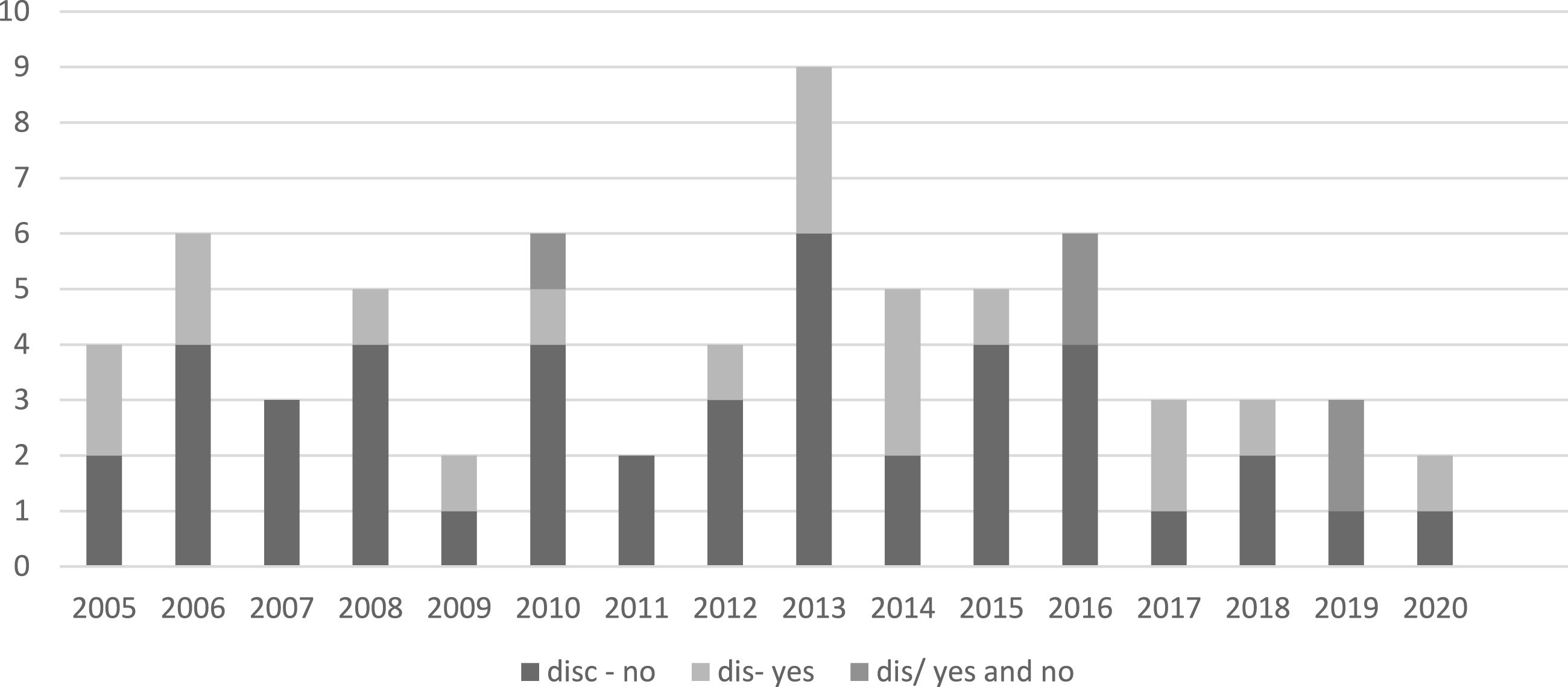
The NHRI/ETC found that some form of discrimination had occurred in just over a third of cases. Specifically, of the 70 Opinions considered in the paper, 20 resulted in a finding of discrimination, 45 resulted in no finding of discrimination, while 5 resulted in findings that discrimination had occurred in regard to some complaints, but not in regard to others. This equates to a (partial) success rate of 36%, which is (significantly) less than the overall success rate of claimants before the NHRI/ETC, which was between 55% and 40% from 2016 to 2020. 26 Of the 17 Opinions considered in this paper which were decided between 2016 and 2020, four resulted in a finding of discrimination, nine resulted in no finding of discrimination, while four resulted in findings that discrimination had occurred in regard to some complaints, but not in regard to others. This equates to a higher (partial) success rate in 47% of cases, in line with the overall success rate of claimants before the NHRI/ETC in this period. An overview of the number of Opinions handed down in this field, as well as the number of Opinions which involved findings of discrimination or not, is found in Figure 3.
Prominent patterns in the Opinions
An analysis of the Opinions reveals a number of noticeable trends and patterns which are discussed further below. In addition to the trends noted below, this chapter contains a brief discussion of the relationship between (Opinions of) the NHRI/ETC and Dutch courts, as claimants can also bring complaints of disability discrimination in the fields of further and higher education before courts.
The claimant must inform the educational institutions of the need for a reasonable accommodation, and the kind of accommodation needed
The NHRI/ETC has found, in a number of Opinions, that in order to benefit from a reasonable accommodation, the claimant must inform the educational institution of the need for an accommodation, and, on occasions, about the specific kind of accommodation required. In total 21 claims failed at least partially on the ground that the claimant had provided the institution with insufficient information about their need for an accommodation in general, or the specific type of accommodation required (2006-81, 2007-26, 2007-37, 2008-56, 2009-4, 2010-90, 2010-132, 2011-14, 2011-18, 2012-120, 2012-202, 2013-1, 2013-27, 2015-57, 2015-85, 2016-13, 2016-52, 2016-56, 2017-127, 2019-84, 2021-71). For example, in Opinion 2013-1 (see the sub-section on Deregistration above) the ETC/NHRI found that the claimant had requested additional supervision, but had not specified the nature of the supervision, while ‘concrete’ accommodations had not been asked for in Opinion 2015-57. In both cases the claimants failed to establish a breach of the accommodation duty. In several Opinions the NHRI/ETC has stressed that it is the responsibility of the claimant to inform the educational institutions about the need for an accommodation and, in the absence of the claimant doing this, their claim failed (e.g. 2007-36). Clearly failing to provide sufficient information about either the need for an accommodation, or being insufficiently clear regarding the nature of the accommodation required, is an important and recurring reason for claimants failing to establish that the duty of the educational institution to provide them with a reasonable accommodation had been breached.
The educational institution must investigate whether a reasonable accommodation can be made once a request is made, and respond in a timely manner
On the other hand, a breach of the duty to provide a reasonable accommodation was established in a number of Opinions when educational institutions failed to investigate whether a reasonable accommodation could be provided, following receipt of a sufficiently clear request from a claimant, or failed to respond in a timely manner to such a request. The NHRI/ETC found that educational institutions had breached the duty to provide a reasonable accommodation inter alia for these reasons in at least 10 Opinions (Opinions, 2009-62, 2013-58, 2014-35, 2014-36, 2014-154, 2015-26, 2016-77, 2017-57, 2017-77, 2019-10). In Opinion 2013-58, mentioned above (see the sub-section on Deregistration), the NHRI/ETC found that a college had not undertaken sufficient action to establish whether the accommodations requested by the claimant were needed or not, and the fact that the requested accommodations were not mentioned in the medical report which it had received from the claimant was insufficient to conclude that the requested accommodations were not needed. In Opinion 2014-154 (see the sub-section on Internships above), the NHRI/ETC found that a bank had discriminated against a student who applied for an internship and who needed accommodations in the form of physical adaptions to the bank’s office, inter alia because it had not investigated what the cost would be of installing the facilities or discussed the installation of such facilities with the landlord. In Opinion 2017-57, also mentioned above (see the sub-section on Non-Admission), the NHRI/ETC found that a college should have investigated with the claimant whether exams concerning spoken language skills could have been organised in a different way, and whether a reasonable accommodation could have been provided, before rejecting the claimant’s application to enrol at the college. Therefore, once a sufficiently clear request for an accommodation has been made by a claimant, responsibility passes to the educational institution to investigate the need for, feasibility and appropriateness of an accommodation, and, on occasions, the NHRI/ETC has held that this requires consultation with the claimant.
The NHRI/ETC sometimes assesses whether the claimant is qualified/able to follow a course or degree programme
In cases concerning non-admittance to a study programme, or de-registration from such a programme, the NHRI/ETC sometimes considers whether the claimant is qualified and able to follow (all elements of) the study programme. Under the Act, discrimination can in principle only occur if an individual is able to follow the relevant education, in the sense that he or she has followed the required prior education and has the relevant competences, or is able to develop those skills. 27 While in principle this is regarded as a matter for the educational institution to determine, the NHRI/ETC occasionally addresses this issue in some detail in order to determine whether discrimination has occurred in an individual case. In such instances the NHRI/ETC’s analysis usually includes a consideration of whether a reasonable accommodation could have been made to allow the claimant to complete the study. If the NHRI/ETC concludes that no reasonable accommodation could be made which would have allowed the claimant to complete the study successfully, it finds that the difference in treatment was justified and no discrimination has occurred. For example, in Opinion 2013-102 the NHRI/ETC found that a middle level vocational training institution had not discriminated against a claimant, by not allowing her to follow a study programme, because the college was able to show that the claimant was not qualified to follow the programme, and no reasonable accommodation was possible to allow her to obtain the necessary skills. The claimant, who had Asperger’s Syndrome, had previously followed and failed to complete two other study programmes at the college. She then registered for a third programme and sat an entrance test to assess her capacities and aptitude. The college did not admit her to the programme, and, in its explanation, referred to the extra supervision the claimant would need to study, which the college said it was unable to provide. As a result of a mistake, the college failed to inform the claimant that the rejection was also based on the college’s view that the claimant did not have the necessary skills to complete the programme successfully. The NHRI/ETC found that the non-admittance was linked to the extra support the claimant needed, and the adverse treatment was therefore related to her disability. A prima facie case of disability discrimination was therefore established. However, the NHRI/ETC agreed with the college that the difference in treatment was not prohibited because the claimant was not qualified to follow the programme, and additional supervision or accommodations would also not enable her to complete the programme. This could be concluded on the basis of her previous poor study results and the entrance test. The NHRI/ETC found that the college had carefully considered the claimant’s situation in reaching this conclusion, and therefore no discrimination had occurred. 28
On the other hand, where the NHRI/ETC finds that an educational institution has not substantiated that a claimant would be unable to complete a study, including by failing to explain why a reasonable accommodation could not be made to enable the claimant to succeed, it reaches a finding of discrimination. This was the case in Opinions 2016-77 and 2017-57. In the latter Opinion, which was discussed above (see the sub-section on Non-Admission), the NHRI/ETC found that a middle level vocational training institute had not demonstrated why the claimant’s reduced ability to study independently meant he was not able to follow the study programme, and why he could not have developed the necessary skills, for example through a reasonable accommodation in the form of being provided with coaching.
The NHRI/ETC therefore does not automatically accept the claim by an educational institution that a claimant is unable to follow an educational programme, and in this respect can analyse a college’s claim in some detail. However, where the NHRI/ETC finds that a claimant does not have the skills needed to complete a study programme successfully, including where this is for a reason related to a disability, no finding of discrimination is reached.
Reasonable accommodation and a disproportionate burden
Given that such a high number of Opinions concerned alleged discrimination in the form of an unjustified failure to make a reasonable accommodation, it is not surprising to find that the NHRI/ETC sometimes considered whether an accommodation would amount to a disproportionate burden. An educational institution, or other duty bearer, is not obliged to make an accommodation if this would result in a disproportionate burden. When making the assessment of whether a disproportionate burden exists, the NHRI/ETC balances the interests of a person with a disability in having the accommodations against the interests of the duty bearer. 29 What is perhaps more surprising is that disproportionate burden was at issue in so few Opinions, and in fact figured prominently in only two Opinions. Most claims which related to reasonable accommodation failed on other grounds, and often because the NHRI/ETC found that the claimant had provided the educational institution with insufficient information about their need for a (specific) accommodation.
However, in Opinion 2013-98 the NHRI/ETC found that organising additional (oral) exams for the claimant outside the standard times did amount to a disproportionate burden, in light of that fact that the claimant should not need more than 3 days to prepare for a resit which would be offered at the standard time. Interestingly, this case did not turn on the cost of the requested accommodation, but rather the administrative and organisational difficulties of providing the accommodations. In contrast, in Opinion 2014-154 considered above (see the sub-section on Internships), the NHRI/ETC found that a bank, which had refused to offer the claimant an internship opportunity on the grounds that she used a wheelchair, and the offices were not accessible for her, had discriminated against the claimant. The NHRI/ETC found that the bank had not established that making the necessary accommodations, in the form of installing a lift and an accessible toilet, would amount to a disproportionate burden. The bank had argued that it could not be expected to undertake such extensive building alterations, given the short-term nature of the internship and the high costs involved. However, the NHRI/ETC found that when making accommodations which involved structural alterations to buildings it is reasonable to not only consider the benefit to the individual requesting the accommodation, but also to consider the value the changes would have for future users of the building. In finding that the bank had not established that making the alterations would amount to a disproportionate burden, the NHRI/ETC also noted that the bank had insufficiently investigated the possibilities for making the alterations, including not investigating whether there was financial support available to cover (partially) the costs. Instead, the bank had made an unsubstantiated estimate of the costs, and not taken into account how the alterations could make their offices more accessible in a generic sense
The relationship between (Opinions of) the NHRI/ETC and the courts regarding complaints of disability discrimination
While many claimants bring complaints before the NHRI/ETC, claimants are also free to bring complaints before a court which, unlike the NHRI/ETC, can hand down a legally binding ruling. Individuals are free to decide whether to bring a complaint before the courts or the NHRI/ETC, and there is no obligation to bring a complaint to one body before going to another, and indeed nothing to prevent a complainant from bringing a case before both bodies at the same time. Claimants who have been successful before the NHRI/ETC, but who find that the Opinion is not acted upon, or inadequately acted upon, by the other party, can bring the same complaint before a court and seek a binding ruling. This was at issue in a 1987 case heard by the Supreme Court (Hoge Raad). The case was brought by a woman who had successfully argued before the then ETC that she was the victim of pay discrimination, in that she received a lower salary than a man for work of equal value. 30 The ETC had issued an Opinion to this effect, but her employer, a school, had declined to implement it. The Supreme Court found that school was unable to demonstrate that the Opinion of the ETC had been drawn up in an inexpert or careless manner or otherwise contrary to its statutory mandate, and the Court therefore adopted the conclusions of the Opinion. In essence, this means that a court should only deviate from an Opinion of the NIHR/ETC if it has good reason to do so.
On the other hand, in two recent Opinions of 2022 (2022-30 and 2022-85), the NHRI has indicated that it will not hear a case, or issue an Opinion, if a court has already addressed the same issue and issued a ruling, unless the complaint before the NIHR involves new evidence or a new claim not heard by the court. It has held that the NIHR cannot examine the same complaint because of the need to secure legal certainty, and that only an appeal court can issue a new ruling. However, if an appeal from a decision of a lower court is pending, the NHRI/ETC has held that it can issue an Opinion on the same set of circumstances and complaints, as no final ruling has been issued and the appeal court can take account of the Opinion of the NIHR in its ruling (Opinion 2022-91).
The NHRI also has the power to bring a complaint before the courts on behalf of an identified victim, or make an ex officio complaint, under Article 13 of the Act on the establishment of the Netherlands Institute for Human Rights. When bringing such cases, the NIHR can seek to have the impugned conduct declared unlawful or prohibited, or seek an order to reverse the effects of such conduct. A claim can only be brought if the alleged victim does not object. However, thus far, the NIHR has not brought a discrimination complaint before the courts.
In addition to issuing Opinions in response to individual complaints or to a request to determine whether action is in compliance with non-discrimination law (see Opinion, 2008-74 discussed above in the sub-section on Admission for an example of such an Opinion), the ETC/NIHR can also initiate its own investigation. This may be done in cases which may involve systemic problems, possibly as evidenced by a high number of individual complaints submitted to the NIHR on this matter. To date, this has been done in a limited number of cases, none of which have involved disability.
There is clearly the possibility for the courts, alongside the NIHR/ETC, to develop a body of case law concerning disability discrimination and students at further and higher education institutions, and for comparisons to be made between court judgments and Opinions of the NIHR/ETC in this field. However, anecdotal evidence suggests that such cases are not being heard by courts. Alexander Hoogenboom, who is legal counsel to the NIHR, has not identified any such court cases in the 3 years up until the end of October 2022. However, the database which reports Dutch court decisions, rechtspraak.nl, only reports about 5% of court judgments. Other judgments are not reported on a systematic basis, and it is difficult to obtain information about them, so one cannot be certain as to whether such cases are being heard by courts or not. The apparent lack of court cases in this field, or at least the lack of information on any such judgments, as well as the transparency of the Opinions issued by the NIHR/ETC, mean that the work of the Institute in this field is particularly important – both in terms of offering claimants an avenue of complaint and in terms of indicating how the law is being interpreted and applied by a (quasi-)judicial body which is expert in equality law.
Concluding reflections
This paper has reviewed how the NHRI/ETC has addressed cases of alleged disability discrimination in the field of higher and further education. Some of the findings are perhaps not surprising, including that a large proportion of claimants have disabilities or chronic illnesses which impact in some way on their ability to learn, and that a large number of complaints have concerned deregistration, examinations and admissions/enrolment. What is perhaps more surprising is that a relatively small number of claimants had a psycho-social disability, and relatively few claims concerned physical accessibility. The number of claims made against educational institutions is roughly proportionate to the number of students enrolled in each kind of education (middle level vocational training, higher level vocational training, and universities). However, the Opinions reveal that other kinds of institutions are also covered by the prohibition of disability discrimination in the field of further and higher education, including bodies offering exams, employers providing vocational training, and internship hosts. Discrimination in the form of an unjustified denial of a reasonable accommodation was alleged in the overwhelming majority of cases. While the majority of claimants did not succeed in establishing that this form of discrimination had occurred, this was rarely because making the accommodation amounted to a disproportionate burden. Indeed, the burden of the accommodation for the educational institution was rarely explicitly considered by the NHRI/ETC, and many claimants failed because they had not provided the institution with (sufficient) information about their need for an accommodation. Direct or indirect discrimination was only occasionally addressed by the NHRI/ETC and was only occasionally explicitly found to have occurred.
This overview reveals the pattern of cases and complaints regarding disability discrimination and further and higher education in the Netherlands based on the Opinions of the NHRI/ETC. This pattern may or may not be reflected in other jurisdictions, including other EU Member States which are subject to the same obligations as the Netherlands under the Employment Equality Directive and the CRPD. The other papers in this special issue may help to reveal patterns across other jurisdictions and facilitate the beginnings of comparative analyses.
Footnotes
Acknowledgements
I am very grateful to Dr Simon Duindam for assistance in analysing the data and making the figures used in this paper and to Dr Alexander Hoogenboom for discussing the work of the NHRI with me.
Declaration of Conflicting Interests
The author(s) declared no potential conflicts of interest with respect to the research, authorship, and/or publication of this article.
Funding
The author(s) received no financial support for the research, authorship, and/or publication of this article.
