



Abstract
The nose is a multisensory organ and a powerful bodily technology that helps orient the experience of consciousness in the material world, and yet, we have come to a socio-technological context so driven by ocularcentrism, largely as a result of the visual nature of social media and new media, that the nose is often reduced to just an idealised ‘shape’. This article explores how the contemporary construction and representation of the nose, especially on social media, is seated in a very long history of gendered and racialised politics. By examining the cultural and political implications of the nose through critical intertextual analysis, I excavate much deeper anxieties about the body, relationships to the self, and motivations for a variety of behaviours, both public (like posting on social media) and deeply intimate (like rhinoplasty). This work is about the symbolic adventure of the nose across time and culture, in terms of where it has left its mark and, in turn, how marks have been left on it.
Introduction
Understanding the role that the nose plays in meaning-making and politics can give us insights about how we overlay history and culture onto our material bodies and how we negotiate the lived experiences of those bodies. The experiences and impacts of body politics may be sometimes unconscious or negotiated, but no matter how politically abstracted, ‘having a nose’ is a very real lived experience – by matter of bone, cartilage, and skin. A nose can be broken, and it can be reset, but it can also be made into pun, metaphor, and symbol. The nose is a multisensory organ and a powerful bodily technology that helps orient the experience of consciousness in the material world (Glaser, 2002; Rombough, 2021), and yet, we have come to a socio-technological context so driven by ocularcentrism, largely as a result of the visual nature of social media and new media (such as the convergence of the camera with the phone), that the nose is often reduced to just an idealised ‘shape’. Thus, the goal of this article is to demonstrate how the contemporary construction and representation of the nose as a visual symbol – especially on social media, as explored later in the article – is seated in a very long history of representations produced via religious and gendered politics.
However, even though this research is based on a way of seeing the nose in intertextual analysis, and is therefore ocularcentric, it is only to emphasise the fact that the visual is so exploited in the contemporary context (in particular, by the shift to social media) that the symbolic often seems to overwrite the material body, especially in gendered and racialised terms. By examining the cultural and political implications of the nose, we can excavate much deeper anxieties about the body, relationships to the self, and motivations for a variety of behaviours, both public (like posting on social media) and deeply intimate (like rhinoplasty). This work is about the symbolic adventure of the nose across time and culture, in terms of where it has left its mark and, in turn, how marks have been left on it.
While I offer tangential arguments in relation to the colonisation of bodies of colour through the politics of visual platforms, via Kathy Davis (2003) and Lauren Gulbas (2013), this research draws primarily from literature and illustrative examples related to gender and Jewishness, as well as the intersection of gender and Jewishness as they are co-constituted through regimes of power. With that in mind, there is scope to advance this study with further close analysis of the nose as it is mediated or produced as a site of struggle, especially in social media communities that bring to bear the broader, long-standing politics of the subaltern. It is important to note that the extermination and persecution of non-Western identities, including bodily aspects such as the nose, goes well beyond Jewishness and gender in Western Christian traditions. For example, there are clear connections between the persecution of Muslim communities in Latin Christendom during the medieval period (Catlos, 2014) and the configuration of contemporary Islamophobia in nose representations on social media (Abdullah, 2020; Merchant-Habib, 2025). Also, contemporary links to the medico-scientific paradigm that defined the Indigenous and African nose as a specimen for Western ‘examination’ during Modernity (Burkitt and Lightoller, 1923) could be interrogated in similar frames of reference. The assertions in this article emerge from a qualitative research process that synthesises intertextual analysis (of historical narrative and social media threads) with scholarly literature using an informed grounded theory approach.
My methodology is seated in a constructivist epistemology that insists that the nose, as with any part of the body, signifies (Ahmed and Stacey, 2001: 3). Conjunctively, the approach is also seated in the phenomenological tradition of Maurice Merleau-Ponty (1968), which recognises that, as part of the body, the nose is felt and lived – and that this point matters profoundly. However, this conjunction is deployed in this article, not as an exploration, but as a way to benchmark the dissonances that emerge in the tension between the nose as it is experienced (as a psycho-physiological phenomenon), and its political representations. This is to say that this research is interested in the nose as organ only inasmuch as the way that the symbolic and representational imprints and impacts lived experience. For example, the representations littering our visual landscape have written themselves upon the actual flesh and skin of the nose – by way of rhinoplasty, facial whitening, injectable dermal fillers in the dorsal hump, nose lifters and shapers, and the damaging effects on the holistic body by bullying and/or racism.
Yet, to understand why the connection between the material and the symbolic is so critical, we must first pay some attention to the sensorial and phenomenological, or what I have developed elsewhere as ‘sensorial somatechnics’ (Glitsos, 2019), which affirms the sensorial turn in the Humanities using the field of Somatechnics, arguing that ‘sight’ is always ‘cooperational with ontological frameworks that render visible, invisible or otherwise, all objects of apprehension’ (p. 21). The grounding logic of the following argument is then figured around the way that the sensorial is embattled against the domination of the visual.
This is especially pertinent when we recall Constance Classen’s (1997) work on gender and sensory hierarchies, which reveals how fully ‘acts of perception are inflected with gender values’ (p. 1). Classen’s work shows how, for example, the sense of sight is ‘often considered to be associated with masculine values’ (p. 1), which is to buttress my argument in this research that in fact nose politics is directed by patriarchal values, and strategies such as rhinoplasty function as a form of gendered oppression (as well as racism). The marvel of the nose in terms of sense perception and olfactory power – those functions associated with the ‘feminine senses’ (Classen, 2005: 70) – is attenuated in service of a ‘look’ or ‘shape’ that bows to visual aesthetics, and also works to further distinguish masculinity. Especially in the conversation on ‘nose communities’, I will show how these tensions play out in the public forum and give us insight into how representations can cause harm to individuals, and also how individuals re-assert their autonomy and identity.
I pull a diverse range of sources into my intertextual analysis to form a corpus that traverses three discrete contexts. The first set of texts uses examples from historical theological sources (historical narrative), the second uses examples from contemporary film representations, and the final is from social media threads. These contexts represent three significant media phases of the production of theological texts in pre-modern storytelling, the domination of film discourse in the 20th century, and the ascendency of social media as our most contemporary public forum. This gives us both breadth and plurality. The point is not to crudely dehistoricise these texts by comparative analysis but instead to point out the ways in which ideology is threaded throughout and within the stories. In which case, rather than comparative analysis, I deploy intertextuality as both concept and method. Without side-tracking this article to Bakhtin or Kristeva – considered the pioneers of contemporary intertextuality theory – I offer that intertextuality is suited to this project because it is ‘research that stresses the subjective, relative and inconstant elements of knowledge [and that] intertextual reading can contribute perception and depth to the understanding of texts and aid in the hermeneutic process of qualitative research’ (Elkad-Lehman and Greensfeld, 2011: 259). As such, I suggest the nose is politically abstracted in different ways throughout different contexts, and we can map resonances between those contexts.
As noted, I also wish to place contemporary popular discourse about the nose into the existing literature and historical narrative to advance an understanding of how social media articulates or transmogrifies discursive constructs about the nose aesthetic. Methodologically, I used the pre-existing themes from the literature and critical historical analysis as preliminary nodes on which to group together comments from a dataset collated from all the top-line Reddit posts from the creation of the r/Noses subreddit to 17 June 2024. This dataset features 984 top-line posts (and 9795 reply posts). The themes which emerged in the literature and historical narrative that I mapped onto the dataset were related to identity politics and, specifically, associations with the ‘witch’ archetype and Jewishness. In keeping with the intertextual tradition, I knit these themes throughout the broader analysis to reveal a constellation of associations that emerge between scholarly literature, historical narrative, and contemporary discourse. 1
Two prominent books have been written on the subject of the nose for general readership: Gabrielle Glaser’s The Nose: A Profile of Sex, Beauty, and Survival (2002) and Paul Barolsky’s Michelangelo’s Nose: A Myth and Its Maker (1990). Both works cover histories of the nose, but neither one offers a critical political analysis. Glaser’s book spends most time on the psycho-biological functions of the nose, that is, its role in smell, and how olfactory perception influences decision-making, memory and emotion. Barolsky places the nose in the art history tradition by using Michelangelo’s nose as a departure point to trace depictions of the nose in the cultural context of the High Renaissance. On a tangential note, Barolsky does reference Pascal’s famous statement that, ‘If the nose of Cleopatra had been shorter, the whole face of the earth would have been changed’ (as cited in Barolsky 1990: 5) – a fun quip to signify the important role of the nose in matters of aesthetics and power, if not for its sexist implication that a woman’s political influence (like all else) is seated in her beauty.
In a more scholarly vein, Sander Gilman (1991) provides a generous collection of key arguments about the nose with regards to aesthetics and race in his book The Jew’s Body. Gilman for example explores Whiteness and Jewishness as framed through the politics of the nose and rhinoplasty. Sometimes this results in people mitigating their Jewishness through surgical intervention. This was, in Gilman’s words, born in the ideological effort to ‘“cure” the disease of the visibility of the Other’ (p. 185). Gilman’s subsequent monographs, Creating Beauty to Cure the Soul (1998) and Making the Body Beautiful (1999), expand on rhinoplasty to understand deeper implications of race in judgements of ‘ugliness’ and ‘beauty’, and the Western surgical paradigm in relation to the nose. Gilman’s trove paved the way for Kathy Davis’s (2003) work on the politics of ‘passing’, then soon after, for Bernice Schrank’s (2007) research on Jewish stereotypes in media and Lauren Gulbas’s (2013) work on racial motivations for women’s choice to undergo aesthetic rhinoplasty in Venezuela, all of which are applied in the following arguments.
In thinking about the way that the nose can be ‘shaped’ and physically impacted by the discursive and the representational, I make a parallel with my work to the approach put forth in Marc Lafrance’s (2018) special double issue published in Body & Society that advances the field of Skin Studies. In particular, I borrow from the assertion that ‘skin work’, such as concealing, medicating and grooming, are both shaped and shaped by identity categories (Lafrance, 2018: 57) to suggest that, in much the same way, ‘nose work’ (such as moulding, filtering, and surgical intervention) is also shaped by identity categories – categories with such deeply held historical roots that they are rendered nearly invisible in contemporary contexts.
In opening the collection, Lafrance (2018) asks a poignant question: ‘why does the skin matter so much’ (p. 4) that it is deserving of its own subfield? This gives rise to a similar question, given that the nose has developed its own scholarly canon. In resonance with Lafrance, I would also argue that the nose is a central site of body contestation, ‘given the symbolic significance of the face in contemporary visual culture’ (p. 57) and the extent to which we see that contestation manifest in public forums such as social media platforms. Lafrance points out that in the modern West, the face is ‘radically “public’ and a ‘vehicle of expression, a site of identity and an instrument of impression formation and management, the face is the most meaningfully visible part of our bodies’ (p. 57). As the nose is quite literally front and centre of this vehicle for expression, it matters a great deal what we do with it and how we talk about it.
Historical and Theological Entrenchments
Contemporary politics is anchored in historical and theological traditions about what makes a nose look good – that is to say, what makes a nose moral. In certain historical periods, the nose emerges as a symbol of divinity. From early Christian contexts, the nose has been endowed with the power to convey or even confer moral goodness – even holiness. Margaret Kenna (1985) evinced the ways in which certain renderings of the nose appropriated the abstract qualities of spiritual authenticity in the Orthodox Christian artistic tradition. She explains that ‘particular parts of the body are depicted in ways that are said to express spiritual qualities’, one of which is the straight, thin nose (p. 354). Thin and narrow noses, along with small mouths, were thought to convey ascetism – the idea being that the organs most associated with pleasure and earthly compulsion were least necessary to the spiritual subject. To ‘thin’ out the nose was to ‘spiritualise’ the saint (Kenna, 1985: 355). Inversely, this is to imply that subjects with a larger (or in fact ‘typical’) facial physiognomy were somehow more fully bound to earthly wonts, which also works to construct non-White ethnicities as inherently wanton. This sentiment was later deployed in the ideology of medico-scientific racism, which I explore shortly.
The nose as a narrativising tool and moralising aesthetic appears in religious storytelling in late-medieval Western Europe, particularly in renderings of the story of Saint Eligius, who is known for casting away a ‘female devil’ by pinching her nose (Benton, 2009: 182). Before sainthood, Eligius was a humble but prodigiously skilled blacksmith working in France in the 7th century. In turn, he became the patron saint of goldsmiths, metalworkers, and blacksmiths. According to religious lore, Eligius exorcised a possessed horse by cutting off its leg, shodding its hoof, and miraculously re-attaching the amputated leg. While doing so, Eligius was harassed by a ‘witch’ or ‘female devil’. In the story, Eligius drives away this unholy figure by using his blacksmith pincers to grab her by the nose, thus banishing her. This ‘nose pinching’ incident, known as ‘The Miracle of Saint Eligius’, was later captured by several medieval and early-Enlightenment era artists (Figures 1 and 2).
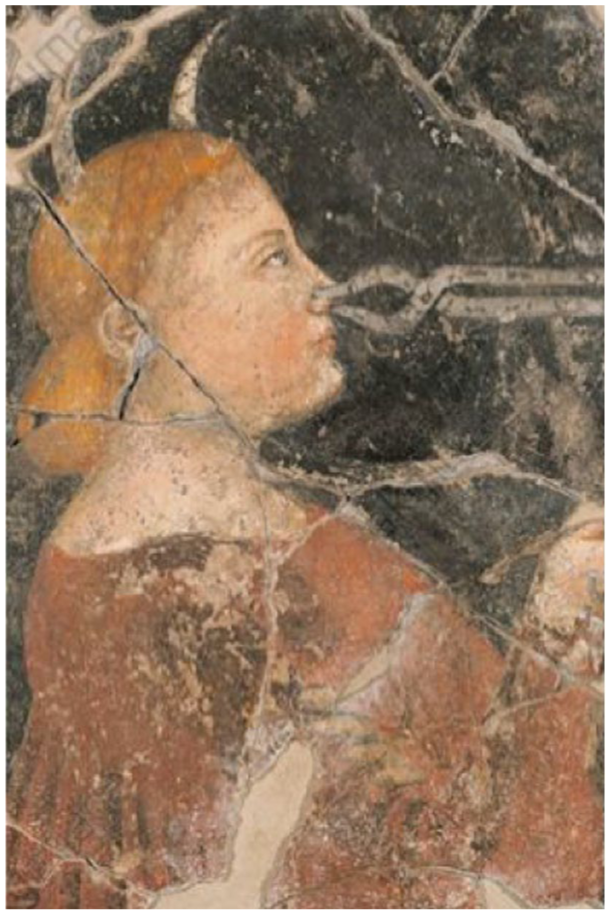
Saint Eligius grasping a female devil’s nose with pincers, Master of Santa Felicita, 14th century (Sailko, 2019).
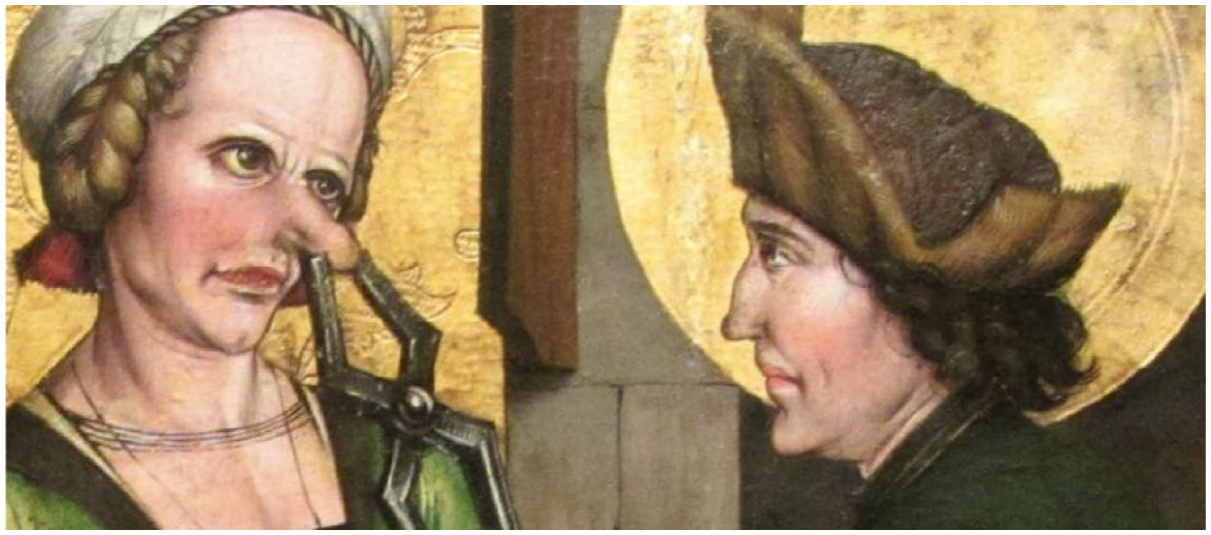
‘The Miracle of St Eligius’, 15th century, by Hans Leu the Elder, Landesmuseum, Switzerland (Baldi, 2020).
The Eligius story demonstrates the critical role that the symbolic (evil) nose plays in misogynist attempts to embed mistrust and paranoia about women in dominant culture. The nose, especially that nose which is prominent or in some way fixated upon (such as in the above paintings), functions to ostensibly ‘reveal’ the (dangerous) phallic woman – the woman whose power threatens to undermine the symbolic order. The nose in this story is emphasised as phallic in nature, both as a protuberance and as a functional organ (and the pinching brings its functionality to bear – cutting off its capacity for bodily seepage). Grosz’s corporeal feminism is useful here in excavating an even deeper analysis; Grosz (1994) recognises that bodily fluid (for example, that which travels in and out of the nose) betrays the ‘permeability of the body, its necessary dependence on an outside, its liability to collapse into this outside (this is what death implies), to the perilous divisions between the body’s inside and its outside’ (p. 193). We cannot escape the parallel of the nose (as a menacing presence) to that of the vagina, the open orifice, which also menaces with a similar potentiality. There is a double-reading here, a kind of semiotic slip, in that the ‘phallic woman’ is doubly endowed by the phallicised nose and also the vagina dentata – that female orifice that threatens to devour as it seduces.
At first glance, this reading may appear counter-intuitive, but in theoretical terms, the ‘phallicized woman’s body’ (Stratton, 1996: 144) does not prohibit the simultaneous existence of the vagina dentata. These are not mutually exclusive phenomena and are produced in the ‘cultural overdetermination’ of the fetishisation of the woman’s body. In his chapter on ‘the phallicized female body and its consumption’, Jon Stratton (1996) unpacks the ‘“active”, phallic woman who, from a male perspective, re-works the phallic power attributed to her into a spectacle which men experience as threatening to their own, already lacking, feeling of phallic power’ (p. 144). This functions in concert with the vagina dentata, because the phallus and the penis are related but not synonymous. Following Judith Gardiner (2012) in ‘Female Masculinity and Phallic Women’, in order to appreciate the threat of the phallic woman, we must first be aware that ‘the word “phallus” is properly understood to indicate not a penis but its attributes – “intrusiveness, power, violence”’ (p. 600). The threat of the phallic woman then stands in for the impudence of women who would dare to take from men, or feign as masculine. As Joseph Campbell (1959) summarises, the threat of the phallic woman motif is ‘perfectly illustrated in the long fingers and nose of the witch’ (p. 73). Thus, the nose is the signifier that cleaves together the archetype of the witch and the material threat of the ‘masculine female’ to the symbolic order.
These kinds of representations function on the level of myth, which I use here in a Barthesian sense to signal the second-order signification in the religious lore. Associative connotations betray long-standing traditions that imbue the feminine subject with a demonic, carnal influence. The women in these stories do not carry the fine, thin noses of Byzantine divinity – cultivated by austerity and ascetism – but the tumescent features of the sexualised feminine. To flesh this out, we must better understand the role of the woman as a witch, and her witchy nose. All subjects under patriarchy are inculcated into a self-reifying symbolic order that necessitates the witch – and her telltale phallic nose – in order to explain the tension between the unruly woman and the hegemonic masculine power. In doing so, patriarchal hierarchy can legitimate otherwise unjustifiable subjugation.
Pulling Judith Butler into this discussion advances an argument about the ways in which the woman-witch archetype serves as cautionary function. Unruly women must be neutralised. Not only does the woman-witch connote the phallus, but the witch is also a ‘figure of excessive phallicism’ and in this role she is ‘devouring and destructive’ (Butler, 2011: 66). This threatening figure requires constant containment. I am reminded here of Eva Ernt’s character (played by Angelica Houston) in the American film The Witches (1990) – both a femme fatale and a wicked witch with a hideously ugly, large, pointed nose when she transforms into her ‘true nature’. This monstrous personage shows us: . . . the negative fate of the phallus when attached to the feminine position. Significant in its misogyny, this construction suggests that ‘having the phallus’ is much more destructive as a feminine operation than as a masculine one, a claim that symptomatizes the displacement of phallic destructiveness and implies that there is no other way for women to assume the phallus except in its most killing modalities. (Butler, 2011: 66)
Butler’s writing on this matter is most poignant when we consider the ways in which women in positions of political power are often conveyed as having a (metaphorical) penis, usually as a way to poke fun and undermine (Curran, 2025), or, more specific to the point being made here, that women with phallic power are either dangerous or an abomination (or both). The stories our culture uses to warn about the danger of the phallic woman are therefore deployed – not subtly – to delimit feminine agency especially in power dynamics or contain them in some way (Taylor and Glitsos, 2023). Just like Eva Ernst, when women’s priapic power is awakened, the dominant social order must ensure that they are revealed as ugly abominations of both nature and the imaginary. If the nose is symbolic of the phallus, and witches (standing in for ‘women with power’) are controlled by this nose-phallus (quite literally in the Eligius story), then Christianity – which is the foundation of the Western dominant order – is symbolically and justifiably ‘castrating the feminine’, ripping away the power that the patriarchy thinks that she thinks that she has. This manoeuvre betrays the unconscious fear of the patriarchy that ‘the phallic woman’ secretly wishes to usurp masculine power.
Christian dogma did not just disappear from mainstream society, just as it did not spring from out of nowhere, but was based in sentiments festering since the earliest essentialising of women’s bodies as nothing other than that which ‘rational knowledge transcends, dominates or simply leaves behind’ (Lloyd, 1993: 2). The Christian worldview is still so dominant, so widespread, and so intermingled with the basis of gender logic, that much of this sentiment continues to permeate dominant ideology more generally. This is also why the demonisation of women via the ‘evil witch archetype’ is such a productive task of misogyny and an enduring trope, even in popular culture to this day. Barbara Creed’s foundational text is vital in this conversation. In The Monstrous-Feminine: Film, Feminism, Psychoanalysis, Creed (2015) dedicates a chapter to the ‘incontestably monstrous role in the horror film that belongs to woman – that of the witch’ (p. 73). Creed looks back at the text used by Inquisitors to detect and prosecute witches: the Malleus Maleficarum (The Hammer of Witches), published c.1486 and in use for at least three centuries (Institoris and Mackay, 2009). This was a text, commissioned by the Catholic Church and authored by Dominican priests, that weaponised scripture and Biblical discourse in order to (ostensibly) exterminate witchcraft. Creed (2015) explains how, among a long list of ‘crimes’, witches were accused of ‘causing the penis to disappear and of stealing men’s penises’ (see also Classen, 2005: 72), to which she aptly points out that these ‘no doubt exemplify male fears of castration’ (p. 75). Castration anxiety is thus projected onto the (phallic) woman’s nose, which is to say that in this paradigm, men’s anxiety is the fault of the woman. In the above story of Saint Eligius, and its immortalisation in artistic renderings, the role of the masculine hero then is to protect against this symbolic castration. Eligius fends off the phallic woman-witch through a pre-emptive symbolic castration – grabbing her nose.
However, the symbolism of the witch’s nose is not just about its threat to the masculine order by way of shape or largeness. As Constance Classen (2005) reveals in her work on the ‘symbolic division of perception into masculine and feminine territories’ (p. 70), the witch’s nose also betrays the association of women with the ‘lower orders’ of sense perception, one of which is smell, and so closely tied to the nose (p. 70). In an inversion of the righteous, saintly (mostly male) figures from Byzantium, the witch is cast as a self-gratifying subject, that is to say non-sacrificing (p. 71) – rendered as the vilest of qualities a woman might possess by the sensory symbolism of the witch.
The implications and ramifications of these entrenched fables and sweeping representations pervade the very real experience of individuals to this day. Hundreds of years after the rendering of St Eligius casting out a witch by her nose, the ‘witch nose’ archetype continues to be used to bully, ridicule, and typecast on social media platforms. Referring here to the Reddit dataset I describe in the introduction, r/Noses, I identified nine comments (from the 984 top-line posts) that directly reference this stereotype as a lived experience. 2
Some people say my nose looks like a witch nose :(do I need to do rhinoplasty?
I got bullied for my ‘witchy’ profile as a kid. I’ve learned to embrace it! I love my Jewish-Italian schnoz.
Always hated my nose ever since someone called it a ‘witch nose’.
I was told that my nose made me look like a ‘witch’ & that I would get a nose job when I got older.
For many years I was bullied for my nose in high school, I would get called ‘big nose’ and that I look like a ‘Witch’.
I call it my witch nose. And the bridge is very wide too from the front.
Witch gang, trying to talk myself out of spending thousands for a nose job.
I’ll never forget being told I have a witch’s nose in elementary school.
For someone who doesn’t like most of my appearance, I feel like my big ol’ bumpy witch nose gives me Disney villain vibes. (r/Noses, n.d.)
The language in these comments exemplifies how ideology – and the spectres of Christian propaganda – are called upon in order to shame subjects into certain forms of submission. Take, for example, how the ‘witch’ fable is interpellated by the subjects above as an experience of shame. Being ridiculed as having a ‘witch nose’ (sometimes consciously related to a subject’s race or sex) has been weaponised to subjugate the individual (often manifested as bullying) and attempts to coerce the subject to acquiesce to the idealised embodiment of the Western archetype (usually typified by the call to rhinoplasty or acceptance of the self as ‘lesser’). Language shapes the very bone and cartilage of the subject, reminding us of Grosz’s (1994) Möbius metaphor in which language inflects ‘mind into body and body into mind’ (p. xii). One user sees their nose through the frame of the ‘Disney villain vibe’ for example, reminding us of the powerful work that representation does in overlaying meaning onto the body and carving its politics onto the very flesh.
Jewishness
To interrogate these themes even deeper, it is crucial to acknowledge that both women and Jews were associated with sorcery in medieval Christian thought (Mackay, 2009), which demonstrably served (and often still serves) a scapegoat function. In Christian dogma, detecting a person of Jewish faith is the same as detecting a witch – by their nose. As early as the 2nd century, the Christian persecution of Jewishness weaponised stereotypes about the nose. The first pogroms were during the time of the Crusades and travelling caravans following the army would raid villages along the routes. It was considered politically acceptable to raid Jewish communities. Propaganda dictated that anyone with ‘the Jewish nose’ was a fair target (Rose, 2022). Emily Rose (2022) recounts the ways in which, during this time, Christians were taught to view Jews as physically different, and when they did not appear so, Jews were required to conform to those expectations by wearing distinctive garb such as a pointed hat, yellow dress or bright badge on the outside of their clothing. Jews were likewise depicted with a hooked nose, red hair and swarthy skin, which like other traits attributed to medieval Jews, were not typical of them, but presumed to be true. People saw what they expected to see. (p. 205, emphasis added)
Thus begins what Sara Lipton (2018) describes as the ‘long history of antisemitic visual caricature, which consistently portrayed Jews with a stereotypical Jewish nose – large, bony, and with a prominent hook, bend, or bump – whether the figures in question actually had such noses or not’ (p. 183). In 14th-century German clericalism, coins were forged with caricatured Jewish faces that showed ‘the distorted face of a person with a “Jewish hat”, a “Jewish nose”, and a grotesque open mouth’ that took inspiration from a 12th-century treatise describing Jewish people as having ‘beak-like noses and coarse features’ (Haverkamp, 2014: 226). Eva Haverkamp (2014) explains that these were ‘theologically and religiously based pejorative depictions of “hostile enemies of faith”’ which played out in the ‘world of economic and political symbols’ (p. 226). In other words, these were politically motivated dramatisations of a stereotype for the purposes of religious and financial manipulation.
Centuries later, the same malevolent stereotyping persisted and rooted itself into the foundations of Modernity, based on just as spurious and politically motivated beginnings, and converging in the Holocaust. Leading up to and during the Second World War, specific propaganda about the nose helped to facilitate Nazi hatemongering, through which ‘the Nazis had developed their own version of the [Jewish nose stereotype], transforming it from an aberrant feature of the individual face to a social problem that endangered the life of the Aryan community’ (Schrank, 2007: 26). It is critical to explicate these associations so that we can bring them to bear on the enduring network that intersects Jewishness, noses, and (self-) shame in contemporary discourse, like thematic ripples undulating throughout the metanarrative of the nose I piece together here.
As such, I identified 74 distinct top-line comments in the r/Noses dataset which explicitly reference a connection between the lived experience of the nose and race or ethnicity in some way. Among this cohort were 13 top-line posts 3 that suggest Jewishness and noses are negatively associated. Some posts are more direct than others and articulate clear experiences of being bullied. Others reference this indirectly, such as comments implying that a Jewish nose can be ‘detected’ in some way or needs to be ‘overcome’ (see Note 2).
Been told all my life that i have a ‘jew nose’- I’m proud of my heritage, and my honker!
Learned to embrace it! I love my Jewish-Italian schnoz.
I’ve been teased for my hearty Jewish nose pretty much my whole life but I’m trying to love it now!!
Jewish-Italian ancestry. It’s been a journey, but I’ve learned to love her.
Growing up I was called ‘jewifer’ a lot.
Jewish + Italian = whatever the fuck this is.
I got so many compliments from my ‘jewifer’ photo.
Is this an aquiline nose? I’ve been told it looks Jewish and Greek.
Jewish nose. Used to hate it, but it’s grown on me . . . literally.
The Antisemitism on this Sub Needs to Stop.
My very Jewish/Levantine nose that has always made me feel insecure.
Can’t believe I got the guts to post this, but my nose has always been my biggest insecurity as it’s a feature that has been pointed out to me my entire life. I’m working on loving my big nose. Does it look Roman or Jewish or something else??
Was never self-conscious of my nose until someone said I had a Jew nose, have always hated it since. (r/Noses, n.d.)
These individuals bring critical theory to life by way of showing how much shame, insecurity, and ‘feelings of ugliness’ must be internalised in order for the subject to be endorsed by ideology. The individuals do not (and I would imagine cannot) necessarily connect these sentiments to the weight and complexity of historical dogma that shapes contemporary discourse, however, subtly at least, as Mark Gorney has put it, ‘Patients seeking rhinoplasty . . . frequently show a guilt-tinged, second-generation rejection of their ethnic background masked by excuses, such as not photographing well’ (as cited in Gilman, 1991: 35). Gorney’s critique is especially strident when coupled with the fact that so much of the r/Noses community is dedicated to sharing photographs of individuals’ noses to ask for comment, critique, or advise on ‘best angles’. In the edited collection Nose Book: Representations of the Nose in Literature and the Arts (2000), Charles Lock’s chapter ‘Ignoring the Nose: Making Faces’ makes an unfortunate but compelling argument. Using examples ranging from Pinocchio to Cyrano, Lock explains that the entirety of the Western canon, particularly of religion, literature and lore, constructs noses deemed ‘abnormal’, too large, or ‘misshapen’ as deviant. In fact, in myth, ‘A hero may unwittingly have committed incest, or have broken other taboos, but he will not have been so unfortunate as to have been born with a misshaped nose; nor to acquire such through the violence of warfare’ (Lock, 2000: n.p.). This idea is so completely embedded in the collective psyche that it is unsurprising that individuals obsess over the shape and shaping of their (either real or imagined misshapen) nose. This is especially damaging when we consider how often individuals, especially women, who undergo cosmetic surgery are then shamed for doing so (Bonell et al., 2022).
The Entanglements of Medico-Scientific Framing and the Nose
Following on from the above, it is clear as to why so many marginalised or Othered subjectivities opt for rhinoplasty in order to ‘pass’: having the capacity to ‘move around unnoticed’ in the social fabric (Gilman, 1991: 184). Bernice Schrank, Jay Geller, Sander Gilman, and Kathy Davis have each attended to the theoretical and political dimensions of the nose and rhinoplasty from the perspective of Jewish studies. As signposted earlier, Sander Gilman’s work is the most extensive on this subject. While there is not space here to unpack each of the important examples used in Gilman’s arguments, the core of his work is that cosmetic surgery embeds and perpetuates social constructs of beauty that are based in racism. Gilman (1991) uses a wide range of evidence and examples to show how devastating the inculcation of Othering became to the Jewish psyche, and that the idea of ‘suffering from a “Jewish nose” was a powerful one’ (p. 187). Especially after the Second World War, ‘Young men and women needed to become invisible, needed to alter their bodies, as their visibility became even more marked. For the virtual invisibility of the Jews in Germany vanished with the introduction of the yellow “Jewish star”’ (Gilman, 1991: 187). Passing was not only a matter of belongingness but also of life and death.
However, the horrors of the Holocaust were preceded, and in fact powerfully cultivated by, the medico-scientific racism emerging in turn-of-the-century Modernity, a prevailing logic which used science to reify fascism. Through that emergent scientific logic, new discourses policed sexuality, gender and race with new language. Jay Geller (2007) writes that at this time: The emergent scientific disciplines endeavoured to administer the increasing overlap of the gender-differentiated bourgeois order and racially differentiated imperial order by affixing an identity to the body, especially to bodies of the one menacing others. [. . .] these sciences provided a grammar of truth that threaten that body, and the reproductive organs especially, as the language by which ‘natural’ difference was expressed. (p. 7)
Noses – which sit plainly readable in the centre of one’s face and thus almost impossible to hide – were (and still are) a locus point for ‘the scientific detection’ of the ‘menacing Other’.
However, as plainly as the nose sits on the face – it is never ‘seen’ without layers of politics and complexity. I gesture back to Emily Rose who, in her discussion of the stereotypes about the Jewish nose, writes that people see what they expect to see. In accordance with the language of Gallopian and Groszian bodily perspective, culture writes itself on the body. In turn, we ‘see’ the face with those stories written all over it. In thinking through the nose, Bernice Schrank (2007) beautifully notes the ironies and contradictions, or perhaps cognitive dissonances, that emerge when reification breaks down. She writes of the fascist gatekeeping dilemma in which: . . . the Jewish look may include many more than just Jews. The distinguished German Jewish historian George Mosse [. . .] asked rhetorically why it was that the Italian fascists had not developed racial consciousness and stereotypes of the Jews in the manner of the Nazis. He immediately answered his own question with the wry observation that it was because Italians fit the Jewish stereotype. Clearly, the Jewish look lets in more than it was intended to keep out. There is yet another wrinkle in its application. Ethnicity does not float free of its social contexts. (p. 21)
This is also to say that the nose, too, does not float free of its social contexts. To expand this point more illustratively, I note that (in the Reddit dataset I introduce above) there is a range of non-European but non-Jewish identities that substantiate this phenomenon, as one user writes: ‘Trying to love my Arab nose before going bankrupt on a nose job’ (r/Noses, n.d.). Thusly, the nose stands in for an Othering process – for many identities that do not fit the archetypal Western Christian aesthetic.
The nose is written upon, over and over again like a palimpsest, until we can barely ‘see’ the bare flesh. In an infuriating double bind inherited from the enduring domination of Modernity’s claim to empiricism, this process is manifest but also elided: ‘Between 1870 and 1920 science, with its claim to objectivity, its empirical basis, and its allegedly value-free knowing, constituted a cultural authority that politicised the discourse of nature – above all in relation to the nation as the people’s body’ (Geller, 2007: 7, original emphasis). Not only do medico-scientific discourses reify existing racisms but the function of these discourses is to appear ‘politically neutral’.
Furthermore, medico-scientific discourse is also at work in the logic that mitigates Blackness and other non-White ethnicities through the discourse of cosmetic surgery. In a similar vein to the ways in which Shirley Tate (2003 [2001]) describes the political effects of Black skin, so too the nose signifies, as ‘a mark of ethnicity, status, identity, [and] self-hood’ (Ahmed and Stacey, 2001: 209). This dates back to the ‘dubious role’ that Western science played in ‘legitimating social inequalities based on both sex and race’ that Kathy Davis (2003) explains ‘intensified and was institutionalized as “racial science” during the second half of the 19th century’ (p. 77). Davis’s (2003) work in ‘Surgical Passing: Or Why Michael Jackson’s Nose Makes “Us” Uneasy’ digs deep into these relationships to expose the ways in which, ‘The emergence of ethnic cosmetic surgery cannot be separated from scientific ideas about race that permeated the popular imagination throughout the 19th century’ (p. 77). These ideas were not merely insinuated nor implied but vigorously pursued and weaponised. For example, Davis (2003) reminds us of the hierarchy laid out in the Great Chain of Being, a Christian doctrine permeating Western science through which White Europeans: Constructed racial groups as discrete and immutable entities arranged hierarchically along a continuum with God and the white European on the top and the African and orangutan at the bottom. In this way, social inequalities stemming from rampant slave trade and colonial expansion could be justified as the inevitable consequences of ‘natural hierarchies’. (p. 77)
In direct conversation with colonial violence is the fact that the ‘gold standard in rhinoplasty’ is a nose that is associated with being White (Gulbas, 2013: 327). In her study on women’s decisions to undergo aesthetic rhinoplasty in Venezuela, Lauren Gulbas (2013) writes extensively on the ways in which rhinoplasty is essentially a ‘technology of Whiteness’ in the way that: ‘Assumptions about normal nose shape are governed by a discourse that privileges the aesthetics of Whiteness [. . .] that take an ideal White body as its starting point’ (p. 327). In addition to the colonisation of Black bodies and Black culture, normative White representations have colonised Black consciousness (Fanon, 1986), and many people of colour opt for cosmetic surgery in order to ‘pass’ and escape the damage left by the legacies of racial science (Gulbas, 2013). This is not an uncontested space and Black activism in a wide range of modalities pushes back against colonial hegemony and creates spaces for delegitimisation and productive counter-discursive positions (see Carlson and Frazer, 2020; Childs, 2022).
Looking at the Nose on Social Media
Recent scholarly literature has begun to unpack the ways in which social media – and facial filters in particular – are inherently based on a White imperialist ideal of beauty and representation. Various scholars from a range disciplines and perspectives talk about this in relation to skin colour (Carlson and Frazer, 2020; Riccio and Oliver, 2023; Trammel, 2023) and some literature also connects social media tools with racism and the nose specifically (Castelló-Mayo and López-Gómez, 2023). Unsurprisingly, the overwhelming consensus is that social media and facial filters are inherently racist.
Social media undertakes this work by consistently augmenting the nose shape to the Eurocentric ideal and reifying the White beauty aesthetic through a variety of simulations: makeup contouring tutorials, Instagram filters, Photoshop, AI photo manipulators, phone camera settings, and other functions of digital manipulation. This exerts even more pressure on the modern subject to conform to (incessant) media representations bloating our social media feeds. This point is well-referenced in my dataset, and I offer two examples here for illustrative purposes:
In the past I believed my nose ruined my face because of social media corrupting my self-image.
I always hated my nose because it wasn’t straight or small, but I stopped following beauty influencers on social media, and I learned to like its uniqueness. (r/Noses, n.d.)
Recent scholars I cite above have provided useful literature to attend to this problem, so it would be redundant to simply regurgitate those arguments here. Instead, I offer a final discussion that adds texture and complexity to these arguments by showing the ways in which the nose is also a locus for bonding through discussions about the body and its politics on social media. Next to functioning as platforms for oppression, online communities can also function as resistant sites for nose-politics, particularly through the way members use digital conversations to re-inscribe meaning onto the nose and celebrate its diversity and its significant place in lived experience. Even though the platforms and algorithms of social media continue the Eurocentric tradition to typify and idealise the small, pointed, and ultimately ‘Western’ nose shape, something new and altogether different also occurs. In fact, as Staci Zavattaro (2020) and Deborah Lupton (2017) have shown, social media opens the conversation to a much broader cohort of lived experience because users cultivate counter-discursive body-politics that can transcend, or at least resist, dominant gatekeeping functions typified by mainstream media and conservative traditions.
Let us consider the r/Noses Reddit community
4
as a self-professed place ‘to celebrate the diverse beauty of human noses’ and – quite purposefully – without judgement towards those who have undertaken or are seeking rhinoplasty. The introduction reads: Welcome to /r/Noses: a supportive community celebrating the diversity and uniqueness of noses, from the bold and distinctive to the unique challenges and questions they bring. Whether you’re here to admire, seek advice, or discuss concerns – be it about aesthetics, surgery, or self-esteem – our forum is dedicated to respectful, empathetic engagement. Join us to embrace nasal diversity, share your story, and engage in thoughtful discussion. (r/Noses, n.d.)
What I have found in the dataset is that individuals use the community to articulate the lived experience of having nose types associated with certain identity markers, such as race, ethnicity, gender, family, heritage and perceived attractiveness. We might say that here, the nose is experienced as a critical site for body politics at ‘the coal face’. Throughout the dataset, I found that the language in some threads works to actively dismantle or resist negative associations that function to keep the nose tied to racist or sexist rhetoric. In one thread, a commenter questions why another poster would undergo rhinoplasty just to ‘Look like what someone decided was what people (or women) should look like today’, adding that, ‘It’s probably based on colonial racism, but definitely its [sic] sexist’ (r/Noses, n.d.). The commenter ends their post by suggesting that the original poster should ‘just stay gorgeous and fabulous for free and “stick it the man/the power”’. In just two lines this comment encapsulates the sentiment of tomes of critical theory and offers a generative alternative.
Furthermore, I identified 38 top-level posts that each reference a way in which the r/Noses community plays a significant role in supporting individuals overcoming (socially-imposed) biases about their noses. While there is not space to table all 38 posts in full, I select few for illustrative purposes (with some edited for length):
With the help of this sub, and some self-love, I learned to love my Roman nose and its little bump.
So happy I found this sub. I’ve been really trying to love me for me. Here’s my half Mexican nose.
Have always been trying to make myself love my nose, this is my first post here and I love all of you on this subreddit.
This sub has inspired me to finally embrace my beautiful bumpy nose as it is.
Loving my schnoz a little more because of this sub :,) used to want a nose job.
This sub helped me learn to love my own nose.
I love you guys!!!! THESE communities: people like YOU are the reason why us men and women get to feel good about our otherwise unconventional beauty and quirks!
I have hated my nose for years . . . this sub has helped me learn to love it.
Hi! just found this subreddit and I already love it :) I’ve been super insecure of my nose for years.
I’m very grateful for this sub and I’ve started to realise that my nose isn’t ugly. (r/Noses, n.d.)
Clearly, the nose is a crucial anchor point through which these individuals navigate their lived experience, and these comments show the powerful ways in which the nose is a nexus for internal feelings of belonging and external criteria for validation. As much as social media perpetuates damaging stereotypes (some of which have been entrenched for hundreds of years), social media also does something new for society by providing spaces in which individuals negotiate and work through body politics as a social process. As I have argued elsewhere, ‘communities are not just “one thing.” They are mutable, complex, and comprised of a variety of feeling rules’ (Glitsos, 2020: 112). In the words of Jessica Cwynar-Horta (2016), online forums can encourage ‘the reclaiming of embodiment and control over one’s self-image’ (p. 38). This reveals the critical importance of Reddit communities in the production of body-positive relationships that use the nose as a locus of communication.
Most significantly for my argument, with all the comments taken together (including the ‘witch’ association comments and comments about Jewishness and ethnicity), it is shown how the nose functions like a totem. The nose, like a totem, embodies ancestry and plays a crucial role in defining and delimiting identity, which can be used as a source for mythology and storytelling, while also manifesting as material objects that can be acted upon by the world such as in the case of rhinoplasty. Much like a totem, the nose is a multifaceted symbol that plays a vital role in the historical, social, and cultural fabric.
Conclusion
The aim of this work has been to understand the nose as a discursive construct produced through the socio-historical context of the Western visual imaginary. There has been previous discussion on the nose as a marker of human relations and human experience; however, no study to date has brought these together with social media discourse in a methodical way to form an overarching view of the nose as a product of history and as a lived phenomenon in the contemporary media environment. Using intertextual frameworks, I have pulled together disparate strands to see the nose as a political and psycho-social site of both intra-subjectivity as well as a conduit for complex relations between the subject and the world. Using the nose as a guide, I problematised the roots of aesthetics in early Christian theology, exposed the misogyny of medieval religious folklore, critiqued medico-scientific racism and the socio-historical context of rhinoplasty, and interrogated the nose in social media.
The nose is not just an organ, it is also an idea. More precisely, the nose is an amalgamation of many associative ideas coalescing on a very real site of skin and bone and cartilage. In Thinking Through the Skin, Ahmed and Stacey (2001) remind us of Merleau-Ponty’s important intervention in which embodiment must be theorised ‘not only as fleshy and material but also as “worldly”, as being in an intimate and living relationship to the world, which is a world made up of other bodies’ (p. 5). In drawing together associative themes from theory, literature, critical historical analysis and qualitative language analysis of social media threads, I have argued that individual stories are played out through the lived experience of the nose, and that the nose can be found as a major character in the grand story of humanity.
Footnotes
Acknowledgements
Thank you to Patricia Glitsos for providing French to English translations for this research.

