




Abstract
To resist the Israeli military occupation of the West Bank, Palestinian prisoners are smuggling sperm samples out of Israeli prisons to enable their wives to undergo fertility treatment. Bodies and bodily matter figure as central actors in this practice of resistance. In this article, I draw from fieldwork I conducted with Palestinian women and medical staff in the occupied West Bank to examine the tension between carcerality and matter(ing). I argue that bodies and bodily matter are constitutive of the relationship between oppression and resistance. I analyze how Israeli military authorities assign evidentiary status to Palestinian bodies and illustrate how Palestinian families challenge the Israeli carceral system through new modes of embodied resistance. This article demonstrates how intersecting forms of oppression shape and are being shaped by bodies and their materiality. It also suggests that theorizing the materiality of power from Palestine offers new ways of understanding the political work that bodies do.
On a hot summer day in July 2018, Mary, the Palestinian interpreter I was working with, and I sat in the office of a Palestinian prisoners’ rights organization in Jenin, the West Bank. We were waiting for our contact person from the organization to drive us to the homes of three Palestinian women and mothers (to be), whose detained husbands managed to smuggle a sperm sample out of an Israeli prison to subsequently enable their wives to undergo in vitro fertilization (IVF) in fertility clinics in the West Bank. The walls of the small office were plastered with old newspaper cuttings I was looking at while we were waiting. Due to the nature of our endeavour, the illustration of the pregnant woman stepping over the barbed wall caught my eye immediately. I took a photograph with my phone. Later, in the car, I showed Mary the photograph, and she translated from Arabic to English. The illustration’s top corner contained a single phrase ‘On the road to give birth / to be born’. ‘The United National Government’ was printed over the pregnant woman’s belly. Although probably much older than the practice of sperm smuggling itself, which first successfully led to the birth of a child in 2012, the yellowed illustration captures the scope of this article. The visibly pregnant woman tries to step over a barbed wall, probably symbolizing the separation wall between the West Bank, East Jerusalem, and Israel. This heavily surveilled and militarized border separates and fragments the occupied West Bank (Bishara, 2017; Tawil-Souri, 2012) and impedes Palestinian women’s already scarce access to reproductive health services, which has caused some women to be forced to give birth at checkpoints (Hamayel et al., 2017; Hammami, 2019; Shalhoub-Kevorkian, 2015). The illustration reveals how Israeli settler colonial population management disturbs Palestinians’ most ‘intimate biosocial ecologies’ (Shalhoub-Kevorkian, 2014: 47) by assigning evidentiary status to Palestinian bodies. At the same time, this interpellation enables Palestinians to harness reproductive technologies to challenge and resist the Israeli carceral regime and military occupation through new modes of border-crossing kin work (Figure 1).
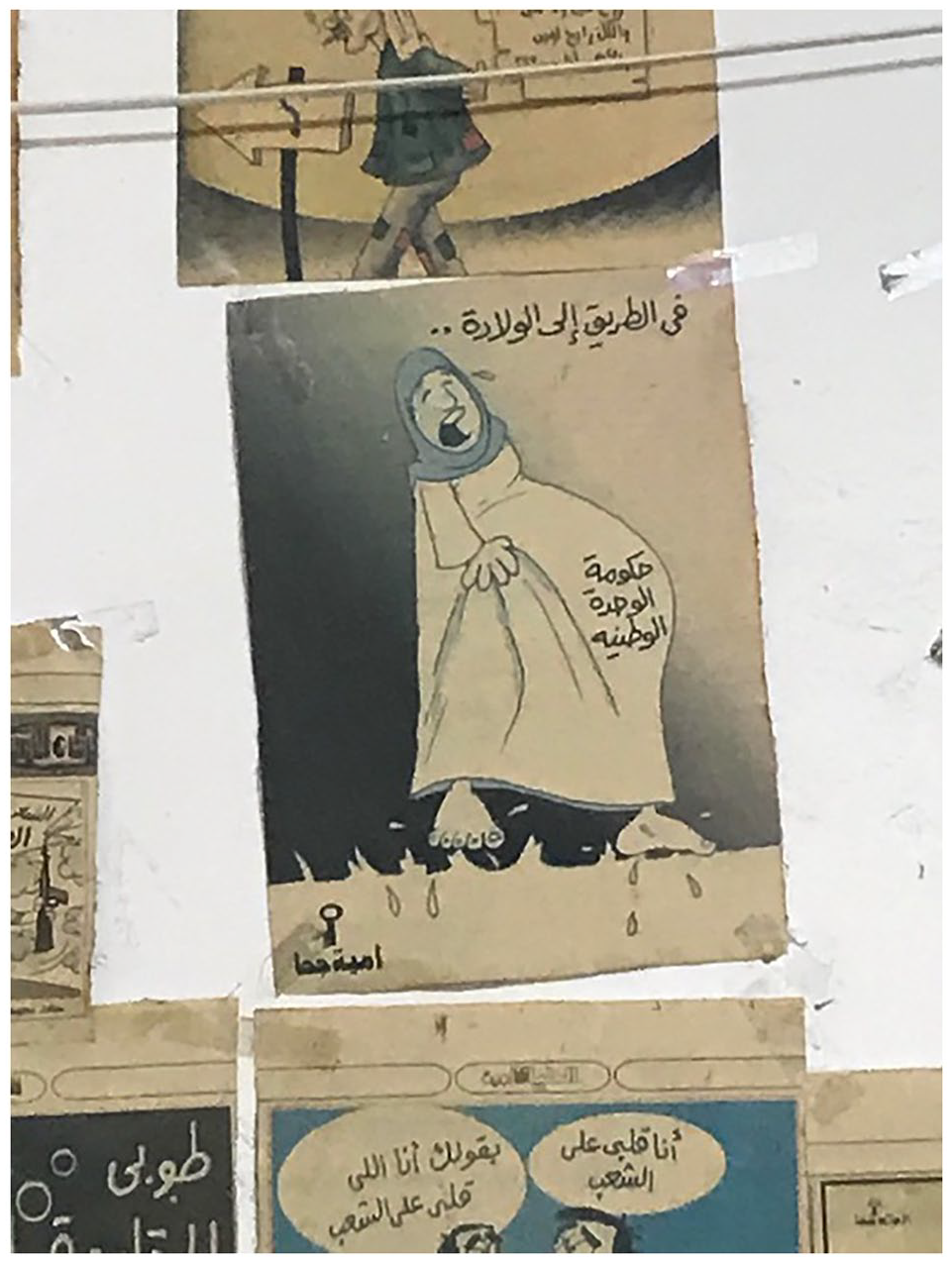
Wall plastered with newspaper cuttings, Jenin.
In this article, I examine this tension between oppression and resistance, governance and matter(ing) by analyzing Israeli settler colonialism and Palestinian practices of resistance through a matter-oriented approach. In exploring how bodies and bodily matter figure as actors in the counter infrastructures that Palestinians have established to enable the smuggling of sperm out of Israeli prisons and into Palestinian fertility clinics, this article contributes to theorizing the materiality of power by focusing on the relationship between the body and society. Bodies are integral to the workings of biopolitics and necropolitics, and different bodily materialities are made disposable or productive at the various intersections of race, class, gender, and sexuality (Chen, 2012). Indexing belonging, denoting kinship relations or relatedness, figuring as threats to biosecurity, or mapping the perceived borders of a nations’ immunity onto bodies (Patchin, 2020), blood (Carsten, 2011), urine (Novick, 2017), breast milk (Newman and Nahman, 2022), or egg cells, embryos, foetuses, and sperm (Fortier, 2007; Martin, 1991; Takeshita, 2017) appear as animate actors in current politics. In Israel/Palestine, a recent turn to human, animal, land, water, and plant bodies reveals them to be a crucial yet understudied site for settler colonial oppression and Palestinian practices of resilience (Daher-Nashif, 2020; Gutkowski, 2021; Salih and Corry, 2022).
I argue that Palestinians’ bodies and bodily matter constitute a crucial lens from which to analyze the multiscalar registers of Israeli securitization and militarization as well as the embodied practices of resistance that emerge in this context. Focusing on Palestinian bodies and their gendered and racialized materiality as contested sites (Abusneineh, 2021; Ihmoud, 2021) is thus key to understanding how settler colonial power not only materializes in and through bodies, but how oppression and resistance also produce, signify, and modulate the matter of bodies (Mikdashi, 2022: 180). In this article, I present fieldwork I conducted together with two Palestinian interpreters and research collaborators in the occupied West Bank. Drawing from interviews, field notes, and English language newspaper articles on sperm smuggling published between 2012 and 2022, I demonstrate how bodily matter is shaped by and shapes interlocking systems of power in the occupied West Bank, including the Israeli carceral system, Palestinian resistance, and militarized heteropatriarchy. In so doing, I situate Palestinian women’s narration of embodied forms of resistance as central to understanding the materiality of power in Palestine.
The Case of Sperm Smuggling
In August 2012, Dalal Al-Ziben gave birth to her son Muhannad, the first baby conceived with smuggled sperm, in a fertility clinic in Nablus in the occupied West Bank. 1 Muhanned’s father Ammar, a Palestinian prisoner who was sentenced to 25 years in Israeli prison, managed to smuggle a sperm sample out of prison and into the Razan Medical Center for Infertility in Nablus. Once the sperm sample had arrived at the fertility clinic and its origin was confirmed by family members of both sides, it was immediately frozen to enable Dalal to undergo IVF treatment. In the summer of 2018, 96 babies had been conceived by sperm that had been smuggled out of Israeli prisons and into Palestinian fertility clinics, a number that is probably much higher by now. The practice of conceiving with smuggled sperm in the West Bank and in Gaza has been discussed extensively in local Palestinian media, North American and European newspaper articles, a recent film (Amira, 2021), and in scholarly articles. In her seminal work, Sigrid Vertommen contextualizes the practice of sperm smuggling as a co-product of Israel’s settler colonial population management, which aims at controlling Palestinian women’s fertility to establish and maintain a Jewish population majority across Israel and Palestine (Vertommen, 2017). Vertommen provided the groundwork to theorizing sperm smuggling as a tool of biopolitical resistance for Palestinian women and men wanting to have a family. Other scholars have since approached the phenomenon from a literary (Hamdan, 2019) or ethical perspective (Rispler-Chaim, 2020), considering the racial geographies sperm smuggling is embedded in (Rexer, 2021), and the gendered identities it produces (Ferrero, 2022). I build on these insights and analyze the practice of sperm smuggling in the West Bank through a matter-oriented approach. I expand the existing scholarship on sperm smuggling by examining the practice across its several constitutive scales, including bodily matter as an entity of analysis.
In this article, I locate sperm smuggling in a complex interplay between biopolitical practices of violence, resistance, and everyday life. In attending to these relationships of co-imbrication, I explore the specific parameters and possibilities of embodiment (Wilcox, 2015: 12). Alongside other scholars concerned with an ontology of the body and the materiality of power, I propose a critical engagement with what it means to be in a biopolitical and necropolitical context that is characterized by entanglements of human actors, infrastructures, historical and contemporary political formations, and intimate, social, medical or military environments (Jackson, 2020: 15). To draw out the relationship between oppression and resistance in the practice of sperm smuggling, I specifically focus on the body and bodily matter not as passively awaiting cultural inscription, but as active entities, recognizing that ‘[m]atter and meaning are not separate elements’ (Barad, 2007: 3). I illustrate how this oscillating movement between matter reflecting social structures, and matter itself mattering is reconfigured by biological processes and social or institutional forces (Pitts-Taylor, 2016: 9). This understanding of matter as active and activated allows me to examine the multiple scales and actors that are constitutive of the practice of sperm smuggling.
After a section on methodology, I first demonstrate how sperm smuggling in the West Bank is organized communally. I analyze how bodies, technology, infrastructures, religion, and settler colonialism converge, shape, and are being shaped by the practice of sperm smuggling. Second, I explore how Palestinian women and their families conceive of sperm smuggling as a material, embodied form of resistance against the settler colonial regime. I show how in the practice of sperm smuggling, bodily matter is assigned evidentiary status to signify resistance, both by the Israeli military authorities and by Palestinian families. I then complicate this narrative by asking whose body and gametes figure as central political actors in the practice of sperm smuggling, illustrating how Israeli militarization, securitization, and incarceration reinforces sexual and political difference in a patriarchal society. I conclude by asking what kind of political work different bodies do in the assemblage of sperm smuggling. Specifically, I argue that it remains imperative to acknowledge Palestinian women as the producers of knowledge about the various ways of unruly and convivial forms of Palestinian resistance I discuss in this article.
Assemblage as Methodology
In this article, I draw from fieldwork I have conducted in the West Bank together with two Palestinian collaborators, Mary Khadija and Rafa Musmar, first in February and March 2016 and again in June and July 2018. 2 This research was conducted as part of a project on reproductive (in)justice in Israel/Palestine. To understand the political, social, and gendered meaning of sperm smuggling, we met nine Palestinian women and their families, whose husbands (or son, in one case) had been able to smuggle their sperm out of an Israeli prison. We mainly reached out to these families through a prisoner’s rights organization, as well as with the help of fertility doctors in the West Bank. The women we interviewed were keen on telling their stories, and I later recognized some of them in other studies and newspaper articles. All interviews took place in the families’ living room. The women we spoke to welcomed us warmly, and we would usually spend an hour or two drinking tea together or snacking on green almonds and sweets. We began each interview by asking how they came to know about the practice of sperm smuggling, what was their decision-making process in trying to conceive like this, and how they experienced getting pregnant and giving birth in such a novel way. We also asked about which other actors or institutions were involved and supported them, how the practice of sperm smuggling was socially and religiously perceived, and how they felt about its political implications. These encounters were rather social, with me, Rafa or Mary, and other family members, friends or neighbours being present. While we mainly spoke to the women and were interested to learn about their experiences, others would also participate in these conversations, which sometimes complicated translation and the women’s abilities to speak freely. After the interviews, the Arabic audio recordings were transcribed and translated into English, which added another layer of meaning to these encounters (Temple and Young, 2004) and illustrates the nature of ‘language-in-and-as-translation’ (Spivak, 1992: 184). To understand the institutional and biomedical perspective of sperm smuggling, I also conducted interviews with the spokesperson of the Razan Medical Center in Nablus and the director of the Al-Hiba fertility clinic in Ramallah.
Drawing from these fieldwork encounters, I approach sperm smuggling as an assemblage defined by ‘new material, collective, and discursive relationships’ (Collier and Ong, 2005: 4). I offer an analysis of sperm smuggling that takes seriously how the interplay between different actors, institutions, and technologies is both relevant to how this practice works and to how it is narrated. In that sense, I show how sperm smuggling becomes a meaningful practice through complex, multisited, and multitemporal technologies of translation and relationality, as well as the (im)mobilities (Tawil-Souri, 2012) that shape the material politics of location of doing research in Palestine (Madhok, 2020; Rich, 1984). I ask not only about the materiality and entangled nature of the practice of sperm smuggling itself, but also what this practice – as an assemblage – does to our understanding of the materiality and relationality of power and bodies and the way we analyze and narrate them (Puar, 2012).
A Communal Practice
The story of Muhannad Al-Ziben, the first IVF baby conceived with smuggled sperm in 2012, had been broadcasted widely once the baby was born in the Razan Medical Center for Infertility in Nablus. Everyone we interviewed in the West Bank knew about them or mentioned their case, as does most other scholarship or media coverage of the practice. Suhad, a 36-year-old mother of five, who lives in a refugee camp in Nablus, got pregnant with her youngest, 2-year-old daughter Hurae, with sperm her imprisoned husband Samir had succeeded in smuggling out of prison. Suhad explained how the story of Muhannad’s birth changed the situation of all the wives of long-term prisoners: ‘He was the first to shake the feelings of motherhood in all mothers. He renewed their identities’. The origin story of Muhannad was framed by the hardship of Palestinian women who had been deprived of motherhood due to their husband’s incarceration. This first case of a successful pregnancy with smuggled sperm illustrates how sentiments of hope and excitement are attached to the novel possibilities presented by IVF with smuggled sperm. This new way of conception resolved a social and political problem: couples separated by the ongoing occupation and Israel’s carceral regime were now able to continue having biologically related children. Medical professionals, religious authorities, Palestinian media, and civil society organizations have since worked together to set up the necessary infrastructures and social and religious protocols to enable more women to get pregnant like this.
While the practice of sperm smuggling originates in a couple’s wish to procreate, the actual need to smuggle semen out of prison is caused by the discrepant treatment Palestinian prisoners receive in Israeli prisons. Palestinian political or ‘security’ prisoners face stricter regulations of their rights to receive visitors, including the prohibition of conjugal visits, which Jewish–Israeli security prisoners are allowed (Steinfeld, 2015). Thus, by banning conjugal visits for Palestinian prisoners, the Israeli Prison Service (IPS) actively controls the Palestinian prisoner population’s reproduction and their families’ intimate lives. A spokesperson for the Razan Medical Center in Nablus explained to me that they and other, smaller fertility clinics in the West Bank respond to this unequal treatment by offering ‘free help’ to women who desire to undergo fertility treatment with smuggled sperm. The IVF treatment, which would otherwise cost around US$3,400, is offered free of charge or at a reduced rate to the wives of long-term Palestinian prisoners.
3
If a couple decides trying to conceive like this, the Palestinian prisoner smuggles a sperm sample out of prison and into a cooperating fertility clinic in the West Bank or in Gaza, where the sample will be cryopreserved immediately.
4
The Razan Center spokesperson described the process as follows: The women bring the samples. The wife of a prisoner comes to us and tells us that she just came from a visit, or that ‘I have a sample from my husband, how do I do that?’ ‘When you arrive at Nablus or Ramallah or Bethlehem, call this number. An employee will receive you’. And she needs to bring two certificates, from her and his parents, IDs, and the official marriage papers. The sample will be examined. If the sample is good, we sign that this sample is her husband’s, and we’ll freeze it at -197 degrees.
The practice of sperm smuggling constitutes a concerted effort that includes various actors and travels across different scales and borders. The fertility clinic is the most important biosocial infrastructure, mediating between the prisoner, his family, and their wish to procreate. Although it is theoretically possible, to undergo artificial insemination with smuggled sperm without medical assistance is technically difficult. Medical staff at the fertility clinic are thus central to facilitating the procedure of receiving, examining, and freezing the sperm sample, performing IVF cycles, and treating the women during pregnancy and birth.
Other actors of Palestinian civil society have also contributed to normalizing and supporting conception with smuggled sperm. After facilitating the first few successful cases and before fully advertising it to more families of detainees, Razan Center staff discussed the practice with religious authorities. This led to multiple fatwas officially approving of artificial insemination for women married to Palestinian long-term prisoners (Hamdan, 2019: 534; Rispler-Chaim, 2020: 5). Specific conditions of Islamic law determined this approval: the intended parents must be married, and the desired pregnancy must be agreed upon by the wife, her husband, and their respective families. Furthermore, members of each family must declare the origin of the sperm sample. These religious rulings were an important point of reference for all women I spoke to. Although reproductive technologies are generally widely used and embraced in the Muslim world (Fortier, 2020; Inhorn and Tremayne, 2012), the women I interviewed expressed relief that there were official guidelines to embed this (at the time) novel practice in the fabric of society. Establishing social and religious protocols helped women and their families to navigate fears regarding accusations of adultery and the resulting illegitimacy of the child according to Islamic law (Rispler-Chaim, 2020: 5). Some women developed their own strategies of making sure that the practice was announced publicly to prevent any suspicions. Marwa, a 39-year-old woman who lives in a village close to Jenin with her two teenagers and her 9-month-old son Majd, remembered: ‘We declared it in the village and almost everyone knew that I’m implanting fertilized ova. On the day of the birth, we announced it on TV and on the internet and explained the way I did the smuggling’. By informing her community and announcing the birth of her son and how he was conceived on TV, Marwa made sure the practice was socially and religiously accepted.
In the practice of sperm smuggling, several actors, institutions, and technologies converge. They are activated, implemented, and supported by fertility clinics and their staff, religious authorities, the couples’ families, friends, and communities as well as by the women themselves. An assemblage approach helps to identify how this multiplicity of actors, affects, relations, and temporalities constitutes the phenomenon of conception with smuggled sperm and its different forms of emergent agency (Ghoddousi and Page, 2020). This practice of assisted reproduction is not only engendered by the circumstances of the Israeli carceral regime and military occupation, but also acts as an assemblage that allows for a new organization of everyday life and kin work. Sperm smuggling emerged as a communal counter infrastructure that challenges the militarized geographies of the occupation, such as borders, checkpoints, prisons, and other infrastructures reconfiguring colonial space and life in Palestine (Griffiths and Repo, 2021; Puar, 2021; Salamanca, 2016). As a concerted effort, pregnancy and childbirth with smuggled sperm enable a temporal passage through the fissures and cracks of the infrastructures of military oppression and control. In the next sections, I demonstrate how in this process, bodies are made as distinct political entities and are assigned meaning in the context of incarceration and resistance.
Engendering Resistance: Bodies That Matter
Iman, 39 years old, lives in a small village close to Jenin with her two daughters and her 4-year-old son Baha. Baha was conceived with smuggled sperm after his father had already been imprisoned for 11 years. We were sitting in Iman’s living room, together with her sister and Baha, who was watching a children’s programme on TV. Spread out onto the floor were all the documents Iman had kept from undergoing IVF with her husband’s smuggled sperm, such as letters from the prison authorities and birth certificates. Iman described sperm smuggling as a communal practice supported by her community and the Razan Center, but also as a form of resistance against the occupying power: ‘The most important thing is to beat the Jews. This is against them. This is one way to beat them. Although he’s in prison, we’ll have children’. Later in our conversation, Iman came back to this point and elaborated further, referencing the material and bodily conditions that sperm smuggling challenges: ‘Even though we are in chains and imprisoned, there is nothing to prevent us from having children, to have a family, a society. That’s the most important thing’. In Iman’s narration, the incarceration of her husband and other Palestinians, their bodies being confined and ‘in chains’, is overcome by their mere continuation of life through reproduction and kin work, and by growing as a society. The settler colonial regime has the power to decide which bodies matter and which bodies need to be contained, but in so doing, also signifies how these bodies come to matter (Butler, 1996; Wilcox, 2015).
Esmail Nashif shows how in a dialectical process between the settler colonial regime and Palestinian society, political captivity assigns imprisonment the status of a rite of passage and enables Palestinian political prisoners to regain a sense of national belonging and community. In that sense, the space of the Israeli prison produces ‘Palestinian bodily matter’ (Nashif, 2004–2005: 46). The Israeli prison system and settler colonial securitization engender the imprisoned Palestinian body and bodily matter as a site of national belonging, community, and resistance. Palestinian bodily matter, then, matters precisely because of its imprisonment behind ‘bars’ and ‘metal’. In the case of sperm smuggling, the connection that is established across the borders, walls, and chains of the prison is enabled through sperm as a materiality that challenges and overcomes carcerality. As a substance deriving yet being separate from the body, smuggled semen becomes biopolitically relevant precisely because it constitutes an active bounded (if temporal) entity. The sperm sample’s movement reveals the porosity of the borders the Israeli state and military set up to slow down or impede Palestinians’ (reproductive) movement (Rexer, 2021). In this process, the Palestinian prisoners’ very material confinement is temporarily suspended through the sperm sample’s animacy (Chen, 2012). Carrying the prisoner’s status across the walls of the prison and into embodied futures, the sperm sample figures as an active entity of Palestinian reproductive futurity.
Salam, 31 years old, lives in a small village close to the Green Line in the Northwest of the West Bank, together with her mother, her three older daughters (aged 16, 12 and 9) and her son Sharif (two-and-a-half years old), who was conceived with smuggled sperm. Salam explained her husband’s reasoning of wanting to smuggle sperm, evoking Nashif’s analysis of the dialectic of political captivity: You know, a prisoner, he considers this an opportunity, an opportunity to go against the authorities, in that he is locked in a room and his wife cannot visit him. So, he had the idea that he wanted to have a boy and also break the rules. [. . .] The Israelis are not going to stop us, they have locked him in, and they have forbidden me and his daughters to visit.
Like Iman, Salam referred to the materiality of power through the lens of the embodied status of being imprisoned ( ‘locked in a room’), which, once overcome, turns into an act of resistance. For Salam’s husband, being able to smuggle his semen out of prison constituted an opportunity to engage in the Palestinian struggle for liberation, while at the same time allowing him and his wife to continue having children. Salam and her daughters are prohibited from visiting their husband and father, but by conceiving with smuggled sperm, they suspended the family’s material separation.
Salam remembered that what ‘drove the Israelis mad’ was when she and other mothers who had conceived with smuggled sperm applied for permits to visit their husbands with their newborn babies. Palestinians living in the West Bank cannot freely travel across the ‘Green Line’ without applying for a permit (Berda, 2017), and Israeli prisons are located within Israeli territory. The Israeli prison authorities would refuse to acknowledge that the prisoner in question was the legitimate father of the child they were applying for, noting that he had been imprisoned during the time the child was born. Fatiha, a 37-year-old woman from a village close to Nablus, explained to me that this led many of the so-called ‘new mothers’ to carry out deoxyribonucleic acid (DNA) tests to prove their husband’s paternity. Once they applied to visit their husbands again, this time showing proof of paternity, the prison authorities began to prohibit visitation for the wives and children of the prisoners in question and established further punitive measures such as prolonging the prisoner’s sentence or sentencing them to a fine for the involvement in the practice of sperm smuggling. The IPS spokesperson Sivan Weizman has been quoted as doubting that the practice of sperm smuggling happens successfully due to the strict security protocols of the prisons and the lack of longevity of sperm (Vertommen, 2017: 215). Yet, by requesting DNA tests and punishing prisoners and their family on the grounds of smuggling sperm, the prison authorities in fact acknowledge the existence and biomedical success of sperm smuggling by granting these children their origin story. In this process, the IPS charges Palestinian bodily matter with political meaning; bodily matter becomes evidence (Maguire and Rao, 2018: 2).
In the security logic of the Israeli prison authorities, smuggled bodily fluid serves as evidence for further punitive measures against Palestinian political prisoners and their families. Salam framed the evidentiary status of Palestinian bodies and bodily matter as a response to Israeli fears of a Palestinian ‘demographic threat’: ‘Our children, they fear them!’ Salam’s son, Sharif, was denied an entry permit to Israel, which they also had applied for to travel to the Israeli prison and visit Salam’s husband. Salam reflected, chuckling: when they gave him the letter stating that Sharif cannot enter Israel, he brought joy to this family and the father! In that his son is still a baby and already wore them out. His son became a threat to Israel.
In denying Sharif entry, the Israeli authorities not only impeded the baby’s freedom of movement but also granted the little boy something else: imbued with the power to be a threat to Israel, Sharif’s body resisted by merely existing. Salam’s son embodies the relationship between Palestinian bodily resistance and Israeli practices of targeting bodies in ever-new configurations of surveillance and control. Sharif’s body is evidence to his family and imprisoned father that Palestinian bodies matter.
The evidentiary status assigned to gametes breaching the prison’s walls makes the semen even more ‘sacred’ (Hamdan, 2019). Palestinian bodies are made and bodily matter emerges in interaction with the Israeli carceral system which, in turn, further hones its security apparatus by inventing and implementing ever-new modes of surveillance and control. DNA tests to prove paternity, sperm crossing the walls of the prison and the ‘Green Line’, or the children conceived with smuggled sperm – they all become actors or bearers of resistance in and through their relationship with the Israeli carceral system. Palestinian bodies are made, and bodily matter matters in a multiscalar system of state violence, communal counter-infrastructures, reproductive technology, and social and religious protocols.
The Absence of the Female Body
For sperm smuggling to lead to a successful pregnancy and the birth of a child, the female body is central. The women we interviewed recounted precautionary measures they applied to ensure the pregnancy would be successful. Iman remembered that she refrained from visiting her husband while she was pregnant. Echoing the broader effects the architecture of the occupation has on women’s bodies (Hamayel et al., 2017; Hammami, 2019; Shalhoub-Kevorkian, 2015), she said: ‘One does get scared at the checkpoints when undergoing fertility treatment, because there might be things that can affect the embryo. So, when I was pregnant, I didn’t visit him at all’. Others reported side effects from the hormonal treatment as part of the IVF procedure, general fatigue associated with the pregnancy or concerns about whether the fertility treatment will be successful. As these instances suggest, the female body, gestational labour (Lewis, 2019), and women’s experiences of conceiving with smuggled sperm are key to understanding this phenomenon. However, while male bodies, bodily matter, and the children conceived with smuggled sperm take centre stage as political actors in the process of sperm smuggling, the bodies of Palestinian women are strikingly absent in the ways in which the practice of sperm smuggling is narrated.
For some women, conceiving with smuggled sperm was not their choice or desire in the first place, and the absence of their bodies can be traced in the biosocial decision-making process of undergoing IVF with smuggled sperm. They shared with us a recurring argument leveraged by their husband or other family members referring to the fact that their ‘biological clock was ticking’. Fertility clinics in the West Bank only subsidize IVF with smuggled sperm for couples where the husband faces a long-term sentence of at least 15 years. For most women of long-term prisoners, they would not be able to get pregnant anymore upon their husbands’ release. Islamic law allows for the wives of prisoners who have been incarcerated for a prolonged period of time to get divorced on these grounds (Ferrero, 2022: 212). However, due to the heroic reputation of long-term political prisoners, women would usually not make use of this regulation (Vertommen, 2017). In a 2013 interview, Dr. Salem Abu al-Khaizaran, the director of the Razan Center, referred to this dilemma: The women here are loyal and want to stand by their husbands, but by the time the men are out of prison, many of these women will be too old to have children. When the man eventually leaves prison, there can be a lot of pressure on him to remarry to have children with a younger wife – and of course, leave his loyal wife. There are certainly cases in which this has happened. (quoted in Dawber, 2013)
This fear of their husband marrying another woman to have a new family was echoed in all interviews, whether it was the woman’s own wish to undergo IVF with smuggled sperm or not. Salam remembered how her husband used the ‘biological clock’ argument to convince her of undergoing fertility treatment with smuggled sperm, cautiously at first and more serious later: When he gets out of jail after the twenty years, he will be in his fifties, and I will be in my forties, and I would not be able to give birth. ‘So, this is a blessing that you can still have children’ and he said, ‘I don’t want to marry another woman to have another child. I consider that a betrayal’ [. . .] He was scared when I refused, he started saying sweet things such as ‘my Sweetheart’ and ‘my Love’. After that, he said ‘you are getting older, and you will stop having children’. I told him it’s not a problem for me. Last thing he said was: ‘this means that you don’t want me anymore and I see you when I see you’ [laughter]
Although Salam refers to this episode jokingly, it reflects how the ‘biological clock’ argument is coupled with the threat of divorce or marrying a second wife. Different embodied temporalities play out in this scenario. On one hand, the woman’s reproductive capacities are addressed and the importance of motherhood and having children ‘in time’ are emphasized (Abu-Duhou, 2007). On the other hand, the period of absence from regular life and the prisoner’s desire for continued fatherhood are considered. In the ‘biological clock’ argument, the latter is balanced against the women’s bodies. Either implicitly or explicitly, the women’s reproductive capacities are used as an argument in favour of undergoing fertility treatment with smuggled sperm. In part to enable her to have a family and children, and in doing so, fulfilling her role of being an ‘exemplary’ Palestinian woman (Buch Segal, 2015), but also for the imprisoned husband to be able to pick up life where imprisonment cut it off. The carceral horizon of Israeli settler colonialism thus affects Palestinian women and their reproductive decision-making, and reinforces patriarchal intimacies. Long-term incarceration and the prohibition of conjugal visits for Palestinian political prisoners positions Palestinian women’s bodies at the threshold for a Palestinian future while simultaneously reinforcing their political invisibility (Hammami, 2019; Shalhoub-Kevorkian, 2010).
This is not to say that Palestinian women are not engaged in the Palestinian struggle for liberation. Palestinian women are actively resisting settler colonialism in various capacities. These include political mobilization, strikes, participating in demonstrations, urban disobedience, and raising international awareness (Abdallah, 2022: 159–202; Hawari, 2019; Kayali, 2021) as well as challenging the occupation through embodied forms of resistance (Ihmoud, 2019; Shwaikh, 2022a, 2022b). Some of the women we spoke to also recounted publicizing the practice of sperm smuggling by giving interviews or appearing on TV to encourage others to follow their example. Salam told us that as the third woman to undergo IVF with smuggled sperm, she considered herself a role model to other women and gave them advice and shared her experience with them. Indeed, as Mohammed Hamdan argues, in being the main narrators of the practice of sperm smuggling, ‘the wives of Palestinian prisoners reclaim power as active agents of history in which their published written stories of sperm smuggling on media challenges the Israeli colonial narrative and decolonizes the oral male history of resistance’ (Hamdan, 2019: 537). However, a matter-oriented approach reveals how the Palestinian body of resistance is also gendered in complex ways. Sexual difference is political difference (Pateman, 1988) and as such shapes knowledge about bodies according to a binary logic, but also what kind of political work different bodies do (Wilcox, 2015: 13).
In the case of sperm smuggling, many Palestinian families use the opportunity to opt for nonmedical sex selection. Nonmedical sex selection is done either through sperm microsorting according to the gametes’ chromosomal bearing, or the embryos produced in vitro are selected by their genetic (chromosomal) make-up through pre-implantation genetic diagnosis (PGD) (Whittaker, 2011). Sperm smuggling requires the freezing of gametes and conception via IVF, and thus introduces nonmedical sex selection as an optional biomedical procedure, reflecting traditional gender roles and patriarchal structures in the West Bank and beyond (Bhatia, 2021). According to the spokesperson of the Razan Center in Nablus, the center generally facilitates sex selection if the couple already has two daughters and has obtained a fatwa from a Mufti stating that they are eligible for sex selection. In our interviews, almost all women had opted for nonmedical sex selection and had given birth to a son. Their reasoning for doing so varied. Some mentioned their husband’s wish for a son or societal expectations, while others referred to economic considerations of a life under occupation. Iman, for instance, explained that ‘with us, the Fellaheen [farmers], there is no situation where we don’t have a boy. The boy is an essential need. That’s the reason the father wanted a boy’. Son preference is not unique to Palestinian society, but patrilineality in Islamic family law produces specific biopolitical categories of belonging, and determines questions of inheritance and caring responsibilities (Abu-Duhou, 2007; Inhorn and Tremayne, 2012; Mikdashi, 2022). Laura Ferrero thus argues convincingly that nonmedical sex selection needs to be understood as a strategy Palestinian women deploy in their daily struggle for security and subsistence (Ferrero, 2022: 221). On a microscopic level, then, son preference illustrates how the specific parameters and possibilities of embodied resistance are modulated along with sexual and political difference, but are also inflected by the social, political, and economic situation of a society under occupation.
Palestinian women’s presence as the narrators of the practice of sperm smuggling and their way of narrating it (remember Salam’s chuckling in her recounting of her husband’s wish for a son) as well as their everyday struggle to survive Israeli settler colonialism illustrate their centrality in this form of resistance. However, on the material level of the body and bodily matter, their reproductive capacities, desires, and everyday practices of resistance seem to be harnessed for the social and biological reproduction of a patriarchal society under occupation. The Israeli settler colonial regime has a long history of exploiting uneven gender relations in Palestinian society by using military strategies intimately targeted at women’s bodies, mobilities, sexuality, and their role in society (Medien, 2021; Shalhoub-Kevorkian, 2009: 14–19). A series of t-shirts produced by Israeli battalion members reveal the normalization of such militarized sexual violence and their embodied effects. These t-shirts depict pregnant Palestinian women with captions such as ‘One Shot, Two Kills’, ‘Better Use Durex’ or ‘Bet You Got Raped’ (Sharif, 2014: 1), illustrating how from the perspective of an Israeli soldier, the pregnant woman becomes a target of military violence first and foremost for her reproductive capacities. Israel’s racialized politics of the womb (Ihmoud, 2021) reveals the ambiguous status of the female Palestinian body: it either needs to be saved from a patriarchal system or to be contained in its capacity to give birth (Rexer, 2021: 1555). If, as I have argued above, the Israeli prison engenders the male Palestinian body as a figure of resistance, then Israeli settler colonialism and its pornotroping (Ihmoud, 2014: 14; Spillers, 1987) of female Palestinian bodies situates them as a liminal figure to the realm of agentive politics. It is precisely in this context, where militarized state violence and sexuality merge, that the female Palestinian body is simultaneously dehumanized, ungendered, and hypervisibilized as a site of domination and a threshold to a Palestinian future.
Resistance as Epistemology
Sperm smuggling constitutes a particular kind of kin work, established by Palestinian families in the West Bank to resist the Israeli occupation. A new materialist approach to sperm smuggling enables us to explore the interaction of state power, society, technology, and infrastructure and how, in this process, bodies are produced, valorized, managed, and sustained. We can see how different systems of power and regimes of knowledge production – settler colonialism, sexual difference, religion, the family, or medicine – politically constitute bodies, and how bodies, in turn reconfigure the materiality of power (Mikdashi, 2022; Wilcox, 2015).
I have argued that conceiving with smuggled sperm is an embodied form of resistance in which matter and meaning converge on a bodily level and modulate who or what counts as a political body. My analysis of this form of Palestinian resistance furthers our understanding of bodies as always relational, but also elucidates the political work that bodies do (Wilcox, 2015: 13). While the right to a body that matters is not distributed equally in the bio- and necropolitical context of Israeli settler colonialism (Puar, 2021), the practice of sperm smuggling also reveals how certain bodies are overburdened with meaning. What crosses the walls of the prison, borders, and, ultimately, engenders resistance, is the male prisoner, his body, his semen, and the (preferably XY-chromosomal) child to be born. These actors are doing political work, both from the point of view of the Israeli state and Palestinian society. While Palestinian women’s bodies and reproductive capacities are central to conceiving with smuggled sperm and Palestinian women are the main narrators of this practice, the ambiguous and complex territory of their bodies as a site of Israeli domination and as a threshold to a Palestinian future complicate any notion of the body as bounded and fixed. In the assemblage of sperm smuggling, Palestinian women’s bodies do a different kind of political work. They urge us to recognize the manifold ways in which bodies become a target for contested and intersecting forms of power and the embodied indeterminacy of meaning-making.
In that sense, I also make a methodological argument about what it means to study assemblages of bodies, society, technology, infrastructure, and state violence. Taking seriously all material, collective, and discursive actors constitutive of sperm smuggling also implicates how we come to produce knowledge about this form of resistance. My analysis in this article draws from fieldwork and interviews with Palestinian women, literally, culturally, and politically translated by Rafa and Mary. The material context of Palestine and its politics of location crucially shape how I am able to narrate the practice of sperm smuggling (Rich, 1984). It remains imperative to acknowledge not only Palestinians’ embodied forms of resistance against Israeli settler colonialism, but to also recognize the specific kind of knowledge about bodies and the materiality power that emerges when we study from Palestine. This means to view Palestinian women as central to theorizing the various ways of unruly and convivial forms of Palestinian resistance (Puar, 2021; Salih and Corry, 2022). Palestinian women thus do another kind of political work in sharing their embodied experiences with us.
Footnotes
Acknowledgements
I wish to thank the Palestinian women who invited us so warmly into their homes and generously shared their stories with us. Thank you Mary and Rafa, for accompanying me during those trips and for your translations – they contained so much more than words. I am grateful to my long-term collaborator and friend Najla Fawwaz for sharing her knowledge with me, as well as to Hania Tayara, Paige Marie Patchin, Sophia Goodfriend, Elizabeth Berman, and the three anonymous reviewers for their invaluable feedback on different versions of this article. Finally, thank you Siggie Vertommen and Himmat Zoubi, for your encouragement and for challenging me when I started out this research.