




Abstract
This article is based on an online ethnographic study of Dutch women who use YouTube as a medium to document their contested illness experiences. During 13 months of observations between 2017 and 2019, we followed a sample of 16 YouTubers, and conducted an in-depth analysis of 30 YouTube videos and of 7 interviews. By adopting a ‘praxiographic’ approach to social media, and by utilising insights from phenomenological theory, this study teases out how bodies are ‘done’ in (the making of) these YouTube videos. We describe three types of bodies: (1) inert bodies, (2) experienced bodies, and (3) authentic bodies. Ultimately, this study shows how vlogging about contested illness is a practice in which bodies are continually (re)configured, and through which the ‘invisibility’ of a sufferer’s condition can obtain social visibility.
Introduction
I wanted to make a document for people to show that invisible illness is really not invisible at all, as long as you fit it into a bigger picture. [. . .] You can see it. I see it with everyone. Everyone who is sick, is tired, is in pain. You can see it, but you do have to recognize it. (Quote from interview with Danielle)
Chronic health conditions are omnipresent. They are also clad with invisibility (Fonseca et al., 2016). While acute illnesses can be rather dramatic in how they start and develop, chronic conditions emerge and evolve more gradually and are resistant to cure (Manderson and Smith-Morris, 2010). Compared to the visual impact of, say, bone fractures, skin burns, and many infectious diseases, chronic illness does not generally alter how the body appears to oneself and others (Charmaz and Rosenfeld, 2010). Yet many chronic conditions – generally understood as conditions in which symptoms last for longer than 6 months – do have the potential to become apparent. They can become visible, for example, in physical examinations, blood tests, or imaging technologies. By contrast, chronic illnesses with a contested aetiology (contested illnesses for short) do not generally manifest themselves in clear-cut symptoms, nor are they unambiguously diagnosable with formalised tests (Dumit, 2006). Such illnesses include long-term conditions such as chronic pain syndrome, fibromyalgia, and myalgic encephalomyelitis (ME)/chronic fatigue syndrome. Due to their inability to ‘attract attention’, contested illnesses are, to a certain degree, medically, socially, and politically invisible (Phillips and Rees, 2017).
This study explores what kinds of bodies can be identified in YouTube videos about contested illnesses, including chronic fatigue syndrome, fibromyalgia, and chronic Lyme disease. Considering the invisibility of contested illnesses, the use of a visual medium like YouTube seems rather paradoxical. For how do you make something that is deemed invisible on various levels, as well as by the YouTubers themselves, visible to the online eye? Turning to the opening quote: what is there to see? What is there to recognise? Guided by these questions, this study uses a phenomenological–praxiographic approach to tease out how bodies are ‘done’ in (the making of) YouTube videos about contested illness. It thus seeks to explain the different ways in which bodies appear in contested illness vlogging practices.
Sharing Illness Experiences on Social Media
In recent decades, more and more people have turned to social media to share their illness experiences with others. Since the development of the Web 2.0, with its emphasis on user-generated content and interactions, growing numbers of people turn to online patients’ collectives to talk about their conditions. Consequently, the experience of illness has shifted from a private to an increasingly public one, resulting in a change in the visibility of symptoms (Conrad et al., 2016; Lupton, 2018). To convey experiences of suffering, users might turn to discussion boards to engage in written conversations (Phillips and Rees, 2017), make and share pain memes on Tumblr (Gonzalez-Polledo, 2016), display their panic attack in a YouTube video (Berryman and Kavka, 2018), or post (un)altered images of malfunctioning or fatigued body parts on Instagram (Berard and Smith, 2019). These studies illustrate how illness experiences are not only shared on online platforms but are also (re)shaped by the affordances of these social media.
We understand vlogging as a set of practices that include staging, filming, editing, uploading, and interacting with online others. Composed of the words ‘video’ and ‘blog’ or ‘log’, vlogs are defined as a record of ‘thoughts, opinions, or experiences that you film and publish on the Internet’ (Cambridge Dictionary, 2022). Because vlogging about one’s life seems to call for a protagonist whose visual body is centre staged, and because most channels are openly accessible, YouTubers are public figures. Moreover, the impetus to enhance visibility is built into the design of YouTube, which frames its users as ‘content creators’ and offers advice on how to ‘create and share great videos’ (Hou, 2019). They are stimulated to adopt the so-called self-branding strategies (Johnston, 2020) – using a recognisable format, engaging with their viewers, and responding to comments, among others – to boost their online scope. Vlogging thus differs substantially from, say, sharing (health-related) content on Instagram, Tumblr, or TikTok, which can be done with less public visibility (McCosker and Gerrard, 2021).
Like blogs, vlogs have been interpreted as a therapeutic tool that can help patients come to terms with their condition by sharing experiences with online others (Huh et al., 2014). In her exploration of cancer blogs, Carsten Stage (2017) argues that social media allow for a new way of storytelling. Because illness bloggers draw upon their (undesired) ill-being as an affective resource, they might be understood as ‘biological entrepreneurs’. Anthony McCosker and Raya Darcy (2013), however, are sceptical of the understanding that the online labour of cancer bloggers is imbued with ‘commercialising and biopolitical forces’. They offer a more nuanced understanding of the multiple ways in which blogging might be of personal value to its protagonists. While many of these studies take online data as their source for analysis, Nathalie Ann Hendry’s (2020) study on the mental health-related online practices of adolescents offers a noteworthy alternative. Using a productive combination of ethnographic research methods (i.e. online ethnography and interviews), she observes that scholarly understandings of illness-related content run the risk of being too narrowly defined because they do not consider (meaningful) interactions with content that is not explicitly related to health. In line with this, this study underlines the importance of considering how (health-related) online practices are embedded in the lives of situated individuals.
It is noteworthy that most illness vlogs are created by women. In the Global North, more women than men make use of social media platforms (Lupton, 2018: 82). They also use these platforms differently, with women being more inclined to use the Internet for social relations and domestic activities compared to men, who use it more often for gaming and entertainment purposes (Lupton, 2018: 83). This can be partially explained in reference to the algorithmic make-up of YouTube, which favours the content of ‘middle class social actors who make highly gendered content’ and, in this sense, promotes the production of feminised videos (Bishop, 2018). YouTube thus stratifies the kind of content that becomes (most) visible in a stereotypical and gendered way (Duffy, 2015).
In this study, we combine online data and in-person interviews to explore the intertwinement of online and offline bodies. This methodology brings to light practices that would remain invisible if one would solely focus on online content, in particular the efforts and risks that are involved in the visual conveyance of embodied illness experiences, and the impact vlogging can have on experiences of the body. This study also complements existing research by focusing on how vloggers relate to their bodies, and how this co-shapes vlogging practices. Contrary to other phenomenologically inspired studies about illness vlogging (Sangeorzan et al., 2019), we combine a phenomenological perspective on first-person bodily experiences with a praxiographic approach that focuses on concrete practices as the core unit of analysis. This allows a more thorough understanding of how online storytelling about first-person experiences is interlinked with, and contingent on, the fleshly realities of analogue bodies doing things. So rather than describing what vlogging does or what it produces, our focus is on the multiple ways in which bodies are experienced, as well as on the ways these experiences are visualised and done in the practice of making YouTube videos.
Phenomenological–Praxiographic Approach
One of the core theses of phenomenology is that our experiences are fundamentally situated. We do not have a ‘view from nowhere’ as free-floating consciousnesses (Nagel, 1986), but we are bodily, situated beings. So while we can study ‘bodies’ as objects or things, our bodies are first and foremost the zero point of our experiences. Within the phenomenology of health and illness, this distinction between the body-as-object and the body-as-subject is further elaborated by looking at how illness or disability may produce differences in how the world and one’s body can appear and be experienced. For example, it is often argued that illness, pain, impairment, and/or the medical treatment thereof, may lead to an objectification of the body which can in turn result in experiences of alienation from one’s body (e.g. Leder, 1992; Svenaeus, 2000; Williams, 1996). Drew Leder (1990) states that where health is generally characterised by the fact that we do not perceive our body at all (the absent or transparent body), disease and pain are typically accompanied by the appearance of the body in a negative way – by the body’s ‘dys-appearance’ (in reference to the Greek ‘dys’ meaning ‘difficult’, ‘bad’, ‘painful’, or ‘not functioning well’ (p. 84)).
Dys-appearance can occur in different illnesses in different ways. In his study on depression, for example, Thomas Fuchs (2013) writes how depressed people can experience their body as a weighed down entity, as a heavy and solid object that stands in the way of ‘all intentions and impulses directed towards the world’ (p. 226). Because depression affects one’s embodied existence, Fuchs argues that depression should not be conceptualised as a cognitive state, but rather as an affective disturbance that alters how people relate to themselves and to the world around them. These findings resonate with a study by Målfrid Råheim and Wenche Håland (2006) on women’s experiences of chronic pain and fibromyalgia. Based on life interviews, their study illustrates how women relate to their ‘treacherous body’ by either feeling subjected to it, by seeking to escape from it, or by caring for it. Along similar lines, this study also illustrates how one’s body does not function transparently but becomes something one must intentionally relate to. The phenomenological perspective on vlogging about contested illness thus allows for an analysis of vloggers’ body experiences in terms of their body being an object or being a subject.
However, as Annemarie Mol (2002) has made clear in her groundbreaking study The Body Multiple, these phenomenological insights can be further refined if we focus on how bodies are ‘enacted’: how they are ‘done’. She endorses the phenomenological distinction between the body as object and the body as subject. But she adds that we also ‘do (our) bodies’ in our daily practices (Mol and Law, 2004: 45, italics in original). With this focus on situated practices, Mol introduces what she calls a praxiographic approach to the study of bodies. In The Body Multiple, Mol draws on ethnographic data about the diagnosis and treatment of atherosclerosis to describe how, depending on the physical realities of a certain context, disease is enacted in multiple and at times conflicting ways. Studying disease thus means studying localities, Mol argues (see also Clever and Ruberg, 2014: 553).
In this study, we adopt a praxiographic approach in that we explore how the vloggers’ experiences are shaped in material and situated practices. We look at how the YouTubers’ material reality is an integral part of the stories they tell in and through their videos, as their movements, postures, speech, gazes, tools, beds, showers, and homes take central stage. We also investigate how vlogging practices are contingent on the (emotional, kinesthetic, and cognitive) abilities of material bodies. Rather than analysing vlogs as (illness) stories – for example, by addressing narrative structure, protagonist development, audience reception, and the like – a praxiographic approach allows us to address how the practicalities of analogue bodies feed into the practicalities of virtual bodies and vice versa. Because praxiographic studies do not necessarily address how the body is enacted, and attended to, as both object and subject, and because our analysis explicitly engages with phenomenological studies about illness and embodiment, we describe our approach as a ‘phenomenological–praxiographic’ one. This approach allows us to direct attention to how YouTubers relate to their bodies, and how experiences of the body and embodiment intersect with their vlogging practices.
Methods and Materials
This study draws on a combination of qualitative research methods. The first method is online research. After receiving approval of the Research Ethics Committee of Tilburg University, the first author spent a total of 13 months (September 2017 to January 2018 and June 2018 to February 2019) conducting online observations on YouTube. Based on online searches and snowballing strategies, she selected a purposive sample of 16 Dutch YouTubers who had uploaded one or more video(s) about their experiences of living with contested illness. At the time of the research, these YouTubers were aged between 18 and 45 years, and most were in their early 20s. All are women, because – despite the aim to be inclusive in terms of gender and despite extensive online searches – the author could not identify any male YouTubers. Except for one YouTuber, whose last video was from mid-2016, all YouTubers were active during (and after) the timespan of this study.
The sample varies strongly when it comes to (1) how active they were on YouTube, (2) how strongly they focused on their illness journey in their videos, and (3) to what degree their lives were disrupted by their illness. At the end of the data collection, the smallest number of videos posted by a YouTuber was 4 and the highest number was 284. Subscription numbers ranged between 94 and over 12,000. Of the 16 YouTubers, 9 focused solely or predominantly on their illness journey, 4 combined their illness-related videos with other topics (such as DIY arts and crafts, self-care, fashion, and pets), and 3 only posted about their illness once or sporadically. Moreover, while some YouTubers reported on minor symptoms and lifestyle adjustments in their videos, others showed footage of severe suffering and expressed their difficulty with posting any online content at all – because editing invoked too much pain or because they were too fatigued to film themselves. Bearing these variations in mind, all YouTubers shared experiences of chronic pain and fatigue, and used YouTube as a medium to convey these experiences and to illustrate how they had adjusted their lives accordingly. It is important to note that this study artificially delineates the online practices of our sample by solely focusing on their vlogging and labelling them ‘YouTubers’. Our decision to focus on YouTube is informed by the popularity of the platform, as well as the unique visual and (linear) temporal structure of vlogs. We do note that several women in our sample use Instagram and Facebook for promotion purposes – to direct their network to their vlogs about their illness experiences.
In our YouTube searches, we used ‘[specific contested illnesses]’ + ‘vlogs’ as our search term. These searches are necessarily structured by YouTube’s untransparent search algorithms; the content that gets to be presented and ‘related videos’ is based on previous searches (Gibson, 2016). The content we scrolled through encompassed videos by patient organisations, treatment centres, and news outlets, among others. We selected YouTubers who (1) had uploaded multiple vlogs about their respective conditions and (2) whose content was uploaded over the course of one or more years. We disregarded vlogs about irritable bowel syndrome because these vlogs were mostly concerned with dietary advice and did not commonly document illness experiences, nor experiences of the body and embodiment, and were thus less relevant to this study. In our first interviews, we found out that Instagram is a particularly relevant platform. We consequently asked interviewees for relevant hashtags, and used those to broaden our searches. Examples include #lymedontkillmyvibe and #invisibleillness (in Dutch: #onzichtbaarziekzijn). This way we got acquainted with several active and engaged Instagram profiles, which we looked up on YouTube and included if the profiles matched our research criteria. Given our use of snowballing strategies, it is safe to say that our sample consists of a loosely affiliated network of YouTubers, many of whom use comparable hashtags to promote their content on various platforms. At the time this study was conducted, younger YouTubers were more prone to use Instagram to disseminate and talk about their YouTube videos, whereas older YouTubers used Facebook for promotion purposes and made more extensive use the comments section on YouTube. In both cases, however, the main content on illness experiences was posted in vlogs.
In addition to online research, the first author conducted interviews with seven of the YouTubers included in this sample. These interviews addressed the practicalities of cogitating, filming, editing, and posting YouTube videos, as well as the meaning they ascribed to their online practices. Four interviews took place face-to-face, and three via email using questionnaires and follow-up questions. The inclusion of interviews informs our decisions to use pseudonyms, and to leave out personal characteristics (e.g. age and ethnicity). The included quotes – from both YouTube videos and interviews – are translations from Dutch to English. Transcripts of the interviews, as well as transcripts of a selection of 30 YouTube videos, were coded in the qualitative data analysis program MAXQDA. The first author started the analysis through open coding, searching for recurring themes in the written data. After this, all authors synthesised the themes with the aim to capture different experiences of embodiment. We then returned to the sample to substantiate our findings and explicate the specifics of each category. In the end, we distinguished three main types of bodies, each of them related to certain material practices and doings: (1) inert bodies, (2) experienced bodies, and (3) authentic bodies. These different bodies (i.e. these different ways in which bodies appear) do not exclude each other, but highlight different aspects of YouTubers’ experiences as they are enacted in their vlogs. In the next section, we present our data and analysis. We start each subsection with a short vignette, followed by a phenomenological–praxiographic reading of the data.
Inert Bodies
Lili is a small and energetic woman who lives in an apartment in the centre of a Dutch city. Schooled as a journalist, she had been making YouTube videos about her travels by bike for some time when she decided to post a video about her illness. This decision had a long history; while she is generally reticent about her illness, a couple of YouTubers who speak openly about their chronic conditions have long inspired her. She also feels that the combination of biking and her illness is very much part of her story because biking helps her greatly in alleviating symptoms. However, previous occasions of opening-up about her illness had, at times, dire consequences, ranging from trivialisations and disbelief, to the dismissal from her previous job after informing her boss about her illness.
In the first video, Lili discusses how she experiences her illness. In the first scene, she cycles into some empty grasslands, brakes, steps off the bicycle, walks a few paces, and squats down in front of a camera she positioned there earlier. She then starts talking about her symptoms, with each symptom written on a post-it sticker to show to her viewers. After briefly discussing each respective symptom, she incorporates a flashback to illustrate and comment on that specific symptom. When she discusses brain fog, for instance, she then shows footage of herself sitting on the floor in an attic, crying and lamenting her bodied immobility, and consequent incapacity to do the things she wants to do. There are no visible windows, and the sole light seems to be coming from a LED light on the ceiling. She first looks up and past the camera, before she addresses the viewer directly:
Oh man . . . it’s because I am so trapped in this body that does not belong to me, to how I am. This body does not belong to what I want right now, you know. I have so many things in my mind, things I want to do. I’ve been feeling it for days now, and eh . . . it all collapses. (YouTube quote by Lili)
All these flashbacks consist of footage of herself in her home, filmed by keeping a camera in front of her face, or using a solid object like a tripod on which she positions the camera. In the video, the flashbacks are recognisable using a black and blurry framework, and by the incorporation of soft and melodious instrumental music. By means of conclusion, and as a way of summing up the content of her video, Lili films herself hidden behind some barren branches. She comments: ‘It feels a bit like this. As if I am [. . .] it feels as if I am stuck between the branches’. She then looks up to the sky as the geese fly by in the evening sun and ponders aloud whether they ever feel trapped like her (Figure 1).
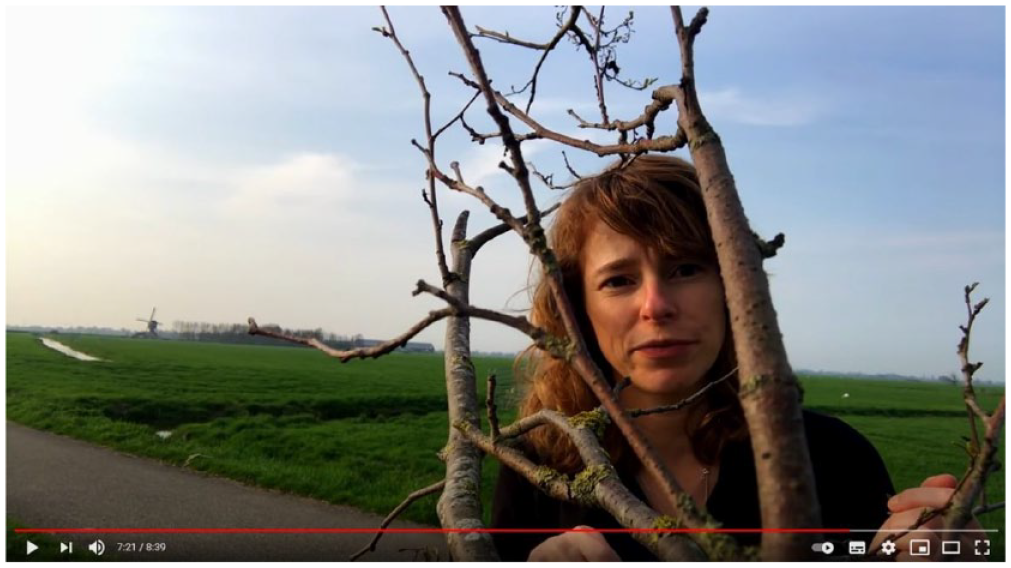
Print screen of first illness-related video by Lili.
As we see in Lili’s account, her illness disrupts her everyday experiences of spatial orientation and motility. This experience can, to some extent, be interpreted along the same lines as current phenomenological analyses of embodiment in depression (Aho, 2013; Fuchs, 2013; Ratcliffe, 2015; Slatman & van de Ven, 2021). Specifically, these analyses show how depression fundamentally alters patients’ experiences of their bodies and their (social) worlds. Depression disrupts one’s bodily intentionality, that is, one’s capacity to make sense of and deal with one’s environment through habitual actions and gestures. Some people with depression experience a diminishment of their sensorimotor space to the closest environment, and even carrying out minor tasks becomes troublesome, as they require the overcoming of corporeal inhibitions. Depression disrupts this flow of action by putting the otherwise unnoticed body in the foreground, reflecting an embodied ‘I cannot’ rather than ‘I can’. In a similar way, Lili feels trapped in her bodily ‘I cannot’.
In our sample of YouTube videos, it is remarkable that much footage is of sedentary bodies and of bodies that are lying down. Pain and fatigue are apparent in facial features, such as sagging eyelids, and bags and dark patches under the eyes, and in slow and faltering speech. Indeed, YouTubers regularly incorporate relatively long silences in their videos in which they search for specific words, or, conversely, scenes in which they are hyperactive, incoherent, and blurry. Several YouTubers have uploaded videos that illustrate the effort it takes to get up in the morning. These videos can take up to 10 minutes, as the YouTuber films herself while she slowly and laboriously rises from her bed and shuffles stiffly through her room.
Yet different from depression, the experience of contested illness generally does not entail a numbness towards the affective qualities of the world (Fuchs, 2013). On the contrary, YouTubers readily speak of an incongruence between having an inert and ‘broken’ body and having a mind that is hopeful and wanting. These vloggers qualify their bodies as ‘malfunctioning’, ‘aged’, or ‘alien’. Through their illness, their bodies dys-appear as ‘negative’ and ‘bad’. Lili vocalises these feelings when she describes how her bodily state is at odds with how she wants her life to be. In her video, the absence of windows and natural light affects the viewer by invoking ominous and uncomfortable feelings of confinement in a dark and restricted space. Associations of spatial restrictions again come to the fore when Lili films herself behind a nest of branches, albeit in a metaphorical manner. More generally, videos about contested illness can be hard and frustrating to watch, because they are plotless and do not ‘move’ towards a certain result or message. Resonating with the embodied performances of the YouTubers, such lengthy videos quite literally ‘drag on’.
This incongruence between a faulty body and a desiring mind also comes to the fore in the process of making YouTube videos. Both in their online content and in interviews, YouTubers explain how filming induces pain in backs, arms, joints, and muscles, and how articulating a coherent story can be particularly troublesome when one is hindered by fatigue and brain fogs. Because editing requires extensive use of fine motor skills, making suitable content is a pain-invoking endeavour that takes a lot of time. In an email interview with Bianca, a young vlogger who documents her experiences with fibromyalgia, she expresses this sentiment in the following way:
What I find a downside [to vlogging] is that I already have very little energy, and vlogging and editing costs a lot of energy. This often makes it hard to make a vlog. I really have to plan this carefully and have to take my energy and time into account. (Interview quote by Bianca)
Inert bodies, then, entail a dualistic experience and enactment of oneself in which one’s body is felt as a strange and cumbersome object that is at odds with the YouTubers’ sense of self, and stands in the way of living a fulfilling life. YouTubers convey the experience of a body that is weighed down and moves laboriously through space and time. Vis-à-vis this alien body, we discern another body; one that urges the YouTuber to heed its demands and to which YouTubers are compelled to relate themselves. This ‘experienced body’ is the subject of the following section.
Experienced Bodies
‘Do you want to hear the whole story?’ It is a rainy morning when the first author interviews Danielle, a hospitable and engaging woman who sporadically posts YouTube videos about her history of, and ways of dealing with, being chronically ill. After installing herself on her couch, equipped with an audio recorder and a notebook, and with a large Rottweiler curled up under her feet and snoring gently, the first author asks Danielle to elaborate on the period leading up to her diagnosis. Danielle looks a little sceptical, but after some nods and reassurances she starts talking. She turns out to be a good speaker who is adept at guiding the listener through the specifics of her illness story. As she talks about her family history, formative life events, (mental) health problems, medical examinations, multiple diagnoses, and the treatment and medication she received, Danielle regularly indicates that there are vast differences between her way of life before and after receiving the diagnosis of fibromyalgia. She explains,
The key for living a relatively pain-free life when you have chronic pain is regularity and as little stress as possible. And so, um, yes, that involves making different choices. (Interview quote by Danielle)
She elaborates that her present way of living is ‘almost a Spartan life’ that involves reserving time to recover after exertion, making energy calculations to determine what she can do on a given day, paying attention to her dietary choices, and de-triggering her entire environment. She also explains how making these choices can seem counter-intuitive, as they involve learning to recognise enjoyable events – such as parties – as stress-invoking situations that are best to be avoided. This new way of living stands in stark contrast with her old life, in which she would ‘work and party hard’ and would not consider the long-term consequences of her behaviour. Danielle put this succinctly by saying: ‘I changed my entire routine, and my entire way of life, really’.
Making more conscious choices also applies to Danielle’s social media practices; while she used to keep a blog, she recently switched to making vlogs instead. This was not an easy decision, because it also meant giving up one of the practices she enjoys most, namely, writing. Schooled in journalism, Danielle passionately affirms that ‘telling stories, writing stories: that is just me’. Not being able to build a sentence, or to memorise what she had or had not said, was a major setback for her. Regardless, she felt that giving up her blog was a necessary thing to do:
Because the trouble is: if my hands get stiff, they start hurting, and if my hands start hurting and I still continue then my arms start hurting, and then my neck starts hurting and then I’m out for two weeks. That is how it works. So I can, I have to obey, if I want to keep doing things. (Interview quote by Danielle)
By contrast, making YouTube videos, for Danielle, requires less extensive use of fine motor skills. Contrary to the laborious practice of typing blogposts, she can make a vlog in only one or two takes. She only spends a limited amount of time on editing the footage before she uploads her videos on YouTube. As such, making YouTube videos is a more feasible way of getting her story out in the online world.
To be able to manage her illness, Danielle, like other YouTubers, must constantly estimate what she can do and what she cannot do. Even though this estimation requires a kind of listening to her own body, it does not imply an increase of ‘inside insights’ or ‘introception’ such as Drew Leder (2018) has described in his recent work. Whereas it is commonly assumed that bodily signals naturally make sense and that we only need learn to listen to them, the experiences of the people suffering from contested illness instead seems to be that the body gives very complicated signals. If the body ‘speaks’, it does so in ways that require extensive studying to get acquainted with. Indeed, YouTubers often express their indignation and frustration about feeling fine at a certain moment in time, followed by a later ‘punishment’ for their activities – that is, by suffering a breakdown, collapse, or setback, and the need to recover for a long time thereafter. Related to feelings of bodily alienation – described in the previous section – the body’s propensity to send ‘faulty signals’ underlines the YouTubers’ sense of having a body that is not working the way it should.
When YouTubers phrase the importance of listening to their body, then, this is not so much a matter of listening to its inner signals, but rather one of heeding its demands. These demands can become known by paying close attention to one’s previous experiences. When the first author interviewed Sue, a middle-aged YouTuber who occasionally posts videos about her experiences with ME, she explained how the understanding she gained of her body and the skill of dosing energy took her a long time to master, and how it involves the continuous, counter-intuitive need to distrust her own feelings of well-being:
It is more from experience, that you know you have to be sensible. [. . .] Previously I used to say: let’s just do it! And then it would be four days of nothing. And then it would be the same thing all over again. [. . .] So it’s more from experience. But it took me over ten years to get there [laughs], because at such moments you simply feel good and joyful [. . .] and that’s really hard to have to suppress. (Interview quote by Sue)
Sometimes, YouTubers express their inability to heed the demands of their bodies. For example, when Ginger, who documents her experiences with chronic Lyme disease, uploaded a video in which she showed her viewers how she uses one of her medical devices, she was talking more rapidly and in an unfocused way than she normally does. Explaining this to her viewers, she said: ‘I might look very fit and very hyperactive, but all this time my body calls out: lie down! Do not talk that much! Ginger, sit down!’ These examples illustrate how heeding the demands of the body is a delicate practice that requires the YouTubers’ constant effort and awareness.
Many of the YouTubers frequently post videos that document a day or a week, to give their viewers a glimpse into their daily lives. Most often these videos are about mundane activities, such as making breakfast or going for a walk. One of the vloggers, for example, posted a video entitled ‘SHOWERING ONCE EVERY TWO WEEKS’, in which she shows how she prepares for a shower by scheduling little for the rest of the day and asking her parents to come over and help her. At the end of the vlog, after having taken a shower and preparing for bed, she rants about why taking a shower is such a frustrating activity to her. She ends by exclaiming how it is particularly infuriating that ‘afterwards you are completely broken’ and that it takes ‘a super long time in total, and that I have to schedule an entire day to simply take a shower’. By making YouTube videos, women with a contested illness can show their audience how much their days revolve around scheduling a very limited number of activities.
Even though YouTubers emphasise that they do not choose to have a (contested) illness and sometimes ardently resist it, they do agree that they have a certain amount of control when it comes to how they manage their illness. In this light, it makes sense that many YouTubers post vlogs on topics such as drinking smoothies, trying out gluten free foods, practising meditation or yoga, working out in personal training sessions, and cycling to appointments with caregivers. While YouTubers acknowledge individual variation in the sense that they readily emphasise that viewers should discover for themselves what works best, the assumption that underlies their online content is nevertheless that heeding the demands of one’s body is something that others are – or ought to be – invested in as well.
In sum, in the enactment of an experienced body, YouTubers illustrates how they manage their unruly and capricious conditions. Compared to the inert body as a weighed down entity that stands in the way of a fulfilling life, the experienced body allows for a more agentive role that is oriented at optimising health and well-being, and that often involves a (radical) break with one’s prior way of life. Through the combined enactment of an inert body and a demanding body, it becomes apparent that these YouTubers experience their embodied suffering as alien and involuntary, and that in response they put in effort to manage, take care of, and regulate their bodies by heeding its demands.
Authentic Bodies
Anne was in her 40s when she first startsed making vlogs about her experiences with having a contested illness. She had some previous experience with making YouTube videos, all of which were about adopting a healthy lifestyle. These older videos were quite staged; they were shot in a garden or kitchen and with Anne presenting a well-composed text about a given topic, such as drinking cow-milk substitutes or sunbathing. Compared to these videos, the vlogs about her illness trajectory are much more intimate: they take place in her home, the content is personal, and her way of speaking is more spontaneous. Her soft and articulate voice further enhances a sense of intimacy, as she informs the viewer of her frustrating and lengthy search for an adequate diagnosis, treatment, and care.
In one of her vlogs, Anne discusses a visit to her occupational therapist. In their conversation, he had addressed Anne’s social media use and implied that it was unwise for her to post ‘positive’ content on Facebook, because then people could take that ‘out of context’ and start thinking that Anne was not really sick after all. This agitated her greatly, and with tears in her eyes she heatedly explicates how, on social media, people never get to see how people with a contested illness – people like her – lie crying on the couch, or how they are too tired to care for their children, or how they slowly cease to be able to do anything anymore. Towards the end of her vlog, she pauses briefly and looks intently at the viewer, before she speaks with great emphasis:
Dear people, take a very good look at what is happening behind closed doors. Ask a friend, colleague, niece, nephew, whoever: how are you really doing? How are you really doing? Because that is what you don’t see on Facebook. But I do show it. Here. This is me. This is me with my fucking shoes on the floor because I can’t put them in the shoe cabinet. With pain in my arms from holding my phone. [. . .] And this is the truth, and this is the real me. I don’t care who can see this. This is me [in English]. (YouTube quote by Anne)
Here, Anne contrasts the one-sidedness of positive Facebook posts with her offer of a more truthful insight in her own life in her YouTube videos. Rather than keeping up appearances, as she deems conventional on Facebook, Anne is determined to give her viewers a glimpse behind the scenes by showing what living with a contested illness is really like.
In interviews, YouTubers explain how the act of documenting their embodied suffering – by creating a channel, filming their bodies, sequencing footage, editing the content, writing captions, and uploading videos – is a way of giving testimony. Through their online content, YouTubers seek to raise awareness, thereby responding to the ‘ignorance’ and ‘indifference’ they experience in their daily lives. In this enactment, the body itself takes central stage. This inert, complicated, and demanding body is still their body. This becomes particularly apparent in the video when Anne says: ‘But I show it. Here. This is me’. Their bodies are there, they exist, and uncomfortable although this may be, the vloggers confront their viewers with this bodily reality of theirs. In this specific practice, Anne’s body appears as an ‘authentic body’; it is her body as she experiences it and how others should see it as well.
In several videos, vloggers document their bodily suffering, for example, by filming pain attacks and seizures or by including close-ups of specific malfunctioning body parts. Take Charlotte, for example, a young YouTuber who posts regular diary-like updates about her illness. In a 10-minute video entitled ‘SYMPTOMS (STILL NOT BETTER)’, she elaborates on somatically visible symptoms she experiences due to her illness, including a tremor in one of her hands and pain attacks. In most of the video, Charlotte is elaborating on the onset, development, and her personal experiences of these symptoms while she is lying in bed. She looks directly into a camera that is presumably positioned on her bedside table. In addition, she also incorporated some shots of real-life symptoms. These are all filmed by her mother, and function as visual illustrations that underline the veracity of her story. This becomes particularly clear when Charlotte announces a shot of a tremor in one of her hands. Preceding this shot, she says: ‘I really cannot fake this, because if I try . . .’. She then keeps her hand in front of the camera and tries to shake it as if she is experiencing a tremor. She laughs, and adds: ‘No, I just can’t do it. So it’s 100% real’. By stating this, Charlotte underlines the authenticity of her online content by rebutting potential accusations of faking symptoms head-on.
Here, we see that practices of camerawork, staging, and editing, that is, a particular vlogging enactment, allows the vlogger’s body to appear in such a way that it might directly affect other people. This, for sure, does not mean that all people are indeed affected by it in equal measure and in equal ways. The affective responses of others, for instance, rely heavily on whether they can relate to the pain and/or to the sufferer. This makes sharing one’s pain experiences an inherently risky endeavour. Given the volatility of sharing pain experiences on YouTube, and because staging is inherent to the practice of vlogging, the YouTubers’ enactment of their body as an object of truth opens the possibility of being accused of staging, malingering, or faking. The enactment of an authentic body can result in feelings of shame from the viewers, for instance, when they feel they are intruding on an experience that ought to remain private, and is therefore ill-suited to be filmed, edited, and broadcasted on social media. Conversely, if viewers acknowledge the truthfulness of the YouTubers’ embodied suffering and acknowledge that the online performances are congruent with the YouTubers’ offline experiences, this can create communal feelings of empathy, solidarity, and recognition.
Our praxiographic analysis reveals that the practice of contested illness vlogging is not simply done by the vlogger, her body, and her material. Other bodies co-shape practices. The enactment of the authentic body – more than the enactment of the inert and the experienced body – is conditioned by (the possibility of) watching and appraising others. This is not so much a linear process in the sense that YouTubers anticipate the responses of others and construct their vlogs accordingly. Rather, the making of a moral appeal and of documenting bodily experiences as a means of giving testimony – practices that are constitutive of ‘authentic bodies’ – would not themselves be possible without the understanding that others may be watching.
In interviews, YouTubers express that they are aware that their videos engender a plurality of affective responses, and that they fear being perceived as insincere. In an interview with Bianca, who vlogs about fibromyalgia, she expressed that pretending as if there is nothing wrong is the ‘easy way’ to deal with being ill. This way, ‘you don’t get any questions or comments like: “oh, but you don’t look ill”, or “you are so young, it can’t be that bad”’. However, her experience was that ‘wearing such a mask also costs a lot of energy and is very demanding of your body’. Feeling reluctant to keep ‘wearing a mask’, and encouraged by the thought that others might benefit from hearing the stories of a fellow sufferer, Bianca decided to start vlogging. Like other YouTubers, she felt the urge to tell her story as it really is, and deemed that urge sufficiently important to expose herself to the prejudices and judgements that her videos might arouse in those who watch them.
Discussion and Conclusion
The fact that contested illnesses neither manifest on the exterior body nor become visible through tests and screening technologies does not mean that there is nothing there to see. As this study shows, YouTube provides women who suffer from a condition that they describe as ‘invisible’ with a powerful tool for visualising their bodies and illness experiences. As soon as these experiences of the body are captured in vlogs, they are ‘enacted’: they come into being through ‘techniques that make things visible, audible, tangible and knowable’ (Mol, 2002: 33). How this happens is, of course, contingent on these specific bodies, but also on cameras, tripods, phones, homes, partners, parents, affordances, and audiences, as well as on the many (micro)decisions that are made in the process of vlogging. Phenomenological studies that focus only on experiences of the body and embodiment miss out on these (material) aspects.
By combining online data with interviews, this study extends the current scope of social media studies about (contested) illness, which mostly focus on online data only. We argue that this methodical move is important, for it allows us to gain a more thorough understanding of how vlogging is ‘done’: how vlogs are pondered, planned, staged, filmed, edited, uploaded, and responded to. This focus complements the interpretation of vlogs as ‘illness narratives’ that – drawing inspiration from the seminal work by Arthur Frank (1995) – centre on the technically mediated performances of ‘wounded storytellers’ (Fullenkamp, 2020). By conceptualising (the making of) vlogs as a practice that is profoundly material, it becomes clear that vlogging involves a rather messy process in which bodies are continually (re)configured (Lupton, 2015:2).
Moreover, the different bodies that are described in this study also line up with different technical affordances. ‘Inert bodies’, for example, appear most vividly through practices of staging: by extensively and longitudinally documenting their weighed down postures, laborious speech and malfunctioning body parts, within the confined space of their living and bedrooms, YouTubers confront their viewers with the experience of their bodies as inert ‘things’ that drag them down. By contrast, ‘experienced bodies’ appear mainly in the oral articulation of experiential knowledge, and in illustrating various self-care practices that serve to make living with a contested illness more manageable. In addition, the linear temporal structure of vlogs allows YouTubers to illustrate how even the tiniest bit of over-exertion can result in the experience of being unable to do anything anymore. Finally, ‘authentic bodies’ appear most pressingly through the YouTuber’s gaze, through which she can look viewers in the eye while giving testimony to experiences of pain, fatigue, and suffering, thereby appealing to the viewers’ recognition. As such, the technical affordances of YouTube offer a relatively accessible possibility to express and share experiences of contested illnesses that are difficult to get across through other means.
In sum, people who suffer from contested illnesses struggle with the invisibility of their condition: neither does it show up on their bodies’ surfaces nor does it become apparent in numbers and images. This study shows that, by making vlogs, the women in this study convey the multiple experiences they have of their bodies: how their bodies feel heavy and alien, how their bodies require self-study and management, and how their bodies – however uncomfortable and demanding they may be – are truthful and important.
