



Abstract
Νon-visitors comprise a lucrative but underexplored segment in the tourism literature. This study fills a research gap on non-visitors by proposing a new typology contributing to a better understanding of their travel motivations and intentions to visit or not a destination, after being exposed to user-generated video content online. Semi-structured in-depth interviews facilitated via two tourist videos of Raja Ampat, Indonesia, available on YouTube, were conducted with 31 Indonesians and 30 British non-visitors. Findings indicate the presence of five types of non-visitors based on travel motivations: neophiles, nationalists, narcissists, volunteers, and reluctant non-goers. The study contributes to a better understanding of non-visitors’ motivations across different cultures and sheds some light on how user-generated video content shapes visit intentions among those who have never visited a destination. In practical terms, the study offers prudent knowledge on enhancing the possibility that non-visitors will turn into goers.
Keywords
Introduction
The destination image construct consists of impressions, beliefs, ideas, expectations and feelings accumulated towards a place over time, gathered from a variety of sources and filtered through an individual's socio-demographic and psychological characteristics (Iordanova, 2015). Information sources such as videos on social media offer various representations of a destination (e.g., country, city, and rural area) in visual form, serving as platforms for destination image formation (Baber and Baber, 2023). Visual representations may act as energizers of motivation, enhance knowledge (cognitive image) and cultivate positive feelings (affective image) towards a destination, generating or reinforcing behaviour (conative image) such as the intention to visit it (Alamäki et al., 2023). Motivations to travel are often conceived as reactions to socio-psychological and cultural disequilibrium, assisting to explain tourists’ intentions and behaviour in the destination (Yousaf et al., 2018). A study by Yan and Halpenny (2019), for instance, supported that tourists’ decision to participate in ethnic or religious events and farmers’ markets in Canada were shaped by their travel motivations. Motivations are also often linked to destination image (Pereira et al., 2022; Yan and Halpenny, 2019). For example, Khan et al. (2019) concluded that travel motivations such as the desire to experience culture, relax and acquire new knowledge had a positive effect on the conative image (behavioural intentions towards) of India.
Baloglu and McCleary's (1999) well-known framework considers information sources (e.g., TV, social media), motivations (e.g., relaxation), and socio-demographic characteristics (e.g., age, culture) as pivotal for destination image formation (cognitive, affective, conative i.e., intentions to visit). Similarly, Yilmaz and Yilmaz (2020) review on the antecedents of pre-trip image called for further research on the role personal (e.g., culture) and socio-psychological (e.g., motivation) factors play in this process. Although the travel motivations and images of visitors and potential visitors have been well explored, far less is known about what motivates non-visitors to include a destination in their travel wish-list (intention to visit), especially after being exposed to user-generated video content (organic) available on social media platforms. For Pearce (2011) and Pereira et al. (2022), non-visitation could stem from various factors including poor destination image, limited knowledge of the destination or other financial or situational constrains (time, life stage). Studies which further examined the destination image of non-visitors (e.g., Cherifi et al., 2014), or compared the image visitors and non-visitors possess (e.g., Sroypetch et al., 2018), concluded that non-visitors hold vague, inaccurate and simplistic images due to indirect experience and lack of familiarity with the destination (see Stylidis and Cherifi, 2018). Social representations formulated via visuals are key elements of communication and social interaction in this regard, due to the absence of direct experience with the destination (Höijer, 2011).
Past studies have used motivations and images to segment visitors into meaningful groups (Salim et al., 2023). Psychographic segmentation involves dividing groups using certain psychological traits (e.g., motivations, attitudes), assisting to understand the cognitive, affective and behavioural facets of visitors (Dolničar, 2004). From a literature review undertaken by the authors, it was evident that typological studies on non-visitors, however, remain underrepresented in the tourism literature (Cherifi et al., 2014; Pike, 2008). Despite their merits, past studies classified the non-visitor market solely based on expressed intentions to visit (or not) a destination, offering opportunities for further research on new typologies grounded in key socio-psychological factors in the decision-making process such as travel motivations. Such classifications are critical for the development and implementation of target marketing activities (Truong et al., 2021).
The literature further posits that people from different cultural backgrounds exhibit different perceptions and preferences in the travel-related decision-making process (De la Hoz-Correa and Muñoz-Leiva, 2019; Kim and Lee, 2020). Several studies, in particular, have confirmed that culture influences tourist motivations (e.g., Yan and Halpenny, 2019), preferences on the information sources used (e.g., De la Hoz-Correa and Muñoz-Leiva, 2019), destination image (e.g., Sun et al., 2023), and travel-related behaviour (e.g., Özdemir and Yolal, 2017). Sun et al. (2014), for example, reported significant differences in the way Chinese and Western tourists perceive Hangzhou, China. The lion's share of past research on tourist-generated videos and their potential impact on travel motivation and decision-making, however, has focused on a single culture. The study of Rasoolimanesh et al. (2023) explored the effects of perceived value dimensions on the satisfaction and revisit intentions of domestic and international tourists and found significant differences in their satisfaction and the direct and indirect effects of social value on domestic and international tourists’ revisit intentions through satisfaction. Given that tourists’ cultural characteristics are essential in tourism marketing practices – as promotional campaigns are far more effective when cross-cultural differences are well-understood (Mele et al., 2021; Zhou and He, 2024) – the influence of culture on travel motivation and intention to visit, especially within the non-visitor context, seeks further examination.
To address these oversights, this study aims to develop a meaningful typology of non-visitors from two different cultures (Indonesian and British), based on their travel motivations and intentions to visit a destination, after being exposed to tourist-generated videos available on social media platforms (YouTube) (Figure 1). Semi-structured interviews supported by two tourist-generated videos (one international and one domestic) of Raja Ampat, Indonesia available on YouTube, were conducted with 31 Indonesians and 30 British non-visitors to Raja Ampat. Although a number of user-generated video hosting services and social media platforms exist, YouTube has been established as the most popular and prominent platform of all (Dinhopl and Gretzel, 2016; Martinez and Olsson, 2019). YouTube recorded over 2 billion users in 2020 and is available in 80 different languages in more than 100 countries. Google data show that the amount of time people spend watching travel-related content videos on YouTube is continuously increasing. For example, recent data show that watch time for travel videos on YouTube in Canada increase 30% year over year (Think with Google, 2023). The destination (Raja Ampat) was preferred as ‘non-visitors’ are the focal point of this research, and Raja Ampat is a remote area with low visitor numbers, but part of Indonesia's national tourism growth strategy. The study expands our understanding of the different non-visitor groups across different cultures along with their underlying travel motivations. It also sheds some light on how user-generated video content shapes visit intentions among those who have never previously visited a destination. In practical terms, the study offers prudent knowledge on enhancing the possibility that non-visitors will become goers (Bennett, 1994). The latter is pivotal, as the success of a tourist destination depends on being perceived as the most desirable in the eyes of non-visitors (Sharma et al., 2022).
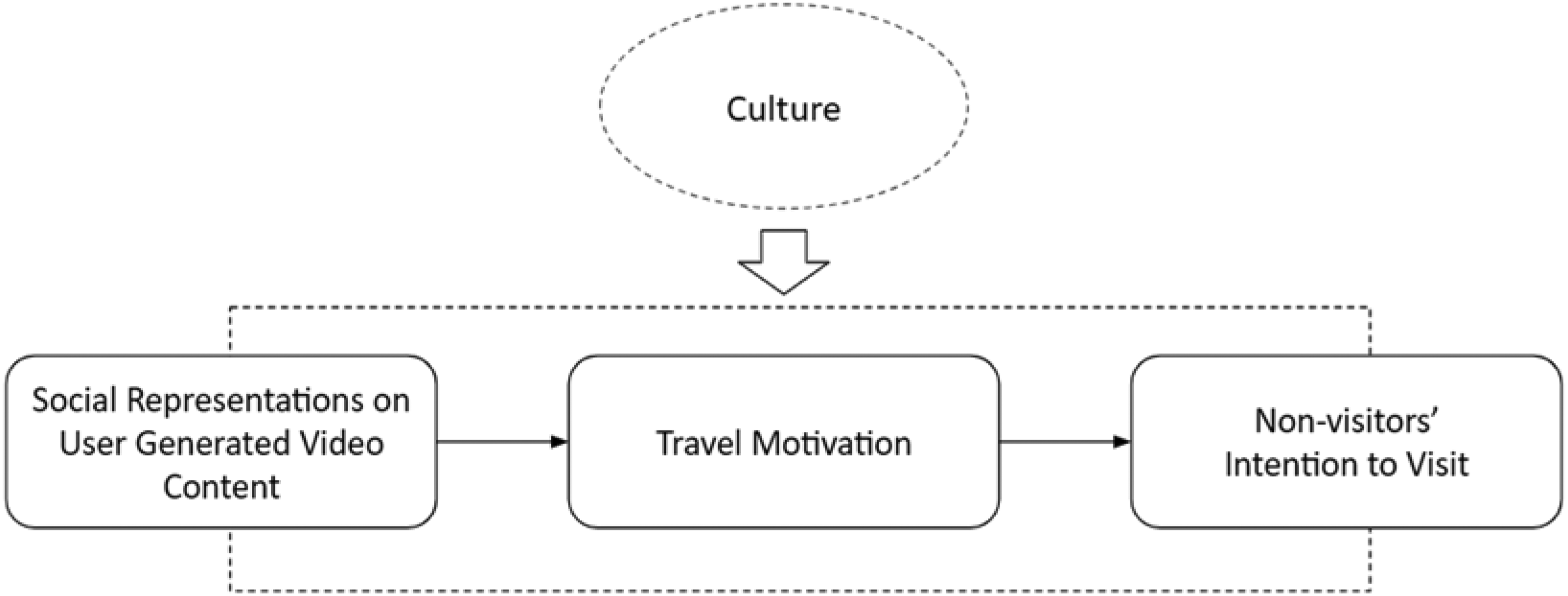
Conceptual model.
Literature review
Considering the study’ aim, and building on the works of Baloglu and McCleary (1999), and Yilmaz and Yilmaz (2020), this section draws on social representations theory to explain how visuals circulated via social media (pre-travel information source) formulate travel motivations and destination image. Previous tourist typologies along with the role of culture in this process are also discussed.
Social representations
Moscovici (1984) approached social representation as a system of values, ideas and practices that aim to establish an order, which will enable individuals to orient themselves in the world and facilitate communication among members of a community. He further added that social representations aim to turn something unfamiliar, into something familiar. Wagner et al. (1999) argued that unfamiliar events or phenomena that threaten a social group require its members to manage the unfamiliarity both materially and symbolically. Symbolic coping, or the ways individuals or social groups construct meaning or cultural symbols to cope with social phenomena, involves ‘anchoring’, interpretations based on existing representations are used for understanding phenomena through a series of discourses. In communication practice, social representations are communicated and repeatedly anchored, till they become common sense (Höijer, 2011).
Social representation and exposure to visuals via broadcasting media (e.g., TV, newspapers) and digital media (e.g., YouTube, social networking sites, online travel applications) assist in constructing an individual's ideology and shaping one's image of a place (Wassler and Talarico, 2021). Such representations and ideology can be re-constructed by international relations, powerful political ideologies and history (De Rosa and Mannarini, 2020). South Africa, for example, has enjoyed significant growth in tourism following the reputation of the FIFA 2010 World Cup event, whereas it had previously suffered from negative stereotypes related to the country's historic background, colonial discourses and media coverage presenting negative events (Hammett, 2014). Zhang and Müller (2018) analysed Swedish newspapers from 1982 to 2015 and highlighted the role of ethno-political discourses of the representations of indigenous Sámi people as ‘exotic others’ in the construction of Sámi identity in the tourism industry.
Studies further confirm that digital media, including online platforms (e.g., YouTube), play an important role in constructing social representations (Kumar and Wadhwa, 2023). Jara-Amézaga (2023), for example, discussed how travel YouTubers assist in constructing positive social representations of Saudi Arabian gastronomy. Similarly, Shakeela and Weaver (2012) analysed how a widely circulated YouTube video portraying the wedding ceremony of a Western couple in the Maldives evoked negative sentiments and associations related to tourism in the Maldives, such as undervalued employees, lack of professionalism, non-Islamic attitudes and underprivileged Maldivians. As a result, representations available on various social networking sites shape human behaviour (Chen and Lin, 2019; Monterrubio and Andriotis, 2014; Shukla and Srivastava, 2023). Pearce and Moscardo (2015) indicated how the emergence of social networking sites, for example, has impacted people's behaviour, including taking selfies to share on social media. Monterrubio and Andriotis (2014) who identified three clusters of spring breaker behaviours in Acapulco, Mexico, indicated that their different attitudes towards the destination were shaped by social representations.
Social media as such enable users, especially non-visitors, to create images of tourist destinations and travel motivations in the absence of previous visitation (Long et al., 2023; Mele et al., 2021). Social media enable two-way communication and interaction, attracting audiences’ attention and engagement (Liao et al., 2020). Several studies (e.g., Alamäki et al., 2023; Terzidou et al., 2018) suggest that visuals including videos available in travel blogs and vlogs have significant effects on destination image, a well-known pull factor. Organic visual representations (via user-generated video content) that are being captured through tourists' cameras are the most notable objects to be gazed upon (Lo and McKercher, 2015), enabling tourists to identify potential contradictions between what has been projected in tourism and the real environment (Urry, 1990). Tussyadiah and Fesenmaier's (2009) study on 120 New York City videos shared on YouTube, concluded that tourist videos online offer mental pleasure by creating fantasy along with a recollection of past travel experiences. The role of representation is also influential in decision making; Lodha and Philip (2019) concluded that travel vlogs assist people to choose accommodation, food and activities. However, given the differences in cross-cultural perceptions of visual attributes (e.g., Kim and Lee, 2020; Sun et al., 2014), and a lack of research on non-visitors’ typologies, motivations and intentions, the paper now turns to review the literature available on non-visitors, motivation and culture in tourism.
Non-visitor typologies
The term non-visitor is used to define someone who has never visited a given destination in the past (Hughes and Allen, 2008). Bennett (1994) highlighted the value of studying non-goers, to increase the possibility that some of them turn into goers. Past research (e.g., Kim and Hall, 2019) suggests that destination image before and after a trip changes as a result of the actual visit to a destination. Kim and Hall. (2019), for example, who studied South Korean visitors’ images of Vietnam at three different points in time (before, during and after an actual visit), reported that cognitive and affective images improved after visiting the place. Visitors as such have more realistic images of the destination due to direct experiences and familiarity with the destination (Gorji et al., 2023; Iordanova and Stylidis, 2017). Other studies on visitor and non-visitor groups reached similar conclusions (e.g., Sroypetch et al., 2018; Stylidis and Cherifi, 2018). Non-visitors seem thus more susceptible to formulating motivations and images/intentions based on social representations of a place they know little about.
Although there is an abundance of segmentation studies on visitors (e.g., Salim et al., 2023), research on typologies of non-visitors remains scarce (e.g., Cherifi et al., 2014; Cohen and Ben-Nun, 2008). For example, Pike (2008) classified non-visitors as follows: (a) potential visitors; those who would like to visit but have not done so for different reasons; and (b) those who have no intention to visit. Using intention to visit a wine destination, Cohen and Ben-Nun (2008) identified three categories: (a) families with children; (b) wine consumers who like specific wines; and (c) those who have never visited any wineries before. Cherifi et al. (2014) classified Czech non-visitors to London as follows: (a) potential visitors (will visit sometime); (b) pre-visitors (will visit soon); (c) non-visitors without an interest; and (d) non-visitors who cannot visit. As these segments were formed based on their expressed intention to visit, additional typological research is needed to understand the potential of key determinants such as travel motivation in non-visitor group formation.
Travel motivation
Motivation is commonly described as ‘a state of need, a condition that serves as a driving force to display different kinds of behaviour toward certain types of activities, developing preferences, arriving at some expected satisfactory outcome’ (Backman et al., 1995, 17). In one of the most influential approaches to tourist motivation, Dann (1977) distinguished between push and pull factors: (1) push factors arise from socio-psychological needs that encourage one to travel; and (2) pull factors are associated with destination attributes or features that attract individuals to travel, such as festivals and local food. Social representations play a critical role in this regard, as the image of the destination projected seems to cultivate or reinforce certain motivations to visit a tourist destination (Long et al., 2023).
In line with Yousaf et al. (2018), there are two streams of research on travel motivations in the tourism literature. The first one focuses on identifying the various underlying reasons to visit a destination (e.g., Lim et al., 2023). For example, based on 30 interviews with domestic and 24 with international visitors, Farmaki (2012) provided a tourist typology based on their main motivation to visit; domestic travellers were labelled as ‘escapists’, while international visitors either belonged to ‘passers-by’ or to ‘the special interest group’. Wickens (2002) using qualitative data from 86 British holidaymakers identified five micro-types of visitors who expressed three different motives: escape, pleasure and ontological security. Somewhat similarly, Bassyiouny and Wilkesmann (2023) interviewed 11 travellers on workation and identified two types: digital nomads and workationers. Such knowledge though stems from research conducted on visitors or potential visitors, while non-visitor subgroups and their respective motives remain largely underexplored. The second stream of studies emphasises how motivations influence tourists’ destination image, experiences and decision-making (e.g., Li and Su, 2022; Tsai and Sukhkhad, 2018). For example, Tsai and Sukhkhad (2018) suggested that both push and pull motivations positively affect travel satisfaction, which subsequently leads to destination loyalty to visit Mongolia. Despite the prominent role of travel motivation in tourism visitation, its potential as a segmentation base for non-visitors is yet to be examined.
The role of national culture
The notion of culture is complex, and therefore there are different levels of culture: (a) universal, (b) civilization, (c) nationality, (d) industry, (e) organisational, and (f) individual (Reisinger, 2009). At a national level, it is expected that people from the same country most likely share some similar national characteristics which shape their behaviour (Hofstede and McCrae, 2004). Cross-cultural studies suggest that each nationality has its unique traits, and there are dissimilarities in meanings, perception, attitude and behaviour between various ethnic groups (e.g., Wei et al., 2023). For example, Hofstede (2011) suggested that Germans are more individualistic than the Chinese. Individual culture, on the other hand, refers to individuals’ values mostly influenced by their demographics and personality (Reisinger, 2009). As an outcome of the several levels of culture, individuals may have multiple personal cultures within themselves (Wong et al., 2014).
Research in the tourism context also indicates that both national and individual culture seem to determine a person's travel motivation and behaviour (Moura et al., 2015). Wong et al. (2014), for example, concluded that Americans with high individualism exhibit greater purchase intentions and preferences toward pleasure holiday packages, while those with lower individualism preferred volunteer packages. Several studies have also identified cross-cultural differences in visitors’ destination image (e.g., Iordanova and Stylidis, 2017; Wei et al., 2023) and travel motivations (e.g., Kim and Lee, 2020; Singh and Sharma, 2023; Yan and Halpenny, 2019). For instance, Yan and Halpenny (2019) who tested for cultural differences in travel motivations between Anglo-Canadians and Asian-Canadians, suggested that the former were more likely to visit farmers’ markets, whereas the latter tended to visit religious or ethnic festivals. Culture seems also to determine the many ways social representations are circulated and understood among the members of different communities (Mele et al., 2021). For example, Mele et al. (2021) revealed that promotion on Instagram differs across cultures, underlying the significance of adapting online content when reaching culturally different markets. Overall, non-visitors’ culture and its influence on motivation and intention to travel, although essential in determining destination success, is still little understood in the tourism literature, a gap that this study aims to fill.
Methodology
Study setting and sampling
Considering the need to understand individuals as ‘social actors,’ along with the complexity of the concepts under investigation, the study follows the constructivist paradigm and a qualitative research design (Saunders et al., 2019). The overarching qualitative methodology adopted here is the case study approach, which ‘involves the study of an issue explored through one or more cases within a bounded system (i.e., a setting, a context)’ (Creswell, 2007, 3). In this methodological approach, data are collected through multiple sources, such as interviews and audio-visual material, leading to case-based themes.
The research setting is the archipelago of Raja Ampat, Indonesia, with a population of 64,000. To test for the potential effect of culture, two diverse nations were selected: domestic (Indonesian) and international (UK) non-visitors to Raja Ampat. Indonesian and British participants were selected as they represent different cultures (Hofstede, 2011). For instance, it has been reported that Indonesians exhibit higher scores in uncertainty avoidance and power distance compared to the British (Hofstede, 2011). Since 2016, British visitors rank first among international tourists who visit Indonesia and are also a target market for Raja Ampat. However, it must be acknowledged that UK participants cannot be considered representative of other nationalities. The Government also aims to increase the number of domestic visitors, given their lower volumes when compared to other destinations in the country (The Central Bureau of Statistics of Raja Ampat Regency, 2022). Applying criterion-based purposive sampling, the sample units were selected based on three criteria (YouTube users, non-visitors to Raja Ampat, adults). Considering data saturation in qualitative research, whereby the last interviews did not generate any new meaningful insights (Andriotis and Paraskevaidis, 2021; Saunders et al., 2019), 61 interviews were conducted in total: 31 with Indonesians and 30 with UK residents. Previous tourism studies that used a qualitative approach also conducted between 8 and 32 interviews (e.g., Chen and Lin, 2019; Terzidou et al., 2018).
Interviews with Indonesians were conducted in Jakarta, while those with British took place in London. To facilitate participant recruitment in Jakarta, Trinity Traveler (277.2 K followers on Twitter, and 124 K followers on Instagram), a well-known Indonesian travel writer, blogger and author of several travel books, posted the recruitment leaflet on her social media accounts. Recruitment in the UK was facilitated via posts on social media platforms (e.g., Facebook travel groups), calls on various research participant recruitment platforms (callforparticipants.com), and posters at various locations in London. In both settings, the researcher provided respondents with a Google Form link to select the appointment date. The form was also used for participants to confirm they had never visited Raja Ampat. The interviews in Jakarta took place in a meeting room at the Bandung Institute of Technology, while the London ones were conducted at the British Library.
Data collection: video elicitation interviews
Face-to-face interviews were conducted in Jakarta and London by one of the researchers. To eliminate procedural bias, the same supporting instruments were used in all cases: a laptop to play the videos; headphones to block out noise distraction and keep the participants focused during video elicitation; a dual-headed mini microphone for clear and good quality voice recording, to be used by both the researcher and participants alike throughout the interviews; and an audio recorder app to record the interviews. All interviews followed the same procedures. Prior conducting the interviews, the researcher first explained the aim of the study; participants read the participation sheet and signed the consent form. Participants were not informed at any point whether the videos are sponsored or unsponsored (user-generated) to avoid potential bias in the selection process. Interviews were conducted in two languages: (a) Bahasa Indonesia for Indonesians, and (b) English, when interviewing British participants.
The researchers selected the videos uploaded on YouTube by tourists, following the procedure proposed by Zehe and Belz (2016). One domestic and one international tourist video were used, as they best reflected the two population samples (domestic and international non-visitors). The YouTube platform was preferred, as people tend to spend a large amount of time watching travel-related content videos on YouTube (Le and Hancer, 2021). YouTube exhibits a 91% penetration in the UK adult market, and 55% in the Indonesian one (Digital Report, 2024). The two tourist-generated videos were selected based on the following criteria: (a) short duration (between 3 to 4 min) to maximise viewer engagement (Chen et al., 2015); (b) destination-related content, following the list proposed by Stepchenkova et al. (2015); (c) fully visual, without any narrations or subtitles- to prevent distraction caused by incomprehensible languages; (d) upload date (within the past 7 years); and (e) popularity, assessed via the total number of video views. To eliminate bias related to user past preferences, the video search was conducted in ‘private browsing’ mode on Google video search. Out of the 578 Raja Ampat tourist videos available online, only 12 (five international and seven domestic ones) met the selection criteria previously specified. The last stage of the process was manually performed, by reviewing the video content. Video A was captured by an international tourist named TravelTheWorld (www.youtube.com/watch?v = VgNdM-GyBV0&t = 108 s); while video B was posted by a domestic traveller called Limba Ringga88 (www.youtube.com/watch?v = xW6L08U5w6o).
The semi-structured interviews started with some ice-breaking questions such as ‘How many times do you travel per year?’ followed by questions about travel-related information sources commonly used. Next, the researcher displayed the two designated videos on the default YouTube interface on a laptop to replicate behaviour when selecting YouTube videos to watch. Participants were invited to watch the two videos and were given the freedom to select which video to watch first. The layout was also designed to enable participants to navigate the video selection by self-clicking. Video A (international) was placed on top and video B (domestic) was placed on the bottom of the YouTube page. After participants watched both tourist-generated videos, the researcher asked questions about their images of Raja Ampat, along with their motivations and intentions to visit it. Interviews lasted on average 45 min. Three pilot interviews were conducted prior to the main data collection to confirm that the interview procedures and questions worked well (time needed, interaction, questions, and videos).
Data analysis
All interviews were first transcribed verbatim, including verbal and non-verbal expressions. Interviews in Indonesian were translated into English retrospectively by one of the researchers (an Indonesian native speaker, fluent in English) to ensure that original meanings were kept. All the data were analysed using thematic analysis facilitated by NVIVO 12, which enabled the researchers (one Indonesian, one British, and two Europeans) to store all the interview transcriptions in one database. All researchers are experienced with qualitative methods, but only the Indonesian one is familiar with the destination setting. Following Corley et al. (2015) the analysis was conducted via the following stages: (1) identification and classification of first-order concepts in which responses were studied to find shared views and themes (similar ideas were grouped together under a common theme, e.g., food/culture/customs); (2) the relationships within and among the categories identified in the previous step were further explored, enabling the development of higher-order themes (i.e., novel experiences); (3) these themes were compared, leading to the development of unique groups of individuals who have expressed different motivations to visit or not visit Raja Ampat after watching the videos. The study used investigator and theoretical triangulation to establish the precision of themes by reviewing the data from different perspectives (Saunders et al., 2019). To ensure participants’ anonymity, pseudonyms such as INDO/BRIT, gender, and age (e.g., INDO, Female, 42) were used. Over half of the Indonesian participants were female (71%), aged between 21 and 30 years old. In the British sample, females (53%) were slightly more than males (47%), aged mainly between 21 and 30 years old (53%).
Findings and discussion
This study aimed to explain how social representations (via online videos) give shape to different motivations to visit a destination individuals have never visited before. Expanding current frameworks by focusing on non-visitors from two cultures (Indonesian, British), the following motivation-based typologies of non-visitors are proposed: (a) neophiles, (b) nationalists, (c) narcissists, (d) volunteers, and (e) reluctant non-goers; further explained below.
Neophiles
The first type termed ‘neophiles’ comprises non-visitors who are interested in visiting Raja Ampat for novelty seeking. The term ‘neophilia’ is used to describe ‘an individual's love or passion for what is novel’ (Baah et al., 2019, 4). The video elicitation interviews show that many participants (eight Indonesian and fifteen British) across both nationalities ‘will visit’ Raja Ampat because they are interested in seeing and experiencing a destination they have never visited before: I really love to go to new places, to explore and to experience new things. I have a thirst for learning new things, as routines get boring. So, I must do something different out there, and travelling is the answer. (INDO, Female, 34)
A significant emphasis denoted across both nationalities on ‘local culture’ indicates its importance as a pull factor that motivates some Indonesian and British participants to travel for novelty-seeking. Local culture is often reflected via food, history, way of life, language, local products, and fashion: ‘It's fascinating to see the people from the East (Indonesia), with their unique way of life in the coastal area’ (INDO, Female, 28). In particular, ‘food’ was mentioned by several Indonesian and British participants as one of the attributes that attracts them to visit a destination like Raja Ampat, as they fantasized about a cultural experience in tasting Papuan local food. For example: ‘Local food, street food, unique food. For example, when I went to Japan, I wanted to try all the food there. Even sometimes I’d just go inside the restaurant without knowing whether the food is halal (laughing)’ (INDO, Male, 27). In tourism, novel food is often underlined as a key motive for travelling abroad (Xu and Zeng, 2022). It is notable that while Raja Ampat boasts rich cultural attributes, the two tourist-generated videos primarily emphasised its scenic beauty, with minimal representation of its cultural aspects. Nevertheless, the videos seem to evoke a strong enough sense of culture; it seems that participants’ prior knowledge/familiarity (see Pereira et al., 2022; Stylidis et al., 2020), along with preconceptions and expectations (Cherifi et al., 2014), influenced their interpretations. Indonesians, in particular, seem to rely on their local knowledge, while for the British the long distance and location of the destination in the far east shape their images of an exotic, rich in culture destination (Stylidis and Cherifi, 2018). The goal of travel, especially for Indonesian Muslims is to appreciate one's life, as expressed in the Qur’an (Oktadiana and Pearce, 2018), while Rahman et al. (2017) who studied Muslim tourists’ motivation to visit Malaysia (Islamic destination) identified all needs present in the Travel Career Ladder model.
Nationalists
The ‘nationalists’ are Indonesian non-visitors who are interested in visiting Raja Ampat to express their pride in their nation. This patriotic attitude was emphasised by six Indonesian participants as they exhibited a tendency traveling to domestic destinations, felt proud to see the Indonesian flag in the video and were motivated to visit Raja Ampat to showcase their love for their country. For instance: My dream is to visit all the destinations around Indonesia, while others want to travel abroad. I don’t know. It's like a true calling for me. It feels, like, I’m very proud to have Indonesia as my home country. I feel happy when I see the beautiful nature of this nation. (…) I’m very proud to be Indonesian. (INDO, Female, 20) I prefer to travel around Indonesia. I want to follow Bung Karno's (the Founding Father of Indonesia) quote: ‘One year abroad, forever and a lifetime in Indonesia’. People may go abroad, but for me, I will only travel around Indonesia’. (…) I’m grateful for the Indonesian people. They are very friendly and generous. (INDO, Male, 34)
Narcissists
Non-visitors (eight Indonesians) belonging to the third group were termed ‘narcissists’. Researchers define a narcissist as a person who seeks affirmation and external validation from others (through social media, for example) (Brailovskaia and Bierhoff, 2020). The findings of this research empirically show that narcissistic motives strongly appeared among younger Indonesian participants in terms of travel motivation and future intention to visit Raja Ampat. For example: ‘It's kind of an accomplishment. It's a place to visit before I die, so thinking about Raja Ampat is like thinking about my crush (laughing). My heart beats faster (laughing)’ (INDO, Female, 20). Since it is perceived as an achievement, travelling has also become a field of ‘competition’, especially for millennials who have been exposed to social media representations, as expressed by one participant: Maybe because we are millennials, we invest in memories. Travelling has become a topic when we hang out (…) Me and my girlfriends sometimes travel together. And since we are all millennial girls in the era of Instagram, we have started to become competitive. Like, when someone goes somewhere, we are like, oh I can go there too! And I feel satisfied to know that I’ve been to places while my other friends have not. (INDO, Female, 24)
What the findings here further indicate is that millennials’ motives to travel are for ‘Insta-bragging’; defined as the act of bragging or showing off about personal achievements such as travelling or ticking off the bucket lists through Instagram posts in order to gain recognition and external validation from others. It appears that some Indonesian participants plan to visit Raja Ampat only to post their travel pictures on Instagram as a place for self-actualisation and personal branding, as well as ‘to get recognition’, as revealed in the following quotes: ‘(…) I travel especially for posting photos on Instagram…I want to be seen as someone who travels a lot. I go to places to take loads of pictures which will be posted as my Instagram content for the next three months’ (INDO, Male, 27) and ‘I travel to take pictures and post them on Instagram to show them, I’ve been there, so when is your turn? (Laughing). Just to make them jealous (laughing)’ (INDO, Male, 24). Setiawan et al. (2018) similarly suggested that interesting locations that look attractive to post on Instagram, known as ‘Instagrammable’ spots, are an important factor in destination choice for modern tourists, who take photos or videos to be shared on their Instagram accounts. For example, a participant stated: ‘It's now become obvious for me that this place is a paradise on earth. It's also a perfect place for divers to see beautiful coral’ (INDO, Female, 25).
Volunteers
Four Indonesian and seven British non-visitors were classified as ‘volunteers’, given their exhibited interest in visiting Raja Ampat to contribute to local communities. Following the representation of local communities as underprivileged in one of the tourist videos, such people are pushed to visit Raja Ampat to do volunteering activities to help them: ‘I heard that the local Papuans are still underprivileged, especially if you compare them to people in Jakarta. They still need to survive and get proper education and welfare’ (INDO, Female, 20). Another British participant added ‘The small children, they are happy, but they are probably quite poor (…) ‘because they are not wearing many clothes. And then, there's not loads of houses’ (BRIT, male, 21). Some participants, however, are aware that this is an image sometimes intentionally built; as one participant said, ‘It's the media who fool you about the underprivileged society of Papua. Papua is huge; they are only reporting a small part’ (INDO, Male, 34).
According to Wong et al. (2014), meaning-seeking shifts one's focus from their egoistic needs for self-interest to a spiritual mind-set for compassion to serve a greater good. For example, a participant mentioned ‘volunteerism’ and sees her life as more meaningful when helping people: My main motivation is because I like volunteering and meeting new people. So, I go to places where I can interact with the locals, teaching the children how to read, or even to help them do their homework. Just for giving back to the community. I like voluntarism. I want to make my life more purposeful by helping people. (INDO, Female, 21)
Reluctant non-goers
The last non-visitor group comprised five Indonesian and eight British participants who were termed ‘reluctant non-goers’. Pan and Ryan (2007) defined ‘reluctant visitors’ as tourists who are physically and psychologically reluctant when visiting a destination. This research, however, uses ‘reluctant non-goer’ to describe a non-visitor who is hesitant or reluctant to visit Raja Ampat; thus, they ‘consider not visiting’ or ‘will not visit’ the destination in the future. For instance, as one British participant said, ‘Because I’ve never heard of the place, sorry, I don’t have any feelings of association towards it’ (BRIT, Male, 30).
The video elicitation interviews revealed that this group demonstrated no interest in visiting Raja Ampat either due to other priorities (e.g., school, family). Some Indonesians referred to studies or work commitments; for example ‘My interest is perhaps 30% (…) because my current priority is studying as I’m still in college, so I don’t want to think about travelling now’ (INDO, Female, 21). Others attributed their lack of interest to constrains (e.g., financial):‘I think it might be a little bit expensive, just because especially from here you'd have to go probably somewhere in Indonesia like Jakarta then fly over to somewhere different as well, so it might be a long journey’ (BRIT, Female, 21) or ‘Raja Ampat is amazing, but there are other beautiful destinations with a more affordable budget than Raja Ampat, like Japan’ (INDO, Male, 25). Lastly, a few expressed lack of visitation as they did not consider the destination appealing to them. For example: ‘It seems very rural, so not much in terms of infrastructure or technology. It seems underdeveloped’ (BRIT, Female, 21). Similarly: After watching the videos, I will not go. (…) The videos are very typical; they show the sea, mountain, beach, but very typical of other destinations in Indonesia. Like, you can also find similar scenery in Java, or at Thousand Island, so why should I go far to Raja Ampat? Even the jumping kids in the video; that is a typical scene in all Indonesian tourism videos. (INDO, Female, 35)
Conclusion
This research aimed to develop typologies of non-visitors (domestic and international) based on their travel motivations; along with their intention to visit a destination after being exposed to two user-generated tourist videos on YouTube. The results from interviews with 31 Indonesians and 30 British non-visitors revealed that user-generated videos seem to cultivate non-visitors’ intention to visit a destination for different reasons. The various representations portrayed in the tourist videos (e.g., local people, customs, traditional beach huts, Indonesian flag, paradise beach, young children) facilitate the development of different motivations (e.g., national pride), leading to a new typology of non-visitors comprising the following groups: (a) neophiles, (b) nationalists, (c) narcissists, (d) volunteers, and (e) reluctant non0-goers. Such typologies appear to be distinct from previous classifications of non-visitors into potential visitors and those who have no intention to visit (Pike, 2008); or potential visitors, pre-visitors, non-visitors without an interest, and non-visitors who cannot visit (Cherifi et al., 2014).
Cultural variations are evident in the composition of such groups, as findings indicate a few similarities (novelty-seeking, volunteers, and reluctant non-goers) and several differences (nationalism and narcissism) pertaining to the major motivational factors identified among Indonesian and British non-visitors. Indonesians, for example, revealed unique motivations such as nationalism and narcissism, while British denoted a need to travel for volunteerism or expressed lack of interest/inability to visit Raja Ampat. Cultural disparities are also recorded in participants’ perceptions of the videos based on the creator's origin (domestic vs international). British, for instance, payed more attention to the traditional beach huts present in the international tourist video, while Indonesians did not seem to be impressed by those as they are considered typical of the area. In contrast, the absence of any cultural representations (e.g., local people) in the international tourist video, as opposed to the more varied cultural portrayal in the domestic tourist video, indicates differences in the way cultural elements are valued and depicted by video creators from two different cultures. Such results reinforce the notion of culture as a critical element in destination image (Iordanova and Stylidis, 2017; Wei et al., 2023) and motivation formation (e.g., Kim and Lee, 2020; Singh and Sharma, 2023), filtering the way representations circulated via social media are perceived.
Theoretical contributions
The study's contribution to tourism theory is three-fold: First, this study confirms the value of the social representation theory (representations circulated via tourist videos on social media such as young children) in generating perceptions of a destination, thereby determining non-visitor motivation and intentions. As studies have largely focused on the role of promotional videos in shaping social representations (e.g., Gal et al., 2016), this work sheds some light by highlighting the pivotal role that tourists’ videos play in reconstructing peoples’ images in the absence of previous visitation. At the same time, such circulated images do not seem to have equal effects on all recipients, differing based on their motivations and cultural backgrounds. In particular, this study expands current knowledge by offering non-visitor typologies grounded in key socio-psychological factors in the decision-making process such as travel motivations. Existing typologies have either focused on visitors (Salim et al., 2023) or used non-visitor intentions to visit a destination (Cherifi et al., 2014). The video elicitation interviews indicated two broader groups of non-visitors to Raja Ampat: (a) those interested in visiting the destination and (b) those reluctant to do so. The study further divided the ‘interested non-visitors’ into four types based on their expressed travel motivations: neophiles, nationalists, narcissists, and volunteers. Third, the findings revealed the critical role of culture in shaping travel motivations and intentions. This study revealed a few similarities (novelty-seeking), but also several differences pertaining to the push factors which drive Indonesian and British to travel. Indonesians’ motivations further included nationalism, while British denoted volunteerism. Such results assist in further highlighting the role of culture, at the national level, on travel motivations.
Managerial implications
The findings offer valuable implications for DMOs and tourism marketers. Understanding travel motivation among the five types of non-visitors, enables DMOs to create more effective and impactful strategies to persuade non-visitors and to attract each identified group based on their key motives to visit a destination. Tourism marketers can also benefit from synergies in tourism promotion based on shared motives among nationalities; non-visitors from Indonesia and the United Kingdom, for instance, exhibited some common needs to travel like novelty. DMOs can use marketing strategies that stimulate excitement, novel experiences and knowledge-gain to attract neophiles, such as physical activities, local culture, food and the uniqueness of the natural landscape for neophiles; or by offering incentives to help in local community-based projects for the volunteers. For some domestic non-visitors, social representations based on national ceremonial events, or country symbols such as flag, traditional patterns or landmarks may be included as part of the marketing efforts. This can be well applied to several destinations worldwide as national and religious emblems seem to attract many individuals lacking destination experience (Stylidis et al., 2017; Terzidou et al., 2018). The study also indicated that visual representations of underprivileged societies seem to evoke humanitarian motives in the volunteer type non-visitor, who is searching for meaning through volunteerism. To attract narcissists, particularly Indonesians, this study proposes the use in destination marketing of Instagrammable spots, famous landmarks and sophisticated places that elevate social status. Prestige and status seeking appear to be strong motivators for different cultures, apart from Indonesians (Schwartz, 2016). Via such tools, destinations can increase visitation numbers of individuals who appreciate what the destination has to offer. It is worth noting that the appropriateness/relevance of visual representation must be culturally and morally acceptable to the targeted audiences for the marketing strategy to be successful.
Limitations and directions for future research
This study has limitations which provide opportunities for future research. First, this research adopted a qualitative research design with a satisfactory sample size, which however restricts the generalisability of the findings to a wider population. Many scholars claim that generalisation is impossible in qualitative research as the sample is not representative of the population. For instance, phenomenological studies in tourism highlight the fact that their research outcomes cannot be generalized because their purpose is to provide a deeper understanding of tourism-related social phenomena (Paraskevaidis and Andriotis, 2023). Future studies should therefore complementary use another research approach (quantitative with a survey questionnaire) and a larger and more diverse sample size that is representative of the population under investigation. Second, in the aftermath of the COVID-19 pandemic, additional research is necessary to explore the stability of motivations and intentions, as these are often shaped by media including tourists’ post-pandemic trust to the image of the destination. Third, given the focus of this study on Indonesian and British nationals, future research should explore the typology of non-visitors across other cultures like Americans, Germans or Chinese. Future studies are also encouraged to explore how non-visitors’ motivation changes before and after mega events. Fourth, this paper used video elicitation interviews based on two tourist videos that were gathered, and selected from YouTube by the researchers. Studies in the future can further apply the video elicitation approach based on wider types of participant-generated videos from different social media platforms (e.g., TikTok) on mobile devices. Last but not least, the level of prior destination knowledge needs to be considered in future research to better assess the role of user-generated content in destination image formation.
Footnotes
Acknowledgements
The author(s) would like to thank the Indonesian Endowment Fund for Education (LPDP), the School of Business and Management Bandung Institute of Technology, and the video creators (TravelTheWorld and Ringga Limba88).
Declaration of conflicting interests
The author declared no potential conflicts of interest with respect to the research, authorship, and/or publication of this article.
Funding
The authors disclosed receipt of the financial support for the research. The first author received research funding from the Indonesian Endowment Fund for Education (LPDP).
