



Abstract
This study aims to investigate the effect of both the affordance of virtual reality (VR) technology and users’ digital media literacy on users’ emotions, which leads to recommendations to use VR experiences in cultural heritage tourism. A survey was conducted at a realistic VR studio in Gyeongju World Culture Expo Park, South Korea using high-quality and sophisticated VR content that accurately reflects users’ physical movements in real-time rendering. A total of 157 visitors participated in the study, and the measurement model and structural model were analysed using partial least square-structural equation modelling (PLS-SEM). The findings show that the cognitive, physical, sensory, and functional affordance of VR devices, as well as user digital media literacy, had a significant effect on the visitors’ positive emotional experiences. In addition, visitors’ positive emotions had a significant effect on the recommendation intention. This empirical result shows that digital media literacy is a new major variable that affects the virtual experience of cultural heritage sites.
Keywords
Introduction
Virtual reality (VR) is transforming tourism experiences, creating more engaging and immersive ways for tourists to interact with destinations, tourism businesses and organisations, and cultural heritage sites (Jung and tom Dieck, 2017). Especially during the recent pandemic, VR allowed tourists to visit foreign places from the comfort of their homes (Talwar et al., 2022); however, research largely acknowledges VR's potential to attract tourists to the actual destination and attraction as well as encourage revisit intentions (Jung et al., 2016; Lee et al., 2020). VR has been successfully employed in cultural heritage tourism, creating virtual visits to distant heritage sites, art collections, and museums (Atzeni et al., 2021; Guttentag, 2010). This is of high relevance for heritage sites located in rural destinations (Atzeni et al., 2021). A significant number of VR applications in the cultural heritage context use immersive 360° content that enables the user to look around in three-dimensional (3D), providing both illusory components of socialisation and interactive stimuli (Kim et al., 2020; Lee et al., 2020; Trunfio et al., 2020, 2022). According to Xu et al. (2022), this presents an interesting opportunity for enhancing visitors’ cultural heritage tourism experiences. To develop such experiences, it is essential to understand VR's affordances in the context of cultural heritage. Affordances are an important part of user experience design and help to understand how users interact with technology (Volkoff and Strong, 2013). Considering limited previous research with a focus on VR affordances, this study aims to extend affordance theory into cultural heritage VR tourism. The concept of affordance was first conceptualised by Gibson (1979) and refers to the different possible behaviours that an individual can perform in a specific environment or in relation to certain characteristics or uses of an object (Gibson, 1979). The tourism field has previously identified that an affordance-centred framework in the design of tourist services could be beneficial (Tomej and Xiang, 2020). However, VR tourism research employing the affordance framework is still scant and remains concentrated in the learning field (e.g. Shin, 2017). Therefore, it is crucial to explore VR affordances in tourism to assess their impact on visitors and their behaviours. However, not all tourists will have the same level of engagement with VR. Digital media literacy is considered an important determinant of behavioural intentions to use technology (Kabakus et al., 2023; Nikou et al., 2022) as different skill levels concerning the use of immersive technologies will impact tourist experiences. According to Castilla et al. (2018), there is a direct link between a high degree of media literacy and users’ ability to feel a sense of enjoyment, mostly related to the diminished barrier of technical issues and misunderstanding once high media literacy is achieved. However, to date, research integrating this concept into VR research outside the scope of education has been limited (e.g. Ha et al., 2022), particularly within the cultural heritage context. Therefore, this research aims to explore the role of VR affordances and digital media literacy in users’ positive emotions and behavioural intentions to recommend the technology.
To achieve this aim, this study explores the literature on VR experiences in the cultural heritage sector, affordance theory, and media literacy to highlight how these concepts come together to form the theoretical foundation of this study. The ‘Methods’ section outlines the design of the study, followed by the ‘Results’ section discussing the results. The report finishes with a general discussion of the study's implications, contributions, limitations, and future research directions.
Theoretical background and hypotheses development
VR experience in cultural heritage tourism
The tourism sector has recognized that VR is an interesting way to provide tourists with memorable and novel immersive experiences both on-site and off-site, enhancing the overall touristic experience (Loureiro et al., 2020). As a result, VR technology has been gradually implemented in tourist attractions, historical collections, heritage sites, and museums for the last three decades (Atzeni et al., 2021; Hudson et al., 2019). Examples of such experiences include Visit Wales and their capturing of Welsh landscapes in 360°, hotel brands (e.g. Shangri-La or Marriott) experience their hotels and destinations, or London's National History Museum where you can dive down into the Great Barrier Reef in VR.
VR generates a fully immersive experience by using computer-generated representations of a digital environment (Jung and tom Dieck, 2017). VR allows individuals to inhabit and explore lifelike environments and situations in which they can move and act, generating a sense of actually being in the virtual world (Atzeni et al., 2021; Loureiro et al., 2020). While the technology is the same, VR can have different purposes. On the one hand, museums, hotels, and most destinations aim to entice tourists to visit or revisit in the future (Jung et al., 2016). Interestingly Leung et al. (2020) found that VR only manages to influence hotel guests’ immediate decision-making processes, opening avenues for further research on how long-term loyalty can be achieved. On the other hand, the example from the Great Barrier Reef highlights the importance of VR for education and sustainability (Coghlan, 2022). Also, overcrowded destinations could see VR as a tool to reduce footfall and the number of tourists (Bec et al., 2021).
In cultural heritage tourism, VR has been identified as a powerful instrument to improve the experience and to complement real travel (Atzeni et al., 2021). Cultural heritage tourism refers to the exploration of places, artefacts, and activities that represent past cultures (Bec et al., 2019). Especially given the increased awareness of protection and preservation, VR has been identified as an effective tool for cultural heritage tourism, since it can generate substitute experiences, adding value to the tourist's experience while minimising disturbance to sensitive heritage sites (Guttentag, 2010). With this line of thought, McLean et al. (2023) explored the use of VR for tourists’ mental well-being and decided to fully focus on the replacement of actual travel through VR. Their research found that VR aids societal and health well-being. However, the question with this line of research remains the economic viability of destinations.
Recently scholars supported that VR provides tourists with novelty, added value, immersion, and personalization (Atzeni et al., 2021; Errichiello et al., 2019). In addition, heritage sites have implemented VR to enhance the whole tourist experience and to complement information at the sites (Bec et al., 2019; Errichiello et al., 2019; Yung and Khoo-Lattimore, 2019). Investment in VR in cultural heritage tourism has also been seen as a way to overcome physical constraints in the exhibition of cultural heritage (Trunfio et al., 2020, 2022) and to provide quality recreational experiences to tourists while reducing the disturbance of the site and its environment (Xu et al., 2022). Moreover, its use could augment revenues derived from increased visits, revisits, and higher visitor engagement and recommendations (Jung and tom Dieck, 2017).
From the visitors’ perspective, VR creates an opportunity for proactive exploration of cultural heritage sites. Valorization and preservation, combined with innovative experiences such as entertainment, escape, and socialisation (Trunfio et al., 2020, 2022), enhance the value, uniqueness, and authenticity of the tourist experience (Jin et al., 2020). Additionally, VR is capable of virtualizing and shaping an immersive learning experience for tourists (Jung and tom Dieck, 2017; Trunfio et al., 2020, 2022). Wang et al. (2023: 1) studied VR in the cultural heritage context and claimed the “underlying characteristics of the experiences still need to be well-researched”. In addition, Wei et al. (2023) acknowledged that VR has been well applied in the context of tourism however raised concerns regarding the limited evidence on how it can enhance tourism experiences. Our study aims to fill this gap through a focus on affordances which will be discussed in the following section.
Affordance theory and VR
The concept of affordance was first conceptualised by Gibson (1979) and it refers to the different possible behaviour that an individual can execute in a specific environment or in relation to certain characteristics or uses of an object (Gibson, 1979). Affordances, as proposed by Gibson, represent perceived action possibilities independent of an individual's conscious awareness, sparking debates among ecological psychologists on their nature: whether inherent to the environment, a relational aspect within the animal-environment system, or the relationship between animals and situations (Chemero and Turvey, 2007; Stoffregen, 2003). Eventually, a consensus emerged defining affordances as emergent and relational properties within animal-environment systems. Volkoff and Strong (2013) elucidate this consensus, stating that affordance is a property of the relationship between the user and the artefact, denoting an opportunity for action. Finally, Gibson succinctly defined affordance as ‘what it [the environment] offers the animal, what it provides or furnishes, either for good or ill’ (Gibson, 2015: 122). Affordances are properties that are neither objective nor subjective of the animal environment but are not of the environment itself (Gibson, 2015), as the environment only can afford something when an individual interacts with it (Şahin et al., 2007).
The concept of affordances, originating in psychology (Gibson, 1979), has garnered diverse interpretations across various domains, notably within technology-related literature. In this context, affordances shifted focus towards the interaction dynamics between users and technology rather than being inherent characteristics of the technology itself (Norman, 1988). Norman's influence on the information systems (IS) perspective of affordances is substantial, emphasizing the importance of acknowledging both an object's intended use (real affordances) and the affordances perceived by users (perceived affordances) for a comprehensive understanding of human–object interactions. Extending into the realm of information systems, affordance theory has been pivotal in explaining the effects of information technology, with research emphasizing outcomes and the relationship between technological objects and users (Markus and Silver, 2008). This framework has found application in studies examining the utilization of emerging technologies (e.g. Shi et al., 2022). In this context, affordance varies across individuals depending on their interpretation of the technology functions and on the perceived tasks and actions that the technology enables them to do (Dincelli and Yayla, 2022).
Immersive realities, such as virtual and augmented realities, can benefit from the affordances approach: it has been proposed that the affordance theory may be a valid approach to understanding why users adopt such technologies, as they enable more advantageous affordances compared to physical reality (Steffen et al., 2019). Indeed, immersive technologies have demonstrated a remarkable ability to offer experiences that are notably more credible, reliable, and persuasive than other forms of representation (Cinnamon and Jahiu, 2023). They tend to evoke a sense of enjoyment or pleasure, largely due to the affordances created through their immersive nature and interactivity (Du et al., 2020; Mouratidis and Hassan, 2020).
Hitherto, frameworks for immersive technologies have integrated established theories like the technology acceptance model (TAM), theory of planned behaviour, flow theory, and self-determination theory (Yung and Khoo-Lattimore, 2019). However, the scarcity of substantive, theory-driven research in immersive technology studies stems from the field's ongoing exploratory phase, still lacking firmly established theories (Edmondson and McManus, 2007). Despite the burgeoning interest in utilizing the affordance framework within VR, this application remains confined primarily to the healthcare and human–computer interaction domains (Dincelli and Yayla, 2022). Addressing this gap, the potential contribution of affordance theory to the study of VR in cultural heritage tourism could be pivotal in augmenting theory-driven research within immersive technologies, offering new insights into user interactions and experiences in these contexts (Yung and Khoo-Lattimore, 2019). Notably, past examinations of immersive VR within travel and tourism studies, such as those by Kim and Hall (2019) and Lee et al. (2020), have yet to embrace an affordance-centred approach.
Research model: Affordances, digital media literacy, and emotional experience in VR
The research model developed in the present study links affordances, digital media literacy, and positive emotions to understand how the complex and holistic emotional experience could affect intentions throughout the changes in affordances and digital literacy. The justifications for bringing these theories and concepts together are as follows.
The tourism field has identified that an affordance-centred framework could be beneficial in the design of tourist services (Tomej and Xiang, 2020). Therefore, it is crucial to explore VR affordances in tourism to assess their impact on visitors and their behaviours. According to the affordance theory, individuals may choose specific features to achieve their diverse goals. According to Hartson (2003), there are four affordances in the context of interaction design and evaluation for computer-based systems: cognitive, physical, sensory, and functional affordances. Cognitive affordance is a design feature that supports knowing about something; physical affordance is a design feature that facilitates performing a physical action; sensory affordance is a design feature that aids in sensing something; and functional affordance is a design feature that helps in accomplishing an action, in terms of usefulness (Hartson, 2003). This iteration of affordance theory has successfully been used in the VR context (e.g. Ronchi et al., 2019).
Tourism and hospitality research has always considered emotions to be a relevant element of the tourist experience (Li et al., 2015). Emotions have been conceptualised as states or feelings that emerge as reactions to experiences (Mehrabian and Russell, 1974). Emotions can stimulate, stop, or change actions (Cohen et al., 2008), and emotions can be qualified as positive when they have a positive effect on tourist behaviour and tourist satisfaction with products and services (Dedeoğlu et al., 2016). In the present study, emotional experience is related to the feeling of positive emotions, such as excitement, delight, pleasure, enjoyment, and arousal.
Human-computer interaction studies emphasized the importance of interactive design in interactions with VR systems (Gong et al., 2020). For instance, they suggested that the physical characteristics and interaction types that users intuitively perceive, such as visual, tactile, and auditory sensations, play a role in users’ emotional responses. Felnhofer et al. (2015), focusing on the emotional experience of users using VR content or systems, argued that VR content can evoke positive emotions (i.e. joy). Additionally, it has been suggested that vivid images, sounds, and interactions in VR technology experience devices can trigger positive or negative reactions (Pallavicini et al., 2020). In the realm of virtual tourism experiences, prior research consistently highlights the capacity of VR to evoke positive emotions, prominently including sensations of enjoyment (e.g. Flavián et al., 2021; Kim et al., 2020; Robaina-Calderín et al., 2023).
Previous research found a theoretical relationship between affordances and emotions in the tourism field with the use of technology (Cai et al., 2020); specifically, the affordances offered by the use of VR might have a direct effect on positive emotions (Flavian et al., 2021). Thus, the present study uses the affordance theory (Gibson, 1979; Hartson, 2003) to explain how Hartson's affordances impact users’ positive emotions when using VR in cultural heritage tourism. Therefore, the following hypotheses are proposed:
While the term ‘digital literacy’ dates back to 1960, it has changed significantly since then, given technology's exponential evolution; consequently, the definition has to constantly adapt to digital reality (Reddy et al., 2020). Although the term ‘digital literacy’ has many definitions, it can be described as ‘the capacity of an individual to search, assess, create, use, share and communicate content using suitable digital technologies’ (Jantavongso, 2021: 4). According to Covello (2010), digital literacy is comprised of several complex sub-disciplines – including media literacy, which is defined as the ability to use digital technologies to access, analyse, evaluate, and communicate information in a variety of digital platforms (Reddy et al., 2020). Normally, lower digital literacy is seen among older adults and in rural areas (Jantavongso, 2021; Oh et al., 2021).
It should be noted that once a user has the competencies of literacy, enjoyment and other positive emotions emerge, as technical issues are eliminated. For example, a user can fully enjoy a book and experiment with positive feelings when they reach a certain level of literacy and can focus on the content and not on the reading process (Liew et al., 2020). Similarly, when a user has high digital media literacy, they can concentrate on the digital activity itself and not on its technical factors. As a result, the more digital media literacy, the more positive emotions that might arise when using technology (Castilla et al., 2018). Digital literacy is an important factor in the implementation and enjoyment of technologies; in particular, it could be a crucial element in tourists’ experiences using VR. However, studies analysing digital media literacy in digital tourism experiences and its effect on positive emotions are lacking. Given the aforementioned extant information, this study expects a direct and positive effect between digital media literacy and positive emotions in the use of VR in cultural heritage tourism:
Chen et al. (2023) underscored that empirical studies on virtual experiences predominantly centre on individual responses, delving into psychological facets like emotions and behavioural patterns. It has been posited that VR in tourism can generate high emotional states and intensify emotional responses, resulting in behavioural intentions (Goossens, 2000). Recent research has provided evidence of the direct relationship between emotional response and behavioural intentions in VR applications in tourism (Yung et al., 2021). Huang et al. (2013) emphasized that positive emotions and emotional engagement resulting from VR experiences with tourist destinations lead to positive behavioural responses. Additionally, Errichiello et al. (2019) proposed a relationship between positive emotions and the intention to share VR tourism experiences. Flavian et al. (2021) empirically confirmed this relationship in the hospitality context with VR pre-experience. In this sense, VR provides a highly embodied and immersive experience that generates intense emotions in the user (Petit et al., 2019), effectively generating higher emotional conditions than other experiences and technologies due to the embodiment facilitated by VR headsets (Kim et al., 2020). Therefore, if a VR experience can generate positive emotions, it is expected that users will be more willing to recommend the experience (Flavian et al., 2021). Thus:
The use of the affordance lens in this study helps shed light on unexplored areas in VR experiences related to cultural heritage tourism. Affordances, as emphasized by Hartson (2003), are integral in interaction design and evaluation, with applicability evident in VR contexts (Ronchi et al., 2019). Furthermore, prior research has established a theoretical link between affordances and emotions in the tourism field, particularly regarding VR's potential to evoke positive emotions (Cai et al., 2020; Flavián et al., 2021; Kim et al., 2020; Robaina-Calderín et al., 2023). Additionally, digital media literacy facilitates positive emotional states during technology interactions (Castilla et al., 2018; Reddy et al., 2020). Notably, Errichiello et al. (2019) proposed a link between positive emotions and the intention to share VR tourism experiences, a relationship empirically confirmed in the hospitality context by Flavián et al. (2021). Therefore, by examining how affordances, digital media literacy, and emotions intertwine, this approach offers a fresh perspective that goes beyond previous research. It provides a comprehensive framework to understand how users engage with VR environments, revealing connections between affordances and emotions and how these feelings impact subsequent actions. Integrating this lens into our research model (Figure 1) aims to uncover overlooked insights, promising a deeper understanding of user interactions in cultural heritage tourism within VR settings. This effort enriches the necessity to explore theory-driven research and broadens the understanding of immersive technologies in the tourism experience (Tomej and Xiang, 2020; Yung and Khoo-Lattimore, 2019).
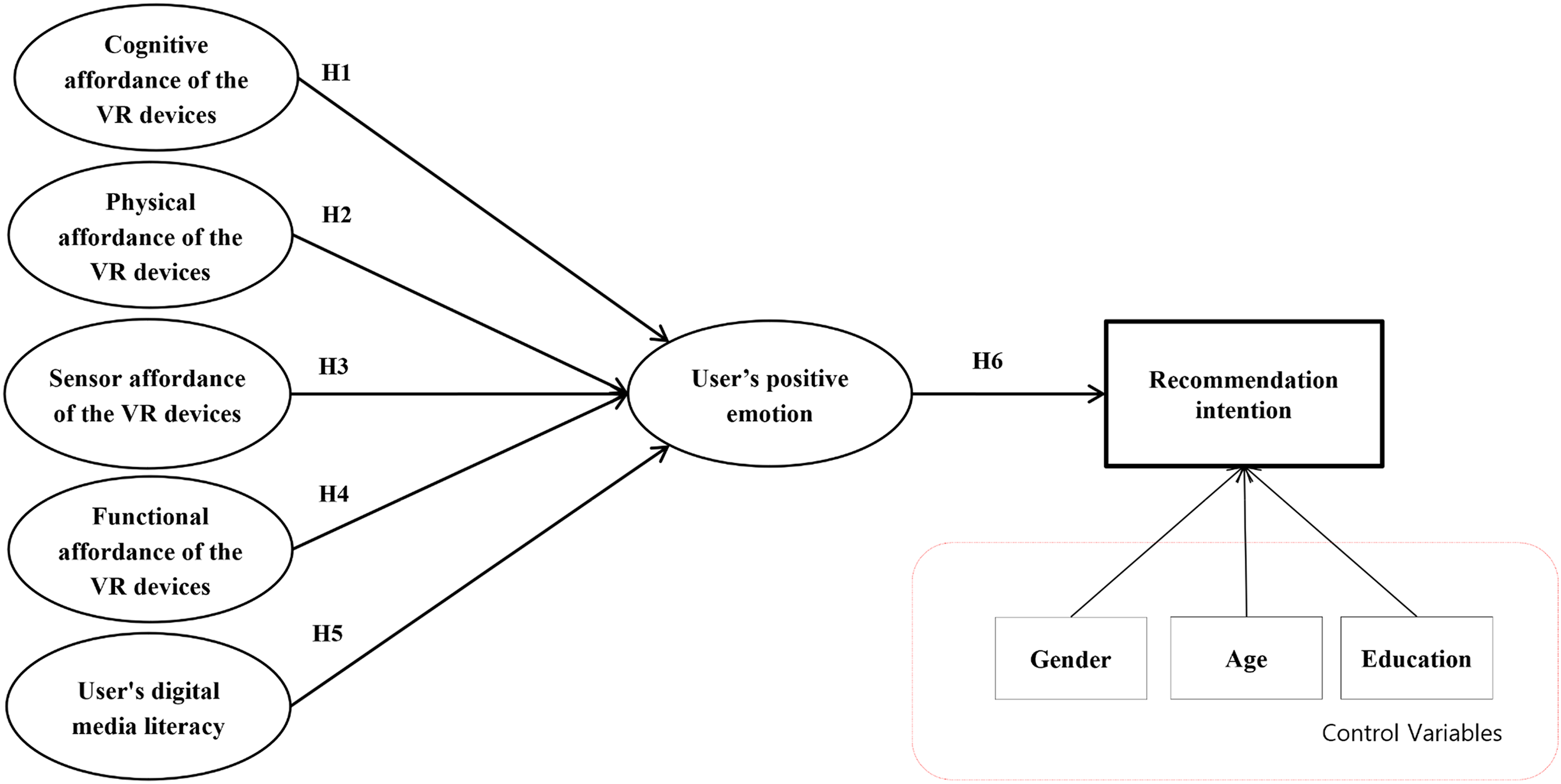
Proposed research model.
Methods
Research context
This study is an exploratory study seeking to understand the user's experience of VR content in cultural heritage tourism. The research took place in a VR studio at Gyeongju World Culture Expo Centre, South Korea. The experience aimed to enhance the visitor experience through the provision of immersive elements; encourage visitors to promote their experience to social media and contribute to the actual visit intentions of the destination. Gyeongju, a representative historical tourist city in South Korea, was the capital of an ancient kingdom and holds numerous world cultural heritages such as architectural structures, sculptures, and artefacts representing the Buddhist culture of the 8th-century ancient kingdom. Among the various heritages representing ancient Buddhist art and culture, this study chose Seokguram, a grotto designated as a UNESCO World Cultural Heritage Site, as the VR historical-cultural content to examine visitor experiences. The reason for this selection is that Seokguram maintains the originality of the 8th-century era in terms of sculptures and architectural methods, being highly regarded for its authenticity and demonstrating the exceptional skills and artistry of ancient people from that time. Furthermore, the VR content based on Seokguram is representative of VR content utilizing the HMD technology in South Korea.
Currently, Seokguram is not accessible for visitors to explore its interior. However, the VR content based on Seokguram allows users to virtually view the sculptures and statues inside Seokguram, providing an advantage by enabling visitors to observe parts of the statues that are difficult to view at the actual height of the statues. This VR content is permanently available at the Gyeongju Expo Park, providing visitors with the advantage of experiencing the VR content in a setting with limited contact with other visitors, allowing them to fully immerse themselves in the VR experience and compare it directly with the actual cultural heritage (see Figure 2(a) to (c)). This content allows users to wear wireless HMDs and walk directly into a 1:1 scale replica of Seokguram during the content experience, providing a realistic experience akin to actually entering Seokguram. Particularly, unlike conventional 360°-VR content, users’ physical movements are reflected in real-time within the VR environment through sensors, allowing them to experience real-time changes in the expressions of the main Buddha and surrounding statues, maximizing user immersion in VR.
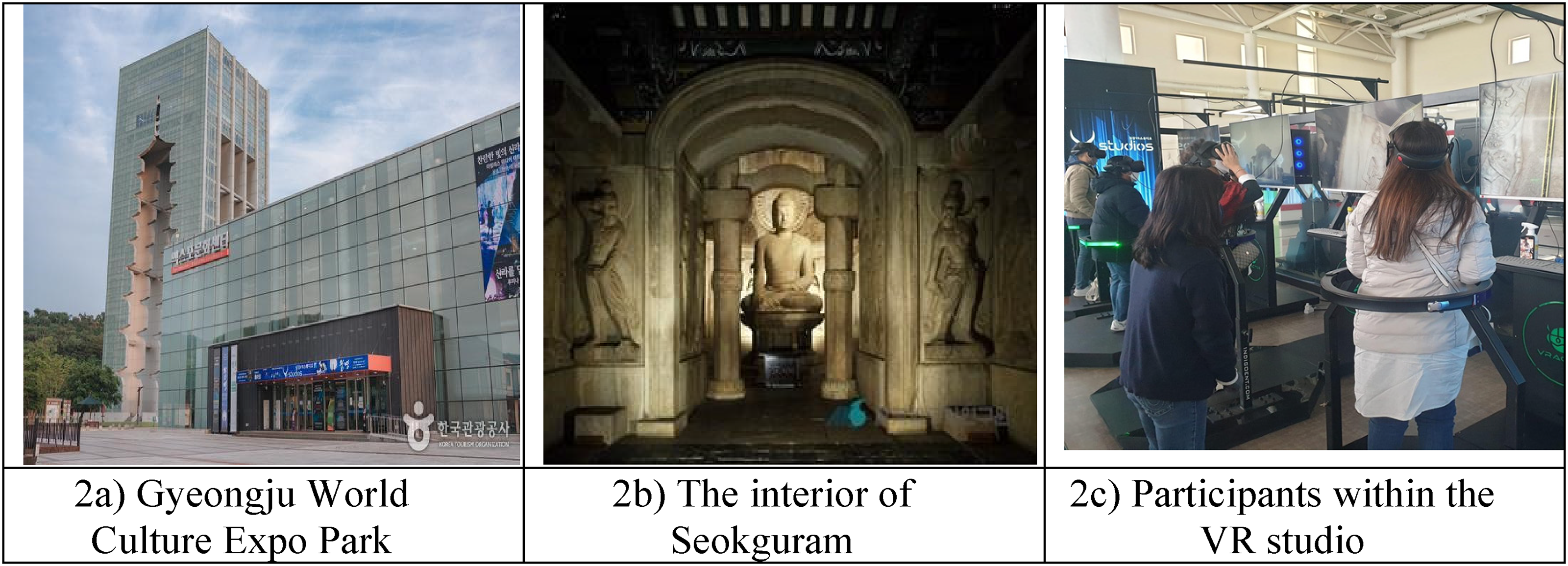
Culture Expo Park, Cultural Heritage, and Participants in the virtual reality (VR) studio: (a) Gyeongju World Culture Expo Park, (b) the interior of Seokguram, and (c) participants within the VR studio.
The HMD-based VR content video, including the guide's explanation and testing, was presented for ∼ 10 min. Participants wear the Oculus Rift HMD while experiencing the content and walk or run on the VR treadmill. Following the device's instructions, they direct their gaze towards virtual objects, move their heads, and navigate by looking at these virtual entities. Also, they can physically walk through the Seokguram, implemented on a 1:1 scale, experiencing a realistic sensation as if entering the Seokguram. Moreover, through sensors, participants witness real-time variations in the expressions of statues and sculptures inside Seokguram based on the positioning of artificial lighting, even within the VR environment. Natural lighting and shadows enhance the realism and immersion within the VR, heightening their sense of being present in the virtual world.
Research instrument
The survey consisted of two parts. Part 1 featured three items pertaining to customers’ perceptions of cognitive affordance, three items on customers’ perceptions of physical affordance, five items on customers’ perceptions of sensory affordance, and three items on customers’ perceptions of functional affordance concerning the VR devices. These items were adapted from Hartson (2003), Jeong and Park (2013), and Park and Lee (2020). Part 2 asked questions measuring customers’ digital media literacy, using five items adapted from Ahn (2013) and Oh (2017). Part 3 included questions assessing customers’ positive emotions and recommendation intentions. The five items on positive emotions were adapted from Cho (2014) and Lavoie et al. (2020), while the one item on recommendation intentions was adapted from Ham and Han (2013). Part 4 asked questions about demographic information, such as age, gender, education, and residential area.
The study also included control variables (gender, age, and education) to check for confounding effects.
As shown in Table 1, all the items (except those pertaining to demographics) were measured using 7-point Likert scales, ranging from strongly disagree (1) to strongly agree (7), in line with previous studies. To ensure content validity, experts in the area – three faculty members and three researchers in academia, along with two directors of the VR division of a cultural heritage tourism company – reviewed a draft of the survey questionnaire. Subsequently, a pilot test was performed with 10 undergraduate and graduate students of the tourism management program of a university in Seoul, South Korea. The results from the pilot test confirmed the adequate comprehensibility and clarity of the survey.
Constructs and measurement items.
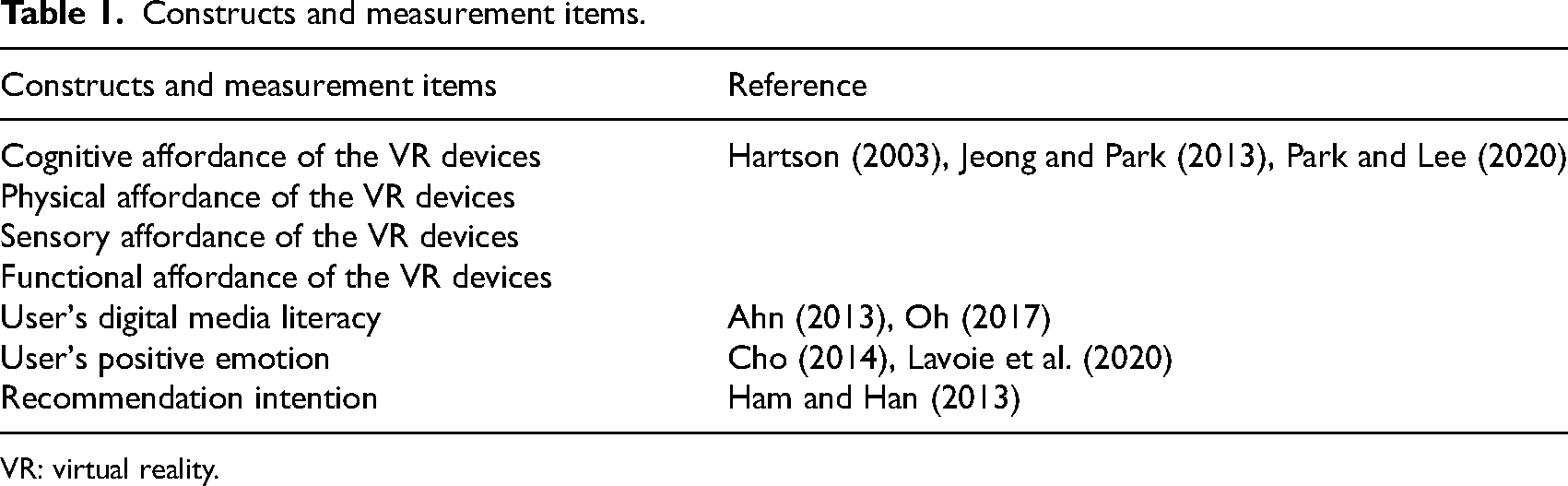
VR: virtual reality.
The questionnaire instrument was translated into Korean, with subsequent linguistic validation. A bilingualist independently translated the original English version of the questionnaire into written Korean. A panel consisting of the aforementioned translators and two authors reviewed the translations to form a single reconciled forward translation of the Korean version. Discrepancies between the original English form and the first draft Korean translation were reviewed by the panel.
Data collection
A field survey approach was used in this study. The data were collected from visitors at a realistic VR studio in Gyeongju World Culture Expo Park, South Korea, where visitors had a cultural heritage experience using a VR headset. A convenience sampling approach was used. The data were collected from 22 November 2019 to 24 November 2019. The average time required to complete the survey was 10 min. After incomplete responses were excluded, 157 complete responses were included in the data analysis.
Data analysis
This study used SmartPLS 3.2.8 (Ringle et al., 2015), a software for partial least squares structural equation modelling (PLS-SEM) because PLS-SEM can be used for a wide range of theoretical and practical studies (e.g. hospitality and tourism management, human resources management, information systems, strategic management, and marketing) and allows indefinite values to be easily tested for predictive relevance (Usakli and Kucukergin, 2018). PLS-SEM, or variance-based structural equation modelling, is often preferred over covariance-based structural equation modelling (CB-SEM) on studies with small sample sizes, complex structural models, non-normally distributed data, and structural models that include formatively measured constructs (Gefen et al., 2011; Hair et al., 2016; Usakli and Kucukergin, 2018). We used a two-step approach that consisted of a measurement model and a structural model testing, as recommended by Anderson and Gerbing (1988). The first step involved confirmatory factor analysis (CFA) to measure the constructs’ components to determine the relationships among the measured variables; the second step, structural equation modelling (SEM), specified the causal relationships among the hypothesised constructs and tested the proposed model.
Results
Sample
Of the 157 respondents, 101 (64.3%) were men and 56 (35.7%) were women. The age distribution was as follows: 10–19 years (n = 11, 7.0%), 20–29 years (n = 63, 40.1%), 30–39 years (n = 34, 21.7%), 40–49 years (n = 44, 28.0%), and 50 or older (n = 5, 3.2%). In terms of the level of education, 106 (67.5%) held a bachelor's degree, 12 (7.6%) had obtained graduate degrees, 31 (19.7%) were high school graduates, and 8 (5.1%) were middle school graduates. A zip code analysis revealed that the respondents’ places of residence covered all seven provinces, with relatively larger sample sizes from more populated provinces, such as Seoul (n = 50, 31.8%), Gyeonggi-do (n = 39, 24.8%), and Gyeongsang-do (n = 45, 28.7%); in contrast, a much smaller number of responses came from Sejong-si (n = 8, 5.1%), Gangwon-do (n = 5, 3.2%), Chungcheong-do (4, 2.5%), and Jeolla-do (6, 3.8%).
Measurement model
This study used SmartPLS 3.2.8 (Ringle et al., 2015), a software for PLS-SEM, because PLS-SEM can be used for a wide range of theoretical and practical studies (e.g. hospitality and tourism management, human resources management, information systems, strategic management, and marketing) and because it allows indefinite values to be easily tested for predictive relevance (Usakli and Kucukergin, 2018). PLS-SEM, or variance-based SEM, is often preferred over CB-SEM in studies with small sample sizes, complex structural models, non-normally distributed data, and structural models that include formatively measured constructs (Gefen et al., 2011; Hair et al., 2016; Usakli and Kucukergin, 2018).
CFA was used to evaluate the model's suitability by confirming the constructs’ reliability and validity. A reliability test employing Cronbach's α yielded values ranging from .807 to .939 for the constructs, indicating good reliability (α = .70), as established by Hair et al. (2006). Convergent validity was established using two proposals as a foundation (Anderson and Gerbing, 1988; Fornell and Larcker, 1981): first, the constructs’ factor loadings from .706 to .943; second, the 10 components’ average variance extracted (AVE) ranged from .558 to .812, which was much higher than the allowed level of .5 (Fornell and Larcker, 1981). As a result, the suggested model's constructs all had adequate convergent validity. The statistics of the constructs are summarised in Table 2.
Descriptive statistics of constructs (N = 157).
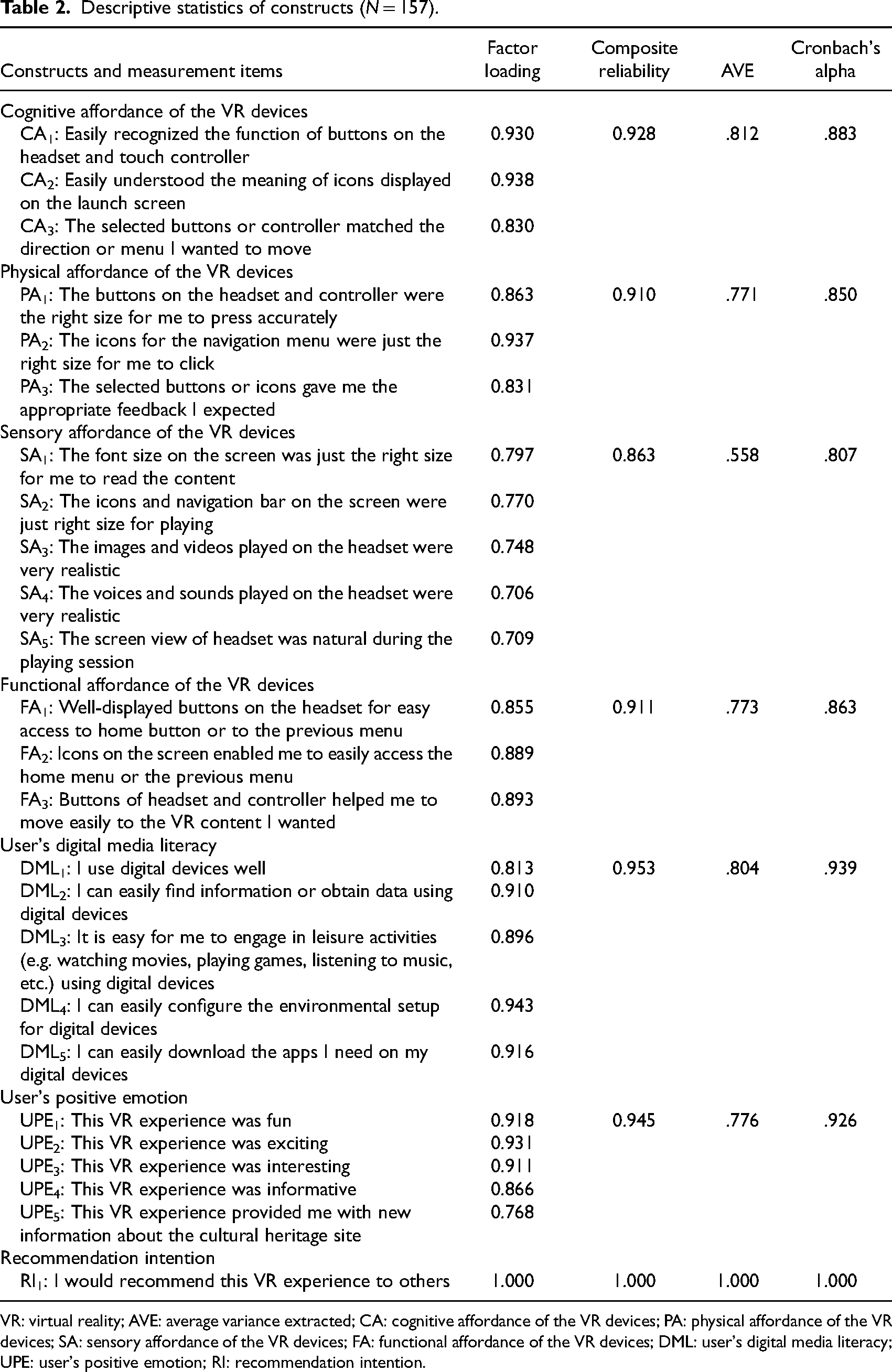
VR: virtual reality; AVE: average variance extracted; CA: cognitive affordance of the VR devices; PA: physical affordance of the VR devices; SA: sensory affordance of the VR devices; FA: functional affordance of the VR devices; DML: user's digital media literacy; UPE: user's positive emotion; RI: recommendation intention.
For the discriminant validity, the Fornell-Larcker criterion and the Heterotrait-Monotrait (HTMT) ratio criterion were assessed (Fornell and Larcker, 1981; Hair et al., 2016; Henseler et al., 2015). To show discriminant validity, the square root of the AVE for a construct must be greater than the correlation between any two of the constructs, according to the Fornell-Larcker criterion (Fornell and Larcker, 1981). The square root of the AVE for each construct exceeded the correlations between the constructs, indicating discriminant validity, as demonstrated in Table 3 under the Fornell-Larcker criterion. Because the notions were conceptually comparable, this study selected 0.85 as the HTMT threshold, which is a higher-level criterion than the Fornell-Larcker criterion (other studies used 0.90 as the HTMT threshold): for more distinct constructions, a conservative threshold of 0.85 can be employed, but for experimentally harder-to-distinguish constructs, a more liberal HTMT inference can be utilised (Hair et al., 2016; Henseler et al., 2015). Table 2 shows that the HTMT values for all constructions were < 0.85. In conclusion, the concept validity and the reliability of the CFA were found to be adequate.
Correlations matrix among the latent constructs (N = 157).
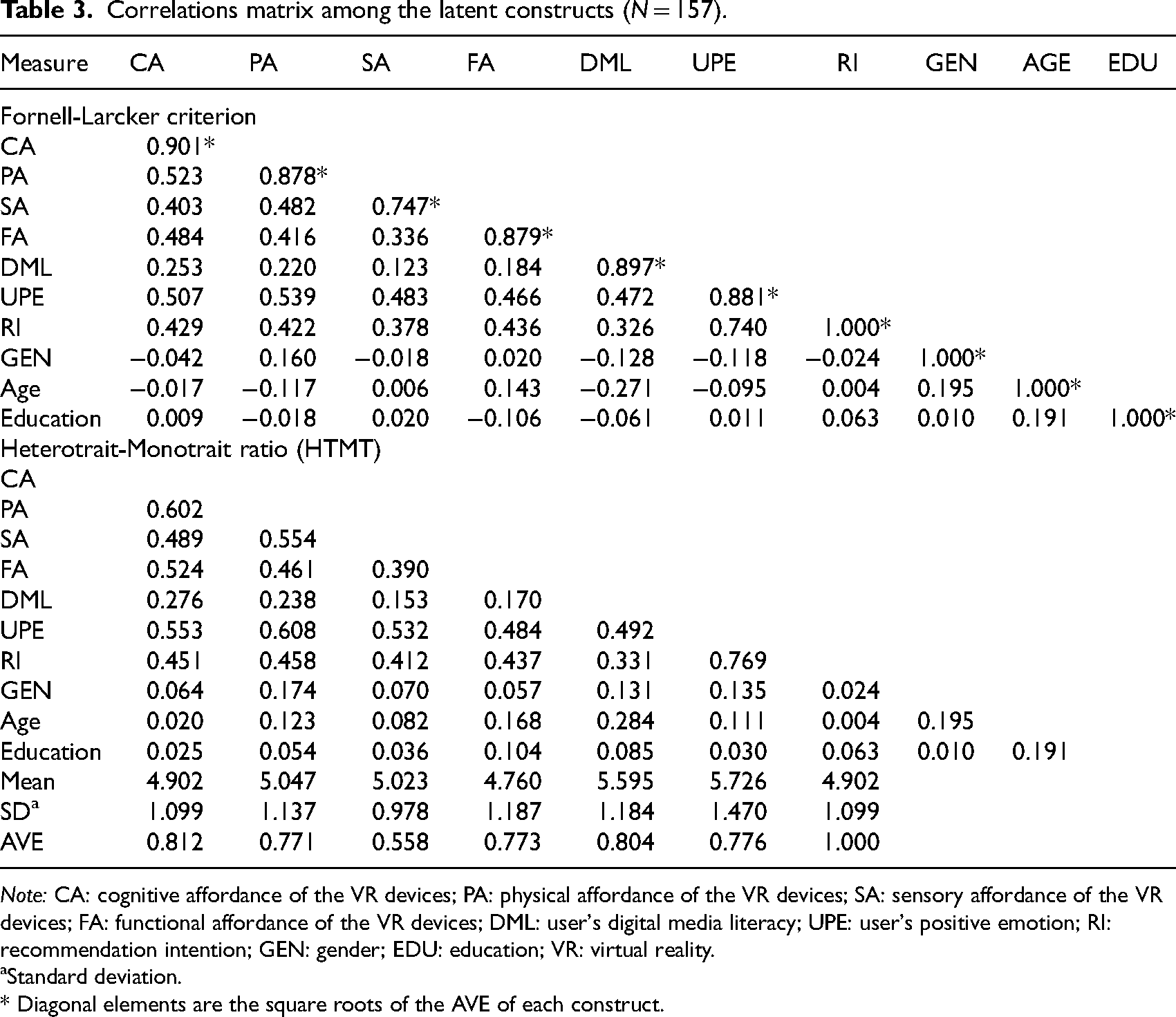
Note: CA: cognitive affordance of the VR devices; PA: physical affordance of the VR devices; SA: sensory affordance of the VR devices; FA: functional affordance of the VR devices; DML: user's digital media literacy; UPE: user's positive emotion; RI: recommendation intention; GEN: gender; EDU: education; VR: virtual reality.
Standard deviation.
* Diagonal elements are the square roots of the AVE of each construct.
Structural model testing
The hypotheses proposed in the research framework were tested using SmartPLS 3.2.8 (Ringle et al., 2015). The results showed that the proposed model has a strong ability to predict users’ positive emotions (R2 = 53.1%) and recommendation intentions (R2 = 55.7%). The proposed model has predictive relevance (Chin, 2010) for users’ positive emotions (Q2 = .393) and recommendation intentions (Q2 = .526). The Q2 values, or Stone-Geisser's Q² values (Geisser, 1974), were estimated using the blindfolding procedure to measure the model's out-of-sample predictive power or predictive relevance (Hair et al., 2016).
The results for H1, H2, H3, and H4 – that is, the impact of the cognitive affordance (H1 = .136; p < .05), physical affordance (H2 = .214; p < .01), sensory affordance (H3 = .225; p < .001), and functional affordance (H4 = .175; p < .01) of the VR devices on the user's positive emotion – show positive and significant coefficients. These findings indicate that when customers perceive the good affordance of VR devices, their positive emotions increase. H5 – the influence of a user's digital media literacy (H5 = .331; p < .001) on their positive emotion – is supported with significant and positive results. The result for H6 – the influence of a user's positive emotion on their intention to recommend – is also significantly positive (H6 = .751; p < .001). Therefore, H1, H2, H3, H4, H5, and H6 were supported. Figure 3 and Table 4 show the results of the SEM.
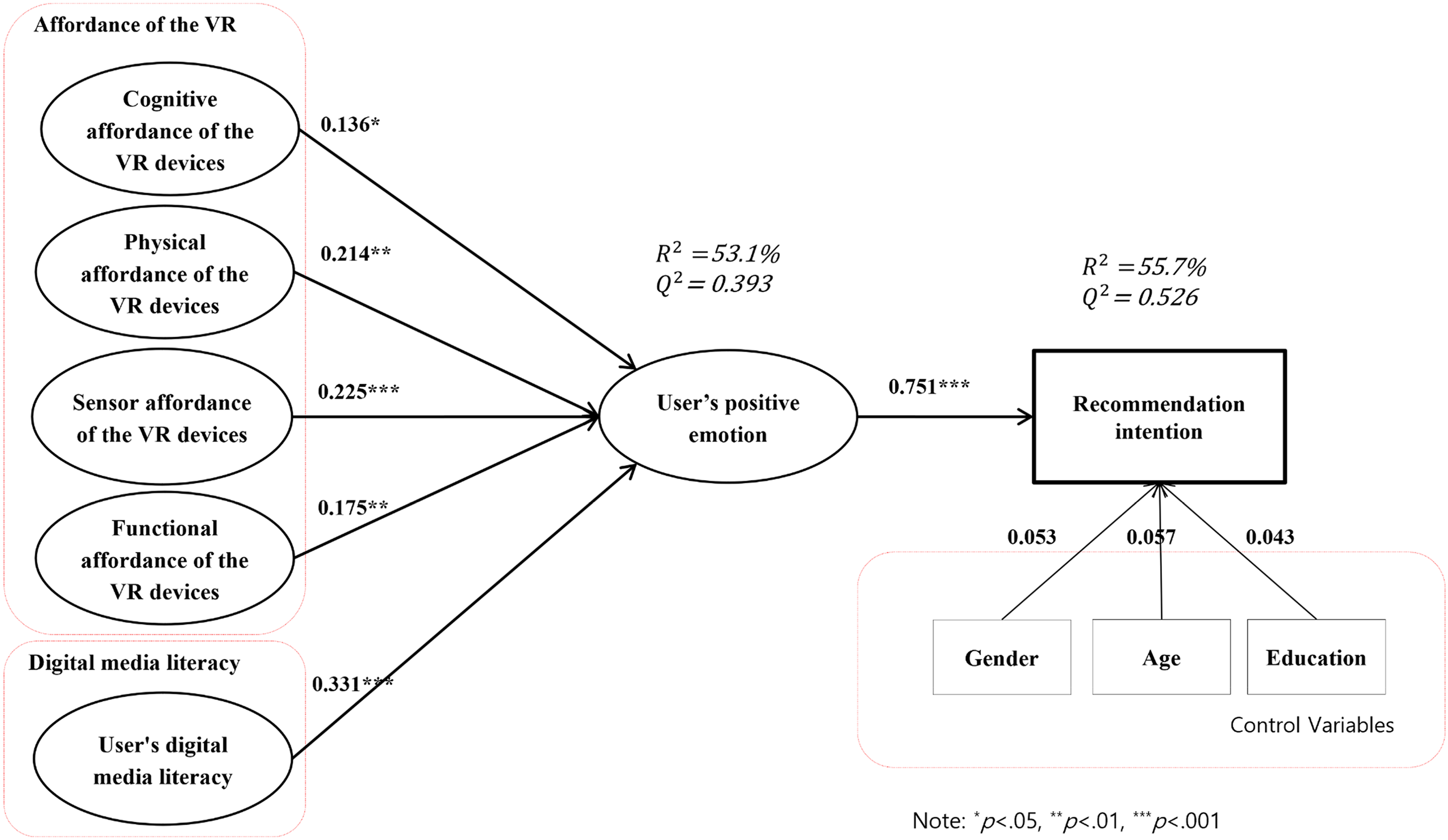
Results of the structural equation modelling.
Standardized parameter estimates (N = 157).
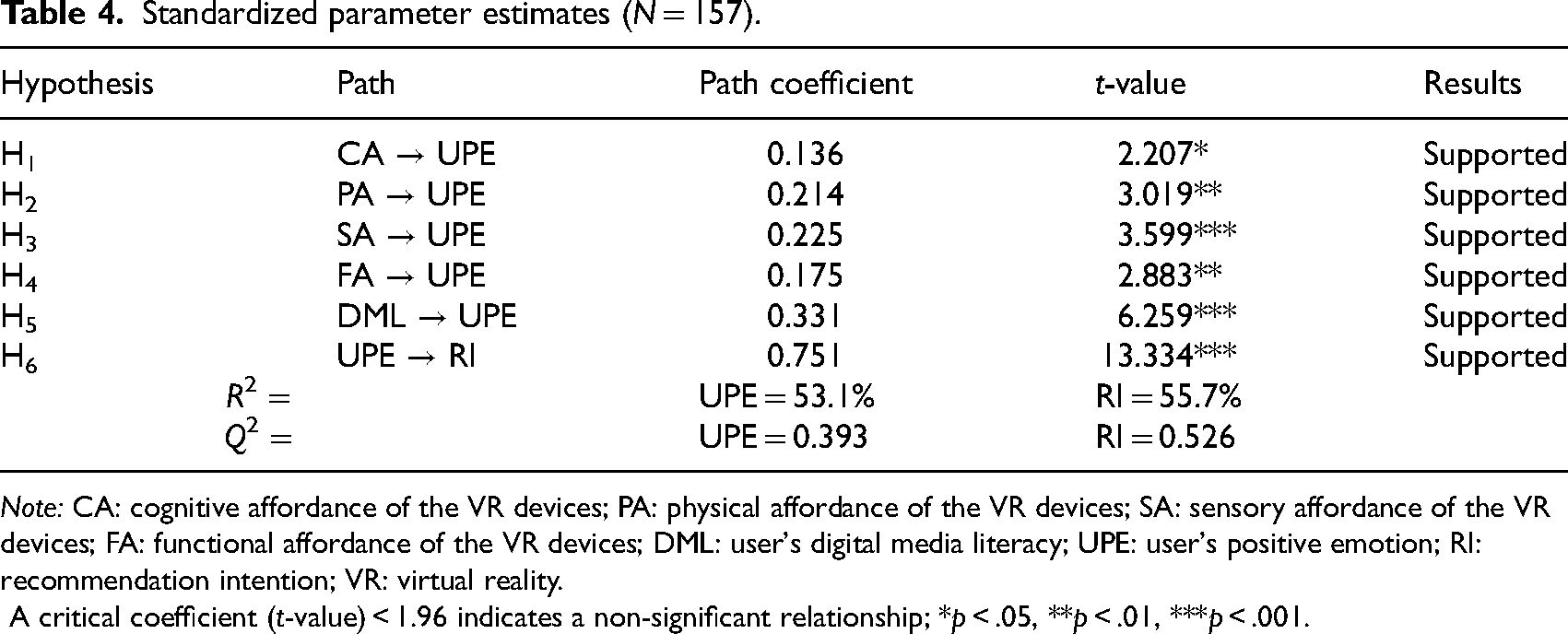
Note: CA: cognitive affordance of the VR devices; PA: physical affordance of the VR devices; SA: sensory affordance of the VR devices; FA: functional affordance of the VR devices; DML: user's digital media literacy; UPE: user's positive emotion; RI: recommendation intention; VR: virtual reality.
A critical coefficient (t-value) < 1.96 indicates a non-significant relationship; *p < .05, **p < .01, ***p < .001.
Mediating effects of user's positive emotion on experience with VR-based cultural heritage content
As a next step, the mediating role of the user's positive emotion was tested by examining the indirect effects of cognitive affordance, physical affordance, sensory affordance, functional affordance, and the user's digital media literacy on recommendation intention. The findings revealed that all five of these variables, significantly affected recommendation intention through the user's positive emotion (
Specific indirect effects (N = 157).
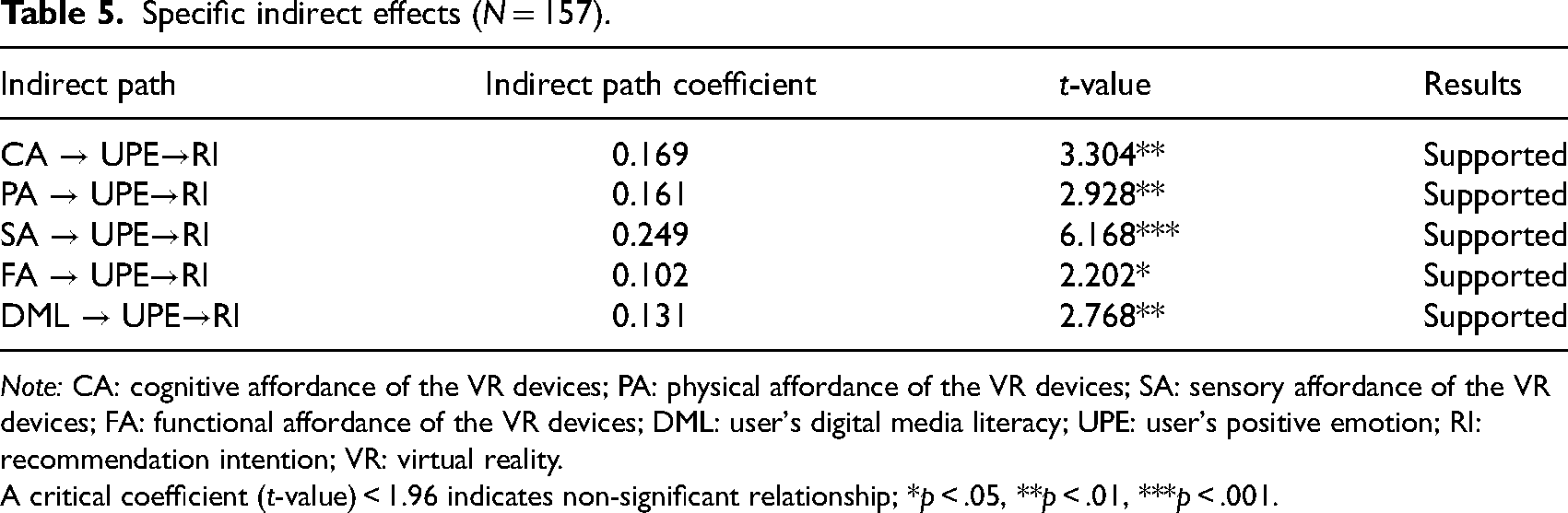
Note: CA: cognitive affordance of the VR devices; PA: physical affordance of the VR devices; SA: sensory affordance of the VR devices; FA: functional affordance of the VR devices; DML: user's digital media literacy; UPE: user's positive emotion; RI: recommendation intention; VR: virtual reality.
A critical coefficient (t-value) < 1.96 indicates non-significant relationship; *p < .05, **p < .01, ***p < .001.
Discussion and conclusion
In light of the increased recognition and exploration of VR applications and their potential in the cultural heritage tourism context, this study aimed to address two essential areas of research that have not been previously addressed. First, this study focused on affordance theory, which has received limited attention in previous tourism studies. Second, digital media literacy was incorporated into the proposed model – another area that required further investigation in the VR tourism context.
This study presents a ground-breaking exploration into the influence of affordances on tourists’ emotional responses to VR experiences in tourism. Responding to a call for research on affordance-centred frameworks in the tourism context (Tomej and Xiang, 2020), this study found that cognitive, physical, sensory, and functional affordances influence tourists’ positive emotions toward VR experiences. What does this mean? In our study, the VR experiences were designed in a way to support the (cognitive) use of the application, to facilitate physical actions, to aid in sensing, and to accomplish tourism-related tasks (functional). Ronchi et al. (2019) had previously confirmed these four dimensions within the VR context, albeit in an entirely different context of evacuation services. As this is one of the first studies to explore affordances in a VR tourism context, it provides an important stepping-stone for future research incorporating affordance theory. Also, this research provides a fundamental building block, laying the groundwork for a more nuanced understanding of how affordances shape emotional experiences in VR-based tourism – a facet often neglected in prior studies. While Flavian et al. (2021) tested a theoretical model focusing on VR embodiment's influence on emotional reactions in tourism, our study delves deeper into the specific affordances fostering positive emotions. This deeper understanding is invaluable for future research endeavours, elucidating how destinations and organizations can leverage these affordances to enhance user experiences. Of course, the original dimensions used in this study stem from more traditional IS (Information System) usage studies, and in the future it will be invaluable to explore whether there are more immersive tech-related affordability dimensions to fully grasp the opportunities.
A second important aspect of our study is the inclusion of digital media literacy in the proposed model. We confirmed that media literacy also affects positive emotions. Tourists’ ability to appropriately use, understand, and evaluate VR experiences leads to positive emotions and, ultimately, the behavioural intention to recommend the VR experience to fellow tourists. How can destinations influence digital media literacy? For one thing, tourists will continue to become more tech-savvy; especially in the Korean context in which this study was conducted, there is already a higher degree of digital media literacy, due to government initiatives and the widespread availability of the latest technologies (Yoon et al., 2019). Although the tourism industry as such may not change the level of digital media literacy, they need to be able to cater for all levels of media literacy to provide an inclusive tourism experience. Therefore, as discussed above, although the Korean market can be considered high in terms of digital media literacy, it is essential to provide experiences for people with a low degree of digital media literacy to create positive emotions. This can be achieved by creating different levels of VR experiences. One example for instance is the simple provision of 360° content whereby users have to simply move their head around to create a feeling of escaping reality. More advanced levels could utilize the full potential of VR in terms of manipulating objects to evoke positive emotions. Additionally, VR tutorials, support staff, and visual explanations can help support the introduction of VR, making it more inclusive and suitable for different levels of digital media literacy.
Theoretical contributions
This empirical study delves into the nuanced interaction between VR and users in the realm of cultural heritage tourism. It stands among the pioneering efforts to systematically investigate the VR experience within cultural heritage settings, with a particular focus on leveraging affordance theory to illuminate VR’s role in enriching user experiences. Specifically, the study underscores the following theoretical implications:
Firstly, the expansion of affordance theory to encompass the study of VR in cultural heritage tourism has proven to be a robust theoretical foundation. While frameworks for immersive technologies have traditionally drawn upon established theories such as the TAM, theory of planned behaviour, flow theory, and self-determination theory (Yung and Khoo-Lattimore, 2019), the primary application of the affordance framework has been observed in healthcare and human–computer interaction (Dincelli and Yayla, 2022). This research significantly contributes to theory-driven exploration within immersive technologies by employing the affordance theory (Hartson, 2003). Through its application to users’ VR-based cultural heritage experiences, this study effectively disaggregated the user's acceptance of the VR cultural heritage system into cognitive, physical, sensory, and functional affordances, subsequently measuring them.
Secondly, this study extends the context of users’ VR experiences by examining how positive emotions mediate user intention. By integrating the affordance theory, the research elucidates how affordances, as conceptualized by Hartson (2003), influence users’ positive emotions during VR interactions in cultural heritage tourism.
Thirdly, while it was initially hypothesized that digital media literacy might play a significant role in understanding the application of VR in digital tourism experiences, studies incorporating digital literacy have predominantly focused on educational and occupational domains (Kabakus et al., 2023; Nikou et al., 2022). This study empirically validates this assumption and extends the literature on digital media literacy to encompass cultural heritage tourism. Specifically, it serves as a precursor to understanding how digital media literacy contributes to the generation of positive emotions and subsequent behavioural intentions. Put simply, the empirical findings of this study underscore the influence of digital media literacy on the VR tourism system, emphasizing its pivotal role in enhancing the overall technology experience and design. Moreover, through an examination of the relationship between digital literacy and positive emotions, the study highlights the importance of considering users’ digital media literacy levels during the development of digital tourism environments, particularly in fostering intentions to recommend the use of VR.
Managerial implications
The use of VR in cultural heritage tourism provides new value, such as improving and supplementing the tourism experience, enabling the continuous preservation of cultural assets, and creating new alternative experiences. Reflecting this environmental change in the field of cultural heritage, this study divided the use of VR media into cognitive, physical, sensory, and functional elements through field case analysis and examined the relationship between each element and the user's emotional response. In addition, this study aimed to contribute to the practical implications of representative 360° VR cases that enable the experience of recent Korean government digital heritage policies and cultural heritage by measuring user experiences with the latest VR content, which underwent high-quality, sophisticated mapping.
The results of this study prove that where VR is used in the field, step-by-step tutorials for VR experiences and support for commentary services are important in improving the user experience. Specifically, graphic elements or sounds in the operation method of VR devices significantly influence positive emotions around VR use. Therefore, detailed plans for this should be incorporated when designing VR content. In addition, during the experience, if it is necessary to adjust the screen and sound size of the VR media, initialise the service, or return to the previous menu, service personnel or a support service are needed to guide the process.
The identified affordances most relate to the optimal design of both hardware and software. Therefore, tourism managers are advised to provide and implement VR solutions using appropriate hardware to evoke positive emotions and favourable intentions. Close collaboration with tourists as part of the design process will ensure that affordances are met and that applications create the intended purpose.
Furthermore, since the user's digital media literacy has an important influence on the VR experience, we propose an operation strategy that identifies a user's literacy level before using VR and matches the VR content accordingly. Since digital media literacy also affects user recommendation intentions through positive emotions, user literacy is one of the main factors to consider in improving user experience. This is linked to the concept of customization and the possibility of having different levels of application design based on the capabilities of tourists. For instance, highly trained or regular VR users may expect a different level of sophistication and experience compared to first-time or irregular users. Customizing experiences based on this level of VR literacy will enable destinations to foster stronger positive emotions and intents to recommend. To facilitate the progress of rapidly changing digital tourism policy, not only should the enrichment of the tourism experience due to digital technology be considered but also the user's technical understanding.
Limitations and suggestions for future research
Although the current study makes meaningful contributions to the experience of VR-based cultural heritage content, collections of samples of content and experiences that could broadly illuminate the VR cultural heritage tourism experience were limited. In this study, VR content accessed through HMDs and controllers was selected and investigated, but collection of a large sample was limited, due to the permanent exhibition. Therefore, 157 samples were available for analysis. Since the results of this study are the analysis results for one type of content and a small sample, the generalisation of the study results is limited.
Furthermore, the factor of ‘digital media literacy’ was used as a factor influencing users’ positive emotions and recommendation intentions. However, research on VR literacy for tablets and mobile devices is still insufficient. In addition, the research design was conducted based on previous studies dealing with digital media literacy in systems, etc. Therefore, we suggest the need for follow-up studies to refine the VR literacy scale.
Finally, by examining user satisfaction in connection with the level of media literacy of VR media users, we intended to analyse the relationship between digital media literacy and user behaviour in more depth. In the future, we intend to conduct a comparative study that expands the sample range to countries around the world, in an effort to generalise the results.
Footnotes
Declaration of conflicting interests
The author(s) declared no potential conflicts of interest with respect to the research, authorship, and/or publication of this article.
Funding
The author(s) received no financial support for the research, authorship, and/or publication of this article
