




Abstract
The advancement of technology and social networking sites has popularised online photo-sharing, allowing tourists to seamlessly share travel encounters with those who are physically absent. At the same time, focus channelled to cameras and mobile screens limits immersion in the tourist experience and detracts from engagement with various destination elements. As the tourist attention becomes divided into physical and virtual spaces, implications on the on-site experience need to be considered. This has challenged existing definitions of the tourist experience through the selfie and distracted gaze coined in contemporary research. As such, this study aims to revisit existing definitions by exploring the experience sought by present-day tourists, with attention paid to their online photo-sharing endeavours. Given the exploratory nature of this study, a qualitative approach was utilised through 17 in-depth interviews conducted with tourists from eleven countries. The findings revealed new meanings to the notion of the present-day tourist experience. While leisure travel has traditionally been regarded as one’s detachment from the mundane environment, such detachment was found to exist only at a physical level. Subsequently, this study proposed the reconceptualisation of the tourist experience, incorporating values derived from both on-site and online interactions. The theoretical contribution to the body of knowledge is seen in the development of the dual realm tourist experience framework which extends past delineations of the tourist experience. This study also sheds light on the kind of services tourism providers could offer to cater to the needs of present-day tourists.
Introduction
Photography has long been recognised as a symbolic practice of tourism. It is the identity badge of tourists (Chalfen, 1979) and the single behaviour that best defines them (Pearce, 2019). The parallel development of photo-taking devices, mobile technology and social networking sites has created opportunities for travel photos to be shared instantly to an intended audience online. Consequently, the photographic visualisation of one’s travel experience has become an essential part of the increasingly digitised society (Konijn et al., 2016). The development of SMART cities across major destinations in Europe, Asia and North America (Yavuz et al., 2018) is expected to intensify such phenomenon. The implementation of 5G technology in SMART cities enables greater connectivity and high-speed communication (Accenture, 2017), facilitating seamless photo-sharing for tourists.
Photography makes experiences more enjoyable (Diehl et al., 2016) and increases tourists’ level of happiness (Gillet et al., 2016). When posted online, photos allow tourists to share travel experiences with family and friends back home, while justifying trip expenses (Prideaux and Coghlan, 2010). The growing appetite for photo-taking and online photo-sharing has, however, proven to come at a cost Photo-taking has been reported to result in 259 deaths between 2011 and 2017 (BBC, 2018), tourist brawls (Schneider, 2018), distracted experiences (Ayeh, 2018) and hampered memories (Henkel, 2014). Distracted experiences lead to disengagement from destination elements which, according to Melón et al. (2021), adversely impact the construction of memorable experiences and subsequently affect tourist satisfaction levels, revisit intentions and recommendation decisions.
Past authors have defined the tourist experience as one’s engagement with key destination elements such as the environment, providers, products and people (Larsen, 2007; Mossberg, 2007; Nickerson, 2006; O’Sullivan and Spangler, 1998). The utility of cameras and mobile devices for online photo-sharing, however, may distract or mediate the tourist experience, including the extent of interaction between the tourist and the aforementioned elements. As Ayeh (2018: 35) reasonably questioned, “to what extent could a tourist give receptive attention to and be fully aware of ongoing events and experiences on the tourist trail (i.e. sights, sounds, people, etc.) while concurrently engaged with information processing on mobile media devices?”. In the same vein, Tanti and Buhalis (2016) discussed how online connectivity could confine tourists to the ‘online world’, causing one to miss out on potential learning experiences.
Kirillova and Wang (2016: 166) argued otherwise, claiming the benefit of vacationing to no longer be a direct outcome of one’s disassociation from the everyday life and hence should not be treated as “an activity taking place in a liminal environment”. Digital technologies have transformed the spatial and temporal dimensions of the social life (Molz and Paris, 2015), and going away may no longer mean absence, detachment or disconnection in the absolute sense. An overlap exists between the physical space of the destination and the virtual space of home that needs to be recognised. In the same vein, the recent conceptualisations of the selfie gaze (Magasic, 2016) and distracted gaze (Ayeh, 2018) denote an increased level of sociality and engagement with the virtual space while travelling. These concepts posit a different way of seeing and experiencing destinations mediated by mobile devices and interactions occurring in online social spaces. A shift from the conventional tourist gaze (Urry, 1990) is noted and previous assumptions about the outcomes of vacationing should be re-evaluated to achieve a better understanding of the contemporary tourist experience (Kirillova and Wang, 2016). Furthermore, the photographic and photo-sharing practices as well as the complexity of what people do for what particular reasons should be considered to attain a comprehensive depiction of the relationship between travel photography and experience (Stylianou-Lambert, 2017).
To further explore the contrasting views on the implications of mobile engagement, this study seeks to revisit definitions of the tourist experience by examining tourists’ interactions with the virtual space, particularly through online photo-sharing while travelling. In doing so, it considers the overlap between the physical and virtual spaces, as well as the value drawn from both, in delineating the present-day tourist experience. Past researchers have conceptualised the tourist experience as a multi-phase consumption process which begins before the trip and extends to when tourists return from their trip (Clawson and Knetsch 1966; Cutler and Carmichael, 2010; Tung and Ritchie, 2011). Clawson and Knetsch (1966) break down the tourist experience into stages of planning and anticipation, travel to the destination, on-site activities, return travel, and recollection. While all stages contribute to the evaluation and outcomes of the tourist experience, the focus of tourism research has largely shifted towards the destination (Servidio and Ruffolo, 2016) with emphasis for tourism planners to facilitate the creation of memorable experiences (Tung and Ritchie, 2011).
This study therefore takes a narrowed focus on the on-site experience as destinations provide frames for photo-taking and hence photo-sharing. Attention paid to the on-site experience will assist tourism providers with carefully curating such frames, including facilities within the destination, to produce desired outcomes and memorable experiences. Implications also extend to the later phase of the tourist experience, particularly in the recollection stage. Recollection involves actions taken to remember and reflect on the experience, including telling stories and sharing photographs (Tung and Ritchie, 2011) which further serves destination marketing efforts through consumer-generated content and word-of-mouth.
Past studies have explored online photo-sharing in particular tourism contexts such as nature-based tourism (Conti and Lexhagen, 2020), theme parks (Prideaux et al., 2018), and selected tourism sites (Konijn et al., 2016; Munar and Jacobsen, 2014). The utility of specific social media platforms such as Instagram (Conti and Lexhagen, 2020) and WeChat (Li, 2020) has also been studied. Although consequences of mobile connectivity on the tourist experience have been widely investigated (Ayeh, 2018; Dickinson et al., 2016; Molz and Paris, 2015; Neuhofer, 2016; Pearce and Gretzel, 2012; White and White, 2007), the role of online photo-sharing in shaping or altering the on-site experience remains underexplored. This study emphasises on photo-sharing as previous research on experience-sharing have focused largely on verbal and written communication, with little attention given to photographic communication (Barasch et al.’s, 2017). Addressing this gap will contribute to the theoretical advancement in experience literature as visuals have been the “central component to tourism since its inception” (Scarles, 2014: 331). Photos are used to consume and produce destinations (Scarles, 2014), and this is fuelled by the rapidly changing technology that are becoming available to tourists.
Literature review
Travel motivation and the tourist experience
Understanding travel motivation and the tourist experience is crucial as these concepts identify ‘why’ people travel and ‘how’ travel motives are fulfilled. Past researchers have identified various motivations for travelling through the development of multiple frameworks and models. Common and recurring motives include novelty, escapism, relaxation, regression, enhancement of kinship relationships, social interactions, prestige, and self-development (Crompton, 1979; Dann, 1977; Mannell and Iso-Ahola, 1987). However, tourists’ dependency on mobile technology is changing the way people travel and why travel is experienced (Magasic, 2016). While tourism is conventionally founded on the premise of separation from home and work life (Krippendorf, 1987), maintaining mobile connectivity while travelling may diminish or alter such notion of separation.
Tourists maintain mobile connectivity for various travel and non-travel related purposes such as information search, navigation, problem solving, communicating with others, making travel arrangements, updating and monitoring updates on social networking sites, taking photos and videos, uploading social media content, playing games, and to kill time (Ayeh, 2018; Gretzel, 2010; Tan, 2017; Tanti and Buhalis, 2016; Wang et al., 2016). While mobile connectedness may contribute to enhancing the tourist experience (Gretzel, 2010), time spent pursuing non-travel related activities could distract tourists from the on-site experience (Tanti and Buhalis, 2016), leading to hampered interactions with those physically present, loss in one’s sense of place and disembodied experiences (Gretzel, 2010). Furthermore, interpersonal encounters could be neglected (Turkle, 2011) as virtual proximity to friends and family makes tourists more ‘distant’ from people in the physical environment (Molz, 2012). In addition, mobile connectivity interferes with the pursuit of escapism (Tan, 2017) and subsequently alters the idea of escaping (Neuhofer, 2016). Such views imply the role of mobile connectivity, including online photo-sharing, in altering the tourist experience, particularly those driven by the desire to escape, relax, enhance kinship relationships, and establish social interactions.
In contrast, research in the past decade has highlighted the centrality of identity-related motivation in the tourist experience, depicting tourism as a vehicle for discovering, retaining, and sometimes separating oneself from certain aspects of one’s identity (Parra-Lopez et al., 2011). In line with this, Bond and Falk (2013) developed the ‘Identity-Related Tourism Motivation Model’ which illustrates how tourism experiences can be used to enact the identity one wishes to portray through the process of identity (re)development, maintenance, and moderation or (dis)engagement. When intersecting the tourist experience with the practice of online photo-sharing, it can be argued that photos taken and shared during the trip would assist in the attainment of such motivation. As Crang (1999) stated, in a conscious attempt to manipulate or alter one’s self-image, tourists take and retain travel photos selectively bearing in mind the audience they intend to share those photos with.
Mobile-connected tourism experience: The good and the bad
Smartphones allow users to occupy multiple spaces at one time (Misra et al., 2016). When utilised at the destination, a convergence occurs between the physical space where the tourist is present and the virtual space online (Tan, 2017). Such convergence was termed by Tan (2017: 615) as the physical-virtual space, adding that the tourist experience is “no longer bounded by the physical limits imposed and the actors being physically present within the destination”. Similarly, Sigala (2016) described the use of social media as pluralising time and social spaces as tourists maintain interactions and engage in social activities with those who are physically absent.
Connecting and sharing travel encounters online can have a two-way effect on the tourist experience (Ayeh, 2018; Dickinson et al., 2016; Molz and Paris, 2015; Neuhofer, 2016; Pearce and Gretzel, 2012; Tanti and Buhalis, 2016). Mobile technology affords a sense of social connectedness which compensates for one’s physical absence from home (Neuhofer, 2016). It allows tourists to mentally detach from their physical environment or travel companions when desired (Neuhofer, 2016). The need to momentarily detach from one’s physical environment and travel companions is particularly noteworthy as it contradicts the common travel motives of escaping one’s routine life (Crompton, 1979; Krippendorf, 1987; Mannell and Iso-Ahola, 1987) and enhancing kinship relationships (Crompton, 1979), signifying a deviation in the way tourism experience is viewed. Furthermore, mobile connectivity enables tourists to invite others to virtually co-live the experience with them (Neuhofer, 2016). Sigala (2016) discussed the virtual presence of others through the concept of omnipresence, claiming that tourists acquire a feeling of being surrounded and observed by others in the virtual world when sharing experiences on social media. The benefits drawn from social-connectedness suggest that total disconnection may not be valued by present-day tourists whose experience is framed by interactions occurring in both physical and virtual spaces.
Conversely, multiple studies argue that maintaining mobile connectedness while travelling can be detrimental to the tourist experience (e.g. Ayeh, 2018; Neuhofer, 2016; Tanti and Buhalis, 2016; White and White, 2007). Tourists lose their sense and purpose of going away, hindering their ability to immerse in the experience, be ‘in the moment’ and live the ‘tourist life’ (Neuhofer, 2016). Tourists multi-task when performing several activities simultaneously such as chatting online while listening to a tour commentary or taking photos during a walking tour (Ayeh, 2018). The conscious attention of tourists becomes divided as they are inclined to ‘inattentional blindness’, and hence less likely to take note of distinctive stimuli in their environment (Simons, 2000). Multi-tasking on mobile devices therefore raises concerns about the quality of tourism experiences; an area that has received limited attention in tourism research (Ayeh, 2018). Furthermore, Magasic (2016) highlighted how engagement with digital technologies and social media platforms while vacationing can change the way travel is experienced and recorded. These changes are manifested through two recent reconceptualisations of the tourist gaze, namely the selfie gaze and distracted gaze.
From the tourist gaze to the selfie and distracted gaze: A shift in the consumption of place
The tourist gaze imposes a particular way of seeing a destination shaped by the imagery the tourism industry creates (Urry, 1990). Such imagery communicates to tourists what is considered important, extraordinary and worth seeing, and is thus central to the constitution of the tourist experience (Urry, 2002). The tourist gaze subsequently takes form through photography as Urry (1990) describes tourism to be a production system and photography to be a tourist practice. Tourists participating in the reproduction of images have, however, been described by past researchers (Sontag, 1979; Urry, 2002) as passive consumers of a destination. In the pursuit of photos, tourists capture anticipated images without looking at what is actually being photographed, therefore never knowing or learning what they have reproduced through their cameras (Bourdieu, 1990).
The development of technologies has allowed tourists to share photos online as experiences unfold. Tourists capture photos while being cognizant of an audience that is not physically present, potentially turning photo-taking into a further act of passive consumption as experiences are directed by the kind of photos the audience expects to see. Such cognizance is evident through the evolution of the tourist gaze as researchers in recent years establish the concepts of ‘selfie gaze’ (Magasic, 2016; Sigala, 2016) and ‘distracted gaze’ (Ayeh, 2018) which take into consideration the mobile connectedness of tourists at the destination. Magasic (2016) described the selfie gaze as the act of photographing oneself with the realisation that there is an audience who will be viewing these images. Tourists visit specific places, participate in certain activities, take and share selected photos, all while keeping an online audience in mind. Factors that give shape to the tourist experience are transformed by the increasing interaction with one’s mobile device and social media (Sigala, 2016), implying its less self-directed nature. The distracted gaze later introduced by Ayeh (2018) denotes that the gaze of the tourist becomes distracted when multitasking on mobile device. Capturing and converting travel photos into online postings require the use of camera and mobile devices which, to a certain extent, distracts the tourist from the surrounding environment. The sense that is actively engaged is narrowed down to sight through the camera lens or mobile screen, while other senses become hampered.
These modern-day gazes indicate the role of those who are not physically present in mediating or distracting the tourist’s way of seeing and experiencing a destination. Sigala (2016) shared a similar view, stating a major reason for experiencing travel moments lies within the intention of sharing those experiences. While these redefined gazes demonstrate a shift in the gaze of the tourist, application in tourism experience research remains lacking. This study therefore investigates the contemporary tourist experience through the lens of the selfie and distracted gaze developed through a conceptual study (Magasic, 2016) and with a broader focus on mobile usage (Ayeh, 2018), respectively. It challenges the conventional concept of the tourist gaze in an attempt to better understand the experience sought by present-day tourists. Application in empirical research will also offer further validation to the selfie and distracted gaze in the context of online photo-sharing while travelling.
Methodology
Given the subjective and personal nature of the tourist experience (Pine and Gilmore, 1998; Tung and Ritchie, 2011; Urry, 1990), a qualitative and inductive approach was utilised to allow in-depth knowledge to be gathered and personal experiences to be understood through participants’ interpretation of their behaviours (Veal, 2005). In-depth semi-structured interviews were conducted as this enables all aspects of interest to be captured while avoiding the pre-judgement of researchers in the form of structured response scales and measures (Rossiter, 2011). Knowledge is subjectively derived as experience is prevailed by individuals’ interpretations of value (Conti and Lexhagen, 2020). As Boas (1943: 314) stated, “if it is our serious purpose to understand the thoughts of a people, the whole analysis of experience must be based on their concepts, not ours” (as cited in Jennings, 2001).
The interview comprised questions requiring respondents to reflect on their most recent trip details, travel motivation, participation in online photo-sharing and interactions, and subsequent implications on their travel experience. The interview guide was developed from relevant literature on travel motivation (Munar and Jacobsen, 2014; Stylianou-Lambert, 2017), tourists’ photo-taking and photo-sharing behaviours (Konijn et al., 2016; Lo et al., 2011), as well as the effects of photo-taking and mobile usage on tourist experience (Ayeh, 2018; Diehl et al., 2016; Tan, 2017) and emotions (Gillet et al., 2016). The interview pulls together concepts that are crucial to understanding the tourist experience and hence corresponds to the conceptualisation of the study formed through the literature review above. While the interview guide offers some form of structure to the interview process, the nature of every interview was fluid, with the order of questions organised according to the thinking process of the interviewee (Jennings, 2001). Where relevant, probing questions were posed to invite further explanation to statements (Whyte, 1982) and gather deeper insights.
The targeted sample include individuals who have travelled internationally or domestically within the last 12 months to allow for a more accurate recollection of respondents’ travel experiences and behaviours. Purposive sampling was utilised as respondents were targeted according to their closeness of fit to the pre-determined criteria set for the study (Jennings, 2001). To enable an international reach, convenience sampling was simultaneously applied. Invitation to participate in the study was posted on social media travel groups where public posting is permitted. These groups function as platforms for open discussions about travel (e.g. experience-sharing, content-sharing, and information-seeking) and comprise members from around the world. All groups utilise English as the common language for communication and translation was not required. The purpose of the study and criteria for participation were detailed in the invitation posted. Interested participants were then contacted and presented with the participant information sheet and informed consent form before organising an appropriate time for the interview.
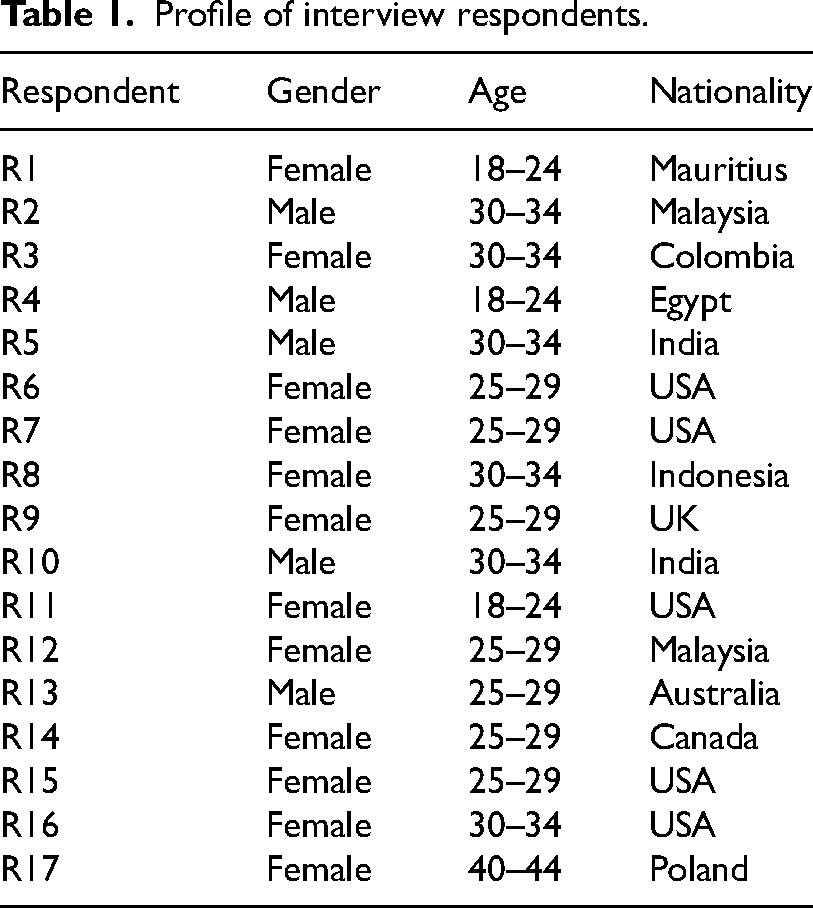
A total of 17 interviews were conducted over three months and the profile of respondents is shown in Table 1. The respondents consist of twelve females and five males from eleven countries belonging to age groups ranging from 18 to 44 years old. Although data was driven from a larger group of female respondents, the gender distribution is representative of the tourist population as nearly two-thirds of travellers are women (GW Today, 2016). Females were also found to partake in online photo-sharing more frequently compared to males (Thelwall and Vis, 2017). Nonetheless, given the subjectivist epistemology and the multiple realities recognised in qualitative research (Denzin and Lincoln, 1994; Jennings, 2001), it is not the intention of this study to produce findings that are generalisable to the overall tourist population.
Profile of interview respondents.
Data was collected until ‘qualitative informational isomorph’ is achieved (Lincoln and Guba, 1985), that is, when redundancy with respect to information occurs and no new data emerges. This is in line with the theoretical sampling approach which entails a cyclical process of collecting and interpreting data until saturation is reached and only a confirmation of previous themes is found (Punch, 1998). While saturation was reached at the 15th interview, two additional interviews were conducted to ensure no new information were elicited and to allow for supplementary validation of findings. Interviews were performed online using voice or video-call applications, depending on the preference of the participant. The duration ranged from 40 min to an hour, with an average length of 50 min. Interviews were audio-recorded and notes were taken to allow for post-interview analysis.
To analyse the data, thematic analysis was performed to seek and identify common threads running through the set of interviews. The analysis was conducted manually to enable immersion in the data and its interpretation, consistent with the interpretive approach that underpins qualitative research. Interview recordings were transcribed and read through for initial note-taking. Meanings were assigned to words, phrases and paragraphs in the preliminary stage of coding, and reflections were noted as memos. Codes representing similar ideas, concepts and viewpoints were subsequently merged to develop themes. To ensure the rigour and trustworthiness of findings, investigator triangulation was employed (Creswell, 2013). Descriptions, interpretations and themes drawn from the data were reviewed, discussed and confirmed by the team of researchers who are experienced in the field of tourism research.
Findings and discussions
The study revealed that 15 out of 17 respondents shared photos of their holiday online during the trip. Photos were frequently shared with family, friends, peers and followers on social media. Common platforms used for photo-sharing include social media (e.g. Facebook, Instagram, Snapchat, YouTube and Twitter) and instant messaging applications (e.g Whatsapp and Facebook Messenger). More conventional channels such as email and text messages were also used by a handful of respondents.
Respondents talked about the process involved in reviewing and selecting photos prior to sharing them, while a few have taken to editing their photos before posting on social media. Here, the practice of selective photo-sharing was found to be at work and evident within the selfie gaze. Photos were selected based on a set of pre-determined criteria which define their social-media-worthiness. Respondents described such images as being aesthetically pleasing and recognisable for the intended audience: Of course, the quality must be very clear, high definition. And also you can see our reaction, our face reactions whether we are really happy inside the pictures. And the colours, you know. I think that’s basically my focus point when I select those photos. (R2)
So if there were, as I said, something like easily recognisable, for example the Times Square photo, you know, I posted that on my Facebook … but then when it came to photos like Brighton Beach or Brooklyn, I waited. I posted those at the end of my trip when I got back to Kentucky on a photo album of New York I had created on Facebook. (R15)
This offers an extension to the concept of the ‘selective filter’ which illustrates tourists’ photo-taking as an act of discarding, taking in and transforming whatever goes through the camera lens (Markwell, 1997; Teymur, 1993). This extension is seen in present-day online photo-sharing as tourists carefully select and edit photos in ways that will appeal and be well-received by the online audience. The desire to relate to the audience through distinguishable images was discussed during the interviews, implying the role of others, who were not physically present, in influencing the type of photos shared during the trip. Photos were also shared with one’s image and social esteem in mind. This supports the concept of the selfie gaze (Magasic, 2016; Sigala, 2016), while demonstrating the attention placed on online photo-sharing during the tourist journey.
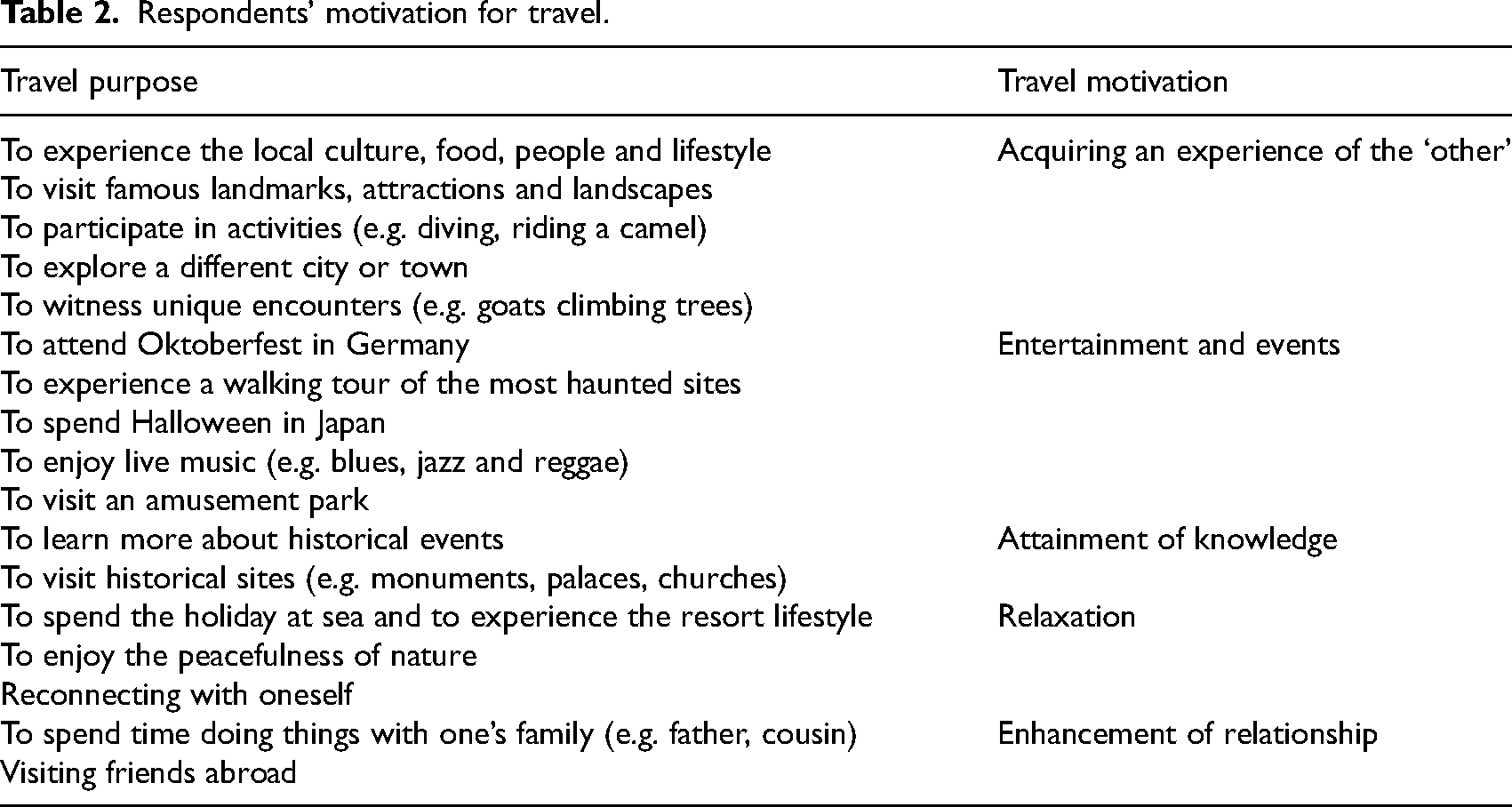
The dedication to online photo-sharing is particularly noteworthy as respondents’ motivation to travel was largely centred on the desire to acquire an experience of the ‘other’, participate in entertainment and events, attain new knowledge, relax, and enhance relationships with family and friends. These motivations were represented by respondents’ travel purpose, as presented in Table 2.
Respondents’ motivation for travel.
The fulfillment of such motivations requires tourists to engage with destination elements (products, providers, people and physical environment), and to a certain extent, disengage from the virtual space. However, the desire to visually share the experience with those who are not physically present demonstrates a conflicting interest as this may distract tourists from their travel experience, reconnect them to the home environment they have intentionally left behind, and hamper their presence on-site. Nevertheless, respondents discussed factors that would determine their level of engagement online, which include who the audience is, the topic of conversation and their participation in ongoing activities. Respondents are more inclined to engage with those who they perceive to be important (e.g. family), and during their downtime (e.g. in the subway or hotel). With regard to the topic of conversation, one respondent explained: It depends on the comment. If it's someone that's just saying, “Oh, great photo”, I probably wouldn't comment right away. If it's someone suggesting a gelato place down the road, sure, I'll respond right away because it was great for them to go out of their way to give me a suggestion based on where I was. (R11)
Implications of online photo-sharing on the tourist experience
The impact of mobile connectivity and online photo-sharing on respondents’ travel experience was subsequently explored, and as shown in Figure 1, three broad themes were identified: a mix of positive and negative implications, insignificant, and negative implications.
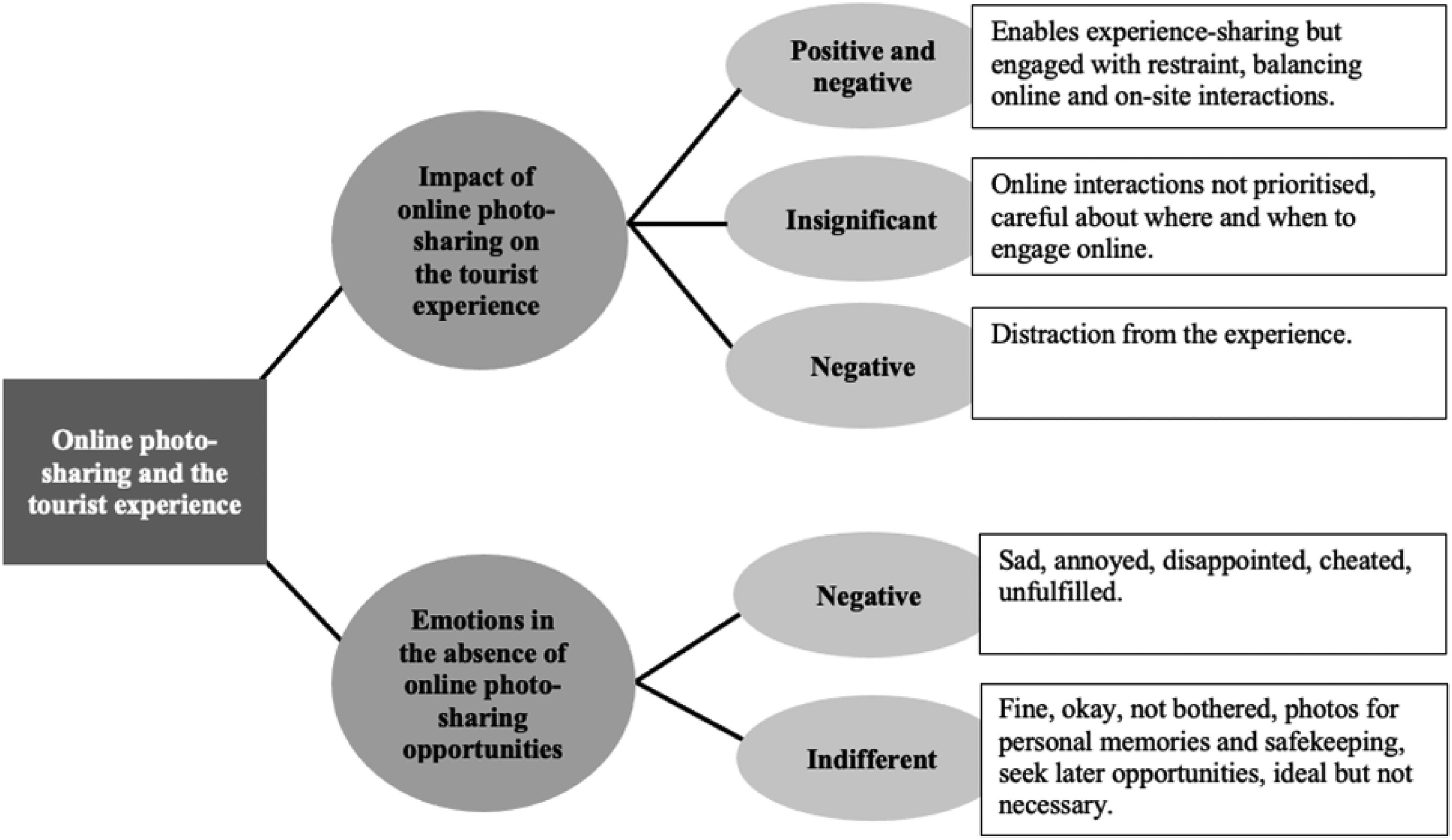
Summary of research findings.
Respondents expressing both positive and negative implications explained how they leveraged mobile connectivity to share travel experiences with people back home. They would, however, consciously limit mobile utility upon realising its impact on their travel experience as it may hinder quality time and conversations from occurring in ‘the real world’. Respondents also appeared to be cautious when in the presence of others. Respondents stated: Sometimes it's just that I feel like I spend too much time rather on my phone than on experiencing the world around. When I realise that, I usually just put the phone away and just get back to the real world. (R17)
For example, New York, my friend, she loves to take pictures of food. She was taking pictures of the food and stuff. I had my phone put away because I was wanting to focus on us in the moment. I try to find a good balance of like, “Okay, it’s time to take pictures. I’ll post one or two”, but then I try to keep the phone away because I feel like a lot of people tend to live through social media … And that’s one thing I try to not do. (R15)
Such consciousness resonates with the ‘balancing act’ termed by Stylianou-Lambert (2017) as respondents attempt to strike a balance between online photo-sharing and being in the moment with travel companions. Words such as ‘divide my time’ and ‘find a good balance’ hinted respondents’ careful prioritisation and organisation of time to allow for the experience to be lived and at the same time, captured and shared online.
Furthermore, respondents portrayed the virtual world as the ‘outside world’, bringing with it aspects of the mundane life they wish to disconnect from. One respondent explained: I also have an experience that I've been on the course of meditation in India where for 10 days I couldn't use phone, any connection with the outside world, and it was actually a wonderful experience to be just with myself, even though there were people around. That was also very nice. So, as I was saying, I did have feelings sometimes that this device is taking really too much of time that you might spend in much more effective way experiencing the world. (R17)
The label ‘outside world’ insinuates that the convergence of physical and virtual spaces discussed by past authors (Misra et al., 2016; Tan, 2017) occurs with boundaries. Assimilation of the virtual world into physical spaces is regulated by what tourists perceive to contribute or detract from their experience. This is determined by the value sought by the individual, and as portrayed through respondents’ careful engagement in online interactions, is influenced by space, time and social contexts – where they are, activities they are participating in, when, and with whom.
A smaller number of respondents claimed their experience was not impacted by mobile connectivity and online photo-sharing, as seen in Figure 1. The implications were insignificant as greater importance was placed on being present at the destination, with travel companions, locals, and people met on-site. Respondents did not actively engage in online interactions and were careful about when and where they establish mobile connection. One respondent stated: No, especially when I am with locals and with other people, I'll pull it out and say, “Hey guys, let's take a picture of us and to remember that we all had dinner together”. But then, I won't check Facebook, I won't check social media or anything when I'm interacting with people in real life. It's one of my pet peeves when people do that when they're talking to me or dining with me or whatever. So, I go out of my way to make sure I don't do it to them. (R11)
An equal number of respondents recognised the negative impact of mobile connectivity and online photo-sharing on their travel experience. As seen in Figure 1, respondents described online engagement as distractions from what was happening around them, causing their senses to become somewhat disengaged. This was particularly in relation to sight and sound. One respondent mentioned: Whether it’s somebody trying to talk to me in a different language and I don’t hear them because I’m staring at my phone and I’m not looking around. I know that has had to have happened. (R6)
Another respondent inferred the unfitting presence of the mobile phone in a holiday setting, labelling the device as “this thing” that should be taken away from the tourist experience. The respondent stated: I keep telling myself “Come on, just put this thing away!” (R1)
Such findings resonate with the ‘inattentional blindness’ discussed by Simons (2000) and the distracted gaze presented by Ayeh (2018). The distracted gaze highlights the adverse impacts of mobile technology on experience quality, including the sights and sounds encountered, social interactions, tourist wellbeing, and the experience of others (Ayeh, 2018). However, it should be noted that such distractions were addressed only by a small fraction of respondents.
Absence of online photo-sharing opportunities
Apart from exploring the impact of mobile connectivity and online photo-sharing on the tourist experience, it is equally important to understand how the absence of photo-sharing opportunities would affect tourists during their trip. As emotions form the core building blocks of experiences (Bastiaansen et al., 2019), respondents were asked to describe their feelings if they did not have the opportunity to share photos of their holiday while travelling. As seen in Figure 1, two broad themes were derived, namely negative emotions and insignificant.
A large number of respondents mentioned they would feel negatively affected, although to varying extents. Sad, upset and annoyed were some of the common words used to describe their feelings. Such feelings stemmed from lost opportunities to utilise photos for their anticipated use. For example, not being able to share the pleasures and novelty of travelling, attain social recognition, and maintain or enhance relationships. Respondents mentioned: I think that if you can't show what you're experiencing right now and where you are, if you can't show it to your friends and relatives and say, "Hey, I'm in the Maldives, can you see it?", I think that would affect me in the sense that I wouldn't be able to show it to my friends every day where I am. (R1)
I usually travel solo, and it’s part of my way of travelling actually that I share what I'm experiencing, and that also made a few connections with some of my friends much stronger because of how I'm posting and what I'm posting. And when I left Poland, actually, because of my travels and because of my experiences, some of my connections back home weakens, and some of them got much stronger. So, it would be kind of a loss for me because I wouldn't have been able to keep it the way I'm keeping it right now because I'm getting really great positive feedback of what I'm posting. (R17)
Several respondents highlighted the joy that comes with sharing, while others enjoy receiving reactions about their holidays online. Such joy, when taken away from their travel, results in feelings of sadness and loss. Respondents explained: I mean I like to share things, so that would be kind of sad … even when I was a kid before social media was a thing, I would make scrapbooks. I would take those scrapbooks, I'd show my family the picture of me and my friends in my scrapbook. Then I'd take those scrapbooks and I'd share them with my friends. Or if I'd have people come over, I'd pull out my scrapbooks and be like, “Hey, look at all these fun pictures of me playing” (R16)
It’s probably because people are interacting with you while you're posting the pictures. You get likes, you get comments, you get people asking, “Oh my God, how did you reach there?”, or, “How much did you pay to go there?”, and stuff like that. It's really all of those interactions with people really curious about how did you get there, the part that I would be missing if I didn't have any pictures showing up on my social media. (R1)
The sadness is amplified when respondents seek to share experiences that are novel or out of the ordinary. This can be tied to ‘peak experiences’ afforded at the destination which Quan and Wang (2004) termed as ways of experiencing something different from tourists' daily lives: I think the only time that I will be sad is you know, if it’s something as I said when I was looking really good in that costume I had and you know, I’m not going to walk around in that rave costume at work or at a regular day in my life. (R15)
The inability to share was also linked to a reduced sense of completion, with respondents describing feelings of being cheated or robbed of their enjoyment. Such feelings imply that present-day tourists view online photo-sharing as a right or entitlement that comes with travel. The willingness to return to the attraction to seize a second opportunity for taking and sharing photos was also indicated: Probably a bit cheated because I like going on vacation, right? And I enjoy it. It's like my me time. I get to explore new countries and stuff, but one of the things I like about, this is so sad, is posting about it on Facebook … I'd feel a bit robbed of my enjoyment of taking this photo, of the like, "Look at my photo." (R9)
I don’t have an opportunity to share with my friends or with my followers. So, I really feel bad. And even sometimes what I do, if possible, so I’ll go again there, click the pictures and come back. (R5)
Past researchers have discussed the gratification and positive emotions derived from responses received when sharing experiences online (Kim et al., 2013; Tan, 2017). Findings of this study offer an added layer of understanding to this knowledge. Apart from eliminating the enjoyment attained from online responses, the absence of photo-sharing was found to generate negative emotions that impact experiences at a deeper and more affective level. Respondents view the absence of online photo-sharing as a ‘missing piece’ of their overall travel experience.
This also echoes the concept of the selfie gaze, which Magasic (2016) claims to grant tourists with the three values of surveillance, (micro) celebrity, and an omnivorous voice. Surveillance implies that tourists take into consideration the personal, professional and social implications of their online posts, although findings of this study revealed only considerations of personal and social implications. This may be attributed to respondents’ travel purpose, which was predominantly leisure and recreation. Magasic (2016) defined micro-celebrity practices as the act of sharing content that contributes to one’s social esteem. This creates an opportunity for what Marwick and Boyd (2011) called the ‘quantifiable metric for social success’, measured through the number likes, reactions, and shares gained online. The third value insinuates that through an omnivorous voice, online postings are made to appeal to the mass audience rather than personal memory. Consequently, travel content shared by tourists is extrinsically motivated rather than intrinsically motivated. This is in line with the views expressed by respondents.
Other than expressing negative emotions that impact the on-site experience, respondents also discussed the adverse effects on their post-trip experience, particularly in the recollection stage. Not being able to share holiday photos was linked to reduced memorability as respondents associate photos shared online with providing some form of permanence to their experience. Respondents stated: I feel like if I couldn't share it, that it's not … I don't know, it's not a memory, I guess. (R14)
I think it would be like an incomplete holiday because for myself I wouldn't have any memories and my social media there wouldn't be any posts about this specific holiday compared to any other holiday that I've had and it's as if I didn't go on holiday (R1)
Impact on the recollection stage was also tied to the lack of visual evidence that would facilitate experience-sharing and storytelling upon returning home from their trip. Respondents explained: I did enjoy the place, but when I came back, I had only stories to share, but not real pictures to show … It will make a difference. I might be a little upset. (R10)
If I want to tell someone, "You really need to go to this place," and I don't have the proof, it will be annoying. (R4)
The centrality of memorability in the tourist experience has been widely discussed in past research (Bastiaansen et al., 2019; Servidio and Ruffolo, 2016; Tung and Ritchie, 2011) as the on-site tourist experience is momentary and provides only transitory feelings while “experiences stored in human memory provide reminiscence, which individuals can repeatedly reflect on” (Kim, 2009: 8). Findings of this study reinforce such notion and offer further insights into the role of online photo-sharing in facilitating memorable tourism experiences. The series of positive and negative emotions occurring during the on-site experience determines memorability (Bastiaansen et al., 2019) and sharing holiday photos online was found to generate positive emotions when participated in and negative emotions when absent. Interestingly, for some respondents, memory of a trip is equated to, or defined by, photos that are broadcasted on their social media profile. This gives a new facet to the meaning of memorability in tourism experiences.
In contrast to the negative emotions, a handful of respondents expressed feelings of indifference in the absence of online photo-sharing opportunities. As shown in Figure 1, ‘okay’, ‘fine’, ‘not a big deal’ and ‘I wouldn’t mind’ were some of the common words used to describe such feelings. For these respondents, photos were captured for personal safekeeping and memories. Travelling was viewed as an experience for themselves and not for the viewing of others. An extension of the experience to those online were not considered to be crucial. Respondents stated: I couldn't care any less. It would not faze me in the absolute slightest because I'm taking those pictures for me. I'm not taking those pictures for other people. (R13)
It’s okay for me. Yeah. It's better to share them, but if I can't, it's okay. It's not the worst thing that's going on. At least I have my memory. (R4)
Although several respondents acknowledged the enjoyment obtained from sharing holiday photos, this was not deemed necessary and hence would not dampen their travel experience.
Conclusion and implications
This study aimed to revisit definitions of the tourist experience which predominantly focused on engagement with destination elements in the physical space. It explored the present-day on-site tourist experience with attention paid to the online photo-sharing endeavours of tourists. The conventional concept of the tourist gaze was challenged to reveal theoretical and managerial developments in the realms of connected tourism experiences. Findings which support the selfie gaze and distracted gaze were uncovered, providing further empirical evidence to these modern-day concepts. For most tourists, travel was valued for both the on-site experience and images produced and shared, which many perceived to be key constituents of their holiday. Although most respondents acknowledged the role of online photo-sharing in affecting their experience, its absence would lead to consequences that are more detrimental as negative emotions resulting from the inability to share would detract from the tourist experience.
To limit distractions from mobile devices and inhibit intrusions of the virtual world, most respondents practiced the balancing act as an instinctive nature. Tourists sought to strike a balance between three priorities that are deemed important to the tourist journey: living, documenting and sharing their experiences. An earlier study conducted by Ayeh (2018) revealed that although tourists are aware of the distractions caused by mobile phones, such awareness does not necessarily translate into the careful utility of devices. In this study, however, a change in tourists’ behaviour is noted. Tourists exercised conscious and careful utility of mobile devices by rationalising the place and time they would partake in online photo-sharing and ensuing interactions.
The study also confirms Sigala’s (2016) concept of omnipresence and the role of social media engagement in co-creating tourism experiences. The presence of others in the virtual world allows tourists to visually share, interact and discuss their holidays with those who are physically absent. The intention to include, and to a certain extent, appease others was showcased, demonstrating the pursuit of travel directed by the combined interest of the tourist and the online audience. Additionally, the online audience functions as co-creators of experiences through positive reinforcement expressed in the forms of likes, comments and questions.
Theoretical implications
Findings of this study reveal that the present-day tourist experience should not be defined merely by the interactions between the tourist and elements of the destination. Socially-driven concepts such as the selfie-gaze and omnipresence of others online were manifested, bringing new meanings and dimensions to the conceptualisation of the tourist experience. A shift from the conventional definitions is noted, particularly for tourists who place great importance on online photo-sharing while travelling. For these tourists, value is drawn from both physical and virtual spaces through their on-site and online engagement, respectively. Fulfillment of travel motivations was also found to occur in dual realms: through physical encounters at the destination which tourists anticipate sharing online during their trip.
While online interactions such as photo-sharing were initially theorised to bring about distractions to the on-site experience (e.g. Ayeh, 2018; Neuhofer, 2016), findings of this study offer a different perspective. The negative notion previously ascribed to such distractions were found to offer benefits that cannot be derived solely from the destination, and hence shines a more positive light on tourists’ online interactions while travelling. Although digital disconnection would create technology-free experiences that are, by definition, distinctive to the mundane life, lost opportunities for online photo-sharing and the subsequent implications should not be ignored. This calls for a need to recognise and incorporate the virtual world as a key component in conceptualising the present-day tourist experience. The study’s theoretical contribution to this gap in knowledge is presented in Figure 2.
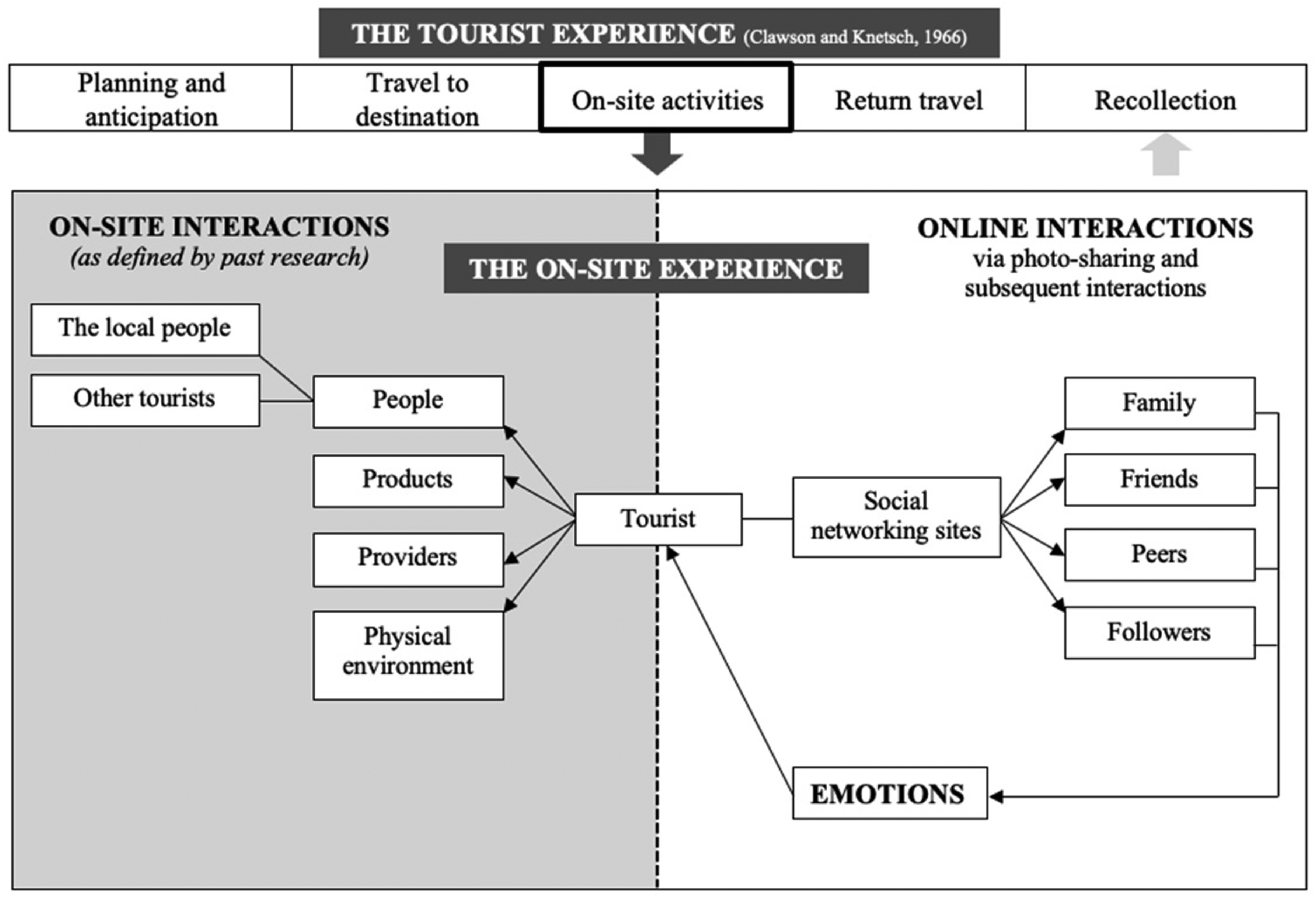
The dual realm tourist experience framework.
Past definitions of the on-site tourist experience have focused primarily on the interactions between the tourist and the environment, products, providers, and people at the destination (Larsen, 2007; Mossberg, 2007; Nickerson, 2006; O’Sullivan and Spangler, 1998), as displayed in the shaded section of Figure 2. However, in a world where it is “no longer normal to be disconnected” (Dickinson et al., 2016: 194), such definitions need to be revisited. The present study expands past definitions to integrate online photo-sharing and interactions facilitated by the increasing functionality of social networking sites (SNS), advancement in mobile connectivity (i.e. 5G network) and the development of SMART cities across major destination countries. The added section recognises online photo-sharing and interactions as practices that are assimilated and embodied within the tourist experience.
The framework represents the overall space a tourist occupies at a given time, with the dotted line signifying the fluidity of the two realms. As the convergence of physical and virtual spaces do not occur in equal fractions, the line shifts according to the selective engagement of the tourist This is regulated by the subjective value pursued by the individual, alongside the space, time and social contexts discussed in the findings. Tourists adjust between the two states of connectivity rather than being entirely connected or disconnected (Tanti and Buhalis, 2016). Hence, value drawn from both realms are complementary as tourists move between spaces to engage in on-site interactions which are then captured and shared through interactions in the online space. This contributes to the overall on-site experience through optimisation of experience outcomes.
Emotions elicited from online photo-sharing were also found to be imperative to the on-site experience. Positive emotions such as joy, which Hosany and Gilbert (2010) state to be a key component of tourists’ emotional experiences, are drawn from engagement in online photo-sharing and the interactions that follow. While past research has conceptualised emotions as a bridge between the tourist and the environment (Pestana et al., 2020), this study identifies online photo-sharing as the vehicle that connects the two: it drives positive emotions when participated in and negative emotions when absent. Previous studies have also linked emotions to the memorability of experiences (Bastiaansen et al., 2019; Tung and Ritchie, 2011) and this research unveils the role of online photo-sharing as a driver of emotions and subsequently, memorability. Furthermore, implications on post-trip recollection and storytelling were revealed, demonstrating a greater extent of its affects. Apart from extending previous definitions of the tourist experience, the non-shaded section of the framework exhibits the interplay between online photo-sharing, emotions, the on-site experience, and to a further extent, the post-travel experience.
This study offers further theoretical contribution by revisiting terms previously defined in the context of non-connected tourism experiences. While travel is conventionally driven by the need to ‘go away from’ (Krippendorf, 1987), this study found the notion of ‘going away’ to be largely represented by respondents’ physical absence but not mental, social and emotional detachment. For many, Kirillova and Wang’s (2016) view is proven to be true, that is, the value of vacationing is no longer a direct outcome of one’s disassociation from the home environment. When viewed in the context of present-day tourism, definitions of conventional tourist motivations require re-evaluation. Crompton’s (1979) definition of escapism reflects a temporary change in one’s physical environment, but not social environment. Enhancement of kinship relationship occurs in a space where virtual connection with those who are physically absent is maintained, while resting and relaxing is pursued in a setting of digital connection. By reviewing these definitions, tourism scholars are able to apply a more contemporary understanding and interpretation of terms in current and future tourism research.
Managerial implications
Findings of this study offer insights that will allow industry practitioners to design experiences sought by present-day tourists. As the conventional tourist gaze shifts towards those mediated by online social interactions, tourism experiences should be designed taking into consideration all on-site and online elements presented in Figure 2.
Respondents’ conscious effort to share holiday photos during their downtime highlights the need to provide free high-speed Wi-Fi services at locations such as restaurants, rest areas, public transports and transportation hubs. This would facilitate the balancing act discussed by tourists as it limits perceived distractions and optimises value attained from tourism activities. Opportunities to capture photos and create visual content deemed worthy of sharing should also be presented to tourists. This can be incorporated as part of the servicescape where spaces are aesthetically and purposefully designed to function as photo-taking backdrops or stages. Furthermore, tour operators, tourist attractions, theme parks, resorts and other tourism providers should consider employing a photographer whose role comes in twofold: to capture photos of tourists participating in activities, and to limit hassle or distractions that may hinder photo-taking. Photos can be taken using professional cameras or the devices of tourists, charged at a reasonable fee or offered for free as a value-add.
A well-managed photo-taking system can also be introduced at prominent tourism sites and destination landmarks. Zones can be established for tourists to queue and have uninterrupted photos of them taken either by a local photographer, tour guide or travel companion. While waiting in line may be time-consuming, findings of this study revealed that tourists are willing to spend time and effort to ensure the quality and appeal of photos shared. Photos were carefully selected, edited and enhanced for the viewing of the intended audience. It is therefore expected that equal, if not greater, importance would be placed on taking photos that are considered worthy of sharing. Additionally, the absence of structured queues can cause friction and frustration among tourists (Pearce, 2019). Unwanted incidents such as tourist brawls can therefore be reduced, and risky photo-taking behaviours resulting in deaths and injuries may be eliminated.
Opportunities to generate positive emotions through online photo-sharing and interactions should be prioritised. Emotions play a crucial role in tourists’ interpretation and evaluation of their experiences, and experience designers should seek to evoke emotions that would positively influence engagement and satisfaction (Walters and Li, 2017). Emotions are also central to creating memorable tourism experiences (Tung and Ritchie, 2011) which in turn affect tourist satisfaction as well as intention to revisit and recommend the destination (Melón et al., 2021). Additionally, memorable tourism experiences increase the tendency and variety of content tourists are willing to share on social media (Tanti and Buhalis, 2016), demonstrating further implications on destination marketing. Any decisions to prohibit photo-taking and mobile connectivity should therefore be pursued with caution as deterrence to online photo-sharing may produce negative emotions that are detrimental to the quality and memorability of experiences.
When shared online, photos turn tourists into co-marketers, allowing tourism providers to leverage the credibility and effectiveness of online word-of-mouth. As Prideaux and Coghlan (2010) stated, digital and web technologies provide travellers with an avenue for word-of-moth recommendations. This is especially relevant in times of crisis as the industry seeks opportunities for recovery and a rebound in travel. With countries negotiating the ease of international travel restrictions, the need to regain travellers’ confidence in the midst of the COVID-19 pandemic becomes pivotal. According to Teeroovengadum et al. (2021), the effectiveness of factors that are expected to reduce perceived travel risks during the COVID-19 pandemic is dependent on the trustworthiness of information received. While the study referred to information published by tourism authorities and organisations, it can be argued that photos shared by tourists offer equal credibility as it reflects the first-hand experience of those who have travelled in the current tourism climate. Moreover, consumer-generated content has been found to generate higher levels of views and engagement compared to marketer-generated content (Lim et al., 2012). Tourists were also found to increasingly use social media as a source of information when selecting tourism destinations, particularly for first time visitors (Pabel and Prideaux, 2016). While data for this study was gathered prior to the COVID-19 pandemic, implications for the current state of the tourism industry can be drawn. Destination marketing organisations (DMOs) as well as tourism providers should therefore assist, encourage and incentivise tourists to share photos of their holiday in hopes of influencing and driving the travel decisions of the online audience.
Limitations and recommendations for future research
Limitations of the study were recognised and considered for future research. The present study focuses on online photo-sharing and the tourist on-site experience. However, the tourist experience has been conceptualised by past researchers as a multi-phase consumption process encompassing events occurring before, during and after the trip (Clawson and Knetsch 1966; Cutler and Carmichael, 2010; Tung and Ritchie, 2011). This prompts further research opportunities to explore the role of online photo-sharing and interactions in shaping all phases of the tourist experience.
Over half of the respondents were females and between the age of 18 and 39. It is therefore recommended for future research to examine the experience of male tourists and those above the age of 40. Past studies have identified distinctions between the photo-sharing behaviours of tourists from different age groups (Prideaux et al., 2018) and gender (Thelwall and Vis, 2017), and emphasised the importance of exploring tourism interests and activities from a gendered perspective (Meng and Uysal, 2008) to avoid gender-blind marketing (Westwood et al., 2000).
Data was collected from respondents who have travelled in the last 12 months, and the potential for respondents’ recall bias is recognised. Recall bias concerns respondents’ increased ability to recall events that occurred more recently and that are more serious (Indrayan, 2008). To limit this, future research can be conducted by interviewing or surveying respondents on-site or upon completion of their trip. Social desirability bias which “drives an individual to answer in a way that makes them look more favourable to the researcher” (|Yüksel, 2017: 377) is also acknowledged given the nature of self-reported data gathered through in-depth interviews.
Through the perspective of 17 interview respondents, this study presents crucial exploratory insights into the evolving concept of the tourist experience. Generalisation of findings to the broader tourist population will require further testing and validation using quantitative methods. Additionally, application of quantitative methods would limit the social desirability bias mentioned above through the anonymity of responses afforded by surveys.
Finally, this study explored the implications of online photo-sharing on the tourist experience as well as emotions resulting from the absence of online photo-sharing opportunities. Marketing implications for destinations was also discussed through the viewership of holiday photos shared. Such outcomes are, however, dependent on the interest and receptivity of the online audience. Hence, future research should investigate the responses drawn from the different types of holiday photos, including the narration and frequency of photos shared. The ways in which the pre-existing relationship between the tourist and the audience influences engagement with photos shared online should also be considered.
Footnotes
Declaration of conflicting interests
The author(s) declared no potential conflicts of interest with respect to the research, authorship, and/or publication of this article.
Funding
The author(s) received no financial support for the research, authorship, and/or publication of this article.
