



Abstract
This article examines the potential for more inclusive and transformative knowledge production within international development cooperation by focusing on the decolonisation of evaluation practices. It argues that integrating alternative, situated knowledges in the evaluation systems – particularly those rooted in indigenous traditions – can contribute to more sustainable pathways towards social transformation. Tensions and possibilities of decolonising international development evaluation are investigated through the interaction between Western development evaluation approaches and ‘indigenous’ evidencing methods, focusing on the approaches of African Initiated Churches as a practical case example. As part of a broader study, this article specifically examines how calls for decolonisation have influenced development evaluation practice, drawing on interviews with international development experts. It investigates how ‘indigenous’ methods of evidencing – such as communal evidencing and spiritual forms of decision-making, which are prevalent in the practices of African Initiated Churches – are perceived by international development evaluators, and it explores the prospects for collaborative, equitable knowledge creation in evaluation processes to serve social transformation. The study finds that development evaluators and institutions often adopt a stance of pragmatic ambivalence, recognising the value of alternative approaches yet only partially accommodating them within existing donor-driven structures.
Keywords
Introduction
The current polycrisis – marked by ecological breakdown, widening inequalities, mass migration and rising geopolitical tensions – reveals the limits of Western growth-based development models and challenges both the paradigms of international development cooperation and the evaluation systems that sustain them (Goldman et al., 2024). Because development evaluation is intended to guide how development interventions are designed, judged and adjusted, it can serve as a decisive arena for change.
I argue that the decolonisation of evaluation systems reflects a critical step towards more sustainable development, requiring evaluators to move beyond Western perspectives and engage with alternative approaches including indigenous actors. 1
In one of the pioneering works on decolonising research methodologies, Smith (2012) contends that one way to mitigate the negative effects of colonisation is to decolonise research methodologies. Smith demonstrates that Western academic structures have historically imposed epistemic hierarchies that marginalise indigenous knowledge systems, portraying them as inferior. The legacy of academic imperialism continues to shape knowledge institutions, maintaining structures that exclude indigenous perspectives and aspirations (Smith, 2012). This process – often described as epistemicide, meaning the systematic erasure of non-Western knowledge traditions – arises from unequal power relations between cultures, which from a post- and decolonial perspective (Santos, 2014) represent a continuing legacy of colonisation.
Diverse attempts have angled the discourse on decolonising science in international development evaluation, highlighting the epistemic violence embedded in common evaluation practices (Chilisa, 2012), addressing power imbalances, advocating for greater self-determination of indigenous voices (Bremner, 2019; McKegg, 2019; Wehipeihana, 2019) and proposing what evaluation grounded in indigenous knowledge systems might look like.
Hopson et al. (2012) advocate for dialogic approaches that enable communities to shape methodologies based on their traditions, requiring ‘unlearning traditional definitions of ‘good evaluation’’ (p.79). Chilisa and Mertens (2021) emphasise African Ubuntu epistemology, which comprises prioritising relationality and including spirituality in evaluation practice. Kawakami et al. (2007) propose stakeholder-driven evaluation rooted in storytelling and indigenous accountability.
This article examines how development evaluators perceive indigenous evaluation practices and the feasibility of integrating them into international development cooperation. It builds on a case study of evidencing practices in African Initiated Churches (AICs) conducted between 2022 and 2024, which revealed alternative forms of development and evaluation rooted in communal, spiritual and human-centred approaches. The study on AICs found that evidencing practices of these grassroots development actors prioritise personal testimonies and communal witnessing, incorporate spiritual revelations as legitimate knowledge, and rely on collective dialogue and shared interpretation rooted in Ubuntu philosophy, rather than individualised or purely quantitative analysis.
The evidencing methods used by the selected AICs exhibit many parallels to principles developed in the Made in Africa Evaluation (MAE) frameworks and other indigenous research methods. The evolving academic discourse on indigenous research methods affirms that numerous communities validate spiritual inspiration and communal, relational and human-centred forms of evidence (Chilisa and Mertens, 2021; Kawakami et al. 2007; Smith, 2012; Wilson, 2008; van der Puije 2025). Indigenous knowledge is ‘subjective, objective, relational and include spirituality and vision’ (Chilisa and Mertens, 2021: 246). These striking similarities of indigenous evidencing methods from different continents should encourage re-examining established knowledge systems in international development cooperation, promoting dialogue about indigenous techniques, and fostering a reassessment process within dominant scientific theory discourses (van der Puije, 2025).
In the article, I will present my findings from interviews with development practitioners with whom I discussed the alternative knowledge systems. By engaging these concrete ‘development evaluation’ practices of AICs in discussions with development evaluation practitioners, I aimed to explore the applicability of decolonised methods based on a concrete example. Through interviews with international development evaluation experts, I examine the extent to which the discourse on decolonising development evaluation has been incorporated into international practice. I then assess whether equity-based approaches that draw on situated knowledge systems – such as those of AICs – can be implemented under current structural and ideological conditions.
As an academic with German-Ghanaian roots and professional experience in evaluation, I argue for a transdisciplinary approach that bridges practice and academic discourse on coloniality. While calls for decolonisation in development are long-standing, their practical application remains limited (Kelly and Htwe, 2024). Engaging with international development evaluation practitioners and experts from AICs reflects an attempt to facilitate a better understanding of the potentials and challenges of equity-based knowledge production and enable mutual learning about pluralistic approaches to implementing social transformation.
Methodology
This study adopts a qualitative approach to explore how development evaluators perceive the discourse on decolonising development evaluation and the alternative evaluation practices of indigenous actors.
By integrating real-world examples and practitioner insights, it explores the viability of equity-based knowledge production and decolonisation within international development evaluation frameworks.
The paper draws on eleven interviews with development evaluation practitioners conducted in 2023 and 2024 to gain practical insights into evaluation frameworks, decision-making processes and institutional constraints in international development practice. The evaluation professionals offer practical expertise beyond publicly available sources and possess in-depth knowledge of the specific challenges involved in operationalising decolonising evaluation approaches. Accordingly, their expertise helps bridge the gap between theory and practice.
The sample involved a diverse range of experts, including evaluators from faith-based organisations (FBOs), multilateral intergovernmental organisations (IGOs), state-owned institutions and independent consultants. The sample was designed to offer a comprehensive and balanced view of development actors. It served to mitigate bias by representing a broad spectrum of the sector, ensuring that insights are not overly influenced by a single institutional or ideological standpoint. At the same time, it acknowledges how organisational frameworks, ideological orientations and institutional mandates might shape perspectives and approaches to the subject matter. Table 1 provides an overview of the institutions and the number of experts interviewed within them.
Organisations and numbers of expert interviewees.
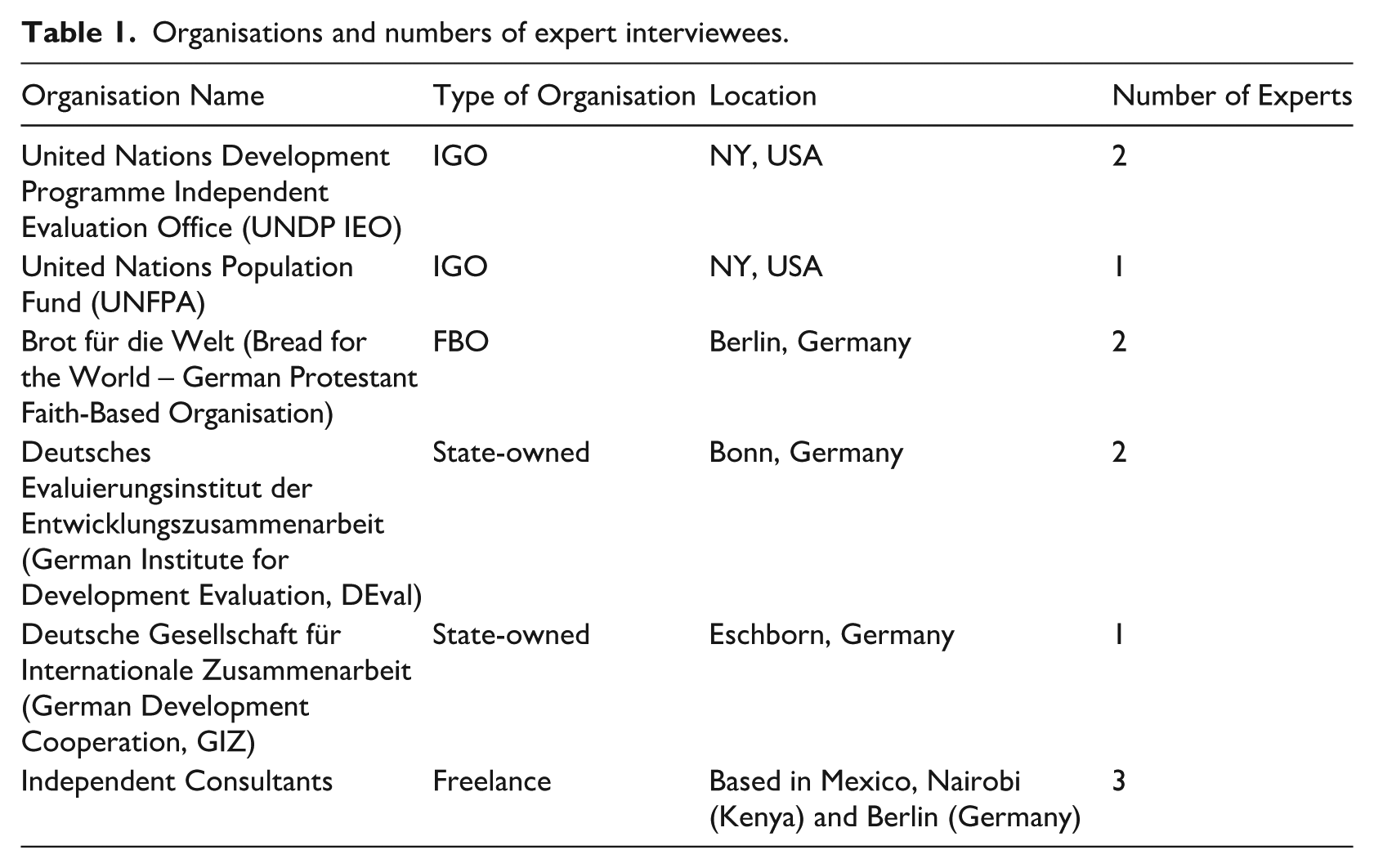
The sample involves a relatively balanced gender distribution, with five female and six male participants. The experts interviewed in the study held various positions, including one senior evaluation specialist, one evaluation specialist, four evaluation officers, one evaluator, one head of the evaluation department and three independent evaluation consultants. National backgrounds included seven participants from Germany, and one each from Spain, Kenya, Mexico and Colombia.
As with any qualitative study, this research has certain limitations that need to be acknowledged. The small purposive sample necessarily limits the breadth of perspectives represented. Participant access was shaped by my institutional positioning in Germany, resulting in a bias towards German evaluation professionals. The sample reflects the accessibility of evaluators through personal meetings in Germany and established connections with major donor agencies. A field trip to New York enabled additional engagement with evaluators from other countries, working with the United Nations. Independent consultants were deliberately selected from three continents – Europe, South America and Africa – although the absence of Asia and the limited representation of Africa remain important limitations. Nevertheless, the sample provides a heterogeneous spectrum of insights.
Drawing on indigenous and decolonial research methodologies that emphasise relationality (Chilisa, 2012; Wilson, 2008), I adopted a reflexive stance in the interviews, acknowledging that knowledge is co-constructed and the researcher’s positionality influences the research process. This translated into making my own knowledge, convictions, perceptions and interpretations as a researcher and evaluator transparent throughout the interview process and bringing these into dialogue with the interviewees. I chose unstructured interviews to foster an egalitarian relationship between the interviewer and the interviewee, valuing the interviewees’ unique accounts and fostering a co-creation process. It also helped to gain insider perspectives and uncover customary practices and values in a relatively unexplored field.
Incorporating the case study of AICs into the dialogue, the interviews examined whether the discourse on decolonising development evaluation has permeated international development practice while also assessing the prospects of decolonisation efforts. The interviews aimed to explore both personal and institutional perspectives on indigenous evidencing methods and the feasibility of integrating these methodologies into mainstream development evaluation practices.
While data collection aimed to adhere to several principles of indigenous methods, the analysis had to follow ‘conventional’ approaches to align with the academic standards of a PhD in a ‘Western’ university context. I adopted a social science established approach to analyse the interviews based on Corbin and Strauss (2008) where knowledge generation prioritises structured analytical processes over relationality to ensure validity.
After open coding to break down the data into discrete parts, identifying key concepts and categories, axial coding was conducted by reassembling the data, establishing connections between categories, and refining them through linking to subcategories and exploring their relationships in terms of causal conditions, context, intervening conditions, action/interaction strategies and consequences. The structure of this article follows the axial coding categories, which gives the article a structured analytical basis to present the complex social phenomena.
Subsequently, selective coding was employed to identify the core category and systematically relate all other categories to it, forming an overarching theoretical framework. Development practitioners were invited to review and comment on the draft, which helped reduce potential bias, strengthen informed consent and foster a more collaborative knowledge co-creation process.
Findings
The results are introduced by outlining the overarching theory of pragmatic ambivalence identified in the interviews. In the subsequent sections, I then analyse the factors shaping this ambivalence. I first describe the causal conditions, providing a snapshot of the perceived and enacted discourse on decolonisation in the field of international development evaluation. I then examine the context conditions, referring to the broader socio-historical and epistemic backdrops – such as macro mindsets, anchoring values, and Euro-Western worldviews – that shape pragmatic ambivalence in development evaluation. Finally, I analyse the intervening conditions, namely institutional structures such as donor agencies and bureaucratic frameworks, which are directly connected to the formation and negotiation of pragmatic ambivalence.
Pragmatic ambivalence: Approaching decolonisation without confrontation
Grounded in the data, pragmatic ambivalence emerged as a core category that encapsulates how practitioners navigate the complexities of integrating decolonial approaches without confrontation with established norms. This ambivalence arises from contradictory personal and professional opinions towards alternative knowledge systems, as well as institutional tensions between decolonial commitments and organisational limitations in integrating these systems.
The category shows parallels with existing conceptual studies on ambiguity in organisational studies, a long-standing debate in the field (Cappellaro et al., 2023). Ambiguity can serve multiple functions within organisations. Eisenberg (1984) identifies key strategic uses of ambiguity:
fostering ‘unified diversity’ by allowing multiple interpretations to coexist;
facilitating organisational change without direct confrontation; and
preserving privileged positions by maintaining flexibility in meaning.
Similarly, pragmatic ambivalence, which has been identified in development evaluation, operates as both a means to adapt alternative knowledge systems and a potential mechanism for sustaining existing power structures.
While strategic ambiguity primarily refers to deliberate vagueness in communication to maintain flexibility or avoid conflict, pragmatic ambivalence extends beyond communication to describe a deeper, structural and emotional contradiction. It accounts for the simultaneous push for change towards decolonisation and compliance with Western values and institutional norms.
The following sections will analyse the conditions, influencing factors, action/interaction strategies and outcomes (consequences) that shape pragmatic ambivalence in decolonising development evaluation.
Causal conditions: Decolonial islands – A snapshot of perceived and enacted discourse on decolonisation in the field of international development evaluation
In the study, the topic of decolonisation of international development evaluation was initiated with international development evaluation practitioners. All interviewed participants could relate to the discourse on decolonising development evaluation to some extent, or expressed that they had an understanding of its meaning and had tried to implement related measures.
In this context, the term ‘decolonial islands’ emerged as a category to describe the fragmented, localised, and often isolated initiatives within the broader structural constraints of the development evaluation sector. These ‘islands’ represent spaces, whether individual efforts, organisational initiatives or community-driven actions, where decolonial approaches are experimented with, discussed and occasionally implemented.
In the following, I introduce the decolonial islands as described by the participants (qualitative/participatory research methods and culturally sensitive evaluation), before examining the underlying factors and events that led to their emergence (Global South resistance and northern engagement). Finally, I explore perceptions of their implementation, particularly the marginalisation of spiritual knowledge.
Qualitative and participatory research methods and culturally sensitive evaluation in development practices
Several interviewees considered established practices in international development evaluation – particularly qualitative and participatory methods, as well as culturally responsive approaches – as aligning with decolonial efforts. An FBO evaluation officer emphasised the openness of qualitative methods, which would create space for genuine expression and enable participants to ‘speak freely’ (evaluation officer – FBO) without rigid frameworks. This openness was described as powerful in fostering decolonised knowledge by capturing diverse perspectives.
An IGO specialist highlighted parallels between indigenous practices, such as witnessing, testimonies, and community discussions within AICs, and mainstream tools including focus groups and interviews: ‘But like witnessing what it is not different from what we do when we do field visits. . . . Testimonies. It is no different from what we do when you can do interviews’ (evaluation specialist – IGO). Such comparisons demonstrate how evaluators sometimes frame alternative practices as compatible with existing methodologies.
Rather than directly challenging the differences to established methodologies, compatibilities are shown to enable a gradual shift in evaluation practices while maintaining institutional credibility, facilitating organisational change without tension.
Nonetheless, power asymmetries remain, particularly in data interpretation. As one FBO officer cautioned, ‘The question is: how do you interpret the data? This might also lead to a Western-centric interpretation again’ (evaluation officer – FBO).
To address such challenges, one evaluator highlighted human rights-based evaluation frameworks as tools for a deeper critique of power. The evaluator stressed that the approaches prioritise meaningful participation and actively confront structural inequalities: In human rights-based evaluation, human rights principles like meaningful participation aim to be implemented, which, if taken seriously, inherently include a very far-reaching, power-critical perspective. . . Meaningful participation does not merely mean taking part or providing data; it entails having the power to genuinely influence decision-making and determine the course of action. (Evaluator – state-owned organisation)
This statement underscores the distinction between tokenistic inclusion and genuine power-sharing. In many conventional evaluation practices, participation is framed as the involvement of stakeholders in predefined processes, where their input is collected but does not necessarily translate into influence over decisions. (Chouinard and Hopson, 2016: 258-60). However, according to the quote, there are theoretical frameworks in place that tackle these shortcomings.
Alongside participation, cultural sensitivity was also frequently highlighted, with an IGO senior evaluator noting, ‘I believe it is already quite mainstream to take culture and context seriously’. Reflecting this shift, the UNEG Working Group on Evaluation Methods has incorporated culturally responsive evaluation (CRE) into its compendium, stressing the role of demographic, socio-political, and cultural contexts, and valuing ‘lived experiences’ through storytelling and relational interviewing (United Nations Evaluation Group (UNEG), 2020). Here, power is indirectly addressed through the co-creation of meaning between evaluators and participants.
Finally, Bagele Chilisa’s MAE framework was cited as pivotal in embedding indigenous perspectives in evaluation (Chilisa and Mertens, 2021). Her membership in a UN evaluation advisory board was seen as signalling growing recognition of decolonial methodologies.
These insights demonstrate the existence of frameworks aimed at redistributing power and recognising local knowledge systems. Nevertheless, their practical implementation remains a significant challenge, as will be discussed in the following sections. This can be attributed to the fact that decolonisation is not embedded within the foundational structures and institutional settings of the development sector but is instead driven by actors from the Global South, individual initiatives and external pressures.
Catalysts for decolonisation: Global South resistance and northern engagement
The interviews showed that pressure from the Global South and individuals engaged in the Global North have been instrumental in driving decolonising efforts. In the dialogue with evaluators, it was observable that growing Global South pressure has pushed some organisations to re-evaluate their approaches. This scrutiny has led to structured internal discussions and working groups focused on decolonisation.
Conferences such as the Global Evaluation Forum provide spaces where actors such as the African Development Bank openly criticise Western-dominated evaluation practices – which they perceive as outdated – and advocate instead for approaches that better reflect local perspectives and needs.
One evaluator reported from the event: So, they will clearly say to your face: So, is this somehow your white, Western, male ideas?” Is this a perspective that I now want to hear more about? Folks, it’s time for something else now. (Evaluator – state-owned organisation)
Another evaluator quoted a partner cynically, saying, ‘Oh yeah, they had to fly in from Europe because they couldn’t find this expertise in Africa’ (evaluator – state-owned organisation). The statements reflect the frustration and critical awareness expressed by African partners regarding the problematic assumption that knowledge and expertise are lacking in Africa, as well as the persistent (neo-colonial) mindsets that assume expertise resides in the Global North. Such critique has pushed development organisations to re-evaluate their approaches. For example, one evaluator from a state-owned organisation noted, ‘We now have an official cross-company working group on post-colonialism. . . partly because the public is closely scrutinising these issues’.
Two evaluators further stated that the COVID-19 pandemic also accelerated this shift. Remote evaluations disrupted traditional power dynamics, giving local partners more control, as one evaluator of a state-owned organisation explained. This opened discussions on sustaining partner-led evaluations beyond the pandemic.
Not all changes were purely values-driven. One evaluator from a state-owned organisation admitted that decolonial engagement was also driven by competition with other donors, based on questioning: ‘Where do we have a comparative advantage?’ This demonstrates that decolonial engagement is not solely driven by ethical commitments but also by strategic considerations. The evaluator’s statement reflects a pragmatic ambivalence, where shifts towards decolonial approaches are influenced not only by values but also by the need to maintain a competitive edge, reflecting a gradual and calculated reorientation that does not challenge the current system.
Beyond Global South pressure, individual evaluators actively contribute to decolonising efforts. One participant described turning to indigenous methods and cultural sensitivity after realising the limits of Western approaches in local contexts. Another noted that more colleagues are now trained in power-critical frameworks such as feminist and decolonial theory. A third – trained in constructivist approaches – recalled her shock at the dominance of positivism in the sector and explained how she now seeks to challenge it within institutional constraints.
These examples demonstrate that although alternative frameworks exist, entrenched norms hinder their integration into mainstream evaluation, often requiring professionals to adopt a stance of pragmatic ambivalence.
Rare implementation of alternative approaches and the exclusion of spiritual knowledge in decolonisation discourse
While it was shown that numerous power-critical theoretical methods are discussed within international development evaluation discourse, the interviews uncovered that these approaches are largely not implemented in actual practice: I think what I see around me is, as I said, a basic agreement that context and culture are important. Yes, especially for global organisations, that’s a no-brainer. But then, yes. How far do you go to really integrate methods that might not be standard? And that depends very, very much on individuals. There are those three people who are interested in such things or who are somehow curious about it, and they come up with something. . . . And the whole rest follows the mainstream, and in the mainstream, such things are not included. (Senior evaluation specialist – IGO)
Efforts to decolonise evaluation often exist as scattered endeavours rather than widespread, institutionalised methods. These ‘islands’ stand in tension with the dominant positivist discourse, which continues to shape the field. As one expert observed, ‘there is already a very, very strong positivist approach, and then there are individuals who are interested in other perspectives’ (senior evaluation specialist – IGO).
Speaking of the rare implementation, a freelance evaluator shared that he did not find decolonised methods implemented in his work experience: ‘I’ve not come across someone who says this is how they decolonised their practice. . . . I’ve come across people expressing the need for it. . . but I’ve not come across that level of nuance’ (independent evaluation consultant). This suggests a significant gap between the theoretical acknowledgement of the importance of decolonisation and its application.
The discussions also revealed that, unlike in the evidencing methods of AICs, spiritual dimensions are largely absent from current decolonisation discourse in international development evaluation practice. None of the evaluators referenced any instance where spiritual elements were incorporated or even discussed in their approaches, despite their centrality in many indigenous and non-Western knowledge systems.
In the interviews, whenever I brought up religious forms of evidence – such as those practised by AICs, including visions or divine communication – this was often met with avoidance. This occurred several times when questions of perceptions of spiritual methods were not answered directly but redirected. When such methods were raised, participants often shifted the discussion towards more generalised acknowledgements of cultural context, without directly engaging with the specific question of integrating spiritual epistemologies. For instance, one evaluator responded by highlighting the increasing acceptance of cultural sensitivity in evaluation and referenced a compendium listing alternative methods. However, their reply notably bypassed the core inquiry about the inclusion of spiritual or religious practices in evaluation frameworks.
It took multiple attempts at inquiring about spiritual aspects before the topic of spiritual epistemics was discussed in concrete terms. This hesitation might indicate a broader discomfort with integrating spiritual data into conventional scientific methodologies. While scepticism towards non-empirical methods was evident, some participants challenged the rigid divide between scientific and non-empirical evidence. One evaluator noted that even in established science, interpretation often relies on personal insights, yet this is rarely made transparent. A freelance evaluator added that other cultures might see supposedly empirical methods differently: ‘I imagine when, community members sit with us, when we are generating, a theory of change, they can also view it like a prophecy, because we are talking the language of visions. We are talking about the language of imagination. We are using a lot of assumptions to derive, even the vision statement of an organisation.’ (independent evaluation consultant).
However, most evaluators showed limited openness towards non-empirical knowledge, especially when linked to spirituality. As one IGO specialist admitted, ‘I do have some level of distrust. . . how rigorous is the result going to be from that type of methodology?’ (evaluation specialist – IGO). The statement exemplifies the dynamics of ambivalence, in which practitioners simultaneously acknowledge the call for decolonisation while remaining entrenched in their own prepositions of rigour. This leads to fundamental ambivalences and tensions in navigating decolonial aspirations.
Practice shows that while isolated power-critical methodologies exist, they often face resistance and remain partially integrated, reflecting the persistent influence of Western cultural worldviews within development evaluation, a theme that will be further explored in the following sections.
Context conditions: ‘We want our values to be their values’ – The persistent hegemony of Western ontologies and epistemologies
Belief in the superiority of Western values
The interviews showed that decolonisation efforts in international development remain widely constrained by the dominance of Western ontologies and epistemologies, including a belief in Western values, confidence in Western scientific and technological superiority, and persisting scepticism towards local knowledge. As one expert openly expressed, ‘We want our values to be their values’ (evaluation specialist – IGO). This statement reflects the widely ingrained belief that Western norms and practices are universally applicable and superior.
The same IGO evaluator emphasised that the Western liberal market economy has achieved significant progress in poverty reduction, life expectancy and education. Despite climate change, Western methods are seen as effective, reinforced by the collapse of alternative systems such as the Soviet Bloc. While progress is slower than desired, the Western approach remains the benchmark for the international development agenda. The statement is exemplary of what other studies have shown (e.g. Escobar, 1995; Sachs, 1993; van der Puije, 2025).
Based on this assumption, development cooperation mostly involves aligning other societies with Western values. One expert highlighted this by honestly stating, ‘Why do we do development assistance? Because we want those societies to look like ours’ (evaluation specialist – IGO). The quote exemplifies the enduring influence of ideology that positions the West as the model for development. From a decolonial perspective, this understanding is a legacy of colonial-era ideologies, where civilising missions evolved into development agendas (Kothari, 2006).
The evaluator’s subsequent remark that ‘boy, I’m going to be in so much trouble’ suggests awareness that these views might be contentious or controversial, potentially with the awareness that superiority narratives and power imbalances are inherited from colonial histories, and that the civilising mission is indirectly expressed through these words. He also reflected that in day-to-day cooperation, it emerges that some societies do not want this ‘imposition’: These are also things I have seen in project reality, so to speak, where feedback comes from projects saying, ‘Leave us alone with this, so to speak’. And then it is shown, ‘No, we are doing value-driven, value-based development cooperation. We, we put this on the agenda, so to speak’. One can now consider whether this is good or bad, I don’t know. (Evaluation specialist – IGO)
The evaluator noted that it is difficult to judge whether the approach of sticking to one’s own situated values is adequate. The common and unresolved conflict of navigating values was also brought into the conversation by another evaluator on the topic of human rights issues: ‘There is a specific tension with this idea of universalism versus cultural relativism, so to speak. I believe there is also a field of tension here’ (evaluator – state-owned organisation).
His statement emphasises the contrast that decolonisation calls for acknowledging and transferring power and decision-making authority to partner countries, valuing their knowledge, situated values and systems, while we have the idea that certain rights and values of human dignity should be implemented for all humans in an equal sense, regardless of their background. It shows that ambivalence is at the core of epistemological and methodological debates in the field of evaluation, leaving practitioners with little alternative but to navigate it pragmatically.
Belief in superiority in delivering justice and taking responsibility
Several statements showed that there is not only a persistent belief in the superiority of Western values, but also an enduring notion that Western donors themselves are better capable and more responsible for delivering these values and bringing morality and justice to the world.
One evaluator expressed discomfort about fully relinquishing control and had concerns about whether local systems consistently uphold human rights principles, or whether such a transfer of power might risk people not being protected in their dignity and fundamental freedoms. Reflecting on what a rigorous implementation of decolonial evaluation practice would mean, the evaluator stated, It would imply a very extensive acceptance that the values, knowledge, and resources existing in the partner country should, so to speak, ultimately lead to the transfer of ‘power’ (in quotation marks) to them. However, at the same time, I do not always have such a great feeling about this from a human-rights-based perspective. (Evaluator – state-owned organisation)
In a statement, another evaluator mirrored the persistent belief of neutral and superior implementation of justice among Western evaluators when discussing community-led storytelling as a method: The storyteller in a village often comes from a specific family dynasty and holds authority. This might mean that disadvantaged groups – such as women or the sick – are excluded, along with their feelings and views, which we actually want to change. (Evaluator – state-owned organisation)
Concerns expressed by the evaluator about group dynamics in participatory settings show a reluctance to give up interpretative authority as an external evaluator. The quote suggests a commitment to bringing justice to the marginalised and the notion that external evaluators are more inclusive. While storytelling is promoted as a decolonial practice, it is also ambivalently met with suspicion. It mirrors the tensions that remain unresolved in the field, with conflicting demands. Ultimately, the contradictions are not thoroughly scrutinised, whereas the decision-making power over whether local methods should be used remains with the donors.
Belief in the superiority of Western scientific advancements
Debates on decolonising evaluation reveal ambivalence in balancing openness to alternative knowledge systems with adherence to established scientific standards. One evaluator emphasised the need for ‘more mutual enrichment between the two perspectives’, yet warned against elevating methods ‘which have little to do with objective data collection’ merely because they are local (evaluator – state-owned organisation).
Another evaluator described the potential problems of other knowledge systems, including non-empirical data: . . . Modern empirically based science has precisely pushed metaphysics out because it said, we only want to make what we can empirically prove the subject of science. . . .. And you now want to bring back into science what the 200-300-year-old modern science has banned from science. It’s interesting, but it’s, of course, a big field. . . . (Evaluation officer – FBO)
The evaluator emphasised that the idea of incorporating metaphysics into science is likely to be met with resistance from those who adhere to the traditions and principles of modern empirical science. Similarly, another participant emphasised the dominance of logic and rationalism in the Western scientific tradition, which has a long history of detaching itself from beliefs and other intangible elements.
To summarise, although one can observe engagement by individuals in decolonising development evaluation, resistance is evident when it comes to the non-empirical, spiritual implications of decolonisation, suggesting that the inclusion of indigenous methods continues to face challenges.
Intervening conditions: Structural coloniality in the institutionalised development sector
Donor-driven frameworks and superficial participation
In addition to the historically ingrained internalisation of Western ontologies and epistemologies, the interviews revealed how the development industry is further shaped by rigid, donor-driven frameworks, resource constraints, and standardised processes that constrain flexibility and innovation, thus challenging decolonisation efforts at the operational level.
In several interviews, it was noted that the widespread method of the Theory of Change often reinforces donor-driven priorities. The Theory of Change – often a mandatory component of development planning and evaluation – intends to ensure that efforts follow logical assumptions and measurable outcomes. However, as one expert stated, ‘. . . the Theory of Change is always developed . . . by Western actors and designed to work the way they envision it’ (evaluation officer – FBO).
This message is also conveyed in the following quote, which critically addresses the hegemonic foundations embedded in the Theory of Change approach. One evaluation specialist notes that Western donors continue to shape development initiatives, leaving limited room for considering alternative or localised approaches, remarking, ‘It’s the Theory of Change, right? It’s not the Theory of Joint Learning. It’s not the Theory of Co-Creation’ (evaluation specialist – IGO). He indicated how planning processes often exclude collaborative models that could foster mutual learning and co-created solutions.
One evaluator provided an illustrative example of how Theories of Change can be problematically imposed. He described an incident where the beneficiaries’ Theory of Change in project planning and evaluation did not align with the donor’s ideologies. In this case, a religious theory was suggested instead of a secular human rights approach. Asked whether different Theories of Change had ever clashed, a freelance evaluator stated, I think I’ve had those. . . . I’ve had in a programme context, someone telling you people need to return to God for all these things to go. So you are running . . .. a human rights education programme, because you think if people know about the Universal Declaration of Human Rights, if they know the values of dignity and equality, they act well. But I’ve been in spaces where some people who spoke say that all that is needed is that many people in this room are Christians. Just practice Christian values. And all these problems will disappear. But do we have space for Christian values in a human rights education programme funded by USAID? No, we don’t. (Independent evaluation consultant)
The scenario exemplifies the practical challenges that arise when different epistemologies of religious and secular meet, which is the core question addressed in this study. A Theory of Change grounded in spiritual inspiration or incentives significantly differs from the ontological and epistemological approach of conventional development frameworks employed in international development cooperation. The critical question arises concerning how the acknowledgement of such alternative approaches unfolds within the mainstream development discourse. How are these problems solved in practice? Asking the participant what they did with the answer of the ‘beneficiary’ and whether they found a solution that reconciles both the ‘conventional’ secular human rights development approach with the ‘alternative’ religious, the evaluator reported, We did not. We did not do a double approach. Like frankly speaking, . . . because we do these participatory things, everything that someone says, we write it on the board, we put it on a sticky note. Then we start sorting out those ones. We can’t use those ones. We cannot. . . .They are not aligned with project objectives. . .. It is actually – criminal (laughs). (Independent evaluation consultant)
The scenario shows how alternative knowledge systems might practically become marginalised. There is no room to challenge a donor-driven Theory of Change, especially when the epistemologies lie so far apart from each other. The example also confirms that no co-creation process is taking place, as stated by the other evaluation expert.
The process described further illustrates how participation can come to an end at a certain point. While donors might argue that people are given the opportunity to contribute, such contributions risk becoming meaningless if certain voices are selectively dismissed in favour of mainstream opinions. In such cases, participants are effectively silenced – here, quite literally – through the use of sticky notes.
The freelance evaluator who co-facilitated the workshop finally critically assessed the process as ‘criminal’, indicating that what happened was highly problematic ethically and practically: There is no dialogue. It’s not even a transparent process. . … It’s extractive. It is also positional because we are imposing models. . . . It’s a participatory session. It doesn’t matter what counter models are proposed. So we go with a fixed mind that, we can only work with things that fall within this spectrum. (Independent evaluation consultant)
On the one hand, the interviewee acknowledged the deliberate exclusion or marginalisation of spiritually grounded approaches in his practice. On the other hand, he visibly felt uncomfortable about it and analysed the problematic in detail as non-transparent, lacking dialogue, extractive, positional, rigid, predetermined and superficially participatory. This ambivalence arises from the tension between adhering to dominant evaluation paradigms and donor restrictions and recognising the need for more inclusive, culturally embedded methodologies.
Donor accountability over local relevance, time and resource constraints
Donor priorities and limited resources emerged as key drivers of top-down, predetermined evaluation processes.
One expert described the donor-driven nature of evaluation: This whole business of evaluation is donor-driven. It’s about accountability. We want to fit everything into target indicators understood here in the West. (Evaluation officer – IGO)
Limited time and resources proved to be another major hindrance to meaningful engagement with diverse knowledge systems. An evaluator reflected, ‘With the resources we have, we can barely evaluate the basics. There’s little room to engage deeply with target groups’ (senior evaluation specialist – IGO). Such constraints prevent evaluators from exploring more inclusive and culturally sensitive approaches.
Time constraints are also suggested as a hindrance to confronting and critically examining spiritual and non-empirical knowledge forms, which are consequently dismissed as impractical. One evaluator noted that engaging with this topic in this scientific study is ‘purely an ivory tower thing, that’s how I would put it’ (evaluation specialist – IGO).
In this context, another evaluator emphasised that time constraints in evaluation practices hinder a deep understanding, as meaningful insights often require time to uncover.
Overall, the interviews showed that structural barriers – such as donor-driven accountability, rigid frameworks and time constraints – limit the inclusion of alternative knowledge systems in development evaluations.
Discussion: Action/interaction strategies towards decolonisation
Synthesising the findings, the study has uncovered several key action and interaction strategies employed by development practitioners navigating calls for decolonisation and trying to challenge established approaches.
One prominent strategy is the advocacy for a diverse toolbox approach, where practitioners incorporate more participatory and alternative methods, such as storytelling, alongside conventional evaluation models (UNEG, 2020). This blend of methods is seen as enabling a more comprehensive understanding of project impacts and community needs without compromising methodological rigour.
Dialogue and reflexivity emerge as strategies for challenging biases and fostering inclusivity. Practitioners engage in critical self-reflection and – to some extent – dialogue with alternative approaches to actively seek ways to decolonise evaluation practices.
As discussed in the interviews with practitioners, conventional qualitative research evaluators often control the framing of questions, data collection, and subsequent interpretation, shaping findings in ways that align with existing epistemological paradigms. This creates an inherent risk of filtering out local perspectives, as Western analytical frameworks tend to dominate the evaluative process, potentially distorting or devaluing indigenous or alternative ways of knowing.
The selective adoption of decolonial elements without fully relinquishing control over methods and interpretation of data exemplifies how pragmatic ambivalence functions. The theory of pragmatic ambivalence describes the delicate balance that practitioners maintain, advocating for gradual change while avoiding direct confrontation with entrenched norms, as they navigate different standpoints and expectations from institutional frameworks and local partners, as well as within their own positionalities.
While most practitioners acknowledge the need for decolonisation, the dominance of Western epistemologies and the lack of institutional support continue to restrict meaningful change. As professionals embedded within the system, many avoid direct confrontation, instead opting for more pragmatic strategies that allow them to deliver within existing structures while subtly advocating for change.
In the discourse on decolonising evaluation practice, the challenge of adaptation requires more thorough examination. Chouinard and Hopson (2016) analyse how culture influences evaluation practice through a study of 71 cases, concluding that ‘much work is needed to ensure that non-western perspectives, worldviews and cultures become a key part of the evaluation conversation’ (265). Their findings also indicate that top-down approaches remain prevalent, highlighting the practical challenges of implementing culturally responsive and decolonised approaches.
Drawing on the interviews, the study finds that despite progress, there appears to be a lack of a consistent and sustainable strategy for critically reflecting on the epistemological and institutional struggles that hinder the adaptation of decolonising development evaluation, particularly when dealing with revealed spiritual knowledge, where challenges become especially evident.
While spirituality is emphasised as a component in many works on decolonising methods (e.g. Billman, 2023; Chilisa and Mertens, 2021; Wilson, 2008), the likelihood of established evaluation practice based on empiricism engaging in dialogue with revealed knowledge remains uncertain due to major inherent incommensurabilities and tensions.
This lack of structural reflection and problematisation of these tensions might suggest that when Western donors promote ‘decolonial approaches’, these efforts can sometimes take on a symbolic character, not addressing the deeper structural legacies of colonialism within development practice. A more thorough reflection on pragmatic ambivalences will be essential in the future, if decolonisation is to move beyond being merely a buzzword.
Conclusion: Consequences – Navigating tensions
This work has aimed to contribute to fostering awareness and critical reflection on the practical implications of decolonising development evaluation, focusing on examining prospects, challenges, tensions and ambiguities. Pragmatic ambivalence emerged as a key category for understanding how individuals and institutions navigate the tensions between conflicting perspectives and demands. The findings reveal constant tensions and paradoxical engagements within the field of decolonising development evaluation. While reflexive and inclusive strategies enrich evaluation practices, structural limitations – such as institutional constraints, as well as socialisation and education – often hinder their full implementation. This illustrates how contradictions in practice are negotiated and managed – rather than fully resolved – enabling flexibility and adaptation in complex and evolving contexts.
At present, integrating decolonised approaches remains an idealistic pursuit, largely confined to theoretical discussions. While evaluators express a willingness to engage with power-critical perspectives, the mechanisms for truly shifting interpretive authority remain underdeveloped. As Frehiwot (2022) argues, the MAE framework is still not internationally acknowledged due to entrenched power imbalances, illustrating how structural hierarchies continue to marginalise alternative epistemologies. It is thus a balancing act between innovation and institutional continuity, where new approaches are introduced but rarely reach their full transformative potential.
When methods seem too far removed from empiricist ideals, they are most likely to be withdrawn and silenced. At the same time, values of equity and power critique are upheld, revealing the inherent complexities and contradictions in attempts to decolonise methods. In this setting, the discourse on decolonisation largely excludes the spiritual sphere, being dismissed as data collection tools. The exclusion of revealed knowledge neglects significant worldviews that are central to many communities, as these worldviews seem to conflict too strongly with the secular scientific stance of the sector. In this way, pragmatic ambivalence often serves to preserve privileged positions within organisations by allowing those in power to maintain control over discourse, defer responsibility for addressing exclusionary practices, and selectively engage with alternative perspectives. This dynamic can hinder genuine progress towards inclusive practices, as it often prioritises the needs and views of established power holders over those of marginalised groups.
While there are some legitimate concerns about romanticising indigenous approaches – which has been raised by several interview partners and is acknowledged by the author – these concerns should not discourage a detailed examination of their potential and assets. For example, some noted that even evaluation practices presented as community-driven can reproduce internal power asymmetries, such as when religious authorities dominate interpretation or when marginalised voices (e.g. women or youth) are excluded from collective decision-making. Nevertheless, it remains essential to explore whether such approaches can provide richer perspectives than conventional Western frameworks, which themselves often conceal embedded hierarchies behind claims of neutrality and objectivity.
Many interviewees also expressed discomfort and awareness of the internal conflicts between openness and scepticism towards alternative approaches. This awareness could provide an opportunity to explore evaluation approaches that better accommodate the situated perspectives of development cooperation partners.
Challenging these paradigms is not merely an ethical imperative for equity-based knowledge production and decolonisation, but a necessary step towards addressing the limitations of existing evaluation systems. These systems frequently support growth-oriented strategies that might unintentionally contribute to socio-economic and ecological challenges. For this purpose, a broader understanding of rigour in evaluation – one that includes local knowledge systems and participatory practices (Apgar et al., 2024) – is necessary and should be cultivated as a guiding principle to move established evaluation practice towards greater inclusivity. By investing time and resources in such approaches, evaluation can contribute to interventions that not only reflect diverse perspectives but also create possibilities for more sustainable socio-economic transformation.
Footnotes
Funding
The author disclosed receipt of the following financial support for the research, authorship, and/or publication of this article: This paper has been produced in the context of the International Research Training Group ‘Transformative Religion: Religion as situated knowledge in processes of social transformation’, funded by the South African National Research Foundation (NRF) and the German Research Foundation (DFG). The article processing charge was funded by the Deutsche Forschungsgemeinschaft (DFG, German Research Foundation)—491192747 and the Open Access Publication Fund of Humboldt-Universität zu Berlin.
