




Abstract
Keywords
Introduction
In his blogpost, Tauri (2020) highlighted a story about a meeting held by an Indigenous community in which the members complained about the amount of time spent on research conducted by ‘outsiders.’ After a community member pointed out that the community ‘was being researched to death,’ one of the elders highlighted that “perhaps it’s time we researched ourselves back to life” (Tauri, 2020). This story points out one of the growing concerns that research has – for a long time – not addressed the needs of the Indigenous communities or the formerly colonised societies (Chilisa et al., 2016, 2017; Chilisa & Mertens, 2021). Evaluators have been called to examine their evaluation practices and adapt them to ensure that they are contextually and culturally appropriate and, importantly, subversively challenge the colonial ideologies that disempower the local communities (Chilisa & Mertens, 2021). Evaluation theory and practice can catalyse transformative change (Van den Berg et al., 2019) and improve the decoloniality of development programmes if effectively applied.
Realist evaluation, a theory-driven evaluation approach, has been lauded for its responsiveness to programme contexts and, thus its principles and practices can potentially contribute to the decolonisation agenda (Renmans et al., 2022). In their article, Bergeron et al. (2021) argued that realist approaches are based on a holistic approach congruent with Indigenous ontologies, anchored in local knowledge, process-oriented, and dynamic, thus making them suitable for Indigenous research. Despite context being central to realist evaluation, underwhelming consideration of power imbalances and an overreliance on Western-based concepts thwart its potential (Renmans et al., 2022). Research using realist approaches within Indigenous communities, and broadly in formerly colonised societies, must acknowledge the impacts of colonisation, power dynamics, and inequalities on outcomes and consider them as essential elements of the context under study (Bergeron et al., 2021).
There is growing interest in how realist evaluation could be implemented in Indigenous settings or to advance the decolonisation discourse (Clark, 2017; Davey et al., 2014; Renmans et al., 2022; Wilson et al., 2023). However, less attention has been paid to how an indigenised realist evaluation would look and how it could help further the decolonisation agenda in development programmes. Using a case study on health research capacity strengthening, we illustrate how an Indigenous realist evaluation can guide the exploration of power structures and dynamics within research partnerships, inspiring a decolonisation discourse.
Indigenous Realist Evaluation: The Paradigmatic Stance
Indigenous realist evaluation lies at the intersection of Realism (scientific and critical) and Postcolonial Indigenous paradigms – see Figure 1 below. This aligns well with the tenets of postcolonial critical Realism. Tinsley (2022) frames postcolonial critical Realism around Bhaskar’s three domains: empirical, actual and real. In their methodology paper, Wiltshire and Ronkainen (2021) have clarified (a) the ‘empirical domain’ as constituting the observed experiences and events that can be captured in data, (b) the ‘actual domain’ as constituting the observed (captured in the empirical) and unobserved, that is, experiences and events that may not be captured in data, and (c) the ‘real domain’ as constituting unobservable causal powers and potential mechanisms which are not observable but have the potential to produce events. A postcolonial critical realist would, thus, look at colonialism and its related power structures and dynamics as a phenomenon that produces visible and invisible effects by exploring people’s lived experiences as the product of ‘real’ and ‘actual’ domains, the causal mechanisms that exist within the ‘real’ domain and the effects/events they trigger in the ‘actual’ domain (Tinsley, 2022, p. 237). If we add the scientific realism aspect to it, we can then postulate the causal explanation of people’s experiences across varied contexts and how those contexts trigger certain mechanisms responsible for specific outcomes (Pawson & Tilley, 1997). Locating the Indigenous Realist Evaluation at the Intersection of Realism and Postcolonial Indigenous Paradigms
Pawson and Tilley’s (1997) realist evaluation framework was primarily grounded in scientific realism rather than the emancipatory dimensions of critical realism. Their approach emphasises identifying causal mechanisms (e.g., “what works for whom, in what contexts, and why”) through context-mechanism-outcome (CMO) configurations. While critical realism, as developed by Roy Bhaskar, incorporates emancipatory goals by addressing structural inequalities and advocating for social transformation, Pawson and Tilley (1997) focused on explanatory power rather than normative or transformative aims (Mukumbang et al., 2023).
Critics argue that realist evaluation’s reliance on scientific realism limits its engagement with critical realism’s emancipatory potential, as it prioritises understanding program effectiveness over challenging power structures or fostering systemic change. For instance, Porter (2015) critiques Pawson and Tilley’s “uncritical realism” framework for not integrating Bhaskar’s emphasis on dialectical critique and social justice. Thus, while realist evaluation shares critical realism’s ontological focus on underlying mechanisms, it diverges by aligning more closely with pragmatic scientific methodologies. Therefore, Pawson and Tilley’s (1997) work laid the foundation for theory-driven evaluation but did not fully incorporate critical realism’s emancipatory agenda, prioritising explanatory rigour over transformative social critique.
While the realist evaluation is focused on explaining social phenomenon, including the understanding of how and why programs work or not through the formulation of theories and models (Mukumbang et al., 2023), we considered including Bhaskar’s notion of emancipation developed through dialectical critical realism to align with the decolonisation agenda of the postcolonial Indigenous paradigm (Bhaskar, 2020). The postcolonial Indigenous paradigm is concerned with interrogating (post)colonial ideologies and power dynamics, ethical conduct and centring the voices of the participants when conducting research in Indigenous or formerly colonised societies (Chilisa, 2012). It is unsurprising that valuing the Indigenous approaches and infusing them with the Western approaches, say, the realist evaluation approach with emancipatory considerations, can help decolonise research paradigms (Held, 2019; Thambinathan & Kinsella, 2021).
Researchers have conducted studies at the interface of Western and Indigenous knowledge systems (Cram & Mertens, 2016; Kovach, 2010) and argued that there is theoretical and practical value in fusing two or more research paradigms. This paper argues that both the Realism and postcolonial Indigenous paradigms can easily interface for two reasons. Firstly, context is central to both the Realism and postcolonial Indigenous paradigms. On one hand, context is central to the realist philosophy because only certain mechanism will be ‘fired’ in specific contexts to generate specific outcomes (De Brún & McAuliffe, 2020; Nielsen et al., 2022). On the other hand, context is central to the postcolonial Indigenous paradigm because colonial power structures and dynamics need to be explored, the culture and knowledge systems of the community considered, and equity and social justice pursued if the evaluation must add value to the community (Chilisa, 2014; Chilisa & Kawulich, 2012). Chilisa and Mertens (2021) argue that if the effects of a programme are to be estimated, then the evaluation should consider the uniqueness of the contextual conditions since they determine how well the programme participants respond to the programme resources. In this way, an Indigenous realist evaluation systematically considers power dynamics and coloniality (other colonial systemic operations) as part of the context within which the programme is implemented. Secondly, both paradigms have complementary potential for transformative change. For instance, Bhaskar (2009) argues that the generative causal question in Realism has an ethical dimension if you want the evaluation to address injustice. The generative causal processes that ignore, maintain, or reinforce injustice must be examined and understood. Bhaskar also developed ‘Dialectical Critical realism’ and ‘Ontology of Persons’, focusing on the freedom for the oppressed and emancipation of the self, respectively (Bhaskar, 2020). The postcolonial Indigenous paradigm highlights the essential role of the evaluation and the evaluator in furthering transformative change (Cram & Mertens, 2015). The evaluator must, therefore, strive for social justice by assuming the social responsibility of actively identifying, calling out, and addressing power imbalances, social injustice, and inequity (Mertens, 2010). Therefore, an Indigenous realist evaluation will aim to emancipate the local community towards social transformation for better social conditions.
Indigenous Realist Evaluation
The Indigenous realist evaluation approach integrates the Indigenous principles into the realist evaluation cycle – see Figure 2 below. The traditional realist evaluation approach is based on Pawson and Tilley’s (1997) seminal work and seeks to understand what works, how, why, for whom, and under what circumstances. The approach uses Context, Mechanism, and Outcomes (CMO) configuration as the analytical framework (Mukumbang et al., 2018) to capture the interaction between context and programme resources and actors’ reasoning (mechanism) that generate programme outcomes (Westhorp, 2014). Just like traditional realist evaluation, Indigenous realist evaluation pays attention to formulating initial programme theories (IPTs) based on disparate sources of evidence, and then testing the IPTs to identify the causal processes at play within the programme context (Wong et al., 2016). However, the Indigenous lens emphasises the need to elevate the voices of the programme participants, pursue ethical conduct, ensure respect for culture and local knowledge systems, and importantly, ensure that the evaluation contributes to transformative change by highlighting where power imbalance, social injustice, and inequities exist and how they might be addressed (Chilisa & Mertens, 2021). In their article, Mutua and Nakidde (2024) have recently described how these principles could be blended with the realist evaluation approach and operationalised in the context of health research capacity strengthening. Indigenous Realist Evaluation Approach Integrates the Indigenous Principles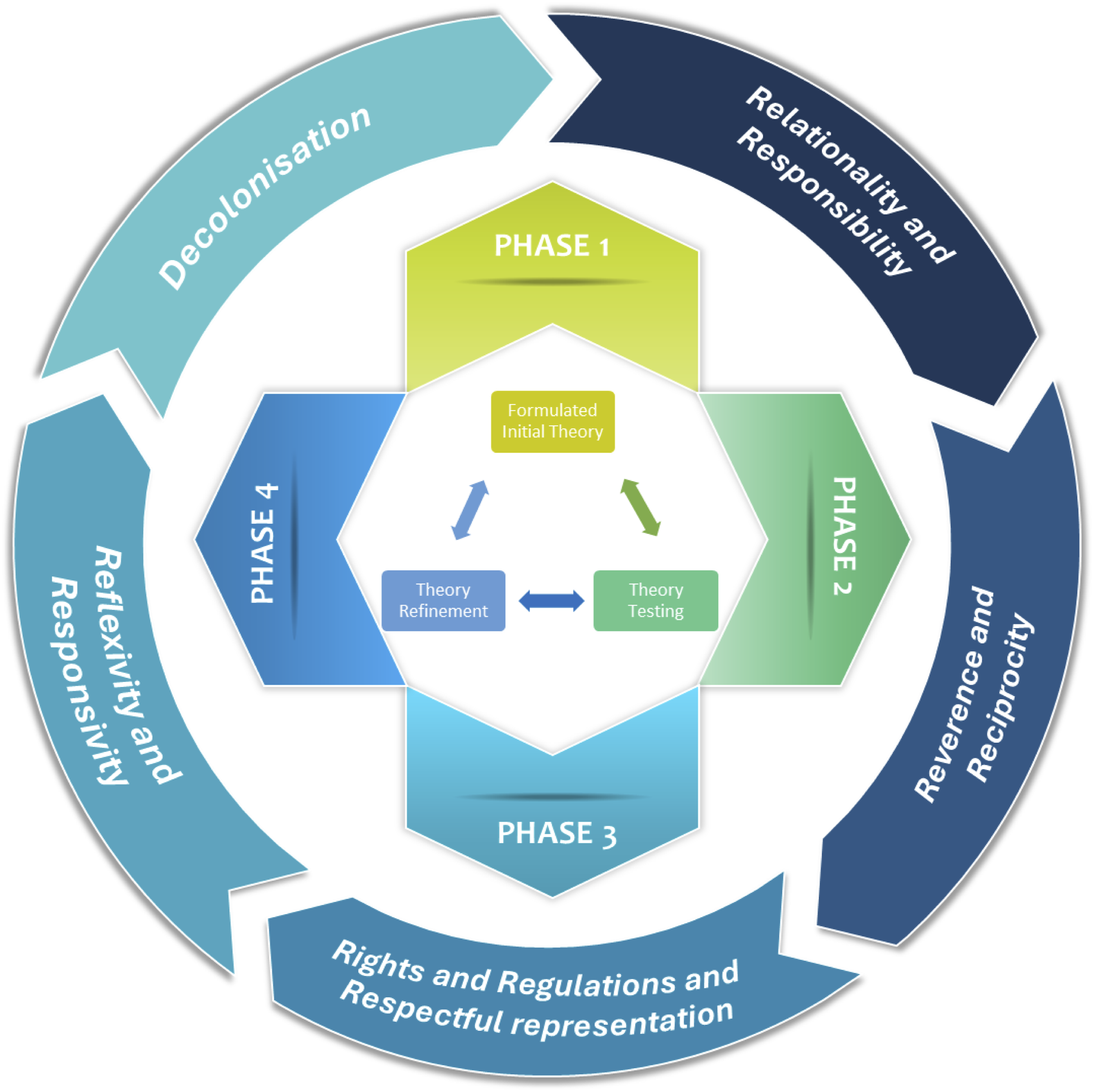
Adopting an Indigenous lens involved blending the Indigenous research principles (Chilisa & Mertens, 2021) with the realist evaluation approach. This includes:
Relationality
This principle emphasises that the programme participants can judge the program’s value and relevance (Chilisa & Mertens, 2021, p. 247). This principle demands that the evaluator centres the voices of the programme participants and, by doing so, promotes epistemic justice (Gould et al., 2023). The evaluation should engage the wide range of actors affected by the programme and pay attention to the voices of those affected positively and negatively.
Responsibility
As an agent of change, the evaluator has a role in pursuing equity and social justice and must resist dominant ideologies that stifle the voices of the programme participants and communities (Chilisa & Mertens, 2021). For the evaluation to contribute to the betterment of society, evaluators have a moral obligation to recognise and support the participants’ concerns (Pidgeon & Riley, 2021). This may require the evaluator to advocate for change by using the evidence to ‘speak truth to power’, thus elevating the participants’ voices.
Reverence
Evaluators should recognise the critical nature and value of spirituality and other cultural practices as an essential contribution to knowledge (Chilisa & Mertens, 2021). The evaluator should identify ways in which spirituality and cultural practices shape the participant’s experiences as a source of epistemic contribution.
Reciprocity
The principle emphasises that the evaluator should establish the real value added to the participants’ lives by the programme and how they respond to the programme resources (Chilisa & Mertens, 2021). Programme participants should, therefore, be allowed to share how they have benefited from their participation (Pidgeon & Riley, 2021, p. 11), and the evaluation should establish the wide range of intended and unintended, positive and negative outcomes.
Rights and Regulations and Respectful Representation
These principles emphasise the need for evaluation protocols to guarantee participants’ rights to voluntary participation, data ownership, and their involvement throughout the evaluation cycle (Chilisa & Mertens, 2021). The participant has the right to self-determination and voluntary participation, which is critical to building a trusting relationship between the researcher and the participants (Lovo et al., 2021; Snow et al., 2016). Facilitating validation or sensemaking workshops with the participants or allowing them to review their transcripts can help ensure their voices are not misrepresented.
Reflexivity
The researcher should continuously reflect on their assumptions, role, and actions and explicitly describe how this shapes the evaluation processes. The evaluation process should be respectful, prioritise the participants’ voices and way of knowing, and explicitly define where the evaluator’s biases might (un)consciously influence their approach to data collection, analysis, and reporting (Drawson et al., 2017).
Responsivity
The principle emphasises the need for the evaluator to learn from the [evaluation] process and accordingly adapt their approaches and methodologies to become context and culturally sensitive (Chilisa & Mertens, 2021). As the reality unfolds and the evaluator gains a deeper understanding of context, the data collection tools and processes should be adapted to uncover relevant, rich, and useful information.
Decolonisation
The principle emphasises that researchers should “resist blindly borrowing Western values and standards” (Chilisa & Mertens, 2021) in evaluating programmes in Indigenous settings or formerly colonised societies. The principle recognises that colonialism and its legacies led to the Euro-centric dispossession of the formerly colonised societies and the ongoing power imbalances (Hull, 2023; Trisos et al., 2021). This calls for interrogating power structures and dynamics in programmes by seeking to understand “what counts as a problem, what constitutes the problem, and what are the means of redress” (Ranawana et al., 2023; Shilliam, 2016).
The Case Study
The study aimed to examine power structures and dynamics within the ARISE programme through an Indigenous realist evaluation approach.
The ARISE Programme
The ‘African Research Initiative for Scientific Excellence’ (ARISE) programme is a 5-year initiative (2022–2026) jointly implemented by the African Academy of Sciences (AAS) and the African Union (AU) with financial support from the European Commission (EC). The programme addresses three objectives: (a) Strengthen the capacities of the emerging African research leaders committed to a research and teaching career in Africa (b) Strengthen institutional research management and support systems for research to thrive (c) Support the generation of cutting-edge research that will contribute towards transforming lives in Africa.
The programme supports African researchers/principal investigators (PIs), who have demonstrated capabilities in research leadership. The PIs are offered up to €5,00,000 to conceptualise and implement research initiatives that address African challenges related to health climate change, among others. As part of their projects, the researchers are expected to participate in research capacity-strengthening activities that will equip them with critical research and research leadership skills – see Figure 3 below. Additionally, the PIs are expected to recruit and train PhD and master’s students to pass on the acquired skills. The researchers are encouraged to establish and leverage research collaborators’ resources, research support staff, and finance and grants management personnel to implement their research initiatives (Mutua & Nakidde, 2024).Since the study aimed to establish how and why the ARISE programme worked to strengthen research capacities for African researchers, initial programme theories (IPTs) were first developed. Three IPTs were elicited through a review of the ARISE programme documents, interviews and focus group discussions with the programme stakeholders, and a review of published literature (covering health research capacity strengthening initiatives). The IPTs were based on three programme components: research collaboration, student training and supervision, and the Good Financial Grant Practice (GFGP), which were chosen because significant progress had been made in terms of the ARISE programme implementation. In this paper, we base our methodological reflection on the ‘research collaboration’ IPT, which was framed as shown in Box 1 below. IF the PI has a network of potential collaborators who have complementary research equipment and expertise for transdisciplinary research (C) and the PI has the financial resources and the autonomy to implement collaborative health research and research capacity strengthening (Intervention), THEN equitable research collaborations will be established (O), BECAUSE the PI will be empowered and motivated to leverage their collaborators’ equipment and expertise (M). The ARISE Logic Model: Adopted From Mutua and Nakidde (2024)Box 1: Research Collaboration IPT

Study Design and Methods
An Indigenous realist evaluation approach was employed. We adopted a multi-case design with three distinct cases of health research projects labelled Case A, B and C. The selection of the cases was based on the nature of the research project, including innovation-based (Case A), policy-based (Case B), or laboratory-based (Case C) research projects and the size of the host university. The value of case study design in realist evaluation has been documented (Koenig, 2009), and the design has been widely applied in realist studies (Leamy et al., 2023; Mukumbang et al., 2018; Robert et al., 2019; Rycroft-Malone et al., 2015, 2018; Strachan et al., 2022). The case study design allowed both per-case and cross-case analyses, thus helping to explore and understand the distinctive characteristics of the cases and how certain context conditions allow specific mechanisms to be ‘fired.’ The study was operationalised in four stages: (a) theory development, (b) data collection, (c) data analysis and (d) theory refinement – see Figure 4 below. Study Phases: Adapted From Mukumbang et al. (2018)
Data Collection and Analysis: Applying the Indigenous Principles
In this section, we report how the application of the Indigenous decolonisation lens inspired a deeper look at the ARISE partnership to understand how it was designed, who (partner) has control over what resources, and how – if at all – power (a)symmetry manifests. Figure 5 outlines our process as an integration of a realist evaluation and the Indigenous research principles. An Indigenous realist Evaluation Cycle: Adapted From Pawson and Tilley (1997)
Data Collection Method/Source

Realist informed qualitative methods were employed. Data collection in realist evaluation allows for formulating and interrogating CMO hypotheses to verify, validate or refute the programme theories (Pawson & Tilley, 2004). We used the realist interviewing technique whereby the initial programme theory (IPTs) were the subject of discussion and the basis for gathering information needed to clarify, modify, approve, or discredit the IPTs (Mukumbang et al., 2020). Our data collection goal was to test our theorised inner workings of research collaborations in the ARISE programme by eliciting information from the participants based on their research collaboration experiences within the ARISE programme. Probing questions sought to elicit deeper information about relevant CMO elements about research collaboration experiences. The data collection tools and questions were structured to elicit information on CMOs (Greenhalgh et al., 2016; Wong et al., 2016). Once the participants were identified, a copy of the participant information sheet was sent to each of them – detailing the study’s aim and processes. A consent form was also shared with each for signing if they decided to participate.
We adopted Wiltshire and Ronkainen’s (2021) realist-informed approach to thematic analysis. Wiltshire and Ronkainen (2021) structured their approach around the three domains described by Bhaskar, namely the ‘empirical’, the ‘actual’, and the ‘real’ domains (see – Indigenous realist evaluation: The paradigmatic stance section above). The retroduction of theories entailed reflecting across the three domains. On the one hand, it requires data-driven coding utilising both deductive and inductive thinking in relation to thematic analysis and, on the other hand, abductive and retroductive thinking, which are central to the realist methodology (Mukumbang et al., 2021; Wiltshire & Ronkainen, 2021).
First, we inductively (data-driven) and deductively (based on the IPT) coded each transcript, identifying experiential themes across each transcript that describe the participants’ reasoning, concerns and feelings about power structures and dynamics within the ARISE partnership and why and how the partnership is positioned to improve research capacity outcomes. We achieved this by using the context-mechanism-outcome (CMO) configurational heuristic. We coded the transcripts as linked dyads (e.g., context-mechanisms) and triads – context-mechanisms-outcomes (Jackson & Kolla, 2012). Using a linked codes approach, we noted recurrent combinations.
Because of our familiarity with the ARISE programme and experience in realist thematic analysis, following the experiential coding, we then, through inductive and abductive reasoning, combined the linked codes to formulate tentative CMO configurations. At this stage of inferential analysis, we began aggregating the linked constructs to formulate CMOs at a higher level above the linked CMO themes.
Finally, our disposition analysis (theorising about the potential powers that must exist for the phenomena to manifest) was achieved in a discursive meeting, whereby we worked through the inferential CMO links using a causal loop diagram to identify the causal mechanisms and the context conditions that must exist for the research capacity outcomes to be generated (retroduction). At the level of dispositional analysis, theoretical generalisation entails using data from particulars to develop broader constructs or theories (Mukumbang & Wong, 2025). The goal is to ensure that the explanation achieved through this analysis can be extended to a specific instance or a wider, universal set (Pawson, 2024). Because retroductive thinking requires the researchers’ experience and judgment (Gilmore et al., 2019), reflexivity was exercised – which also aligns with the Indigenous principles. Identifying thematically and linking the data using CMO configurational maps, as guided by Pawson (2006), helped to abduct and retroduce the CMOs.
While the realist-informed approach to thematic analysis helped us to formulate CMO configurations and retroduce our theories, the (Indigenous) decolonisation lens stimulated meaningful conversation. It inspired a deeper understanding of the ARISE partnership’s power dynamics and related contexts and mechanism. To highlight the contribution of the [Indigenous] decolonisation lens, we have highlighted some Indigenous principles and outlined how they added methodological value. Notably, we looked at the application and contributions of the principles of reflexivity, rights and regulation, and responsibility.
Reflexivity
Prior to this study, having worked in global health research funding and research capacity strengthening, there was a general perception that decolonisation would be a sensitive topic for Global North partners, who are often viewed as the perpetrators rather than the African partners, who are viewed as victims of colonisation. During interviews with the partners, it surprisingly emerged that the Global North partner was open to the conversation about the decolonisation of health research partnerships and even went ahead to point out that there were deliberate efforts to ensure that the research initiatives implemented in Africa were based on equitable partnerships and, notably, were locally driven and addressing the local research needs and priorities. On the other hand, the decolonisation conversation was termed ‘agitating’ and strikingly uncomfortable for the Global South partners. The quote below captures this. …I find the language of decolonisation very agitating in that it seeks to find fault even in situations where partners are acting in good faith and for the common good. As you already know, [Partner] is a pan-African organisation, and our work is to ensure that we support Africa-led and Africa-owned research and research capacity strengthening efforts on the continent and that was clearly described in our agreement and Description of Action documents. Who do you think conceptualised the programme and various research projects? African researchers. Who is leading the initiatives? African researchers. Any external interference by our partners? Absolutely none. All these things clearly shows you that no one, among the partners involved, is wielding more power than the other or exercise their power wrongly. [Interview, Partner A] We have been talking about equal partnerships for quite a while now and believe that there is probably no better field than research and innovation to make that come true. So, we have a Unit that has been tasked with issues of Ethics and Equity in research partnerships, which is very much looking at what is going on in our partnerships with African entities. …we are alive to the need to interrogate our structures and processes to ensure that there are no colonial traces and all our partners whether in the North or South are treated with respect and are valued. [Interview, Partner C]
The discussions with partners challenged our misconceptions about the openness to engage in conversations about decolonisation and colonial structures. Additionally, as the conversation about decolonisation became uncomfortable for the partner, we adapted the process to focus on power structures, dynamics, and control instead of explicitly discussing decolonisation.
Rights and Regulation Principle
Inspired by the Indigenous ‘rights and regulations’ principle, the programme participants were allowed to review their transcripts. Some participants reviewed, edited and/or added responses to their transcripts. For instance, one PIs added a statement to their transcript to clarify her previous response. The quote below shows the views that were added to the transcript. Power asymmetry is very evident, particularly in most research initiatives led by PIs based in the Global North, which simply engage African researchers to access the African population. Such kind of engagements can feel very transactional. A good example is the [programme name] which demanded the African researchers to submit their data to their Global North lead institution before the next tranche of funds could be transferred to our account. In such a case you just feel that the Global North partners are simply using you. That is not the case with the ARISE. [Interview, PI, Case C]
In the quote above, the participant clarified power asymmetry in research partnerships involving Global North entities and even provided an example of one of the programme partnerships characterised by inequity. In their example, the participant highlights how their right to data ownership was breached, thus violating the basic principle of equitable research partnership.
Responsibility Principle
Interviews with the PIs established that, although the ARISE partnership has supported the PIs to attend scientific forums, conferences and workshops that have been pivotal in elevating their scientific profiles, female PIs with newborn babies were disproportionately disadvantaged since they needed additional support to attend such forums. Since the Indigenous responsibility principle emphasises that the evaluator has an ethical and moral responsibility to be an agent of change committed to equity and social justice, the issue (parental responsibilities affecting female PIs) was raised with one of the partners. Consequently, a communication was sent to the ARISE grantees informing them of the available support for the mothering PIs in case they need any administrative support or additional financial support to attend critical scientific forums or workshops. This would provide a level playing field for all the PIs thus ensuring that the ARISE partnership does not perpetuate or reinforce any inequity between parenting and non-parenting PIs. Excerpt 1 below captures a conversation with one of the parenting PIs.
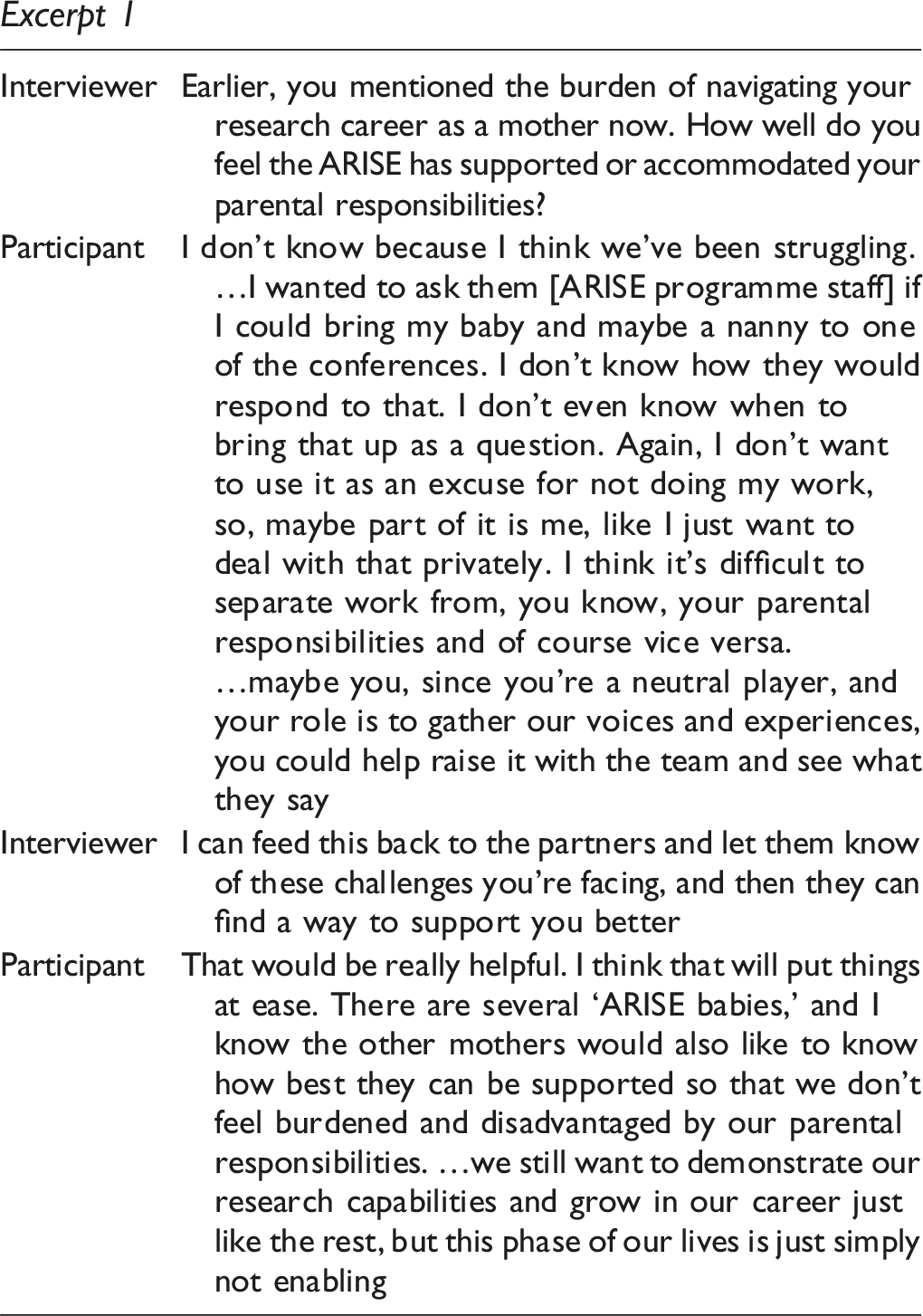
The Indigenous responsibility principle inspires the evaluator by ensuring that – through participant engagement – conversations are initiated, and appropriate actions are taken to pursue equity and social justice. It is likely that with a level playing field, a conducive mechanism will likely be triggered thus generating positive outcomes for the mothering PIs.
Results
In this section, we present our retroduced theory obtained through applying the Indigenous decolonisation lens to explicate how the ARISE programme was designed and who (partner) has control over what resources and how – if at all – power (a)symmetry manifests. We present the overarching programme theory elicited and “if…then…because… statement” and a causal loop diagram illustrating the connections between the intervention modality, context, mechanism and outcomes.
Programme Theory: Empowerment, Independence and Control
Interviews with the partners established that the ARISE partnership was birthed from shared interests and priorities between Africa and Europe (C1). The ARISE partnership was founded on the AU-EU High Level Policy Dialogue
1
framework, which aims to strengthen science, technology, and innovation in Africa. The ARISE Partnership is therefore aligned with the AU’s Science, Technology, and Innovation Strategy for Africa 2024 (STISA-2024) and the Agenda 2063 frameworks, which seek to build capacities of African scientists and their research institutions to conduct cutting edge research. One of the partners highlighted that the Africa-Europe partnership framework benefits the African continent by unlocking resources towards African development, and Europe by keeping ‘soft influence’ on the African continent. The study did not, however, explore what the ‘soft influence on the African continent’ looks like. …the negotiation of the ARISE [grant] was made in the light of the EU-AU High-Level Policy Dialogue on Science, Technology, and Innovation priorities [shared interests and priorities] [C1]. …there’s also keeping a close relation because the programme also has a very important dimension of networks between Europe and Africa. It's also in the interest of Europe to keep some soft influence on the African continent. …there was a deliberate effort to contextualise the initiative [ARISE] to the existing regional and international frameworks and policies such as the SDGs, the STISA 2024, and the African Agenda 2063 which highlight the place of science, technology and innovation in the Africa’s development [C1]. [Partner C]
The partner allyship (which is characteristic of the Bottom-Up approach used in the design and implementation of the ARISE programme) was identified as a key context that guarantees autonomy/independence (M) and shifts the power/control (M) to the African PIs. Although the research funding came from the Global North, the PIs corroborated that the partnership guaranteed their independence/autonomy (M) to define their research ideas and questions and independently implement their research initiatives. The intentional design to achieve equity (C) in the ARISE partnership is a critical context that makes the ARISE an ‘equitable partnership’ (O), and the equity is reflected through the [African] PIs’ research leadership, decision-making, data ownership, publication and dissemination of the research results. A partner debunked the notion that if one of the partners does not financially contribute to the partnership, then equity would be difficult to achieve. …the idea was really to support young scientists in Africa [C1] and to support them in a bottom-up approach [partner allyship] [C2]. This meant that the topics to be selected came from them and not from the bodies financially supporting [autonomy/independence; (M1)] and in a very transdisciplinary approach as well. [Interview, Partner C] Sometimes it is mistaken to many that if you don’t bring money to the table, then you're not an equal partner. What I see in the AU-EU cooperation agreement is a definition of the priorities and modes of engagement so that the EU has its part to play which is to provide the funds and then Africa provides the platform…the EU brings the money, but the agenda setting is done on the [Africa] continent [Intentional design to achieve equity] [C3]. …the equity that I’m talking about is evident in the PI’s research leadership, decision-making, data ownership, publication, and dissemination of results responsibilities [equitable partnership] [O1] and the role of the Global North in all that. [Partner A] …having the resources to not only advance genomic research in [country] but also train the next generation of genomics researchers and bioinformaticians is what this country critically needed, and ARISE grant was timely [local needs and priorities addressed] [O2]. …although it [ARISE] is funded by a Global North partner, I think the independence given to the research teams [M1] makes the initiatives more locally driven. [Interview, PI, Case C]
The African actors highlighted that the ARISE partnership had shifted power in two ways: (a) allowing the African researchers to set the agenda (including defining the research problem and questions) and (b) giving them [PIs] the autonomy to manage the research funding resources and establish collaborations. The power shift empowered the African PIs and the autonomy/independence (M) to implement their ARISE research projects. For instance, the PI’s autonomy/ independence is reflected in their freedom to choose collaborators from anywhere. The PI’s independence/autonomy (M1), empowerment (M2), and power/control over research resources and decisions about research collaborations allowed the ARISE to be locally led and locally driven, leading to equitable partnerships being established (O1) and the local health research needs/priorities being met/addressed (O2). The voices of the different actors captured this. …I think the beauty is that as the leader, I can quickly determine what relationship is inequitable and quickly address the issues or terminate it [empowered] [M2]. This is the kind of thing that you can’t experience when you are simply the African partner or collaborator who doesn’t have a decision-making power on the funding [Interview, PI, Case A] I think the PIs have the control and are able to make decisions quickly [empowerment] [M2] and fix issues as they arise. It’s the essence of being the PI or the research leader. It would not make sense if they were to lead their research projects and not have the freedom or the autonomy to make those critical decisions like whom to collaborate with, where to allocate more financial resources and the best way to maximise the impact of the project [control/power] [M3] [Interview, Collaborator, Case A] …what this means is that they [African researchers] are the ones setting their research agenda, defining their research questions and leading their research initiatives to addressing their health research needs [independence/autonomy] [M1]. It has given them the opportunity to implement locally driven research initiatives [O2]. [Partner C] It is a plus for the PI to network and grow their network with the European collaborators because it comes with the wealth of knowledge and opportunities. But it’s not imposed on them to have to work with European or collaborators from foreign countries other than their own [empowerment] [M2]. The PI is at liberty to choose a suitable collaborator who will help them achieve their project objectives. [Partner A] The African PI’s independence makes a huge difference [M2] in terms of forging meaningful collaborations that contribute to capacity strengthening. It [independence/autonomy] sort of gives you some space where you can do what needs to be done to successfully implement your project [empowerment] [M2]. …so that independence kinda gives you the opportunity to choose partners you trust and have confidence in their work and who will add value to your research efforts. [Collaborator, Case B]
As described above, multiple contexts were necessary for the three key mechanisms (i.e., independence/ autonomy, empowerment and power/ control) to be triggered, thus generating two positive outcomes. Based on the identified CMO elements, the programme theory can be represented using if … then … because statement, as shown in Box 2 below. IF partners have shared interests and priorities (C2), there is allyship (C1) and intentional design to achieve equity in partnership (C3) and the programme provides the financial resources to undertake collaborative research and African researchers have the right to come up with their research ideas and choose collaborators (I) THEN equitable research partnership will be established (O1) and the local health research needs and priorities addressed (O2) BECAUSE the PI will have autonomy/ independence (M1), be empowered (M2) and have control/power over resources and decision making (M3).Box 2: Refined Programme Theory
Figure 6 below illustrates the overall theory obtained after appying analytical generalisability to retroduce an explanation of how the ARISE partnership addresses power imbalance in research collaborations. Overarching Programme Theory
As shown in Figure 6 above, three mechanisms (autonomy/independence, empowerment, and power/control) were triggered by the ARISE programme resources (financial support) and opportunities (the right to come up with research ideas and choose collaborators). The ARISE did not provide any constraints/sanctions in its programme architecture. For the three mechanisms to be triggered, the study identified that key context conditions need to exist: intentional design to achieve equity, partner allyship, and shared interests and priorities among the partners. The mechanisms activated across those context conditions resulted in an equitable partnership and the local health research needs and priorities being met.
Discussion
In this paper, we illustrate how the Indigenous realist evaluation approach can be used to systematically examine and understand power structures and dynamics within the ARISE partnership and, specifically, its Bottom-Up approach. The Indigenous realist evaluation inspired us to interrogate about ‘who’ (partner) has what control over ‘what’ resources; this has allowed us to both understand the ARISE programme architecture and identify some of the key context conditions (e.g., ‘allyship between partners’) which are central to the establishment of equitable partnerships that address local health research needs and priorities. Allyship has been defined as support by the Global North actors (who are well-resourced) to actors in the South without expecting anything in return (Pai et al., 2024). The Indigenous realist evaluation lens helped us judge the ARISE partnership and conclude that it meets the principles of equitable partnership as defined by ESSENCE on Health Research and UKCDR (2022) and Dutta et al. (2023). As such, we present the ARISE as a good case of research partnership demonstrating equity in its design and implementation and providing useful evidence (to policymakers and global health funders and practitioners) on how similar initiatives can achieve equity. Importantly, we highlight how the Indigenous realist evaluation inspires and furthers the decolonisation discourse.
During the evaluation process, one of our key observations was the actors’ reaction/response to the decolonisation conversation. Although all the partners reported that the ARISE partnership was equitable and had no traits of power imbalance, we found that the conversation about decolonisation was viewed as a ‘fault finding’ act and ‘agitating partners.’ It was therefore inappropriate [to some] to have the decolonisation conversation when the partners had demonstrated goodwill, respect and trust, and the partnership was delivering improved research capacity outcomes for the African researchers. It was clear that the ‘decolonisation’ conversation was sensitive and uncomfortable even though the ARISE could be termed as an equitable partnership. This then begs the question, is it worth disturbing settled knowledge? (Jansen and Walters (2022). Put it While the Indigenous lens stimulated these uncomfortable conversations about decolonisation and power relations, the only true way to confront explicit and implicit power dynamics and decolonise global health research may be by normalising the uncomfortable conversations. Hassnain (2023) argues that in decolonised context, actors view conflict as healthy (p. 150) and therefore would not be afraid of engaging in the uncomfortable decolonisation conversation. We argue that the Indigenous realist evaluator should be prepared to navigate difficult evaluation environments where, as observed in this study, actors are afraid of ‘rocking the boat’ by engaging in the decolonisation conversation.
Besides interrogating the power structures and dynamics and advancing the decolonisation discourse, the Indigenous lens had additional value. For instance, it emerged that allowing the participants to review their transcripts empowered them to control what gets written (Rowlands, 2021) by editing the transcript to capture their voices accurately. As Rowlands (2021) argues, this process helped validate the participant’s voice. The additional views added to the transcript were useful in clarifying the participant’s responses. In all likelihood, those views might not have been captured had the participants not been allowed to review their transcripts, and we would probably have missed the opportunity to understand how distinct the ARISE partnership is from other programmes that the participants had been involved in. We, therefore, suggest that depending on the nature of their participants, the Indigenous realist evaluators should give the participants a chance to review their transcripts or hold validation meetings with the programme participants.
The Indigenous realist evaluation expands the evaluator’s role to include not just using their methodological expertise to examine what works, for whom and under what circumstances, but also using their voices – in line with the Indigenous reciprocity principle – to call out and address inequities and social injustices perpetrated, reinforced or ignored by an intervention. Shadish et al. (1991) and Luo (2010) have looked at evaluator’s roles as some of the evaluation theorists and scholars described. For instance, according to Scriven (1991), the evaluator’s role is to judge the value of an evaluand. According to Campbell (1991), an evaluator is a methodologist whose work is to design scientifically sound and rigorous evaluations, eliminate bias and determine causal inferences about the evaluand. According to Rossi and Freeman (1985), the role of the evaluator will contextually vary depending on the stages of evaluation and the nature of programme. In their popular quote “I’ll show you my theory if you show me yours,” Pawson and Tilley (1997) argue that a realist evaluator assumes both the role of a teacher and a learner, which is evident in realist interviewing. In this case, the participants engage in a meaning-making process rather than simply being a source of information (Mukumbang et al., 2020) and this is what generates meaningful learning.
An evaluator employing the Indigenous realist evaluation approach will take on varied roles. As a methodologist, an Indigenous realist evaluator must appropriately integrate Indigenous research methodologies (e.g., interviews, storytelling, etc.) to articulate, test and refine programme theories. As a judge, the evaluator will need to pass judgement on ‘what’ changes or outcomes a programme has brought about, whether positive or negative, intended, or unintended, and how the context has influenced the achievement of those outcomes. As a teacher/learner, the evaluator will use realist techniques to “teach” the participant how they theorise the programme works and learn from the participants how they theorise about the program’s inner workings of the programme thus allowing them to learn from each other. As an advocate, the evaluator will need to capture the voices of the programme participants and actively use their voice to advocate for change specifically, where the programme is perpetuating, ignoring, or reinforcing inequities and social injustices. As highlighted in paper, it took voicing out the concerns of the mothering PIs for the ARISE to provide them with additional resources to participate in scientific forums and provide a level playing field to all regardless of their gender or parental status.
Researchers may raise questions about the position and objectivity of the evaluator—as an advocate of change. Greene (1997) argued that the evaluator becomes a friend of the programme to play the role of an advocate in an evaluation, compromising the evaluator’s ability to impartially judge the program’s effectiveness. Nonetheless, the Indigenous principles encourage the evaluator to generate high quality evidence and use their voice to bring about positive change in the lives of the programme participants (Chilisa & Mertens, 2021) and this does not mean that the evaluator’s position and ability to view things objectively is compromised. This is because professional and ethical standards guide the evaluator’s work, the evidence centres the voices of the programme participants and, importantly, the evaluator must remain reflexive throughout the evaluation process thus making it clear where their decisions and actions are likely to be subjective or biased.
Fundamentally, the Indigenous realist evaluation aims to—beyond understanding how programmes work, for whom and under what circumstances—catalyse transformative change by identifying and addressing power imbalances and inequities perpetuated, reinforced, or ignored by a policy or a programme. Given the current global challenges including climate change, rising poverty levels and development inequities, evaluators are challenged to play an active role in catalysing transformative change (Van den Berg et al., 2019) by generating high quality evidence, building relationships, and initiating dialogues with programme actors that are necessary for evidence use and transformation. The transformation element in Indigenous realist evaluation brings an essential language that evaluators can use to address power differentials among the diverse actors, ranging from donors with conflicting interests to the competing interests of stakeholders, governments, and beneficiary communities (Chilisa & Mertens, 2021, p. 250). Evaluators using the Indigenous realist evaluation, are encouraged not to remain neutral in the face of inequity or social injustice but to adopt practices, methodologies, and tools that allow them to identify and call out such. Therefore, we argue that the Indigenous realist evaluation approach can contribute to the decolonisation of the evaluand, be it policy, programme or strategy.
We hypothesise that the effectiveness of the Indigenous realist evaluation approach will differ across programmatic contexts. For instance, an evaluation seeking to understand how a programme aimed at strengthening the capacity of African scientists to conduct high-quality scientific research (academic context) works and why will be different to an evaluation of a programme aimed at enhancing the capacity of African Indigenous communities on sustainable farming practices (Indigenous community context). Additionally, the two programme contexts will potentially yield different experiences and opportunities for the evaluator and the programme participants. We, therefore, encourage researchers to apply the Indigenous realist evaluation approach across different programmatic contexts to build evidence on its effectiveness and, importantly, refine it further.
Conclusion
In this article, we have argued that the Indigenous realist evaluation approach goes beyond understanding how programmes work, for whom, and under what circumstances to subversively challenge power asymmetries and inequities perpetuated, reinforced, or ignored by an intervention. The evaluation should centre the voices of the programme actors; the evaluation design, methods, and processes should reflect the local context and employ a wide range of methods, including Indigenous methods. Notably, the evaluator should use their voice to actively advocate for actions necessary for addressing inequities and social injustices.
Ethical Statement
The ethical approval for the study was granted by the University of Cape Town Research Ethics Committee (Reference number REC, 2022/12/008).
Footnotes

Funding
The authors disclosed receipt of the following financial support for the research: This work was supported by the School of Management Studies, University of Cape Town, South Africa.
Declaration of Conflicting Interests
The authors declared no potential conflicts of interest with respect to the research, authorship and/or publication of this article.
Data Availability Statement
All relevant data has been included in this article.