




Abstract
The current existential crises crystallize an urgent need for us all to contribute to meeting international environmental and social commitments. The message is clear: we need to take action. However, one of the challenges for decision-makers leading the transition is the dearth of practical tools and approaches available. Even in our field, evaluations are still based on practices which systematically overlook important determinants of human health, neglecting what matters most for our societies to thrive. This article aims to build on existing knowledge of program theories, theories of change, and theory-based evaluations to create a practical approach to designing interventions, while taking into account human and natural systems: what is referred to as evaluating for Planetary Health. A key purpose is to explore how we can conceptualize and elaborate interventions, taking into account their implications for Planetary Health, to suggest improvements or alternatives to existing programs, projects, or policies.
Keywords
Introduction
More than a decade ago, the Planetary Boundary Framework (Rockström et al., 2009; Steffen et al. 2015) was conceptualized as a way to identify Earth’s interdependent biophysical subsystems and processes that sustain humans and ecological biodiversity. Nine interrelated processes define relevant planetary boundaries for human activities: climate change, ocean acidification, stratospheric ozone depletion, biogeochemical flow (mainly nitrogen and phosphorus cycles impacted by fertilizers used in modern agriculture), freshwater use, changes in land use, biodiversity loss, aerosol loading, and chemical pollution (Rockström et al., 2009). Three of those boundaries—biodiversity loss, nitrogen cycle, and climate change—had already been transgressed at that time (Rockström et al., 2009) creating major threats to human health and survival. The updated Planetary Boundary Framework (Steffen et al., 2015) shows biodiversity loss (genetic diversity) and nitrogen and phosphorus cycles are well beyond their limits, with climate change and now land-system change posing increasing risk as they also sit beyond the safe boundary zone. These processes are not independent from each other, and transgressing one impacts others. To maintain an environment safe for humanity, we need to live within the planetary boundaries and drastically change some major sectors and human activities (Alexander, 2015a, 2015b; Raworth, 2017; United Nations Environment Program, 2021)
Among these processes, the greatest threat to human health is posed by climate change (Watts et al., 2015). By increasing pressure on land, oceans and their ecosystems, climate change creates increasing risks to health, livelihoods, biodiversity, food systems and security, water supply, human security, infrastructure, and economic growth, and jeopardizes human survival (Haines et al., 2014; Intergovernmental Panel on Climate Change (IPCC), 2018, 2019, 2021; Neira, 2014). Furthermore, environmental imbalances and depletion increase social inequities, because those who are disproportionately affected by flooding, heatwaves, extreme cold, and the sanitary impacts of air pollution also have less capacity to adapt to environmental and health risks (Cutter, 2006; Douglas et al., 2012; Nicholas et al., 2015). The populations most at risk of harmful consequences from climate change events and trends are those already most disadvantaged and vulnerable, and those living in arctic ecosystems, drylands, small islands, and lower income countries (IPCC, 2018). In Canada, the most affected are “those living closest to the land” (Brown et al., 2019: 198), many of whom are Indigenous and farmers or fishers in coastal and remote communities. The Intergovernmental Panel on Climate Change (IPCC, 2018) also warns that “poverty and disadvantage are expected to increase in some populations as global warming increases” (p. 9).
It is also important to mention that the ecological crises are largely intertwined with other social injustices based on a larger system of domination and exploitation of human and natural resources (Nesmith, 2021; White, 2020). Indigenous Peoples across Turtle Island, including the Wet’suwet’en nation, Secwépemc nation, Six Nations and others are confronting ongoing colonization and extractivism that attempt to dispossess them from their territories of life. In 2007, the United Nations adopted The Declaration on the Rights of Indigenous Peoples (United Nations, 2007), which reinstates the human rights of Indigenous Peoples and their right to self-determination. This declaration was adopted, with 144 states voting in favor, four votes against—not surprisingly: Australia, Canada, New Zealand, and the United States and 11 abstentions (https://www.un.org/development/desa/indigenouspeoples/declaration-on-the-rights-of-indigenous-peoples.html). Canada reversed its position in 2016 by removing their permanent objectors’ status to the Declaration and in June 2021, the United Nations Declaration on the Rights of Indigenous Peoples Act became federal law (Bill C-15). In addition, one of its provinces, British Columbia, made UNDRIP into law, in November 2019. Today still, in different regions of the world, colonial oppressive systems are largely in place, with many intersecting layers at play such as environmental racism, cultural depletion, land dispossession and many others with the consequence of deeply affecting Indigenous Peoples and communities (Deranger et al., 2021; Nesmith et al., 2021). Many policies supported by national governments are further negatively impacting Indigenous Peoples and are not taking into consideration Indigenous Peoples’ reality, contributing to further marginalizing and dispossessing them of their rights (Deranger et al., 2021). In parallel, Indigenous movements of resistance to fossil fuel industry projects on traditional lands are taking place, with a documented impact on reducing overall greenhouse gas emissions, and land defenders again facing violence and repression (Goldtooth et al., 2021). Finally, awareness of these situations and understanding how ecological and human crises are tightly woven highlight different elements for evaluators to consider in such contexts: power structures in place and their impacts on local peoples, the imperative to do no harm to already vulnerable communities, and the need to adopt human rights and culturally responsive approaches to evaluation (Chouinard and Cram, 2020).
Thus, climate-related solutions need to take into consideration the impacts on both environmental and human-related dimensions.
The concept of “Planetary Health” aims at reconciling these dimensions: Planetary Health is the achievement of the highest attainable standard of health, wellbeing, and equity worldwide through judicious attention to the human systems—political, economic, and social—that shape the future of humanity and the Earth’s natural systems that define the safe environmental limits within which humanity can flourish. Put simply, planetary health is the health of human civilization and the state of the natural systems on which it depends. (Whitmee et al., 2015: 1978)
In 2018, The Canmore Declaration was published (Prescott et al., 2018) listing Planetary Health Principles which are presented as expanding the 1986 Ottawa Charter for Health Promotion and responding to the United Nations 2030 Agenda in a holistic and systemic manner, stressing the importance of considering the interconnectivity of the 17 United Nations Sustainable Development Goals (UN-SDG). The declaration articulates the principle of sustainable vitality of all systems: Planetary health, inseparably bonded to human health, is defined as the interdependent vitality of all natural and anthropogenic ecosystems; this vitality includes the biologically defined ecosystems (at micro, meso and macro scales) that favor biodiversity; it includes the more broadly defined human-constructed social, political, and economic ecosystems that favor health equity and the opportunity to strive for high-level wellness; this definition also includes the business ecosystems that influence sustainable and health-promoting local and global commerce. (Prescott et al., 2018: 3)
More recently, the Geneva Charter for Well-Being emphasizes the need to achieve “equitable health now and for future generations without breaching ecological limits” (https://www.fnes.fr/wp-content/uploads/2021/12/ac-211230-Geneva_Charter_for_Well-being_WHO.pdf).
The emergent concept of Planetary Health is intended to capture and promote the interconnection and reciprocal relationships between nature and living species, including humans. However, such a concept is central to many Indigenous cultures and knowledge systems (Redvers et al., 2020): hesook-ish tsawalk means “everything is one” in the language of Nuu-chah-nulth people (Umeek Atleo, 2011); Gina waadluxan gud kwaagid means “everything depends on everything else” in language of the Haida Nation (McGuire, 2015).
Applying Planetary Health lenses to all decision-making and actions would support decision-makers to consider multiple dimensions systematically and simultaneously for human beings, other living species, and natural systems to thrive. The Planetary Health concept can enable better alignment with Indigenous knowledge systems and cultures, which can contribute to reconciliation efforts. It would also offer a complementary approach to the ambitious UN 2030 agenda on Sustainable Development. Currently, the UN-SDGs are often considered as siloed and separate objectives and, to our knowledge, there is no comprehensive approach allowing for the consideration of the 17 goals in an integrated way. Adopting a dialogic approach to Planetary Health can enable systematic and holistic system change, with the potential to address the 17 UN-SDG in a comprehensive way while also considering potential trade-offs between objectives (Brousselle and McDavid 2021).
Evaluators are currently eager to bring transformation and innovation into our practices to address the many social and environmental challenges humanity is facing. New initiatives are emerging from varied evaluation contexts: Associations are organizing conferences and webinars around transformational change and evaluation in the Anthropocene (The International Development Evaluation Association (IDEAS); the European Evaluation Society (EES)), taking a position by promoting and supporting equitable and sustainable human and ecological development (EvalAgenda 2020 endorsed by EvalPartners and Eval Youth), and implementing practices to reduce their own footprint (the Canadian Evaluation Society (CES)). Increasing numbers of publications are addressing the environmental crises (Patton’s (2020) Blue Marble Evaluation; Rowe’s (2018, 2019) Sustainability-Ready Approach; Uitto, 2019, 2021; Brousselle and McDavid’s framework for Planetary Health (2021). This mobilization creates potential for transforming our approaches and practices to capitalize on the emerging movement that recognizes Planetary Health as an overarching goal, the long-standing movement of evaluation globally, and the field’s commitment to the social agenda. The 2030 UN agenda and the Paris Agreement also crystallize an urgent need for us all to contribute to meeting international environmental and social commitments. The message is clear: we need to take action. However, one of the challenges for decision-makers leading the transition is the dearth of practical tools and approaches available to support the complexity of decisions. Decisions are often constrained by siloed, reductionistic mechanisms of governance that box us into singular initiatives, priorities, and thinking and prevent us from considering the systemic impacts of interventions. Even in our field, evaluations are generally focused on narrowly identified outcomes and impacts based on expected results and are “unlikely to address sustainability” which leads to systematically introducing positive bias into our results, excluding Indigenous knowledge systems, and underfulfilling the evaluation mandate (Rowe, 2019: 35).
How do we make decisions (as policy-makers and evaluators) about interventions? How do we assess and prioritize interventions? These questions are now central to relevant and effective action.
This article aims to build on existing knowledge of program theories, theories of change, and theory-based evaluations to design a practical approach to assessing and improving interventions while reconciling human and natural systems—evaluating to contribute to Planetary Health. A key purpose of this article is to elaborate an approach that accounts for the possible relationships between interventions (projects, programs, and policies) and factors that are recognized as contributors to Planetary Health. This article builds on previous work to show how using program theories and theory-based evaluations can support evaluations for Planetary Health. In particular, we will explore how we can conceptualize and elaborate interventions for Planetary Health to suggest improvements or alternatives to existing programs, projects, or policies. This article follows a series of two articles published in Evaluation: the first one articulating the current state we are in within the Anthropocene (Brousselle and McDavid 2020), and the second one proposing a framework and a dialogic approach for designing and evaluating interventions for Planetary Health (Brousselle and McDavid 2021).
This new work is the result of an active collaboration between two Climate Caucus co-founders and researchers and students with expertise in local government, Indigenous governance, and communication. Climate Caucus (https://www.climatecaucus.ca) is a Canadian non-partisan network of approximately 400 elected officials representing over 180 local governments across Canada, working collectively to create and implement effective and equitable policy solutions that align with the IPCC and Intergovernmental Science-Policy Platform on Biodiversity and Ecosystem Services (IPBES) science and the United Nations Declaration on the Rights of Indigenous Peoples (UNDRIP). This collaboration started following the publication of the Planetary Health Framework and as Climate Caucus was exploring frameworks for change; the timing and content alignment serendipitously presented the opportunity to jointly test and further develop this approach. Through monthly meetings, our team has been discussing what local elected officials need when they are willing to apply Planetary Health lenses to their decisions and, together, we are developing approaches and tools/heuristics to improve the design and implementation of interventions. Contributors to this work are listed as co-authors and are noted in the acknowledgments. The approach presented in this article is the result of this dialog and the mutual desire to bridge the needs of politicians and administrators in evaluation practices.
In this article, we first review the principles for Planetary Health evaluation, followed by an introduction to the Planetary Health Framework. In the next section, drawing from John Mayne’s approach to program theory, we will show a way that evaluators can use to represent interventions and evaluate them, taking into account their contributions to Planetary Health.
Principles for Planetary Health evaluation
Briefly, there are four related principles that connect evaluation to Planetary Health. In this section, we outline each principle and its implications for our field.
First, to meet the scale and scope of change required to reach the 2030 UN Sustainable Development Goals and the Paris Agreement targets for GHG emissions, we need to consider social and environmental impacts in all interventions, regardless of their intended objectives, and include those in our evaluations. This will require starting a movement in our field—one that commits our field to an active role in addressing the causes and consequences of climate change, pollution, and loss of biodiversity. As a start, we need to develop approaches and tools that integrate both social and environmental aspects in all evaluations without requiring evaluators to become experts in climate change, pollution, biodiversity, or social justice. We need to find ways to systematically consider effects on human and natural systems and make these assessment tools accessible to all evaluators. Decentralizing responsibility from the hands of a few will contribute to democratizing knowledge and know-how and facilitate our responding to environment-related challenges in a holistic and embedded way.
Second, and more specifically, in framing the intended outcomes for policies and programs, we need to consider all impacts (intended and unintended) of interventions. This amounts to working with a variety of actors to conceptualize the environment-related effects of interventions, including those that have long-lasting and far-reaching impacts beyond their sites of origin. We need to consider the impacts on current and future generations (intergenerational equity), as well as on our planet. In the way, we generally conceptualize, plan, and implement purposive human activities, whether they be producer- or consumer-related, we typically consider only direct impacts, treating indirect impacts on humans and the environment as externalities. This approach has resulted in common problems at all scales of governance, the most fundamental of which is our collective production of GHGs. Clearly, the causes of the environmental changes and depletions we are experiencing are directly related to these “externalities” (Haines and Frumkin, 2021).
Third, when dealing with the environmental impacts of interventions, we should prioritize actions that directly contribute to repairing, restoring, reducing, protecting, and mitigating instead of actions that distribute responsibilities to others. For example, carbon offsetting is an option that maintains current greenhouse gas emissions from one party and assumes that a reduction of GHG elsewhere will compensate for these emissions—typical carbon offsetting activities include tree planting or fuel source replacements. Evaluations of such practices have demonstrated that the expected effects are often not achieved (trees have not been planted or were planted where plantations were already planned). Evaluations also demonstrate that this system perpetuates colonial relationships with associated impacts from richer countries toward peasants and households in poorer countries (Heuwieser, 2017). Such practices constitute the perpetuation of the dominance of wealthy groups over others. Climate and sustainability actions should not be the sole responsibility of those who contribute far less to the problem, but should be everyone’s priority (social and economic equity).
Fourth, we need to acknowledge the existence of different cultures and values and to interpret Planetary Health lenses in ways that would be meaningful to local communities. Even if models and approaches presented today aim at speaking to a world community, the various dimensions of the framework, their importance, and the ways of representing program theories are not universal and need to be adapted and negotiated to make sense to different peoples with different cultures. Successful evaluations are processes and products that are leading to felt ownership by people involved and recognized as credible, legitimate. This will be achieved if and only if many different local actors are being part of modeling the evaluation in a way meaningful to them. Furthermore, Indigenous Peoples, communities, and nations have complex relationships with lands, waters, more-than-humans that go beyond standard models of sustainability, and/or climate change. Considering relational approaches to Indigenous climate action and justice would certainly lead to a redesign of the approach described below.
Moving forward, we also need to recognize that our field is primarily aimed at practicing the “business” of evaluation where we respond to evaluation commissioners’ requests. Increasingly, the question of moral leadership and our claims to work for the public good is on the table. Picciotto (2020) shares how evaluators are complicit in obscuring their professions’ good intentions to status-quo agendas: ‘Co-opted, institutionalized, and routinized, evaluation is now shaped by buyers’ preferences, the range of evaluation questions has become restricted and manager-oriented evaluations no longer privilege the weaker segments of society. In this operating context, evaluators are induced (or seduced) to share their clients’ perspectives, while giving lip service to the public good: they cannot afford to bite the hands that feed them’ (Picciotto, 2020:51).
Consultancy is now the dominant practice in our field and it comes with important constraints related to the client-contractor relationship. In this context, it will take courageous evaluators, standing up and speaking truth to power (Blousselle and McDavid 2020), as well as the reinforcement of the professional ethos and independency and the upgrading of expertise and accredited education opportunities in evaluation (Picciotto, 2021).
This article is for those evaluators who wish to elevate their practice to our professional aspirations. For those who wish to fulfill the collective claim to work for the public good (we believe that the public good is now inextricably related to confronting the causes and consequences of climate change, pollution, and loss of biodiversity), this article offers a way to simultaneously prioritize our human health, environment, and the lives of future generations.
Planetary Health Framework: A quick overview and steps forward
The Planetary Health Framework was published (Brousselle and McDavid 2021) to suggest how evaluators might systematically and practically consider the key dimensions of human and natural systems that really matter for thriving communities.
The Planetary Health Framework (see Figure 1) includes two fundamental systems: the natural system (exterior circle) and human system (interior circles). It identifies sets of factors that, when taken into account, improve the design and successful implementation of projects, programs, and policies that will make a positive difference in the natural and human health of communities. This framework can be applied to well-defined, specific, small-scale projects and to larger-scope policies. We also show how using the Planetary Health Framework can be connected to the seventeen 2030 United Nations Sustainable Development Goals in a holistic and integrated way.
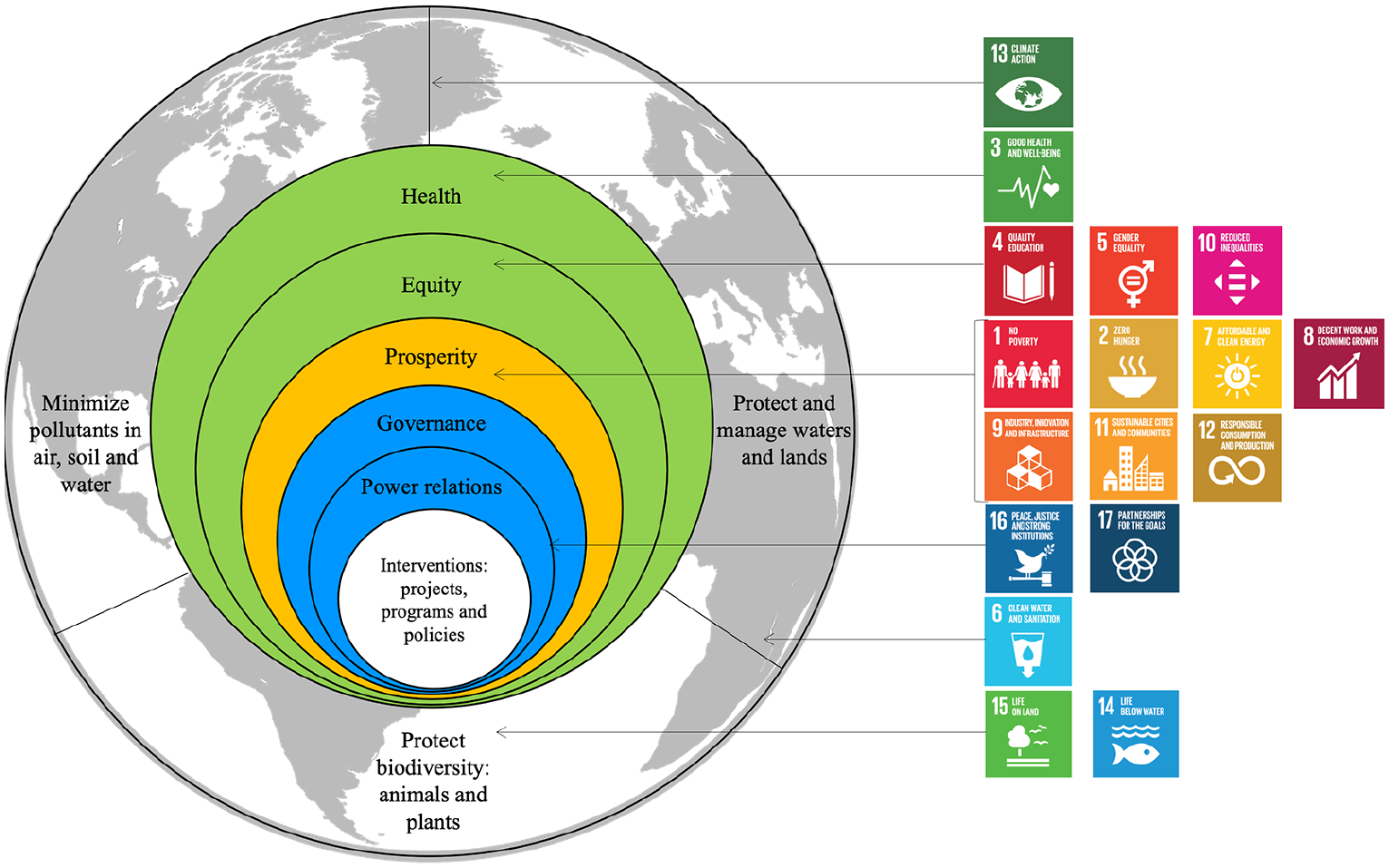
A Planetary Health Framework.
Possible applications of the framework were illustrated with a series of questions intended to support dialogue about the model’s various dimensions (see Brousselle and McDavid 2021). Building on this earlier work, efforts have been made to test the value of those questions by undertaking a focused dialog to design tools to assess interventions for their planetary health-related implications. We have been collaborating with Climate Caucus as well as engaging with interdisciplinary researchers with expertise in local and Indigenous governance and climate change.
We next turn to sharing our experiences and present some results of this collaborative work to show how program theories, as heuristics, can contribute to conceptualizing, improving, or even replacing interventions with alternatives that are better with respect to human and environmental health.
Program theory for Planetary Health
Program theories and values
Program theory is central to evaluation practice and has evolved as a response to black-box evaluations and the related difficulty of results interpretation (Funnell and Rogers, 2011). As evaluators, we now have a vocabulary to describe these representations, with models that vary in the ways that they depict programs and policies, depending on the context and evaluation purposes. Generically, we call these representations logic models, program theories, theories of change, change models, theories of action, impact pathways, intervention logics, and/or causal chains (see Funnell and Rogers (2011) for a comprehensive historical overview of program theories). Overall, program theories serve the purpose of offering representations of causal linkages supporting a particular evaluation process—they are often a central part of how we engage with local actors and communities. The place and role of program theories in evaluations may vary from the basic representation of the intervention to playing a major analytical role, as in theory-based evaluations (Brousselle and Buregeya 2018). It is not the objective of this article to conduct an exhaustive review of these approaches but rather to build on existing evaluation practices and shed light on new avenues and possibilities for evaluations related specifically to planetary health.
Fundamentally, the etymological roots of evaluation are about values. Objectivity, or value-free evaluation, is a contested notion. The critical question is whose values are we integrating? Commonly, when conducting an evaluation based on stakeholders’ orientations, we adopt their values and lens in our evaluations. However, these values are not necessarily aligned with the public interest, even though we often claim to work for the public good (Mathison, 2018). Hence, we also need to be explicit about the values that undergird the theoretical lens used for our analysis and we need to purposefully select and align values with demonstrated positive impact on social betterment. Such self-conscious practice mitigates the likelihood that evaluators become technicians that simply respond to particular stakeholders, whose agendas may be inconsistent with or undermine the public good. Schwandt (2017, 2019) has suggested that building an evaluation ethos (an explicit statement of the moral values for which evaluators stand) is part of building the foundations of an evaluation profession.
Many values are identified in the scientific literature as contributing to the public good and social betterment. Equity is one and environmental sustainability is another (Brousselle and McDavid 2020). These two values are both major determinants of individual and population health. It follows that a world in which humans thrive requires systematic inclusion of these dimensions in all evaluations.
Introducing normative components in our evaluation approaches is not new and it has already been done for equity. For example, John Mayne (2017), a pioneer in theory-based evaluations, worked on an impact pathway approach to include equity in all evaluations (Mayne, 2014, 2017). Similarly, UNICEF developed the guide, “How to design and manage Equity-Focused Evaluations” (Bamberger and Segone, 2012); here, in a practical way, an equity lens shapes the design of the evaluation, logic models, the choice of evaluation approaches, and finally, the way interventions are analyzed.
Contributing to the design, implementation, and evaluation of interventions that support Planetary Health begins with aligning values that truly matter for humanity to thrive, with our program theories. These program theories allow us to analyze the intervention according to expected resources, activities, and effects, and introduce some normative elements that are critical for Planetary Health. Elaborating on such program theories can be done to design new interventions based on existing scientific and expert knowledge as when conducting a logic analysis (Brousselle and Champagne, 2011), or can be done for evaluating existing projects programs and policies. In fact, the current environmental challenges we are experiencing are due to our current way of organizing societies and to the many impacts on natural and human systems that were ignored and not taken into consideration when elaborating these interventions. We just can’t continue the same way if we are serious in meeting the 2030 commitments. We need to redress the current situation and offer corrective measures to existing interventions by assessing them against the dimensions that matter for contributing to Planetary Health. Systematically assessing existing interventions using Planetary Health lenses will have two consequences. First, it will raise awareness on the real impacts of our interventions, and it will indicate ways forward to improve them. Of course, this will involve evaluators deliberately going beyond usually negotiated mandates with commissioners. In the next section, drawing on the methodology inspired by John Mayne (2014, 2015, 2017), we elaborate on program theories that can inform programs, polices, and practices to sustain Planetary Health.
John Mayne’s foundations
Very early when John Mayne started to elaborate the Contribution Analysis approach, he worked with program theories and theories of change. The experience he acquired through the years led him to revise how he would build robust theories of change models (Mayne, 2015)—he introduced aspects that are often neglected in logic models: assumptions, unanticipated results, external influences, and reach and reaction. By including unanticipated results, he makes room for effects that impact populations and the environment in ways that were not considered when the intervention was originally designed. Similarly, creating space for external influences spotlights power relations and other influences that will structure the intervention (both its design and implementation). The most evident example of such a cluster of external influences is the governance system (institutions, laws, regulations, political, and administrative processes) that are specific to the intervention context, that will shape the intervention, and that are not necessarily generalizable to other contexts. Finally, “reach and reaction” reveals who benefits from the intervention, who is excluded, and who is harmed by it. In the Generic Theory of Change article, Mayne (2014) suggests building different theories of reach for different groups. These examples show how a comprehensive theory of change can link to the “connectivity” concept identified by Rowe (2019) that would extend the “temporal and spatial reach of the intervention, articulating natural systems as well as human system inputs, assumptions, mechanisms, and effects” (p. 39).
Program theories for Planetary Health
Program theories are useful to evaluate new or existing interventions. Evaluating existing programs will involve creating extra layers to introduce Planetary Health lenses to existing program logics. Using program theories to inform evaluations for Planetary Health involves three different steps: (1) building the logic model of the intervention, (2) systematically assessing the dimensions that matter for Planetary Health, and (3) recommending an improved or alternative intervention. Each of these components will be described in the following section.
Building the logic model of the intervention
The first step consists of building a model of the intervention under evaluation (in either ex-ante or ex-post evaluations). When working with existing interventions and logic models as in all ex-post evaluations, the evaluator will need to revise the existing logic model to introduce Planetary Health lenses. Components of logic models in our mainstream evaluation practice typically are the intervention’s Objectives, Resources, Activities, Beneficiaries/Reach, and then the Impact Pathway(s). To be able to evaluate interventions using Planetary Health lenses, in our models, we will need to systematically introduce the dimensions that matter the most: human systems-related dimensions—health, equity, and prosperity—as well as natural systems dimensions—pollution, biodiversity, and land and water. Contextual factors such as power relations and governance should also be added as they shape the intervention and have a major influence on the effects of the intervention (see Figure 2) (see also Brousselle and McDavid 2021 for a more detailed presentatio). In total, eight dimensions need to be systematically included in all interventions’ representations. These dimensions are viewed as filters aimed at assessing a given intervention. Again, the eight dimensions may be interpreted in different ways, according to different cultures and systems of representations. The natural system dimensions, for example, were identified based on the Planetary boundary framework (Rockström et al., 2009) and could be reinterpreted according to other cosmologies, land and water having their own agency as living beings from Indigenous standpoints. The same “translation” could apply to any of the dimensions briefly summarized below.
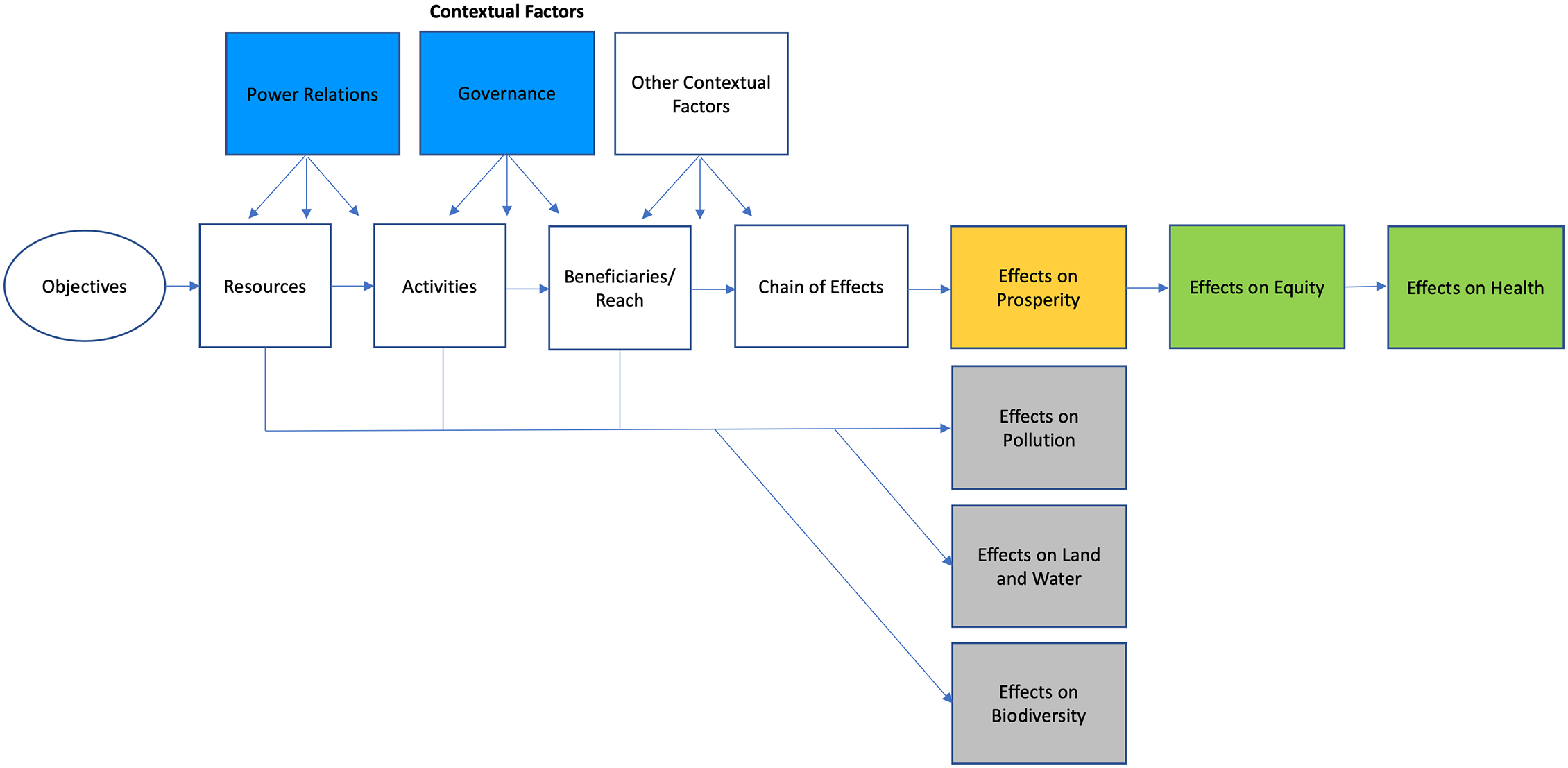
Logic model for Planetary Health.
Health: Health is a determinant of our ability to enjoy and thrive in life. “Health is a state of complete physical, mental and social well-being and not merely the absence of disease or infirmity” (WHO: https://www.who.int/about/who-we-are/constitution). Health is determined by many factors related to individual behaviors and characteristics, our physical environment, access to health services, and is in part determined by our position in society in terms of income, education, gender, employment, and working conditions. Culture also defines what health means and determines, in a certain measure, what health determinants are significant (see as an example The BC First Nations Health Authority Framework for Health and Wellness: https://www.fnha.ca/wellness/wellness-for-first-nations/first-nations-perspective-on-health-and-wellness). Furthermore, it makes a significant impact on our health; our culture normalizes behavior and influences and is influenced by our attitudes and actions. For example, in the recent past, it was common not to wear a seatbelt, to smoke in public indoor spaces, and to cycle without a helmet. Over time, our cultural attitudes have shifted, and new norms have emerged.
Equity: Equity “is the absence of avoidable or remediable differences among groups of people, whether those groups are defined socially, economically, demographically, or geographically” (WHO: https://www.who.int/healthsystems/topics/equity/en/). Equity “refers to fair opportunities for everyone to attain their full health potential regardless of demographic, social, economic or geographic strata” (WHO: https://www.who.int/gender-equity-rights/understanding/equity-definition/en/). Equity is a major but often overlooked determinant of health. It is also a major determinant of population resilience, which is our capacity to adapt to and recover from crises (Karanikolos et al., 2013; Stuckler and Basu, 2013; Stuckler et al., 2009). Attention should be paid to people excluded from programs and policies to avoid increasing or institutionalizing inequities. Universal programs (accessible by all) are normally more equitable.
Prosperity: The goal here is for our collective activities to meet basic needs and support population well-being. We choose to use the term prosperity rather than economic growth to include the many forms of economic and social activities that contribute to well-being. Prosperity includes contributions such as social capital, informal exchange and sharing systems, and/or out-of-market solidarity systems, for example. GDP is no longer considered a valid indicator of progress (Alexander, 2015a, 2015b; Jackson, 2017; O’Neill et al., 2018; Raworth, 2017). There is an on-going debate around Green Growth, Degrowth and Green New Deal. Green growth is likely to lead to reduced GHG emissions but also to increased unemployment and inequities unless strong redistributive social programs are concurrently implemented (O’Neill, 2020). Degrowth, with strong redistributing policies, and Green New Deal seem to be models that would allow for reduced impacts on GHG emissions while also mitigating negative social impacts and achieving a just transition (D’Alessandro et al., 2020; O’Neill, 2020). The use of the term prosperity in the framework refers to the rights of human beings to have enough resources to fulfill their basic needs and enjoy life.
With regard to existing programs or policy theories, effects (intended and unintended) on three dimensions of natural systems need to be considered. These dimensions have been identified based on Rockström et al.’s (2009) work on planetary boundaries for safe operating space for humans:
Pollution: Pollutants (including upstream pollutants from intervention inputs) that are attributable to the program or policy (production, implementation, and operation) need to be identified.
Land and Water: Impacts of the program or policy on land (e.g. carbon sinks, natural land cover) and on water (e.g. perturbations to rivers, freshwater use, and ocean acidification) need to be considered.
Biodiversity: Impacts of the program or policy on biodiversity (e.g. pollinators, plants, animals) need to be systematically considered.
Governance: “Governance refers to the ways and means employed by society to make collective decisions, choose collective goals, and take action to achieve those goals” (Chaffin et al., 2016: 401). Governance is a multilevel function, from local/community governance to international institutions and laws as well as political, economic, and military interactions. In contexts of colonization, “consent, trust, accountability, and reciprocity are qualities of relationships that are critical for justice-oriented coordination across societal institutions on any urgent matter” (White, 2020: online). Working respectfully with local Indigenous Peoples and communities, respecting self-determination and Indigenous sovereignty is part of building more equitable and more resilient communities (Corntassel, 2021; Corntassel and Bryce, 2012; Kuokkanen, 2019). Implementing these concepts necessarily leads to transforming existing power relations.
Power Relations: Closely related to governance, power relations are an important determinant of whether/how resources for policies and programs are allocated and benefits and costs are distributed, how programs are designed, and whether/how they are implemented. It is important to consider who holds power due to systemic inequity/bias, how power can be redistributed to people and communities who are marginalized by dominant systems, and what and how opportunities and partnerships for shared capital, resources, land, and governance are created. As transformational projects may also lead to strong political opposition from some interest groups, anticipating power relations and resistance will be important when leading evaluations for Planetary Health. We suggest systematically including a mapping of major actors and understanding the structure of power when constructing the logic model.
Other Contextual Factors: External factors unrelated to the intervention may also influence it and its impacts on human and natural systems (inflation is a possible example). These factors should be identified and named to accurately represent the system of influence.
We have argued in an earlier work that each of these dimensions are determinants of human health and well-being (Brousselle and McDavid 2021) and if they are not made explicit in the logic model, they will not be addressed in the evaluation and in the intervention. If we want the ecological transition to bring more positive and equitable benefits, we need to think more holistically and integrate and ground evaluation in these dimensions. Systematically including these dimensions in our evaluation models is aligned with the UN Sustainable Development Goals (see Figure 3), and it becomes apparent that this approach could address all 17 SDGs simultaneously rather than approaching them in a siloed way or choosing specific goals and setting others aside. In the next section, we demonstrate how to use this representation to offer better alternatives with greater positive impacts on Planetary Health.
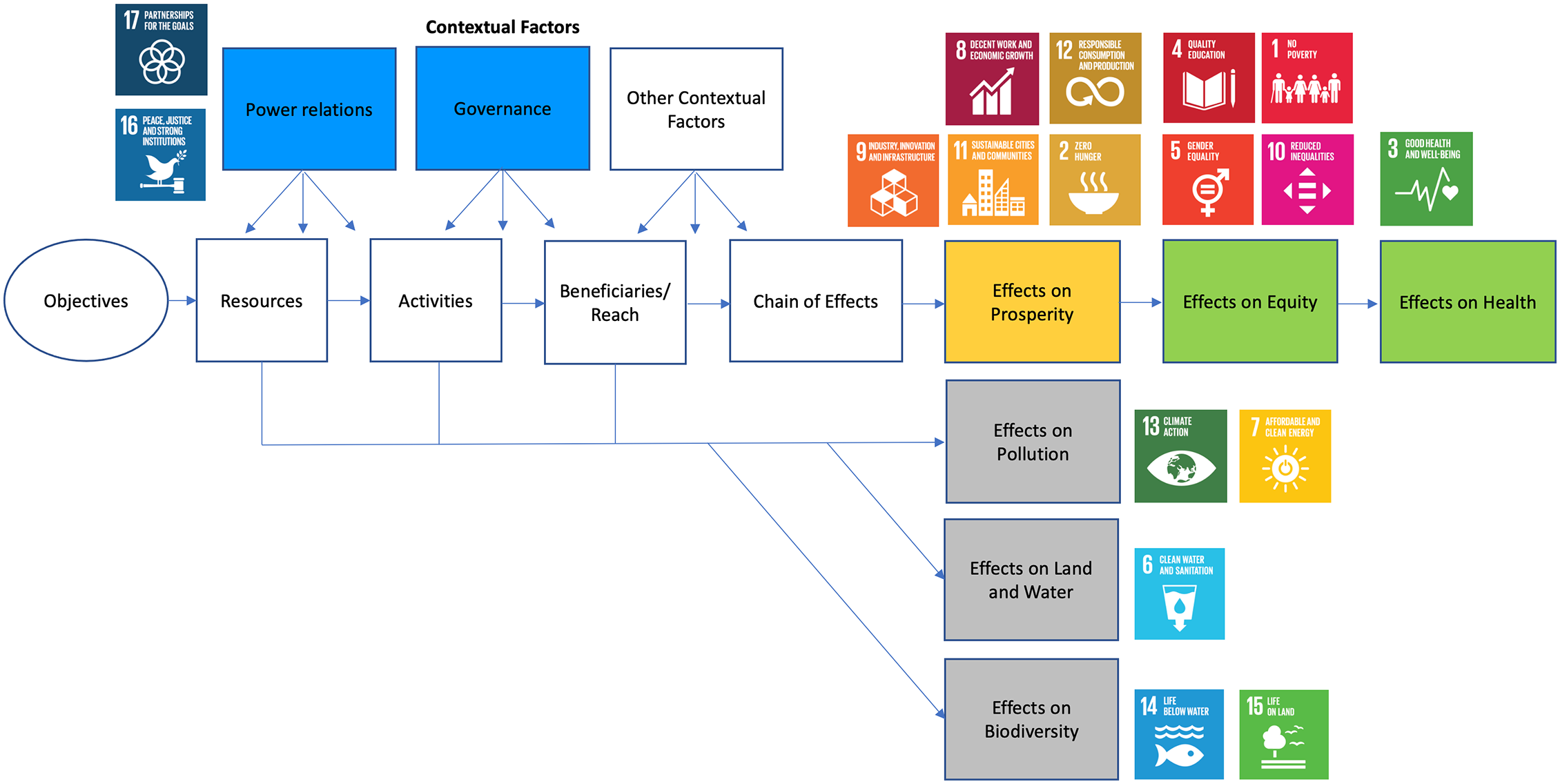
Logic model for Planetary Health and the 17 UN sustainable development goals.
Systematically assessing the dimensions that matter for Planetary Health
Thus far, we have critiqued evaluators’ assessments of projects, programs, and policies that are complicit in decision-making processes that are siloed and reductionistic; we have made the case that a more holistic approach to evaluation, captured in the Planetary Health lens, is necessary to address the complex environmental problems of our time. In this section of the article, we will demonstrate how to assess each of these eight dimensions and offer recommendations for improving the intervention or alternatives for more desirable ones. The assessment process is shaped by a series of questions that reflect the Planetary Health dimensions. We have set this up by asking questions intended to generate dialog, reflection, and learning.
Using the logic model as a guide, we first assess the environmental considerations: pollution, biodiversity, and protection of land and water. Below, we demonstrate how this assessment is approached in formative and summative evaluations.
In a summative evaluation, alternatives with lower (negative) environmental impacts or with restorative potential should be considered. What alternative interventions contribute to environmental restoration? What alternative interventions have lower impacts on pollution, on land and water, and present lower risks for biodiversity? Would they be options in the current context? Why or why not? If there are alternatives leading to reduced negative impacts and/or increased positive impacts on the environment, they should be seriously considered and discussed. The discussion will likely reveal resistance to innovative options, but addressing climate change, pollution, and loss of biodiversity is iterative and moves agendas toward the transformation that implies a readiness to stand and have these conversations if we do not want to contribute to further deterioration of the situation.
Formative and developmental evaluations are usually done during the development or improvement process of a project, program, or policy. In formative and developmental evaluations, ways to mitigate negative environmental impacts can be explored: How can pollution caused by this program or policy (production, implementation, and operation) be reduced? How can negative impacts on land and water be mitigated? What can be done to protect or encourage biodiversity? How can we enhance positive impacts of the intervention on the environment?
Again, this kind of dialogic approach will need to be applied to all kinds of evaluations, even on existing programs, to identify impacts on natural and human systems, to make them visible, and enhance dialog on how to reduce such negative impacts and implement positive changes that would contribute to better consequences on Planetary Health. The questions indicated below need to be considered as a guide and should be adapted to local contexts. The dialogic process is largely iterative and the questions are intended to animate discussions among evaluation participants, focusing attention on Planetary Health-related factors.
With regard to Health, we need to document what health-related effects there are, positive and negative, and then ask if there are ways to mitigate negative health impacts and enhance positive benefits. Questions include: Is the intervention impacting individual and population health? How can negative health impacts be prevented or compensated for? How can positive impacts on health be increased? Is the intervention contributing to creating places that promote social interactions, connection to culture and place, and encouraging physical activity? Consider green spaces, quality of life, social well-being, physical activity, and mental health.
With regard to Equity, questions that may be asked include: who benefits and who is excluded from the design and implementation of the intervention? Is the intervention increasing inequality among some groups of the population? Who will be negatively impacted? What can be done to reduce or negate these impacts? Is there a way to create a more inclusive intervention? Can a universal program be implemented? Are there other alternatives that will bring higher equity and inclusivity while achieving the main expected objectives? Consider gentrification, gender, racism, colonization, disabilities, income, and age.
With regard to Prosperity, questions that can be explored include: Is this intervention strengthening the local economy and contributing to livable incomes? What can be done to increase positive local economic consequences, including diversification? Does the intervention contribute to building social capital? Could it do more? What needs to be put in place to minimize negative economic impacts of the intervention on individuals and communities? How can the intervention be designed to give new sustainable economic opportunities to citizens? How can the program contribute more to local expertise? What needs to be done to transfer expertise locally, to produce locally?
External factors should also be considered early as they are major determinants of an intervention’s implementation success. In particular, two elements need to be emphasized: multiorganization/government coordination, which includes respectfully consulting and/or partnering with Indigenous communities in the region, and power relations.
In terms of multilevel coordination and governance: What groups, networks, institutions, and so on have an interest or influence on the intervention? Are there Indigenous communities in the region? What is their relationship to place? Have they been consulted and are they part of the decision process? Have they given free, prior, and informed consent (United Nations, 2007) to participate and to the outcome of the evaluation? Are all levels of government coordinated in such a way that they offer optimal support to the implementation of the intervention? How can greater collaboration and support be built across orders of government and communities? What needs to be done to enhance Indigenous Peoples’ rights?
With regard to Power Relations: How are current corporate interests benefiting from the intervention? Who could be affected by changes to the status quo and in what ways? What is the current power structure around the intervention? What can be done to reduce resistance and protect the intervention implementation? What needs to be done to protect the implementers from external political pressures? In the context of reconciliation, is Indigenous sovereignty and self-determination respected? Do actors engage in enhancing consent, trust, accountability, and reciprocity with local Indigenous communities? How can power be redistributed to people and communities who are marginalized? Can opportunities and partnerships for shared capital, resources, land, and governance be created?
Proposing an improved or alternative intervention
Based on this analysis, recommendations are formulated to improve the intervention or offer alternatives. A new model of the proposed intervention can be drawn which would represent an intervention for Planetary Health since it takes into consideration impacts on natural and human systems. Figure 4 offers a schematization of this approach. The initial model of the intervention is presented on the left side of the figure. The middle part of Figure 4 can be thought of as a series of filters with the intention of improving its alignment with Planetary Health goals. It is, in fact, an iterative process to question the design of the intervention and explore promising alternatives. This dialogic process will normally lead to the identification of some trade-offs, recommendations for improvements, and identification of alternatives to the intervention. On the right side is the model of the revised intervention or alternative that is now better aligned with planetary health goals.
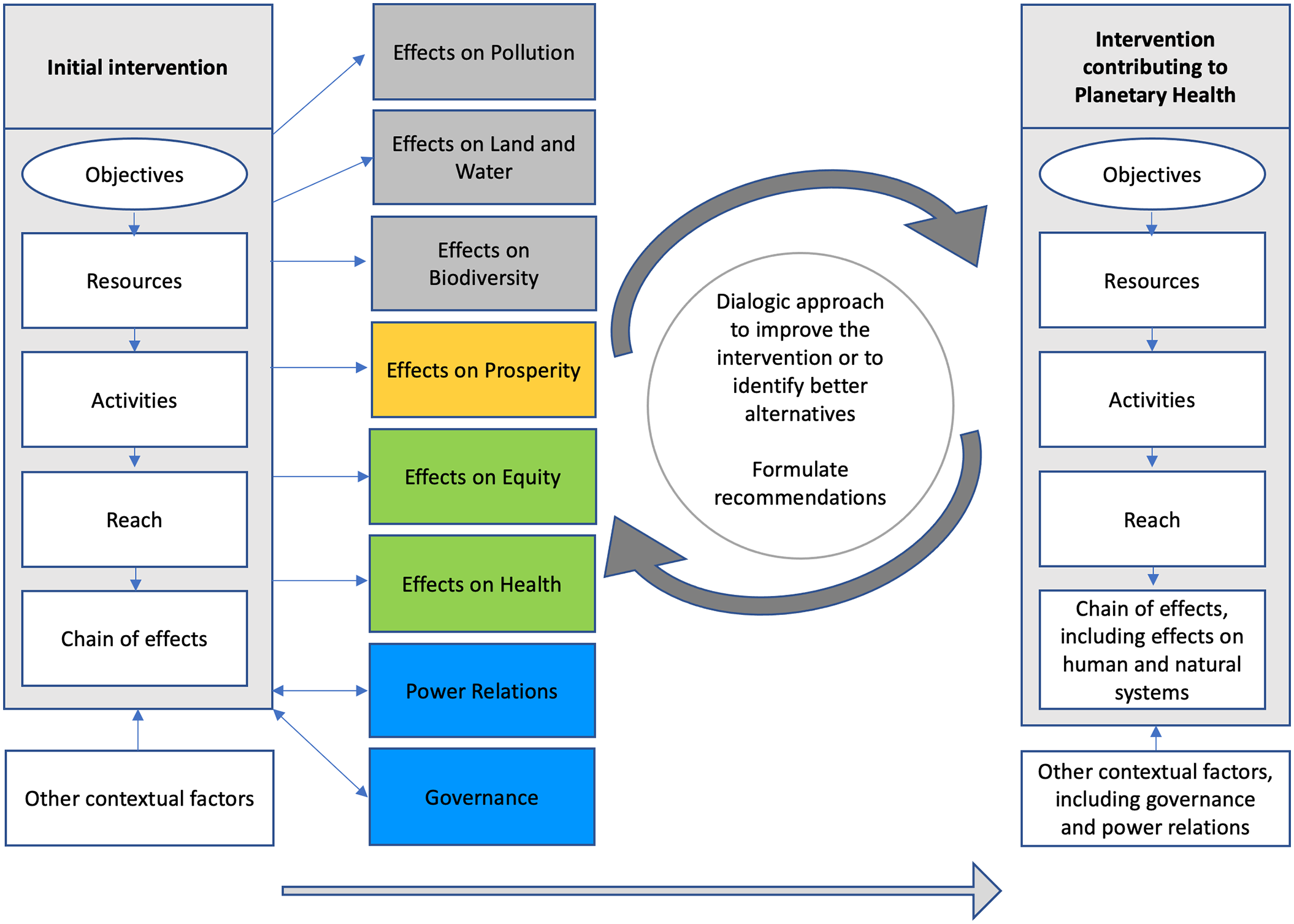
Designing program theories for Planetary Health.
Because the methodology that is suggested in our example below is focused around using checklists, this whole approach is intended to shift the conversation—to include topics and questions that otherwise would not be a part of decision-making. We view this as a pragmatic place to begin.
There are three challenges for evaluators using such an approach. The first one is about the iterative process and interpreting the interconnections of some dimensions. While using a step-by-step approach, one will probably realize that iterative work needs to be done to readjust the model when progressing toward the integration of more dimensions. Using this approach and testing it on different interventions and in different contexts permits the identification of the most efficient steps for conducting such an analysis. In the meantime, this model includes the dimensions that matter, in a comprehensive way, which is an important aspect of this work, and the evaluator needs to be prepared to be flexible to allow for the necessary iterations.
The second difficulty will be related to the level of analysis. For example, should direct as well as indirect GHG emissions effects associated with the substitution of activities be factored into the analysis? A bike-share program, for instance, generates GHG emissions through bike production and merchandize transportation to communities purchasing bikes for their programs. Should impacts on the reduction of cars also be included as they have indirect effects on GHG emissions? Questions may also arise with regard to human dimensions: When considering health, for example, how can individual health be valued compared to the community or population health? Or should both be considered and to what degree is each weighted in importance?
The third difficulty is about trade-offs. Even if co-benefits exist for many interventions (a bike share program will, e.g., lead to positive impacts on human health and on GHG emissions), the evaluator may sometimes be confronted with trade-offs. An intervention may lead to positive impacts on health and lead to negative effects on natural systems, or the contrary. Time is also commonly debated: how do we value short-term versus long-term impacts? What criteria should be used to make a choice? How do we decide one dimension is more important than the others? There are no easy answers to these questions. The scope of effects will be important to consider if such trade-offs exist. Being transparent about the trade-offs and debating with different actors will help move forward; choices will also be made on more explicit criteria.
An example
The Planetary Health framework has been used by several Climate Caucus workgroups to analyze several local government initiatives. Below, the example of an e-bike program aiming at reducing reliance on traditional transportation modalities by community residents is presented. The questions posed during this reflective and exploratory process enabled the participants to think more broadly about the project. Instead of thinking about a singular program focused on e-bikes, the questions and dialog allowed participants to see the opportunity to broaden the project concept to micromobility: the range of small, lightweight devices operating at speeds typically below 25 km/hour, that can be privately owned or shared, and that can be either human or electrically powered. We present a summary of the considerations that illustrate the kinds of results this approach produced. Figure 5 presents an illustration of this process, showing the initial logic model and the revised one after applying Planetary Health lenses, which we will explain later in this section.
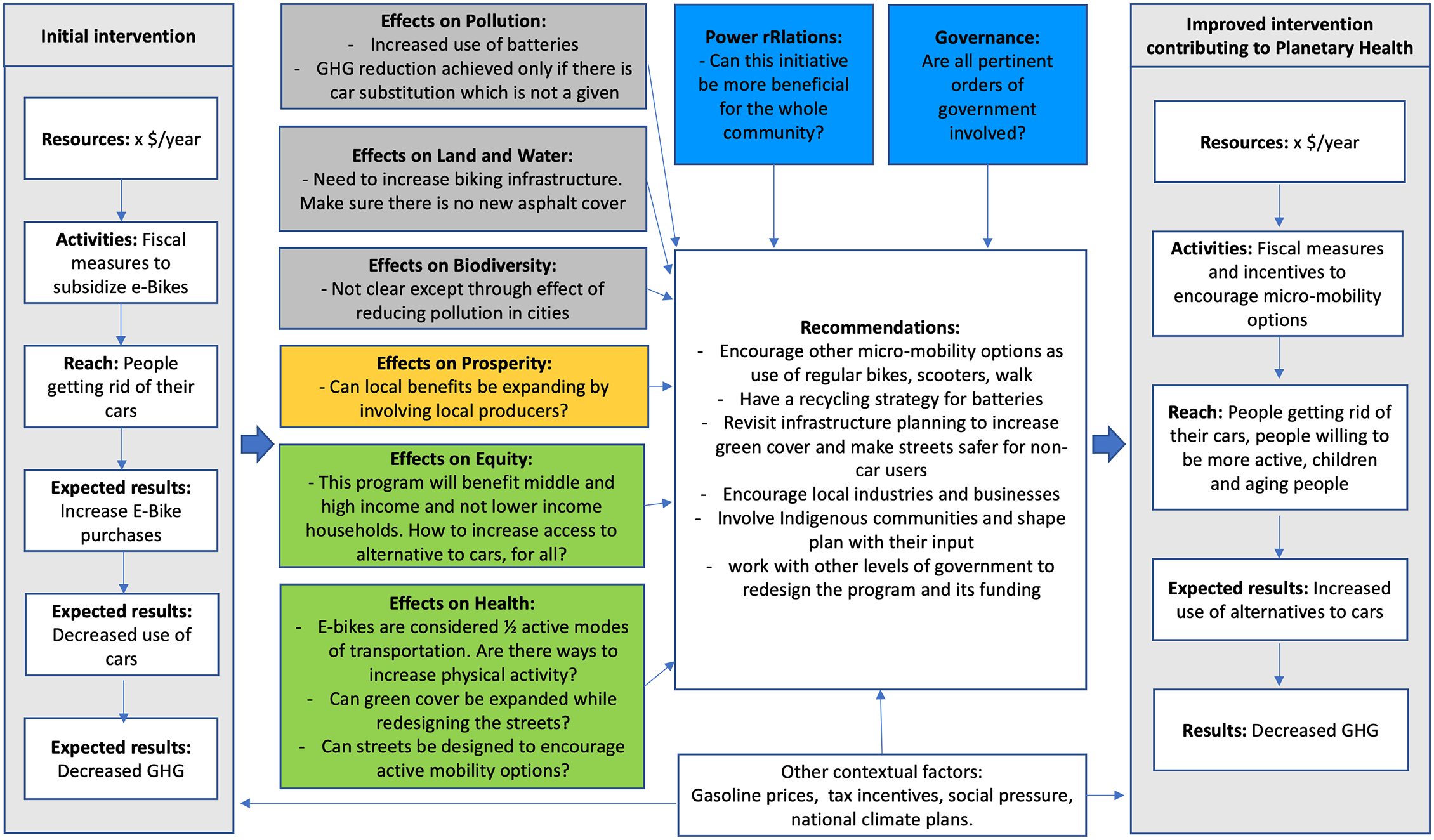
From e-bikes to micromobility options.
How the project evolved through consideration of its natural systems implications
The Planetary Health Framework invited local elected officials to consider the impact on natural systems upfront. The process uncovered impacts that could be directly managed through intervention design but would otherwise not have been contemplated until well into the program implementation stage. For example, the process uncovered the potential to repurpose existing developed spaces (e.g. defunct railway lines; existing parking spaces; and existing roadways) to reduce impacts on land and water. Further, the framework helped highlight the need to find low-impact weather-related road maintenance practices (alternatives to salting and sanding in the winter which can impact water quality).
How the project evolved through human systems dimensional thinking
Overall, the Planetary Health Framework supported holistic planning in this example. This approach facilitated designing the program to include outcomes that would not have been realized using a status quo model. For example, beyond expanding the scope of the project from e-bikes to the broader micro-mobility plan, several additional considerations surfaced that enhance infrastructure planning and design, reduced negative impacts on natural systems, engaged community members, and improved equity and prosperity across the community.
The end result is a program design that not only meets the original objectives of reducing GHG emissions but will have further positive and sustainable ripple benefits for the community on health, equity, prosperity, and community relationships as more users are likely to be involved and switch modes of transportation. Importantly, the new program design will not do further harm to the natural environment on which community health and well-being depend.
Discussion
A key purpose of this article has been to elaborate and illustrate with an example, an approach that takes into account the possible relationships between interventions (projects, programs, and policies) and factors that are widely recognized as contributors to Planetary Health. As such, our purpose is to contribute to a broader transformation agenda for the evaluation field, recognizing that, notwithstanding the challenges in advocating such an approach, the stakes for us as professionals are unprecedented.
Evaluators have a key role in influencing how evaluation participants and commissioners perceive interventions and their impacts and on the recommendations moving forward. Typically, evaluators take the stance that they are also facilitators and ready to engage in debate and conversations for the public good. In this article, we urge them to be more reflective and self-conscious about their own practices, and to insist that those for whom they do this work, also take this stance.
In this article, we have offered a step-by-step approach to representing logic models and systematically assessing interventions in terms of their contributions to Planetary Health. This approach can also be introduced as a component of any evaluation project. In this article, we are not proposing a recipe that would be systematically applied, but rather want to illustrate how it is possible to systematically integrate the dimensions that matter in our evaluations and that are beyond the effects normally considered in our projects. We encourage each one of you to try this approach and offer feedback. The spirit in which this work is being developed is to encourage cooperation and collaboration among evaluators. This work is intended to benefit our society. Its relevance rests in it being used and improved. Using this approach in different contexts may also suggest the need to introduce pertinent dimensions not already introduced.
This proposal is a broad approach to evaluation that does not require any specific expertise. It is accessible to anyone willing to make a positive difference through their evaluation work (theory and practice). As for program-related models, we encourage evaluators to build the program theory by involving a variety of actors. The benefits of using such an approach are programmatic—by making a difference in how the interventions are designed—but also processual; by involving different actors, they can contribute to building the original model and play an important role during the assessment of the intervention. This will likely result in higher levels of engagement and commitment and increase awareness of the many impacts of the intervention.
Fundamentally, because this process advocates core values, it will be political. Evaluators need to be ready to justify why such an approach is used and is different from the usual approaches to evaluation work. Our field is shifting in response to global recognition of the need to transform our practices to address today’s challenges (Patton, 2020; Van den Berg et al., 2021). There is increasing consensus that we need to be self-conscious of how we contribute by our current practices to this undesirable status quo and the need to reinstate what is core to our profession, working for the public good. These efforts parallel those of many international institutions’ and governments’ commitments. The new IPCC report released on 9 August 2021, declares the urgency of bringing transformative changes to avoid cataclysmic consequences for human beings. These transformative changes will come from each one of us, and, as evaluators, it is our role and responsibility to immediately implement different practices that would bring such desirable change.
Conclusion
We are in a decisive decade for human civilization, with limited time to debate the merits of transformational changes. To be relevant as a field, we evaluators must recognize there is a multitude of solutions and each one of us can make a difference on our own scale. It is time we dared to try new things. We can introduce new practices that will systematically and simultaneously consider the well-being of humans and the health of the planet addressing both the ecological and social crises. Starting evaluation projects with program theories that take into account Planetary Health dimensions is a significant step: they offer a way for evaluators to be self-conscious, transparent, and accountable in how we represent our interventions. It reveals hidden dimensions that will make a critical difference to address the common good. Being aware of the impacts of our interventions on human and natural systems is a beginning. As evaluators, we know how to lead these conversations and that is a key to start this crucial work.
Footnotes
Acknowledgements
We would like to express our deep gratitude to Jeff Corntassel, Associate Professor in Indigenous Studies, University of Victoria, who generously shared his expertise and provided comments to strengthen the draft of this manuscript.
Declaration of conflicting interests
The author(s) declared no potential conflicts of interest with respect to the research, authorship, and/or publication of this article.
Funding
The author(s) received no financial support for the research, authorship, and/or publication of this article.
