




Abstract
Evaluators often find themselves on ‘rough ground’ as they try to do the right thing and do it well. They face unanticipated ethical issues requiring decisions that are subtle and nuanced, and they do not always find the expected guidance in current ethics guidelines. In the present article, the authors offer practical wisdom as an alternative to the deontological approach. First, we develop this complex concept and illustrate its contribution to addressing and resolving ethical issues. Second, we present a study and the model that emerged from it to illustrate how practical wisdom contributes to finding solutions to ethical dilemmas and taking the necessary action.
Evaluators often find themselves on ‘rough ground’ as they try to do the right thing and do it well (Schwandt, 2005). They face unanticipated ethical issues requiring decisions that are subtle and nuanced, and they do not always find the expected guidance in current ethics guidelines.
McDavid et al. (2019) distinguish two major approaches of ethical reasoning – the deontological approach and practical wisdom – and both are required, as they serve different purposes. Deontological ethics is ‘based on being able to identify and act on a set of unchanging ethical principles’ (McDavid et al., 2019). This is also called the duty or rules approach. Practical wisdom, for its part, is defined as the ‘ability to perceive a situation, to have the appropriate feelings or desires about it, to deliberate about what was appropriate in these circumstances, and to act’ (Schwartz and Sharpe, 2010: 5). DeMartino (2019) adds the following nuance: ‘[practical wisdom is] about helping virtuous practitioners do good in a complex world where what it is right or good to do is often uncertain’ (p. 9).
Professionals like physicians, nurses and managers have come to understand over time that the deontological approach is appropriate for simpler situations or situations without conflicting ethical principles, but it is not able to offer an adequate answer in the case of complex situations where there is no ‘one-size-fits-all’ solution (Bachmann et al., 2018; Butts and Rich, 2016; Dunham, 2010; Jeannot, 1989; Melé, 2010; Morales-Sanchez and Cabello-Medina, 2013). If more and more of these professionals have opted to use practical wisdom as a framework for ethical reasoning to guide their practice when facing complex ethical issues, this does not seem to be the case for evaluators, despite their demands for better guidance when confronted with similar situations.
Having said that, one must recognize that practical wisdom is a complex concept that not all theoreticians understand in the same way in all respects. Kinsella and Pitman (2012) acknowledge that it is a ‘slippery concept’ which makes guidance difficult (Bachmann et al., 2018).
The present article aims to first define the concept of practical wisdom, and then to describe how it can be used to address and resolve unanticipated ethical issues.
Presenting practical wisdom
What is practical wisdom?
For Robinson (1990), practical wisdom is one of the human virtues and encompasses three dimensions: wisdom of life (sophia), wisdom of theoretical knowledge (episteme) and wisdom of practice (phronesis). Sophia refers to the behaviour of an individual who combines awareness of self and others with temperance, prudence, sincerity, discernment and justice, while relying on reasoned knowledge. Episteme constitutes the body of scientific knowledge, which allows scientific inquiries to be validated by offering standardized methods to guarantee predictable and reliable results. Finally, phronesis consists of ‘some kind of moral knowledge or conscience or even mindfulness, which allows us to do and act good in a given situation, based on our understanding of how to live well overall’ (Weiss, 2018: 13), without denying that ‘in complex circumstances, knowing which goods and which ills are at stake is relatively easy, but knowing the various net balances among them is the hard part of determining what course of action to undertake’ (Kroll and Mason, 2022: 168).
The concept of practical wisdom being complex per se, theorists have a nuanced understanding of it. Flyvbjerg (2001), Kirkeby (2009) and Saunders (2018) view practical wisdom as a combination of the telos of a practice and moral values. Melé (2010) enhances this description by discussing the combination of three actions: counselling (deliberation), judging (evaluation of possible courses of action) and commanding (acting effectively in relationship to one’s judgement), a view that is also endorsed by Kristjánsson et al. (2021). Finally, Jenkins et al. (2019) add to this conception the contribution of abilities such as embodiment, open-mindedness, perceptiveness and reflexivity.
Key characteristics of practical wisdom
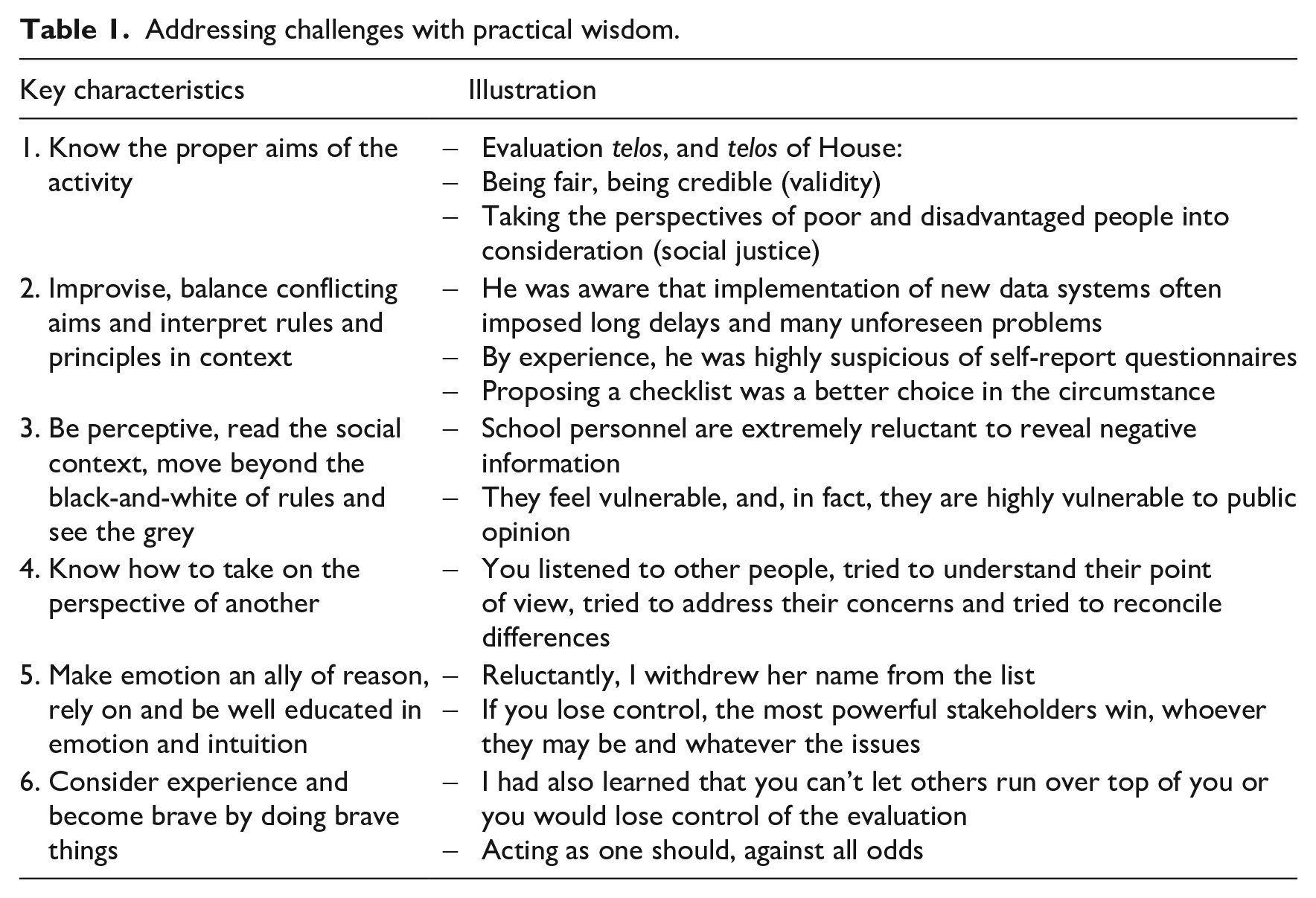
Key characteristics bring us closer to an operational understanding of the concept. For Schwartz and Sharpe (2010), a person who uses practical wisdom to identify a problem, formulate a solution and take action embodies six key characteristics, namely: [The person] (1) . . . knows the proper aims of the activity she is engaged in. She wants to do the right thing to achieve these aims – wants to meet the needs of the people she is serving; 2) . . . knows how to improvise, balancing conflicting aims and interpreting rules and principles in light of the particularities of each context; 3) . . . is perceptive, knows how to read a social context, and knows how to move beyond the black-and-white of rules and see the grey in a situation; 4) . . . knows how to take on the perspective of another – to see the situation as the other person does and thus to understand how the other person feels. This perspective taking is what enables a wise person to feel empathy for others and to make a decision that serves the client’s (student’s, patient’s, friend’s) needs; 5) . . . knows to make emotion an ally of reason, to rely on emotion to signal what a situation calls for, and to inform judgment without distorting it. He can feel, intuit, or ‘just know’ what the right thing to do is, enabling him to act quickly when timing matters. His emotions and intuitions are well educated; and 6) . . . is an experienced person. Practical wisdom is a craft and craftsmen are trained by having the right experiences. People learn how to be brave, said Aristotle, by doing brave things. So, too, with honesty, justice, loyalty, caring, listening, and counselling. (Schwartz and Sharpe, 2010: 25–26)
By helping to find solutions to various pitfalls as they appear, practical wisdom can address as well as resolve ethical dilemmas. We will offer stories to illustrate these two options.
How practical wisdom addresses dilemmas
We have selected the following story shared by Ernie House (2015) in his chapter ‘Evaluating with Practical Wisdom’ to illustrate how practical wisdom can address dilemmas, thereby preventing problems from emerging.
The Denver bilingual program had been in the news for many years . . . During these years, antagonisms between the school district and Latino community had become intense. I set up my first meeting with the Denver superintendent of schools. That meeting turned out to be quite rough. The superintendent wanted me to act as total arbiter of the new court agreement. One option was to assume the legal authority of the court and declare ‘what was what’. However, in thinking about the politics, I decided to be more conciliatory and inclusive. I had been involved in several politicized evaluations before, and my sense of how things worked out was that the long-term results would be better if you listened to other people, tried to understand their point of view, tried to address their concerns, and tried to reconcile differences. At the same time, I had also learned that you can’t let others run over top of you or you would lose control of the evaluation. If you lose control, the most powerful stakeholders win, whoever they may be and whatever the issues. I struck a balance between using my authority and sharing it with stakeholders. And this required balanced judgment. (pp. 92–93)
The full case study in House (2015) provides additional information that allows us to follow the challenges Ernie House encountered while collecting and analysing data, managing relations and so on (pp. 46–54). We will consider how he addressed various potential problems by referring to the key characteristics presented in Table 1.
Addressing challenges with practical wisdom.
How practical wisdom resolves dilemmas
We would also like to share the ‘Luke story’, an often-referenced anecdote in respect to practical wisdom that was first presented by Schwartz and Sharpe (2010). We chose the following summary by House (2015) as it best captures the story’s essential elements.
Luke is a custodian working at a large teaching hospital. A young comatose man was a patient in one of Luke’s rooms. The man had gotten into a fight in a bar and had been seriously injured. He hadn’t gained consciousness for six months and showed no signs of doing so. During this period, his father spent a huge amount of time at his son’s bedside, hoping for a miracle. One day, while the father was out smoking a cigarette, Luke cleaned the room. When the father came back, he became angry and accused Luke of not having cleaned. At first Luke started to argue with him, but then decided that wasn’t the wisest course of action. Luke cleaned the room again with the father watching him do it. (pp. 87–88)
To highlight the contribution of practical wisdom in solving ethical dilemmas, we analyse the situation via two scenarios, one considering the deontological approach, and the other, the practical wisdom approach. These two scenarios are presented in Table 2.
Comparing two scenarios.
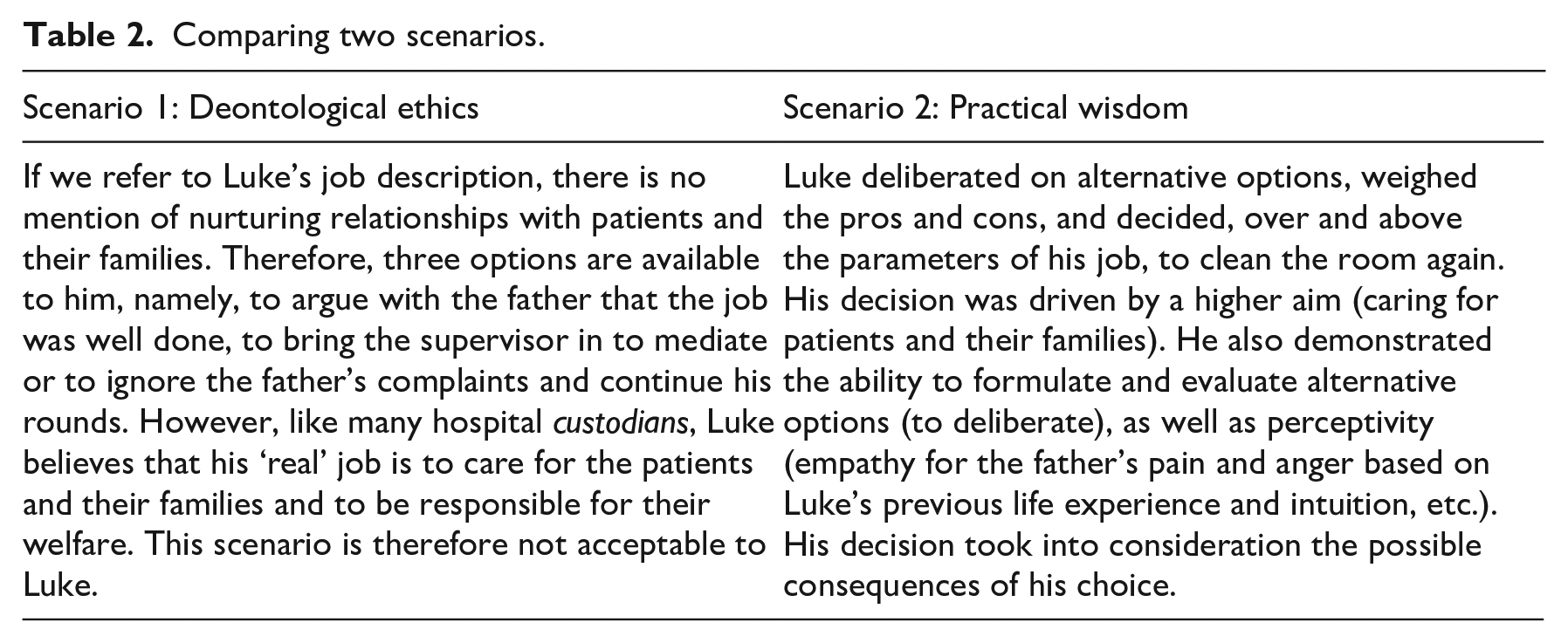
The distinctions between the solutions in the two scenarios help us understand that each option has its own characteristics. In the next comparison, we refer to ethics to define the boundaries and principles of each approach and how the consequences of actions are viewed. This comparison is presented in Table 3.
Comparing the characteristics of the two approaches.
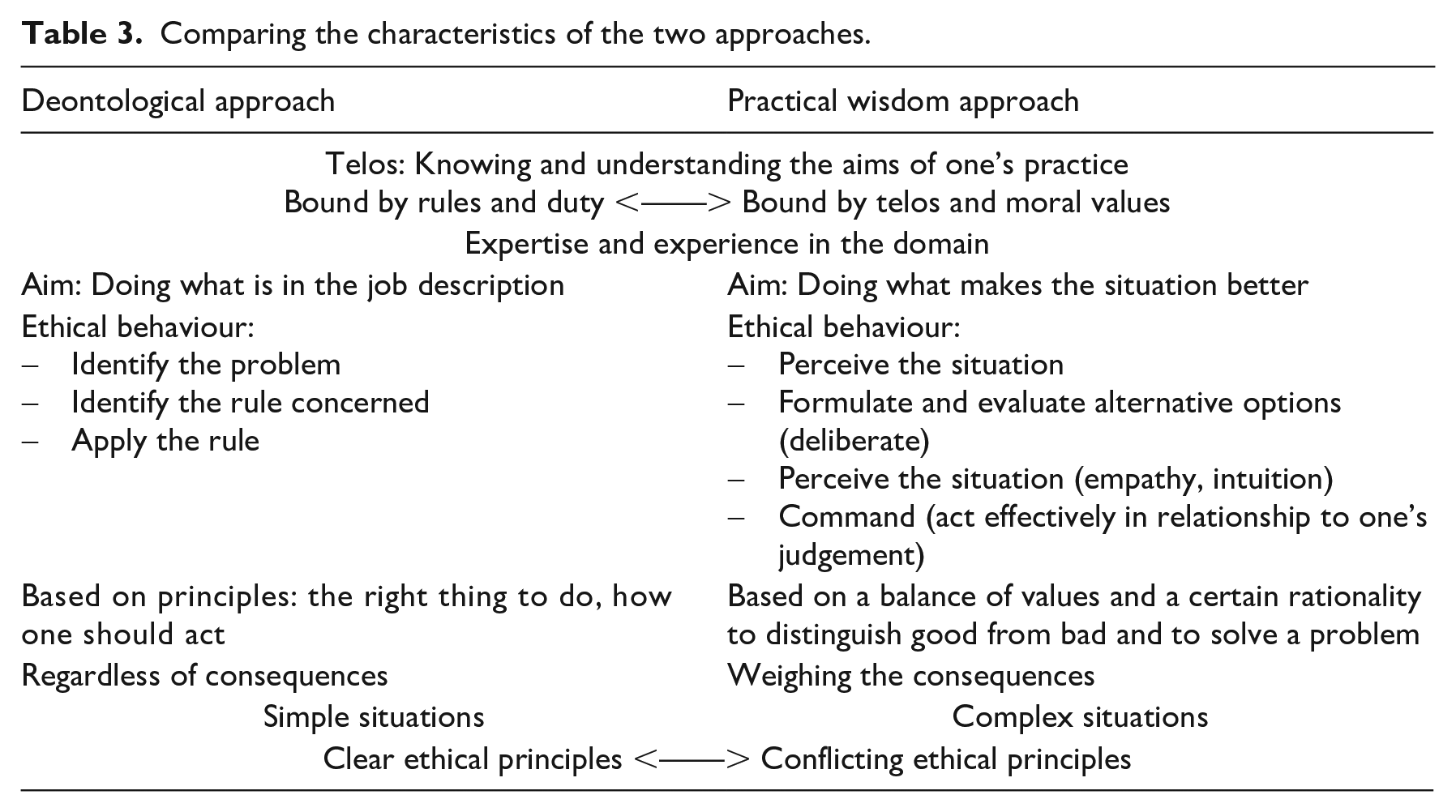
The two approaches generate different solutions, and both could be considered valid. This comparison aims above all to highlight the differences in how information is processed and what solutions are identified.
Synthesis
Many situations will arise in professional life in which the solutions offered by the rules and guidelines of one’s job or one’s role, as in Luke’s case, will not offer an acceptable solution to a complex problem. Practical wisdom offers an alternative approach in unexpected situations as well as in new contexts that pose new problems. By ‘bending the rules’, practical wisdom offers an approach to ethical reasoning that fits into daily practice by ensuring pragmatic decision making as well as a robust professional autonomy. For many theorists, By acknowledging the moral dimensions of professional practice and fostering the development of moral dispositions in those who practice, it is more likely that practitioners will be able and willing to reflect on the consequences of their decisions for their clients and for other stakeholders, and have ethical considerations impact their actual practice. (McDavid et al., 2019: 486)
Finally, Krettenauer (2019) reinforces our earlier remarks to the effect that there is no ‘best’ approach. Rather, rules-based approaches and practical wisdom are complementary to one another. Evaluation societies and associations have largely relied on deontological codes of ethics (the duty approach) to oversee the practice. It is important to reiterate that the goal of the present article is not to question deontological ethics but to offer a complementary approach to evaluators facing complex situations.
Keeping in mind that evaluators are requesting better guidance around ethical dilemmas, that practical wisdom is not a well-established practice in the field and that practical wisdom is a complex concept, we will describe how practical wisdom can be used in various fields to find solutions to unanticipated ethical problems. We hope that evaluators will develop a better understanding of the concept and that they will consider integrating it into their practice as an approach to resolving complex ethical issues.
Greeff and Rennie (2016) conducted a similar study in the context of community-based research. They selected eight expert researchers to take part in a semi-structured focus group discussion. That discussion induced a model presenting phronesis as a crucial decision-making skill for dealing with the uncertainties faced during community-based research. The focus group describes phronesis as a specific skill built on experience, expertise, personal values and so on, and facilitating characteristics such as common sense, empathy and trust. This study provides some legitimacy to our.
Applying practical wisdom
Presentation of the study
Instead of the inductive approach chosen by Greeff and Rennie (2016), we chose a deductive approach. We analysed documents relating to the experiences of professionals from various fields closely related to evaluation practice, who had applied practical wisdom to resolve unanticipated ethical issues. We decided to use the six key characteristics presented by Schwartz and Sharpe (2010) as criteria because they include different dimensions of defining practical wisdom, namely, the combination of telos and moral values, reasoning and certain abilities.
More precisely, we searched for documents over the 5-year period leading up to this study using public and university search engines with ‘practical wisdom’ and related terms as keywords. The initial search found several hundred documents referencing practical wisdom and its application. To be eligible for inclusion in the present study, documents were required to be of a scientific nature and to present case studies, which eliminated articles on religion, politics and philosophy, among other examples. We discovered next to no publications addressing practical wisdom in the programme evaluation field, so we turned to documents on judgement and decision making in other professions (e.g. health services, management, education) to facilitate the transferability of findings to the programme evaluation practice. Of a total of 166 scientific articles and 33 scientific website documents, 47 were retained. These were distributed across three sectors: education, management/business/leadership and health services, with one article integrating experience across these three domains. Most articles were in management/business/leadership and health services.
These documents were submitted to content analysis by two researchers who worked independently, after their interrater reliability was established on several articles.
One limitation of this study is that the articles are sourced from several different professional fields. A second limitation is that the articles studied were not written with the explicit intention to document characteristics of people enacting practical wisdom. Third, the field of evaluation is not addressed.
Emerging findings
The following points emerged from content analysis:
Aside from bravery whose frequency of occurrence is low, five other key characteristics can effectively be traced to support decision making in all cases, which in a way validates their suitability.
When it comes to bravery, it is understandable that people do not want to call themselves brave, especially when bravery refers to having the decisiveness and will to actualize ethical decisions, which can sometimes require professionals to go against guidelines or codes of conduct. As such, it is often their colleagues that report such acts.
Professionals always evoke the goals (telos) that drive them (e.g. honouring patients’ needs, healing, acting for the common good).
Translating these aims into action requires expertise and skills learned through experience.
The process of decision making is not linear. The different characteristics come into play at different times, in different ways and always with a view to finding a solution.
Finally, practical wisdom supports ethical decision making and can also prevent dilemmas from occurring.
Proposed framework of practical wisdom for ethical decision making in evaluation
Content analysis allowed the emergence of a model that illustrates how these characteristics interact in a situation to enable finding a solution and taking action. Figure 1 presents an outlay of this model by describing how these key characteristics interact to generate an ethical solution. More precisely, telos and moral values directly influence the nature of a solution; reasoning and abilities contribute to streamlining it, and courage provides the path from will to action.
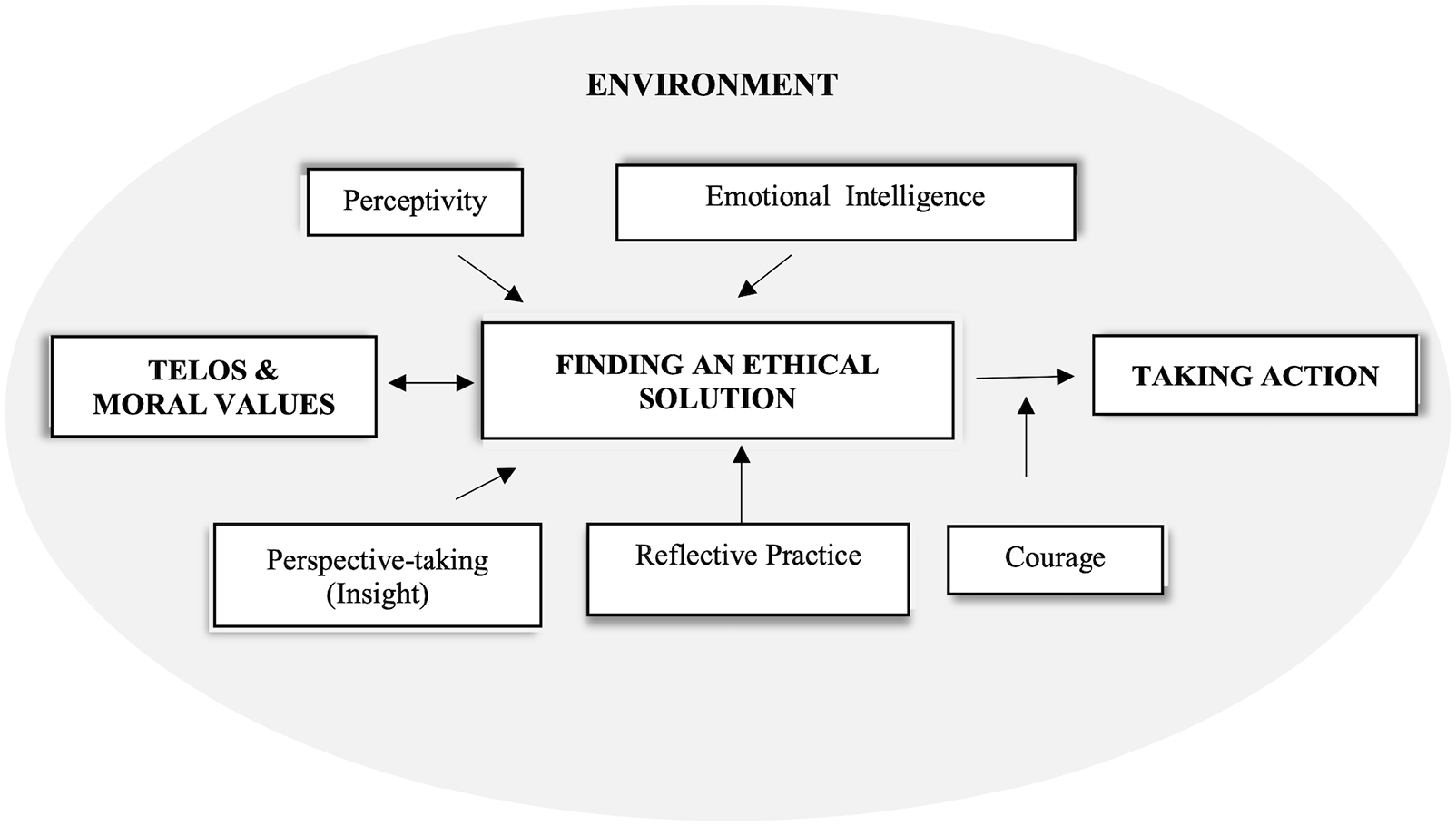
Interrelation of the key characteristics of finding an ethical solution.
We added the component environment to the model to represent the social, organizational and professional environments. This also implies that professionals must demonstrate competencies and experience related to their professional domain, and that guidelines govern their decisions and actions (through codes of conduct and ethics). This is a fundamental aspect of the model because practical wisdom should in no instance be expected to justify malpractice.
Discussion
It is interesting to observe the similarities between our model and the model proposed by Greeff and Rennie (2016). One main similarity is their presentation of practical wisdom as the result of interaction between a set of components to be used depending on the situation at hand. Another is the notion that practical wisdom can be considered a skill that leads to effective action. However, our model distinguishes what one might call prerequisites (the environment) from personal skills. It also pinpoints courage as a requirement because, importantly, professionals often know what to do but stop short of taking the necessary action due to fear of the professional and personal consequences. Finally, we believe that our model has a greater scope in terms of transferability of results, given the number of documents consulted as well as the variety of fields of practice.
However, one should not fall into the trap of believing that if one endorses practical wisdom, it will automatically be applied. Indeed, the application of practical wisdom is complex, requiring experience as well as competencies. Fortunately, evaluators can refer to various professional fields that have already adopted practical wisdom and developed guiding tools. For example, the Canadian Psychological Association’s code of ethics addresses the need to balance conflicting ethical principles in complex situations. Furthermore, psychologists are properly trained to do so. There is no reason evaluation associations and evaluators could not follow suit.
Conclusion
Evaluation is not the only discipline whose aims consist of making a judgement and identifying solutions, nor is it the only discipline faced with ethical problems. It is also not the only discipline that will require one to think outside the box to find solutions.
To solve problems, one should always refer first to codes of conduct (standards) and codes of ethics. However, such codes do not effectively resolve problems in all circumstances, and in such cases, practical wisdom is a framework that supports finding an ethical solution.
Increasingly, management, health services professionals as well as researchers are using practical wisdom as a framework for their practice and reaping enormous gains. Thus far, professionals using practical wisdom as part of their practice have not set aside codes of ethics; rather, they consider such codes to be essential and complementary to practical wisdom.
The present article aims to contribute to the evaluation practice by proposing an option that supports the process of resolving complex ethical issues. This is fundamental because, as noted by House (2015), ‘like the medical profession, evaluation has the capacity to inflict considerable damage if uncaring’ (p. 91). We could say that practical wisdom adds a tool to the evaluator’s toolkit, because ethics should be considered in all circumstances.
Footnotes
Declaration of conflicting interests
The author(s) declared no potential conflicts of interest with respect to the research, authorship, and/or publication of this article.
Funding
The author(s) received no financial support for the research, authorship, and/or publication of this article.
