




Abstract
This paper investigates the role of evaluation commissioning in hindering the take-up of complexity-appropriate evaluation methods, using findings from interviews with 19 UK evaluation commissioners and contractors. We find, against a backdrop of a need to ‘do more with less’ and frustration with some traditional approaches, the commissioning process is perceived to hinder adoption of complexity-appropriate methods because of its inherent lack of time and flexibility, and assessment processes which struggle to compare methods fairly. Participants suggested a range of ways forward, including more scoping and dialogue in commissioning processes, more accommodation of uncertainty, fostering of demand from policy users, more robust business cases, and more radical overhauls of the commissioning process. Findings also emphasised the need to understand how the commissioning process interacts with the wider policy making environment and evidence culture, and how this manifests itself in different attitudes to risk in commissioning from different actors.
Introduction
Interest in using ideas and methods from complexity science to enhance policy evaluation has increased in the last decade or so (Walton, 2014, 2016). A perceived benefit of ‘complexity-appropriate’ evaluation is its ability to capture the full complexity of the policy and context being evaluated (e.g. path dependency, emergence, feedback loops, multi-causality; see Boehnert et al., 2018), using methods that can adapt to emerging findings, that involve iteration and multi-stakeholder working (Barnes et al., 2003; Gates, 2016; Mowles, 2014; Reynolds et al., 2016; Sanderson, 2000; Walton, 2014; Williams, 2015).
Competitive tendering through government research frameworks is an important way in which policy evaluation is commissioned in the United Kingdom. The aim of this paper is to identify barriers to the uptake of complexity-appropriate methods that arise from the commissioning process, and practical changes to make commissioning easier if barriers were found. We report the research findings from qualitative interviews with 19 commissioners and contractors who have been involved in tender exercises for policy evaluation studies, mainly for one UK government department.
The paper begins with a summary of relevant work on evaluation commissioning, then describes the scope and method. The findings cover the wider operating context for commissioners and contractors as an influence on their attitudes and behaviours during commissioning, then the perceived barriers within the commissioning process, first for novel methods in general, then for complexity-appropriate approaches and methods specifically. We then describe interviewees’ suggestions on practical measures for enhancing the uptake of complexity-appropriate evaluation and conclude with the authors’ reflections.
Relevant work: Recent practical guidance for commissioning in complexity addressed a gap in the academic literature
In this section, we first review relevant academic research which has tended to only consider commissioning in passing or as part of a wider study, or to propose changes which make sense for evaluators, but not for commissioners or users. We then review practitioner guidance and discuss why these, despite only offering partial resources, are so important in the political environment evaluation operates in.
Academic research
There is a relatively small selection of studies which have dealt directly with the commissioning process and its impact on evaluation. Where it is explored, it is typically part of a wider study on evaluation or applied academic research as a whole. The differences between commissioners and evaluators is a common theme; Schneider et al. (2016) and Broer et al. (2017) find that evaluators and commissioners sometimes differ in what they perceive as ‘good’ evaluation and typically have different views and priorities. Gates (2017) suggests systems and complexity approaches can be a way to bridge this gap and be used to reconfigure the relationship between commissioners and evaluators, away from a client-service-type relationship, towards partnership models involving shared question setting, negotiated and flexible contracts, and a high level of involvement of commissioners in the actual evaluation activities.
Others have identified barriers (within and around commissioning) which can undermine effective evaluation; Schneider et al. (2016) finds a long list of barriers which the commissioning process creates (note, they do not focus on complexity or systems-appropriate evaluation specifically), including political influence, tight funding, unhelpful timeframes, lack of a ‘culture of evaluation’, caution over anticipated results, and lack of skills among commissioners. The LSE GV314 Group (2014: 226) are especially concerned with political influence, including ‘‘political ammunition objectives’ [i.e. wanting to use evaluations to support already held political positions] as opposed to ‘scientific relevance and quality objectives’’ when designing an evaluation, which they propose can shape the tender specification and compromise methods choices. Walton (2016) takes a step back and suggests it is the framing (i.e. rhetoric and political context) and governance of a policy or programme itself which may create barriers for effective complexity-appropriate evaluation, such as too narrow focus, or a limited set of evaluation users and stakeholders. Barbrook-Johnson et al. (2020) find mixed understandings and different views on the value of complexity as a lens for evaluation, among commissioners, suggesting negative views or misunderstandings (e.g. believing that being complexity-appropriate is more expensive, or creates room for uncertainty to be used as a defence by evaluators for lack of rigour, precision, or clear recommendations) may be a barrier in some cases. Barbrook-Johnson et al. (2019) more fundamentally suggest profound inflexibility, conventionality, and inertia in the research and evaluation commissioning process undermines potential for complexity-appropriate evaluation. None of these studies pay explicit attention to the rationale for the features of the commissioning processes that create the barriers and how these confer benefits to the organisations commissioning the evaluation (e.g. internal clients want them, they feel secure against critique).
However, De Laat (2013) do consider the relationship between evaluator, evaluand and commissioner in depth, but focus on the role of the commissioner (which they rightly highlight is largely omitted in the evaluation literature). They do not focus on the commissioning process in detail, but rather propose a framework through which to understand the role of commissioner. Nonetheless, this is a valuable contribution in light of the focus of existing studies on suggesting changes to the commissioning process and those which view things solely from an evaluator standpoint.
Proposing changes to the commissioning process
Another theme, which we pick up in this paper too, relates to how the commissioning process might be improved or changed. Gates (2017) makes some proposals to this end, in the face of systems and complexity thinking, suggesting different ‘things’ should be evaluated (i.e. more complex or systemic issues, boundaries of evaluations should be re-drawn), and the process should be designed to be more flexible and adaptive. Giorgi (2017) digs further into practicalities, finding that commissioning is often overly separated from other components of the evaluation and policy making process, despite efforts and the intention to have them be more integrated. Similarly, Anderson et al. (2008) suggest commissioners need to be more explicit about the aims and intended uses of studies (presumably, where they are vague in tenders, or where there are other ‘real’ or political intentions, beyond those included in a tender), and that they need to have regular contact with evaluators, though this is common in many places during an evaluation, but not during the commissioning process. De Laat and Williams (2013) pull out lessons for evaluation commissioners based on experience of evaluations in the European Commission, though they do not focus on complexity specifically. Lessons for the commissioner include, providing results on time, using steering groups, continuous quality assurance, developing dissemination strategies, and being acquainted with wider budgetary and policy processes.
These lists of things to improve or change are helpful, but only take us so far. In this paper, we build on these and go further, to develop a richer understanding of how these requirements interact with the hard reality of commissioning processes, the wider policy process, with different epistemological views, and demanding policy users. Though not focussed on evaluation, but rather on the commissioning of public service delivery in the face of complexity, Davidson Knight et al. (2017) demonstrate one way to do this. They describe an emerging approach to commissioning public services in complex environments, emphasising an optimistic message that there is an alternative to traditional approaches, which break down the conventional arms-length contractor–client relationship. Our aim here is pragmatic: to describe what commissioners and contractors believe can be done within, or beyond, the existing public procurement system to enable complexity-appropriate evaluation. We do not intend to define or reflect on the value of complexity-appropriate evaluations, which many others, including those cited in the introduction, have done.
Patchy and evaluator-focused
The studies with some direct focus on the commissioning process in evaluation are limited both in the focus they put on commissioning specifically (many are focussed on a wider question), but also in their geographic and policy domain coverage, which tends to be dominated by experiences in Australia and the health domain, respectively. Relatedly, Schneider et al. (2016: 209) also note, ‘[t]here are also few studies that deliberately seek to gather, compare and analyse perceived barriers from both policy makers and evaluation researchers operating within the same policy space’. There appears an implicit bias in much of the literature, taking the view of evaluators alone, rather than engaging more with the pragmatic reasons on the policy side that suit things being as they are. Other excellent studies omit commissioning as a significant concern or only refer to it implicitly, for example, Stame (2010) explores why evaluations fail, asserting they look beyond methodological concerns, but does not focus on commissioning as component in and of itself. Similarly, Walton (2016), Reynolds et al. (2016), McIntosh et al. (2018), and Schwarzman et al. (2018, 2019) all consider conceptual and practical barriers to the wider adoption of (complexity-appropriate) evaluation, but either do not tackle the commissioning process directly, or mention it only in passing. Why this is, is unclear.
Practical guidance
Until recently, there were comparable gaps in the practice literature, where many different organisations produce their own guidance for evaluators. However, these have been partially addressed by the recent publication of the updated UK Magenta Book and its Annex ‘Handling Complexity in Policy Evaluation’ (HM Treasury, 2020), and a Complexity Evaluation Framework, or ‘CEF’, developed for its own commissioners by one UK government department (Defra, 2020) but available to all. The Magenta Book annex on complexity overviews why complexity matters in evaluation, the challenges it poses, makes suggestions for commissioning and managing in complexity, and selecting approaches and methods. On commissioning, it articulates the need to rethink what evaluation is and to adjust expectations in the context of complexity, both to be more ambitious in how evaluation connects to the rest of the policy process, but also to be more realistic and appropriate in demands put on evaluations for quantitative rigour. As a high-level piece of guidance, the annex does not dive into the details and politics of the commissioning process, but rather provides a set of heuristics or general-purpose pointers on how to commission in complex settings. These include challenging tradition notions of evaluation and evaluation design, connecting tightly to other parts of the policy process, engaging with stakeholders, and making evaluation management flexible.
The CEF developed by Defra is an example of how the high-level guidance in the Magenta Annex has been tailored to the specifics of one department. Its guidance provides a set of questions as prompts (and related suggestions) to cover a wide range of technical issues when evaluating in complex settings. Like the Magenta Annex, though, this guidance leaves negotiating the actual day-to-day details of the commissioning process to readers. This is entirely understandable given the purpose and scope of both new sets of guidance but does mean that despite the welcome addition of both, commissioners and evaluators across government are still left without detailed guidance on the political, legal, financial, and procedural day-to-day realities of commissioning in complex settings.
Beyond these recent additions, most guidance does not mention complexity at all, or only in passing; others identify methods that could be used in complexity-appropriate evaluation (e.g. Stern, 2015, for development evaluators) and some practitioner-focused websites offer information or training opportunities on complexity-focused evaluation (e.g. UK Evaluation Society, betterevaluation.org). A lack of coverage and detail on complexity and commissioning in official government guidance (which is only partially addressed by the recent annex and CEF) is relevant here because commissioners (in the United Kingdom at least) are expected to adhere to the approaches and methods set out in the guidance. Individuals are further bound by formal quality assurance responsibilities to uphold evidence standards (e.g. the Government Social Research Code, Government Social Research Profession, 2018). While not relating to complexity specifically, recent wider debates on formal evidence standards (see Puttick, 2018, for example) and evidence-based policy in government are therefore also relevant. For example, an enquiry by the National Audit Office (2013) concluded that government should review commissioning arrangements with a view to adopting higher quality and more robust – by which it meant quantitative and experimental – approaches in policy evaluation. Davoudi et al. (2015) discussed whether such a drive to common evidence standards might result in too narrow a focus on certain approaches, squeezing out other methods that do not fit the narrow definition of evidence quality. Also concerned with evidence-based policy, Head (2010) mentions the role of bargaining, entrenched communities and multiple stakeholder interests and values as limitations on rational decision-making. Reporting on policy stakeholder discussions, Rutter (2013) similarly identified barriers to the wider use of evaluation evidence that arise from cultures and incentives on the demand side (i.e. policy clients), including avoidance of political risk. How such tensions might play out in evidence commissioning is not covered.
Attempting to partially address these gaps is our aim here, by focussing on the commissioning and tendering process specifically, by focussing on environmental policy domains in the United Kingdom, and by speaking to individuals on both sides of the supposed commissioner-evaluator divide.
Scope and method
We theorise that the approaches and methods selected in commissioned evaluations evolve from the behaviour of actors on both ‘sides’ of competitive tendering, interacting with a rules-based procurement process (e.g. derived from public procurement regulations). 1 Behaviours are further influenced and shaped by the contexts in which the actors are operating, including the political and intellectual zeitgeist. The tender competition is the decision-making nexus where rules and behaviours interact and where the wider influences on commissioners and contractors are crystallised in the choices that are eventually made about approaches and methods. 2 Sources of influence throughout the lifecycle of a commissioned evaluation are illustrated in Figure 1.
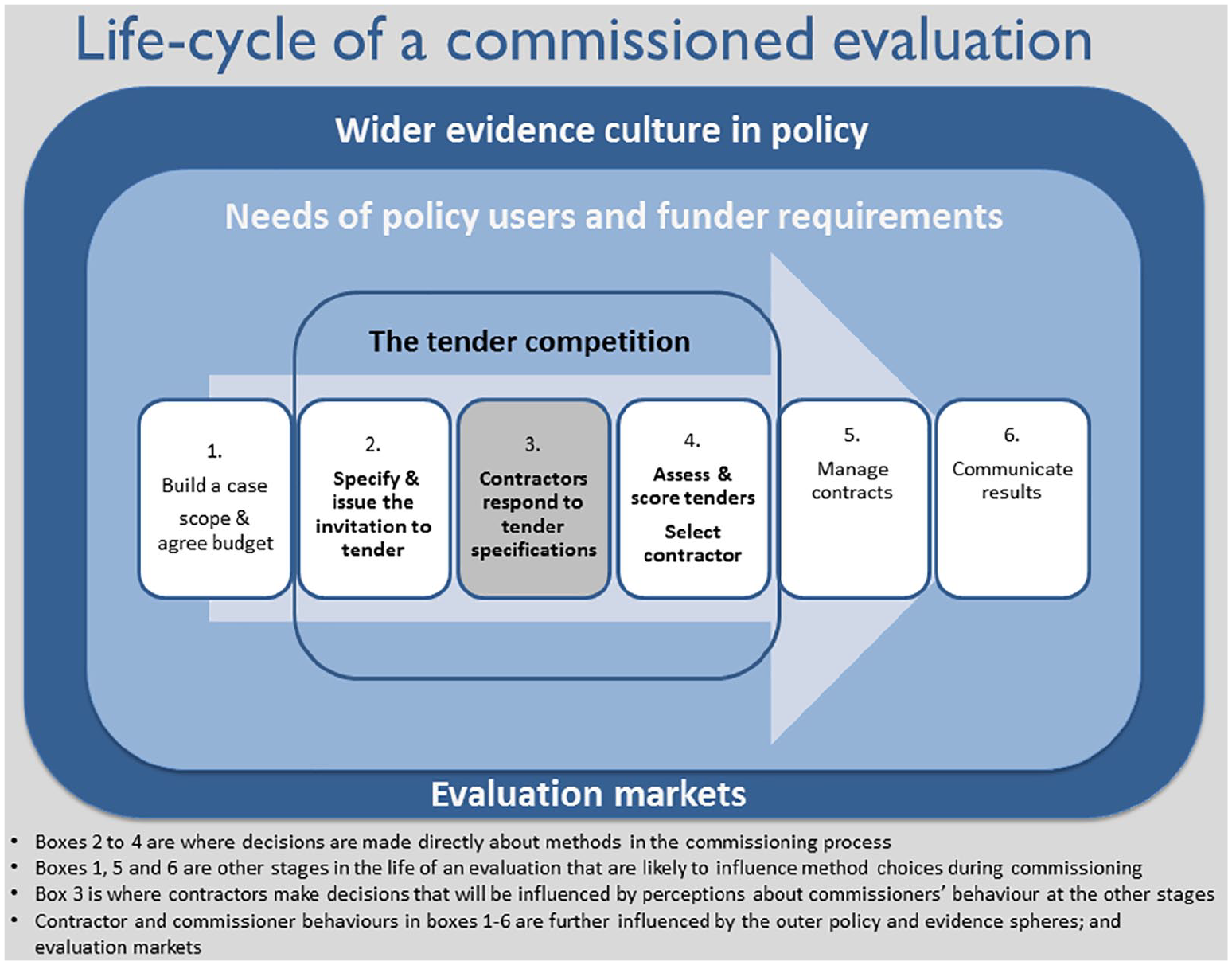
Simplified description of the different stages in the lifecycle of an externally commissioned evaluation.
A semi-structured interview guide was developed around the framework in Figure 1, to explore the immediate constraints from commissioning on decision-making with respect to methods, as well as ‘upstream’ and ‘downstream’ influences. The main question themes and flow are summarised in Figure 2. To aid discussion, basic concepts were introduced to those who were not familiar with complexity, focusing on aspects such as emergence, feed-back loops, multiple causal paths and so on. The research took place before the updated UK Magenta Book and its Annex ‘Handling Complexity in Policy Evaluation’ (HM Treasury, 2020) was published, so this was not covered.
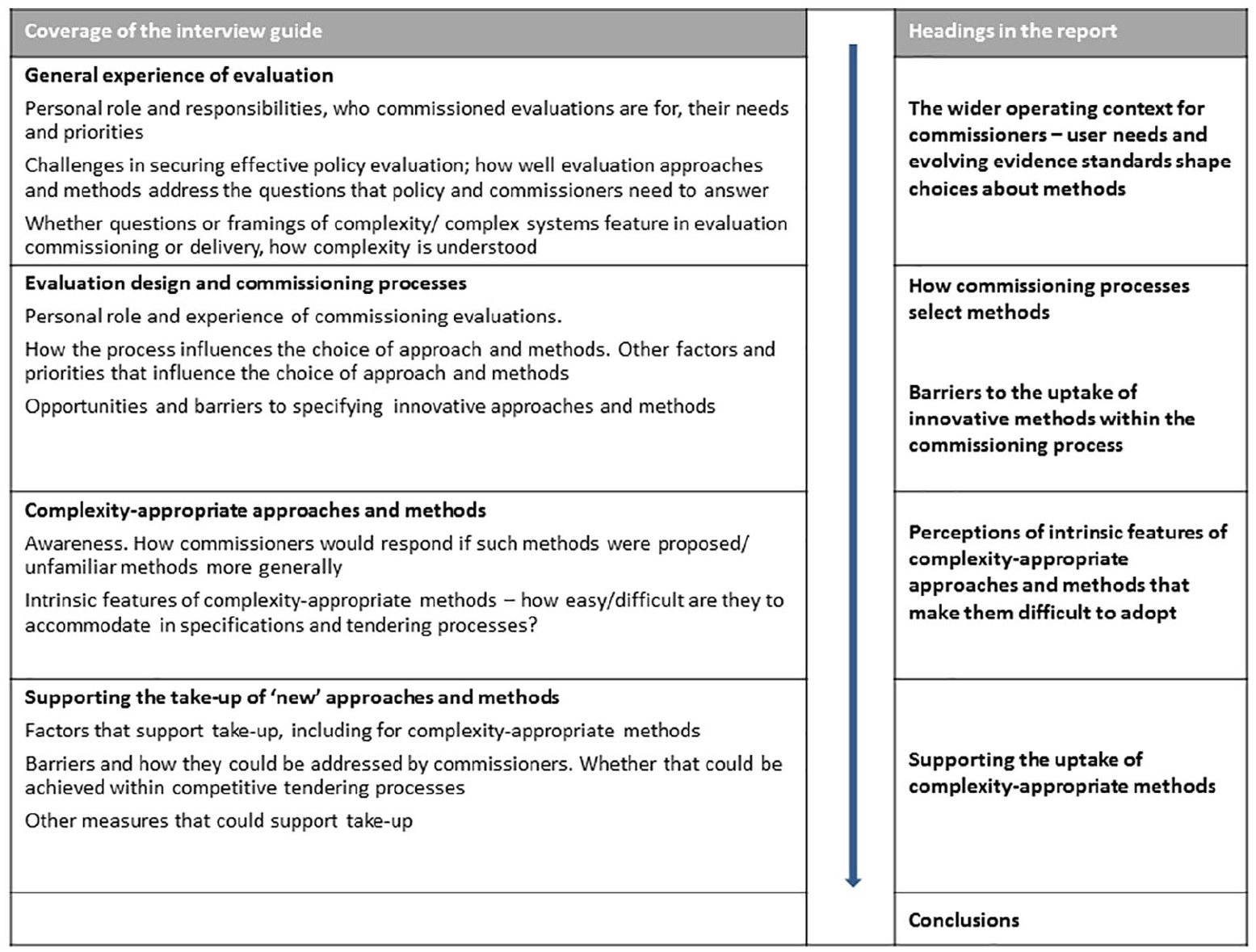
Summary of themes in the interview guide.
In-depth interviews were conducted in summer 2018 with 9 commissioners and 10 contractors who are directly involved in evaluation tendering processes. Figure 3 describes the full methodology, including the sampling approach, data extraction and management, and analysis. A thematic approach was used for the analysis. The manual procedure (feasible because of the small sample size) involved several steps and iterations. Data for each case (interview) were summarised systematically from transcripts in a framework grid developed in MS Excel, where category headings were derived from topic guide themes and key questions, plus a few additions from an initial coding of transcripts. The categories included descriptive, contextual information (e.g. contractor or commissioner, evaluation role and expertise) to enable analysis by different respondent characteristics and contexts, and for the whole sample. Emergent themes relating to the categories were derived from initial coding of transcripts and during detailed summarising. Further themes and connections were identified through both cross-case and within-case searching and mapping. Findings were ‘tested’ at two sessions with evaluators in government and contractors, and academics, which prompted clarification of some of the findings but no major revisions.
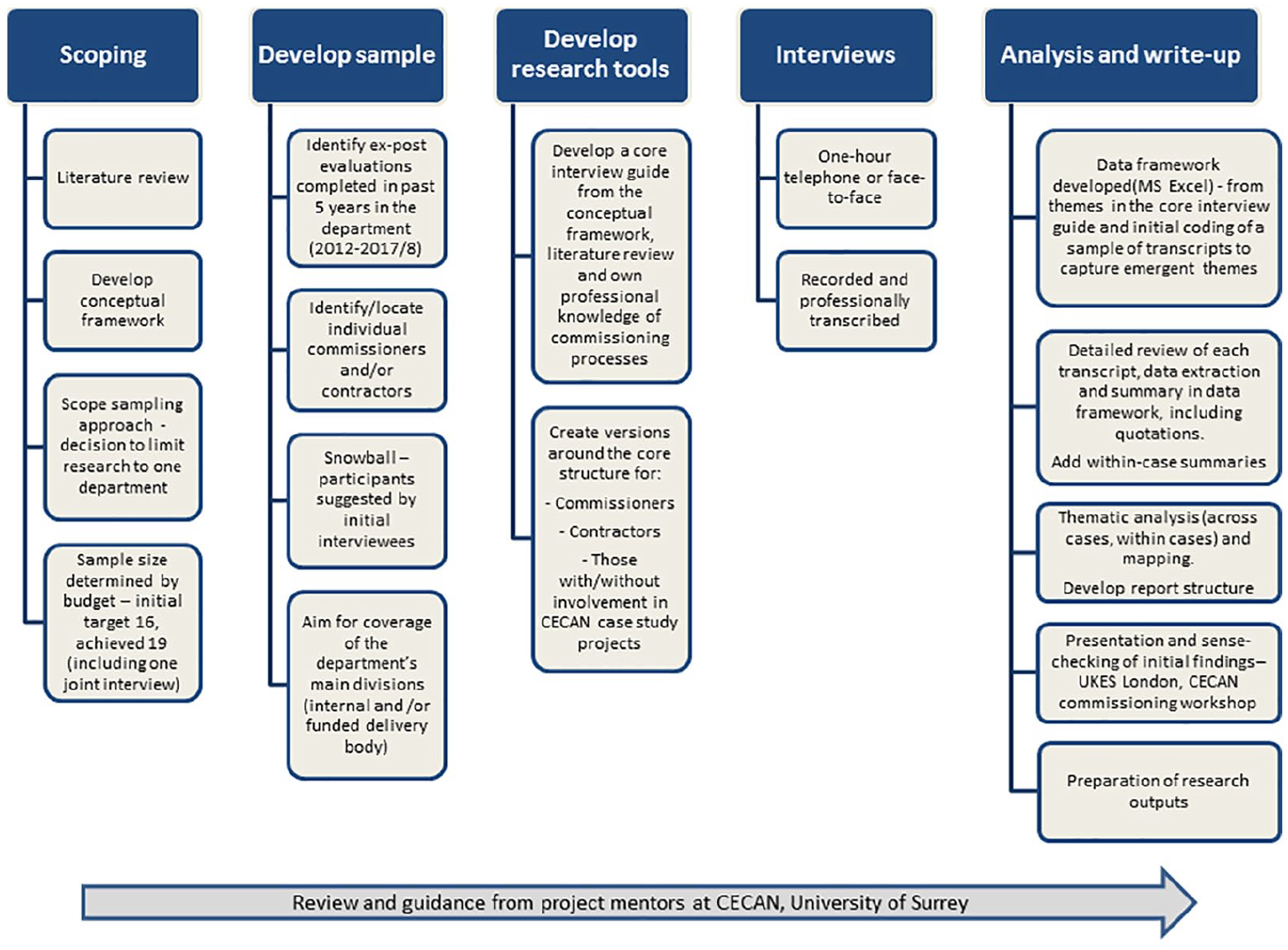
Summary of the methodology.
Coverage of the interviews was limited to one department to ensure consistency in the contexts and procurement processes being explored. That does not mean, however, that the commissioning process described in the paper is unique to the department. Evaluations may be commissioned through pan-government procurement frameworks and several interviewees gave examples of similar practices and barriers in evaluations commissioned in other departments.
‘Commissioners’ were social research managers and analysts, mainly in one UK government department and its network (i.e. bodies who support policy delivery). They are directly involved in specifying evaluations, preparing tenders and managing contractors, often as part of a wider research/evaluation role. They are typically accountable to internal policy ‘clients’ and funders for the scope and outputs of evaluations. ‘Contractors’ were senior individuals in private companies who devise and lead evaluation bids. The sample was identified by first identifying evaluations completed for the department in the past 5 years, then by cascading from contacts known to the authors or from initial interviewees. It is important to note, individuals gave their personal views and the findings should not be taken to represent the position of any individual, public body or private organisation.
While interviews were spread across different policy areas there are limitations from the size and nature of the sample: (1) we could not cover the entire commissioning chain in the policy areas covered, notably procurement officials or higher-level budget holders (e.g. deputy directors in the department), who might have different perspectives. (2) While findings were sense-checked in workshops with a wider policy evaluation audience, findings may not be repeated in other departments or beyond the United Kingdom, where procurement practices may differ. (3) While the contractors we interviewed work across UK government departments, there is a larger market of evaluation contractors that were not interviewed. Further research to test these findings more widely would therefore be worthwhile.
Findings
Throughout the findings we refer to ‘commissioners’ or ‘contractors’ where results were specific to that group. Otherwise, themes are drawn from contractors and commissioners alike. Findings broadly follow the order of themes in the interview guide: Figure 2 shows how the headings below refer to interview themes. Behaviours around risk emerged as an important cross-cutting theme.
The wider operating context for commissioners – User needs and evolving evidence standards shape choices about methods
Commissioners and contractors discussed how the wider context in which evaluations are developed and used bears on the decisions they make when specifying or responding to an evaluation tender. Considerations included
‘
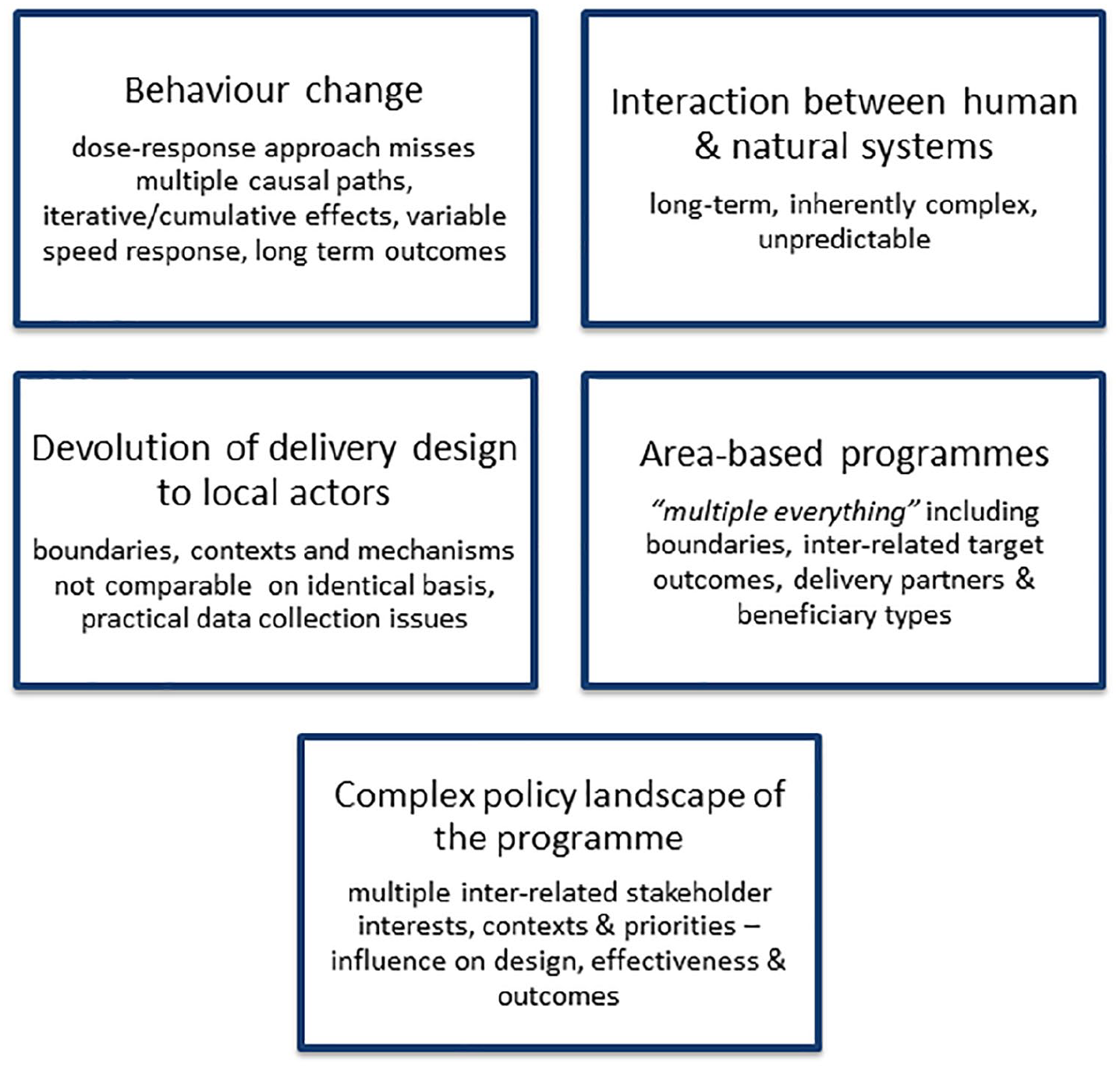
Manifestations of complexity where commissioners felt conventional evaluation methods had shown significant limitations.
The themes above emerged as important influences on how far commissioners and contractors are willing to depart from well-known and accepted (or ‘standard’) evaluation methods, principally those set out in the UK Treasury guidance. In the prevailing budget and evidence climate, many felt it was difficult to take risks on ‘new’ or possibly expensive complexity-appropriate methods. They often preferred conservative methods choices as a result. To improve the appropriateness of evaluation, several (including contractors) would like to see a more plural evidence culture, to include a pragmatic blend of approaches from different evidence traditions.
How commissioning processes select methods
The interviews revealed how individuals’ behaviours and decision-making processes interact with the formal commissioning structures to select the methods that are eventually used in evaluations. Here we explore how barriers to ‘new’ methods arise in commissioning.
The commissioning process – Multiple interests and priorities
The commissioning process described by interviewees typically involves individuals from (at least) three government ‘professions’, each having different priorities and interests in the evaluation. Normally they represent:
Social science – typically the manager for the evaluation who is a specialist in research methods, though not necessarily evaluation.
Policy – typically the policy or programme ‘owner’ and user of the evaluation findings, whose priorities are timely delivery and usability of the findings, subject to assurance about evidence quality.
A procurement representative – concerned with ensuring a commercially fair competition within the relevant regulations, assuring the financial viability of contractors, and value for money of the proposed approaches and outputs.
To ensure a fair competition, contractors’ bids will be scored by the assessors (typically the above individuals) against an assessment framework agreed with Procurement officials during the tender specification process. Scores for different aspects of the tender proposal will be given different weights. Each tender will be given an overall score, typically combined from: a technical quality score (methodology, appropriate outputs and contractor experience), a project management score (e.g. including risk management), and a financial score.
Crucially, the winning methodology will be the one that has scored highly across the various criteria, including lowest price. As we shall see later, the weighting between technical and financial scores is an important influence on contractors’ decision-making about methods.
The choice of approach and methods in evaluation tendering processes – Balancing multiple requirements and appetites for risk
Decisions are made about methods at several stages during tendering: when formulating the tender specification, in the contractor’s response, and in the tender assessment process to select a winning contractor. Interviewees reported that many compromises are made along the way and the final choice is rarely confined to purely the technical merits of a method.
Balancing multiple requirements
Commissioners set out their preferred methodology in the tender specification, which contractors then respond to in competition with each other. The final specification emerges from a negotiation between the social science lead, policy and procurement. Commissioners said it will reflect a compromise between the different priorities of those involved, which is often compounded by the short timescales for developing specifications. Lack of time may focus attention on well-understood methods. More rarely, commissioners had been able to undertake a ‘scoping study’, either a full evaluability assessment (rare) or exploration of feasible evaluation methods for an extant programme. Aspects to balance when choosing methods were said to be:
Policy clients’ and funders’ preferences (including external funders – e.g. if they are a department-funded body or the Treasury is involved)
Appropriateness to the evaluation questions;
The approach that was agreed with the funder;
Combined constraints of budget and timescale;
The limits of personal knowledge of methods;
Government evaluation guidance (the Magenta and Green Books);
Personal confidence in securing a useful and defendable result;
Confidence that methods can be scored fairly and effectively in the tender assessment process so that the tender exercise will succeed.
A priority for commissioners is to issue a specification that will attract enough bids to ensure an effective competition. If a tender exercise fails, the lengthy approvals process may preclude a re-tender with a revised specification. Contractors will not always respond if they feel an evaluation is unclear or unrealistic (e.g. scope, timescale, budget), too risky, poor quality, or does not add to their knowledge or professional standing. Principal influences on methods choices by contractors are a need to be price competitive, to offer added value over competitors (e.g. by being more creative or innovative), while remaining compliant with the commissioner’s specification (e.g. meeting the tender scoring criteria).
Appetite for risk
Perceptions of risk emerged as one of the most widespread and important influences on the choices that are made about designs and methods during evaluation commissioning, in terms of what commissioners specify and what contractors propose. This included risks arising from the wider context described above (notably pressure on research budgets and meeting client expectations) and perceived risks of failure in the procurement process.
Commissioners, especially, appeared to be risk averse. They were more likely to stick with methods that had worked in the past, that they knew could be achieved within a given budget and would deliver an answer they were able to communicate (and defend) to policy. A further barrier, though less often mentioned, was lacking knowledge about the typical cost of an unfamiliar method to support a judgement about value for money. A few were concerned about their own lack of familiarity with non-standard evaluation methods, which could impair their competence to manage the contractor and quality assure the evaluation outputs.
More generally, uncertainty about what ‘new’ methods would deliver was a potential barrier, including whether that could be explained or assessed adequately in tenders. Some also flagged that it would be difficult to assess delivery risks adequately, whether that was risk of evaluation failure or resource risk from ‘learning on the job’ (with consensus that this investment risk is borne largely by contractors). For contractors specifically, risk also arises from uncertainty about future client demand to balance against the scale of investment that would be needed to upskill their teams in ‘innovative’ methods.
A few examples were given where risks of the unknown were mitigated through an element of risk sharing with the government evaluation client. For example
Enabling flexibility to re-profile resources and deliverables at key stages during a large and complicated evaluation, or when using a novel method.
Where the client and contractor have a long-term working relationship, which was said to enable shared learning over several projects and build mutual trust in finding solutions to cope with the unexpected.
However, those who spoke about it felt that procurement processes specifically discourage this type of co-productive learning relationship, with shared goals and risks, favouring instead an arms-length purchase-fulfilment relationship to avoid creating financial conflicts of interest.
Barriers to the uptake of innovative methods within the commissioning process
Procurement – Too narrow and rigid?
While most interviewees make the best of the commissioning system, some questioned whether it is fully fit-for-purpose for evaluation and research commissioning. There were complaints that it prevents evaluators from responding either to evolving (‘agile’) policy making or the emergent conditions where policies are being implemented and evaluated.
Research procurement in government (including evaluation) has developed from systems designed for procuring a defined physical product, where suppliers compete on price to fulfil the ‘delivery’ of a specified number of items at a minimum quality or better. All parties in the competitive process need to be kept separate to prevent collusion and thus ensure that the procurement authority achieves an economically efficient price and best value for money. Similar principles apply to research and evaluation procurement: contractors bid against an overall requirement and list of ‘deliverables’ or outputs, pre-competition dialogue (e.g. to scope the feasibility and applicability of approaches and methods) is normally ruled out, and contractor performance is tied to the deliverables in the tender specification (which then forms the basis for the contract), with limited scope for variation during delivery of the contract. In this system, the tender specification plays a significant role in determining which methods are selected, as well as the scope for innovation.
Tender specifications – A guessing game for contractors that can favour conservative choices
Commissioners can signal their appetite for innovation through the tender specification, although both they and contractors described the process as imperfect for achieving that. The two options open to them are to issue: (1) a tightly defined specification, citing a specific approach, method and narrowly defined outputs; or (2) to offer a more open specification, where required outcomes are clearly defined but contractors have scope to interpret the best ways to achieve those.
Procurement officials (and some policy clients) were believed to favour tight specifications to ‘create a level playing field’ and to ensure a successful competition. Tight specifications were thought to be useful where time and budget are tight, and where evaluation questions are simple. On the other hand, there was a view that this route can favour methods that commissioners already know well and therefore deters contractors from proposing new ones, because those would be less likely to ‘tick the boxes’ in tender assessment frameworks. Some felt that tight specifications tend to use scoring criteria that favour tangible outputs, which can make it difficult for methods with less easily countable ‘deliverables’ to compete on an equal footing. One commissioner said that can favour contractors who ‘promise the moon’ (i.e. large quantities for low cost); a contractor made a similar point about methods such as stakeholder workshops where cost per unit could be a poor indicator of quality and value for money (but, they say, is often used).
There was consensus that open, outcome-focused specifications, that invite ‘creative’ approaches, tend to leave more room for new methods to emerge, unless commissioners have the knowledge and skill to propose them in a tight specification. However, there are drawbacks that need to be managed. First, invitations for creativity may elicit too many radically different proposals which cannot be assessed effectively through the scoring framework and therefore risks a failed procurement (several described this as ‘the apples and pears’ problem). There might also be disagreement about the scoring framework between the research manager and procurement: a few, for example, felt that procurement officials do not understand the implications and value to evaluation outcomes of different methods choices. Second, contractors have to second-guess what commissioners really want and mean by ‘creative’, which may result in contractors being cautious in what they propose, to ensure they stay compliant and price competitive.
Commissioners can provide clues – for example, the weighting for price, the overall scoring framework, scale of inputs or deliverables, the language in the ITT – but several felt it is an imperfect substitute for meaningful dialogue. The very fact of having to guess commissioners’ true requirements would make some contractors ‘strike out’ some methods as being too risky to their bid. Moreover, normal practice in the department is to not specify a budget for the evaluation, which was widely criticised. Because contractors do not know what the price ‘floor’ is (i.e. the likely lowest price that other competitors will propose) they cannot take an informed view on how much ground they would have to make up on a superior technical score. This factor, together with guessing what a client means by ‘creative’, was commonly mentioned as something to deter risk-taking on possibly more costly but also more useful methods. This is especially the case where there is a high weighting for price in the scoring criteria, where a high technical score is unlikely to offset a losing financial score.
Tender assessment – High weighting for price deters creativity and risk taking
Here, interviewees focused mostly on scoring frameworks, and how those are applied, as the main barrier to selecting innovative methods. A significant influence on contractors’ decisions about methods at bidding stage was clearly how bids would fare in the scoring exercise compared to competitors. Commissioners sometimes complained about having to compromise with Procurement over price versus technical weightings for scores. It was consistently felt that a high percentage of the total marks awarded to price (more than 30% or 50% were mentioned) will tend to encourage conservative methods choices.
Several observations were made (by contractors and commissioners) that value for money assessments, when using cost per unit metrics, tended to favour quantity of deliverables (e.g. survey respondents) over quality of evaluation outcomes. Innovative methods that require, for example, extensive or ongoing stakeholder involvement, or large amounts of senior resource (e.g. realist approaches), would typically score low on value for money and would be penalised. There were several complaints (including from commissioners) that separating the value for money assessment (often done by procurement) from the technical assessment (often done by the evaluation manager) can prevent a properly contextualised measure of the value of the overall proposal.
Contract management – Lack of flexibility for variation and responding to emergence
Interviewees were often critical of the inflexible pathway for project delivery that tends to be imposed by procurement rules, where contractor compliance is determined in narrow ways, often through quantitative Key Performance Indicators in the contract. Those who spoke about evolutionary or ‘recursive’ and iterative approaches, felt these were often at odds with standard government research contracts. Others noted project examples where it had been difficult to change direction in an evaluation in response to learning, because of strict milestone and deliverable requirements.
Procurement has an interest in not allowing too much variation in contract scope, and budget especially, because that could invalidate the original tender competition. But for contractors it increases delivery and resource risk, and it is difficult for commissioners to manage evaluations effectively where uncertainty is intrinsic to the approach. Interviewees consistently called for more flexible approaches to contract management where complexity is involved, to reduce risks of contract failure or deterring contractors from innovating.
Perceptions of intrinsic features of complexity-appropriate approaches and methods that make them difficult to adopt
A range of additional commissioning challenges was identified in relation to intrinsic characteristics of complexity-appropriate methods, including
How to achieve flexibility in procurement and contracts to accommodate unpredictability and emergence: ‘ . . . accepting that it’s going to be emergent and will need regular reviews of the methodology, of the data, to really understand whether you’re getting the right data, using the right methodology’.
How to enable collaborative working, which is essential to some of the approaches and methods (such as systems mapping).
How to accommodate multi-stakeholder perspectives and involvement.
Concerns about cost and timeliness.
Concern about the usability of findings.
Figure 5 summarises barriers that were identified by interviewees, organised according to the different stages of the commissioning chain. These are often special cases of the general barriers to methods innovation identified in the previous section. A more fundamental challenge, mentioned by a few, would be a need to shift evaluation funders’ and users’ mindsets from a linear to systems-based way of thinking about policy delivery and accountability.
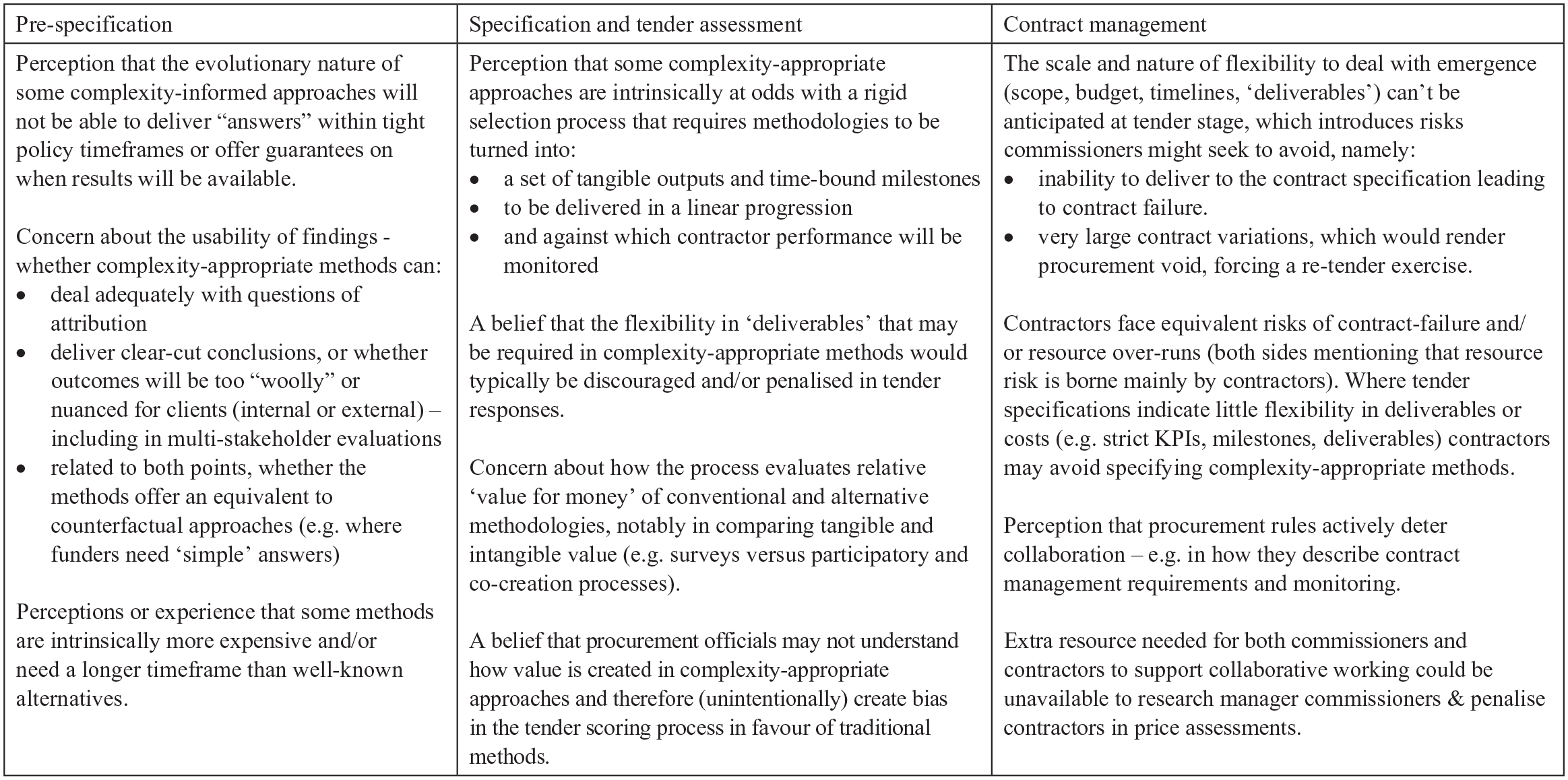
Potential barriers arising from intrinsic features of complexity-appropriate methods cited by interviewees.
Supporting the uptake of complexity-appropriate methods – Solutions suggested by interviewees
Changes that could be achieved within the existing procurement framework and process
Interviewees largely felt there is some scope to accommodate complexity-appropriate methods within the present commissioning system. That could include learning from other departments that have used non-standard evaluation methods more extensively (including developmental evaluation approaches). Figure 6 summarises actions that were suggested for different stages in the evaluation commissioning process.
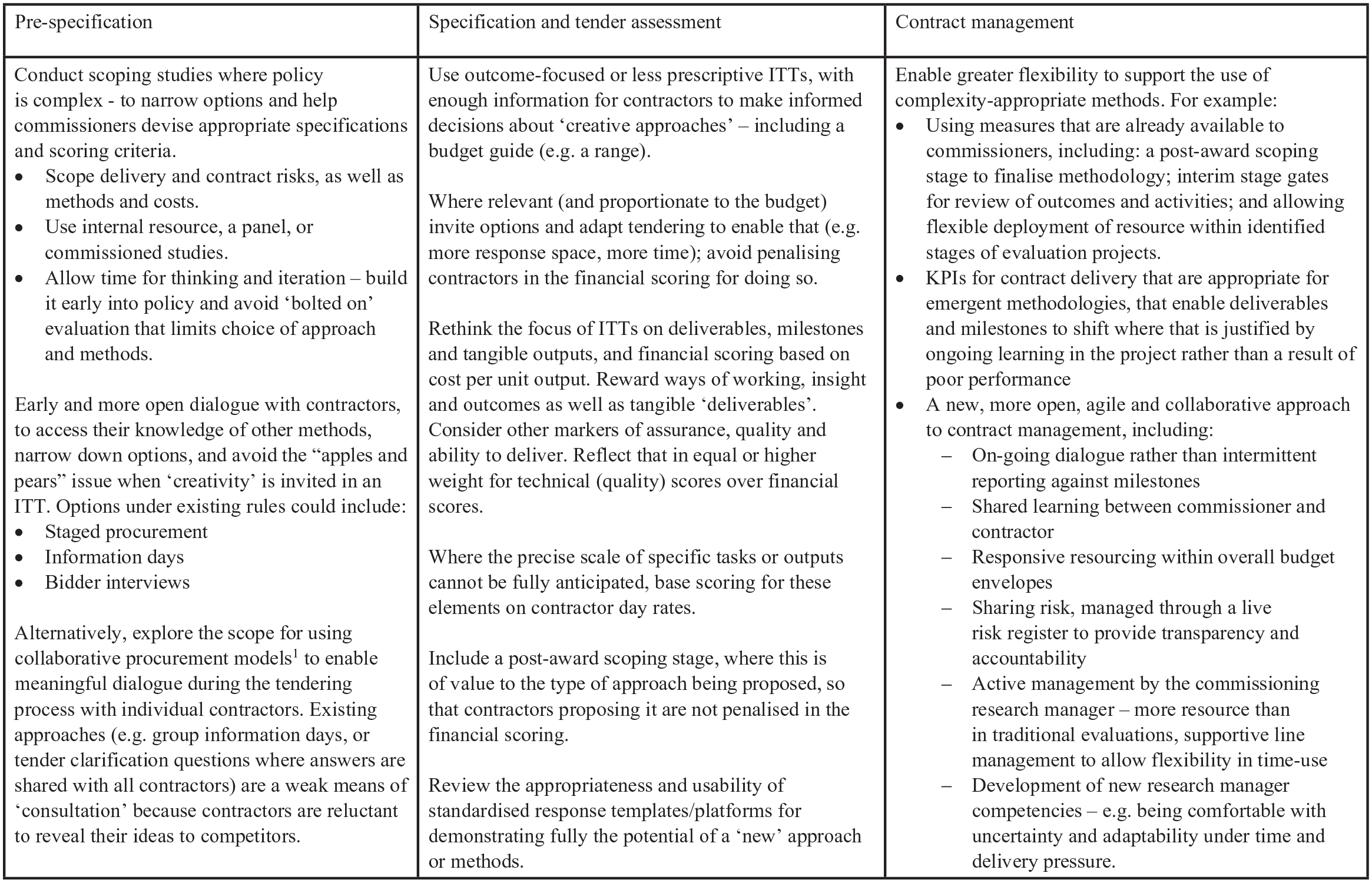
Potential solutions for addressing barriers in the evaluation commissioning process to the uptake of complexity-appropriate methods.
There was some scepticism that these changes could happen easily: commissioners tended to feel they have little influence over the procurement system. Barriers included constraints on individuals’ time to influence change outside their ‘day job’, short time horizons for running procurement exercises, embedded practice and preference, risk aversion, and lack of shared understanding between researcher-commissioners and procurement officials, about the implications of methods choices for evaluation outcomes and their usefulness to policy. 5
A more radical overhaul of procurement – Move away from ‘one size fits all’
A less widely held view was that only a radical overhaul of government research commissioning would enable commissioners to select the best approaches in evaluation studies. Those holding this view wanted a procurement process that was simpler to operate, more flexible in how requirements can be specified and how bids are evaluated (including value for money), and quicker to execute (in terms of the approvals chain). Their priority is to enable commissioning to be more responsive to fast-moving policy.
Create an enabling environment – Foster demand from higher levels of policy
There was a widespread view that removing procurement barriers needs to be matched by greater demand for complexity-appropriate evaluation at higher levels of policy if its uptake is to increase. That would include Ministers. It would also require a shift from linear to systems-informed ways of thinking about evaluation questions and using evaluation findings. Greater acceptability at higher policy levels would help to de-risk the use of complexity appropriate methods for commissioners and contractors: ‘ . . . there is something to be done there at a level above where the ITT gets issued in terms of actually saying “We are open to these things, these are legitimate methods that should be proposed that we actively encourage”.’ Some thought that advocacy by influential internal champions (e.g. chief scientist, social scientists, economists, deputy directors, ministers) is needed, as happened with the adoption of RCTs in policy evaluation. Diffusion of knowledge and skill throughout the department would also be required. Mechanisms for delivering the suggestions in Figure 7 would need to be researched further.
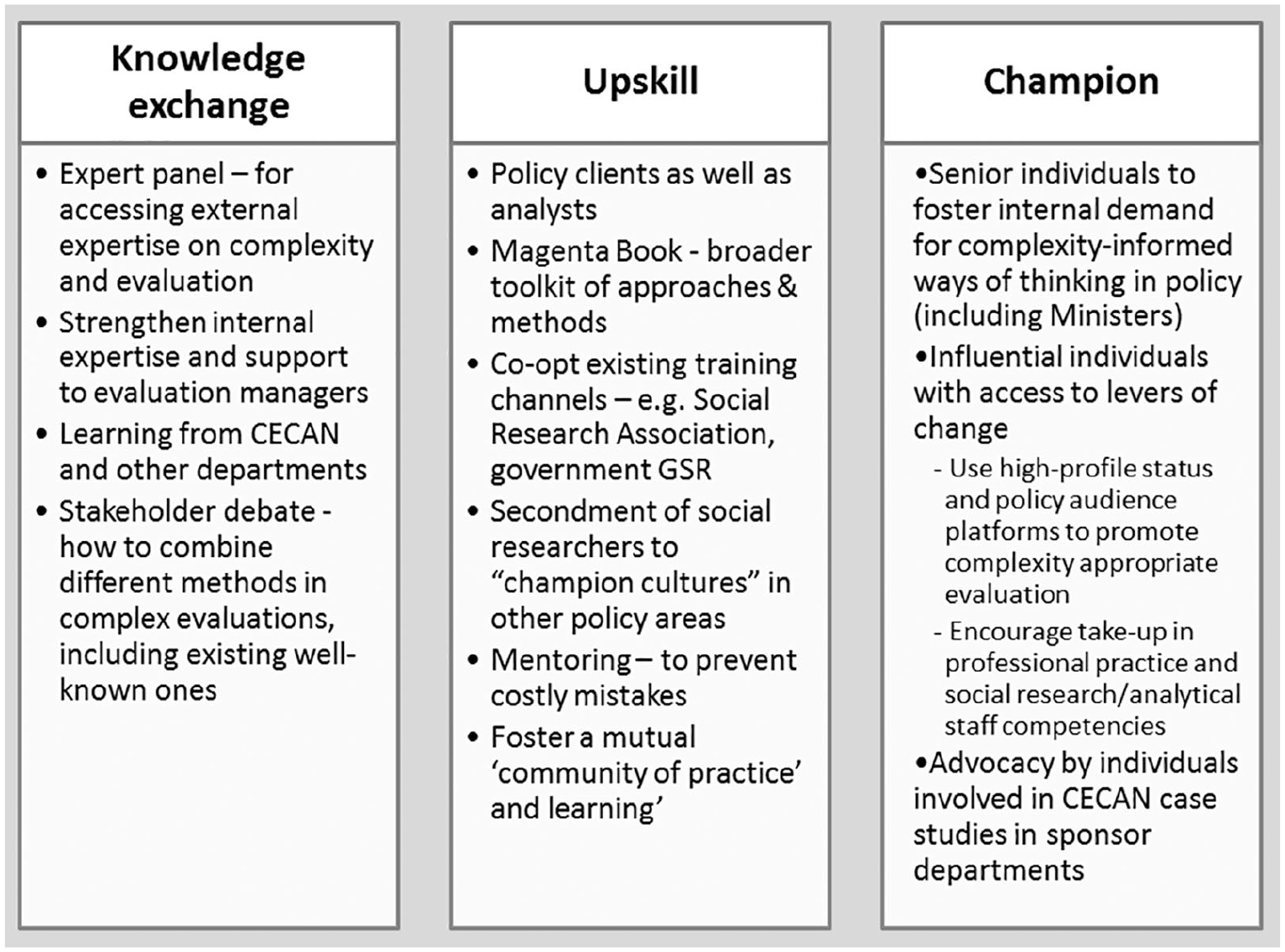
Interviewee suggestions for creating an enabling environment for the uptake of complexity-appropriate evaluation.
At the level of individual evaluation commissions, various suggestions were made that would support a ‘business case’ to help de-risk and ‘sell’ such approaches to evaluation funders and policy end-users. Interviewees wanted evidence on a range of aspects, summarised in Figure 8. It would need to outline what the methods would deliver and at what cost, as much as how they work technically: ‘ . . . [funders] want to know the methods we use are reliable and credible, and robust, but beyond that most of our managers will glaze over when you get into the technicalities of it . . .’. Some suggested that having better evidence on cost and performance would make it easier to score the relative risk and value of such methods in tender assessments.
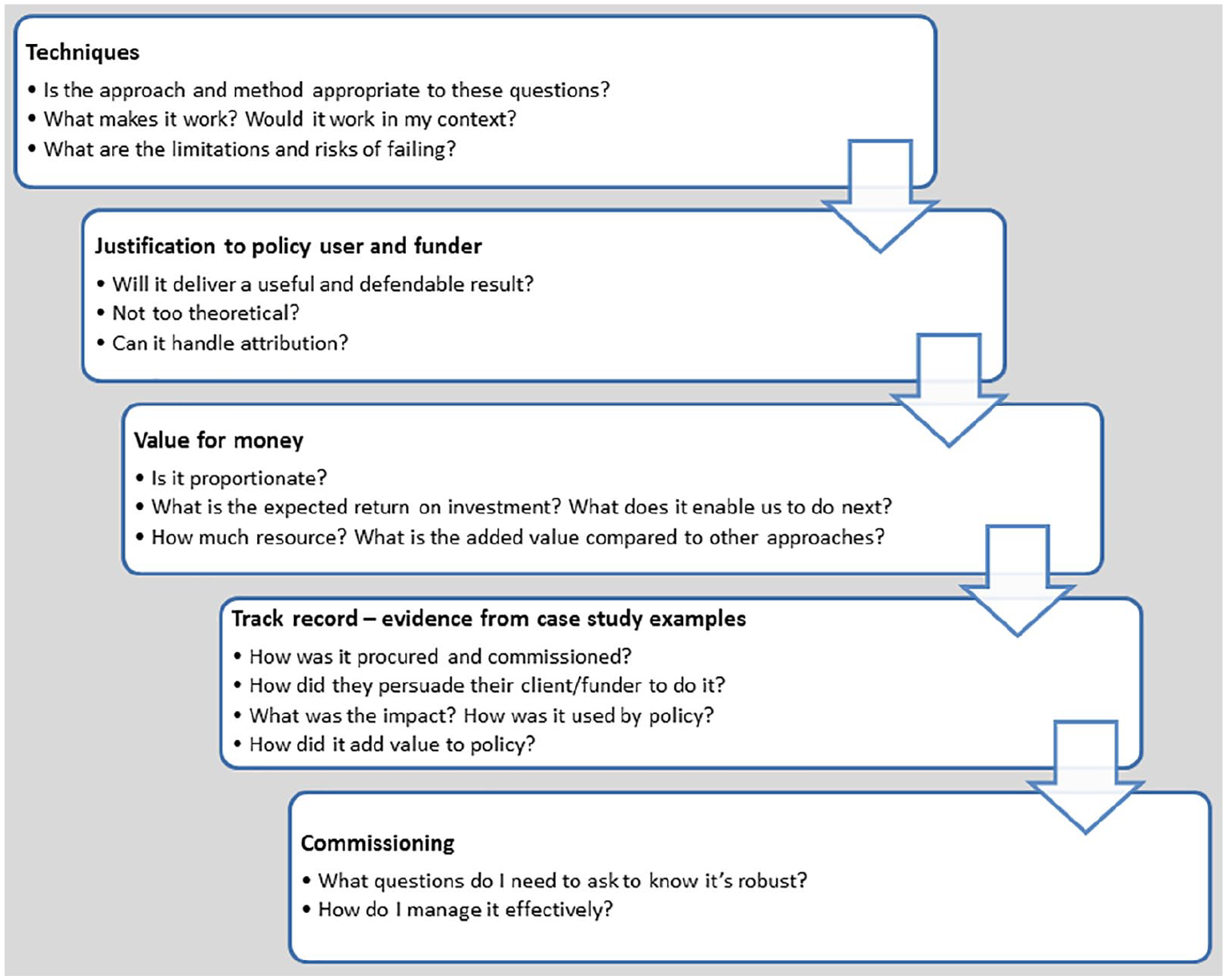
Interviewee suggestions on the evidence needed to support a case to evaluation funders and policy managers to commission complexity-appropriate methods.
Interviewees gave examples where they felt there were opportunities to build the evidence: by trialling methods on small and low-profile projects, where the consequences of failure would be low; or in new policy areas, where there is less evaluation history and embedded methodological preference.
Conclusion
This paper addressed gaps in the literature on barriers to the commissioning of complexity-appropriate evaluation methods and how the commissioning system could be improved. Unusual in the literature (Schneider et al., 2016), the research examined perspectives of both evaluators (research contractors) and commissioners operating in the same policy space (a UK government department), drawn from interviews with 9 commissioners and 10 contractors.
We theorised that approaches and methods selected in commissioned evaluations evolve from the behaviour of actors on both ‘sides’ of competitive tendering, interacting with a rules-based procurement process. Behaviours are further influenced and shaped by the contexts in which the actors are operating, including the political and intellectual zeitgeist. The tender competition is the decision-making nexus where rules and behaviours interact and where the wider influences on commissioners and contractors are crystallised in the choices that are eventually made about approaches and methods.
The study found that behaviours of commissioners and contractors alike were shaped not only by the practical constraints of procurement processes but also the wider policy and organisational context. It confirmed that higher-level commissioning barriers emerge from the political contexts where evaluation demand arises (e.g. Rutter, 2013; Schneider et al., 2016; The LSE GV314 Group, 2014). Those higher-level barriers included tight budgets and timeframes, evaluation being embedded to different levels in different policy areas, lack of knowledge and skills about complexity-appropriate evaluation, concern over anticipated results and political influence. There was consensus across contractors and commissioners that the shape of demand from policy clients is a crucial influence on choices about evaluation approach and methods. Scientific relevance and quality objectives are important but so is making sure that results ‘land’ with policy clients – that is, they are useful for the purpose the client has in mind, which may be a political one (as in The LSE GV314 Group, 2014).
Like Rutter (2013), who found that avoiding political risk was a barrier to the wider uptake of evaluation in evidence-based policy making, we found it was similarly a constraint on the choice of methods when evaluation tenders are being specified. Indeed, risk in many forms emerged as a crucial influence on decisions made about methods during the whole commissioning chain, from securing approval and budget for an evaluation all the way through to communicating the findings to policy users. For commissioners and contractors, it spanned perceptions of technical risks (whether methods would work), delivery risks, contract risks, organisational risks and personal risks (e.g. to their own performance and professional standing). Risk for contractors further revolved around having to guess commissioners’ true requirements, including budgets, and of being non-compliant or uncompetitive if they got it wrong.
On both sides, controlling for risk often meant conservative choices about evaluation methods, in favour of ‘standard’ approaches that proposers could be confident are acceptable to clients. Prevailing evidence cultures and preferences across government were an important influence here. In addition, combined pressures to raise the quality of evaluation practice and to ‘do more with less’ budget were said to favour risk averse behaviours and sticking with well-known and accepted methods (e.g. counterfactual impact methods). Equally, some pointed to an opportunity for developing a more plural ‘evaluation toolbox’ where commissioners or policy are finding that ‘standard’ methods are not suited to the complexity of the questions they are trying to answer.
Turning to the rules and mechanisms of the tendering process itself, the study identified changes that might be made at key points to make it easier for novel methods to compete effectively against traditional evaluation methods. Interviewee observations about barriers and solutions were described in Figures 5 and 6. From those, we have drawn out in Figure 9 some principles for adapting existing procurement models to be more ‘complexity-friendly’.
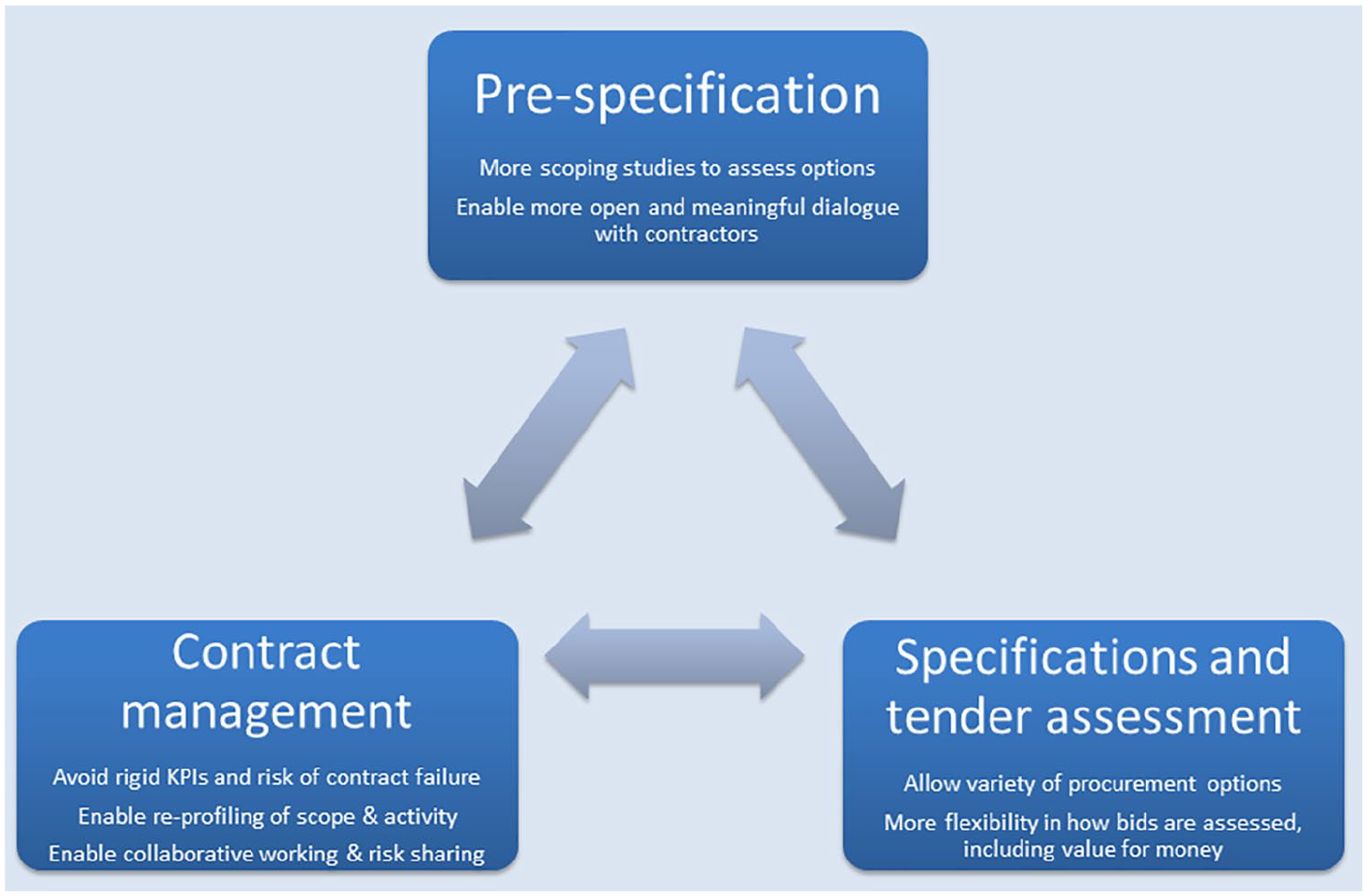
Principles for reforming key aspects of evaluation procurement to enable commissioning of complexity-appropriate methods, drawn from interviewees’ detailed suggestions.
Interviewees who were familiar with complexity-appropriate methods identified some intrinsic features that are especially difficult to accommodate in existing evaluation procurement processes. These relate to
Flexibility of scope, tasks and resource allocation – to accommodate emergence in the parameters being evaluated and responsive evaluation frameworks and tasks
Co-productive ways of working – commissioner-contractor relationships based on trust rather than command-and-control, mutual learning, some shared risk taking, and resource to support the active management and ongoing dialogue needed to make it effective
While many interviewees felt that existing procurement mechanisms could be revised to make room to commission complexity-appropriate methods, some were sceptical and thought that a more radical overhaul of research and evaluation procurement is needed. That might include modifying the conventional relationship between commissioner and contractor (Knight et al., 2017) to allow greater interaction, collaboration, shared goals and risk sharing.
Changing mindsets and fostering demand for complexity-appropriate evaluation at higher-levels of policy was also called for. Without that, revising the evaluation procurement process would fail to encourage the wider uptake of complexity-appropriate methods, according to some. Suggestions were made for upskilling and knowledge exchange in government research and policy professions, credible and high-profile champions to build support internally, and for commissioner-contractor joint communities of practice. A need to generate evidence to answer commissioner and policy questions about cost, relevance and reliability of complexity-appropriate methods was also flagged.
We could therefore conclude that reforming procurement needs to be matched by a shift in demand at higher levels in policy (including Ministers), to give those lower in the hierarchy the confidence and ‘permission’ to procure complexity-appropriate evaluation and, for contractors, to offer it. Making the changes to tendering processes that could support uptake would require a lead from procurement functions in government: for example, to explore alternative commissioning models that enable more collaborative approaches than are possible in conventional competitive tendering and contract management. Models like this may exist 6 but were outside the scope of this research. On the demand-side, further research into policy makers’ attitudes towards, and appetite for, complexity-appropriate evaluation is needed.
Footnotes
Acknowledgements
The authors gratefully acknowledge the contributions of all the interviewees who generously gave their time. The views reflected in the findings are the authors’ interpretation and do not represent the view of any individual or organisations they are affiliated with.
Declaration of conflicting interests
The author(s) declared no potential conflicts of interest with respect to the research, authorship, and/or publication of this article.
Funding
The author(s) disclosed receipt of the following financial support for the research, authorship, and/or publication of this article: This work was supported by the Economic and Social Research Council (grant numbers ES/N012550/1 and ES/S000402/1).
