




Abstract
Physical education (PE) in Northern Ireland (NI) is positioned within a complex and separated educational context. While we know something about the PE curriculum within this landscape, we know little about how PE teachers navigate this complexity. Consequently, we recruited secondary PE teachers from different school types in NI (n = 8) to take part in individual, semi-structured interviews to explore how they understand and structure their PE curriculum. Given this focus, our analysis paid some attention to Bernstein's (1975) concept of boundaries, which helps us to consider the potential impact of curriculum structures in schools. We found that all the PE teachers referred to the overarching national curriculum (the ‘Big Picture’ curriculum), highlighting the opportunities it offers – through weak boundaries – to shape broad, connected and meaningful PE curricula. However, the findings also reveal tensions that limited the extent to which these opportunities could be fully realised. Specifically, given the weak boundaries between sport and national identity in NI, sport (particularly team games) plays a significant role in shaping PE curricula. This, in part, may contribute to the perception among participants that PE is not valued by other teachers or society more broadly. We suggest that weakening boundaries both within the PE curriculum and across the broader school curriculum has the potential to shift the emphasis away from sport towards other forms of knowledge. This could create opportunities for teachers of other subjects to better understand the educative possibilities of PE.
Introduction
While limited research has explored physical education (PE) within Northern Ireland (NI), it is acknowledged that the educational landscape in this context is complex (Roulston et al., 2024), significantly shaped by the two main political communities – unionists, primarily Protestant and identifying as British, and nationalists, mainly Catholic and identifying as Irish. This, along with academic selection at the age of 11 (the end of compulsory primary education), has resulted in a separated schooling structure comprising multiple school types, where pupils largely attend schools that align with their religious and/or socio-economic backgrounds (Milliken and Roulston, 2022). Against this complex socio-political backdrop, we previously analysed the NI PE curriculum (primary and secondary) to understand the key discourses and structures that shape PE provision in this context (Stirrup et al., 2025). We found that, despite the progressive and holistic nature of the overarching curriculum, which promotes interdisciplinary learning and citizenship, tensions remain between the shared structure and intentions of curriculum policy and the realities of enacting this within NI's separated education system. Furthermore, no research to date has explored how PE teachers navigate this complexity. Addressing this gap, the present study investigates how PE teachers in NI understand and structure the PE curriculum within their unique school environments, offering important insights for teachers and curriculum scholars both locally and internationally.
PE provision in NI
Before examining the complexity of the PE landscape in NI, it is important to provide context for those less familiar with this system. Pupils in NI begin primary school at age 4 and finish by age 11. Post-primary schooling begins at the age of 12, and compulsory schooling finishes when pupils are aged 16. In primary schools, PE is predominantly taught by generalist teachers, whereas at post-primary level, it is taught by subject specialists. The overarching ‘Big Picture’ 1 curriculum in NI (CCEA, 2019) spans both primary and post-primary levels, emphasising the development of personal understanding, citizenship and mutual understanding. This is achieved through subject-based learning activities that include thinking skills, personal capabilities and cross-curricular skills such as Using Mathematics and Communication (McFlynn et al., 2024).
For PE in primary schools, the curriculum outlines the statutory requirement for all pupils to develop knowledge, understanding and skills in athletics, dance, games and gymnastics – with swimming becoming statutory from ages 8 to 11. At post-primary level, the statutory areas include athletics, games, gymnastics and swimming, while dance and outdoor education are non-statutory. From ages 14 to 16, the curriculum includes statutory statements that focus on extending pupils’ knowledge, understanding and skills to sustain a healthy and active lifestyle. Across both sectors, the Department of Education (DE) recommends that pupils receive two hours of PE per week. However, as this is not a statutory requirement, schools determine their own PE provision and data shows that most schools fall short of this recommended time (DE, 2025).
A complex educational landscape
As summarised in the introduction, NI has a complex and challenging education system, partially born from a wider religious and political divide. The schooling system reflects this broader political division between the nationalist and unionist communities, where approximately 93% of learners go to schools associated with their religious background, with just 7% attending integrated provision (see Table 1) (Milliken and Roulston, 2022).
School types in Northern Ireland.
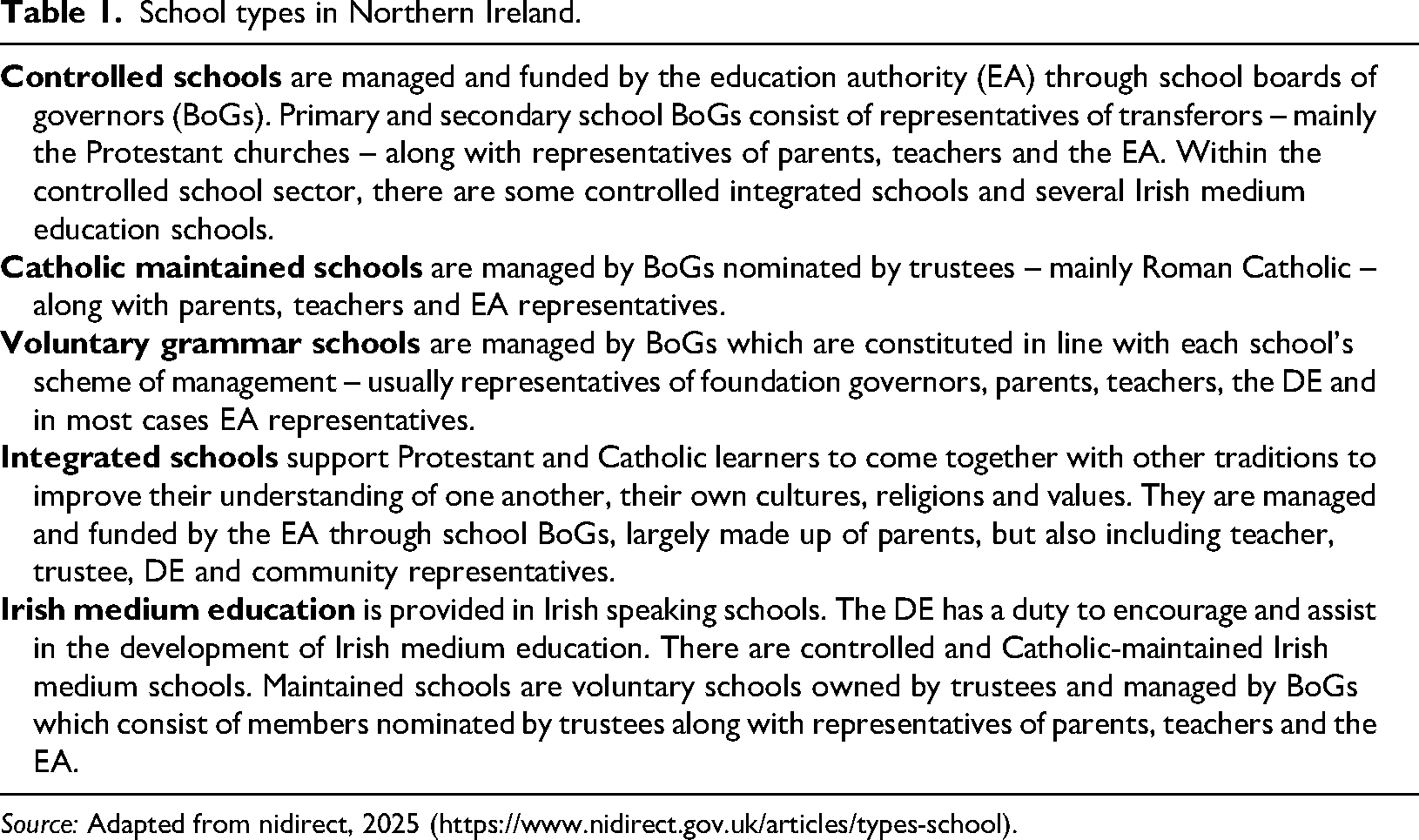
Source: Adapted from nidirect, 2025 (https://www.nidirect.gov.uk/articles/types-school).
Academic selection and social class also contribute to the complexity of the educational landscape in NI. Academic selection refers to the process by which some 11-year-olds opt to sit the transfer test to be considered for admission to selective voluntary grammar schools. Those who do not sit the test typically progress to non-selective secondary schools (see Table 1). Whilst both types of schools work within the same national curriculum, grammar schools are deemed to be more academic (Milliken and Roulston, 2022). This separation has been argued to not only reinforce social division but also perpetuate educational inequalities (Borooah and Knox, 2015). For example, pupils in grammar schools, which tend to serve more affluent and academically successful populations, outperform those in non-selective secondary schools, where pupils from more disadvantaged backgrounds are concentrated. Notably, these two ‘major fault lines’ (Gardner, 2016) in the NI education system have led to a highly separated schooling system, resulting in the creation of many different types of schools including Catholic maintained, controlled (state), voluntary grammar, integrated and Irish medium education (IME) (McFlynn et al., 2022) (see Table 1).
Regardless of the school type, the NI curriculum sets out what young people are expected to learn and adopts a ‘Big Picture’ approach, positioning each curricular area within a framework that encourages connections between subjects as well as broader educational goals such as citizenship and health and wellbeing. Our previous analysis of the PE curriculum set within this ‘Big Picture’ framework highlighted the possibilities for cross-curricular learning, suggesting that it provides holistic, interdisciplinary opportunities for the subject. This is particularly the case at Key Stage 3, where there is greater alignment between PE and the NI curriculum objectives of supporting learners to learn as individuals and contributors to society, economy and the environment (Stirrup et al., 2025). However, we also identified tensions between the NI PE curriculum documentation and the traditional contextual factors that frame education in NI. For example, we noted that within this system, and particularly in grammar schools, the role of PE may be marginalised in favour of more ‘academic’ subjects with little expectation for it to be selected by pupils for further study as they progress through secondary school. Instead, the focus for young people moves away from the curriculum goals, towards becoming successful sports performers – largely to enhance the school's external reputation. Furthermore, the (team) games that are taught in PE often align with specific cultural, social and gender identities, which can advantage some pupils while marginalising others. Hargie et al. (2015: 7), for example, argued that ‘participation and interest in soccer, rugby and Gaelic Games,2 all continue to be affected by the community divide’, where Gaelic Games are played mostly by Catholics whilst rugby and football (games associated with British nationalism) are played by a more diverse group. In the context of PE in NI, this means that pupils attending a Catholic maintained school may be more likely to experience Gaelic Games but are unlikely to experience rugby and hockey, whereas pupils from a controlled school are likely to experience rugby and hockey but not Gaelic Games (Abbott and McGuinness, 2024). Young people who attend an integrated school are likely to experience all these sports, potentially receiving a broader games experience than those attending Catholic or controlled schools. Moreover, in many secondary schools, despite being shaped by the same overarching curriculum, PE is often organised around two distinct curricular offers (one for male learners and one for female learners), with gender seen as binary within this traditional PE approach. Although team games dominate across both curricula, the games offered will differ depending on gender (e.g. rugby for male pupils and hockey for female pupils), which can further limit young people's opportunities for learning in and through movement (Roberts et al., 2019).
While there have been calls across the United Kingdom (and internationally) to re-imagine PE for a more socially just and equitable future (Flory and Landi, 2020; Gray et al., 2024), the separated schooling system in NI, characterised by strong religious and cultural beliefs and identities (Roulston et al., 2024), could make it difficult for teachers to look beyond their own school contexts to consider how PE could be conceptualised, organised and taught differently. As a result, whilst a forward-thinking, interdisciplinary, flexible and learner-centred approach to curriculum is evident in NI policy, the PE teaching community faces contextual challenges which have the potential to maintain inequalities and impact the learning experiences of young people from across the diverse cultural communities. As such, we suggest that further research is needed in this complex context to better understand how teachers navigate these challenges and the opportunities they have to think differently about PE, as well as how they can realise the aspirations of the broader ‘Big Picture’ curriculum in NI.
The importance of curriculum and knowledge structures
Building on our previous curriculum analysis, this article explores the perspectives of PE teachers in NI to understand how they conceptualise and structure the PE curriculum within this complex context. Here, we again draw from the work of Basil Bernstein (1958–2000) to help us consider how the curriculum (or teachers’ interpretations of it) determines what knowledge is privileged and the mechanisms through which this privilege is (re)produced. Curricula are not neutral; they reflect the values and interests of those in power (Bernstein, 2000). Thus, education becomes a site of cultural reproduction where the curriculum is regulated by what is deemed most beneficial to society, and schools function to reproduce the society in which they are embedded. More specifically, through the construction of curriculum, governments legitimise official pedagogic discourse. Policy discourse is then recontextualised by schools and teachers to produce curriculum, pedagogy and resources, adapting the official curriculum to align with the needs of their pupils and the culture of their schools (Singh, 2002). In questioning how forms of legitimate knowledge emerge through this process of adaptation, Bernstein (1971) identified two key concepts: classification – the translation of power relations, and framing – the relations of control. This article is particularly concerned with the former, classification as a mechanism for orienting school practices (including curriculum organisation) towards different forms of knowledge, social relations and identities.
The concept of classification refers to the relationships between and within categories such as schools, school subjects, spaces and people (Bernstein, 1975), and illustrates how power operates through the maintenance of strong or weak boundaries between these categories. It is important to stress at this point that we are using Bernstein's work in a theoretical sense, while mindful that the concept of boundaries may also carry a specific meaning in NI. We use this concept to indicate how structural and symbolic separations shape practice, and readers are encouraged to interpret its use from this perspective. For example, when subject boundaries are strong in schools, hierarchies are created, thereby limiting opportunities for cross-curricular work and producing specialised discourses and identities. Conversely, when subject boundaries are weak, teachers’ own interpretations play a significant role in the formation of subject content, allowing them to bring in new ideas, knowledge and perspectives to create meaningful learning experiences. Importantly, therefore, boundaries should not be understood as fixed; there is always scope to challenge and weaken boundaries which can lead to new discourses and possibilities in PE (Penney, 2013). Thus, by drawing on the concept of classification, and relatedly boundaries, it is possible to better understand how PE teachers in NI conceptualise and structure their PE curricula, appreciate the implications of this for their learners and reveal where there might be opportunities for change. Specifically, this article seeks to answer the following research questions: What forms of knowledge emerge when PE teachers talk about the PE curriculum in NI? How does this knowledge influence the structure of the curriculum in their schools?
This research is significant as it is, to our knowledge, the first empirical study to examine secondary PE teachers’ perspectives of curriculum in NI. It contributes to ongoing discussions about the future of PE and curriculum reform in NI, ensuring that the factors influencing curriculum development and enactment are critically examined to understand the broader implications for all learners. However, this work is also relevant in other countries, providing a stimulus for cross-border discussion and debate, and encouraging critical thinking around the nature, purpose and future of PE.
Methodology
Participants
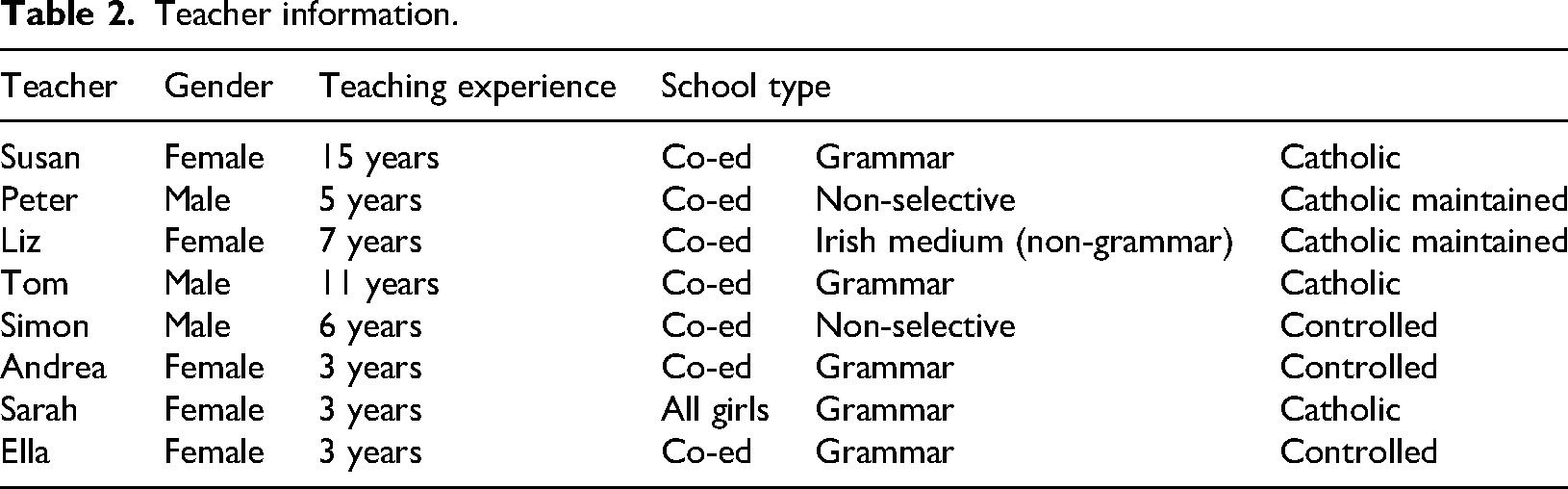
A combination of convenience and purposive sampling was used to recruit secondary PE teachers for this study (n = 8). We aimed to recruit both male and female PE teachers from a range of secondary school types in NI (see Table 1). To do so, a call for participants was made via email to the third author's professional network of PE teachers in NI. Of 15 emails that were sent, eight PE teachers responded and agreed to be interviewed (see Table 2). While the teachers do not represent all school types in NI, controlled, Catholic maintained, IME, grammar and non-selective schools are represented in this sample. Information about each teacher and their school is provided in Table 2, intentionally limited to preserve anonymity, and all the names are pseudonyms. However, it is important to note that all the teachers from the non-selective schools described their schools in terms of socio-economic disadvantage. Also, all the teachers have participated in competitive sports, mostly in team games but also in some individual sports. These include Irish national sports like camogie, as well as international sports such as basketball. In addition, all teachers have an undergraduate degree in a sports-related subject, a one-year postgraduate degree in PE and are registered with the General Teaching Council for Northern Ireland.
Teacher information.
Procedures
While all authors contributed to the development of the research focus and design (as well as the structure and intellectual content of the manuscript), data collection and analysis were largely carried out by authors 1, 2 and 3. At the outset of the project, a favourable ethical decision was granted from the second author's institution (ref: 17505).
All participants were informed of the nature and purpose of the research and signed a consent form prior to commencing the study. Given our aim was to explore the perspectives and experiences of PE teachers positioned within a unique political and educational context, qualitative one-to-one semi-structured interviews were conducted (Creswell and Creswell, 2018). This enabled us to focus discussions on topics relevant to the research questions, whilst also revealing and exploring the nuanced and specific perspectives and contexts of each teacher (Kvale, 1996). The schedule was co-developed by authors 1, 2 and 3, all of whom have extensive experience developing interview questions and conducting interviews with in-service PE teachers. The starting point for the schedule was the research questions, from which questions related to the participants’ experiences, contexts and perspectives about both PE in general and PE in NI were developed. All interviews took place online using Microsoft Teams and were conducted by the same researchers who developed the research questions. The length of each interview ranged between 40 and 60 minutes, and all interviews were recorded and transcribed verbatim.
Analysis
As noted above, the majority of the data analysis was conducted by authors 1, 2, and 3. For transparency and context (Smith and McGannon, 2018), it is important to note that all authors also contributed to the earlier curriculum analysis (Stirrup et al., 2025) and therefore brought pre-existing perspectives on how NI's educational landscape might shape PE teachers’ views and practices. Additionally, authors 2 and 3 are from NI and have direct experience of the education system as pupils. Author 2 attended a Voluntary Grammar School both as a pupil and as a pre-service teacher, completing teaching placements in the same type of school. Author 3 attended both Catholic non-selective and selective schools. Author 3 was also a PE teacher for 12 years in a Catholic grammar school. These positionalities inevitably influenced how the data were interpreted. Recognising that researcher identity cannot be separated from the analytic process (Smith and McGannon, 2018), steps were taken to ensure that the voices of the teachers remained central. Author 1, who has no direct experience of the NI education system, led the analysis. Additionally, analysis involved dialogue between all three authors, which provided opportunities to consider how their backgrounds shaped the themes constructed from the data. Finally, authors 4, 5 and 6 (none of whom are from NI) acted as critical friends, interrogating each theme during the writing phase to clarify meaning and support conceptual refinement.
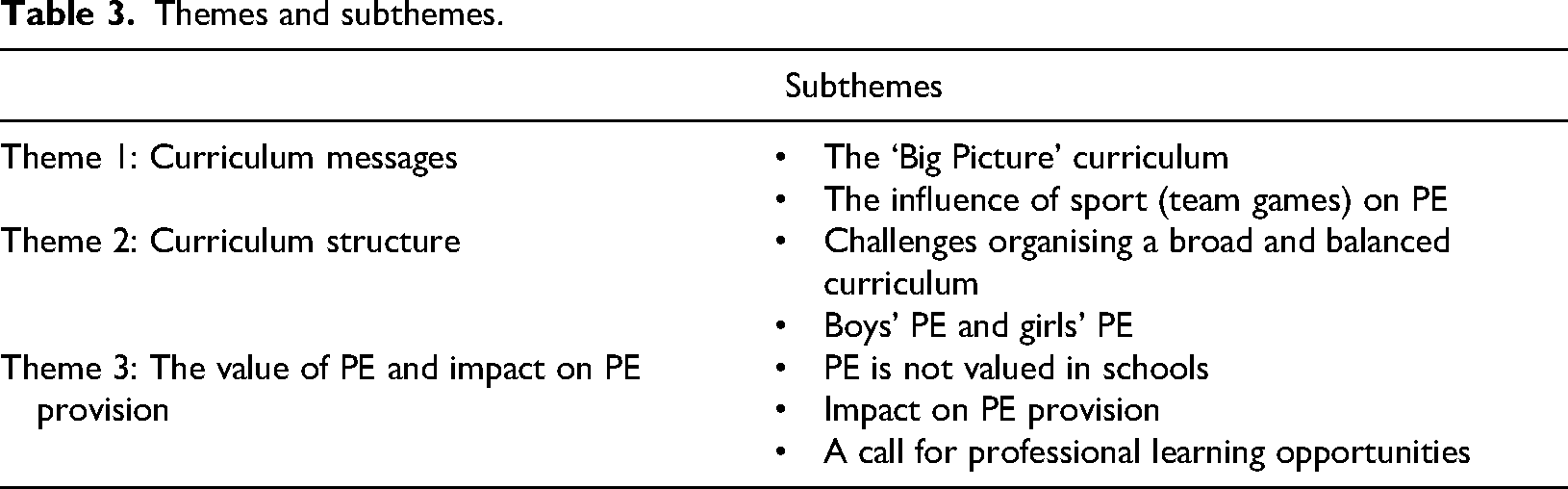
Data analysis involved author 1 reading and re-reading all the transcripts to become familiar with the participants’ responses and begin to identify preliminary themes. These were then discussed with the second and third authors, who reflected on each theme considering their positionality and their experiences conducting the interviews (Smith and McGannon, 2018). This led to a discussion to explore gaps and/or similarities in these interpretations. Subsequently, author 1 carried out a more systematic analysis of each transcript. This was an inductive approach where portions of text were highlighted and assigned a phrase to indicate meaning, then similar units of meaning were grouped together to generate initial themes (subthemes) which were further refined through an iterative process (Braun and Clarke, 2019). Simultaneously, authors 2 and 3 read a sample of the transcripts to deepen their understanding of more of the participants’ responses. All three researchers met again to discuss the identified subthemes, engaged in dialogue to explore their interpretations and, drawing from their previous curriculum analysis and the concept of boundaries, consider them within the broader educational context of NI. This discussion led to the identification of broader themes and subthemes (see Table 3), which are described in more detail in the sections below.
Themes and subthemes.
Findings
Curriculum messages
The ‘Big Picture’ curriculum. In our previous analysis of the NI PE curriculum, we highlighted that this is a forward-thinking curriculum that adopts a ‘Big Picture’ approach to support young people's development, enabling them to contribute to society, the economy and the environment (CCEA, 2019). To achieve this, the curriculum in NI is multidisciplinary and encourages connections between subject areas to develop a broad range of knowledge and skills essential for life and work. In the present study, we found evidence among all participating teachers that curriculum discourse significantly influenced their understanding of the aims and purposes of PE, where, through weak boundaries, broader educational goals can be seen to permeate the PE curriculum. For example, all teachers described PE as ‘holistic’, helping young people develop a wide range of social and emotional skills, including confidence, resilience and teamwork, as well as cognitive skills such as problem-solving and independent thinking. Some teachers also referenced cross-curricular learning, emphasising the development of literacy, numeracy and information and communication technology (ICT) skills.
Interestingly, while references to curriculum and the development of competencies such as communication, teamwork and problem-solving were evident across all teachers, they appeared more prominently among those teaching in non-selective schools (Peter, Liz and Simon). The boundaries between PE and the community seemed to be especially weak in these schools, where understanding learners’ needs and contexts was important, ensuring that schools provided a safe and inclusive environment for all pupils: Think about like their outside influences … some of them are maybe getting involved in stuff that would be unheard of when I was at school. So, it's most like schools are [a] safe place … It's just about putting together a curriculum that gets them engaged in school and if they wanna come to school and hopefully they want to come to PE, that's obviously a huge win … and knowing the kids and what their likes and what their interests are. (Simon)
Although all teachers demonstrated an awareness and understanding of the NI curriculum and had integrated curriculum discourse into their conceptualisation of PE, their understanding of PE was not always straightforward. Indeed, there was some tension between PE as shaped by the national curriculum and PE as shaped by teachers’ knowledge and experiences of sport in NI.
The influence of sport (team games) on PE. At times, there appeared to be weak boundaries between PE and sport, where teachers discussed ‘PE as sport’, with an emphasis on team games. For example, the teachers sometimes used the terms ‘PE’ and ‘sport’ or (team) ‘games’ interchangeably, discussed the aims of PE in terms of learning sports skills, and at times, referred to certain pupils as ‘sporty’ (Liz, Tom and Andrea). Importantly, all participants also understood sport as a vehicle through which they could teach the broad range of skills outlined in the ‘Big Picture’ curriculum. That said, the dominance of this discourse varied across school types. For example, in grammar schools, the boundaries between PE and sport appeared especially blurred with some indication that sport was valued more than PE by other teachers and members of the senior leadership teams (SLTs). In grammar schools, sport was perceived as a draw for parents, with some making school choices based on the success of sports teams: It's something that, you know, parents whenever the children are moving, are transitioning from primary school and they obviously take that as a big thing into consideration. The [extracurricular] activities [sports] and the things that we provide and there's certain positives and there's obviously certain negatives in relation to that. (Susan)
The prevalence of the sport (team games) discourse among all teachers was perhaps unsurprising, given their backgrounds in team sports and undergraduate degrees in sports-related subjects. The power of these experiences and the understanding of PE as sport was clearly demonstrated, particularly by those teachers in the grammar schools, who referred to their specialised sports and the value this brings to the curriculum and the extracurricular programme: We have a wide variety of teachers in terms of the activities that we specialise in. I'm Gaelic myself, camogie … [another PE teacher] is basketball. And then we have … one of our permanent members of female staff, she's a netballer, and the two other boys are Gaelic football and soccer. (Susan)
Interestingly, some of these specialised sports are linked to Catholic or Protestant identities. For example, the teachers in Catholic schools played and taught Gaelic Games, while those in Protestant schools focused on sports such as hockey and rugby. Importantly, this was not always the case; for instance, one of the Catholic grammar schools recently introduced extracurricular rugby. Furthermore, community-affiliated sports were more prevalent in extracurricular games than in curricular PE. Interestingly, and given this prevalence, Liz highlighted that the pupils in her school are intentionally not offered the same activities in curricular PE as they are in their extracurricular programme. This suggests a level of critical awareness regarding the social and religious implications of certain sports in NI. Further evidence of this awareness can be seen in teachers’ critiques of schools that emphasise particular sports, reinforcing religious identity while limiting pupils’ opportunities to engage in alternative activities. For example, Tom recognised that: Protestant versus Catholic sports heavily influences the accessibility and the availability of sport for the children that go to those schools.
However, while some teachers were both aware of and critical about the role that sport plays in schools in NI, and had some scope to make changes to their PE curriculum to challenge this position, the dominance of the sport discourse in the responses of all teachers was evident. This suggests that the curricular inclusion of sport (and the specialised discourses associated with it), together with teachers’ sporting (and cultural) identities, work to maintain strong boundaries around what counts as legitimate knowledge in PE. These boundaries make it difficult for teachers to talk about or organise PE curricula in alternative ways.
Curriculum structure
Challenges organising a broad and balanced curriculum. Despite participants referring to their curriculum as broad and balanced, as noted above, the dominance of team games was evident – especially in the grammar schools, albeit in diverse ways. For example, in Andrea and Ella's schools, pupils’ time in curricular PE is reduced as they progress to their senior years (Andrea) or removed completely (Ella), yet their time in extracurricular games is sustained in both schools. Conversely, Sarah described how the time allocated to the PE curriculum in her school has increased because their headteacher is ‘really trying to drive PE and sport within the school’. This ‘drive’ for PE and sport is perhaps also reflected in the fact that at the start of the year the curriculum in Sarah's school is dominated by games.
This tension between promoting breadth and balance and a continued focus on games may also be influenced by the strong boundaries created through the curriculum planning process, where PE programmes are typically structured around discrete sports or physical activities. All schools in the present study had a PE curriculum organised according to six-week blocks of sport/games or physical activities. As Andrea noted: You have to use it, so we would work in six-week blocks, so the girls would maybe start on swimming while the boys do like a sports activity and then we swap.
Here, the weak boundaries between PE and sport in NI seem to have created strong boundaries between PE activities, shaping how the curriculum is organised, what is taught and what is valued. Despite all teachers engaging with curriculum discourses that emphasise cross-curricular learning, the PE curriculum seemingly remains constrained by its organisation around specific activities. That said, even with these constraints, there was evidence to suggest that teachers explicitly endeavoured to create a broad curriculum through providing a range of activities. For example, Peter shared: I really do try [to] make sure that we have a broad and balanced curriculum because I know that other schools’ PE programmes of study are heavily weighted towards the traditional team invasion games. And I make a real conscious effort that that won't be the way for my classes.
Similarly, and as noted earlier, Liz highlighted that they aim to provide their pupils with activities that they would not do after school ‘because everything's football, GAA, hurling’. Therefore, despite working within a system that might limit their ability to plan a broad and balanced curriculum, participants valued these principles and made concerted efforts to implement them, albeit with varying levels of success.
Boys’ PE and girls’ PE. Across all schools, PE is also structured around strong gender boundaries. Reflecting the way adult-level sport is typically organised, girls and boys are mostly educated separately in PE, often participating in different activities and being taught by teachers of the same gender. For example, Tom noted that only girls can do dance in his school. These strong gender and sport boundaries are problematic because ‘male’ sports are perceived to be more privileged in NI (Hargie et al., 2015; Liston, 2001). This may contribute to the (unequal) distribution of power between boys and girls in PE (and likely male and female PE teachers) and could negatively affect how girls and young women feel in this context, which may then influence the effort they apply to their learning. Indeed, recent research from NI highlights a rapid decline in female pupils’ participation in PE (and sport and physical activity), as they move into adolescence (Connolly et al., 2020). It was perhaps unsurprising then that, within this curriculum structure, there was a perception that some girls had negative attitudes towards sport, with teachers suggesting that girls were less motivated to engage in physical activity (Susan and Peter) and were less ‘sporty’: If I get a class full of sporty kids, it would be a big ask teaching them new skills or sports that they've never did. But then I may get a class of girls who are unmotivated and aren't into PE [or] sport at all. (Liz)
In attempting to address girls’ disengagement in PE, Liz noted how they focused on activities aligned with the promotion of physical activity and health, stating that it ‘is just then having them active, maybe it's doing a couch to 5 K or going out and doing steps’. While motivated by good intentions to ‘have them active’, teachers may unintentionally reinforce strong boundaries that reproduce inequalities and limit learning opportunities for girls and, more broadly, for those pupils who do not conform to normative conceptions of masculinity.
The value of PE and impact on PE provision
PE is not valued in schools. Despite all participating teachers understanding the ‘Big Picture’ curriculum in NI, and the ways in which PE can contribute to this curriculum, there was an overwhelming perception that the subject of PE is not valued in schools or in NI society more broadly. It was felt that other teachers, parents and communities lack an understanding of what PE is and how it can contribute to the learning and lives of young people. Interestingly, PE was perceived to be undervalued as a subject across both selective and non-selective schools, although teachers thought that sport and sporting ability were valued by other teachers and parents in the grammar schools: Generally, I don't think it's valued and [seen as] that important. PE on the curriculum, [pupils] will go down there and kick a ball about. That it's a bit of free time for them … And so, I don't think there's that good of a view with people outside PE, people that aren't paid teachers, and even [other] teachers within the school. (Liz) As a whole, generally people would maybe not see the value of PE unless you've had like a good experience of it as a pupil. And that would tend to be like the sportier people. (Andrea)
Despite aligning with the ‘Big Picture’ framework in NI and with the potential to support learners holistically, participants seemed to suggest that the way PE is currently structured is likely to hinder this. The organisation of PE curricula around categories of sport, with weak boundaries between curricular PE, sport and extracurricular games, makes it difficult for other teachers and parents to understand PE in alternative ways.
Impact on PE provision. The ways in which PE is perceived/valued by those outside the PE community (e.g. SLTs and parents) may have implications for how PE is supported and resourced within each school. According to the teachers in the present study, PE's relatively low status and position within this social order may be a contributing factor to the amount of time allocated to PE within the school curriculum: It's only an hour a week we get. And by the time the kids get [there] … because we have our own PE complex [10 minutes away from the school] we probably have around 40 minutes of physical activity a week, which is another thing [that's] hard for you in the school. (Liz)
Although the DE in NI recommends that all young people have two hours of PE each week (CCEA, 2024), none of the schools represented in this study met this recommendation. In fact, time allocated to PE varied across all the schools from 60 minutes to 90 minutes. As well as variation across schools in terms of the amount of PE time, there was also the perception by the PE teachers that the resources (including facilities and materials) they had access to were limited. For example, Peter stated: There's a real lack of facilities, but yet you walk in the classrooms and there's these six TV whiteboards that do everything and you go to English departments and they've 20 copies of Harry Potter. You walk in the science departments and they've got any amount of equipment that they need. And so, I do think facilities and resources can be another issue.
A lack of facilities and resources was reported to be an issue for teachers positioned in all schools, although there was a general perception by the teachers in non-selective schools that the facilities in the grammar schools were superior to theirs: …typically grammar schools are very well equipped, like loads of sports stuff, pitches, indoor facilities, outdoor pitches, 3Gs, the fitness suites. (Simon)
Highlighting the value placed on ‘other’ forms of (more academic) knowledge, all of the teachers found that access to their facilities was particularly challenging during examination periods, where sports halls would be used to cater for national examinations, limiting learning spaces in PE (and) often forcing classes outside (which was particularly problematic when there were adverse weather conditions). Furthermore, Sarah described how some pupils are taken out of PE so that they can have additional time to revise for other ‘more academic’ subjects. By contrast, in grammar schools, the teachers reported that it was common for pupils to be taken out of school, usually by the PE teacher themselves, to compete in games against other schools. However, it was also noted that when PE staff are out of school for games, teaching cover is not provided, and other PE teachers must double up classes. This limits what can be taught, how it is taught and the PE experiences of those pupils who do not participate in extracurricular school sport.
A call for professional learning opportunities. All the PE teachers recognised the challenges that they faced working within a subject that was less valued in school and often misrepresented as ‘sport’. They critiqued variations in provision across school types, the dominance of team games with PE curricula (although they found this difficult to resist/challenge) and the negative perceptions that others had about PE. However, they also seemed unsure about how to change perceptions to demonstrate the valuable contributions that PE can make to young people's learning and development. Relatedly, when asked at the end of the interviews if there were any other (relevant) topics they would like to discuss, all the teachers highlighted the need for professional learning opportunities to help navigate some of these challenges. While some of this was focused on the development of content knowledge for different sports and physical activities, there was also a call to learn from others, across schools (boundaries) and share ‘good practice’: To have courses that PE teachers need to attend to share good practice. Share ideas and because I know people can get stuck in their ways and aren't open to that change. (Ella) If there were more opportunities for continued professional development … for teachers across schools that they were able to go to, I think that would certainly maybe enthuse people and maybe get them more involved and try [different] ways in which they can deliver their PE curriculum. (Tom)
In NI, there are several financial and political barriers that limit the provision of professional learning opportunities for teachers (e.g. centralised control, union intervention, budget cuts and political instability), yet all participants expressed the desire for opportunities to learn and build capacity to change their understanding of and approaches to teaching the PE curriculum (McFlynn et al., 2024).
Discussion
Our findings reveal ways in which the ‘Big Picture’ curriculum in NI has created opportunities to shape broad, connected and meaningful PE curricula. However, they also revealed tensions experienced by teachers that limit these opportunities; for example, how a focus on sport makes it difficult for PE teachers, as well as teachers of other subjects, to understand, enact and value PE in more creative and inclusive ways. Drawing from the literature and Bernstein's (1971) concept of classification (boundaries), we now explore these findings in more detail and conclude by making some tentative suggestions about how these challenges might be overcome.
The importance of the ‘Big Picture’ curriculum
All teachers referred directly to the NI curriculum and so (indirectly) at least acknowledged the weak boundaries between PE and other subjects. This was particularly evident when they discussed the development of literacy, numeracy and ICT skills within PE. As previously noted, this positioning of PE knowledge as cross-curricular, with weak subject boundaries, was more prevalent among teachers working in the non-selective controlled or Catholic maintained schools, all of whom described their schools in terms of socio-economic disadvantage. Moreover, during their cross-curricular discussions, they spoke about prioritising the needs of their learners to ensure a safe and inclusive learning environment. For example, Simon, whose school demographic he described as being of an ‘extremely low socioeconomic background’, referred to the importance of understanding the local community, of ‘knowing the kids’ and creating a curriculum that ‘gets them engaged in school’.
Drawing from Bernstein (1970), Morais and Neves (2001) highlighted how pedagogic structures and practices within schools can lead to educational inequality. This occurs because not all young people find meaning in the forms of knowledge conveyed in schools; rather, they may find it difficult to access such knowledge and, as a result, feel alienated and become disengaged. Morais and Neves (2001) also argued that to promote educational equality, teachers must understand the values and experiences learners bring from their families and communities and use this understanding to support learners in becoming successful within the school context. In Bernstein's (1970: 347) words: ‘if the culture of the teacher is to become part of the consciousness of the child, then the culture of the child must first be the consciousness of the teacher’. Cross-curricular – and even cross-community – learning thus has the potential to create space for alternative forms of knowledge that reflect the diversity of the pupil population, particularly for those whose ways of knowing do not align with the more traditional, dominant forms of school knowledge. Importantly, there was evidence of this weakening of boundaries in the present study, especially in the non-selective schools whose pupils come from more disadvantaged communities. This highlights the potential of the NI curriculum to enable teachers to create meaningful learning experiences, connect to the lives of young people and improve their opportunities for success. As noted, there was also evidence of this in the grammar schools, although this was somewhat limited by, and in tension with, the teachers’ references to the position of sport within their PE curricula. In other words, the weak boundaries between sport and PE seemed to create stronger boundaries between PE and other contexts, for example, other more ‘academic’ subjects and the local community.
The ‘PE as sport’ problem
In our previous analysis of the PE curriculum (Stirrup et al., 2025), we suggested that, given the strong connection between sport and national identity in NI (Liston and Deighan, 2019), sport (particularly team games) might play a significant role in the development and enactment of PE curricula. This was confirmed in the current study, where all participants drew from their knowledge of sport when discussing PE in NI. This is perhaps unsurprising, given their backgrounds in team sports and their undergraduate degrees in sports-related disciplines. Indeed, research has highlighted that PE teachers often enter the profession because of their experiences in sport, which in turn influences how the curriculum is organised, as well as what is taught and how it is taught (Green, 2002).
While understanding PE as sport can be problematic, largely because such a focus tends to privilege pupils who bring successful prior experiences and physical competencies, this issue becomes even more complex in NI due to the powerful relationship between sport and national identity (Bairner, 2016). As Quennerstedt (2019) notes, decisions about curriculum and pedagogy are inherently political choices, reflecting broader views about the purpose of education. Along with other scholars (e.g. Hughes, 2011; Liston and Deighan, 2019), we argue that decisions about which sports are taught in NI (particularly in extracurricular games) are implicitly political. Although government is shared between unionists and nationalists, cultural and identity boundaries remain strong, as seen in the continued separation of spaces, communities, schools and sports (Liston and Deighan, 2019). In this way, sport in schools (curricular PE and extracurricular games) becomes legitimised through social and cultural identities, and the knowledge that is valued in school reflects that of the community it serves. However, the weak boundaries between PE and sport in NI may also contribute to the reproduction of cultural identities that limit opportunities for dialogue, learning and other ways of knowing and being. This is at odds with the aims of the NI curriculum, which seeks to develop mutual understanding among young people (CCEA, 2019). Furthermore, weak boundaries between PE and sport make it difficult, perhaps, for teachers to understand and/or enact PE in alternative ways. These challenges are further compounded by the potential backlash teachers may face when they attempt to challenge traditional norms (Hughes, 2011). As a result, while the boundaries between PE and sport appear weak, the subject remains strongly bound in its organisation, often structured around six-week blocks of sports and games. One of the problems with this structure is that it shapes how PE is viewed and valued by others (as sport) which can influence resource allocation and, ultimately, the learning experiences of young people.
PE is not valued
In the present study, there was an overwhelming perception that PE was not valued by other teachers, SLTs and society more broadly. From our findings, we suggest that this may be because of the aforementioned weak boundaries between PE and sport. This was articulated by the PE teachers in this study and may help to explain why PE becomes understood as less academic, while subjects like maths or science are privileged, legitimising this form of ‘more academic’ knowledge. This appeared more prevalent amongst teachers in the grammar schools, which are more widely understood as ‘academic’ and ‘high achieving’ schools (Roulston et al., 2024). In this context, the purpose of PE is not aligned with academic goals, but with sporting success, school reputation and the development of characteristics and skills such as pride, hard work, character formation and networking (Horne et al., 2011). Thus, in NI grammar schools, sport becomes a way of promoting educational and social advantage, highlighting further differences between school types and contributing to educational inequalities (Gorard and Siddiqui, 2018). That said, while there are likely differences in how sport is conceptualised across different school types, the negative impact of ‘PE as sport’ on the PE curriculum is felt across all schools, evidenced by the lack of time, facilities and resources allocated to the subject. Unfortunately, this mirrors the international picture of how PE is understood and valued within schools and across communities (Gray et al., 2025).
Conclusions
Exploring the curriculum perspectives of PE teachers in NI is important for several reasons, but perhaps most importantly is that, ultimately, they shape the experiences of learners in this context. For example, a tightly bound curriculum dominated by sport tends to privilege those who have experienced sport outside of school and enter the PE space with pre-established sports skills (Roberts et al., 2019). For those lacking these skills, PE can be a negative space, which may especially impact girls given the perceived masculine nature of many sports/games. There were some suggestions by teachers from both selective and non-selective schools that there was an issue with girls’ (lack of) participation in PE. Drawing from Bernstein's concept of classification, we suggest that weakening the boundaries both within the PE curriculum and across the broader school curriculum has the potential to move the emphasis away from sport towards other forms of knowledge, shifting the balance of power to create a more inclusive PE space. For example, there may be value in bringing together teachers from PE and social subjects (e.g. history or sociology) to create a cross-curricular PE programme that critically explores and challenges the social, historical and cultural influences on moving bodies, and the ways these influences shape conceptions of masculinity and femininity. This collaborative approach also creates opportunities for teachers of other subjects to better understand the educative possibilities of PE, which may then influence how they perceive its value.
While we acknowledge that this level of innovation will be difficult for many teachers, there was some evidence within this study to suggest that the teachers had scope to adapt/resist dominant knowledge forms and produce new ways of knowing for their learners. For instance, Liz organised activities in curricular PE that were different to those experienced after school to ensure her learners experienced a range of activities, while Peter was critical of schools who focused primarily on one sport within their PE curriculum. Additionally, all participants indicated that a broad range of skills could be taught in/through PE, including literacy, numeracy and ICT. These more critical perspectives are important, and scholars have argued that a critical disposition is a necessary first step towards change (Hickey and Mooney, 2019). We suggest that the critical perspectives evident in the teachers’ responses, though not dominant, are promising and may serve as a useful catalyst for future curriculum developments.
Our findings also suggest that the teachers aspired to broaden their thinking about PE, as indicated by their call for more professional learning opportunities and desire to work with other PE teachers from across different schools. Previous work exploring cross-border learning found that weakening the boundaries between teachers from different schools created opportunities for critical thinking. This was achieved through sharing and interrogating experiences, encouraging some teachers to question the relevance of their own PE curriculum for their learners (Gray et al., 2024). Replicating this work in NI may have a similar effect, inviting teachers to critically reflect on their PE curriculum and to (re)consider how learning in PE connects to the lives of their pupils. This focus on the purpose of PE in relation to their learners requires a shift in focus away from what is taught in PE (and how subject content is organised), towards why and how curricular activities are taught. From this position, one that focuses on the needs of their learners in context, PE teachers might also begin to challenge and move away from, not only traditional ways of organising the curriculum, but also traditional ways of enacting the curriculum. Future research is therefore warranted to explore these pedagogical possibilities with PE teachers across different school types in NI. Importantly, future research should consider the limitations of the present study, that the data were drawn from a relatively small number of teachers and collected at a single point in time. These constraints may have limited participants’ opportunities (or willingness) to engage deeply with key concepts or to express their knowledge in alternative ways (Roulston, 2010). Acknowledging these limitations, it is important that future research involves working with PE teachers over a more sustained period to ensure not only greater depth of investigation but, perhaps more importantly, that teachers have sufficient opportunities to engage in meaningful learning and even personal transformation.
Footnotes

Ethical considerations
A favourable ethical decision was granted by the Ethics Committee at Loughborough University, UK (Ref No. 17505).
Funding
This project was funded by the School of Sport, Exercise and Health Sciences, Loughborough University, UK.
Declaration of conflicting interests
The authors declared no potential conflicts of interest with respect to the research, authorship, and/or publication of this article.
Data availability
Data sharing is not possible for this project. Participants’ consent was based on the knowledge that only the research team would have access to the interview data.