




Abstract
This article presents an investigation on music education in Northern Ireland (NI) aimed at uncovering how 22 music teachers in post-primary schools addressed the 2007 statutory music curriculum in terms of its potential to promote social cohesion in NI’s post-conflict society, where most schools are segregated on religious grounds. In the discussion we consider three curriculum requirements: (i) to promote cross-cultural and (ii) mutual understanding and (iii) to undertake shared learning through school collaboration. While presenting a primarily positive view to the promotion of cross-cultural understanding, the data outlines the existence of closed minds across the community divide. Approaches to mutual understanding evidenced a picture of classroom activity where it was translated into ‘mutual respect’. Shared learning through school collaboration was treated on two fronts: collaboration needed to access external exams, and collaboration arising from the Department of Education’s 2015 Shared Education initiative. While exam collaboration raised issues for pupils and teachers, the shared education initiative promoted a small number of cross-school projects driven by individual teachers. Educational implications are considered in the conclusions.
Keywords
Introduction: Post-conflict NI as the context of the enquiry
Northern Ireland’s (NI) Belfast (‘Good Friday’) Agreement (1998) produced peace, but it did not disperse the deep-seated political aspirations and cultural traditions of its two historically divided Protestant and Catholic communities. During ‘the troubles’, from the late 1960s to the late 1990s, over 3,700 people died and 47,000 were injured, due to violent conflict between and within republican and unionist groupings, the UK army and local police (McKeown, 2013; McKittrick et al., 2007). Equal rights and current opportunities at whole-society level are impeded by learned historical memory and differing socio-cultural affiliations that emanate from within the home (Muldoon et al., 2007; Taylor et al., 2020). The reality is, that while each community is socially and politically inclusive, each is, at the same time, perceived to be socially and politically exclusive, as outlined by Furey et al.’s (2017) comparison of different school settings. NI is a segregated society in which the majority of districts are overwhelmingly Protestant or Catholic, and the school system reflects this with most children attending local schools with relatively homogeneous intakes of students (Department of Education [DENI], 2017). While segregation in NI has the potential to perpetuate social exclusion and reinforce sectarianism, it also reflects complex issues of identity: religious (Protestant and Catholic); political (Unionist and Nationalist); and cultural (Ulster Scots-‘orange’ and Irish-‘green’). In a population of approximately 1.9 million, segregated schools educate approximately 93% of NI’s children while, since 1981, the remaining 7% are educated together in integrated schools (DENI, 2017).
Over the last three decades a number of school policies have been developed to try to promote cross-community understanding. One of the first such developments followed the Education Reform (NI) Order (Department of Education, 1989) that legislated for ‘Education for Mutual Understanding’ and ‘Cultural Heritage’ to become essential elements of NI’s curriculum. Education for Mutual Understanding (EMU) and Cultural Heritage (CH) were designed as cross-curricular themes in NI’s first statutory school curriculum (DENI, 1992) but were frequently overlooked by teachers’ and school inspectors’ focus on the new subject-specific content. A subsequent 7-year longitudinal study concluded that the themes did not form a ‘meaningful part of pupils’ curriculum experience’ (Harland et al., 2005, p. 53). They are now implicitly referenced in the statutory learning areas of ‘Mutual Understanding’ and ‘Cultural Understanding’ in the latest curriculum iteration (Council for the Curriculum Examinations and Assessment [CCEA], 2007).
Given the combined interests of the co-authors, this empirical study was aimed at uncovering how music teachers in post-primary schools addressed the 2007 curriculum in terms of its potential to promote social cohesion in NI’s post-conflict society. In the following four sections we outline the literature review and research question, methodology and discussion of findings, before concluding the paper with final reflections and implications.
Literature review and research question
The literature review in the four-year investigation from which the paper draws 1 was framed within MacDonald’s (2013) model for music and wellbeing that addressed music as an artistic phenomenon and a contributory factor in personal and social development, as set out in Figure 1.
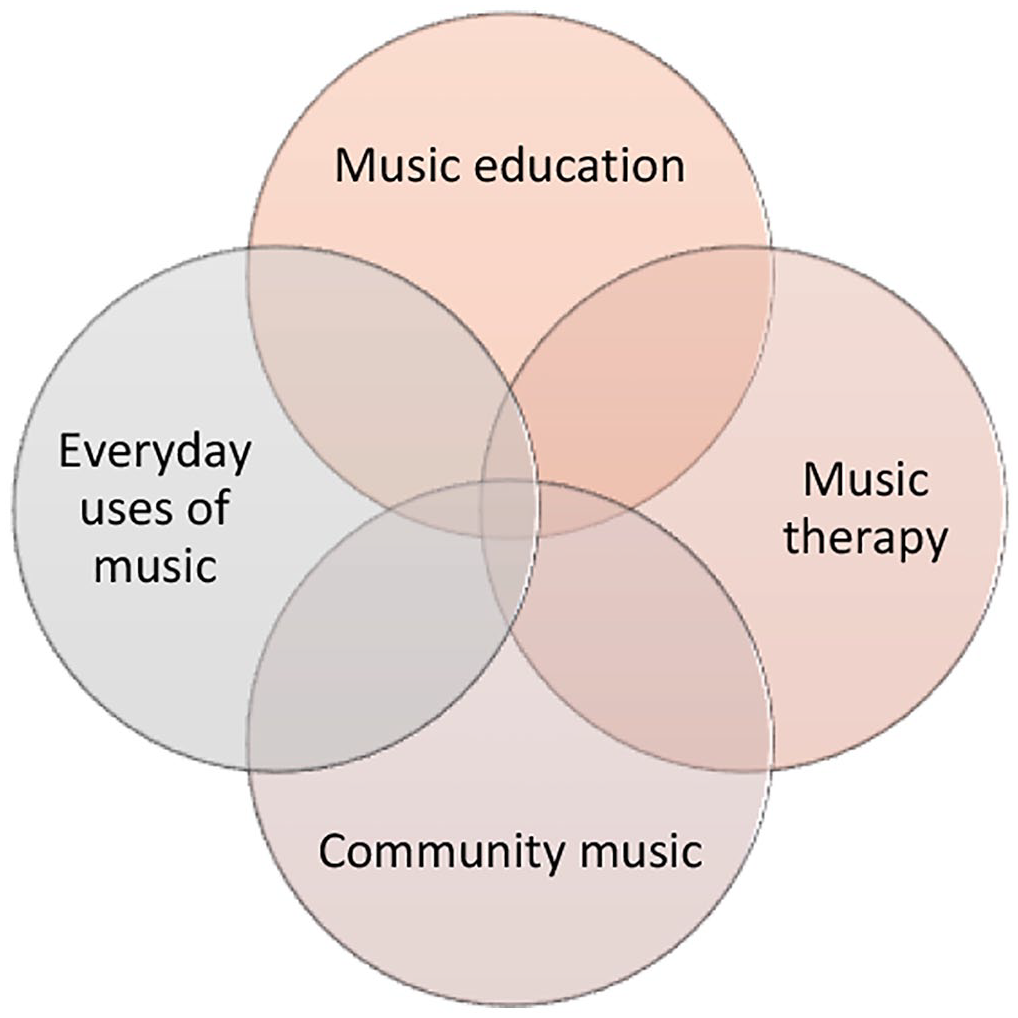
MacDonald’s conceptual framework for music, health and wellbeing (adapted from MacDonald, 2013, p. 8).
While the review of literature addressed the breadth of Mac Donald’s framework, music education formed a particular focus for the research to be undertaken. It covered a number of historical and modern perspectives ranging from Dewey’s (1938) and Bruner’s (1996) constructivism; through Paynter’s (1982) curriculum focus on an education in and through music; to Odena’s (2010) overview of cross-community music education in NI; and DeNora’s (2000) review of music in everyday life. MacDonald’s important contribution to music as a resource in promoting health and wellbeing within and beyond the dimensions of education, was supported, for example, by Small’s (1999) concept of ‘musicking’. Small’s argument that musical meaning does not lie in musical works as artefacts, but in the human aspect of their presentation through performance, outlined the importance of place and context. Small (1999) proposed the term ‘musicking’ as value-free representation of meaning based on relationships between performers and listeners, and between the musical sounds themselves, within a certain place at a certain time. Ultimately, NI reveals the dilemma that exists between Hall’s (1992) vision of culture as a national construct, Bruner’s (1996) proposition of culturalism as dependent on cultural resources, and Hargreaves (2000) assertion that the cultural resources are within schools that are not neutral.
In recent decades scholars in the sociology of music have discussed how individuals and groups of adults use music, and how music relate to broader social distinctions such as class and ethnicity (e.g. DeNora, 2000; Roy, 2002). For instance Bourdieu (1984) and Roy (2002) outlined how music functions as a ‘technology of the collective’ when adult listeners gravitate towards those with similar tastes. Groups use music as a tool for developing identity in two ways: music is generally labelled as belonging to a particular group, and group membership is marked by embracing this music. Roy and Dowd (2010) discuss the concepts of ‘bounding’ and ‘bridging’ as the mechanisms that align music genres with distinctions such as class (bounding) and that allow group members, usually high-status, to listen to genres beyond those ascribed to their group (bridging). Overall the above studies focus on how adults use music in non-conflict Western settings. A further review of the sociology of music may yield an interesting framework for the analysis of music in contemporary NI society, but would be beyond the scope of this paper, which focusses on music education in schools.
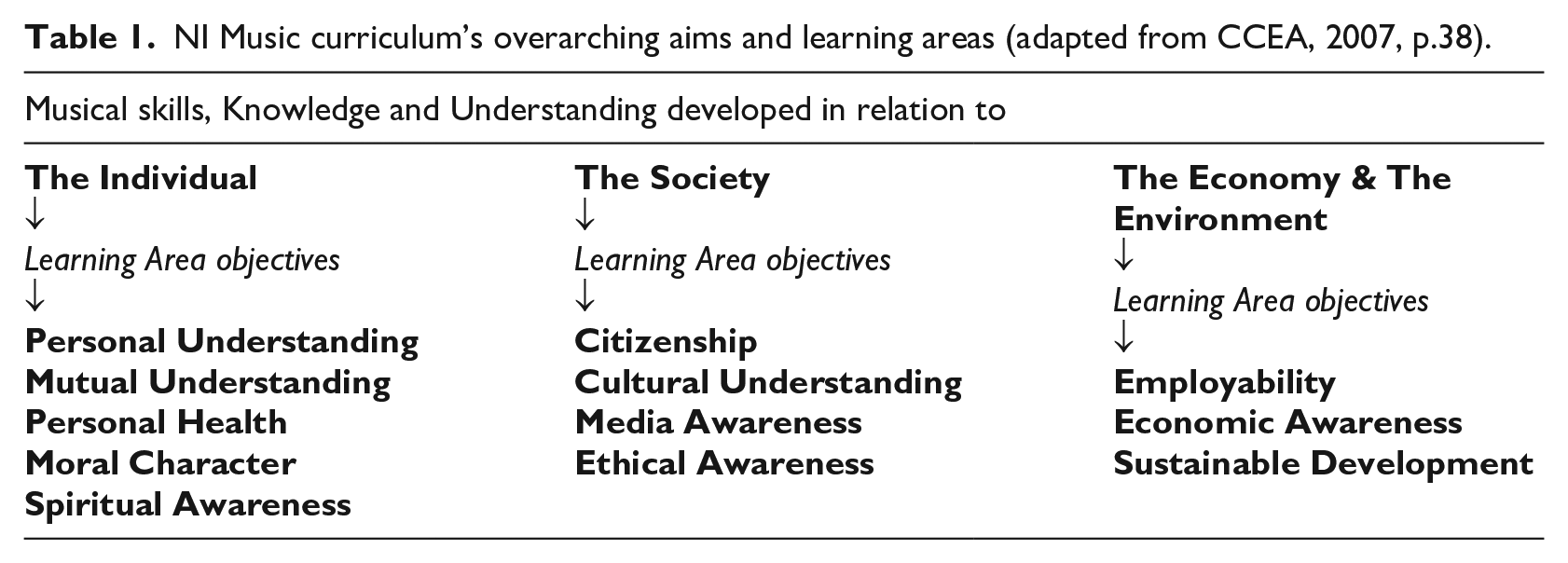
Music, like all subjects in the NI statutory curriculum (CCEA, 2007) has three overarching aims: pupils’ personal development; their contribution to society; and their contribution to the economy and the environment. Aims are supported by key objectives, defined as 12 areas of learning, through which subject knowledge, understanding and skills are to be promoted and developed. The music curriculum programme sets out the range of musical activities including improvising and composing, performing individually and in groups, listening and appraising and the use of information technology, that pupils should undertake in 12 areas of learning. These are set out in Table 1 below.
NI Music curriculum’s overarching aims and learning areas (adapted from CCEA, 2007, p.38).
Music teachers are challenged both by the statutory learning areas which are not overtly music specific, but must be implemented, and by opposing concepts of inclusion and segregation which form the background to their professional life as educators. Therefore the main research question guiding this study was: how do teachers view the potential of the 2007 statutory music education programme to meet the specified curriculum objectives and contribute to cross-community cohesion?
Prior to data collection we reviewed the literature on school music education in NI since the Education Reform (NI) Order (1989) that legislated for Mutual Understanding and found only three papers on the 1990s developments, including Drummond (1999, 2001) and Jarvis (1990). Although Drummond concluded that music should become an optional subject after the first 2 years of post-primary education, his recommendation was not put into practice and music education for all pupils aged 11 to 14 remained compulsory. Jarvis (1990), as DENI Inspector for music education, underpinned the early development of the new music curriculum and reported on its implementation. No research on the 2007 music curriculum was found.
Research methodology
Given the varied community settings of NI schools data collection, undertaken in 2016 and 2017, required a degree of educational representation. We aimed to achieve this by including schools from across NI, which we divided in four sampling areas defined as North (N), South (S), East (E) and West (W) – see Figure 2.
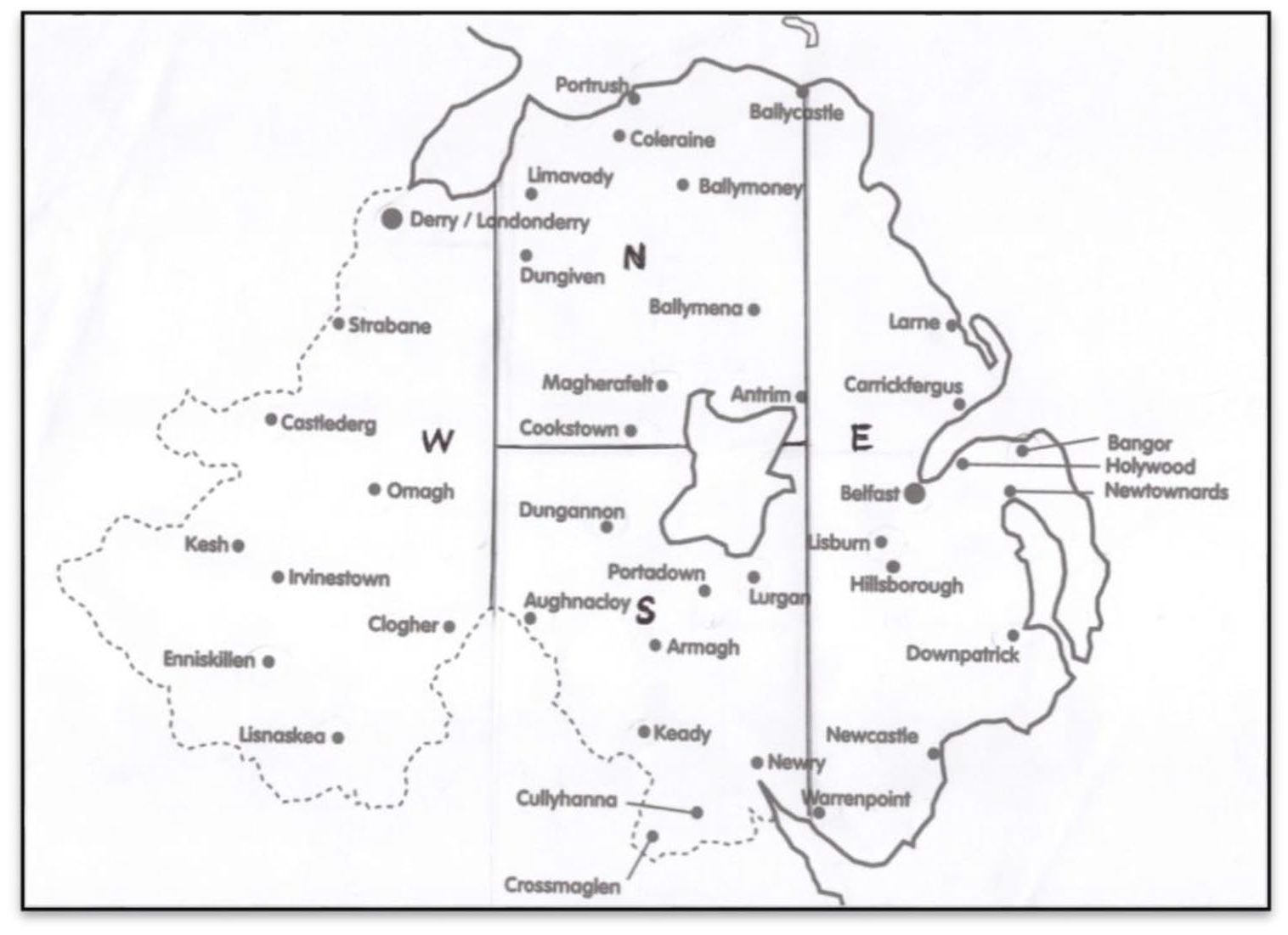
Map of NI with main towns in the four sampling areas.
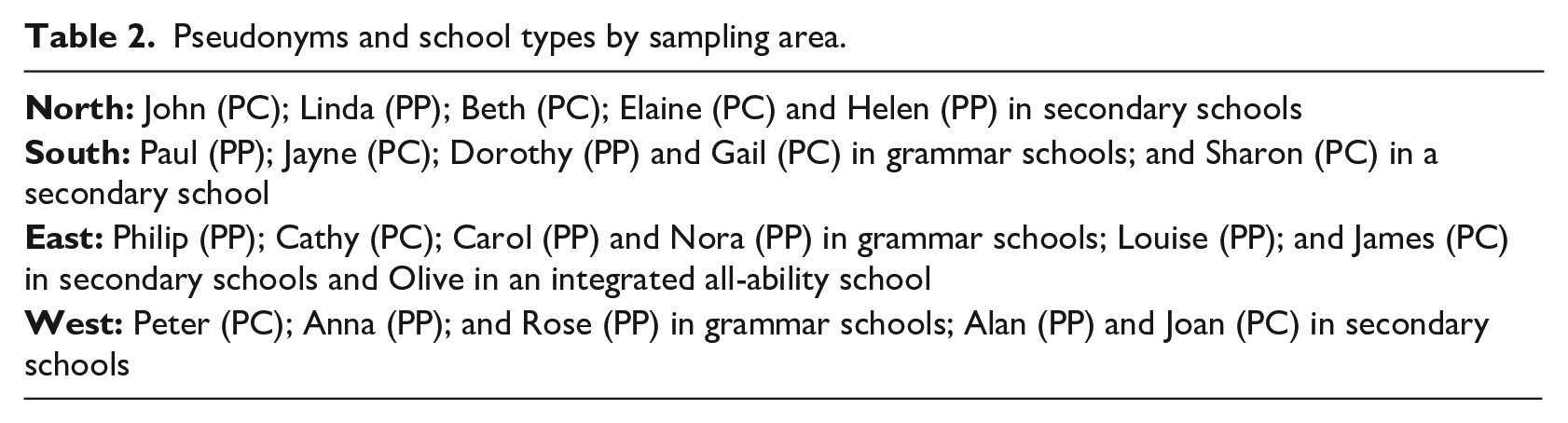
A random sampling procedure (Cohen et al., 2011) was undertaken by contacting 60 school principals across the different sampling areas, asking their permission to contact their heads of music. This resulted in 25 music teacher invitations and 22 agreeing to participate in semi-structured interviews. 2 Post-primary music teachers in the UK and NI have either a 3-year Bachelor’s degree in Music Education (4-years in Scotland) or a Music degree followed by a 1-year postgraduate course in Education. Participants worked at 11 selective grammar schools that allow entry on the basis of tests, 10 post-primary secondary schools and one integrated school which teaches all children together. Participants and school types are set out by sampling area in Table 2. In order to protect confidentiality, pseudonyms replace teachers’ names, and schools’ affiliations are identified according to the community they serve (Primarily Protestant/PP or Primarily Catholic/PC).
Pseudonyms and school types by sampling area.
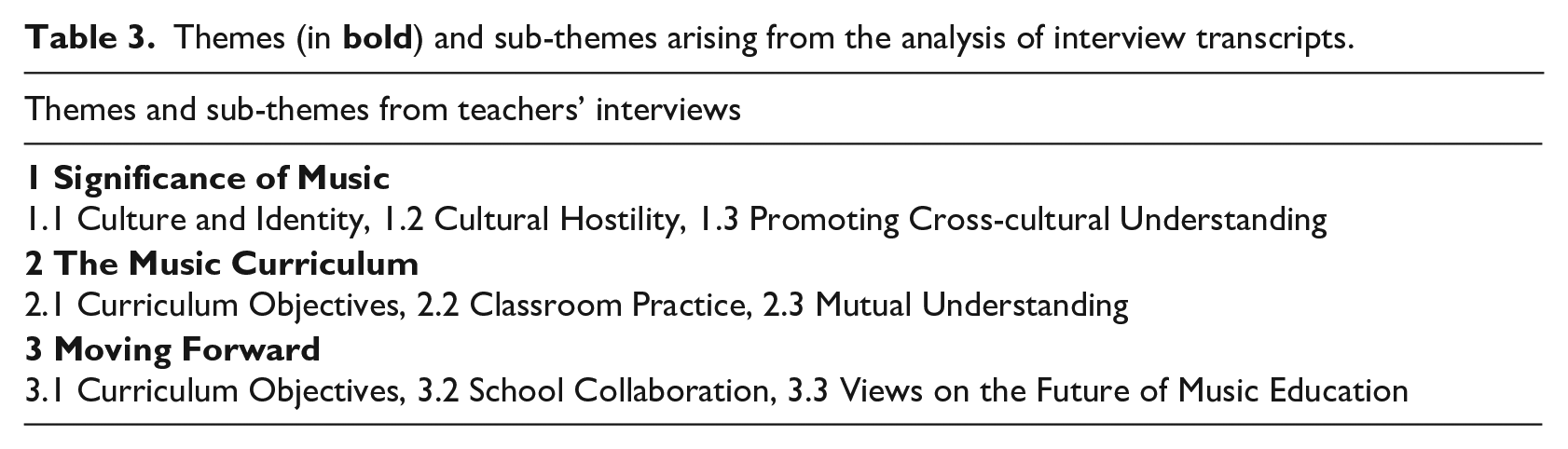
Semi-structured interviews (Kvale & Brinkmann, 2009) were conducted in schools and allowed participants to expand on seven questions that had been piloted with two school principals. Examples of questions are included in the Appendix. The questions covered teachers’ views on music in NI, their approaches to curriculum implementation and the impact of recent initiatives by NI’s Department of Education – for example, Sharing Works (DENI, 2015). The influence of their music and teacher education on their attitudes was not directly explored, and we suggest this will be a topic for further research. The teachers’ responses were supplemented with a focus group with 10 Newly Qualified Teachers, however due to space limits the focus group is not discussed in this paper. The empirical data was recorded in over 12 hours of audio files. A thematic approach (Kvale & Brinkmann, 2009; Odena, 2013) was used to analyse the situated knowledge arising from the verbatim transcription of the teachers’ interviews, resulting in the three themes and nine sub-themes set out in Table 3 below.
Themes (in
Discussion of findings
Taken together, the three broad themes above provide a coherent account of participants’ views during 2016 to 2017, a time when schools’ oversight and support was in the process of change through replacing the five pre-existing Education and Library Boards with a single Education Authority. The discussion of findings focuses on the question outlined earlier. While a fuller answer is provided in the thesis resulting from the four-year study, for the purposes of this paper we focus on the teachers’ views to promoting cross-community cohesion. These views are located, primarily, in the sub-themes 1.3 Promoting Cross-cultural Understanding, 2.3 Mutual Understanding, and 3.2 School Collaboration, which are discussed in the following sections.
Promoting cross-cultural understanding
The issues categorised under this sub-theme relate to the teachers’ interpretation of the curriculum requirement to promote ‘Cultural understanding’, a key learning area in the 2007 music curriculum (see Table 1). The importance of culture first arose when Helen in her (PP) school mentioned its relationship with identity – ‘it keeps us apart’ – and all but two teachers mentioned social identity through music by references to ‘culture’, ‘cultural traditions’, ‘cultural identity’ and ‘cultural division’. For readers unfamiliar with NI we should explain that at the time of data collection many NI towns had two primary schools (one PP and one PC). The same applied to post-primary education, where bigger towns had two secondary and two grammar schools (one PP and one PC, respectively). The divided structure of the school system after the partition of Ireland in 1921, resulted from the NI government’s need to accommodate two aspects of social memory and identity, predominantly under the cultural labels of ‘orange’ (Protestant) and ‘green’ (Catholic). Although Ulster-Scots music permeated both orange and green cultures it was appropriated as representing mainly the Protestant community (Cooper, 2010). The traditions of each side were represented through songs which reflected social and political contexts and aspirations over time. Pietzonka’s (2013, p. 27) study of NI songs identified a clear distinction between ‘orange’ and ‘Irish’ traditions that led her to conclude the biggest obstacle to overcome division ‘was the widespread hesitancy to step across into what is seen as the territory of ‘the other side’.
Against a background exemplified by Paul’s experience of moving from a (PC) to a (PP) school, which challenged his use of a unit on Irish music, Paul admitted that the approach to the unit’s content changed to one more acceptable to his school’s Protestant status. He did this by focussing on Ulster-Scots cultural traditions before addressing the Irish dimension. His experience reflected a need for teachers to address the cultural hostility exemplified, for example, by Sharon’s (PC) pupils’ ‘unwillingness to address “Protestant” music’; and Alan’s (PP) parents’ unwillingness to have their children participate in an Irish music festival. Constrained, perhaps, by parental or otherwise closed minds, two of the teachers did not include the Irish traditional music element into their teaching units. Joan, in her (PC) secondary school showed cultural insight by focussing on Celtic traditions across the UK: It’s something that they really enjoy and they’re very aware of. We look at Celtic traditions, not just Irish music, but back in history across the islands.
Carson (1997) had identified the tunes used by NI’s two cultural traditions to be a shared phenomenon, and his point was raised again by grammar-school teachers Anna (PP) and Peter (PC). Anna reported talking to her pupils about the same tune being used across the cultural divide, but with different names or words while Peter spoke of his experience in hearing ‘protestant’ bands play the tunes he had played during Irish traditional music sessions. Despite much of the music being shared, the bands were prevented from marching in a Catholic district. Peter recognised the underlying emotional sectarianism when he responded: ‘It’s ludicrous! It’s nothing to do with the music’.
Alienation arising from musical performance covered both sides of the community in that its expressive character was identified as a competing culture. For example, the idea of fear or threat in the Catholic community that arose from neighbours drumming the large Lambeg drums in evenings before the 12th July, was addressed by James in his (PC) secondary school when he introduced the Lambeg drum into his classroom so that his pupils ‘could see the culture’: It’s given them, not only understanding, but respect. They recognised that this was somebody else’s culture and wanted to have a go on this very loud drum.
For NI outsiders, Lambeg drums are very large drums, larger than bass drums, being ‘beaten’ during NI’s summer marching season which culminates in the 12th of July celebration (the yearly occasion on which NI’s ‘orange men’ and affiliated marching flute bands celebrate the 1690 victory of Protestant King William over Catholic King James at the battle of the river Boyne).
Like James, some of the most positive responses to cultural difference were from younger teachers. Gail, for example, in her (PC) grammar school talked of her own learning about Ulster-Scots music through teaching: ‘There’s an incredibly rich background through bands. [Pupils] need to look at the two traditions. . .the ‘kick the Pope’ flute bands. . .there’s cultural heritage going on there as well!’ While Louise, in her rural (PP) secondary school spoke of the pipe-band culture that contributed to the richness of school life, Paul’s experience of teaching in grammar schools across the religious divide supported the view that people in NI use history as a way of creating and maintaining opposing identities.
Most PC schools included some ‘Ulster Scots’ cultural content in their teaching, but there was only one reference to its influence on the music used for classroom or extra-curricular performance. This was from John, whose teacher education had been in Scotland. He commented on the similarities between the Irish tin whistle and the Scottish bagpipe chanter, and how he had used this to explore and promote pupils’ understanding of their associated heritage: We have students who play tin whistles and when I gave them a [bagpipe] chanter they were instantly able to play it because of the fingering and their skill in playing the Irish traditional music.
Other examples of promoting cross-cultural understanding were provided by Elaine in her (PC) secondary school and Olive in her integrated school. Elaine explained her approach to developing cultural understanding and a sense of mutual respect in her music classes which included Polish pupils: We try to put as much of their music in as we can so that they feel they are being understood and at the same time, it gives them a chance to understand the Irish children. When pupils are working in groups, maybe doing composition, they try to fuse different cultures. . .it builds close friendships.
Olive’s integrated school pupils were also culturally and ethnically diverse and she, too, spoke of the need to integrate everybody’s culture into the school. Olive also referenced her approach to addressing NI’s two historic cultures as ‘not being frightened to come in and play the Lambeg drum, and then having a Uileann pipe [Irish bagpipe] player. . .without the fear of reprisal’.
In describing NI’s two historic cultures we found some stereotyping (Allport, 1954), as evidenced by Alan’s ‘personal theory’, proclaimed in his (PP) secondary school: Catholic children play different than Protestant children . . . I’ve never heard Catholic children play the bagpipes as well as Protestant children - so it seems to be the old Protestant work ethic of ‘real hard work will get you there’, whereas Catholic children play with a grace and finesse that I don’t find within the Protestant community.
However, in promoting cross-cultural understanding most teachers sought to address cultural stereotypes. For example, Philip spoke of addressing stereotypes through discussion of pupils’ changing musical preferences as they matured. Rose also spoke of the impact of modern technology in challenging stereotypes: With all the opportunities provided by the Internet, we don’t have to listen to what our families say or what. . .we should be believing or saying. We can go and research it for ourselves.
The complexity of competing norms and values in NI society provided reasons for the inclusion of ‘Mutual Understanding’ as a significant element of classroom discourse in the 2007 music curriculum. It seems unfortunate that ‘Mutual Understanding’ and ‘Cultural Understanding’ are specified as two distinct learning areas in the curriculum, with no attempt to recognise their inter-relationship within NI. This is the dilemma which underpins discussion in the next section.
Mutual understanding
Given NI’s post-conflict society, the discussion, here, will consider the learning area, ‘Mutual Understanding’ which has its origin in the 1992 curriculum’s theme of Education for Mutual Understanding (EMU). Its distillation in the 2007 curriculum was concerned with developing qualities such as patience, tolerance in group work and understanding of how music can help or hinder harmonious relationships (CCEA, 2007). Possibly because of their own experiences, most participants considered that the present curriculum reflected the original EMU requirements, which were read during interviews as a tool to elicit discussion. On reading the EMU statements (DENI, 1992) Dorothy’s and Joan’s responses were, ‘it’s more or less the same’, ‘only written in different words’. Paul agreed there were similarities, but most importantly, ‘it’s what you do with it as well’. Olive’s integrated school perspective was more challenging: ‘We do it as a matter of course – but I don’t think it is as big as a cross-curricular theme throughout NI as it used to be’.
When addressing Mutual Understanding, teachers recognised its relevance to Cultural Understanding when they talked about understanding as ‘Mutual Respect’, possibly representing their belief that mutual ‘understanding’ would engender mutual ‘respect’ within and beyond the classroom. The development of understanding and respect were emphasised by the teachers, as the foundation of musical learning in the classroom. Although pupils could be critical of each other’s endeavours and opinions, in Joan’s classroom they had to be respectful towards each other: ‘We might refer to it now and again when someone’s speaking. . .Have respect!’
Interestingly, Cathy’s (PC) curriculum approach to developing pupils’ understanding was to avoid ‘the political side of music’ in her lessons: ‘It’s one of those things you don’t want to get into – political views’. Cathy and Rose in their (PC) and (PP) grammar schools focussed on the importance of group dynamics in music-making activities. For Cathy, it was about ‘self-discipline, and learning the skills to work together as a team’. Nora, in her (PP) grammar school, also considered classroom group work to be a fundamental basis for developing the mutual respect that was important in pupils’ future lives: ‘[to learn] how to interact, how to disagree with somebody in a non-confrontational way’.
While engaged in promoting mutual respect and understanding, most of these teachers appeared hesitant to cross the segregated schools’ boundary in terms of teaching in a school from the ‘other side’ of the community (Pietzonka, 2013). Yet Paul and Anna had positive experiences in doing so. Paul did voice, however, the need for a more targeted approach to conflict resolution: ‘can it be done, successfully, by a classroom teacher? I am not sure – I think it might need a bit more specialist approach’. And, for Anna, music education was ‘not a panacea’ for alleviating society’s ills: You’re trying to develop mutual understanding, but by the time they get to us, they’ve already developed a lot of their attitudes and their beliefs. . .Music definitely has a role to play, but we can’t do it by ourselves.
Yet the personal challenge in crossing the schools’ boundary was evidenced by Alan and Sharon in their (PP) and (PC) secondary schools. Alan’s view was that ‘you’re setting yourself up because [the pupils] will know more than you know’. Perhaps this was why Alan omitted Irish music and Sharon omitted Scots-Irish (orange) culture in their (PP) and (PC) schools’ curriculum. It may be understandable that just as Cathy wished to keep politics out of the classroom, there was a more general desire to avoid controversial issues and music deemed to reflect NI’s more aggressive symbolism.
A positive finding was Olive’s approach to promoting mutual understanding and respect in an exemplary model of classroom practice at her integrated school: I have a drummer from a pipe band, and he teaches and helps pupils along with the bodhrán. We have flautists and we have pipers and flute players in other bands. . .they will recognise music as a march or a reel and play it together. They look for and find a common ground, enjoy the common ground and even will cross over into what we would call ‘each other’s territory’. . .it’s lovely to watch.
Perhaps the most telling comment was made by Carol in her (PP) grammar school when she spoke about music education, not in her role as teacher, but as a mother when she said that anything that broke down barriers was worth pursuing – ‘my only hope for [my son] is that he grows up in a more progressive Northern Ireland than I did’.
Taken together, the DENI’s (2007) requirements to understand ‘the emotional and social contexts of music from different cultures’ (Cultural Understanding) and to ‘explore the power of music to evoke mood and atmosphere and to influence behaviour’ (Mutual Understanding) are based on value systems which follow the 1992 EMU statement that ‘pupils should understand how music can help or hinder harmonious relationships’ (DENI, 1992). Yet teachers appeared to focus only on the mood and atmosphere aspect of music rather than its power to influence negative behaviour. This was, perhaps, a reflection of teachers’ insecurity in addressing the controversial issues that underpin emotional responses to different aspects and forms of cultural representation.
The promotion of shared inter-group activities was embedded in the 1992 curriculum under the EMU and Cultural Heritage (CH) themes, but regressed during the 1998–2006 years of curriculum developments that resulted in the present curriculum (CCEA, 2007). The concept of Shared Education reappeared under a different guise in several post-2007 initiatives, including the Entitlement Framework (DENI, 2010) and Sharing Works (DENI, 2015), which form the background to school collaboration, discussed next.
School collaboration
Collaborative initiatives identified under this sub-theme required schools to liaise with each other, but for different purposes and aims. Entitlement Framework collaborations (DENI, 2010) were aimed at providing pupils with access to teaching provision for external examination subjects not available in their own school. This was to be achieved without reference to cross-community integration. Collaboration arising from DENI’s 2015 Sharing Works: A Policy for Shared Education, on the other hand, was about promoting reconciliation across the religious and cultural divide. Participants did not differentiate between the concepts of collaborating for examinations and Shared Education so both are here discussed under School Collaboration.
Only two interviewees expressed a clear awareness of the ‘Sharing Works’ policy. Nevertheless, responses to shared education were generally positive for different reasons, some more personal than others. Carol and Linda, for instance, in their (PP) secondary schools, were positive because they considered that the teachers in the Catholic schools would have more expertise in teaching the Irish traditional music that would not be part of their own cultural experience. It is quite possible that Carol’s and Linda’s views tie in with comments by Alan and Sharon under discussion in Mutual Understanding. They arise from the assumption that all teachers have expertise in the musical culture allied to their school. A different perspective on Shared Education in and through music was presented by Helen, a senior member of staff in her (PP) secondary school. Shared Education was better operating at cross-curricular rather than at subject level because, as she observed, ‘my music department, I’m very protective of it, it’s my little kingdom’.
Although Louise’s (PP) secondary and Cathy’s (PC) grammar schools were located in rural areas, they, too, were positive about the idea of sharing, ‘if intended outcomes were clarified, issues of timetabling sorted and adequate resourcing [made] available’. Despite initial positivity, the general view was that the restricted timetable allocation for music and the logistics of moving pupils would create a significant barrier for Shared Education in music. Peter, the Vice Principal in a (PC) grammar school spoke optimistically about sharing, particularly in urban areas, but he also acknowledged problems of transport, supervision and resourcing in rural areas. He recounted how funding for his proposed Shared Education trips with a neighbouring (PP) grammar school had been rejected by DENI because of teacher union’s action regarding internal assessment in many schools across NI. Despite his school’s rebuff Peter was convinced of the importance of sharing through music, because when musicians are playing together, ‘the focus is if the other person is in tune or not’.
The fact that DENI finance was only available for Shared Education during school day time was an important element to consider. For example, Shared Education appeared problematic for Beth and Linda whose pupils had timetabled music classes for only half the school year. The timetabling issue was also exemplified by Gail in her (PC) grammar school where her nearest (PP) school timetabled music for only half an hour each week. Nevertheless, Gail’s position was, ‘if you could do a project for students in two schools – it would be brilliant!’.
Although Olive, in her integrated school, was the only teacher engaged in formal cross-community education at the time of the interview, James and Elaine in their (PC) secondary schools mentioned that they had submitted Shared Education music proposals to the Department of Education for the 2016-2017 school year. Despite Elaine’s view that pupils aged 11 to 14 years would not be mature enough to move between schools, she and her (PP) partner school were successful in securing DENI funding for a performing arts project involving workshops and a concert. Elaine’s interview was followed up with further contact in late 2017 to see the outcome of their project. She provided news that the project had involved 70 pupils aged 11 to 18, and resulted in a well-received concert in the local and wider community: The choir had several rehearsals together focussing entirely on learning rather than any ice breakers or getting-to-know each other activities. . .There was also a dance routine. . .We paired them up, told them what to do, and they got on with it. We had a mixed cultures band that performed a mix of Traditional Irish and Ulster-Scots music. The pupils seemed to really enjoy it [but] I would say the majority saw it as a performance project rather than cross-community.
While feedback from the project was positive, Elaine spoke about inherent problems in preparing for the concert during the school day when pupils and teachers missed their normal timetabled lessons: ‘if it was my decision, I would have run it as an afterschool club’. This highlighted the tension between sharing education during school curriculum time and the social aspect of ‘getting to know’ each other as a basis for developing mutual understanding. This important element was lacking in Elaine’s curriculum-time collaboration. She acknowledged the issue, and also commented that her timetabled cross-community work had had a detrimental impact on her own music classroom teaching. This is, perhaps, why she thought that afterschool sharing might be more appropriate. Elaine’s Shared Education project was further proof of her socially inclusive approach to education with her Polish and Irish pupils, discussed under Promoting Cultural Understanding.
During his interview James, who had brought the Lambeg drum into his (PC) school classroom, reflected Peter’s view of the importance of group music-making when he spoke enthusiastically about a cross-community wind band project with the neighbouring (PP) school. His proposal was to timetable a weekly block of music in both schools in order to provide wind band tuition for first year pupils. James’ interview was also followed up with further email contact: The wind band is up and going; we practice at the other school every Friday morning from 10am to 10.40 am. It’s working great! We have a total of 50 pupils taking part in the project. The pupils are all beginners and it is led by the music service. Pupils walk to the other school.
James’ creative thinking suggested a model that was in line with the Shared Education policy of promoting good educational outcomes, reconciliation and efficient use of resources. It also provided a way of addressing the tuition gulf that teachers identified in their first-year students – between those whose parents could afford to pay for instrumental lessons, and those who could not. The most positive outcome of James’ project, beyond that of pupils getting to know each other through working together, was that they all started their post-primary music education on a ‘level playing field’.
Collaborative experiences emanating from the Entitlement Framework (DENI, 2010) were reported less positively. For example, the framework appeared to have a negative impact on Advanced (A) level examination subject provision and uptake, particularly in secondary schools which could no longer offer the subject at that level; but also in grammar schools, as evidenced by Philip and Helen who were required to teach both first and second year A-level pupils in the same class, and provide additional support during their own free time. Access to study for A-level music meant that secondary school pupils taking A-level music had to join an existing grammar school music class and be taught by an unfamiliar teacher in a strange environment. Issues of perceived and felt inclusion/exclusion were made explicit in comments by grammar-school teachers Nora (PP) and Jayne (PC), a shared concern voiced by Nora as follows: There are issues in terms of the level the pupil might be coming in at - their self-confidence and how they feel in a class where you might have people who are hungry not only for grade As but for A*s. Their work ethic might not match that. Realistically, you might have to spend 90% of your composing time with that pupil to try and bring them up to a reasonable level, and then you’re effectively denying the other pupils of that time. It’s a really difficult issue.
Beth described the A-level collaborative music problem from her (PC) secondary school pupils’ perspective: I find that it can be to their disadvantage; they’ve to get used to a new building, new teachers and so on. Some of them do very well, but some may find it harder to adapt to a different style of teaching.
At the time of writing (2021) no systematic study on the impact of the Entitlement Framework on music was available to contrast our findings. We found one instance of cross-community A-level music provision with a positive message on the power of musical engagement as a bridge across the divide. It was evidenced by a student’s experience reported by Loader and Hughes (2017, p. 123): One of the guys in my music class. . .I only met him this year, but he had the same sort of musical taste and. . .we just hit it off right away, and around December time we decided we’d just start a band together.
Implications and conclusions
This closing section considers some issues drawn from the three sub-themes discussed above, including educational implications and ideas for further research. The underlying issue of identity represented in the closed minds of Helen and Sharon’s pupils was supplemented to a large extent by Alan’s stereotyping of Catholic and Protestant pupils’ musicianship. The importance of family backgrounds in shaping young people’s attitudes, identified through the literature, creates the circumstances for urgent research on the process of implementing the statutory curriculum and of schools’ engagement in Shared Education initiatives (DENI, 2015). Although mutual understanding is a statutory element of the curriculum since 1992, the focus of DENI school inspections is now, primarily, on cross-curricular issues of literacy and numeracy. Since no DENI or CCEA official report on music education was produced after 1999, it is unsurprising that, on the basis of curriculum time allocated to the subject, some of the teachers referred to music as ‘the poor relation’, valued only for its extra-curricular contributions to public events that promote the school’s profile and status. Nevertheless, the research did identify promising practices in the promotion of mutual respect, as expressed in Olive’s integrated school approach and, also, that of James and Elaine in their curriculum teaching and cross-cultural projects.
It is obvious from this study that some teachers were not very open-minded in terms of crossing the religious and cultural boundary and, therefore, may need help and training that equips them to address potentially controversial issues which may arise in shared educational contexts. Based on the view that teachers are leaders who have a very important role, and on an understanding that their personal views may reflect those of their school or home communities (e.g. Smith, 2001), there is a need to ensure the existence of a wider shared purpose across NI’s teaching profession. For example, it may be helpful if teachers had the opportunity to engage in Kanra’s (2012) social learning by discussing their possibly opposing ‘identity and cultural’ positions, perhaps with expert help. The success of Shared Education is dependent on teachers embracing a dual purpose: improving pupils’ learning and surmounting cultural and religious barriers. This may require confidence achieved through ‘on the ground’ support and training, rather than paper-based guidance on dealing with controversy; and also, by having appropriate training included in teacher-education courses. The influence of the teachers’ initial education on their attitudes to overcome division was not systematically explored in this study and would be an issue for future research. However, most interviewees were entitled to feel that, although not engaging in Shared Education during the research period, they were promoting respect for and understanding of NI’s two cultures by implementing the 2007 music curriculum.
While the possibility of unforeseen consequences resulting from the outworking of the Entitlement Framework is yet to be assessed, the prime focus on schools’ examination results ignores their collaborative potential for promoting Shared Education. Given the experiences of James and Elaine it would appear that music’s contribution to Shared Education, and to eventual societal cohesion, could lie primarily in the area of musical performance – as suggested by Peter, James, Elaine and Beth - with approaches that reflect Small’s (1999) concept of ‘musicking’. Beyond the re-creative activity of performance, it could be argued that the fundamentally creative activity of composing also provides fertile ground for collaboration within and beyond the classroom (e.g. Odena, 2018).
There did, however, exist a particular music-curriculum issue that was unvoiced by the teachers. It concerns the legal status of the 2007 curriculum’s learning areas (see Table 1) which promote a message that music education is valued, mainly, in terms of the economy and the environment rather that pupils’ right to knowing and experiencing music, in line with Eisner’s (2001) advice that 21st century music education should be based on music for its own sake rather than on some extrinsic value. Ultimately, in terms of school music’s potential to develop societal cohesion, NI’s piecemeal approach through segregated education has yet to recognise the potential of cross-community togetherness in education, as provided and promoted by the integrated schools.
Many of the issues addressed in this investigation are shared in other cultures, for instance avoidance of the political side of music, and music’s dual role to unite and divide. When considering the term ‘post-conflict settings’ globally one might assume such settings have attained peace, but evidence suggests that is not the case. ‘Conflict’ defined as ‘hostilities and incompatible wishes’ forms the background to life in most post-conflict settings. This study was predicated on the music education’s potential to promote mutual and cultural understanding. The data provided positive examples of music’s potential to address division through cross-community collaborations in and through music. From this position, we would like to outline some implications for research in other post-conflict settings, including music’s contribution within a broad educational framework. One can argue that, from a Western cultural perspective, music’s internal dialogue (conflict between concord and discord and between harmony and dissonance) creates and resolves an aural tension which has potential to support peace and/or provoke aggression. Music’s power was clearly expressed by Pietzonka’s ‘Musical Journey Towards Peace in NI’ (2013) and by Bailie’s ‘Trouble Songs’ (2018) which charts 30 years of the ‘troubles’ through the resilience of rock and punk groups. Despite politicising their music, the groups retained cross-community support from teenagers and young adults, perhaps an indication that the words sung were less important than the overall sound.
McClain Opiyo’s (2015) research identified how the Acholi people of Northern Uganda credited music with the ending of armed conflict, aided by a popular song sung during peace talks. This resonated with NI’s peace process and the words sung by local NI musician Tommy Sands (1995): ‘I’ve learned to be hard and I’ve learned how to tremble, Sing me the music of healing’ (Green Linnet Records 1995). Sands (2005) wrote of his life’s journey through music, the courage of Vedran Smailovic, the lone cellist’s response to the deaths of 22 of his neighbours in Sarajevo in 1992 and how Smailovic agreed to play his cello at the recording of Sand’s peace song ‘The Heart’s a Wonder’. One significant difference between the Acholi people’s and Sands’ songs was that theirs contributed to peace-making, while many NI songs stir division.
The above examples would provide a model for music as a resource, and ultimately, as a resource for research across four dimensions: (i) music as protest, as a force for change (ii) music as a therapeutic response to violence (iii) music as an instrument in peace building and (iv) music as an instrument in supporting peace attained. Each of these dimensions would benefit from systematic research across contexts. The importance of participants’ voices, the need for positive emotional environments and collective planning, and the need to evaluate the activities undertaken are highlighted by Odena (2018) as significant aspects of music education in communities fractured by past conflicts. These features could underpin the development of music education initiatives in different post-conflict settings.
Footnotes
Appendix
Acknowledgements
We are grateful to the 22 classroom teachers who gave of their time for individual interviews. Thanks to the anonymous reviewers who provided useful suggestions during the article review process.
Funding
The authors disclosed receipt of the following financial support for the research, authorship, and/or publication of this article: Collaborative work to develop this paper was supported by the UK Arts and Humanities Research Council (Grant AH/S003851/1) and the Royal Society of Edinburgh (Grant 62292).
