




Abstract
Movement competence (MC) and emotional intelligence (EI) are positively associated and important for child development. Intervention research is needed to determine causal relationships between these outcomes. Gamification is a pedagogical model that may enhance MC and EI, but implementing interventions in schools is complex and requires multi-stakeholder involvement to ensure feasibility, acceptability and sustainability. However, methodological evidence to inform co-development work within physical education (PE) is lacking and further research is required. This study describes the process of co-developing a gamified PE intervention with school stakeholders to increase MC and EI among primary-aged children. A total of 91 children and four classroom teachers from three primary schools participated in a series of co-development workshops. Data from the workshops were thematically analysed and informed the development of three school-specific gamified PE curriculums. Findings from children included: (1) the social and foundational movement skills (FMS) to improve during the intervention; (2) the enjoyable components of PE, which included skill development and social interaction; (3) a desire to include more equipment in PE lessons; and (4) games, activities and gamification strategies to incorporate in the intervention. Findings from teachers included: (1) the barriers and facilitators to implementing a gamified model in PE; (2) the successful components of PE lessons; and (3) the overall development of the intervention. This methodology provides a framework for co-developing PE interventions within a school context. Results provide strategies to operationalise gamification. Future research should explore the feasibility and acceptability of the co-developed interventions to increase MC and EI.
Introduction
Mental health is the state of an individual's cognitive, behavioural and emotional well-being (WHO, 2022). Globally, issues such as anxiety and depression present significant health challenges (Erskine et al., 2015). In England, the prevalence of mental health problems in primary-aged children (5–11 years old) increased from 9.4% in 2017 to 14.4% in 2020 (Vizard et al., 2020). Unaddressed mental health issues in early life can lead to adverse outcomes, including low academic attainment (Deighton et al., 2018), permanent school exclusion (Paget et al., 2018), poorer peer relationships (Long et al., 2020) and ongoing physical and mental health problems in adulthood (Schlack et al., 2021). Identifying protective factors, particularly among those from low socioeconomic areas (Reiss, 2013), is crucial in mitigating mental health problems and associated negative outcomes (Holmes et al., 2020).
Emotional intelligence (EI) has been defined as interrelated competencies that enable processing of emotions to guide thinking and behaviour (Mayer et al., 2008). Developing EI competencies (e.g. social awareness) is important for children as it aids their understanding of mental and social well-being, helping them to adapt to change (Lea et al., 2019). Moreover, developing EI competencies during childhood can prevent mental health problems in adolescence (Davis et al., 2019). Childhood is a crucial developmental stage and EI competencies develop with age (Durlak et al., 2011). Importantly, EI competencies are not fixed and can be improved through school-based interventions (Hansenne and Legrand, 2012).
Evidence suggests that high levels of EI competencies can help buffer prolonged internalising behaviours in children (Davis et al., 2019). For instance, higher EI was associated with lower depressive symptoms and feelings of loneliness over a 1-year period in children aged 9–11 years (Davis et al., 2019). In education, children with higher EI are less likely to be excluded from school, highlighting its importance for socialisation in primary school students (Mavroveli and Sánchez-Ruiz, 2011). Similarly, EI influences children's peer relations and facilitates prosocial behaviour at school (Petrides et al., 2006). Moreover, EI positively impacts overall physical health (Martins et al., 2010), correlating with increased participation in physical activity (PA) due to stronger self-efficacy and interpersonal adaptability (Amado-Alonso et al., 2019). Therefore, promoting EI through socially interactive PAs can enhance emotional development (Khan et al., 2021).
Physical education (PE) lessons necessitate participation in PAs and support holistic development, encompassing physical, social-emotional and cognitive learning (Bailey et al., 2019). Globally, PE aims to improve children's movement competence (MC) (Lorås, 2020), defined as the degree of proficiency in performing motor skills (Robinson et al., 2015). Developing MC benefits children significantly, with positive associations found between MC and academic performance (Nobre et al., 2024), self-esteem (Lopes et al., 2022), physical fitness (Den Uil et al., 2023) and perceived physical competence (Niemistö et al., 2023). One aspect of MC is foundational movement skills (FMS) which include both traditional ‘fundamental’ skills (e.g. running) and ‘non-traditional movement skills’ (e.g. squat). Developing competence in FMS during childhood can enhance opportunities for PA (Hulteen et al., 2018), laying the foundations for developing more specialised movement patterns, such as sport-specific skills (Clark and Metcalfe, 2002).
To the best of the authors’ knowledge, only Mohammadi Orangi et al. (2023) have investigated the association between EI and MC, examining three age groups: children 5–11 years old (N = 360), adolescents 12–17 years old (N = 360) and young adults 18–21 years old (N = 400). This cross-sectional study revealed strong positive correlations between EI and MC scores, suggesting that even from an early age, children with lower MC may have lower EI. The relationship between EI and MC can be explained by the Elaborated Environmental Stress Hypothesis (Cairney et al., 2013; Missuna and Campbell, 2014), which posits that low levels of MC contribute a primary source of stress causing internalising problems such as symptoms of depression and anxiety. Poor MC is also conceptualised as a ‘secondary stressor’ because children with low MC are at greater risk of negative social experiences and interpersonal conflict (e.g. peer victimisation due to their lower ability to perform well in games and sports), which impacts on their self-worth (Cairney et al., 2013; Missuna and Campbell, 2014). EI represents a personal resource that buffers against the negative impact of stress, protecting against internalising problems (Davis et al., 2019). Children with low MC might avoid taking part in PE and wider PA, leading to decreased opportunities to develop EI through social participation in group work and being part of a team. Improving MC can lead to increased feelings of mastery and the confidence to engage in PAs (Lopes et al., 2022; Niemistö et al., 2023), which provide children with the opportunity to acquire and reinforce EI competencies through conflict (e.g. winning and losing) and socialisation (Castillo-Viera et al., 2021), in turn helping them manage their own emotions and behaviours as a response to others (sub-constructs of EI) (Rico-Gonzalez, 2023).
Gamification, defined as ‘the use of game-like elements in non-gaming contexts’ (Deterding et al., 2011), may be a promising pedagogical approach to support the development of EI and MC. Gamification utilises game-like elements grouped into three categories: (1) dynamics, the highest conceptual level which regulates social-emotional competence (e.g. narrative/story); (2) mechanics, elements that create a sense of progression (e.g. challenges); and (3) components, tangible elements between the child and the activity (e.g. points) (Werbach and Hunter, 2015). The underlying concept of gamification is that the specific game elements, known as motivational affordances, make engagement in activities more motivating (Deterding, 2011). In PE, motivation is crucial for student success (Vasconcellos et al., 2020). Self-determination theory (SDT) is frequently employed as a macro-theory to understand the role of motivation (Ryan and Deci, 2020). SDT has been widely used in PE contexts (Vasconcellos et al., 2020) and specifically in gamification (Fernandez-Rio et al., 2020; Quintas et al., 2020; Sailer et al., 2017). According to SDT, motivation is influenced by the extent to which social conditions support the satisfaction of three basic psychological needs (BPNs): competence, autonomy and relatedness (Ryan and Deci, 2020). Blain et al.'s (2022) conceptual model highlights how gamification strategies can support these needs. For instance, challenges can provide children with a choice (autonomy), teamwork offers opportunities for social interaction with peers (relatedness), and graded levels support competence. Evidence indicates that utilising gamification in PE improves student motivation (Chuang and Kuo, 2016) and increases intrinsic motivation (Fernandez-Rio et al., 2020). Additionally, Ros Morente et al. (2018) found significant increases in both social and emotional competencies among primary school-aged children following a gamified intervention. Few studies have explored the influence of a gamified intervention on MC (Fernández-Vázquez et al., 2024) and physical outcomes (Shameli et al., 2017). Therefore, more research is necessary to evaluate the impact on both psychological outcomes (EI) and physical outcomes (MC).
Schools are pivotal for promoting health and well-being among children (Shaw et al., 2019). Traditionally, PE interventions are developed and implemented through a top-down approach (Rütten et al., 2019), led by external experts such as academics. Such interventions may lack a nuanced understanding of the needs of the children and schools (Evans et al., 2015). A novel approach to intervention development involves a process of co-production (Smith et al., 2023), where school stakeholders – including teachers, children and school leadership – collaborate with researchers to design interventions (Craig et al., 2018). In this study, co-production is defined as ‘collaborative intervention developments by academics working alongside other stakeholders’ (Leask et al., 2019: 2). Recent evidence suggests that co-produced interventions enhance impact (Darby, 2017) while being more feasible, acceptable and relevant due to direct involvement during the development process (Reed et al., 2021). Drawing upon school stakeholders’ experiences and knowledge of PE could result in more meaningful PE lessons and increase teacher competence and confidence in PE. However, there is limited research on co-producing PE interventions with school stakeholders (Clifford et al., 2023). Therefore, this study aims to describe the development of a gamified MC intervention with key stakeholders.
Methods
Study design
This co-development study was guided by previous recommendations and principles (Leask et al., 2019) and formed part of a wider programme of research to examine the impact of a gamified PE intervention on MC and EI. Effectiveness findings will be reported elsewhere. Ethical approval was obtained from the lead author's institutional Research Ethics Committee (22/SPS/064).
Researcher positionality
We employed a relative ontological view, recognising reality as individually constructed and subjectively experienced (Guba and Lincoln, 2005). This approach ensured that the research reflected multiple viewpoints and was inclusive of the participants’ lived experiences of PE. We also embraced a social constructivist epistemology, aiming to integrate diverse perspectives and collaborative input (Kamberelis and Dimitriadis, 2005). The lead author, a doctoral student with a bachelor's degree in education with special and inclusive educational needs and a master's degree in education, has 7 years’ experience of working in educational settings and first-hand experience working with children and teachers. This background provided valuable insights into educational contexts and the practical challenges of the research programme. However, the lead author lacked experience in teaching PE, offering an outside perspective. This academic experience enabled her to recognise personal biases and appreciate participants’ experiences in primary school PE. All other authors, who are the doctoral study academic supervisors of the first author, contributed unique strengths, experiences and expertise, acting as critical friends throughout the study. We acknowledge that the experiences and expertise of all authors have reflexively influenced the research and the development of the study.
Participants
The authors utilised their existing primary school network to recruit schools for the study. Following an email inviting expressions of interest, gatekeeper consent was obtained from the director of education of a multi-academy trust with six schools in an urban town in Cheshire, England. Purposive sampling was subsequently employed to identify multi-level stakeholders from the schools for the co-development process (Patton, 2002). Thereafter, headteachers from six primary schools attended an in-person meeting, and representatives from three of these schools agreed to participate. Inclusion criteria were as follows: (a) a pupil in Year 5, aged 9–10; (b) teachers responsible for teaching PE to Year 5 classes; and (c) Year 5 classroom teachers. Informed consent/assent was obtained from teachers, parents/guardians and children. Across Schools A, B and C, 91 Year 5 children (mean age = 9.2 years) were recruited, with one classroom teacher each recruited for Schools A and B, and two classroom teachers recruited from School C due to a shared class timetable. The sample included 59% male and 41% female children, of whom 92% were White and 8% were of ethnic minority. Socio-economically, 33–63% of children at each school were eligible for free school meals. All teachers (100%) were female (mean age = 42 years) and White British. They all held a Post Graduate Certificate in Education, with three holding a master's level degree. Teaching experience ranged from 5 to over 20 years, with three teachers responsible for teaching PE to their respective class. Of the three teachers, two were PE leads in their schools (School A and School C). One classroom teacher (School C) participated in the co-development process but was not responsible for teaching PE.
Co-development workshops
Previous research informed the co-development process (Clifford et al., 2023; Leask et al., 2019; Reed et al., 2021; Smith et al., 2023), which took place from November 2022 to March 2023. In each school, the lead author conducted four 1-hour classroom-based workshops with the children during curriculum time and four workshops, lasting between 1 and 3 hours, with the classroom teacher(s) during regular school hours. Additionally, co-authors from universities in the UK (N = 4), USA (N = 2) and Belgium (N = 1), with expertise in child movement skill development, PA, PE and motivation, sense-checked the theoretical alignment of the interventions. This methodology adhered to principles of equitable and experientially informed research, employing an ‘inside-out’ pathway (Smith et al., 2023). The workshop aims were predetermined, as illustrated in Figure 1, and a detailed descriptive table can be found in Supplemental File A.
A systematic overview of the co-development process and workshop objectives. Note: This procedure was conducted at each of the three schools.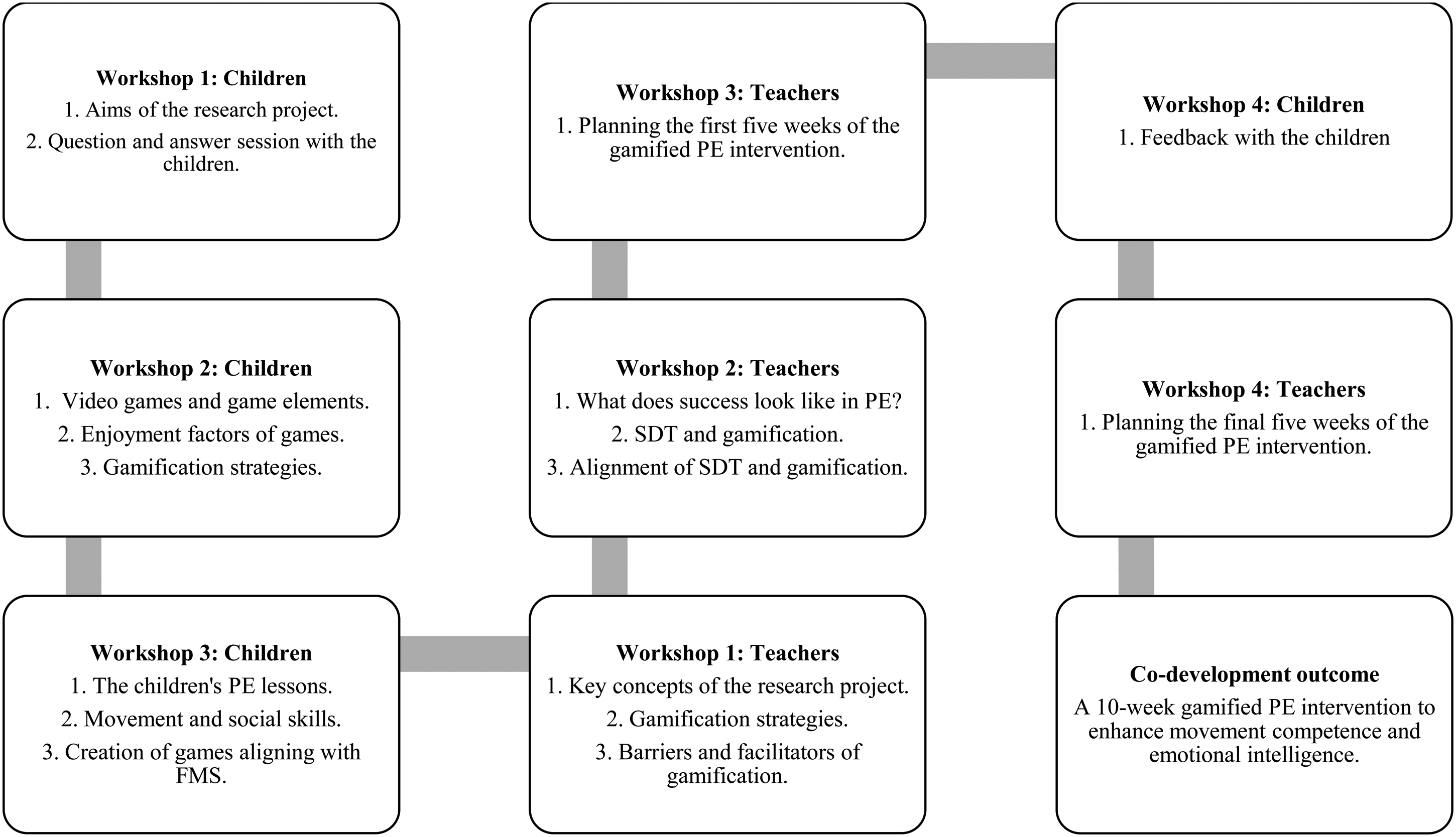
Workshop 1
Children
Workshop 1 was a 1-hour classroom session where the lead author introduced the research project outlined its objectives and provided an overview of each workshop. Children could ask questions throughout.
Teachers
Workshop 1 was a 90-minute classroom session that included an overview of the project and provided the knowledge and understanding needed for subsequent workshops. Task 1 involved the teachers identifying any barriers and facilitators to implementing a gamified approach in PE, aimed at increasing their confidence and competence in the co-development and subsequent delivery of the intervention. Teachers could ask questions throughout.
Workshop 2
Children
Workshop 2 consisted of exploring gamification and generating potential ideas for how gamification strategies could be incorporated into PE lessons. Task 1 involved groups of five children constructing a mind map on an A3 sheet with the subheadings ‘game element’ and ‘video games’. Mind mapping was chosen for its flexible structure (Buran and Filyukov, 2015). Each group were given 10 minutes on each subheading. The lead author then facilitated a discussion on the children's ideas. Task 2 involved the children identifying what components of video games they enjoyed, based on the concept that gamification is inspired by digital video games (Gee and Price, 2021). Each child answered three questions on an A4 sheet: (1) What do you enjoy about video games? (2) If you could pick only one video game element, what would it be? (3) What do you enjoy least about video games? Children had 10 minutes to complete this task. Building on previous tasks, in Task 3, children were provided with an A3 sheet with headings ‘dynamics’, ‘mechanics’ and ‘components’. Prompts under each subheading included ‘What rules could you include?’ (mechanics) and ‘What stories could you use?’ (dynamics). Terminology had been explained earlier and was deemed appropriate by their teachers. Children were then given 10 minutes to brainstorm ideas before moving on to the next heading. The session concluded with children proposing three intervention themes, which were selected through a democratic vote and then presented to the teachers.
Teachers
Workshop 2 involved exploring success in PE (Beni et al., 2019) and understanding the theoretical underpinnings of gamification (Ryan and Deci, 2020). For Task 1, teachers discussed: ‘What does success look like in PE?’ and ‘What factors make up a successful PE lesson?’ Responses were given verbally and audio-recorded. In Task 2, a short video was presented to explain SDT (Ryan and Deci, 2020). Following the video, teachers engaged in a discussion about the three BPNs – competence, autonomy and relatedness – and how these could be addressed during PE lessons. The workshop concluded with a Q&A session, allowing teachers to ask any remaining questions.
Workshop 3
Children
Workshop 3 involved exploring each child's PE preferences (Knowles et al., 2013). Task 1 involved asking children their likes, what works well, dislikes and potential improvements in PE. The lead author then facilitated a discussion on skill concepts (e.g. what is a social/movement skill?). Task 2 involved asking the children which movement or social skills they wanted to improve, writing their ideas on an A3 sheet of paper. The lead author then asked them to explain their choices. For the final task, children were asked to brainstorm activity ideas for stability (e.g. balance and landing), locomotor (e.g. jumping) and object-control skills (e.g. throwing and catching) on A3 paper for 5 minutes. They were also asked to incorporate gamification strategies. The lead author prompted them with questions such as: ‘How could you include different levels to make it easier or harder?’ and ‘What choices could you include during your activity?’
Teachers
Workshop 3 consisted of presenting ideas generated by their classes in the previous child workshops and developing the first 5 weeks of a gamified PE curriculum. Teachers were provided with lesson plan worksheets, which included a warm-up and two activities. Teachers were asked to include at least four gamification strategies (Werbach and Hunter, 2015), but were free to choose which strategies to use. Teachers also integrated strategies and ideas from the children in workshop 3. The lead author facilitated the session, providing prompts to guide the planning process and addressing any questions.
Workshop 4 (final)
Children
A 30-minute mini-workshop was held to gain children's perceptions of the initial gamified PE lessons designed by their teachers. Children were asked to provide their opinions on the curriculum, including the storyline, activity ideas and gamification strategies, and to suggest any changes. For the curriculum to proceed, at least 90% of children from each class needed to express satisfaction, determined by a vote. Feedback was collected by the lead author.
Teachers
The lead author facilitated a structured discussion of feedback on the initial 5 weeks of gamified PE lessons from both children and co-authors with expertise in motor development (LF, JF, ML, AD, DS, KFD) and pedagogy (KFD). This feedback was used by teachers to refine the initial 5 weeks of the curriculum and to develop the latter 5 weeks, with optional support from the lead author. The workshop concluded with a discussion of the next steps of the project, including the digitisation of lesson plans and planning for the delivery of the gamified curriculum in the 2023 Summer term.
Data analysis
Workshops 2, 3 and 4 with the children and workshops 1 and 2 with teachers were audio-recorded and transcribed for qualitative data analysis. Workshop 1 with the children and workshops 3 and 4 with the teachers were not analysed due to insufficient data richness. Data from the included workshops were separately analysed using Braun and Clarke's (2019; 2021) six-phase reflexive thematic analysis, which was appropriate for this study due to its flexibility and capacity to provide rich, detailed and complex accounts of the data (Braun and Clarke, 2021). This involved familiarisation with the raw data from each workshop by the lead author listening to the audio-recordings and reading the transcribed content several times. Initial codes from each workshop were generated using inductive coding; there was no pre-conceived theory or coding framework, and the meaning communicated by the participants was prioritised (Braun and Clarke, 2006). Having reflected on these codes, initial themes were generated through an iterative reading, writing and analysis process. The themes were then reviewed with the assistance of critical friends (LF, JF, CM, ADM, DS, ML, KFD) to provoke further reflexivity and understanding of the rich data (Smith and McGannon, 2018). Finally, the lead author defined the themes, and all researchers agreed on them. This iterative approach ensured transparency and trustworthiness (Nowell et al., 2017). Confidentiality was maintained by coding participants with letters, e.g. teacher from School A labelled as Teacher A, while boys and girls from School A were labelled as Boy A and Girl A, respectively.
Results
In total, three different gamified PE interventions targeting MC were co-developed with school stakeholders. The findings from the workshops, which were instrumental in shaping the interventions, are presented in the order of the workshops conducted.
Workshop 1
Children
No data was gathered from the children's first workshop.
Teachers
When identifying barriers, the most common theme reported by the teachers was the lack of understanding and knowledge of gamification strategies. One teacher noted, ‘It's [gamification] something new, so it can take some time getting used to, not only for me but the children as well’ (Teacher B). In contrast, another teacher (Teacher A) did not perceive any barriers, attributing this to a willingness to explore new pedagogies and a shift away from traditional PE approaches. For facilitators of using gamification, the most commonly expressed themes were the novelty and the gamification strategies, with one remarking: ‘The children love trying new things, you know, it's something different and something they are going to enjoy’ (Teacher 1C).
Workshop 2
Children
The most commonly expressed themes were social elements, such as ‘I can interact with different people’ (Boy C), entertainment factors like ‘you don’t know what's coming next, and that's fun’ (Boy B) and specific game elements such as ‘the challenges you can complete’ (Girl B) as the most enjoyable aspects of video games. When asked about their favourite game elements, children ranked them as follows: progression from one activity to the next (N = 39), rewards such as points (N = 39), levels (N = 21), having the choice of what I get to do (N = 19), challenges (N = 18), storyline (N = 18) and working with others in a team (N = 15). For key elements they would change, common themes included the main characters, with children noting ‘the boys are always the main characters, there isn’t many girl characters’ (Girl B), unclear rules, ‘when there are no clear rules’ (Boy A), and repetitiveness, ‘when you do the same thing five+ times, it's annoying’ (Boy C).
Teachers
A theme expressed was the teachers viewed success in PE as being on a spectrum, not solely based on a child's skill level. They emphasised effort and teamwork abilities, with comments such as, ‘Some children put lots of effort in, and some are good at working with others’ (Teacher A). The themes reported by the teachers for successful components in PE included: structure, ‘structure is key to a successful lesson’ (Teacher B); variation, ‘having lots of activities to do’ (Teacher A); peer demonstration, ‘when the children demonstrate’ (Teacher 2C); and teacher demonstration, ‘when I show the kids, and then they do it’ (Teacher B).
Workshop 3
Children
Children were asked what social skills they wanted to improve. The most commonly reported themes were teamwork, leadership, problem-solving and listening. At School A, issues with teamwork and conflict management were noted in PE: ‘Some people just can’t deal with losing, it's not all about winning, and then they get upset, and it can ruin the lesson’ (Boy A). Similarly, children in School C reported both teamwork and leadership skills, influenced by their roles as play leaders: ‘We have been doing play leaders, and I’d like to do more leadership stuff’ (Girl C). Furthermore, children at School B pointed out the need for improvements in patience: ‘People become impatient, so it would be something other people could improve. It would mean I didn’t get stressed out and feel rushed’ (Girl B), and listening to peers and the teacher: ‘need to use their listening ears more’ (Girl B).
The children reported the following movement skills that they would like to improve: ‘catching’, ‘kicking’, ‘running’, ‘jumping for height’, ‘skipping’, ‘hopping’, ‘throwing’, ‘balancing’, ‘bouncing an object’, ‘rolling an object’ and ‘other’ (e.g. ‘football’ and ‘gymnastics’). Children from Schools A and C reported similar needs for locomotor and object-control skills, while School B children focussed more on object-control skills (e.g. throwing). Some children mentioned specific sports: ‘I would like to improve on karate’ (Girl A). Additionally, one child emphasised the importance of peers developing their movement skills to increase participation: ‘I would like other people to improve overall on their skills so that they can play and join in during the PE lessons’ (Girl C).
Child PE preferences
The most common themes for the enjoyable elements noted in PE were skill development: ‘there is always a new goal to achieve and new things to learn’ (Girl C), and social interaction: ‘working in teams’ (Girl C). Two children noted preferring to work on their own: ‘I like working individually’ (Girl B). Some children highlighted resources: ‘I enjoy PE when we get to use loads of equipment’ (Boy A), although many children perceived available resources as requiring improvement. Competition was also noted: ‘Sometimes they are competitive, and that is fun’ (Boy A), although primarily by boys. In general, children perceived their PE lessons to be fun: ‘PE is my favourite lesson because they are fun, not like maths’ (Boy C), particularly when teacher instructions were clear: ‘It works well when there are clear instructions’ (Girl B).
A commonly expressed theme for factors they do not enjoy was lesson duration: ‘The lessons are too short’ (Boy B). Furthermore, children commented on peer behaviours making PE unenjoyable, specifically: ‘when people start fighting’ (Boy B), ‘when people start arguing’ (Girl A), ‘when people just mess around’ (Girl B) and ‘people not taking turns’ (Boy C).
When asked for suggestions to improve PE, commonly expressed themes were: equipment, ‘using equipment we don’t usually get to use’ (Girl C); teacher instruction, ‘less talking and more doing’ (Boy A); and task-related issues, ‘more games instead of sports’ (Boy B), as factors that could be improved. Additionally, teamwork, ‘being able to choose our teams more often’ (Boy A), and partner work were reported by some children. Nearly all children reported they wanted to ‘make the [PE] lessons longer’ (Girl C).
Children also contributed numerous ideas for activities and games aimed at improving weekly outcomes. These ideas, which were derived from various settings such as breaks, lunch or previous PE lessons, were compiled and presented to the teachers for curriculum development (see Supplemental File B).
Teachers – development of the gamified PE lessons
In developing the gamified PE lessons, teachers planned a comprehensive 10-week programme, with each lesson lasting 60 minutes. The following narratives were chosen to align with the interests and themes identified by the children: ‘A Quest through Time’ (School A), ‘The American Dream’ (School B) and ‘Treasure Island’ (School C). Teachers emphasised the importance of integrating cross-curricular themes, noting that it enriched the learning experience: ‘You would never think of bringing together America and PE. I think it's important to incorporate both’ (Teacher A). Each lesson was crafted to include gamification strategies (e.g. a narrative, challenges, achievements). See Supplemental File C for an example lesson plan.
Workshop 4
Children
Almost all children expressed that they were happy with the progress of the curriculum, design and narrative. Specifically, 28 children (School A), 30 children (School B) and 31 children (School C) were satisfied. However, two children expressed their dissatisfaction with the narrative choices; one preferred a ‘knights and princess story’ (Girl, School B), and another wanted ‘Transformers’ (Boy, School C).
Teachers
The teachers reviewed the recommended changes by academic experts (N = 7) with the first author. For School A, this included enhancing the focus on uni-lateral and bi-lateral movements during Week 1, such as using one arm or two arms for throwing. For School B, the recommendation was to further incorporate narrative elements in Week 3. The teachers approved the changes and emphasised the value of academic input through the development process: ‘It is good to have feedback from academics, it means the children can get the most out of the intervention. It has helped’ (Teacher C). Due to their current workloads, the teachers opted to delegate the task of digitising the lesson plans to the lead author.
Key features of the three gamified movement competence interventions
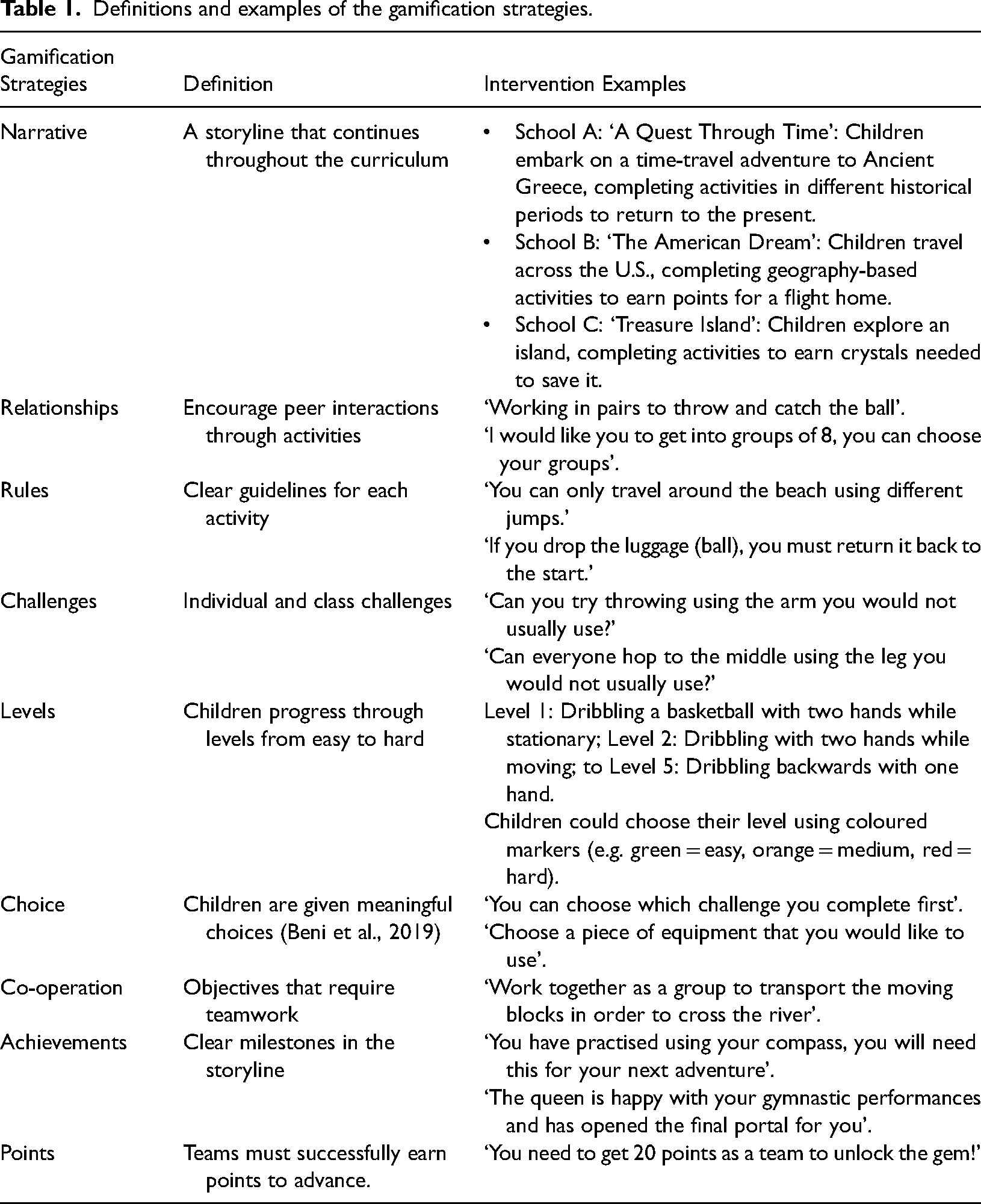
Following the final workshop with each school, three distinct gamified MC interventions were developed. The key and school-specific features are presented in Supplemental File D. Examples of the gamification strategies employed in each intervention are detailed in Table 1.
Definitions and examples of the gamification strategies.
Discussion
This study aimed to describe the process of co-developing a gamified MC intervention with key stakeholders. To the best of the authors’ knowledge, this is the first study to co-develop a gamified MC intervention in a UK primary school context. This research is an important step towards advancing the fields of gamification and the co-development of PE interventions in the school setting, both of which are limited (Clifford et al., 2023). Findings relating to (1) the key features of the interventions, (2) gamification in PE and (3) reflections on the successes and challenges of co-developing interventions with schools are discussed below.
Key features of the co-developed gamified interventions
Previous research has not established a definitive dose-response association between interventions and MC outcomes (Foweather and Rudd, 2020; Ma et al., 2021; Morgan et al., 2013). Consequently, no gold standard exists for the optimal dose and duration needed for effective MC interventions. In the current study, the intervention dose was constrained by the schools’ timetabled PE provision. As a result, the designed interventions consisted of 10 weekly 60-minute PE lessons delivered over a 10-week school term. Although the participating schools did not appear to be providing the recommended 2 hours of PE each week (Department of Education, 2013), reviews of MC interventions have found shorter-dose interventions to be effective (Foweather and Rudd, 2020; Logan et al., 2012; Morgan et al., 2013). Furthermore, recent research on gamified interventions conducted with primary-aged children in Spain has demonstrated that a similar dose – 1 hour per week for 12 weeks – can lead to improvements in movement skills (Morales et al., 2023; Parra-González et al., 2021; Sotos-Martínez et al., 2023).
Our focus on FMS for each weekly outcome was influenced by several factors. Participating children expressed a desire to improve a broad range of FMS, which guided the interventions’ development. This broad interest aligns with recent evidence indicating that children aged 7–10 years often exhibit low proficiency across locomotor, object-control and stability domains of FMS (Duncan et al., 2022; Lawson et al., 2021). Given that MC development is widely recognised to depend on optimal FMS (Lopes et al., 2020), the focus on FMS appears appropriate. Moreover, the underlying mechanisms of gamification are said to support intrinsic motivation (Ryan and Deci, 2020). The positive association between intrinsic motivation and MC is well established (Bardid et al., 2016; Coppens et al., 2021), suggesting that children are likely to enjoy developing their FMS as a result. Recent evidence reported an increase in FMS following a gamification intervention that focussed on FMS (Davies et al., 2024; Morales et al., 2023). However, due to the small sample size and specific populations studied, further investigation is needed to explore the mechanisms and impact of gamification on FMS.
Structure is an important component of intervention design (Miller et al., 2023) and was identified as a key element of a successful PE lesson by both children and teachers. Consequently, our interventions were developed with a well-structured activity plan (Killen and O’Toole, 2023) to maximise and promote engagement. This structured approach aligns with those used in previous gamification interventions (Morales et al., 2023).
Gamification in PE in a UK context
Evidence on the most effective gamification strategies and their optimal quantities remains limited (Arufe-Giráldez et al., 2022; Blain et al., 2022; Sotos-Martínez et al., 2023). Some recent studies (Ahn et al., 2019; Quintas et al., 2020) did not yield improvements in children's motivation and BPNs, which may partially reflect the failure to utilise essential elements of gamification. To address this, we proposed incorporating a minimum of four strategies, with at least one from each level (dynamics, mechanics, components). Additionally, the gamification strategies were tailored for each school to ensure a personalised gamified experience (Chan et al., 2023). We aligned these gamification strategies with each BPN (Ryan and Deci, 2020) to sustain children's motivation throughout the intervention (Sotos-Martínez et al., 2023). For example, levels were designed to address competence, choice to support autonomy and relationships to foster relatedness. Recent evidence suggests that gamified interventions can improve the satisfaction of all BPNs (Sotos-Martínez et al., 2023), although research on gamification's effects on primary-aged children's need satisfaction is limited compared with secondary-aged students (Fernandez-Rio et al., 2022; Sotos-Martínez et al., 2024).
Our findings also underscored the importance of designing a narrative/theme (dynamics) that was cross-curricular. The interventions aimed to support a holistic approach to learning, whereby different disciplines overlap and fuse to create an integrated unit of learning (McDowall and Hipkins, 2019). Furthermore, understanding the context and stakeholders’ needs was critical in designing the gamification interventions. Differences in how strategies such as narrative, point accumulation and activity rules were presented across schools highlight this need. Despite the limited evidence on the role of context in developing gamification interventions in education or PE specifically (Richards et al., 2014), it is recognised that school-based interventions should be context-specific and goal-orientated (Norström et al., 2020). Taken together, our results provide a foundation for researchers and practitioners interested in applying gamification in PE.
Reflections on co-developing interventions with schools
Capturing diverse perspectives from stakeholders is crucial but often overlooked when implementing school-based interventions (Schultz and Evans, 2015). In our study, standardising certain features – such as the dose and duration, weekly lesson outcomes and the number of gamification strategies – was necessary to evaluate the intervention's impact in future research (Craig et al., 2008; Moher et al., 2010). Following recent research (Cardiff et al., 2023; 2024), we ensured that children's views were integral to the intervention design (Conner, 2022). For instance, the children voiced that they wanted a variety and high volume of equipment during the interventions, which was subsequently incorporated as a result. Previous studies have shown that incorporating student voice in PE can enhance engagement (Howley and O'Sullivan, 2021) and lead to more meaningful PE experiences (Walseth et al., 2018). Although meeting the diverse needs of 91 children posed challenges, we strived to ensure that all voices were considered through a group consensus approach (Turner et al., 2020).
During the process, teachers had the option to independently digitise their paper-based intervention lesson plans. However, due to concerns about their current workload (Solvason et al., 2023), they chose to delegate this task to the first author. Despite this, teachers were frequently consulted via email to ensure their ideas were accurately represented. This approach demonstrated a transparent sharing of power throughout the process (Smith et al., 2023). The importance of collaborative work with stakeholders cannot be overstated. A one-size-fits-all approach would not have been appropriate (Clifford et al., 2023). Developing partnerships between school stakeholders and universities has several practical implications. For example, co-developing interventions creates a synergy that potentially enhances children's PE experiences (Reed et al., 2021). Similarly, teachers provide contextual knowledge about the children and the school, as well as practical information regarding time, equipment and space, which together have the potential to increase the feasibility and effectiveness of interventions (Fairclough et al., 2024). Meanwhile, researchers can ensure interventions are theoretically sound and the process is methodologically robust (Skivington et al., 2021). We hope that this collaborative approach will increase the interventions’ relevance, usability and acceptability, leading to better implementation and outcomes through greater teacher buy-in and ownership (Darby, 2017; Fairclough et al., 2024). To further support and facilitate academic collaboration with school stakeholders, school sport and PA partnership networks should be established and/or utilised.
Strengths and limitations
This study's strengths are multifaceted and highlighted by its adherence to the principles of co-development and participatory research (Leask et al., 2019; Smith et al., 2023). By involving both teachers and children in interactive workshops, the study captured rich data and insights on implementation and translation to PE contexts that might otherwise have been overlooked. The close collaboration between researchers and teachers during the development of the intervention fostered a sense of ownership and commitment among all stakeholders. This cooperative approach ensured that the interventions were both theoretically sound and contextually relevant. However, several limitations should be noted. A total of 12.5 hours were spent in each school conducting the co-development workshops, and an additional 1.5 hours were dedicated to consulting with the teachers via email about the curriculum, underscoring the significant time commitment required (Oliver et al., 2019). Participating in co-development workshops may be challenging for school stakeholders with limited capacity (March et al., 2022). The scheduling of these workshops was arranged around stakeholder availability and stringent research timelines (Buckley et al., 2019; 2023). Despite our best efforts to adhere to the pre-agreed schedule, sporadic changes within the school setting and the need for teachers to balance their regular duties sometimes made this challenging. Although scheduling disruptions did not directly impact our study, future research should consider adopting longitudinal, action research designs that could afford greater flexibility in co-developing interventions with school stakeholders.
Conclusion
In conclusion, this study offers valuable guidance on co-developing interventions with stakeholders using gamification as a pedagogical model. By adhering to a rigorous co-production process supported by existing research and theory, this study establishes a workable framework for future researchers. Although three contextually specific interventions were developed, educators in other settings can adapt these interventions to their school environments. This study represents the first step in a broader research agenda. Further research is needed to analyse the feasibility and acceptability of these gamified MC interventions and to investigate their potential to enhance EI through improved MC and engagement.
Supplemental Material
sj-docx-1-epe-10.1177_1356336X241301352 - Supplemental material for Co-development of a gamified physical education movement competence intervention with school stakeholders
Supplemental material, sj-docx-1-epe-10.1177_1356336X241301352 for Co-development of a gamified physical education movement competence intervention with school stakeholders by Jenna Rice, Lawrence Foweather, Jonathan Foulkes, Ceriann Magill, An De Meester, David Stodden, Matthieu Lenoir and Katie Fitton Davies in European Physical Education Review
Footnotes
Acknowledgements
The authors would like to thank all participating teachers and children who contributed to this study.
Declaration of conflicting interests
The authors declared no potential conflicts of interest with respect to the research, authorship and/or publication of this article.
Funding
The authors received no financial support for the research, authorship and/or publication of this article.

Supplemental material
Supplemental material for this article is available online.
Author biographies
References
Supplementary Material
Please find the following supplemental material available below.
For Open Access articles published under a Creative Commons License, all supplemental material carries the same license as the article it is associated with.
For non-Open Access articles published, all supplemental material carries a non-exclusive license, and permission requests for re-use of supplemental material or any part of supplemental material shall be sent directly to the copyright owner as specified in the copyright notice associated with the article.
