



Abstract
Many places and locations for physical education, and the associated pedagogies, limit the enrichment of the individual–environment system. Strengthening this relationship can provide children and youth with greater functionality to navigate a diverse range of environments more effectively, leading to a positive relationship with sport and physical activity across the lifespan. The purpose of this position paper is to draw attention to the role that environmental constraints play in shaping the relationship between places, locations, and pedagogical practice in physical education. More specifically, we demonstrate how the design of spaces for physical education, and movement competencies more generally, emerges under political, historical, cultural, and socioeconomic factors. Ecological dynamics is presented as an explanatory framework to position the concept of open spaces as a means of enriching individual–environment interactions via guided discovery and exploratory behaviour. In unpacking these key concepts, we highlight innovative approaches to the design of open spaces for physical activity and sport, exemplified by the Skills Garden and PLAYCE initiatives. To move beyond the theoretical arguments presented in this article, we encourage practitioners and applied scientists to collaborate and integrate sub-disciplines, applied ideas, and research methods to re-imagine the design of spaces for learning. To take full advantage of redesigned spaces in strengthening the individual–environment system, practitioners need to adopt a model of physical education that complements these contemporary learning spaces.
Keywords
We shape our buildings; thereafter they shape us. (Sir Winston Churchill, 1943)
Introduction
Learning and development experiences in physical education are intricately tied to specific spaces and locations which continue to shape the pedagogical principles used by teachers and educators (Rudd et al., 2021a, 2021b). This complex relationship is particularly prevalent in physical education and sport where the design of facilities such as gymnasia, playing fields and swimming pools, and associated pedagogical practices, have been shaped by specific socioeconomic, political, and historical constraints over the past 150 years (Biesta, 2018; Burke, 2005). For instance, in England during the late 1800s, moral attitudes towards public health saw the provision of washing facilities become more available for the working classes, through a vast network of public baths and swimming pools (Bale and Vertinsky, 2004). Over time, swimming for recreation and fitness became a focus, and with it, aquatic buildings designed for order, safety, and the regulation of human behaviour were commonplace. As swimming grew in popularity, it proliferated into the school curriculum where spaces for swimming and pedagogical orientations were focused on controlling student behaviour, with safety and group supervision as the primary concern. Terret (2004: 52) has argued that such concepts of space and associated pedagogies act as a means of ‘physically delimiting’ individuals’ ‘behaviour and attitudes’, at the expense of stimulating exploration, creativity, and autonomous movement.
In this position statement, we discuss how the relationship between spaces and locations for physical education and sport, and the pedagogical practices that are habitually used in them, have been shaped by socioeconomic, political, and historical constraints, and the cultural contexts within which they emerged. There have been few attempts to conceptualise key theoretical ideas on how environmental designs may have historically shaped pedagogical approaches traditionally used in teaching. Appreciating the emergence of locations, venues, and spaces in the ecological niches of practice and learning in physical education can help us understand why certain pedagogical practices are still adopted. It is important to understand how such venues for physical education and sport have also retained historically embodied rules, routines, rituals, and principles of practice that focus on the acquisition and reproduction of measurable performance outcomes (Stirrup, 2020). Traditional spaces for physical education have enculturated teachers into using pedagogies that fit a perceived ‘correct’ delivery approach (Moy et al., 2019, 2023), even though these traditional methods have long been criticised for an over-riding emphasis on the implementation of a ‘one size fits all’ reproductive teaching style (e.g. Mosston and Ashworth, 2002).
In exploring the relationship between spaces, locations, and pedagogical practices, we discuss how an ecological dynamics rationale can support a re-imagining of this relationship that continues to be historically constrained so tightly by properties of the environment. The interdisciplinary framework of ecological dynamics provides an integration of concepts and ideas from nonlinear dynamics and ecological psychology that problematises this challenge (Rudd et al., 2021a). It provides a theoretical explanation of how adverse environmental constraints in the shape of spaces and locations influence self-organising tendencies of physical educators and recipients of the pedagogical practices they deliver. Self-organisation under constraints is a key tenet of ecological dynamics and relates to how individuals perceive surrounding information sources (e.g. visual, proprioceptive, haptic, and acoustic) to regulate intentions and use cognition to select actions (Thelen and Smith, 1994), during physical education and sport (Correia et al., 2012). Crucially, in ecological dynamics, the individual–environment system is the base unit of analysis for understanding how individuals become skilled at navigating constraints imposed by the environment.
A crucial and interrelated element of ecological dynamics relating to the perception of surrounding information sources and self-organisation is Gibson's (1979) theory of affordances. Gibson (1979: 119) argued that an individual's environment consists of action possibilities that can be directly perceived, for ‘good or ill’, that do not cause behaviour but make it possible. The interrelated nature of affordances, and an individual's capacity for self-organisation under constraints, provides a contemporary framework for reconceptualising the spaces in which children experience movement, play, and physical activity in education and sport programmes. In this sense, self-organisation in the context within which children experience movement can be highly influential in which affordances they select to guide specific actions (for good or ill). Therefore, affordances can be considered relational in the sense that action possibilities are embedded in sociocultural practices. This conceptualisation of affordances in ecological dynamics draws attention to the ‘value and meanings’ of things in the environment (Gibson, 1979: 119). To exemplify, in a blistering critique of practice and design, Pierce and Telford (2023: 2) lament the ‘McDonaldization’ of outdoor adventure activities, which have become ‘closely controlled’, ‘rationally constructed’, and ‘tightly managed, bound and constructed’ into a bland product. Their epithet ‘McDonaldization’ refers particularly to commercial pressures on over-managing spaces, equipment, and locales. These potentially invaluable educational experiences have been gradually diluted through abstract and reproductive commodification, instead becoming reductive, scripted and limited, rather than nuanced, generative and educational. Here, we argue that the limitations of affordances (specifically the opportunities or invitations for learning behaviours) available in the spaces, locales, and venues of our schools, gyms, pools, fields, community centres, and sports halls remain a challenging issue in contemporary sport and physical education.
Drawing on Gibson's insights into ecological dynamics, we will argue that socially and culturally defined spaces and venues should not dictate specific actions. Rather, redefining traditional spaces for physical education and sport as open spaces can offer neutral affordances that invite autonomous behaviours, creativity, and functional movements. In presenting these arguments we hope to achieve two aims. First, we aim to encourage physical educators to consider how the teaching and learning methods they use reflect specific socioeconomic, political, and historical constraints within their contexts. Second, we aim to question whether traditional norms of what it means to perform and learn in these spaces are providing mentally and physically engaging opportunities for children to remain active and excel at sports and physical activities across their lifespan.
Historical and sociocultural influences on spaces, venues, and associated pedagogies in physical education and sports
In the evolution of societies, it has been recognised that the development of institutions, organisations, and cultural conventions is driven by political and socioeconomic needs that emerge in different eras (Williams, 1975). The challenge of environmental constraints influencing societies and physical education practices more specifically has gained global attention. A detailed critique of individual societies across multiple countries is beyond the scope of this paper. Hence this paper focuses only on Norway and Britain due to the authors’ knowledge of the physical education landscape in these countries.
In Britain during the 1800s, physical education and organised sports underwent a rapid transformation from locally organised games, physical activities, and traditional pastimes in the villages and towns of pre-industrial England into more codified and structured activities designed to enhance the physical health and spiritual well-being of people in society (Elias, 1982). This shift was perhaps, in part, due to the rapid transformation of small towns into huge urban conglomerations, that required a robust, resilient, and compliant workforce to service the burgeoning factories of the Industrial Revolution (Dunning, 1970). To achieve and sustain rapid growth in industrialisation in urban centres, and colonisation for the production of raw materials required for economic growth, it was considered necessary to use educational practices to train a fit and healthy workforce and militia.
In the chaotic social and cultural conditions that rapidly emerged in Victorian Britain, the brawling, often violent, rural games and pastimes engaged in during centuries-old festive occasions were subjected to a ‘civilising process’ (Elias, 1982). The development of formalised physical education and sports programmes in this era emerged from the need for greater control of an ‘instrumental’ educational curriculum by the state and institutions (focused on specific achievements and outcomes) (Arnold, 1979). This implementation process required dedicated associated pedagogies, formalised by instruction and replication of skills, serving the purpose of inculcating relevant behaviours and strict values in learners, such as loyalty and compliance, cooperation, and adherence to instructions and commands (Donovan et al., 2006). The major historical influences on the newly codified curriculum, and the educational venues and establishments of Victorian England, were the ‘Protestant Ethic’, ‘Muscular Christianity’, and desires for military expansion of the British Empire (Mangan, 1973). Indeed, the first ‘physical educators’ hired in schools were military personnel who instructed learners in callisthenics and physical exercises purported to train their physical capacities, spirituality, and moral character. Consequently, spaces, locations, and venues were designed to meet this operational need for drilling individuals to comply with instructions, led by a dominant ‘command and control’ style of pedagogical practice (Donovan et al., 2006). Gymnasia, outdoor fields, and swimming pools were operational, compact, and maintained for instrumental purposes of completing rote learned drills, exercises, and whole-body movements using wooden beams, bars, and frames with lines on the gym floor marking places to queue, stand and move from on command. The rooms were designed in such a way to facilitate military training in the form of drills, discipline and order, allowing teachers or officers to have control and an overview of the training (e.g. Augestad, 2003). Other examples of the built environment constraining physical activity can still be seen in swimming pools and aquatic buildings, which were designed to meet the education of discipline and safety concerns on one hand, and hygienic regulations on the other (Terret, 2012). As a result, pools were designed to be linear and symmetrical spaces, and building permits mandated that these pools were constructed according to specific standards and criteria, for example, transparent water, ambient temperatures, lighting intensity levels, and construction materials (Perkins, 2000).
Across Europe, social, cultural, and political constraints were also influencing physical education strategies and practices. In Norway, for instance, the Education Act of 1889 (Folkeskoleloven) provided schools with the opportunity to teach gymnastics and provide shooting practice to prepare children for defending their country, and much of the pedagogical content which aimed to meet the military requirements was based on order, obedience and marching drills (Folkeskolen, 1989). The association between military training and sport has been tightly wedded throughout history, as sport has been viewed as a crucial part of both training and recreation for soldiers and military personnel (Wakefield, 1997). One of the first Norwegian sports clubs originated in the military domain in the form of a shooting club, and it was common for sports to be related to military traditions that combined the use of weapons with other physical activities, like skiing, as is the case in biathlon.
While political matters exerted a strong influence over approaches to physical education, sport facilities, and spatial arrangements, they were also at the mercy of government thinking. The Norwegian government was most influential in defining the content, shape, and equipment for each gymnasium (Figure 1), which again was primarily aimed at preparing children for military exercises (Augestad, 2003). The design, shape, and architecture of the buildings mirrored the need for discipline and order, reflected in the pedagogical practices of teachers and instructors. Perhaps the most prevalent example of the physical environment forming a sport could be found in Per Henrik Ling's gymnastics, which secured a position in Norwegian schools from the 1860s onwards. From 1886, several official communications were sent out about the operational design of gymnasiums and selection of fixtures and gymnastics equipment. A 1915 directive recommended the following: ‘floor area of 3 m2 per pupil, 5 m height, 8.5 m width and 20 m length’ (Augestad, 2003: 66). In addition to design features, the communication also advised on the utilitarian positioning of equipment and how the instructor should interact with teaching practice: In preparing the hall, position the apparatuses such that the various exercises can be performed serially or in constant flow, and the placement of the apparatuses provides the instructor with a good overview and control. (Rundskriv 1915, as cited in Augestad, 2003).
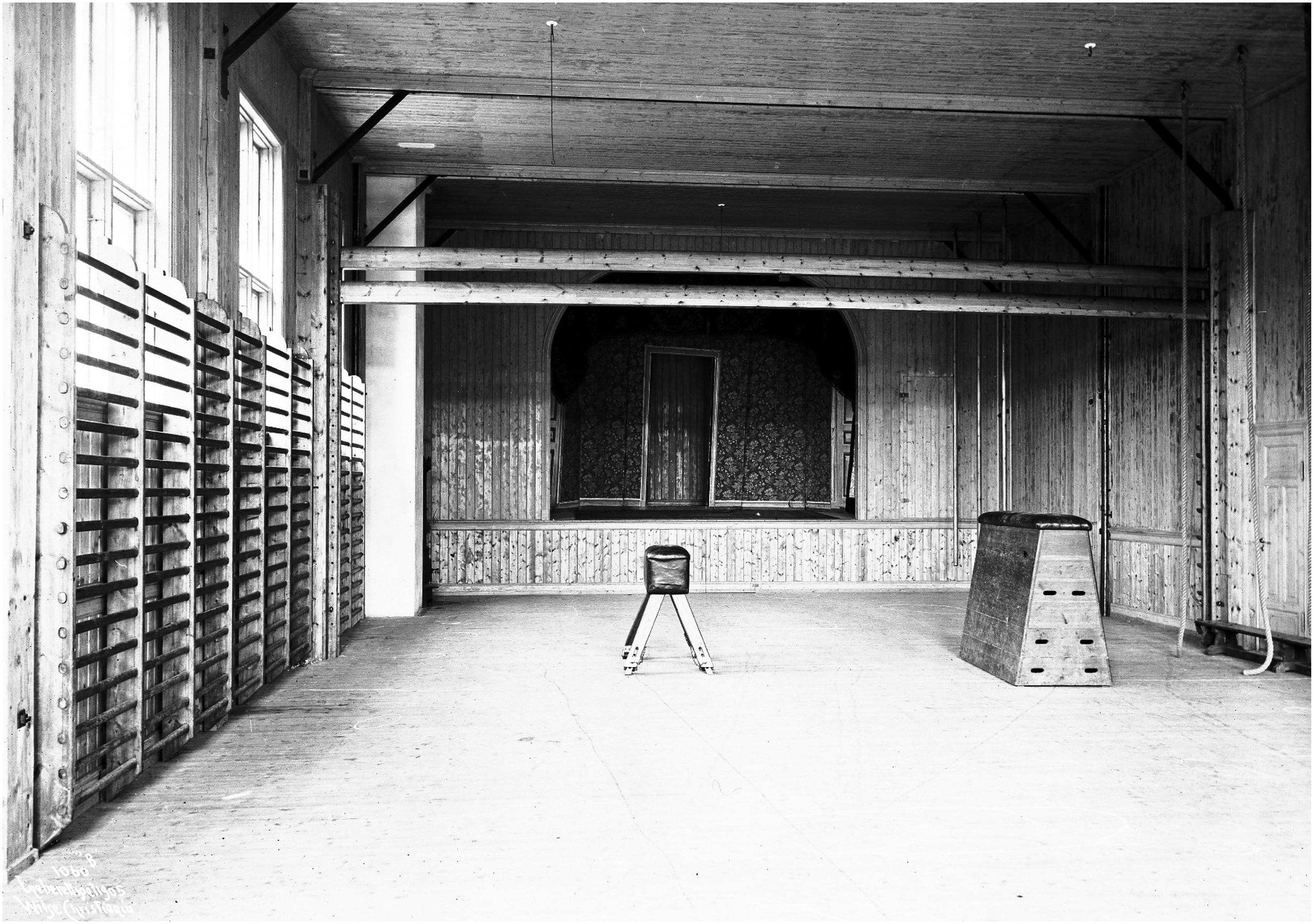
A Norwegian gymnasium from the early 1900s.
To compound the spatial and pedagogical challenges, after World War 2 the Norwegian government launched initiatives to get the general population more active, partly funded by the National Gambling Agency (Norsk Tipping AS) (AbstraktSkille and Säfvenbom, 2011). To do this, halls and facilities for sports were built close to schools with the intention of getting children more active during school hours, and for public use in the local community after school hours. Facilities were designed for sports such as soccer and invasion games, and building designs, layouts, and markings therefore influenced perception and movement in a very specific way. In the case of Britain and Norway, spaces, equipment, and pedagogies were specifically instrumental, lacking diversity awareness. They were purposed to invite individuals to follow commands and comply with instructions, where whole body exercises were prescribed by teachers and instructors to develop healthy and strong future members of society, available for the militia or industrial workforce. In these instances, pedagogies were constructed in the belief that following and responding to commands from the teacher or instructor was an essential skill for inducing specific moral qualities such as ‘self-control, perseverance and enterprise’ (Augestad, 2003: 58; Kirk, 2012).
Spaces and pedagogy in modern-day physical education
In more modern times governments have recognised the role contemporary physical education should play in developing physically active and healthy children, with inclusive campaigns such as Sport England's Uniting the Movement a current example (Sport England, 2021). Indeed, there has been a push for contemporising pedagogies in school and sports more generally, which has been an increasing focus of attention in academic publications. In such accounts, practitioners have been challenged to ‘embrace the concepts of intrinsic challenge, personal experimentation and discovery, and self-selected risk-taking in physically challenging environments’ (Roberts et al., 2019: 164). In addition, in a recent Office for Standards in Education, Children's Services and Skills (Ofsted) report, it was stated that pupils should learn ‘increasingly intelligent movement and important knowledge that can reduce barriers to participation and inform their own healthy, active lifestyle choices’ (Ofsted, 2022: 2). The message for teachers, and practitioners more generally, is a far cry from the proposed teaching and instructing practices that could be seen in the nineteenth-century gymnasia of Norway and the swimming pools of England. Alongside recent attempts to influence teaching practices, England's Building Schools for the Future (BSF) initiative, the largest single capital investment in the last 50 years, aimed to rebuild or renew all of England's 3500 secondary schools. Crucially, the BSF programme aimed to transform existing schools into world-class learning environments, through ‘educational transformation’ (Department for Children, Schools and Families, 2008: 13). According to the Department for Children, Schools and Families (2008: 13), educational transformation was going to be achieved, amongst other strategies, through being ‘creative in designing for learning’ and ‘places for learning that are exciting, (and) flexible’. Despite these bold attempts to evolve teaching environments into more innovative learning spaces, the design aspects of current-day gymnasia under the BSF programme are very similar to the design of such spaces from over 100 years ago (see Figure 2). This issue was also evident through the design concept of linear cloisters, a key principle of the BSF's programme. The concept of linear cloisters refers to the design of long symmetrical spaces that can be easily adapted to accommodate additional teaching space. As we will discuss later, linear designs can be problematic, because they infer specific actions that simply require individuals to follow patterns of common behaviours. Moreover, the procurement of school infrastructure through the BSF was scrapped in 2010. This meant that hundreds of schools across England, and the traditional learning spaces within them, were not developed, leaving physical educators and pupils continuing to inhabit building designs from the early 1900s.
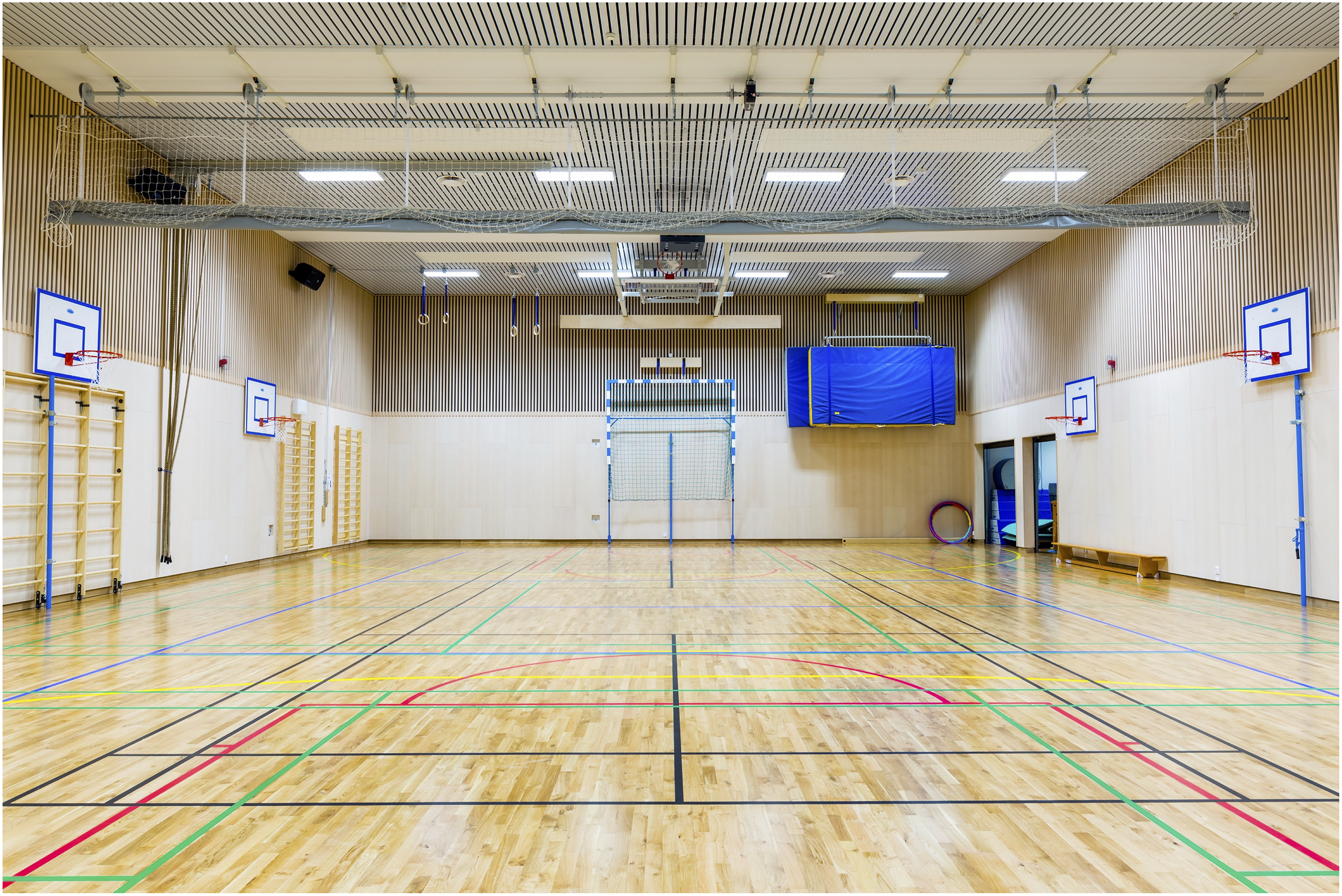
A modern-day school gymnasium. Notice the similarities with the gymnasium in Figure 1.
Taking the current narrative into consideration, we feel it is important that physical educators consider how the teaching and learning methods that they are trained to use continue to reflect specific socioeconomic, political, and historical constraints within their education context. Equally important is to question whether traditional norms of what it means to perform and learn in spaces for physical education are providing mentally and physically engaging opportunities for children to remain active and participate in sports and physical activities across their lifespan. Next, we provide a reflection from the fifth author, to shed light on their experience of entering the teaching profession, and how the complex interaction between socioeconomic, political, and historical constraints ultimately shaped their pedagogical practices. I began teaching Physical Education (PE) during 1998 in a large state coeducational secondary school. I joined a department of experienced teachers and the school had strong local connections with sports clubs. PE and school sport were given a high priority and used to support a sense of identity, discipline, and aimed to provide pathways into sport and physical activity. Built in the 1970s, the school resided in an ex-coal mining community. The spaces for PE and sport comprised two sports halls, a gymnasium, extensive playing fields, tennis courts, a fitness room, and a small portacabin for examination PE. The changing room design included walk-through showers with towel rails, vestigial traces from a bygone industrial era and the role of education in supporting hygiene. Once the students were changed, this space was now used as the teachers’ perch to settle the group, deal with discipline issues, and introduce the outcomes and instructions necessary for the lesson. Woe betide any students who did not comply with having the full and correct kit! Several pedagogical approaches were used within this setting. Experiential learning through the exploration of space, movement, and body awareness (often using apparatus) was applied within dance and gymnastics. However, the dominant pedagogy was largely ‘games’ focused, skill-based, and instructional, combined with opportunities for more varied practice situations. The facilities and spaces were largely ‘purposed’ and conceptualised for managing this training experience, e.g. 10 m × 10 m grid squares marked on the playing fields were used for drills and small-sided conditioned games. A games-based pedagogy was also a focal point of both my undergraduate course and initial teacher training (ITT). ‘Raising the Game’, a government report published in 1996, had some influence on the direction and intention of PE. This further privileged the position of traditional competitive games within the curriculum content. Also, within the school, PE and school sport were seen as vehicles for social mobility and, to a point, to gain social control. The spaces reinforced a mostly gendered approach to PE, i.e. separate spaces for boys' PE and girls' PE especially within a Key Stage 3 context. This less than inclusive approach was almost the opposite to my undergraduate and ITT learning, which advocated a coeducational approach. However, there was a need, as a recently qualified teacher, to assimilate into the raison d'être of the department. Therefore, it was easier to acculturate into this system rather than to challenge the status quo. The department teaching resources were modelled on the Royal Navy and Marines resource packs (still in circulation today). I would copy the practices and conditioned games within the manuals that would utilise court and pitch markings for progressive drills and practices. The emphasis was teaching rather than learning, with a focus on disseminating teaching points accompanied by teacher or student demonstrations. In retrospect, much of this was only relevant for students with prior experience or those able to adequately process an abundance of teaching points and then execute the desired outcome. This teacher-led approach became my default mode. I felt this style would enable effective behaviour management and learning. I would plan the use of space to primarily support the process of class management and secondary to this, the acquisition of skill.
Close analysis of this reflection reveals that socialisation into specific pedagogical practices was highly constrained by prevailing social (reproduction and discipline associated with working-class values) and cultural (gendered approach, military instruction, and teacher-led approach) constraints, with dedicated locations and spaces closely aligned to the pedagogical principles. For Lawson (1986), this occupational socialisation serves to acculturate physical education teachers into constructing knowledge and beliefs about pedagogical approaches. Crucial to this socialisation approach is how facilities and equipment shape and establish these perspectives aligned to the school culture, exemplified here by the closed nature of spaces (e.g. 10 m × 10 m grid squares), which, as we will discuss next, may solicit specific responses and actions from learners in formal education programmes.
Creating open spaces provides opportunities for the enrichment of interactions
In ecological dynamics, the focus of practice, training, and physical education is to enrich the individual–environment relationship. When children and youth are becoming more skilful at satisfying interacting individual and environmental constraints, they are considered to have developed the functionality to navigate a range of different environments more effectively and efficiently (e.g. traditional sports, physical activities, or activity experienced in day-to-day life) (Davids et al., 2023). In this sense, enrichment does not refer to improving physical capacities or environmental features separately, but the strengthening of the individual–environment system concurrently. Open spaces, that is, spaces that do not specify specific actions or behaviours, provide opportunities to enrich ongoing individual–environment interactions via guided discovery and exploratory behaviour (Lynn van der Schaaf et al., 2020). Theoretically, the design of open spaces makes information available for use in a rich affordance landscape, facilitating opportunities for individual creativity to generate novel movement solutions, leading to individuals developing adaptable behaviours to satisfy and cope with new situations (Rietveld and Kiverstein, 2014). When coaches, teachers, or educators are facilitating practice in open spaces, we argue that they should transition away from the traditional, prescriptive role of an instructor and adopt the position of a learning designer (Strafford et al., 2022). This approach to designing open spaces is closely aligned with Bernstein's (1967: 234) consideration of practice as ‘repetition without repetition’, whereby movement variation is required to achieve similar task outcomes. In this sense, play elements with an open function in school settings are more likely to stimulate creativity of movement via exploratory behaviour (Lynn van der Schaaf et al., 2020). In physical education settings, these open spaces would afford enrichment of interactions between the learner and environment by using experience and aspects of play with more generalised movement activities in the moment, as well as more specialist practice at the latter stages of the developmental continuum (Davids et al., 2023) (see also the Athletic Skills Model, a framework for practitioners to consider how to promote skilful movement across the lifespan encompassing elite sport, physical literacy, and developmental perspectives (Savelsbergh and Wormhoudt, 2021; Wormhoudt et al., 2018)).
Introducing play elements with an open function may be relevant for the transition away from traditional playscapes that lack variety to challenge children beyond entry-level interactions. In many cases this is due to the highly symmetrical object configuration and high levels of uniformity and rigidity in physical challenges and spaces (Rudd et al., 2021b; Strafford et al., 2022). As recommended by Strafford et al. (2022) in their study of sport practitioners’ receptiveness to Parkour-style training, arranging objects in a mixture of asymmetrical and symmetrical formats and orientations may afford children the opportunity to continually adapt their actions to solve movement problems relative to their intrinsic dynamics and capacities (Jongeneel et al., 2015). From a developmental perspective, in ecological dynamics, a person's intrinsic dynamics are what they ‘bring to the learning environment’, which constitutes the task dynamics (Kelso, 1995). Each individual's intrinsic dynamics are continually shaped by influential sources of constraint such as genetic endowment, developmental status, capacities developed from past learning experiences, and social influences (Thelen and Smith, 1994). The places and spaces that people interact with throughout their life course are vitally important in continually shaping their intrinsic dynamics. Consequently, each person develops a perceptual-motor workspace of attractors (coordination patterns) which are continually stabilised by learning and experience, interacting with genes, perception of information from their surroundings and intentions, as well as environmental constraints and movement system properties (Muchisky et al., 1996; Thelen and Smith, 1994).
Using interchangeable objects to alter equipment proprieties and features can afford children with a variety of possible interactions with their environment (see Strafford et al., 2020). For example, altering the angle, height, and orientation of equipment and objects invites the (re)coupling of perception and action, problem-solving and movement exploration, as well as enjoyment and creativity as children seek to find innovative movement solutions (Seifert et al., 2019). However, coaches should be aware of threats to enjoyment and motivation if children are repeatably exposed to challenges which they do not succeed at, or if they do not have the capacities, dispositions, or tendencies (effectivities; Gibson, 1979) to adapt to.
Through this approach, children and youth can be conceptualised as wayfinders who self-regulate their way through diverse spaces and locales of learning and performance environments (Otte et al., 2020). For example, placing children in an obstacle-type environment (for Parkour example see: Strafford et al., 2021, 2022; Williams et al., 2023) affords them time and space for adaptive skill exploration (e.g. continually adjusting to individual and environmental constraints), as they seek to develop creative and individualised actions (Otte et al., 2021). This process of ‘wayfinding’ via obstacle course activities may lead to children developing and refining decision-making and self-awareness as they discover the most relevant information (affordances) to couple their intended actions relative to task demands (Strafford et al., 2022; Woods et al., 2021; Woods et al., 2020).
Open spaces offer neutral affordances
For motor learning in sport and physical education, Withagen et al.'s (2012) ideas suggest that practice designs cannot improve the acceptance and utilisation of available affordances by making them more prominent to learners (e.g. providing bigger gaps between defenders in training for passing or shooting opportunities) (Davids et al., 2023). Rather, affordance utilisation in sport practice and physical education sessions can be best improved by pedagogical methods that carefully align the action capabilities of individual learners with the affordances and information that are available in the context of practice and performance (Davids et al., 2023). Pedagogical aims in learning contexts can be achieved by designing tasks, sessions, and programmes that continually seek to make the person-environment relationship more functional. Enhanced functionality here implies the building of a meaningful, goal-oriented relationship between each learner and the opportunities for action that exist in performance, allowing them to use available affordances to achieve their task goals in individual contexts. The quality of the functional relations between a learner and the environment can emerge and develop through specific (dedicated training in a particular sport) and general (not specific to learning a particular sport skill) practice experiences (Ribeiro et al., 2021). Enrichment of learner–environment relations is well aligned with the key ideas of Withagen et al. (2012), who suggested that environments can be designed to be more soliciting of affordances which are closely related to the effectivities (Gibson, 1979) of an individual performer.
To achieve this aim, practice designs should be more neutral (tasks being more open-ended, inviting many actions, not just specifying one action to be drilled or rehearsed, as historically pre-supposed by traditional designs of places and spaces) (Withagen et al., 2012). By way of example, designers (architects, engineers, and urban landscapers) understand the key idea that many objects and locations in life can have multiple affordances. Using the example of architecture, designers can produce objects or locations which are suitable for limited purposes, for example, pathways or exits in a venue that only has one trajectory. In physical education and sport, this can also happen when coaches and teachers deliberately design practice drills which intentionally limit the performance outcomes learners can perform, for example, prescribing few opportunities for decision-making, problem-solving and including predetermined technique repetition. Instead, by designing more neutral task landscapes, coaches and teachers can facilitate adaptability, creativity, and innovation in learners, encouraging them to search (seek information), discover (find opportunities for action), and explore affordances which are more diverse in function. Designing and implementing practice tasks that are more neutral in performance outcomes can encourage learners to develop their problem-solving skills, adaptability, and decision-making skills by utilising different affordances to find solutions (Davids et al., 2023).
Even in the most stable of performance contexts, neutral places and tasks in coaching and teaching can be conceptualised as having more than one affordance, appearing and disappearing, depending on the ebb and flow of the dynamics of a well-designed ‘open’ practice environment. The idea of open environments was highlighted by the elite football coach, Pep Guardiola (2016), who suggested ‘football is the most difficult game in the world because it is open and every situation is completely different and you have to make decisions minute-by-minute’ (McRae, 2016). To summarise, practice designs could include, not just opportunities for action, but solicitations for selection from a range of functional actions in a specific field of promoted actions (e.g. in a specific phase of team sports) which may be preferred by a player and coach during a training activity. Specific aspects of a practice environment could be designed to include the property of ‘inviting potential’ (Withagen et al., 2012: 254), predisposing a learner to seek and explore certain performance tendencies in terms of the functionality (relevance and value) of performance outcomes. This soliciting effect of practice designs is an aspect of pedagogical design that has the powerful capacity to invite individual learners to perform in a relational way, accepting or resisting the inviting potential of available affordances in the learning environment. This dynamic in the affordance landscape provides the basis for self-regulation in learners in physical education and sport (Rudd et al., 2021a).
Implications for the design of open spaces, locations, and venues in sport and physical education
Next, we present examples of how open spaces, locations, and venues in sport and physical education can be designed to provide greater inviting potential to individual performers. We highlight examples from the built environment such as the Skills Garden (www.skillsgarden.nl; Figure 3(a)) and PLAYCE (www.playce.nl; Figure 3(b)), initiatives which have informed the design of public parks, sports halls, and rehabilitation centres in the Netherlands. Influenced by the Athletic Skills Model and industrial architecture (e.g. Lennon et al., 2017), the Skills Garden and PLAYCE adopt five design principles: Fundamental Movements, Affordances, Scaling, Asymmetry, and Monitoring/Testing. As a starting point, the design of these spaces affords users opportunities to perform fundamental movements (e.g. climbing and scrambling, jumping and landing, and balancing and falling), and unlike in traditional sports and physical education activities, individuals are encouraged to perform fundamental movements according to the action capabilities. For example, a large slide with an adequate inclination angle affords not only sitting-sliding, but also standing-sliding when going down, as well as climbing and running when going up (see Figure 3(a)). Hence, instead of focusing on offering spaces for specific activities, this approach tries to offer an enriched neutral landscape of affordances by thoughtfully considering how features are configured so that children and adults can scale their abilities according to the different features of the space (see Figure 4(a)). The process of scaling within the Skills Garden and PLAYCE frameworks (i.e. to offer opportunities for actions to users of different action capabilities) is complemented by the development of asymmetrical features which include different sizes and heights for sport equipment (e.g. basketball hoops and football goals) and other movement features (e.g. stepping stones and bars; see Figure 4(b)) as well as asymmetrical painted lines and targets on the floor and walls (see Figure 4(c)). Asymmetrical features invite users to adapt their activity within their own boundaries (e.g. smaller fields to play football for smaller children), enabling the space to be versatile and multifunctional from a movement perspective (i.e. opportunities to perform as many fundamental movements as possible, in a variety of ways by playing different games and sports on the same space (see Figure 4)). Additional markers on the floor or wall are also included to support practitioners in monitoring users’ development. With more than 50 indoor and outdoor movement spaces ranging from physical education halls, parks, and sports centres to rehabilitation centres, the Skills Garden and PLAYCE affordance-based and movement-focused framework invites users to explore and perform a wider range of movements compared to traditional movement spaces (e.g. football pitches or basketball courts) (Gower et al., In preparation). Gower et al.'s (in preparation) evaluation study shows that users of Skills Gardens perform on average twice the number of variable movements when compared to traditional movement spaces. These data reinforce the idea that the physical environment shapes social, psychological, and emotional transactions of humans through movement. This ecological idea highlights the need for more meaningful and sophisticated approaches to the design of spaces to better facilitate the perception of multiple affordances for a diverse range of users.
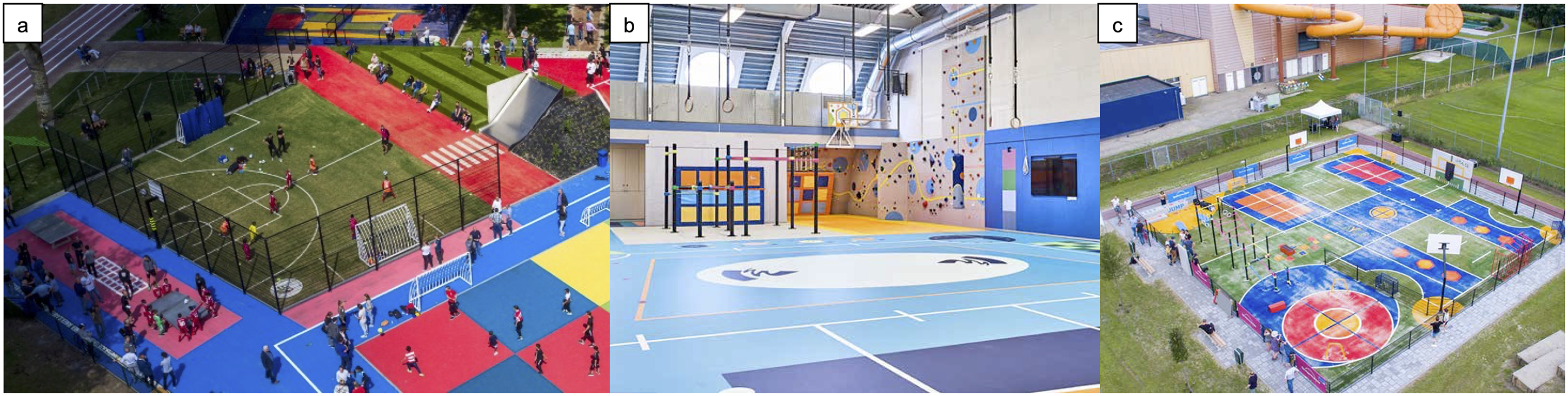
(a) An example of a Skills Garden located in a public space in the centre of Almere, Netherlands. (b) An example of an indoor PLAYCE located in a college in Amsterdam, Netherlands. (c) An outdoor PLAYCE located in a sports club in Ede, Netherlands. Although the Skills Garden and PLAYCE are informed by the same design principles, the former focuses on unique and larger spaces to be designed within natural surroundings, whilst the latter focuses on redeveloping typical smaller-scale activity spaces (e.g. indoor and outdoor sports courts/halls). Images by ASM© Athletic Skills Company.
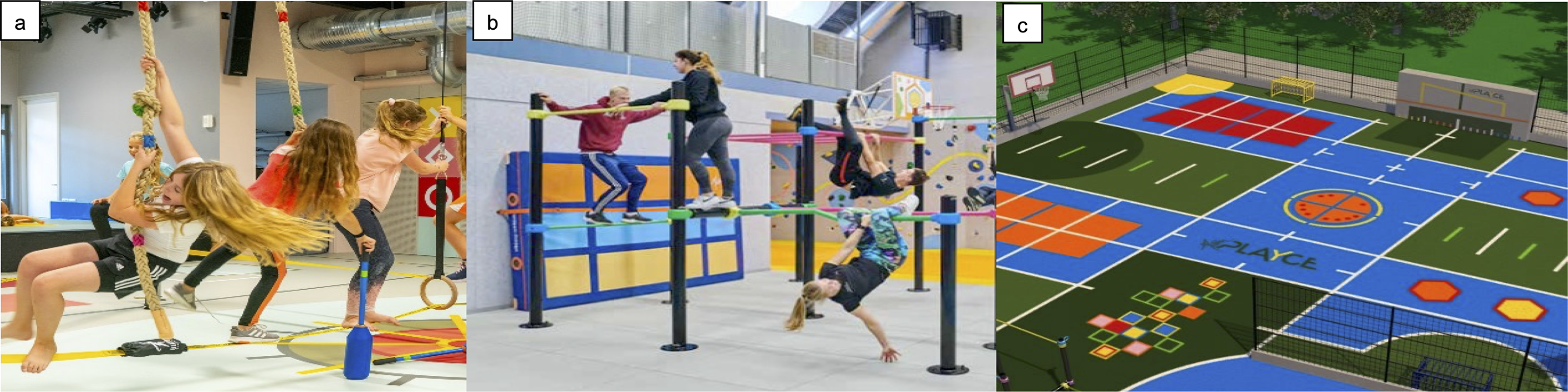
Examples of how the configuration of environmental features including asymmetrical configurations can invite different opportunities for action according to users’ action capabilities. (a) Ropes installed above a slackline can invite balancing (un)supported as well as climbing and swinging. (b) Bars that allow different configurations in heights and widths can afford swinging and climbing as well as jumping and landing. (c) Asymmetrical painted lines on the floor and walls can increase the perception of different affordances by playing different games, sports or activities in a user-scaled environment. Images by ASM© Athletic Skills Company.
Conclusion
In this opinion paper, we have challenged physical educators to consider how the closely tied relationship between spaces, locations, and pedagogical practice emerges under specific environmental constraints. What this contemporising effort now needs is practitioners and applied scientists to collaborate and integrate sub-disciplines, applied ideas, and research methods to re-imagine the design of spaces for learning, while also formulating a model of physical education and sport that complements these innovative spaces. Practitioner and scientist integration is essential to make the key distinction between ‘what’ decisions are made, and ‘how’ these decisions are best implemented. The theoretical ideas outlined in this position statement represent a contextualised synthesis of relevant quantitative, qualitative, and mixed methods research to study this complex challenge. Informed by this position statement, future research could focus on ‘how’ these theoretical ideas are applied to establish in what way the built environment, and practices within them, enrich interactions between individuals and their surroundings. Placing individuals at the heart of this process can support an empowering approach to facilitate meaningful participation and enjoyment in physical education and sport across the lifespan.
Footnotes
Declaration of conflicting interests
The authors declared no potential conflicts of interest with respect to the research, authorship, and/or publication of this article.
Funding
The authors received no financial support for the research, authorship, and/or publication of this article.
