



Abstract
Primary physical education lags behind student voice developments in research and practice internationally ( Gillett-Swan and Baroutsis, 2023) and in post-primary physical education ( Howley and O'Sullivan, 2021; Iannucci and Parker, 2022a). Furthermore, evidence is lacking on how to guide primary teachers learning to implement student voice pedagogies in physical education successfully. This research begins to fill this gap by focusing on the research question: What direction can be taken from primary teachers’ experiences of learning to enact student voice in physical education? Insight on what mattered in teachers’ learning to enact student voice can guide how to promote student voice pedagogies as everyday primary physical education pedagogies. Within a professional learning community (n = 10), nine primary teachers enacted student voice pedagogical strategies over a six-month period. Data sources included recordings of monthly collective meetings with teachers (n = 7), mid-point (n = 4) and/or end-point (n = 6) individual interviews with the teachers, blog posts (n = 2), conference presentations (n = 2), and three focus groups with children (n = 12). Drawing on teachers’ and children's experiences, a roadmap for teachers getting started with enactment of student voice pedagogies is presented with attention to: starting small, starting smart, and not stopping. Teachers valued the outcomes of enactment of student voice pedagogies for the children in their classes in ways that changed their teaching approaches and sustained their commitment to student voice pedagogies. The roadmap presented can be used to support teachers learning how to enact student voice as an everyday pedagogy in primary physical education.
Introduction
Including children's voices in decision-making is well-established as a fundamental educational right (Welty and Lundy, 2013). There has been a significant increase in the exploration of student voice in research and practice internationally (Gillett-Swan and Baroutsis, 2023; St. John and Briel, 2017) and in Ireland (Skerritt et al., 2023) over the last decade. This trend is reflected in physical education (PE) at post-primary level (Howley and O'Sullivan, 2021), but primary PE lags behind (Iannucci and Parker, 2022a). The absence of children's influence in the practices of primary PE is problematic. It is evident that when students are given an authentic opportunity for their voice to be heard and to shape their experiences in PE and physical activity the results are positive as the quality of their experience is enhanced (Fletcher and Ní Chróinín, 2022), and they are more engaged in learning (Ní Chróinín et al., 2019). The absence of student voice, however, is not surprising given the lack of evidence-based direction for primary teachers to incorporate children's perspectives systematically into their everyday practices (Iannucci and Parker, 2022a). This research set out to add understanding of how primary teachers learn to enact student voice in everyday ways that promote children's voices to authentically influence primary PE practices.
Conceptualising student voice in primary PE
The term ‘student voice’ represents efforts to promote dialogue and collaboration between students and teachers in ways that influence the quality of participation experiences for students (Fielding, 2004). Student voice acknowledges that students have distinct perspectives and that their perspectives are valuable because children and teachers experience the classroom differently (Parr and Hawe, 2022). Student voice practices empower students to collaborate in co-designing their educational experiences with teachers (Gillett-Swan and Baroutsis, 2023). Student voice holds a democratising potential because children are more actively involved in educational decision-making processes (Bragg, 2007). The extent of influence seems to relate, in part, to the degree to which students are authentically involved (Mayes et al., 2019). Lundy's (2007) model of participation provides a practical guide to consider what authentic use of student voice with the intent to inform practice should entail, including the following four elements:
Space is established that makes it safe and inclusive for students to express their views. Voice is supported, allowing children and young people to express their ideas. Audience is given so teachers can receive children and young people's views. Influence is demonstrated through explicit evidence of how children and young people's views and ideas have been considered and taken up.
Adult positioning within student voice activities is crucial because it plays an important role in ensuring that children are given space, voice, audience, and influence (Holquist et al., 2023; Pearce and Wood, 2019). Adults are involved in deciding what space is given, how voices are amplified, who listens to these voices and ultimately what influence children have. For example, one risk is that teachers hear the children's voices that align with their own pedagogical and curriculum priorities, a form of ‘ventriloquism’ (Mayes et al., 2021: 199), rather than authentically engaging with children's ideas.
Education systems worldwide have increasingly paid attention to how student voices can colour participants’ educational experiences. While the Irish education system does not have a strong tradition of student voice (Skerritt et al., 2023), there is however momentum towards promotion of student voice within the system (e.g. Association of Community and Comprehensive Schools (ACCS), 2021). In recent years, Irish national policy has embraced Lundy's (2007) model of participation (space, voice, audience, and influence) to conceptualise how to promote children's voices in decision-making about their lives (ACCS, 2021). The inclusion of student voice within the new Primary Curriculum Framework (National Council for Curriculum and Assessment (NCCA), 2023) and specifically within the PE strand of the Wellbeing Curriculum (2024) to provide ‘opportunities, where appropriate, to empower child voice and involvement through choice of how and what to learn’ (NCCA, 2024: 2) indicates energy towards more student voice in the everyday practices of schools.
There is significant evidence of student voice positively impacting the educational experiences of post-primary students at both the classroom and whole-school levels (ACCS, 2021; Gillett-Swan and Baroutsis, 2023). This trend is reflected in post-primary PE with positive results for student experience (e.g. Hemphill, 2022; Howley and O'Sullivan, 2021). These studies provide some direction on what student voice might look like in primary PE as student voice is represented as a process of empowering students to contribute to their PE experience by teachers listening to, including, and responding to their ideas.
Empirical studies capturing student voice approaches with primary school children are however less common (Mayes et al., 2019; Susinos and Haya, 2014) and often focus on whole-school initiatives or interventions by researchers rather than guidance to help teachers learn how to implement and sustain student voice in everyday practice. Student voice initiatives within everyday primary classroom practice seem to involve teachers including students’ opinions or asking for their input into school or classroom decision-making using a range of techniques for soliciting student voice in order to inform instruction, empower students, and build strong student–teacher relationships (O’Conner, 2022). Yet, there is limited evidence to inform student voice pedagogies in the everyday practices of generalist teachers in primary PE (Iannucci and Parker, 2022a).
Conceptualising teacher learning about student voice in primary PE
Teachers have a fundamental role in what happens in the classroom and how it happens. Pearce and Wood (2019) highlighted the need for teachers and children to learn how to enact pedagogies of student voice, but better understanding is needed of teachers’ and children's learning processes (Moses et al., 2020). For many teachers, enacting student voice requires new ways of working and thinking about their relationship with students and the pedagogical decision-making process. For example, Howley and O'Sullivan (2021) emphasise how post-primary teachers of PE struggle with giving over control to students. Primary teachers experience both structural and interpersonal barriers in enacting student voice in PE (Iannucci et al., 2023). Based on teachers’ accounts, Iannucci et al. (2023) provide some initial direction on how to get started with student voice, highlighting the importance of building trust as a foundation for richer collaboration and engagement. Some very recent small-scale empirical accounts (Cardiff et al., 2023a; Iannucci et al., 2023) provide encouragement of both the suitability and the transformative potential of student voice in primary PE. What is lacking is comprehensive empirical direction on how to support teachers to learn about and enact student voice in their everyday practices. This research aimed to begin to address this gap by focusing on the following research question: What direction can be taken from primary teachers’ experiences of learning to enact student voice in PE? Insight into what mattered to teachers in supporting their learning and enactment of student voice pedagogies is important as a foundation for evidence-based approaches to underpin teachers’ use of such pedagogies. We draw on theoretical ideas related to teacher change (Fullan, 2007; Sparkes, 1990) to make sense of teachers’ experiences of learning about and enacting student voice.
In this research, a change in teacher practices in primary PE was targeted by supporting teachers to enact student voice strategies. The new ways of working with students and the pedagogical decision-making process required when enacting student voice can be threatening for teachers (Skerritt et al., 2023), fearing lack of control, a perceived lack of competence (Skerritt, 2023), ridicule from other teachers, and unwanted surveillance (Skerritt, 2023). Teacher change theory (Fullan, 2007; Sparkes, 1990) suggests that changes in relation to pedagogical practices and/or beliefs and understandings are indicative of teacher change. In a PE context, Sparkes (1990) proposed teacher responses to curricular reform occur on three levels. First, teacher change may be seen in the use of new or revised materials or technologies. Second, teacher enactment of new pedagogical skills and teaching approaches (such as student voice strategies) indicates change. Third, on the highest level, are changes in teacher beliefs. Sparkes (1990) suggests that movement on all three levels (materials, teaching approaches, and beliefs) is necessary to promote sustainable change. The literature implies that levels of teacher change are somewhat hierarchical with changes in curriculum materials preceding changes in practice and changes in practice preceding changes in teacher beliefs. Changes in beliefs are considered potentially most powerful because of the possibility to challenge teachers’ core values and beliefs (Fullan, 2007; Sparkes, 1990). Having a voice and ownership in the change process can influence teacher beliefs in ways that promote lasting change (Schaap and de Bruijn, 2018). Teacher change theory provided a lens to understand how these teachers experienced learning to enact student voice pedagogies in this research, capturing the change, the impact of change, as well as the drivers of change to their teaching (Fullan, 2007).
Methodology
Setting and participants
Ten early career primary generalist teachers (see Table 1 for teacher details) took part in this research. Six teachers came from different schools. Five of them were classroom teachers and one was a special educational needs teacher who got access to another teacher's class group for the purpose of this initiative. The other four teachers were from one school where they formed a micro-professional learning community (micro-PLC). Within the micro-PLC, three teachers (Belinda, Darcie and Fiona) enacted the student voice strategies led by Millie, the fourth teacher. Millie was in a special educational needs role in her school so she did not have access to a class for the project but she had a special interest in student voice following completion of her master's research on the topic. Eager to promote student voice in her school, she led the micro-PLC and attended overall macro-PLC meetings on behalf of the micro-PLC.
Teacher details.
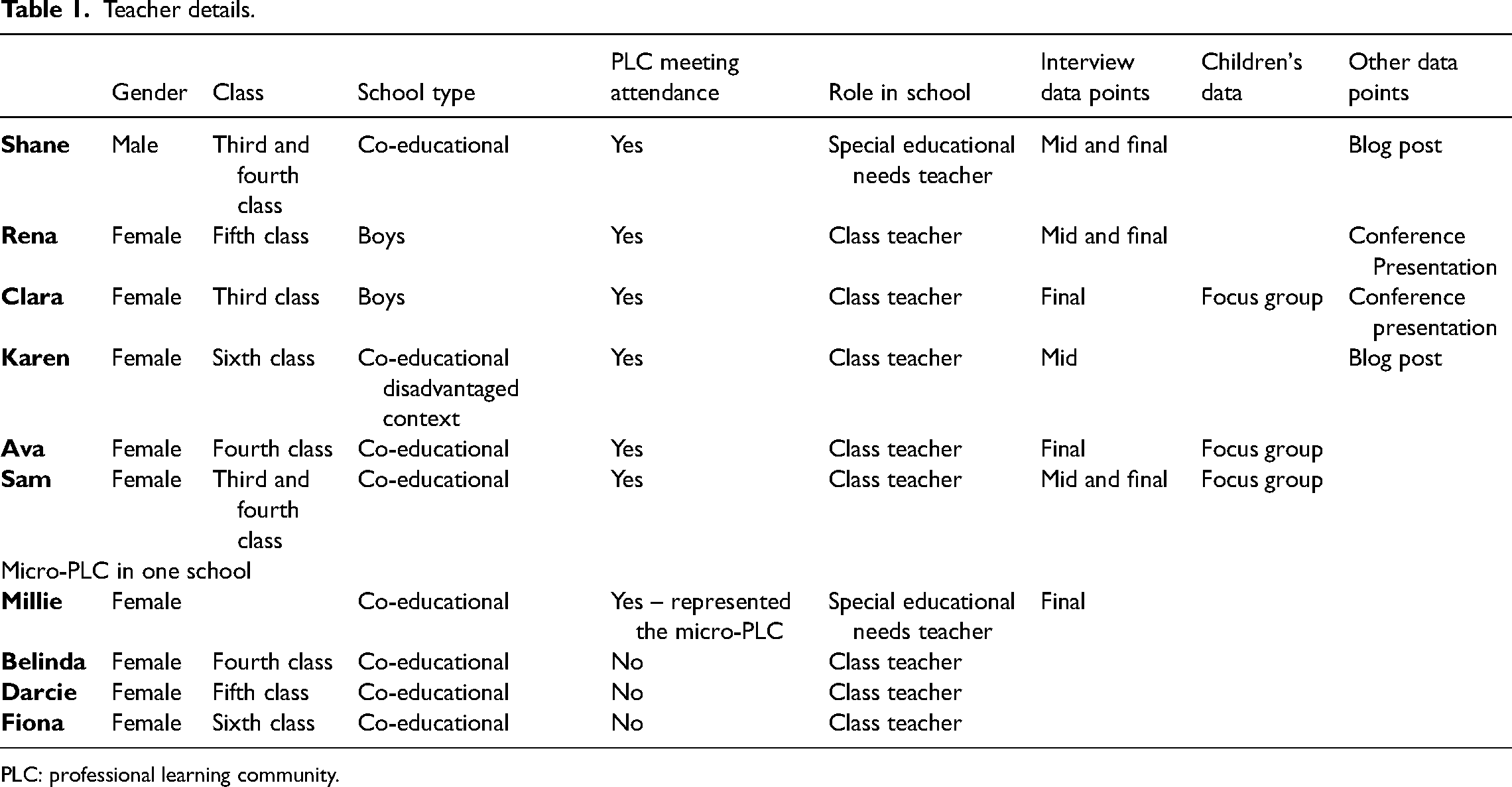
PLC: professional learning community.
In total, nine of the teachers (excluding Millie) implemented student voice ideas with children aged 8–12 in their PE lessons. Teachers were volunteers and recruited via solicitation through the Irish Primary Physical Education Association and personal contact with former students of the researchers. Snowball recruitment occurred as teachers suggested other teachers. All researchers knew some of the teachers, but none knew all of them. None of the teachers had any previous or current relationship with the group facilitators. All teachers self-identified as positively disposed to teaching PE and that PE was an area of strength in their teaching. Teachers had some experience of student voice in the classroom but little experience in PE. They aimed to learn how to enact student voice strategies in PE based on motives to be more student-centred and to provide more inclusive and engaging learning environments. All participants signed informed consent in line with ethical approval received from Mary Immaculate College Research Ethics Committee. The children in each class provided assent and their parents/guardians also gave consent for them to participate. All are identified by pseudonyms throughout the paper.
Research design
To support the teachers in their learning and implementation of student voice in their primary PE classes, a PLC (Vangrieken et al., 2017) led by two members of the research team was established to facilitate teacher and teacher/researcher dialogue. Student voice research related to both PE and primary education provided useful direction in framing what an everyday pedagogy of student voice might entail in primary PE (Enright and O’Sullivan, 2010; Iannucci and Parker, 2022a, 2022b; Oliver and Lalik, 2001). Pedagogies such as giving students choices, supporting students to identify their preferences, and helping students to share their ideas, to direct their learning, and to prioritise their preferences were all considerations. The skills and competencies teachers needed to learn to support participation in student voice activities with children aged 8–12 were also factored in. Mindful that any approach we developed would need to be workable on an everyday basis in a primary classroom, we were careful in considering demands on the teachers that would be unrepresentative of ordinary classroom practice.
The PLC held monthly 1-hour meetings across a six-month period. In total, there were six meetings. An introductory workshop provided the teachers with an overview of the why, what, and how of student voice (Welty and Lundy, 2013) and included a teacher needs assessment in which teachers outlined their motives for getting involved, their expectations of involvement, and the supports they perceived they needed. Lundy's (2007) model of ‘participation with purpose’ provided a starting point to explore and identify PE-specific pedagogies that primary teachers can use to listen and respond to children's perspectives and ideas. The capacity to enact student voice strategies on an everyday classroom basis was the benchmark for judgements about the version of student voice enacted. Examples of strategies included are: (a) Strategy 1: Using choice to find your voice, (b) Strategy 2: Learning to direct play, and (c) Strategy 3: Identifying and responding to children's preferences. At each PLC meeting one new student voice strategy was outlined to the group. Teachers were tasked with implementing this strategy in ways that suited their context for the following weeks. Each subsequent PLC meeting included an update from participants on their progressive implementation of student voice pedagogies, a needs reidentification by the teachers in response to the question ‘what do you need now?’, an ‘expert’ input, and a discussion/question and answer session. Seven teachers attended the PLC meetings; six teachers from six separate schools and Millie, the leader of the micro-PLC in her school. Millie relayed the experiences of the other three teachers (Belinda, Darcie, and Fiona) in her school at overall PLC meetings and represented them in a final interview; the other three teachers in the micro-community were not interviewed.
Data collection
Data sources to capture the experiences of teachers and children across the implementation period were:
Recordings of PLC meetings (n = 6). Each PLC meeting was recorded on Microsoft (MS) Teams and later transcribed. The total meeting time was 244 minutes, averaging 40 minutes per meeting. These data captured the detail of teachers’ experiences progressively month-to-month and provided useful context for the mid-point and final interviews. One-on-one interviews with the teachers at mid-point (n = 4) and/or end-point (n = 6). Three teachers participated in both interviews. Taking into account the realities of teachers’ busy lives and the commitment demanded by involvement in the PLC, we never intended to interview all the teachers at each time point. Instead, these interviews were a snapshot that provided additional detail and context to the PLC meeting recordings. Mid-point interviews were conducted by the two members of the research team who were not involved in leading the PLC and did not attend PLC meetings after the first introductory meeting. This allowed them to ask questions as relative outsiders to the everyday operation of the PLC. The final interviews were conducted by three members of the research team based on teacher and interviewer availability. Each mid-point interview was 20–30 minutes long. The final interviews were longer, lasting 20–55 minutes. Questions focused on teachers’ experiences and impressions of student voice. For example: What are your impressions of ‘student voice’ in PE at this point? How has listening and responding to student voice influenced your practice? What has been easy/hard? What are the benefits/drawbacks? Who has benefited most? What advice would you have for another teacher using pedagogies of student voice? What teacher qualities are important? Focus group interviews with children (n = 12) at the end-point. Four children in each of three of the classes participated in short focused conversations about student voice at the conclusion of the research. These focus groups took place on MS Teams and lasted 15–20 minutes. It should be noted that the interviews with children were conducted while they were in school but during the COVID pandemic access to interviewing them face-to-face was restricted. The research team noted the challenges of maintaining a quality dialogue when conducting focus group interviews with children online. Sample focus group questions included: Did you notice anything changing in PE? Did you notice it feeling different in any way when the teacher started asking you about your ideas? Did any of the ideas happen? Did you notice any difference in what PE felt like or what you did in PE? Can you think of one example to share with me where something the teacher did from listening to your ideas made the lesson better for you? Other teacher data: As part of the project activities, two teachers authored blog posts about their experiences and two teachers shared their experiences using PowerPoint presentations in a national and international conference, respectively. These data were also included in making sense of teachers’ experiences.
Data analysis and trustworthiness
Final data for analysis included transcripts of PLC meetings (n = 6), transcripts of interviews with teachers (n = 10), transcripts of children's focus groups (n = 3), blog posts (n = 2), and PowerPoint presentations (n = 2). Data analysis followed a reflexive thematic analysis (Braun and Clarke, 2019, 2021). Data were analysed primarily by two members of the team who were experienced in student voice methods, familiar with student voice literature, and the co-hosts of the PLC. The researchers inevitably brought these experiences to the analysis process. In approaching the analysis we focused on both semantic and latent meanings as we were interested in both what participants named as important within their experiences, as well as the implications of their positioning for student voice pedagogies more widely. We followed Braun and Clarke's (2021) recommended approach. The two members of the research team read and re-read all data to become familiar with the data set. Based on this, we made notes as we critically examined the data set – what stood out? What was important? What was missing? Next, we separately coded the data by marking segments that appeared interesting and relevant to answering the research question. We noted short comments next to these to mark the segment's significance. We met online and arranged data into themes based on the central organising concepts we had identified separately in the data set. At this point, we drew connections with other projects and literature to help make sense of the ‘so what’ of the data and place an organising structure on the data by developing and refining the themes. We started with four themes; this was later reduced to three as one theme was out of proportion with the other themes and did not merit inclusion as a separate theme. As part of this phase, we drafted the detail of each theme to check for coherence and a consistent central organising idea within each theme. To address trustworthiness we also shared our themes with the other two members of the research team. They contributed insights and commentary that were considered as we refined, defined, and named each theme. The logical sequence and order of themes became important in considering theme names. Following Braun and Clarke (2021), we acknowledge the messiness and overlap between these phases and our positionality within the process. Finally, we wrote the story of each theme in ways that told the teachers’ story and connected clearly to the overall message of the paper. The teachers’ final interview data dominated the themes because this was the point at which they provided most insight on their experiences. Children's data are less prevalent because the focus of this paper is on teacher experiences. The draft paper was reviewed by all members of the research team to ensure the narrative presented captured the essence of the story journey from all our perspectives.
Findings
The findings are presented as direction to support teachers in the enactment of student voice as an everyday practice in primary PE. The beginning of this journey for teachers was to step to the metaphorical starting line. All the teachers involved were volunteers who were open to learning about and enacting student voice in their primary PE practices. All were attracted to the possibilities of what might emerge, both for their practice and for the children's experiences. Here we present a ‘roadmap’ guide based on their experiences to help other teachers on their implementation journey, drawing on direct teacher and children's data to illustrate and support the ideas presented.
1. ‘Start small’
All the teachers agreed with the idea of implementing student voice incrementally, starting with ‘small choices’ (Rena, mid-point interview). Starting small was important from both the children's and teachers’ perspective for three reasons.
First, the teachers emphasised the need to build trust with the children through gradual enactment: You have to go into it with the respect it deserves… there has to be that foundation built between student and teacher. The trust has to be there… for the student to know that, ‘if I say this to the teacher, it won't backfire on me’, that you genuinely take on what they're saying and value it… by hearing, it means an action needs to be taken. (Millie, final interview)
Second, children needed time to embrace the collaborative spirit of student voice. As Rena explained, ‘they need a gradual increase of responsibility and control over their learning as well, especially if they're not used to it’ (final interview). For these teachers, ‘giving over’ power and adopting more collaborative approaches to decision-making involved a quid pro quo: with rights came responsibilities. For example, sharing responsibility for what happened in PE demanded respectful collaboration in how the children interacted with each other. Based on her experience, Sam emphasised the skills this required: ‘Yes, their voice is going to be heard, but they also have to respect other children's voice within the class’ (final interview). Across time, the children grew in confidence in finding and using their voices: Confidence is something that's major that's shone through. And their communication skills, in the way that they need to listen to others and consider other points of views. It's mainly communication skills that I think have been developed for the children, and knowing where to say what, and putting themselves forward to speak has been a major thing for a lot of them. (Karen, mid-point interview) I found that gradual step into this whole voice PE thing with strategy one [using choice] and strategy two [learning to direct play] was really attainable. It was very easy to follow the strategy, to implement it, and to see the benefits straight away. It gave me confidence to push it more… (Rena, final interview)
Third, the notion of starting small ensured that children's choices were bounded and that activities continued to focus on achievement of selected learning outcomes. Clara explained her approach: …really explain it to the kids in the beginning… The teacher listens to their voice more, but on the flip side, they have to put in the effort and they have to put in the work as well. It has to be a balance between them getting their voice… and everything [learning aligned with curriculum content and objectives] getting done. (Final interview) If they came up with a suggestion that wasn’t safe or wouldn’t work, I’d always try and explain it and help them adapt it a little bit so that it wasn’t just a flat ‘no’, that they couldn’t do it. You try and work around and build it into something else… (Final interview) 2. ‘Start smart’ …it was explaining to them what their voice was and then explaining to them how they’re getting their voice. Being ‘OK, you’re allowed to pick your partners’, ‘you have a choice now of activities’ or ‘you have a choice of warm-ups’, and they understood then that they were getting their voice. (Final interview)
‘Starting smart’ was about knowing what works for the children in the local context, scaffolding the process with easy and accessible wins, and helping children see the difference their voice is making. Teachers made decisions about the extent and range of strategies to promote student voice based on what they knew about their class and how the children responded to each successive pedagogy. How teachers introduced and presented student voice ideas mattered to the children's understanding and engagement: ‘The more familiar the pupils get with the layout of the lessons, the quicker they get at giving their thoughts and reflecting’ (Karen, blog). Identifying student voice when it was happening was important to help children recognise these moments. Clara explained:
More responsive teaching and learning resulted in children seeing the difference their voices were making. Early wins were important in demonstrating to the children that the teacher was both listening and responding. Karen indicated that: ‘When they see that their voice actually turns into them doing an activity that they have chosen, it's more valuable to them, it's encouraged them to get more on board and to join the discussion’ (mid-point interview). Shane was even more vehement in explaining what happened in his class: ‘the PE lesson took [on] a life of its own because when they’re adding their rules themselves, they were so excited, and they nearly actually forgot I was there, but in the best possible way, obviously’ (PLC meeting 2).
Implementing the student voice strategies promoted a collaborative approach that teachers perceived highlighted to the children that the decisions and choices they made mattered: Listening to the voice for me was allowing the kids to follow through with the decisions that they had made, and if it didn’t go well, we learned from it as a group. Maybe I would have brought them back in and we would have discussed it and then if it did go well, we would praise each other for making that decision and be ‘oh my goodness, I didn’t know that we could do that, I’m so impressed’. It was like a team effort between myself and the boys. (Rena, final interview)
Letting children direct their learning and make choices was not always a straightforward process and sometimes the intended results did not emerge. These learning experiences often revolved around ‘something that was difficult, ignoring or giving them a chance to make the mistakes or pick the wrong partner and let them see how it went’ (Clara, final interview). Teacher flexibility was identified as the most important teacher skill – being open and willing to risk, make mistakes, and be responsive to the children's voices: A more flexible approach to teaching, not being afraid to move away from your set lesson sometimes depending on where the children are bringing the lesson… they might actually take the lesson in a completely different direction. So, it's not being afraid to go with that, it definitely encourages you to loosen the reins on the lesson, and be more flexible in your approach. (Sam, final interview) 3. ‘Don’t stop’ At first, she just told us what to do, and then we’d do it. But now she's letting us choose whether we want to do one thing where she teaches us or one thing where the things are already laid out and then we could do it ourselves. (Ava's class, children's focus group) It's really built a lovely relationship between me and the boys; a working relationship that we work well together, and they understand that I’m not there to tell them what to do… that I value what they have to say, and they feel that what they have to say is valued by the adult. (Mid-point interview) It's definitely tailored how I approach PE now. It's not as prescribed… I consider what they’d like to do, and it's impacted on my planning. It's changed my view of PE for the better… I just didn’t realise what my lessons had been missing. (Karen, mid-point interview)
The process of listening and responding to student voice changed the teachers’ approach to teaching PE, as Ava recognised: ‘It's changed my way of thinking and it's worked for the better’ (final interview). The children were able to articulate the differences in their teacher's practices as well:
In the process of listening and responding, the quality of the relationship with the children was enhanced in ways that helped teachers be more aware of, and more responsive to, individual needs. Student voice pedagogies were, therefore, inclusive in ways that benefitted children, leaving a lasting impression on the teachers. Ava shared: The voice of the reluctant child or the child that's not very confident, or the child that might not be very outspoken, or the child that might not be very competent in PE, I have a new burning urge to hear that voice or for that voice to be heard. (Final interview) …there were a lot of girls, they were sitting outside, ‘I don't want to, teacher’…. I know a lot of them would have felt, ‘I’m last picked on the team’, ‘I’m no good’, whereas when there's another element to it, well ‘I get listened to in PE’, ‘people want to hear what I have to say’. It just puts a far more positive spin on it all. (Mid-point interview) I might have the boys giving out to me maybe because I didn’t score that goal or something; or in rounders I don’t know how to run as fast as some other girls in our class. So, it just makes me feel I’m the worst playing a game, but if I got a choice then it's easier for me to just relax and play my own game with my own rules or play my own game…. (Sam's class, children's focus group)
The impact on children's experiences in PE was the biggest driver of teachers sustaining their commitment to student voice pedagogies. Karen explained: It's something that's always going to be in my PE teaching now, because once I’ve seen what the engagement in activities is when they’ve had a voice, it would be very hard to go back on that… they found their voices now and they want to use it…. (Mid-point) I think you need to start using it throughout the day in the classroom and have it as something that's in your class as a value because I don’t think it's fair to the kids to be ‘OK, you can have your voice in PE, we’ll see how you get on, but then we go back to class, it's just teacher that's in charge’. (Clara, final interview)
These teachers are committed to continuing to engage in student voice practices in their teaching. They shared advice for another teacher starting out: ‘Make mistakes…have an open mind, try something out… drive on again and try it again in a different way in a different strand [content area] or in a different time of the day, and take it from there’ (Ava, final interview).
For the teachers in this project, their learning how to implement student voice was sustained by starting small and starting smart. The immediate impact on their relationship with the children, the quality of children's experiences overall, and the benefits for individual participants all provided momentum for these teachers to not stop.
Discussion
Enactment of student voice pedagogies changed how these teachers taught PE and how these children experienced PE (Fielding, 2004). Echoing similar findings at post-primary level (Howley and O'Sullivan, 2021), from the children's vantage point they learned gradually how to use their voices with purpose to influence their experiences, and they felt that their perspectives were valued (Cook-Sather, 2020). Democratic participation added value to their experiences, as reflected in Lundy's (2007) framework for authentic participation with purpose. Children were provided with structured opportunities to use their voices to express their views. New spaces were opened by teachers in PE lessons for children to discuss and share ideas. The teacher was their audience who listened and showed the children they were having an influence by making changes to what happened in PE time. In these ways, the children authentically used their voices to influence their experiences (Lundy, 2007). Equally important to the outcomes for the students is the teacher learning and resultant change that took place.
For these teachers, enacting student voice changed their understanding of what PE teaching should entail, resulting in a more collaborative approach involving shared decision-making with children about what happened in PE lessons. At times, similar to recent findings elsewhere (Cardiff et al., 2023b), their new ways of teaching pushed beyond PE to other learning areas. The change in teachers’ approach can be captured through the tenets of teacher change theory (Fullan, 2007; Sparkes, 1990). Both Fullan (2007) and Sparkes (1990) suggest that developments at all three ‘levels’ of the system (curriculum materials, teaching approaches, and beliefs) are necessary to embed lasting teacher change. Findings of this research illustrate how learning prompted change at all three levels. First, changes in use of materials are evident in the consistent use of student voice resources. The teachers used, revised, and re-used the resources provided for enacting voice. Second, a dramatic shift was evident in teachers’ pedagogical approaches and skills towards more democratic and student-centred approaches. They saw merit in helping students learn to make decisions on their own – even when those decisions did not match theirs. They became patient in letting children wade through the murky process of learning to use their voice. The teachers talked less. Third, changes to teacher beliefs and understandings are evident in how they reflected on their learning journey. Most importantly, they came to recognise how student voice changed PE for the better. These teachers moved from using student voice as a strategy to embracing it as ‘a culture and a moral purpose’ (ACCS, 2021: iii). As Guskey (2002) intimates, once teachers have a positive experience with an initiative (in this case, student voice), they become increasingly motivated to pursue other means to follow that initiative.
Authentic and lasting change is more likely to occur if teachers’ beliefs align with the priorities of the change (Fullan, 2007; Sparkes, 1990). In this research, the teachers’ disposition towards student voice mattered. All of these teachers started out with an openness to learning about and implementing more democratic pedagogies in PE – what they lacked was impetus and support to do this. The design and leadership of the PLC in this research aligned with the three levels of change. It is unsurprising, as a result, that impact at all three levels is evident. The enactment of materials and pedagogy with attention to teacher voice was scaffolded and itself provided teachers with choice. Helping teachers to start small and start smart was critical to their success as trust was built (Iannucci et al., 2023) and skills of using voice (Cardiff et al., 2023a) were developed. As each student voice strategy in turn yielded positive results, teachers were ready to take on the next strategy. Guiding teachers to self-pace their enactment, starting small, they matched their learning and pace of implementation. These teachers were also smart in the choices they made and how they responded to children's progress in using student voice. As teachers enacted student voice successfully and witnessed the benefits, the change in beliefs was almost simultaneous. It seems that attention to all three levels (Sparkes, 1990) within the PLC provided stability to sustain the new ideas. Now, convinced of the value of student voice, they do not plan to stop.
Lundy's (2007) model is also helpful in making sense of the aspects that sustained teacher engagement with student voice pedagogies. The PLC format provided space for the teachers to express their views. They appreciated hearing others’ perspectives and experiences because understanding that others faced similar challenges and were travelling a similar path mattered to their feeling supported. The PLC also provided support for their voices and ideas. Their ideas, thoughts, and feelings were listened to and acted on. Cycles of action and reflection helped to refine their thinking. The children were their primary audience who received their views. The children's responses to how PE played out were the influence in continually shaping their ideas. We suggest that Lundy's ideas provide features of a pedagogy to help teachers learn how to enact student voice. This framework is particularly attractive because it is consistent with the approach teachers are learning to use with children in their classes. From the outset these teachers were positioned as learners, with attention to their backgrounds, perspectives, voices, and learning journeys. When a teacher's learning is positioned at the centre of professional development, greater teacher engagement and empowerment, as well as greater student learning, results (Parker and Patton, 2017). In this case, supporting the findings of others (Schaap and de Bruijn, 2018), naming and supporting their learning process helped the teachers to own, direct and appreciate their learning and resultant change in practice.
We are conscious that the version of student voice represented in this research might be considered limited in its scope; radical change was not presented as an option. Yet, the fact that children authentically influenced the practices of PE suggests there is merit in this approach. We contend that the incremental approach adopted, though modest, was appropriate to our focus on everyday practices. For these teachers starting out, the scale of their ambitions matched their growing capacities as they learned about student voice. This may have limited the possibilities for children in some ways, but what we can assert is that in ways that were possible for them, these teachers did authentically listen and respond to students’ voices. Encouraged by Cook-Sather (2020: 188) that action can take many forms, our student voice focus continues to be on ‘implementing immediate changes in pedagogical practice’. More radical change or pressure of a more intense change process might well have been overwhelming and resulted in disengagement. The approach to supporting teacher learning worked.
This research drew on teachers’ accounts of their experiences. Children's perspectives were limited by the lack of access to schools caused by the COVID-19 pandemic. In an effort to close the student voice circle, their voices should be prioritised in designing future research on teacher student voice learning and enactment. Future research that includes direct observation of the teachers in PE and teaching other subjects would provide additional support for claims related to changes in teachers’ identity. In addition, targeting teachers at multiple data points would allow for more systematic tracking and explanation of teacher change across time. Furthermore, following these teachers across a longer period of time would allow insight into if, and how, enactment of student voice continued to develop and provide further insight on their changing identities as teachers. Along with others (e.g. Cardiff et al., 2023a, 2023b; Hemphill, 2022; Iannucci et al., 2023), our illustrative account of teachers’ and children's experiences adds weight to the value of pursuing student voice as an everyday practice of primary PE.
Conclusion
The findings of this research point to the value of student voice in primary PE because giving children input on their participation altered the quality of their participation in positive ways. Findings also indicate the suitability of student voice pedagogies as everyday practice in primary PE that can be learned and enacted by generalist primary teachers. The steps we have identified here based on teachers’ experiences – start small, start smart, don’t stop – represent a viable means to embed student voice in PE. They provide an empirically-based roadmap for primary teachers to begin to introduce student voice in their teaching of PE. We hope that the roadmap presented can be used as a framework for primary teachers to implement student voice pedagogies and for others to support primary teachers learning to enact student voice.
Footnotes
Acknowledgements
The VOICE-PE initiative was a collaboration with the Irish Primary Physical Education Association. Thanks to the amazing teacher participants who shared with us as you enacted student voice; we loved being a part of your journey.
Declaration of conflicting interests
The authors declared no potential conflicts of interest with respect to the research, authorship, and/or publication of this article.
Funding
The authors disclosed receipt of the following financial support for the research, authorship, and/or publication of this article: This work was supported by the Irish Research Council (grant number New Foundations NF/2021/27143159).
