



Abstract
Learning communities (LCs) in a variety of formats are touted as an effective strategy for continuing professional development (CPD) in physical education. This study’s purpose was to provide an overview of the research on LCs in physical education for professional development between 1990 and 2020. A scoping review undergirded the research process and search parameters included full-text empirical studies in 12 languages. Ultimately 95 studies were found. A descriptive analysis revealed teachers as the focus in 75% of the studies; fewer studies focused on initial teacher education students, teacher educators, and facilitators. The largely qualitative studies reflected an international database (18 countries; four multinational studies) with South Korea, the US, and England dominating the literature. Four features spotlight thematic findings: (a) facilitation, (b) the process of community development, (c) the focus of the group and (d) the product(s) of the group. Learning communities as a CPD approach in physical education appear to be effective in a variety of ways. Little evidence, however, exists regarding their sustained nature over time, or how teacher engagement in LCs may result in substantive student learning. Contributing to the scattered nature of literature to date was the interchangeable use of communities of practice (CoP) and other forms of LCs. Often communities were not theoretically aligned, the development process of communities not explained, nor evidence provided as to how the community studied contained the qualifying features of a CoP or LCs. Future research, therefore, should detail the nature of community and fidelity to the theoretical framework.
Keywords
Introduction
Continuing professional development (CPD) through the cultivation of learning communities (LCs) holds the ‘promise of transforming teaching and learning for both educators and students in our schools’ (Lieberman and Miller, 2008: 106). Participants in LCs have reported being more motivated and committed to their professional development and learning (Cordingley et al., 2007; Hadar and Brody, 2010). Pedagogically, teachers engaged in LCs have improved their teaching and learning strategies and their ability to recognise students’ learning needs. Further, teachers have applied learning theories to teaching, used new technologies and implemented educational policy and subject-specific knowledge (Cordingley et al., 2007; Vescio et al., 2008). In physical education (PE), LCs have been vastly used as a CPD strategy (Parker and Patton, 2017). Both teachers and teacher educators in LCs have demonstrated changes in attitudes and beliefs (Deglau and O’Sullivan, 2006), as well as developed a sense of community and shared power during their CPD (Gonçalves et al., 2020; Patton and Parker, 2017; Tannehill and MacPhail, 2017). Moreover, LCs have been reinforced as a path to overcome the challenges of traditional CPD by promoting teacher agency and constant collaboration between teachers, pre-service teachers, and teacher educators (MacPhail and Lawson, 2020).
While the benefits of LCs are evident, they are not without debate. Prominently, a ‘contrived collegiality’ is identified as harmful to CPD (Hargreaves and O’Connor, 2018: 21), occurring when teachers are forced to participate in top-down LCs with limited decision-making, spontaneity, and prioritisation of teachers’ learning and development (Kennedy, 2014). It is also argued, albeit less frequently, that these contrived communities, when imposed on teachers, have the potential to ‘function as a means to silence dissatisfaction through the hegemonic appeal to “community” and its normalising function as arbiter of ideological control’ (Watson, 2014: 27). Despite the tensions and challenges associated with cultivating and participating in LCs, they can initiate change in institutions by the conscious confrontation of competing values (Watson, 2014) and contribute to microchange in schools (Gonçalves et al., 2020).
Within education literature, LCs are referred to using a variety of terms including professional LCs (PLCs), communities of learners, school communities, teacher communities, and communities of practice (CoP). Community has become an overused term (Patton et al., 2005) and PLC as an all-encompassing term has lost much of its original meaning (Armour et al., 2017; Watson, 2014). Acknowledging that PLC and CoP are the main theoretical constructions adopted to define LCs (Blankenship and Ruona, 2007; Vangrieken et al., 2017), the definitions and characteristics of each are pivotal.
PLCs are based on a learning organisation theory, dominant in business and applied to the education field. Five main features are identified as essential to constitute a PLC: (a) a supportive group with a shared leadership; where (b) people share values, vision and goals; (c) there is collective learning and application; (d) shared individual practice; and (e) both physical and human supportive conditions (Vangrieken et al., 2017). Two additional points constitute the foundation of the PLC concept. First, there is the assumption that knowledge is situated in daily experiences. Second, teachers must reflect critically about such knowledge to enhance teachers’ and students’ learning (Vescio et al., 2008).
Alternatively, supported by situated learning theory, a CoP is a group of people interested in learning and developing their practice. It requires people mutually engaged around a joint enterprise, sharing the repertoire of their practice (Wenger, 1998). According to situated learning theory, learning interpretation centres on social practice and defends sociocultural transformation through daily relations between people who share the same practice (Lave and Wenger, 1991). Thus, learners are members of communities who share the same practice, the understanding of this practice, and develop a shared repertoire of resources (Lave and Wenger, 1991; Wenger, 1998).
Given the scholarly attention afforded to LCs to promote CPD in PE, it is timely to take stock of and reflect on recent developments in this field of research. No review of the current state of knowledge in this field has been produced, and very few studies have engaged with non-English language publications on the topic. Therefore, the purpose of this paper is to provide an overview of the research on PE LCs for professional development between 1990 and 2020. The intent is to chart the key concepts of this research and the main sources and types of evidence available to provide a useful context for the conduct of future scholarship.
Methodology
A scoping review undergirded the research process. Scoping reviews are useful when a research area is complex (Mays et al., 2001) as they allow researchers to map the extent, range and nature of literature in an area, summarise and disseminate research findings, and identify gaps in knowledge (Arksey and O’Malley, 2005). Scoping reviews provide comprehensive coverage addressing the breadth of the existing literature; neither the quality of the research nor the effectiveness of interventions/programmes is considered. Instead, scoping reviews create an analytic framework or thematic analysis to report the narrative findings of their review presenting insights at a macro, rather than a micro, level (Arksey and O’Malley, 2005). Arksey and O’Malley (2005) suggest five steps in a scoping review: (a) identifying the research question, (b) identifying relevant studies, (c) study selection, (d) charting the data, and (e) collating, summarising and reporting the results. How we addressed each step is presented in the following sections.
Identifying the research question
The use of LCs within PE is prevalent in the literature, but not extensively reviewed. Thus, the research question for this review was, ‘What is empirically known from the existing literature about LCs for professional development in PE?’
Identifying relevant studies
Given we desired to understand the extent of the literature in the most comprehensive manner possible, our search parameters included full-text empirical studies in 12 languages between 1990 and 2020 available online. The contested and inconsistent use of the terms referring to LCs prompted us to utilise the database search terms of: ‘physical education’ + ‘learning communities’ OR ‘professional learning communities’ OR ‘communities of practice’ OR ‘teacher communities’ OR ‘professional communities.’ Databases included Academic Search Elite, Educational Resources Information Center (ERIC), SPORTDiscus, Dissertation abstracts and Web of Science as well as the Google Scholar search engine. The search process included three phases: (a) search of electronic databases, (b) manual search of key journals, and (c) finally a search of the reference lists of all papers deemed to satisfy the inclusion criteria from the previous two steps. The search of electronic databases yielded 358 potential articles. The reference list search produced 10 additional articles and a manual search of the most popular journals identified nine articles.
Preliminary information for each of the identified studies was entered in an Excel table that included descriptive data: authors, title, journal of publication, publication year, country in which the study was conducted, purpose, participants, methodology, data sources, and theory used. In addition, notes were made regarding key findings. Afterwards, the table was reviewed by one author for duplications, which were subsequently removed. This resulted in 249 articles remaining for potential inclusion. The Excel table and full-text copies of (potentially) relevant studies were saved in a Google Drive folder shared with all authors.
Study selection
After all entries were included in the table, each author was assigned a group of articles to review using the inclusion and exclusion criteria. Inclusion and exclusion criteria were adopted after multiple conversations between all authors, such as to include: articles about teachers or teacher educators and their professional development; empirical full-text papers; theses – which were not also published as papers; papers published in all years, and in selected languages (English, Portuguese, Korean, Spanish, Dutch, Norwegian, Swedish, Danish, French, Slovenian, Turkish, and Greek). Articles meeting all criteria were coded in green; those that did not meet the criteria were coded in red; and those that were undecided in yellow. All articles coded as undecided were discussed and resolved by the entire group. This multi-language literature review process was enabled by the linguistic diversity of the research team. The authors included English, Portuguese, and Korean native speakers. Research assistance was received from colleagues whose native languages are Spanish, Dutch, Norwegian, Swedish, Danish, French, Slovenian, Turkish, and Greek. In total, 95 articles remained for analysis. The duration of the study selection process allowed us to expand the review period by an additional nine months (to September 2020). See Figure 1 for a detailed analysis of the screening process.
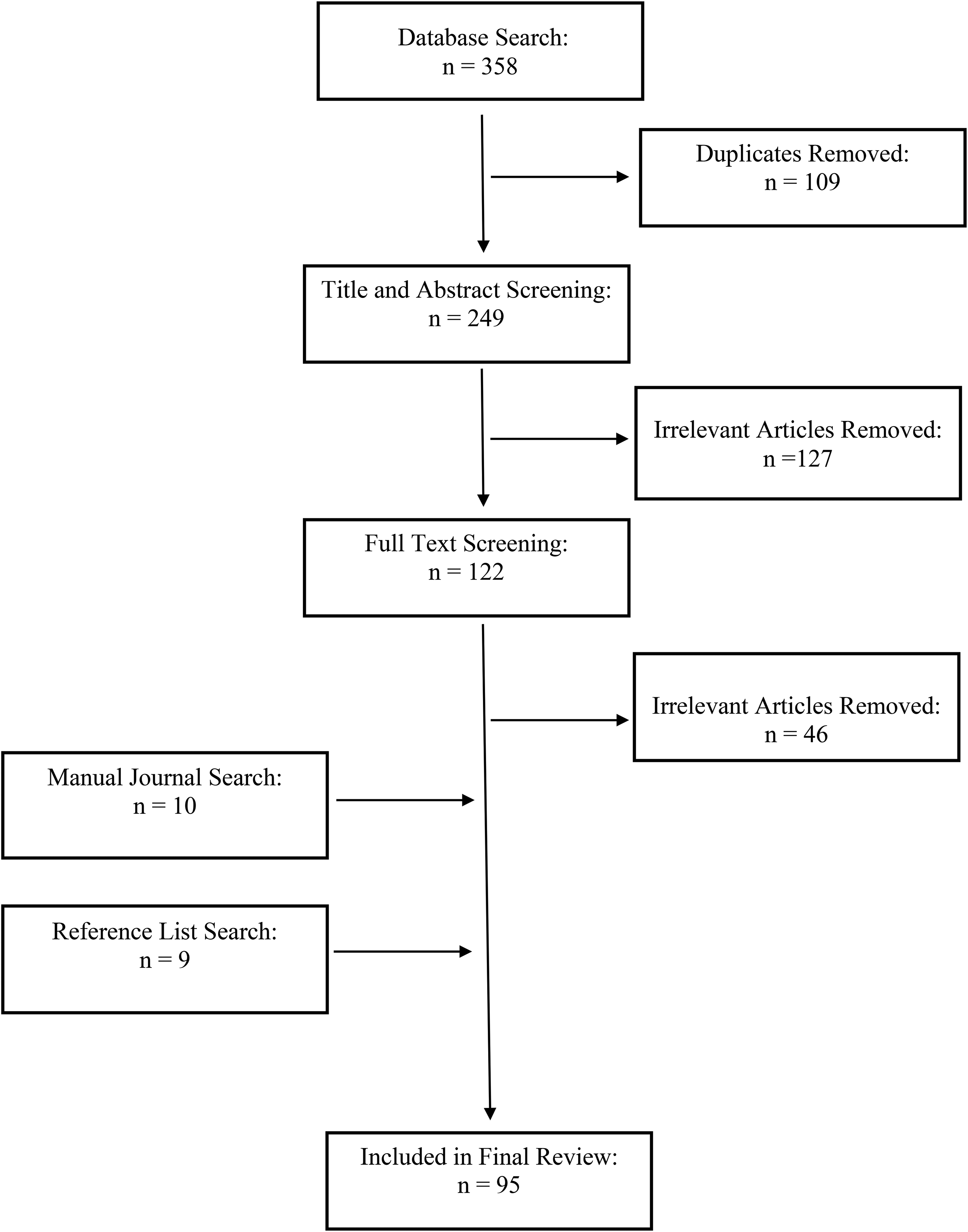
The review process.
What constituted a specific type of LC was a topic of great deliberation given the contextually varied descriptions in the articles. While we agreed not to overrule the author(s)’ terminology used for a community, the mottled use of terms did raise considerable issues discussed later in this paper.
Charting the data
Once the table was reduced to 95 articles, authors were assigned a final group of articles to record more in-depth details in an Excel table. Articles were assigned a numeric code (1–95). These studies are available in the supplemental materials available online and referenced in text using numeric style.
Collating, summarising and reporting the results
Due to the number of articles in the review, first, a descriptive analysis is provided followed by a thematic analysis of the narrative findings (Ellmer et al., 2020; McEvoy et al., 2015). A frequency analysis is used to present the descriptive results of the nature and extent of the articles reviewed while a thematic analysis is used to analyse the content. Following guidelines for thematic content analysis (Silverman, 2014), all authors read the articles independently and developed what they thought were key findings or themes. These were then discussed with the group, revised, and consolidated.
Descriptive findings
The articles in this scoping review represent an international database of work published in 35 journals and 13 doctoral theses from 18 countries; four studies presented data from a multinational perspective. Studies from South Korea, England, Ireland, and the US dominated the literature (see Table 1). Our descriptive analysis of the papers is depicted in three subcategories: (a) who was investigated; where and when the study took place, (b) how communities were studied, and (c) what theoretical framework guided the investigation.
Countries, languages and journals of included articles.
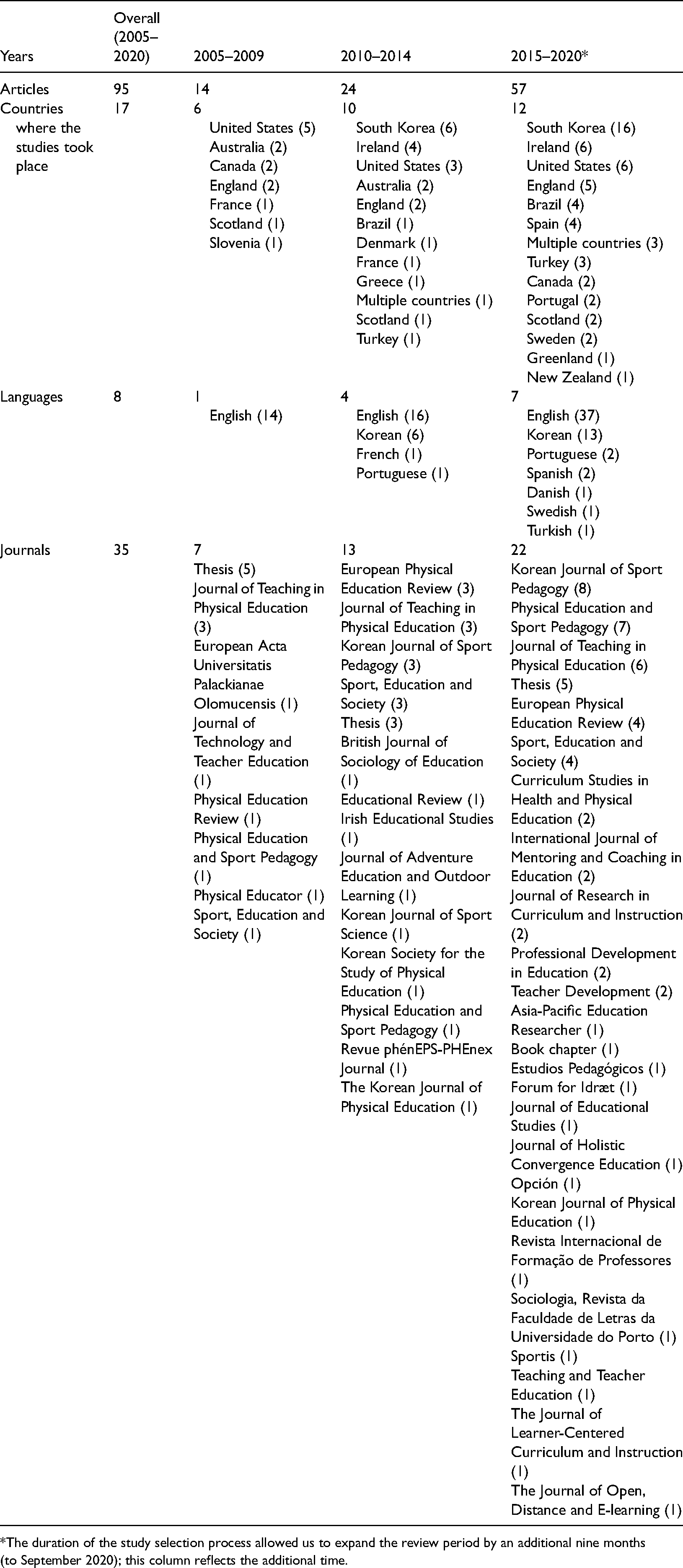
The duration of the study selection process allowed us to expand the review period by an additional nine months (to September 2020); this column reflects the additional time.
Who was investigated: where and when?
While we intended to review the literature regarding LCs over a period from January 1990 until October 2020 (inclusive), when we accessed the literature the first articles on LCs appeared in 2005 (94, 95). In the five years after, 12 other studies regarding LCs were published. The next five-year intervals reflected an exponential increase in the topic; between 2010 and 2014 there were 24 publications and 57 between 2015 and 2020.
PE teachers in LCs were the focus in 75% (N = 71) of the studies. Of these, 18 studied teachers at the elementary or primary level (including both specialist and generalist teachers), 36 focused on secondary PE teachers, 11 concentrated on teachers from mixed grade levels, and six were unknown. In four studies, administrators (e.g. principals and superintendents) were also identified as participants (34, 68, 69, 81). Most of these studies were conducted in South Korea (N = 22), followed by the US (N = 12), and England and Ireland (N = 6 each). The remaining studies were scattered across 14 countries; only four studies (3, 15, 66, 68) examined international contingents of teachers or teacher educators in LCs. Going beyond simply looking at teachers in LCs, nine studies examined the students of the teacher(s) engaged in LCs (e.g. 39, 41, 43, 44, 64). The role of facilitators surfaced in 16 studies and was most often reported as an aspect of the results (e.g. 17, 55). The facilitators of LCs, however, were the specific topic of four papers. These studies addressed facilitation practices in Brazil (6, 7), Turkey (40), and one paper focused on an international cadre of facilitators (66).
While teacher educators were participants in multiple studies, their engagement within LCs was the focus of six studies (9, 20, 28, 33, 38, 50) spread across four countries including Brazil, Ireland, the US and Spain; only one study examined teacher educators from an international perspective (38). Finally, 16 studies across nine countries investigated the use of LCs to enhance the professional growth of initial teacher education students (e.g. 46, 65, 83, 85).
How were LCs studied?
From a methodological perspective, 94% of the studies employed a qualitative approach using a variety of data sources. The vast majority of the studies collected data either by individual or focus group interviews (N = 85). These interviews were supplemented by open-ended questionnaires for 14 studies (e.g. 23, 25), while document analysis augmented other forms of data in 29 studies (e.g. 13, 29). The analysis of tweets served as data in nine papers (e.g. 5, 15). Diaries, journals, and written reflections were used in 23 studies (e.g. 41, 69). A total of 28 studies included observations and field notes of LCs in action as data sources (e.g. 38, 67). Other qualitative data included stimulated recall (23), self-study (16), and video of lessons (31). The two quantitative studies (30, 86) used questionnaires as the primary data source. Six studies employed a mixed methodology using a combination of surveys or questionnaires followed by interviews (e.g. 21, 57, 90) and teacher knowledge tests (64; 93). Regardless of the research paradigm employed, 80% (N = 76) of the studies used two or more data sources to support their claims with 45% (N = 34) of those using four or more data sources.
What framed the investigation?
Situated learning theories or CoP framed most studies (N = 47). An array of other theories, such as complexity theory, cognitive development, and Freire's critical pedagogy framed individual or small clusters of studies. Only a handful of studies (N = 4) identified no theoretical perspective to explain the community development or practice.
While situated learning or CoP was the most common framework used, the type of community was inconsistently defined and the heterogeneous use of the terms CoP, PLC, and LC was problematic. The most common terms were CoP (N = 50), PLC (N = 13), LC (N = 7), and virtual CoP or e-LC (N = 8). As many as 15 studies did not mention the type of community and 11 studies utilised other names to define the type of community such as collegial learning, dysfunctional CoP, emerging CoP, knowledge community and living-LC. Five studies used multiple terms to define their communities highlighting the lack of a clear definition of the groups. In this paper, unless authors have theoretically identified a group as a CoP we generically refer to these groups as LCs.
Many studies did not explain how the community studied contained the qualifying features of a CoP or a PLC. In addition, disconnections between the type of community and the theoretical framework utilised in the study were found. Although most of the studies defined their communities as CoP, only 21 studies presented a theoretical foundation in line with CoP concepts (e.g. Lave and Wenger, 1991).
Thematic summary
Four themes are used to provide an overview of the research on LCs in PE from 1990 to 2020: (a) facilitation, (b) the process of community development, (c) the focus of the group, and (d) product(s) of the group.
Facilitation
Facilitation can be described as the actions of the leader of an LC, whether formal or informal, in engaging participants in creating, discovering, and applying learning insights. Studies focused on facilitation examined: (a) the process of facilitation, (b) the context of facilitation, and (c) facilitator learning.
Process of facilitation. Facilitation processes included both the development of an environment promoting teacher engagement and the pedagogies of facilitation directly supporting teacher growth and development. Various aspects related to the creation of the environment were the topic of numerous papers. The importance of facilitating with care, providing both content and process support was highlighted by some (e.g. 81, 92). Others (e.g. 27, 55) delved into the environment, spotlighting the importance of specific strategies such as ‘greet and talk’, ‘share and tell’ and ‘observe and discuss’ to promote open dialogue within the LCs in support of developing trusting and supportive relationships between members. Strategies to reinforce the LC as a democratic space were also explored (7). Still others acknowledged the importance of helping teachers with practical daily tasks such as cleaning and organising sport equipment (6, 66, 67).
Strategies supporting teacher growth and development were also explored. For instance, pedagogical strategies used to aid teachers in implementing new curricular ideas were examined, concluding that prompting teachers to do, try, and share provided a needed scaffold in teachers’ ability to implement new ideas (66). Similarly, using social media as a form of communication with teachers to reinforce the implementation of new practices was probed [62]. While authors repeatedly reported that the facilitator was an essential catalyst for change and teacher learning (e.g. 6, 34, 55), at times the presence of a facilitator hindered learning (67). In these instances, the facilitator was too technical and did not promote the desired learning (7) or exerted either actual or perceived power over the group (2).
Context of facilitation. A second facilitation aspect addressed the varying contexts in which the LC existed. While some (66) suggested little variation between the North American and European context regarding facilitation, others (6) advocated that in global south countries, immersed in precarious contexts, the facilitation strategies might be different. In these circumstances, rather than focusing on teachers’ learning about pedagogical knowledge, facilitators needed to struggle with teachers to change their realities and attend to basic structural needs. Likewise, it was found that in a culture where the role of the facilitator was traditionally more hierarchical (and wielded more power) there was a negative influence on teachers’ learning (2). In similar situations, it was reported that the facilitator's role was difficult, with the person in this position struggling to find the balance between pushing the teachers or pre-service teachers and providing space to grow autonomously (6, 7, 67). The context of facilitating through social media also brought with it critical issues of power and control which limited voices (15). In addition, with social media groups, facilitation is needed to provide access to a ‘knowledge’ source whether that be an instructor (88) or ‘boundary spanner’ who engaged both online and in-person to meet the diversified needs of the group and sustain the community (55). When examining three types of LCs (top-down, funded as a result of application, and voluntary member-based), although authors did not detail the strategies used in each type of community, it was implied that the facilitator's roles might be different depending on the LC format. This was especially true when the LC was directly connected with administration (80).
Facilitator learning. The studies investigating facilitators’ learning or how they changed over time represented a small portion within facilitation literature. A teacher learning to be a facilitator through the concrete experience of facilitating an LC, reflecting on the process individually and by discussing and planning with a skilled facilitator was studied in Turkey (40). In varying Brazilian settings (6, 7), facilitators’ learning to become democratic facilitators who created spaces for microchanges was examined. Others (40, 67) explored facilitators’ development of pedagogical skills. Similarly, the notion of instructional coaches, playing the role of a facilitator of teachers’ professional learning, albeit a learned skill, was examined (21).
Process of community development
A total of 28 studies examined, to some extent, the process of LC development, including details of (a) their formation from a participant perspective, (b) active engagement in day-to-day operations, and (c) the development of a sense of community and commitment. Of these studies, a handful described the development of an LC from its inception to a functional group. For example, the shift from blind participation without a shared purpose to an official LC with administrative support to a collaborative LC was reported (80), while others described changes from an official LC to a collaborative LC and ultimately a reflective LC (75). Still others reported changes from a committee to a community (81) or from a collection of teachers to an established group, to an authentic CoP (70). Social media sites as a platform for professional development were increasingly the focus of recent studies (e.g. 5, 16, 55, 62), one of which (15) investigated the extent to which engagement in a social media group resulted in developing a CoP. While a good deal is known about launching and sustaining LCs, to date, no studies have reported about their dispersal when their purpose is fulfilled.
Formation from a participant perspective. Nine studies reported the developing process of an LC in relation to participants’ experiences. Although most studies reported smooth and positive learning experiences (37, 42, 43, 61), other studies highlighted the development process as challenging, complex, and non-linear (63, 71, 78, 83). Challenges reported included teachers’ initial submissive experience due to the hierarchical nature of group dynamic (83), school teachers’ lack of time and cynicism about change (63), and the side effects of scaling up a small group LC to a national level (71). Particularly, the importance of a de-centralised approach, considering local needs and linking diverse stakeholders when scaling up LCs was highlighted (71).
Active engagement in day-to-day operations. Research regarding the process of community development further examined factors enabling participants’ active engagement and the day-to-day operation of the community (N = 11). Despite the cultural differences across countries, there were common enabling factors such as catalyst to initiate (81), district or university level of support (61, 63, 79, 81), personal and professional relationships (38, 61, 74, 79, 81), ownership and empowerment (14, 61, 81), and common focus and vision (38, 81). Among these, developing a sense of ownership through empowerment was critical to ensuring the sustainability of LCs. Activities with the potential to promote empowerment included disseminating and showcasing LC learning outcomes through conference and social media presentations and becoming a subject leader within one's own school (14, 61, 71, 74, 81, 92).
Development of a sense of community and commitment. The majority of ‘process oriented’ studies (N = 24) focused on developing a sense of community, collaborative learning and problem-solving and demonstrating a commitment to share their experience with other teachers (e.g. 27, 35, 52, 71, 80, 92) and teacher educators (9, 38). Several examples illuminate strategies to advance collaboration including: using a framework for common language (52), action research and sharing (8), teacher reflection (43), mentoring (95), identifying a common focus, creating safe, but challenging spaces, and shared commitment (38, 81, 92). Collectively, these studies indicated that successful LCs provide a structured framework to share a common focus and engaged in reflective discussion to generate knowledge.
Further examining teachers’ active engagement in LCs, studies investigated patterns of interaction (17) and engagement (15, 24), the value of informal learning (14, 61, 89), the pedagogy of facilitation (66), the influence of school subject culture in a subject-based community (82, 94), and characteristics of virtual communities (28, 86). While occurring in varying ways, one of the common mechanisms for sustaining active engagement was the multifarious recognition of the importance of the social nature of learning and establishment of professional relationships with individuals and community to support growth and development within LCs (15, 17).
Studies also addressed barriers negatively impacting LC formation, specifically the interplay between the type of community (e.g. virtual and subject-based) and social interaction and group processing between members. For example, in a Twitter-based community or virtual community, the communication among a high number of participants was reported as disconnected or fragmented (15, 28), hijacked by a few people while some participants played the role of a lurker (15, 28), thus hindering the professional learning of participants. Similarly, the power relationship existing in a subject-based community made initial teachers fit in and adopt experienced teachers’ beliefs rather than challenge them (94).
Focus of LCs
The purpose or intent of LCs was addressed in 83 studies and grouped into the following categories: (a) curriculum development, (b) the learning of models-based practice, and (c) a generic CPD framework for overall professional learning and development.
Curriculum development. A total of 10 studies examined LCs as a mechanism for supporting teachers’ curriculum development and implementation. Studies conducted in South Korea and the UK have adopted LCs as a mechanism to interpret the national curriculum and develop school-level PE curriculum. In this process, LCs helped teachers re-examine ‘what’ and ‘how’ to teach by asking questions on ‘whys’ through reflection and collaborative sharing (37, 47, 51). When teachers shared vision and purpose, set problems related to curriculum implementation, and co-created knowledge and resources within an LC, they transformed the ideology and theory of curriculum into practice within their own school setting. Likewise, when the development and dissemination of the district-wide elementary school curriculum in the US was examined as a social practice combining learning from experts with learning from each other through the establishment of personal and professional relationships, teachers were empowered to take new leadership roles and demonstrated ownership of the work (81).
Only a few studies, however, addressed initiatives that lacked capacity-building and the potential to empower teachers involved. In one case, challenges arose in supporting teachers to enact a designed curriculum through a cascade LC model [63]. Within the programme, it was found that a lack of time and negative perceptions of the curricular changes on behalf of the curriculum leader and school teachers interfered with peer-coaching.
Models-based practice. The understanding of how an LC facilitated the enactment of specific instructional models or approaches was the focus of 19 studies. For example, health-related fitness education (64), sport education (9) cooperative learning (55, 62), teaching personal and social responsibility (26), teaching games for understanding (48), an activist approach (7) and outdoor education (67) were all studied. Findings indicated that to enhance the quality of model enactment, the LC provided structured support such as external expert assistance (55, 67), resources (25, 26, 67), continuous online/digital-based support (1, 25, 62), and content knowledge and pedagogical content knowledge development support (1, 26, 67, 64). In this process, LCs not only provided information on model-specific knowledge, but also guided teachers’ change in perspective to internalise educational orientation of specific models by posing critical questions, creating safe space (7, 9), enhancing adaptive expertise to adjust the model to meet the needs of students and contexts (1, 26), and creating strong bonds among members (2).
Generic CPD framework. A total of 54 studies reported the use of LCs as a generic CPD framework for professional development, broadly focused on teacher learning and development. The construct of an LC was used to address a myriad of topics directly related to classroom instruction and assessment. Sometimes, the LCs were used to help teachers plan and prepare lessons together (e.g. 10, 38, 89), resulting in different types of knowledge than the knowledge generated by individuals. Similarly, assessment practices through an LC (95) and the use of an LC on teachers’ capacity to teach and evaluate critical thinking and evaluation (52) were examined. When LCs served as a CPD framework for teacher educators, either formal or informal, the focus was on reducing isolation (38), teacher educator learning (28, 33, 50), and building research capacities (38, 50).
Alternatively, LCs also focused on aspects indirectly associated with teacher learning. For example, teacher induction was the focus of a group of studies (8, 13, 94). Relatedly, teacher empowerment with a cadre of Brazilian teachers was addressed (6). The supervision of field experience students and student teachers guided the work of others (e.g. 45, 49). A handful of studies described the concept of teacher as researcher (e.g. 31, 32, 74).
We found 13 articles representing five countries that dealt with technology in some format. One study addressed the professional development of teachers learning to use technology [88]. Others investigated the use of technology for professional learning and the exchange of information (4, 28, 30). More recently, one teacher's engagement in an online professional LC and her perceptions of its impact on her own feelings of isolation were explored (5).
Product(s) of the group
The outcomes or products of LC participation can be grouped into four broad categories: (a) teacher learning, (b) teachers’ affective characteristics, (c) culture of trust, respect and support, and (d) student learning outcomes.
Teacher learning. Most often, connections between participation in LCs and teacher learning practices were highlighted. These include increased knowledge and changes in practice, including changes to pedagogy and use of indirect teaching behaviours (39), cooperative learning as a pedagogical innovation (55), teaching games with a child-centred and understanding approach (48), improved health-related content knowledge (64), practical knowledge (51), and use of assessment (95), among others. In each instance, participants felt supported and learned socially while experimenting to build their own practice. Similarly, changes in teacher educators’ practice were also experienced, including improved reflection (50), enhanced teaching and research capacities (33, 38), and enhanced teacher identity (33).
Studies also examined the impact of LCs on pre-service teachers focused broadly on social aspects around developing teacher identity and power differentials between agents [82]. Herold and Waring (2018) identified both in-school and university-based LCs as powerful learning opportunities for teacher candidates to explore school culture, policies, and embedded practices. Encouragingly, the ongoing everyday dialogue that occurred between mentors and prospective teachers while engaging in an LC was found to directly affect their teaching (19).
Teachers’ affective characteristics. The development of teachers’ affective characteristics was also a consistent topic. Some (92) reported that teachers engaging as a CoP formed strong identities as teaching professionals. Similarly, when learning to use a particular curricular approach was examined, it was reported that the constant ‘what was best for kids' focus, ‘facilitated the development of the teachers' pedagogical identities, changing positionalities, and negotiating culture, values, beliefs and professional backgrounds’ (20: 855).
Multiple studies reported a genuine sense of community and an increased sense of work efficacy led to enhanced motivation, satisfaction and greater collective responsibility for student learning. Empowerment as an outcome of an LC involving a process where teachers develop the competency to assume responsibility for their own growth and development while solving ongoing problems as they emerge was the focus of numerous studies (e.g. 2, 6, 7, 81). Prior issues, however, must be addressed such as trust, power, and vulnerability (95). Yet when cultivated, empowerment resulted in teachers developing the confidence and capacity to engage with peers to change classroom practice to address issues posed by their challenging work situations (34, 81, 35), improve and strengthen the field, and refuel their desire to learn.
Culture of trust, respect, and support. Studies exploring the environment necessary to support LCs indicate that successful LCs are nurtured with mutual trust, respect, and support. Engagement in a community with trust established over time was reported to help teachers articulate their priorities, clarify their goals, and align practice changes with their priorities (34); thus, these elements were deemed essential to negotiate challenges that emerged (9). The delicate balance between support and trust has also been reported; findings indicate that teachers became more receptive to support when they perceived the identification of practical solutions to problems in their teaching context, and this in turn built greater trust (95). Finally, when PE teacher education communities were examined, it was found that engagement in a CoP that provided safe but challenging spaces and shared commitment, allowed for the process of professional development to occur (38).
Student learning outcomes. While there are indications of a link between LCs and student learning, empirical evidence about these effects is sparse. For example, there are promising results of a teacher CoP in South Korea indicating that students identified the new intended learning about character development at both cognitive and behavioural levels, although there was little evidence of understanding about or intention to transfer this learning beyond PE (39). Likewise, when seeking to capture the complexity, tensions and struggles of delivering and experiencing a sport education season, engagement in a community supported the modification of activities and confirmed that learning had taken place, but no formal achievement data were collected (9). Finally, when examining the impact of teacher engagement in communities of research practice on student learning it was indicated that the lessons implemented were more effective regarding the students’ learning outcomes (31). It is worth highlighting that only one study, which examined teacher health-related fitness knowledge gains because of participation in a CoP, reported significant quantitative student improvements in health-related fitness content knowledge (64).
Discussion and conclusion
The results of this review indicate a proliferation of studies reporting on LCs as a CPD format in PE. Impressively, there have been 95 articles on the topic since 2005, with a marked increase in recent years. Results confirm the powerful nature of LCs and provide optimism that this line of inquiry is both extremely valuable and will continue to build momentum as a research focus contributing to the improvement of PE-CPD. Focusing on the most salient observations of the current literature base allowed us to identify gaps and provide recommendations for future investigation.
While including several languages raised awareness of and provided insights into relevant research published worldwide, a greater international representation of research on LCs is needed. Because of the wide net cast, a much larger breadth of international LCs was identified than would have occurred if English-only publications were a limiting factor. The vast majority of the studies were published in English; however, the highest number of studies were from South Korea (the majority of which were published in non-English journals), followed by the US, England, and Ireland. Geographic regions underrepresented included Australia, New Zealand, South America, and Scandinavia. There is a notable absence of research from the Middle East, Central America, South America outside of Brazil, and Africa. Despite our team's ability to identify studies in a variety of languages, we acknowledge that there could be papers in additional languages that were not captured.
Secondary PE teachers dominated the literature. Therefore, future studies may further explore teachers at the elementary or primary level. Interestingly, the elementary teachers studied included both specialists and generalists. For the generalists, how the competing responsibilities of teaching multiple subjects impact their interest and successful participation in LCs requires further attention. While teacher educators were included, their professional learning or engagement within LCs was the focus of only six studies. This result is not surprising based on reports of teacher educator professional development more broadly. Despite general agreement that becoming a teacher educator is a difficult and challenging process filled with contradictions, tensions, and ambiguity (Hordvik et al., 2021; Loughran and Hamilton, 2016), teacher educators continue to be viewed as a unique but often overlooked or devalued professional group (Murray et al., 2009). Teacher educators’ engagement in LCs, including how LCs can embed professional responsibility and commitment to CPD among teacher educators and pre-service teachers, warrants further investigation. Further, as Lawson et al. (2020) challenged, how do teacher educators engage in CPD (e.g. LCs) to keep pace with research and practice breakthroughs? More fundamentally, are they prepared to do so and are they committed to this CPD priority?
A growing concern regards the conflation of CoP and other forms of LCs. This lack of clarity among researchers as to how these concepts are defined and operationalised resulted in confounded understandings. While theory was mentioned in the majority of papers, often communities were not theoretically aligned with the theory or described in terms of theory; the development process of communities was not explained, nor evidence provided as to how the community studied contained the qualifying features of a CoP or other specialised LC. In other words, the community and the theory were not connected. This uncertainty contributes to a misunderstanding about LCs (Vangrieken et al., 2017), and the varied use of the terms CoP and LC is problematic. When discussing PLCs, Watson (2014) warned that the term has been used as a kind of catch-all phrase that has lost much of its original meaning. Future research, therefore, should detail the nature of community and fidelity to the theoretical framework.
There are distinct differences between LCs and CoPs worth mentioning. Importantly, the two concepts have also been conceived in a variety of ways, with LC models drawing from organisational learning theory (e.g. Senge, 1990) and CoP models informed by situated cognition and social learning theory (e.g. Wenger, 1998). While it is beyond the scope of this discussion to delve deeply into the differences, at a fundamental level these differences include variations in membership, leadership and knowledge sharing (Blankenship and Ruona, 2007). Broadly, there tend to be distinctions regarding voluntary membership, bottom-up structure, and knowledge creation concepts of CoP in contrast to the forced membership, top-down structure, and knowledge transmission concepts of LCs (Blankenship and Ruona, 2007). Collectively, these differences though sometimes subtle, may account for the inability of researchers in some of the studies examined to define and operationalise these concepts. By extension, this finding also alludes to challenges experienced by teachers and schools looking for ways to foster school improvement and change practice. The lack of clarity among teachers and administrators about the conceptual enactment may impede school efforts to find ways for teachers to establish relationships, share knowledge, and collaborate (Drago-Severson and Pinto, 2006). This finding also calls for developing a shared collective technical language (Lortie, 1975) to deepen our understanding of the nuances between and among various forms of LCs.
While LCs as CPD in PE appear to be effective, little evidence exists regarding their sustained nature over time, or how teacher engagement results in student learning. Few of the 95 studies employed a longitudinal design, especially focusing on what happens once the LC has dispersed. Such longitudinal research provides information about changes over time that are highly relevant to understanding experiences and outcomes of LCs. Relatedly, few studies in PE have moved beyond self-reports of positive impact. While there are indications of a link between LCs and student learning, compared to the other outcomes, empirical evidence is severely lacking. Most studies focused on how teachers focus on student learning, but very few studies have sought to systematically link LCs with specific student learning outcomes (e.g. Hunuk et al., 2013). This may be, in part, a result of LCs as a PE-CPD strategy often being planned and conducted based on new teaching practices or other ideas rather than impact on student learning. Discussions about the specific goals of LCs, what evidence best reflects the achievement of those goals and how that evidence can be gathered in meaningful and defensible ways must become the starting point for the planning and research of future LC initiatives.
Qualitative methodologies constituted the bulk of existing research. There is clear space to complement qualitative only investigations with robust mixed methods designs bringing together meaning and measurement by integrating qualitative and quantitative approaches. An additional recommendation is to further interrogate the emergent interest in alternative data sources such as those which are customarily part of participatory action research (e.g. visual and/or creative methodologies) and innovative self-study research designs.
Two understudied areas identified by this review are the closely related concepts of power and facilitation. First, positive interaction, a safe learning environment, and shared commitment play a critical role in either supporting or impeding professional learning within LCs. Disappointingly, some contemporary PE-CPD often falls short of changing teaching practices and reduces teachers to the status of technicians who deliver the thoughts of others (Armour et al., 2017). Therefore, a careful examination of power relations and group processing within LCs is essential to helping teachers at all career stages reflect critically, pose questions, and learn collaboratively. Power relations between LC members were mentioned in several reviewed studies but few have directly addressed it as the focus of their investigation. Particularly lacking are studies that explore the impact of actual or perceived power differentials on the development and maintenance of LCs. Additionally, as a profession, we know little about LCs that fail, because of issues related to unequal power, or for other reasons. As Watson (2014) notes, LCs place a great emphasis on mutual trust while conflict seems never to be cited as a key characteristic of effective LCs. Specifically, how conflict may introduce diversity which enhances organisational learning, and when such conflict undermines social ties and fuels distrust, should be further explored. Related, the investigation of the impact of the facilitation process is scarce. Effective facilitation, while regarded as highly important to the overall health and efficient functioning of LCs, is an understudied area. Facilitator identity, how they learn to facilitate LCs by successfully navigating issues of power and how they change throughout the process of facilitation is a gap in the literature.
Results of this review indicate robust evidence in support of PE LCs for professional development and showcase a growing international interest in the topic. We hope that this review can be used to facilitate further discussion among stakeholders committed to quality PE, by illuminating gaps in our understanding and highlighting research questions worth pursuing. Equally important, we hope to have provided a starting point for the development of a common vocabulary and deeper understanding of LCs.
Supplemental Material
sj-docx-1-epe-10.1177_1356336X211055584 - Supplemental material for Learning communities and physical education professional development: A scoping review
Supplemental material, sj-docx-1-epe-10.1177_1356336X211055584 for Learning communities and physical education professional development: A scoping review by Melissa Parker, Kevin Patton, Luiza Gonçalves, Carla Luguetti and Okseon Lee in European Physical Education Review
Footnotes
Declaration of conflicting interests
The authors declared no potential conflicts of interest with respect to the research, authorship and/or publication of this article.
Funding
The authors received no financial support for the research, authorship and/or publication of this article.

Supplemental material
Supplemental material for this article is available online.
Author biographies
References
Supplementary Material
Please find the following supplemental material available below.
For Open Access articles published under a Creative Commons License, all supplemental material carries the same license as the article it is associated with.
For non-Open Access articles published, all supplemental material carries a non-exclusive license, and permission requests for re-use of supplemental material or any part of supplemental material shall be sent directly to the copyright owner as specified in the copyright notice associated with the article.
