



Abstract
Physical education (PE) has long been contested as various discourses compete and conflict on what the subject is and what its purpose ought to be. Within these discussions, less attention has been placed on student accounts of the purpose of compulsory secondary school PE in England, and on the meanings constructed based on experiences of the subject. Therefore, this study sought to build on and extend the insights in this area from the student perspective. Drawing on data generated through six focus groups with 27 students, aged between 11 and 14, we show the obdurate nature of dominant sport discourses within PE in England. The meaning and purpose of PE were largely constructed as sport and positive experiences of PE came mostly from students who enjoyed and participated in sport. PE-as-sport was reported to broadly, and sometimes negatively, influence student experiences based on ability, gender and through lack of choice and autonomy within the subject. We do not conclude with clear ‘practical’ recommendations for change in practice, but instead suggest a continued focus on critically questioning the role of sport in PE amongst practitioners and researchers is necessary.
Introduction
The purpose of physical education (PE) has long been contested as various social actors (such as children, 1 parents, teachers, sportspeople, coaches, policymakers, government ministers, researchers and health professionals) compete to influence the subject based on their own perceptions, experiences and worldviews (Stirrup, 2020). A prominent feature of contestations around the purpose of PE is the interplay of sport, health and/or leisure discourses competing and conflicting alongside educational aspirations (Houlihan and Green, 2006). Whilst debates on the purpose of PE continue, the most dominant discourses in neoliberal Western countries have been focused on sport and health (Garrett and Wrench, 2007; Gray et al., 2022), with the two often being conflated as sport is imagined as a vehicle to promote health alongside other culturally esteemed beliefs such as teamwork, discipline and a valuing of competition.
Despite research documenting the problems with the dominance of sport and health discourses, there has been little change in how PE is imagined and practised around the world (Gray et al., 2022; Kirk, 2010). One key factor in the continuity of ‘PE-as-sport’, and associated sport-health discourses, is the role of governments in constructing PE curricula and allocating resources (Gray et al., 2022). In that sense, government guidance on PE is not neutral or value-free but a reflection of wider ideas on what is commonly believed to be valuable for children and young people within body cultures (Rossi et al., 2009).
Considering popular ideas around ‘sport’ within Western cultures helps frame why sporting discourses appear dominant within PE. The mythology surrounding organised competitive sport has been a subject of critical study within the sociology of sport for considerable time. A clear and consistent finding in this body of work is that the dominant model of performance-oriented sport, developed and codified in capitalist Western societies, is often uncritically accepted as a wholly socio-positive institution which brings unique benefits to people and society (Coakley, 2015). This idea is captured in Coakley's (2015) ‘Great Sport Myth’, which refers to the common-sense assumption that sport is inherently ‘good’ and pure, thus there is little need for critical questioning of its value and place in society. Importantly, PE teachers are frequently those who had positive experiences of PE and youth sport, so may readily accept the ‘Great Sport Myth’ and subsequently embody the common-sense assumptions around the benefits of a certain model of performance-oriented sport (Ferry and McCaughtry, 2013; Flemons et al., 2023). Over time, such social processes have resulted in the frequent conflation of ‘sport’ and ‘physical education’ by governments and practitioners alike, which has led to what Kirk (2010: 6) terms the ‘sportification’ of school PE.
PE-as-sport can be problematic due to the privileging of traditional competitive sports over a range of physical activities (Harvey and O’Donovan, 2013), and the normalisation of zero-sum competition within the parameters of performance-oriented sport (Aggerholm et al., 2018). Previous research has highlighted how the dominance of sport discourses in PE can lead to the marginalisation of girls due to the masculinised discourse embedded within competitive sport (Paechter, 2003), and that it can create negative experiences amongst students of ‘lower’ sport ability (Bernstein et al., 2011). A further concern is one of relevance, with Kirk (2010, 2012) suggesting, over a decade ago now, that PE practices that follow the logic of PE-as-sport are not relevant to the 21st century and were not relevant for the previous 30 years. This argument continues today, with Stidder (2022) highlighting the need to modernise the subject, particularly in detaching PE from competitive sport. This is not an exhaustive list of examples, but highlights that problems with PE-as-sport have been well documented.
This paper sits within a context whereby sport discourses have been an obdurate and defining feature of PE in England (Flintoff, 2003; Kirk, 2010, 2019). Herold (2020) outlined how PE in England had remained steadfast in its commitment to deliver PE-through-sport. The National Curriculum for Physical Education (NCPE) sustains ideas of competition over participation, success, performance and character building through sport, with only cursory reference to health and physical activity outside the parameters of competitive sport (Herold, 2020). Indeed, the NCPE states the purpose of PE is to ‘…inspire all pupils to succeed and excel in competitive sport and other physically demanding activities’ (Department for Education, 2023, our emphasis added). Furthermore, a cursory look over the updated School Sport and Activity Action Plan in England shows the continued conflation of physical activity, PE and competitive sport (Department for Education, 2023). Most recently, and ‘ahead of a huge summer of sport in 2024’, the UK government non-statutory guidance for PE continues to conflate the subject with elite national sporting success (Department for Education, 2024).
With this structural and cultural context in mind, there is a continued need to understand how students experience, understand and give meaning to PE. In that regard, various research has converged in findings that students view the purpose of PE as a ‘break’ from school life in America (Cothran, 2010), Norway (Lyngstad et al., 2019), Ireland (Tannehill et al., 2015) and England (Smith and Parr, 2007). Other research in England found that secondary school students viewed PE as synonymous with sport, with learning about sport being its main purpose (Jones and Cheetham, 2001). A slightly more recent study from Smith and Parr (2007) suggested that young people viewed the nature and purpose of PE primarily as a fun and enjoyable lesson that they took part in amongst the company of friends.
Other useful research to draw on here is undergraduate PE students' and aspiring teachers' views on the purpose of PE. McEvilly (2022) recently showed how UK students constructed views on the purpose of PE that reproduced sport discourses by frequently conflating PE and sport, as well as conflating sport and health discourses. Such findings have also been reported internationally (see Mordal-Moen and Green, 2014; Ní Chróinín and Coulter, 2012). In a sample of in-service PE teachers, McEvoy et al. (2017) suggest the most common view on the purpose of PE was to prepare young people for a lifetime of meaningful physical activity participation.
With regard to student experiences in the UK, a recurrent finding amongst available literature is the reported desire for greater choice and autonomy. For example, Lewis’s (2014) qualitative study on experiences of compulsory PE at an English secondary state school suggested that the provision of more choice in activities and increased student involvement to make decisions based on their personal needs would influence positive experiences. Likewise, in Scotland, Gray et al. (2018) conducted a mixed-method study on student experiences in primary and secondary schools, finding that students’ sense of choice was an important factor in mediating positive experiences. More recently, Hemingway et al. (2023) suggested that students found PE lessons in Key Stage Three (aged between 11 and 14) to be less enjoyable due to the rigid structure and lack of choice. The available research on the meanings of PE for secondary school students in England appears to point towards young people having little autonomy over their experiences.
This literature review has so far suggested that performance-oriented sport exists as an esteemed institution across Western societies. Following on from this, we highlighted that the practice and ideologies of performance-oriented sport have long been embedded in the structure and culture of English PE, leading to the notion of ‘PE-as-sport’ (Kirk, 2019). This phenomenon of PE-as-sport may be sustained structurally by government policy conflating PE with elite performance sport (Herold, 2020), and culturally by PE practitioners and aspiring teachers who reproduce the dominant model of performance sport in their practice (Ferry and McCaughtry, 2013; Flemons et al., 2023). Within this milieu, we drew attention to the need for research to explore how students experience, understand and give meaning to the subject. Specifically in the UK context, limited research has focused on student accounts of PE and that which does largely takes an individualised, psychological perspective, as demonstrated through the consistent use of self-determination theory across the studies (Gray et al., 2018; Hemingway et al., 2023; Lewis, 2014). In extending this work, the current study contributes further empirical insights into student accounts of the meaning and purpose of PE in the English context, which are analysed and discussed broadly from a sociological perspective. This means we endeavoured to connect our findings to historical social processes associated with how PE is structured and practised, as well as examine the student accounts against wider social influences. Before outlining these findings, we provide an overview of the key methodological details of the research.
Methodology
This research proceeded broadly from an ‘interpretivist’ perspective, which has a long history within PE research (Macdonald et al., 2002). This means we were concerned with exploring how people come to construct and give meaning to the world around them. Specifically, our research focus and aims were to try to understand how students viewed the purpose(s) of PE and gave meaning to the subject based on their experiences. We took a critical orientation towards the construction of meaning by considering the students spoken to as both individual social actors and as part of a larger social organisation which shapes and influences their views and experiences. A qualitative approach was deemed the most appropriate methodology for the aims of this research and, after consideration and discussion, we determined focus groups were the most appropriate method for data collection. The primary rationale for this was that we wanted the young people to feel comfortable amongst peers and it was the most practical method to reduce disruption to the teaching staff (Ennis and Chen, 2012).
Institutional ethical approval was granted before the research commenced, and all British Educational Research Association Guidelines for Educational Research (2018) were strictly adhered to. All data collection was undertaken by the lead author. He was a previous student of the school and is currently a volunteer teaching assistant and pre-service PE teacher. In this regard, he had experience in the PE field and was also well-known to the teachers and students within the context of this study. Importantly, he attended several PE classes prior to any data collection in his capacity as a teaching assistant. In doing so, he became familiar with the students across the year groups we focused on for the study. We deemed this was important to ensure students felt confident in sharing their experiences with someone familiar to them (Ennis and Chen, 2012).
The research was undertaken at one state secondary school in the Midlands, England. Approximately 1300 students aged between 11 and 18 attend the school and the current Ofsted report, awarded in 2023, ranks the school as ‘Good’. PE is undertaken for a minimum of two hours per week for students in Years 7 to 11, following the NCPE. General Certificate of Secondary Education and Business and Technology Education Council Level Two qualifications are offered to students in Years 9 to 11; however, compulsory core PE is mandatory from Years 7 to 9, which was the focus of this study. PE was sex/gender-segregated for all groupings apart from the ‘bottom sets’ which were sex/gender-integrated.
Permission to undertake the research was obtained from the Head Teacher and the Head and Deputy Head of the faculty which oversees the provision of PE. Recruitment and consent to participate were managed sensitively and occurred as a staged process. With support from the school staff, the lead author first attended all PE lessons for pupils in Years 7, 8 and 9 at the school over a two-week period to tell the students about the research.
In the following PE lesson after the study was explained to students, teachers then handed out participation information sheets, and a Student Self-Reflection Questionnaire (SSRQ), to all students present. This period after the initial advertisement of the research was to allow the students time to consider and reflect on participating. The questionnaire obtained student interest in participating and their self-perceived ability, enjoyment, and motivation within PE using a competence scale adapted from Nicholls (1989). We used this to ensure we could sample an even representation of students, as we did not wish to bias the study towards students who enjoyed PE, with high self-rated scores of ability, enjoyment, and motivation. At this stage, the teachers reminded students participation was entirely optional and that indicating initial interest to participate in the focus groups was not committing to anything. All students were then encouraged to hand the questionnaire back to teachers whether they were completed or not. In total, the questionnaire was distributed to 195 students, with 123 agreeing to be considered for participation in the focus groups.
Following this, the research team purposefully selected 12 students (two focus groups with six participants) from each year group that represented a range of scores on the SSRQ, as well as an even split of boys and girls. The rationale for this approach concerned our desire to include a range of voices across the focus groups, with students who may have had different biographies and PE experiences being able to listen and learn from each other as the group explored how they understood and gave meaning to the subject. Of course, this should be considered when interpreting the findings and may have influenced the interactions; for example, a student with lower self-rated scores may have been reserved in front of those with higher self-rated scores. The lead author being familiar with the students helped manage this ethically, which we discuss below.
The selected students were then checked with the Deputy Head of Faculty to ensure there were no issues we were unaware of with any students. In total, 36 students were selected and invited to take part in the focus groups. These students were then provided with participant information and consent sheets that gave a detailed overview of the focus groups. Students were asked to take these home, discuss them with their parents/caregivers and return them to their teacher with both their and their guardians' signature of consent to be involved. Due to student absences on the days of data collection, as well as withdrawals, 27 students participated in the focus groups. Table 1 provides the demographic details of each participant. All names presented are pseudonyms.
Focus group participant details.
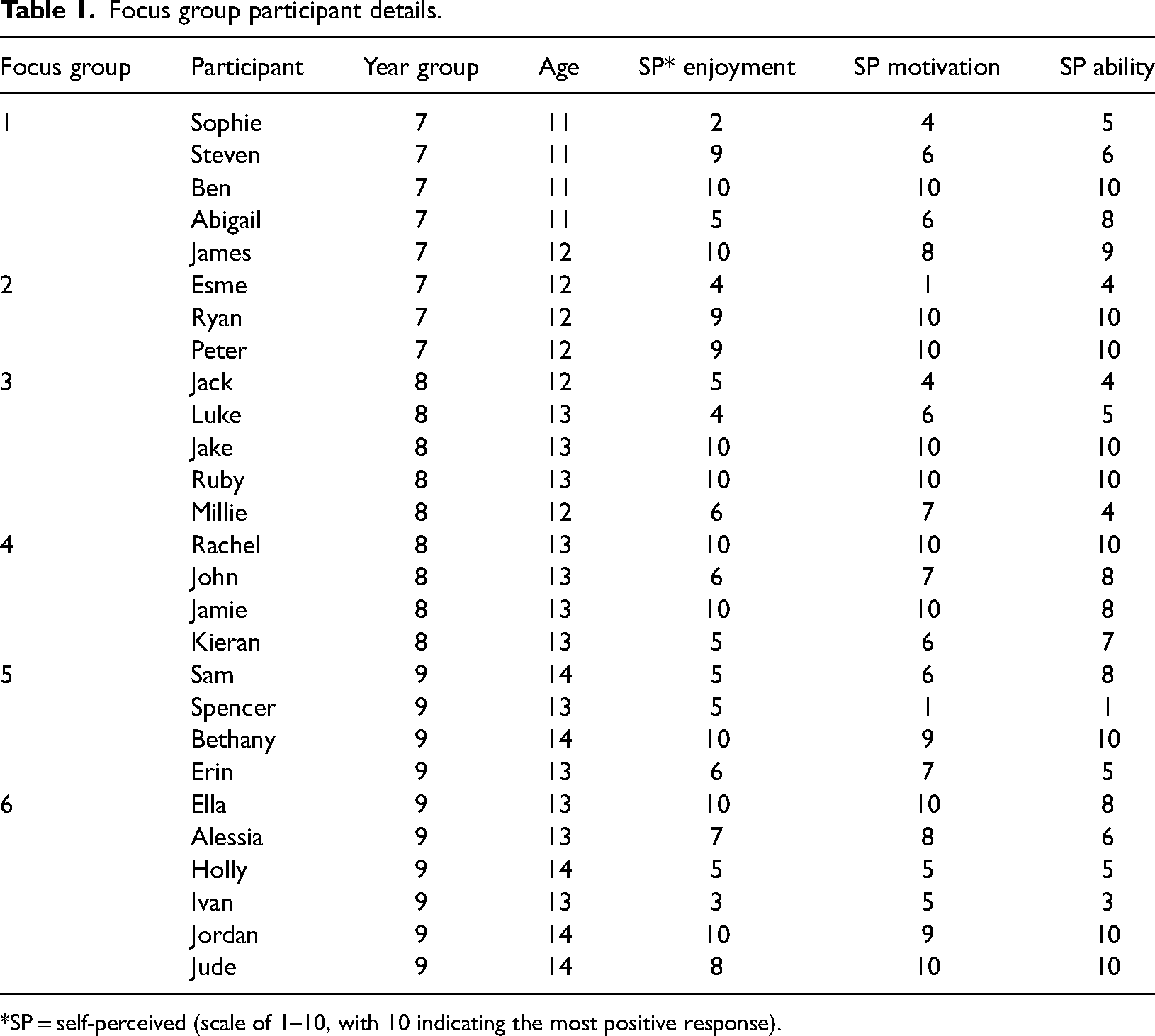
*SP = self-perceived (scale of 1–10, with 10 indicating the most positive response).
The focus groups were undertaken between October 2022 and March 2023. A quiet and private room in the school was selected to ensure confidential conversations could take place, in addition to providing a familiar location for the students to reduce potential anxiety (Ennis and Chen, 2012). The focus groups were purposely designed to last between 20 and 30 minutes to ensure students maintained engagement with the discussion (Gibson, 2007). A semi-structured format was followed, permitting flexibility and adaptability in questioning. The interview schedule was collectively created amongst the research team and was informed by previous research in the area, with a focus on experiences and views on the purpose of PE, likes and dislikes, and what students would keep or change in the subject. The questions were purposefully broad, and intended to be adapted to each focus group, the context of it and the ‘flow’ of the group conversation. Examples of questions used to guide the discussions include: Why do you think you do PE? Do you have a favourite part of PE? Is there anything you don’t like about PE? Imagine you were in charge, would you change anything about PE?
To begin each focus group, the moderator took time to introduce himself and set expectations for the discussion (mainly to not talk over each other and let everyone have a say). He also provided name badges to the students, asking them to share their name with the group to foster a friendly environment. The students were reminded at this point they could withdraw should they change their minds about participation. Autonomy was encouraged by providing children with the option to sit on chairs, on the floor, or to stand. The focus group was purposely organised so that the children and moderator were positioned in a circle to reduce student–researcher power differences, in an attempt to create a non-authoritarian climate (Gibson, 2007). In acknowledgement of the inherent power imbalances in an adult facilitating a children's focus group, as well as the power imbalances within educational settings, it was made explicitly clear that the moderator was not a teacher and that this was not a test with right or wrong answers; rather, it was a safe space to express their own opinions freely (Morgan et al., 2002). There were no teachers present during the focus groups, as we deemed this may impact the students' willingness to speak freely. The moderator also played an active role in controlling the discussions to ensure all students had equal opportunity to contribute and engage.
The focus groups lasted between 20 and 35 minutes (averaging 25 minutes) and were transcribed verbatim for analysis. Our analytical approach was an iterative and evolving process over time. Firstly, the lead author, Berkshire (MB), conducted a thematic analysis guided by the reflexive approach outlined by Braun and Clarke (2022). The first level of analysis involved MB familiarising himself with the data and conducting the initial coding of transcripts guided by our research aims. The third author, Hardwicke (JH), and MB had regular meetings to discuss first impressions throughout this stage, with JH encouraging reflection and justifications for any initial interpretations. Following this, JH then separately familiarised himself with the data and coded it. Both authors then regularly met and worked together in a second phase of analysis whereby key empirical details that were recurrent across the data were grouped under provisional themes. These were: sport-centric PE and PE-as-sport, healthism, conception of ability in PE, reproduction of gendered norms, lack of choice and autonomy.
JH then engaged in a cyclical process of moving between the data, initial tentative interpretations and established academic ideas to develop an analysis which was honest to the data, coherent and plausible. Of course, his theoretical background within sociology will have shaped the interpretations and sensitising concepts drawn on. Taking the provisional themes, he revisited literature on student views of PE, the purpose of PE, student experiences, competitive sport in PE and the sociology of sport. Following this, two themes to structure the findings were developed: (1) the continuity of PE-as-sport and (2) meaning-making and experiences within PE-as-sport. This process was refined through continuous dialogue between the first and last authors, revisiting the data and the editing of this paper. The second author (JM) acted as a ‘critical friend’ (Smith and McGannon, 2018) throughout by reviewing the process and offering any alternative perspectives on the data, as well as encouraging the first and last authors to confront their positionality, theoretical assumptions and use of concepts to interpret the data. What follows is the product of this systematic and evolving analysis, which provides empirical insights into how students understood the purpose and meaning of PE.
Findings and discussion
The continuity of PE-as-sport
As foregrounded in our literature review, the PE curriculum in England has been suggested to be closely tied to competitive sport and performance-oriented fitness (Harris and Legget, 2015). The dominance of sport and health discourses in PE more broadly has been well documented (McEvilly et al., 2014), with competitive sports being a central feature of English PE (Herold, 2020; Kirk, 2010; Stidder, 2022). Within this context, it becomes apparent why the students discussed the purpose of PE around narrow conceptions tied to ideas connected to sport. Jake, for example, described the purpose of PE as learning ‘about all the different types of sports’ and Alessia suggested that ‘once you finish you should be able to say that you learnt about your favorite sport in school’. For Jamie, the purpose was, ‘to help other students like, for example, if they don't know how to play football, it might teach them how to play football and get them interested in football’.
Our findings resonate with Jones and Cheetham's (2001) study, whereby students viewed the primary purpose of PE to be participation in sport. Expanding on this, many of the children discussed the purpose of PE as preparing students for roles in sport, including professional sport, beyond school: Because you need to learn how to do things in sport so that maybe one day you can become professional in some sports and you can make a lot of money from that (Ryan) PE can help someone become professional and make loads of money? (Peter) So like, when you're older, like trying to get a job and like, you can't really think, like, if you're good at a sport, you could try like play for a team? And become like, really good at it? (Esme) I think that we do PE to like keep our bodies healthy so that we can get used to doing more sports (Ruby) Think so you get some knowledge about all the different sports and so you can get some knowledge about like your body, like your muscles and stuff like that (Jake)
Taken together, the secondary school students spoken to in this research reflected dominant sport discourses and thus they largely constructed the purpose of PE as doing and learning about sport. This was combined with a secondary understanding that the purpose of PE was related to health, and sport was understood as a vehicle to achieve positive health outcomes. Given that research highlights the dominance of such beliefs among university PE students (McEvilly, 2022), PE teachers (Ferry and McCaughtry, 2013), within PE policy and curricula (Herold, 2020; Kirk, 2019; McEvilly et al., 2014) and within a wider Western culture (Safai, 2022), such findings were perhaps predictable. With this dominant view on the purpose of PE highlighted, we next consider the students’ meaning-making based on their experiences within the subject.
Meaning-making and experiences within PE-as-sport
Perhaps unsurprisingly, students who expressed enjoyment of PE, with high levels of self-perceived ability and motivation, also talked passionately about sport and often engaged in sport outside of school. For example, Ryan suggested, ‘So basically, I really like PE because I enjoy sports a lot’ and, for Bethany, PE was her favourite subject because of ‘the sports’. However, those students who did not enjoy sport and had lower self-perceived ability in PE were not so positive about the subject, with Esme sharing she was not a ‘massive fan of PE’ and Spencer and Erin having ‘mixed feelings’. Among the students we spoke to, positive experiences of PE came mostly from students who enjoyed and participated in sport.
PE is a subject in which the ‘body’ is centred, and young people are socialised into ideas around ‘valued bodies’ (Aartun et al., 2022). As the students mostly understood the purpose of PE through sport, ability and ‘valued bodies’ were broadly connected to sporting performance, which shaped their experiences of the subject, and resonates with previous research (Hunter, 2004). Luke, for example, suggested: Sometimes like the really bad players get put in a group with like the good players or like, I'm bad at football, and I usually get put with like, really good people. And when I mess up, they always get mad at me. The kind of sets like this, higher girls and a higher boys set, it might put like the lower set people's mental health and self-esteem a bit lower. So I feel like they're being put down and like shunned because they're not as good at a sport. I really don't like it in gymnastics and you know how you have to perform? Your teacher like points out the person that has to do it. And then you have a feeling that you have to do it now, because I have this thing. I don't know if it's stage fright, or anything like that. When we do a performance, everyone's watching me, and I really don't like it. I feel like you're going to hurt yourself or something like that in PE because you fall over, you get muddy and things like that. I know you have to keep strong, but when you actually feel pain, like you keep falling over and you don't feel like doing it, I think you should have a break. Sometimes when you have a stitch and you tell your teachers, they are like ‘you need to keep doing this so you get good at PE’, and you're like ‘but I feel hurt, Miss, and I've got stitches everywhere’. It's just, ‘no, I want you to carry on, I want you to be strong’. But that upsets me because I feel pain and I want to rest.
Research has shown the benefits of students having choice and active involvement in shaping their PE experience (Cardiff et al., 2023; Domville et al., 2019; Lewis, 2014). However, the students we spoke to regularly mentioned having a lack of choice and expressed a desire for greater involvement. For example, Abigail suggested, ‘I would want more of a choice yeah, so teachers don't really boss you about all the time’. Similarly, Alessia suggested, ‘I don’t think we really get much choice. I felt like we couldn't even ask to like, change this, like the activity we're doing you kind of just have to stick to it. And we have to do it’.
This lack of choice was frequently related to impacts on student enjoyment and students feeling that they had ‘to do what the teacher says and not complain about it’ (Esme). Some of the students were critical of the way PE was delivered and the focus on learning sports in a structured manner: I think that if we had like longer PE lessons or more time that we should do more than one activity each lesson instead of just focusing on one sport because sometimes it can get quite boring, if you're just doing the same thing like every lesson (Rachel) I will say that you should let like the students take a variety of sports that they actually like, would like to do, instead of getting them to do something that they don't like doing (Millie) I would change how there's, like, most of the sports are like ballgames and they don't do many other things like life skills, or anything like that (Ryan)
Scholars have suggested that ‘ability’ in PE is not neutral, but coded as masculine by being associated with the capability to perform in competitive sports structured around strength, power and speed (Wright and Burrows, 2006). This is perhaps reflected in boys often ranking PE higher than girls in terms of enjoyment, and boys tending to engage in higher levels of activity during classes (Walseth et al., 2018).
With that in mind, it is perhaps not surprising that the girls in our study recurrently brought up the influence of gender on their PE experience. The girls more readily highlighted the gendering of the PE curriculum with regard to the activities offered. For example, Bethany stated: I know what I would change, not like a particular sport. But like, there's designated sports for like, males and females. Like, I feel that should be changed, right? Boys do a lot more like basketball and volleyball and cricket and stuff like that. Well, girls do more like dance and Zumba and all that stuff. I agree, they've made it more like, for dance and stuff, like that to be feminine. So girls have to do that, yeah. But then in the mixed group because there's more boys in the mix, they do what boys want to do.
The reproduction of gendered norms within PE was also present around the discussions of uniform. Alessia commented, ‘With the uniform thing, it's always like skorts or shorts, we don't really have any other choice. So when it's winter, we all get really cold and then we moan about it and teachers moan at us for it’. Millie also commented on this: I think also like the PE kit as well, like they tell you off when you don’t have the proper equipment like kit. But I think you should have something that you feel comfortable in instead of a skort or shorts. And I think you should be allowed like leggings and stuff like that, but they don’t allow leggings.
This section has provided an overview of the students' meaning-making based on their experiences of PE. Students who enjoyed sport and were ‘good’ at it reported the most positive experiences and feelings towards the subject. Connecting to the students’ views on the purpose of PE being to learn and do sport, we found that they constructed ideas around ability in PE being equated to ability to perform in sporting settings. This was coupled with discussions of the competitive and performance-focused environment, which led to some having negative experiences. Resonating with previous research (Gray et al., 2018; Hemingway et al., 2023; Lewis, 2014), we found that the students expressed a desire for greater choice over their PE experience, with some being critical of the sport-centric focus. Finally, we highlighted how PE-as-sport reproduced gendered norms and outlined some potential issues associated with this.
Concluding comments
This research has provided some empirical insights into young people's accounts of the purpose and meaning of compulsory PE from one state secondary school in the Midlands, England. Of course, we place reservations on generalising our findings to all state secondary schools in England. Further research across a range of schools is required to build a clearer picture of the topics covered in this paper. Notwithstanding this limitation, this work makes important contributions to the broader PE literature and to the specific English context.
From our findings, we show how the dominance of sport discourses amongst PE teachers (Ferry and McCaughtry, 2013), aspiring teachers (McEvilly, 2022) and across curricula (Herold, 2020; McEvilly et al., 2014) appears to have been reproduced in how the students understood the purpose of PE. This influenced the students' meaning-making based on their experiences, as the PE space was shaped around underlying ideas tied to sport, which led to ability in PE being equated to sporting ability, the reproduction of gendered norms and a lack of choice and autonomy over the PE experience.
We contend that, for PE to move towards being inclusive, relevant, accessible, and enjoyable for all, the value, purpose, and meaning of PE must continue to be questioned. A sporting curriculum taught by PE teachers who often have an affinity with sport will continue to talk only to students who enjoy and excel in sport. A more critical stance and consideration of PE-as-sport could help shifts in practice towards more holistic teaching of the subject which may benefit a wider range of students and serve broader purposes.
Without such a shift, history will likely continue to repeat itself, whereby PE is taught by ‘true believers’ of its (sport's) value (Green, 2008), which will continue to serve children who enjoy and excel in competitive sport. Moreover, the growing work outlining the need for greater student voice and choice in PE is welcome (Cardiff et al., 2023; El-Sherif, 2014; O'Sullivan and MacPhail, 2010), and our findings support student desire for this. However, if there is not a meaningful shift away from PE being structured around competitive sport, then there are limits to the agency of students having choice beyond traditional sporting activities. If PE-as-sport continues to dominate, the subject will likely distance itself from contemporary youth, culture which research suggests is turning away from competitive sports and towards informal lifestyle sports (O’Connor and Penney, 2021), and increasingly rejecting the achievement culture associated with traditional competitive sport (Gilchrist and Wheaton, 2017).
We acknowledge this is a somewhat pessimistic outlook on the subject and there is, of course, much nuance and changes in practice occurring across the PE landscape in England. Yet, our findings add to the historical and contemporary literature which continues to highlight the obdurate nature of PE-as-sport. There are structural (e.g. curriculum, policy, outsourcing and funding) and cultural (e.g. school cultures, teacher socialisation, and common-sense assumptions around sport) constraints which present significant barriers to challenging the dominance of PE-as-sport. We do not outline clear ‘practical’ recommendations for change, as it is not an easy fix, but instead suggest a continued focus on scrutinising the role of sport in PE amongst practitioners and researchers. More critical questioning about who PE-as-sport benefits is a good starting point for future research and critical inquiries.
In light of the data we present, it appears there is continuity of PE-as-sport and that the subject narrowly educates students on the codes and ethos of traditional performance-oriented sports. Our findings are salient when considered against the extant literature showing the problems with PE-as-sport, such as the marginalising of girls (Fagrell et al., 2012; Wrench and Garrett, 2017), exclusion of those who identify outside of a gender binary (Drury et al., 2023), sustaining of ableism (Evans and Penney, 2008), compulsion of boys into contact sports with high injury rates (White et al., 2022), reproduction of the sport-health ideology (Waddington et al., 1997) and encouragement of competition over participation and enjoyment (Herold, 2020). Whilst it is not within the scope of this paper to outline what ought to be the dominant discourses in PE, we do highlight that competitive sport appears to continue to reign supreme. As Kirk (2010: 1) reminds us, ‘physical education is defined by what is said, done and written in its name’. In that regard, we suggest greater efforts may need to be placed into saying, doing, and writing about PE in ways that move beyond traditional performance-oriented sport if we wish to help all children ‘lead healthy, active lives’, as set out in the NCPE (Department for Education, 2023: 1).
Footnotes
Acknowledgements
We would like to extend our gratitude to the school that helped in supporting and facilitating this research, and to the children and young people that engaged and shared their experiences. We would also like to thank the two reviewers and the editor for their support and help in making this a much stronger paper.
Declaration of conflicting interests
The authors declared no potential conflicts of interest with respect to the research, authorship, and/or publication of this article.
Funding
The authors received no financial support for the research, authorship, and/or publication of this article.
