



Abstract
The period from 2013 to 2019 was one of relative continuity in policies for physical education (PE), school sport and physical activity (PESSPA) in England. Starting from the advent of the government’s flagship PE and Sport Premium (PES Premium) initiative in 2013, the end of the period was reached 20 with renewed uncertainty in 2020 about the future of PESSPA policy. It is therefore an appropriate point for this article to ‘take stock’ of PESSPA policies and their consequences since 2013. The political science literature on policy design underpins the approach to considering the mix of both policy goals and those instruments used by governments to achieve them. To do so, a comprehensive set of policy documents, published reports, academic literature and empirical research on schools’ use of the PES Premium was interrogated. Policy goals articulated by government since 2013 reinforced, rather than resolved, long-standing debates about the purpose of PESSPA. Health-related objectives rose in prominence, but sat uneasily alongside continued commitments to competitive sport. Only a narrow range of the policy instruments available to governments were used in pursuit of their policy goals. PES Premium funding was solely distributed to primary schools, with limited use of regulation and information systems to shape PESSPA provision. These aspects of policy design contributed to increasing reliance on external coaches in primary schools and indicators of a decline in secondary school provision and participation, resonant of prioritisation of short-term approaches over longer-term strategic development. Possibilities for improving future PESSPA policies are considered as a result.
Introduction
Policy for physical education (PE), school sport and physical activity (PESSPA) in England was characterised by a large degree of continuity and historically high levels of central government funding from 2013. Although the first three years after the 2010 election of the Conservative-led coalition government were marked by uncertainty in PESSPA policy (Lindsey, 2020), the announcement of new ‘PE and Sport Premium’ (PES Premium) funding for primary schools in 2013 marked an important turning point. Since its introduction, over £1.5 billion was committed to the PES Premium over the seven years until 2020 by both the coalition and subsequent single-party Conservative governments (Lindsey, 2020). This scale of funding has placed the PES Premium as the centrepiece, but not the sole component, of contemporary PESSPA policy. Other PESSPA policy initiatives (e.g. Sport England’s (2018) ‘Secondary Teacher Training Programme’) were also announced through this period and, prior to the most recent UK election, a cross-governmental ‘School Sport and Activity Action Plan’ (Department for Education, Department for Digital, Culture, Media and Sport, and Department of Health and Social Care, 2019) was published in July 2019. With the election of a new Conservative government in December 2019 and with uncertainty as to the future of the PES Premium beyond the 2019/2020 academic year, this is an appropriate point to take stock of Conservative-led PESSPA policy over the seven years since 2013.
Over this period, a variety of academic and non-academic publications have scrutinised English PESSPA policy and its consequences. Reports on PESSPA and related health issues were published by government agencies (e.g. Office for Standards in Education, Children’s Services and Skills, 2014, 2018) and other parliamentary bodies (All Party Parliamentary Group for a Fit and Healthy Childhood, 2016, 2019; House of Commons Education Committee, 2013). Such reports were written for different, and in some cases political, purposes and have drawn on various forms and sources of information. Specific, if relatively small scale, data have also been collected and published on the PES Premium by both the government itself (Department for Education, 2015, 2019) and by the authors on behalf of the Sport and Recreation Alliance (2019), with the Youth Sport Trust (2018) also publishing results from a survey of secondary school PE provision. Academically, the first author has published in-depth research on the political factors that have shaped PESSPA policy over the period of Conservative-led governments (Lindsey, 2020). Analyses of how primary schools have spent their ringfenced allocations of PES Premium funding have also been undertaken (Griggs, 2016; Meir and Fletcher, 2020), although these studies have focused data collection on specific geographical locations and school years. Other relevant academic literature has valuably and specifically considered issues associated with the leadership, staffing and delivery of primary school PE (Griggs and Randall, 2019; Jones and Green, 2017).
These sources of information enable valuable consideration of PESSPA policy issues since 2013, but are individually and collectively limited in a number of ways. Most publications focus on a particular aspect of PESPPA policy, most commonly the PES Premium, and specific types or samples of schools, often primary schools. Those studies with a specific research design have collected cross-sectional data which, without comparison, limits the findings of individual studies to a snapshot of the consequences of PESSPA policy. The specific focus and timing of different publications means that none offer an overarching analysis of PESSPA policy across an important period of Conservative-led government. This article seeks to fill this gap in the existing literature.
In aiming to ‘take stock’ of PESSPA policies and their implications over the period 2013 to 2019, the article is underpinned by a novel utilisation of key concepts from ‘policy design’ literature. Authors from that literature (e.g. del Rio and Howlett, 2013) emphasise that such an analysis requires, and has involved, considering the design of PESSPA policy in a broad sense, encompassing ‘attempts to define policy goals and connect them to instruments or tools expected to realise those objectives’ (Howlett et al., 2015: 291). The specificities of the approach undertaken to analyse PESSPA policy are set out in the next section, which is followed subsequently by sections that consider PESSPA policy goals, the governmental instruments utilised to realise these goals, and their implications for PESSPA in schools in turn. The article concludes by providing an overarching appraisal of PESSPA policy design over the period from 2013 to 2019 and considering different possibilities for bringing about improvements in future policies.
Undertaking policy design analysis
Conceptualisations of policy design have been valuably utilised in a variety of other fields (Howlett et al., 2015) but have rarely, if ever, been explicitly utilised in analyses of policies for PE or sport. The absence of such analyses in the fields of PE and sport is despite the early emergence, in the 1970s, of wider frameworks for examining and differentiating between ‘policy instruments’ that may be utilised to achieve policy goals. While some of these frameworks remain relevant, policy design research has broadly developed over time to consider and evaluate ‘policy mixes’, that is the ‘(complex) combination of multiple policy instruments that serve a single or multiple goals’ (Bouma et al., 2019: 34). The recognition of the complexity of contemporary policy designs has led to researchers giving further conceptual and empirical attention to the extent of coherence or contradiction across multiple policy goals, between policy goals and the policy instruments utilised to achieve them, and arising from the concurrent use of different policy instruments (Howlett and Rayner, 2013). Policy design research may also be considered as being more comprehensive when studies encompass analysis of decisions not to pursue particular goals and under-utilisation of specific policy instruments as well as any unintended consequences of overall policy design (Öberg et al., 2014).
This literature, therefore, identifies the importance of considering both policy goals and the instruments utilised to achieve them as separate, but connected, aspects of policy design (Bouma et al., 2019). As policy goals tend to be specific to particular sectors (such as PESSPA), common conceptual tools to analyse them have not been developed within the literature. Bouma et al. (2019) also recognise that choices of policy goals are inherently political, which militates against identifying optimal approaches to their design even if identification of synergies or conflicts between multiple policy goals remains possible. On the other hand, different frameworks are available for analysing and differentiating policy instruments. For the purposes of analysis in this paper, particular use is made of Hood’s (1996) seminal categorisation of policy instruments, given that it continues to be a key reference cited by leading authors in the policy design field (Capano and Howlett, 2020). Hood’s (1996) categorisation utilised, or co-opted, the acronym ‘NATO’ to distinguish between four types of policy instruments: Nodality, Authority, Treasure and Organisation. In this categorisation, nodality policy instruments relate to governments’ potential for influence through utilising their central position in collating, using and disseminating information. Authority refers to governments’ capacities to make laws and regulations, as well as to enforce them through the use of sanctions. Treasure represents the function and capacity of government to raise and disburse funding in different ways. Finally, governments can create, shape and mobilise different organisations and networks of organisations through which implementation of policy may be enacted.
The theoretical contributions summarised here underpin the analysis of PESSPA policy that represents the core of the article. This analysis is itself based on interrogation of an array of different sources of information. In the first instance, publicly available documents represent key references on PESSPA policy and its implications over the period 2013 to 2019. Briefing papers on PESSPA produced at regular intervals by the House of Commons Library (2014, 2017, 2019) provided summaries of government policy, but were particularly useful for identifying other published documents and evidence from parliament, government and other external bodies. Comprehensive identification of government policy documents related to PESSPA also benefitted from accessing those identified from systematic searching in two preceding studies on obesity-related policies relevant to schools and policy making processes for PESSPA respectively (Chapman et al., 2020; Lindsey, 2020). Full examination of all identified documents was undertaken to give confidence that the main features of PESSPA policy design were identified in the article. Interviews previously undertaken by the first author (Lindsey, 2020; Sport and Recreation Alliance, 2019) from 2017 to 2019 with a variety of stakeholders involved with PESSPA policy making and implementation were also re-interrogated for any additional insights associated with policy design.
A further significant source for understanding the implications of PESSPA policy design was data on primary schools’ spending of the PES Premium that were collected by the authors for research that was funded and published by the Sport and Recreation Alliance (2019). These data were compiled from PES Premium spending reports for 2017/2018 that every primary school was required to publish on their website. The sample comprised 423 schools, selected to be representative of all primary schools in England in respect of: maintained or academy status; urban or rural location; small (up to 149 pupils), medium (150 to 299 pupils), large (300+ pupils) size; and the proportion of pupils qualifying for free school meals. Specific results presented in this article are taken directly from the full report (Sport and Recreation Alliance, 2019), and are complemented by findings from similar studies (Griggs, 2016; Meir and Fletcher, 2020) and by the latest PES Premium evaluation commissioned by the Department for Education (2019). Although limited sample sizes in all these quantitative studies mean that individually their results should be interpreted with caution, commonalities in findings that are recognised subsequently in the article give reassurance of validity of key implications. Insights from other relevant research studies and those documentary sources identified earlier are also integrated to enhance the discussion throughout the following sections.
What are the policy goals for PESSPA? Limitations of clarity and coherence in the policy mix
Debates about appropriate policy goals, and the mix of differing goals, for PESSPA are long-standing and well-represented in academic literature (e.g. Carse et al., 2018; Kirk and Gorely, 2000; Ní Chróinín et al., 2020). Educational outcomes that some consider to be fundamental to the purpose of PE sit, often uncomfortably, alongside aspirations that schools should serve as an initial environment for the identification and development of young people with potential to achieve competitive sporting success (Jung et al., 2016). Further, as an object of government policy, PESSPA has long been instrumentally positioned by its potential contribution to a wide range of social and welfare policy agendas, including health, social cohesion and economic advancement (Green, 2007).
Classifying the contemporary mix of PESSPA policy goals is not necessarily straightforward, and previous research on PESSPA policy (e.g. Houlihan, 2000; Houlihan and Green, 2006) demonstrates the importance of considering how governmental aspirations may be articulated and understood by key stakeholders and politicians, in addition to their more formal representation in specific policy documents. Reflecting on PESSPA policy since 2013, stakeholders involved in policy making processes who were previously interviewed by the first author almost all recognised a strong shift towards prioritisation of health-related objectives for PESSPA. One interviewee, for example, articulated ‘health is the big focus in town now’, with this change being partly a consequence of increasing engagement and funding for PESSPA from the Department of Health from 2011 (Lindsey, 2020). Alternatively, key government ministers also sought to advance traditional Conservative Party support for competitive sport within education policy. Setting the context for PESSPA policy from 2010 onwards, Michael Gove (2010) stated his wish was to ‘encourage more competitive sport, which should be a vibrant part of the life and ethos of all schools’. A similar call by Damien Hinds (a subsequent Secretary of State for Education) to ‘improve school sport and ensure all children have the opportunity to take part in competitive sport’ (Department for Education, 2018) is indicative of this agenda continuing to resonate within government at the end of the period covered by this article. At the overarching level of political prioritisation, therefore, this analysis suggests that increasing focus on health-related goals for PESSPA has not replaced, but continues to sit somewhat uneasily alongside, commitments to competitive sport in schools.
Given these overarching political and policy discourses, it is perhaps unsurprising that the specific objectives set for the government’s flagship policy initiative, the PES Premium, do not signify a clear or coherent representation of differing policy goals for PESSPA (All Party Parliamentary Group for a Fit and Healthy Childhood, 2019). Initial government guidance on how schools may spend the PES Premium was brief and ambiguous, and did not explicitly state any specific objectives to be achieved (Department for Education, 2013a). Five key indicators (KIs) for the PES Premium were first published in 2017 (see Figure 1) and encompass policy goals concerned with competitive sport (KI5), physical activity and health (KI1) and educational improvement through PE and sport (KI3). The indicators were representative of a universally-orientated policy agenda, encompassing ‘all pupils’ (KI1 and K4) and the capacity of ‘all staff’ (KI3), rather than specifying more fine-grained and differentiated policy goals that could, for example, target inequalities in participation within and across schools (Meir and Fletcher, 2020). There was, similarly, no specific differentiation of PE from sport with both mentioned collectively in KI2 and KI3, and ‘sport and activities’ mentioned in isolation in KI4. Arguably, the collective scope of these indicators does encompass the wide range of policy goals that have traditionally been associated with PESSPA. However, the bare specification of the indicators as the primary statement of objectives for the PES Premium does not provide a steer towards the relative prioritisation of particular policy goals or, more pertinently, a ‘joined up’ and coherent account of the mix of government policy goals for PESSPA.
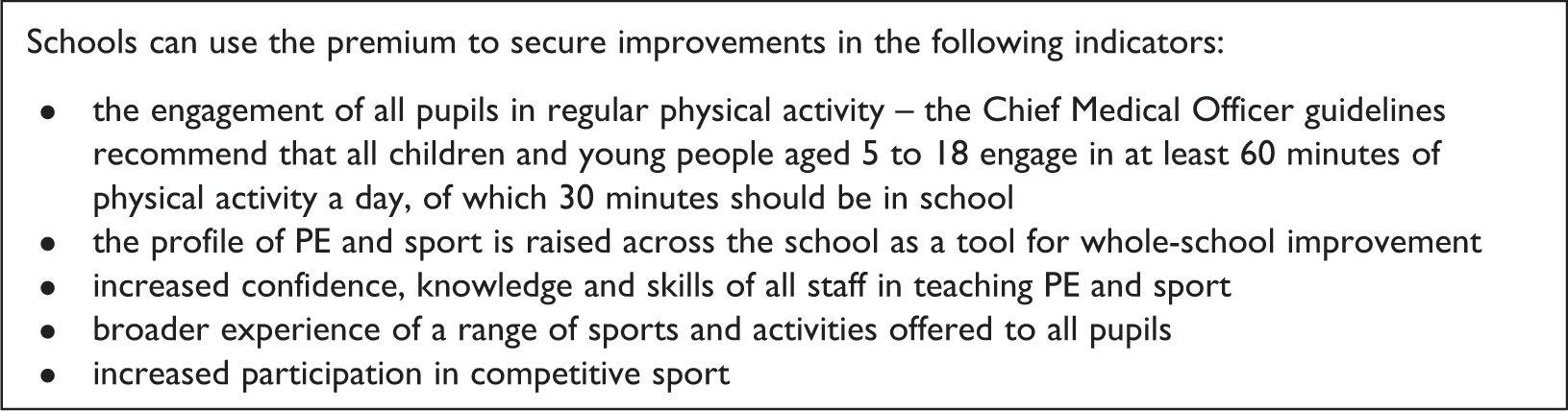
Key indicators for the PE and Sport Premium (Department for Education, 2017).
Further policy developments only added to the lack of clarity regarding overall PESSPA policy goals. The government’s publication of a new overarching sport policy document in 2015, ‘Sporting Future – A New Strategy for an Active Nation’ (Her Majesty’s Government, 2015) gave continued recognition of schools being a key site for enhancing children and young people’s participation in sport and physical activity. A specific key performance indicator in the strategy was orientated towards increasing ‘physical literacy standards’ (Her Majesty’s Government, 2015: 78), a concept that has long been considered to be relevant to PE (Whitehead, 2001) but one that was not referenced in any of the guidance for the PES Premium. ‘Sporting Future’ (Her Majesty’s Government, 2015) also highlighted concerns regarding the swimming competencies amongst children of primary school age, subsequently resulting in swimming being recognised as a potential use of PES Premium spending from 2017/2018 (Department for Education, 2017). Policy guidance directed towards secondary schools, meanwhile, remained conspicuous by its absence. PES Premium funding and objectives were directed solely at primary schools, and bar brief mention of issues across pupils’ transitions from primary to secondary in ‘Sporting Future’ (Her Majesty’s Government, 2015), no key government policy documents gave specific consideration to PESSPA in secondary schools.
The publication of the cross-departmental ‘School Sport and Activity Plan’ (Department for Education, Department for Digital, Culture, Media and Sport, and Department of Health and Social Care, 2019) did not resolve, but rather perpetuated, the lack of clarity in the mix of policy goals for PESSPA. Three overarching ‘ambitions’ were identified relating to: (a) children’s levels of physical activity; (b) ‘developmental, character-building experiences through sport, competition and active pursuits’ and (c) provision that enables both fun and physical literacy (Department for Education, Department for Digital, Culture, Media and Sport, and Department of Health and Social Care, 2019: 8). The most notableidentified in the following section aspect of these ‘ambitions’, and the title of the plan itself, was the lack of specific mention of PE alongside references to priorities for school sport and physical activity. The appearance of somewhat vague references to developing ‘high quality, modern PE’ (italics added) sat alongside those supporting ‘competition as a key element of sport’ (Department for Education, Department for Digital, Culture, Media and Sport, and Department of Health and Social Care, 2019: 20) and others that did not differentiate ‘PE and sport’. While an overarching interpretation of the ‘Action Plan’ could still infer health-related objectives as being central, a clear articulation of the mix of government policy goals remained missing.
The key conclusion of analysis presented across this section is that successive Conservative-led governments pursued a broad set of PESSPA policy goals from 2013, but without clear articulation or coherence as to the mix of these goals. It should be reiterated that this is not necessarily a new problem, especially since PESSPA has long been a ‘crowded policy space’ (Houlihan, 2000) in which the range of policy ‘actors’ who seek to shape policy goals in different ways has, if anything, increased (Lindsey, 2020). Nevertheless, what the analysis also demonstrates is that policy design and goal setting has continued through a process of ‘layering’ since 2013 through which new ‘objectives have been piled on top of older ones, creating a palimpsest-like mixture of inconsistent and incoherent policy elements’ (del Rio and Howlett, 2013: 4). These concerns with the ensemble of policy goals for PESSPA should also be considered in light of the limitations of governments’ use of policy instruments to steer implementation, as identified in the following section.
How to make it happen? Government’s narrow use of potential policy instruments
Policy instruments represent ‘techniques of governance which, one way or another, involve the utilization of state resources, or their conscious limitation, in order to achieve policy goals’ (Howlett and Rayner, 2007: 2). As explained earlier, Hood’s (1996) ‘NATO’ categorisation of policy instruments is used to support and structure the following account of the policy instruments enacted in the PESSPA field since 2013. The order in which policy instruments are considered is adapted through this section so as to commence with treasure and organisation as the most significantly utilised PESSPA policy instruments, followed by consideration of nodality and authority instruments.
The importance of treasure as a governmental policy instrument merits particular emphasis given the extent of governmental funding that was specifically allocated to PESSPA since 2013. Figure 2 indicates that, after cuts that immediately followed the election of the Conservative-led government in 2010, PESSPA funding returned to historically high levels. Lindsey (2020) has previously explained the political processes that led to funding increases, first in 2013 and then through the Soft Drinks Industry Levy (commonly known as the Sugar Tax) in 2017. Of specific relevance here is the particular approach by which Conservative-led governments directed the allocation and distribution of this funding over time. This approach has seen the allocation of some comparatively small sums of funding at particular times, including between £18 million and £22 million annually for the ‘School Games’ (Department for Culture, Media and Sport, 2016) and £13.5 million for a secondary school PE teacher training programme underwritten by Sport England (2018). Further commitments, of £2 million for co-ordination of PE teacher training and £400,000 to encourage volunteering amongst young people, were also proposed in the ‘School Sport and Activity Action Plan’. Nevertheless, the initial £160 million annual allocation to the PES Premium from 2013–2014, and the doubling of this funding from 2017–2018, continued to represent by far the largest proportion of the government’s overall funding for PESSPA.
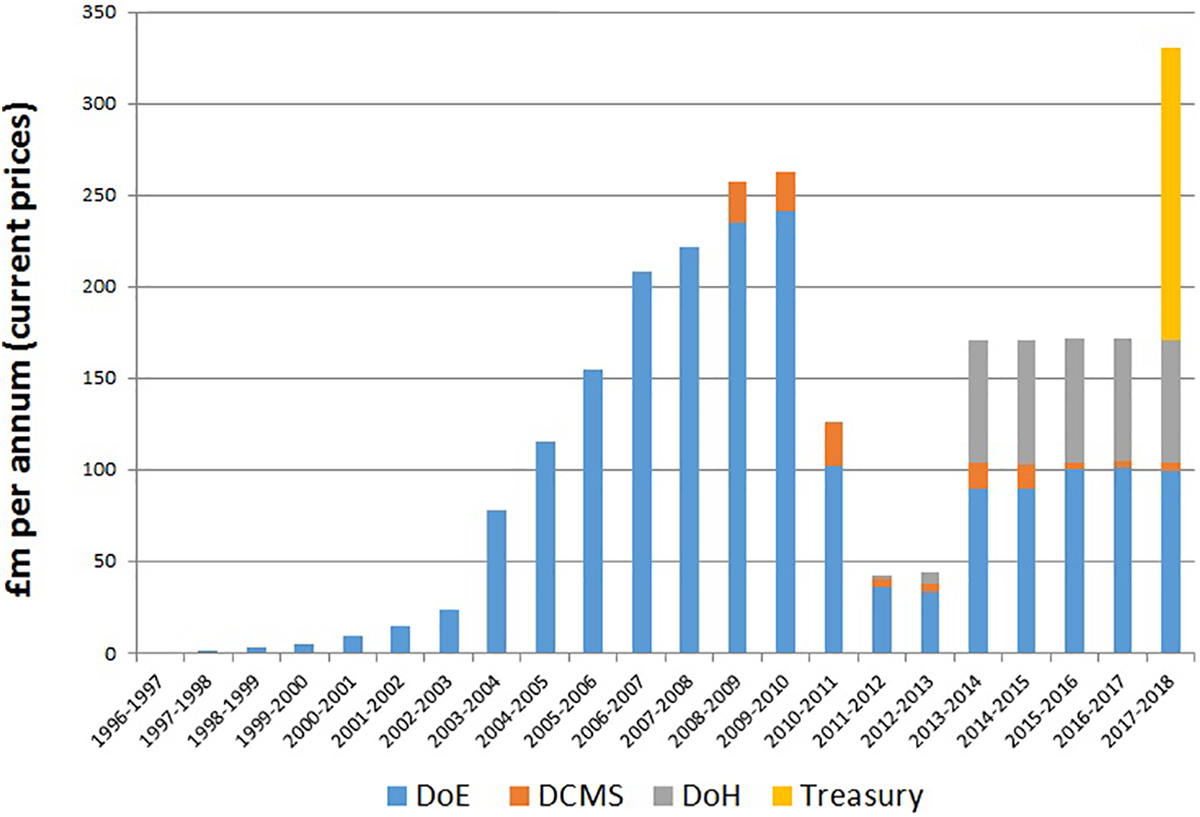
Specifically-allocated exchequer funding for physical education and school sport. Source: Lindsey (2020). © www.tandfonline.com.
This scale of funding for the PES Premium makes analysis of government approaches to its distribution particularly worthy of attention, especially as such funding distribution mechanisms can be a key factor in the influence of treasure as a policy instrument. In this regard, the PES Premium represents a universal but relatively simplistic approach to distributing funding. Allocations are provided to all state-funded primary and special schools based on a standardised formula. Baseline funding for every school with more than 16 pupils was initially £8,000 per annum until 2016/2017 and became £16,000 per annum after the Soft Drinks Industry Levy was introduced in 2017/2018. An additional and smaller proportion of each school’s annual funding was based on their number of enrolled pupils. Arguably, this approach could be seen to provide for a straightforward and equitable funding distribution. On the other hand, the distribution took no account of potentially different degrees of need within primary schools or of the existing inequalities in PESSPA participation between, for example, genders and different socio-economic groups that are evidenced in Sport England’s (2018) national ‘Active Lives Children and Young People Survey: Academic Year 2017/18’.
Linked to the orientation of the PES Premium, primary schools were both the focus of PESSPA policy and also the principal type of organisation directly charged by the government with delivering policy. Focusing PES Premium resources towards primary schools was initially relatively uncontroversial given widely recognised limitations in their capacity and provision of PESSPA (Lindsey, 2020). Nevertheless, the influence of broader Conservative education policy and its ideological orientation can also be identified in the design of the PES Premium. In this regard, Michael Gove’s tenure (2010–2014) as Secretary of State for Education was marked by strong rhetorical commitment to decentralising of decision-making to school leaders (Allen, 2015), reflected in the government’s decision to devolve sole responsibility for spending of the PES Premium to individual primary schools.
The decision to prioritise primary schools as individual organisations did, however, represent a narrow approach to policy instrument design which could potentially have encompassed a broader organisational component. Instead, PESSPA policies gave little attention to the potential roles that may be enacted by other types of organisations in policy implementation. Most notably, secondary schools were accorded limited consideration in governmental PESSPA policy discourses after 2013 and, significantly, there was no replacement for the preceding Labour government’s approach of developing an overarching organisational system for delivery of PESSPA policy (see Phillpots, 2013). Mention was made in the latest ‘School Sport and Activity Action Plan’ (Department for Education, Department for Digital, Culture, Media and Sport, and Department of Health and Social Care, 2019) of primary schools being supported through new pilot ‘teaching school hubs’ and working in partnership with (largely unspecified) ‘providers’. Such developments would not, however, represent a major change towards more significant and system-wide utilisation of organisational policy instruments that could otherwise be enacted.
Governments’ use of nodality policy instruments, involving the collation and distribution of information, was also relatively limited from 2013. In comparison to the scope, scale and regularity of PESSPA evaluations undertaken under preceding Labour governments (see Lindsey and Bacon, 2016), widespread collation of information was curtailed under Conservative-led governments and focused almost solely on primary schools and their use of the PES Premium 1 . Schools were mandated by government to produce reports on their annual spending of the PES Premium. Rather than provide government with this information, the requirement to publish these spending reports on school websites was intended to represent a form of accountability to parents (Department for Education, 2013a). National collation of these reports was limited, and the rigour and use of the samples of website reports which all County Sport Partnerships 2 were required to retrieve was open to question given that processes for doing so were not made public. Further surveys of schools’ use of the PES Premium were commissioned twice by the government (Department for Education, 2015, 2019). However, each of these surveys only sought and gained voluntary responses from under 1000 schools, compared to the annual collation and comparison of returns from all schools that had been undertaken through the Labour government’s previous ‘PE and School Sport Survey’. That neither survey of the PES Premium provided specific recommendations for schools also suggests that they represented ‘procedural’ policy instruments that are recognised in policy design literature to have greater value in processes of policy making than in influencing organisations, such as schools, involved in service delivery (Howlett and Rayner, 2007).
Other publications did provide or propose further guidance for schools. The national schools inspectorate, the Office for Standards in Education, Children’s Services and Skills (Ofsted), published a range of recommendations for schools and government departments based on early inspections of 22 ‘primary schools known to be performing well in PE’ (Office for Standards in Education, Children’s Services and Skills, 2014: 4) and additional guidance on ‘What works in schools and colleges to increase physical activity?’ was published by Public Health England (2015). However, reports and case studies of schools’ provision published by the government itself (Department for Education, 2013b; Department for Education and Department for Culture, Media and Sport, 2014a, 2014b) did not provide significant steer for actions to be implemented by schools. The specific guidance for spending of the PES Premium has also lacked clarity and detail over time (Sport and Recreation Alliance, 2019), with the need to improve this information recognised in the ‘School Sport and Activity Action Plan’ which proposed to provide a ‘toolkit’ to support schools’ use of the PES Premium (Department for Education, Department for Digital, Culture, Media and Sport, and Department of Health and Social Care, 2019: 15).
The government’s use of authority policy instruments, consisting of setting and enforcing regulations, was similarly limited. Revisions made by the government to the National Curriculum for Physical Education in 2013 represented incremental change through a fusion of elements from previous guidelines (Department for Education, 2013c). Greater emphasis was given in 2013 to the development of fundamental movement skills, increasing levels of activity and fitness through PE lessons, and strengthening the emphasis on PE in primary schools. The ongoing prominence accorded to competition in the revised National Curriculum, which was rhetorically linked to a legacy from the London 2012 Olympic Games, continued the extent of obfuscation regarding overall policy goals for PE. There was, however, some contrast with previous iterations in that the 2013 National Curriculum for Physical Education was less prescriptive for schools. This change again aligned with the government’s decentralising education policies, especially as the increasing numbers of state schools that became newly designated as ‘academies’ and ‘free schools’ had discretion as to whether to teach the National Curriculum.
Alternatively, in terms of enforcement of governmental PESSPA agendas, policy documentation repeatedly cited Ofsted inspections, including changes to their framework to encompass consideration of the PES Premium spending, as an accountability mechanism (e.g. Department for Education, 2019; Prime Minister’s Office, 2013). In practice, ongoing concerns have been raised about the influence of Ofsted inspections as a PESSPA policy instrument given that there may be a number of years between school inspections and that use of the PES Premium is one issue amongst many that such inspections need to consider (All Party Parliamentary Group for a Fit and Healthy Childhood, 2019; House of Commons Education Committee, 2013). As one government civil servant explained in an interview undertaken by the first author: while they [Ofsted] still play a very important role, and while I still think they do inject that necessary level of challenge within the system, I think from our point of view we do need to look at alternative levers that we could be using or developing to encourage schools to deliver on that curriculum requirement in sports [sic].
As a summary of the analysis across this section, it is clear that use of the policy instruments available to government was limited after 2013. Large scale provision of funding was not combined with significant use of nodality or authority policy instruments, and the organisational focus of policy was largely limited to primary schools. This narrow utilisation of policy instruments stands in contrast to the breadth of PESSPA policy goals. The implications of this discrepancy will be subsequently considered in light of evidence on PESSPA provision in schools that is presented in the following section.
What has happened? Resultant implications for implementation and PESSPA provision within schools
Findings from the authors’ analysis of primary schools’ PES Premium spending reports (published in Sport and Recreation Alliance, 2019), alongside those from already published academic research and other sources of information, collectively reveal a number of key trends in schools’ implementation of PESSPA policy. Limited use of other policy instruments alongside the significant funding for the PES Premium led to prominent and significant concerns about its impact and accountability (All Party Parliamentary Group for a Fit and Healthy Childhood, 2019). The representative sampling of primary schools’ websites undertaken for the Sport and Recreation Alliance (2019) found that over a quarter (28%) did not provide any reporting of PES Premium spending in 2017/2018 by the government’s deadline for doing so, and a further 7% did not break down their spending as required. Other studies undertaken in specific geographical areas and other school years similarly showed high proportions of schools not reporting on their PES Premium spending (Griggs, 2016; Meir and Fletcher, 2020). Amongst those schools in the Sport and Recreation Alliance (2019) sample that did fulfil PES Premium reporting requirements, many examples were identified of funds being spent on other aspects of health, wellbeing and wider school provision, rather than specifically PESSPA. The government’s rationale that publishing reports of spending would allow for accountability through parental scrutiny was potentially flawed from the outset: it is questionable whether many parents would have the motivation to access and follow up upon a relatively minor component of school provision and spending (Allen, 2015). Instead, the lack of comprehensive reporting and spending compliance can be taken as a reflection of the Department for Education not undertaking and publicising their own monitoring of primary schools’ reporting as well as the absence of any enforced sanctions for non-compliance.
The governments’ counterpoint that decentralisation of decision making for the PES Premium would allow schools to prioritise locally-identified needs (Prime Minister’s Office, 2013) is only partially borne out by the available evidence. Concerns were strongly articulated that head teachers did not feel ‘confident or well prepared’ to make decisions on PES Premium spending (Office for Standards in Education, Children’s Services and Skills, 2014: 4) and that ‘many [PE subject leaders in primary schools] have never been so unqualified to offer such direction’ (Griggs and Randall, 2019: 669). Analysis of PES Premium reports undertaken by the authors did identify some variations in spending patterns with five clusters of schools distinguishable by the extent to which they concentrated spending in particular areas (such as employing staff, equipment and facilities, professional development or through local school sport partnerships) or spread their funds across these different areas (Sport and Recreation Alliance, 2019). However, further statistical analyses did not show consistent or strong trends that particular types of primary schools spent their PES Premium in similar ways (Sport and Recreation Alliance, 2019). Schools with high proportions of pupils eligible for free school meals, for example, did not demonstrate distinctive approaches to spending. These analyses align with Meir and Fletcher’s (2020) own mixed-method study of PES Premium spending in a local authority in North-West England from which they argue that insufficient prioritisation was given to ensure social inclusion in the resultant PESSPA provision.
Rather, the employment of additional and external staff is the dominant theme across all studies of PES Premium spending. Both the Sport and Recreation Alliance (2019) and Griggs’ (2016) analyses of PES Premium spending show that over 75% of schools allocated funds to employ additional staff and coaches, with the average spending on additional staff being 30.7% of schools’ overall PES Premium allocation in the nationwide sample analysed for the Sport and Recreation Alliance (2019). The governments’ own survey also reinforces and provides further details on these trends (Department for Education, 2019): 62% of schools indicated they had hired new coaches after 2017 through PES Premium funding, whereas only 14% had employed new PE staff. Moreover, the percentage of schools in which external sports coaches delivered curriculum PE increased by 11 percentage points after the doubling of the PES Premium in 2017/2018 (Department for Education, 2019). Such spending may be a pragmatic response by primary schools to the long-term lack of policy impetus to address well-recognised limitations of PE training in primary teacher education (Harris et al., 2012). However, previous research has evidenced widespread concerns regarding external coaches’ common lack of educational training and primarily sport-orientated expertise (Griggs and Randall, 2019; Jones and Green, 2017). The background of these coaches also leads to questions as to the extent to which they may support capacity building of non-specialist teachers within schools, with head teachers interviewed by Jones and Green (2017) voicing concerns about coaches’ ability to balance educational, health and sporting policy goals in their PESSPA delivery.
Moreover, at organisational and system-wide levels, the possibilities and relative ease of spending on external coaches has stimulated an ‘unseemly rush’ of commercial providers that now offer PESSPA services to schools (All Party Parliamentary Group for a Fit and Healthy Childhood, 2019: 19). Along with these commercial providers, examples of School Sport Partnerships that were instigated under the previous Labour government remain in some areas, often sustaining themselves by offering services to primary schools under Service Level Agreements. While School Sport Partnerships and commercial providers may not be found uniformly across the country, what has been institutionalised more broadly is a market-based system of external organisations providing PESSPA services to primary schools. Ultimately, the extent of dependency of primary schools on external providers raises questions about the quality and sustainability of PESSPA provision, not only while the PES Premium funding remains in place but especially if it may be discontinued.
Additional constraints on the potential for schools to utilise funding in more long-term and strategic ways came as a result of further government decisions regarding the PES Premium. Although different methods have been used in research about schools’ usage of PES Premium over time, it can be inferred from consistencies across available evidence (e.g. Department for Education, 2014, 2019; Sport and Recreation Alliance, 2019) that a high proportion of schools spent funding on their PESSPA facilities and equipment, and that this proportion increased after schools’ allocations doubled in 2017/2018 (Department for Education, 2019). Compared to other spending areas such as transport to activities or events beyond the school, enhancing facilities and equipment may be considered a more sustainable use of funds especially given that the latest Department for Education (2019) survey found 49% and 48% of primary schools reporting lack of space and lack of facilities, respectively, as constraints on PESPPA provision. Nevertheless, revisions to the Department for Education’s own PES Premium guidelines in 2018/2019 explicitly precluded such ‘capital spending’ for the first time. The government’s approach of confirming schools’ PES Premium allocations on a yearly basis and the lack of confirmation of funding beyond 2019/2020, coupled with increasing pressures on schools’ wider budgets, may also contribute to schools prioritising immediate utilisation of funding rather than long-term development of PESSPA provision. As one head teacher succinctly explained in an interview undertaken for the Sport and Recreation Alliance (2019) research: we don’t quite know how long we’re going to keep getting this money for, especially the doubled sport premium, so let’s spend it on giving our children some real lasting memories.
Conclusions
The common thread running through the preceding three sections concerns the shortcomings of PESSPA policy design and the problems that have emerged as a result. Policy design theory suggests that a complex mix of policy instruments is required in cases where multiple policy goals are prioritised (del Rio and Howlett, 2013). PESSPA is certainly such a case, with multiple policy goals being articulated and established in the period since 2013 but without clarity in the balance and links between the different agendas associated with PESSPA. Contrary to policy design theory, there was also an overreliance on treasure as the principle policy instrument utilised to achieve multiple policy goals. Utilisation of nodality and authority policy instruments was limited, with organisational instruments being narrowly focused on primary schools alone. As Howlett and Raynor (2013: 175) surmise, a poorly designed mix of policy instruments ‘may evoke contradictory responses’ and failure to achieve policy goals. The spread of a largely-unregulated array of private coaching companies delivering in schools, prioritisation being given to short-term delivery rather than long-term systematic development, and indications of declining provision in secondary schools are amongst the problematic consequences that are evident in PESSPA implementation. Irrespective of what the longer-term implications of these problems may be, PESSPA policy design across the period of Conservative-led governments is certainly resonant of what Penney (2017: 569) critiques as forms of ‘policy magic’ whereby simplistic solutions are ‘magically’ expected to address complex and entrenched problems.
It is important to emphasise that policy, especially for relatively marginal issues such as PESSPA, is not made in a vacuum. In the context of the wider austerity policies pursued by Conservative-led governments since 2010, the scale and increases in ring-fenced funding for PESSPA can be viewed as remarkable. That policy instruments were not more fully utilised is unsurprising given the commitment of Conservative-led governments to a smaller state and the decentralising ethos that has continued as a key strand of their education policies. The marketisation of external provision ‘bought in’ by schools is, similarly, entirely in line with the governments’ ideological support for increasing private sector involvement in the delivery of public services. It should, nevertheless, be recalled that the alternative top-down approach of previous PESSPA policies enacted by the Labour government was not without problems either (Phillpots and Grix, 2014). A historical perspective also reminds us that problems of reconciling different PESSPA policy goals are not new. Both previously and during the timeframe covered in this article, (small-p) politics amongst non-government PESSPA organisations have hindered the sector being able to articulate and advocate a coherent collective vision for PESSPA (Houlihan and Green, 2006; Lindsey, 2020). These represent broader political constraints which must be taken into consideration when identifying possible avenues for improving PESSPA policy into the future.
The re-election of a Conservative government in December 2019 is the most obvious, but not the only, political constraint that means that incremental improvements in current PESSPA policy are likely the best that can be realistically hoped for. Certainly, the ‘School Sport and Activity Action Plan’ published in July 2019 did not represent a change of government policy sufficient to ‘shift the dial’ on PESSPA, as proclaimed by the Minister for Sport and Civil Society of the day 3 (Davies, 2019). Ministers for Sport have historically had limited influence within government irrespective of political party (McMaster and Bairner, 2011), and theory used in the first author’s preceding analysis of PESSPA policy making would suggest that more substantive changes in policy require engagement by senior government policy makers whose attention is most often accorded to other pressing policy issues (Lindsey, 2020). Implications of earlier policies can also be hard to reverse. The fragmentation of PESSPA providers and especially the trend towards coaches and private sector organisations delivering in schools, for example, may now be sufficiently well-established that significant change would require substantial political impetus and commitment. Addressing this issue through increased regulation of external providers could, nevertheless, be beneficial. Continued advocacy for government to confirm PES Premium funding over multiple school years and a return to allowing spending on capital developments would also provide better conditions for schools to take more sustainable and planned approaches to developing their PESSPA provision.
Such changes would, however, only represent further ‘layering’ of incremental modifications onto existing policy instruments. Bouma et al. (2019) caution that developing policy in this way brings risks of creating a ‘policy mess’ rather than necessarily improving the ‘policy mix’. Given that problems highlighted in this article are intrinsically linked to the current contours of policy design, a more fundamental policy change should be an aspiration for the PESSPA sector. Significant policy change in PESSPA would be harder to work towards, with no guarantees of success, but the policy literature does recognise that ‘windows’ for rapid policy change can open unpredictably as a consequence of wider political, cultural and/or economic shocks or events (Houlihan, 2005). Whether the COVID-19 pandemic and crisis that spread in 2020 may ultimately provide such an opportunity is unknowable at the time of writing. Debates that have arisen through the COVID-19 pandemic regarding the prioritisation of physical activity and purpose of PE could conceivably link with ongoing collation of evidence on the problematic consequences of recent PESSPA policies so as to create the conditions for radical policy change (Baumgartner, 2013). However, policy windows do not tend to open for long periods of time and, as Cairney et al. (2019: 55) counsel, ‘by the time [policy makers] pay attention to a problem, it’s too late to produce a solution’. There is no lack of ideas for better futures in the PESSPA sector, but particular proposals need to reflect principles within the policy design literature by clarifying a coherent set of policy goals and identifying an appropriate mix of policy instruments to achieve them. For any policy change to occur, different stakeholders also need to come together to collectively advocate a shared vision to the government (Carse et al., 2018). Doing so would take imagination, political awareness and a greater degree of co-operation than has been the case in the English PESSPA sector for some time – this is the challenge for all who seek a different and better future for PESSPA.
Footnotes
Acknowledgements
The authors thank the two anonymous peer reviewers whose constructive comments enabled significant improvements to the article.
Declaration of conflicting interests
The author(s) declared no potential conflicts of interest with respect to the research, authorship, and/or publication of this article.
Funding
The author(s) disclosed receipt of the following financial support for the research, authorship, and/or publication of this article: Funding was received from the Sport and Recreation Alliance for some of the research presented in this article.
