



Abstract
Creative dance, that is to say, movements, with or without music, which allow participants to express ideas, thoughts, and feelings, are sometimes accompanied by a ‘there is no right or wrong way to move’ rhetoric. This may reinforce the impression among physical education teacher education (PETE) students, who often have limited experience of (creative) dance, that there is nothing to practise in creative dance and that this activity is merely directionless movement. In this paper, however, based on Aggerholm's notion of practising movements, we explore an occasion in a PETE course where a magic moment occurred, indicating that the students had practised and ‘figured out’ something that made this moment possible. The purpose of the paper is to explore the knowledge in movement that PETE students were practising as they participated in creative dance. The purpose is also to shed light on what pedagogical practice contributed to enabling such practising. Video documentation and short interviews with students in one PETE course and one continuing professional development course for physical education teachers indicate that the magic moment was made possible as the students’ practised making sense of moving in non-predetermined – creative – ways and appreciating the expressive dimension of movement. Laban's movement analysis framework seemed, along with the teachers’ knowledge of movement, to be an important element in the pedagogical practice that made the magic moment possible.
Introduction
Creative dance, sometimes also called expressive dance (Ørbæk and Engelsrud, 2021), can be described as a form of free movement occurring in education that allows pupils to express ideas, thoughts, and feelings (Bergmann, 1995; Cleland Donnelly and Faden Millar, 2019; Cone and Cone, 2012). In physical education (PE) research, creative dance is typically described as composed of undetermined and unpredictable movements (Mattsson and Larsson, 2021; Ørbæk and Engelsrud, 2020). It aligns with ‘teaching that rarely prescribes how learners should move or act and that supposes movements and actions to be produced through experimentation’ (Engdahl, 2024: 17; see also Larsson and Karlefors, 2015). It thus allows students opportunities to ‘move beyond pregiven positions and already defined possibilities’ (Engdahl et al., 2023: 620; see also Baker, 2015; Svendler Nielsen, 2006). To be able to provide students with such opportunities, future PE teachers learn to teach creative dance in PE teacher education (PETE). The vignette below, which highlights a situation in the empirical study that is the basis for the results and conclusions in this article, illustrates teaching in creative dance that ‘made a difference’ to a group of PETE students who had little or no previous experience of creative dance: A group of PETE students participate in a creative dance unit as part of their education. Initially, participation among the students looks cautious and somewhat tentative. ‘What is this going to be?’ Gradually, however, with close guidance from the teacher, they begin to ‘let go’. After a while, pairs practise ‘movement phrases’, short sequences of free movements, that they compose themselves. The students mime movements from different sports to form the phrases, which they are subsequently invited to ‘tweak’ so that the movements become almost unrecognisable. The teacher encourages the students to explore the movements. How do they feel? What do they express? Now all caution seems to be blown away. The students are focused. Creative yet systematic. They seem to practise intensely, adapting and refining the movement phrases … often in unexpected ways. After a while, when the students are tasked with presenting their movement phrases in a joint performance, a magic moment occurs, a condensed moment in which the students are engrossed in the unusual movements they are exploring. The teacher exclaims that the students have created a work of art! The students look satisfied – and a little taken by the intensity of the moment.
The literature rarely deals with quality aspects in creative dance, or what it means to know creative dance. Researchers sometimes claim that creative dance, ‘unlike other dance forms […] does not require years of training’ (Bergmann, 1995: 57) and instead assign creative dance mainly an instrumental value. It is taken as a means to enhance creativity (Neville and Makopoulou, 2021) or ‘improve students’ self-concept’, and as ‘a valuable component of an integrated curriculum’ (Bergmann, 1995: 56; see also Gilbert, 2015; Persson and Arvidsson, 2022). Yet, we believe that the PETE students in the introductory vignette discovered what it means to know creative dance. They practised knowledge in movement in a way that allowed a magic moment to happen. The purpose of this paper is to explore the knowledge in movement that the PETE students were practising. The purpose is also to shed light on what pedagogical practice contributed to enabling such practising.
Creative dance – functional and expressive movements
PETE students’ experiences of dance in general and creative dance in particular tend to be limited. Their movement experiences are mainly from competitive sports, especially ball games (Larsson, Mattsson and Ferry, 2022; McCullick et al., 2012; Ørbæk, 2018). Even in schools, children have little contact with creative dance, at least during PE lessons (Baker, 2015). If dance is at all included in the PE curriculum, it is mainly as established folk or ballroom dances, or as aerobics-like ‘workout movements’ performed to pop music (Larsson and Karlefors, 2015; Mattsson and Lundvall, 2015). Lack of experience, or lack of knowledge in what they are supposed to teach, potentially limits teachers in their teaching. Ørbæk and Engelsrud (2021) demonstrate how PETE students, when trying to teach creative dance, ‘discovered that they had embodied the “old school” tradition of teaching dance’. This tradition meant ‘[l]ecturing and standing in between the pupils, showing movements the pupils should adopt, and then evaluating whether the pupils had made the right movements’ (Ørbæk and Engelsrud, 2020: 6).
The dominance of teacher-directed instruction and narrow movement norms has been well documented in PE research (Aasland et al., 2020; Kirk, 2006; Larsson and Nyberg, 2017). A lack of knowledge of creative dance and the contrast to an otherwise strong focus in PE on teacher-directed instruction of movement practices with pre-determined movements and pre-defined meanings could be reasons behind the low confidence among PETE students when facing the prospect of teaching creative dance (MacLean, 2007; Rolfe, 2001). This means that teacher educators need to help student teachers not only learn what creative dance is about but also look beyond conventions about teaching and movement norms. Emphasising that there is no right or wrong way to move could be interpreted as a sign of teacher educators’ attempts to help student teachers unlearn certain movement norms before they work with creative dance. However, if the knowledge remains implicit, it may well be that student teachers do not believe there is anything to know at all in creative dance.
So, how can the character of the knowledge in movement in creative dance be theorised? According to Stanley (1977), movements are at the same time functional and expressive. While the functional relates to the practical task to be performed, or solved, the expressive is about how movements express meaning. ‘The functional’ and ‘the expressive’ denote dimensions of all movements, but each dimension can be foregrounded or backgrounded in practice. In most competitive sports, for example, the functional is foregrounded. ‘Right or wrong’ then relates to the result of the movement. In athletics, for example, the fastest runner wins the competition, regardless of running style or experience of running. The same goes for reasoning about motor skill testing (e.g. Magill and Anderson, 2018), where focus is on the objective functional aspects of the movements, not on the subjective expressive ones (Tidén et al., 2017). In creative dance, it is the other way around. Here, expressive dimensions of movement are foregrounded, which include feelings, moods, and atmosphere (Mattsson and Lundvall, 2015). The focus of creative dance in educational settings is on the meaning of the expression for the mover, but this does not mean that the activity constitutes a completely solitary situation. Movement expression is usually explored together with others, with participants helping each other find and explore new movements. Since PETE students have limited experience of creative dance, we surmise that they tend to habitually foreground functional dimensions of moving (cf. Gard, 2006). Thus, the students need to be introduced to how they can foreground expressive dimensions of moving. If it is creative or expressive dance that we are interested in, then, the job of the teacher is to acquaint pupils with dance skills and techniques, knowledge of dance-artistic conventions, and traditional forms and to equip them with a repertoire of abilities to perform particular movements, but always with a view to their being able eventually to act autonomously in the light of this knowledge, understanding, and skill. (Carr, 1984: 73). [The participant] has no idea what the experience is which demands expression until he [sic] has expressed it. What he wants to say is not present to him as an end towards which means have to be devised; it becomes clear to him only as the poem takes shape in his mind, or the clay in his fingers. (Collingwood, 1938, quoted in Bergmann, 1995: 160)
Here, Collingwood emphasises a non-essentialist understanding of movements. Movements are always in some sense undetermined until they materialise and get their meaning in the specific situation. To sum up, in creative dance, the expressive dimension of movements is foregrounded. This means that students need to (be able to) discover other things to practise compared to when functional dimensions of moving are foregrounded. Next, we present an elaboration of the concept of practising, which will be used in the analysis of the empirical material.
Human practising
To learn something, you need to practise. This is probably self-evident to most educators, but what does it mean to practise? According to Lehmann and Gruber, 2006: 461), practising is a ‘systematic activity with predictable stages and activities’. Perhaps it is views about practising like this that in the 1970s led the philosopher Bollnow to argue that ‘practising has been misunderstood and discredited as a necessary evil, an annoying component of learning, that serves to discipline and prepare for other things but has no meaning and value in itself’ (Bollnow cited in Aggerholm, 2020: 118). The goal of practising is improvement in some respect, but there are many different things and ways to practise. We have mainly been inspired by Aggerholm's work on practising movements (Aggerhom, 2020; Aggerholm et al., 2018). Aggerholm et al. (2018: 201) start from the overall idea that practising can ‘be described as the form of activity in which we seek to improve our capabilities through repeated efforts’. It involves some features that, taken together, indicate that practising is going on:
Agency: ‘Practising is an active pursuit of qualitative self-transformation, the awareness of which can be both implicit and explicit’ (Aggerholm et al., 2018: 201). ‘Qualitative self-transformation’ indicates that practising is linked to changing the person, not just a technical aspect, for example, a person's isolated performance of a movement. Content: Practising is always ‘practising of something’ (Aggerholm et al., 2018: 201). There is thus no practising ‘in general’. One challenge for learners in educational contexts may be to perceive what the content is among many possible alternatives, which means they may need help from a teacher to perceive it. Goal: ‘Practising is […] a goal-oriented activity; it is always a process of practising towards something […] The goal of practising is ambiguously positioned somewhere between being internal and external to the activity’ (Aggerholm et al., 2018: 201–202). In other words, the goal is neither predetermined nor completely open. Verticality: ‘Practising is a form of activity where one engages in this tension [between better or worse], senses a potential for qualitative improvements and strives towards being better at something’ (Aggerholm et al., 2018: 202). The expression ‘better or worse’ contrasts with our earlier discussion of ‘right or wrong’. While right or wrong are antonyms (either/or), better or worse suggests a continuum. By referring to ‘senses’, Aggerholm et al. (2018) emphasise how movements are apprehended and judged in the moment, and not how they are assessed after the outcome is known. Effort: ‘The aim of practising is not ease or absence of struggle. Rather, the efforts of overcoming challenges and striving for refinements comprise an intrinsic good of practising’ (Aggerholm et al., 2018: 202). This means that the meaning dimension is crucial for practising. People tend to participate in a disengaged way – if they participate at all – in activities in which they find no meaning. Uncertainty: ‘Practising occurs on the border between “I can” and “I cannot”. It is directed at what is not-yet-possible and involves the possibility of failure or errors’ (Aggerholm et al., 2018: 203). Conversely, there is no practising if the activity is either too easy or too difficult. Moreover, an aspired outcome must not be too narrow. Practising presupposes the opportunity of solving a task in different ways. Repetition: ‘Practising repetition is consequently a source of difference and improvement, a path somewhere between habit and spontaneity because it is through repetition that we build up new and better habits’ (Aggerholm et al., 2018: 203). The goal of repetition is not ‘the same’, but is more unconditional and rather connects to sensing potential for qualitative improvements, as discussed above under verticality.
The above features should not be considered as separate phenomena, which are, so to speak, ‘added together’ to become practising. Rather, practising is an indivisible phenomenon that includes the above features.
Method
The ontoepistemological approach of our research can be called nonlinear. The notion of nonlinearity is conventionally used in statistics to describe a situation where there is no direct relationship between two variables. Transferred to our study, nonlinearity means that practising does not occur because of aspect (agency, content, etc.) being added to aspect to ultimately lead to the occurrence of practising. The mentioned aspects do not exist ‘in and of themselves’. Rather, they occur in practice when they ‘create each other’ (Barad, 2003) to become practising. Even if teaching and practising in conventional terms ‘lead to’ increased capacity, the perspective means that increased capacity is enacted as teaching and practising create connections that allow the students to act in specific ways.
The research project
The paper is based on a research project about knowledge in movement within Swedish PETE. Alongside dance, the project includes studies of a range of movement practices, such as games, outdoor activities, and gymnastics. Regarding dance, we approached two PETE teachers who are also active in dance and dance education outside of PETE. These teachers were responsible for, respectively, a dance unit in a PETE course and a dance unit in a continuing professional development (CPD) course for PE teachers. The two teachers were subsequently invited to co-author this paper. They have many years of professional experience in creative dancing as well as teaching dance.
The PETE course included four lessons, each lasting approximately two hours with creative dance. Two classes participated, with some 30 students in each class. The analysis in the present paper is based on material from one of these classes. The CPD course included three two-day sessions, where the greater part of one such session (about 7 hours) involved creative dance. The 20 participants in this course were active PE teachers and PE teacher educators.
Data generation
Data in the project were generated through video recording (two GoPro cameras worn on the chest by two researchers with active participation in the movement practice), short interviews (in connection with the movement practice, documented by the GoPro cameras), and field notes written by two researchers with passive participation in the movement practice (Nyberg et al., 2021). The video recording produced 30 hours of film material. It contributes a combination of participant and observer perspectives. The video recordings give us the opportunity, through the ability to play them back and forth, to review in detail what happened during the lessons (Öhman and Quennerstedt, 2012). This meant not only the possibility to see what happened but also allowed the researchers who wore the GoPro cameras to recall analytical ideas that were evoked through participating in the lessons (e.g. the significance of music during the explorative tasks that the teacher gave the students). Moreover, the video recordings captured both spontaneous conversations between all actors in the environments (students, teachers, and researchers) and brief interviews (between a few seconds and up to a few minutes) between researchers and teachers or students (Spradley, 1979). These short interviews focused on the questions: What do you think the students/you should learn and know in creative dance? What is difficult/easy? What are the indicators that ‘we are on the right track’?
The field notes contribute mainly from an observer's perspective. They focus broadly on similar questions as above: What knowledge in movement is being enacted as the students are practising creative dance? This question included both explicit (i.e. what was talked about) and implicit (i.e. what was not talked about, but what we could deduce based on the expectations the teachers placed on students in tasks and questions) knowledge.
Analysis
The empirical material has been analysed using the concept of ‘practising’ as a heuristic. A heuristic is a ‘practical tool’, in this case, an analytical construct, which can assist in exploring a social phenomenon (Romanycia and Pelletier, 1985). The analysis unfolded from the magic moment occurring during Lesson 4 in the PETE course. Its significance was felt by the researchers (as well as by the teacher, as we will show below, and perhaps also by the students). Thus, it can be said that the analysis had already started during the lesson. The magic moment was examined in terms of what was happening at the time, and what knowledge in movement the students were practising to be able to arrive at the moment. We then went back through the video footage and field notes to find clues about what the teacher had been teaching and, more specifically, how the practising evolved over the lesson unit. One element attracted our special attention, namely the teacher's use of a specific framework for movement analysis, which in the PETE classes was mentioned only briefly and sometimes implicitly by teachers and students. This framework was used more explicitly and systematically in the CPD course. Therefore, we continued the analysis with an examination of the occasions in the CPD course when the movement analysis framework was used.
Findings
Earlier in the paper, we included a vignette about a magic moment occurring during Lesson 4 in the PETE course. In the analysis below, we begin to map what the students were practising to arrive at the magic moment. We subsequently explore the significance that a specific framework for movement analysis had for the practising of movements in the CPD course.
A magic moment in the PETE course
In Lessons 1 to 3, the teacher tries, in various ways, to help the students get beyond the idea that the outcome of movements is the focus of creative dance. Instead, he emphasises moving without thinking too much about ‘why’ and ‘how’, and reflecting on the experience of moving, not the outcome. However, the practice is not exempt from norms. The teacher takes it upon himself to acquaint students with dance skills, techniques, artistic conventions, and a repertoire of movements that foreground the expressive dimension of movement, mainly by showing with his body. Still, he does this with a view to the students being able to act autonomously in light of this knowledge (cf. Carr, 1984). We return to the matter of teacher demonstrations later in the findings. Moreover, the teacher tasks the students with exploring movements, how they feel and what qualities they express, but without verbally applying any specific standards. It seems important that the movements express something, but this expression needs not to be put into words or perceived similarly by all the participants.
During Lesson 4, the teacher invites the students to create ‘phrases’, movement patterns composed of two or more movements, which they are to repeat over and over again. Neither the type of movements nor how they are done is important – the students are simply asked to ‘hold on to’ certain movements that they explore more extensively. This way, the students are allowed to perceive the movements as something over which they have bodily ownership, that is, something they can judge whether they are doing ‘better or worse’ (verticality).
The verticality consists, among other things, of the ‘flow’ of movements, which is emphasised by the teacher. In the movement phrase, flow is more important than movement precision. The students should practise experiencing the movement phrase as one rather than as a sequence of separate movements. The teacher asks the students to join together, so that one student either does their phrase followed by the other student, or both students teach each other the respective phrases and do them simultaneously. The teacher also encourages the students to mimic each other's phrases. Are they the same? Are they synchronized? Do the movements flow? These questions offer the students opportunities to judge whether they do the phrase ‘better or worse’.
Sometimes students report that the practice is ‘difficult’, which indicates how the uncertainty and unpredictability of creative dance become part of the verticality. The difficulties lie in how the movements should be executed when there is no pre-determined outcome. Miming and tweaking a volleyball spike, for example, is not difficult. Rather, pushing the functional dimension to the background, that is, not considering why and how you are doing the movement in relation to a certain desired outcome, is difficult. But ‘difficult’ also refers to moving in unusual or unexpected ways and managing to keep the entirety of the movement sequence in focus when the complexity of the sequence increases. This is about not losing focus – or giving up – when something gets difficult. It is also a challenge for the students to move outside established positions and identities, to become someone else (Gard, 2003) when focusing on expressive dimensions of moving.
Some way into Lesson 4, the teacher asks the students to ‘find a space in the hall’ and explore ‘a movement from a sport’. According to the teacher, starting with a movement from a sport is about starting from something familiar and moving towards what is unfamiliar: Teacher: ‘What is happening in that sport?’ ‘Explore the movements!’ ‘Repeat the movement patterns’.
Teacher: ‘Now, choose two specific movements and put them together into a small phrase … which you repeat … Do the same thing over and over again’.
One of the researchers follows a student who explores what appears to be ‘handball movements’. The student bounces an imaginary ball on the floor, picks it up, and makes a mock jump shot.
After a while, the teacher encourages the students to ‘find a friend who doesn't play the same sport as you … Put the phrases together’. The students show their phrases to each other. In several student pairs, intense discussion about how to develop the phrases takes place. They try to combine the movements into one composite phrase. Some student pairs explore different ways of combining the movements. Teacher: ‘Have you got your phrases together?’ Scattered ‘yes’ answers among the students. The teacher continues: ‘This phrase […] we call it A. Now I want you to take it … and tweak it … If you have a basketball shot – boom – maybe it will look like this’. The teacher changes the mock shot into something that only remotely looks like a basketball shot. ‘Tweak the basic phrase so that you can hardly recognise what it is that you have done’. Students begin to explore.
The researcher follows a group of three male students. They show their tweaked movements to each other. They ‘let go’, which means that they devote themselves to the task of tweaking the movements without giving much thought to observers and any possible outcomes of the movements. They present proposals to each other to which they comment: ‘Wow!’ ‘Oh!’ ‘Like this?!’ One student suggests an undulating arm movement that creates a ‘cool’ sweeping yet distinct expression that the fellow students seem to appreciate. The teacher interrupts: ‘If we’re talking musical language, you’ve now taken the same theme, but made a variation of the theme and then we usually put number one on it, we call it A1. Now I want you to put A + A1 together so that there is a flow between somehow. Okay, go!’
The researcher shifts focus to two new students at the same time as the music shifts to Gula Gula by Mari Boine. This song is not instrumental, but according to Wikipedia, Boine ‘sings in an adaptation of traditional Sámi style, using the “joik” voice, with a range of accompanying instruments and percussion from indigenous traditions from around the world’. The students are probably oblivious to the lyrics of the song, the title of which translated into English is ‘Hear the Voices of the Foremothers’. According to the teacher, Gula Gula is certainly a joik but it gives a ‘flowing vibe’ that he hoped would help the students find connections and interweave their phrases into an ongoing flow. By now, like most students in the class, the two students are completely engrossed in the task of exploring and refining their movement phrases. The teacher interrupts again: ‘Now we are going to do the following: we have a dance floor here … All the groups have been given a number … When I say, “go ahead”, you enter the dance floor, take a space that you feel comfortable with. You dance your phrase. When you are done, you leave the floor. When one pair leaves, another pair enters. It's a matter of feeling when it's appropriate to enter the floor. So that there are always dancing pairs on the dance floor’.
The dance performance continues like this for a couple of minutes. The atmosphere is dense, intense, and focused. The students are fully attending to the movements, to each other, and to when to leave or enter the dance floor. They observe each other's movements with equal intensity. Now there is no conversation, but only sounds from the movements, some stomping on the floor, some swishes from sliding shoes … and the ‘psychedelic electronica’ of Archive. This is the magic moment described in the opening vignette!
Applause! The spell is broken! The teacher turns off the music and starts talking: ‘Thanks! … Exciting!’ He walks towards the centre of the hall, holding his right hand over his chest. His movements are slow yet determined. He is looking diagonally forward, down into the floor… Oh, I was a bit taken, I notice … This is what happens when … when things are created in the moment … together it becomes a work of art … This conscious: goes in, goes out – together we create choreography. You have your small compositions (i.e. the movement phrases), but together we create choreography and in the whole it becomes powerful. It becomes incredibly powerful. And that's why I get a little taken. Thanks for that!
Towards the end of the lesson, there is time for reflection among the student groups. One of the researchers asks a group of students how they perceive the task of ‘exploring’ movements: Student: ‘So, if you just learn straight from the front … you don't get the feel of your own dance. It just feels like … I’m following someone else … When we do it like this, I immediately feel … that I care about the dance in a completely different way. If I imitate, it's just, yeah, okay, I go here and then I go there. Now it becomes more like this: I want to express myself!’ Researcher: ‘That he (the teacher) shows – what is the significance of that? Is that important?’ Student: ‘Yeah, really. I think it's extremely important … that he shows … He really creates a safe space … In a previous lesson, when he talked about [a framework for movement analysis], one example was: where is the movement initiated? And then he just showed, like this, with his elbow [the student shows with his elbow]. And just that movement, I was like, “ahhh, okay, that's how it could be … how exciting!” It was only for a second, but I was like, “this is going to be really fun!”’
To summarise, and relate back to the features of practising, we believe that the magic moment illustrates how the students:
Are introduced to a clear yet permissive structure that enables agency: a structure in which they are allowed to explore movements they decide by themselves relatively unconditionally, without being inhibited by ideas of ‘right or wrong’. Agency allows the expression to become stronger, and more heartfelt and genuine. Perceive that they are doing ‘something’, that is, that they are involved in certain content which can be deepened, refined, and developed. In other words, the students create meaning around movements that are perhaps initially perceived as ambiguous and elusive, and in that sense ‘meaning-less’, but which are gradually beginning to make sense in the practice. Perceive that they have a task or a goal for the practising: to explore what the movements mean to themselves. What the task should lead to (the functional dimension) is not so important. What is becoming, is ‘becoming in the present – and then disappears afterwards’, as the teacher put it. This approach differs markedly from a functional perspective where certain movements are to be stabilised according to a predetermined pattern – and stay that way. Are enabled to perceive norms that allow them to improve. This verticality is not about ‘right or wrong’ but about ‘better or worse’. The movements are better, that is, their expression becomes stronger, if the students stick to the same movement phrase, which they deepen, refine, and develop to achieve, for instance, stability, flow, and simultaneity (that the group's movements are synchronised). Find it ‘difficult’, ‘challenging’, and ‘tough’ – but still continue to practise because it is ‘worth the effort’. This too seems to a large extent to be about looking beyond functionality. If the effort was initially weak, when the students had difficulty discerning the meaning of the practice, it gradually became stronger, as the significance of the expressive dimension of moving became clearer. Appreciate uncertainty, for example, regarding that what movements are selected is not so important, nor how they are performed. It is more important to explore what meanings are embodied in movements, rather than deciding the meaning (or function) beforehand. Repeat the movement phrase over and over again, towards ‘fluency’, ‘intensity’, and ‘simultaneity’. The condensed atmosphere associated with the magic moment illustrates how the students’ repetition is associated with attention to the interface between how the movements ‘feel’ and their ‘execution’ (the interface between the subjective and objective space).
There are many potential threads to follow up on here, but we will focus the remainder of the findings section on one thread, which was briefly touched upon by both teachers and students in the PETE class and which seems to amplify key aspects of creative dance. This thread, which concerned a certain framework for movement analysis, was more explicitly discussed in the CPD course.
Laban movement analysis in the CPD course
In the above analysis, the framework for movement analysis which seemed to help the students arrive at a magic moment existed mostly in the background. Both teachers and students made brief references to it. However, these references seemed to be enough to help the students overcome some obstacles that the introduction to creative dance involved. In the CPD course, this movement analysis framework, adaptations of the Laban Movement Analysis (LMA) (Engdahl, Heikkinen and Arvidson, 2022; Schwarz, 1995), was expressed more explicitly (often with the more colloquial term ‘the Laban framework’). According to the Laban/Bartnieff Institute of Movement Studies, LMA ‘is a method and language for describing, visualizing, interpreting and documenting all varieties of human movement’. Engdahl et al. (2022) maintain that the framework can be useful as a practical pedagogical tool in PETE, although it was not created specifically for this purpose. In the CPD course, LMA was presented by the teacher as a useful teaching aid at the beginning of the first lesson (see Figure 1).
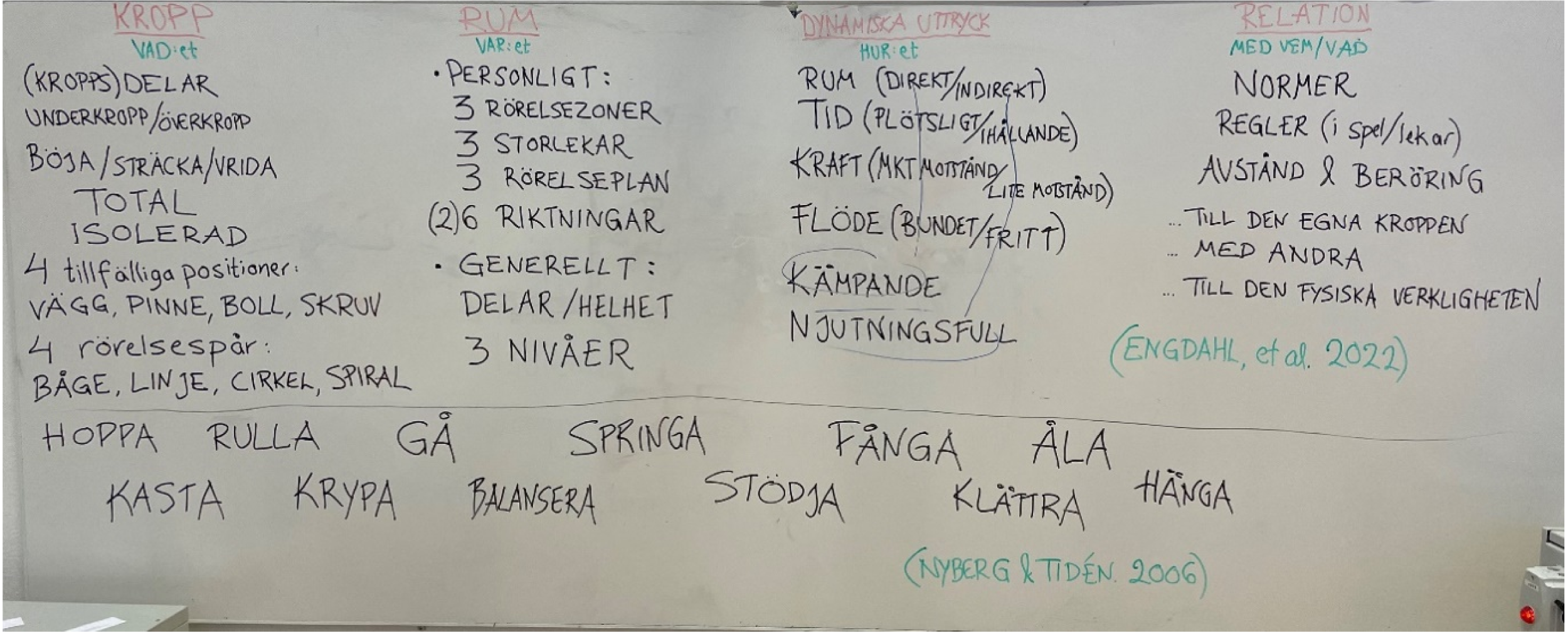
The version of the LMA framework (top) and basic motor skills (bottom) used in the CPD course as displayed on the whiteboard during the lesson.
At the top of the whiteboard, in red, are the aspects that Laban believed always pervade movement: Body (KROPP), Space (RUM), Effort (DYNAMISKA UTTRYCK), and Relation (RELATION). The category Body concerns, for example, what body parts are moving, if the body bends, twists, or stretches, or if the body movements are temporary or leave clear traces. This category concerns the ‘What?’ of movements. Space concerns ‘Where?’ the body moves, whether near or far out, high or low or if the movements are small or large. Effort concerns the ‘How?’ of movement: if the movements are performed with more or less resistance, or if they are direct or indirect, sudden or sustained, or bound or free. Finally, Relation concerns ‘With whom or what?” the body is moving, be they material (e.g. people or things) or non-material (e.g. norms) objects. Moreover, these relations can be near (and even include touching) or at a distance. At the bottom of Figure 1, under the solid line, are examples of basic motor skills (Nyberg and Tidén, 2006). These are categories of movements where Body, Space, Effort, and Relations can be explored, which was a task that the participants in the CPD course were given.
In the CPD course, participants were invited by the teacher to play ‘The Positive Game’, which was done in the following way. The students were given the task of moving around the hall (first by walking) and continuously searching for free spaces on the gym hall floor. Teacher: ‘At any time, any of us can say a motor skill. And when someone does that, we all loudly respond, “yes, we do!” And then we move like that until someone else shouts out another motor skill’. The group starts walking around the gym hall floor. One of the participants shouts: ‘We run!’ The others respond: ‘Yes, we do!’ ‘We jump … Yes, we do! … We climb … Yes, we do!’, and so on. When someone shouts: ‘We catch’, the participants pretend to catch imaginary objects.
Agency, in the sense that it allowed the participants the freedom to choose among a range of motor skills that could be linked to Body, Space, Effort, and Relation to foreground expression.
Content, in the sense that it offered the participants a clear structure based on which new, and perhaps unusual, or unexpected, ways to move were introduced. It enticed the participants to ‘get outside’ or ‘go beyond’ habitual movement patterns.
Verticality, in the sense that ‘going beyond’ habitual movement patterns is highly valued in creative dance, that is, it is better to move in unusual and unexpected (even ‘weird’) ways than conventional ways.
While uncertainty was evident in the dance practice, this may not be traceable to the LMA framework, which instead contributed to crystallise a structure. Rather, it was playing 'The Positive Game' that contributed to uncertainty, as the participants were not able to know (exactly) what the next movement would be.
During the CPD course, there was less focus on goal, effort, and repetition. While the focus in the PETE course was more explicitly on learning creative dance, the CPD course focused to a greater extent on pedagogy, which may explain why there was relatively little focus on putting effort into the repetition of movements. This may be because many of the participants in the CPD course were already established teachers and teacher educators, which may have reinforced the assumption that the course was primarily about pedagogical issues related to teaching creative dance. Nevertheless, it is possible to see the usefulness of the LMA framework in the CPD course in light of the activities in the PETE course.
Discussion and conclusions
The purpose of the paper was to explore what knowledge in movement the PETE students were practising in creative dance and what pedagogical practice enabled this practising. To begin with, practising (the integral phenomenon of agency, content, goal setting, verticality, effort, uncertainty, and repetition; Aggerholm et al., 2018) creative dance in a PETE context is largely about students trying to ‘make sense of’ moving in non-predetermined – creative – ways and appreciating the expressive dimension of movement. This is the knowledge in movement that the students are practising. The ‘making sense of’ is related to, on the one hand, the students’ inclination to foreground functional dimensions of movement rather than expressive ones, and on the other hand, the idea that creative dance lacks verticality entirely (Mattsson and Larsson, 2021).
The analysis suggests that the capacity to move beyond habitual movement patterns and to appreciate expressive dimensions of moving (along with functional ones; Stanley, 1977) is considered to be valuable knowledge in creative dance. The capacity to move beyond habitual movement patterns is expressed as a divergent educational process, where the capacity to orient oneself, explore (and possibly solve) movement problems in a movement landscape, or a kinescape, to use Larsson, Nyberg and Barker's (2022) concept, is in focus, rather than the ability to ‘hit a (narrow) target’, that is, to reproduce a certain movement in a certain way, which would signify a convergent process. Moving beyond habitual movement patterns is not only about knowledge in movement in a technical sense but about becoming and ‘being someone else’ (Gard, 2003), that is, not stagnating within narrow positions and identities, which easily becomes the case in a more convergent educational process. Furthermore, appreciating expressive dimensions of moving can also be linked to a divergent educational process where students are encouraged to explore, for example, how movement norms relate to gender, sexuality, class, ethnicity, and so on. Arguably, this aspect is backgrounded when the pedagogical process is aimed at reproducing a certain movement.
What pedagogical practice enabled the students to develop knowledge in movement in creative dance? We contend that the two teachers’ vast experience of dance and dance education enabled them to help the PETE students discover and practise the relevant knowledge in movement in creative dance to arrive at the magic moment. More or less intuitively, they knew that norms about right or wrong ways to move sometimes ‘stand in the way’ of PETE students’ possibility of being wholeheartedly involved in creative dance. Moreover, they also embodied knowledge of dance-artistic conventions, which is combined with knowledge of how certain music, and a repertoire of abilities to perform movements (Carr, 1984) can ‘open up’ possibilities for the unexpected to happen. Arguably, with teachers who are less knowledgeable of creative dance, instrumental values, such as developing self-esteem and knowledge of other subject areas (Bergmann, 1995), could have been emphasised rather than developing knowledge in movement, which could be seen as the intrinsic aim of movement education (Kirk, 2006).
As one pedagogical strategy, the teachers used the LMA framework to balance a potentially crippling unpredictability with some degree of structure. The framework was here used to introduce beginners (i.e. the students) to the practice of creative dance (Engdahl et al., 2022; Frisk and Svanström, 2023; Schwarz, 1995). Moreover, combined with a pedagogical approach that resembles what Matthias (2007) calls show, don’t tell!, it enabled the teachers in our study to open up opportunities for the students to develop knowledge in movement of a format they had not previously delved into. The show, don’t tell! approach involves ‘improvising scenes from a given minimal set of information’ (Matthias, 2007: 55). More specifically, the teacher showed some dance-artistic conventions and a movement repertoire that the students could ‘scoop from’ or be inspired by in their exploration and practising.
We believe that the study not only demonstrates what knowledge in movement can be in creative dance, but also the importance of the teacher's knowledge in movement to help others develop such knowledge. Possibly, the study can thereby contribute to the long ongoing discussion about pedagogical content knowledge in PE (Backman and Barker, 2020; Siedentop, 2002; Tinning, 2002). Through the present study, we believe that such knowledge is crucial for PE teachers, although the meaning of knowledge in movement possibly needs to be broadened.
Footnotes
Declaration of conflicting interests
The authors declared no potential conflicts of interest with respect to the research, authorship, and/or publication of this article.
Funding
The authors disclosed receipt of the following financial support for the research, authorship, and/or publication of this article: This work was supported by the Swedish Research Council (grant number 2021-03830).
